




Abstract
Family firms purportedly use different socioemotional wealth (SEW) reference points in choosing strategies, yet empirical research continues to use family involvement as a proxy for SEW. This study uses a configurational approach to examine how the multidimensionality of SEW may be used to explain the firm’s chosen strategy. We use psychometric measures of the various SEW dimensions proposed by Berrone et al. to explain the formalization of corporate social responsibility (CSR) strategy as an example. We identify various SEW configurations to understand why family firms exhibit a preference for more formal or informal CSR strategies.
Keywords
Introduction
Family business scholars have often used the socioemotional wealth (SEW) construct, defined as the nonfinancial value embedded in the family firm, to distinguish family from nonfamily firms (e.g., Gomez-Mejia et al., 2007, 2011, 2018, 2019, 2022). Compared with nonfamily firms that focus on maximizing the firm’s financial value, family businesses consider not only financial value but also SEW when making strategic decisions (Martin & Gomez-Mejia, 2016). Derived from the behavioral agency logic (Gomez-Mejia et al., 2022; Wiseman & Gomez-Mejia, 1998), the SEW model argues that family owners are loss averse to SEW and that this feature drives family firms’ strategic decisions. For instance, the preservation of SEW has been used to explain why family firms diversify less (Gomez-Mejia et al., 2010), are more inclined toward mergers (Chirico et al., 2020), acquire more similar firms (Gomez-Mejia et al., 2018), adopt fewer new innovations (Souder et al., 2017), invest less in R&D (Gomez-Mejia, Campbell, et al., 2014), pollute less (Berrone et al., 2010), experience more disruptive managerial succession (Minichilli et al., 2014), avoid underpricing for initial public offerings (Kotlar et al., 2018), are less likely to engage in earnings management (Martin et al., 2016), establish more transparent accounting procedures (Gomez-Mejia, Cruz, & Imperatore, 2014), and realize greater returns from risk-taking under financial distress (Gomez-Mejia et al., 2022). SEW has been argued to be an umbrella concept encompassing multiple dimensions of nonfinancial value, including family control, family identity, binding social ties, family emotional attachment, and preservation of the family’s dynasty (Berrone et al., 2012). The SEW construct can thus represent different combinations of dimensions (i.e., diverse reference points) to determine a firm’s strategic decisions (Brigham & Payne, 2019; Williams et al., 2018). By using corporate social responsibility (CSR) endeavors as an example, we argue that a configurational approach using various SEW dimensions enriches our understanding of the heterogeneity of family businesses in regard to the firm’s strategic choice. As Jaskiewicz and Dyer (2017) pleaded in a Family Business Review editorial, there is a need to demonstrate how “different dimensions [of SEW] and approaches capture family heterogeneity . . . [allowing us] to build and test richer theory to extend and refine our knowledge of family firms” (p. 111).
Whether specific SEW elements become sufficient conditions or interact with each other to determine a firm’s strategy continues to puzzle family business scholars and raises questions regarding the predictive value of the SEW construct (Swab et al., 2020). The multiple dimensions that have been proposed to represent SEW (Berrone et al., 2012) do not necessarily share linear relationships but might interrelate in complex ways to determine the firm’s strategy (Kosmidou & Ahuja, 2019). Traditional hypothesizing poses the challenge of a priori explication of such theoretical complexity as it considers only a limited number of interactions (up to three-way interactions) between variables (Douglas et al., 2020; Misangyi et al., 2017). Instead, the configurational approach employed in this study overcomes such limitations and allows us to “dig deeper into the data to reveal finer-grained detail about the complexity of [the] phenomenon” (Douglas et al., 2020, p. 2). The configurational methodology considers the conjunction (i.e., interdependence of multiple causes), equifinality (i.e., more than one path to one specific outcome), and asymmetry (i.e., the same antecedent factors in different configurations may be unrelated or even inversely lead to the opposite outcome) (Misangyi et al., 2017). For this reason, we propose that a configurational approach could allow researchers to better leverage the multidimensionality of SEW to explain the heterogeneous or even extreme strategies of family firms (Miller & Le Breton-Miller, 2021).
To examine the applicability of heterogeneous SEW configurations to explain family businesses’ strategy, we use CSR as an example of a dependent variable. Theoretically, CSR strategy requires an integrative approach that considers multiple factors simultaneously as they may complement or substitute each other in explaining the firm’s approach to its strategy (Aguilera et al., 2021). Thus, CSR provides a suitable setting to apply the configurational approach to understand how multiple SEW dimensions interact to determine family firms’ approaches to CSR strategy. A firm may choose a formal approach in which it professionally and systematically tracks and communicates tangible CSR activities to external stakeholders over an extended period of time (Aragón-Amonarriz et al., 2019), such as having a code of conduct, releasing regular CSR reports, and signing written agreements with stakeholders (Vazquez, 2018), or an informal approach that relies on the family’s personal knowledge, connections, and commitment to relate to and communicate with external stakeholders (Fassin et al., 2011). Informal CSR typically involves private dialog with specific stakeholders without a permanent structured system (Vazquez, 2018).
Empirically, existing studies report conflicting results on the influence of SEW on formalized CSR strategies, including a positive (Campopiano & De Massis, 2015; Marques et al., 2014), negative (e.g., Arena & Michelon, 2018; Cabeza-García et al., 2017; Muttakin et al., 2018), and mixed relationship (e.g., Aragón-Amonarriz et al., 2019; Cruz, 2020; Dick et al., 2021; Terlaak et al., 2018). Scholars tend to use family involvement in the firm, such as governance, ownership, and management, as a proxy for SEW (see Cennamo et al., 2012; Zientara, 2017) but neglect the configurational relationship among various dimensions that purportedly compose SEW, such as family ties, emotional attachment, and family identification (Swab et al., 2020). Considering the interdimensional configurations of SEW can help us better understand why firms with the same extent of family involvement choose different CSR strategies (Miller & Le Breton-Miller, 2021). Our analysis also has important practical implications, as regulators, investors, community organizations, and other stakeholders may monitor and assess why family firms adopt particular strategies and respond to their needs (Arena & Michelon, 2018; Aureli et al., 2020). For instance, in our example of CSR strategy, we can better identify how family firms with heterogeneous SEW configurations respond to stakeholders’ demands and expectations differently.
Specifically, in this study, we address the following research question: What configurations among the different SEW dimensions determine the (non)formalization of family businesses’ CSR strategy? Adopting a configurational approach and the model developed by Berrone et al. (2012), we consider SEW in terms of not only control (family involvement in governance, ownership, and management) but also family ties (network distance), family identification, emotional attachment, and dynastic renewal. Furthermore, we integrate the temporal focus perspective (Nason et al., 2019; Shipp et al., 2009), as the family’s temporal focus can affect how it frames SEW and uses it to evaluate a situation such as the CSR strategy (cf. Lumpkin & Brigham, 2011), but this temporal consideration remains overlooked in existing SEW studies (Zahra, 2018). As such, we discuss how the family’s temporal focus—forward-looking (focusing on the future) vs. backward-looking (focusing on the past and present) attention—alters the influence of SEW on the firm’s CSR strategy. We analyzed primary data from 186 Italian family firms with the fuzzy set qualitative comparative analysis (fsQCA) method, a common technique for configurational analyses (e.g., Campbell et al., 2016; Douglas et al., 2020; Kosmidou & Ahuja, 2019; Pittino et al., 2018). We find that the family’s temporal focus is key to explaining the CSR formalization decision. The family’s forward-looking SEW formalizes the strategy to renew the dynasty with which it strongly identifies. Instead, if focusing more on backward-looking SEW without considering dynastic renewal, the family is likely to adopt the informal CSR approach of personal communication with stakeholders to preserve family legacies—the unique and continuous meanings associated with the family, such as the family’s material rights in legal ownership and property, biological ties, and social values (Hammond et al., 2016).
This study makes several contributions. First, we improve the theoretical clarity of the SEW construct by elucidating the interrelations among its multiple dimensions (Brigham & Payne, 2019). Through the configurational analysis and the incorporation of the temporal focus perspective (Nason et al., 2019), we specify how diverse nonfinancial reference points (for instance, forward-looking on future dynasty vs. backward-looking on past legacy) determine the way the family frames the firm’s strategy. Second, the configurational analysis of multiple SEW dimensions allows us to explore “the theoretical causes of family firm heterogeneity” (Jaskiewicz et al., 2020, p. 15), which has been at the center of much recent debate in the field (Jaskiewicz & Dyer, 2017; Miller & Le Breton-Miller, 2021; Williams et al., 2018). Using CSR as an example, our configurational approach enables us to elucidate family business heterogeneity by showing how the same SEW dimensions interact (i.e., through conjunction) and signal different paths leading to the same outcome (i.e., through equifinality) or the opposite extreme outcome (i.e., through asymmetry) (Miller & Le Breton-Miller, 2021). From a methodological standpoint, our approach extends beyond a simplistic examination of the effect of family involvement and shows the potential to fundamentally advance the study of family firm heterogeneity, as it could be applied to revisit prior studies with contrasting evidence of various family firm behaviors. Using CSR as an example, we illustrate how the configurational approach can explain the mixed evidence of the relationship between family businesses’ SEW and their CSR strategy (e.g., Cabeza-García et al., 2017; Campopiano & De Massis, 2015; Terlaak et al., 2018). Our consideration of multiple SEW dimensions extends beyond the traditional focus on family involvement to theorize the push for (non)formalizing a family firm’s CSR strategy. For instance, despite the legitimizing benefits of a formalized CSR strategy (Dekker & Hasso, 2016; Déniz & Suárez, 2005), most family firms still adopt an informal approach to CSR. We suggest that the family is motivated to protect its historical legacy, which may not be easily preserved through formal documentation. Our configurational approach helps explain what motivates a family firm to adopt a particular CSR strategy.
Theoretical Background
SEW and the Heterogeneity of Family Firms
SEW is a relatively new construct in the family business literature and was first proposed by Gómez-Mejía et al. (2007) to explain the strategic decision of Spanish olive oil mills to join a cooperative. The authors argued that family businesses are willing to risk their financial performance (unlike nonfamily firms) to retain control of the firm. Since then, SEW has become a popular theoretical construct to explain different strategies of family businesses and their emphasis on nonfinancial value compared with their nonfamily counterparts, such as diversification (Gomez-Mejia et al., 2010), mergers and acquisitions (Chirico et al., 2020; Gomez-Mejia et al., 2018), human resource practices (Christensen-Salem et al., 2021), innovation (Gomez-Mejia, Campbell, et al., 2014; Souder et al., 2017), risk-taking (Gomez-Mejia et al., 2019, 2022), financial decisions (Gomez-Mejia, Cruz, & Imperatore, 2014; Kotlar et al., 2018; Martin et al., 2016), and environmental strategies (Berrone et al., 2010). Although some of these strategic choices may appear irrational for improving financial performance, they are rational decisions for family businesses focusing on nonfinancial value (Chrisman et al., 2012), such as ensuring family and transgenerational control and dynastic succession (Gu et al., 2019; Miroshnychenko et al., 2021).
To capture the nonfinancial reference points differentiating family and nonfamily firms’ strategies, scholars have often relied on Berrone et al.’s (2012) SEW multidimensional model. This deductive model conceptualizes five noneconomic values that family owners may consider important to their welfare: (a) family control and influence in ownership, governance, and management; (b) identification of family members with the firm and the desired family image; (c) binding social ties through kinship; (d) emotional attachment of family members through sharing a long history and past events; and (e) renewal of family bonds through dynastic succession. Following this model, several studies attempt to highlight certain noneconomic values, such as family continuity (Debicki et al., 2016), transgenerational vision (Hauck et al., 2016), and family name (Cleary et al., 2019). A family firm decision-maker weighs each noneconomic value differently in the decision-making process, thus leading to different firm choices (Kellermanns et al., 2012).
Recently, scholars have started using the multidimensional SEW construct to explore the heterogeneity of family businesses. Rather than viewing family firms as a monolithic group against their nonfamily counterparts, there is increasing acknowledgment of “the growing heterogeneity of family patterns within and across societies” (Jaskiewicz & Dyer, 2017, p. 111). Even with the same characteristics (such as family involvement), family firms may experience diverse strategic outcomes (Miller & Le Breton-Miller, 2021). To capture such heterogeneity, family business scholars have emphasized the value of SEW and its multidimensionality, which allows “a combination of different configurations of the dimensions” (Brigham & Payne, 2019, p. 328) to depict why and how family firms make a variety of choices (Stanley et al., 2017, 2019; Williams et al., 2018). With this insight, we can better explain how family owners and managers run their firm differently from other family businesses (Jaskiewicz et al., 2020).
A few recent studies have attempted to capture the heterogeneity of family firms by configuring different profiles through some of the SEW dimensions. For instance, Stanley et al. (2017) used family ownership, family generation, and succession intention to categorize German family firms with a wide range of foci, from preserving their tradition to expanding the family’s dynasty. Similarly, Stanley et al. (2019) used family influence on the ownership, board, management, and generation to draw the profiles of Spanish and Portuguese family firms at different life stages, such as the early or the dynasty stage.
However, profile analyses adopting the theoretical SEW construct tend to neglect two important aspects to explain heterogeneity among family businesses. First, these analyses (e.g., Stanley et al., 2017, 2019) do not consider all the possible SEW dimensions identified by Berrone et al. (2012). The underrepresentation of noneconomic value may not capture sufficient variations in SEW among family firms (cf. Suddaby, 2010). Second, this underrepresentation in the construct makes it difficult to determine the nomological validity of SEW and the links between unexplored dimensions and strategic outcomes (Podsakoff et al., 2016). In turn, questions arise regarding the theoretical applicability of SEW to explain other constructs (Swab et al., 2020).
In the next section, we use the example of a formalized CSR strategy as the strategic outcome to discuss how these issues may limit our ability to fully capture the heterogeneity of family firms, leading to the mixed findings reported in existing studies.
SEW Relative to Family Involvement and the Formalization of the Family Business’s CSR Strategy
A CSR strategy denotes how a firm manages social issues, such as consumerism, environmental protection, or discrimination against minority groups (Clarkson, 1995). This strategy tends to involve cross-level implementation, including compliance with institutional regulations, establishing the organizational structure, and engaging individuals, such as employees and targeted stakeholders, in a social campaign (Aguilera et al., 2007). To successfully implement this multilevel process, firms tend to gradually formalize their CSR strategy to professionally and systematically record, evaluate, and inform stakeholders about their CSR activities (Aragón-Amonarriz et al., 2019; Vazquez, 2018).
Family businesses can benefit from the formalization of their CSR strategy in two ways. First, it facilitates the development of an internal system to support the implementation of the CSR strategy. For instance, information-based formalization and documentation can help firms better monitor the implementation process, including planning, resource allocation, and evaluation (Simons, 1991). Managers can further adapt the CSR strategy to better fit stakeholder demands when they can easily access information through the formal system (Hunoldt et al., 2018). Family firms can particularly benefit from formalization if their CSR activities exhibit great variety (types of stakeholder groups) and depth (time and resources required; Marques et al., 2014).
Second, compared with an informal approach, the formalization of the CSR strategy can help family businesses effectively “market” their CSR activities to external stakeholders (Wickert, 2016). An informal CSR strategy tends to rely on the owner-managers’ personal relationships rather than a visible structure or channel to communicate with external stakeholders (Spence, 2016; Vazquez, 2018). In the informal approach, a family firm’s CSR policy is highly dependent on the owner-managers’ personal knowledge, connections, and commitment, which may be vague or ambiguous to external and impersonal stakeholders (Fassin et al., 2011). Instead, family businesses with a formalized strategy can reduce information asymmetry with external stakeholders. A formal CSR commitment with interpretive information, such as having a separate and independent foundation dedicated to CSR activities (Feliu & Botero, 2016) or reporting changes in greenhouse gas emissions (Terlaak et al., 2018), can help external stakeholders better monitor and evaluate a firm’s activities (Salvato & Moores, 2010).
Despite these benefits, existing studies report mixed evidence when applying the SEW construct to explain family firms’ (non)formalization of CSR decisions. Some empirical studies support the aforementioned benefits of the formalization decision. For instance, Marques et al. (2014) analyzed 12 Spanish family firms and found that the family’s close involvement in the firm facilitates the development of an internal system, such as programmatic evaluation approaches for CSR activities and developing tools to support their implementation. Regarding the external benefits, Campopiano and De Massis (2015) analyzed the CSR information disclosure of 98 Italian firms and found that family-owned and family-managed firms are more likely to disclose more information to enhance their visibility and reputation as perceived by external stakeholders, such as investors lowering the cost of capital for disclosing family ties in the ownership group (Gjergji et al., 2021).
In contrast, some studies present the opposite empirical evidence. For instance, Cabeza-García et al. (2017) analyzed 150 Spanish public firms and found that family involvement, such as ownership and board chairs, leads to less transparency in CSR activities and compliance with the institutional standard for CSR disclosure. Similarly, Arena and Michelon (2018) studied Italian publicly traded firms and found that family control and influence reduce firms’ disclosure of environmental activities. Relatedly, Muttakin et al. (2018) examined public firms in Bangladesh and found a negative influence of family CEOs on firms’ formal communication of CSR activities due to these CEOs’ greater concern with personal and family interests than accountability to external stakeholders. The focus on the family’s SEW tends to limit the firm’s CSR activities to close stakeholders, reducing formal communication with other external and distant stakeholders (Zientara, 2017).
Mixed findings also emerge regarding the relationship between SEW and CSR strategy formalization. In a recent study, Dick et al. (2021) surveyed Polish family businesses and found that they restrict the formalization of CSR activities when led by first-generation leaders who fear losing control in the formalization process. For instance, information disclosure is limited to only peripheral CSR activities, such as fundraising for the community, hospitals, and retirement homes (Cruz, 2020). Family leaders who hold ownership and CEO positions determine the extent of disclosure after considering the SEW trade-off between reputational gains and losing family control (Terlaak et al., 2018). Instead, these studies suggest that family businesses combine formal and informal approaches to communicate their CSR activities (Aragón-Amonarriz et al., 2019; Vazquez, 2018).
The mixed evidence on CSR formalization as a function of SEW may be attributed to reliance on easily available SEW proxies. Specifically, these studies tend to operationalize SEW in terms of family ownership (e.g., Aragón-Amonarriz et al., 2019; Arena & Michelon, 2018; Campopiano & De Massis, 2015), governance (e.g., Cabeza-García et al., 2017), management (e.g., Cruz, 2020; Muttakin et al., 2018; Terlaak et al., 2018), or generation (e.g., Dick et al., 2021), based on data generally available from archival sources. Instead, primary data on other dimensions, such as identification, social ties, and emotional attachment, are not easily accessible, and thus, these aspects of SEW are either ignored or downplayed (Berrone et al., 2012; Gómez-Mejía & Herrero, 2022; Hauck et al., 2016).
SEW Beyond Family Involvement and Incorporation of Temporal Focus Perspective
Family involvement tends to capture the family’s ability to “exert control over strategic decisions” (Berrone et al., 2012, p. 262), that is, whether the family has the discretion to formalize the firm’s CSR strategy. However, it does not capture whether the family is motivated and perceives formalization as a strategic opportunity for the firm, which is also key to explicitly formalizing the CSR strategy (Sharp & Zaidman, 2010). For instance, Hammond et al. (2016, p. 1210) argued that the family legacy—the unique and continuous stream of meanings associated with the family—tends to be the motivation that influences how the family views and uses SEW to guide a family firm’s behaviors and decision-making. If the family is not motivated to transfer its biological legacy (through the family bloodline and genes), social legacy (through the family attitude and beliefs), and material legacy (such as legal ownership and management rights; Hammond et al., 2016, p. 1215), it is less likely to use SEW as a reference point to evaluate a strategic opportunity and exert efforts to pursue such an opportunity. Hence, without motivation and opportunity perception, family owners may simply choose an informal strategy (Kotey & Folker, 2007) with limited CSR disclosure (Cabeza-García et al., 2017).
Guided by Berrone et al.’s (2012) model, we argue that other SEW dimensions, namely, family identification, family ties, emotional attachment, and dynastic renewal, may complement the ability-based argument of family involvement to denote the scope of a family’s motivation and opportunities. To do so, we further rely on the temporal focus perspective in the strategy literature. The temporal dimension has been largely overlooked when examining the heterogeneity of family firms and SEW (Zahra, 2018), despite its importance in the strategy literature for analyzing decision-makers’ strategic reference points. Fiegenbaum et al. (1996) argued that strategic reference points, which signal organizational priorities, need to consider temporal dimensions as well. The organizational past can provide a reference point to motivate continued achievement but can also constrain the strategic opportunity perceived as viable by the organization, whereas the future can be a reference point that motivates firms to commit resources and capabilities for an opportunity in the “deep future – 10 or 20 years” (Fiegenbaum et al., 1996, p. 227). For instance, Shipp et al. (2009) surveyed several samples in the United States and found that individuals with a future-focused reference evaluate a potential task more positively and demonstrate more commitment to it than those with a past-focused reference. In the context of family firms, the temporal focus is particularly important, as the family may make decisions to preserve its long-lasting value or to focus on the future utility of current actions (Lumpkin & Brigham, 2011). For example, if the family is indifferent to the future transfer of its legacies, such as ties, material rights, or value, its SEW is likely to revert to stagnant references by focusing on maintaining, rather than expanding, existing social interactions (cf. Hammond et al., 2016). Hence, the framework of forward-looking (focusing on the future) versus backward-looking reference points (focusing on the past) is useful to help us examine whether the family is motivated to engage in a strategic opportunity (Nason et al., 2019).
Family identification indicates the extent to which family members associate their persona with that of the firm (Deephouse & Jaskiewicz, 2013). If they perceive that their value is closely linked to that of the firm, they may be motivated to project a positive identity and continuously feel positive about themselves (Dieleman & Koning, 2020; Elsbach & Pieper, 2019). Family owners may explicitly communicate the firm’s CSR activity as an opportunity to convey not only a positive self-image but also an image that impresses a broader range of external stakeholders (Morsing & Spence, 2019). However, according to social identity theory, members with strong identification tend to see themselves and those who share the same history more positively than others (Tajfel, 1982). Family members may be biased toward favoring only “in-group members” or stakeholders who are close to the family due to a common history (Bettinelli et al., 2022; Uhlaner et al., 2015). That is, their attention to their past identity may motivate them to seek CSR opportunities that benefit mainly family stakeholders, such as spouses and friends who share the same history (Spence, 2016), thus limiting their commitment to scaling up CSR activities (Dyer & Whetten, 2006). Therefore, depending on the family’s temporal focus, family identification may variously motivate and affect how the family perceives and influences the firm’s CSR strategy.
Family ties represent the genealogical relationships from the past, including kinship and marriage (Stewart, 2003), and can be captured by the genealogical distance between two particular members (White, 1963), such as the third-degree kinship of a niece–aunt relationship. The closeness of family ties tends to be path-dependent on members’ historical precedence and to shape their motivation to pursue a strategic opportunity (Arregle et al., 2007). Intuitively, members with close ties are motivated to focus first on stakeholders who are closely connected to the family for a long period, such as friends or local clubs, through informal communications (Uhlaner et al., 2004). The family is thus expected to limit strategic opportunities to informal relationships with close stakeholders known from the past, such as specific politicians (Ge et al., 2019). However, a family with a future focus may wish to sustain the business by extending its close relationships to other stakeholders (Sirmon & Hitt, 2003). A formalized CSR strategy, demonstrating consistent altruistic behaviors to nonfamily stakeholders, represents an opportunity to build more close ties and thus extend the network (Cennamo et al., 2012). Through frequent information exchanges with nonfamily stakeholders, the family can use this opportunity to develop reciprocal relationships and strengthen the firm’s competitive advantages (Pearson & Marler, 2010). Hence, the family’s temporal focus also influences how it is motivated to leverage ties in the firm’s CSR strategy.
Emotional attachment denotes the affective ties to family or “significant other” individuals (Pieper, 2010). Family members’ feelings toward each other, such as warmth and love, could shape how they manage the firm (De Massis & Foss, 2018; Picone et al., 2021), for instance, using formal strategic planning to reduce family members’ anxiety (Dunn, 1999). If the family has strong and positive emotional bonds and expects these to continue in the future, family members are likely to show genuine concerns for nonfamily stakeholders (Cennamo et al., 2012). The reason is that positive emotional bonds can induce individuals’ enthusiastic, active, and pleasurable engagement in firm activities and lead to the development of mutual trust and care for others (Bormann et al., 2021). For example, Miller et al. (2009) examined family businesses in South Korea and argued that tighter emotional bonds with employees and external stakeholders (such as external advisors and investors) encourage a family business to invest in, cooperate with, and communicate with broader communities. Such cooperation and communication are requisites for formalizing a strategy (such as CSR) involving the coordination of diverse stakeholders (Feliu & Botero, 2016). Instead, emotional conflicts from the past may undermine family members’ motivation to plan for the future formalization of the firm’s CSR strategy, as they may focus on the strategic opportunity to resolve historical or present conflicts first (Sharma & Sharma, 2011), including establishing the family’s constitution or hiring a trusted advisor (Harrington & Strike, 2018). Even if family members share tight emotional bonds, they may be motivated to focus on informal, personalized communication (Spence, 2016). Strong, positive affective linkages suggest that members already share an easy, verbal, and interpersonal communication pattern since the early stage and do not perceive the need for formal forms of communication (Marques et al., 2014). Thus, the family’s temporal focus could motivate family members to reconsider their emotional bonds in the process of formalizing the firm’s CSR strategy.
Dynastic renewal refers to the family’s transfer of the business to future generations (Berrone et al., 2012). Intuitively, it represents the family’s forward-looking references in determining the firm’s strategy, including how it involves and communicates with nonfamily stakeholders in the long run (Nason et al., 2019). A family focusing on continuing its dynasty is motivated to develop a clear corporate vision and system to help successors take over the businesses and depend less on predecessors’ personal influence (Morsing & Spence, 2019). For instance, the family might use the opportunity of formalized certification and periodic evaluations to ensure consistency in implementing the firm’s CSR across generations (Delmas & Gergaud, 2014). Formalizing the CSR strategy enables the family firm to integrate past leaders’ values and to ensure consistent and professional stakeholder management across generations (Aragón-Amonarriz et al., 2019). However, the focus on continuing the past dynasty may motivate the family to adopt the opposite approach. Attention to maintaining past success can cause inertia. For instance, the longitudinal study of Raitis et al. (2021) on a Finnish family firm and the survey of Hauck and Prügl (2015) on Austrian family firms have shown that the family’s backward-looking reference on past success limits the firm’s strategic investment in innovation and entrepreneurship. Similarly, inertia can undermine the family’s acumen to strategic opportunities and mobilization of resources to scale up its CSR strategy (Spence et al., 2011). As such, the family may fall into habitual CSR communication with personal and internal stakeholders, such as employees and shareholders, rather than open communication with a broader public audience (Morsing & Spence, 2019). Accordingly, we argue that dynastic renewal is another key factor that also has different temporal foci in determining the family’s motivation and perception of a formalized CSR strategy.
In sum, we complement the enabling control-based SEW perspective (focusing on family involvement) to discuss how the other SEW dimensions—identification, ties, emotional attachment, and dynastic renewal (Berrone et al., 2012)—shape the family’s motivation for and opportunity perception of a strategy. Specifically, we explore the configurations among these SEW dimensions and their effects on the (non)formalization of the family business’s CSR strategy that we use as an example, as graphically summarized in Figure 1.
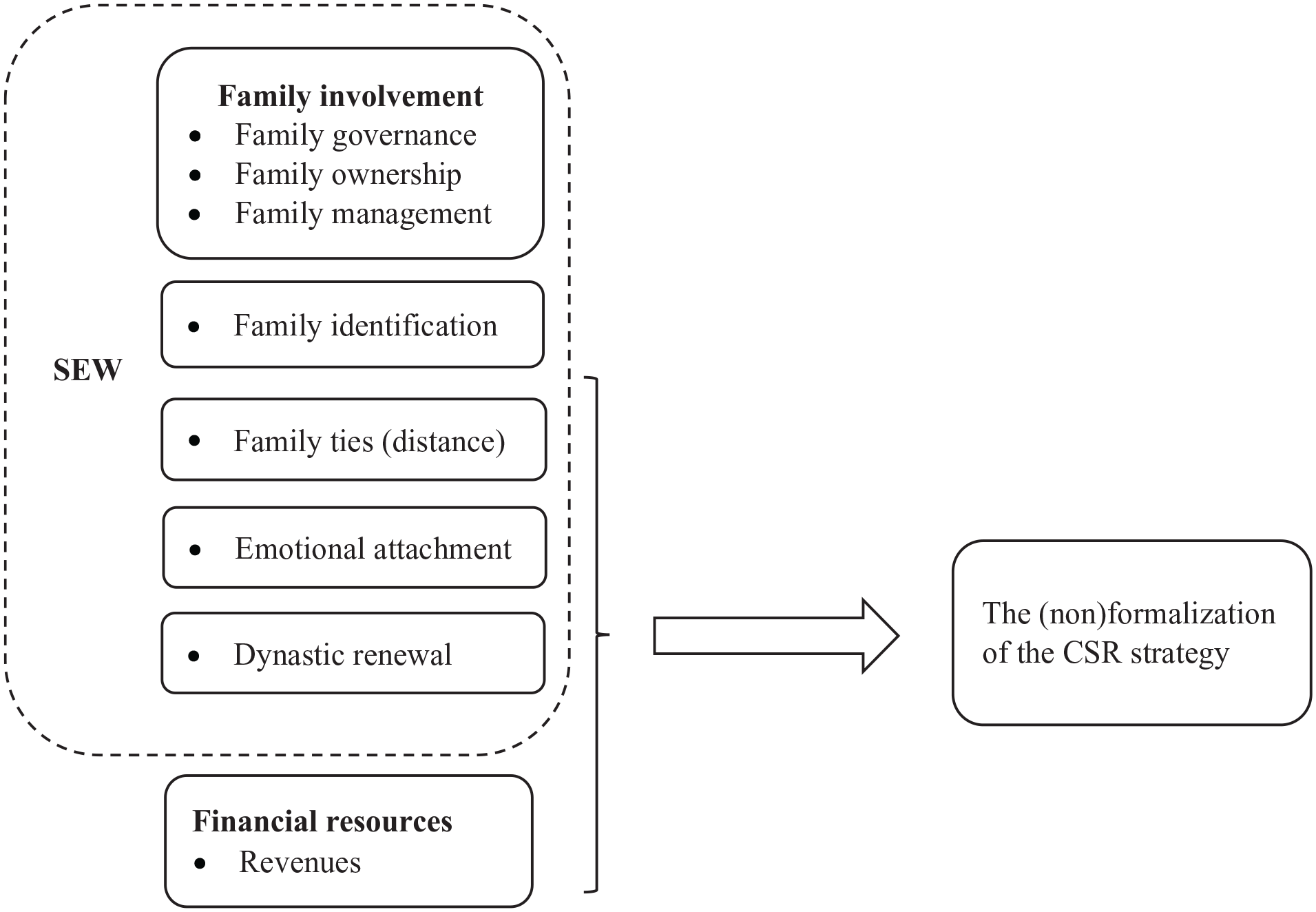
A Configurational Framework of SEW Leading to the (Non)formalization of Family Businesses’ CSR Strategy.
We adopt the configurational analysis method to answer the following research question: What configurations among the different SEW dimensions determine the (non)formalization of family business strategy (using CSR as an illustrative example)? Configurational analysis allows us to not only explore the interdependence of the antecedents (i.e., SEW dimensions) but also identify various combinations that are equally effective in explaining the outcome (Douglas et al., 2020; see details in the next section).
Methods
Sampling and Data Collection
Our sample was drawn from the database of Bocconi University, which includes all Italian family firms with more than €20 million in revenue since 2000. The database contains data on family involvement, dynastic renewal, and financial resources. We collected data on the other SEW dimensions—identification, ties, and emotional attachment—through survey questionnaires sent between February and June 2015 to the firms’ leader (CEO or president), board director, or other managers on the top management team (TMT). These members are more likely to have direct contact with the controlling family and are thus in a better position to evaluate the family situation (Han et al., 2017). The formalized CSR strategy data were collected manually from the Global Reporting Initiative (GRI) and Social Accountability International (SA8000) databases, the two most commonly used CSR reporting protocols (Harrison & Smith, 2015), and from corporate documents at the end of 2015. Combining different data sources can better capture the validity of the multifaceted SEW construct and avoid common method bias with our outcome variable (Podsakoff et al., 2012).
The initial sample included 2,974 Italian companies. We first collected their email addresses from the Bureau van Dijk database. These email addresses (as gatekeepers) are mostly for general inquiry and do not specify the recipient in the company. To target key informants “who have extensive and exclusive information and the ability to influence important firm outcomes” (Solarino & Aguinis, 2021, p. 2), we used these emails to inquire whether these gatekeepers could refer us to the aforementioned key informant in their firms. We received 493 referrals with the specific names and email addresses of key informants, given that gatekeepers tend to strictly control the private contacts of key informants (Solarino & Aguinis, 2021).
After obtaining the 493 direct contacts of key informants, we sent individualized invitations with the questionnaire to collect their evaluation of SEW in their firms. Within 1 month after the initial invitation, we sent two follow-up emails and received 230 responses. However, after excluding incomplete responses or responses with missing values, the final sample comprised 186 complete responses (a response rate of 37.73% of the 493 direct contacts, a high rate for organizational studies using online surveys; Baruch & Holtom, 2008). Over half the respondents (68.28%) were male, and the average age was 44.97 years. Most respondents hold an undergraduate or higher degree (68.11%). The average tenure of respondents is 16.91 years, and most hold top managerial or director positions (87.10%). Our sample is composed of small and medium-sized private family firms with an average of 186.98 employees and an average history of 38.12 years since the foundation and is based mainly in the manufacturing (54.84%) and wholesale (23.12%) sectors.
We do not find a significant difference between responding and nonresponding firms or between early and late respondents when comparing the mean values of their organizational characteristics (e.g., revenues, profitability of return on assets, total assets, and employee numbers), 1 indicating a low risk of nonresponse bias (Rogelberg & Stanton, 2007). To ensure response validity, all measures were separated into different sections, had different scaling systems, and included both positive and negative items to reduce potential common method variance concerns (Podsakoff et al., 2012).
Analytical Strategy
We performed fuzzy set qualitative comparative analysis (fsQCA), a common technique for configuration analyses (e.g., Campbell et al., 2016; Kosmidou & Ahuja, 2019; Pittino et al., 2018), which simultaneously considers configurations between antecedent factors and the outcome (Ragin, 2009b). Unlike crisp sets that dichotomously separate the observations into either membership (with “1”) or nonmembership (with “0) in a set (i.e., the antecedent condition), fuzzy sets capture the degree of membership between the two extremes (0 and 1) and provide a more refined analysis (Ragin, 2009b).
Specifically, fsQCA allows equifinality, when different configurations result in a similar outcome (i.e., CSR strategy formalization), and asymmetry, when different configurations potentially lead to the opposite outcome (Misangyi et al., 2017; that is, CSR strategy nonformalization). Regression-based analyses have a limited ability to model heterogeneous configurations (Douglas et al., 2020) for reasons that include the sample distribution assumption, computational power, collinearity, and interpretation difficulty. Although a cluster analysis or latent profile analysis could model the configurations of the selected dimensions, the former lacks the test statistics to examine the relationship between the variables of interest and the outcome variable (Ketchen & Shook, 1996), whereas the latter focuses primarily on the antecedents of the profiles (i.e., configurations) and requires the presence of all variables of interest (Gabriel et al., 2018). FsQCA overcomes these issues and generates meaningful interpretations of the multiple casual dimensions, allowing for the absence of factors and the possibility of different outcomes (Ragin, 2009b).
Measures and Calibration
In fsQCA, all measures (see the Online Appendix) must be calibrated and converted into a membership score ranging from 0.0 to 1.0. 2 We used the direct calibration method (Ragin, 2009b) by specifying the threshold value (based on the raw variables) in full membership (“in”), full nonmembership (“out”), and the midpoint (neither “in” nor “out”) of each measure. The fsQCA 3.1b software (Ragin et al., 2016) transformed the variables into fuzzy membership scores using the three thresholds based on the log odds of full membership (Ragin, 2017). We set the thresholds based on the family business literature and sample characteristics where appropriate to minimize the “researchers’ degree of freedom” (Douglas et al., 2020, p. 4).
CSR Strategy Formalization
Following previous studies (Philippe & Durand, 2011; Terlaak et al., 2018), we measured the formalization of a firm’s CSR strategy with three levels, depending on the amount of concrete information that the firm systematically collects and discloses to stakeholders. We examined data from the GRI and SA8000 databases, corporate websites, and documents, including sustainability and annual reports. Family firms that voluntarily report their CSR activities with quantitative information, such as the ratio of change in their greenhouse gas emissions, were set at full membership (adopting a formal CSR strategy) (Sethi et al., 2017), firms with only a general CSR policy without reporting actual activities were set at the midpoint (adopting a formal but probably symbolic CSR strategy) (Borgstedt et al., 2019), and firms with no disclosed information via formal reporting or communication channels were set at full nonmembership (adopting an informal CSR approach; Vazquez, 2018).
Family Involvement
Based on the database (and cross-checked with the survey), we adopted three measures: (a) Family governance (percentage of family directors on the board), set to 90% for full membership (as the sampled firms at the 75th percentile and above only have family directors), 67% for the midpoint (just below the 50th percentile), and 20% for full nonmembership (5th percentile). (b) Family ownership (percentage of shares controlled by family members). Following previous thresholds in defining family businesses (e.g., Minichilli et al., 2014; Vandekerkhof et al., 2018), we set full membership at 99%, the midpoint at 50%, and full nonmembership at 32%. (c) Family management (percentage of family members in the TMT, including chairperson, vice president, and CEO). We set full membership at 90% (more than half the sampled firms have family managers only), 67% for the midpoint (the 25th percentile), and 33% for full nonmembership (5th percentile).
Family identification captures the extent to which family members share a sense of belonging with the collective identity (Sluss & Ashforth, 2008). Consistent with prior organizational identification measures (e.g., Carmeli et al., 2017; Mael & Ashforth, 1992) and the adapted scales for family businesses (e.g., Bernhard & Labaki, 2021; Hauck et al., 2016), we used three survey items to measure family members’ identification (e.g., “Family members have a strong sense of belonging to this family business”) with a 7-point Likert-type scale. The measure is the average of the three items (Cronbach’s α .72).
To address the potential issue of skewness with a Likert-type-scale measure, we followed Duşa (2018, p. 97), who suggests “the totally fuzzy and relative (TFR) approach based on rank orders . . .[which] uses an empirical cumulative distribution function on the observed data” to calibrate a potentially skewed measure. Through the TFR approach, the membership functions were calculated on the basis of the sample distribution by looking at the position of a case in the distribution of the observed data (Cheli & Lemmi, 1995, pp. 124, 130). We used the ecdf option in the calibrate command of the QCA package in R (Duşa, 2018) to calibrate family identification based on its cumulative distribution function. As such, full membership was set at value 7, the midpoint at 6.3 (at the 50th percentile), and full nonmembership at 4.5 (below the 5th percentile).
Family ties followed a genealogical measure by looking at the family distance between members in the firm (Verdery et al., 2012). This measure is a network measure (White, 1963) collected from the survey by asking respondents to free call the longest family distance to the first family leader in the firm (ranging from 1 to 11). 3 For instance, the distance between the chairperson and his or her nephews in the firm is a third-degree relation. We reversed the value of the measure: the higher the value is, the shorter the distance between members is, and the stronger the family connections are (Verdery et al., 2012). Full membership is set at 11 (the highest value), the midpoint at 9 (below the 50th percentile), and full nonmembership at 6 (below the 5th percentile).
Emotional attachment was measured using the adapted scales of Cabrera-Suárez et al. (2014) and Hauck et al. (2016) with three survey items (e.g., “In this family business, the emotional bonds between family members are very strong”). The measure was based on the average of these three items (Cronbach’s α .78) measured on a 7-point Likert-type scale. Similar to family identification, we relied on the TFR approach to calibrate this measure. After calibrating family emotion in R, full membership was set at value 7, the midpoint at 5.6 (50th percentile), and full nonmembership at 3 (below the 5th percentile).
Dynastic renewal followed the definition of Swab et al. (2020) by focusing on intrafamily succession in the TMT, consistent with prior studies (e.g., Cabrera-Suárez et al., 2014; Gu et al., 2019). The measure excluded nonfamily succession because such a family firm is more likely to follow a similar path as nonfamily firms to professionalize business operations rather than maintaining the family’s influence and running the business as a “family dynasty” (Huang et al., 2020). This measure was a binary variable (based on the university dataset) to denote whether either the chairperson or CEO position was transferred to a family member between 2000 and 2014. As the dichotomous measurement clearly distinguishes membership between cases (Ragin, 2009b), we retained its original format.
Financial resources were included to control for the firm’s economic consideration that may affect the formalization of the CSR strategy: whether the firm has resources for systematic CSR activities (Orlitzky et al., 2003; Waddock & Graves, 1997). The measure was the firm’s revenues (with the natural logarithm) according to the university’s data set. Full membership was set at 12 (95th percentile of the sample), the midpoint at 10.44 (50th percentile), and full nonmembership at 9.91 (5th percentile). 4
Analyses
We performed configurational analyses using fsQCA 3.1b (Ragin et al., 2016) with the truth table algorithm. A truth table is a data matrix with 2k possible combinations, where k is the number of antecedent attributes (i.e., measures) to the outcome (Ragin, 2009a). Its consolidation is based on (a) the minimum number of cases required to consider a given configuration and (b) the minimum consistency level of a given configuration, where consistency refers to the degree to which cases correspond to the set-theoretic relationships in a given configuration (Fiss, 2011)—that is, whether a configuration of factors almost always leads to the outcome of interest (Campbell et al., 2016, p. 172). Following Ragin (2017), we set the minimum of one case for each configuration and the consistency value above the minimum threshold of 0.75 (Ragin, 2009a, 2009b). These thresholds led to a truth table with six potential configurations that included cases with membership scores greater than 0.5 in one of the identified configurations. The remainder of the sample had membership scores less than 0.5 in those configurations, and there were too few cases to support a new additional configuration. Thus, the remainder of the sample was treated as “logical remainders” that lack enough empirical observations to support a configuration (Ragin, 2009a, p. 107).
Thereafter, the software applied the Boolean algorithm to logically simplify the truth table. The algorithm was based on the counterfactual analysis of three solutions: parsimonious, intermediate, and complex. We report the intermediate solution, which is considered superior to the other two solutions: The complex solution removes all the nonlogical remainders, that is, cases with membership scores less than 0.5 to any configuration; and the parsimonious solution may consider all the logical remainders but does not evaluate the plausibility of cases. Instead, the intermediate solution does not allow the removal of necessary conditions, considers the logical remainders that are more plausible to theoretically make sense for a configuration (Ragin, 2009a, p. 111), and, in turn, retains only the logically nonredundant configurations (Pittino et al., 2018, p. 278). However, we also examined the parsimonious solution, based on all simplifying assumptions, to identify the core and peripheral conditions (Douglas et al., 2020; Fiss, 2011). Core conditions are part of both parsimonious and intermediate solutions and represent the essential and stronger relations of antecedent factors with the outcome, whereas peripheral conditions are absent from the parsimonious solution (Campbell et al., 2016; Kosmidou & Ahuja, 2019) and have weaker relations and often share substitution effects on the outcome (Pittino et al., 2018, p. 277). After logical simplification, the final configurations represent the most plausible combinations among our antecedent attributes (i.e., the presence or absence of attributes shown in Figure 1), leading to the same outcome, that is, (non)formalized CSR strategies.
Results
Configurations for the Formalization of Family Businesses’ CSR Strategy
Table 1 presents the descriptive statistics and correlations between the original measures (without calibration), 5 whereas Table 2 summarizes the configurations identified in our analysis. Our eight theoretically important factors (seven nonfinancial SEW factors and one financial factor) resulted in four configurations with “neutral permutations” (Configurations 1a vs. 1b and 2a vs. 2b) that share similar central conditions but differ in the peripheral conditions. The consistency value of all configurations ranges from 0.78 to 0.87 > 0.75, showing that the cases consistently produce the outcome, and the coverage value denotes the extent to which the outcome is accounted for by a given configuration (Ragin, 2009a). The overall solution consistency and coverage show the values after combining all the configurations. The four configurations contribute uniquely to the outcome since zero unique coverage values are absent. As shown in Table 2, dynastic renewal focusing on the future and strong family identification are the critical factors motivating a family firm to formalize its CSR strategy.
Mean, Standard Deviations, and Correlations.
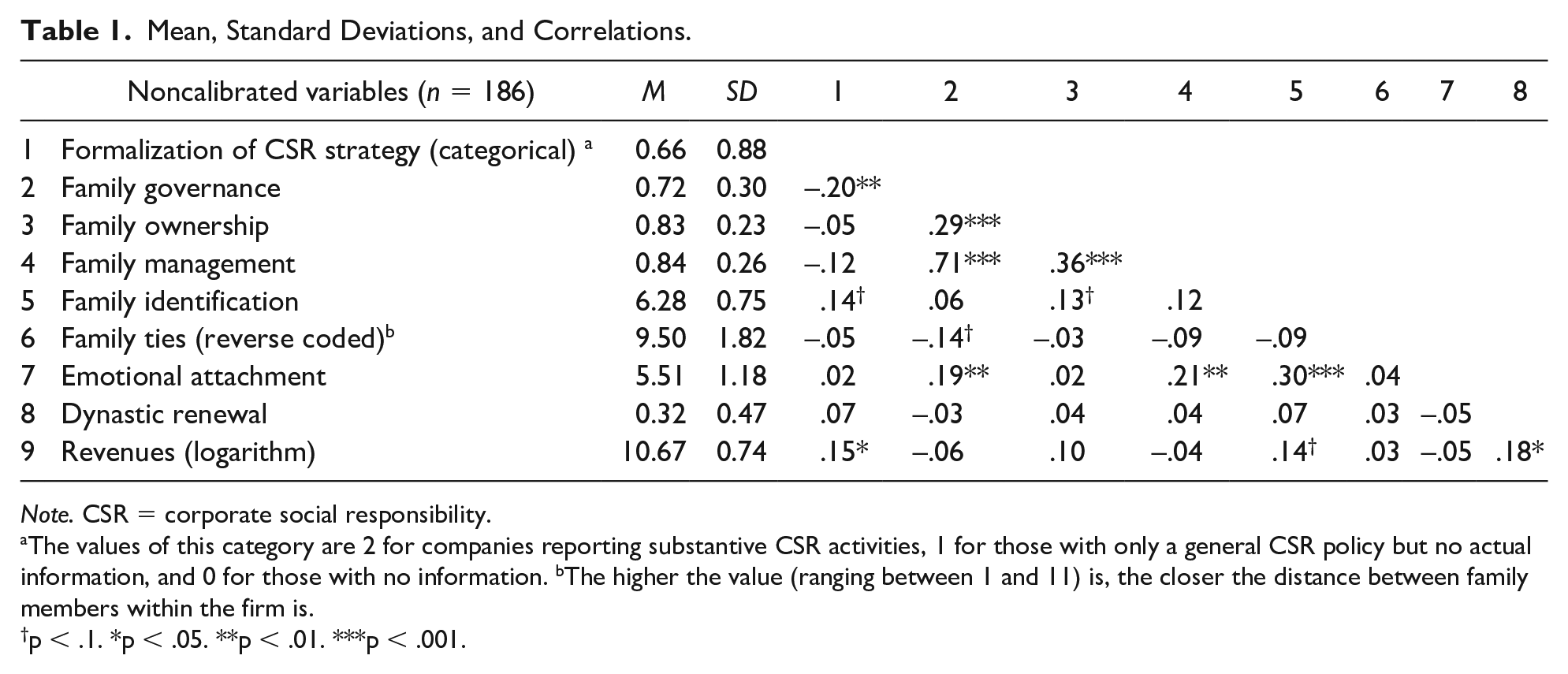
Note. CSR = corporate social responsibility.
The values of this category are 2 for companies reporting substantive CSR activities, 1 for those with only a general CSR policy but no actual information, and 0 for those with no information. bThe higher the value (ranging between 1 and 11) is, the closer the distance between family members within the firm is.
p < .1. *p < .05. **p < .01. ***p < .001.
Configurations for Formalizing Family Businesses’ CSR Strategy a .
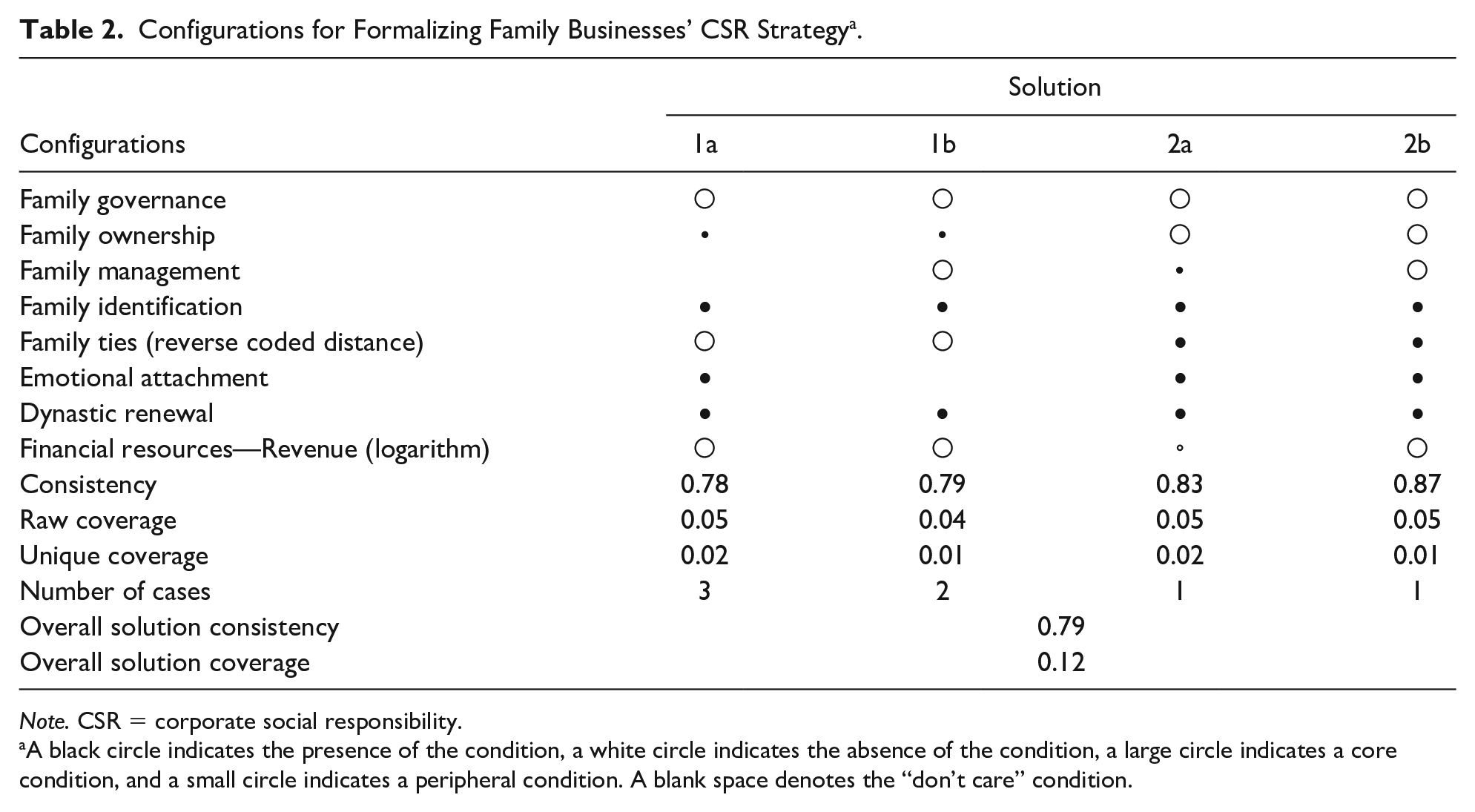
Note. CSR = corporate social responsibility.
A black circle indicates the presence of the condition, a white circle indicates the absence of the condition, a large circle indicates a core condition, and a small circle indicates a peripheral condition. A blank space denotes the “don’t care” condition.
Configuration 1: Renewal of the Firm Dynasty
Our analysis shows that there are more cases in this configuration in which the family owns the business with limited involvement in governance or management. The owning family in this configuration pays particular attention to continuing the family control of the firm to which the family identity is closely connected. Notably, families in this configuration are not strongly embedded in the firm structure, as family owners do not share close ties with each other. Without involving close family members from their private network, the owning family relies on nonfamily stakeholders in the firm network to sustain the firm dynasty (Sanchez-Famoso et al., 2015). Formalizing communication with nonfamily stakeholders can solicit the engagement of nonfamily stakeholders to support the continuation of the family firm to which the owning family may have strong emotional attachment (Configuration 1a) (Cruz, 2020). Even without emotional considerations, family owners rationally calculate all possible strategic opportunities, including the formalization of their strategic thinking, to persistently project a positive family firm identity (Configuration 1b) (Ponroy et al., 2019). In Configurations 1a and 1b, family owners emphasize the renewal of the “firm dynasty” with a formalized system and decision-making to continue operating with the firm’s own resources (e.g., network) in the long run.
Configuration 2: Renewal of Family Dynasty
Similar to Configuration 1, family firms in this configuration have a strong motivation to sustain the dynasty and maintain a positive identity. Although less common than Configuration 1 (focusing on renewing the firm dynasty), families in this configuration are motivated mostly by the family value to sustain the “family dynasty” with its own resources (Carney & Nason, 2018; Le Breton-Miller & Miller, 2018), including the close network. Rather than relying on nonfamily professionals to run the business, the family manages the business operation by itself (Configuration 2a) with close emotional bonds and a clear vision for a desired identity in the future. The strong presence of SEW in a family firm motivates the family to seek strategic opportunities that can help it transfer the family value to the future generation, even if the family is not deeply involved in the firm (Configuration 2b). Therefore, in this configuration, the founding family cares more about renewing the entire “family dynasty,” including family identity and emotional bonds from their network, than family involvement or financial wealth. These families see the opportunity to formalize their values as a way to ensure that the family dynasty persists in the long run (cf. Le Breton-Miller & Miller, 2016).
Configurations for the Nonformalization of Family Businesses’ CSR Strategy
To explore the asymmetry of family businesses’ SEW, we also examine the configurations (see Table 3) that lead to the opposite outcome, namely, a nonformalized strategy, in line with prior studies (Aragón-Amonarriz et al., 2019; Vazquez, 2018) and common in our sample (with an overall solution coverage of 0.38). We identified four main configurations with four neutral permutations (Configurations 3a–d). Most configurations in Table 3 focus on family involvement (except for Configuration 6). In contrast with Configurations 1 and 2, they lack the future-looking reference on renewing the family firm dynasty and focus on the backward-looking perspective on the past value and the present network.
Configurations for Not Formalizing Family Businesses’ CSR Strategy a .
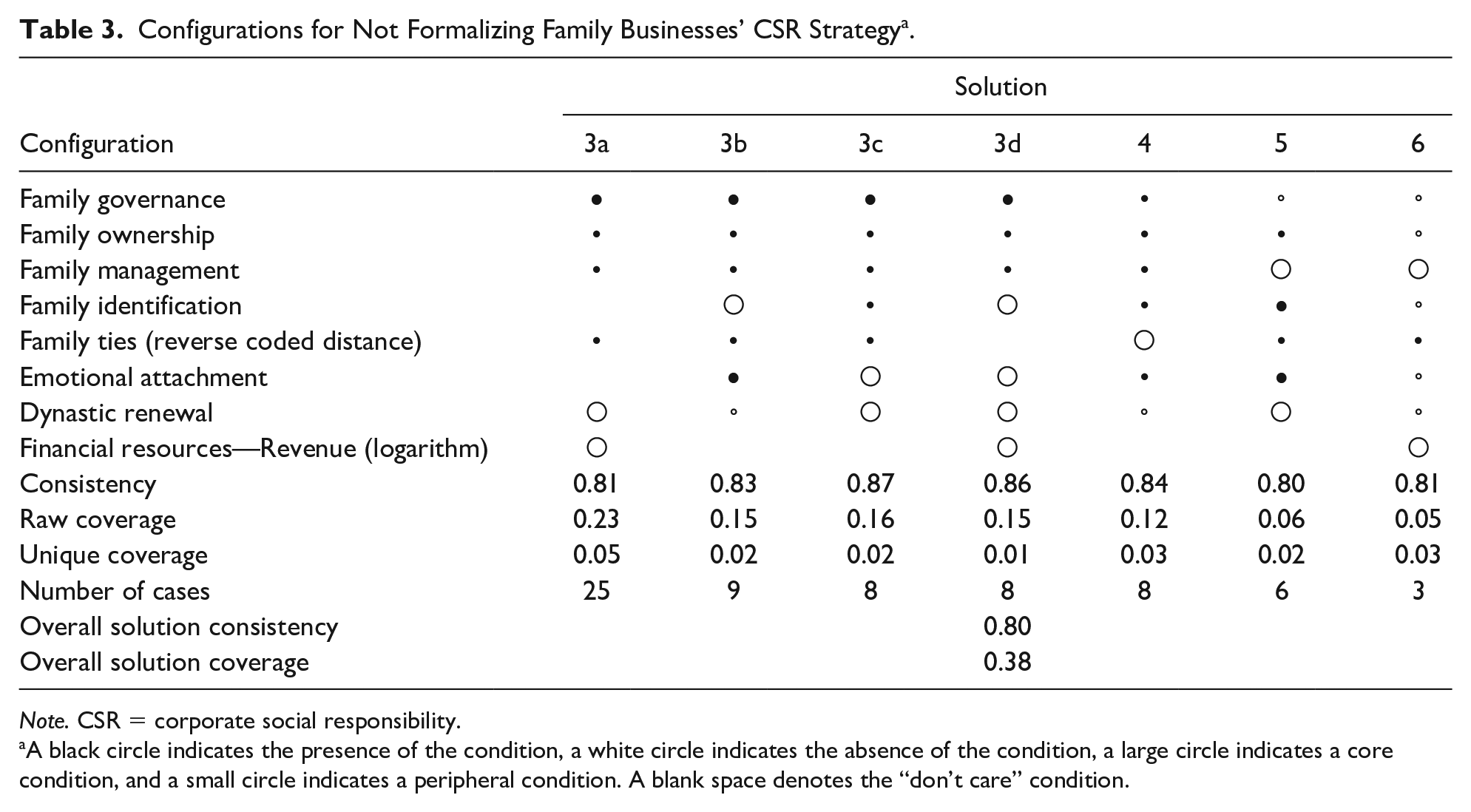
Note. CSR = corporate social responsibility.
A black circle indicates the presence of the condition, a white circle indicates the absence of the condition, a large circle indicates a core condition, and a small circle indicates a peripheral condition. A blank space denotes the “don’t care” condition.
Configurations 3: Guarding the Past Family Legacy
The most common configuration in our sample is the family firm with a strong presence in the firm structure, including in the board, ownership, and management. In contrast with the configurations in Table 2, these families pay less attention to continuing the dynasty or maintaining a positive identity for the future. Instead, the family focuses more on using its current involvement in the firm to guard the past family legacy in the firm. These family members rely on informal, relational interactions within the family, rather than a formal system, to help monitor the firm’s operations (what Gomez-Mejia et al., 2001 referred to as “relational agency contracts”).
In this configuration, the involved family may focus on guarding three different family legacies (Hammond et al., 2016): biological legacy (Configuration 3a), social legacy (the emotional bond in Configuration 3b or the family’s in-group identity in Configuration 3c), and material legacy (Configuration 3d). In Configuration 3a, the involved family relies on its biological legacy accumulated from the past, that is, the close family network, to communicate with each other, not seeing the future need to expand communication to a broader network. The involved family in both Configurations 3b and 3c looks beyond the biological legacy to consider the social family legacy, including the affective emotion (Configuration 3b) and cognitive value of the in-group identity (Configuration 3c). Close family members feel a strong sense of belonging to each other and often prioritize communicating with those who share the same feeling and/or identity rather than those outside their network (Zellweger et al., 2010). If family owners do not have a strong biological or social legacy, they are likely to focus only on protecting their material legacy in terms of ownership and management rights (Configuration 3d). These families are motivated to preserve existing family control over the business, which serves as a vehicle to accumulate wealth for the family while minimizing other family elements and nonfinancial considerations in the business (Holt et al., 2017), such as adopting a formalized CSR strategy by systematically interacting with nonfamily stakeholders.
Configuration 4: Strengthening the Coalition
Another common configuration is that the family is involved in the firm but not as strongly as in Configuration 3. The involved family members form a coalition in which they share a certain extent of the in-group identity and emotional bonds (which are weaker than those in Configurations 1–2). As the family coalition is not dominant yet in the firm (i.e., without a clear family’s collective motivation and strategic view yet), members focus first on strengthening the exchange within the coalition before engaging in more proactive communication with nonfamily stakeholders (cf. De & Massis, 2012; Sharma & Sharma, 2011).
Configuration 5: Bathing in the Glory of the Past Family Dynasty
This configuration resembles other configurations in Table 2 with regard to family ownership (Configuration 1), strong identification, close ties, and strong emotional bonds (Configuration 2). However, unlike the forward-looking reference in previous configurations, the family in this configuration has the backward-looking reference to take advantage of the family dynasty, including a shared identity, emotional bonds, and a close network, which tend to be associated with quality interpersonal communication (Pieper, 2010). As such, these family owners may believe that informal, interpersonal communication is sufficient to make strategic decisions (i.e., no motivation for formalized communication).
Configuration 6: Retaining only the Family Relic
This configuration is the least common in Table 3: the family has extremely weak SEW, that is, the absence of family involvement, identity, emotional bonds, or a forward-looking reference to renew the family firm dynasty. This type of family firm maintains only a close network built from the family’s past. Despite the close ties, the founding family is not particularly motivated by either economic or noneconomic opportunities as family members do not have strong involvement in the firm, identity, or emotional bonds to engage in formalizing the family firm’s CSR strategy (Schaltegger & Burritt, 2018). Instead, their motivation is driven mainly by private social ties, which the family uses to manage the family firm’s CSR strategy while expecting no long-term benefits from formal CSR communication for either the family or the firm.
Discussion
Based on our configurations from the fsQCA, we adopt an “inductive top-down approach,” which is commonly used in fsQCA studies (e.g., Campbell et al., 2016; Kosmidou & Ahuja, 2019; Pittino et al., 2018), by first explaining our phenomenon and then generating new theoretical insights (Shepherd & Sutcliffe, 2011). Specifically, in light of our findings and the extant literature, we develop theoretical propositions to summarize salient SEW dimensions in determining family firms’ temporal focus and different motivations for their strategy in terms of (non)formalized CSR communication (see Figure 2).
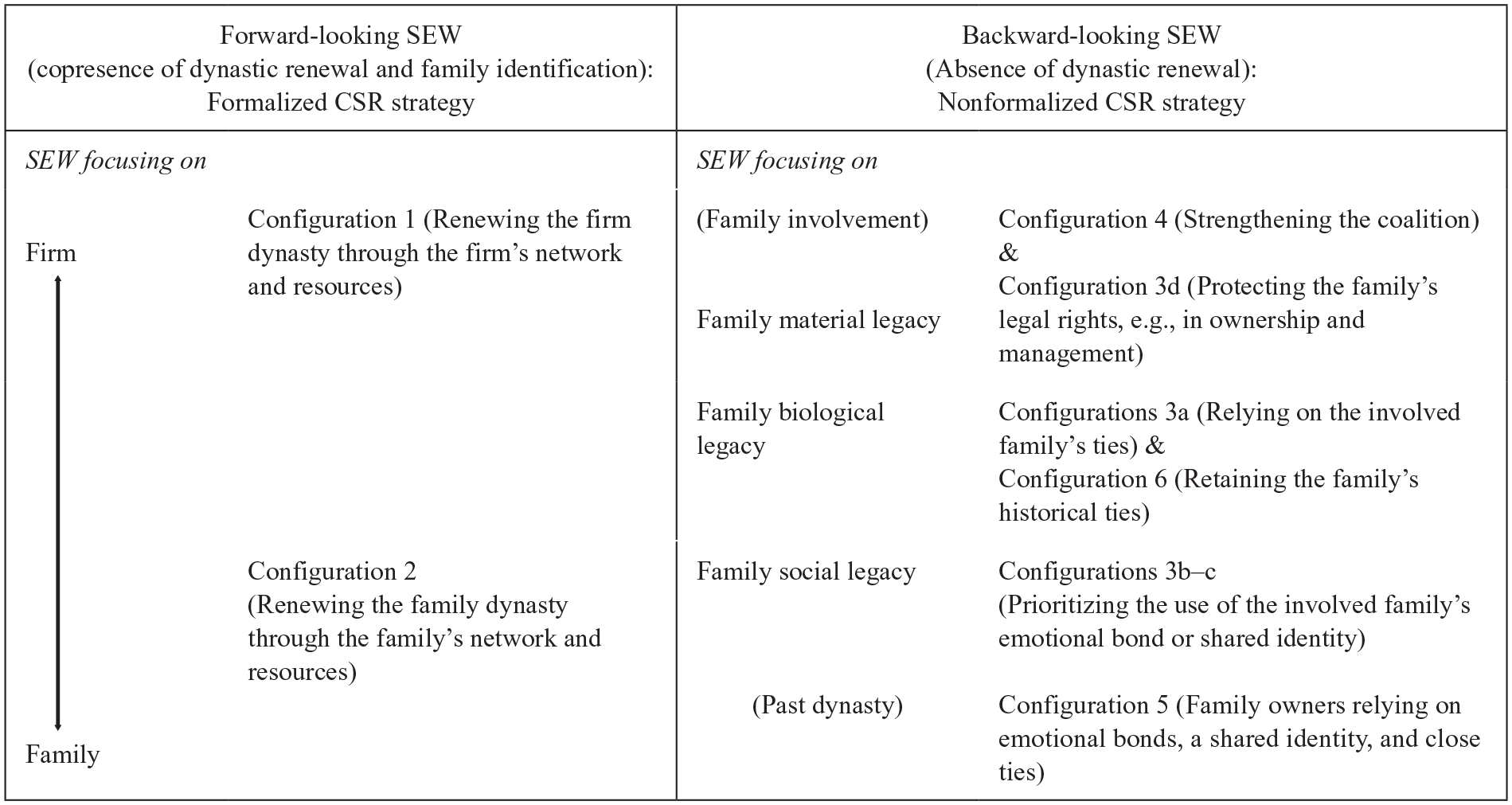
Configurations of Forward- and Backward-Looking SEW With (Non)formalization of Family firms’ CSR Strategy
Our results indicate that the presence of dynastic renewal is a key SEW dimension that determines whether the family adopts forward-looking reference points in making strategic decisions. As shown in Tables 2 and 3, even in the presence of other SEW dimensions, such as close ties and emotional attachment in Configurations 2 and 5, the presence or absence of dynastic renewal leads the two types of family firms to completely opposite strategic decisions. Another key dimension that signals the family’s forward-looking focus is the presence of a strong family firm identity (i.e., always observed in Configurations 1–2). When the family is motivated to renew its dynasty and to develop a positive identity in the future, it is more likely to pursue strategic opportunities of communicating with a wider group of stakeholders (Morsing & Spence, 2019). Hence, our results suggest that the SEW dimensions of dynastic renewal and family identification may provide valuable signals on whether the family is future-oriented to use its other SEW dimensions to pursue a strategic opportunity (Nason et al., 2019), in our case, dedicating long-term commitment to formalizing the firm’s CSR strategy:
Interestingly, our results differentiate two ways that the family’s forward-looking SEW leads to the same strategic decision, depending on whether it relies on the family’s or the firm’s resources. If the controlling family focuses on the firm’s resources and network rather than its own network, it is common for family members (with strong emotional bonds or not in Configurations 1a–b) to hold mainly an ownership role and distance themselves from the daily operation by delegating decision-making to nonfamily members. Family owners are motivated to institutionalize communication with nonfamily stakeholders and reduce reliance on family resources and networks so that the firm dynasty can run on its own resources (cf. Aragón-Amonarriz et al., 2019).
Another (and less common) approach is that the family uses its own network in which members intend to transfer their shared identity and emotional bond to the future generation. Whether family members are personally involved in management (Configuration 2a) or not (Configuration 2b), they are determined to sustain their nonfinancial value. They may see the value of systematic documentation and reporting as a way to tell a consistent family story across generations (cf. Hossain et al., 2019) to sustain the family’s quality network:
In contrast to forward-looking SEW, our results also identify the asymmetry of the same SEW dimensions but with the backward-looking reference points (i.e., absence of dynastic renewal), leading to the opposite outcome—an informal approach to the family firm’s CSR strategy. Rather than focusing on renewing the family or the firm dynasty, it was much more common for the family to hold backward-looking reference points by focusing on preserving the family legacy from the past and in the present. As shown in Table 3, Configurations 3 to 6 have a stark contrast with those in Table 2 in that most families in our sample are not yet paying attention to the future renewal of their dynasties. Although family firms are often argued to be more long-term-oriented than nonfamily firms (Le Breton-Miller & Miller, 2006; Lumpkin & Brigham, 2011), the family may center their long-term orientation on continuing the past legacy in the current generation (e.g., in the following two to three decades) but not yet considering a strategic opportunity for a much more distant future. This type of family limits communication to informal interactions with close, internal stakeholders (rather than formal communication with other external stakeholders):
As shown in Figure 2, families with backward-looking SEW may focus on different types of family legacies (Hammond et al., 2016). The first important legacy lies in the family’s material legacy in terms of their rights as directors on the board, owners, and/or managers, which have been the common determinants of a family firm’s CSR strategy, as found in previous studies (e.g., Cabeza-García et al., 2017; Marques et al., 2014; Samara et al., 2018). The involved family cares primarily about their own power and control (Configuration 3d) or strengthens the in-group identity and bond of its coalition (Configuration 4). As such, these families restrain their strategic horizon to reinforce their coalition in the current firm structure through internal communication rather than investing in long-term, systematic communication with external stakeholders (Cui et al., 2018).
The second legacy is to preserve the family’s biological legacy (i.e., family ties) in the firm (Hammond et al., 2016). Unlike their forward-looking counterparts (Configuration 2), backward-looking families rely primarily on communication within the close family’s network since the involved family (Configuration 3a) is more likely to exchange inside information with each other than with external nonfamily stakeholders (Arregle et al., 2007). In a few extreme cases, backward-looking family firms may become merely a relic of the family’s historical network (Configuration 6) without a formal strategy to communicate with outsiders.
Finally, a backward-looking family may be driven by its social legacy—the family value in terms of beliefs and emotions (Hammond et al., 2016). Although these families have strong emotional bonds (Configuration 3b), a clear identity (Configuration 3c), and close social ties (Configuration 5), their backward-looking reference points (i.e., absence of dynastic renewal) prevent them from seeing the strategic opportunity of formal communication with external stakeholders. Instead, if they are immersed in past success with internal, informal communication, they may become less motivated to expand communication to nonfamily stakeholders who do not share the same social legacy (cf. Spence, 2016). To summarize, we offer the following proposition:
Theoretical Implications
Our findings and propositions make a number of contributions to the family business literature. First, we contribute to the recent debate on the multidimensionality of the SEW construct by illuminating the within-construct interrelationships. Although studies have acknowledged the usefulness of the SEW construct to capture various noneconomic reference points in determining family firms’ strategies (e.g., Berrone et al., 2012; Debicki et al., 2016; Hauck et al., 2016), scholars have indicated the need to clarify the “ambiguity about overlapping, causal, and synergistic relationships . . . between components of SEW” (Chua et al., 2015, p. 179). This knowledge is particularly valuable for a relatively new construct such as SEW (Brigham & Payne, 2019). Based on the multivariate SEW construct proposed by Berrone et al. (2012), the results of our fsQCA illustrate how different conjunctions among multiple SEW dimensions may have equifinality in determining asymmetric outcomes (Misangyi et al., 2017), in our case, the (non)formalization of CSR communications with external stakeholders.
Our examination of the configurational influences of SEW enables us to capture the temporal focus perspective (Nason et al., 2019; Shipp et al., 2009) in our propositions concerning forward-looking and backward-looking SEW. Instead of giving all SEW dimensions equal consideration (Debicki et al., 2016; Hauck et al., 2016), our results identify the salience of certain dimensions, for example, dynastic renewal and family identification, for capturing the controlling family’s temporal focus when evaluating firms’ strategic decisions. As Schulze and Kellermanns (2015, p. 456) argue for “the relevance of the time horizon of the dominant decision makers,” determining the temporal focus in the family’s strategic reference points allows scholars to provide a more accurate interpretation of whether the family is motivated to exploit a strategic opportunity, such as a promising entrepreneurial venture (Zahra, 2018) or CSR formalization in our case. Depending on the family’s temporal focus, the same SEW dimensions, for example, family involvement, ties, and emotional attachment, may lead the family to pursue different strategic approaches. Our configurational approach and propositions derived from fsQCA “test for additional sufficient conditions when studying the dimensionality of SEW and its applicability to other theories” (in our case, CSR strategy) and allow scholars to “further extend the assumptions associated with SEW and the applicability of SEW” (Swab et al., 2020, p. 437).
Second, our exploration of diverse SEW configurations responds to recent calls for a deeper understanding of the heterogeneity of family firms (Dyer, 2018; Jaskiewicz & Dyer, 2017; Jaskiewicz et al., 2020). Scholars have highlighted the value of SEW and its multidimensionality for capturing various family values (Williams et al., 2018; Zahra, 2018) and how they translate into firm behavior (De Massis & Foss, 2018). However, existing studies tend to rely on the extent of family presence in the firm structure to build firm profiles that capture family firm heterogeneity (e.g., Stanley et al., 2017, 2019). Instead, our fsQCA looks beyond family involvement to consider various SEW dimensions, such as family identification, ties, and emotional bonds, according to Berrone et al.’s (2012) model. Conversely, our study also shows how the multidimensional SEW model may be useful to study important phenomena (such as CSR) through an fsQCA approach.
In particular, our results emphasize the equifinality and asymmetry of the same SEW dimensions leading to contrasting strategies (Gabriel et al., 2018), in our case, (non)formalization of the firm’s CSR strategy. For instance, forward-looking families formalize their firm’s strategy mostly to sustain the firm dynasty (Configuration 1) with fewer cases pursuing a family-dominated dynasty (Configuration 2). Notably, our results regarding the nonformalized strategy (Configurations 3–6) provide potential explanations for evidence that family firms commonly adopt an informal approach to their strategy (e.g., Aragón-Amonarriz et al., 2019; Vazquez, 2018). These families typically hold a backward-looking reference point and focus their attention on maintaining the family legacy (Hammond et al., 2016), such as their legal rights, genes, cognitive values, and affective bonds. This focus on the family’s past legacy may increase the firm’s strategic inertia, such as limiting investment in innovation (Hauck & Prügl, 2015; Raitis et al., 2021) and CSR activities (Spence et al., 2011). However, backward-looking families may rely on inherited practices to maintain functional stakeholder relationships in the current generation so that they can have more time to prepare for a future transgenerational transfer. Hence, our study provides an important means for future research to unpack the causes and consequences of heterogeneity among family firms. More specifically, from a methodological standpoint, our configurational approach based on multiple SEW dimensions cautions against the widespread habit among scholars to use family involvement (that is, the family’s ability to exercise control and influence over the firm’s decisions, captured through archival measures) as a singular proxy of SEW; it also has the potential to fundamentally advance the study of family firm heterogeneity as it could be applied to revisit prior studies on different family firm behaviors where results have been equivocal (Miller & Le Breton-Miller, 2021). Put differently, we applied our methodological approach to CSR (non)formalization as an example outcome variable, but it could be extended to interpret prior conflicting research results across a wide spectrum of outcome variables (e.g., diversification, environmental pollution, innovation, internationalization, or HR policies; see the review by Gomez-Mejia et al., 2011). Overall, our study reveals that different configurations of SEW dimensions can lead to heterogeneous “extreme” or “polar” responses across family firms (Miller & Le Breton-Miller, 2021), paving the way for future research to better understand why family firms (with similar SEW dimensions) may pursue polar strategies where prior results have been inconclusive.
Finally, we empirically clarify the mixed findings on family businesses’ formalization of their CSR strategy. We consider not only the traditional determinants in terms of family involvement (e.g., Cabeza-García et al., 2017; Campopiano & De Massis, 2015; Dick et al., 2021; Terlaak et al., 2018) but also other important determinants, such as family identity, ties, and emotional attachment, according to Berrone et al.’s (2012) model. Our findings are in line with previous studies (e.g., Cuadrado-Ballesteros et al., 2017; Fassin et al., 2011) that show that most families still prefer an informal approach to the firm’s CSR strategy, despite the benefits of formalization, such as explicit steps for implementation (Marques et al., 2014) and better external stakeholders’ evaluation (Terlaak et al., 2018).
Interestingly, our findings identify an alternative to a commonly used strategic preference explanation for choosing an informal versus a formal approach to CSR. We do so by complementing the typical argument that family firms rely on the informal approach due to financial resource constraints (Dekker & Hasso, 2016; Déniz & Suárez, 2005; Gjergji et al., 2021). Specifically, when determining the firm’s CSR strategy, families in our sample pay more attention to the preservation of the family legacy, such as material rights, biological ties, or social values (Hammond et al., 2016), than financial resources. On one hand, these family legacies may not be easily preserved in the formalized documents and artifacts and thus may still require interpersonal interpretation and transfer (Hammond et al., 2016). We find that prevalent family involvement in the firm (e.g., Configurations 3–4) prevents family members from formalizing the firm’s stakeholder management out of fear that a formalized system may undermine their existing relationships and interests (Vazquez & Rocha, 2018). On the other hand, although the family involved behaves as guardians protecting the family legacy, the reliance on its own network and values may appear as family-centric endeavors from the perspective of external stakeholders who do not necessarily have access to all the information. As such, our findings can help scholars explain what “motivates” a family firm to adopt an informal CSR strategy, as extant studies have focused primarily on “how” such a strategy is implemented, such as through interpersonal communication (Aragón-Amonarriz et al., 2019; Vazquez, 2018), vague personal interpretation (Fassin et al., 2011), and the family’s ethical values (Cuadrado-Ballesteros et al., 2017).
In short, all things considered, our configurational study confirms the value of the SEW construct and its dimensions (as per Berrone et al., 2012) in explaining how and why family firms make particular strategic choices (such as CSR). At the same time, our methodology offers a much more sophisticated approach to study the ability of SEW to predict a firm’s strategic choices than earlier research on this topic (see the review by Gomez-Mejia et al., 2011).
Practical Implications
Our results are relevant for practitioners, including family firms’ owner-managers and external stakeholders. For owner-managers, our results highlight the importance of careful examination when benchmarking their own firms against other firms with similar family characteristics, such as the family’s ownership share of the firm, managerial positions, and board representation. When owner-managers intend to learn from other similar family firms before investing in a new strategy, such as formalizing CSR communication with external stakeholders, it is critical to understand the temporal focus and the strategic motivation of other family firms. For instance, a similarly close family network can be used differently, by focusing on maintaining intrafamily communication within the existing network or on passing such a quality network to the future generation by building a more extensive communication system. When owner-managers compare themselves with the other families, a meaningful comparison requires the consideration of others’ focus on future dynasty or past legacy.
For external stakeholders, our results can be a valuable guide to adapt their expectations of a family firm depending on the controlling family’s strategic focus. For instance, although formalized CSR communication is common among large nonfamily firms (Cabeza-García et al., 2017; Muttakin et al., 2018), we found that the most common approach among small- and medium-sized family firms is still informal communication. They rely primarily on the family legacy, including structural power, the in-group network, and social value from the past, to facilitate communication with close family stakeholders. If external stakeholders aim to further their engagement with these firms, such as increasing their investment (Su et al., 2016) or forming a new partnership (Miller & Le Breton-Miller, 2021), their primary information sources may depend less on open communication (such as a formal sustainability report) and more on interpersonal relationships with the controlling family. Hence, external stakeholders would need to adjust their information sources when evaluating strategic engagement with a family firm by closely examining the configurations of its family elements and developing communication channels that best fit those configurations.
Limitations and Future Research Avenues
Although we make novel and important theoretical and methodological contributions to the family business literature in general and the SEW literature in particular, our study has some limitations worth keeping in mind. First, although survey data are commonly used to capture SEW (e.g., Cabrera-Suárez et al., 2014; Chrisman et al., 2012; Vandekerkhof et al., 2018), the low response rate of survey studies tends to limit the sample size, and there is thus the risk of selection bias (Baruch & Holtom, 2008). We addressed the first issue by adopting the fsQCA method, which can generate meaningful analyses even with a small sample size (Ragin, 2000), although our final sample (>50 cases) is considered large in traditional fsQCA studies (Douglas et al., 2020). Future research could increase the sample size by targeting public firms or other types of firm strategies, such as entrepreneurship and innovation strategies involving risky investment, for which more public data may be available. Concerning the selection issue, we examined the possibility of response bias through a comparison of respondents and nonrespondents and did not find evidence that this issue was a problem.
Second, our survey was targeted at key informants who are close to the firm’s controlling family and can better evaluate SEW. Although this approach can improve the response rate and capture how the family’s reference point is perceived by close members, it may still not fully capture collective perceptions (Huselid & Becker, 2000). Future research could adopt a multiple respondent approach for subjective measures such as family identification and emotional attachment in SEW, albeit potentially further reducing the response rate and thus the sample size.
Third, the survey data were collected before 2016, when the Italian government enacted Legislative Decree 254/2016, following the European Union Directive 95/2014 requiring companies to disclose nonfinancial information, including CSR activities (Aureli et al., 2020). After 2016, family firms’ CSR communication was likely to be driven by the institutional rule rather than by discretionary family influence (i.e., SEW, the focus of our study). Including institutional-level factors, such as regulation and enforcement, is likely to increase the computational challenge for fsQCA (Ragin, 2017) and leaves room for alternative interpretations. Future research could examine the CSR strategy after 2016 if the research focus is centered on the regulatory influence. However, a different research method, such as case studies, may be required to uncover the multilevel interactions among factors.
Fourth, there may be an endogeneity issue of reverse causality. We address this concern through procedural and statistical approaches (Podsakoff et al., 2012), using data from multiple sources at different times (i.e., historical data from secondary sources and contemporary data from the survey and corporate archives). Nevertheless, future research could consider a different research design to ascertain causality, such as a field experiment or longitudinal surveys.
Finally, we limited our attention to the SEW dimensions that Berrone et al. (2012) proposed in their deductive model and to formal communication of the firm’s CSR activities. Future research could expand this scope by looking at other noneconomic foci that may vary at different firm stages, such as firm culture 6 and family values. Furthermore, future studies could examine informal CSR strategies in depth by examining whether family firms undertake limited activities or rather substantive but unobservable activities in private (Morsing & Spence, 2019) or the transformation process shifting from the informal approach to a formalized strategy (Mintzberg, 1994). In addition, as emphasized before, the approach proposed here could be used to revisit the role of SEW in influencing a broad range of family firms’ strategic choices (such as business exits, acquisitions, diversification, and internationalization) with a more rigorous and rich methodology.
Conclusion
We examined the configurations of SEW dimensions, exploring the heterogeneity of family businesses—in our case, the strategic motivation to formalize their CSR strategy or not. By integrating the multivariate SEW construct of Berrone et al. (2012) and the temporal focus perspective (Nason et al., 2019; Shipp et al., 2009), we reveal that the same SEW dimensions may lead to polar strategic choices (Miller & Le Breton-Miller, 2021), that is, whether or not to systematically and openly communicate the firm’s CSR activities to external stakeholders. Although formalizing the firm strategy is useful to help the family sustain the (firm or family) dynasty, most family firms are still motivated to take advantage of the past family legacy (including legal rights, biological ties, and social value) to focus on informal communication with close stakeholders. We believe that future scholars will benefit from our approach to use the SEW construct to evaluate family firms’ heterogeneous strategic behaviors.
Supplemental Material
sj-docx-1-fbr-10.1177_08944865221146350 – Supplemental material for Examining Heterogeneous Configurations of Socioemotional Wealth in Family Firms Through the Formalization of Corporate Social Responsibility Strategy
Supplemental material, sj-docx-1-fbr-10.1177_08944865221146350 for Examining Heterogeneous Configurations of Socioemotional Wealth in Family Firms Through the Formalization of Corporate Social Responsibility Strategy by Josh Wei-Jun Hsueh, Alfredo De Massis and Luis Gomez-Mejia in Family Business Review
Footnotes
Acknowledgements
We are grateful to Keith Brigham, Jess Chua, Franz Kellermanns, Carlo Salvato, Pramodita Sharma, anonymous reviewers of Family Business Review, and the participants of the 2016 Academy of Management Annual Meeting and the 2015 INFORMS Annual Meeting for their helpful comments.
Declaration of Conflicting Interests
The author(s) declared no potential conflicts of interest with respect to the research, authorship, and/or publication of this article.
Funding
The author(s) received no financial support for the research, authorship, and/or publication of this article.

Supplemental Material
Supplemental material for this article is available online.
Notes
Author Biographies
References
Supplementary Material
Please find the following supplemental material available below.
For Open Access articles published under a Creative Commons License, all supplemental material carries the same license as the article it is associated with.
For non-Open Access articles published, all supplemental material carries a non-exclusive license, and permission requests for re-use of supplemental material or any part of supplemental material shall be sent directly to the copyright owner as specified in the copyright notice associated with the article.
