




Abstract
The review aims to explore fuzzy-set qualitative comparative analysis (fsQCA) as a bridge between the qualitative and quantitative paradigm divide in tourism, leisure, and hospitality management studies and explain why and how field scholars employ it. A comprehensive systematic review of complete and original articles from 31 top-tier tourism, leisure, and hospitality journals was conducted on the basis of the PRISMA framework. Since its inception in the field, fsQCA has been employed as a mixed method and analysis technique for theory development, testing, and data analysis. Its application in the field has grown because it acts as a back up in addressing complex sets through rigorous qualitative and quantitative approaches. Complexity, fuzzy set, planned behavior, chaos, and motivation are the leading theories consistently used; behavior, intention, motivation, performance, attitude, satisfaction, crisis, and experience are the complex research themes in the field that most frequently employ fsQCA.
Keywords
Introduction
When scholars need to investigate a complex phenomenon, a mixed-methods approach is often employed (Fetters et al., 2013; Johnson & Onwuegbuzie, 2004), as it provides fundamental insights into a wide range of phenomena that cannot be fully understood with a single approach (Venkatesh et al., 2013). However, integrating qualitative and quantitative data in a meaningful way remains elusive and requires further refinement (Guetterman et al., 2015) because each approach has unique features and ways to tackle different issues.
Although mixed-method research is increasingly common in tourism, leisure, and hospitality, trade-offs are often made during integration (Truong et al., 2020). Quantitative research works with objective measures and solutions. Nonetheless, it may restrict the scope of the investigation and run the risk of oversimplification (Berman, 2017; Guetterman et al., 2015; Walle, 1997). Hence, some scholars turn to qualitative approaches to gain deep insights into complex problems (Altinay & Taheri, 2019; Fetters et al., 2013; Guetterman et al., 2015). These approaches emerge as distinct, but neither can be defined as the absence of the other (Creswell & Clark, 2017; Nasution et al., 2020; Walle, 1997). Mixed methods emerge as a third—more balanced—approach. However, debates on its triangulation are significant. For example, the combination of multiple methods founded on substantially different paradigmatic assumptions is questioned (Creswell, 2007; Guba, 1990; Venkatesh et al., 2013). Moreover, the two data types may contradict in explaining causes and outcomes. Likewise, multiple rounds of data collection and analysis take place over a long period, and the depth and breadth of data analysis simultaneously complicate the triangulation, resulting in inconsistent outcomes that are challenging to reconcile (Hanson et al., 2005). This problem necessitates the development of a new approach with a cautious triangulation of qualitative and quantitative methods using a single data source.
Qualitative comparative analysis (QCA), which combines the methodological discipline and rigor of quantitative research with the causal intricacy and inductive sensitivity of qualitative analysis, can be a good solution (Kane & Kahwati, 2019). Scholars from various fields are increasingly using QCA, as it avoids the need to collect two sets of data and reduces triangulation disparity. Therefore, QCA has been employed for multiple research purposes and falls halfway between the qualitative and quantitative approaches (Fiss, 2011; Marx et al., 2014). It can summarize and describe cases; check analytical coherence; evaluate existing theories; develop new hypotheses, propositions, or theories based on the researcher’s prior knowledge; and perform an in-depth analysis of cases to extend or refine existing theories (Marx et al., 2014). Given the strengths of QCA and its growing popularity in tourism and hospitality research, this comprehensive systematic review aims to explore the scope of fuzzy-set QCA (fsQCA). The review examines fsQCA as a mixed-method and analysis technique and identifies how it has been used in tourism, leisure, and hospitality research. This paper is structured as follows: QCA and fsQCA foundations; method and analysis technique of fsQCA; methodology; results and discussion; number of studies published each year; type of journal and country; research themes of fsQCA; theories of fsQCA; integration of fsQCA with other methods and analyses; application of fsQCA in tourism, leisure, and hospitality studies; critiques of fsQCA; tenets and theoretical and practical implications; conclusions; and limitations and future research.
QCA and fsQCA Foundations
Charles Ragin’s seminal work on “Boolean algebra and set theory” introduced QCA to political science and became the standard tool for asymmetric analyses in other fields (Marx et al., 2014; Ragin, 1998; Rihoux & Ragin, 2012). QCA rejects dogmatism as a research paradigm. Instead, it opts for inclusive, pluralistic, and complementary mixed methods research (Marx et al., 2014; Ragin, 2017; Rihoux & Ragin, 2012). Aiming to bridge the qualitative and quantitative paradigm divide, it combines inductive and comparative case-based methods and techniques with quantitative approaches, which results in more generalizable outcomes than symmetric analyses (Marx et al., 2014). QCA is based on two foundational tenets: (a) a single condition is seldom enough to create a result and (b) many conditions in combination are usually accountable for the outcome, and multiple and complex combinations of conditions cause similar effects (Rihoux & Ragin, 2012). These configurations can be used to evaluate if a causal approach is neither necessary nor sufficient, necessary but insufficient, sufficient but unnecessary, or sufficient to cause an outcome (Marx et al., 2014; Ragin, 2017; Rihoux & Ragin, 2012).
Based on Boolean rather than linear algebra, the absence or presence of a result relies on different conditions in QCA methods and analyses (Schneider & Wagemann, 2012). QCA allows researchers to understand cases and produce generalizable outcomes (I. O. Pappas & Woodside, 2021; Rihoux, 2006; Vis, 2012). I. O. Pappas and Woodside (2021, p. 1) stated that “QCA is an asymmetric data analysis technique that combines the logic and empirical intensity of qualitative approaches that are rich in contextual information, with quantitative methods that deal with large numbers of cases and are more generalizable… than symmetric theory and tools.” Vis (2012, p. 191) added that the result of QCA is more detailed and case complex. It compares cases, explores multiple causes, and reduces a wealth of case data into more concise descriptions (Marx et al., 2014).
The most common types of QCA are crisp-set QCA (csQCA), multi-value QCA (mvQCA), and fsQCA, which can be used in small, intermediate, and large samples at all levels of study (Hsu et al., 2013; Rihoux & Ragin, 2012). In csQCA, the membership set is assigned either full membership (1) or full non-membership (0), but mvQCA sets have an additional crossover point (0.5), which is neither fully in nor fully out. Furthermore, fsQCA sets have partial values that better assist the degree of presence and absence of set membership than the former two. It has a fuzzy set of three, five, seven, or continuous membership values. For example, three-value fuzzy sets include (1 = fully in, 0.5 = neither in nor fully out, or 0 = fully out), five = value fuzzy sets include (1 = fully in, 0.75 = more in than out, 0.5 = crossover, 0.25 = more out than in, and 0 = fully out), and a continuous value fuzzy set assigns (1 = fully in, 0.5 < a < 1 = more in than out, 0.5 = crossover, 0 < a < 0.5 = more out than in, 0 = fully out). These fuzzy value sets enable fsQCA users to measure continuous variables.
QCA investigates how different combinations of antecedents result in varying degrees of outcome for various groups of cases (I. O. Pappas & Woodside, 2021; Rihoux & Ragin, 2012). The csQCA method is the first QCA that deals with complex binary data sets, whereas mvQCA and fsQCA treat variables as multivalued (I. O. Pappas & Woodside, 2021; Timberlake, 1989). According to Rihoux and Ragin (2012), mvQCA is the most underutilized because fsQCA also includes mvQCA’s three-value fuzzy set membership. Similarly, fsQCA addresses the dichotomization of csQCA that restricts the complexity of antecedents. Also known as case-oriented analysis, cross-case analysis, configurational modeling, and asymmetrical modeling, fsQCA is based on fuzzy logic and is the most recent development of QCA (Hosany et al., 2021; Marx et al., 2014; Olya & Gavilyan, 2017). Kane and Kahwati (2019) stated that fsQCA can solve the limitations of csQCA and mvQCA while maintaining their advantages. fsQCA helps scholars compare cases, establish causal relationships, and determine which conditions result in a specific outcome. It differs from conventional symmetric approaches that require multiple-criteria decision-making methods (Roig-Tierno et al., 2017).
fsQCA has gained popularity for various reasons (J. Zhang & Zhang, 2021b). First, it solves the dichotomizing of csQCA and trichotomizing of mvQCA problems by converting data into fuzzy membership values from 0 to 1. Second, it can easily complement other symmetric and asymmetric methods and analysis techniques (J. Zhang & Zhang, 2021b). Third, it can handle more horizontal (case) and intricate complexity than symmetric analysis (Vis, 2012). Furthermore, there is no straightforward (1 or 0) way to sort cases in fsQCA because each condition has individual membership scores that lead to partial membership (Rihoux & Ragin, 2012). Finally, scholars who studied complex issues and did not use fsQCA acknowledged it as a limitation of their studies and recommended that future scholars use it in combination with other methods (Mariani & Baggio, 2020; Ness et al., 2021; Sukhu et al., 2017).
The Journal of Business Research has published 464 studies related to fsQCA since 2007. In 2016, the journal published 185 studies emphasizing the methodological and analytical benefits of fsQCA. However, the first tourism-related article that used fsQCA was published in 2011. It is titled “General theory of cultures’ consequences on international tourism behavior,” which examines national cultures as multiple combinations of values rather than a set of discrete single values (Woodside et al., 2011). It was not until 2013 that the first fsQCA article was published in a tourism, leisure, and hospitality journal: the Journal of Travel Research (Hsu et al., 2013). Despite the methodological and analytical advantages of fsQCA, its application in tourism and hospitality research has not progressed as much as it should.
Method and Analysis Technique of fsQCA
Comparative investigation and asymmetrical relationships are the two foundational assumptions of fsQCA. In a significant proportion of cases, the relationships are contrary to the effect of an antecedent on an outcome variable (Rihoux & Ragin, 2012). In a symmetrical relationship, when the independent variable changes, it has a net impact on the dependent variable, but this is not the case in fsQCA (Olya & Gavilyan, 2017; Woodside, 2014). The primary goal of fsQCA and comparative techniques is to provide researchers with analytical tools and enable them to combine case and variable-oriented approaches (Marx et al., 2014; Ragin, 2017; Timberlake, 1989). It develops a new formal logic by comparing cases, investigating causal diversity, and condensing voluminous case data into more parsimonious explanations (Marx et al., 2014). Its main applications go from small sample size configurations to big data in various fields (I. O. Pappas et al., 2019; Rasoolimanesh, Ringle et al., 2021).
In fsQCA, analyses are translated into a continuous degree of membership rather than a mere absence or presence of a single attribute like a discrete variable (Kraus et al., 2018). Therefore, the first phase of fsQCA is calibrating membership values or transforming data into fuzzy sets ranging from 0 to 1, with 0 implying full non-membership and 1 implying full membership (Rihoux & Ragin, 2012). Throughout the calibration, the original values of variables are converted into continuous fuzzy values. For example, in a five-point Likert scale, 0 corresponds to a value of 1, but fuzzy values of 0.5 and 1 correspond to 3 and 5, respectively (Ragin, 1998; Rihoux & Ragin, 2012). Ragin (2008) and Woodside (2013) defined the degree of membership for each variable as full membership (0.95), the crossover point (0.50), and full non-membership (0.05). However, this calibration of the qualitative breakpoints requires scholars’ practical and theoretical knowledge to represent 0 = non-membership, 0.5 = crossover, and 1 = full membership (Kraus et al., 2018; Rihoux & Ragin, 2012). Unlike other QCA methods, fsQCA empowers outcomes and antecedents on a continuous scale and pattern. It also allows for variable reduction for each combination pattern, resulting in configurations that meet necessary and sufficient conditions. As a result, it is appropriate for deciphering complex relationships between antecedent and outcome sets (Mikalef & Pateli, 2017).
In the second phase, scholars must construct the truth table based on the fuzzy-set values with 2n rows to operate the Boolean algebra, and “n” is the number of antecedents (Kraus et al., 2018; Mikalef & Pateli, 2017; Rasoolimanesh, Ringle et al., 2021). Then, the truth table is used in the third phase to determine frequency and consistency threshold values using an algorithm configuration minimization procedure. The frequency value helps to decide which configuration of antecedents is essential. For example, according to Rihoux and Ragin (2012), a frequency threshold of 1 is appropriate in small samples (<50 cases), but cutoffs should be set higher in large samples (>150 cases). Similarly, consistency criteria should be set at 0.75, with scores below this threshold indicating inconsistency and being represented as 0 and scores above the threshold as 1. This process eliminates irrelevant conditions and simplifies solutions.
The fourth phase is defining the causal configuration. fsQCA configurations are constructed using three Boolean operations of negation (~), AND (*), and OR (+). Negation switches the membership of “a” by subtracting the fuzzy-set value from 1; for example, “~ a” is equal to “1 – a.” The logical AND takes the intersection/minimum of the fuzzy-set score of the conditions, whereas the logical OR considers the conditions’ union/maximum fuzzy-set score (Marx et al., 2014; Rasoolimanesh, Ringle et al., 2021; Rihoux & Ragin, 2012). fsQCA labels the sufficient and necessary conditions for predicting an outcome by combining antecedents (Ragin, 1998; Rihoux & Ragin, 2012). If four antecedents (a, b, c, and d) influence the outcome (e), fsQCA determines which combinations of these antecedents result in an outcome. If all conditions of “a and b,” “a and c,” and “a and d” result in “e,” then these three combinations are sufficient conditions for “e” and e = (a*b) + (a*c) + (a*d). As “a” appears in all combinations but not by itself that leads to outcome “e,” it implies that “a” is a necessary condition for the outcome “e” (Marx et al., 2014; Olya & Gavilyan, 2017; Rasoolimanesh, Ringle et al., 2021). Therefore, a necessary condition should always exist for the outcome. However, its existence alone does not guarantee that the event will occur. It is the superset of the outcome, whereas sufficient conditions constitute a subset (Rihoux & Ragin, 2012). Similarly, a condition that may be sufficient but not necessary can be expressed as e = a + (b*c). The antecedent “a” is sufficient to bring outcome “e,” but “e” can result in other ways. In other words, the antecedent “a” is insufficient: when “a” is present, the outcome “e” may be absent. Similarly, a condition may simultaneously be neither necessary nor sufficient, e = (a*b) + (c*d). However, if a condition is both necessary and sufficient, it can result in a perfect correlation in the symmetric variable-centered statistics (Kent, 2005).
Once the main causal combinations have been defined, the last phase is to determine the consistency and coverage of each combination. In fsQCA, set-theoretical consistency is the ratio of cases with the same outcome. The extent of a subset relationship has been determined and is similar to the symmetrical correlation (r) analysis (Olya & Akhshik, 2019). It is the relationship between the sub-sets of conditions and outcome and the extent to which the cases share conditions. The value of consistency is used to determine which causal combinations should be included in the research and which should not be.
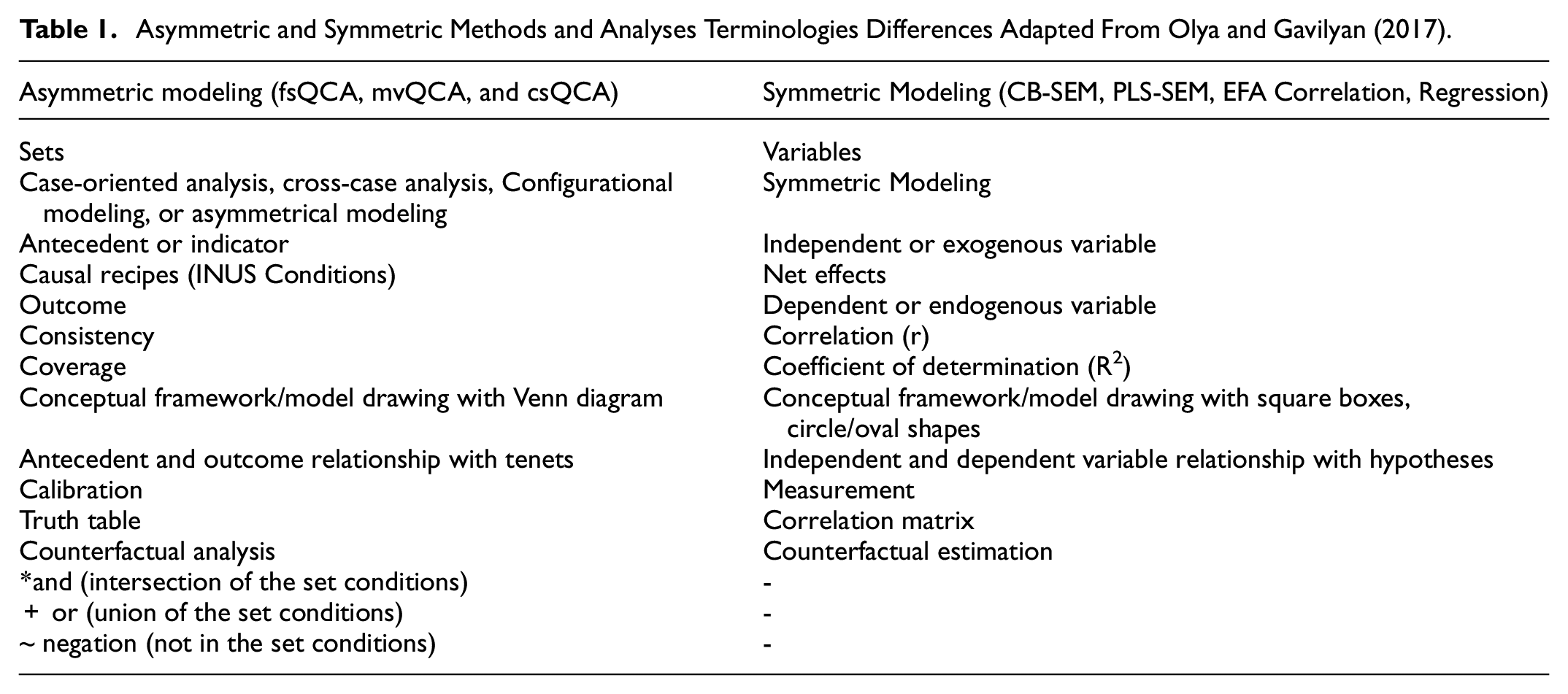
Moreover, coverage is a consistent subset that determines the ratio of memberships that explains the complete outcome solution and is comparable to the coefficient of determination (R 2) in symmetric analysis (Kraus et al., 2018; Rihoux & Ragin, 2012). Therefore, before determining the coverage values of a particular configuration, the value of consistency must be specified (Olya & Akhshik, 2019; Wu et al., 2014). Scholars should familiarize themselves with these procedures and terminologies before utilizing fsQCA because it differs from conventional or symmetrical systems and terms. The complete list of the technical terms used in QCA, especially in fsQCA, is given in Table 1.
Asymmetric and Symmetric Methods and Analyses Terminologies Differences Adapted From Olya and Gavilyan (2017).
Methodology
The first challenging step in conducting a review study is determining the scope of the journals to be included in the review. Top-tier journals are generally considered more impactful, with their reputation, frequency of readership, and contribution to essential advancements in theory and practice (Pechlaner et al., 2004). As fsQCA is a relatively new and advanced approach, this review focused on leading, top-tier journals in tourism and hospitality. Specifically, top-tier journals were identified as Q1 journals (top 25%) in the Scopus 2021 data metrics and Scimago journal and country ranking under the subject category of “tourism, leisure, and hospitality management” in the area of business, management, and accounting. A list of 31 tourism, leisure, and hospitality journals under the category of Q1 was compiled and included in this review.
Next, the researchers developed a search strategy for this systematic review to identify and include relevant articles. The search focused on mapping existing literature that utilized fsQCA in tourism, leisure, and hospitality management journals. The selection was based on Moher et al. (2009) PRISMA criteria. Accordingly, each record was thoroughly evaluated at each stage and extracted based on five criteria: (1) Articles must be original; guest editorial articles, review papers, book chapters, conference papers, published reports, and short surveys were excluded. (2) Articles should be published or in press in one of the 31 top-tier (Q1) journals. (3) Articles must be written in the English language. (4) Since the method and analysis technique of fsQCA in tourism, leisure, and hospitality management research is a recent phenomenon, all articles from the database inception were included. (5) The extracted papers were not limited to specific geographical regions.
The search strategy was tailored to the Google scholar search engine and five databases: Scopus, Web of Science, EBSCOhost (hospitality and tourism complete), ProQuest, and Science Direct. For all the databases and search engines (tourism, hospitality, or hotel) AND fsQCA keywords were used in the article search. Moreover, the name of the Q1 journals and fsQCA were used in the Google Scholar advanced searching option as keywords. Thirty-two documents and 14 journal source titles and source types were found in the Scopus database with the keywords (tourism or hospitality or hotel) AND fsQCA, business, management, accounting subject area, and article document type. With exact keywords, the search was limited to articles in the hospitality, leisure, sport, and tourism categories on the Web of Science, resulting in 43 records. In EBSCOhost: hospitality and tourism, the complete database was limited to peer-reviewed and English-language articles, and 36 documents were found. In Science Direct, 21 records were found through exact keywords and were limited to research articles in six Q1 journals. In ProQuest, with exact keywords and limited to scholarly journals and peer-reviewed article document types in the English language, 247 documents were found. Finally, the Google Scholar search engine found 574 papers with exact keywords. Through its advanced searching option with the name of 31 Q1 journals separately AND fsQCA applied, a total of 180 articles were found. In addition to the articles found in databases and search engines, six were found through other articles’ references and included in the analysis. Thus, the search for articles on fsQCA was a comprehensive systematic literature review.
The researchers merged all the documents in Mendeley referencing and summed up1,139 papers. All duplications were checked thoroughly, and 154 documents were found and removed. In addition, 187 non-tourism, leisure, and hospitality management journal articles were removed. Seven hundred eleven guest editorial articles, book chapters, review-related articles, conference papers, non-Q1 journal articles in tourism, leisure, and hospitality management, and 12 articles in the non-English language were excluded from the study. In addition, three articles were removed from the list after checking their titles, keywords, abstracts, and texts. Abstracts were thoroughly checked to ensure the inclusion of relevant academic articles in the review. As illustrated in Figure 1, 72 articles from 19 Q1 tourism, leisure, and hospitality management journals were found relevant for inclusion in the review and analysis of the study. Then, the researchers used content analysis to find fsQCA in leisure, tourism, and hospitality management studies and identify essential methods and analysis techniques for future field research.
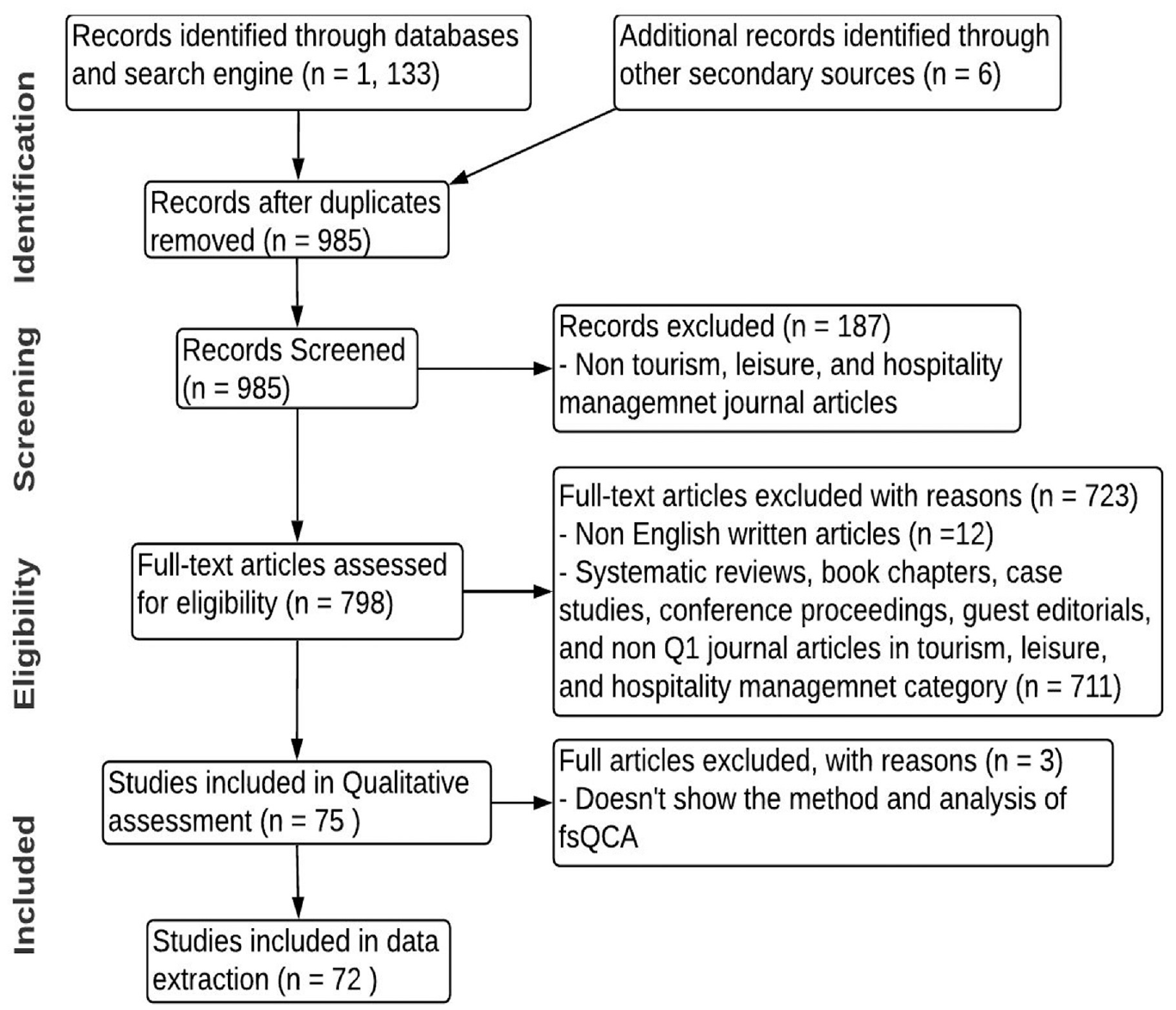
Review methodology as per Moher et al. (2009) PRISMA framework.
Results and Discussion
Number of Articles Published Each Year, Type of Journal, and Country
The analysis revealed that the number of mixed-methods research that adopted fsQCA in tourism, leisure, and hospitality management has increased exponentially in recent years. The first QCA study in tourism, leisure, and hospitality management was published in 2011 in the Journal of Business Research (Woodside et al., 2011). However, the first article in top-tier tourism, leisure, and hospitality journals was published in 2013 in the Journal of Travel Research (Hsu et al., 2013). The review revealed that the number of published articles grew significantly in 2021, with a 50% increase over the previous year. Despite previous interruptions, the number of publications has been rejuvenated after 2020, as shown in Figure 2.
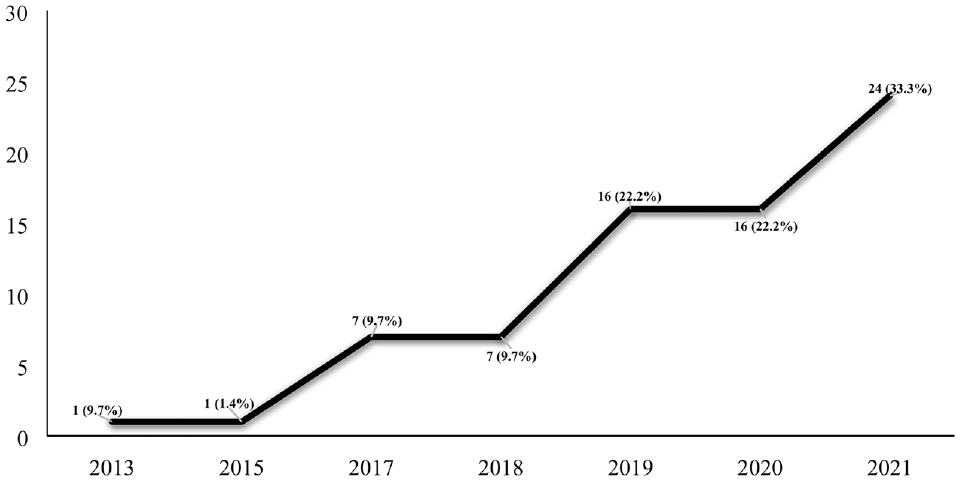
Number of fsQCA articles published across years.
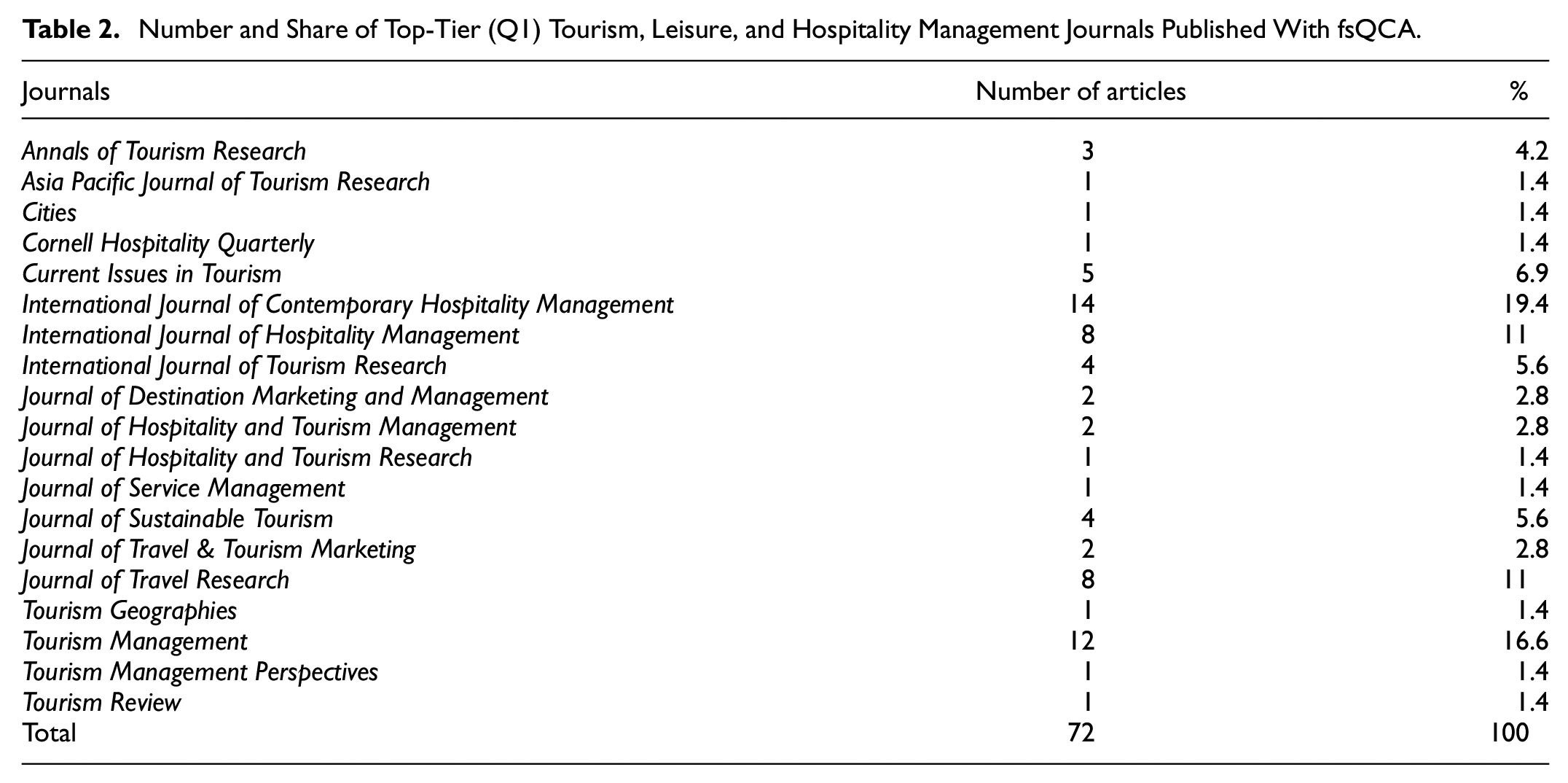
In terms of the journals that published these articles, nearly 60% (n = 42; 58%) were published by the International Journal of Contemporary Hospitality Management (n = 14; 19.4%), Tourism Management (12; 16.4%), International Journal of Hospitality Management (n = 8; 11%), and Journal of Travel Research (n = 8; 11%). The detailed list of journals and the number of published articles is shown in Table 2.
Number and Share of Top-Tier (Q1) Tourism, Leisure, and Hospitality Management Journals Published With fsQCA.
The studies were conducted in various settings worldwide, ranging from a single case study to a study of 141 countries (Ham et al., 2020). As shown in Figure 3, China and Greece are the leading countries, with nine studies published in each setting. However, three studies (Olya, 2023; Rasoolimanesh, Ringle et al., 2021; Ruhlandt et al., 2020) did not specify their settings.
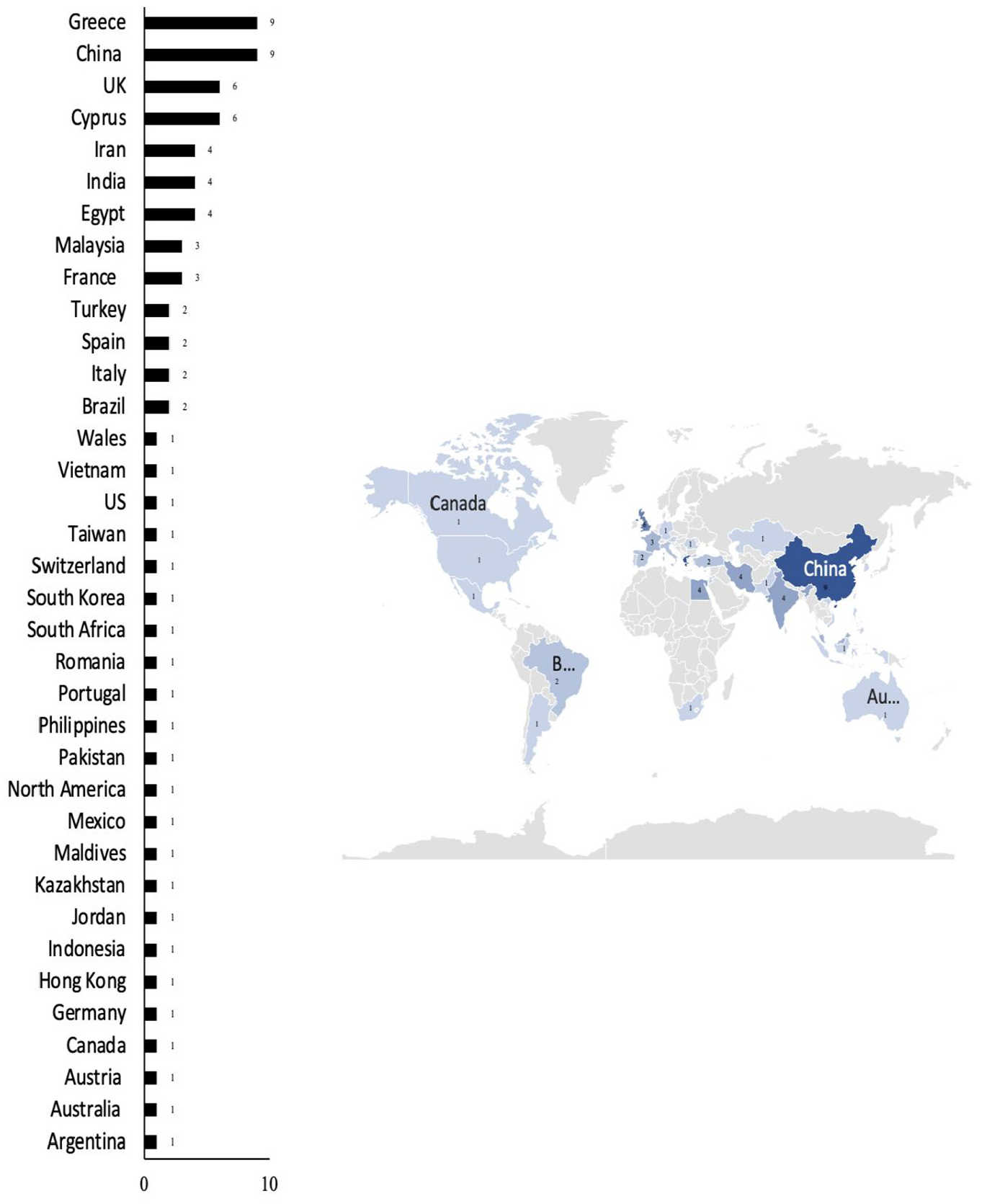
fsQCA studies across countries.
Research Themes of fsQCA
Woodside and colleagues were the first scholars to publish a fsQCA article in the Journal of Travel Research (Hsu et al., 2013) and another relevant article in the Journal of Business Research (Woodside et al., 2011). Their research focused on national cultures, behavior, and travel expenditure. The first study was conducted on 14 Asian, North American, and European first-time and repeat visitors in Australia, which aimed to evaluate the “complex configurations of national culture impact on international experiential behavior” (Woodside et al., 2011, p. 785). The second study (Hsu et al., 2013, p. 679) also aimed to test the usefulness of the “national cultures” theories that influenced customers’ experience of “international services.” The study tested “multiple theories of cultures’ consequences” with two research contexts—visiting the USA and Australia from five Asian and five Western countries. The data were collected from over 4,000 samples. A tenet rather than a hypothesis was used to express the relationship between the antecedents and outcome sets. It proposed and tested configurational perspectives of cultural influences in combination rather than testing the net effects. The study revealed that cultural configurations affected the consumption behavior of international tourists beyond the influence of demographic conditions. Woodside and colleagues employed fsQCA analysis in both investigations because the research themes were complex and required numerous analysis conditions.
Following the pioneering efforts of Woodside and colleagues, Hossein Olya of Sheffield University and Nikolaos Pappas of Sunderland University are the leading scholars and putting their footprint in the use of fsQCA in tourism and hospitality. They published 27 fsQCA articles, 37.5% of the total articles reviewed. Of course, this may have influenced the research agenda, context, and theory adoption of fsQCA research in the field. For example, eight of Pappas’s works were based on complexity and chaos theories (Papatheodorou & Pappas, 2017; N. Pappas, 2015, 2017a, 2019b; N. Pappas & Glyptou, 2021a; N. Pappas & Papatheodorou, 2021). In addition, eight studies were conducted in Greece (Papatheodorou & Pappas, 2017; N. Pappas, 2017a, 2018, 2019b; N. Pappas & Glyptou, 2021a, 2021b). As a result, there may be a need to expand the theory selection, context, and study themes in fsQCA research, with more scholars adopting this method and analysis.
fsQCA has been applied to examine different issues and contexts. The content analysis of the articles reveals that the main research topics that have utilized fsQCA in tourism and hospitality include the following:
Behavior intention (J. Liu et al., 2020; Mehran et al., 2020; Olya & Han, 2020; Olya et al., 2018; Rasoolimanesh et al., 2022; Tesone & Ricci, 2009; Weaver et al., 2020)
Luxury behavior (Correia et al., 2019; Shi et al., 2022)
Behavioral response (Olya & Nia, 2021)
Sustainability and pro-environmental behavior (Akhshik et al., 2021; Olya & Akhshik, 2019; H. Zhang & Zhang, 2019)
Financial behavior (Penela et al., 2019)
Attitude, intention, and subjective norm (Carvajal-Trujillo et al., 2021; Eid et al., 2021; Olya et al., 2019; Yadav et al., 2019)
Motivation (Küçükergin et al., 2021; N. Pappas, 2019a)
Chaos, crisis, resilience, and impact (Beynon et al., 2018; N. Pappas, 2017b, 2018; N. Pappas & Papatheodorou, 2017; Torres & Augusto, 2021)
Governance, leadership, and decision making (Correia et al., 2019; N. Pappas & Glyptou, 2021b; Ruiz-Palomino et al., 2019)
Machine learning (Rezapouraghdam et al., 2021)
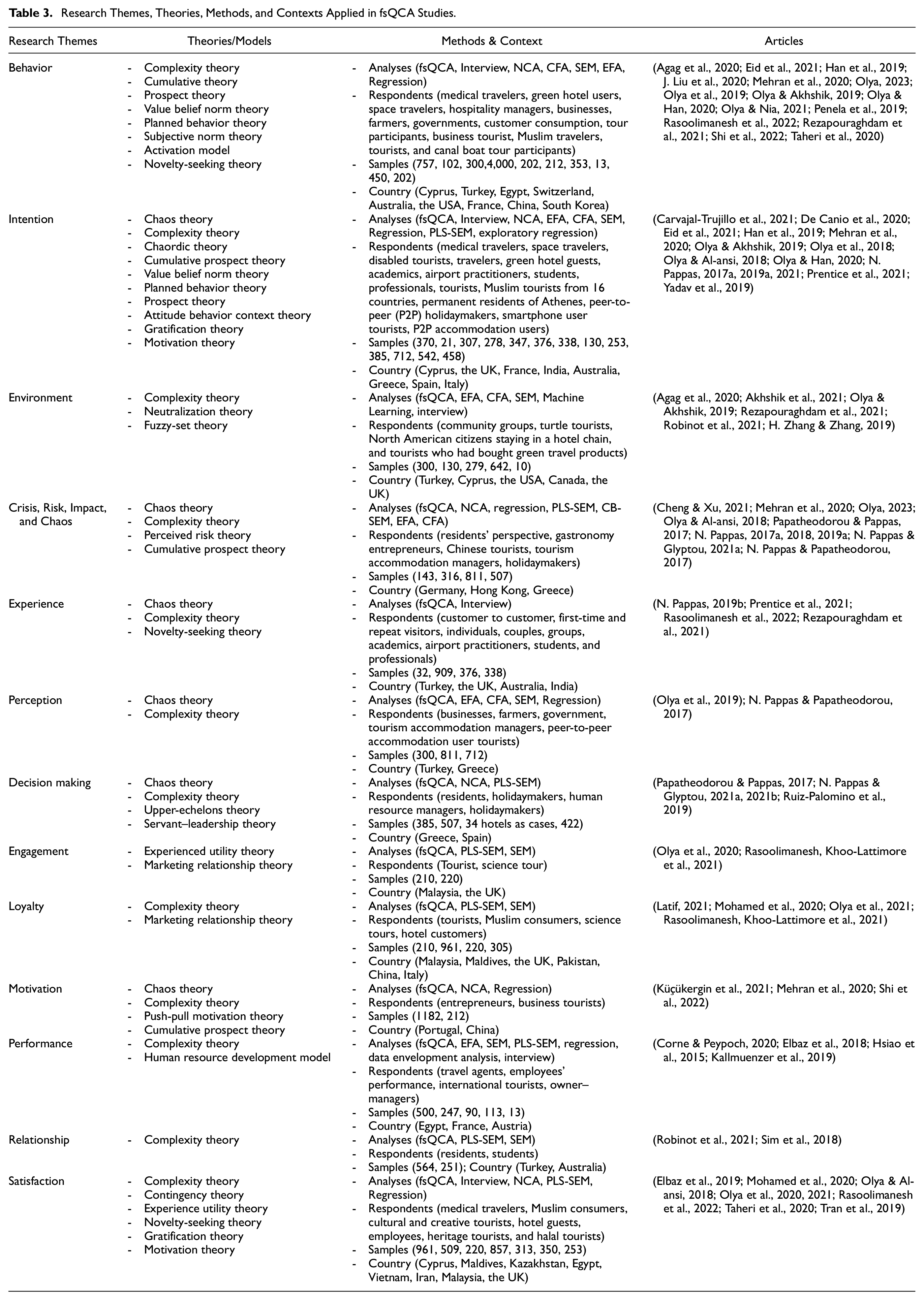
Complex social phenomena occur concurrently in natural settings, and it may be challenging to analyze the impact of each complex antecedent on the outcome condition separately, as other symmetric analyses do (Marx et al., 2014; Rihoux & Ragin, 2012). For example, Rasoolimanesh et al. (2022) examined the effect of memorable travel experiences, which has seven subconstructs: hedonism, novelty, local culture, refreshment, meaningfulness, knowledge, and involvement on the revisit and word of mouth intention with a mediating set of satisfaction. They applied partial least square structural equation modeling (PLS-SEM) and fsQCA to gain a better understanding of each set. The PLS-SEM result shows that only involvement, knowledge, and local culture have a significant relationship. However, attributes occur concurrently, and fsQCA analysis yields more heterogeneous sufficient configurations of high satisfaction, revisit, and word-of-mouth intention. Therefore, in addition to the three significant antecedents in PLS-SEM, novelty and hedonism result in high satisfaction levels, word of mouth, and revisit intention. Furthermore, this complex analysis (27 = 128, configurations) reveals a different complex impact of recipes for memorable travel experiences on revisit intention even when other sets in the configuration are too low. The details of the major research themes are presented in Table 3 and Figure 4.
Research Themes, Theories, Methods, and Contexts Applied in fsQCA Studies.
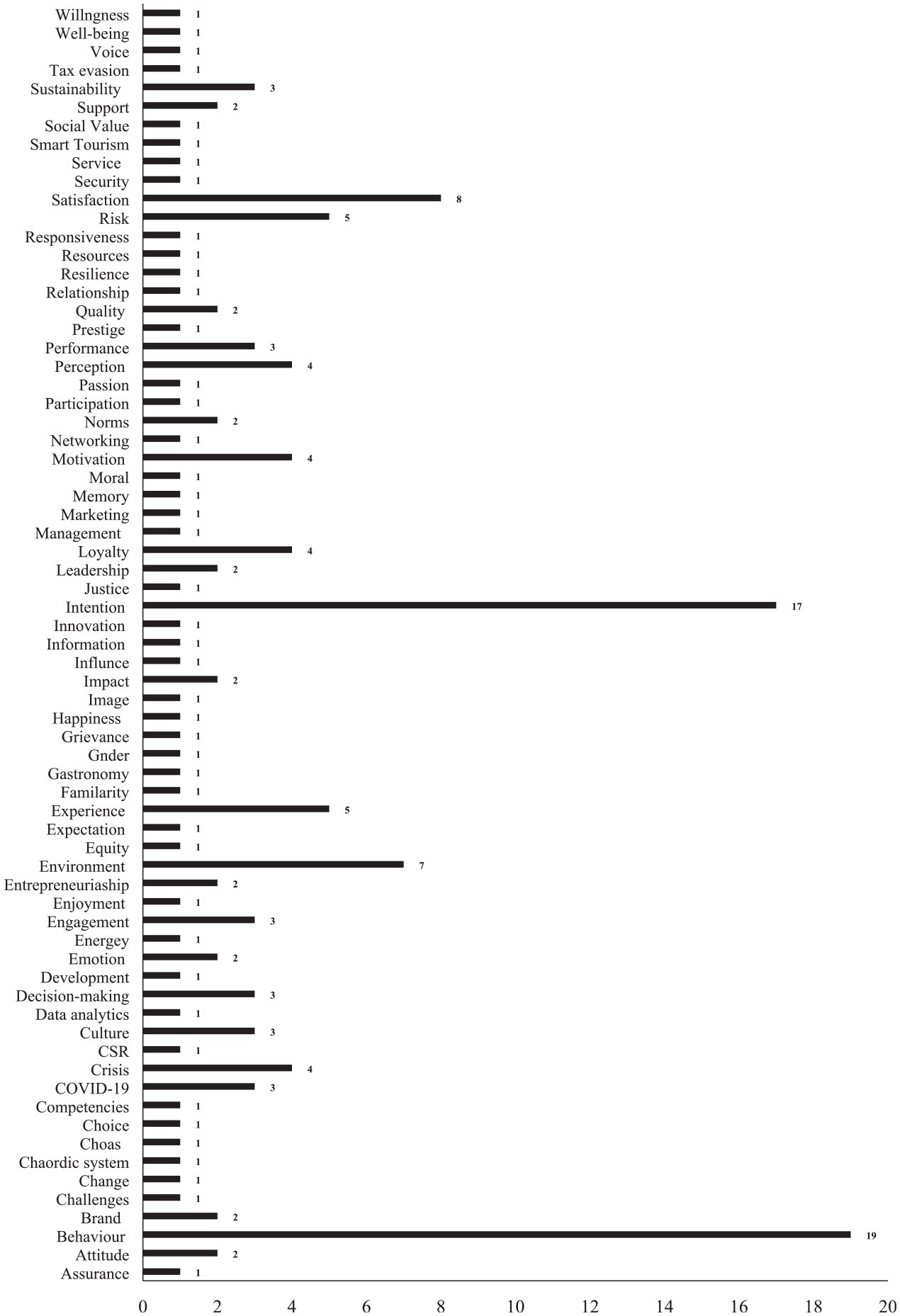
Research themes employed in fsQCA studies.
Theories of fsQCA
fsQCA has been used for theory development (Marx et al., 2014; Ruhlandt et al., 2020) and empirical testing (Ragin, 1998; Rihoux & Ragin, 2012). Conditions can be chosen inductively based on in-depth knowledge of cases or deductively based on existing theories that predict multiple cause combinations for a single outcome (Rihoux & Ragin, 2012). However, only seven (9.7%) of the 72 articles reviewed in this study were devoted to theory development. In addition to the fuzzy logic foundation, upon which almost all studies are based, 38 clearly stated theories were used.
As the underlying assumption of fsQCA is complex causality, 37 articles (51.4%) employed complexity theory as a leading or supportive theory. In 26 articles (36%), complexity theory was used as the leading theory, and all antecedent configurations were based on complex theory (Cheng & Xu, 2021; Han et al., 2019; Küçükergin et al., 2021; Olya & Nia, 2021; Rasoolimanesh, Khoo-Lattimore et al., 2021; Rezapouraghdam et al., 2021; Robinot et al., 2021; Sim et al., 2018). Additional 11 articles (18.1%) used it as a supporting theory in combination with other theories, such as chaos theory (N. Pappas, 2017a, 2018, 2019a, 2019b, 2021; N. Pappas & Glyptou, 2021a; N. Pappas & Papatheodorou, 2017). In the latter case, complexity theory was employed to describe specific antecedent configurations rather than explaining the complete study sets of antecedents. Planned behavior (Eid et al., 2021; J. Liu et al., 2020; Olya et al., 2019; Yadav et al., 2019), cumulative prospect (Carvajal-Trujillo et al., 2021; Mehran et al., 2020; Olya et al., 2018), and motivation (Shi et al., 2022) theories were also commonly used in fsQCA. Table 3 and Figure 5 reveal the most frequently used theories, including complexity, fuzzy set, planned behavior, chaos-risk, motivation, cumulative prospect, and other theories, along with their respective themes, methods, and contexts.
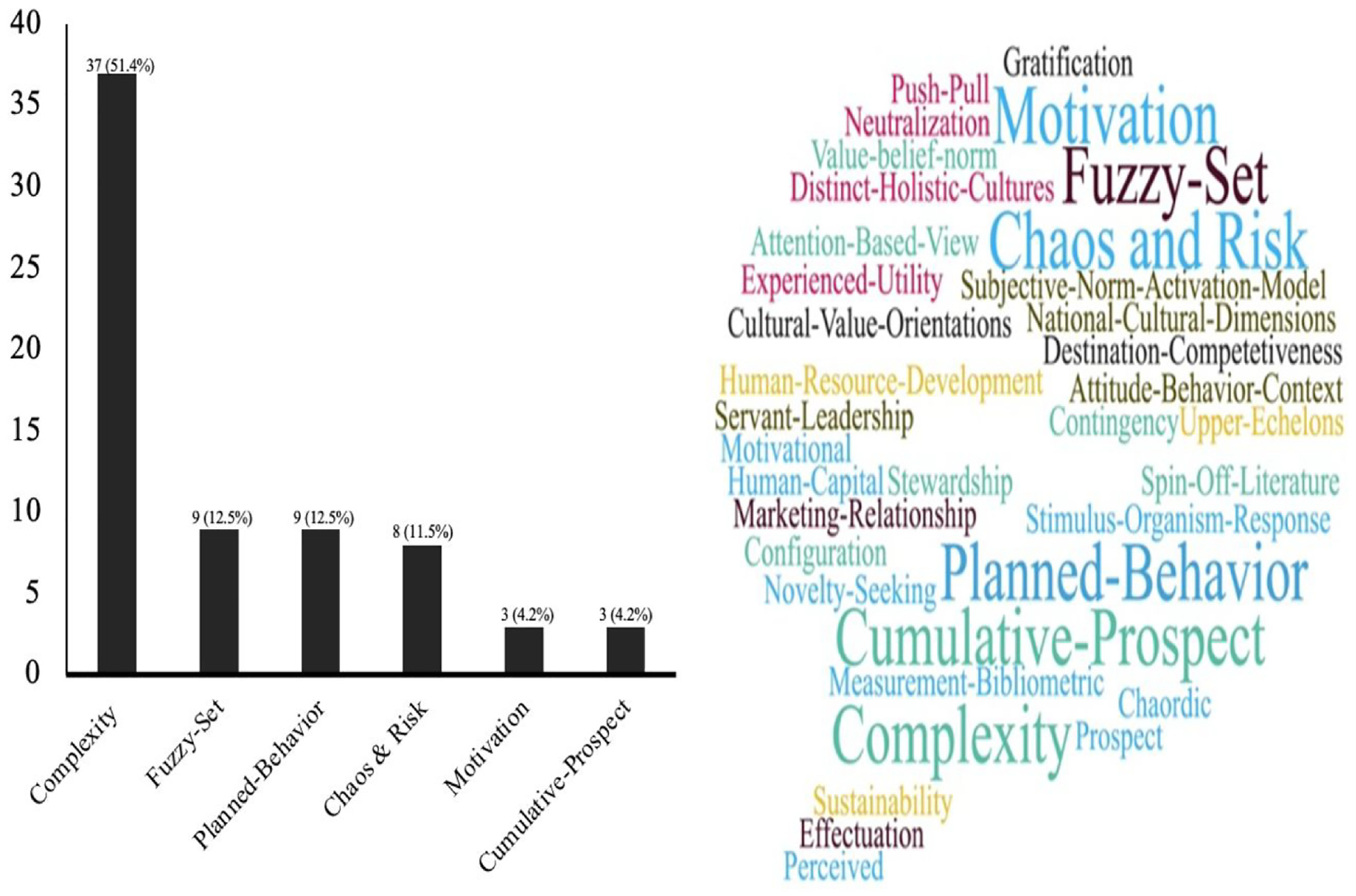
Theories used in fsQCA studies.
Integration of fsQCA With Other Methods and Analyses
Many tourism, leisure, and hospitality studies employ symmetric analysis to describe a phenomenon by incorporating numerous explanatory elements based on net effects (N. Pappas, 2017b; Woodside, 2016). Regression analysis and structural equation modeling are widely used to investigate statistical correlations from a Newtonian perspective (N. Pappas, 2017b, 2018). Although determining whether the variables under investigation are positively or negatively associated at a given level of confidence is possible (Woodside, 2016), these symmetric relationships do not demonstrate the presence of necessary and sufficient antecedent conditions. Necessary conditions are abundant, but few configurations are sufficient to cause an outcome. Thus, a sufficient condition is rarely necessary because it has several prerequisite conditions (Ragin, 1998; Rihoux & Ragin, 2012; Woodside, 2016). In such a symmetrical analysis, all relationships between sets are assumed to be linear, but this is not always the case (Ragin, 1998; Rihoux & Ragin, 2012). As mean-centered symmetric modeling estimates an incomplete picture of the effect, scholars also develop asymmetric techniques that process and evaluate each case rather than the variables (Olya, 2023; Rasoolimanesh, Ringle et al., 2021). Thus, scholars may focus on developing structural configurations to optimize a specific outcome rather than antecedents that enable them to test hypotheses (Azimi Hashemi & Hanser, 2018).
In the beginning, QCA was integrated with qualitative methods that attempt to explain observed phenomena through case studies (Goldthorpe, 1997; Rihoux & Ragin, 2012). Rihoux (2006) stated that although QCA was first combined with case-oriented qualitative methods, it has been recently integrated with more quantitative approaches. Among the journal articles reviewed in this study, only seven used fsQCA and qualitative interviews, and one was a purely qualitative study (Rihova et al., 2019). fsQCA strengthens qualitative and quantitative research but is still closer to qualitative approaches. It has been suggested fsQCA works well with case-oriented data to develop new theoretical arguments for hypotheses and ways to allocate the numerical score of “1” and “0” (Rihoux & Ragin, 2012).
Integrating symmetrical and asymmetrical analyses is expected in fsQCA because it is a case and variable-oriented method and analysis (Rihoux & Ragin, 2012). This combination yields a comprehensive knowledge of the complex causal relationships between antecedents and targeted outcomes (Olya, 2023; Rasoolimanesh, Ringle et al., 2021). Furthermore, it can produce more actionable prescriptions for future scholars and managerial recommendations. Among the 72 articles reviewed, scholars combined fsQCA with other symmetrical and asymmetrical approaches in 49 studies. Covariance-based structural equation modeling (CB-SEM) accounted for 25 studies (34.7%), and PLS-SEM analysis accounted for 12 (16.7%) studies. Thus, more than half of the articles (51.4%) utilized SEM analysis in conjunction with fsQCA. This combination drew much attention because the two methods and analyses provide a complete and more detailed picture of the data (Agag et al., 2020; Eid et al., 2021). Furthermore, 11 (15.3%) studies were analyzed and integrated with another asymmetrical analysis: necessary condition analysis (NCA). As depicted in Figure 6, two studies were analyzed and combined with machine learning (Rezapouraghdam et al., 2021) and interview (Rihova et al., 2019). Lastly, 23 studies (31.9%) were conducted entirely using fsQCA without combining other symmetric or asymmetrical analyses (Beritelli et al., 2020; Beynon et al., 2018; Ferguson et al., 2017; N. Pappas, 2019a).
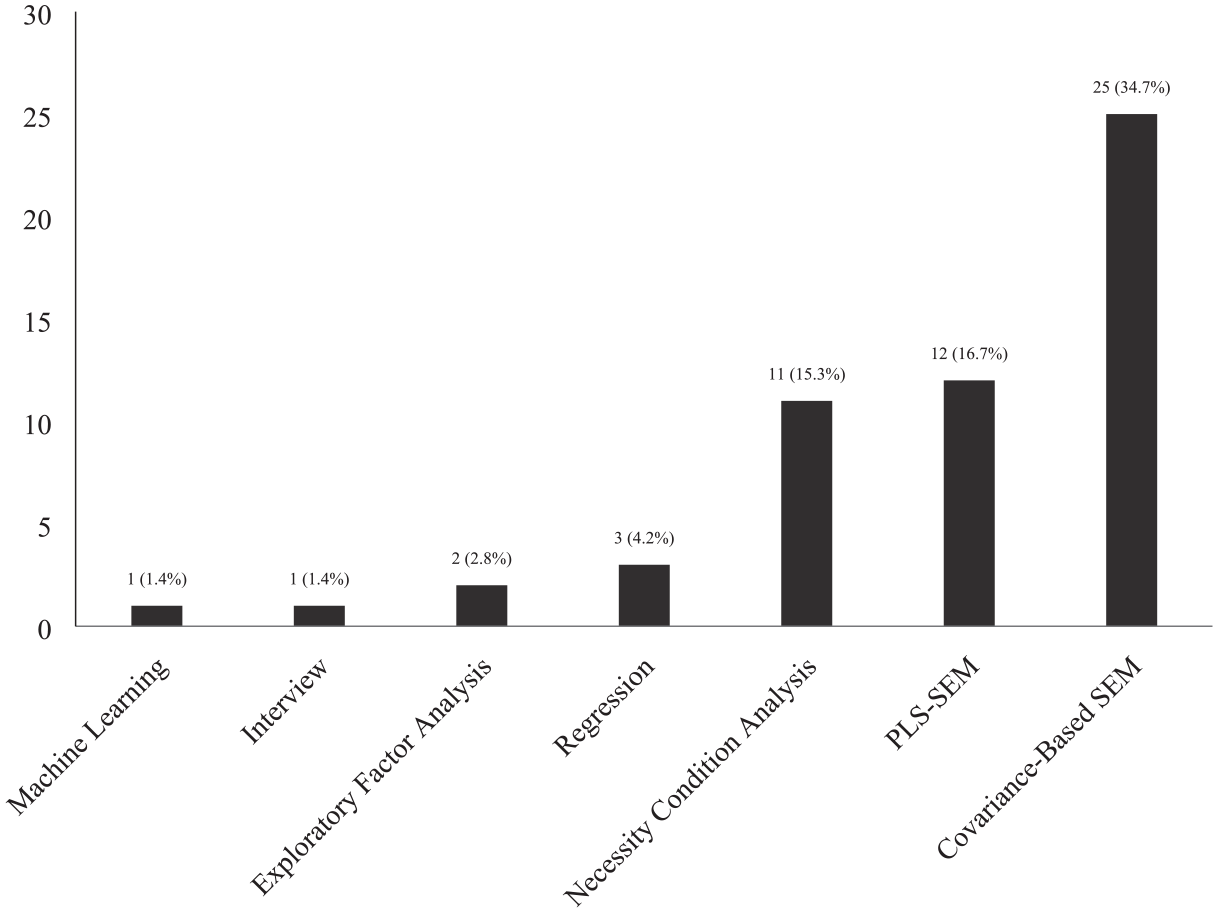
Conventional methods and analyses used with fsQCA.
fsQCA approach was designed for small and intermediate sample sizes (<50), but recent studies have shown its application for large sample sizes (Hosany et al., 2021; Kallmuenzer et al., 2019; Kraus et al., 2018; Küçükergin et al., 2021; N. Pappas, 2021). fsQCA aims to track several paths that lead to the same outcome rather than establish the phenomenon’s average tendency (Rihoux & Ragin, 2012). For example, in J. Zhang and Zhang’s (2021b) study, 20 samples were collected from 10 countries. Hsu et al.’s (2013) study had an extensive database with over4,000 respondents from 12 countries. Four studies (Olya et al., 2018; Penela et al., 2019; Ruiz-Palomino et al., 2019; J. Zhang & Zhang, 2021b) used small samples of less than 50 (x < 50). Two studies (Phillips et al., 2020; J. Zhang & Zhang, 2021a) used samples between 50 and 100 (50 < = x < 100). Even if fsQCA was initially geared toward small-N, it has broadened to intermediate and large-N sampling designs (Marx et al., 2014; Rihoux & Ragin, 2012). Twenty-eight reviewed articles (38.9%) had sample sizes greater than 500. Another 17 articles (23.6%) and 21 articles (29.2%) used samples between 100 and 300 and between 300 and 500, respectively. Interestingly, among all the reviewed articles, the study with the smallest sample size (N = 20) and the one with the largest sample size (N > 4000) used fsQCA without combining it with other approaches (Hsu et al., 2013; J. Zhang & Zhang, 2021b). These findings show that fsQCA works with small and large numbers of cases.
Statistical hypotheses were used when fsQCA was combined with other symmetrical analyses as a supporting method and analysis (Han et al., 2019; J. Liu et al., 2020; J. Zhang & Zhang, 2021b). However, when fsQCA was used as the sole or primary method and analysis technique, most scholars did not use hypotheses (Akhshik et al., 2021; Gannon et al., 2019; N. Pappas & Glyptou, 2021b; Wu et al., 2014). Accordingly, only 18 articles (25%) used the term “hypotheses” to express the relationship between antecedents and outcome conditions. Scholars who used fsQCA as their primary method and analysis tool presented their hypotheses in algebraic form or using Boolean statements (Rihoux & Ragin, 2012). Other scholars used “tenets” rather than “hypotheses” to distinguish between asymmetric and symmetric matrix-based index metrics (Hsiao et al., 2015; Olya & Gavilyan, 2017; Torres & Augusto, 2021). Similarly, 21 studies (29.2%) used the term tenet, while the remaining 33 (45.8%) used other terms, such as research questions or objectives. Thirty-one studies (43.1%) used the Venn diagram, a graph depicting all the possible logical relationships among sets (Rihoux & Ragin, 2012), to demonstrate the relationship between antecedents and outcome sets. Some scholars who used hypotheses also used the Venn diagram. However, most experienced fsQCA scholars preferred to use tenets and Venn diagrams rather than hypotheses and other SEM diagrams (Olya & Akhshik, 2019; Taheri et al., 2020).
Application of fsQCA in Tourism, Leisure and Hospitality Studies
Researchers have used symmetrical analyses in equations with multiple independent variables, which requires a multicollinearity test (I. O. Pappas & Woodside, 2021). A symmetric relationship reveals that high independent variable values are necessary and sufficient for high dependent variable values and vice versa (I. O. Pappas & Woodside, 2021; Woodside, 2013). However, in reality, cases have asymmetrical configurations rather than symmetrical associations with the outcomes (Woodside, 2013).
The primary goal of an asymmetric approach is to investigate how different antecedent configurations produce specific levels of outcome set (Fiss, 2011; Olya & Gavilyan, 2017; Rasoolimanesh, Ringle et al., 2021). In the relationship, high antecedent set values are sufficient for high outcome values. Still, a high value of the antecedent set is unnecessary for the outcome’s high value to occur. High values of an outcome may occur when the antecedent set is low, indicating that additional “causal recipes” are associated with high values of the outcome. For example, Rasoolimanesh et al. (2017) studied various factors influencing rural and urban residents’ perceptions of tourism development. They hypothesized that community attachment (CA), economic gain (EG), community involvement (CI), and environmental attitude (EA) would all influence residents’ perceptions (RP). PLS-SEM symmetrical analysis was used in this study to determine which independent variable was causing positive perception and compare the results across rural and urban contexts. However, independent variables occurred concurrently rather than one after the other. Hence, they combined the analyses of PLS-SEM and fsQCA to determine which configurations (from the sixteen, 24) resulted in a specific outcome in their second study (Rasoolimanesh, Ringle et al., 2021). This combination of symmetric and asymmetric approaches provided more detailed and multifaceted insights into the complex causal relationships between antecedents and outcome sets than PLS-SEM results (Olya, 2023; Rasoolimanesh, Ringle et al., 2021).
fsQCA approach can be used in research guided by post-positivism, constructivism, transformative, and pragmatism paradigms (Kane & Kahwati, 2019). Similarly, it is consistent with inductive, deductive, and abductive reasoning (Park et al., 2020; Saridakis et al., 2020). Thus, it can be employed for theory development either through theory generation or elaboration and testing (Greckhamer et al., 2013; Misangyi et al., 2017). The causal complexity of conjunction, equifinality, and asymmetry assists scholars in developing theories since it allows thinking outside of the square of symmetrical assumptions. For example, the conjunction principle helps scholars to think of the antecedents in terms of combinatorial logic or recipes, and the equifinality leads to different causal recipes resulting in the same outcome. The asymmetrical principle also justifies that the presence and absence of any antecedent may produce the same outcome, and it depends on its combinations with other antecedents (Misangyi et al., 2017).
fsQCA has also been used for theory testing. For example, Rasoolimanesh et al. (2017, 2021b) studied the applicability of social exchange theory (SET) to residents’ perceptions of tourism development. The study hypothesized that residents’ engagement and exchange in tourism development activity would be high when they perceived that the benefits outweighed the cost. The PLS-SEM result confirmed that all the independent variables had a significant positive relationship with residents’ positive perceptions. Similarly, fsQCA was performed to test the SET with the following steps:
The standardized PLS-SEM latent variable scores were extracted.
The latent variable scores were calibrated to [0, 1] and [0.50] crossover point.
The truth table was created with all the possible recipes, and recipes with two or fewer cases and consistency <0.80 were removed.
The consistency and coverage of all recipes were calculated, and an intermediate solution score was used.
They set coverage >0.20 and consistency >0.80 for the recipes’ sufficiency and >0.90 for both to indicate the necessary condition.
They randomly divide the sample into two groups and run fsQCA based on the first sample and check sufficient recipes than they draw an XY plot based on the second group and check coverage and consistency scores to confirm the predictive power of their model.
The results revealed that residents’ perceptions of tourism development activity were highly buoyant because of their strong community attachment and environmental attitude [↑(CA*EA) →↑RP]. Residents had a positive perception of tourism development when they spoke the local language and identified themselves as members of the community who were sensitive to environmental issues. They were highly positive, regardless of their economic gain or community involvement [↑(EG*CI) +↓(EG*CI) →↑RP]. The residents did not worry about how much they gained from tourism development when they were engaged. The absence of community attachment and environmental attitude yielded low positive residents’ perceptions toward tourism development [(~CA*~EA) →↓RP]. High community attachment, economic gain, and community involvement resulted in highly positive residents’ perceptions toward tourism development [↑(CA*EG*CI) →↑RP]. Comparably, high community attachment, high environmental attitude, and low economic gain resulted in low positive residents’ perception toward tourism development [(↑CA*↑EA*↓EG) →↓RP]. Therefore, generating high and low levels of positive residents’ perceptions needed more complex recipes. However, there was no necessary condition since all the recipes’ consistency and coverage scores were below 0.90. The results supported the SET since the high community attachment and environmental attitude led to low residents’ perception toward tourism development in exchange for low economic gain.
fsQCA can be applied to diverse sample sizes, from very small (≥5) to large numbers of cases, and a wide range of data types, including Likert scales, clickstreams, and multimodal data, as long as they can be transformed into fuzzy sets. Furthermore, it can be used with categorical data that do not require transformation into fuzzy sets (I. O. Pappas & Woodside, 2021). In terms of outlier detection, the sample’s representativeness does not affect all solutions in fsQCA. Hence, it is more resilient than variance-based approaches (Y. Liu et al., 2017; I. O. Pappas & Woodside, 2021). Moreover, it explains without dismissing “exceptions,” “outliers,” or “contrarian cases” that deviate from the overall trend of the data (Marx et al., 2014; Woodside, 2016). For example, previous symmetrical analysis studies revealed that the high cost of medical tourism is a determinant factor for negative behavioral responses (Olya & Nia, 2021). However, some consumer groups are not sensitive to the cost of medical services. As a symmetrical analysis is based on aggregated results, price-insensitive consumers are not considered and analyzed. Thus, fsQCA is needed to address this heterogeneity or outlier group (Olya & Nia, 2021). Similarly, it assists in understanding the demand disparity between luxury and economy tourists. fsQCA is also a more comprehensive, explanatory, and horizontal complexity analysis than symmetric analyses (Roig-Tierno et al., 2017; Vis, 2012). Therefore, scholars can use fsQCA in conjunction with symmetrical studies, especially if their research is sensitive to causal equifinality (Fiss, 2011; I. O. Pappas & Woodside, 2021).
In sum, when the study model has more variables and complex configurations, it has been suggested that fsQCA is an important method and analysis technique for theory development and testing. However, there is no one-size-fits-all problem-solving method and analysis technique, and fsQCA is no exception (Rihoux & Ragin, 2012). It is better suited for tourism, leisure, and hospitality studies when combined with other symmetrical approaches. Furthermore, it is more appropriate for studying complex issues such as behavior, experience, motivation, satisfaction, intention, performance, crisis, perception, engagement, attitude, competencies, and sustainability.
Critiques of fsQCA
Intellectual debates about the methodological limitations and potential of fsQCA compared with other symmetric analyses have been raised since its inception. First, fsQCA gives equal weight to all configurations of antecedents that lead to an outcome, regardless of cases (Rihoux & Ragin, 2012). This case sensitivity of fsQCA has been a source of contention. Opponents criticize that a single case can change the results because it is sensitive (Clarke, 2020; Krogslund et al., 2015). However, proponents regard this as one of fsQCA’s distinct explanatory advantages (Marx et al., 2014; Ragin, 2008; Rihoux & Ragin, 2012). These scholars argue that case sensitivity is advantageous because it facilitates case selection, theory development, and minimization. Unlike symmetric analysis, which considers cases deviating from the main path as outliers, fsQCA considers such cases as undiscovered phenomena. This counterfactual result allows multiple interpretations and accounts for all causal combinations present with simplified expressions (Marx et al., 2014; Rihoux & Ragin, 2012).
Second, fsQCA assumes case independence, which means that the cases are compared independently. Of course, this is not unique to fsQCA but to asymmetric analysis and other techniques (Marx et al., 2014). The inclusion or omission of some cases impacts the paths identified for the outcomes of other cases (Rihoux & Ragin, 2012). Third, fsQCA does not determine and explain the causality of complex conditions and processes; instead, it acts as a flashlight, illuminating some critical areas of the investigation (Goldthorpe, 1997; Rihoux & Ragin, 2012). Therefore, scholars should combine in-depth knowledge of the investigated phenomena with the conditions. Although theories are essential to explain the conditions and analyze the outcomes, scholars’ understanding of the context is critical to consider the logical remainders.
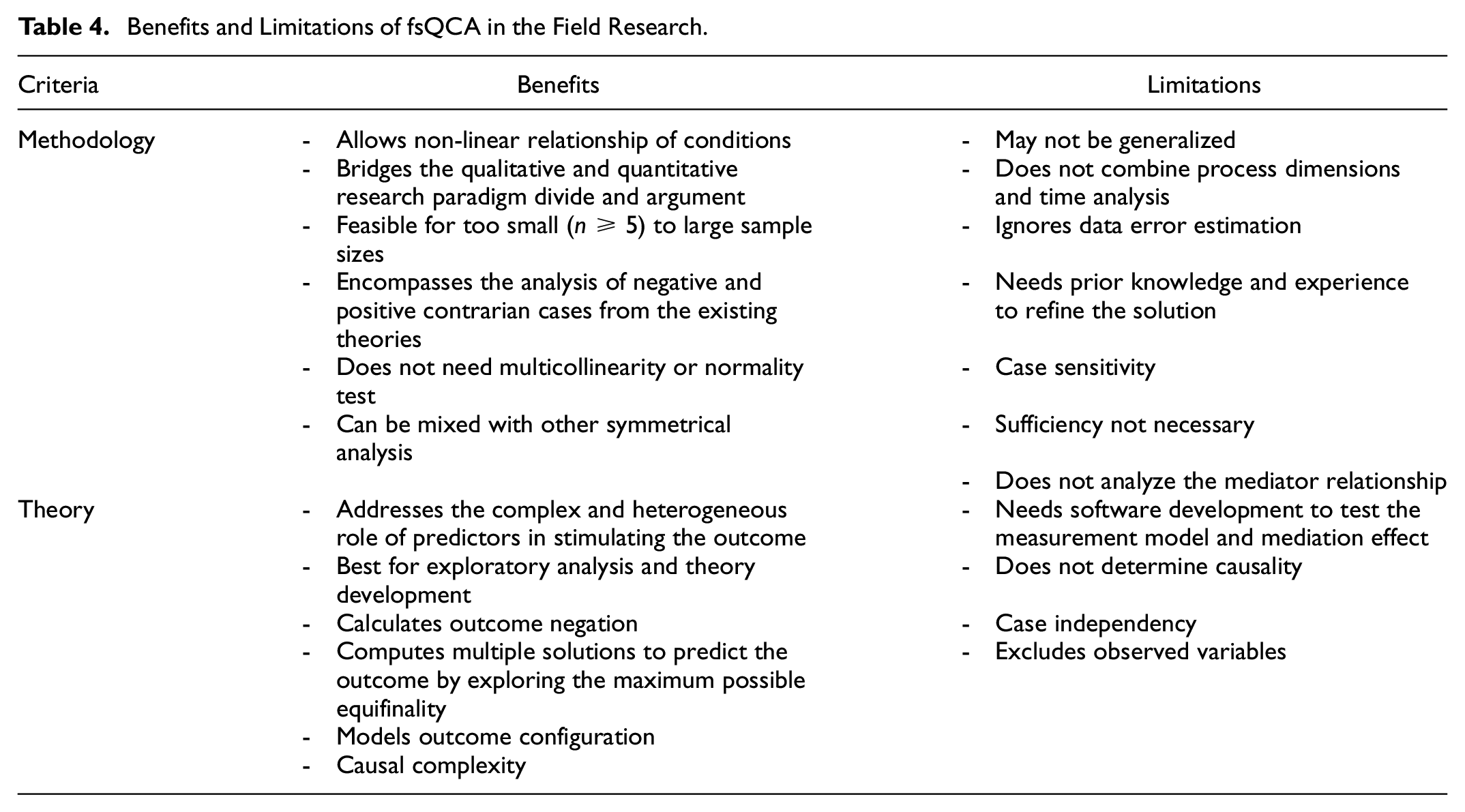
According to Rihoux and Ragin (2012), the fourth and most serious limitation of fsQCA is that it does not explicitly combine process dimensions and time analysis. Finally, fsQCA ignores measurement error and does not have a means for mediator relationship analysis (Rasoolimanesh, Ringle et al., 2021). Table 4 shows the benefits and limitations of fsQCA according to certain authors (Gannon et al., 2019; Mehran et al., 2020; Olya & Altinay, 2016; Olya et al., 2018; Olya & Gavilyan, 2017; Olya et al., 2018; Olya & Nia, 2021; Olya et al., 2019; Olya et al., 2020, 2021; Taheri et al., 2020).
Benefits and Limitations of fsQCA in the Field Research.
Tenets and Theoretical and Practical Implications
The antecedent sets of digitalization (D), digital transformative leadership (DTL), resilience (R), and an outcome set of digital organizational citizenship behavior (DOCB) dimensions in the hospitality industry are used to demonstrate the contribution of fsQCA. The multiple configurations and realities of the relationship are depicted in Figure 7.
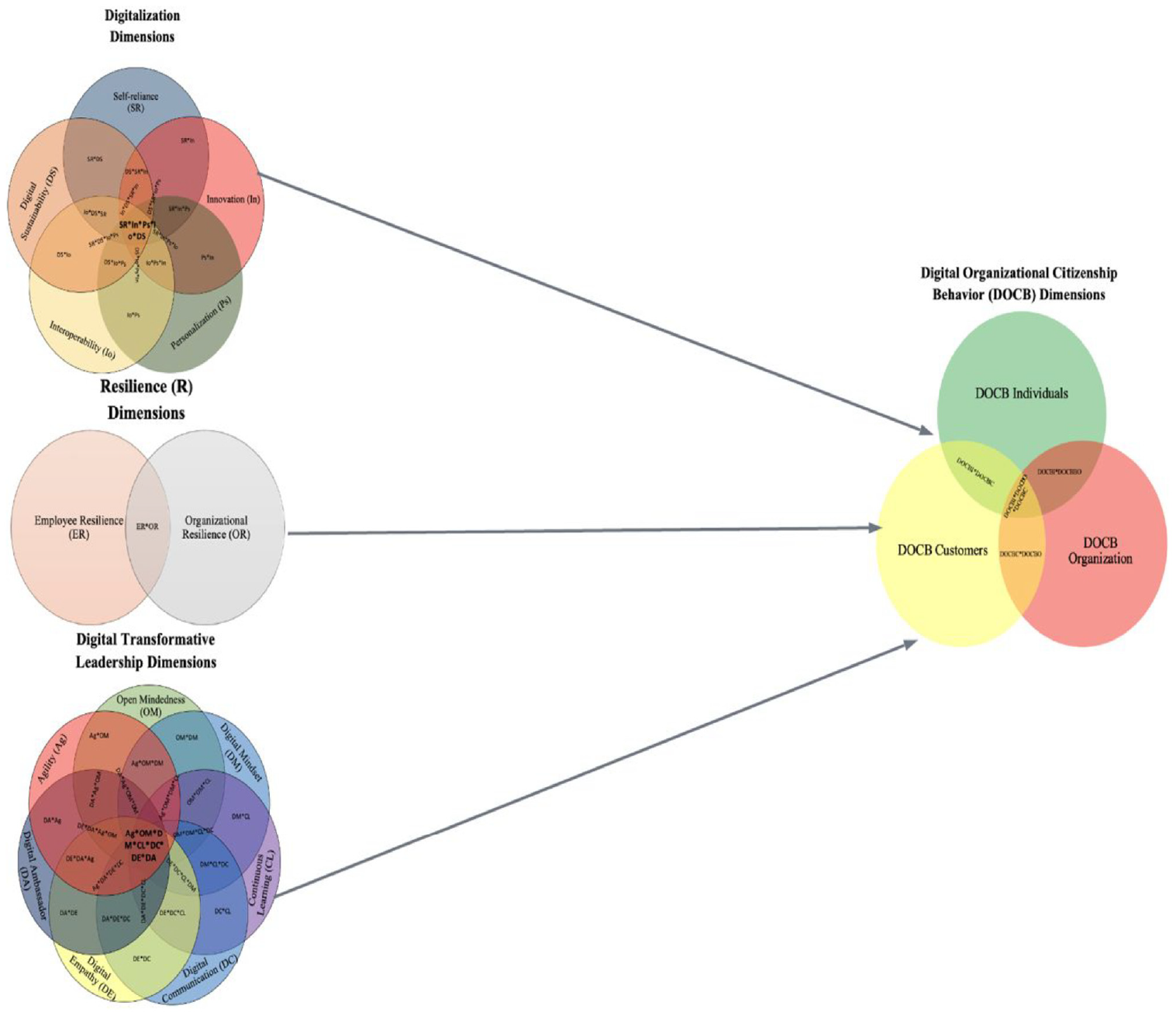
Configurational model of antecedent and outcome sets.
Tenet 1: A Simple Recipe May be Statistically Significant in a Symmetric Relationship and Necessary but may not be Sufficient to Predict a Specific Low or High Outcome Consistently
A simple recipe is not a set but part of a statement specific to the set (Woodside, 2014; Woodside et al., 2018). In symmetric analysis, a high recipe score is sufficient in predicting or explaining a high outcome, but this is not true in asymmetrical analysis (Woodside, 2014). A high antecedent score is insufficient for consistently predicting a high outcome score, even if the relationship’s effect size is large. For example, in symmetric analysis, the more an organization is digitalized, the greater the chance it can sustain digital organizational citizenship behaviors (↑D →↑DOCB). However, this is not always true in asymmetric analysis because it depends on other antecedents. Even though the impact size between the antecedent set and the outcome is large, high digitalization may be insufficient for consistently predicting a high digital organizational citizenship behavior score.
High digital organizational citizenship behavior outcome also needs the organization’s high digital-oriented leadership and resilience. Thus, the sufficiency model explains the antecedent conditions of high digital transformative leadership (DTL) and resilience (R) to high digital organizational citizenship behavior (DOCB). Having high membership in all three conditions (↑D*DTL*R) indicates that the digital organizational citizenship behavior is high (↑D*DTL*R →↑DOCB). Therefore, D*DTL*R equals the lowest value for the configuration condition. If D = 0.9, DTL = 0.6, and R = .8, then D*DTL*R = 0.6. All antecedents must be high for this condition to result in a high outcome. Thus, an antecedent such as digitalization alone is not sufficient to result in high digital organizational citizenship behavior, but necessary.
Tenet 2: A Complex Antecedent Recipe Configured With Simple Recipes is Sufficient to Consistently Achieve a High Score in an Outcome Set
The complex recipes that arise from configurations of digitalization antecedents (self-reliance, innovation, personalization, interoperability, and digital sustainability), digital transformative leadership (open-mindedness, digital mindset, continuous learning, digital communication, digital empathy, digital ambassador, and agility), and resilience (employee and organizational) are sufficient for achieving a consistently high score in digital organizational citizenship behavior toward individuals, organizations, and customers. Therefore, digitalization alone has 32 (25, where 5 = the number of antecedent sets), digital transformative leadership has 128 (27), resilience has 4 (22), and digital organizational citizenship has 8 (23) simple recipes. Highly accurate outcome predictions need the configuration of complex recipes (Woodside, 2014). However, achieving a 100% in any of the field’s research antecedents is highly unlikely. It should be above 0.80 consistency score to predict the outcome set. Therefore, all antecedents’ simple recipes configure one another and create more complex recipes that may have a high score in the configuration to result in a high DOCB outcome.
Tenet 3: There are Several Ways to Achieve the Same Result in fsQCA, but This Sufficiency is not Necessary for a High Score—Equifinality
A complex recipe may be sufficient but not necessary for the outcome. However, different recipes do not occur with the same frequency across all configurations. The main issue is constructing a highly consistent configuration, but scholars should develop accurate recipes to show the outcome. The model selection depends on the consistency analogous with correlation (r) of symmetric analysis and coverage equivalent with a coefficient of determination (R 2). The consistency cutoff value should not be less than 0.85 for macro-level data, and a coverage of more than 0.2 confirms a recipe of sufficiency. However, a sufficient model is not necessary for an outcome with a high score (Woodside, 2014; Woodside et al., 2018).
Various configurations of digitalization, digital transformative leadership, and resilience are sufficient for higher digital organizational citizenship behavior but not necessary. A high digitalization may not be necessary as an antecedent for a high digital organizational citizenship behavior to occur. Still, simple and complex recipes and configurations may yield the same results. This equifinality tenet assists scholars in exploring and explaining the different configurational causes of outcomes and giving options to make decisions. Changing the direction of one independent and dependent variable relationship may not change the direction of the relationship in different models in symmetric model development. However, symmetric scholars may need to understand that adding various variables in models changes the causal relationships because of contrarian cases (Woodside et al., 2018).
Tenet 4: Configurations are Distinct and do not Contrary; Rejection is not the Exact Contrary of Approval—Causal Asymmetry
The reasons for rejection frequently reveal little about the reasons for approval, and vice versa. Thus, asymmetric models that explain rejection and support are necessary for a scholar to explain both cases in a separate model. The causal recipes of high digitalization, digital transformative leadership, and resilience that predict digital organizational citizenship behavior are unique to low recipes, ↑(D*DTL*R) is not the mirror reflection of ↓(D*DTL*R). No one antecedent is necessary or sufficient to result in high digital organizational citizenship behavior because a high score is unlikely to explain the causes of low scores. Thus, this is not a real contradiction to any different configuration outcome. Even negation of the recipes is not a complete absence in the configurations, but it is one minus the value of the recipes, ~(D*DTL*R) =1 – (D*DTL*R).
Tenet 5: An Antecedent in a Configuration can Contribute Negatively or Positively to a Specific Outcome, Depending on the Presence or Absence of Other Antecedents
Multiple configurational asymmetrical models are critical in explaining and predicting what and how antecedent configurations lead to low and high outcome scores. Digital organizational citizenship behavior can be achieved through high digitalization and digital transformative leadership, ↑(D*DTL) →↑DOCB. However, the same high level of digitalization and resilience may not result in a high level of digital organizational citizenship behavior, ↑(D*R) ≠↑DOCB. This can help scholars explain both high and low outcomes of digital organizational citizenship behavior with or without digital transformative leadership and other antecedents. The models may assist hospitality organizations to plan before the failure of digital transformative leadership happens and how to prevent avoidable root causes.
Tenet 6: A Simple Antecedent Set has Positive and Negative Associations With an Outcome Set
A specific causal combination of high digitalization, digital transformative leadership, and resilience may be necessary for a highly positive digital organizational citizenship behavior outcome, ↑(D*DTL*R) →↑DOCB. Similarly, high positive digitalization, digital transformative leadership, and negative resilience may result in low digital organizational citizenship behavior outcomes, ↑(D*DTL*~R) →↓DOCB. Thus, the outcome set can be shaped differently for digitalization, digital transformative leadership, and resilience antecedents. The question is whether these antecedents positively or negatively influence the outcome set with a different recipe directionality.
Tenet 7: A Few Exceptions Exist for High Antecedent Set Scores for a Given Recipe That Predicts High Outcome Scores
Any simple recipe may not affect the outcome unless these antecedents are incredibly high or low in other recipes (Woodside et al., 2018). Digital organizational citizenship behavior may not be achieved unless the organization is high on digitalization and has excellent digital transformative leadership and resilience. This tenet reminds the application of fsQCA as a combinatorial rather than additive rules of asymmetrical modeling.
Tenet 8: Developing and Measuring Complex Outcomes Recognize Contrarian Cases and Their Underlying Causes
Scholars examine various outcome antecedents together, but they mostly do separately. Examining the antecedents as configurations of a simple recipe assists them in shifting their analysis from shallow to deep understanding, justification, and prediction of outcome sets. High–low digital organizational citizenship behavior can occur in high–low digitalization, digital transformative leadership, or resilience. High–low digitalization may lead to conditions that can be constructive in gaining a deeper understanding and more accurate prediction of the outcome set, ↑D →↑DOCB, ↓D →↑DOCB, ↑D →↓DOCB, or ↓D →↓DOCB. If the antecedent of digitalization is replaced with more complex recipes of digital transformative leadership, the analysis most likely supports a more complex outcome of digital organizational citizenship behavior.
If fsQCA is integrated with other symmetric analyses, these tenets can be tested more thoroughly, yielding novel insights with higher predictive model power. In addition, it introduces new antecedents and outcome-set relationships that allow for more precise hospitality leadership decisions. The integration is also critical because it forecasts item measurement error and generates factor scores thru latent variable relationships. Furthermore, fsQCA can broaden and support individual integration results by identifying all potential combinations of digitalization, digital transformative leadership, and resilience resulting in digital organizational citizenship behaviors. Thus, fsQCA assists scholars in studying more complex relationships than a mere net effect by providing a way to identify nonlinearities (Olya & Altinay, 2016; Rasoolimanesh, Ringle et al., 2021) and latent variability in the model (Olya & Gavilyan, 2017; Rasoolimanesh, Ringle et al., 2021).
Conclusion
fsQCA has been used in various fields, including sociology, criminology, psychology, geography, political science, life sciences, economics, and management, as it combines case-oriented and variable-oriented analyses (Rihoux & Ragin, 2012). However, it has yet to be widely adopted in tourism, leisure, and hospitality research. Thus, this review aimed to identify best practices and how fsQCA’s complex variable conditions can be used to address emergent problems in tourism and hospitality. It reveals why and how fsQCA fits mixed-method research, showing its advantages over symmetrical analyses and explaining why it is an excellent methodological choice compared to other asymmetrical approaches (i.e., csQCA and mvQCA). It demonstrates the necessity of fsQCA for analyzing complex situations.
Scholars can benefit from this pragmatic approach, which allows a wide range of antecedents to be included in the model (Olya & Nia, 2021). Despite growing interest in combining fsQCA with more traditional statistical techniques, most reviewed articles focused on the analysis components. Scholars may also employ this method and analysis to better understand the phenomena under study. Furthermore, fsQCA bridges the gap between symmetric thinking and an asymmetric research paradigm based on algorithms (Hsu et al., 2013; Woodside, 2013; Woosnam et al., 2022). It provides a better understanding of different outcome circumstances (Vis, 2012). This review also analyzed why and how scholars utilize fsQCA and integrate it with other methods and analyses. The methodological and analytical merits of fsQCA were identified, which may inspire future scholars to adopt it.
In sum, fsQCA is used to summarize and validate data coherence, develop new theories, and test existing theories (Rihoux & Ragin, 2012). It has the potential to evolve as a method and analysis technique for investigating complex tourism, leisure, and hospitality issues with immediate theoretical and managerial implications. Although it is more than a novel method and analysis technique focusing on multiple conditions, fsQCA is not a panacea for all problems. Similarly, it does not diminish the importance of qualitative or quantitative methods. However, it is more appropriate for complex and contemporary issues in the field with a complementary approach.
Limitations and Future Research
This work reviewed the use of fsQCA in top-tier tourism, leisure, and hospitality journals. Although QCA has been around for three decades, it did not appear in top-tier tourism and hospitality journals until 2013. So, only articles published between 2013 and 2021 were included with the systematic review approach.
This review revealed several avenues for future research. First, there is a need for a more comprehensive assessment of fsQCA as a research method because many scholars have focused on its data analysis technique. Therefore, future research can consider the methodological advantages of fsQCA when designing a study. Second, many scholars frequently combined fsQCA with other symmetrical analyses of CB-SEM and PLS-SEM. Thus, more research on combining different symmetrical and asymmetrical approaches may be carried out, especially its integration with qualitative research that necessitates more case studies for theory development. Third, going beyond regression analyses and using algorithms may be necessary to establish appropriate consistency and coverage thresholds. Fourth, future studies may investigate ways to analyze mediator relationships of sets through fsQCA. Fifth, bibliometric and meta-analyses can be employed to quantify such systematic reviews further. Thus, the review recommends future scholars to apply fsQCA with symmetric analyses because the integration allows for a more robust assessment of the model, especially its predictive model power.
Footnotes
Declaration of Conflicting Interests
The author(s) declared no potential conflicts of interest with respect to the research, authorship, and/or publication of this article.
Funding
The author(s) disclosed receipt of the following financial support for the research, authorship, and/or publication of this article: The Hong Kong Polytechnic University, associated money for research postgraduate students.
