




Abstract
This study investigates how family and nonfamily firms learn. Specifically, it asks whether family influence fosters or hinders the transformation of the potential absorptive capacity augmented by research and development (R&D) into the realized absorptive capacity embodied by innovation outcomes. The conceptual model posits that family influence will enhance the absorptive capacity performance of R&D regarding exploitative innovations that tend to result from deep external search yet diminish the absorptive capacity performance of R&D regarding exploratory innovations that tend to result from broad external search. Regression analyses using a sample of 346 Dutch manufacturing small and medium-sized enterprises largely support the hypothesized model.
Introduction
Over the past years, academic interest in family firm innovation management has grown exponentially, as demonstrated by recent field-synthesizing work (De Massis, Frattini, & Lichtenthaler, 2013; Duran, Kammerlander, Van Essen, & Zellweger, 2016; Röd, 2016). This overwhelming attention is not surprising, as the strategic renewal of a firm’s products and related competences is instrumental to the long-term firm-survival that enables family owners to reach many of their (non)economic objectives (Chrisman, Chua, Pearson, & Barnett, 2012; De Massis et al., 2013). Catalyzed by recent meta-analytical findings (Duran et al., 2016), an emerging discussion focuses on the presumed impact of family involvement on the efficiency with which knowledge generated through internal research and development activities (hereafter R&D) is converted into new or improved products or technologies (e.g., Diéguez-Soto, Manzaneque, & Rojo-Ramírez, 2016; Duran et al., 2016; Matzler, Veider, Hautz, & Stadler, 2015). Most of this work, however, adopts a rather simplistic perspective, in which the R&D function of firms is implicitly assumed and oftentimes also explicitly modelled to serve only a single purpose: creating novel ideas that can be directly transformed into innovations.
Although considering the R&D–innovation relationship as a strict input–output process allows for the assessment of straightforward propositions regarding the innovation performance and efficiency of family firms (Duran et al., 2016), it ignores the complexity inherent in this association (Ahuja, Lampert, & Tandon, 2008; Mairesse & Mohnen, 2002). One major omission in this line of work pertains to a well-established second role of a firm’s R&D function. Cohen and Levinthal (1989, 1990) argue that firms invest in R&D to foster the absorptive capacity needed to acquire, assimilate, and exploit knowledge inputs available outside the boundaries of the firm. In turn, the longevity of businesses is increasingly contingent on their ability to leverage knowledge available within their external environment and manage their innovation process accordingly (Calantone, Cavusgil, & Zhao, 2002; Van de Vrande, De Jong, Vanhaverbeke, & De Rochemont, 2009). Hence, further knowledge development on the nature of family firms’ absorptive capacity is of both theoretical and practical relevance (Andersén, 2015; De Massis et al., 2013; Feranita, Kotlar, & De Massis, 2017; Hernández-Perlines, Moreno-García, & Yáñez-Araque, 2017; Kotlar, De Massis, Frattini, & Kammerlander, 2016).
To enable a departure from the strict input-output view as described above, this study embeds the role of R&D and innovation in an organizational learning perspective (Levitt & March, 1988), and particularly draws from the literatures on search (e.g., Katila, 2002; Katila & Ahuja, 2002; Rosenkopf & Nerkar, 2001) and absorptive capacity (Cohen & Levinthal, 1990; Todorova & Durisin, 2007; Volberda, Foss, & Lyles, 2010; Zahra & George, 2002) to address the following research questions: How do family and nonfamily firms learn? In particular, does family influence foster or hinder the transformation of the potential absorptive capacity that is augmented by a firm’s R&D activities, into realized absorptive capacity that is embodied by innovation outcomes? And is any positive or negative impact of family influence on the “absorptive capacity performance” of R&D contingent on the nature of the innovation process considered?
In light of these questions, both the “innovation input performance” and the “absorptive capacity performance” of the R&D investments of family and nonfamily firms are studied within two related, yet distinct forms of organizational learning: exploitation and exploration (March, 1991). Firms need to balance these learning behaviors in order to generate both short- and long-term profits. However, the dominant search capabilities underlying innovations that enable the exploitation of existing routines versus the exploration of new routines—and in effect the implications of family influence for both roles of R&D in “exploitative” versus “exploratory” innovation—likely differ (Danneels, 2002; March, 1991; Rosenkopf & Nerkar, 2001). First, it will be argued that the innovation input performance of R&D is stronger for family firms, especially regarding innovations enabling exploitative learning. Second, the absorptive capacity performance of R&D is argued to be weaker for family firms regarding innovations that enable the exploration of new routines and that should predominantly rely on “broad” external search, yet stronger for family firms with regard to exploitative innovations that are more likely to result from “deep” external search. These theoretical predictions are tested in a sample of 346 family and nonfamily manufacturing SMEs from the Netherlands.
As such, this study contributes to both the family firm innovation literature in specific, as well as to our more general understanding of absorptive capacity. First, by theorizing on the role of external sources of knowledge in family firm innovation, and by empirically accounting for the absorptive capacity performance of family firm R&D, this study departs from the “innovation in isolation” perspective that underlies a substantial share of empirical family firm innovation research to date (Duran et al., 2016). While not in any way seeking to discredit the importance of the lessons learned from past research building on this “closed innovation” perspective, investigating the behavior of family firms in more “open” models of innovation should yield important insights (e.g., Brinkerink, Van Gils, Bammens, & Carree, 2017; Feranita et al., 2017; Lambrechts, Voordeckers, Roijakkers, & Vanhaverbeke, 2017). Second, this study responds to a call by Volberda et al. (2010), who explicitly encourage scholars to investigate absorptive capacity’s intraorganizational antecedents. Specifically, it enhances our understanding of how and under which conditions certain pervasive differences in a firm’s governance structure (i.e., family ownership and influence) may either bridge or expand the gap between its “potential” and “realized” absorptive capacity (Zahra & George, 2002).
Theoretical Background
Organizational Learning: Exploration, Exploitation, and Broad Versus Deep Search
Organizational learning theory as per Levitt and March (1988) describes how organizations encode historical experiences into routines, procedures, and strategies (hereafter generically referred to as “routines”) that guide their future actions. These routines capture the “lessons learned” from history, and thus make those lessons accessible for organizations and their members irrespective of whether or not they experienced the history themselves (Levitt & March, 1988). In this conceptualization, organizations are adaptive systems that are likely to adopt those routines that lead to favorable outcomes, and reject alternatives. They also incrementally refine their skills and competencies within the chosen routines by gaining additional experience in executing them. In effect, the frequency with which those chosen routines lead to favorable outcomes and the probability that the firm chooses to stick with the successful routine in the future increase simultaneously. This coevolution of experience and productivity (cf. Arrow, 1962) renders firms increasingly specialized and efficient in the execution of those fixed routines (Levitt & March, 1988). While specialization enables firms to develop competitive advantages and market leadership in operational niches, it also carries the inherent danger that firms do not develop enough experience with potentially superior alternative routines to make “switching” routines attractive or feasible. Eventually then, misalignment between the static firm and a dynamic environment might leave the firm defenseless against competitors that do adopt superior alternative routines (Levitt & March, 1988).
Seminal work by March (1991) posits that, in order not to fall victim to this “competency trap,” firms should not only exploit tried-and-true routines but also need to consistently engage in the exploration of potentially superior alternatives. In fact, March stresses the importance of balancing exploration and exploitation in organizational learning, as firms that engage in exploration to the exclusion of exploitation are likely to find that they suffer the costs of experimentation without gaining many of its benefits . . . while [firms] that engage in exploitation to the exclusion of exploration are likely to find themselves trapped in suboptimal stable equilibria. (March, 1991, p. 71)
Indeed, several studies document the positive performance implications of a firm’s ability to be “ambidextrous” (e.g., Jansen, Van Den Bosch, & Volberda, 2006; Katila & Ahuja, 2002; Lavie, Stettner, & Tushman, 2010).
Innovation plays a pivotal role in both exploration and exploitation, as it enables firms to improve their competencies within existing routines, yet also creates opportunities around which it can create new routines that may be exploited in the future. The innovation processes supporting exploitative learning versus exploratory learning tend to differ substantially though, in particular with regard to the dominant underlying knowledge “search” behaviors (Danneels, 2002), where search is defined as a firm’s proactive efforts at accessing knowledge relevant to its own purposes (Katila, 2002; Katila & Ahuja, 2002).
First, innovations that allow firms to engage in exploitative learning (hereafter “exploitative innovation”) enhance a firm’s competencies in executing its established product–market routines. Such innovations involve, for instance, incremental adaptations to existing products and improved efficiency of their provision and production processes and are often aimed at reaping scale economies in established markets (Jansen et al., 2006). Given both the path-dependency of exploitative innovation and its focus on continuity, it tends to rely on “deep” search (Ferreras-Méndez, Fernández-Mesa, & Alegre, 2016), which refers to search strategies in which a firm draws extensively from its knowledge sources and revisits existing knowledge repeatedly (Danneels, 2002; Katila & Ahuja, 2002; Laursen & Salter, 2006).
Second, innovations that allow firms to engage in exploratory learning (hereafter “exploratory innovation”) provide the firm with new product–market opportunities around which potentially superior new routines can be built. Such innovations involve, for example, the development of radically new products, the introduction of products catering to new market segments, and the experimentation with new technologies (Jansen et al., 2006). Given both the need to break existing habits in exploratory innovation and the inherent uncertainty surrounding its outcomes, it rather tends to rely on “broad” search (Ferreras-Méndez et al., 2016; Luo, Lui, & Kim, 2017), which refers to search strategies in which a firm exposes itself to a variety of ideas and perspectives, and draws from a broad range of knowledge sources (Danneels, 2002; Katila & Ahuja, 2002; Laursen & Salter, 2006).
The “Two Faces” of Research and Development in Organizational Learning
A firm’s in-house R&D plays an important dual role in the innovation processes that enable it to exploit existing processes and explore new routines. First, R&D activities renew and extend the internal knowledge stock of a firm. The firm then draws from its enhanced knowledge stock by transforming its new findings into innovative products, services and processes, or artifacts that may be valorized in other ways, such as patented technologies (e.g., Ahuja et al., 2008). Depending on the nature of the innovation (cf. discussion above), it may allow the firm to increase its competency in exploiting existing routines, or serve as an exploration opportunity around which to build new routines (Jansen et al., 2006; March, 1991).
Second, in order to benefit from broad and deep external search, firms need to be able to recognize and understand the value of the external knowledge to which they are exposed, and assimilate, transform, and exploit that knowledge, as to appropriate its inherent potential value through the development and commercialization of innovative products (e.g., Ferreras-Méndez et al., 2016) or services (e.g., Mennens, Van Gils, Odekerken-Schröder, & Letterie, 2018). Cohen and Levinthal (1989) argue that firms therefore face an extra incentive to invest in R&D, as “R&D obviously generates innovations, [but] also develops the firm’s ability to identify, assimilate, and exploit knowledge from the environment—what [they] call . . . “‘absorptive’ capacity” (p. 569). To Cohen and Levinthal, a firm’s absorptive capacity depends on the possession and diversity of prior knowledge related to the external knowledge it seeks to leverage toward its own innovation purposes. Hence, in this conceptualization, the mere presence of an R&D function in a firm generates absorptive capacity. Moreover, as absorptive capacity is argued to be cumulative, it follows that the more a firm invests in R&D, the larger its absorptive capacity should be. Some scholarly work building on this idea indeed documents how R&D enhances a firm’s benefits from exposure to knowledge spillovers of other firms and organizations (Griffith, Redding, & Van Reenen, 2003, 2004; Grimpe & Kaiser, 2010). However, other empirical work finds no such, or even opposing, results (e.g., Laursen & Salter, 2006).
More recent conceptualizations of absorptive capacity shed some light on these mixed findings and dispute the idea of R&D investment being not only a necessary but also a sufficient condition for the development of effective absorptive capacity. In fact, Zahra and George (2002) argue that absorptive capacity should be thought of as being made of two distinct “absorptive subcapacities”—potential absorptive capacity and realized absorptive capacity. First, potential absorptive capacity refers to the firm’s knowledge acquisition and knowledge assimilation capabilities and, according to Zahra and George (2002), “captures Cohen and Levinthal’s (1990) description of a firm’s capability to value and acquire external knowledge but does not guarantee the exploitation of this knowledge” (p. 190). To achieve the latter, a firm needs realized absorptive capacity, which is a function of the firm’s knowledge transformation and knowledge exploitation capabilities, and shapes “the firm’s capacity to leverage the knowledge that has been absorbed” (Zahra & George, 2002, p. 190). In isolation, both potential and realized absorptive capacity are necessary yet insufficient conditions for benefiting from exposure to external knowledge. Hence, “bridging” potential and realized absorptive capacity poses a challenge to firms that attracts substantial academic attention (Lane, Koka, & Pathak, 2006; Todorova & Durisin, 2007; Volberda et al., 2010).
Following Zahra and George (2002), R&D predominantly creates potential absorptive capacity as it ensures the firm is experienced in being exposed to and interpreting the value of new ideas but does not automatically result in realized absorptive capacity—an argument later empirically substantiated by Fosfuri and Tribó (2008). In the context of the present study, we should thus not per se expect to find an unequivocally positive impact of R&D on the transformation of externally available knowledge into innovation outcomes—that is—the embodiment of the firm’s realized absorptive capacity (Zahra & George, 2002). Instead, the transformation of the firm’s potential into realized absorptive capacity requires the acquired knowledge to be shared effectively among those members of the firm that have a role in transforming and exploiting the knowledge toward value-creating applications (e.g., Grant, 1996). In that regard, social integration mechanisms within the firm serve an important role in reducing the gap between potential and realized absorptive capacity (Jansen, Van Den Bosch, & Volberda, 2005; Todorova & Durisin, 2007; Zahra & George, 2002). Such mechanisms lower the barriers to internal knowledge sharing, and thereby may increase the efficiency of both knowledge assimilation and knowledge transformation practices (Zahra & George, 2002). Effective social integration mechanisms may be both formal (e.g., matrix designs in reporting structures) and informal (e.g., social capital). Todorova and Durisin (2007) do advice some caution though, as certain aspects of social integration may harm rather than foster effective knowledge practices, depending on the knowledge activity performed and the character of the knowledge itself. Moreover, these authors identify the nature of power relationships—both within the firm, and between firms and the partners from which they seek to draw knowledge—as a further determinant of the degree to which firms manage to transform their potential absorptive capacity into realized absorptive capacity.
The latter contingency considerations provide an interesting angle from which to approach the absorptive capacity of family and nonfamily firms, as family influence has well-established implications for the power relationships within the firm (e.g., Carney, 2005; Ensley & Pearson, 2005; Schulze, Lubatkin, Dino, & Buchholtz, 2001) and between the firm and its external partners (e.g., Arrègle, Hitt, Sirmon, & Very, 2007; Gómez-Mejía, Haynes, Nunez-Nickel, Jacobson, & Moyano-Fuentes, 2007; Kotlar, De Massis, Frattini, Bianchi, & Fang, 2013; Lambrechts et al., 2017; Roessl, 2005), as well as for the internal social structure of businesses (e.g., Arrègle et al., 2007; Danes, Stafford, Haynes, & Amarapurkar, 2009; Dyer, 1988; Pearson, Carr, & Shaw, 2008; Tagiuri & Davis, 1996). The differences in social and power structures resulting from family involvement in turn are likely to affect whether and how knowledge enters, flows through, and is transformed within a firm (Chirico & Salvato, 2008, 2016; Cunningham, Seaman, & McGuire, 2017; Zahra, Neubaum, & Larrañeta, 2007), and hence, the degree to which family influence will be detrimental or beneficial in bridging the gap between a firm’s potential and realized absorptive capacity (Andersén, 2015). These arguments will be further developed in the hypothesis section, in which the impact of family influence on both the innovation input performance and the absorptive capacity performance of R&D will be scrutinized in light of the exploratory and exploitative innovation processes discussed above.
Hypothesis Development
Prior work establishes that family firms tend to invest less in R&D relative to nonfamily firms (e.g., Block, 2012; Brinkerink & Bammens, 2018; Duran et al., 2016; Gómez-Mejía et al., 2014; Matzler et al., 2015), yet also shows how this spending gap may be reduced or reversed based on certain contingency factors (e.g., Chrisman & Patel, 2012; De Massis, Ding, Kotlar, & Wu, 2016; Gómez-Mejía et al., 2014). Moreover, recent findings suggest that family businesses have efficiency advantages in converting the knowledge generated through R&D into innovations (e.g., Duran et al., 2016; Matzler et al., 2015). Duran et al. (2016) partly attribute these findings to family firms’ presumed superior ability to leverage external networks, thereby implicitly alluding to the absorptive capacity performance of R&D. This idea will, however, exclusively be considered in the development of the absorptive capacity hypotheses, as it is important for this study’s purpose to not only empirically but also theoretically disentangle the absorptive capacity performance and the innovation input performance of family and nonfamily firm R&D, starting with the latter.
The Innovation Input Performance of Family Firm R&D
The innovation input performance of family firm R&D may, however, be stronger even when disregarding any network effects. Recall that R&D activities augment a firm’s existing knowledge stock with new ideas. Firms can turn these new ideas into innovative artifacts, which usually occurs by combining the new idea with existing knowledge elements that together form a value-creating solution to an applied problem (Kogut & Zander, 1992). While the R&D process is already inherently path-dependent (Helfat, 1994), if we discount the role of external parties, a firm’s “closed” innovation proficiency will strongly depend on its ability to revisit and rejuvenate its own existing knowledge as to find “recombinatory” opportunities—in other words, its “deep” internal search ability (e.g., Katila & Ahuja, 2002).
Family firms may be better positioned to engage in effective deep internal search and creatively recombine new and existing knowledge assets (e.g., Chirico & Salvato, 2008, 2016; De Massis, Kotlar, Frattini, Petruzelli, & Wright, 2016; Patel & Fiet, 2011). First, longer tenures and a lower turnover of pivotal organizational members in family firms, and the strong internal social capital developed among those people, should foster the efficient integration of internally developed specialized knowledge (Chirico & Salvato, 2008, 2016; Ensley & Pearson, 2005; Pearson et al., 2008). Second, the shared emotional attachment to their firm, and greater concern for the well-being and success of future generations of organizational incumbents should enhance family firm members’ motivation to effectively transfer their tacit knowledge across time and people (e.g., Cabrera-Suarez, De Saa-Perez, & Garcia-Almeida, 2001; Jaskiewicz, Uhlenbruck, Balkin, & Reay, 2013). Third, a greater attention for, and valuation of the company-traditional knowledge that built the “legacy” of the firm should enhance family firms’ ability to creatively combine knowledge assets across temporal boundaries, as it essentially enlarges the firm’s perceived available set of (re)combinatory opportunities (De Massis, Kotlar, et al., 2016; Nerkar, 2003; Patel & Fiet, 2011).
The superior ability of family firms to retain and integrate specialized knowledge, to effectively transfer it through time and across people, and to reinterpret and rejuvenate historical knowledge assets should result in an overall lower knowledge “depreciation rate” (e.g., Boone, Ganeshan, & Hicks, 2008), as knowledge is less likely to be lost (cf. Cabrera-Suarez et al., 2001; Chirico & Salvato, 2008; Jaskiewicz et al., 2013; Patel & Fiet, 2011) or become obsolete (cf. De Massis, Kotlar, et al., 2016; Nerkar, 2003). However, the additional combinatory opportunities available to family firms through their strong attention for the past are inherently path-dependent, as they likely relate to the same technology domain in which the firm has incrementally developed mastery in the time spanning the “old” and the “new” (De Massis, Kotlar, et al., 2016; Patel & Fiet, 2011). Moreover, the outlined superior knowledge practices of family firms are more conducive to continuity in, rather than diversification of the firm’s internal knowledge base (Cabrera-Suarez et al., 2001; Patel & Fiet, 2011).
In sum, the arguments brought forward imply that family firms should be highly capable “closed innovators,” and hence, the direct R&D returns of family firms may indeed be superior to those of nonfamily businesses (Duran et al., 2016; Matzler et al., 2015). However, they simultaneously suggest that this superiority should pertain in particular to innovations of more exploitative nature that allow family firms to build on company-historic knowledge assets and capabilities. Hence, the following prediction is made:
The Absorptive Capacity Performance of Family Firm R&D
De Massis et al. (2013) suggest that family influence may have a severe negative impact on the absorptive capacity benefits of R&D activities. Basing their arguments on the unique agency situation of family businesses (e.g., Carney, 2005), they suggest that in a family firm the investments in R&D are expected to be less likely to increase the firm’s absorptive capacity because the most critical decisions in the management of technological innovation are centralized in the hands of [a family] agent rather than being contingent on the choices and capabilities of R&D people within the organization. (p. 23)
De Massis and colleagues thereby implicitly allude to the previously discussed importance of intraorganizational power relationships as a determinant of the degree to which firms manage to transform their potential absorptive capacity into realized absorptive capacity (cf. Todorova & Durisin, 2007). However, a deeper analysis of the absorptive capacity literature and existing knowledge on the internal and external knowledge management practices of family firms gives reason to believe that family firm R&D may not exhibit stronger or weaker absorptive capacity performance per se (Andersén, 2015). Instead, any absorptive capacity performance surpluses or deficits of the R&D activities of family versus nonfamily firms will likely be contingent on the nature of the innovation process considered.
Exploratory Innovation and Broad External Search
Recall that exploratory learning requires the departure from old routines and the development of innovations around which new routines may be built (Levitt & March, 1988; March, 1991). Prior literature documents that opportunities for developing exploratory innovations are therefore most likely to result from broad external search, as broad search increases the variety of ideas to which a firm is exposed, and hence, maximizes the chances of finding truly novel combinations (Katila & Ahuja, 2002; Kogut & Zander, 1992). The realized absorptive capacity achieved through leveraging broad search strategies—and thus the absorptive capacity performance of R&D activities in light of broad search—should therefore be predominantly embodied by exploratory innovative outcomes.
Family firms are likely at a disadvantage when it comes to leveraging broadly searched knowledge, for reasons that pertain to the implications of family influence for the nature of power relationships and social integration mechanisms within firms.
First, regarding the nature of power relationships, Todorova and Durisin (2007) argue that rigid power structures hinder the development of an internal flow of knowledge conducive to absorptive capacity, especially regarding substantially new knowledge (see also Dougherty & Hardy, 1996). Family owners are preoccupied with maintaining control over decision making, as this control allows the family to protect its socioemotional endowment (Berrone, Cruz, & Gómez-Mejía, 2012; Gómez-Mejía et al., 2007). Of particular relevance to their absorptive capacity, this control orientation makes family owners reluctant in recruiting external managerial talent, and in granting the nonfamily talent that does get attracted a lot of discretion in decision making (Gómez-Mejía, Cruz, Berrone, & De Castro, 2011). In line with the argument of De Massis et al. (2013) outlined above, the resulting lack of discretion of R&D managers to influence the selection and exploitation of external ideas lowers the benefits family firms will derive from being exposed to diverse knowledge, as only those ideas that both appeal to R&D personnel, yet also suit the particularistic agenda of the family owners and managers will be put to applied use. Moreover, the limited cognitive diversity of the family firm’s overall human resource base induced by their lower attractiveness toward external talent limits the breadth of combinatory opportunities that the firm is able to identify and pursue (Classen, Van Gils, Bammens, & Carree, 2012). Finally, family owner’s control orientation not only affects internal power relationships but also affects the degree to which they seek to maintain control over the technology trajectory followed by the firm. In effect, even if family firms have identified potentially valuable novel combinations, the large technological distance between the family firm’s knowledge base and many of those “breadth-induced” combinatory opportunities may render family agents rather unwilling to pursue these opportunities (Basco & Calabrò, 2016; Chrisman, Chua, De Massis, Frattini & Wright, 2015), as they do not want to give up their perceived control over the firms technology trajectory toward outsiders (e.g., Classen et al., 2012; Kotlar et al., 2013; Lambrechts et al., 2017).
Second, and disregarding the control arguments above, the social integration benefits identified in light of the “closed” innovation process may lead to a lower depreciation rate of the firm’s internal knowledge base, yet also increases its idiosyncrasy, as the knowledge is embedded within a homogenous group of blood-related individuals, and thus becomes increasingly family- and firm-specific over time (Andersén, 2015). Hence, for given levels of R&D intensity and breadth of externally accessible knowledge, the perceived “cognitive distance” between a firm’s own knowledge base and the externally available knowledge inputs is likely higher for family as opposed to nonfamily firms. While to a certain degree cognitive distance between existing internal and new external knowledge is needed for exploratory innovation purposes, too big of a distance impedes the recipient’s ability to integrate the external knowledge in its own innovation process (e.g., Nooteboom, Van Haverbeke, Duysters, Gilsing, & Van den Oord, 2007).
Taken together, these arguments suggest that the absorptive capacity performance of R&D may indeed be lower for family firms (De Massis et al., 2013), especially regarding the development of exploratory innovations that should rather rely on broad external search.
Exploitative Innovation and Deep External Search
Whereas exploratory innovation should thus predominantly rely on the exposure to diverse knowledge, innovations enabling the further exploitation of existing routines are more likely to result from deep internal (cf. previously discussed innovation input performance of R&D) and external search strategies. In deep search, a firm draws extensively from its different knowledge sources and revisits existing knowledge repeatedly (Katila & Ahuja, 2002; Laursen & Salter, 2006). Repeated interactions with trusted external knowledge sources allow for the incremental improvement of existing products and for the streamlining of production and distribution processes. However, a strong reliance on existing external partnerships also impedes the degree to which truly novel combinatory opportunities are identified and exploited (Hill & Rothaermel, 2003). In effect, the realized absorptive capacity achieved through leveraging deep external search strategies—and thus the absorptive capacity performance of R&D activities in light of deep search—should be predominantly embodied by exploitative innovative outcomes.
Relative to their nonfamily counterparts, family firms are likely better able to transform their R&D-induced potential absorptive capacity into realized absorptive capacity when it comes to leveraging deep search strategies. Again, one may turn to nature of power relationships and social integration mechanisms of family firms to explain why this might be the case.
First, the detrimental impact of the control maintenance orientation of family agents on the effective transformation of deeply searched external knowledge into exploitative innovation outcomes is likely to be less severe in comparison to the breadth-dependent exploratory innovation process outlined above. Specifically, the combinative opportunities identified by R&D personnel through deep search are less likely to invoke resistance of family agents, as repeatedly drawing from the same knowledge sources breads familiarity of the family firm with both the external knowledge sources and with the knowledge domain in which those sources are active (Basco & Calabrò, 2016). In effect, the attitude of family agents will in general be more favorable toward combinatory opportunities identified by their R&D personnel, who in turn are less likely to be overruled by those family agents. Hence, the assimilation and transformation of those deeply searched ideas is less likely to be cut short or hindered by the rigid internal power structures of family firms (cf. De Massis et al., 2013). Moreover, the familiarity with those knowledge sources and domains allows family firms to rely on heuristics to a greater extend (e.g., Bingham & Eisenhardt, 2011), and thus makes them less likely to suffer from the lower cognitive diversity resulting from their limited attractiveness toward external talent.
In terms of externally manifested control maintenance concerns, deep rather than broad search strategies allow for the development of trust-based long-term exchange relationships (Ring & Van de Ven, 1994). Again, family firms are driven by a desire to maintain control over the technology and strategic trajectory of their firm (Kotlar et al., 2013) and thus try to avoid situations in which they might encounter opportunistic behavior of external parties. Interorganizational trust therefore tends to be a more important determinant of the willingness to engage in open knowledge exchange for family as opposed to nonfamily firms (Arrègle et al., 2007; Hadjielias & Poutziouris, 2015; Lambrechts et al., 2017; Lester & Cannella, 2006; Roessl, 2005), and hence, deep rather than broad search strategies are more likely to encourage effective knowledge exchange of family firms. On a related note, as opposed to the more technologically distant combinatory opportunities identified through broad search, the exploitative nature of the opportunities generally arising from deep search should allow family firms to build on their own competences to a larger degree. In effect, family firms are better able to take a leadership role in collaborative innovation projects based on deep search and, hence, should experience a greater perceived control over the technology trajectory (Lambrechts et al., 2017).
Second, in isolation the power-related arguments above would still only render the absorptive capacity performance of family and nonfamily firm R&D equal at best. To understand why family firm R&D might actually exhibit stronger absorptive capacity performance in exploitative innovation, we again need to turn to the social structure of family internal- and external relationships. Arrègle et al. (2007) discuss how the ties between a family firm and its external stakeholders gain additional strength through the link between the family’s and the firm’s social capital. In parallel to the intraorganizational knowledge structure as discussed with regard to the “closed innovation” performance of R&D (Chirico & Salvato, 2008, 2016), also many of the interorganizational knowledge activities of family firms are based on stakeholder relationships that are deeply embedded in the owning family and its individual members (Arrègle et al., 2007). This family-embeddedness of stakeholder relationships should further increase the level of mutual familiarity with collaboration partners’ processes and technologies that is of critical importance for the successful codevelopment of efficiency-oriented exploitative innovations. In addition, deep rather than broad search efforts should enable family firms to leverage their “deeper” yet highly family- and firm-specific internal knowledge base (Chirico & Salvato, 2016; De Massis, Kotlar, et al., 2016; Patel & Fiet, 2011), as the aforementioned greater mutual familiarity between family firms and trusted long-term partners will unlock a plethora of exploitative combinatory opportunities.
Figure 1 summarizes the proposed conceptual model and its constituent hypotheses.
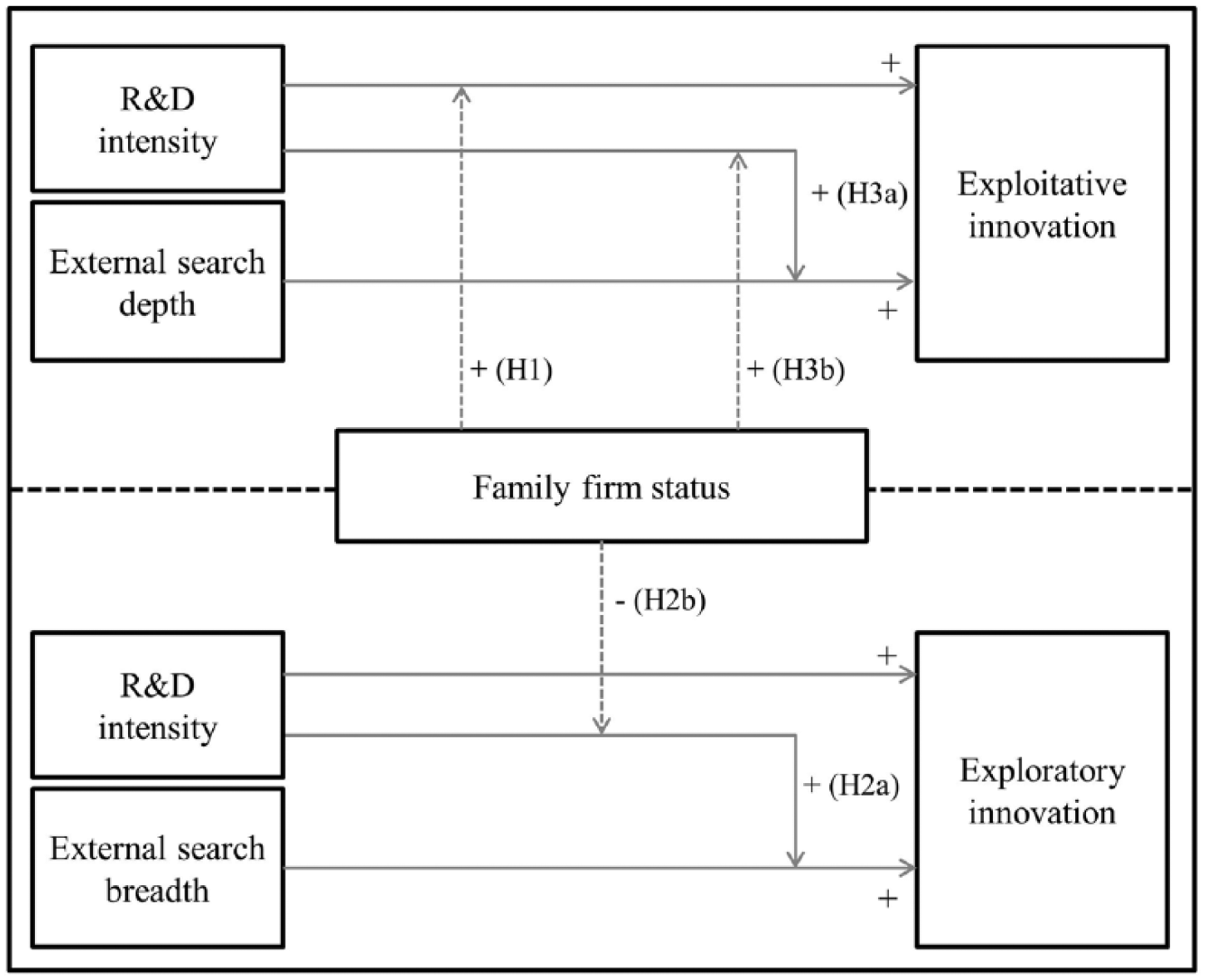
Conceptual model and hypotheses: The moderating impact of family firm status on the innovation input performance and absorptive capacity performance of R&D in exploratory and exploitative innovation.
Methodology
Sample
The data used in this study were collected by means of a survey of manufacturing small and medium-sized enterprises (SMEs) conducted between May and July 2014. Specifically, contact information of all Dutch SMEs active in NACE manufacturing industries 10 to 32 1 and with 21 to 250 employees was obtained from Bureau Van Dijk’s REACH database. Following these criteria, the initial population contained 3,895 businesses. The CEOs of these companies were contacted by postal mail and invited to either fill out the survey online or by using an enclosed hardcopy. A reminder was sent 2 weeks later. A total of 413 questionnaires were returned, for an initial response of 10.6%. Deletion of unusable cases due to missing data on the variables used in the analyses left 346 observations, 2 corresponding to 8.9% of the targeted population. 3
Measurement
Because most of the included variables were obtained through the same survey and provided by a single respondent for each firm, the presence of common method variance could cause systematic measurement errors leading to biased results (Podsakoff, MacKenzie, Lee, & Podsakoff, 2003). The core variables in this study are however predominantly based on rather factual and nonaffective measurements (e.g., R&D investments; existence/frequency of collaboration relationships) that should not be very conducive to social desirability. Nevertheless, to further reduce the potential for common method issues in the data ex ante, (1) the measurement of independent, dependent and moderator variables was separated as far as possible within the survey; (2) respondents were assured that their individual responses would not be disclosed to third parties or published by any other means; and (3) a number of different response formats were used in the survey (Podsakoff et al., 2003).
Dependent Variables
Both exploratory and exploitative innovation were measured using existing scales originally developed by Jansen et al. (2006) and widely used in other research on firm level exploratory and exploitative innovation (e.g., Alexiev, Jansen, Van den Bosch, & Volberda, 2010; Yang & Li, 2011). The scales capture the degree to which firms create innovations that allow for exploring new product–market combinations versus innovations that allow for improving their competences in catering to existing product–market combinations. However, as the original scales were developed for studying exploration and exploitation in the different business units of a large financial services firm, the phrasing of the items had to be slightly adapted to suit the context of private SMEs. Both scales were measured using six items, all scored on 7-point Likert-type scales ranging from (1) fully disagree to (7) fully agree. Specifically, to capture exploratory innovation respondents were asked to what extent they agreed with statements claiming that “our business accepts demands that go beyond existing products and services,” “we invent new products and/or services,” “we experiment with new products and/or services in our local market,” “we commercialize products and/or services that are completely new to our firm,” “we frequently utilize new opportunities in new markets,” and “this company regularly uses new distribution channels.” The composite scale was found reliable (Cronbach α = .78). Exploitative innovation was assessed by asking to what extent “we frequently refine the provision of existing products and/or services,” “we regularly implement small adaptations to existing products and/or services,” “we introduce improved, but existing products and/or services for our local market,” “we improve the efficiency of the provision of our products and/or services,” “we increase economies of scale in existing markets,” and “this company expands services for existing clients.” Also, the exploitative innovation scale was found reliable (Cronbach α = .79).
Independent and Moderator Variables
R&D intensity was measured as the amount of money invested in R&D, expressed as a percentage of the firm’s annual sales. Specifically, respondents were asked for the average of R&D investments as a percentage of annual sales over the past 3 years, to average out incidental peaks or troughs in R&D spending. The measures for external search breadth and depth are largely based on prior research (e.g., Chen, Chen, & Vanhaverbeke, 2011; Classen et al., 2012; Laursen & Salter, 2006). Respondents were asked to indicate the frequency with which their firm collaborates with each of these five different types of external parties: clients, suppliers, competitors, knowledge institutes or universities, and public sector organizations. Answer options (assigned value in brackets) were as follows: never (0), about once a year (1), about once every 6 months (2), about once every quarter (3), about once a month (4), about once every 2 weeks (5), about once a week (6), on a daily basis (7). A binary variable was computed for each partner type taking value 0 if respondents indicated their firm does not collaborate with the specific partner type (i.e., if “never” was marked) and 1 if it does (i.e., for all other responses). Following Classen et al. (2012), the external search breadth variable was then calculated as the sum of all binary terms, and thus ranges between 0 and 5. External search depth on the other hand was calculated—in line with the approach of Chen et al. (2011)—by dividing the sum of all five collaboration frequency values by the sum of the binary terms. In effect, it measures the average frequency of collaboration reported for those types of partners the firm actually collaborates with. A family firm variable was constructed in line with prior studies conducted in a private SME context. Specifically, a business is considered a family firm when (1) it is perceived as such by the responding CEO and (2) the family in question owns more than 50% of the company’s shares (e.g., Classen et al., 2012). If at least one of these conditions is not met, the business is classified as a nonfamily firm. 4 Following this operationalization, some 62% of the sample is identified as family businesses (N = 213 [214 in sample used for exploratory innovation analyses]; nonfamily N = 132); a figure comparable to other survey-based studies in the same empirical context (e.g., Classen et al., 2012).
Control Variables
A number of potential confounding variables are controlled for. Firm size is measured as the number of employees in full-time equivalents. Because of its skewed distribution, firm size received a natural logarithmic transformation prior to the estimations. Firm age is measured in years. To give an account of the financial health and structure of the responding businesses the firms’ solvency, measured as total shareholder funds over total assets, and liquidity, measured as current assets over current liabilities, are added as control variables in the analyses. 5 Finally, because the firms in the sample are active in a range of different subindustries within the manufacturing sector, separate controls are added for three dimensions of environmental dynamism. CEOs were asked to indicate on a 7-point Likert-type scale (fully disagree to fully agree) to what extent they perceived their industry to experience high competitiveness, growth, and technological change.
Analytical Procedure
The hypothesized model is tested by means of hierarchical ordinary least squares regressions, using heteroscedasticity-consistent (i.e., robust) standard errors. For both exploratory and exploitative innovation, in a first step control variables and main effects of R&D intensity, external search breadth and depth, and the family firm dummy are introduced. A second step in the exploratory (exploitative) innovation model introduces the R&D–external search breadth (depth) interaction term used to capture the absorptive capacity role of R&D. A third step adds the two-way interaction terms between the family firm dummy and R&D intensity and between the family firm dummy and external search breadth (depth). A fourth and final step adds the three-way interaction between R&D, external search breadth (depth), and the family firm dummy. For sake of completeness, for exploratory (exploitative) innovation an additional interaction model will be reported, in which the search breadth (depth) interaction terms are replaced by the relevant search depth (breadth) interaction terms.
In the exploratory innovation models, Hypothesis 2a will be tested using the R&D–external search breadth interaction term, and Hypothesis 2b using the three-way interaction of R&D, external search breadth, and the family firm dummy. In the exploitative innovation model, on the other hand, Hypothesis 1 is tested using the R&D–family firm interaction term, Hypothesis 3a is tested using the two-way interaction term of R&D and external search depth, and Hypothesis 3b using the three-way interaction of R&D, external search depth, and the family firm dummy. The correlations between and variance inflation factors of the independent variables displayed in Table 1 give no rise to serious multicollinearity concerns (Hair, Tatham, Anderson, & Black, 2010). Moreover, to prevent such multicollinearity issues from arising in the interaction models, prior to the computation of the various interaction terms, the R&D intensity, as well as the external search breadth and depth variables were mean-centered (Aiken, West, & Reno, 1991).
Descriptive Statistics.
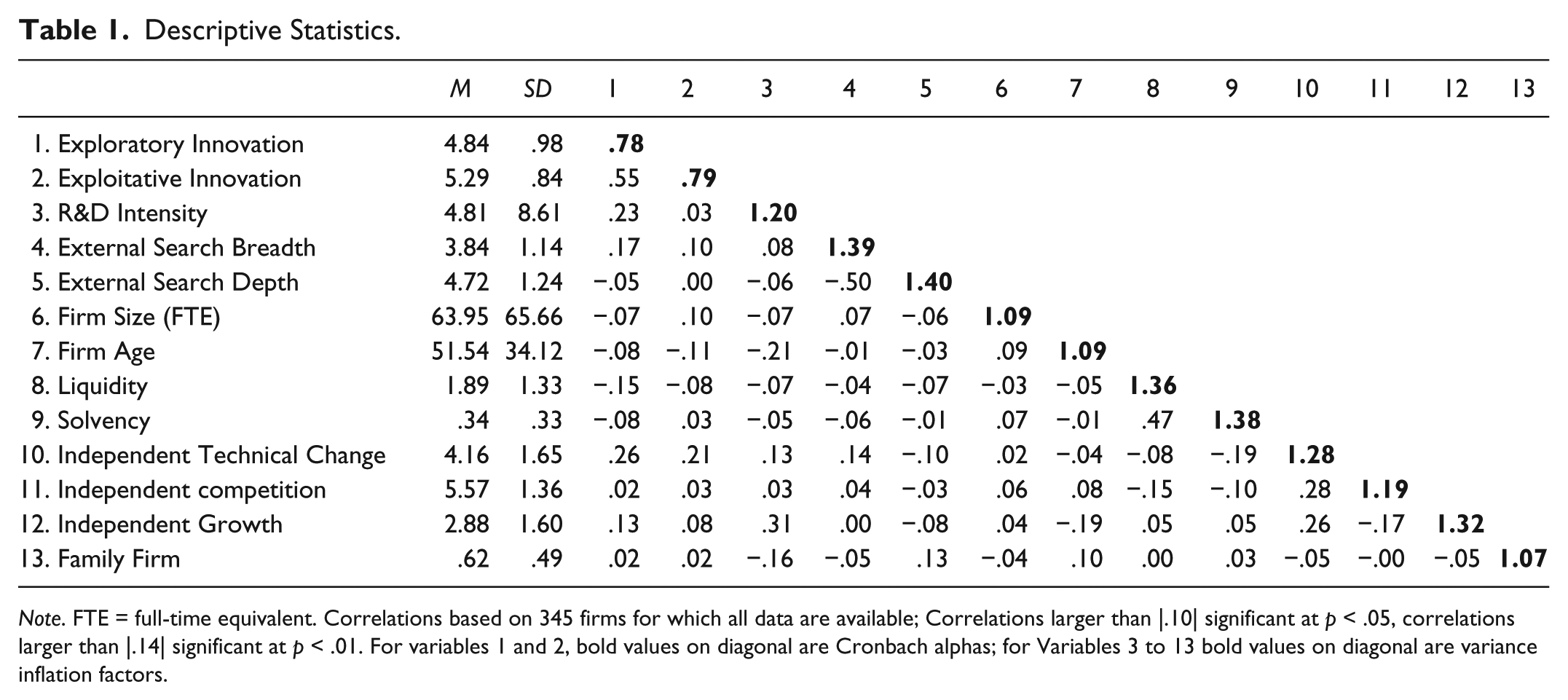
Note. FTE = full-time equivalent. Correlations based on 345 firms for which all data are available; Correlations larger than |.10| significant at p < .05, correlations larger than |.14| significant at p < .01. For variables 1 and 2, bold values on diagonal are Cronbach alphas; for Variables 3 to 13 bold values on diagonal are variance inflation factors.
Results
Descriptive Statistics
Table 1 documents means, standard deviations, and Pearson correlations for the sample. The average firm in the sample employs some 64 people, is about 51 years old, invests on average 4.81% of its annual sales in R&D, collaborates with 3.84 different types of partners, at a “search depth” value of 4.72, which corresponds with a frequency of collaboration between about once every 2 weeks and about once a month (cf. “Measurement” section). The correlations show small yet significant associations between family firm status and external search depth (positive; r = .13), and between family firm status and R&D intensity (negative; r = −.16). 6 Finally, the moderately high correlation coefficient (r = .55) between exploratory and exploitative innovation suggests that firms indeed have a tendency to balance their efforts in both learning behaviors, yet also confirms that both are distinct forms of innovation.
Hypothesis Testing
Tables 2 and 3 present the regression results for the exploitative innovation models and exploratory innovation models, respectively.
Exploitative Innovation Models.
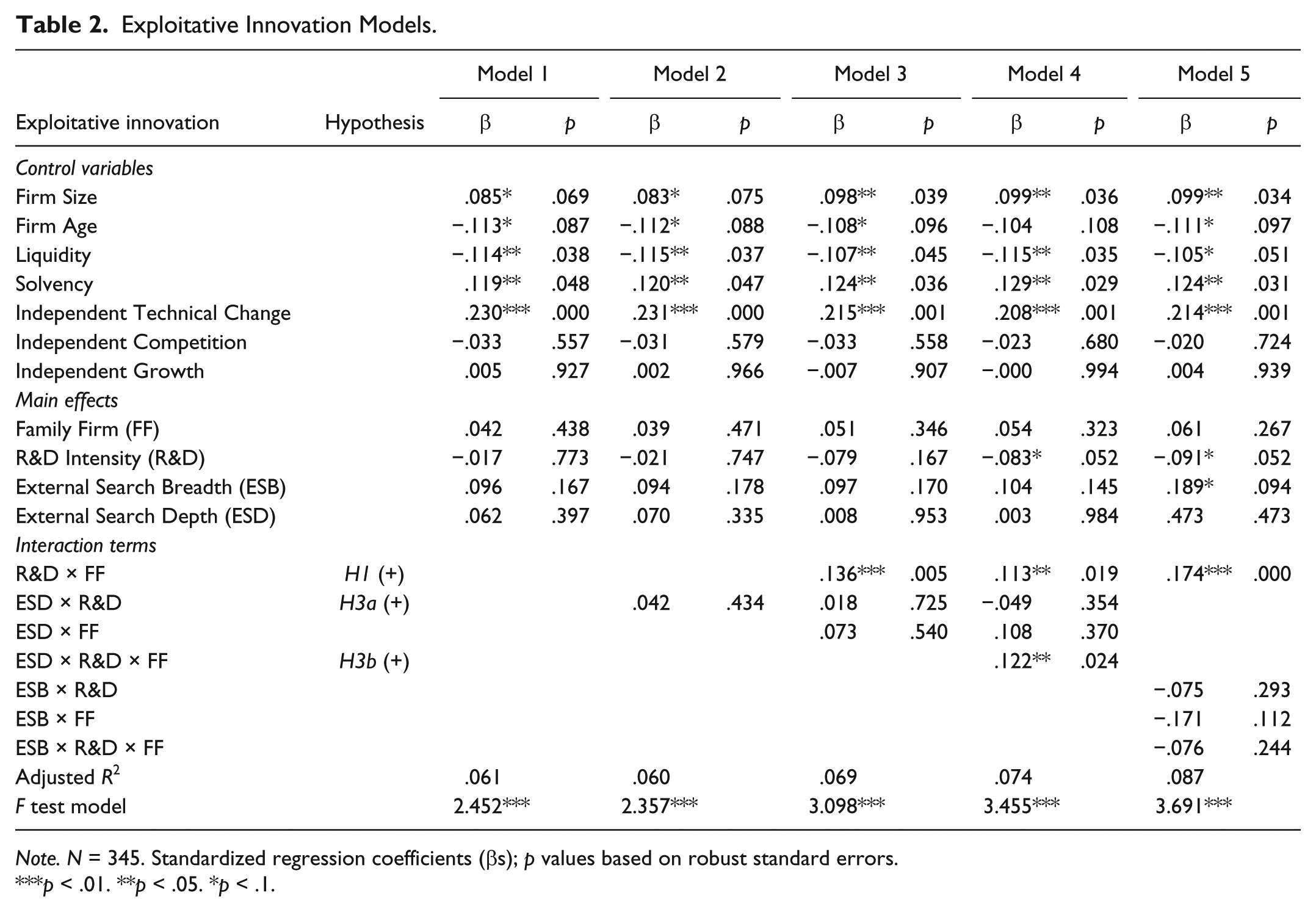
Note. N = 345. Standardized regression coefficients (βs); p values based on robust standard errors.
p < .01. **p < .05. *p < .1.
Exploratory Innovation Models.
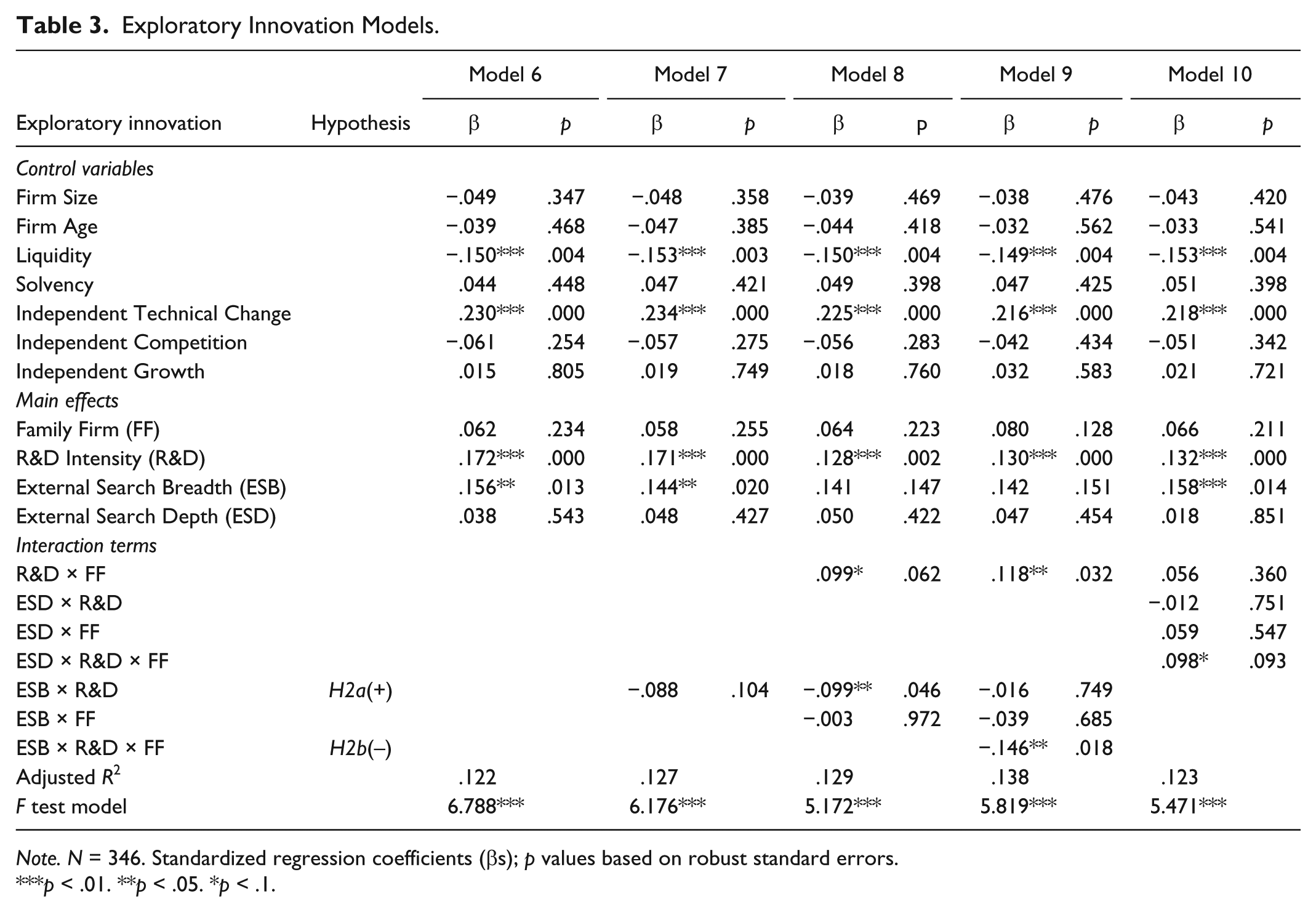
Note. N = 346. Standardized regression coefficients (βs); p values based on robust standard errors.
p < .01. **p < .05. *p < .1.
For testing Hypothesis 1, we turn to Model 3 in Table 2. In line with the predicted positive moderation of family influence on the association between R&D intensity and exploitative innovation, indeed a significantly positive R&D × family firm interaction coefficient is observed (β = .136, p = .005). Hypothesis 1 is thus supported. Interestingly, while only a “family firm advantage” in the association between R&D and exploitative innovation was predicted, Table 3 also documents some evidence for a greater innovation input performance of family firm R&D in the exploratory innovation process. Specifically, the R&D × family firm interaction coefficient in the “search breadth” regression is statistically significant at a 10% level (Model 8; β = .099, p = .062). 7
For testing Hypothesis 2a, which predicted a positive moderation of R&D intensity on the association between external search breadth and exploratory innovation, we turn to Model 7 in Table 3. In contradiction to the hypothesized positive interaction, we find a nonsignificant but negative R&D × external search breadth interaction coefficient (β = −.088, p = .104). Hypothesis 2a is thus rejected. For testing Hypothesis 2b, we use Model 9 in Table 3. In line with the hypothesis, which suggested that the moderation of R&D on the external search breadth–exploratory innovation association would be less positive for family firms, we find a significantly negative three-way interaction term (β = −.146, p = .018). Hence, Hypothesis 2b is supported.
Hypothesis 3a, which predicted a positive moderating impact of R&D on the association between search depth and exploitative innovation, is assessed using the R&D × external search depth interaction coefficient reported in Model 2, Table 2. Although the interaction coefficient is indeed positive, it is also nonsignificant (β = .042, p = .434). Hence, Hypothesis 3a is rejected. Finally, in line with Hypothesis 3b, which suggested that the interaction between R&D and search depth would be more positive for family firm exploitative innovation, we indeed find a significantly positive three-way interaction term in Model 4, Table 2 (β = .122, p = .024). Hypothesis 3b is thus supported.
To ease the interpretation of the results, Figure 2 plots the interactions related to Hypothesis 2 and Hypothesis 3 using the beta coefficients in Models 9 and 4. The interaction plots clearly display the detrimental versus beneficial impact of family influence on the absorptive capacity performance of R&D in light of exploratory versus exploitative innovation, respectively.
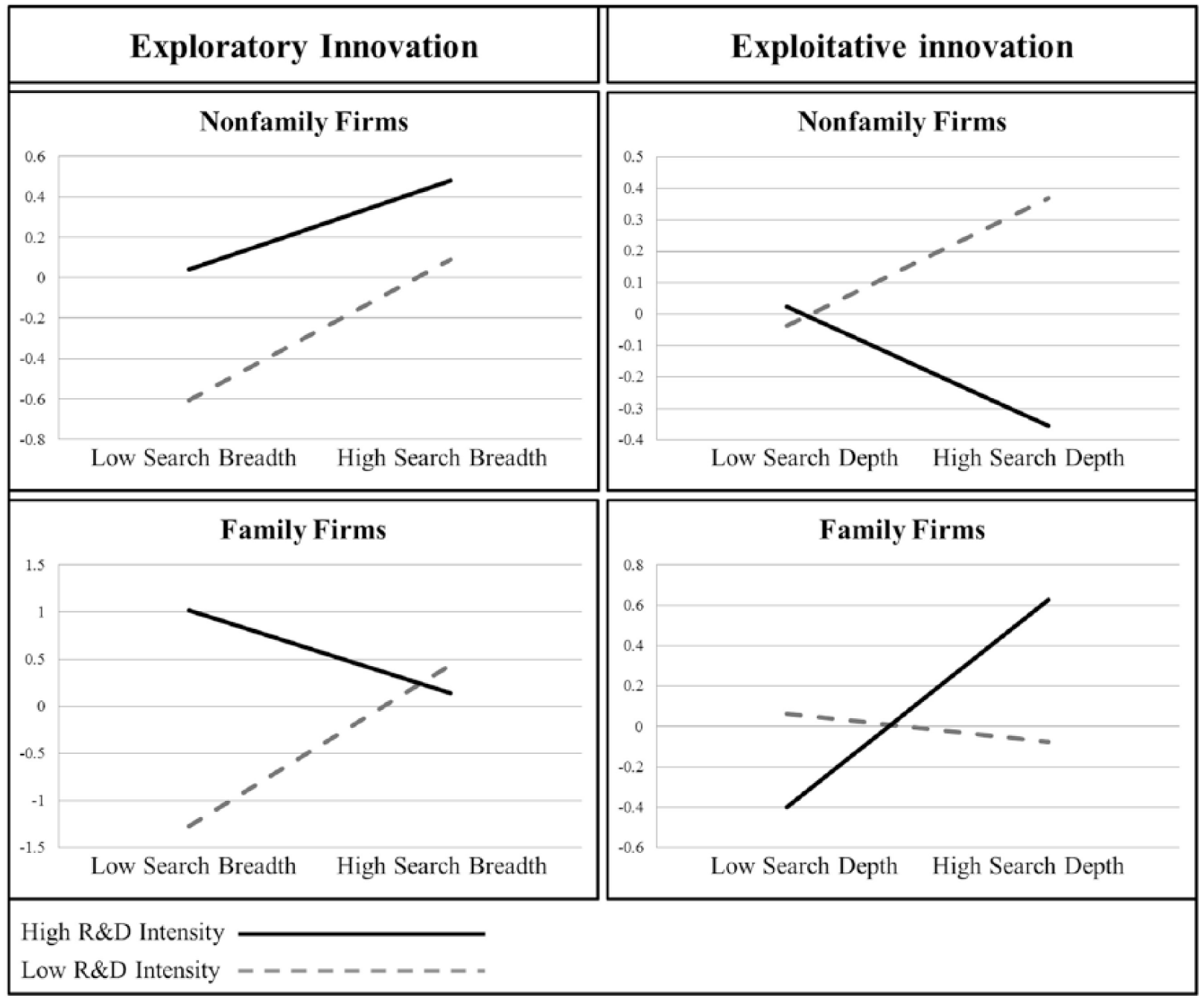
Plots of three-way interactions: Family firm absorptive capacity disadvantages (advantages) in exploratory (exploitative) innovation.
Robustness Tests
Given the cross-sectional nature of the data, and therefore the impossibility to statistically verify the causality of the relationships within the proposed model, it is worthwhile to consider and test some potential alternative explanations of the findings. To that end, a number of robustness tests were conducted. 8
Family Firm Definition
Full consensus on an operational definition of privately owned family firms has not yet been reached. While the operationalization used in this study should reflect both “components of involvement” (i.e., through the ownership criterion) and “family essence” (through the perception criterion), it is good to assess whether the outcomes are somehow dependent on the operational definition used. The models were reestimated using both a more relaxed and a stricter family firm definition. In the more relaxed definition, only the perception criterion needed to be fulfilled, and the ownership criterion was neglected. In the stricter definition, next to the ownership and perception criteria, also at least one of the firm’s executive managers had to be a member of the owning family. The results do not qualitatively change as a result of using alternative operational definitions of family firms. 9
Firm Size
The ability of firms to benefit from the resources available within a diverse set of collaboration partners may depend on the size of the firm, as firm size should correlate with the managerial and cognitive capacity necessary for identifying and realizing innovation opportunities residing within the firm’s external network (Van de Vrande et al., 2009). To make sure that the “external search breadth” interaction effects found in the analyses are not driven by differences in firm size between family and nonfamily firms, all relevant interaction models were reestimated supplemented with the interactions between firm size, R&D intensity, external search breadth, and the family firm dummy. Hypothesis 2b still receives support.
Environmental Dynamism
Models 4 and 9 were reestimated, supplemented with all two- and three-way interactions of R&D and the relevant search variables with the “technological change” control variable, to make sure that the interaction effects of family firms are not due to family businesses (stereotypically, cf. nonsignificant correlation coefficient of the family firm dummy and technological change in Table 1) residing in less dynamic environments. Hypotheses 2b and 3b are still supported.
In sum, and taking into account the limitations of the data set, the results seem robust to alternative model specifications.
Discussion and Conclusions
In developing the innovations that enable the exploitation of existing and exploration of new organizational routines (Lavie et al., 2010; Levitt & March, 1988; March, 1991), firms are increasingly dependent on their ability to acquire, assimilate, transform, and exploit knowledge residing within their external networks—in other words, their absorptive capacity (Cohen & Levinthal, 1990; Todorova & Durisin, 2007; Volberda et al., 2010; Zahra & George, 2002). While the importance of the absorptive capacity concept has been widely acknowledged both in academic circles and among practitioners, knowledge on the nature of absorptive capacity in family firms is scarce (Andersén, 2015; De Massis et al., 2013; Feranita et al., 2017; Hernández-Perlines et al., 2017; Kotlar et al., 2016). To that end, this study addressed the “two faces” of the R&D activities of family and nonfamily firms (Cohen & Levinthal, 1989) that, next to the generation of knowledge inputs directly applicable to innovations, should also enhance a firm’s potential absorptive capacity. Potential absorptive capacity alone is, however, an insufficient condition for the effective transformation and exploitation of externally sourced knowledge (Zahra & George, 2002). The developed conceptual model therefore discussed how and why the gap between the potential absorptive capacity augmented by R&D activities, and the realized absorptive capacity embodied by innovative outcomes may be bridged more or less effectively by family firms, depending on the external search strategies and innovative outcomes considered.
The findings of hierarchical regression analyses on a sample of Dutch manufacturing SMEs suggest that, in line with earlier findings (e.g., Duran et al., 2016; Matzler et al., 2015), the direct innovation input performance of R&D—that is, the “first face” of R&D as per Cohen and Levinthal (1989)—is indeed stronger for family versus nonfamily firms. Interestingly, however, the theoretical arguments suggested that this innovation input performance surplus of family firm R&D should particularly pertain to the development of exploitative innovations that allow family firms to leverage their superior knowledge retention and rejuvenation capabilities (e.g., Chirico & Salvato, 2008, 2016; De Massis, Kotlar, et al., 2016; Patel & Fiet, 2011). However, also a smaller—yet not significantly different—family R&D input performance surplus was found regarding the development of exploratory innovations. Apparently, if we discount the role of external networks in family and nonfamily firm innovation, family firms are superior “closed” innovators irrespective of the nature of the considered innovation outcomes.
With regard to the absorptive capacity performance of R&D—that is, the “second face” of R&D according to Cohen and Levinthal (1989)—the findings largely confirm the hypothesized differences between family and nonfamily firms. First, the findings suggest that family firm R&D is less conducive to the realization of absorptive capacity in light of exploratory innovations building predominantly on broad external search, likely because of the detrimental impact of family firms’ more rigid power structures (De Massis et al., 2013), their control orientation (Classen et al., 2012; Kotlar et al., 2013), and the higher path-dependency and idiosyncrasy of family firms’ own knowledge bases (Andersén, 2015). Surprisingly, however, the results do not show the presumed absorptive capacity benefits of increased R&D expenditures for nonfamily firms (cf. near-zero R&D–external search breadth coefficient in Model 9, Table 3). Apparently then, rather than just a lower absorptive capacity performance of family firm R&D, there actually seems to be a substitution effect between internal R&D and broad external search efforts for family firms in exploratory innovation. As a tentative explanation for this finding, one might suggest that family firms are more conducive to “not-invented-here” (Katz & Allen, 1982) sentiments toward external knowledge (König, Kammerlander, & Enders, 2013). These biased attitudes toward innovative ideas suggested by outsiders are thought to arise primarily through social identification processes (Antons & Piller, 2015), where individuals that derive a substantial part of their individual identity from their membership of a social group discriminate against potential contributions by salient out-groups (e.g., Tajfel, 1978). In the innovation domain, external parties offering innovative suggestions are especially salient when the recipient firm has strong innovation capabilities (i.e., substantial internal R&D) itself. Now, family firm decision makers are particularly likely to derive strong social identities from their membership of the (family) firm (e.g., Cannella, Jones, & Withers, 2015). As such, especially among family businesses, R&D intensive firms should be likely to discriminate against outside innovative ideas, and hence, a substitution effect between internally developed and externally available knowledge assets among family firms may be explained (cf., explanation of similar findings in Laursen & Salter, 2006).
Second, family firm R&D was indeed found to exhibit stronger absorptive capacity performance regarding exploitative innovations that were argued to rely predominantly on deep external search, likely because family firms are better positioned to benefit from long-term trust-based relationships with external parties (e.g., Hadjielias & Poutziouris, 2015; Lambrechts et al., 2017), and the exploitative nature of combinatory opportunities found through deep search may enable family firms to leverage their “deeper” yet highly family- and firm-specific internal knowledge base (e.g., Chirico & Salvato, 2016; De Massis, Kotlar, et al., 2016; Patel & Fiet, 2011). In fact, the results suggest that only family businesses realize the depth-related absorptive capacity benefits of R&D in the exploitation domain (cf. negative, yet nonsignificant R&D—external search depth coefficient in Model 4, Table 2).
Revisiting the research questions outlined in the introduction section, the findings in this study suggest that organizational learning, and in particular the innovation processes underlying exploration and exploitation, unfolds differently in family versus nonfamily firms. Specifically, the results show how family firms may simultaneously face absorptive capacity advantages and disadvantages, as family involvement was found to either bridge or expand the gap between the potential absorptive capacity augmented by a firm’s R&D activities and the realized absorptive capacity embodied by innovative outcomes, depending on the nature of the innovation processes and external search strategies considered. Whereas family firms seem to excel in leveraging deep knowledge—searched both internally and externally—toward exploitative innovation purposes, family firms apparently face difficulties in deriving exploratory innovation benefits from their exposure to broadly searched external knowledge. Implications of these findings for theory and practice are discussed below.
Theoretical Implications
The conceptual arguments developed in, and findings of, the present study contribute to our understanding of the nature of absorptive capacity and its implications in family firms in ways that may be of interest to both family business scholars and broader academic audiences. First, knowledge development on family firm innovation is still in its infancy relative to the more general innovation literature (De Massis et al., 2013; Röd, 2016). This study contributes to bridging that gap, as it adds some nuance to the strict input–output perspective on the association between R&D and innovation that implicitly pervades a substantial share of the family firm innovation literature to date (e.g., Duran et al., 2016), and simultaneously responds to work calling for the more systematic inclusion of the role of external partnerships in family firm innovation (Brinkerink et al., 2017; De Massis et al., 2013; Feranita et al., 2017). With regard to the latter issue, the findings of this study testify to some of the “ability versus willingness” paradoxes that characterize family firm innovation management (e.g., Chrisman et al., 2015; De Massis, Kotlar, Chua, & Chrisman, 2014). Specifically, whereas family involvement seems to enhance both a firm’s ability to process and its willingness to exploit internally developed and deeply sourced external knowledge, distinct willingness constraints may hamper the degree to which family firms build and apply the same capacity needed to benefit from broad exposure to external knowledge. Future work on the nature of willingness and ability paradoxes in family firm innovation management should both theoretically and empirically incorporate the role of external knowledge sources, as this study suggests—thereby corroborating previous findings (e.g., Block, Miller, Jaskiewicz, & Spiegel, 2013; König et al., 2013; Lambrechts et al., 2017)—that these paradoxes may have implications for the nature of the innovation outcomes that family firms tend to achieve, and hence, for their ability to engage in both exploitative and exploratory learning (Goel & Jones, 2016; Levitt & March, 1988; March, 1991; Zahra, 2012).
Second, a contribution to the broader absorptive capacity literature is made, as the study demonstrates how family involvement may either bridge or expand the gap between potential and realized absorptive capacity (Zahra & George, 2002), depending on the nature of the external search behaviors and innovation outcomes considered. In that regard, this study responds to a call by Volberda et al. (2010) to investigate absorptive capacity’s intraorganizational antecedents, by studying the role of differences in governance structures (i.e., family ownership and influence) and their conditional impact on absorptive capacity. Future work may investigate how heterogeneity among family firms regarding, for instance, family governance structures, family values, family (non)economic goals, and family firm organizational cultures affect the development of absorptive capacity (e.g., Chrisman, Sharma, Steier, & Chua, 2013; Daspit, Chrisman, Sharma, Pearson, & Mahto, 2018; De Massis, Wang, & Chua, 2018).
Practical Implications
This study also contains some potentially valuable food for thought for practitioners. First, the findings suggest a superior efficiency of family firms, both in terms of “closed” innovation performance and the degree to which they benefit from repeatedly revisiting established external knowledge sources. Taken together, these outcomes may explain why so many family firms could be considered “hidden champions” (De Massis, Audretsch, Uhlaner, & Kammerlander, 2018)—that is, businesses that are highly innovative, yet not very visible to the outside world because of their relatively narrow and targeted set of exchange relationships within highly specialized operational niches (Simon, 2009). In addition, these findings may provide some tentative explanation as to why family firms are likely to dominate especially in those industrial settings where owning families’ long-term orientation and depth-inducing knowledge and collaboration practices are well aligned with a shared set of core products and processes that are historically characterized by a developmental path of predominantly incremental improvements (e.g., wine, olive oil; see Gedajlovic and Carney, 2010). 10
However, also firms that excel in exploiting their historically established position in a specialized operational niche run the risk of falling victim to the “competency trap” discussed in the theory section (Levitt & March, 1988). Family firm owners and managers should perhaps consider the degree to which the superior internal and external deep search capabilities that allow their firm to sustain its current position might simultaneously invoke “strategic blind-spots” that may lead them to ignore (seemingly) distant technological developments that could however pose a potential threat to the long-term competitive position of the firm (e.g., Zahra & Chaples, 1993). They could, for instance, consider appointing managers or advisors experienced in working for or with family businesses active in loosely related technology domains, who might be able to challenge these potential blind-spots, while simultaneously understanding and respecting the socioemotional sensitivities of family firms.
Second, policy makers looking to enhance the innovativeness—and thus the “future-proofness”—of their manufacturing sector may take notice of the relative advantages and difficulties seemingly faced by family firms in benefiting from more open models of innovation. They may consider better aligning new or improved policy instruments with the specific needs of family businesses. For instance, cooperative R&D subsidy schemes (e.g., Hottenrott & Lopes-Bento, 2014) targeted specifically at family firms could be developed, in which funding is made available conditional on a certain “technological distance” incorporated in the project proposal (e.g., through requiring co-applications of firms operating in different industries). In addition, to somewhat reduce the detrimental impact of family firms’ control orientation on the degree to which they are willing and able to pursue combinatory opportunities resulting from broad search strategies, policy makers may consider setting up effective impartial network mediators that can aid family businesses in finding trustworthy, yet technologically distant collaboration partners (Lee, Park, Yoon, & Park, 2010).
Limitations and Future Research
As all empirical work, the research presented in this article has its limitations, some of which could be addressed in future studies. First, the cross-sectional nature of the data does not allow for the verification of the causality of the results. Longitudinal (representative) innovation surveys documenting different aspects of family involvement may be used in future work to paint a more dynamic picture of the interplay between knowledge inputs of different nature and origin in family firm innovation. Second, this study used a key informant approach targeting top executives. Although the substantial ex ante measures taken and the rather factual nature of many of the key variables should minimize the potential for common method bias and social desirability issues, future work may collect data from multiple relevant specialists (e.g., R&D managers, account managers) within the same firm. Third, the results of this study are based on the analyses of manufacturing SMEs in the Netherlands, and future research may assess whether the findings also hold in different contexts. Fourth, some of the concepts that have been used in the argumentation for family firms’ advantages or disadvantages in bridging potential and realized absorptive capacity—for example, social integration mechanisms, social capital, shared emotional attachment, longer tenures, and lower turnover of key individuals—were not directly measured in the present study. Hence, future research could empirically (i.e., as opposed to only theoretically) investigate whether these proposed explanations indeed account for the observed differences between family and nonfamily firms. Fifth, while this study compares family and nonfamily firms, it does not assess the aforementioned heterogeneity among family businesses, which forms an increasingly important aspect of family business research (e.g., Chua, Chrisman, Steier, & Rau, 2012; Daspit et al., 2018; De Massis, Wang, et al., 2018). To further extend the practical relevance and applicability of the model proposed in this study, the unmeasured explanatory concepts mentioned above could form a fruitful lens through which family firm heterogeneity may be incorporated in future work. For instance, family firms may differ substantially regarding the possession of intra- and interorganizational social capital elements and social integration mechanisms that could be either functional or dysfunctional in realizing absorptive capacity and desired innovative outcomes (e.g., Chirico & Salvato, 2016; Pearson et al., 2008).
Besides addressing these limitations, future research could build on this study in a number of ways not yet discussed above. First, while this study adds nuance by departing from the strict direct input–output perspective on family firm R&D performance, the relationship between R&D inputs and innovation outputs is characterized by additional complexities that are not explicitly accounted for in this study. For instance, ample prior work documents that R&D investments are subject to diminishing marginal returns and also identifies decreasing, or even concave returns to collaborative innovative efforts (e.g., Hottenrott & Lopes-Bento, 2016; Laursen & Salter, 2006). Hence, future work may further enhance our understanding of the dynamics of family firm innovation by theoretically and empirically extending the present model with nonlinear or curvilinear relationships among its core variables. Second, this study used a single measure to capture the R&D activities of family and nonfamily firms. However, also within R&D activities firms can search broadly versus deeply. Future research may want to further disentangle the “R”—that is, the research activities that share the variety-seeking character of broad external search—and the “D”—that is, the development activities that are rather based on the deep interaction with more applied knowledge elements—activities of family and nonfamily firms. Scholars could then assess whether family firms indeed allocate more attention and effort to development versus research activities, and whether that has any implications for the nature of their absorptive capacity. Third, while this study built and tested hypotheses for exploratory and exploitative innovation separately, the moderately strong correlation between the two dependent variables (cf. Table 1) suggests that—in line with findings and theoretical ideas in earlier work (e.g., Atuahene-Gima & Murray, 2007; Gupta, Smith, & Shalley, 2006)—one might find interesting interplays among the explanatory variables when considering their impact on both types of innovation simultaneously. Future work may use more advanced statistical methodologies to consider such dynamic models. Fourth and final, prior work building on behavioral theories shows that certain general innovation-related tendencies of family firms can be reduced or even reversed as an effect of shifts in reference points (Gómez-Mejía et al., 2014; Kotlar, Fang, De Massis, & Frattini, 2014). Future research may extend the model presented in this study, by for instance investigating how performance aspiration gaps affect the degree to which family firms search deeply versus broadly, and whether the exploitation of knowledge accessed through these search strategies is dependent on such contingencies.
Footnotes
Acknowledgements
The author expresses his gratitude to Yannick Bammens, Martin Carree, Nadine Kammerlander, Josip Kotlar, and Anita Van Gils for their valuable feedback on earlier versions of this article; to the organizers of and participants in the 2017 IFERA research development workshop held at the Free University of Bozen-Bolzano, where a previous version of this study was presented; and to FBR’s editors and reviewers for their insightful comments and suggestions.
Declaration of Conflicting Interests
The author declared no potential conflicts of interest with respect to the research, authorship, and/or publication of this article.
Funding
The author received no financial support for the research, authorship, and/or publication of this article.
