




Abstract
Drawing on dual-process theories, this study aims to investigate the factors associated with social media users’ acceptance of mental health-related misinformation (MHRM). We conducted a case study of Chinese microblogging Weibo on conversations that emerged following a publicised celebrity suicide of South Korean superstar Sulli. This incident sparked an extensive discussion on mental health issues as Sulli was reported to have suffered from depression prior to her death. Whilst previous studies on users’ information acceptance mainly adopted survey methods, our study employs a mixed-method approach (i.e. computational data collection method, content analysis and statistical analysis), which opens up new directions to utilise secondary social media data. We identified MHRM from the discussions on Weibo and labelled the responses to the misinformation as whether they indicate an acceptance of the MHRM. Binary logistic regression was used to examine the associations of receivers’ acceptance of MHRM with its information features (e.g. number of likes) and information sources (e.g. gender). Inconsistent with previous studies, our findings suggest that MHRM is less likely to be accepted when published by male users, underscoring the context-specific nature of heuristic cues. This study also revealed some novel findings, such as MHRM with more pictures or with more words is less likely to be accepted. A theoretical model was proposed based on the findings, which highlights the importance of heuristic cues and individuals’ pre-existing knowledge in information processing.
Keywords
Introduction
Social media has emerged as a pivotal aggregator and distributor of information in recent years (Gottfried & Shearer, 2016), serving concurrently as a mediator of public opinion (Sülflow et al., 2018) and a platform for self-expression (Myers West, 2018). While facilitating expeditious information dissemination (Sülflow et al., 2018), it has also introduced challenges like online incivility and misinformation (Wang & Song, 2020). A particular area of concern is the surging tide of unreliable health information in the digital sphere (Fernández-Luque & Bau, 2015). This misinformation exposure poses significant detriments, ranging from individual non-compliance with health guidelines (Dhawan et al., 2021) to a broader societal erosion of trust between the public and health professional (Barreto et al., 2021). Although numerous studies have conducted on health-related misinformation, the focus has predominantly been confined to specific diseases or medical treatment (Suarez-Lledo & Alvarez-Galvez, 2021). Mental health-related misinformation remains inadequately researched, even as mental health issues have witnessed a rapid increase (Aldridge & McChesney, 2018), and mental health-related misinformation is prevalent in online communities (Bizzotto, Schulz, & de Bruijn, 2023). Given the critical role of mental health in both social and economic development (Herrman & Jané-Llopis, 2012), and its established link to suicide (Bachmann, 2018), addressing this gap is imperative.
In a society like China, where mental health resources have been traditionally scarce and stigmatisation prevalent, the internet has emerged as an alternative resource for mental health information (Liu et al., 2014). Due to the stigmatisation and a deficit in mental health literacy (Hurley et al., 2020), social media users may not only fail to recognise mental health-related misinformation (MHRM) but also inadvertently propagate it, potentially amplifying its adverse impacts. This study aims to investigate factors associated with users’ acceptance of MHRM online in order to provide insights and recommendations. Previous studies of public opinion discourse on social media mainly examined the use of Twitter/X (e.g. Haro-de-Rosario et al., 2018; Mueller & Saeltzer, 2022). In the Chinese context, Weibo is an equivalent of Twitter/X, where Chinese netizens share views and opinions, and a case study of mental health-related discussion on Weibo will be the focus for this paper.
Perceived credibility plays a critical role in online information processing (Sundar, 2008) and could be influenced by heuristic cues (e.g. sentiment of information and gender of information source) on social media (Xiao et al., 2018). Dual-process theories posit that individuals tend to employ heuristic information processing method for efficient attitudinal decision-making (Allport et al., 1954; Chaiken & Ledgerwood, 2012), especially when confronted with huge amount of information (S. Chen & Chaiken, 1999) or environments marked by heightened uncertainty (Simon, 1990). Despite the acknowledged impacts of heuristic cues and processing in domains like political campaigns and online marketing, research on their role in MHRM is quite limited. Therefore, the present study endeavours to fill in this gap and explore the associations between MHRM acceptance and heuristic cues. Unlike previous studies which primarily relied on experimental or survey methods, we utilised social media data to assess individuals’ acceptance of MHRM. This approach helps overcome the limitations of traditional methods such as limited sample size and susceptibility to self-reporting bias. It concerns how individuals, more specifically social media users, process MHRM.
Literature Review
Conceptualisation of Misinformation and Mental Health-Related Misinformation
Misinformation is commonly defined as inaccurate information with potential to mislead the public (Wu et al., 2016). Its existence could be traced back to the inception of the earliest writing systems (Marcus, 1992) albeit with restricted diffusion and a constrained scope of influence (Burkhardt, 2017). The definition of misinformation is a subject of extensive debates in the academic literature, and a universally agreed definition remains elusive. Some researchers consider misinformation to be inaccurate information that is unintentionally spread (Wardle & Derakhshan, 2018; Wu et al., 2016), while others focus on the veracity of the information rather than the intention behind its dissemination (Nyhan & Reifler, 2010; Southwell et al., 2018). The use of several terms interchangeably with misinformation also complicates reaching a consensus on its definition. ‘Fake news’, a term extensively used after the 2016 U.S. presidential election, is defined as misleading information presented as news (Gelfert, 2018). Some researchers have criticised this term for obscuring the multi-dimensionality of the phenomenon of misinformation, such as the content format, motivations and agents involved in its distribution (Wardle & Derakhshan, 2017). Another related term is ‘disinformation’ which denotes inaccurate information intentionally disseminated to deceive the public (Wardle & Derakhshan, 2017). While the definitional distinction between misinformation and disinformation is clear, the practical application of these terms becomes complex due to the challenges in ascertain intention. ‘Rumour’ is also a widely used term which refers to ‘unverified statements in circulation’ (DiFonzo et al., 2012). Unlike misinformation, which is necessarily untrue, rumours may or may not be factual. For the purpose of this study, we adopt a broad definition of misinformation, encompassing both false and unverified information, irrespective of the intent behind its spread.
With the advancement of communication technology, especially social media, the spread and impacts of misinformation have been significantly increased (Burkhardt, 2017). In recent years, researchers have increasingly focused on health-related misinformation, like vaccine, smoking, cancer, viral infections or medical treatments (Suarez-Lledo & Alvarez-Galvez, 2021), while studies specifically focussing on mental health-related misinformation (MHRM) is very limited. Health-related misinformation has gained significant attention due to its impacts on public health and society (Barreto et al., 2021; Dhawan et al., 2021). It is generally defined as claims about health issues that are composed of biased or decontextualised health information or falsehood without an evidence basis (Bruns et al., 2021; Suarez-Lledo & Alvarez-Galvez, 2021). However, mental health issues have become increasingly prevalent globally (Aldridge & McChesney, 2018), which warrant further investigation. Based on the definition of misinformation and health-related misinformation, MHRM in this study is defined as a category of mental health-related claims that are not supported by the existing scientific knowledge.
Heuristic Decision-Making: Information Processing on Social Media
Dual-process theories, such as heuristic-systematic model (S. Chen & Chaiken, 1999) and elaboration likelihood model (Petty & Cacioppo, 1986), proposed that individuals typically evaluate information via either a heuristic/peripheral route, which relies on selective information or shortcuts (i.e. heuristic cues), or a systematic/central route, which entails complex cognitive models and in-depth consideration. Heuristic processing is the default route in information processing, unless individuals are both motivated and able to use systematic route (Chaiken & Ledgerwood, 2012). One reason is that heuristic processing helps individuals to process information faster (Fiske et al., 1999; Hastie & Park, 1986) and achieve attitudinal decision as efficiently as possible (Allport et al., 1954), especially on social media where users are exposed to vast amounts of information (Schäfer, 2021). On social media platforms, users often encounter information passively instead of actively seeking it, making them less likely to engage in systematic processing and more inclined to utilise heuristic shortcuts (S. Chen & Chaiken, 1999; Petty & Cacioppo, 1986). Bounded rationality suggests that heuristic route is more likely to be used in complex or unpredictable environments (Simon, 1990) which are similar to social media. Consequently, users tend to process information heuristically on social media (Schäfer, 2021). However, when facing unpredictable environments, individuals tend to seek more information to reduce uncertainty and perceived risk, relying more on systematic rather than heuristic route (Connolly et al., 2023; Xu, 2018). Moreover, individuals are more likely to employ systematic route in information processing if they perceive the information as highly credible (Haim & Maurus, 2021; Winter et al., 2015) or to be associated with negative sentiment (Ju, 2008). This indicates that the ways of information processing are context-specific, and further research is warranted to explore whether heuristic processing is the default approach when social media users process MHRM on digital platforms.
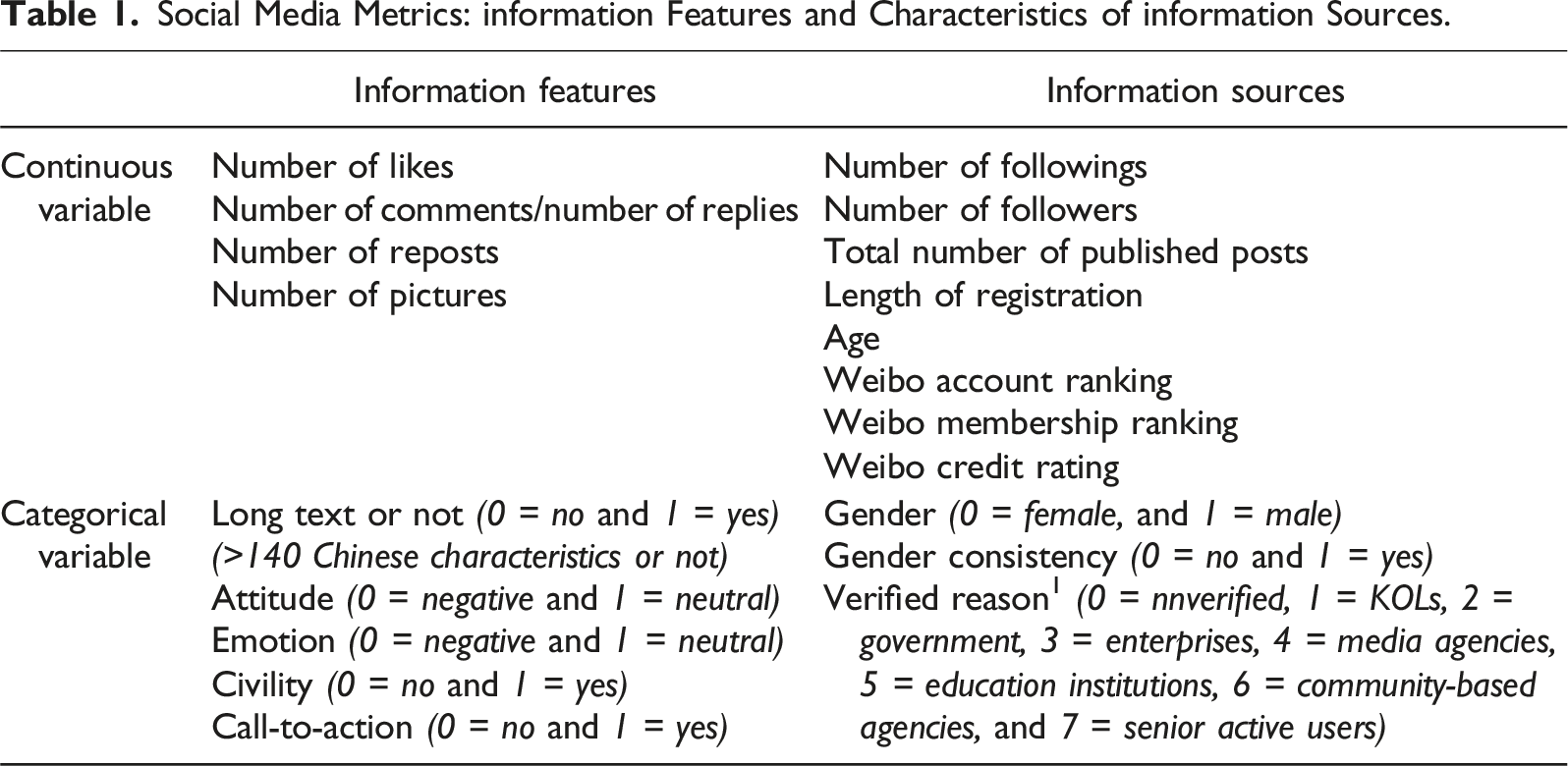
Social Media Metrics: information Features and Characteristics of information Sources.
Predictors of Users’ Information Acceptance on Social Media
Heuristic cues could significantly influence the acceptance of online information by shaping its perceived credibility (Sundar, 2008). Credibility refers to the authority and trustworthiness attributed to a person or a piece of information (Sundar, 2008). Prior empirical studies have mainly examined perceived credibility from two perspective: perceived information credibility and perceived source credibility. Both dimensions have been empirically validated to exert a discernible impact on individuals’ acceptance of information (Hovland et al., 1953; Metzger et al., 2003). Furthermore, perceived source credibility could indirectly influence information acceptance by modulating perceived information credibility (Wathen & Burkell, 2002).
Perceived information credibility refers to the quality of information based on its features (D.-H. Park et al., 2007). On social media, bandwagon cues, including metrics such as the number of likes, comments and reposts, emerge as salient heuristic indicators. These cues notably influence user’s perceptions of information credibility and acceptance (De Vries, 2019; Lee-Won et al., 2017; Li et al., 2020; S. Park & Jung, 2023). For instance, the number of likes serves as an index of popularity and the endorsement, with posts garnering more likes are considered to be more credible and more likely to be accepted (Li et al., 2020). The number of comments has a similar effect on how users perceive the information (Sundar, 2008). Research on the role of comment content is mixed, with Sundar (2008) suggesting that the content could act as a heuristic cue in information processing while Haim and Maurus (2021) proposing that individuals tend to systematically process the content. Besides descriptive features, some semantic ones, like sentiment (i.e. emotional tone of information) and attitude (i.e. evaluation or judgement towards a particular object embedded in information) of the information, could also influence users’ perceived information quality. These features not only convey certain messages but also have social functions that indicate the thoughts of individuals generating the information (Fridlund, 1991; Parkinson et al., 2005). Studies have shown that both negative sentiment and negative attitude have positive impacts on individuals’ willingness of misinformation acceptance (H. Nguyen & Nguyen, 2020; Rozin & Royzman, 2001). One plausible interpretive schema suggests that negative sentiment and attitude embedded in misinformation could attenuate the perceived credibility of information from professional sources (Chinn & Hart, 2022; Waddell, 2018), despite concurrent perception of the misinformation itself as lower quality and less credible (Brooks & Geer, 2007). Moreover, other information-related social media metrics (e.g. text length of a post, number of pictures a post has and communication function of information) may also have impacts on perceived information credibility, while the relevant studies are limited and findings are inconsistent (Aswani et al., 2019; Castillo et al., 2011; Chua et al., 2017; Mendoza et al., 2010). Having reviewed relevant literature as discussed above, we devised the following research question and hypotheses: RQ1: What are the associations of receivers’ acceptance of MHRM with various information features on social media? Hypothesis 1. Receivers’ acceptance of MHRM on social media is positively associated with number of likes(a), comments(b), reposts(c) or pictures(d) of the misinformation. Hypothesis 2. MHRM with shorter length(a), with negative sentiment(b) and attitude(c), with uncivil expressions(d) or with the purpose of calling others to take action(e) is more likely to be accepted.
Perceived source credibility refers to the believability of the source providing valid information (Hovland et al., 1953; Ohanian, 1990). Perceived source credibility is not only a precursor to the quality of the information (Wathen & Burkell, 2002), but also a salient factor in information acceptance (Austin & Dong, 1994). Within the realm of health information, sources such as health professionals, media agencies, health institutions and friends are traditionally accorded higher levels of credibility than industry stakeholders like pharmaceutical companies, marketers and advertisers (X. Chen et al., 2018; Morris et al., 2016). Specifically, studies on online communities for mental health found that expert-led communities have less MHRM (Bizzotto, Schulz, & de Bruijn, 2023), and participants in those communities are less likely to agree with the misinformation (Bizzotto, De Bruijn, & Schulz, 2023). Moreover, the influence of the source’s gender on perceived credibility has been extensively investigated, yet empirical findings in this regard are inconclusive (Armstrong & McAdams, 2009; Deaux & Lewis, 1984). A majority of studies suggest gender bias as men are considered to be more credible and authoritative (Armstrong & McAdams, 2009; Klaas & Boukes, 2022), and one reason individuals tend to perceive that official or professional sources are credible is because they assume the sources are male (Armstrong & Nelson, 2005). Contrarily, some studies found that female authors, especially African American women had higher credibility (Andsager & Mastin, 2003) or that gender has no discernible impact on perceived source credibility (Paul et al., 2022), especially among younger populations (Armstrong & McAdams, 2009; Burkhart & Sigelman, 1990). Several studies posit that, rather than gender of information source, congruence between the gender of information source and the receivers has a more significant influence on perceived source credibility (White & Andsager, 1991). In other words, men are more likely to deem male authors more credible and, correspondingly, more inclined to accept information from them (Klaas & Boukes, 2022).
Beyond demographic factors, social media metrics related to source of information also have impacts on perceived source credibility. For instance, information source with more followers on social media is more likely to be accepted because having more followers indicates that the user has received more endorsement on social media, which can be seen as possessing higher credibility (Li et al., 2020; Weismueller et al., 2020). There are some other metrics (e.g. frequency of posting and number of followings) that might have impacts on perceived source credibility, while studies on the impacts of these metrics are limited and findings are mixed (Aswani et al., 2019; Castillo et al., 2011; Mendoza et al., 2010). In the context of MHRM studies, we proposed a second research question and related hypotheses that investigate information sources:
RQ2: What are the associations of receivers’ acceptance of MHRM with various characteristics of information sources on social media?
Hypothesis 3. Receivers’ acceptance of MHRM on Weibo is positively associated with the number of followings(a) or followers(b), the total number of published posts(c), length of registration on Weibo(d), age(e), Weibo account ranking(f), Weibo membership ranking(g) or Weibo credit rating(h) of the sources of the misinformation. Hypothesis 4. MHRM from males(a) or verified accounts on Weibo(b) is more likely to be accepted. Hypothesis 5. MHRM is more likely to be accepted if the gender of the information source is consistent with the gender of the receivers.
Methods and Materials
To address these questions, we adopted a mixed-method approach that combines computational data collection method, content analysis and statistical analysis. First, Python-based automated crawlers were developed to collect data from Weibo. Second, data was processed by computational method and content analysis to select MHRM, measure MHRM acceptance and label the semantic features of MHRM. Then, statistical analysis was employed to examine factors associated with MHRM acceptance.
Data Collection
To investigate mental health-related discussion on social media, we conducted a case study centred on Weibo conversations that emerged following a publicised celebrity suicide which took place on 14th October 2019. In China, mental health issues has long been stigmatised (Liu et al., 2014), and the mental health-related discussions online is subject to dual censorship by the state and the platform as the discussion are overly negative and not align with the positive mainstream values promoted by the Chinese government (Kou et al., 2017). Widespread discussions on mental health issues in China are rare unless a high-profile case arises. South Korean superstar Sulli had reportedly suffered from severe depression prior her death (Snapes, 2019), and her death sparked an extensive discussion on mental health issues on Weibo, which is one of the most widely discussed mental health-cases in China in recent years. Therefore, Sulli’s case serves as the focus of this study.
Data was collected from Weibo by Python-based automated crawlers. Utilising Weibo’s archive of trending topics for October 14, 2019, the topics related to Sulli’s death were selected based on the following hashtags: #Sulli confirmed dead# (#雪莉确认死亡#), #Sulli confirmed passed away# (#雪莉确认去世#), #No more peach on Earth# (#再无人间水蜜桃#), #Sulli depression disorder# (#雪莉 抑郁症#). The hashtags were fed into the crawler to collect posts with a timeframe from 14th October 2019 to 31st December 2019. Following de-duplication, a dataset comprising 31,422 posts was retained for analysis. After that, comments and reposts of these posts and replies of the comments were collected by other crawlers. After de-duplication, 245,325 comments, 19,631 reposts and 41,511 replies were left for further analysis. Additionally, metadata associated with posts and comments, such as the number of likes, comments and reposts for each post, as well as the number of likes and replies for each comment, were collected. We also collected information about the source of that post and comment, including the number of followers and followings, age, length of registration and so on. Table 1 reports the details of social media metrics investigated in this study. In Table 1, replies refer to users’ responses to a comment.
Data Processing and Analysis
Upon preliminary analysis of the dataset, it was ascertained that the majority of the content was tangential to the domain of mental health. As a result, irrelevant data were filtered out, and the remaining data was then categorised as truth, unclear or misinformation. In order to identify the keywords that contain mental health-related issues, Jieba, a Python library for Chinese text segmentation, was used to segment the posts, comments, reposts and replies into phrases. Then a list of Chinese stopwords was built based on stopwords from phrases insignificant while frequently used in the collected dataset and Baidu 2 with the purpose of excluding insignificant or meaningless phrases, and the remaining phrases used in the dataset were sorted according to the frequency of their occurrence. Based on that, 126 keywords related to mental health were identified and the data containing these keywords was gathered, which includes 12,986 posts, 14,873 comments, 1508 reposts and 2663 replies.
Then, we conducted content analysis to code the social media data. The mental health-related data was manually labelled as misinformation, truth or unclear. An attempt was made to use machine learning to label the mental health-related data, while the results are not so promising because the detection of misinformation may require a combination of text-based features and contextual features. In this study, the machine learning model can only detect semantic features of misinformation without an understanding of mental health-related concepts and access to reliable mental health-related datasets. Therefore, all the mental health-related data was manually coded as truth, unclear or misinformation based on the definition of misinformation and MHRM from previous studies (e.g. Hedman-Robertson & Sage, 2020), as well as news reports on Sulli from various sources and existing scientific knowledge on mental health was based on information accessed from professional health authorities such as World Health Organisation 3 , Centres for Disease Control and Prevention 4 and NHS 5 . In this process, 15% of the mental health-related data was randomly selected, and the first author and the corresponding author independently coded the data. Intercoder reliability was 0.86, and disagreements were resolved through discussion. The first author then coded the rest of the data. Mental health-related information was labelled as misinformation and the reasons of it being labelled as misinformation were categorised. Based on the categories, three major categories were generated: the information describes a single mental health issue as part of an epidemic or sky-rocketing trend, the information associates mental health issues with single events or unsubstantiated causes or the information is not supported by the existing scientific knowledge (examples of MHRM can be found in Appendix A). After that, 2583 mis-posts, 3680 mis-comments, 166 mis-reposts and 416 mis-replies were coded for further analysis.
As discussed above, besides the collected descriptive attributes, semantic attributes could also have impacts on information acceptance. Based on previous studies, attitude, sentiment, civility (i.e. the presence or absence of uncivil expression) and call-to-action functions (i.e. whether the information calling others to take action) could have impacts on individuals’ information acceptance (Chua et al., 2017; Parkinson et al., 2005; Wang & Song, 2020). Accordingly, a coding scheme was developed based on these variables to facilitate text analysis. Given the substantial volume of text data, natural language process (NLP) techniques were employed to expedite the coding process. To train NLP models, one-third of the mis-posts, mis-comments, mis-reposts and mis-replies were selected by stratified random sampling and manually labelled based on the coding scheme. Then four deep learning models were built and trained based on the manually labelled data. Model performance was measured by confusion matrix, and parameters in the models were tuned in order to achieve better results. To validate the models, the manually labelled data was also labelled by deep learning models, and the results labelled by the models were validated based on Cohen’s Kappa by measuring the agreement between the results of manual labelling and models’ labelling of the same data. Coefficients of Cohen’s Kappa for the four categories are all above 0.8, which shows a perfect agreement (Blackman & Koval, 2000). Then, attitude, sentiment, civility and call-to-action functions of the MHRM were coded by the four deep learning models, respectively.
Coding Scheme for Misinformation Acceptance.
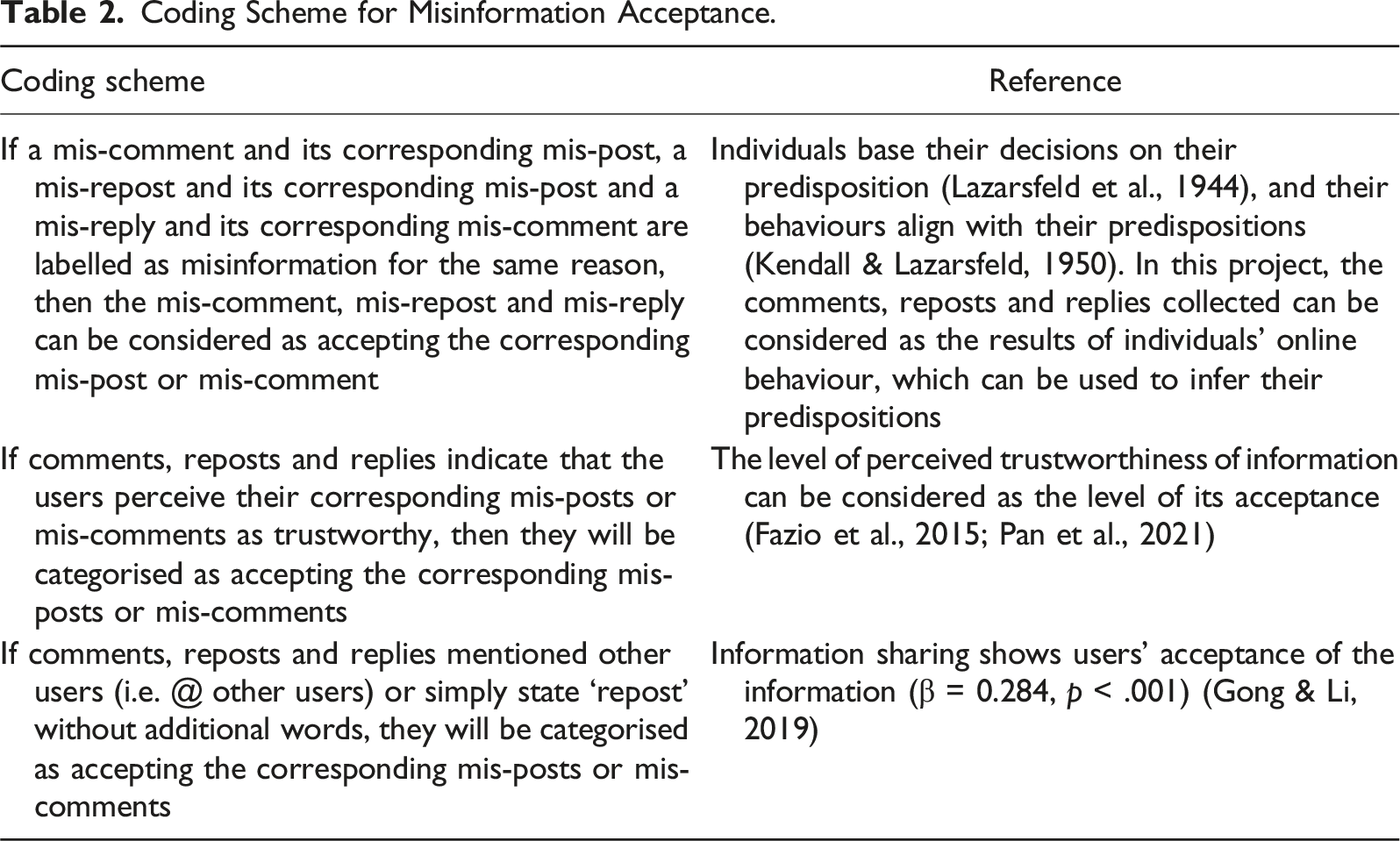
To investigate RQ1 and RQ2, and test the hypotheses, we employed a binary logistic regression model to examine factors associated with MHRM acceptance. The outcome variable was coded as ‘yes’ or ‘no’ for accepting MHRM. The independent variables are information features and characteristics of information sources as reported in Table 1.
Results
Binary Logistic Regression for Mental Health-Related Misinformation Acceptance.
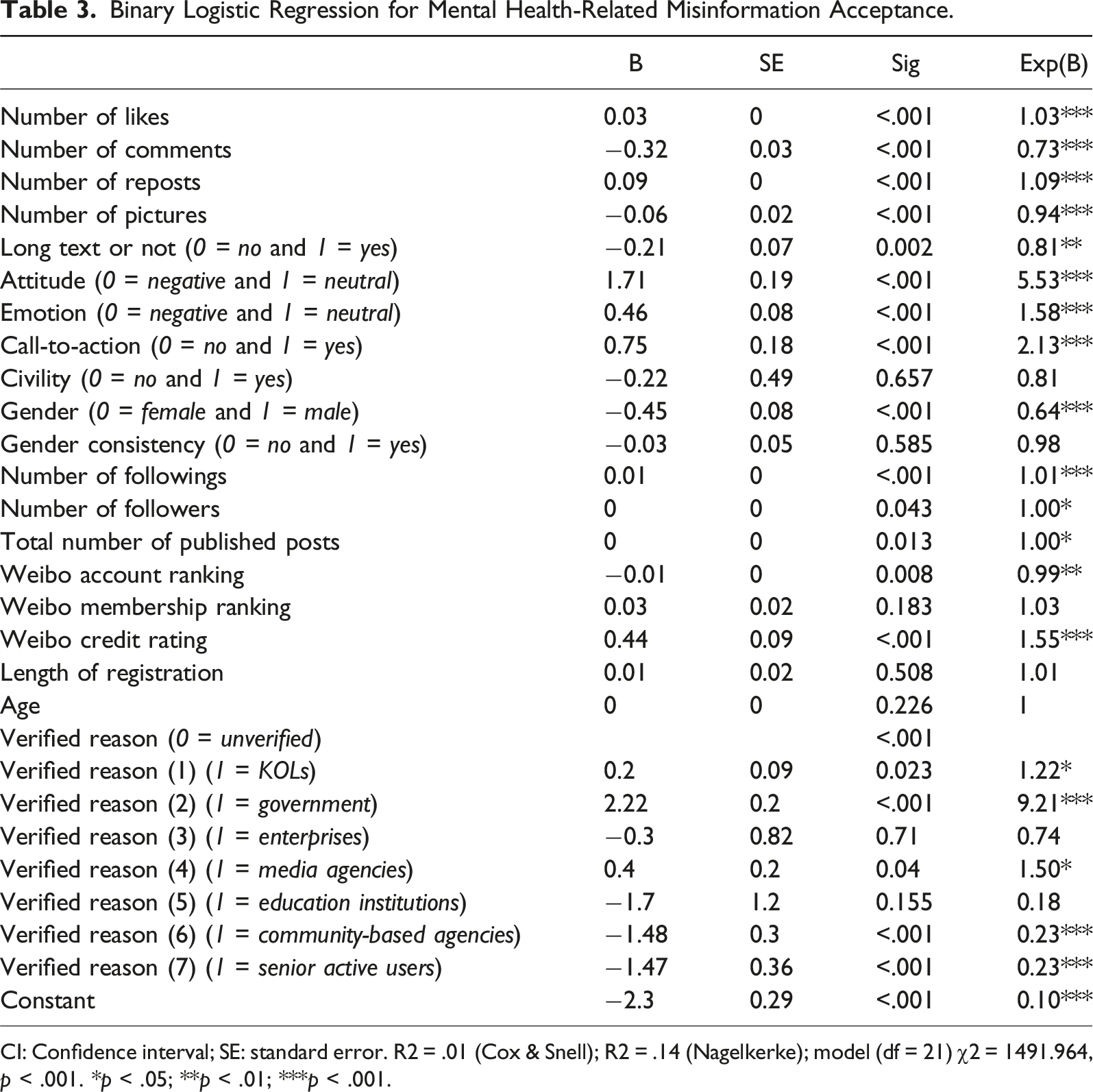
CI: Confidence interval; SE: standard error. R2 = .01 (Cox & Snell); R2 = .14 (Nagelkerke); model (df = 21) χ2 = 1491.964, p < .001. *p < .05; **p < .01; ***p < .001.
Hypotheses Testing Results.
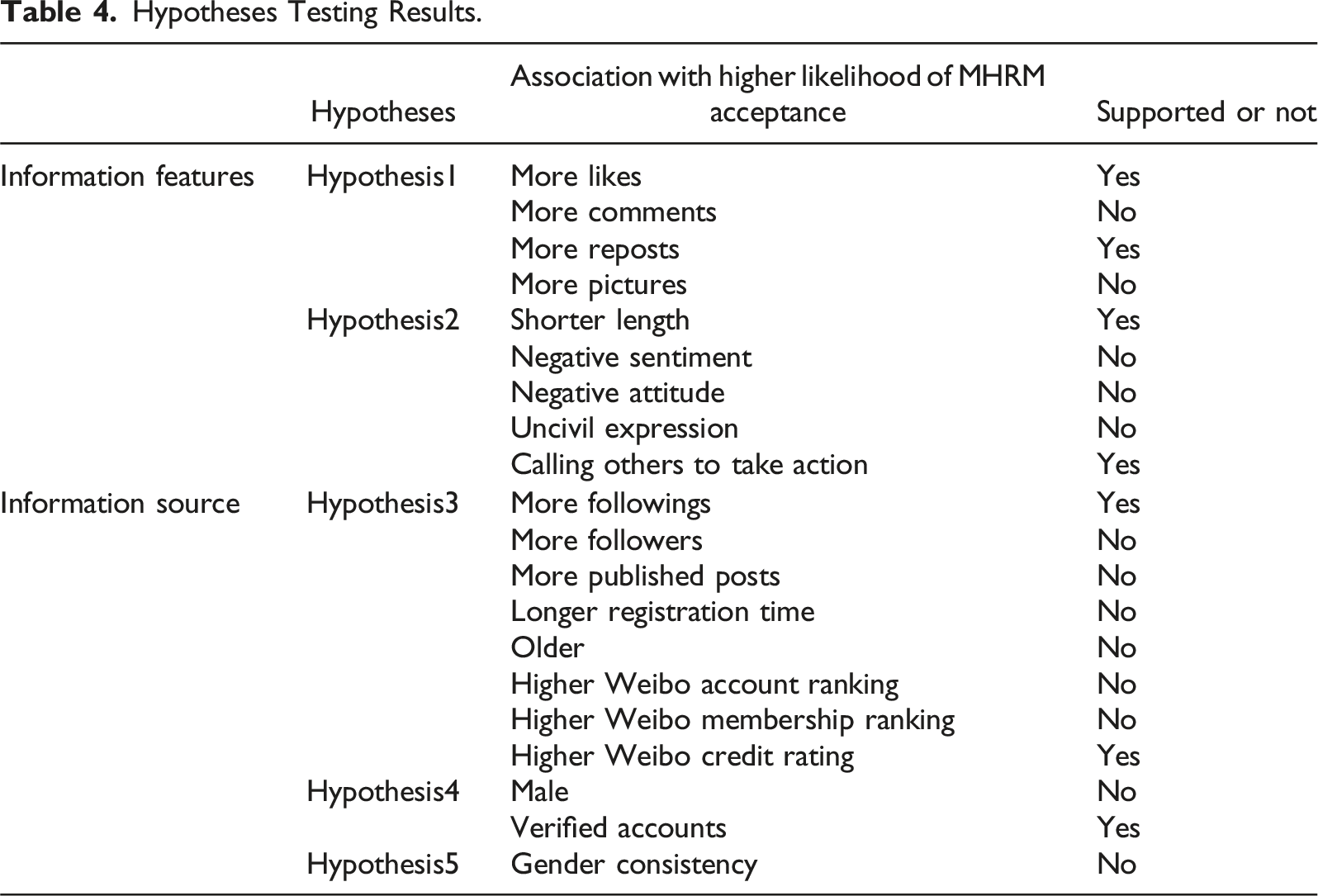
Concerning information sources, the results show that MHRM from female users is more likely to be accepted, while gender consistency and age show no significant association with MHRM acceptance. Although the relationships between MHRM acceptance and the number of followings, number of followers and total number of the published posts are statistically significant, the odds ratio (OR) for the number of followings is 1.01, and the ORs for the number of followers and the total number of published posts are 1.00, indicating only a nominal impact on MHRM acceptance. In other words, the number of followings has a slight positive association with MHRM acceptance, and the number of followers and total number of published posts have no association with MHRM acceptance. Weibo account ranking is significantly negatively associated with MHRM acceptance, albeit the effect size is minimal, indicated by an OR of 0.99, and Weibo credit rating has significantly positive association with MHRM acceptance. Weibo membership ranking and length of registration show no significant association with MHRM acceptance. Information sources being verified seems to have strong association with MHRM acceptance. MHRM from accounts verified as key opinion leaders (KOLs), government or media agencies is more likely to be accepted while MHRM from accounts verified as community-based agencies (e.g. agencies providing information on local cuisine) or senior active users (i.e. ordinary users who are more active on Weibo) is less likely to be accepted. Verified enterprise accounts and education institutions have no significant association with MHRM acceptance.
Discussion
This is the first study that investigates factors associated with social media users’ acceptance of mental health-related misinformation (MHRM). Moreover, it adopts an innovative methodology which utilise social media data and employ machine learning techniques to avoid self-reporting bias which are common in traditional studies. This study provides new evidence to reveal that various heuristic cues on social media are significantly associated with users’ acceptance of MHRM, despite that some findings are inconsistent with previous studies. For instance, previous studies that employed survey methods found that information from males was considered more credible and more likely to be accepted (Armstrong & McAdams, 2009; Klaas & Boukes, 2022), whilst this study found that information posted by male users is less likely to be accepted. This suggests that the impacts of heuristic cues on how individuals perceive information are highly context-specific.
The results show that the number of comments is significantly negatively associated with MHRM acceptance. This finding is inconsistent with previous studies that information with more comments is more likely to be accepted because it indicates the popularity and endorsement of the information (De Vries, 2019; Li et al., 2020). Our study suggests that number of comments might not be associated with the perceived popularity and endorsement of the information. Moreover, some studies have proposed that sheer volume of comments is not as important as the content of the comments themselves (Haim & Maurus, 2021; Winter et al., 2015). One reason is that comment section provides a space for users with diverse background to exchange their ideas, which could enhance the perceived credibility of comments (Haim & Maurus, 2021; Wang & Song, 2020). A review of the data in this study shows that the discussions, particularly the MHRM with more comments, are controversial, with many comments critiquing the misinformation. This could also explain the negative association between number of comments and MHRM acceptance, as users investing time in reading the comments and their perceptions were influenced by the comments critiquing or rejecting the misinformation. The results indicate that heuristic processing (i.e. relying on number of comments rather than content of comments) is not the sole mechanism at play when individuals engage with comments. Our results also suggest that content of comments has the potential to influence users’ perception and, consequently, the acceptance or rejection of MHRM.
The role of number of pictures has been rarely analysed in previous studies, and our findings offer a novel contribution to this field. The results show that MHRM with more pictures is less likely to be accepted. An examination of the data revealed that all the pictures are Sulli-related, and the responses to such kind of misinformation are mainly to express their feelings over Sulli’s passing. This suggests that the fans were not motivated to engage with the arguments presented in the misinformation. Instead, they focused more on the pictures, utilising a peripheral route (i.e. relying on the pictures instead of the content) to process MHRM, as proposed by the elaboration likelihood model (Petty & Cacioppo, 1986). Another interpretation might be that more pictures could overwhelm the users, increasing their cognitive load. This cognitive overload could also lead to a heuristic processing style (Sweller, 2011) where the users reply on mental shortcuts (e.g. a celebrity called Sulli committed suicide) to respond to the misinformation.
Regarding the semantic attributes of information, this study reveals that MHRM with negative sentiment or attitude is less likely to be accepted, contradicting the findings of most previous studies. One potential rationale for this difference could be the perception of negative information as low-quality, characterised as biased, sensational or lacking substantial evidence (H. N. Nguyen & Vo, 2021). This perception might be associated with a reduction in the credibility of the information (Metzger et al., 2003; Metzger & Flanagin, 2013), which negatively impacts its acceptance (Khan et al., 2024). Another explanation might be that users employed their pre-existing knowledge to process MHRM. Ju (2008) contended that the negative misinformation tends to capture attention, leading individuals to compare newly exposed information against their personal ‘anchor points’. When users are strongly motivated to employ their pre-existing knowledge in processing online content, they tend to assess incoming information against their personal ‘anchor point’ using more central instead of peripheral routes (Ault et al., 2017), adopting a defensive stance to the information that deviates from these beliefs (Chaiken & Ledgerwood, 2012). When confronted with information inconsistent with their ‘anchor point’, individuals tend to regard it as having a low level of credibility and to dismiss it (Ault et al., 2017). In this study, the selected case, Sulli, was a controversial figure, who never publicly clarified her condition. An examination of the data reveals that many users reject the claims in the MHRM and present their own ‘facts’. Some of them express their views about reasons of Sulli’s depression with strong and intense language as below: ‘It is completely nonsense! How could Sulli’s depression be a result of cyberbully? It is surely due to the unwritten rules of the entertainment industry’. ‘What does cyberbully have to do with Chinese netizens? Sulli is Korean and she cannot understand Chinese. If we are addressing the issue of cyberbully, it should be seen as a problem among Korean netizens. Do not pretend to be a saint here’.
This suggests that the users believe they are right and others with different views are wrong, and they are motivated to defend their views when exposed to contradictory opinions. Since this study was not able to test users’ pre-existing knowledge, the importance of pre-existing knowledge compared to social media metrics need to be examined with experiments or studies that interview human participants.
In terms of the information sources, the present study identifies gender and Weibo account verification type as significantly associated with users’ acceptance of MHRM. We found that MHRM originating from female users is more likely to be accepted, contradicting previous studies which usually suggest males as being more credible (Armstrong & McAdams, 2009). One potential explanation could be sample bias, as the sample size of female users in this study was notably higher male users. Another interpretation might consider how the nature of the discussion in this study is associated with a higher perceived credibility of females. Sulli’s case is female-centred as Sulli is a female and the majority of her fans are female, and the discussion focuses on mental health, where females may be seen as more empathetic or trustworthy on topics related to personal health (Almenar et al., 2021; Borgwald, 2012; Siegrist, 2000). In this context, female users might be considered as a credible information source. Moreover, White and Andsager (1991) proposed that female audiences are more inclined to accept information generated by females. In this study, a higher proportion of the audience was female, which might be anticipated to corroborate the perspective offered by White and Andsager (1991). However, the findings of this study reveal that gender consistency does not significantly influence the acceptance MHRM, thus challenging the applicability of the viewpoint from White and Andsager (1991) to explain the observed higher likelihood of MHRM acceptance from female users.
Compared with MHRM from unverified Weibo accounts, misinformation from Weibo accounts verified as government, KOLs or media agencies is more likely to be accepted, which suggest that authorities and public figures are seen as more trustworthy (Li et al., 2020; Weismueller et al., 2020). In this study, the discussions centre around Sulli and other female celebrities in South Korea, where the authorities and public figures in China had no impact on the issues. Besides, some MHRM compares the mental health issues of celebrities in China and South Korea, claiming that South Korean government did a bad work in protecting celebrities’ mental health while China did well as very limited mental health issues are reported in China. Therefore, the users tend to have higher trust to the authorities and public figures in China. MHRM from verified community-based agencies is less likely to be accepted perhaps because these agencies seem to be irrelevant to Sulli and they provide information (i.e. local cuisine) that looks like advertising. MHRM from senior active users is less likely to be accepted possibly because these users are perceived as less professional. An ordinary account on Weibo can apply for the status of a verified senior active user if it has over 100 followers. This relatively low threshold for verification may contribute to a perception that these accounts are less professional and the associated information is less trustworthy. This nuanced understanding of the role of gender and account verification in the acceptance of MHRM serves as an invaluable addition to the literature on digital platforms and misinformation. It underscores the importance of source-related heuristics cues in shaping individual perception and acceptance of information, especially in a context-sensitive domain like mental health.
Conclusion and Implication
This study makes both theoretical and methodological contributions to the understanding of mental health-related misinformation (MHRM) acceptance on social media. Theoretically, this study proposes a new theoretical model (Figure 1) that highlights the importance of heuristic cues on social media in information processing such as sentiment and attitude, number of pictures, text length, which were overlooked in previous studies. This new theoretical model is an extension of theories developed by S. Chen and Chaiken (1999). This study also contributes to the methodological development as we harvested and analysed social media data whilst previous studies on users’ acceptance mainly adopted the more traditional methods. This new methodological approach opens up new directions to utilise secondary data generated on various digital platforms. Social media metrics model proposed in this study. *p < .05; **p < .01; ***p < .001.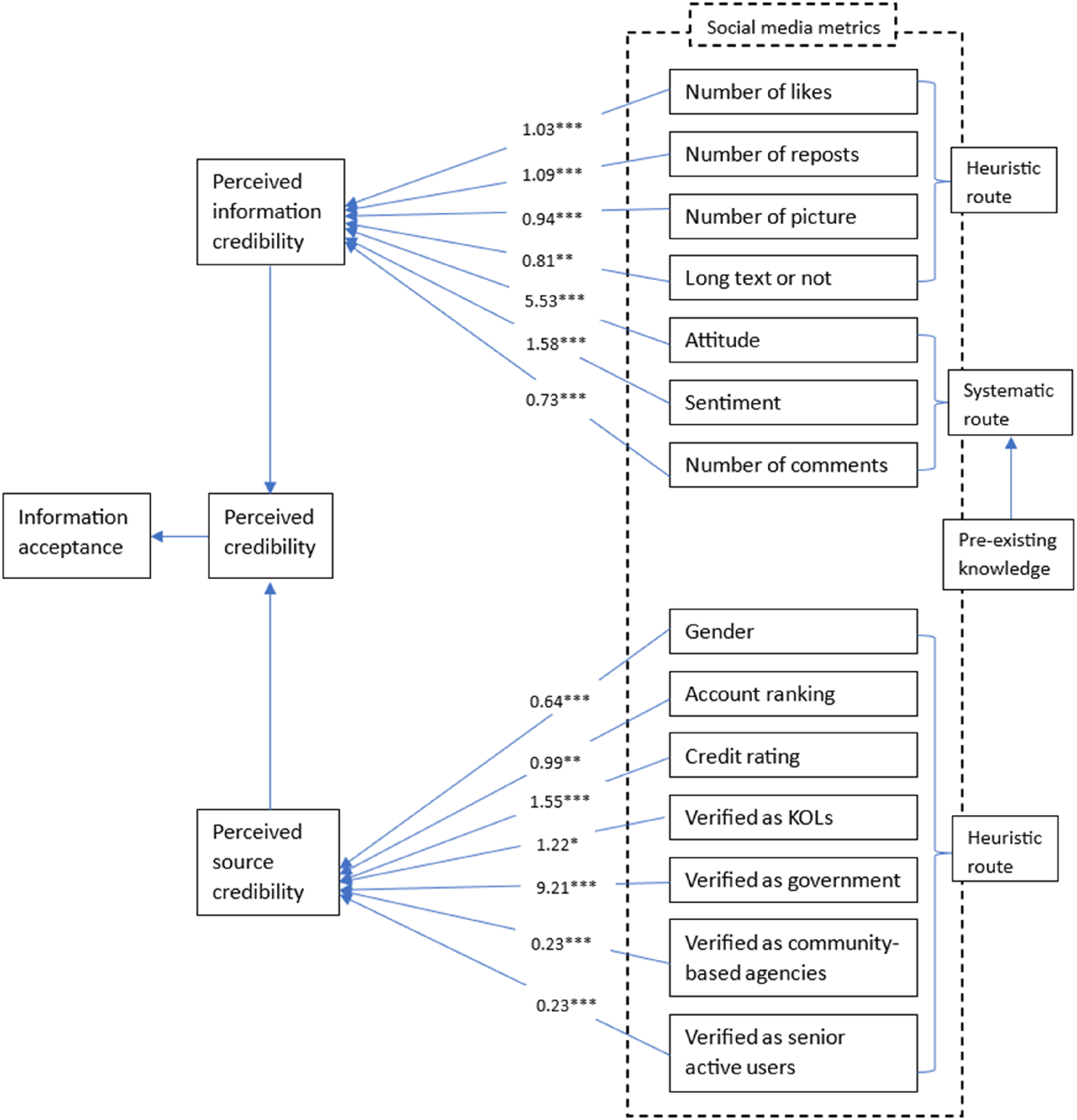
This study centred around the notable case of a celebrity, which may limit the application of the results across different social context. While the case primarily examines broader mental health issues, the dynamics of MHRM observed in this case also reflect patterns relevant to the general public’s understanding of mental health narratives online. Sulli’s case incorporates unique aspects related to celebrity context and fan engagement, while the extensive discussions it provoked also encompassed a wide demographic, extending beyond her immediate fan base. This broad involvement underscores that the insights drawn from this case are not confined to celebrity-centric discussions. Instead, they reflect a more widespread engagement with MHRM in general.
This study also emphasises the potential harm posed by MHRM. The misinformation encompasses a wide array of topics, such as the causes, treatment and symptoms of mental health issues, potentially leading the public to acquire incorrect knowledge on mental health. Furthermore, MHRM that gains popularity or originates from verified accounts is more likely to be accepted, thereby potentially inflicting greater harm on the public. Therefore, our study provides several implications for addressing health-related misinformation through multiple efforts on societal level. For social media companies, it is important to monitor the information with more likes, more reposts and positive sentiment, as these factors increase the likelihood of user acceptance. Health authorities should consider providing training on digital media communication and persuasion to enhance health professionals’ skills in online health communication. For example, based on elaboration likelihood model, health professionals may embed important messages in pictures to grasp audiences’ attention as the peripheral route for persuasion. Furthermore, comment section serves as a vital arena for misinformation correction. Verified health professionals might effectively address health-related misinformation in comment section, utilising their expertise to provide informed opinions.
A number of limitations should be noted. First, the predominance of female perspectives could have biased the results since Sulli’s fans are mainly females. Future studies may choose cases with more balanced proportion of each gender. Second, the outcome variable was coded manually and was subject to researchers’ bias to certain degree. Third, the study relies on secondary social media data and employs correlational methods, which are inherently limited in their ability to yield deeper insights or to establish causal relationships. Future studies could benefit from integrating qualitative interviews or quantitative surveys to examine specific hypotheses suggested in the discussion section. For instance, future studies might explore whether individuals place greater emphasis on the content of comments rather than their quantity, assess the role of pictures accompanying the content in individuals’ information processing and investigate the perceived credibility of information sources where the source gender is female within discussions centred on female issues or mental health topics. Fourth, the collected data may be subject to censorship by the state and platform, which might not fully represent the entire spectrum of mental health-related discourse.
Footnotes
Declaration of Conflicting Interests
The author(s) declared no potential conflicts of interest with respect to the research, authorship, and/or publication of this article.
Funding
The author(s) received no financial support for the research, authorship, and/or publication of this article.
Notes
Appendix
Author Biographies
 .
.