




Abstract
This paper investigates how the acceptance of data-driven political campaigning depends on four different message characteristics. A vignette study was conducted in 25 countries with a total of 14,390 respondents who all evaluated multiple descriptions of political advertisements. Relying on multi-level models, we find that in particular the source and the issue of the message matters. Messages that are sent by a party the respondent likes and deal with a political issue the respondent considers important are rated more acceptable. Furthermore, targeting based on general characteristics instead of individual ones is considered more acceptable, as is a general call to participate in the upcoming elections instead of a specific call to vote for a certain party. Effects differ across regulatory contexts, with the negative impact of both individual targeting and a specific call to vote for a certain party being in countries that have higher levels of legislative regulation.
Keywords
In elections all over the world, political parties rely on data-driven techniques in their election campaigns to reach and persuade voters. Data-driven campaigning can be defined as campaigning strategies ‘accessing and analyzing voter and/or campaign data to generate insights into the campaign’s target audience(s) and/or to optimize campaign interventions’. (Dommett et al., 2023, p. 2). One central tool of data-driven campaigning is the use of targeted messages to reach specific voter segments. Whilst operationalised in various forms dependent on context (Kefford et al., 2023), it is now common for parties to use data on an individual’s location, voting intention or issue preferences to target campaign messages via doorstep conversations, leaflets, targeted mail or online political advertisements (Kusche, 2020). Despite being an established element of election campaigns, in recent years the increasing availability of personalized data – afforded by the rise of digital technology – has led to concerns about voter privacy and the potential for voter manipulation (Diamond, 2019). Arising from these concerns, attempts have been made to establish public views of the acceptability of data use and targeting within election campaigns. To these ends, existing work has reported evidence of concern, predominantly negative to neutral evaluations of data-driven political advertising among citizens (authors blinded), but also some variation by precise practice (authors blinded). Whilst generating important insight into perceptions of data-driven campaigning techniques, to date, these insights have been gathered in only a few country contexts. This is leaving us with unanswered questions about the degree to which common attitudes are apparent worldwide and to what degree perceptions about various forms of data-driven campaigning are contingent upon country-level characteristics.
Within this paper, we address this gap by presenting new data on the perceived acceptability of data-driven campaigning in 25 countries around the world. We consider this a key aspect in the normative debate of data-driven campaigning, but also on the impact of artificial intelligence in our daily lives more broadly. We deploy a vignette study to consider how partisan motivated reasoning, the form of targeting, the topic and the objective of targeted political ads affect perceptions of acceptability. In particular, we are interested in how context might moderate the impact of message characteristics. More specifically, we focus on the impact of both the legislative context as reflected in the degree of data protection as well as the broader information environment and more specifically the level of media freedom.
We find that political ads that use general targeting are considered more acceptable than those deploying individual targeting and that ads from a liked party are considered to be more acceptable than ads from a non-liked party. We also find the correlation between issue importance and acceptability to be positive and significant, whilst ads that contain a specific call to vote for a party are considered less acceptable than those that contain a general call. Looking comparatively at results from our 25 countries, we also find the significance of structural factors within the context where targeting occurs. Whilst the degree of media freedom in specific countries does not exert an impact on message characteristics, there are noteworthy differences across levels of data protection legislation. Specifically, we find that the acceptability of general and individual targeting is greater if data protection legislation is stricter, and that more direct attempts to impact voting preferences are considered less acceptable compared to more general calls to vote when data protection legislation becomes stronger.
A Comparative Perspective
Despite recent efforts to conduct comparative research (Kefford et al., 2023), current knowledge about Data Driven Campaigns (DDC) is primarily concentrated on a small number of advanced Western democracies, most particularly the US. Some research is emerging in countries such as Australia, Canada, Germany, the Netherlands, the UK, and Sweden, demonstrating wide, yet little sophisticated use of data driven campaigning techniques (Kefford et al., 2023, p.7). Even fewer studies have concentrated on public attitudes towards DDC, let alone beyond advanced Western democracies. This mirrors a wider trend observed by Chadwick, wherein ‘digital politics scholarship over the last two decades has mostly been fueled by analyses of broadly progressive or pro-democratic cases’ (2019, p.7). The direct consequence of this is a lack of understanding not only of how widespread concerns are about DDC practices but also the degree to which the precise cause of concern is consistent in different jurisdictions. Existing studies have remained almost exclusively focused on case studies. This lack of knowledge is particularly significant in light of transnational efforts to counter concerns about data misuse, as it is by no means clear that the public in different countries is equally concerned about this practice or identifies the same factors as in need of response. Given well-established norms about the importance of responsiveness to public opinion within democratic societies (Powell, 2004; Spoon & Klüver, 2016), this lack of knowledge poses particular challenges. As such, there is an urgent need for studies of different and currently un (der)-examined contexts, particularly for comparative analysis.
Studies on the practice of DDC itself also run the risk of lacking applicability. A lot of nuance is lost by asking respondents to evaluate either an archetypical example of targeting or simply their own interpretation of the practice. This might not fit the most common practices in reality, since as we will point out, the extent to which different types of DDC techniques are adopted by parties varies widely within- and across countries. Thus, it is important to study what aspects of DDC in particular people can accept or not. In this paper, the focus is on different scenarios and we seek to tease out differences in types of targeting practice. Based on the current literature, we formulate four suspected tipping points of acceptability in terms of message characteristics.
Message Level Factors
Which attributes make a political message more or less acceptable? Individuals’ perceptions of political messages might vary according to the characteristics of the message. We identify four message-level factors that could influence ad evaluation, namely (1) the source of the message, (2) the use of more or less fine-grained targeting criteria, (3) the issue that is addressed and (4) the specificity of the call.
The Source of the Message
First, the source of the ad could be a political party that is either congruent or incongruent with the recipients’ political preferences. Ads from an ideologically congruent source, a party one is likely to vote for, are perceived more favourably (Lavigne, 2021). Exposure to ads from preferred parties strengthens and consolidates partisan affiliation (Lavigne, 2021). There is also some evidence that political targeting from a liked party is perceived as less manipulative than targeting from a disliked party (Hirsch et al., 2023). So even if individuals do not necessarily agree with the content of the message or the way the message was targeted to them, they might perceive ads from political parties they like more positively than ads from parties they dislike. This mechanism is described in the well-known theory of motivated reasoning. If motivated reasoning is induced by partisan bias, individuals are expected to be inoculated from giving a negative verdict (Bisgaard, 2015). Even though people might have existing beliefs about DDC that are distinctly negative, they will dismiss these beliefs in order to protect the loyalty they feel towards their preferred political party (Druckman et al., 2013; Taber & Lodge, 2006). Qualitative findings also show that voters are more likely to critically process a political ad if they disagree with the message (Haley, 2020). If voters receive an ad from a party they like, they are more likely to agree with the message, and accept the ad uncritically. Another factor that drives the influence of the source in the level of acceptance is that most people lack substantive knowledge of the complicated practice of DDC, though this might vary across contexts (Nelson et al., 2021). A study among US voters found that not even half of the respondents were able to correctly evaluate true and false statements about online targeting and personalization practices (Nelson et al., 2021). Thus, the source of the message could function as an information shortcut. By relying on party cues, a lack of knowledge of DDC can be compensated by inferring beliefs about their preferred party to conclude that their use of DDC techniques must be somewhat acceptable (Carmines & Kuklinski, 1990). We therefore hypothesize: Liked party (H1): if the ad comes from a party that the respondent likes and has voted for in the past, the ad will be perceived to be more acceptable than if it comes from a party the respondent dislikes and would never consider voting for.
The Use of Personal Data
Second, a political ad can be optimized with a variety of data sources. The use of data is an essential characteristic of DDC. There is a wide variety in the types of data that are used within data-driven campaigns. Most relevant in the context of acceptability is the distinction between the use of personal data about individual voters and the use of data based on group-level characteristics. The former also implies higher levels of ad personalization than the latter.
The use of personal data by political actors might trigger privacy concerns. Prior studies from the domain of marketing found that personalization based on increasingly sensitive data might elicit feelings of vulnerability and, in turn, lead to reduced ad effectiveness (Aguirre et al., 2015; Binder et al., 2022; White et al., 2008). This idea is based on the information boundary theory, which suggests that when an individual sees the collection of gathered personal data as discomforting, they perceive targeting as a major risk that does not outweigh the benefits (Boerman et al., 2017). In other words, citizens are critical of the use of personal, sensitive data when being targeted and perceive privacy risks as the highest cost of personalized advertising (Aguirre et al., 2015; Segijn & van Ooijen, 2022). Although knowledge about personalized advertising might be low, citizens are found to differentiate considerably between different types of personal data (Chanchary & Chiasson, 2015; Milne et al., 2017; Wei et al., 2020). Generally, the use of individual-level data such as phone numbers or email addresses is perceived more negatively than the use of general (demographic) information, such as gender or interests (ibid). As research shows, online users tend to perceive the covert collection of data and inference of characteristics as an unacceptable flow of information (Kim et al., 2019). Related to this, personalized ads might also elicit negative emotional reactions, such as feelings of creepiness which arise from the uncertainty of danger (e.g. to one’s privacy) being present (De Keyzer et al., 2022; McAndrew & Koehnke, 2016; Segijn & van Ooijen, 2022). In the context of election campaigns, the use of personal data also elicits what can be described as moral panic (Bodó et al., 2017). More so, it seems, than the use of personal data by commercial actors. This moral panic is based on the notion that the use of DDC techniques has a harmful impact on the level playing field during election campaigns and that being influenced into buying something is less concerning than being influenced into voting for someone. Therefore, while these findings reflect the low acceptability of personal data use in general, the acceptability of personal data use by political actors is likely even lower.
In practice, the level of sophistication of targeting is highly dependent on contextual factors (e.g. electoral system), budget, legislation, party structures, internal knowledge about DDC, and the availability of good quality voter data (Kruschinski & Haller, 2017). In terms of more or less personalization, a distinction can be made between targeting at a more general level to improve the likelihood that a campaign ad reaches a relevant audience and targeting at the individual level which is preceded by a detailed analysis of persuadable voter groups and their characteristics. The former does not even necessarily require political parties to collect their own voter data and might be more applicable to political actors in countries with stringent privacy legislation. It can take the form of targeting lookalike audiences, for example, which is available on social media platforms for a cost (Gibson et al., 2023). Lookalike targeting is defined as targeting a group that shares similar user behaviour with an already existing audience of the advertiser on that platform, for example, people who follow the Facebook page of a specific political party or who have liked posts from these pages in the past (Ghosh et al., 2019). More individual-level targeting involves the use of personal data, which is sometimes restricted by legislation (Ghosh et al., 2019; Kefford et al., 2023). Lists of voter data are enriched with personal data, such as education and pet ownership to improve their predictive value. Specific users can be targeted based on these lists of voter data which is collected and uploaded by the political party and then matched to social media profiles (ibid). Targeting based on personal data thus consists of a combination of various data sources. This is desired to reach higher levels of precision in targeted advertising. Not all political parties collect or use personal data about voters. That political parties of all shapes and sizes and in all contexts make use of advanced DDC techniques is often found to be based more on myth and assumptions than on empirical proof (Anstead, 2017; Baldwin-Philippi, 2019; Kruschinski & Haller, 2017). Given this variation in practice, it is important to study whether voters are accepting of different types of DDC. Even though individuals are not always aware of personalized targeting and transparency is not one-to-one related to awareness (Segijn et al., 2021), we anticipate that disclosure of this type of strategies yields a more critical evaluation. Thus, we expect that: Individual targeting (H2): if the targeting is based on detailed individual-level characteristics, the ad will be perceived as less acceptable than when the targeting is based on more general characteristics.
The Salience of the Content
Third, a common practice of DDC is matching the content of the campaign message to the concerns of the recipients of the message (e.g. issue-based targeting) (Dobber et al., 2023). Whether individuals think the issue that is addressed in the ad is important might determine the level of acceptability of DDC. A majority of political ads on Facebook during the US 2018 midterm elections discussed a specific issue, the two most common issues being the environment and immigration (Kruikemeier et al., 2022). Previous studies indicate that voters are more responsive towards political ads that address issues they deem important (authors, forthcoming). Correctly matching the content of an ad and voters’ predispositions can decrease support for the opposing candidate (Endres, 2020). Online political content about salient issues also increases emotional reactions as opposed to content about less salient issues (Eberl et al., 2020).
Issue congruent ads might be perceived as more acceptable since they provide voters with political information they find interesting. From research into news consumption, we know that people’s preference for information about political issues is indeed driven by how important they consider those issues to be (Feldman et al., 2018). Personalization can increase the relevance of political ads by increasing issue congruency. In other words, if political actors use more advanced DDC techniques they might be more likely to identify voters that are interested in certain issues and target them accordingly. Naturally, if someone thinks climate change is a major issue for their country, they would want politicians to engage more with the issue and they might be less concerned about the tools that are used for the issue to gain attention in the process. Vice versa, if citizens might be less accepting of ads using DDC techniques when they contain content about issues that are not salient to them. Exposure to ads that are perceived as irrelevant might increase annoyance about online campaigns in general and thus lower acceptability. On a psychological level, importance may override critical elaboration on the practice of targeting. This is similar to the effect of party preference (H1). That is, if an ad is perceived as interesting, it becomes likely that citizens will devote attention to the message rather than to negative considerations about the practice of targeting. In practice, political candidates are not always able to identify voters’ issue positions correctly and effective issue-based targeting is (again) dependent on the accessibility of voter data in any given context (Endres, 2020). Thus: Issue importance (H3): the more important the respondent the political issue the ad addresses concerns to be, the more acceptable the ad will be considered.
The Specificity of the Call
Lastly, the content of ads can have different objectives – they can be used to convey a party-specific message (i.e. vote for my party) or to convey a generic and non-partisan idea (i.e. make sure you cast your vote). The practice of DDC often brings up concerns of voter manipulation. The fear is that political parties with the right strategy and resources might be able to shift the outcome of an election, also by demobilizing certain segments of the electorate. However, DDC could also positively impact democracy by mobilizing voter groups that are traditionally hard to reach. A study by Valenzuela and Richardson (2016) indeed shows that targeted ‘get out the vote’ messages can increase actual turnout (see also Haenschen, 2023). It is generally thought to be beneficial for democratic legitimacy if voter turnout is high, and if political participation is broadly divided among groups in society. Therefore, it is expected that people will be more accepting of DDC if it is employed to increase political engagement more generally rather than steering voters towards a specific vote choice. Electoral influence (H4): if the ad contains a general call to vote in the next elections, it will be perceived as more acceptable than when the ad contains a call to vote for a specific political party.
Comparisons Across Countries: Different Regimes of Data Protection
The possible influence of factors such as the regulatory system are recurrently highlighted by scholars, but to our knowledge this is the first study in which the influence of systemic factors on the acceptability of different forms of DDC is explored. This oversight is particularly surprising given an established history of comparative media research which has shown factors such as the electoral or party system, the socio-political environment, the system of government or media system to be influential in conditioning social attitudes (Bowler et al., 2001). Within this paper, we address this gap by taking an exploratory approach. On the one hand, in the case of higher levels, one might expect strict legislation to lower the concerns for far-reaching types of targeting as it provides people the feeling that ‘checks and balances’ are in place. On the other hand, people might be more aware of the potential threats, since legislation is often preceded by public debate, and subsequently less willing to accept the practice of certain types of targeting.
The past half century has witnessed increasing efforts by national and international governing bodies to introduce and harmonize controls over private and public sector uses of citizens’ personal data. Beginning in the German state of Hesse in 1970, by 2020 it was estimated that more than two-thirds of countries worldwide had enacted data privacy policies, with over half of this legislation introduced in the past decade (Greenleaf & Cottier, 2020). The first attempt at standardization came with the publication of the OECD Privacy Guidelines in 1980. This was followed in 1981 by the Council of Europe’s (CoE) Convention 108 which strengthened the guidelines significantly by making them legally binding on signatories. In 1990, the UN Privacy Guidelines further extended core data protection principles to an even wider set of countries. The trend toward international alignment arguably culminated in 2018, with the implementation of the European Union General Data Protection Regulation (GDPR). The GDPR is widely seen as the most restrictive and robustly enforced framework for personal data processing in the world. The added requirement that its provisions apply to EU citizens’ data transferred to non-member states has proven to be particularly influential on global practice and policy concordance. Recent legislative initiatives in several U.S. states, including the California Consumer Privacy Act (CCPA) have been directly traced to GDPR principles of consent, transparency (Barrett, 2019; Kaminski, 2023).
Despite the increasing convergence of data protection regimes globally, there remain significant differences across countries, particularly in regard to the type of data that is included, which entities are covered and how binding the rules are. Differences are both regional and historical in nature. Regionally the spread and scope of the regulations varies considerably, with European countries typically seen to be at the forefront of stronger controls, while the nations of North America, and to an increasing extent those in the Asia-Pacific region, Latin America, Africa and the Middle East are regarded as adopting a more ‘laisser-faire’ approach (Bygrave, 2010). While some of this variance is due to the resources available for governments’ to monitor and enforce compliance, scholars have also underlined the influence of deeper historical and cultural divides between countries, and particularly their understanding of individuals’ right to privacy (Bygrave, 2010).
Essentially, data protection frameworks can be envisaged as forming something of a continuum, anchored at one end by a highly liberalized ethos that is most commonly observed in countries considered part of the Anglosphere, and exemplified most notably by the United States. The restrictions that do exist are largely reactive and sectoral in nature, that is, they are targeted at particular governmental agencies and industries, and tend to rely, as a default, on self-regulation (Richardson et al., 2019). Contrasting with this approach is the more pro-active bureaucratic model that is prominent among the countries of continental Europe. Inspired by the view that individual privacy is of societal value and should be a constitutionally prescribed right, such regimes consider that any personal information shared with companies, employers and parties, is done so in adherence with clear guidelines and subject to their ‘owners’ consent. In tracing the origins of these outlooks, scholars have highlighted a relationship with countries’ prior experience (or not) of totalitarian rule, and a heightened sensitivity to the dangers of uncurbed state surveillance and monitoring of citizens activities (Bygrave, 2010, p. 176).
Within these broader regional and philosophical divides, there is of course scope for considerable national variability. Conversely, even within the most ostensibly aligned nations, such as the EU member states, divergence occurs in the interpretation and implementation of core principles. Some of this flexibility is explicitly granted in the legislation with the EU allowing several key areas of policy be subject to national discretion. This includes specification of the ‘appropriate safeguards’ that are placed on the processing of more sensitive data (DLA Piper, 2023). However, differences across countries are also likely to arise on a more passive basis, as a result of the lack of precision in the wording of key sections of the legislation. Individuals’ consent to share data can, for example, be waived if there exists a ‘legitimate public interest’ in its use. As McDonagh (2019) argues this opens up the potential for significant gaps and differences in countries and particularly political parties understanding of the protections afforded to ‘the processing of personal data for the purpose of electoral activities’ (p.138).
Given the variance in the strength and also history or public profile of the data protection agencies that exist across countries there are clearly grounds to expect these differences to affect citizens’ acceptance of targeting that uses personal data. While the issue of data protection and information privacy has not mobilized the type of public activism that has occurred for other issues, such as environmentalism, consumer protection and human rights (Bennett, 2008), its prominence and awareness of its importance have gained increasing publicity. This has been particularly the case in the wake of the Cambridge Analytica scandal since its exposure in 2018. As such one might expect that citizens living in countries with stronger data protection rules are more conscious of their importance and thus are likely to be less accepting of targeting around their personal characteristics and interest. Countering this, however, one might consider an ‘acclimatisation’ argument whereby those countries with the strongest and longest standing systems of data protection also have a stronger concomitant norm or expectation of data disclosure and thus have become less concerned overall about the dangers it poses (Bygrave, 2010, p. 178). Both lines of argumentation seem plausible. Given the lack of previous studies we ask a broader research question and explore how data protection legislation moderates the hypothesized effects of the various message characteristics: (RQ1) How are the effects of message characteristics moderated by data protection legislation?
Methods
We rely on a cross-national vignette study conducted in twenty-five countries in February 2023. This factorial experiment was conducted by Kantar by means of an online survey, which used in each country its own respondent pool or that of a partner. Respondents received an incentive upon completion of the survey. These countries were selected to capture a wide variety of electoral settings with varying degrees of legislative regulation, but in all countries, political microtargeting is allowed – thus making the presented vignettes realistic to evaluate. A complete overview of countries is provided in Figure 1. In each country, a minimum of 550 respondents who were largely representative of age and gender, completed the survey, answering a range of questions relating to political attitudes and opinions about political parties’ campaign activities. Response rates differ across countries, with between 13.5 (United States) and 51.7 (Japan) percent of the invited respondents participating, with an overall participation rate of 21.5%. Of those people who started the survey, 87.7% completed the full questionnaire. For our analyses, we rely on a total of 14,390 respondents. Countries included in the study.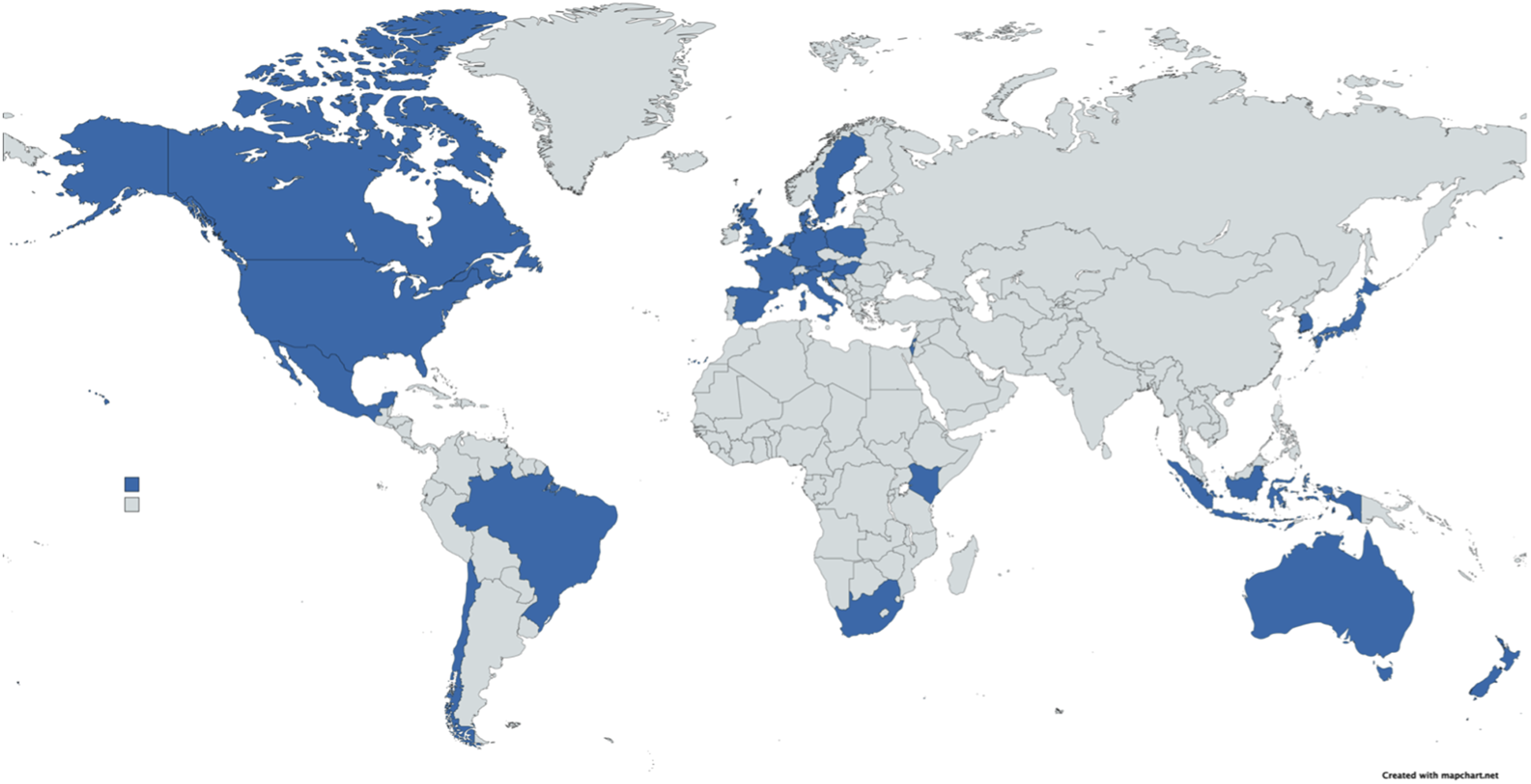
Independent Variable
Each respondent was presented with three scenarios that differed randomly on the four message characteristics we identified above. The vignettes looked as follows:
‘A national party [liked party]
Liked party, individual targeting and electoral influence are all operationalized as dummy variables as outlined above. For issue importance, we use the following additional question: Below we list a range of different issues. Can you tell us how important you consider each of them in your country today? Answer categories ranged from 1 (not important at all) to 7 (very important). The list included both immigration (M = 5.12, SD = 1.73) and environment (M = 5.35, SD = 1.68) and scores were matched with the issue that was mentioned in the vignette. After being presented with the scenario, the respondent is asked to answer a range of questions. We registered the time people took to read the vignette and answer those questions. We use per country the lowest percentile (10%) for the time variable to and remove those cases because of speeding. This leaves us with 38,436 cases from 13,828 respondents. Without removal of those cases, results as presented below, would be substantially similar.
Dependent Variable
To measure the acceptability of the ad, we used a battery of seven items, a slightly extended version of the perceived manipulative intent scale as introduced by Binder et al. (2022), including the following statements: • The way this ad tries to convince me is acceptable to me. • This ad is not manipulative. • This ad is fair in the information it contains. • It is ok for my personal data to be used to target messages on this particular topic. • The tactics used in this ad are fair. • The chosen advertising strategy of the ad as described is acceptable to me. • The use of the information that the party has obtained about me is acceptable to me.
The scale captures the general evaluation and the degree to which people consider the proposed scenario acceptable in general terms. Answer categories range from 1 (completely disagree) to 7 (completely agree). The items form a reliable scale (Cronbach’s alpha = .95). We calculated the average over the seven items (M = 3.24, SD = 1.58).
Country-Level Moderator: Data Protection Legislation
For the data protection legislation, we use the classification from DLA Piper (https://www.dlapiperdataprotection.com) that classifies countries based on their legislation in four categories. Given the wide range and complexity of existing laws and the rapid evolution in codes of practice now occurring across countries, designing a metric able to capture variation in nation’s data protection rules is clearly a difficult task. In response to this challenge, but also reflective of the more regional and cultural factors shaping national outlooks, indicators that have been developed adopted a more aggregative approach and relied on ‘clustering’ countries across a simple ordinal level scale. One of the first attempts to develop this area of empirical research can be found in the work of DLA Piper, which has taken the initiative to provide the first global measurement of the strength of nations’ data protection legislation according to four categories – heavy (3), robust (2), moderate (1) and limited (0). Nations they explain are scored on 12 areas of global data protection that form the basis for their data privacy ‘scorebox’ against which organizations can evaluate themselves. These include, for example, requirements regarding data collection and storage, data protection, and breach notifications. The relatively crude nature of the scale means that it does not reflect a great amount of variance among countries in general, and consequently for our sample. However, it is clear that it picks up the differences argued for in the wider literature, for example, in regard to Argentina and Uruguay’s leading role among Latin American countries, and similarly for Senegal in Africa and UAE-Bahrain and Dubai in the Middle East. Most countries in our sample classify as heavy but also includes Limited (Kenya), Moderate (Brasil, Chile, South Africa) and Robust (Indonesia, Japan) countries. An overview of the countries with response rates, number of included cases as well as scores on data protection legislation is presented in Table A1 in the Online Appendix.
Control Variables
Research has focused on individual-level explanations for different levels of acceptability – including background characteristics (Dobber et al., 2023): age and education are both found to decrease acceptance, and the same goes for privacy concerns (Dobber et al., 2023; Schäwel et al., 2021). Also political preferences are related to attitudes (Hirsch et al., 2023), with right-leaning people being more lenient towards various political microtargeting strategies, as are males compared to females (Gibson et al., 2024). Though this is not the key focus of this paper and randomization of experimental conditions (vignettes) should account for those individual differences, we control for the following respondents’ characteristics:
Age as measured by the following question: What is your age? (M = 45.5, SD = 42.1); Female, using information from the following question: What is your gender? (52.5% female); Education, measured by the following question: What is the highest level of education you completed? With a five-point answer category, ranging from ‘less than high school’ (1) to ‘graduate degree’ (5). (M = 3.10; SD = 1.20); Political interest is captured by the following question: To what extent are you interested in politics, with answer categories ranging from ‘not at all’ (1) to ‘very much’ (7). (M = 4.51, SD = 1.78); Political placement is based on self-placement on an 11-point left-right scale, relying on the following question: In politics, people sometimes talk about the left and right. Where would you place yourself on a scale from 0 to 10, where 0 means left and 10 means right? (M = 6.25, SD = 2.51). Privacy concerns relying on the agreement with the following statement I am not concerned that my personal data is being used to influence my voting behaviour (reversely coded) with answer categories ranging from completely disagree’ (1) to completely agree’ (7) (M = 4.25, SD = 1.95).
Finally, we control for the order of presenting of the vignettes. It might be that people become more negative over time and evaluate the second and third scenario they are presented with more negatively. We include dummy variables for the second and third vignette, with the first one being the reference category.
Analysis
We use multilevel models with maximum likelihood estimation (xtmixed command in Stata), with vignettes nested in respondents nested in countries to test our first four hypotheses. More specifically, we use multilevel regressions with random intercept to test the main effects of message characteristics. To answer our research question, we conduct an additional multilevel analysis, where we allow the slope of the message characteristics to vary across countries and look at interaction effects of with data protection legislation at the country level.
Results
We first compare the average acceptability scores for each of the message characteristics. Descriptive statistics per condition are presented in Table A2 of the Online Appendix. First, ads from a liked party (M = 3.34, SD = 1.58) are considered to be more acceptable than ads from a non-liked party (M = 3.14, SD = 1.58; t = 12.65, p < .001). Second, general targeting (M = 3.28, SD = 1.57) is considered more acceptable than individual targeting (M = 3.20, SD = 1.59; t = 4.50, p < .001). Third, the correlation between issue importance and acceptability is positive and significant (r = .11, p < .001). Finally, ads that contain a specific call to vote for a party (M = 3.19, SD = 1.59) are considered less acceptable than those that contain a general call (M = 3.29, SD = 1.57; t = 6.12, p < .001). All these findings are in line with hypotheses 1 to 4.
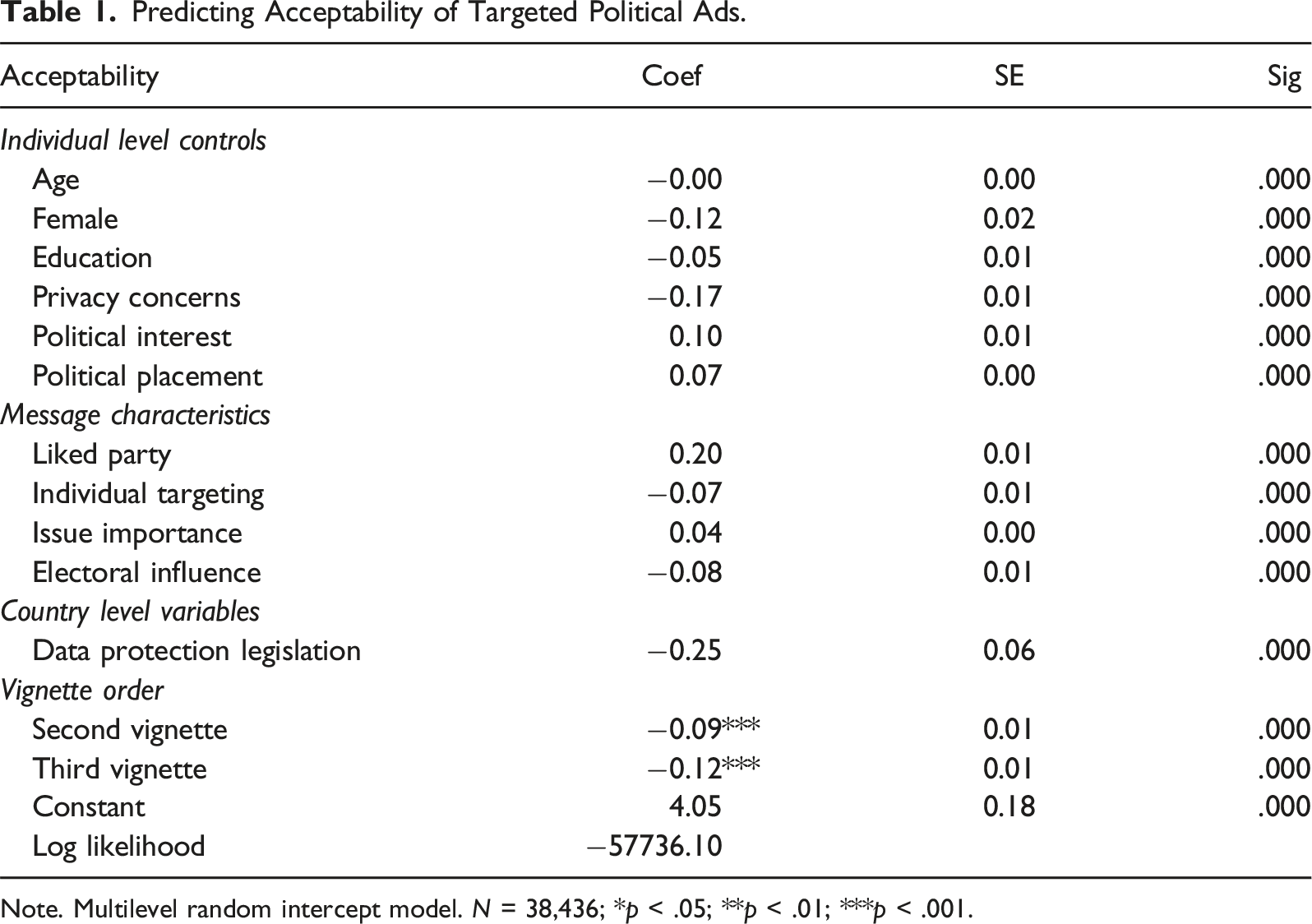
Predicting Acceptability of Targeted Political Ads.
Note. Multilevel random intercept model. N = 38,436; *p < .05; **p < .01; ***p < .001.
Furthermore, as for our control variables, they confirm findings from previous studies. We find that younger, male, and lower educated people are more willing to accept targeted ads. Privacy concerns lower acceptability, while political interest increases general levels of acceptability, as does right-wing political self-placement. Indeed, respondents evaluate the second and in particular the third vignette they are presented with slightly more negative, irrespective its content.
Concerning country level differences, we find that overall, in countries with stronger data protection legislation acceptability is lower, potentially due to increased salience and awareness of the disadvantages of targeted advertising. We do, however, have to be cautious in overinterpreting this effect given the fact that we do not have representative samples in our countries.
In terms of effect sizes, we find that the source of the advertisement and the issue matter (see Table 1). If the ad stems from a preferred party, it is on average evaluated .20 points higher than it is from a non-preferred party. If a respondent rates an issue one point higher on the seven-point importance scale, they will also consider .04 higher on the acceptability scale – which translates into a .24 difference for issues that the respondent considers highly important and issues that they consider not important at all. Substantially, differences of separate factors are limited, but additively they can yield a substantial difference between different vignettes. The limited effect of the separate factors is underlined by the fact that vignette ordering has similar effect sizes, demonstrating, probably due to fatigue, respondents being less positive about the second and particular the third vignette they have to evaluate.
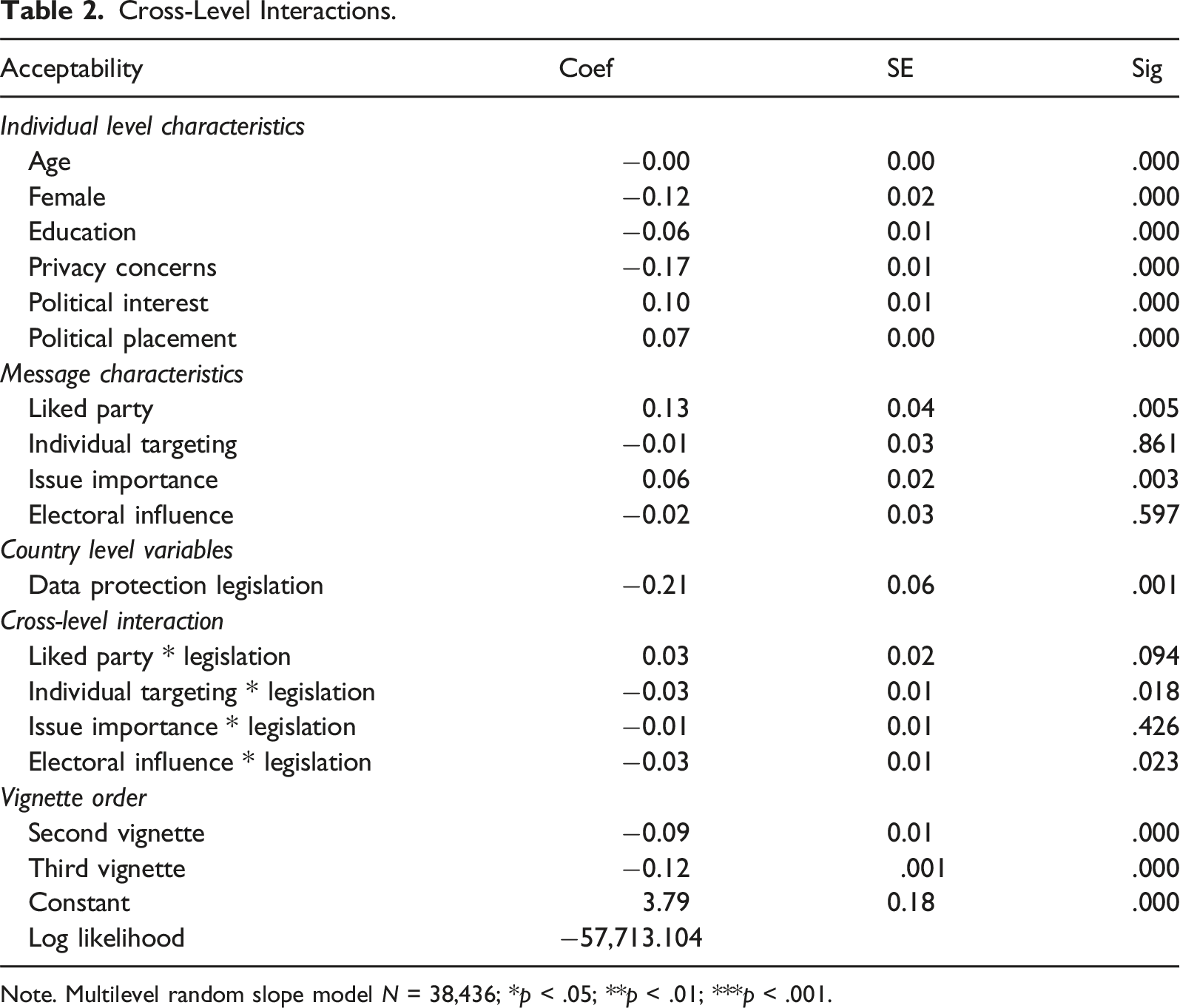
Cross-Level Interactions.
Note. Multilevel random slope model N = 38,436; *p < .05; **p < .01; ***p < .001.
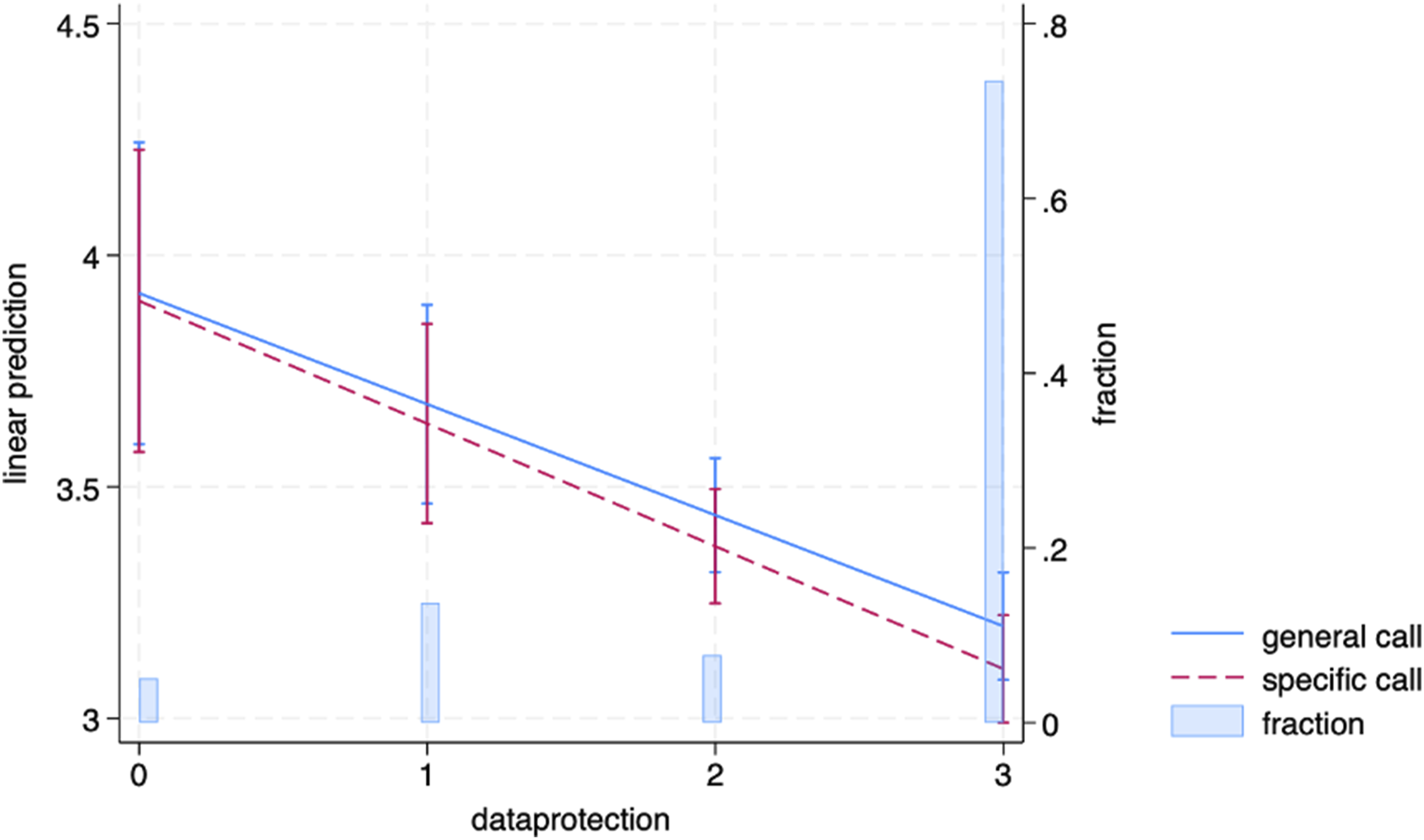
Figures 2 and 3 provide a graphical representation of the interaction effects – again, it is important to emphasize that differences across contexts are relatively limited. Figure 2 demonstrates that in contexts with little data protection legislation, participants consider general and individual targeting similarly acceptable (score 0), while in countries with high levels of data protection legislation (score 3, the majority of our cases), general targeting is considered more acceptable than individual targeting. Figure 3 demonstrates a similar pattern for general versus specific calls to vote. In case of little protection legislation, general and specific calls to vote are considered equally acceptable, while in countries with higher data protection legislation ads with a general call are considered more acceptable. Effect of general versus individual target across contexts. Note. Based on the fixed part of the multilevel random slope model with only interactions with data protection legislation included, 95% confidence displayed. Effect of generic versus specific call to vote across contexts. Note. Based on the fixed part of the multilevel random slope model with only interactions with data protection legislation included, 95% confidence displayed.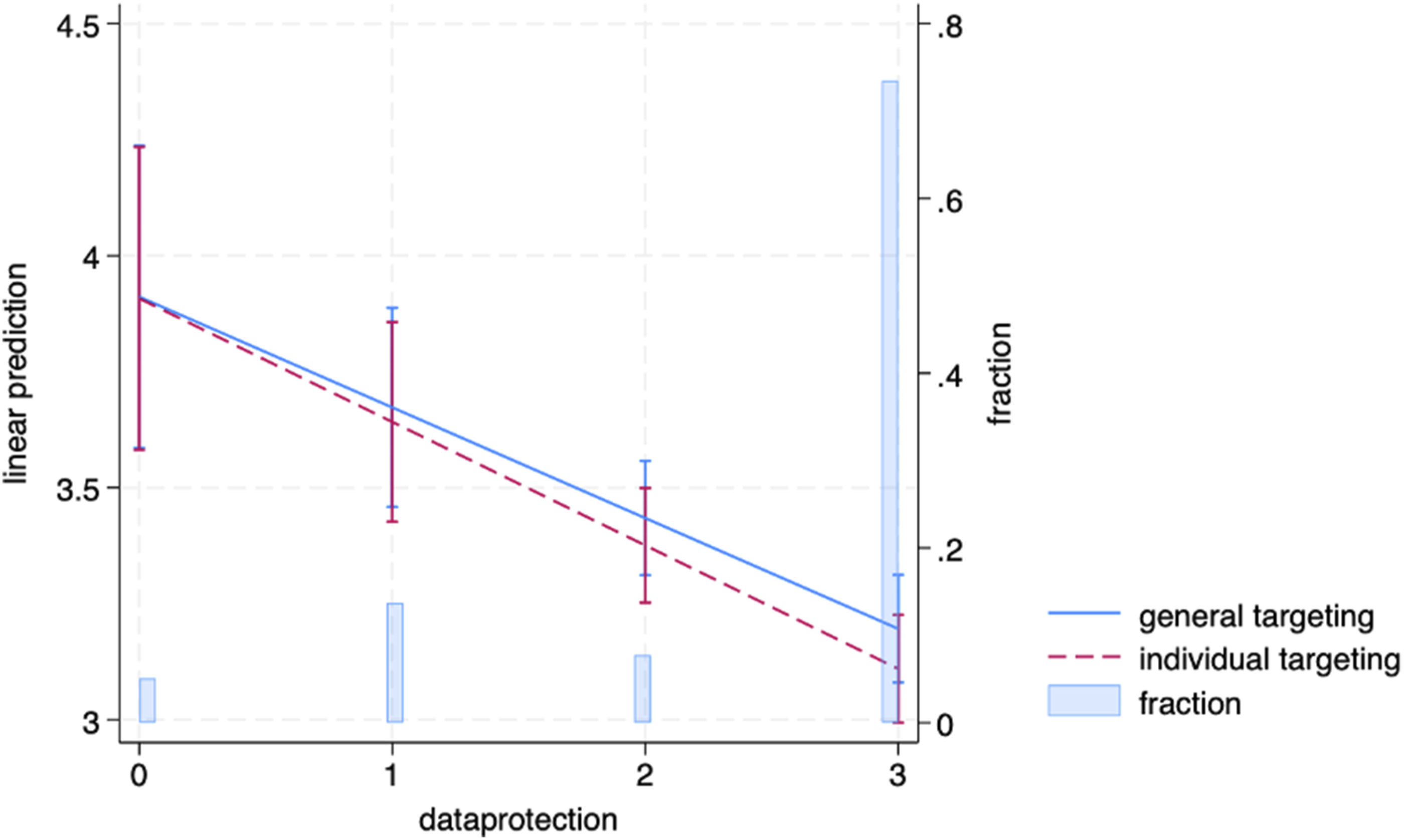
Conclusion
Concerns about data-driven election campaigns are widely spread, but degrees depend on the actual operationalization of its practices. Using a novel methodological approach, this paper unpacks the acceptability of targeted political messages that differ on four different factors. We see that in particular the source and the issue of the message matters. Messages that are sent by a party the respondent likes and deal with a political issue the respondent considers important are rated more acceptable. In line with the motivated reasoning theory (Bisgaard, 2015), we found evidence that people are more positive towards information (in our study, the description of certain ads) that aligns with their ideas. This is also in line with previous work that examines the effects of microtargeting and argues that ‘microtargeting strengthens partisan identities’ (Lavigne, 2021, p. 972).
Also targeting based on general characteristics instead of individual ones is considered more acceptable, as is a general call to participate in the upcoming elections instead of a specific call to vote for a certain party. Based on the information boundary theory (see also Boerman et al., 2017), for certain types of characteristics (or personal data), people do not perceive that type of information to be that invasive. It does not cross a boundary – as the costs are not perceived to be high. The finding that ad source and ad content are more impactful for acceptability than DDC practices is interesting given the literature that shows citizens’ negative perceptions of personal data use and the increase in legislation aimed at safeguarding citizens’ data. An explanation for this could be that the specific examples given in the vignette did not seem particularly invasive to the respondents. Overall, these findings confirm our expectations and point to the fact that citizens are able to pick up nuanced differences across different messages and rate them differently.
In the next step, we investigated whether the impact differs across contexts and whether certain characteristics interact. We find that this is the case for two out of the four factors: the negative impact of both individual targeting (vs. more general targeting) and a specific call to vote for a certain party (instead of a general call to vote) is stronger in countries that have higher levels of regulation. Thus, in more regulated countries, citizens are more sensitive towards the degree of targeting and the explicit manipulative intent of the message, making them disapprove of those attempts more. This effect can be explained by the fact that in countries with more legislation, a stronger norm has been set on what is acceptable and not. Citizens might be more aware of this norm and perceive targeted ads in a different way. In that way, laws that are aimed at protecting citizens, at the same time, might seem to empower citizens in a way that they become more sensitive towards certain aspects of targeting (Boerman et al., 2017).
While this study is methodologically advanced in its application of a vignette study in a wide range of countries with considerable variation, allowing for a solid cross-national comparison, our study has also a few shortcomings. Foremost, the experimental design presents respondents with descriptions of political marketing, without exposing them to real targeted ads, which might look artificial and therefore suffer from limitations in terms of external validity. Future studies could overcome this issue by presenting respondents with actual advertisements that differ in the characteristics investigated in this paper and map their varying levels of acceptance. Yet, investigating the perceptions of targeted ads in different countries with real advertisements is rather difficult to realize. In some countries, a lot of parties campaign and this would have resulted in the inclusion of (too) many ads – which are then difficult to compare. The advantage of a vignette study is that it is easier to systematically compare countries, enabling internally valid cross-country comparisons. Still, the high variation in country contexts poses serious challenges to equivalence – especially ‘construct bias’ might be present. Here, the way we captured different aspects of DDC might not be equally well applicable across different context (Esser & Vliegenthart, 2017). We tried to deal with this issue by using very generically formulated vignettes, but more in-depth country-specific analyses are warranted to increase our knowledge of how citizens in different countries understand DDC. Additionally, we focussed the cross-national comparison on data protection legislation. However, multiple other country characteristics pertaining to the political and media context might well account for differential acceptance of forms of DDC. These cross-national differences deserve to be scrutinized further in future research.
Furthermore, our party identification measure was based on telling participants that they saw an ad from a party they liked or disliked. However, this represents a binary perspective on citizens’ preference for or against a political party. In real life, in particular in countries with a multi-party system, citizens will be more nuanced about whether they like or dislike a party (e.g. they might be more favourable to a party that is more similar to a party they already prefer). This nuance is not captured in the scenarios. Additional research is required to grasp these nuances, especially in countries with multi-party systems.
Overall, our findings demonstrate important variations in citizens’ responses to data-driven campaigning techniques, revealing that the precise form of data-driven campaigning can result in different degrees of acceptability but also that systemic factors can affect perceptions. These findings are meaningful for debates around data-driven campaigning as they suggest the significance, first, of the decisions taken by actors as to how to use these tools, but also of the systemic contexts in which they operate. For those interested in dealing with data-driven campaigning these findings are significant in showing that either actor-focused codes of conduct designed to promote more acceptable conduct, or regulatory reform to promote favourable systemic dynamics appear to be viable mechanisms through which to pursue more acceptable data-driven practices.
Supplemental Material
Supplemental Material - Citizens’ Acceptance of Data-Driven Political Campaigning: A 25-Country Cross-National Vignette Study
Supplemental Material for Citizens’ Acceptance of Data-Driven Political Campaigning: A 25-Country Cross-National Vignette Study by Rens Vliegenthart, Jade Vrielink, Kate Dommett, Rachel Gibson, Esmeralda Bon, Xiatong Chu, Claes de Vreese, Sophie Lecheler, Jörg Mattes, Sophie Minihold, Lukas Otto, Marlis Stubenvoll, and Sanne Kruikemeier in Social Science Computer Review
Footnotes
Declaration of Conflicting Interests
The author(s) declared no potential conflicts of interest with respect to the research, authorship, and/or publication of this article.
Funding
The author(s) disclosed receipt of the following financial support for the research, authorship, and/or publication of this article: This work was supported by the NORFACE Joint Research Programme; (822166).
ORCID iDs

Supplemental Material
Supplemental material for this article is available online.
Author Biographies
References
Supplementary Material
Please find the following supplemental material available below.
For Open Access articles published under a Creative Commons License, all supplemental material carries the same license as the article it is associated with.
For non-Open Access articles published, all supplemental material carries a non-exclusive license, and permission requests for re-use of supplemental material or any part of supplemental material shall be sent directly to the copyright owner as specified in the copyright notice associated with the article.
