



Abstract
Party identification is an important predictor of voting preference, but because a growing percentage of voters do not express any party identification, alternative ways to anticipate voting preferences are required. Partisan slants in voters’ media consumption might offer a relevant proxy. With method triangulation, the current study explores whether media consumption prior to elections can predict voting preferences among independents. Depending on the media outlets adopted by voters and their partisan skew, as detected by Bert machine learning models, the authors calculate an overall partisan slant for each voter’s political information consumption. Data from a nationwide panel survey conducted in Taiwan affirm that their media diet “color” in 2019 can predict independent voters' choices in 2020.
Keywords
For various reasons (e.g., annoyance at party politics, ideological centrism, or closet partisanship), many voters choose not to identify with any particular party (Fiorina, 2016). Self-classified independents often constitute a significant portion of voters in modern democracies, and parties that gain the most support from them often win elections (Fiorina, 2016). The number of independent voters who express no party preference has been increasing in many established democracies (Dalton, 2016; Holmberg & Oscarsson, 2020); a recent longitudinal survey of U.S. voters showed that 44% of them claimed to be independent in 2021, a notable increase from 32% in 1984 (Jones, 2021). But if more people are reluctant to indicate their party identification, predicting voting choices becomes more difficult. Building on the prediction that media outlet consumption represents a symbolic gesture of self-affirmation, we argue that it may be possible to predict voting preferences by reviewing the media consumption behaviors voters exhibit prior to elections, as a proxy for party orientation.
Prediction and explanation are two common research goals. Because we seek to address a practical issue, this study relies on predictive modeling, which is valued for its applied utility, rather than explanatory modeling, which instead is used for theory building and testing (Allison, 2014; Shmueli, 2010). These two approaches differ in important ways. First, for explanatory modeling, predictors cause outcomes; for predictive modeling, the key is demonstrating associations between predictors and outcomes (Shmueli, 2010). Second, for explanatory modeling, omitting variables that affect the dependent variable can invalidate conclusions; for predictive modeling, the goal is to achieve optimal predictions based on available variables. Even though media consumption choices do not lead to voting preferences (which presumably reflect party orientation instead), they might proxy for party identification and thereby predict voting preferences when party information is missing.
Therefore, relying on predictive modeling, we compare the predictive utility of consumption of two types of political media: web-delivered news outlets and political influencers' videos. To achieve a good prediction, we build on nuanced assessments of partisan slant in voters' media consumption. A machine-learning technique determines the partisan slant in each story or post and derives scores of the slant exhibited by each studied news outlet and political influencer. Depending on the news outlets or political influencers that each voter regularly consumes, we can calculate an overall partisan slant in their consumption of each source, or their media diet color. To establish whether media diet color can predict voting preferences well, we gather three-wave panel data in Taiwan. These data show that voters’ partisanship in 2018 predicts their media diet color in 2019, before a presidential election, and then that it can predict voting choices in 2020, among both partisans and self-identified non-partisans, including some closet partisans.
Study Context
Taiwan has a quasi–two-party system, in which two major parties compete: conservative-leaning KMT and liberal-leaning DPP (Hsiao & Cheng, 2014). A key distinction is that the DPP supports independence, whereas the KMT supports unification with China. Other, smaller parties exist, but they also take clear positions on unification versus independence, so an informal classification exists of parties in the “blue camp” (unification supporters) versus the “green camp” (independence advocates).
Since 1996, when the people of Taiwan were first able to elect their president directly, only candidates from the KMT and DPP, the leading parties of the pan-blue and pan-green coalitions, respectively, have won presidential elections, and only those two parties have held a majority of legislative seats. Thus far, the government has undergone three transfers of power between the KMT and DPP, suggesting that Taiwan is a politically divided country. In the 2020 presidential election, the setting for the current study, Tsai was the incumbent and DPP candidate, competing against Han, the KMT candidate, and Soong, who represented the People’s First Party. With a voter participation rate at 74.90%, the vote shares were 57.13% for Tsai, 38.61% for Han, and 4.26% for Soong.
Symbolic Meaning of Political Information Media Repertoire
People establish their unique “political information media repertoire” (PIMR) or “media diet” (Dubois & Blank, 2018, p. 733), which refers to “the collection of media an individual uses to access news and political information regularly” (Dubois & Blank, 2018, p. 5) and can be gauged by the variety (number of outlets) and partisan slant of sources. According to research into partisans’ selective exposure (PSE), political predispositions affect PIMR (Stroud, 2008). Such PSE has been well established in surveys (e.g., Nie et al., 2010) and experiments (e.g., Iyengar & Hahn, 2009), but research examining voters' online behaviors and digital footprints indicates mixed results. Voters’ PIMR can include various outlets, including both partisan niche sources and general interest news providers (Weeks et al., 2016). This stream of research also compares media use information collected from voters’ digital footprints versus their self-reports and documents a notable gap; self-reports indicate a greater degree of selective exposure (Nelson & Webster, 2017). Comparing survey responses and web log data, Dvir-Gvirsman et al. (2016) highlight that 83% of respondents who report visiting ideological websites did not in fact visit them. That is, voters appear unable to recall their media behaviors correctly (Prior, 2009, 2012), and self-reports may serve a self-affirmation function.
Many mechanisms can account for PSE effects, such as seeking ideology-congruent information to avoid dissonance (Metzger et al., 2020) or for self-validation (Hart et al., 2009) or self-affirmation (Weeks et al., 2017). People actively engage in behaviors that remind them of who they are; qualities or identities (e.g., political identities) central to their self-concept are key domains for self-affirmation (Sherman & Cohen, 2006). Indicating an ideology-congruent PIMR thus may help reinforce self-identities and serve self-affirmation functions, especially for partisans (and closet partisans).
Such self-affirmation also requires voters to have clear perceptions of the ideological contours of various media sources. Prior research affirms that people in Taiwan are aware of partisan slants in major news media outlets (Hsiao, 2006), largely derived from their personal experiences. Content analyses also confirm that news media in Taiwan exhibit ideological tilts (Dzwo & Lee, 2010; Lo et al., 2007; Lo & Huang, 2010). Similarly, U.S. voters perceive substantial partisanship in popular news media outlets (Stroud et al., 2014), and U.S. news media reveal partisan bias (Covert & Wasburn, 2007). However, the bias appears consistent only in certain media outlets (Groeling, 2008; Zeldes et al., 2008) and mostly varies by topic (Covert & Wasburn, 2007) or context (Zeldes et al., 2008). Some studies even question whether there is partisan skew of coverage of the same election by the same station (Groeling, 2008; Morris & Francia, 2010). Because categorizing an entire media outlet as liberal or conservative, without considering story-level slant, may not be sufficient, we aim to detect media color at the story level, then develop an overall color score for each outlet.
Sought-After versus General Interest Media in the Political Information Repertoire
Although PSE has been documented in a wide variety of media contexts, media differ in the degree to which audiences seek them (Lawrence et al., 2010). For example, general interest media “target a demographically diverse audience and provide general, less partisan content” (Weeks et al., 2016, p. 250), but voters also might seek information from political influencers who provide reinforcing viewpoints, such as bloggers (Lawrence et al., 2010) or politicians (Parmelee & Roman, 2020), as well as political talk shows with well-known hosts (Stroud, 2008). These political media tend to be sought more actively by polarized voters (Lawrence et al., 2010), who are motivated by a stronger ideological leaning (Johnson et al., 2009). Voters’ ideology shapes their selection of these sought-after media to a greater degree than it does their selection of general interest media (Lawrence et al., 2010). Huang and Chang (2020) note that the percentage of Taiwanese voters who use television, the Internet, influencers’ videos, radio, and newspapers to acquire political information varies: 88.91%, 84.51%, 32.51%, 31.17%, and 20.24%, respectively. Because major television stations and dailies maintain websites, we explore web-delivered news sites as general interest media and political influencer videos as sought-after media. If voters’ political information media repertoires signal who they are, in terms of their political ideology, PSE should be magnified when the selection involves sought-after media, such as political influencers’ videos, compared with habitual media, such as online news websites. We test this prediction with the current study.
News Websites
Reflecting growing Internet penetration, major dailies and news channels use websites to reach wider audiences, and researchers have examined PSE for news websites (e.g., Garrett et al., 2013). Footprint data reveal that mainstream news media, rather than partisan media, constitute substantial portions of voters’ PIMR (Nelson & Webster, 2017), and voters’ consumption of news websites is often ideologically mixed (Cardenal et al., 2019; Weeks et al., 2016). Noting that real media behaviors tend to differ from perceived media behaviors (Dvir-Gvirsman et al., 2016), we predict that voters might express that they rely on mainstream news outlets, due to their high accessibility, and ideology-congruent outlets, to attain self-affirmation, in their PIRM. Thus, the ideological slant in voters’ media consumption may be diluted if we consider their overall consumption, but doing so also provides a more conservative test of whether media consumption can signal voters’ ideology.
Partisanship at W1 can predict voters’ news website diet color at W2.
Political Influencers’ Videos
Political social media influencers engage in self-branding and reach their potential audiences through livestreaming on multiple social media platforms (Fietkiewicz et al., 2018). Approximately 86% of U.S. respondents indicate their awareness of online streaming services, and 34% use such channels as news sources (Barthel et al., 2020). About one-third of Taiwanese consumers watched online streaming in 2020, spending about 138 minutes per week watching videos about politics and current issues (Huang & Chang, 2020). Voters often seek information about current issues from influencers who specialize in politics and current issues (Fietkiewicz et al., 2018) and who vary in their political ideology. They livestream and upload recorded commentary for online viewers, as a form of infotainment (merging entertainment and information) related to politics and public affairs (Moy et al., 2005). They also represent a form of politainment, which reaches the wider public effectively, especially relatively apolitical audiences, by integrating political topics in popular media (Nieland, 2008). Because people who want entertainment are less likely to seek dissonant information (Atkin, 1985), they may follow (or claim to follow) influencers who share their existing ideology.
Accordingly, we offer predictions for the effects of voters’ existing partisanship at a first measurement wave (W1) on their diet colors in a second wave (W2).
Partisanship at W1 can predict voters’ political influencers’ video diet color at W2.
Media Diet Color as a Proxy for Party Identification in Predicting Vote Choices
Two streams of research suggest that media diets can provide a proxy to predict vote choices. First, exposure to partisan media influences vote choices (DellaVigna & Kaplan, 2007; Ksiazek et al., 2019; Ramirez-Duenas and Vinuesa-Tejero, 2021). Second, partisan slants in media shape voters' candidate evaluations (Kahn & Kenney, 2002) and alter their voting choices (Druckman & Parkin, 2005). Rather than testing a causal effect of media diet color on voting choices though, we focus on its self-affirming role.
Media Diet Color to Predict Partisans’ Voting
The predictive power of media diet color on voting choices is indirectly evident in surveys of partisans, whose self-reported selective exposure to partisan media increases the divergence of their evaluations of supported versus opposed candidates (Stroud, 2010). Distinguishing activation effects, which motivate “partisans who initially are undecided or planning to … shift their vote back to their own party,” from reinforcement effects, which strengthen “partisans’ preference for their initial voter choice,” Dilliplane (2014, p. 79) demonstrates, with multi-wave panel surveys, that the number of pro-party programs to which partisans are exposed increases activation effects, whereas the increase in this number (not the actual number) generates reinforcement effects. For the current study, we gauge both outlet numbers and slant (diet color) to reflect respondents’ consumption. Even if outlet diversity increases voter turnout (Ksiazek et al., 2019), diet color, not outlet numbers, should serve self-affirmation functions more effectively and thus predict voting choices for major candidates in Taiwan’s 2020 presidential election (the third wave [W3] in our study).
Partisan slant in partisans’ consumption of (a) news websites and (b) political influencers’ videos at W2 can predict their voting choices for the DPP or KMT candidate at W3.
Media Diet Color to Predict Independents’ Voting
Self-classified independents constitute the largest single segment of the electorate in Taiwan: 44.9% in 1996, when the first direct presidential election was held, and 44.4% in 2021 (Election Study Center, 2022). However, independent voters are not homogeneous. They include subtypes, like pure independents, partisan leaners, and closet partisans (Dennis, 1992). Closet partisans are reluctant to express their partisanship but exhibit greater political involvement and political autonomy than partisan leaners (Dennis, 1992). In attempting to learn why partisan leaners might self-classify as independents, Greene (2000, 2002) offers several explanations. First, they have more negative attitudes toward parties than do partisans. Second, they are more likely to be brought up by independent parents. Third, their social identity is more oriented toward being independent. Fourth, their affective evaluations of the parties are more negative than those of partisans, even though their cognitive evaluations are similar. In addition, some psychological factors likely motivate closet partisanship in Taiwan. Liu & Tsai, (2016) speculate that Taiwanese partisans refuse to reveal their party identification to reduce conflicts with others, who may have opposing political orientations. If avoidance of social conflict is the motivation for not revealing one’s party identity, this secrecy is likely to occur only in contexts where social conflict might occur, as among work colleagues, friends or family, and there seems to be no reason why it should also appear as reluctance to reveal one’s identity when answering surveys. Chang et al., (2014) also show that independents in Taiwan express more ambivalent attitudes toward parties. When partisans feel ambivalent toward parties (rather than univalently positive), even though they lean toward a party (e.g., due to socialization), they may have reasons for not fully supporting the party, e.g. they dislike party politics, part of the party platform, mud-slinging during election campaigns, etc., and thus some may be reluctant to reveal their identities. Therefore, we posit that partisans might feel ambivalent toward the two competing parties and be uncomfortable revealing their identities.
For these people, who are reluctant to express their partisanship, media diet color offers an alternative indicator of party orientation. Closet partisans also may be more willing to indicate what media outlets they consume (than which party they support), because describing media uses is less subject to self-censoring than revealing partisanship. If their unrevealed party orientation is associated with their media diet color, this media diet color should predict their voting preferences.
Partisan slant in independent voters’ consumption of (a) news websites and (b) political influencers’ videos at W2 can predict their voting choices for the DPP or KMT candidate at W3.
Methodology
We use data from a three-wave panel survey (Political Polarization Survey) (Huang & Chang, 2018, 2019, 2020) and machine learning to detect partisan slant in news websites and political influencers’ videos. The annual, face-to-face survey of a representative sample explores political communication habits and attitudes by people aged 20 years or older who live at their address at least four days per week and have registration records in Taiwan. It uses stratified, three-stage probability, proportional to population size, to select townships (or cities), then villages (or districts), and then households, within which one respondent is selected, using Hung’s (2001) household sampling table.
The data were collected in 2018 (W1, July 9–November 23, N = 2,484, response rate = 24.47%), 2019 (W2, May 27–October 20, N = 3,825, including 1,839 from W1 and 1,986 from a new sample, response rate = 86.87%/19.35% for the panel/new sample), and 2020 (W3, June 1–August 9, N = 3,048, response rate = 93.96%). When testing H1, we considered those who participated in W1 and W2 (N = 1,839, 74.03% of W1 respondents); for H2 and H3, we considered those who participated in W2 and W3 (N = 3,048, 79.69% of W2 respondents). The election on January 11, 2020, occurred after the W2 and before the W3 data collection. Because PSE tends to increase as an election approaches (Stroud, 2008) and negative campaigning polarizes voters (Lau et al., 2017), voters’ group identity should be salient at these times.
Measures
All measures were included in each wave unless specified otherwise (Online Appendix A).
Demographics
Participants indicated their gender, age, education (1 = none to 7 = graduate school) and income (from 1 = NT$28,000 and below to 10 = NT$143,001 and above).
Party Identification
We used two questions (“Do you usually think of yourself as close to any particular party?” and if no, “Do you feel a little closer to one of the parties?”) to categorize respondents as pan-green (pro-DPP), pan-blue (pro-KMT), or independent.
Ideology
Respondents indicated which of the statements regarding the relationship between China and Taiwan reflects their preference: (1) To unify with China as soon as possible; (2) to maintain the status quo at present but aim at unification in the future; (3) to maintain the status quo and decide the future later; (4) to maintain the status quo forever; (5), to maintain the status quo but aim at formally declaring independence in the future, or (6) to formally declare independence as soon as possible. Those who selected (1) and (2), (3) and (4), and (5) and (6) were categorized as pro-unification, pro-status-quo and pro-independence voters, respectively.
Past Voting Behaviors
Respondents in W2 indicated whether they voted in the 2018 local election and, if they did, for whom. Their voting choices and whether they voted created three groups of voters, for pro-green, pro-blue, or other candidates, and a fourth group who did not vote.
Diet Color
For news websites and political influencers videos separately, we gauged exposure and partisan slant, which together produce overall diet color scores. Complete details regarding the procedures (i.e., corpus for training, classification by trained machine learning models and verification) can be found in Online Appendices B and C.
News Websites
In response to a question related to their exposure, “What news websites do you usually use to acquire information about politics and public issues?” respondents could choose from available lists of 45, 46, and 58 options in W1, W2, and W3, respectively. Some of the entries include portal sites, which curate news from different sources, and international news sources. We identified 19 websites maintained by major dailies and television programs or online-only news websites that were consumed by at least 5% of users (Table A1). Then to assess partisan slant, we scraped the news from these websites and classified each story according to a Bert model with fivefold cross-validation (accuracy: 94%; false positive rate: .05, F1 value = .94; are under curve = .96; Matthews correlation coefficient = .89), trained on earlier political stories (N = 20,190) from United Daily, known for its pro-blue slant toward unification, and those (N = 17,892) from the Liberty Times, known for its pro-green slant toward independence. The results were verified by experts’ ratings and audience profiles (information about the percentages of pro-green and pro-blue partisans and independents who obtained their news from each of these 19 news websites) (Table A2) (Barbera et al., 2015; Nelson & Webster, 2017). To calculate the overall partisan slant score for each news website, we subtracted the number of pro-green stories from the number of pro-blue stories and divided by the total number of stories (Online Appendix B). Finally, depending on whether respondents indicated their exposure, we developed a diet color score for each respondent by summing the slant scores of the outlets he or she consumed (Online Appendix B contains the formula). To reduce missing values, participants who indicated no exposure received a diet color score of 0.
Political Influencers’ Videos
In W2 and W3, respondents indicated if they watched political influencers’ videos; if so, they indicated which of a list of 48 (W2) or 91 (W3) popular livestreaming political influencers they watched often. Then, we scraped the posts from these influencers’ fan pages on Facebook and classified them with a Bert model (accuracy: 90.45%; false positive rate: .10, F1 value = .90; area under curve = .97; Matthews correlation coefficient = .81), trained on other pro-blue and pro-green posts. The results were verified by audience profiles (information about the percentages of pro-green and pro-blue partisans and independents who watched each of the influencers’ videos) (Table A2). To calculate the overall partisan slant (Table A3), we subtracted the number of pro-green from the number of pro-blue posts and divided by total posts (Online Appendix C). Thus, depending on whether respondents indicated their exposure, we developed an individual diet color score by summing the slant scores of the influencers’ videos each respondent consumed. To reduce missing values, participants who did not watch any videos received a score of 0.
Voting Behavior in 2020
Respondents in W3 indicated whether they voted in the 2020 presidential election, and if so, for whom: Han (KMT), Tsai (DPP), or Soong (PPC).
Ambivalent Attitudes Toward Competing Parties
Respondents reported how positive their attitudes were toward the KMT and DPP on a scale of 0–10 (“not at all positive–very positive”), as well as how negative their attitudes were toward the KMT and DPP, again on a scale of 0–10 (“not at all negative–very negative”). We used these responses to determine the degree to which voters felt ambivalent toward the two parties, or their comparative ambivalence, using Basinger and Lavine’s (2005) formula, as specified in the Online Appendix A.
Results
The percentage of respondents who did not express political identification ranged from 56.00% in 2018 to 42.17% in 2019 to 38.12% in 2020 (Table A4). As expected, those who did not express their political orientation (M = 3.81, SD = 1.80) in 2020 had more ambivalent feelings toward the competing parties than pan-blue partisans (M = 2.08, SD = 2.73) or pan-green partisans (M = 1.26, SD = 2.77), F (1, 3107) = 333.76, p < .01, η2 = .18.
Predicting Media Diet Color (W2) Using Party Identification (W1) Among Partisans.
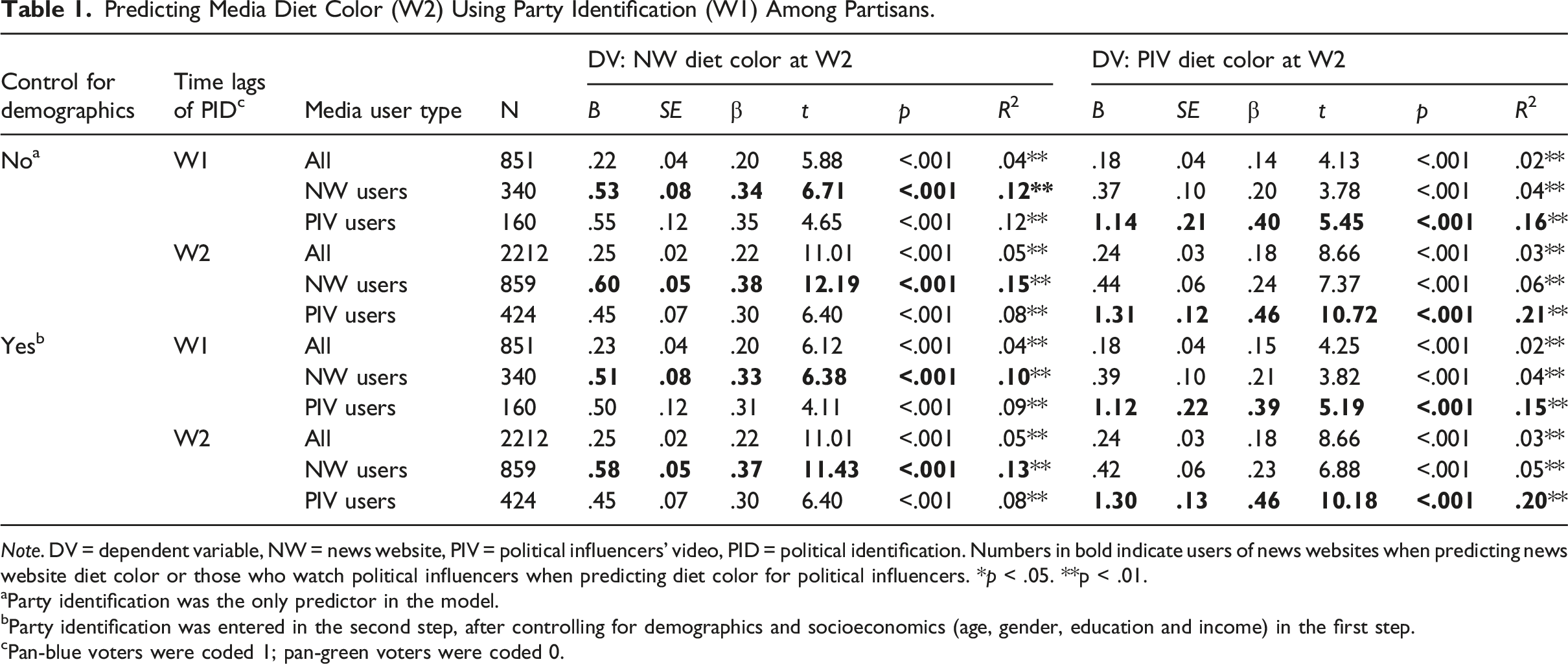
Note. DV = dependent variable, NW = news website, PIV = political influencers’ video, PID = political identification. Numbers in bold indicate users of news websites when predicting news website diet color or those who watch political influencers when predicting diet color for political influencers. *p < .05. **p < .01.
aParty identification was the only predictor in the model.
bParty identification was entered in the second step, after controlling for demographics and socioeconomics (age, gender, education and income) in the first step.
cPan-blue voters were coded 1; pan-green voters were coded 0.
The R2 also increased if we consider the party identification collected at W2. Across the three samples, party identification (W2) significantly predicted participants’ news website diet color (R2 from .05 to .15) and political influencers’ videos (R2 from .03 to .21) that respondents consumed (W2) (Table 1). The predictions remained significant even when we controlled for demographics. Across the three samples, party identification (W2) significantly predicted the color of the news websites (R2 from .05 to .13) and political influencers’ videos (R2 from .03 to .20) that respondents consumed (W2).
When more voters consumed news websites and political influencers’ videos, R2 increased more in later waves (Table A5). Across the three samples, regardless of whether demographics were controlled, party identification (W2) significantly predicted the diet color of the news websites (R2 from .04 to .15) and political influencers’ videos (R2 from .05 to .25) that respondents consumed (W3). When we considered party identification collected at W3, across the three samples, regardless of whether demographics were controlled, party identification (W3) significantly predicted the color of the news websites (R2 from .04 to .13) and political influencers’ videos (R2 from .04 to .26) that respondents consumed (W3).
Alternatively, we tested an explanatory model. Because the survey at W2 and W3, but not at W1, asked respondents to indicate their exposure to influencer videos, we tested the influence of party identification in W2 on media diet in W3. Similar to Yanovitzky and Cappella (2001; see also Stroud, 2008, 2010), we included a lagged measure of the dependent variable in the analysis. If we regress online news media diet color in W3 on (1) demographics, (2) online news media diet color and influencer media diet color in W3, (3) ideology in W2, and (4) party identification in W2, pan-blue identification is a positive predictor, and pan-green identification is a negative predictor, in support of H1a (Table A6). When we regress influencer media diet color in W3 on (1) demographics, (2) online news media diet color and influencer media diet color in W2, (3) ideology in W2, and (4) party identification in W2, pan-blue identification also is a positive predictor, and pan-green identification is a negative predictor, in support of H1b (Table A6).
Multinomial Regression Analysis Predicting Voting Choices.
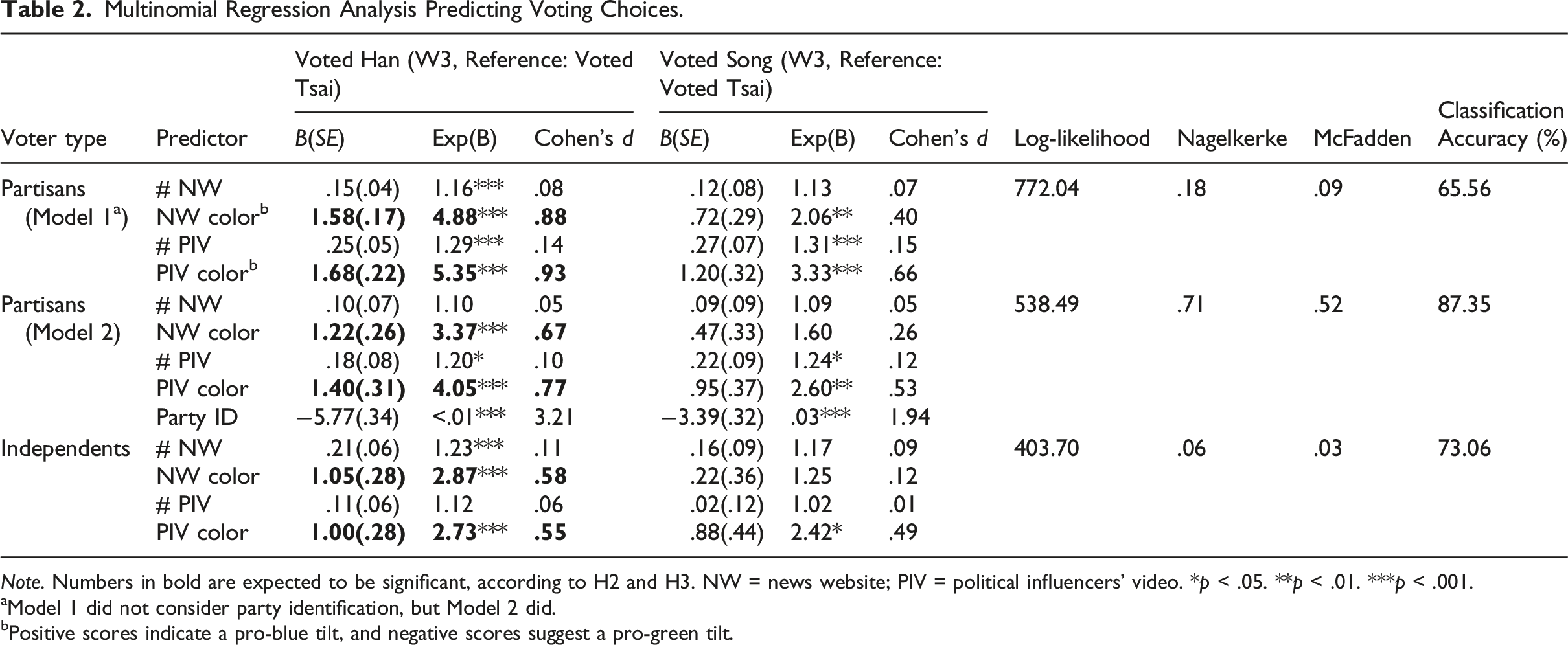
Note. Numbers in bold are expected to be significant, according to H2 and H3. NW = news website; PIV = political influencers’ video. *p < .05. **p < .01. ***p < .001.
aModel 1 did not consider party identification, but Model 2 did.
bPositive scores indicate a pro-blue tilt, and negative scores suggest a pro-green tilt.
Multinomial Regression Analysis Predicting Voting Choices Controlling Related Variables.
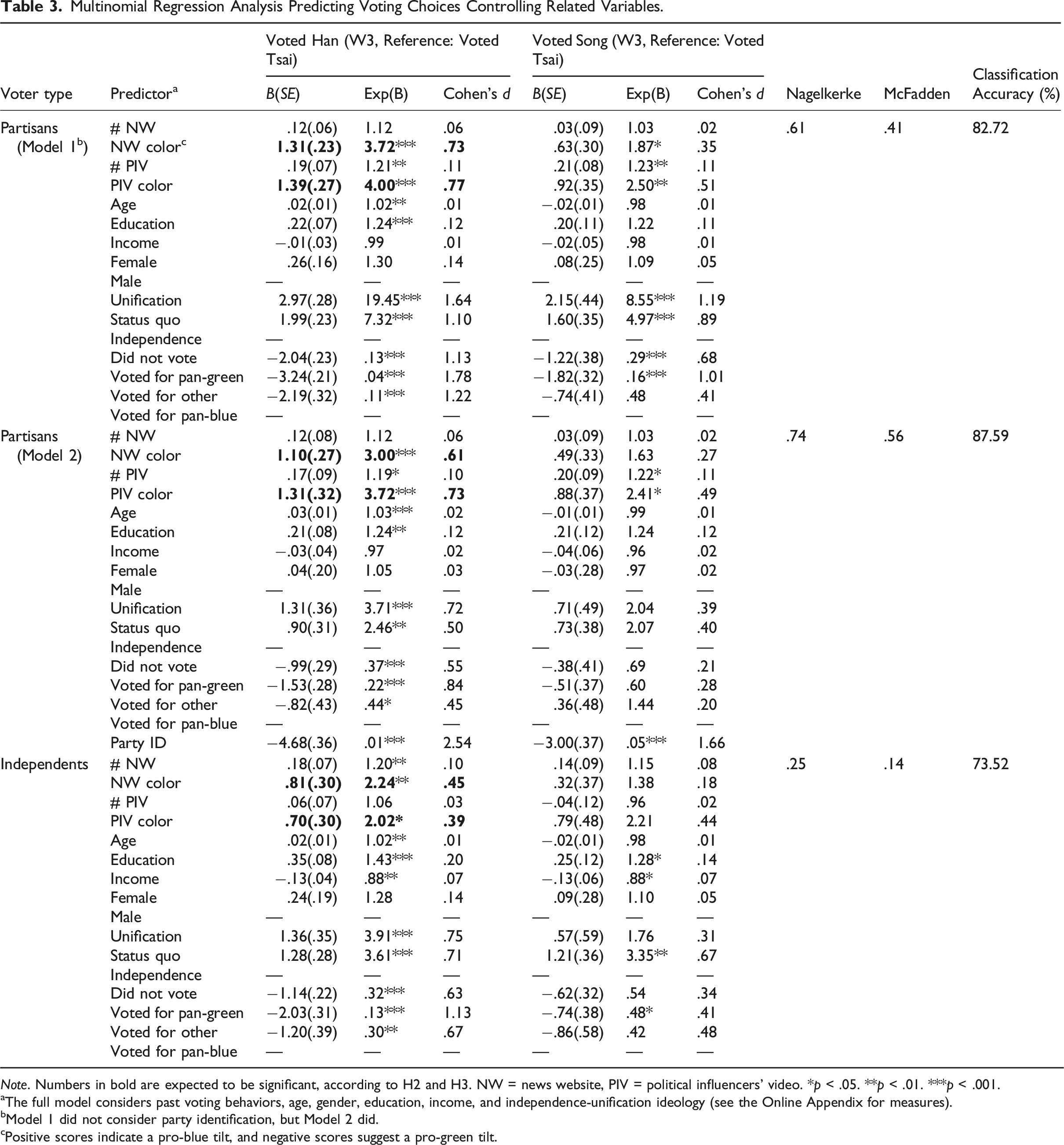
Note. Numbers in bold are expected to be significant, according to H2 and H3. NW = news website, PIV = political influencers’ video. *p < .05. **p < .01. ***p < .001.
aThe full model considers past voting behaviors, age, gender, education, income, and independence-unification ideology (see the Online Appendix for measures).
bModel 1 did not consider party identification, but Model 2 did.
cPositive scores indicate a pro-blue tilt, and negative scores suggest a pro-green tilt.
Among independent voters who voted, both types of media diet color (W2) predicted voting for Han (vs. Tsai) (W3) (Table 2, Model 3), in support of H3a and H3b, again regardless of the inclusion of demographics, ideology and past voting behaviors as control variables (Table 3, Model 3).
Tables 2 and 3 also reveal that the political influencers’ video diet color (Cohen’s d = .93) generates larger effect sizes than news websites color (Cohen’s d = .88) among partisans. However, their effect sizes are similar (.55 vs. .58) among independents. Media color also generates greater effect sizes than the number of websites or videos, whose effects are not robust.
General Discussion
Findings, Implications, and Contributions
About 40% of the respondents in this survey, conducted in Taiwan, did not express a party identification, a percentage that is similar to that in the United States (Jones, 2021). Our findings suggest that independent voters feel ambivalent toward the competing parties. Prior research also suggests that partisans have ambivalent attitudes toward both parties (Chang & Wu, 2019), which may apply for closet partisans. Because party identification is an important component of the self-concept, denying it may enable closet partisans to cope with any discomfort associated with their ambivalent attitudes toward competing parties. Therefore, independents (some of whom may be closet partisans) may be reluctant to express their party identification.
Therefore, predicting voting choices is a critical task, especially in close races, that is challenged by voters who choose not to reveal their preferences (Enns et al., 2017) or are undecided (Box-Steffensmeier et al., 2015). In such contexts, party identification can predict voting preferences, but a growing percentage of voters do not express any such identification. Partisan slant in voters’ media consumption might offer a relevant proxy, based on the prediction that party identification is associated with media diet color. As we hypothesized, media diet color in W2 predicts partisans’ and independents’ votes for the DPP candidate versus KMT candidate in W3. For independents, media diet alone significantly predicts vote choices, with an accuracy of 72.89%. For partisans, media diet and party identification together generate 87.07% classification accuracy. Although both types of media diet color are significant predictors, sought-after media diet color generates greater effect sizes in predictions only among partisans.
Contribution to Mixed Methods Research
We use machine learning to categorize news articles and influencer posts, such that we could assign each website and influencer a partisan bias score, then calculate overall media diet colors for each respondent. Thus, our study features method triangulation, an emergent trend in social science research. It also was conducted in Taiwan, but the utility of media diet color for predicting voting behaviors should apply in other party-divided countries where media systems align with party division and people have clear perceptions of partisan slant in media outlets.
Limitations and Further Research Directions
This study builds on the assumption that self-reports of media use behaviors are unreliable but can signal self-concepts, such that they can proxy for the party identification of closet partisans. Documented gaps exist between voters’ self-reports of media consumption and their online behaviors, according to digital footprint data (Nelson & Webster, 2017). If our assumption holds, scores calculated using self-reported media behaviors should better predict people’s voting preference than scores using digital footprint data. Moreover, this study builds on the assumption that self-reports of voting choice are true, which can be questionable, such as when voters claim to have voted for the winner when they did not in reality.
Among the many versions of sought-after media, we explore political influencers’ video consumption. Our machine learning approach could be applied to develop partisan scores for political blogs, but it is relatively less common for Taiwanese voters to browse blogs than to watch political influencers’ videos (Huang & Chang, 2021). Still, other sought-after media, such as political talk shows, are common in modern democracies, including Taiwan (Sullivan et al., 2018). Continued research should apply the proposed approach to explore the predictive power of these media. For example, young U.S. voters are likely to self-classify as independents (Miller & Wattenberg, 1983) and watch more streaming videos than voters in other age segments (Barthel et al., 2020), so assessing their potential political orientation would be of interest, especially as political influencers become more popular sources of information.
Recent developments in data science offer new approaches to detect partisan bias. These approaches can be content-based, like the one we adopt, or audience-based, which are more common in prior research. For example, using web-browsing records and the party ideology of respondents who visited particular web-delivered news websites, Flaxman et al. (2016) categorize them as liberal or conservative. Nelson and Webster (2017) classify web-delivered news outlets as pro-liberal or pro-conservative, using the party orientation of those who follow the websites’ Twitter accounts. The various approaches rely on different methods to develop scores of partisan slant, so we call for research that explores the different methods or even develops new approaches by taking advantage of recent social computation advances.
Voters’ political information sources include various media (e.g., newspapers, websites, particular outlets), which constitute their media diet. We only explore two common media types, then use respondents’ reported exposure to certain outlets or influencers to develop their distinct news outlet and influencer partisan slant scores. Research that integrates these different media could develop a media diet color index for each voter’s overall consumption of political information across media or outlets (channels).
Furthermore, prior research indicates that Republican voters express greater selective exposure to Fox than Democratic voters do to CNN (Iyengar & Hahn, 2009), likely because party slant is more strongly associated with Fox than CNN. In other words, the partisan diagnosticity of the channels differs, with Fox scoring higher than CNN. Perhaps people who are reluctant to express their party identification also are less likely to indicate their exposure to online news outlets or political influencers perceived as having stronger partisan biases. Additional research should test if the perceived diagnosticity of partisan slant affects voters’ willingness to indicate their exposure. However, considering the vast selection of media outlets, respondents might be relatively insensitive to partisan diagnosticity when they report their consumption.
Conclusions
The manuscript’s contribution lies in its demonstration of the predictive capacity of media consumption data on voting. The amount of self-declared independent voters (or those who express no preference) has increased over the last few years in many countries. It makes voting predictions a challenge for pollsters and campaign practitioners. The manuscript offers a work-around for this practical problem, which could also potentially be applied in other contexts as well.
Supplemental Material
Supplemental Material - We are What We Consume: Predicting Independent Voters’ Voting Preference from Their Media Diet Color
Supplemental Material for We are What We Consume: Predicting Independent Voters’ Voting Preference from Their Media Diet Color by Chingching Chang, Yu-Chuan Hung, and Morris Hsieh in Social Science Computer Review.
Footnotes
Declaration of Conflicting Interests
The author(s) declared no potential conflicts of interest with respect to the research, authorship, and/or publication of this article.
Funding
The author(s) disclosed receipt of the following financial support for the research, authorship, and/or publication of this article: This work was supported by the Education Bureau in Taiwan (110H22).

Supplemental Material
Supplemental material for this article is available online.
Author Biographies
References
Supplementary Material
Please find the following supplemental material available below.
For Open Access articles published under a Creative Commons License, all supplemental material carries the same license as the article it is associated with.
For non-Open Access articles published, all supplemental material carries a non-exclusive license, and permission requests for re-use of supplemental material or any part of supplemental material shall be sent directly to the copyright owner as specified in the copyright notice associated with the article.
