




Abstract
The availability of online data has altered the role of social media. By offering targeted online advertising, that is, persuasive messages tailored to user groups, political parties profit from large data profiles to send fine-grained advertising appeals to susceptible voters. This between-subject experiment (N = 421) investigates the influence of targeted political advertising disclosures (targeting vs. no-targeting disclosure), political fit (high vs. low), and issue fit (high vs. low) on recipients’ party evaluation and chilling effect intentions. The mediating role of targeting knowledge (TK) and perceived manipulative intent (PMI), two dimensions of persuasion knowledge, are investigated. The findings show that disclosing a targeting strategy and a high political fit activated individuals’ TK, that is, their recognition that their data had been used to show the ads, which then increased the evaluation of the political party and individuals’ intentions to engage in future chilling effect behaviors. High political fit decreased individuals’ reflections about the appropriateness of the targeted political ads (i.e., PMI), which then increased party evaluation. Issue fit did not affect individuals’ persuasion knowledge.
Keywords
Through large amounts of user data, shared deliberately online by users or collected via online activities on social media, advertising appeals can be catered to specific audiences (Boerman & Kruikemeier, 2016). Next to commercial advertising, political campaigners and parties also started integrating targeting practices into their online campaigns (Bennett, 2016). Hence, they adjust to a changing media environment, shifting from offline to online, making digital advertising tools more relevant (Williams & Gulati, 2018). While it has always been of interest to political parties to convey their messages to the “right” audiences, the abundance of online data has lifted this practice to a new level (Zuiderveen Borgesius et al., 2018). In this sense, political targeting refers to “sending a message from a candidate [or a party] tailored to a group with the intent of influencing the group to evaluate the candidate [or party] favorably” (Holman et al., 2015, p. 817). Such microtargeting is based on information, such as demographics, location, preferences, interests, or online behavior (e.g., Aguirre et al., 2015; Boerman et al., 2017a) and results in targeted political advertising (TPA).
Overall, political targeting on social media facilitates sending fine-grained messages to specific audiences (Zuiderveen Borgesius et al., 2018). Hence, one of the goals of this advertising approach is to reach persuadable voters (Hillygus & Shields, 2009). This raises the question of which factors influence the persuasive effects of TPA and how voters could be best equipped to deal with it appropriately. To investigate influential factors of TPA we concentrate, in this study, on targeting disclosures and on the match between TPA and individuals’ party preferences, that is, political fit, or issue relevance, that is, issue fit.
First, we focus on the usage of targeting disclosures. Disclosures aim to increase individuals’ recognition and understanding of an advertising strategy (Hudders et al., 2017). Targeting involves collecting, using, and distributing user data to tailor specific appeals to susceptible audiences and embrace high privacy risks (Boerman et al., 2017a; Zuiderveen Borgesius et al., 2018). Targeting disclosures can help individuals to activate their persuasion knowledge (e.g., Boerman et al., 2012), which enables them to properly cope with advertising (Friestad & Wright, 1994). Since targeting disclosures change over time, it is necessary to monitor their effectiveness and evaluate their suitability to raise individuals’ awareness and understanding of targeting practices in advertising.
Second, we focus on how the congruence or fit of TPA on social media activates individuals’ persuasion knowledge. Tailoring advertising appeals to specific characteristics of recipients represents a central feature of this advertising strategy. Such tailoring can be based on personality traits (Krotzek, 2019; Zarouali et al., 2020), identity (Holman et al., 2015), or party preferences (Binder et al., 2022) and can positively influence recipients’ attitudes and behaviors. While this provides insights into the persuasive potential of TPA when it matches individuals’ specific characteristics, we lack further understanding of how other fit dimensions, such as the issue discussed in TPA, influence recipients.
Both political preferences and issue stances play an influential role in election campaigns, applying political microtargeting practices (Hillygus & Shields, 2009). While the political fit of TPA can elevate recipients’ evaluation of the political party as the message sender via persuasion knowledge (Binder et al., 2022), even a political misfit of TPA can increase voter mobilization if the issue of the message is congruent (Endres, 2020). Since targeted online campaigns might handle the heterogeneity of voter stances more efficiently (Pilditch & Madsen, 2021), it is crucial to investigate which role the issue fit plays in TPA.
As a result, we focus on the fit dimensions of political and issue fit of TPA and investigate how these factors interact with one another and in combination with targeting disclosures. In this study, we operationalize political fit as the match between individuals’ party preferences and the sources’ partisan ideology (Binder et al., 2022) and the issue fit in terms of issue proximity, that is, the match between the geographical closeness of the message conveyed in TPA and the message recipient.
To further investigate the implications of such persuasive effects, we investigate the influence of targeting disclosures, political fit, and issue fit on individuals’ attitudes and behavioral intentions via persuasion knowledge. Generally, scholars widely discuss possible harms and benefits for democracy associated with political microtargeting. While benefits could be connected to mobilization, enhanced interest, and knowledge (Zuiderveen Borgesius et al., 2018), concerns center around negative consequences for democracy, like manipulating or excluding voters (Barocas, 2012) or influencing individuals’ information-seeking processes through chilling effects (Dobber et al., 2019). To account for this debate, we focus on the one side on individuals’ evaluation of the political party as the message sender and on the other side on chilling effect intentions. Chilling effects imply a change in online behaviors because of the feeling or fear of being observed (Büchi et al., 2020; Marder et al., 2016). To better grasp the underlying psychological mechanisms, we draw on the theories of self-congruity (Sirgy, 2018), cognitive dissonance (Festinger, 1957), and reactance (Brehm, 1966) and investigate the mediating role of persuasion knowledge (Friestad & Wright, 1994).
We conducted an online experimental study in October 2020 in Germany. Despite being well-established in U.S. campaigning, targeting practices also increasingly influence European campaigns (Bennett, 2016). Therefore, it is relevant to investigate TPA on social media and its implications for recipients in an environment defined by stricter data protection regulations. By doing so, our study contributes to research on political microtargeting and targeted political advertising in Europe.
The Persuasion Knowledge Model
To cope with advertising effectively, individuals need knowledge as well as motivation to use their knowledge (Friestad & Wright, 1994). The Persuasion Knowledge Model (PKM) describes which knowledge dimensions individuals need to “identify how, when, and why marketers try to influence them” (Friestad & Wright, 1994, p. 1). The PKM encompasses various dimensions, that is, “beliefs about motives, tactics, appropriateness of motives and tactics, and how persuasion works” (Campbell & Kirmani, 2008, p. 553). These dimensions can also be classified as conceptual and attitudinal components of persuasion knowledge (Boerman et al., 2018b; Rozendaal et al., 2011). Conceptual persuasion knowledge describes people’s recognition of advertising, tactics, and the persuasive intent, while attitudinal persuasion knowledge is characterized by critical evaluations and feelings (Boerman et al., 2012; Rozendaal et al., 2011; van Reijmersdal et al., 2017). According to the outlined differentiations and to account for the multidimensionality of the model, we investigate three dimensions based on previous research (Binder et al., 2022): perceived persuasive intent (PPI), targeting knowledge (TK), and perceived manipulative intent (PMI).
Perceived persuasive intent describes recipients’ understanding of the purpose of an advertising strategy, that is, that the post aims to advertise (Boerman et al., 2018b). Based on the PKM, the inference of a persuasive motive constitutes a precondition for activating other dimensions of persuasion knowledge, which can consequently influence individuals’ responses to such advertising (Campbell & Kirmani, 2008). Scholars suggest that the persuasive intent of advertising is expected to be developed among adult recipients (Boerman et al., 2018b; Rozendaal et al., 2010). Furthermore, advertising disclosures contribute to individuals’ recognition and understanding of advertising on social media (Boerman et al., 2012, 2018b). On social media platforms, such as Facebook, targeted advertising has to be marked, applying disclosure icons together with the ad (Facebook, 2020). Hence, individuals are likely to be familiar with the persuasive intent of targeted advertising on social media (e.g., Morimoto, 2021).
Next to PPI, recipients also need to develop beliefs that an advertiser’s action is a tactic (Campbell & Kirmani, 2008). Following previous research (Binder et al., 2022), we refer to this PKM dimension as targeting knowledge (TK), defined as the extent to which people possess beliefs and the awareness that targeting procedures were applied. Research shows that people possess limited knowledge about political behavioral targeting (Dobber et al., 2019). Therefore, it is critical to investigate under which conditions individuals’ beliefs and awareness of such practices can be activated.
When a recipient recognizes the persuasive intent and the applied tactic behind an ad, they can further activate reflections about the appropriateness of such strategies (Campbell & Kirmani, 2008). Such evaluations involve considerations about the extent to which the strategies are right or wrong, fair or unfair, appropriate or manipulative (Campbell, 1995; Campbell & Kirmani, 2008; Friestad & Wright, 1994). This evaluative component of persuasion knowledge was found to be associated with scepticism, avoidance, or affecting attitudes (Boerman et al., 2018b).
PPI, TK, and PMI constitute important dimensions of individuals’ persuasion knowledge, initially defined by Friestad and Wright (1994). Hence, in this study, we account for the relationships within the three persuasion knowledge dimensions to gauge the influence of PPI on the activation of TK and, further, on PMI. However, as outlined above, we expect high levels of PPI. Therefore, we only control for its mediating mechanism in our model and center our study on the dimensions of TK and PMI (see Binder et al., 2022).
Effects of Targeting Disclosures on Persuasion Knowledge
Persuasion knowledge supports recipients’ coping strategies with persuasive appeals (Friestad & Wright, 1994). In this regard, disclosures raise awareness and inform recipients about the persuasive nature of an advertisement (Hudders et al., 2017). Research has shown that recipients are more likely to differentiate advertising content from other content when they see a disclosure, which can invoke persuasion knowledge (e.g., Boerman et al., 2012; Wojdynski & Evans, 2016).
In targeted advertising, disclosures include information to enhance transparency about “data collection, processing, or sharing by the sender” (Segijn et al., 2021, p. 128). Research found that participants’ persuasion knowledge increased when a political ad was labeled with a sponsorship disclosure (Boerman & Kruikemeier, 2016). However, the activation of persuasion knowledge can depend on individuals’ recall of such disclosure labels (Kruikemeier et al., 2016), which can pose difficulties for individuals (e.g., Boerman & Kruikemeier, 2016). Further, even if people pay visual attention to Facebook disclosures, it might not automatically lead to individuals’ ad and source recall (Binford et al., 2021). Disclosure effectiveness can also depend on timing (Campbell et al., 2013), layout (Wojdynski & Evans, 2016), or the transparency information used (e.g., Dobber et al., 2023). Hence, the effectiveness might change based on minor adjustments. In this study, we move beyond former research on general disclosure labels, like sponsored (e.g., Boerman et al., 2017b), and focus on disclosures explaining why individuals were targeted and which information had been used for political microtargeting (Binder et al., 2022). Based on previous research and the PKM, we assume that exposure to TPA disclosures will induce thinking processes about the applied advertising strategy (TK) and increase appropriateness reflections of such advertising (PMI). Thus, we hypothesize:
Disclosing a targeting strategy of TPA leads to a) more PMI and b) more TK compared to not disclosing a targeting strategy.
Effects of Political Fit and Issue Fit on Persuasion Knowledge
In commercial advertising, self-congruity influences how consumers evaluate a brand or engage in purchase behavior depending on the match, that is, high self-congruity, or the mismatch, that is, low self-congruity (Sirgy, 2018). Against the background of the self-congruity theory, people strive for consonance, which is connected to individuals’ “self-concept needs,” such as self-consistency (Sirgy, 2018, p. 200). This resonates with previous research, showing that advertising appeals congruent with one’s self-concept positively affect recipients’ attitudes toward a product and buying intentions (Hong & Zinkhan, 1995). The self-concept also plays an influential role in other areas. Scholars in political research focus on the political self-concept (e.g., Lane et al., 2019). The political self-concept is connected to political components, such as partisan ideology and partisanship, and can be strengthened with messages consistent with one’s attitudes, whereas the opposite was found for messages not consistent with one’s attitudes (Knobloch-Westerwick & Meng, 2011). Also, the cognitive dissonance theory by Festinger (1957) suggests that when individuals get in touch with information that does not fit with the “knowledge, opinion, or belief about the environment, about oneself, or about one’s behavior,” it can create dissonance and psychological discomfort (Festinger, 1957, p. 3). While attitudinal, behavioral changes or exposure control could be possible reactions (Gilbert, 1993; Zuwerink & Devine, 1996), individuals might also engage in critical thinking processes when seeing misfitting content and start to evaluate how appropriate an ad is (Germelmann et al., 2020; Maheswaran & Chaiken, 1991; Mandler, 1982).
To investigate these processes, we focus on the effects of political fit and issue fit. In the context of TPA, research found that the congruence of TPA with recipients’ party preference can influence individuals’ evaluation of a political party (Binder et al., 2022). Additionally, microtargeting practices strengthened affiliations toward a political party and decreased the likelihood that voters would change their opinion regarding electoral support of their preferred party (Lavigne, 2021). Next to party preferences, issue stances are also influential in political campaigns. According to the issue ownership theory, political parties are associated with owned issues, which can influence voters’ perceptions about the parties’ competencies in dealing with such issues (Walgrave et al., 2015) or can shape voters’ electoral choices (Bélanger & Meguid, 2008). A recent content analysis of sponsored Facebook ads in the United States found evidence for issue ownership patterns in political microtargeting, meaning that political actors mainly focused on owned issues (Kruikemeier et al., 2022). By focusing on specific issues and issue stances, campaigns aim for persuadable voters, engaging in issue-based targeting (Hersh & Schaffner, 2013; Hillygus & Shields, 2009).
In this study, we assess issue fit regarding geographical proximity, which is considered as a news value of identification in journalism research (Allern, 2002). Proximity is connected to “relevance, locality” (Ahva & Pantti, 2014, p. 2). It describes how close a person and an issue are, whereas high levels of proximity are effective message cues for the persuasiveness of ads (Chang, 2012). Issue proximity, that is, geographical closeness, can be connected to higher levels of relevance and influence individuals’ processing (Nanz & Matthes, 2020). Hence, we consider an issue to fit due to its geographical closeness, which implies higher relevance.
Extrapolated to the PKM, we assume that individuals who are exposed to TPA that fits their party preference and/or tackles an issue that concerns them, that is, high levels of fit, might be more aware that a targeting practice was used and individuals make assumptions about the persuasive tactic behind a targeted message (e.g., Binder et al., 2022; van Reijmersdal et al., 2022). Misfitting ads, however, are likely to enhance the evaluative component of persuasion knowledge. When individuals encounter information that is not in line with existing experiences, beliefs, or attitudes, they are likely to engage in critical thinking processes (Mandler, 1982), which in contrast to fitting TPA, might foster individuals’ critical evaluations of the targeting strategy applied in TPA. Therefore, we hypothesize:
High political fit of TPA (a) decreases PMI and (b) increases TK in comparison to low political fit.
High issue fit of TPA (a) decreases PMI and (b) increases TK in comparison to low issue fit.
Interaction Effects on Persuasion Knowledge
In addition, we aim to investigate the interactions between targeting disclosures, political fit, and issue fit. Previous research has shown that the interaction between an issue and the appliance of a targeting strategy can be decisive for electoral support (Herrnson et al., 2003). Also, “political preferences (reinforcing or conflicting) shape how voters respond to political information,” and candidates try to win voters by, for example, focusing on specific issues (Hillygus & Shields, 2009, p. 7). In this sense, not only the issue but especially the combination of it with party preferences can be influential in political targeting (e.g., Endres, 2020). However, we still need experimental research to explore the causal relationships of such interactions to understand their interconnectedness. Therefore, we investigate the interplay between targeting disclosures, political fit, and issue fit with the following research questions:
How does disclosing a targeting strategy interact with (a) political fit, (b) issue fit, or (c) political fit and issue fit in affecting PMI?
How does disclosing a targeting strategy interact with (a) political fit, (b) issue fit, or (c) political fit and issue fit in affecting TK?
Attitudinal and Behavioral Responses to Targeted Political Advertising
When individuals encounter new advertising practices, the activation of persuasion knowledge will be necessary to evaluate the practice. New practices might make recipients realize that more than their existing knowledge is needed to activate their persuasion knowledge (Friestad & Wright, 1994), which might undermine their evaluation of the sender of the advertising (e.g., Wojdynski & Evans, 2016). Furthermore, we assume that when individuals realize that a targeting strategy was applied based on the use of their data, and individuals perceive the ad to be manipulative, they likely feel threatened in their experienced freedom. As suggested by the reactance theory (Brehm, 1966), however, individuals prefer to maintain their freedom and do not appreciate persuasive or manipulative attempts (Boerman & Kruikemeier, 2016), resulting in reactance and an eagerness to reestablish the threatened freedom (Miron & Brehm, 2006). Such reactance can affect individuals’ attitudes and behaviors (e.g., Eisend et al., 2020; Ham, 2017). Hence, we assume that when individuals activate their persuasion knowledge due to TPA, they might feel threatened by realizing that personal data was used for advertising. Likewise, when people perceive higher levels of manipulativeness of TPA, this could challenge the normative standards of individuals and induce negative outcomes (Campbell & Kirmani, 2008; Friestad & Wright, 1994). Thus, we hypothesize:
a) Higher PMI and b) higher TK negatively predict party evaluation.
Besides individuals’ attitudes, their behaviors can be influenced by activated persuasion knowledge. In the context of TPA, Kruikemeier et al. (2016) found that persuasion knowledge is an essential mediator, decreasing individuals’ intentions of electronic word of mouth. This study aims to investigate the behavioral intentions component focusing on chilling effects. Chilling effects can occur when voters change certain online activities or behaviors because they fear or perceive being observed (Büchi et al., 2020; Marder et al., 2016; Penney, 2016). This could even imply that individuals start withholding from searching for political information online because they might feel uncomfortable that personal inferences could be made based on their searching behavior (Dobber et al., 2019). Chilling effects are prominently investigated in surveillance research, showing that online surveillance increases chilling effects (Penney, 2016). However, it is also relevant in targeted advertising. U.S. surveys highlighted that 40% of individuals reported they would alter their behavior online if their data were collected for advertising purposes (McDonald & Cranor, 2010), and around three quarters would not visit a website anymore if they knew that their information was shared with political advertisers (Turow et al., 2012). In this study, we argue that chilling effects can be considered a form of resistance (Festinger, 1957) or exposure control (Gilbert, 1993), which can be a behavioral reaction to persuasion (Zuwerink & Devine, 1996) or serve as a possibility to restore freedom (Brehm, 1966). Hence, we assume:
a) Higher PMI and b) higher TK positively predict intentions to engage in chilling effects.
Methods
Context
We conducted an online between-subject experiment in October 2020 in Germany. The study was unrelated to an ongoing election campaign. It took place during the COVID-19 pandemic—a period that further enhanced the relevance of online campaigning due to pandemic-related restrictions (Stubenvoll et al., 2022). Against this background, TPA might be even more relevant to political parties to reach detached or less interested voters (see Zuiderveen Borgesius et al., 2018). However, implementing microtargeting practices largely depends on contextual factors, like “cultural, legal, institutional, financial, and other constraints” (Bennett, 2016, p. 274). In this study, we focus on a country where stricter legal regulations (e.g., the EU general data protection regulation, GDPR) are implemented (Papakyriakopoulos et al., 2018) and the political system is characterized by multiple parties. Based on these factors, it is of interest to investigate how TPA affects recipients in a country in which microtargeting practices might not be as well-established as in other parts of the world, for example, the United States, but are nevertheless more frequently incorporated in political campaigns (Bennett, 2016).
Sample
A quota sample based on the distribution of age and gender in Germany was recruited by a professional data collection company. After consenting to study participation, a total of 421 participants took part in this study (50.4% female, 49.6% male; Mage = 42.65, SD = 13.26). While education was diverse, it was not fully in line with the quota (14.0% completed low, 58.4% middle, and 27.6% high education). The online experiment was conducted as part of a larger survey, adhered to the ethical guidelines of the University of Vienna, and was approved by the Institutional Review Board of the Department of Communication (ID: 20200914_024).
Design and Procedure
The study followed a 2 (targeting vs. no-targeting disclosure) × 2 (high vs. low political fit) × 2 (high vs. low issue fit) between-subjects design. Before treatment exposure, we asked participants about their demographics, place of residence (federal state), and party preferences. These questions were aimed at raising participants’ feelings that the posts shown later were based on the previously shared data.
Next, we randomly assigned participants to the high or low issue fit treatment. Issue fit of TPA was manipulated through geographical issue proximity. Participants were exposed to two newspaper articles: one from a broadsheet quality newspaper (Süddeutsche Zeitung) and one from the largest tabloid newspaper (Bild Zeitung) in Germany. Two articles were shown to increase external validity through multiple message exposure (Reeves et al., 2016). We created the content of the newspaper articles for the study, whereas we respected the design, layout, and style typical for each newspaper. The newspaper articles focused on a new European Union directive for standardizing the width of European roads, causing major roadwork. This European Union directive was inspired by discussions around other regulations, for example, the curvature of vegetables and fruits. To create high issue fit, we tailored the newspaper articles to participants’ actual federal state of residence, as reported in the questionnaire. The articles then described that the new European Union directive would mainly concern this federal state together with some closely-situated others (high issue fit). Alternatively, participants read newspaper articles explaining that the new European Union directive would concern Portuguese regions, which induces geographical distance (low issue fit).
Next, participants were assigned to either see a disclosure statement (targeting disclosure) or no disclosure statement, informing participants they would see random Facebook posts (no-targeting disclosure). In the targeting disclosure treatment, participants were exposed to the original wording and design of Facebook disclosure statements. These were tailored to participants’ age group, gender, and location, next to a statement that the party wanted to reach people similar to the party’s “customer,” also called lookalike audiences. The aim was to increase participants’ feelings of being targeted (see Binder et al., 2022).
Then participants were randomly exposed to multiple political ads and filler ads. The stimuli consisted of three TPA posts of the conservative party (CDU) or the environmental party (Bündnis 90/die Grünen) with slogans against the new European directive causing significant roadwork. By choosing these parties, we covered both political spectra. The design and the slogans on the ads were consistently used throughout the conditions, according to the style and layout characteristics of TPA on Facebook. Participants were debriefed at the end of the study. The stimulus materials were created for this study (for an overview see Appendix A).
Measures
As independent variables, participants were exposed to no-targeting disclosure (n = 215) or a targeting disclosure (n = 206). Political fit described the match between the sender, that is, the political party, of the presented TPA and individuals’ party preference. If a participant stated a preference for the conservative or environmental party with a response higher than 5 on a 10-point Likert scale and was exposed to ads from this respective party, we considered the fit to be high (Binder et al., 2022). We calculated an overall political fit variable (high political fit: n = 175 or low political fit: n = 246). Issue fit was achieved via issue proximity (high issue fit: n = 217 or low issue fit: n = 204).
As dependent variables, we measured party evaluation by asking individuals how much they agreed (1 = do not agree at all; 7 = totally agree) with five descriptions of the party derived from Ahluwalia (2000; α = .95, M = 3.81, SD = 1.58). Chilling effect intentions were measured with three items based on Stubenvoll and Binder (2021) by asking participants to evaluate the likelihood that they would change their online behavior in the future (1 = very unlikely; 7 = very likely; α = .75, M = 4.34, SD = 1.48).
We assessed the mediators on a 7-point Likert scale (1 = do not agree at all; 7 = totally agree). Perceived persuasive intent (PPI) was measured with five items (Binder et al., 2022; see also Boerman et al., 2018b; α = .93, M = 4.75, SD = 1.62). Perceived manipulative intent (PMI) was measured with three items based on Binder et al. (2022; see also Campbell, 1995; α = .83, M = 3.70, SD = 1.51). Targeting knowledge (TK) was measured with five items based on Binder et al. (2022; see also Aguirre et al., 2015; Dijkstra, 2005; α = .94, M = 3.80, SD = 1.68).
As controls, we included individuals’ age (in years), gender, education, Facebook usage per day on a 7-point Likert scale (M = 2.61, SD = 1.60), and privacy concerns using three items (see Hsu & Lin, 2018; Mani & Chouk, 2017; 1 = do not agree at all; 7 = totally agree; α = .86, M = 4.79, SD = 1.49). All control variables were measured prior to the treatment exposure. See Appendix B for an overview of the measures.
Manipulation and Randomization Checks
All manipulation checks were successful. Individuals in the targeting disclosure group (M = 4.53, SD = 1.13) had significantly higher values in comparison with the no-targeting disclosure group (M = 3.53, SD = 1.00; t (419) = −9.58, p < .001). Participants correctly identified the party, χ 2 (4, N = 421) = 215.79, p < .001; 94.1% correctly recognized the conservative party, and 85.0% the environmental party. Individuals in the high issue fit group (M = 4.36, SD = 1.51) had significantly higher values in comparison with the low issue fit group (M = 2.98, SD = 1.79; t (397.99) = −8.53, p < .001). Randomization checks were successful (Appendix C).
Data Analysis
To examine the conceptual model, we conducted a covariance-based structural equation model (SEM) using lavaan in R (Rosseel, 2012). Before testing our conceptual model, we conducted confirmatory factor analysis (CFA) of the main latent constructs and investigated the fit of our measurement model based on the conventional fit indices (see Byrne, 2016). To account for the 2 × 2 × 2 design of our experiment, we applied deviation coding (−.5, .5) for each experimental group.
Results
Factorial Structure
The CFA of the three-dimensional persuasion knowledge revealed two items of PMI with low factor loadings (“These posts promote a party in an unfair way,” λ = .04 and “The chosen advertising strategy of the posts is not acceptable to me,” λ = .17). Based on the factor loadings, we excluded the items and repeated the CFA, which indicated a good model fit (χ 2 (62) = 118.84, p < .001, CFI = .99, TLI = .98, RMSEA = .05, SRMR = .03) and high factor loadings (λ = .62–.90). Additionally, we tested the discriminant validity by comparing the three-factorial model against the one-factorial model. The three-factorial model had a significantly better model fit (Δ χ2 (3) = 1911.40, p < .001). Additionally, we tested the discriminant validity of the dependent variables. The two-factorial solution yielded a significantly better model fit as compared to the one-factorial solution (Δ χ 2 (1) = 297.15, p < .001). The CFA of the overall measurement model showed a good model fit χ 2 (237) = 397.70, p < .001, CFI = .98, TLI = .98, RMSEA = .04, SRMR = .04. See Appendix D for an overview of the factor loadings.
Conceptual Model
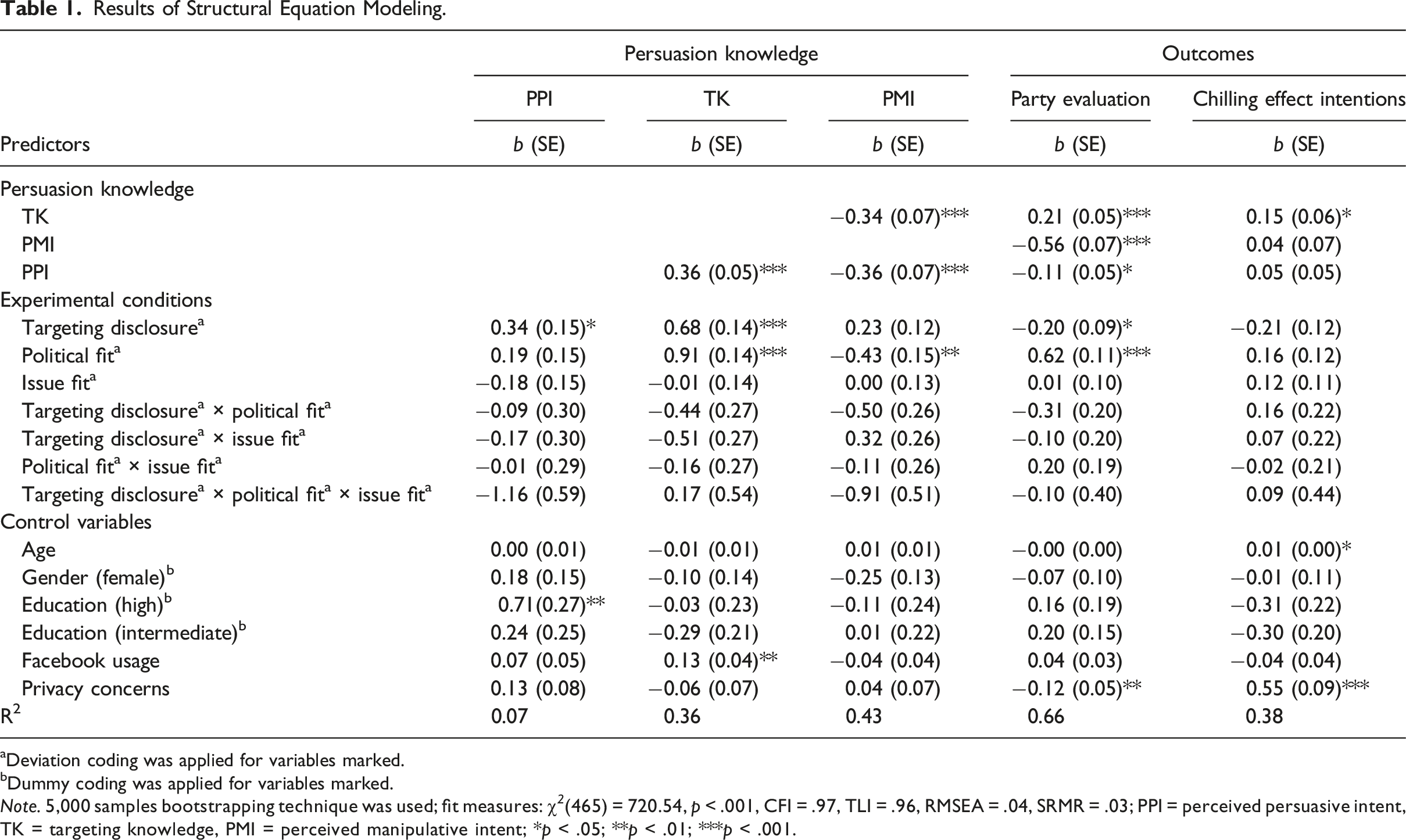
Next, we tested our model with SEM, revealing a good model fit, χ 2 (465) = 720.54, p < .001, CFI = .97, TLI = .96, RMSEA = .04, SRMR = .03. Based on previous research, the latent constructs PPI, PMI, TK were allowed to covary (Boerman et al., 2018b).
First, we tested whether targeting disclosure activates individuals’ PMI or TK. The exposure to the targeting disclosure did not significantly influence individuals’ PMI (H1a, b = 0.23, p = .068). However, we found a significant positive effect of targeting disclosure on TK (H1b, b = 0.68, p < .001). Regarding political fit, we found that high political fit significantly decreased PMI (H2a, b = −0.43, p = .004), whereas it significantly increased TK (H2b, b = 0.91, p < .001), supporting H2. Against our expectation in H3, issue fit did not influence individuals’ PMI (H3a, b = 0.00, p = .991) or TK (H3b, b = −0.01, p = .946).
Further, we examined if any interactions of the experimental manipulations affect persuasion knowledge. No interaction effects of targeting disclosure and political fit (RQ1a, b = −0.50, p = .053) or targeting disclosure and issue fit (RQ1b, b = 0.32, p = .220) on PMI were found. The interaction of targeting disclosure, political fit, and issue fit on PMI did not reach significance (RQ1c, b = −0.91, p = .074). Regarding TK, no interaction effects of targeting disclosure and political fit (RQ2a, b = −0.44, p = .102), targeting disclosure and issue fit (RQ2b, b = −0.51, p = .059), or targeting disclosure, political fit and issue fit (RQ2c, b = 0.17, p = .752) on TK yielded statistical significance.
Next, we tested the relationships between persuasion knowledge and individuals’ attitudes and behavioral intentions. Higher levels of PMI were negatively associated with individuals’ party evaluation (H4a, b = −0.56, p < .001), whereas higher levels of TK were positively associated with party evaluation (H4b, b = 0.21, p < .001), supporting H4. Additionally, political fit positively influenced party evaluation directly (b = 0.62, p < .001), while disclosing a targeting strategy had a direct negative effect on party evaluation (b = −0.20, p = .031). Whereas we did not find any relationships between PMI and individuals’ intentions to engage in chilling effects (H5a, b = 0.04, p = .514), higher levels of TK were positively related to individuals’ chilling effect intentions (H5b, b = 0.15, p = .011; see Figure 1). Visualization of Significant Paths of the Conceptual Model. 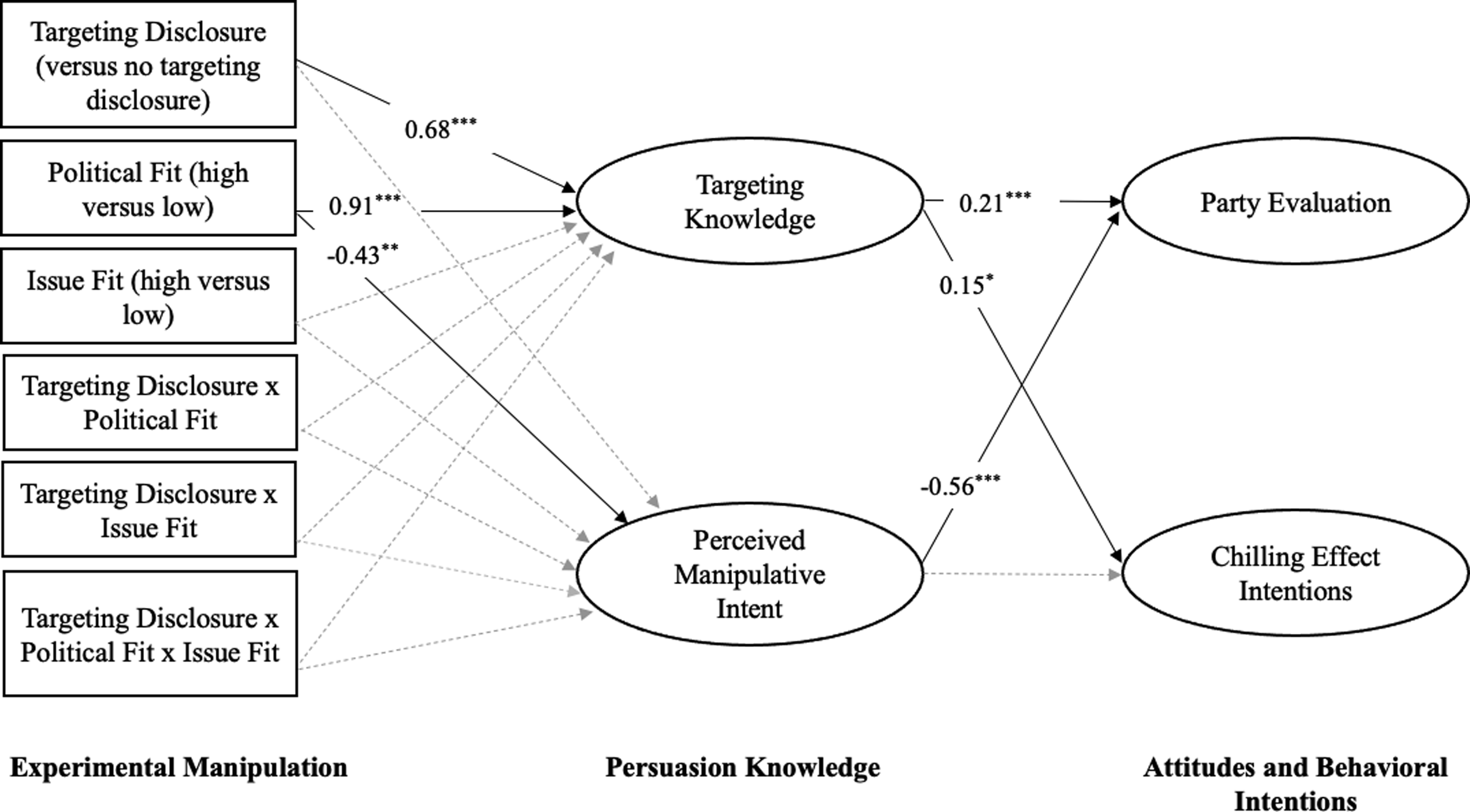
Results of Structural Equation Modeling.
aDeviation coding was applied for variables marked.
bDummy coding was applied for variables marked.
Note. 5,000 samples bootstrapping technique was used; fit measures: χ 2 (465) = 720.54, p < .001, CFI = .97, TLI = .96, RMSEA = .04, SRMR = .03; PPI = perceived persuasive intent, TK = targeting knowledge, PMI = perceived manipulative intent; *p < .05; **p < .01; ***p < .001.
Discussion
In this study, we investigated how disclosing a targeting strategy of political ads online, political fit, and issue fit affect recipients’ persuasion knowledge and shape attitudes and behavioral intentions. By doing so, we contribute to research on the persuasive potential of TPA and extend existing research on the impact of congruency in TPA (Binder et al., 2022; Zarouali et al., 2020).
This study examined whether the current Facebook disclosure of TPA is sufficient to activate individuals’ persuasion knowledge. Whereas previous studies mostly worked with general disclosure labels and icons (e.g., Binford et al., 2021; Boerman et al., 2017b), we focused on more detailed disclosure statements, including specific information about why a person saw an ad and which information was used for the targeting. Our findings indicate that more detailed targeting disclosures can activate participants’ awareness of the applied targeting strategy, that is, TK. While this resonates with research showing that disclosures can activate conceptual persuasion knowledge (Boerman et al., 2017b), our finding contradicts research on varying degrees of targeting disclosures, which did not activate individuals’ TK (Binder et al., 2022). These mixed findings highlight the importance of continuous research in targeting disclosures because minor changes in the information provided in the field of disclosure statements might induce different reactions.
Targeting disclosures did not activate individuals’ PMI. Two possible explanations exist: First, participants might have problems recognizing the manipulative intent because targeting and its consequences, for example, privacy invasions, might still be challenging to grasp (Dobber et al., 2019), despite being aware of the strategy itself. Similarly, research on online privacy protection behaviors found that despite being aware of the threat severity of online privacy, people protect their privacy through concrete actions to a different extent because of a lack of confidence or knowledge (Boerman et al., 2018a). Second, people might not have activated PMI because concrete targeting disclosure statements did not activate critical thinking processes. This might be connected to users’ expectations of receiving relevant targeted advertising on social media as part of the social contract they enter with such platforms (van den Broeck et al., 2020). Additionally, Facebook users might not be motivated enough to evaluate political ads thoroughly (Binford et al., 2021), which could dampen appropriateness judgments. It would be necessary to examine whether individuals’ motivation to engage in political ad content on social media could interfere with the PMI of TPA.
Furthermore, we investigated how the political and issue fit of TPA influenced participants’ activation of persuasion knowledge. Regarding political fit, we found that individuals’ TK increased when they received TPA that was fitting because it came from a party they preferred. Our finding resonates with previous research (Binder et al., 2022), further strengthening the notion that participants might be more attentive and effortful in processing an ad when it matches their self-concept (see Wheeler et al., 2005). We did not find these effects regarding issue fit, which might indicate that political predispositions, like party preferences, are more anchored in an individual’s political self-concept than issue stances. Operationalizing issue fit through issue proximity is one way to increase issue relevance to the discussed topic. However, it could also be induced through issue interests or varying levels of issue importance, which should be addressed by future research.
Regarding participants’ evaluation of the manipulative intent of TPA, only political fit reduced individuals’ PMI (see Binder et al., 2022). This points to underlying self-congruity mechanisms. As suggested by the self-congruity theory, advertising appeals that match individuals’ self-concept are more likely to foster positive evaluations or behavioral intentions (Sirgy, 2018). Thus, critical thinking processes might not be sufficiently activated when a stimulus is presented that aligns with previously defined experiences or attitudes (e.g., Festinger, 1957; Mandler, 1982). Another explanation may be rooted in the social identity theory (Tajfel & Turner, 1986), suggesting that recipients might aim to retain a positive self-image and preserve their social identity. Hence, TPA in line with one’s party preferences, stemming from the ingroup, did not activate reflections about the manipulative intent of the preferred political party.
However, individuals who fall short in critical reflections about an ad or an advertising strategy might be more susceptible to unwanted persuasive attempts (see Eisend & Tarrahi, 2021). This could increase the vulnerability of persuadable voters targeted by political parties that aim to increase favorable attitudes or to ensure their electoral support (e.g., Binder et al., 2022; Zarouali et al., 2020). Hence, fostering literacy could increase recipients’ persuasion knowledge of advertising forms that match persuasive appeals to individuals’ self-concept, which might help voters to adequately deal with TPA (see Friestad & Wright, 1994).
In this study, issue fit did not influence persuasion knowledge, indicating that political fit was more decisive. Overall, however, we cannot completely rule out the possible influence of the issue fit of TPA. For example, Endres (2020) found that targeting voters with congruent issues in the 2012 U.S. presidential elections was related to the mobilization of Democrats for Mitt Romney when targeted by the Republican candidate with congruent issues. A recent content analysis of TPA on Facebook before the 2018 U.S. midterm elections showed that political actors use targeted ads to tailor specific issues to voters (Kruikemeier et al., 2022). The authors further outline that while political parties mainly focus on issues they own, they also target voters with issues originally owned by other parties or with divisive issues, so-called wedge issues (see also Hillygus & Shields, 2009). This highlights that issue-based targeting in political campaigns matters, which should be further investigated by follow-up research.
Next, we investigated how persuasion knowledge shaped participants’ attitudes and behavioral intentions. The activation of TK was associated with more positive evaluations of the political party. Individuals might perceive targeted ads as more useful or relevant (e.g., de Keyzer et al., 2015), therefore positively shaping recipients’ evaluation of the party. This finding aligns with research showing that persuasion knowledge might not automatically lead to rejecting a persuasive appeal (e.g., Binder et al., 2022; Kirmani & Campbell, 2004; Youn & Shin, 2020).
Furthermore, we found that higher levels of TK encompass the risk of chilling effect intentions, that is, refraining from future online behavior, such as being on social media or looking for information online. This seems especially problematic because it can negatively influence individuals’ information-seeking behaviors and have democratic implications (Dobber et al., 2019). Since microtargeting allows political parties to tailor an appeal to a specific group of voters rather than focus on topics that might be of general interest to the electorate (Hillygus & Shields, 2009), recipients would need to engage in further information-seeking processes to put targeted appeals into perspective. One possible explanation for increasing chilling effect intentions is that the awareness of such a strategy could induce negative feelings, such as feelings of intrusiveness (see van Doorn & Hoekstra, 2013). This could explain why people might feel less comfortable moving freely online. Since this leads to a certain paradox, our findings thus indicate the importance of equipping individuals with the necessary knowledge to preserve their privacy when engaging in online behavior. Individuals who feel capable of securing their privacy might not have to activate chilling effects to restore their threatened freedom when being online (see Brehm, 1966). This relationship, however, should be further tested.
Regarding individuals’ PMI, we found that participants indicated more negative party evaluation when they perceived an ad as manipulative. This is in line with research arguing that challenged normative standards of individuals can be associated with negative outcomes (Binder et al., 2022; Campbell & Kirmani, 2008). PMI was not related to recipients’ chilling effect intentions. We assume that TK might be a more decisive driver for recipients’ chilling effect intentions because TK focuses on the applied advertising strategy, which involves using and analyzing personal data for advertising purposes.
Additionally, we found a positive direct effect of political fit on party evaluation. This effect underlines the premises of the self-congruity theory, showing that people prefer self-consistent appeals, which leads to more favorable evaluations (Zarouali et al., 2020). Furthermore, we found a direct effect of disclosing TPA on party evaluation, indicating that when recipients are confronted with a TPA disclosure, they evaluate the respective political party less favorably. This finding implies that individuals disapprove of political parties using targeting as an advertising strategy (Turow et al., 2012). However, this disapproval was only prominent when recipients were exposed to a detailed targeting disclosure on how their data was used to generate the targeted political ad.
Limitations and Future Research
The study comes with some limitations. Persuasion knowledge dimensions are constantly changing due to technological developments in advertising. Therefore, we need to evaluate and adjust their measurement continuously. In this regard, it is essential to mention that our measurement of TK only grasped the extent to which participants recognized the targeting tactic. While this constitutes a vital prerequisite for the activation of further persuasion knowledge dimensions (Friestad & Wright, 1994) and was applied in previous research (Binder et al., 2022), it gives us only limited information about more sophisticated knowledge of online behavioral advertising or the use of algorithms and user data. Future research should further elaborate on these measures.
Additionally, other knowledge dimensions should be investigated to address the multidimensionality of the PKM (Friestad & Wright, 1994), such as recipients’ agent or topical knowledge. Future research should also continue investigating chilling effects by including additional conceptual dimensions and focusing on actual chilling effect behaviors. The present study focused on chilling effect intentions. Furthermore, it would be relevant to focus on further democratic implications, like political participation or mobilization (e.g., Towner, 2013).
Regarding our stimulus material, we exclusively focused on Facebook. Future research could replicate our study in other contexts or on different platforms. Furthermore, we focused on one issue, whereas it would be interesting to address and compare several topics. Since we applied an experimental design with forced exposure, our findings should be further validated in other settings, such as longitudinal research.
Our experimental design allows inferences about causal relationships between the manipulated independent variables and the mediators as the direct cause. The mediators, however, were not manipulated, which informs the correlational nature of the second part of our model and limits causal inferences (see Spector, 2019). While future research should further delve into the causal relationships between individuals’ persuasion knowledge and evaluations or behaviors, cross-sectional insights, nevertheless, offer insights into how these variables relate to each other based on theoretical reflections, while ruling out alternative explanations (see Mahmoud et al., 2021; Spector, 2019). To further establish the generalizability of our findings, our study should be replicated outside of the COVID-19 pandemic context, as well as in different societies, political systems, and countries. This should further advance our understanding of how TPA affects recipients in environments with different legal regulations (Bach et al., 2021) or in regions marked by political conflict, protest, or war (see Mahmoud et al., 2020). Such factors could influence the interplay between the political fit and issue fit and lead to different outcomes regarding recipients’ evaluations and behavioral intentions.
Conclusion
Online user data and algorithmic targeting practices have opened new avenues for parties and campaigners to tailor messages to persuadable voters. How individuals react to such appeals can depend on several aspects, such as information about an applied targeting strategy via disclosures or the fit. Our study focuses on these aspects and shows that exposure to a targeting disclosure and political fit can activate people’s targeting knowledge. In contrast, political fit decreases individuals’ perceptions of the manipulative intent. While targeting knowledge positively relates to party evaluations, it can also positively predict chilling effect intentions. This highlights the importance and the need for detailed targeting disclosures. Furthermore, it shows that when parties use targeting strategies, they could risk people feeling uncomfortable using social media and might reconsider their online information-seeking habits in the future. More research is required to verify our findings further.
Supplemental Material
Supplemental Material - The Influence of Political Fit, Issue Fit and Targeted Political Advertising Disclosures on Persuasion Knowledge, Party Evaluation and Chilling Effects
Supplemental Material for The Influence of Political Fit, Issue Fit and Targeted Political Advertising Disclosures on Persuasion Knowledge, Party Evaluation and Chilling Effects by Melanie Hirsch, Alice Binder, and Jörg Matthes in Social Science Computer Review.
Footnotes
Declaration of Conflicting Interests
The author(s) declared no potential conflicts of interest with respect to the research, authorship, and/or publication of this article.
Funding
The author(s) received no financial support for the research, authorship, and/or publication of this article.

Supplemental Material
Supplemental material for this article is available online.
Note
Author Biographies
References
Supplementary Material
Please find the following supplemental material available below.
For Open Access articles published under a Creative Commons License, all supplemental material carries the same license as the article it is associated with.
For non-Open Access articles published, all supplemental material carries a non-exclusive license, and permission requests for re-use of supplemental material or any part of supplemental material shall be sent directly to the copyright owner as specified in the copyright notice associated with the article.
