




Abstract
Flags are important national symbols that have transcended into the digital world with inclusion in the Unicode character set. Despite their significance, there is little information about their role in online communication. This article examines the role of flag emoji in political communication online by analyzing 640,676 tweets by the most important political parties and Members of Parliament in Germany and the United States. We find that national flags are frequently used in political communication and are mostly used in-line with political ideology. As off-line, flag emoji usage in online communication is associated with external events of national importance. This association is stronger in the United States than in Germany. The results also reveal that the presence of the national flag emoji is associated with significantly higher engagement in Germany irrespective of party, whereas it is associated with slightly higher engagement for politicians of the Republican party and slightly lower engagement for Democrats in the United States. Implications of the results and future research directions are discussed.
Flags are important national symbols that provide a tangible representation of the shared national and political identity (Harré, 2002; Jaskulowski, 2016; Schatz & Lavine, 2007; W. Smith, 1975). They are a common element in political communication (Schill, 2012), and they significantly impact political cognitions and feelings of political affiliation (Carter et al., 2011; Chan, 2017; Hassin et al., 2007; Kalmoe & Gross, 2016). Political actors use flags to establish an association between them and symbols of common identity to send subliminal cues triggering subconscious prejudices or to signal alignment with a shared set of values or beliefs (e.g., Ehrlinger et al., 2011; Kalmoe & Gross, 2016). Correspondingly, studies show that exposure to flags can increase feelings of attachment to the nation as an abstract concept or feeling of superiority toward other nations (Kemmelmeier & Winter, 2008; Schatz & Lavine, 2007).
Flags thus serve as powerful symbols of belonging and specific interpretations of a nation. Yet, as classic work on symbolic interactionism argues, symbols can vary in their interpretation across contexts, groups, or time (H. S. Becker, 1988; Blumer, 1966; Snow, 2001). For example, we find the use of flags to vary greatly across countries due to history and cultural norms. In Germany, national flags are rarely displayed in public and private spheres after World War II (Elias, 1992), while in the United States, public display of flags is a common phenomenon (e.g., Billig, 1995; Butz et al., 2007; Ferguson & Hassin, 2007). Yet as recent controversies in the Colin Kaepernick/National Football League (NFL) kneeling incident (Boykoff & Carrington, 2019) show, this unpartisan way of interacting with the flag as a national symbol in the United States might be contingent on political actors not choosing to use it as a symbol of political division. Finally, studies show that exposure to flags tends to increase support of political parties strongly emphasizing national identity and belonging and not others (Carter et al., 2011; Chan, 2017). As symbolic interactionists would expect, we find the meaning and power of flags as a symbol to shift between cultural, national, political, and cultural contexts. We examine consequences of these diverging meanings in the use of flags in online communication by politicians in Germany and the United States on the microblogging service Twitter.
Recently, flags were introduced to online communication through the integration in Unicode 6.0.0, which was released in 2010 and which included 256 national flags and along with seven other flags ( ,
,  ,
,  ,
,  ,
,  ,
,  ,
,  ; Unicode 6.0.0, 2010). Other than for the uses and effects of exposure to actual flags, little is known about the uses and effects of their digital representations in form of emoji. To fill this gap, we examine the use of flag emoji in 640,676 tweets by the most important political parties and members of parliament (MP) in Germany and the United States. This allows us to examine whether the use of emoji varies between parties and MP depending on their political leaning, depends on events of shared national importance, varies in semantic context, and has divergent effects for different parties depending on their emphasis of national identity. The between-country comparison allows us to identify whether the effects of flag use are universal or contingent on cultural and political contexts.
We find that in both Germany and the United States the national flag emoji are frequently used in online political communication, with parties and politicians on the political right using the flag emoji more frequently than those on the left. Among these users, national flag emoji are very prominent. They are even more frequent than facial emoji, such as  [winking face] or
  [face with tears joy], which generally are the most widely used emoji in online communication (Hu et al., 2017). We observe a high association of national flag emoji with national events in United States, whereas this association is somewhat weaker in the case of Germany. Political actors use flag emoji in the context of their political ideology, and the meaning of flag emoji changes notably for different parties. This is especially true in Germany, where we see more variance between parties. In the United States, both parties use the national flag in context of elections and to represent the country; however, we do not observe a clear divide along ideologies of the political parties. Interestingly, the national flag is strongly associated with higher engagement for all political parties in Germany irrespective of their ideology. This is most pronounced for Alternative for Germany (AfD), Grüne, and Free Democratic Party (FDP), where we see a more than 5-fold increase in engagement for tweets with a national flag. In the United States, presence of flag emoji is associated with increase in engagement for Republicans, whereas it is associated with decrease in engagement for Democrats, though only marginally for both parties.
These findings demonstrate that as symbolic interactionists would expect, the uses and meaning of national flags as a symbol vary across cultural and political contexts and have different consequences as expressed in stimulating audience reactions. Here the divergent contextual uses of national flags in tweets of political actors depending on their ideological leaning are especially interesting and offer promising perspectives for future research. More generally, our findings illustrate the research potential examining varying uses and effects of symbols in digital communication in understanding their power with audiences (Jungherr, 2015).
Related Work
Our article draws on multiple lines of research on understanding the function and importance of national symbols and role of emoji in online communication.
Role of National Flags
Schatz and Lavine (2007) found that national symbols promote national identification by signifying the group and providing a tangible representation of the group which communicates groupness, promotes the in-group identification and out-group distinction. Additionally, they suggest that symbols supplement an individual’s identity with a timeless group entity. In his seminal work, Mueller (1970) studied the increased support of the president of the United States during time of crisis and formulated the theory of “Rally around the national flag.” It suggests that during crisis the president is seen as an embodiment of national unity, in a similar way as a national symbol. Among the national symbols, national flag is arguably the most important one. On the value of national flag, Durkheim (1911/1953) wrote: A flag, as such, is only a piece of cloth from which no emotional meaning can be derived. However, the emotional meaning of the flag can become so dramatic that people are willing to sacrifice their life for it. The flag is the bearer of the notion of collectivity; it represents the soul of society and, as such, the flag is sacred. (p. 87)
In the political context, Kalmoe and Gross (2016) found that American flag has a pro-Republican effect on the people identifying as Republicans but offers no advantage to the Democrats. In a similar study, Carter et al. (2011) found limited evidence that exposure to national flag can shift support toward Republicans for months and in general alter people’s behavior and political judgment. Flag emoji have increased the accessibility of the national flag in online communication and since flags have varying effects on people with different political views, some political parties may benefit more from increased accessibility than others.
We compare the intensity of engagement toward posts from various political parties to check whether flag emoji disproportionately affects their audience. On engagement, Khan (2017) wrote “Engagement may be viewed as an individual’s interaction with the media. (p. 237)” Online interactions such as likes, retweets, and replies can have various meaning and purposes, and they do not imply support for the content (Dhir et al., 2019; Hayes et al., 2016; Lee et al., 2016; Scissors et al., 2016; Wohn et al., 2016). In this study, we do not distinguish the purpose of an interaction and only consider the total amount of interaction in form of favorites and retweets. To limit confounding factors, we measure the relative change in engagement within a political party and only compare these relative changes among the parties. Here we assume that the confounding factors would symmetrically affect the tweets with national flag and tweets without national flag, within a party.
Role of Emoji
We investigate the prevailing role of emoji in communication to better understand the role of flag emoji. The recent progress in emoji-related research postulates the varying roles emoji serve in a text. Na’aman et al. (2017) identified three main functions of an emoji. Firstly, as a replacement by a similar sounding word, for example,  as a replacement for “do not,” secondly as stand-in for a lexical word or phrase, such as,
  emoji for the word “tomato,” and lastly as a multimodal affective marker such as
  to show happiness. They also found that emoji are most commonly used as a multimodal affective marker.
Their findings are supported by that of Hu et al. (2017) which further indicate that facial emoji are mostly likely used as a multimodal marker. They studied the intentions and sentiments of an emoji by dividing them into positive, negative, and neutral facial emoji and nonfacial emoji. Their results indicate that emoji are mostly used to express sentiment, strengthen expression, and adjust tone. And, they found that the sentiment effect of the nonfacial emoji is relatively small as compared to other categories. Nonetheless, flags in off-line communication are very powerful and influential symbols (Butz et al., 2007; Carter et al., 2011; Chan, 2017; Ehrlinger et al., 2011; Hassin et al., 2007; Kemmelmeier & Winter, 2008), this motivated us to investigate whether flag emoji would behave more like their off-line equivalents or would they behave more like their categorical emoji counterparts. We test this by studying the engagement with national flag emoji and comparing them with other emoji. Since related work suggests that anthropomorphic emoji are the most commonly used emoji, we check if this also holds true for specific contexts such as political communication.
Meaning of an Emoji
Another goal of the study is to understand the differences in the meaning and use of the national flag differs across countries as well as across parties. This question is directly motivated by the theory of symbolic interactionism (H. S. Becker, 1988; Blumer, 1966; Janssen & Verheggen, 1997; Snow, 2001). Symbolic interactionism argues that, through social interaction, symbols come to develop seemingly stable meanings, but those meanings are contingent upon person and context. Different groups of people could develop different interpretations of a symbol, and these interpretations may change based on the specific context.
Similar studies have been conducted in the context of emoji, for example, Barbieri et al. (Barbieri, Kruszewski, et al., 2016) studied the semantics of emoji in varying sociogeographical situations. They found that meaning of some emoji changes depending upon the context. They also suggest that meaning ascribed to certain emoji is not universal but something that needs to be investigated for groups of users. However, there has been little discussion about whether this variance of meanings is also applicable with regard to emoji representing strong national symbols like national flags. This motivated us to study if the national flag is used in the same context by various parties.
To study the meaning of the flag emoji, we use the distribution hypothesis. In linguistics, the distributional hypothesis states that words with similar meaning occur in similar contexts. This implies that the meaning of a word can be inferred from its distribution across contexts (Sahlgren, 2005). In natural language processing, the distributional hypothesis was implemented in word representations, sometimes also called word embeddings. Such representations are increasingly used to represent the meaning of words and sentences (Mikolov, Sutskever, et al., 2013). Barbieri et al. used a vector space skip-gram model on Twitter emoji and 10 million tweets posted by users from the United States (Barbieri et al., 2016). In their qualitative evaluation, they found that semantically similar emoji are represented similarly as emoji and words with similar meanings.
Motivated by the lack of emoji in resources like the Google News-based word representations, Eisner et al. (2016) released pretrained vector representations of all Unicode emoji learned from their description in the Unicode emoji standard. They show that such representations are useful for the downstream task like sentiment analysis. They also found that emoji representations learned from short descriptions outperform word representations trained on a large collection of tweets. This motivated us to train our own vectors since the investigation shows that the meaning captured by the representations differs from those trained-on tweets, that is, that the emoji have a specific meaning on such platforms.
Study
Case Selection and Research Questions
We investigate the role of national flag emoji in online political communication in international comparison. In this, we explore if the use of national flag emoji varies between political parties, over time, contexts, and whether it affects engagement with political content. This helps us to understand varying meanings and effects of flag emoji in political communication. Given the varying emphasis on national identify by political parties, we are especially interested if use of the flag emoji benefited some parties more than others in increasing engagement with content posted by them or their MP.
This leads us to the following research questions:
Additionally, as noted above, national flags act as symbols of common identity and can send cues to audience members. Accordingly, we test if the use of flag emoji translates into higher engagement metrics, potentially driven by the heightened symbolic appeal of flag emoji:
To answer these questions, we study the flag emoji usage on Twitter by political parties and MP in Germany and United States. Social media is integral to contemporary political communication. Politicians, journalists, and public alike use social media to publicly comment on the news of the day, strategically post information, or research information (Evans et al., 2018; Jungherr, 2016; Jungherr et al., 2020; McLaughlin & Velez, 2019; Schroeder, 2018; Spierings et al., 2019). We focus on the use of Unicode characters representing national flags in Twitter posts by parties and MP in Germany and the United States.
Germany and United States are promising contrasting cases. Both countries have different relationships to national identity and national symbols. The use of the national flag in Germany as a national symbol is highly contested as could be seen by an ongoing public discussion about the appropriateness of the ubiquitous use of German flags during soccer world cup games (Dohmen et al., 2006; Heinrich, 2003; Stehle & Weber, 2013). Before the FIFA World Cup in 2006, the German newspaper Spiegel (2006) published an article with the title: “Germany’s Patriotism Problem; Just Don’t Fly the Flag.” The article highlighted the very sensitive topic of nationalism in Germany. And the national flag, a symbol of national identity, was at the core of the debate. After World War II, the national flag had become a taboo, and it became rare to see the flag on buildings and houses, unlike in many other countries (Elias, 1992). Starting from 2006, Germany’s association with their national flag has changed a lot. A major turning point was the FIFA World Cup itself. Shortly after the World Cup, New York Times published the article “In World Cup Surprise, Flags Fly With German Pride” (Bernstein, 2006), emphasizing that at least for the period of the sporting event, Germans embraced the national flag. However, even today, the relationship with nationhood and national symbols in Germany remains politically conflicted. This behavior is not limited to the common public, and politicians also avoid from waving the national flag during party or national events (Roßmann, 2016). This more conflicted relationship with the flag might translate into German politicians using the flag more sparingly in their posts and if they do so less as an overt reference to national identity but instead as a playful replacement for the word “Germany” in their posts. Further, we should expect differences in the use of the national flag emoji by party affiliation, given a party’s relationship to nationhood and national symbols.
In the United States too, liberals and conservatives associate different meaning to national flag as recently seen in the Colin Kaepernick/NFL kneeling controversy (Boykoff & Carrington, 2019). However, differences are smaller as compared to Germany, and we find general political consensus across the political spectrum concerning the importance of national identity and national symbols, especially the American flag (Huntington, 2004; A. D. Smith, 1991). We can thus expect representatives of both major parties, Democrats and Republicans, to use flag emoji with the same propensity and potentially more in line with national identity.
For Germany, we considered the six main political parties represented in the Bundestag (Lower House of the Parliament). Sorted from left to right of the political spectrum, these parties are Linke (The Left), Grüne (Alliance 90/The Greens), Social Democratic Party of Germany (SPD), FDP, coalition of Christian Democratic Union of Germany and Christian Social Union of Germany (CDU/CSU), and AfD. Similarly, for the United States, we focused our analysis on the two main parties in the House of Representatives of the U.S. Congress: the Democratic Party and the Republican Party.
Study Platform: Twitter
Twitter was our choice of social media platform for this study for two main reasons. Firstly, due to Twitter’s growing importance as a political communication channel (Jungherr, 2016). And secondly, we observed that posts on Twitter often contained more emoji than similar posts on other social media platforms. Figure 1 (bottom) shows one such example. Michael Roth, a member of German Bundestag from SPD, uses no emoji in a Facebook post as seen on the left, while similar post on Twitter, as seen on the right, contains  and
and  emoji in the text and in the screenname. This difference between the text across two platforms could be due to redundancy in the Facebook’s input interface where you can add an emoji either as
  or directly though the
  icon. Or it could also be due to the strict character limit on Twitter where replacing words with emoji can save space.
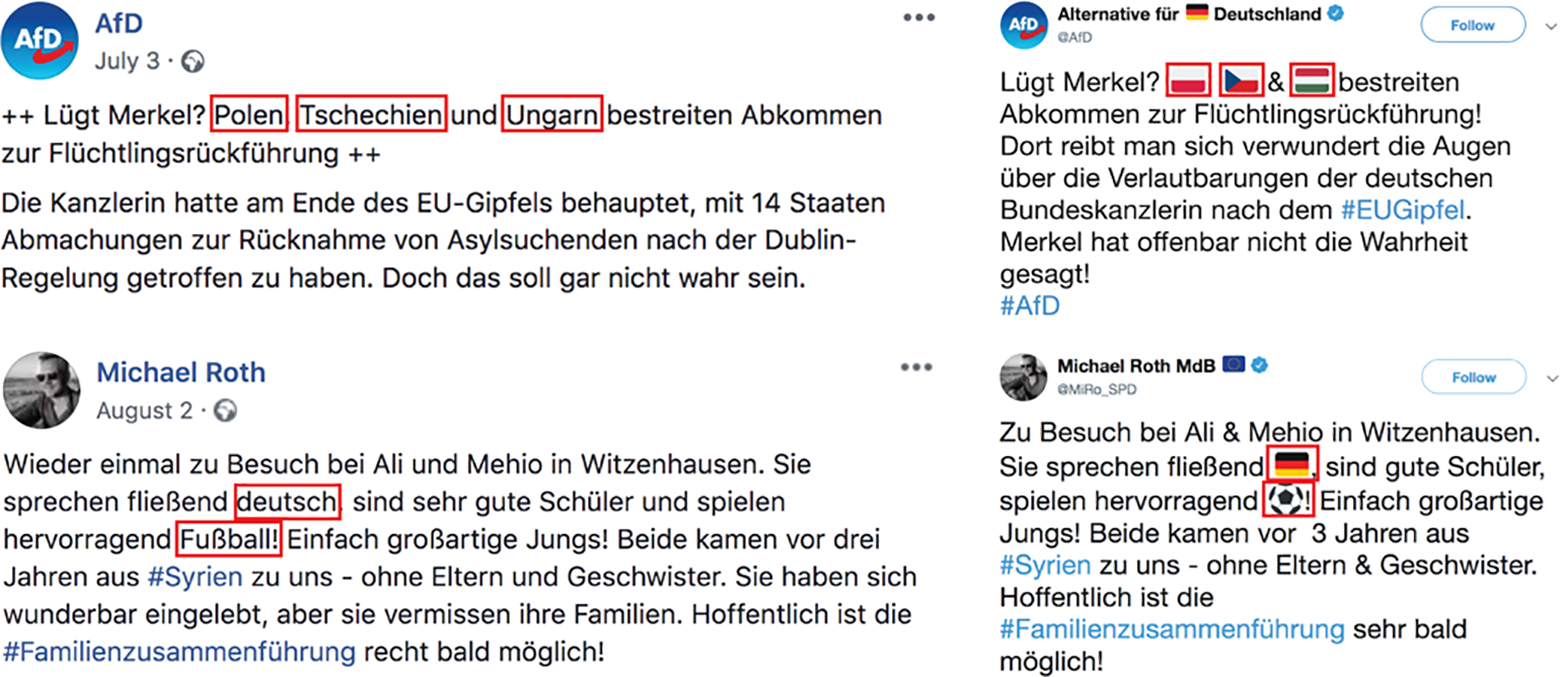
The differences in emoji use in a post on Facebook (on the left) and Twitter (on the right) by Alternative for Germany and Michael Roth, members of German Bundestag Social Democratic Party of Germany.
Data Set
For each political party, we looked at the party’s official Twitter accounts at the national and state level and the Twitter accounts of the members of the 18th and 19th Bundestag in Germany and members of the House of Representatives of 115th and 116th U.S. Congress. We included members from the current and the previous sessions of parliament of the two countries to minimize biases in comparison since the two countries held elections at different point of time. Elections for the 19th Bundestag were held of September 24, 2017, and elections for 116th U.S. Congress were held on November 6, 2018.
Using the described method, we collected 642 accounts from Germany and 634 Twitter accounts from the United States. In there, we had 547 accounts from members of German Bundestag (MdB) and the rest from the official party outlets at national and state level. For the United States, we collected 531 accounts from the Republican and Democrat members of the House of Representatives of the U.S. Congress, while the rest of the accounts were official accounts of the parties at national and state levels. In rare occasions, we found multiple Twitter accounts for a politician; in such cases, we choose the account that was designated as official or the account that was oriented toward politics instead of personal use. We focused on the members of Bundestag and Congress plus the state and national accounts to give us a comprehensive set of active and official political accounts on Twitter. We started our data collection in June 2018. Using the Twitter application programming interface (API; User timelines, 2016), we downloaded up to 3,200 tweets for each account. This data set was periodically updated for new tweets for each account posted after June 2018 until March 2019. In this way, we collected a total of 3.04 million tweets.
Filtering Tweets
We removed tweets outside the period of March 1, 2017, to Feb 28, 2019, which left us with a total of 1,605,370 tweets. March 1, 2017, was chosen as the starting date since by then about 75% of the Twitter accounts had at least one tweet in our corpus, and it provided us good coverage for both countries. About quarter of accounts did not have tweets covering the entire period as some accounts were only opened in this period, some were deleted in this period and for rest the initially downloaded tweets did not extend as far back as March 1, 2017.
We also removed retweets, quoted status (retweets with additional text), and replies from this corpus. This left us with a total of 640,676 tweets, out of which 218,077 were from Germany and 422,599 from the United States. There were two main reasons for focusing on original tweets for our analysis. Firstly, to eliminate the problem of double counting of tweets, which were retweeted by another person in our data set, and secondly, to limit the analysis to the flag usage in the writing style of national representatives.
Tables 1 and 2 show the number of accounts, tweets, tweets with an emoji, and tweets with a national flag for each party in Germany and United States, respectively. For Germany, European Union is the macroregion; hence, the number of tweets with the emoji are also included.
For Each Party in Germany; Number of Accounts, Tweets, Tweets With an Emoji, Tweets With , and Tweets With .
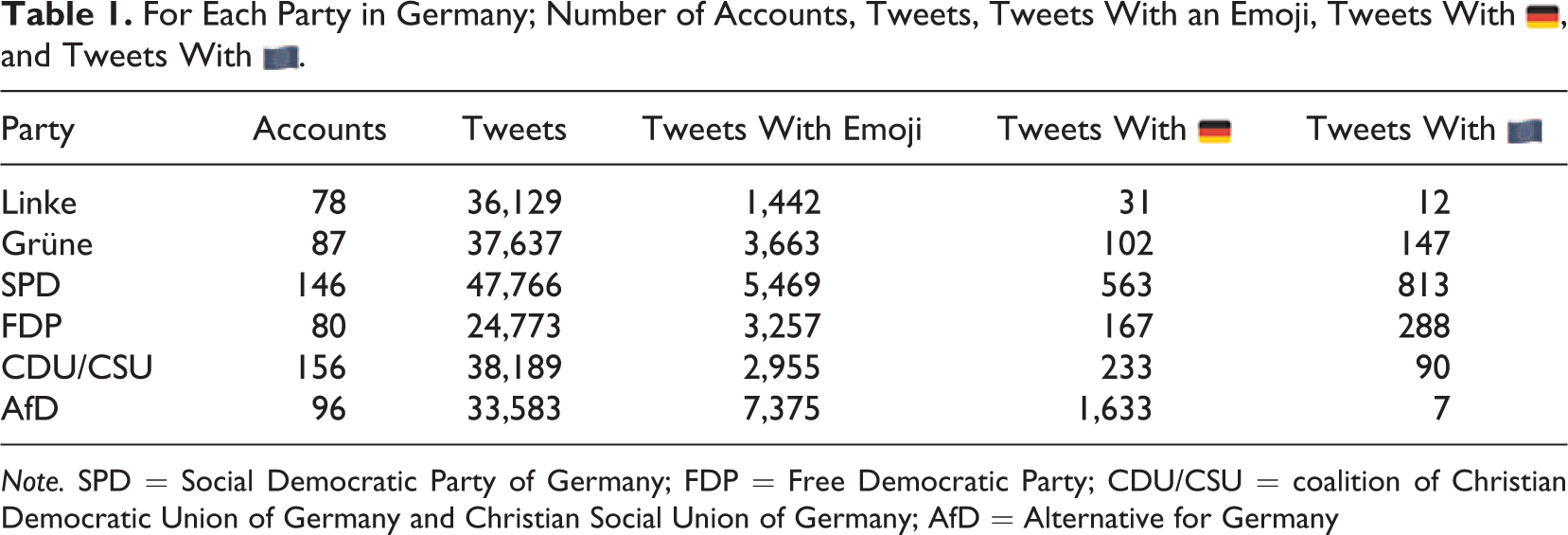
Note. SPD = Social Democratic Party of Germany; FDP = Free Democratic Party; CDU/CSU = coalition of Christian Democratic Union of Germany and Christian Social Union of Germany; AfD = Alternative for Germany
For Both Parties in United States; Number of Accounts, Tweets, Tweets With an Emoji, and Tweets With .

Similarity of the Emoji
To investigate the similarity of different words and emoji, we operationalized similarity as co-occurrence, that is, how often a specific emoji or a specific word occurs together with another emoji or word. This connects to the distributional hypothesis, which states that words with similar meaning occur in similar contexts (Sahlgren, 2005). There are a variety of computational models that implement the distributional hypothesis, including word2vec (Mikolov, Sutskever, et al., 2013), GloVe (Pennington et al., 2014), and Random Indexing (Sahlgren, 2005). We used the word2vec implementation in Gensim (Mikolov, Chen, et al., 2013; Rehurek & Sojka, 2010). word2vec takes a text corpus as input and produces vector representations as output. We trained word2vec using the continuous-bag-of-words approach for all words that appear at least 3 times. We trained the neural network to predict a certain word using a context window of 3, that is, we used the three words preceding the current word and the three words succeeding the current word to predict it. For example, in the sentence “Angela Merkel is the chancellor of ,” the term “chancellor” is predicted using the words “Merkel,” “is,” “the,” “of,” and “.” To illustrate what this means semantically, LeCun provides the example of a news story (LeCun et al., 2015). In a news story, words like Tuesday and Wednesday can be easily replaced, that is, they are used very similarly in any given sentence. The word representations also have other properties: In the vector space of word2vec, similar words are encoded by similar vectors. This means that the angle between the vectors can be used to quantify the similarity of the words. In this investigation, we use the cosine between two vectors to investigate how similar two words are. To train the word2vec model, we removed all special characters except for the #, -, and _. The first was kept due to its semantic meaning as a hashtag, the last two were important for the emoji definitions. We further replaced German umlauts (ä, ö, ü) and converted all words to lowercase.
Results
In this section, we first present high-level descriptive statistics about the use of flag emoji in our data set. We then present results specific to research questions that we formulated in the beginning.
Descriptive Statistics
Overall, we were surprised to find that the national flag emoji are among the most frequently used emoji in both countries, and they are more frequent than the widely popular anthropomorphic emoji. Figure 2A and 2B show the 10 most commonly used emoji in political communication on Twitter in Germany and United States in our data set. The national flag is the second and third most used emoji in Germany and United States, respectively. The flag of the European Union, which is a political and economic union of 28-member states including Germany, is the second most used flag in Germany. This demonstrates that in specific contexts such as political communication, topic related nonanthropomorphic emoji are popular ones. Interestingly, anthropomorphic emoji and symbols/markers both appear frequently in case of Germany, and in United States symbols are the prevailing emoji. The  emoji, which is most frequently used in both Germany and United States, is mostly used for point to external weblinks in a tweet.
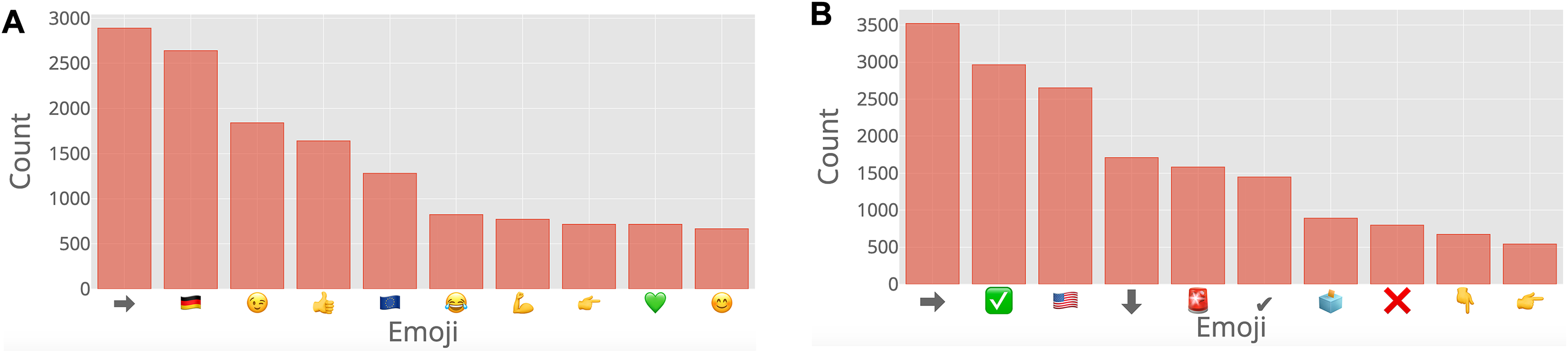
Panel A (left): Ten most used emoji in political communication in Germany. Panel B (right): Ten most used emoji in political communication in United States in our data set. Note: National flag is the second most used emoji in Germany and third most in the United States.
Investigating the proportion of accounts that used emoji at all, we find that in Germany, 78.8% accounts used emoji and 29.3% used the national flag emoji at least ones during our study period. We also find that emoji usage varies greatly between different accounts. For example, for some accounts, more than 90% of tweets contained an emoji and 60% of the tweets contained the national flag emoji as compared to many accounts that did not use any emoji in period. In United States, 82.9% accounts used an emoji and 43.6% used a flag emoji at least ones. In the United States, for some accounts, more than 80% of tweets contained an emoji and 70% of the tweets contained the national flag emoji.
To understand how the emoji usage varies across parties, we analyzed the percentage of tweets that contained national flag emoji for each account. Figure 3A and 3B show the result for Germany and United States, respectively.
Panel A (top): Each dot represents an account’s percentage of tweets with emoji and any emoji. Panel B (bottom): Each dot represents an account’s percentage of tweets with  emoji and any emoji.
In both countries, right-wing parties use emoji and flag emoji more than the left-wing parties. In Germany, 4.86% tweets from the far-right AfD, but only 0.08% tweets from the far-left Die Linke contained the emoji. This pattern also holds for United States and Republicans and Democrats, even though the ideological distance between Republicans and Democrats is closer than the ideological distance between AfD and Linke (The Political Compass, n.d.). Overall, Republicans use an emoji in 4.77% tweets and the national flag emoji in 0.81% tweets, whereas the Democrats used emoji in 3.76% tweets and national flag emoji in 0.25% tweets.
In this section, we study the impact of external events including major national and sporting events on the flag emoji usage in the two countries. Figure 4A and 4B show the daily percentage of tweets with and emoji for Germany and United States, respectively. In Germany (Figure 4A), the peaks around external events are distinguishable, and they are usually twice as large as the surrounding data. The highest peak is observed on June 23, 2018, when the German soccer team won against Sweden in a game crucial to stay in the FIFA World Cup. On German Unity Day (October 3), a local spike can be observed in 2018 but not in 2017. Another spike can be seen on January 22, with 22 German flags used on the anniversary of Élysée Treaty between Germany and France. In general, around FIFA World Cup (June–July 2018), we observed higher national flag usage than around national elections (September 2017).
Panel A (top): Daily percentage of tweets containing the from all German parties. Panel B (bottom): Daily percentage of tweets containing the from both American parties.
For the United States (Figure 4B), the flag emoji usage is more closely related to the national events, and peaks are notably higher than the baseline. We observe the dominating spikes on the July 4, 2017 and 2018 (Independence Day), and local spikes on November 10, 2017 and 2018 (Veterans Day), January 31, 2018 (after the State of the Union delivered by the president on the previous day), and May 28, 2018 (Memorial Day).
Since the national flag usage in the United States is linked to the national events, it is possible that the flag usage is an overt reference to national identity. However, in case of Germany due to conflicted relationship with the national flag, the usage is probably driven more by the context of the text instead of the external event and hence the smaller differences.
Since flag emoji are so frequently used, our third research question explores the meaning of flag emoji in greater detail. We trained independent word2vec models for every party and one additional model combining data from all parties. Table 3 shows which words and emoji are the most similar to the emoji. Note that this similarity is based on cosine similarity, ranging from -1.0 for dissimilarities and 1.0 for the highest possible similarity.
Results for Research Question 3, 10 Most Similar Words With Their Cosine Similarity to the Emoji.
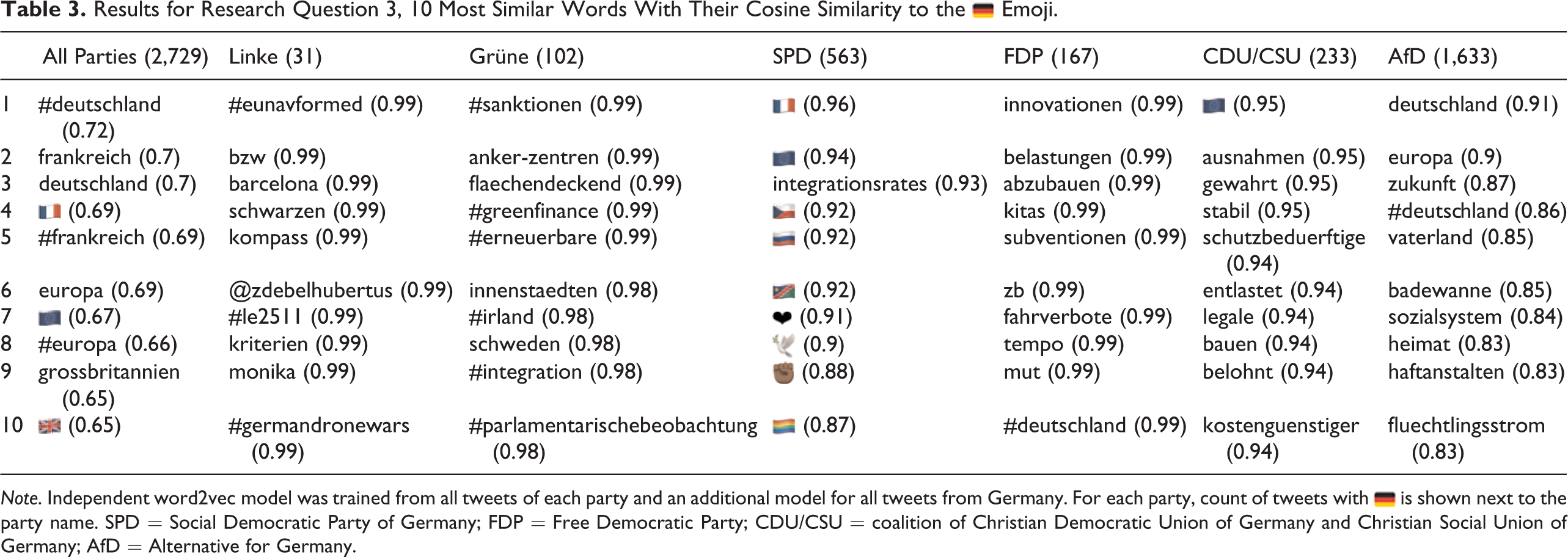
Note. Independent word2vec model was trained from all tweets of each party and an additional model for all tweets from Germany. For each party, count of tweets with is shown next to the party name. SPD = Social Democratic Party of Germany; FDP = Free Democratic Party; CDU/CSU = coalition of Christian Democratic Union of Germany and Christian Social Union of Germany; AfD = Alternative for Germany.
At a high level, we find that in Germany the national flag is mostly used in the same context as the country name Deutschland, words relevant to the current affairs in Germany and flags of neighboring countries ( ,
,  ,
,  ) and European Union (). However, there are differences in the parties along their political and economic agenda. Linke uses the national flag in context of social issues such as #EUNAVFORMED in context of military mission to stop human smuggling in the Mediterranean, #le2511 in support of Anti-fascist movement (Antifa) in Leipzig, and #germandronewars to oppose the development of autonomous drones for wars. For Linke, we had only 31 tweets with German flag, hence the results should be interpreted with care. Grüne uses the national flag in context of environmental issues such as #erneuerbare (renewable energy), Innenstädten (with regard to the pollution in inner cities), and #greenfinance. Additionally, words and hashtag related to social issues (#integration, Anker-Zentren) and foreign policy (#sanktionen, #irland and Sweden) also appear in the similar context. In case of SPD, flags of neighboring countries (, , ,
  ,
,  ) and emoji used for empowerment and support for communities (
 ,
,  ,
,  , ) appear in similar context. For FDP, we observe words related to trade and economic issues such as Innovation, Belastungen (charges), abzubauen (reduce), and Subventionen (subsidy). In case of CDU/CSU, we see the flag used in the similar context along with words related to economic and social issues (bauen, belohnt, kostengünstiger, and Schutzbedürftige). Finally, AfD is a far-right (Chase & Goldenberg, 2019) political party with a focus on German national identity. AfD has the largest number of tweets with German flag in our data set. Due to AfD’s strong anti-refugee stance, it is unsurprising that AfD uses Deutschland (Germany), Europa (Europe), Zukunft (future), Vaterland (homeland), Sozialsystem (social system), Heimat (home), Haftanstalten (prison), and Fluechtlingsstrom (refugee flood) in a similar context as the national flag. In general, the context in which the national flag used by political parties in Germany varies with their social, environmental, foreign, and economic policy.
Unlike Germany, in the United States (Table 4), other flags and emoji are predominantly used in similar context as the national flags. Interestingly, compared to Germany both U.S. parties use the national flag more strongly in the context of electoral politics than policy. In case of the Republicans, we observe country name (#usa), campaign slogan (#maga), party symbol ( ), and the flags of other countries (
 , ,
, ,  ,
,  ,
,  ). For the Democrats, we find party and election-related symbols (
 ,
,  ), flags of neighboring country () and emoji that show solidarity with queer and Black people (
 ,
,  ,
,  ). sometimes also refers to the Purple Heart, the oldest military decoration still given in the United States, awarded to those wounded or killed while serving.
Results for Research Question 3, Most Similar Words With Their Cosine Similarity to the Emoji.
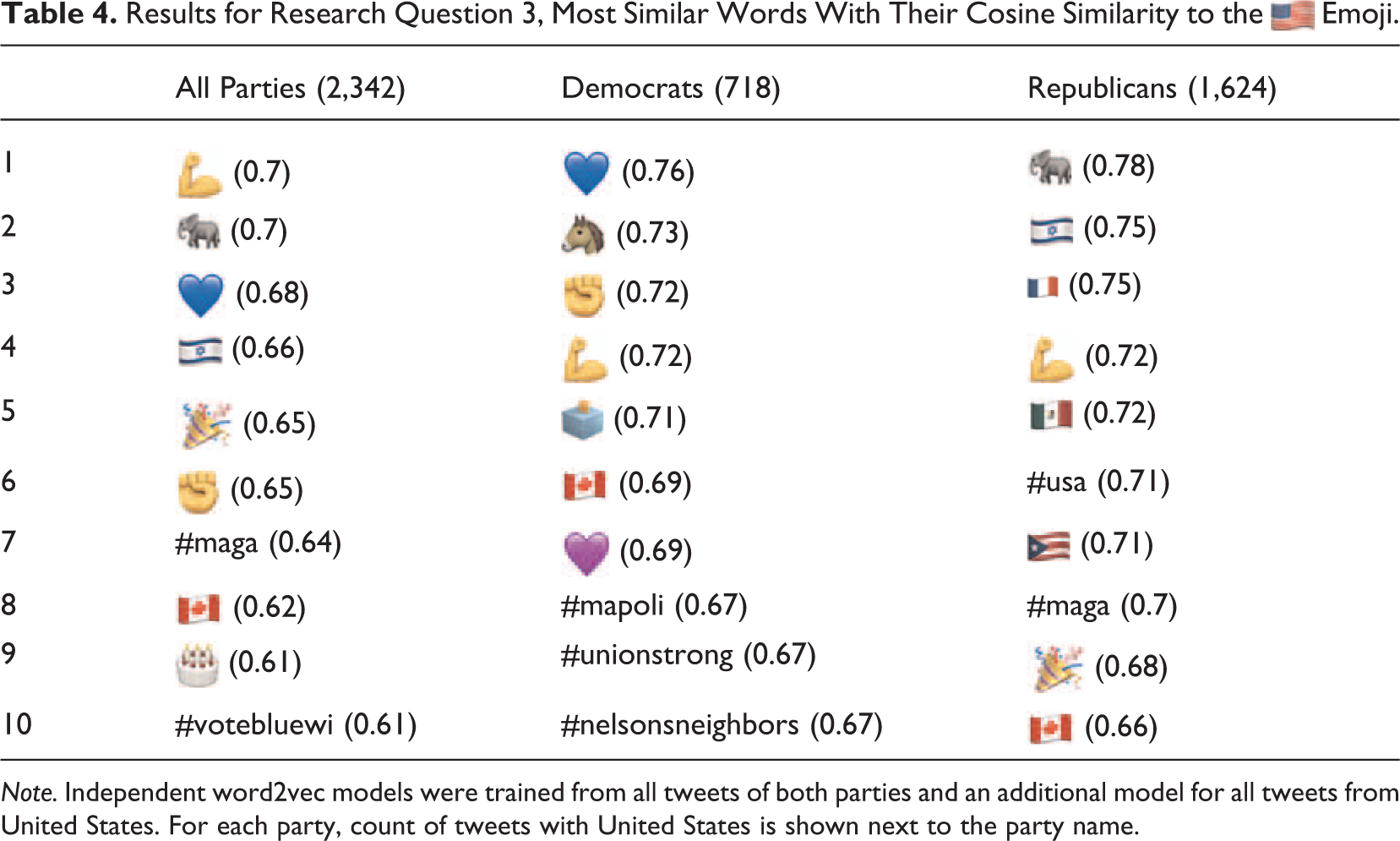
Note. Independent word2vec models were trained from all tweets of both parties and an additional model for all tweets from United States. For each party, count of tweets with United States is shown next to the party name.
The results are well in line with our expectation that different parties would use flag emoji in different context. And they are in agreement with predictions of the symbolic interaction theory regarding divergent meanings across countries. While in Germany, the use of the national flag emoji function as an overriding symbol of the country for parties to align with their policy preferences, in United States, the use of the national flag appears to be more strongly related to the context of electoral competition.
For this section, we operationalized engagement as the number of retweets. Additionally, to investigate whether the presence of an emoji leads to a higher engagement with content, we calculated the median number of retweets of all tweets and compared the number to the median number of retweets that contain either an emoji, a flag emoji or the national flag. In our data set, the favorites (sometimes referred to as likes) and retweets are highly correlated with a Pearson correlation coefficient of .95 for Germany and .89 for United States. And the overall trends described here for retweets also hold for favorites.
The results for Research Question 4 are shown in Figure 5A and 5B. In Germany, for all parties’ tweets that contain national flag emoji have a higher median engagement. The highest impact is seen for the Grüne, FDP, and AfD, where we see more than a 5-fold increase in the median retweet count for tweets with . The lowest impact can be observed for the ruling parties, CDU/CSU and SPD. To provide additional support that a difference in engagement between tweets with a national flag emoji and tweets without a national flag emoji exists, we used Mood’s (1950) median test. It is a nonparametric test that is used to test whether the medians of two samples are identical. We used the test’s implementation available in the SciPy Stats package with default parameters (SciPy Version 1.2.1 Reference Guide, 2019). We found a significant difference for all political parties in Germany, Linke (median with flag = 14, median without flag = 4; p = .002), Grüne (median with flag = 10.5, median without flag = 2; p < .001), SPD (median with flag = 3, median without flag = 1; p < .001), FDP (median with flag = 6, median without flag = 1; p < .001), CDU/CSU (median with flag = 1, mean = 5.87, SD = 12.59, median without flag = 1, mean = 3.67, SD = 17.92; p = .005), and AfD (median with flag = 157, median without flag = 15; p < .001). For Linke, we should consider that there are only 31 tweets with a flag emoji in the data set.
Panel A (left): Median retweet count for all tweets, tweets with an emoji, tweets with emoji, and tweets with emoji for Germany parties. Panel B (right): Similar figure for U.S. parties. Note: Please note that in case of Germany, Alternative for Germany is on a different scale than the rest of the parties.
Compared to Germany, in the United States, the effect of national flag on the engagement of a tweet is minuscule. For Democrats, the tweets with a national flag have a lower median retweet count (median: 6.0) as compared to tweets without a national flag (median: 7.0). Even though the differences are small, the results are statistically significant (Mood’s median test; p < .001). For Republicans, the trend is opposite. The median number of retweets for tweets with national flag (median: 5.0) is higher than that for tweets without the national flag emoji (median: 4.0). For Republicans also, the result is significant (Mood’s median test; p < .001).
The results indicate that in Germany, a tweet with a national flag is associated with higher engagement on Twitter as compared to tweet without the national flag. In the United States, it is associated with a slight increase in engagement for Republicans and a slight decrease for Democrats.
Discussion and Limitations
In the article, we study the role of national flag emoji in online political communication. We calculate the prevalence of national flag emoji in the online communication, study the differences in its usage across parties, explore the impact of external events on its usage, analyze the meaning of the national flag emoji for various political parties, and measure the impact of the national flag emoji on engagement with the audience.
We find that national flag emoji are among the most frequently used emoji in online political communication in both Germany and United States. While a likely explanation for this is the ubiquitous use of national flag in the United States, the results are noteworthy for Germany since use of the national flag as a national symbol is highly contested (Dohmen et al., 2006; Heinrich, 2003; Stehle & Weber, 2013). It is also interesting to note that for both countries, flag emoji are more popular than facial emoji (such as  , , and ) which are often reported to be the most popular in online communication (Hu et al., 2017; Miller Hillberg et al., 2018; Na’aman et al., 2017).
For evaluating the impact of external events, we examined the flag emoji usage on days of national importance such as Independence Day, Veterans Day and Memorial Day in United States, and Day of Unity in Germany. In both countries, we observed increase in percentage of tweets with national flag on days of national importance. Flags are a common phenomenon in sporting events, and national events and that seems to impact their online usage as well. While comparing Germany and the United States, we observe two notable differences. Firstly, in Germany, both national and sports events result in similar increase in the national flag emoji usage, while in United States, a striking increase can be observed for national events but not for sports events. Secondly, in United States, we see up to 5-fold increase in percentages of tweets with national flags on days of external events, while only 2-fold increase is the case of Germany. Germany and United States have different relationship to the national identity and national symbols and probably this leads to different impact of the external events on national flag usage.
An interesting observation to emerge from the data was in the context of meaning of the flag. In the face of the highly conflicted relationship of Germans with national symbols and a proven reluctance of politicians to appear as literal or symbolic flag wavers, the question arises: Has Unicode given a new meaning to the German flag by including it as an emoji? We found that in Germany, parties use the flag emoji in the context of their policy stances. In a way, they are thus using the flag not as a symbol to align themselves with traditional values of national identity automatically associated with the flag. Instead, they appear to attempt to redefine the flag as being aligned with their policy goals. Thus, they use the flag as a symbol of national unity which is then given meaning to by the policy content they are proposing. The national flag can thus not automatically be read as a signifier for tradionalist, right-wing, or conservative values of national identity. Over time, this more relaxed attitude toward the symbol of the national flag might also translate into uses of the actual physical manifestation of the flag.
In the United States, national flags appear more strongly in the context of electoral competition. In both countries, we also observe the national flag is also used in the similar context as the country name (#usa and #deutschland). Overall, we found different uses of the national flag based upon specific context and political leaning.
The most striking result to emerge from the data is that in Germany, tweets with are associated with significantly higher engagement for all political parties. For AfD, Grüne, and FDP, we observed more than 5-fold increase in engagement for tweets with German flag, which is remarkably higher when compared to political parties from the United States. Our results indicate that even though the use of the national flag in Germany as a national symbol is highly contested, national flags in Germany remain a powerful symbol when it comes to interaction with online content.
In the United States, we observe that tweets with national flag are associated with a slight increase in engagement for Republican party and slight decrease for Democratic party. This connects to Kalmoe and Gross (2016) who found that the American flag has a pro-Republican effect on the people identifying as Republicans but offers no advantage to the Democrats. Our study finds a similar pattern for the Republicans but also observes slight disadvantage for the Democrats.
Although we have found that in Germany parties across the political spectrum were using the national flag emoji successfully to redefine its meaning and to foster engagement with their content, we also found it a powerful symbol on the political far right. In fact, political parties on the far right of the political spectrum use flag emoji with higher frequency and usually for these parties, tweets with flag emoji are associated with higher engagement. These two findings taken together mean that political parties on right and especially parties endorsing nationalistic thought might overall benefit most from the introduction of flag emoji in the Unicode character set. These findings point to important challenges for Unicode consortium and the designer of emoji, who might have unseeingly skewed online communication in favor of some parties. In the recent years, right-wing nationalism is on rise globally (Duara, 2018; Snyder, 2019; “The right-wing nationalists shaking up Europe,” 2019). Flag emoji provide an easy to use tool to represent the nation and through it express nationalistic thought, in a media through which it is easy to reach masses. This research has thrown up many questions in need of further investigation. Further work needs to be done to establish the effectiveness of flag emoji in expressing nationalistic ideology and its role in increasing nationalism around the globe and the successful contestation of these ideas through uses of flags across the political spectrum.
There are various factors that influence engagement with a tweet. Some of these factors are related to the authors’ timing, while others are related to the context. In this article, we do not investigate the effect of these factors on engagement with a tweet. For example, while it is unlikely, it is possible that all the flag tweets containing national flag might be written in only acclaimed contexts (e.g., sports or foreign affairs), and people could be responding to the context rather than the flag emoji itself. Difference in context might explain why the effect of the flag on engagement in the United States is smaller—because it might be used in a wider range but often more mundane of contexts as compared to Germany. In this study, we do not investigate this factor and cannot comment on its impact the engagement with a tweet.
We started out to determine the role of national flag emoji in political communication in Germany and the United States. One of the more significant findings to emerge from this study is that presence of flag emoji is associated with notable higher engagement with tweets in Germany. The second major finding is that meaning of national flag emoji depends on political and cultural context. The results also show that the usage of flag emoji greatly varies between parties and in general political parties on the right use of flag emoji more often than the parties on the left. Furthermore, flag emoji usage in online communication is associated with external events of national importance. These findings demonstrate that as symbolic interactionists would expect, the uses and meaning of national flags as a symbol vary across cultural and political contexts and have different consequences as expressed in stimulating audience reactions. Here the divergent contextual uses of national flags in tweets of political actors depending on their ideological leaning are especially interesting and offer promising perspectives for future research.
Footnotes
Authors’ Note
We would like to thank Stefanie Walter for her input and feedback on this research. We are also grateful to the two anonymous reviewers for their comments that helped us improve the manuscript. We thank our colleagues Daniel Diethei, Gian-Luca Savino for the discussion and Daria Vladimirovna Soroko for the help with the figures.
Data Availability
This study is based upon analysis of tweets from Twitter. Due to Twitter’s terms of use, we can’t release the complete data set, but we release the list of tweet IDs, for noncommercial research purposes, that we considered in this study, along with their relevant attributes such as party affiliation and count of emoji. This information is sufficient for all analysis except for training a word2vec model. With the tweet IDs, a replica of the data set can be created through the Twitter API to train the word2vec model. The partial data set can be obtained from the first author or accessed via the open-source repository ( .0).
.0).
Declaration of Conflicting Interests
The authors declared no potential conflicts of interest with respect to the research, authorship, and/or publication of this article.
Funding
The authors disclosed receipt of the following financial support for the research and/or authorship of this article: This research was supported in part by the Volkswagen Foundation through a Lichtenberg Professorship.