




Abstract
Twitter is credited for allowing ordinary citizens to communicate with politicians directly. Yet few studies show who has access to politicians and whom politicians engage with, particularly outside campaign times. Here, we analyze the connection between the public and members of parliament (MPs) on Twitter in the Netherlands in-between elections in 2016. We examine over 60,000 accounts that MPs themselves befriended or that @-mentioned MPs. This shows that many lay citizens contact MPs via Twitter, yet MPs respond more to elite accounts (media, other politicians, organized interests,…), populist MPs are @-mentioned most but seem least interested in connecting and engaging with “the” people, and top MPs draw more attention but hardly engage—backbenchers are less contacted but engage more.
Introduction
Barack Obama is often called “the social media president” (Katz, Barris, & Jain, 2013). This is not only because of his successful use of social media in his election campaigns (Bimber, 2014, p. 131). Also after his election, he wanted “to draw on the power of digital engagement to tap into the wishes and talents of the American people” (Katz et al., 2013, p. 3). In his own words, “I felt that some of the things that we were doing to help us get elected could also be used once we were elected” (Obama, 2013). He is not alone in his ideas. As Jungherr (2016, p. 79) notes, “politicians see public exchanges referring to politics on Twitter as indicators of public opinion.”
Yet beyond the Obama case, empirical research on the matter is scarce. Indeed, there are at least two gaps in the literature on social media, public opinion, and politics. The first lacuna is related to the Burkean, top-down perspective that guides most studies in the field (Jackson & Lilleker, 2009, p. 246). Typically, these studies focus on political actors and their messages (Jungherr, 2016, p. 76). Yet as Vaccari and Valeriani (2015, p. 1028) put it succinctly, “the political Twitter-verse is not just about talking (writing) but also about listening (reading).” Social media are credited for allowing ordinary citizens and “outsiders” to approach politicians directly, but few studies have focused on whom politicians listen to on social media. A Dahlian perspective, analyzing who has access to politicians (e.g. who politicians follow) 1 and whom politicians listen to (e.g. who they reply to and who they retweet), is therefore badly needed.
The second lacuna is that most studies focus on campaign times (e.g. Hosch-Dayican, Amrit, Aarts, & Dassen, 2014; Jungherr, Schoen & Jürgens, 2015; Vergeer & Hermans, 2013), while only few study politicians’ everyday online practices (Larsson, 2015). However, during campaigns, politicians adopt a “broadcasting” style of communication (Jungherr, 2016, p. 76), while social media have an “always-on” logic and also offer politicians many opportunities outside of the campaign (Larsson, 2015, p. 150). In-between elections, politicians can use social media to forge long-lasting relationship by engaging with the public. Similarly, social media provide “the general public” an easy means to express its “opinion” to their representatives directly (Graham, Broersma, Hazelhoff & van’t Haar, 2013, p. 710). In other words, the Burkean, top-down perspective is useful in campaign times, but a Dahlian perspective may be more useful when politicians are not campaigning.
In this study, we analyze to what extent there is a vertical connection between the public and politicians on Twitter (Kruikemeier, 2014). Indeed, while a horizontal connection is a connection between political elites (such as members of parliament [MPs]) and other elite accounts, vertical connections between political elites and lay citizens are very important as well. Such vertical connections determine what politicians “see” of public opinion without having to actively search for it. “Seeing” public opinion on Twitter does, however, not necessarily equal noticing it. Therefore, we also examine the engagement of politicians with the accounts they are connected with. Specifically, we examine the over 60,000 accounts that were connected with all Dutch MPs on Twitter (befriended or @-mentioning) and of those the ones with which the MPs engaged (retweeted friends and @-mentioners @-mentioned by MPs). We also examine which types of MPs are more likely to vertically connect or engage with lay citizens. All data come from in-between elections (May–August 2016; cf. Mejova & Wever, 2014).
The Dutch case is a particularly interesting as the country is a digital front-runner (see Vergeer & Hermans, 2013). It has a very high Internet penetration rate (94% in 2013) and a relatively high Twitter penetration rate. It has 3.3 million users on a population of close to 17 million (Oosterveer, 2013) and a reported Twitter penetration rate among the population of around 20% in 2016 [Statista, 2017; Telecompaper, 2017]). Moreover, over 95% of the MPs have adopted Twitter and they themselves say Twitter is an important way to connect with the people (Hosch-Dayican et al., 2014; Jacobs & Spierings, 2016; Weber Shandwick, 2014). Hence, if we do not find a vertical connection and engagement with public opinion here, it is unlikely to exist in comparable countries.
Our addition to the literature is as follows: Currently, researchers only focus on which users politicians recognize by tweeting messages to them or whom they interact with (cf. Tromble, 2016a). They do not focus on who is tweeting to politicians and who politicians follow. Our study does both and thereby allows us to identify discrepancies between the two. Our main findings are 3-fold. First, while a substantial number of lay citizens try to draw the attention of MPs, the average MP is not likely to connect with such accounts. Instead, MPs focus mostly on elite accounts (e.g., media, other politicians, and organized interests accounts). If Twitter does not live up to its equalizing potential, this is not because no lay citizens want to. Second, MPs of populist parties seem least interested in connecting and engaging with “the” people. They rather create echo chambers with “their” people. They befriend few accounts of lay citizens, but those befriended are retweeted relatively often. At the same time, populist MPs are @-mentioned by the most accounts, but these accounts are often ignored. Third, MPs’ parliamentary position matters. Top MPs draw a lot of attention from citizens (@-mentions) but hardly engage with them and rarely befriend them. Conversely, backbenchers are less connected, but they engage more with their connections.
Theoretical Framework
Using Twitter as an indicator of public opinion
During election campaigns, politicians try to attract votes. In-between elections politicians have other motivations for communication too. They typically wish to implement specific policies and represent their voters (cf. Strom, 1990). 2 Therefore, they also inform themselves about what citizens think and test certain ideas they have. Under such circumstances, politicians are likely to keep an eye on public opinion (i.e., what citizens want, think, and feel). Politicians have several tools and channels at their disposal to do so such as opinion polls, internal polling by the party, communication with citizens directly, and traditional media (e.g. Van Aelst & Vliegenthart, 2014). More recently, Twitter has been added to these tools, and it has several features that give it a distinct added value (Hosch-Dayican et al., 2014).
As Jacobs and Spierings (2016, p. 20) stress, Twitter has “unique characteristics” that make it different from, for instance, opinion polls and media coverage. First, Twitter is inexpensive and does not require specialist technical knowledge: Anyone can open an account and send and read tweets (Jacobs & Spierings, 2016, p. 22). 3 Content generation “by lay persons” and “amateur activity, by those who may have authentic knowledge and information access” is at the heart of social media such as Twitter (Klinger & Svensson, 2014, p. 6). Especially for politicians who specialize in the less salient topics, such information is useful. The topics on social media are vastly more diverse than on traditional media and thereby paint a richer picture of public opinion, one that taps into its “sentiment” more directly (cf. Chadwick, 2013). 4 Social media such as Twitter allow “hearing the voice of the people” (Katz et al., 2013, p. 13). 5
Second, Twitter is unmediated (Klinger & Svensson, 2014, p. 10). Journalists filter and edit content in traditional media and pollsters decide the focus of public opinion polls. Twitter on the other hand offers raw information on any topic. The public can directly communicate with politicians, and politicians can directly view what “the public” wants, thinks, or feels (e.g., Jacobs & Spierings, 2016, p. 64). 6
Third, Twitter is characterized by speed (Klinger & Svensson, 2014, p. 8). Opinion polls do not allow politicians to (re)act swiftly and similarly traditional media have a relatively slow news cycle compared to social media. Twitter is fast and messages can go viral within hours (Klinger & Svensson, 2014), thereby potentially triggering spillover effects to traditional media (Chadwick, 2013). As such, it can act as a “weather forecast” (Bleijerveld, personal interview, August 21, 2013).
By no means is it our claim that Twitter is the only tool used by politicians, but it is one of the tools that they can use, that they say they use (Weber Shandwick, 2014), and, most interestingly, one that allows traditionally excluded people to have quick and direct access to politicians.
Vertical connections and engaging with the public
Some politicians might use advanced software to keep track of what is going on Twitter. The information collected this way typically refers to general trending topics on twitter, but it tells us less about who has access to politicians. Our focus is on the accounts MPs vertically connect with, particularly who it is that politicians look at on Twitter for information (who is followed by MPs) and who tries to draw the attention of politicians (who @-mentions MPs).
While politicians—and journalists alike—are aware that “users tend not to be representative of a population as a whole” (Jungherr, 2016, p. 77), they still seem to treat Twitter as a proxy for public opinion (Jacobs & Spierings, 2016, p. 96). A recent study by Freelon and Karpf (2015, p. 398) showed that politicians, journalists, and celebrities are the most active in salient political discussions. So even if politicians form vertical connections with the Twitter public, this means that they get a distorted view of what public opinion is. Therefore, it is important to know with whom politicians form connections on Twitter and to examine to what extent lay citizens are part of these connections.
These issues echo a broader discussion in the field of the effects of technological innovation: Whether they open up politics and allow new voices to be heard (the equalization thesis) or whether new technologies simply replicate existing inequalities (the normalization thesis; Gibson & McAllister, 2015; Vergeer & Hermans, 2013). Specifically, one can expect that if the equalization perspective holds true, politicians will mainly have vertical connections with public opinion—lay citizens—on Twitter (not e.g., organized interests, other politicians, and journalists). Conversely, from a normalization perspective, one would expect that politicians mainly connect (horizontally) with, for example, organized interests, other politicians, or journalists (not lay citizens). In the first part of our empirical analysis, we will analyze which of the two perspectives is most aligned with the empirics.
It is one thing to connect with lay citizens on Twitter but that does not necessarily mean that politicians notice and engage with them, for example, by replying to them or retweeting them. After all, the first is merely unilateral and says very little about whether politicians noticed what citizens said (or tried to bring to the politician’s attention). Engagement, as a form of reciprocal communication, tells us far more in this respect. Indeed, as Klinger and Svensson (2014, p. 10) note, online information spreads so fast that individual tweets get snowed under quite quickly. It is therefore important to check what type of accounts politicians engage with. If they engage with an account, we can be certain it was genuinely noticed (however short that attention to it may have been). From the campaign literature, we know that politicians mainly focus on “elite accounts” and journalists in particular (Jungherr, 2016, p. 76; Kreiss, 2016, p. 1475). During campaign times, it therefore seems that politicians mainly behave in line with the normalization perspective. However, as mentioned above, during such times, politicians are in a broadcasting mode. It could be that they behave differently in-between elections. In the first part of our analysis, we therefore also examine the following research question:
Differences between MPs
So far, we have considered politicians in general, but it is likely that some politicians connect and engage more than others. Even in the campaign literature, little is known about who is more likely to connect and engage with the public via social media (Jungherr, 2016, p. 77; Vergeer & Hermans, 2013).
Regarding connecting with the public on Twitter, it seems reasonable to expect that the top politicians or politicians from large parties will be less reliant on Twitter as they have the resources to issue polls themselves and generally deal with topics that are well covered in the media and in general polls. We can therefore expect them to be less likely to follow accounts of lay citizens. Conversely, parties and politicians that focus on traditionally excluded voices or topics, ones that typically are less visible in traditional media or in opinion polls, are more likely to take to Twitter to feel the pulse of (certain segments of) public opinion. As such, we can expect backbenchers (i.e., lower ranked, less prominent politicians), MPs from smaller parties, female MPs, and MPs with an ethnic-minority background to connect more with lay citizens (cf. Bailey, Steeves, Burkell, & Regan, 2013; Lassen & Brown, 2010). Lastly, one can expect that MPs from populist parties connect with citizens “as a means of demonstrating that the politician and party are ‘of the people’ and not the political establishment” (Tromble, 2016b, p. 9).
At the same time, one can expect that the “public” mainly wants to draw the attention of the most influential and well-known politicians and parties (via @-mentions) instead of backbenchers and MPs from smaller parties. However, building on the aforementioned reasoning, one can also expect that female MPs, MPs from an ethnic-minority background, and MPs from populist parties are more likely to be contacted by lay citizens. Indeed, the former two can function as a contact person for these underrepresented groups. And MPs from populist parties can be contacted by citizens who feel excluded by “the mainstream establishment.”
Hence, in the second part of our analysis, we wish to answer the following question:
Regarding engagement, 7 we can fall back on some studies from the campaigning literature (though it is obviously not certain that their results also hold in-between elections). Gibson and McAllister (2014, p. 531) suggest that politicians from postmaterialist/green parties engage more with the public because interactivity would fit their party identity. 8 Similarly, Jacobs and Spierings (2016, pp. 114–120) find that while big parties and top politicians seem more focused on journalists, at least some backbenchers are more likely to engage with lay citizens. 9 Tromble (2016a, p. 13), who analyzed politicians’ interaction on Twitter in-between elections, found that female MPs are more likely to hold conversations with their followers. If female MPs indeed function as a contact person and also themselves identify as such, one would expect more engagement from them as well. While Tromble did not include ethnicity in her analysis, a similar pattern for ethnic-minority MPs can be expected. Tromble also found populists are less likely to hold conversations, which is not entirely what one would expect based on the reasoning outlined earlier. Indeed, if populists want to demonstrate that they are a party of the people, one would expect them to interact with ordinary citizens. 10 It is therefore worthwhile to see whether our analysis replicates this finding.
The second part of our analysis will address this:
Method and Data 11
Operationalizing the Concepts
As discussed, we operationalize connections by (1) being followed by an MP and (2) an MP being @-mentioned. Both make accounts “visible” to that MP. By following an account, an MP actively links to that person or organization and the tweets of that account will appear on the time line of the politician. 12 The MP grants these accounts—“friends” in Twitter jargon—direct access to the information flow toward the MP. Contrarily, from an account holder’s perspective, the most direct way to try to get an MP’s attention is @-mentioning that MP. The MP gets a notification and is drawn to the message. These incoming @-mentions (from the MP perspective) thus indicate which people or organizations try to push their views to the MP.
Befriending and incoming @-mentions measure reach out or potential visibility. Therefore, we also look at further engagement by looking at (3) retweets of accounts the MP follows and (4) outgoing @-mentions by the MP of the accounts that @-mentioned them. While many users explicitly claim that a retweet is not an endorsement, a retweeted message is at least noticed and deemed interesting enough to be retweeted (Metaxas et al., 2015; see also boyd, Golder, & Lotan, 2010). The MP in a way raises the status of the tweet to something that is worth of being shared in a larger public debate (Klinger & Svenson, 2014). 13 Similarly, outgoing @-mentions of MPs serve as an indication that the account @-mentioning an MP is getting the MP’s attention.
Twitter Data
We collected data on all 150 Dutch MPs of the June 16, 2016 parliament. 14 No less than 146 (96%) had a twitter account, 140 of the accounts tweeted at least once during our period of study (May–August 2016), and 142 had friends. Of the 146 MPs, we collected and verified their twitter account handles and uploaded these to our script.
Our Twitter data collecting relies on the Representational State Transfer (REST) and Search Application programming interface (APIs). 15 Via the REST API, the friends of an account are accessible as are the statuses on the user’s time line (including retweets). We collected and stored their openly accessible user information including names and short biographical descriptions. 16 Regarding the retweets, the accessible backlog only goes back 3,200 statuses per account. 17 As the final data collection started early August 2016, the 3,200 statuses trail allows us to include all retweets of MPs from May to August 2016. Of all retweeted accounts, we selected those of which the retweeted account was also friend of the retweeting MP (58% of the retweet-MP dyads).
Information on @-mentioning an MP cannot be accessed from the MP’s account. 18 The @-mentioning data are therefore collected through the Search API, searching for the text “@[MP’s screen_name]” in Tweets of the last 7 days. 19 Once found, the account name of the @-mentioning account was collected. Running daily searches, we could collect all MPs incoming @-mentions for August. 20 Next, from the MPs’ statuses, we obtained the @-mentions by the MPs (outgoing @-mentions) for the same month and selected those which involved @-mentioning an account that @-mentioned the MP.
The number of friend and @-mention dyads and unique accounts is given in Table 1 in the Findings section.
Summary Statistics of MPs’ Friends, Retweeted Friends, Incoming @-Mentions, and Reciprocal @-Mentions.
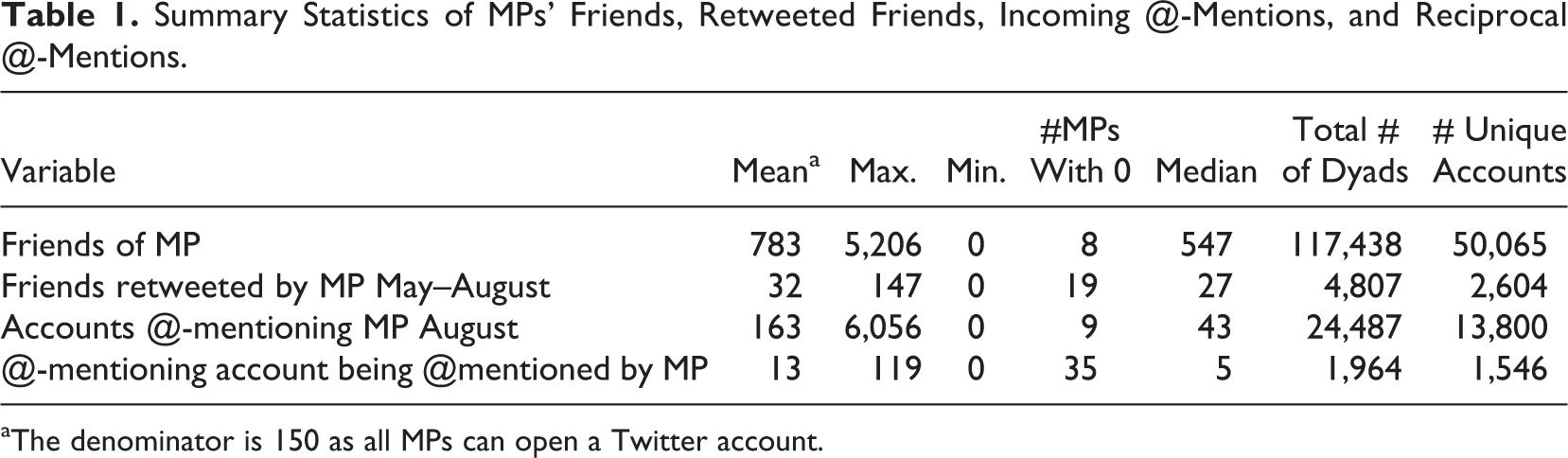
aThe denominator is 150 as all MPs can open a Twitter account.
Politicians, Parties, Pundits, and People
The information collected above only provides a general overview of the connection and engagement of MPs with other accounts. We are also interested in who or what kind of account has access to politicians. We therefore developed a semiautomated procedure to classify as many accounts as possible. We build on the seminal classifications by Vaccari and Valeriani (2016) and Graham, Broersma, Hazelhoff, and van’t Haar (2013), distinguishing: other MPs; non-MP political accounts including party officials, local council members, MEPs, party staff, elder(wo)men, mayors, provincial governors, party accounts, former MPs, local party accounts, and foreign politicians;
21
government accounts including accounts of ministers and government organizations; news accounts including journalists, media organizations, commentators, and news accounts but not including sports and showbiz news; civil society and business interest including nongovernmental organization, their leaders, lobbyists, and other accounts clearly focused on public interests, group representation, and collective issues; science and research including academic institutes and statistical bureaus, professors, and other scientific university employees; entertainment and commerce including sports, showbiz, humoristic accounts, and commercial organizations (but not organized business interest).
Accounts can fall in multiple categories. The list above is used hierarchically. 22 To classify, we applied four steps. 23 (1) A first round of automated coding based on exhaustive (hand-checked) lists of account names of all MPs, Members of European Parliament (MEPs), and parliamentary candidates in the 2012 elections, government officials, and parties as collected for prior studies (e.g., Jacobs & Spierings, 2016; Spierings & Jacobs, 2014). Moreover, we took relevant accounts from the main Dutch top100 twitter lists on, for example, political accounts, media accounts, NGO’s, and television (Berger, 2016). The accounts on these lists are ranked by the number of followers. To be on the list, they needed (a) to be based in the Netherlands or (b) to tweet in Dutch. The composers of the lists classified accounts as a certain group (e.g., politics) based on information in the self-reported Twitter description and local knowledge (Berger, 2016). They were hand-checked for this study. As the project is running for several years and is regularly updated, the lists are a reliable source to assure that prominent accounts in the groups at the core of this study are not overlooked. (2) For all friends, we searched their Twitter description for (combinations of) words identifying the account. For each category, (long) lists or identifiers were developed including alternative spellings and abbreviations. 24 For each identifier term, we looked at the Twitter description of a random sample of accounts it returned to check whether the search terms were too generic. If so, search terms were dropped or refined. For instance, the term “reporter” returns journalists as well as sports reporters, so the script was expanded to identify people with “reporter” and “sport” in their description and those were then recoded from “news account” to “entertainment and commerce” (see above). We also searched the account names for mentioning parties. 25 (3) All remaining accounts were ranked by number of MP followers. Those with more than 10 MP followers were hand-coded. They were looked up on Twitter and the Internet at large. Consequentially, many more, political, media, and civil society and business accounts were identified. This step is particularly important as these accounts weigh relatively strongly on the overall numbers. Overlooking them would have led to overestimating the number connections between MPs and ordinary citizens. Our first three steps identified over 60% of the friends and 80% of the retweeted friends. (4) From the remaining unclassified accounts for each indicator (friends, retweeted friends, incoming @-mentions, and outgoing @-mentions), we drew random samples of 100 accounts. These accounts were examined and hand-coded (see above). 26 The numbers for these samples were extrapolated to all unclassified accounts. The unadjusted numbers are provided in Appendix Table A1. 27
Differences Between MPs
For the explanatory analyses (Research Questions 2a and 2b), the dependent variables are the number of accounts befriended, retweeted, and @-mentioned by the MPs. We linked our MP-level aggregated Twitter data to information about MPs’ position in the party (political leader, top5 in parliament, list position—the higher the number, particularly of large parties, the more likely a politician is a backbencher), sex, ethnicity, age (control variable [e.g., Lassen & Brown, 2010]), and party affiliation (D66 and GL are postmaterialist parties (Jacobs & Spierings, 2016); PVV and SP are considered populist parties (Schumacher & Rooduijn, 2013); PvdA and VVD are the two “bigger” parties and in the government coalition). To analyze these data, we use Ordinary Least Sqaures (OLS) regression models (IBM SPSS Statistics 23), and to obtain more normally distributed dependent variables, the natural logarithms of these are used.
Findings
The Extent to Which MPs Connect and Engage
Table 1 shows that a direct connection with the broader public is restricted to a minor part of “the public.” The median Dutch MP follows 547 other Twitter accounts. Collectively, the 150 MPs follow only 50,065 unique accounts (compared to about 3.3 million registered Dutch Twitter accounts). Moreover, merely 5% of these unique friends (2,604 accounts) were retweeted by an MP from May to August. The median MP retweeted posts of 26 accounts she follows. These numbers suggest that MPs strongly select which accounts are worth following and an even more strongly which are retweet-worthy.
The bottom half of Table 1 shows that in the month of August, 13,800 unique accounts contacted at least one MP via Twitter. A whopping 89.4% of them were not befriended by that MP. The median MP was @-mentioned by 43 accounts. 28 Moreover, MPs rarely engage with these accounts: Only 8.0% of the accounts contacting an MP (1,964/24,487) were also @-mentioned by the MP, and 26 MPs were @-mentioned at least once but did not @-mention anyone back. So if Twitter is facilitating a direct connection between politicians and the general public, the practice does not live up to this potential and seems one-sided. Lay citizens are taking the initiative to provide MPs with their opinion, but the typical MP does not seem to reciprocate.
Type of Account MPs Connect and Engage with
Table 2 shows that of the 117,438 MP–friend connections, 63% was with other political or with media accounts. Another 16% represent civil society and business interest. Only 13% MP–friend connections involved ordinary citizens. This weak direct linkage of MPs with the general public is even more pronounced for the retweets: Only 4% of MP-retweeted friend dyads involved ordinary citizens being retweeted. In contrast, the proportion of other MPs increased from 7% (friends relations) to 16% (the retweeted friend dyads). Clearly, MPs do not focus much on ordinary citizens directly. If they obtain information about public opinion on Twitter, it is through media and organized interests’ accounts.
What Kind of Accounts Are Followed by, Retweeted by, @-Mention and Are @-Mentioned by MPs.
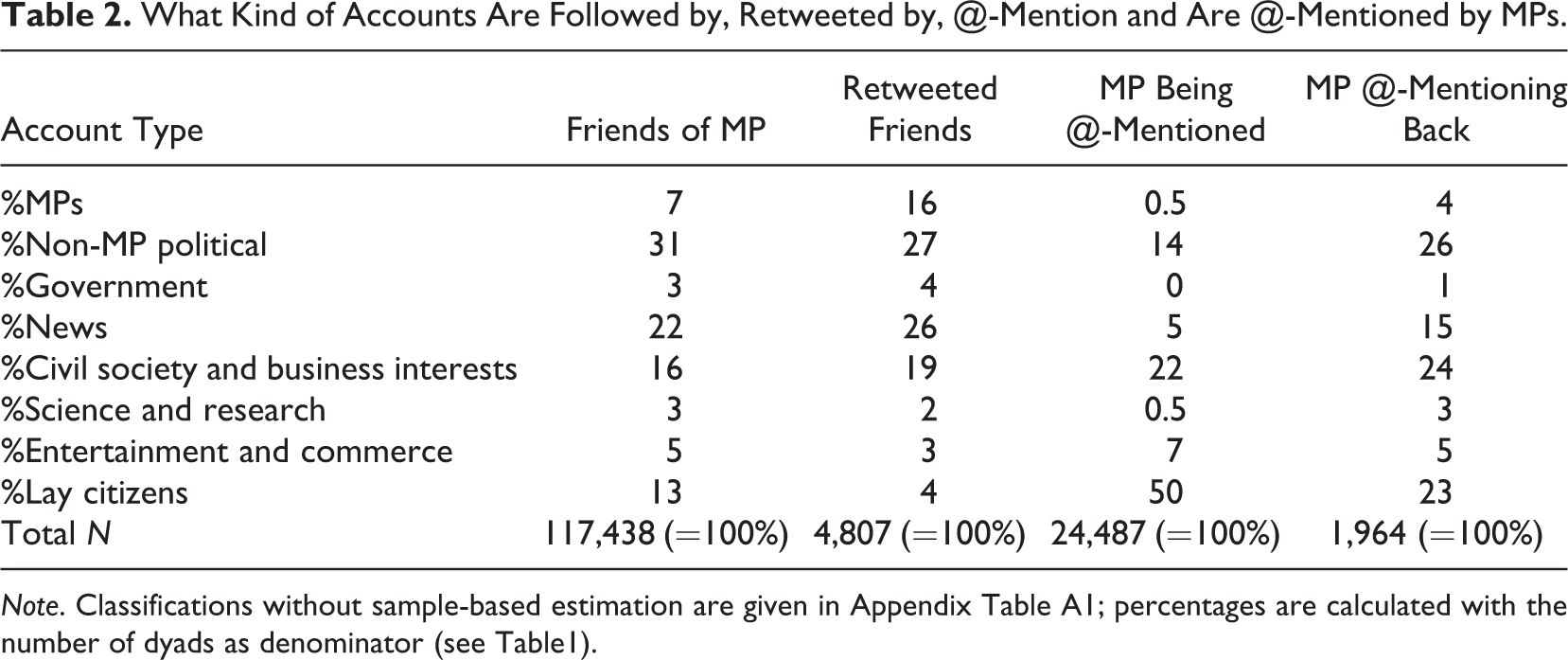
Note. Classifications without sample-based estimation are given in Appendix Table A1; percentages are calculated with the number of dyads as denominator (see Table 1).
Accounts that @-mention MPs include a large share of lay citizen accounts: 50%, or over 12,000 @-mention relations. Yet few also receive @-mentions from these MPs. Of the 1,964 returned @-mentions, only 23% are to lay citizens. This means that of the lay citizens, @-mentioning an MP only a mere 4% is @-mentioned by that MP (0.23 × 1,964)/(0.50 × 24,487). This is in stark contrast with lay citizens actually asking for the attention of politicians on Twitter. Relatively speaking, MPs have far more reciprocal @-mention relations with their colleagues, other political accounts, media, and organized interests.
Differences between MPs
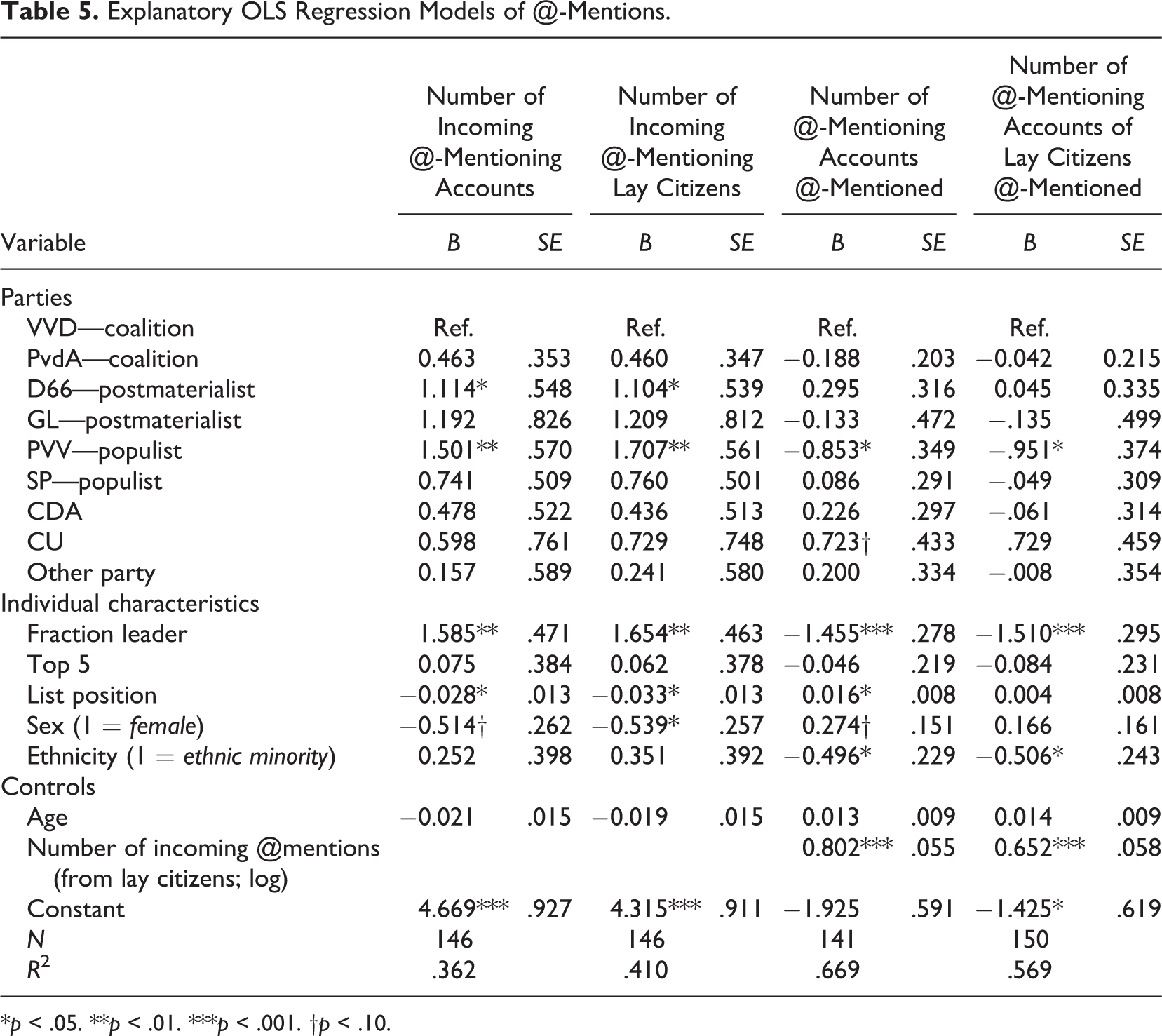
In this section, we explore how MPs differ regarding their connection and engagement behavior (Research Questions 2a and 2b). Table 3 presents the summary statistics disaggregated by party, while Tables 4 and 5 show the explanatory models. As the engagement models in those tables (Models 4.3, 4.4, 5.3, and 5.4) include the respective connection measurement as a control, the other coefficients should be read as relative engagement. 29
Summary Statistics of MPs’ Friends, Retweeted Friends, Being @-Mentioned, and Reciprocal @-Mentions per Party.
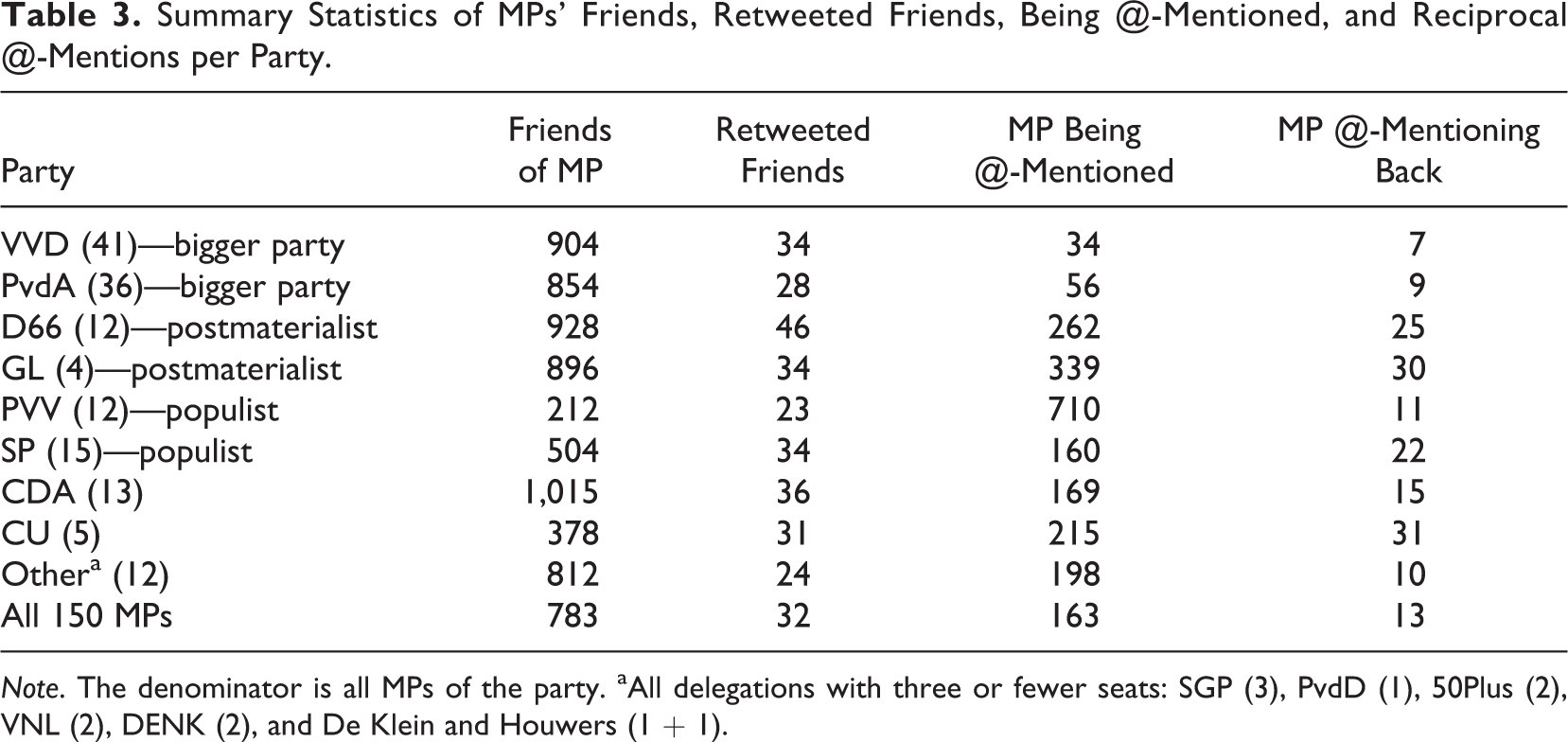
Note. The denominator is all MPs of the party. aAll delegations with three or fewer seats: SGP (3), PvdD (1), 50Plus (2), VNL (2), DENK (2), and De Klein and Houwers (1 + 1).
Explanatory OLS Regression Models of Number of Friends and Retweets.
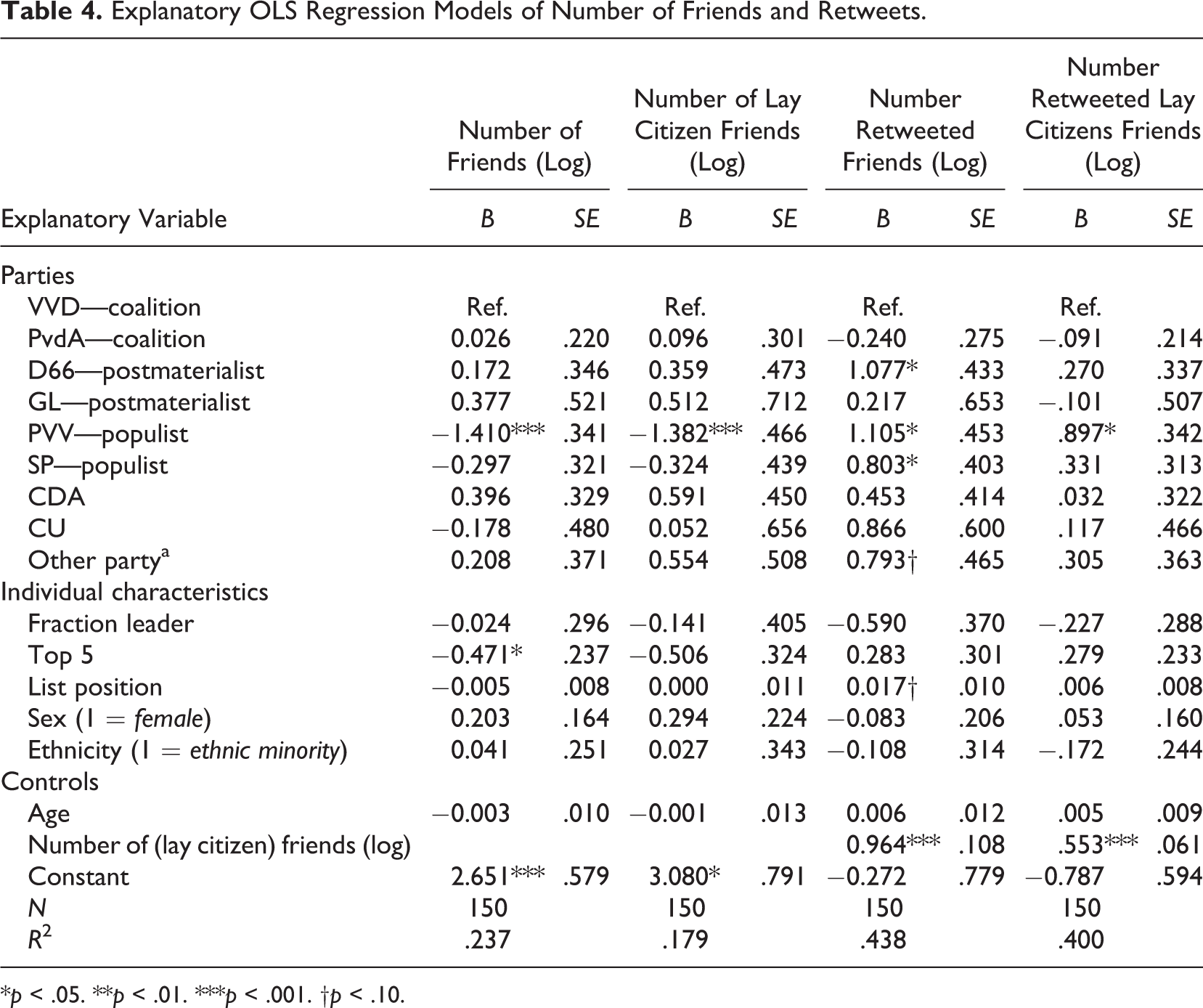
*p < .05. **p < .01. ***p < .001. †p < .10.
Explanatory OLS Regression Models of @-Mentions.
*p < .05. **p < .01. ***p < .001. †p < .10.
Turning to the differences between parties, Table 3 shows that MPs from both government parties (PvdA and VVD) have a number of friends and retweet behavior similar to other parties; however, they are @-mentioned less. How to explain this? One might suggest this is related to them being government coalition parties. However, as Table 5 shows, the lower averages are in fact an artifact of these two parties being biggest and having a high number of less known MPs (i.e., these parties have more MPs and therefore more MPs with higher list positions; the party differences in the regression models are controlled for this). 30
Overall, in Table 3, the MPs of the populist radical right PVV stand out: They befriend least people but get @-mentioned most. Also, the two postmaterialist parties, D66 and GroenLinks, seem somewhat more connected and engaging on Twitter than the two biggest parties, but it remains to be seen if these fairly limited differences hold in regression analyses.
Tables 4 and 5 zoom in on connections and engagement with lay citizens and include both party and individual characteristics as possible explanations. Regarding party differences, they broadly confirm the patterns discussed above. After controlling for list position (and therewith that bigger parties have more MPs in parliament and more backbenchers who have the highest list position scores), the biggest parties do not significantly differ from the smaller parties, except the MPs from populist and the some extent the postmaterialist parties. The populist MPs follow fewer accounts and (consequently) fewer accounts of lay citizens. However, the ones that they do follow are more likely to be retweeted. 31 Further corroboration for this, particularly for the PVV, comes from Table 5, showing that populist MPs get @-mentioned more often by lay citizens (and other accounts) but reply to fewer of these @-mentions.
The differences between the two postmaterialist parties and the biggest parties are a bit more nuanced in the multivariate analysis. Most importantly, D66 MPs retweet more accounts (Model 4.3) but not of lay citizens (Model 4.4). Table 5 adds that postmaterialist MPs get @-mentioned by more accounts and by lay citizens than the MPs of other parties (except PVV; Models 5.1–5.2) and consequently @-mention back more, though not disproportionally so (Models 5.3–5.4). 32 This may reflect that both postmaterialist parties in the Netherlands still have more Twitter-savvy electorates than the biggest parties, while the biggest parties nowadays are on par with them regarding engagement ratios (Gibson & McAllister, 2014; Jacobs & Spierings, 2016).
Regarding the individual-level characteristics, MPs’ position within the party hierarchy seems most important. As expected, MPs who are leaders of their parliamentary faction are @-mentioned by lay citizens most (Model 5.2), but relatively speaking, they are less likely to return @-mentions. They also seem to retweet friends relatively less, but the rather substantial coefficient is only just below conventional levels of significance. MPs with higher list positions show the reverse pattern: They are @-mentioned by fewer account and lay citizens (Models 5.1–5.2), but those that do @-mention them are more likely to be @-mentioned by the MPs too. A similar (though weaker) pattern was found for retweeting friends (Model 4.3). However, these relative engaging responses were not found when the @-mention or friend involved a lay citizen (Models 4.4 and 5.4).
Finally, regarding underrepresented groups, we find no clear-cut effects regarding friends and retweets, but it seems that, ceteris paribus, female MPs get @-mentioned by fewer lay citizens. Ethnic-minority MPs get @-mentioned by more accounts, 33 but they significantly engage less with those @-mentioning accounts. Some literature suggests they prefer face-to-face contact and the more personal Facebook to communicate with their electorate (Jacobs & Spierings, 2016, p. 121). Additionally, the @-mentions here might include substantial numbers of inflammatory tweets, given the recent heated debates on ethnicity in the Netherlands.
Conclusion
Politicians use social media to inform public opinion (Jungherr, 2016), but public opinion on social media also informs politicians. Social mendia are a means to “tap” information flows and “track” and “monitor” the public’s sentiment (Chadwick, 2013, p. 157).
In this study, we examined to what extent MPs established connections and engage on Twitter, particularly with lay citizens. We adopted a Dahlian perspective and examined who has access to politicians. Moreover, we focus on an in-between elections period, when politicians might be less in a broadcasting-style use and be more receptive toward lay citizens. This was hardly the case. MPs mainly connect with elite accounts (other politicians, media, and established organizations), even though citizens do try to draw the attention by @-mentioning MPs (cf. Research Question 1a). These attempts mainly fall on deaf ears: Lay citizens followed by MPs get retweeted less than elite accounts and their @-mentions are less reciprocated too (cf. Research Question 1b). Thus, while Twitter potentially gives access to new voices (“equalization”), the average MPs’ behavior is focused on the usual suspects (“normalization”). If Twitter is an indicator of public opinion to politicians, it is still heavily skewed toward what elite accounts say is public opinion—not “the public” itself.
We also looked at which politicians were more likely to connect and engage with lay citizens (cf. Research Questions 2a and 2b). Mainly, populists stood out in a negative way. They connected and engaged less with lay citizens, though they did retweet more of their limited number of friends. They appear to contribute to creating echo chambers rather than being interesting in broader public opinion and the public at large. Also, MPs of postmaterialist parties appear to connect and engage somewhat more than other parties. Within parties, backbenchers stood out: The MPs with higher list positions engaged with relatively more of the accounts that they connected with but not with those of lay citizens.
How do these results relate to existing studies in the field? As mentioned in the introduction, most studies focus on interaction, so we focus on that part of our study here. Like in our study, they find that MPs mainly, though not exclusively, use Twitter as a “broadcasting tool” (Ahmed, Jaidka, & Cho, 2016, p. 1079; Arnaboldi, Passarella, Conti, & Dunbar, 2017, p. 243; Frame & Brachotte, 2015, p. 282; see Jungherr, 2016 for an overview). Furthermore, these studies have also found that there is still some interaction taking place (Frame & Brachotte, 2015; Tromble, 2016a), especially in the early days of Twitter (Graham, Jackson, & Broersma, 2016, p. 774) and especially when the incoming @-mentions are positive and when the MP’s party is not populist (Tromble, 2016a). Regarding the latter, we also show that the lower degree of interaction by MPs of populist parties still holds now Twitter is far more widespread then several elections ago (cf. Tromble, 2016a). Like in our study, these researchers also note that most interaction takes place between MPs and accounts that do not belong to lay citizens (Ahmed et al., 2016; Frame & Brachotte, 2015; Tromble, 2016b; but see: Graham, Jackson & Broersma, 2016, p. 775). 34 Our study thus confirms and updates existing insights and additionally highlights that the position an MP has within a party seems to matter as well: The more an MP is a backbencher, the more she is likely to interaction with accounts of lay citizens. Moreover, we showed that MPs of postmaterialist parties are contacted more, leading to more interaction. In short, beyond our results on connection and engagement with different groups of users, our results regarding interaction are in line with and complementary to those found in other studies.
While this lends credence to our overall findings, these are certainly not definitive. At least three venues may be promising for future research. First, other approaches might further deepen our findings. Given our Dahlian perspective, we focused on who was connected to and engaged with. Future content analyses might help to show what types of messages are retweeted by MPs and which ones they respond to. Similarly, in-depth interviews with MPs could yield useful insights in how they see and deal with Twitter in-between elections. Second, future studies should check to what extent our findings hold in other political systems. In the Dutch proportional electoral system, MPs do not perform constituency services. In majoritarian political systems, direct contact is especially important (Kreppel, 2011, p. 125). Consequently, MPs might connect and engage with their district’s lay citizens more (cf. Lassen & Brown, 2010; Tromble, 2016a). Third, the patterns we revealed for populist MPs deserve more attention, particularly in times of a contagious populism zeitgeist (Rooduijn, De Lange, & Van Der Brug, 2014). Why do they not connect to “the” people but to “their” people? And what are the differences between left and radical right populist MPs? Each of these venues for future research might help us understand why politicians let pass the opportunities Twitter offers to connect and engage with the direct source of public opinion: the public.
Footnotes
Appendix
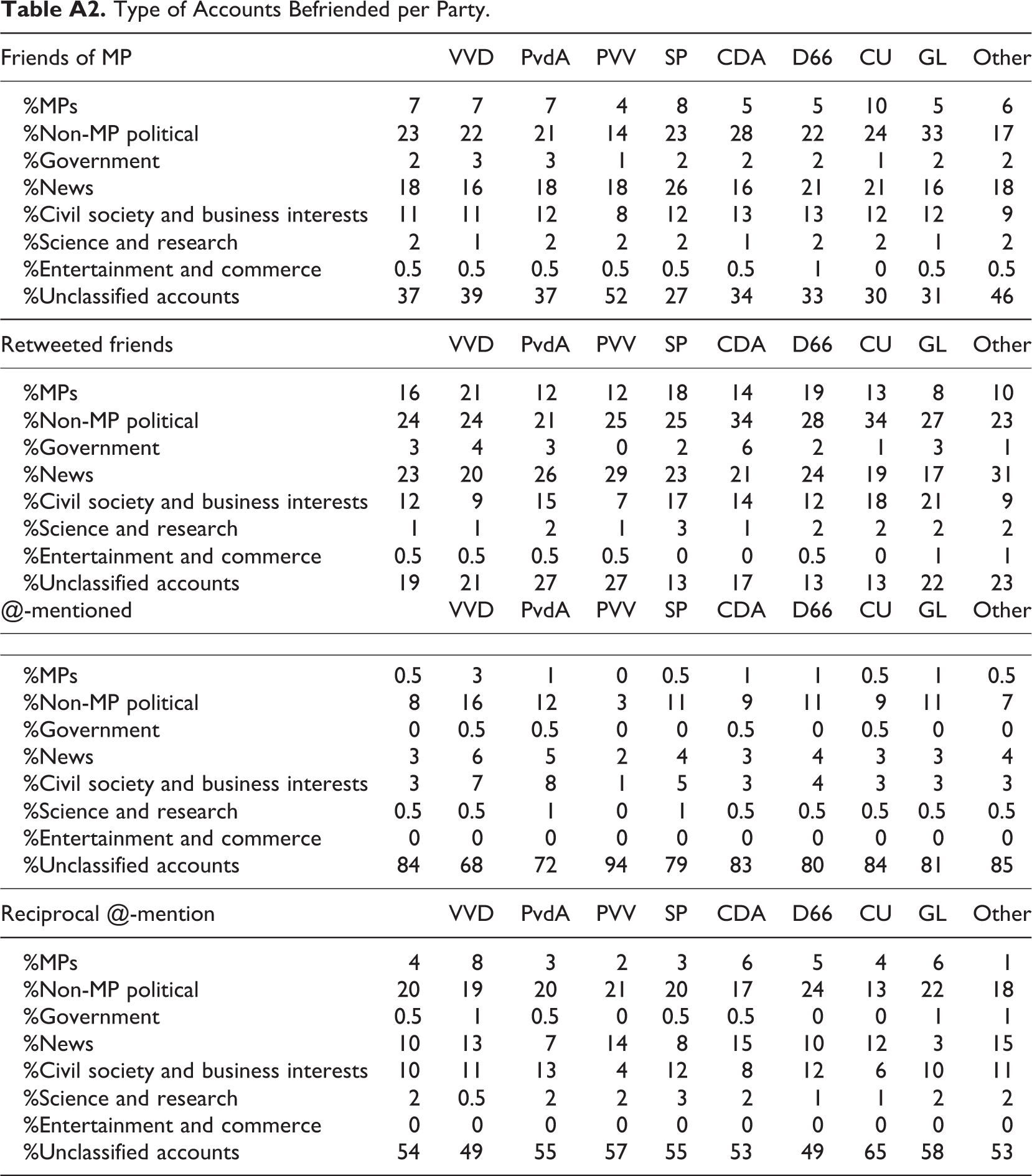
Type of Accounts Befriended per Party.
| Friends of MP | VVD | PvdA | PVV | SP | CDA | D66 | CU | GL | Other | |
| %MPs | 7 | 7 | 7 | 4 | 8 | 5 | 5 | 10 | 5 | 6 |
| %Non-MP political | 23 | 22 | 21 | 14 | 23 | 28 | 22 | 24 | 33 | 17 |
| %Government | 2 | 3 | 3 | 1 | 2 | 2 | 2 | 1 | 2 | 2 |
| %News | 18 | 16 | 18 | 18 | 26 | 16 | 21 | 21 | 16 | 18 |
| %Civil society and business interests | 11 | 11 | 12 | 8 | 12 | 13 | 13 | 12 | 12 | 9 |
| %Science and research | 2 | 1 | 2 | 2 | 2 | 1 | 2 | 2 | 1 | 2 |
| %Entertainment and commerce | 0.5 | 0.5 | 0.5 | 0.5 | 0.5 | 0.5 | 1 | 0 | 0.5 | 0.5 |
| %Unclassified accounts | 37 | 39 | 37 | 52 | 27 | 34 | 33 | 30 | 31 | 46 |
| Retweeted friends | VVD | PvdA | PVV | SP | CDA | D66 | CU | GL | Other | |
| %MPs | 16 | 21 | 12 | 12 | 18 | 14 | 19 | 13 | 8 | 10 |
| %Non-MP political | 24 | 24 | 21 | 25 | 25 | 34 | 28 | 34 | 27 | 23 |
| %Government | 3 | 4 | 3 | 0 | 2 | 6 | 2 | 1 | 3 | 1 |
| %News | 23 | 20 | 26 | 29 | 23 | 21 | 24 | 19 | 17 | 31 |
| %Civil society and business interests | 12 | 9 | 15 | 7 | 17 | 14 | 12 | 18 | 21 | 9 |
| %Science and research | 1 | 1 | 2 | 1 | 3 | 1 | 2 | 2 | 2 | 2 |
| %Entertainment and commerce | 0.5 | 0.5 | 0.5 | 0.5 | 0 | 0 | 0.5 | 0 | 1 | 1 |
| %Unclassified accounts | 19 | 21 | 27 | 27 | 13 | 17 | 13 | 13 | 22 | 23 |
| @-mentioned | VVD | PvdA | PVV | SP | CDA | D66 | CU | GL | Other | |
| %MPs | 0.5 | 3 | 1 | 0 | 0.5 | 1 | 1 | 0.5 | 1 | 0.5 |
| %Non-MP political | 8 | 16 | 12 | 3 | 11 | 9 | 11 | 9 | 11 | 7 |
| %Government | 0 | 0.5 | 0.5 | 0 | 0 | 0.5 | 0 | 0.5 | 0 | 0 |
| %News | 3 | 6 | 5 | 2 | 4 | 3 | 4 | 3 | 3 | 4 |
| %Civil society and business interests | 3 | 7 | 8 | 1 | 5 | 3 | 4 | 3 | 3 | 3 |
| %Science and research | 0.5 | 0.5 | 1 | 0 | 1 | 0.5 | 0.5 | 0.5 | 0.5 | 0.5 |
| %Entertainment and commerce | 0 | 0 | 0 | 0 | 0 | 0 | 0 | 0 | 0 | 0 |
| %Unclassified accounts | 84 | 68 | 72 | 94 | 79 | 83 | 80 | 84 | 81 | 85 |
| Reciprocal @-mention | VVD | PvdA | PVV | SP | CDA | D66 | CU | GL | Other | |
| %MPs | 4 | 8 | 3 | 2 | 3 | 6 | 5 | 4 | 6 | 1 |
| %Non-MP political | 20 | 19 | 20 | 21 | 20 | 17 | 24 | 13 | 22 | 18 |
| %Government | 0.5 | 1 | 0.5 | 0 | 0.5 | 0.5 | 0 | 0 | 1 | 1 |
| %News | 10 | 13 | 7 | 14 | 8 | 15 | 10 | 12 | 3 | 15 |
| %Civil society and business interests | 10 | 11 | 13 | 4 | 12 | 8 | 12 | 6 | 10 | 11 |
| %Science and research | 2 | 0.5 | 2 | 2 | 3 | 2 | 1 | 1 | 2 | 2 |
| %Entertainment and commerce | 0 | 0 | 0 | 0 | 0 | 0 | 0 | 0 | 0 | 0 |
| %Unclassified accounts | 54 | 49 | 55 | 57 | 55 | 53 | 49 | 65 | 58 | 53 |
Authors’ Note
As described in more detail in Notes 11, 23, and 24, the Twitter data, additional information on MPs, hand-coded samples, and the account lists per category as well as the code used for automatically identifying other accounts into these categories can be obtained from the authors.
Declaration of Conflicting Interests
The authors declared no potential conflicts of interest with respect to the research, authorship, and/or publication of this article.
Funding
The authors received no financial support for the research, authorship, and/or publication of this article.