




Abstract
This study examined the efficiency of the health belief model in understanding preventive behaviors of pregnant women in Iran. A cross-sectional descriptive-analytical methodology study was conducted of pregnant women who were referred to a healthcare center in 2021. The data were the responses to a questionnaire designed for this study. The data were analyzed with SPSS 24 software, Amos 22 software, correlation tests, regression analysis, and independent t tests. In terms of the health belief model, pregnant women with high perceived susceptibility showed the highest vaccination rate, while those with high perceived barriers had the lowest. The model predicted 20% variance in the preventive behavior from COVID-19, with perceived susceptibility and cues to action being the strongest and weakest predictors of behavior, respectively. The conclusion of the study was that the health belief model was an appropriate model to guide the care of pregnant women.
While the elderly and persons with multiple comorbidities have been groups that account for most of the severe morbidity and deaths associated with having COVID-19, pregnant women have also been at increased risk and deserve research attention. The speed of the spread of COVID-19 in March 2020 was such that the World Health Organization declared it a global pandemic (Rasmussen et al., 2020). The first cases reported in Iran were in February of that year. The coronavirus is a family of very contagious viruses that trigger a range of symptoms, leading to severe illness and death for some. While older adults were the most vulnerable group of severe infection and death worldwide, pregnant women and their fetuses were also at increased risk.
Due to physiological changes in the immune and cardiopulmonary systems during pregnancy, which include reduce inflammatory responses to prevent fetal rejection, pregnant mothers are more prone to infectious and other diseases than women of the same age who are not pregnant (Liu et al., 2018). For this reason, there are serious concerns regarding the consequences of COVID-19 for pregnant women (Poon et al., 2020). For example, viral infection during the second and third trimesters of pregnancy is associated with an increased risk of cardiac and pulmonary complications. Liu and colleagues (2020) reported increased rates of preterm delivery, emergency cesarean section, acute respiratory syndrome, and hospitalization in the intensive care unit in China during the peak of the pandemic.
In pregnancy, as with most other groups, viral pneumonias are responsible for much of the severe illness from COVID-19 infections (Hantoushzadeh et al., 2020). Maternal pneumonia is typically associated with increased risk of premature rupture of membranes, preterm delivery, loss of intrauterine fetus, intrauterine growth restriction, and infant death (Schwartz & Graham, 2020). Hence, pregnant women and newborns should be prioritized in COVID-19 prevention strategies. Choosing the right model for teaching preventive behaviors is therefore an important consideration.
The health belief model (HBM; Rosenstock, 1974) is a widely used model in primary care in various countries. The HBM suggests that a person’s perception is critical to the motivation to adopt preventive behaviors. Accordingly, persons are more likely to adopt preventive behaviors the more that they feel threatened by a health risk. The model applied to COVID-19 suggests that persons who perceive themselves to be susceptible are more likely to act to prevent exposure and severe illness, which is described in the model as perceived severity. In addition, behavior recommendations are more likely to be adopted by a person who perceives the benefits to adopting them and faces minimal perceived barriers to doing so. A positive judgment about one’s ability to adopt preventive behaviors (self-efficacy) also facilitates their adoption (Movahed et al., 2014). Given the limited studies dealing with the impact of COVID-19 on pregnant women in Iran, this study was conducted to examine the ability of the HBM constructs to predict and promote the effective preventive behaviors of COVID-19 in pregnant Iranian women.
Method
A cross sectional descriptive-analytical study was conducted with 200 pregnant women who were referred to the healthcare centers in Ahvaz, Iran, in 2021. Seven of the 15 comprehensive healthcare centers that make up the West Health Care Center of Ahvaz were randomly selected for this study. Out of 1220 pregnant women from these centers, 686 fit the inclusion criteria; of these, 165 were excluded because they had chronic disease, and 101 were excluded due to a history of COVID-19. Of the 420 remaining ones, 200 who met the inclusion criteria were included in the study.
A questionnaire developed by the researcher team was used. It consisted of three sections. In the first part were 6 demographic questions (age, education, employment status, gestational age, vaccine injection status, and reason for not being vaccinated), followed by 12 knowledge items and then items addressing the concepts in the HBM (perceived susceptibility, severity, barriers, and benefits), as well as 7 items measuring self-efficacy. The HBM items were based on a Likert scale from 1 to 5: strongly agree, agree, have no opinion, disagree, and strongly disagree, respectively. The last 15 items addressed preventive behaviors.
To check the content validity (index and content validity), a panel of experts in the fields of health education and promotion, infectious diseases, and gynecology reviewed and modified the questionnaire. A pilot study was done to evaluate the reliability of the questionnaire; it included 30 pregnant women. Cronbach’s alpha of the model structures turned out to be .7 for perceived susceptibility, .8 for perceived severity, .7 for benefits, .64 for barriers, 7 for guide for action, .81 for self-efficacy, and .84 for behavior. Since Cronbach’s alpha was >.6 in all the structures, the questionnaire was determined to have acceptable reliability.
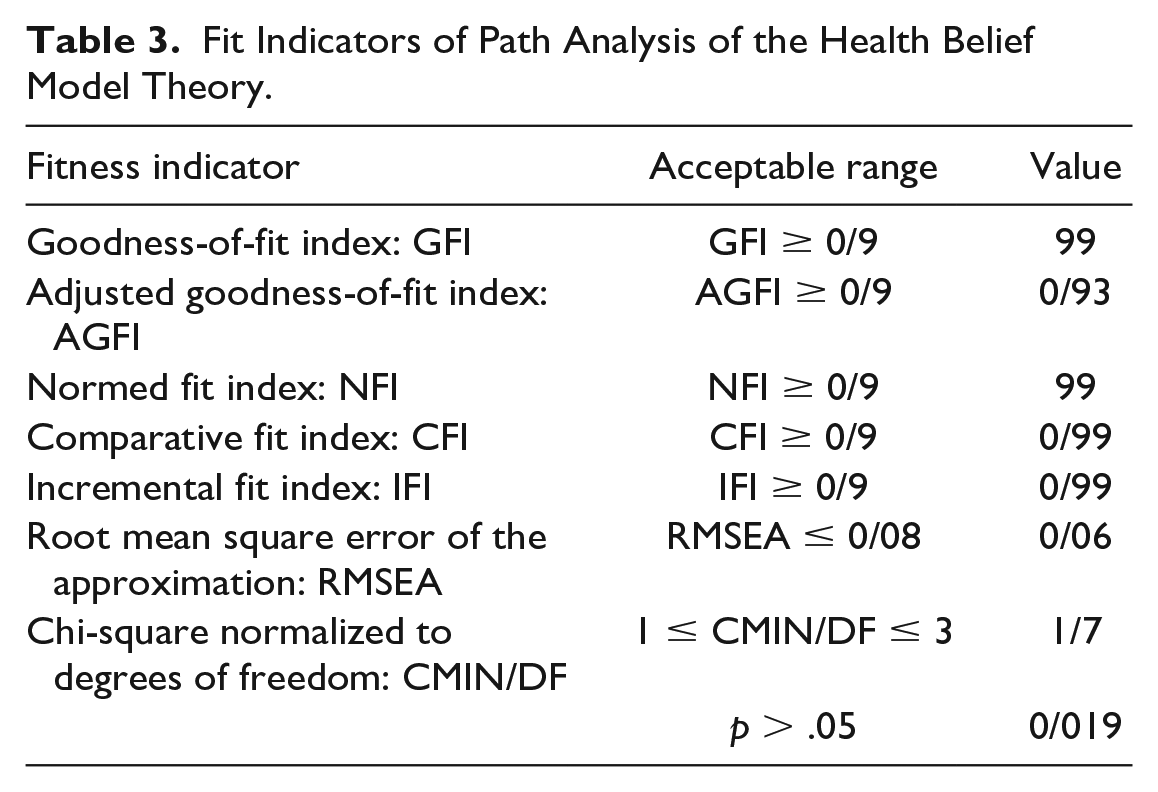
Because of the pandemic, the questionnaires were emailed to participants through virtual networks, and they were asked to complete them through the messaging network. The data were then analyzed by using structural equation modeling and SPSS 24 and Amos 22 software. Descriptive statistics and statistical tests were done, including chi-square and independent t tests and Pearson correlation coefficients. In the structural equation modeling method, there are several indicators to show the fit of the tested models. Of these indices, the main indicators of a fit model in path analysis are the coefficient of variance of the approximation error (root mean square error of approximation) with an acceptable value <.050, the ratio of chi-square to the degrees of freedom with an acceptable value ≤2, and the nonsignificance of the chi-square test (p > .05). Other indicators—indices such as goodness of fit, adjusted goodness of fit, adaptive fit, incremental fitness, and normalized fit—are between 0 and 1, and the closer they are to 1, the more efficient the model will be (Bai et al., 2010; Baji et al., 2020).
Results
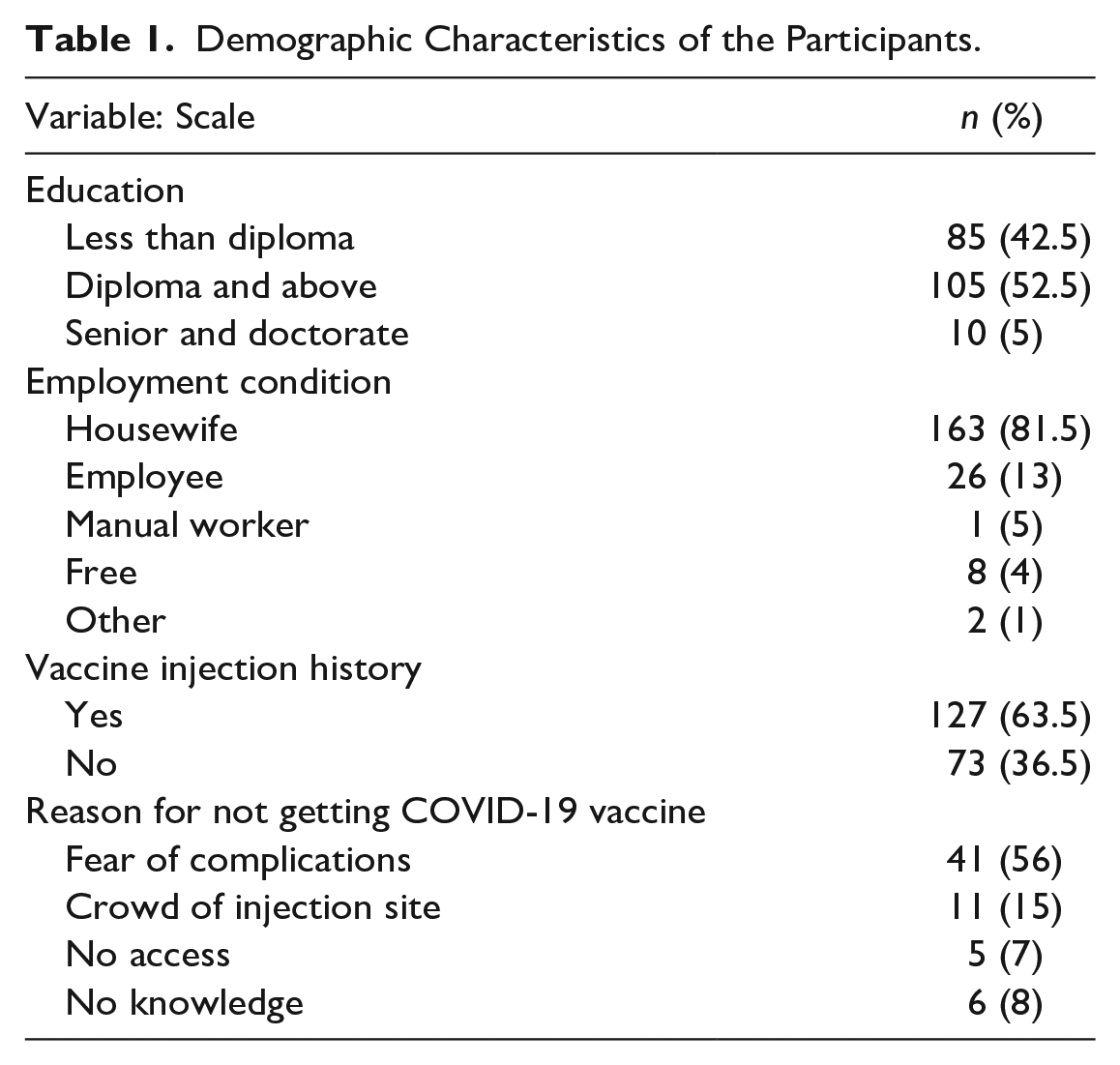
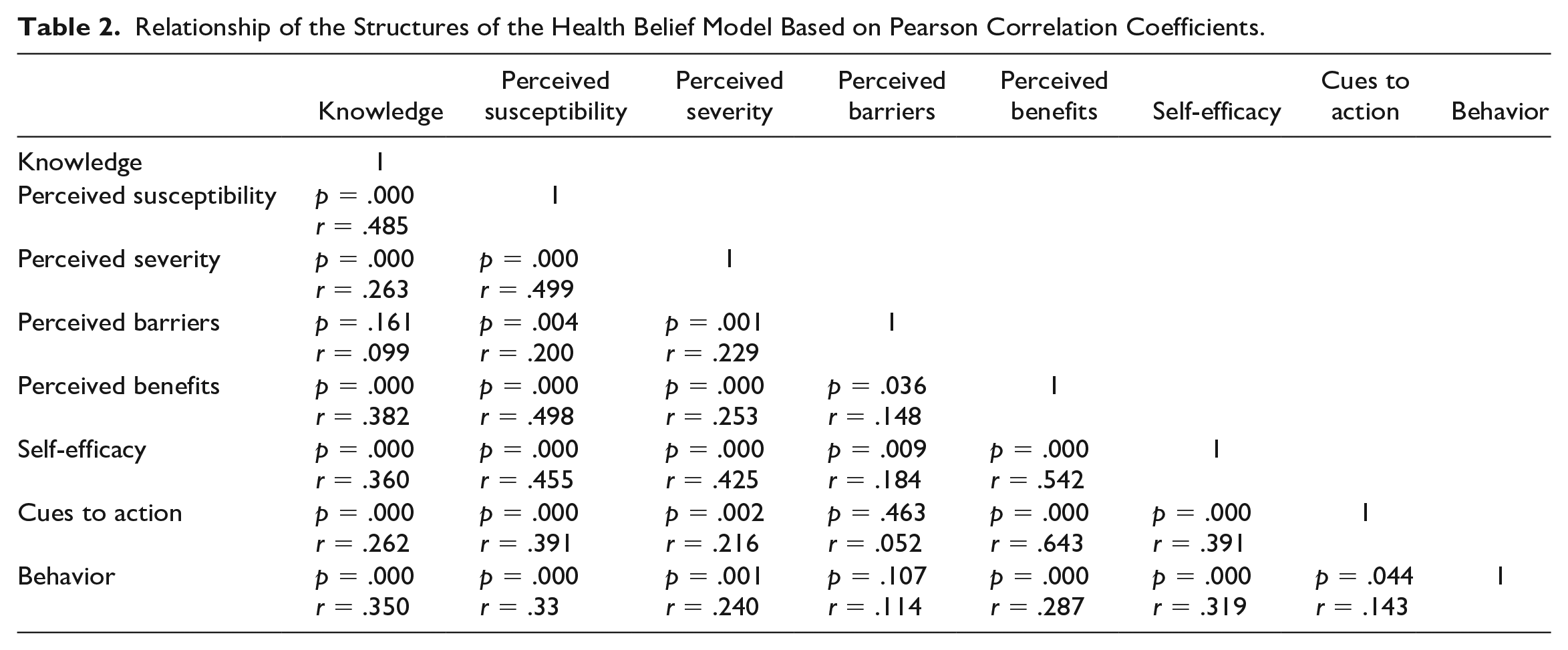
The average age of the participants was 28 years (range, 15-47; Table 1). The percentage of participants who received the COVID-19 vaccine was 63.5%; their average gestational age was 18 weeks at the time of their participation. Pearson correlation coefficient results indicated a significant correlation between behaviors to prevent contracting COVID-19 and components of the HBM (perceived susceptibility, perceived severity, perceived benefits, self-efficacy, and cues to action). Perceived susceptibility had the highest correlation with preventive behaviors (r = .393) and the lowest with barriers (r = .114; Table 2). The path analysis also revealed a positive and statistically relationship between the components of the HBM and preventive behaviors of pregnant women (Table 3).
Demographic Characteristics of the Participants.
Relationship of the Structures of the Health Belief Model Based on Pearson Correlation Coefficients.
Fit Indicators of Path Analysis of the Health Belief Model Theory.
The variance regarding behavior was 40% for perceived susceptibility, 25% for perceived severity, 14% for barriers, 29 for benefits, 33% for self-efficacy, and 13% for cues to actions. Notably, perceived susceptibility and cues to actions were the strongest and weakest predictors of behavior (figure).
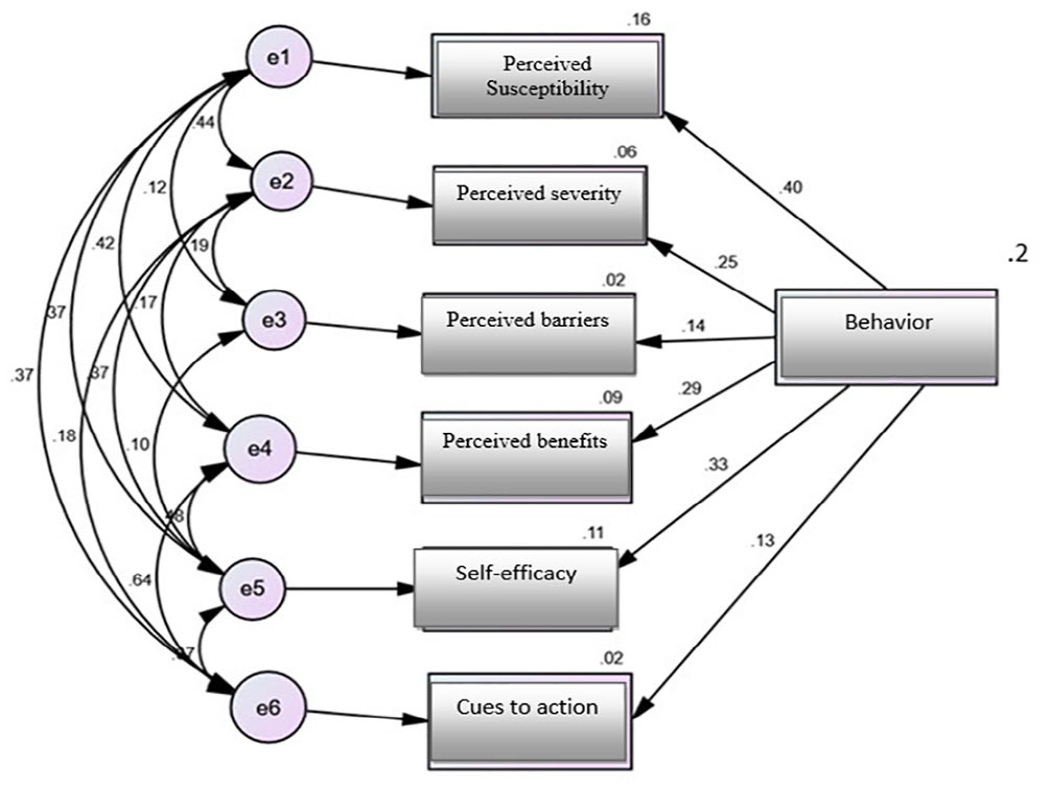
Conceptual Model of the Final CFI Structure.
Discussion
The purpose of this study was to identify the factors and components of the HBM that correlated with preventive behaviors related to COVID-19 in pregnant women in Ahvaz, Iran. The correlation coefficients demonstrated that the components of the HBM were significantly correlated with the preventive behaviors in the sample. Perceived susceptibility had the highest correlation (r = .393) and perceived barriers the weakest (r = .143). These results suggest that perceived susceptibility was the most significant factor related to the adoption of preventive behaviors in pregnant women. These findings were similar to what Khazaee-Pool and colleagues (2020) found. The study also suggests that cues to action were weak predictors of preventive behaviors.
According to the results, self-efficacy was the second strongest predictor of preventive behavior in the sample. This finding is consistent with that of Noghani and colleagues (2020), whose study included persons aged ≥15 years in Iran, as well as a study by Shahnazi and colleagues (2020) done in the Golestan province, in northeast Iran.
In this study, the HPM constructs predicted 20% of variance of preventive behaviors. Khazaee-Pool and colleagues (2020) reported a predicting value of 26% and showed self-efficacy as the strongest predictor as well, while Nasirzadeh and Aligol (2020) study of knowledge and attitudes predicted 18% of preventive behaviors. The current study showed that educational level—that is, people with an associate degree and higher—had significantly more knowledge than those with a diploma or less education. These results were consistent with the study of Farzaneh and colleagues (2020) on predictors of oral health status among pregnant women in Rafsanjan. Higher education not only increases people’s knowledge but also paves the way for obtaining information that is more accurate.
This study did find that pregnant women’s knowledge had a significant relationship with wearing a mask properly, attending gatherings, proper hand washing, physical distance, and proper ventilation. Last, the mean score of knowledge in pregnant women did show that knowledge was associated with preventive behavior, which was consistent with the results of other studies (Jose et al., 2021; Tadesse et al., 2020).
Conclusion
In general, the findings of the study confirmed the predictive role of the concepts based on the HBM of susceptibility, severity, benefits, and self-efficacy in the prevention behaviors of COVID-19 in pregnant women. Thus, it is recommended that efforts be made to modify these components by avoid further spread of the virus and its variants and reduce the burden of illness associated with it for vulnerable individuals, such as pregnant women. The limitations of this study include that the results were based on self-reported measures and online recruitment and participation.
Footnotes
Declaration of Conflicting Interests
The authors declared no potential conflicts of interest with respect to the authorship and/or publication of this review.
Funding
The author(s) disclosed receipt of the following financial support for the research, authorship, and/or publication of this article: The authors express their wholehearted gratitude for their support of the Vice Chancellor of Research and Technology University, the Faculty of Health, the West Ahwaz Health Centers.
