



Abstract
Research on strategy as practice (SAP) has become a vibrant area of inquiry, but what do people actually do when engaging in strategizing in everyday situations? Drawing on insights from CCO scholarship and practice theory, this paper addresses that question by highlighting situational attunement as an important aspect of strategizing, which unfolds through communicative practices that make responsiveness to what a situation calls for observable, thereby bridging immediate conditions with evolving aims. Situational attunement, in other words, involves sensing what matters in the moment and acting with others who are also shaping the evolving relational field. The value of this concept is illustrated through an ethnography of a female entrepreneur’s communicative practices in a small Icelandic village during and after the COVID-19 pandemic. Thus, this paper contributes to SAP scholarship and communication research on strategizing by clarifying how a key aspect of strategizing is accomplished in and through communication, showing that situational attunement becomes empirically observable through communicative practices, and specifying two interwoven dimensions of this process (relational sensing and practical reasoning).
Keywords
Kashigi Yabushige: “[How does it feel] to shape the wind to your will[?]”
Yoshii Toranaga: “I don’t control the wind. I only study it.”
(Clavell, Kondo, & Marks, 2024)
Volumes have been written on what it takes to be(come) a great organizational strategist (e.g., Hinterhuber & Popp, 1992). Yet few pages have been dedicated to the fact that, as a practice, strategizing requires “studying the wind,” to paraphrase the words of Yoshii Toranaga in the 2024 Shōgun television miniseries; that is, sensing what a situation or “field of relation” (Massumi, 2015, p. 200) calls for, responding in real time to shifting conditions, and participating communicatively in the actualization of what is potential. More specifically, conventional perspectives of strategy often obscure how policy and tactical action are mediated in situ (Kornberger & Engberg-Pedersen, 2021; Kornberger & Vaara, 2022).
To understand better how this mediation happens in everyday interactions, this paper proposes situational attunement, a concept that extends Martin Kornberger and colleagues’ work by regarding strategizing as a bridge between immediate conditions and evolving aims (Kornberger, 2013; Kornberger & Engberg-Pedersen, 2021; Kornberger & Vaara, 2022). We offer this concept as a way to theorize the role of the situation in strategy as practice (SAP) scholarship. While partially recognized in this literature, the importance of the situation in which strategizing unfolds remains under-conceptualized and tends to be equated with the concepts of context or location, neglecting both its relational and dynamic dimensions. To deepen research on the role of the situation in strategizing, we build on a communication-centered view of SAP, which regards strategizing as a communicative accomplishment (Cooren et al., 2015). Our concept of situational attunement highlights how, in moments of strategizing, communicative practices—understood as situated actions through which meaning and coordination take shape in interaction—express responsiveness to what a situation seems to demand. Situational attunement does not characterize all moments of action. It tends to emerge when the demands of a situation intensify and call for a heightened responsiveness. Through these practices, actors adjust, improvise, engage, and compose with the situation as it takes shape. As we’ll show, these practices can be analytically understood along two interwoven dimensions: relational sensing and practical reasoning. In turn, even more diffuse aspects such as atmosphere or affect become empirically accessible through their manifestations in interaction. Thus, in this paper, we posit that situational attunement is a central aspect of strategizing and examine its consequences in practice. Our concept emerged abductively from our ethnographic research (see Tracy, 2020) and can be articulated through the metaphor of “composing with the wind.”
As the guest editors of this special issue note, SAP research has often examined communication as the discursive negotiation of meaning, while giving less attention to how strategizing unfolds in communication and how these situated dynamics connect to broader strategic aims (Asmuß et al., 2024). Heeding this call, we propose to advance research on strategizing by showing how the ongoing enactment of coherence between what’s emerging and what matters is vital for the continuation and direction of action. This enactment occurs in relation with human and more-than-human forces shaping situations as they unfold. Drawing on insights from practice theory (Rouleau, 2022; Rouleau & Cloutier, 2022), American pragmatist-inspired research on the communicative constitution of organizations (CCO; Brummans, 2006; Brummans et al., 2014, 2024; Cooren, forthcoming; Cooren et al., 2024a), and related work on attunement (Ash & Gallacher, 2015; Jørgensen & Beyes, 2023; Knight et al., 2024), we show that strategizing emerges through attuned participation in the becoming of a situation, not simply through planning or intention (see also Chia & Rasche, 2025). This attuned participation involves an embodied sensitivity to what is emerging, including the atmospheric conditions that shape what becomes strategically possible (Jørgensen & Beyes, 2023).
Our paper draws on a longitudinal ethnographic study of a female entrepreneur in Vík í Mýrdal, the southernmost village of Iceland, conducted during and after the COVID-19 pandemic. While our ethnography centers on an entrepreneur, we regard the actions in which she engages as a form of strategizing—a recurrent pattern of actions aimed at shaping the trajectory of a venture in consequential ways (Seidl et al., 2024), and an expression of a situated, relational practice of attunement. Rather than framing strategizing as the outcome of individual, rational analysis of the environment and decision-making, we trace how it took shape as a communicative accomplishment, that is, social, embodied, and emergent, unfolding with human and more-than-human forces. Our data include observations (or rather “witnessings”), interviews, artifacts, and journal entries, which we engaged with abductively, iteratively refining our conceptual understanding in response to what the ethnographic field revealed (Tracy, 2020).
Across three vignettes, we trace how the entrepreneur navigated the social, spatial, and temporal challenges of building a business in a tightly knit community—a place she first entered as an outsider. Her sensitivity and responsiveness to local rhythms, unspoken norms, relational tensions, and environmental shifts reveal situational attunement as a quiet yet consequential aspect of strategizing. In closing, we discuss the implications of our work for SAP research and communication scholarship on strategizing, as well as its methodological and practical contributions, particularly in terms of attention to the knowledgeable dimension of practice and how actors learn what to do in unfolding situations.
Strategizing as Situational Attunement
Revisiting the Concepts of Practice and Strategy in SAP Research
The concept of practice has long grounded SAP scholarship, offering a way to move beyond macro-level theories of strategy and attend more closely to what people actually do when engaging in strategizing (Jarzabkowski et al., 2025). Yet despite the field’s richness, questions remain about how fully it has taken up the foundational implications of practice as a concept, and how clearly the strategic character of such practice is understood. As some practice theorists point out, the concept of practice goes beyond mere sayings and doings (Nicolini & Monteiro, 2016): these are only the starting point of the study of any practice. Indeed, in their comprehensive review, Linda Rouleau and Charlotte Cloutier (2022) suggest that much of SAP research still operates from a “weak” practice perspective, one that focuses empirically on the actions of actors rather than conceptually on practice as a situated and relational phenomenon. Throughout this paper, we follow their distinction by using practice to refer to the relational mode through which strategy emerges, and practices to denote the observable actions through which that emergence becomes recognizable in interaction. This distinction foregrounds the collective, unfolding nature of strategizing and clarifies how local actions, as they take shape in interaction, draw upon and reshape the broader practice.
Rouleau and Cloutier urge scholars to return to the core insight that strategy is accomplished through the ongoing enactment of practices. This means shifting the unit of analysis away from individual actors and toward the unfolding of practice itself. As they put it, “taking social practice seriously invites researchers to decenter their focus on strategists…and what they do… and focus instead on the practices themselves” (p. 729). Practices, in this view, aren’t simply the result of conscious, meaningful action; they emerge within “larger networks of relationships in which multiple practices are embedded in one another” (p. 729; see also Nicolini, 2012; Schatzki, 1996). While Jarzabkowski et al. (2021) suggest that strategizing can be understood in terms of what’s consequential (which concrete actions are seen to have strategic effects), Rouleau and Cloutier call for greater attention to what’s knowledgeable: the situated, often tacit, practical knowledge that underpins and guides those actions. Importantly, Rouleau and Cloutier distinguish between asking what people do (the surface of practice) and exploring why and how they act in context (the forms of knowing-in-practice that guide how strategic possibilities take shape). From this perspective, strategizing becomes a social and relational accomplishment, even when viewed through the lens of a single practitioner. Fully relational accounts, however, remain relatively rare in SAP scholarship, despite emerging contributions from CCO scholars (e.g., Bencherki et al., 2021; Cooren et al., 2015; Vásquez et al., 2018). This relational, communicative view aligns with Silvia Gherardi’s (2022) conception of practice as knowledgeable doing, where action is shaped by embodied, situated forms of practical reasoning. Gherardi’s work also echoes Robert Chia and Andreas Rasche’s (2025) dwelling worldview, where mundane coping activities are key as strategic action unfolds (see also Chia & Holt, 2006).
Focusing on knowledgeability invites reflection on what makes an activity strategic beyond the notion of consequentiality, an inquiry that can broaden SAP (Seidl et al., 2024). It also draws attention to what happens in ordinary actions and circumstances, which still tends to be overlooked in much of SAP research (Chia & Rasche, 2025), and to what unfolds in situ as strategizing takes shape. As Rouleau and Cloutier emphasize, it’s “the situatedness of local practices that constitutes an accomplished instance of strategizing” (p. 729, emphasis added). Yet, while the role of the situation has been acknowledged since the early development of SAP scholarship through a reference to adjacent concepts (situatedness, situated practice, in situ study), its contours and effects remain underdeveloped.
We argue that situational attunement brings into focus how strategizing emerges through responsiveness to a relational field as it takes shape in interaction, bridging immediate conditions with evolving aims. In doing so, it offers a way to conceptualize the role of the situation in SAP more precisely, emphasizing its relational and dynamic character. By attending more closely to the dynamics that constitute a situation as a relational field (Massumi, 2015), and to how actors attune to those dynamics, we can deepen SAP scholarship’s practice-theoretical foundations and our understanding of how strategy is performed in practice. Finally, as we’ll show in the next section, a constitutive approach to communication—particularly one aligned with the Montréal School of CCO research (Brummans, 2006)—is well suited to attend more closely to how strategizing emerges in interaction and often involves enacting coherence with what the situation demands.
Situational Attunement: A Central Aspect of Strategizing as Communicative Accomplishment
Building on emerging communication-centered approaches within SAP, we conceptualize situational attunement as a communicative accomplishment by drawing on insights from Montréal School CCO research, particularly its American pragmatist current (Brummans, 2006; Brummans et al., 2014, 2024; Cooren, forthcoming; Cooren et al., 2024a). SAP research has already started to build on insights from this stream of scholarship (e.g., Aggerholm & Asmuß, 2016; Asmuß & Oshima, 2018; Bencherki et al., 2019; Bencherki et al., 2021; Cooren et al., 2015; Nathues et al., 2023; Spee & Jarzabkowski, 2011; Vásquez et al., 2018). Both traditions invite us to see action as emergent; that is, not initiated by individual agents, but unfolding in relation with others, with context, and with what a situation seems to call for. From this view, strategizing is less a matter of collecting and analyzing information, planning, and implementing than of engaging with unfolding tensions, shifts, and demands.
We suggest that in many instances, strategizing occurs through attunement to the immediate situation—its atmospheres, resistances, potentials. Seidl and colleagues (2024) emphasize that strategizing generates consequential effects through sensitivity, judgment, and receptivity, not detached reasoning. This observation echoes Mary Parker Follett’s (1925/2003) law of the situation, which suggests that action arises from specific present-moment conditions (see also Cooren et al., 2024a; Simpson & den Hond, 2022). These conditions must be felt, interpreted, and engaged with. Drawing on American pragmatism (Dewey, 1938/1993; Peirce, 1998), we thus understand a situation as a generative field of relation (Massumi, 2015), a site where humans, nonhumans, and meanings co-emerge in and through communication (Brummans, 2022; Brummans & Vézy, 2022). This field calls for inquiry, experimentation, and practical adjustment (see also Cooren, forthcoming).
Building on these insights, we propose situational attunement as a central aspect of strategizing that unfolds in and through communication. It involves attuning to a relational field as it forms and seeking to affect its trajectory. From a CCO perspective, communication constitutes sociomaterial reality, meaning that the embodied and affective dynamics involved in situational attunement do not stand outside communication but take form in and through it. In turn, situational attunement isn’t only cognitive or intentional, but embodied, social, and often tacit. It includes the ability to read atmospheres, sense hesitation, interpret affective tones, and adjust posture, rhythm, or phrasing accordingly (Ash & Gallacher, 2015; Jørgensen & Beyes, 2023; Knight et al., 2024). Such attunement tends to arise when the demands of a situation intensify and call for a heightened responsiveness.
While situational attunement, as a capacity to read what's happening in a situation, could be interpreted as a form of information gathering, it goes well beyond such rational activity, at least as it is understood in the various forms of analysis associated with traditional approaches to strategy (Johnson et al., 2017). We propose that it takes shape through two interwoven dimensions: relational sensing and practical reasoning. These dimensions become analytically observable through how actors engage in interaction. Relational sensing involves tuning into the social and atmospheric cues that signal how a situation is shifting. That is, attending to how the situation is taking shape as a relational field and discerning what seems to matter in that unfolding. This includes attending to emotional cues, bodily rhythms, and unspoken signals, such as hesitation, tone, posture, or silence. Think of a team leader who notices discomfort in a meeting, pauses, and gently reopens the floor for discussion. Practical reasoning involves responding with situated judgments about what matters, what’s possible, and what kinds of actions maintain coherence across time and relation, adjusting action in response to what is sensed to maintain or restore coherence in relation to evolving conditions. It includes reading constraints, navigating tensions, and acting in a way that aligns with the situation’s evolving demands. For instance, a team leader chooses not to challenge a comment in a high-stakes meeting, knowing that doing so would derail trust-building, but returns to the issue privately later.
Furthermore, we suggest that while situational attunement unfolds in the moment, it also evolves over time, as actors develop an intuitive grasp of what particular situations typically call for. By taking the situation seriously as a relational field formed in interaction, attunement connects what’s often treated as tactical or operational with what’s considered strategic. It links the tactical immediacy of a moment with a felt horizon of purpose, allowing strategy to take shape without a predefined plan based on prior analysis. This conception builds on Martin Kornberger and Eero Vaara’s (2022) reframing of strategy as the activity of bridging policy and tactics, which happens through ongoing engagement (see also Kornberger & Engberg-Pedersen, 2021). Where policy signals long-term orientation and tactics mark situated adjustments, strategizing is the work of holding them together through attuned participation. Our contribution specifies how this participation takes shape in situ by attending to the situation as a relational field and by making its dynamics empirically observable in communicative practices. In this view, the bridging articulated by Kornberger and Vaara (2022) is an emergent rhythm, a communicative receptivity. Strategizing unfolds as expressive responsiveness to ambiguity and constraint (Kornberger, 2013; see also Chia & Rasche, 2025).
From this perspective, strategists compose with unfolding circumstances, adjusting to tensions, openings, and shifting purposes, rather than attempting to pre-empt or control them. This compositional work isn’t limited to exceptional or dramatic events; it unfolds continuously, including in the most mundane and ordinary situations. These observable actions both shape and are shaped by the emerging situation as a relational field, making it intelligible and actionable in interaction. From a CCO perspective, communication is both the site where organizing becomes observable and the ongoing accomplishment through which it takes shape (Taylor & Van Every, 2000). Following this line of thought, we extend this view to strategizing, suggesting that it too unfolds as a communicative accomplishment.
In what follows, we trace situational attunement through a longitudinal ethnographic study of Holly Keyser, an English entrepreneur who founded Skool Beans in Vík, Iceland, during the COVID-19 pandemic. Although our focus centers on Holly’s communicative practices, we understand these as expressions of a more-than-individual process of situational attunement. Her story illustrates how strategizing emerges from present-moment participation in the relational field she helps shape through situational attunement, despite being initially regarded as an outsider.
Composing With the Wind in Vík: Strategizing in the Setting of Skool Beans
For our investigation, we drew on ethnographic data collected by Simon, the third co-author. Between 2020 and 2024, Simon became closely familiar with Holly’s trajectory as it became entangled with that of Skool Beans, the venture she was shaping. As we’ll show, Simon’s ethnography offers a rich illustration of how a newcomer, entering an established community during precarious times, learns to sense what situations demand and seizes moments to affect the unfolding relational field, even as she’s shaped by it in turn.
While the communicative practices of other humans or other-than-humans could have served as entry points into this dynamic field, Holly’s actions are particularly illuminating for understanding how situational attunement operates as a vital—perhaps the vital—dimension of her business’s life cycle. Simon’s fieldwork suggests that attunement is not incidental but integral to her strategizing: to the communicative practices through which she navigates unfolding tensions, acts responsively, and helps shape the future of her venture.
Although our study centers on a single entrepreneurial case, we offer it as a generative account that can invite resonance and reflexive engagement for practitioners and scholars encountering similar situations, rather than as a basis for broad generalization.
Holly’s Skool Beans Café Bus
After working as a police officer in the UK for nearly a decade, Holly moved to Melbourne, Australia, where she spent just over six years working as a barista in small cafés. Wanting to be closer to her family in the UK, she relocated to Iceland in 2017 and initially worked as a glacier expedition guide. In 2018, she came across an opportunity to draw on her barista experience and pursue her long-held dream of becoming an entrepreneur: the chance to buy back a yellow school bus previously used by a tourism agency and convert it into a café. On August 1, 2020, amid the COVID-19 pandemic and after investing over US$20,000 to purchase and refurbish the bus, Holly opened Skool Beans (https://skoolbeans.com), a café bus stationed in Iceland’s southernmost town, Vík, a village with a population of around 300 (see Figure 1). Skool Beans, as Holly describes it, is the region’s first micro roaster. Her goal is to offer high-quality specialty coffee and beverages, complemented by a curated selection of local products, such as soaps, jams, and handmade jewelry. Holly’s Skool Beans café bus
Skool Beans employs four part-time staff—seasonal foreign workers who assist Holly during busier periods. Opening a business as a newcomer, especially during the pandemic, posed significant challenges. Many of the established businesses in Vík are owned by three local families who, as Holly was told and later observed, hold considerable sway in the community. From the beginning, then, Holly focused on building collaborative relationships with other entrepreneurs. Her aim was to show the local community that her business wouldn’t threaten existing ventures but rather offer a valuable addition to the village’s economic and social life. As we’ll show, these early moves were expressions of a deeper attunement to local dynamics rather than merely tactical decisions.
Simon’s Ethnographic Methods
Inspired in part by Gherardi's (2019) work on affective ethnography, Simon approached ethnography by engaging with the field through his capacity to affect and be affected, while allowing those exchanges to shape how he made sense of what occurred. His approach was thus grounded in the idea that actors, artifacts, and environments are already entangled and must be studied in motion, through their unfolding interactions (see Gherardi, 2019; see also Mallette et al., 2025). In turn, Simon sought to engage through presence, perception, and participation; that is, by relating with others, places, and events in ways that mirrored the communicative responsiveness he was witnessing in Holly. His aim was to understand her situational attunement in a grounded, embodied way. This meant relying on formal data collection techniques as well as his evolving sense of what mattered in the relational field.
Moving with Holly and Skool Beans’s trajectory created what George Marcus (2001, p. 519) has called “complicity,” a sense of shared entanglement that shaped Simon’s embodied understanding of the field and his role within it. His fieldwork, and our collaborative analysis and writing, were therefore informed by a kind of “ethnographic attunement” that unfolded alongside Holly’s, “composing with the terra fluida of interaction” (Mallette et al., 2025, p. 1). This attunement guided both how he moved with the field and how he made sense of it. Simon engaged in this mode of inquiry through four interwoven techniques: (1) conducting interviews; (2) witnessing everyday communicative practices; (3) collecting and archiving artifacts; and (4) keeping a reflexive journal.
First, since the start of his research coincided with the COVID-19 pandemic, Simon conducted monthly in-depth, semi-structured Zoom interviews with Holly between July 2020 and June 2022. Each session lasted approximately an hour, resulting in over 24 hours of recorded conversation and nearly 200 pages of transcripts. He adopted a “localist” (Alvesson, 2003, p. 15) style of interviewing: conversational and exploratory, oriented toward co-developing a shared understanding of how Holly attuned to situations. They discussed relational dynamics with key actors in Vík, tensions with employees, and practical challenges such as supply shortages. These conversations shed light on how she navigated relational tensions and interpreted evolving demands by engaging in communicative practices that shaped both her business and her sense of place in the community. Over time, Simon also became part of this field, participating in the unfolding dynamic he was studying, albeit at a geographical distance.
Second, following the easing of COVID-19 restrictions, Simon conducted field visits to Vík in 2022 and 2023. During these visits, he sought to witness (Tracy, 2020) the everyday communicative practices through which Holly attuned to her environment. He video- or audio-recorded five meetings between Holly and her employees and three meetings with local entrepreneurs, took extensive field notes (Emerson et al., 1995/2011), and shadowed Holly throughout her workdays (Vásquez et al., 2012), sitting with her in the café bus, joining her on errands, and observing her interactions with customers, suppliers, and collaborators. These activities deepened his embodied sense of how attunement took shape in real time through situated speech, gestures, silences, and adjustments to emerging cues.
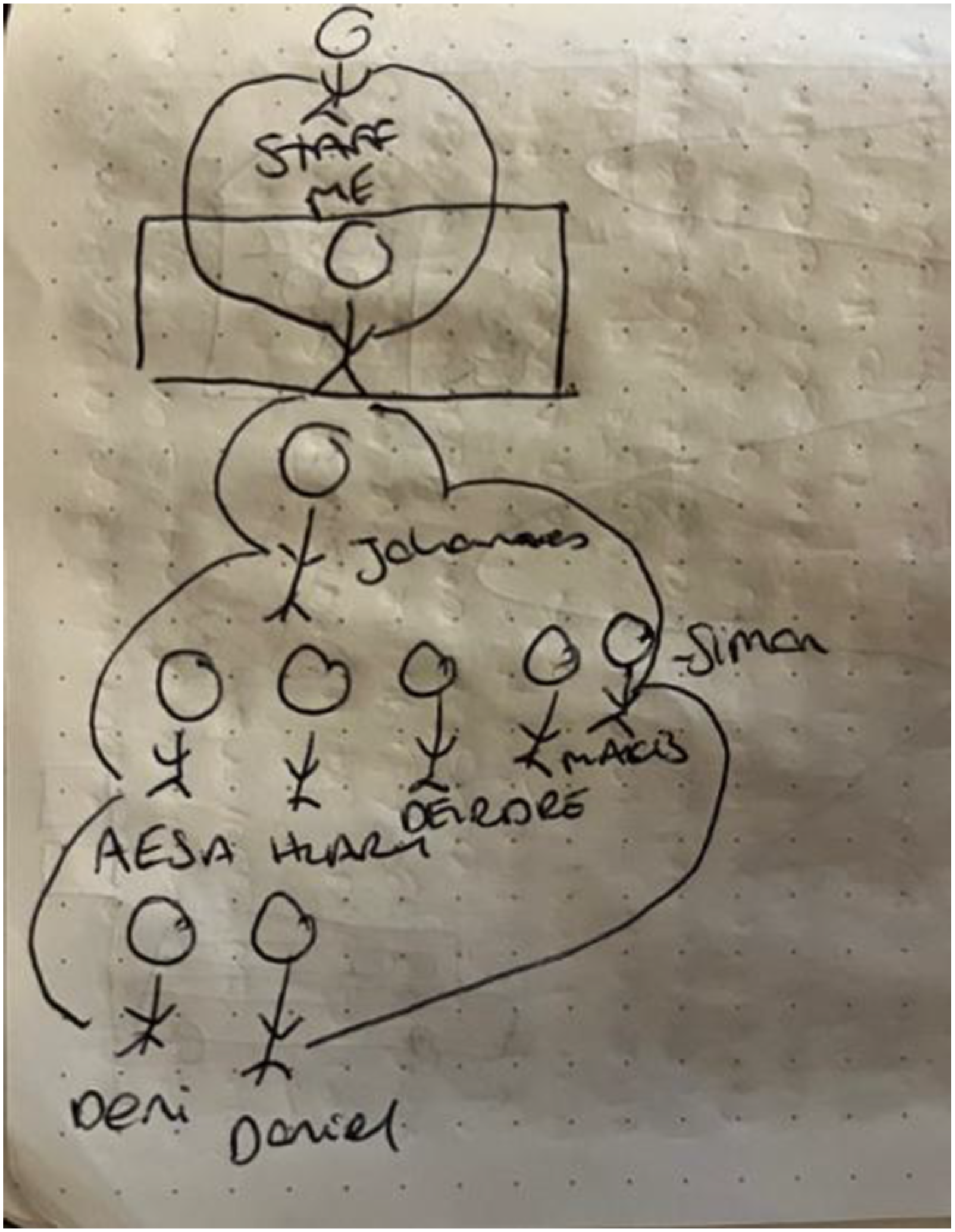
In addition to this witnessing, Simon conducted informal ethnographic (Spradley, 1979; see Figure 2) and walking interviews (Feinberg, 2016), often while hiking in the areas surrounding Vík (see Figure 3). These spontaneous, conversational exchanges about whatever preoccupied Holly or Simon weren’t video- or audio-recorded but were documented in detailed notes afterward. The walks created space for reflection and grounded dialogue, allowing Simon to register the field not only intellectually but viscerally—as something lived, felt, and co-constituted. These ethnographic methods enabled him to move with the field as it unfolded, further entangling his perception with the dynamics Holly was navigating (see Figure 4). Holly shows Simon letters and postcard she received since opening Skool Beans during an ethnographic interview in Holly’s home Holly and Simon during a walking interview Holly’s drawing representing key people in her relational field, including Simon, made during an ethnographic interview in Holly’s home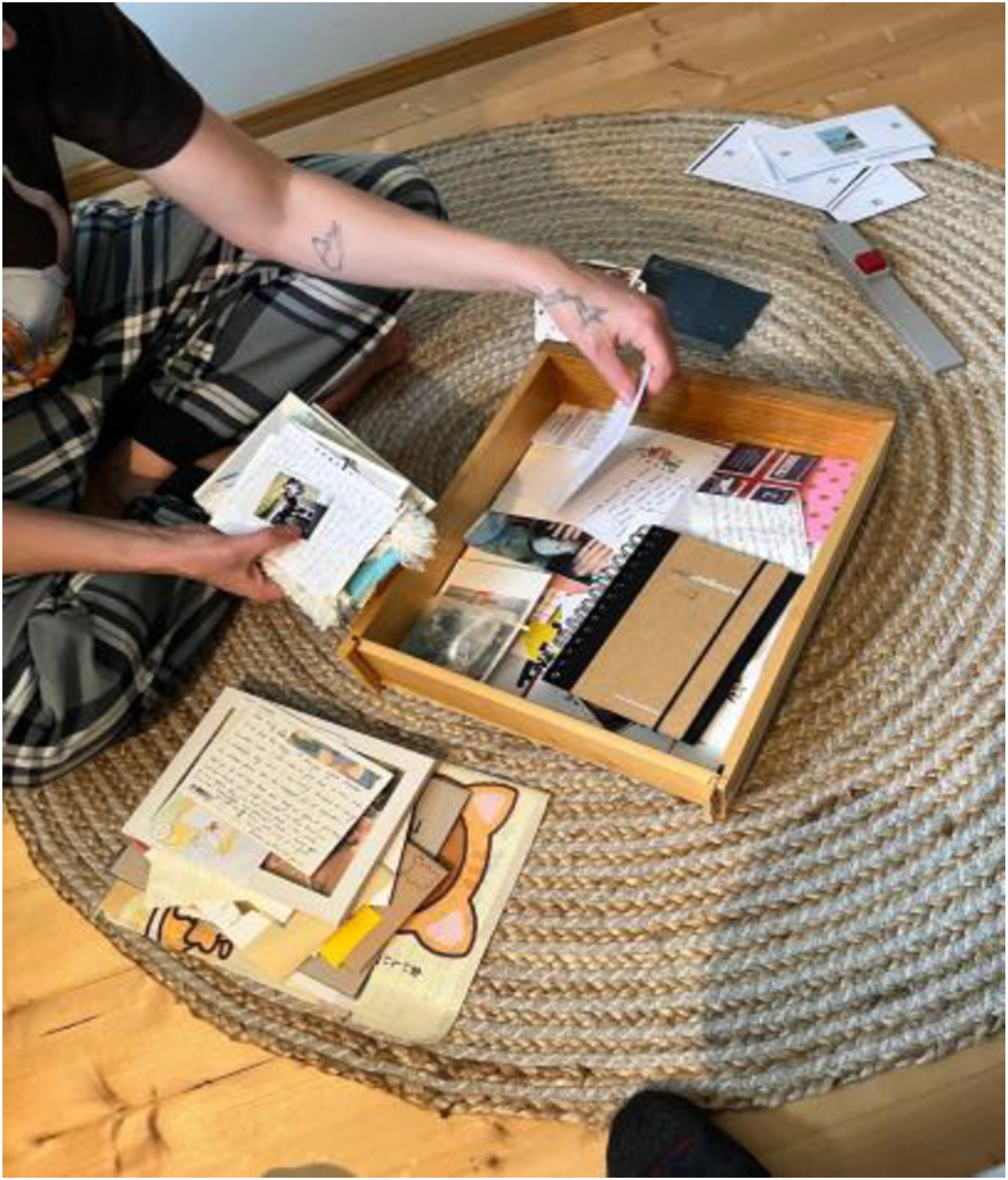

Third, Simon collected visual and material artifacts from the field, including posters, photographs, flyers, and branded items from Skool Beans. These materials served as textured entry points into the sensory and symbolic dimensions of the relational field and helped him stay attuned to its expressive unfolding.
Finally, he kept a reflexive journal throughout the research process (Tracy, 2020), recording thoughts, feelings, and questions that arose during fieldwork. This journaling helped Simon track shifts in the field with which he was becoming increasingly complicit, and to recognize how his communicative presence shaped both what came into view and how he responded to it.
Our Collaborative Analysis
Since the aim of our exploratory research was to generate insight into the communicative practices through which Holly composed with the wind, we (the four co-authors of this paper) engaged in a collaborative analysis of the data (see also Stadler et al., 2025). Our approach paralleled those guiding other studies of communicative relationality (Brummans et al., 2022; Cooren et al., 2024b) and followed a logic of abduction; that is, a process of moving iteratively between empirical material, existing literature, and conceptual insight (Tracy, 2020; see also Vásquez et al., 2016, 2018). Rather than applying a preexisting framework to the data, we allowed a conceptual lens to emerge through a process of sensing and theorizing with the field Simon studied ethnographically (see also Mallette et al., 2025).
To support this collaboration, Simon transcribed his interviews with Holly and the audio and video recordings of meetings he made during his field visits. His transcription drew selectively on Gail Jefferson’s (2004) conventions, allowing attention to interactional features such as pauses, emphasis, and turn-taking, without aiming for a fully detailed conversation analytic (CA) transcription. Given our focus on situational attunement as it unfolds across verbal, embodied, and contextual cues, we complemented transcripts with field notes, video observations, and reflexive accounts to attend to multimodal aspects of interaction that are not fully captured in transcript form. All materials, including transcripts, field notes, artifacts, photos, and journal entries, were curated in a shared digital folder for all authors to read, view, annotate, and discuss together.
We began by analyzing the materials individually through repeated readings, followed by collective sessions in which we shared interpretations and identified resonant patterns. As we engaged with the data, we noticed recurring instances of Holly picking up on subtle cues, such as emotional shifts, hesitations, silences, and gestures, and responding in ways that sustained or transformed the unfolding situation. These moments were often small yet consequential, revealing a pattern of attentiveness and responsiveness that became the seed for our conceptual development. Over time, and through frequent analytical conversations, this responsiveness took form as situational attunement, a way of acting grounded in and expressive of a relational field.
In line with Sarah Tracy’s (2020) abductive approach, we encountered Kornberger and colleagues’ view of strategy as a bridge or medium between policy and tactics during our iterative movement between data and literature (see Kornberger & Engberg-Pedersen, 2021; Kornberger & Vaara, 2022). This view resonates with broader SAP scholarship that understands strategizing as an ongoing, situated accomplishment (e.g., Jarzabkowski et al., 2007; Rouleau & Cloutier, 2022; Seidl et al., 2024). While Kornberger and colleagues’ work articulates how strategy links higher-level ambitions with situated actions, it gives less attention to strategizing as a relational mode (a practice) through which actors link immediate circumstances with evolving aims. Our analysis revealed that engagement in specific communicative practices is key to understanding how this linking occurs.
To examine this engagement in an actual setting, we centered our analysis on two interwoven dimensions that emerged through our engagement with the data, in conversation with literature on pragmatist-inspired CCO research, practice theory, and attunement: (1) Relational sensing: tuning into social and atmospheric cues through which the situation is shifting. This included how Holly responded to tone, tension, gesture, emotion, hesitation, and silence—signs that something was shifting or in need of care. These cues were often subtle and not always explicitly named, yet they played a crucial role in how she stayed in touch with the dynamics of the field. (2) Practical reasoning: responding with situated judgments about what matters, what’s possible, and how to act in ways that maintain coherence across time and relation. This included moments when Holly reflected aloud, paused to consider options, or made decisions that balanced immediate needs with longer-term concerns. Her reasoning often unfolded through dialogue but was just as often felt in the timing or modulation of her actions.
Instead of coding these dimensions as fixed categories, we treated them as mutually informing: relational sensing opened a situation, while practical reasoning oriented action within it. Together, they gave shape to Holly’s ways of composing with unfolding tensions and transitions. By focusing on these dimensions, we were able to trace situational attunement as communicative practices through which strategizing takes shape over time, bridging the tactical immediacy of a moment with a felt horizon of purpose.
In what follows, we present our analysis in the form of three episodes, each corresponding to a phase in Skool Beans’s life cycle: its emergence, development, and gradual establishment. This longitudinal view highlights how situational attunement evolved, how it drew on experience, and how new dynamics continually retested and reshaped Holly’s ability to attune. Rather than distinguishing between internal and external dynamics, we approach all three episodes as unfolding within a single relational field, where local relationships, Holly’s interactions with Skool Beans employees, and broader conditions co-constitute one another in practice. Across these episodes, we trace how her strategizing is communicatively accomplished as an expression of felt, knowledgeable doing (Gherardi, 2022; Rouleau & Cloutier, 2022), in tune with what the field seems to require.
As the Wind Blew in Vík: Three Episodes of Situational Attunement
Episode 1: Opening to the Wind
During interviews and recorded meetings with other business owners in Vík, Holly often returned to the beginnings of her entrepreneurial journey. In particular, she reflected on the challenges she faced in being accepted by the local community. In one such conversation, recorded during a Zoom interview on September 21, 2020, Holly spoke about Vík United, a coalition of local businesses she created shortly after launching Skool Beans at the start of the COVID-19 pandemic. She explains:
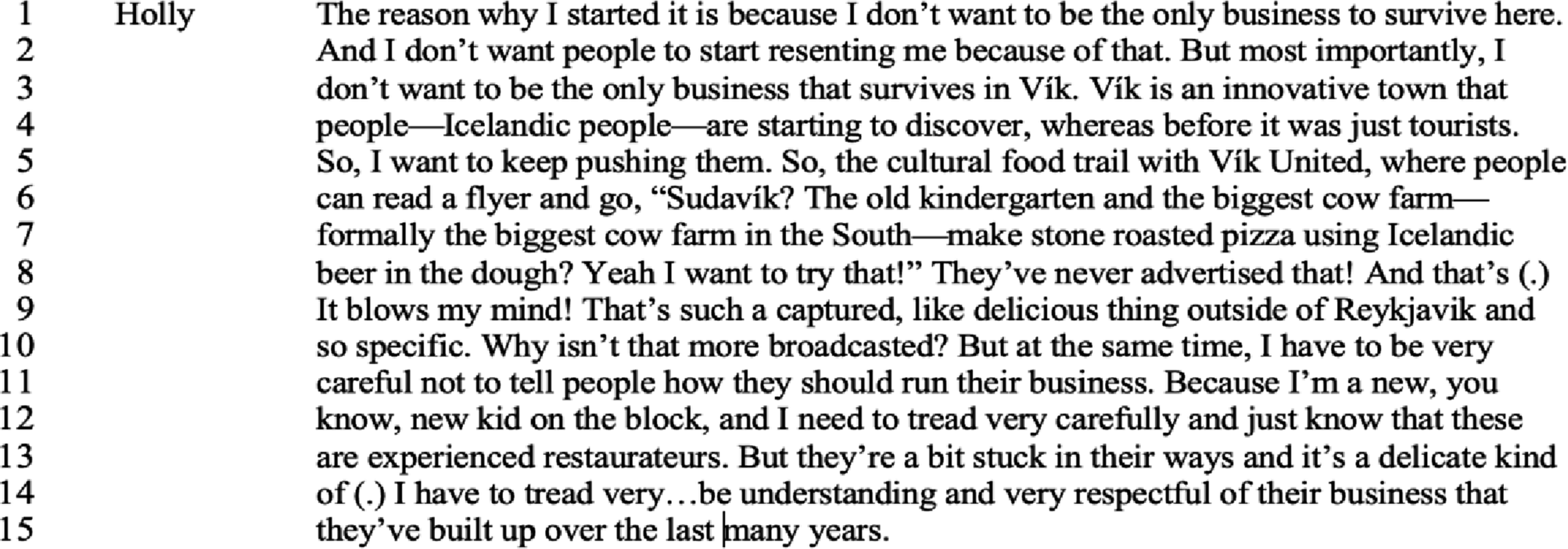
As Holly shares, she didn’t just create Vík United because she “didn’t want to be the only business to survive here” (line 1), but also because she feared others might resent her success (line 2). By “people,” she means the more established business owners in Vík. As she told Simon in this and other interviews, she felt she couldn’t simply open her café without showing that she was willing to collaborate. Put differently, she didn’t want to be seen as a threat. However, as Holly quickly learned, collaboration wasn’t a norm in Vík. While many local entrepreneurs respected each other, there was little active cooperation. At worst, businesses competed; at best, they coexisted. Simon repeatedly witnessed how this concern surfaced in Holly’s interactions, with him and with others. In his field notes from the first year of research, he documented the emotional weight this carried: Holly would sigh deeply or bury her head in her hands when recounting the lack of engagement within Vík United.
This meant Holly was navigating a paradox. She wanted to demonstrate a team spirit, even though that spirit wasn’t widely valued. At the same time, she was aware of how presumptuous or “bossy” she might appear if she encouraged long-time local business owners to join a new initiative or revise their advertising strategies, especially as a newcomer. In the excerpt, she expresses this tension directly, referring to herself as a “new kid on the block” (line 12).
Nonetheless, she sensed that forming Vík United could offer a way forward, both for her and the broader community. By initiating this coalition, she hoped to affect the relational dynamics of the town without disrupting them. This reflects relational sensing: Holly picked up on subtle tensions in the field (e.g., lack of engagement, hesitation from other business owners, and a pattern where businesses tended to coexist rather than actively collaborate) and responded with care. Like a spider in a web, she tuned into ambient signals and created new links, gently encouraging others to participate in a shared vision while respecting existing rhythms.
Her practical reasoning is evident in the care with which she approached other business owners. She seemed to anticipate how it might feel for them—a British woman arriving in a small village and proposing a new way of working together. She also recognized that collaboration might be the best path to local acceptance, even if the conditions for it had to be cultivated. In this sense, she walked a tightrope: initiating cooperation without appearing to impose it.
The excerpt also reveals how Holly worked communicatively to reframe what already existed in Vík. She did this by highlighting the uniqueness of local businesses. These qualities had often gone unrecognized even by the owners themselves. In lines 5 to 10, for instance, she imagines a tourist discovering Suður-Vík, a restaurant that makes pizza using Icelandic beer. For Holly, this detail is a powerful selling point—something the restaurant hadn’t previously promoted. This moment reflects strategizing as situational attunement: sensing potential, naming it in a way that aligns with local identity, and supporting others in re-seeing their own value.
In doing so, she engages in strategic reframing: helping others recognize the potential of what they already offer while reinforcing rather than threatening their identity. At the same time, she acknowledges their experience and history, noting in lines 13 to 15 that “they’re a bit stuck in their ways” and that she must remain “understanding and very respectful of their business that they’ve built up over the last many years.” Still, she also knows she must “keep pushing them” (line 5). Here again, Holly isn’t shaping the field by force; she’s composing with it, adjusting her communicative moves in response to what the situation seems to require.
Another way Holly engaged in relational sensing was by amplifying a sense of local innovativeness, something that hadn’t been strongly associated with Vík prior to her arrival. As she puts it, “Vík is an innovative town that people—Icelandic people—are starting to discover, whereas before it was just tourists” (lines 3–4). Her efforts to establish Vík United were part of an attempt to help other business owners recognize and claim this quality. She was sensing into multiple layers of the relational field: longstanding norms and latent potentials. What might appear as contradiction between “stuck in their ways” and “innovative” is actually a practice of relational sensing: attuning to what is and what could be, holding both together.
One of the initiative’s outcomes was the co-creation of a “cultural food trail” (line 5), which was promoted through a printed flyer (see Figure 5). This flyer encouraged tourists to visit various restaurants, bars, and cafés, offering discounts at each stop. The Vík united flyer that was on display in many businesses in Vík
The flyer did more than advertise individual businesses; it presented them as a social collective. By including all participants, it positioned Skool Beans not just as another café, but as part of an innovative local network. In this way, Holly used a material artifact to support her strategizing, literally putting Skool Beans on the map. The flyer thus served as a tactical expression of a broader, evolving strategic aim: cultivating inter-business cooperation and local identity.
Over time, this symbolic positioning became reality. In the summer of 2022, almost two years after the launch of the Vík United flyer in fall 2020, Skool Beans was featured on Vík’s official tourist map (see Figure 6). The map is produced annually by Visit Vík, a local organization dedicated to promoting area businesses. This transition, from self-initiated, collective promotion to formal recognition, illustrates how Holly’s ongoing practical reasoning, expressed through subtle and sustained communicative interventions, gradually reshaped her place within the community. Skool Beans appears on Vík’s official tourist map (number 28)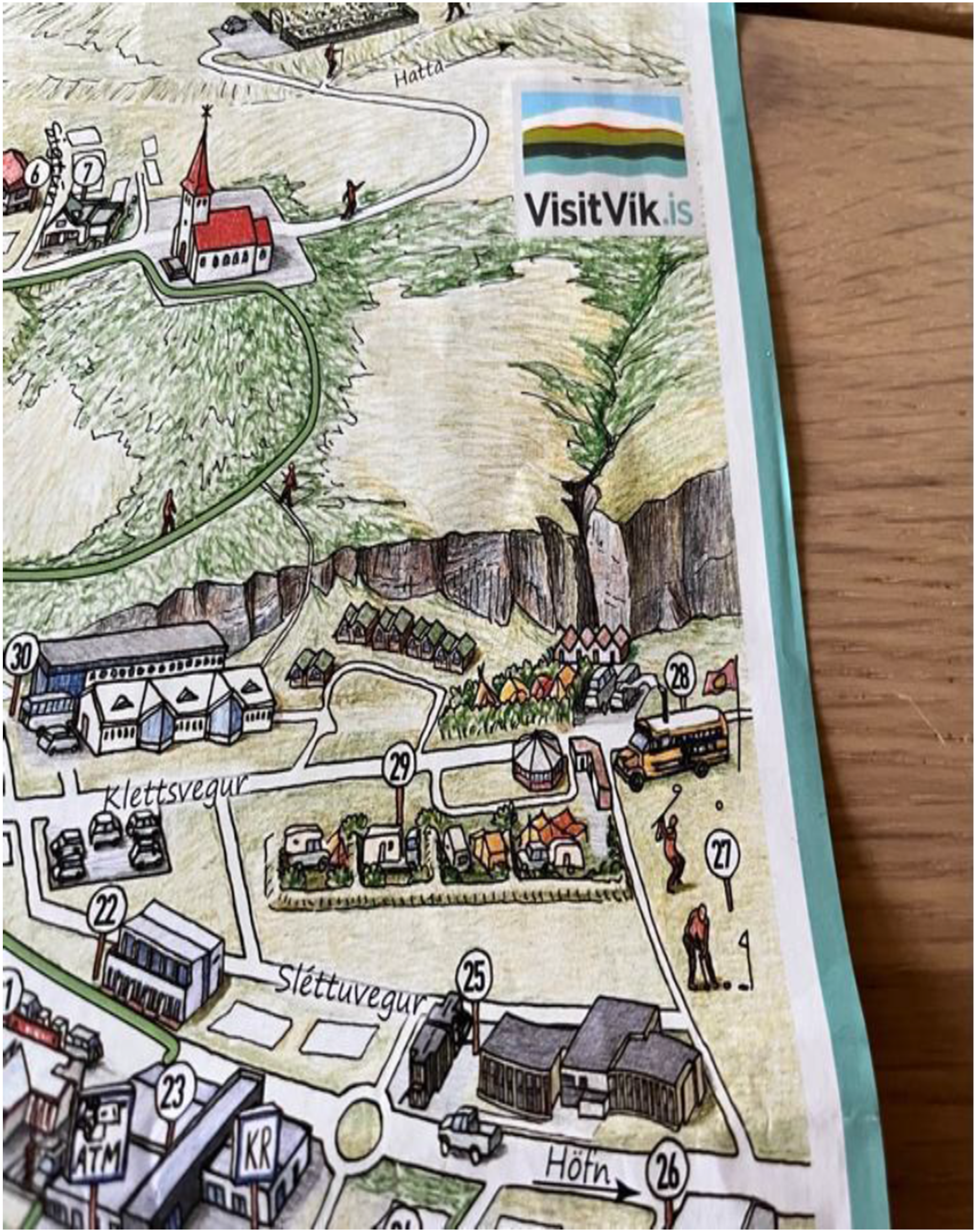
Yet, can we speak of strategizing here? From a conventional perspective, you might interpret Holly’s actions as attempts to shape the situation to her will. Yet this view overlooks how her actions emerged through ongoing responsiveness to the field. Rather than trying to command the wind (i.e., directing the situation from the outside), Holly engaged with it from within, adjusting her actions to shifting conditions.
In this episode, strategizing becomes visible as situational attunement: relational sensing of what matters (Vásquez et al., 2018) to others and to herself, who together co-constitute the relational field, combined with practical reasoning about how and when to intervene. These communicative practices (pausing, reframing, encouraging, and holding back) show how strategizing is communicatively accomplished in interaction.
What we see, then, is a form of knowledgeable doing through which Holly and Skool Beans gradually become part of the relational fabric of Vík. This process can be understood as a kind of apprivoisement (a gradual process of taming and being tamed; see also de Saint Exupéry, 1943/1971): a careful entering-in, shaped by empathy and restraint, that allows Holly to begin opening to the wind.
Episode 2: Keeping the Wind in the Sails
During a relaxed evening conversation on June 22, 2022, in Daniel’s home, Holly and Daniel—both members of Vík United and local entrepreneurs (Daniel runs the Soup Company restaurant and belongs to one of the three influential families in Vík)—reflected on the origins of the initiative and the challenges they’d faced over the past two years. Simon was present to witness and record, occasionally joining the conversation.
Before visiting Daniel, Holly had shared with Simon why she was looking forward to the encounter. As Simon later wrote in his journal (translated from French): June 22, 2022, 9:30 AM A rare moment of tranquility on the bus. I think back to my conversation with Holly last night. I get the impression that she’s sometimes playing out worst-case scenarios in her head about her employees and other entrepreneurs in the village. She told me yesterday that she’s probably too emotionally invested, and I think that’s true. She wonders how she could take a step back when Skool Beans is her baby and when her priority is for people to “get what Skool Beans is about.” June 22, 2022, 4:30 PM The café is about to close. Holly mentions that we might go for a drink at Daniel’s this evening. She hasn’t sat down with him in a while, and she thinks it would be good for her nerves to be able to reconnect with him and talk to another business owner.
Simon’s reflections capture Holly’s self-awareness and intentionality. She saw the visit as an opportunity to “take a step back” from day-to-day operations while deepening a key relationship in the community. This reveals a moment of practical reasoning expressed in how she deliberately creates space for reflection and relational reconnection: recognizing that strategizing doesn’t only happen in the heat of action, but also in stepping back, reconnecting, and reaffirming shared ground.
Here is part of the recorded conversation she and Daniel ended up having (the transcript is simplified for readability and doesn’t represent full Jeffersonian [2004] CA notation):
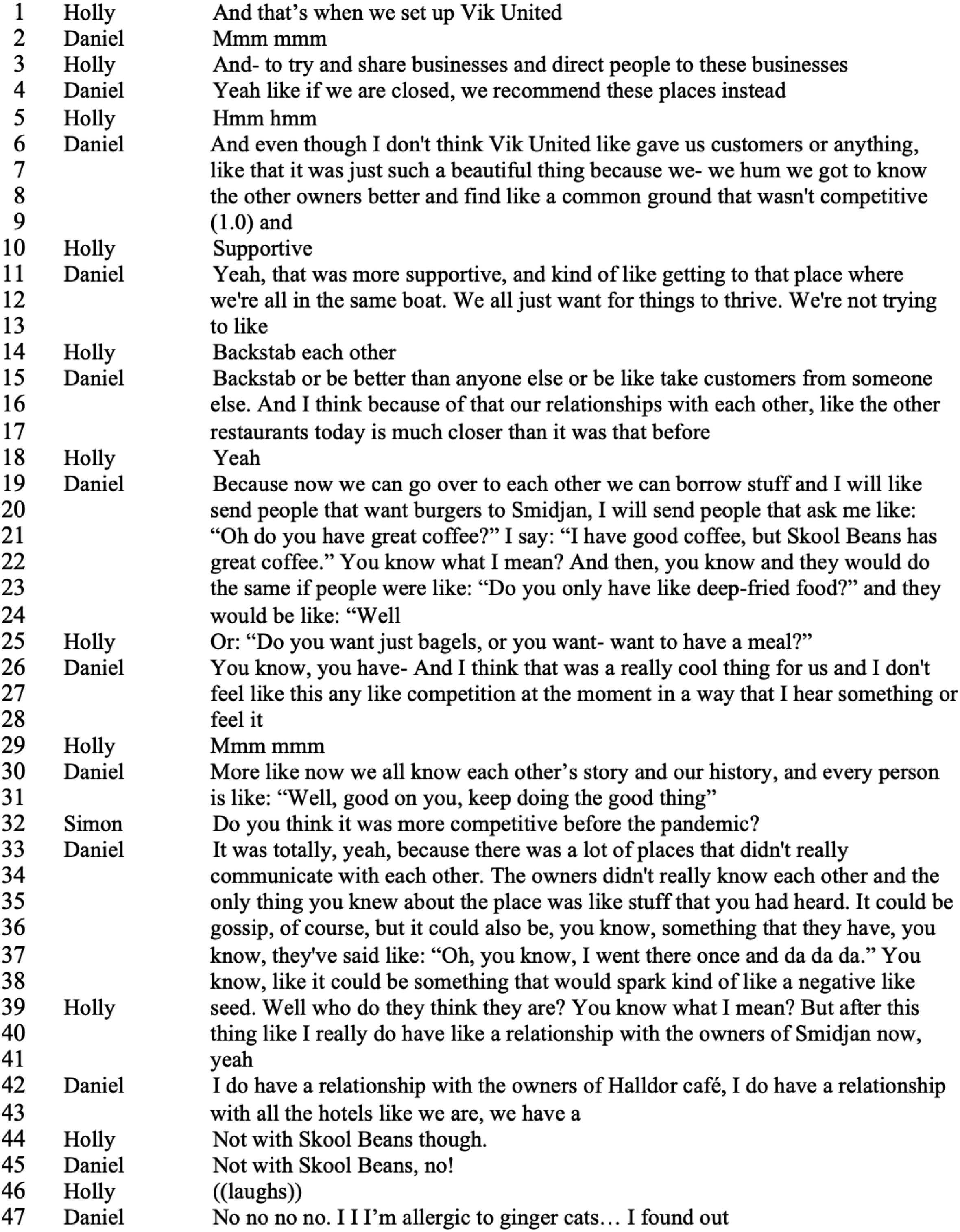
Their conversation illustrates a form of mutual attunement grounded in both relational sensing (attending to tone, timing, and positioning in interaction) and practical reasoning (calibrating how and when to speak, affirm, or reframe). Holly never positions herself as the initiator of Vík United, even though she was. Instead, she frames it as a collective endeavor (“And that’s when we set up Vík United,” line 1). While Holly begins the discussion, her choice of words and timing signals attentiveness to Daniel’s role and voice, expressing her relational sensitivity. It’s Daniel, in turn, who articulates the group’s shared goals: (1) to recommend other businesses whenever possible (line 4; lines 19–24); (2) to get to know each other better and foster community (lines 7–8; 16–17; 30–31; 33–35; 42–43); and (3) to cultivate collaboration instead of competition (lines 8–9; 11–13; 15–17; 21–24; 26–28).
Strikingly, Daniel echoes many of the points Holly had shared in earlier interviews with Simon. This suggests a process of appropriation, which signals that Holly’s attunement had affected the field and that her communicative practices had become embedded in others’ sensemaking (Weick, 1979). Throughout the exchange, Holly affirms Daniel’s perspective through subtle vocal cues (“hmm hmm,” line 5; “yeah,” line 18; “mmm mmm,” line 29; “yeah,” line 41) and by completing his sentences (“supportive,” line 10; “backstab each other,” line 14; “Or: ‘Do you want just bagels, or you want- want to have a meal?’,” line 25; “seed,” line 39). These utterances exemplify relational sensing in action: noticing where Daniel’s going and moving with him to support and shape the interaction’s tone and content. These practices make her sensitivity to the unfolding interaction empirically observable.
Daniel, in turn, echoes Holly’s language. Their interaction shows how shared understanding—and a certain complicity—had grown between them, expressed both verbally and through embodied orientation (although not visible in the transcript, Holly and Daniel are seated closely on a sofa, angled toward each other, their gestures expressing ease and appreciation). These embodied cues reflect how strategic coherence can emerge relationally, not through planning alone but through attuned co-orientation (Taylor & Van Every, 2000).
This complicity becomes particularly clear near the end of the excerpt, when Holly jokingly says that Daniel has no relationship with Skool Beans (line 44), and Daniel plays along (line 45). Their shared laughter (line 47) reveals the intimacy of their relationship. Daniel’s joke about being allergic to ginger cats signals his knowledge of Jeffrey, Holly’s cat and the mascot of Skool Beans, featured prominently on posters, stickers, his own webpage, and Instagram profile (https://www.skoolbeans.com/jeff + https://www.instagram.com/jeffthevikingcat; see Figure 7). Skool Beans’s ginger Cat, Jeffrey (posted on the Skool Beans Facebook page)
This moment signals more than familiarity. It reveals the accumulated effect of Holly’s situational attunement. Vík United, once a tentative initiative born of necessity and vulnerability, had matured into a shared space of collaborative identity. The alignment and ease between Daniel and Holly reflect the cumulative work of strategizing as situational attunement; of “studying the wind” and learning how to move with it rather than against it. What began as Holly’s effort to build trust had become a shared orientation that shaped the field of relation.
As Simon witnessed many times, cultivating this kind of relational complicity became one of Holly’s most important ways of affecting the field while being affected by it in turn. In doing so, she not only earned her place within the community, but also helped shift the broader field toward a more collaborative dynamic. In line with Seidl et al.’s (2024, p. 12) definition of strategizing as “recurrent patterns of action aimed at affecting the trajectory of a venture in consequential ways,” the communicative practices in which she engaged became central to how Holly sustained and grew Skool Beans. They were, in short, how she kept the wind in the sails.
Episode 3: Navigating Crosswinds
Now that she and Skool Beans had become part of Vík, Holly began facing new challenges that continued to demand creative forms of situational attunement. Interestingly, many of these newer challenges didn’t emerge from interactions with the Vík business community, but from within Skool Beans, particularly in Holly’s day-to-day communication with employees. These interactions, while taking place within the team, are shaped by ongoing relations with the broader field, including customer expectations, professional standards, and the evolving identity of Skool Beans. To illustrate this strategizing, consider the following excerpt from a written message in the WhatsApp group Holly uses to communicate with her staff. She frequently relies on this channel to share inventory updates, customer feedback, and gentle reminders to keep things running smoothly.
In the spring of 2024, Holly sent a message to her team regarding Emma (a pseudonym), a new barista who wasn’t yet part of the group. Her goal was to inform the other employees about Emma’s early missteps while also clarifying that she’d be addressing these matters directly with Emma to help her reach “the Skool Beans level.” The interaction unfolded as follows:
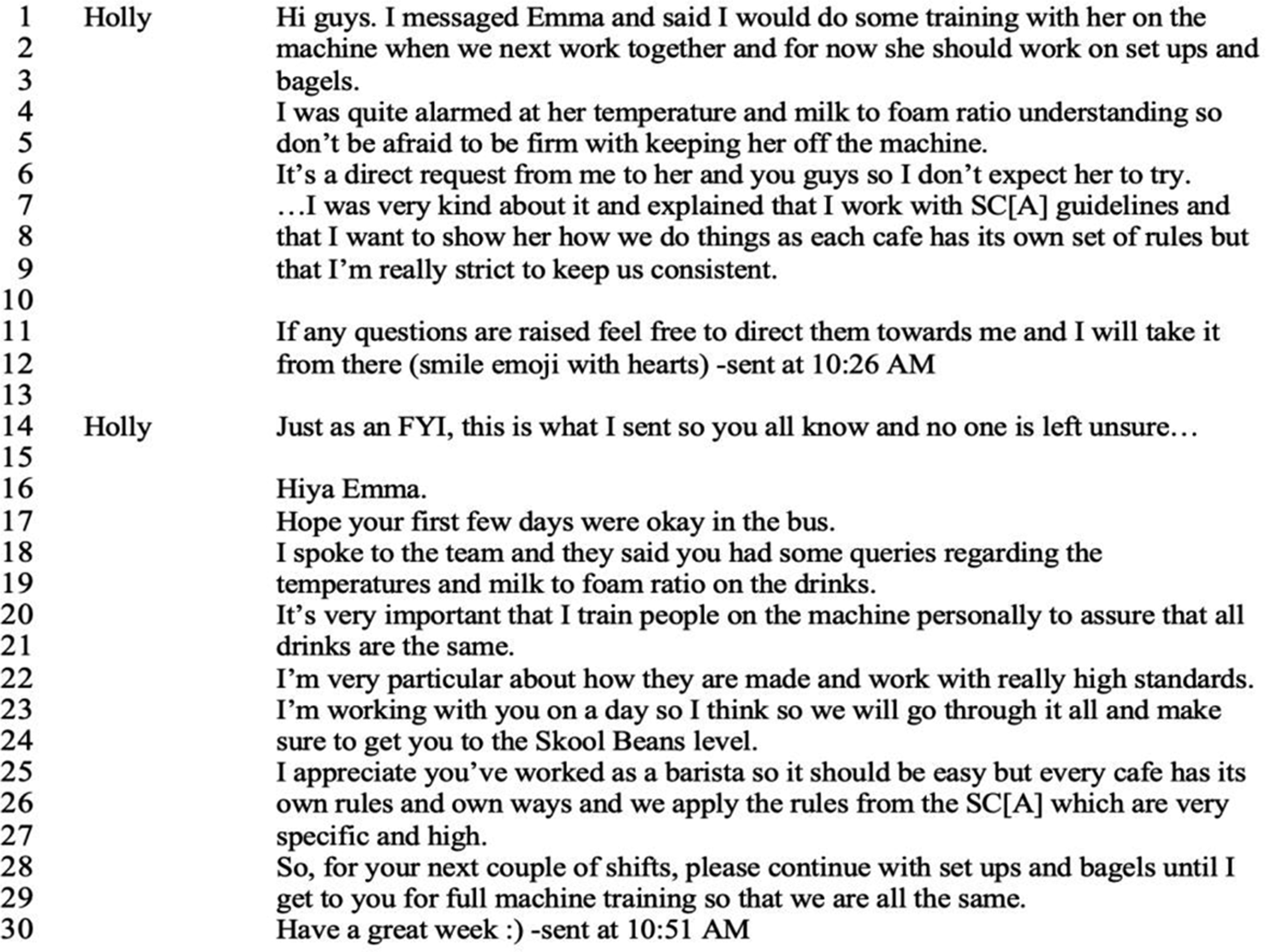
These messages make clear what matters to Holly in that moment, and what she perceives to be at stake for Skool Beans. Her concerns include: (1) keeping her staff informed and aligned (lines 6, 14); (2) ensuring that Emma and the others understand and follow both the internal standards at Skool Beans and the broader Specialty Coffee Association (SCA) guidelines (https://sca.coffee/; lines 7, 18–19, 26–27); (3) communicating with kindness and care, especially when offering correction (lines 18–19, 25, 30); and (4) ensuring that staff consult her directly when questions arise (lines 11–12).
This situation calls for careful calibration between firmness and empathy. Holly senses that she must uphold Skool Beans’s high standards, which she sees as integral to the café’s identity and coherence, while also supporting her team, especially new hires like Emma, in ways that foster learning rather than defensiveness. This moment exemplifies relational sensing: Holly attends to how her message might be received across different team members, calibrating tone, wording, and timing in the absence of face-to-face cues. At the same time, her message reflects practical reasoning, a situated judgment about what kind of tone, explanation, and follow-up will preserve both quality and trust.
This tension frequently surfaced in Simon’s field notes and journal entries. During his first extended visit to Vík in June 2022, he spent significant time witnessing Holly’s interactions with her team and discussing her management style. During a walking interview on a cliff near Vík, Holly shared that she was raised by her father and often feels “like a tomboy.” This, she said, makes it difficult to connect with some female employees, particularly those she referred to as “self-proclaimed drama queens.” Because of this, she told Simon, she tries to be empathetic without compromising her authority.
The WhatsApp messages reflect this calibration. Holly opens with warmth (“Hiya Emma,” line 16; “Hope your first few days were okay,” line 17; “Have a great week:)” line 30), while also reinforcing her expectations and commitment to consistency (“It’s very important that I train people on the machine personally to assure that all drinks are the same,” lines 20–21; “I’m very particular about how they are made and work with really high standards,” line 22; “I think we’ll go through it all and make sure to get you to the Skool Beans level,” lines 23–24).
One way Holly navigates the crosswinds is by presenting the standards as integral to what makes Skool Beans distinct, giving them meaning beyond mere rules. For example, she writes: “I’m very particular about how they are made and work with really high standards” (line 22), presenting expectations as expressions of care and craft, not control. This helps soften the critique, signaling that Emma is adapting to something meaningful and cultivated, and avoids framing her as being blamed for falling short.
At the same time, Holly grounds her expectations in an external source of legitimacy (the SCA), reaffirming that Skool Beans’s quirkiness is matched by its professional alignment. This move reflects practical reasoning at work: clarifying the rationale behind expectations and linking them to broader values. Strategizing here involves retracing the threads that compose a situation by articulating its constraints, norms, and aspirations in ways that make them understandable and actionable for others.
As in earlier episodes, Holly isn’t simply re-acting. She’s sensing what matters in a moment of interpersonal complexity and choosing how to act in ways that protect the café’s identity, affirm her leadership, and support an employee’s growth. Her response reveals a double attunement: to the unfolding relational dynamics and to the practical implications of the standards she’s upholding. What’s at stake is the integrity of the field she’s continually composing with, well beyond quality control.
A year later, in May 2025, Holly once again turns to the WhatsApp group with her employees—this time to gather their impressions of another new hire, Paula. Having spent more time away from the café in recent weeks, she wants to better understand how Paula is performing from the team’s perspective. The interaction unfolded as follows:
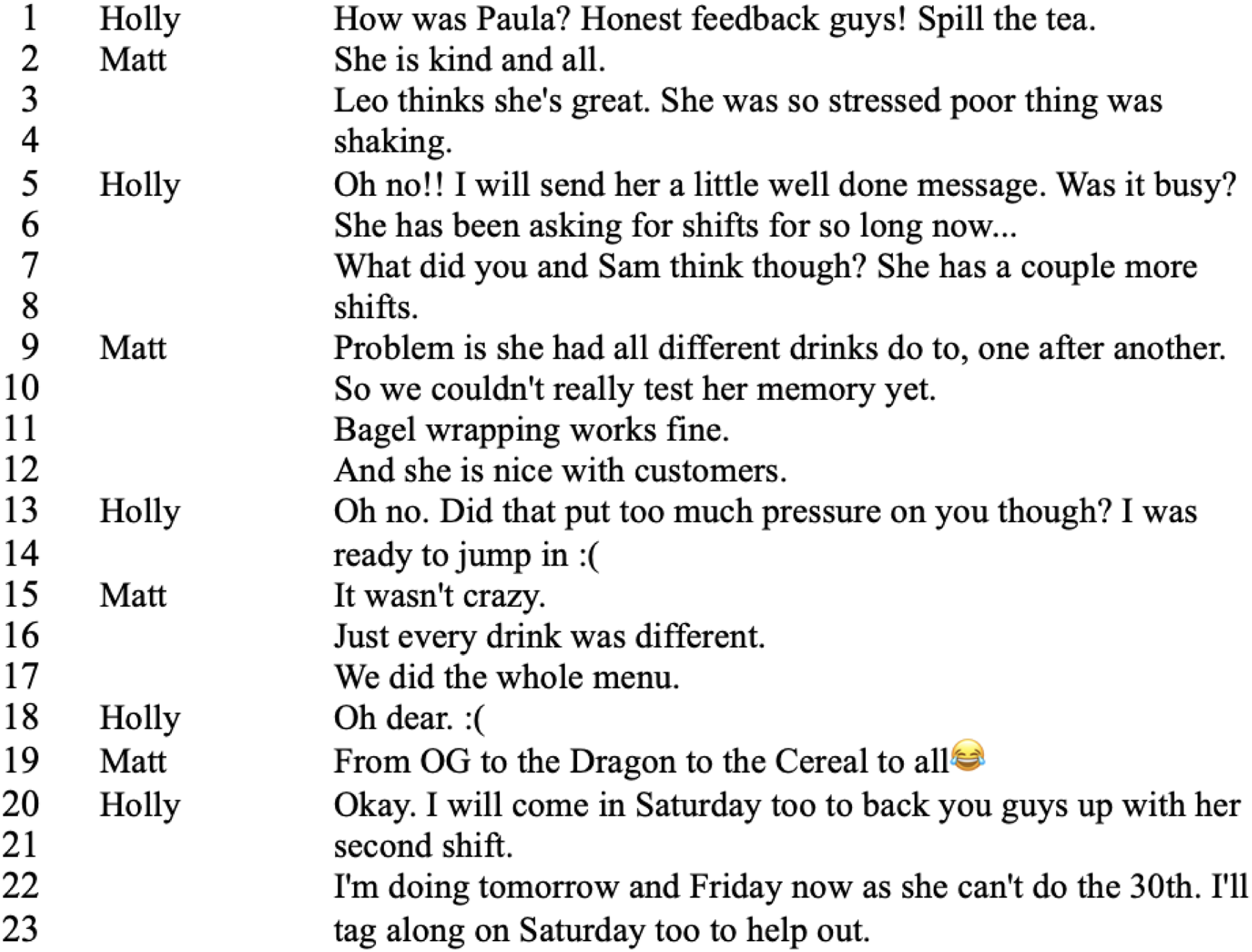
Holly’s opening (“Honest feedback guys! Spill the tea,” line 1) sets an affective tone that invites candid yet informal input, lowering the threshold for employees to share concerns without framing the exchange as an evaluation. Through this move, she engages in relational sensing at a distance by interpreting textual cues, timing of responses, and reported experiences as signals of shifting dynamics: she reads Matt’s comments about Paula “shaking” (lines 3–4), the difficulty of assessing her memory under varied drink orders (lines 9–10), and the team’s workload as signals about both Paula’s learning curve and the collective atmosphere behind the counter. Rather than treating performance as an individual metric, she attends to how pressure was distributed across the shift (“Did that put too much pressure on you though?,” line 13), indicating an attempt at attuning to her team rather than to Paula alone.
Holly’s subsequent responses illustrate practical reasoning oriented toward maintaining coherence between care, standards, and operational demands. By deciding to “tag along on Saturday” (lines 22–23) and increase her own presence during Paula’s next shift, Holly translates sensed tension into a situated adjustment that supports both the newcomer and the existing staff. This intervention doesn’t take the form of corrective instruction (unlike the earlier Emma exchange), but of embodied co-presence, redistributing responsibility and signaling shared commitment to training. Strategizing here unfolds through anticipatory support: Holly uses mediated communication to diagnose emerging strain and then modifies staffing patterns to stabilize the situation.
In this episode, then, we see strategizing as situational attunement unfolding through Holly’s ongoing engagement with the relational field, including team interactions, customer expectations, and professional standards. Holly’s communicative practices cultivate coherence through attunement. She’s composing with the wind once more, this time navigating the crosswinds between standards and care, between managerial clarity and empathic responsiveness. In other words, this episode illustrates how Holly composes with cross-pressures of absence, team capacity, and newcomer anxiety, aligning immediate scheduling decisions with the longer-term aim of sustaining Skool Beans’s collaborative and high-care work environment. In doing so, Skool Beans continues to grow as a business that is a living web of relations.
Discussion
This paper has offered a communicative view of strategizing as situational attunement, allowing us to show how it emerges through embodied, relational adjustments as actors orient and respond to what the situation calls for. Drawing on insights from CCO scholarship, practice theory, and research on attunement, our study shows that strategizing unfolds through communicative practices in which actors sense what matters in the moment and act with others who are shaping the evolving relational field.
To clarify this understanding of strategizing, we defined situational attunement as a communicative accomplishment that connects immediate conditions with evolving aims. This accomplishment takes shape through two interwoven dimensions: relational sensing, the embodied discernment of what seems to matter, and practical reasoning, the situated judgment of how to act in response. In this way, our perspective extends the work of Kornberger and colleagues (Kornberger & Engberg-Pedersen, 2021; Kornberger & Vaara, 2022) by specifying how attuned participation is communicatively accomplished in situ, through observable practices that connect the felt specificity of unfolding situations with evolving horizons of purpose.
In what follows, we discuss the implications of this view for SAP research and communication scholarship on strategizing, as well as its methodological and practical implications and directions for future research.
Strategizing as In Situ Knowing-in-Action
First, our study contributes to SAP scholarship by deepening the field’s engagement with both the concept of practice and the situation. As Rouleau and Cloutier (2022) note, much SAP work has focused on what actors do, without fully exploring the situated nature of practice itself. We respond to their call for stronger theorization by treating practice not as behavior but as knowledgeable doing, a form of embodied, situated action that unfolds through social interaction (Gherardi, 2022). From this perspective, strategizing is a mode of engaging with the relational field as it takes shape in interaction. What matters isn’t whether an action is planned, but whether it’s attuned; that is, whether it reflects the textures, tensions, and potentials of a particular situation as it emerges. In turn, our study extends theorizing on the role of the situation in SAP research by conceptualizing it as a relational field that isn’t given in advance but takes shape through ongoing communicative engagement.
Our contribution aligns with recent SAP scholarship that emphasizes the consequentiality of communication (Seidl et al., 2024) and the knowledgeability of practice (Rouleau & Cloutier, 2022). We show that strategizing involves relational sensing and practical reasoning. While our access to these dimensions was mediated through recorded interactions and conversations with Holly, our analysis attends to how such communicative practices reveal a deeper sensitivity to unfolding stakes. According to Danner-Schröder et al. (2025), this sensitivity is central to practical knowing. Thus, our study shows these two dimensions are vital for understanding how strategy emerges as a social accomplishment (Rouleau, 2022). This perspective also opens a more fine-grained analysis of strategizing as a communicative accomplishment, particularly by attending to how such knowing-in-action becomes observable in interaction, an aspect we develop further in the next section.
Extending this point, we frame decentering from individual actors not only as a move toward a stronger conception of practice, but as an explicitly relational orientation, one that foregrounds the human and more-than-human field in which strategizing unfolds. Whereas Chia and Rasche’s (2025) dwelling worldview offers a valuable counterpoint to building worldview approaches, it remains primarily focused on human actors, giving less attention to how material arrangements, atmospheres, and situational dynamics participate in shaping action. Our study addresses this by showing how such more-than-human dynamics become empirically visible through communicative practices, for example in how actors orient to atmospheres, material constraints, and evolving situational cues in interaction. Thus, we highlight strategizing as a distributed accomplishment of a heterogeneous field, emerging beyond the actions of bounded individuals. Our view sits between more intentional views of strategy and a processual view of “strategy as practical coping” (Chia & Holt, 2006), showing how strategizing emerges through actors’ ongoing orientation and response to what the situation calls for.
By treating practice as a site for the enactment of strategy and a form of knowing-in-action, we also extend Gherardi’s (2022) call to understand practice as epistemic. Our longitudinal analysis shows how Holly’s strategizing unfolded over time as a recursive engagement with situations, each demanding its own communicative adjustments and improvisations. In this way, our work aligns with recent SAP studies that explore how strategy emerges through embodied responsiveness (e.g., Danner-Schröder et al., 2025; Knight et al., 2024), while contributing a distinct communicative lens grounded in CCO scholarship and pragmatism. In turn, we connect with recent work that examines the affective textures of strategizing. For example, our study builds on Knight et al.’s (2024) account of how collective bodily tonality and interaction generate atmospheres that shape strategic sensemaking and its possible forms. While sharing this sensitivity to atmosphere, our contribution extends their work by theorizing these dynamics as part of situational attunement, which includes bodily tonality without being limited to it. It foregrounds how strategizing unfolds through ongoing responsiveness to these forces, in ways that attune to the felt mood of interaction as well as to shifting constraints, tensions, and potentials in the field.
Advancing Communication Research on Strategizing
Second, building on the previous section, this paper contributes to communication-centered research on SAP by showing how strategizing unfolds in and as communication; that is, through situated communicative practices that are linguistic and more-than-linguistic. We advance this research by specifying how strategizing can be analyzed through the fine-grained study of communicative practices that make situational attunement empirically observable. In particular, we show how relational sensing and practical reasoning become visible in interaction, not only through talk but through pauses, silences, jokes, gestures, images, and atmospheres, thereby extending SAP studies on talk (Aggerholm & Asmuß, 2016; Asmuß & Oshima, 2018; Bencherki et al., 2019; Bencherki et al., 2021; Cooren et al., 2015; Nathues et al., 2023; Spee & Jarzabkowski, 2011; Vásquez et al., 2018) and responding to Eero Vaara and Laura Fritsch’s (2022, p. 1170) call for more in-depth analyses of actual language use “in strategy process and practice.” While our research resonates with this work, it extends this line of inquiry beyond human actors by showing how embodied, material, and atmospheric aspects of interaction participate in shaping strategizing in practice. In our analysis, these more-than-human dynamics become visible in how actors orient to tone, timing, material arrangements, and shifting atmospheres as part of their communicative engagement.
Importantly, our paper contributes to emerging research that foregrounds communication as a strategic force in its own right (Seidl et al., 2024), not simply a conduit for transmitting or enacting strategy. Strategy becomes what it is in and through communication, rather than preexisting it. From this view, through their embodiment, repetition, and consequentiality, communicative practices form the very substance of strategizing. This resonates with Hällgren et al.’s (2025) emphasis on strategizing as an emergent, situated process that participates in shaping the field it responds to. In other words, it becomes less about reflecting a pregiven world than about participating in its ongoing co-constitution, echoing Chia and Rasche’s (2025) work. Thus, our contribution lies in showing how this constitutive role of communication can be traced empirically through the unfolding of relational sensing and practical reasoning in situated interaction.
Ethnography as Attuned Inquiry
Third, our study contributes methodologically by specifying how ethnography can be practiced as a form of attunement to an unfolding relational field. We followed an abductive, iterative process in which theoretical insight emerged through sustained engagement with situated interaction (Tracy, 2020). Simon’s fieldwork created conditions for such attunement through extended presence, relationship-building, attention to atmospheres, and the documentation of micro-events. Practices such as witnessing, reflexive journaling, and walking interviews cultivated an embodied sensitivity to how communicative dynamics took shape in context.
Our approach underscores how meaning and insight emerge in the relational unfolding of fieldwork through responsiveness, copresence, and “complicity” (see Mallette et al., 2025). The collaborative nature of our analysis further highlights that theorizing itself can take the form of collective attunement to the field and to one another (see also Stadler et al., 2025). This collaborative process enables the researcher to make visible the “knowing-in-practice” (Gherardi, 2022, p. 25) that guides strategic action, including when such knowing is tacit, improvised, or affectively sensed.
What distinguishes this approach is not the use of novel methods, but the way these methods are oriented analytically. Specifically, our approach attends to how situational attunement becomes empirically observable through communicative practices. This involves tracing how relational sensing and practical reasoning are expressed in interaction through shifts in tone, timing, gesture, silence, and material engagement. Thus, ethnographic attunement is not only a way of being in the field, but also a way of analyzing how actors engage with unfolding situations by becoming with the field as it unfolds.
In this way, our contribution lies in showing how ethnographic inquiry can be oriented toward capturing the communicative textures through which strategizing unfolds in practice. By foregrounding attunement as both a mode of engagement and a mode of analysis, we extend existing SAP research (e.g., Rouleau & Cloutier, 2022), particularly their call to decenter the strategist and attend to the relational dynamics through which strategizing emerges, by offering a more precise account of how the situated, relational, and affective dimensions of strategizing can be studied empirically.
Practical Implications
Fourth, our study offers practical insights for strategists, entrepreneurs, and organizational practitioners more broadly. Strategy is often taught as a matter of planning and rational analysis, preceding execution. It’s also traditionally viewed as something an organization has (cf. Jarzabkowski et al., 2007). SAP scholarship has criticized these two ideas since its inception, through its core proposition of conceptualizing strategizing as something that’s done—as practice. This turn to practice also reconceptualizes knowledge as knowing (Nicolini, 2012). Our ethnography complements and extends this view on knowledge by suggesting that strategizing requires another kind of expertise: the ability to sense what matters, read subtle cues, and respond in ways that shift or stabilize a relational field. This isn’t merely a question of intuition, but a cultivated attentional skill, learned through experience, dialogue, and sustained attunement to others. Whether entrepreneurs, managers, or community organizers, for those involved in strategizing, our findings suggest that such activities are continually shaped, complemented, and transformed through relational sensitivity, timing, and improvisation. From this perspective, strategizing becomes an ongoing navigation rather than the execution of a fixed course from point A to point B; a process of sensing shifts in the wind, adjusting one’s communicative practices and staying in touch with the evolving field.
Such a view complements and extends existing SAP scholarship by emphasizing the consequential nature of action (Seidl et al., 2024) as well as the communicative work through which consequences become possible. By foregrounding situational attunement, we propose a view of strategy that is more embodied, humane, and open-ended, one that resonates with how people act skilfully and effectively in uncertain, dynamic contexts (Danner-Schröder et al., 2025; Hällgren et al., 2025). Far from being mundane and inconsequential, we contend that this conceptualization of strategizing empowers those involved by valuing their relational sensitivity and showing how consequential such sensitivity can be for their ventures. It also invites a rethinking of conventional distinctions between strategic, tactical, and operational action, by showing how what appears routine is integral to how strategy takes shape in practice. Recognizing the consequentiality and knowledgeability of situational attunement encourages practitioners to notice, in daily circumstances, its two intertwined dimensions: relational sensing (e.g., attending to embodied perceptions and unspoken signals) and practical reasoning (reading constraints and tensions, adapting to the situation’s demands). Cultivating this sensitivity involves a reflexive orientation toward one’s own participation in unfolding situations, that is, a willingness to pause, notice how one’s actions affect the field, and adjust accordingly. We thus suggest that on top of more traditional strategy competences linked to activities like analyzing the environment and developing strategic plans, practitioners can develop their strategizing skills by nurturing their capacity for situational attunement in everyday interactions.
Future Research Directions
Our study opens several avenues for future research. First, while we focused on a single entrepreneur in a tightly knit community, future studies could explore how situational attunement unfolds in more complex, fragmented, or conflictual organizational settings. This could include comparative or multi-sited ethnographic approaches (Marcus, 1995) that examine how strategizing as a relational mode travels across, or resists translation between, different contexts and configurations of power.
Second, there’s room to examine more closely the affective dimensions of strategizing: how spaces, objects, atmospheres, and embodied experiences enable or constrain attunement. This resonates with Hällgren et al.’s (2025) call to view strategizing as a situated process that co-constitutes the very world to which it responds—an emergent form of world-making or worlding (Manning, 2023) rather than world-reflecting, again echoing Chia and Rasche’s (2025) work.
Third, our findings suggest that both communication researchers and SAP scholars would benefit from deeper engagement with the knowledgeable dimension of practice; not only with what people do when they strategize, but with how they come to know how to act. Such engagement calls for expanding our understanding of knowledge: not only understanding it in terms of action, as knowledgeable doing (Gherardi, 2022), but also moving beyond a purely cognitive and rational conception of what constitutes knowledge. This includes attending to how actors develop the capacity to feel their way through shifting conditions of uncertainty, ambiguity, and interdependence, especially in mundane, ordinary circumstances. Understanding how this practical knowledge-in-action emerges, is shared, and evolves remains a generative task for future research, and one for which a communicative take on strategizing can be especially fruitful.
Footnotes
Acknowledgments
We kindly thank Birte Asmuß, Matthew Koschmann, and three anonymous reviewers for their helpful suggestions throughout the review process. We’re also grateful to Dennis Schoeneborn for his thoughtful comments on an earlier draft.

Funding
The authors disclosed receipt of the following financial support for the research, authorship, and/or publication of this article: This research was generously supported by the Social Sciences and Humanities Research Council of Canada (SSHRC, #435-2020-0605).
Declaration of Conflicting Interests
The authors declared no potential conflicts of interest with respect to the research, authorship, and/or publication of this article.