



Abstract
Instructors in organizational communication courses often acknowledge the critical importance of listening and cover various listening practices such as receiving information, hearing feedback, inviting input, and considering others’ views. However, our textbooks, and likely our courses, lack detailed attention to the processes, systems, and practices of quality listening. In this essay, we present a rationale for developing and enhacing teaching about listening in organizational leadership, team communication, and external organizational communication. Each section includes examples of activities that instructors can use to enhance listening pedagogy in organizational-related communication courses.
Introduction
Every organizational communication course and textbook makes mention of listening in explicit or implicit ways. Models of communication highlighted in most of our textbooks discuss communication such as “receiving messages,” “information seeking,” “being socialized,” “getting feedback,” “receiving whistleblowing reports,” that involve listening to others. Given this, we are surprised that no organizational communication textbook we could find had a chapter devoted to listening nor, in most we looked at, was there even an index entry for listening. In fact, in many cases, textbooks use synonyms for listening including receiving, observing, witnessing, hearing, and gathering perspectives. Or, textbooks will refer to general interactions, engagements, and communication without breaking down the complex components, styles, skills, and structures that are related to listening. Given the fundamental nature of listening in organizational communication, this essay seeks to foster greater attentiveness to listening and specifically encourage instructors to discuss, explore and encourage quality listening practices throughout their organizational communication courses.
The International Listening Association has defined listening as “the attending, receiving, interpreting, and responding to messages presented aurally” (Bodie et al., 2008, p. 11). Lewis’s book on organizational listening (2020) has described senders and receivers as creating meaning through a complex dance of context: “As individuals interact, they make meaning together through the attention given to each other’s words, gestures, symbols, and actions, which are then interpreted and married together within a given situation” (p. 221). Brownell’s (2018) reminds us that there are many capacities and foci in listening including hearing, understanding, remembering, interpreting, evaluating, and responding. In organizational contexts, these processes become highly complex. For example, interpreting what is heard will involve multiple individuals, departments, expertises, and accommodating power differences. Further, responding will necessitate formal roles, job descriptions, and channels to be created and activated.
Barbour (2016) summarized the academic literature on organizational listening. He suggested that skillful listening has been related to important organizational outcomes, including perceptions of listener competence, more effective teamwork, and a supportive organizational climate. In contrast, he argued, poor listening has been associated with negative organizational outcomes, such as counterproductive conflict and organizational mishaps, including medical errors, misunderstood work orders, feedback confusion, and decreased safety climate.
This essay presents a rationale and some specific learning activities for increasing our pedagogical attention to organizational listening in leadership, teams, and external stakeholder communication as exemplarly of ways this topic can be integrated into existing or new courses.
Teaching the Complexity of Organizational Listening
One good place to begin in our teaching of listening to students is to make clear the consequences for ignoring listening in actual organizations. To misunderstand or underappreciate listening in organizations may lead to dire, even catastrophic, outcomes and failures (Lewis, 2020). Examples of business failures, PR crises, and tragic outcomes abound when detailing how poor organizational listening can create bad outcomes. Clarke and Eddy (2017) described the important role of “Cassandras” (taken from the Greek mythology figure), who had accurately predicted what would happen and provided significant and repeated warnings to decision-makers. The Cassandras were “often ignored, their warnings denigrated, disregarded, or given only inadequate, token responses” (Clarke & Eddy, 2017, p. 4). “What is clear from . . . [their] analyses is that often-flawed processes, biases in how evidence/data/cautionary signals are processed, and the lack of listening are responsible for preventable and sometimes tragic failures in organizations” (Lewis, 2020, p. Xi, emphasis added).
Another important rationale for increasing our attention to organizational listening in our courses is that it is perhaps more complex than it has been at any time in history. In contemporary organizations, managers and leaders often are influenced by vast feeds of information, competitive intelligence, and advice. The demands on many organizations to monitor, receive, process, and store input, communication, feedback, and data from multiple sources far surpasses that of previous decades. Wide spans of stakeholders, partners across sectors (governmental, educational, nonprofit, business), and an increasingly global economy all increase the listening load on organizations. This load includes demands by employees, volunteers, and members to be heard. It is becoming typical for organizations to widely solicit input, conduct routine surveys for employee feedback, activate confidential whistleblowing channels, and increasingly work for employee engagement through high-involvement strategies. These trends are making organizational listening more complex and a more important component of the broader topic of organizational communication.
Organizational listening is complex, collective, and involves interdependent acts of individuals, departments, and structures. In the next sections of this essay we will examine how listening can be integrated into organizational courses and course modules in leadership, team, and external communication. Each section provides a rationale for increasing explicit attention to listening and calls into focus specific skills and pedagogical strategies.
Leadership Listening
Listening is one of the most powerful tools you possess as a leader. It helps you build trust and foster loyalty. It lets others know that they are important to you and that you value what they have to say. (Runyon, 2021, para. 1)
Organizational leadership can take many forms including supervisors, team leads, division leads, and C-Suite leaders. Research has shown that the ability to listen effectively is a key part of leadership in organizations (Hargie, 2011). In surveying hundreds of U.S. companies, Hargie (2011) found poor listening skills create problems “at all levels of an organizational hierarchy.” Leadership literature emphasizes that leaders need the ability to shape and articulate a vision and a leader who is an ineffective listener will be unable to do so (Rappeport & Wolvin, 2020).
A common starting point for emphasizing listening in leadership communication is to discuss the benefits of active listening. Active listening is an important competence for a leader. It enables a leader to better understand employee struggles and identify issues before they turn into more serious problems (Runyon, 2021). Empathic listening helps develop “rapport, influence and credibility to lead” (Runyon, 2021, para. 20). Although we can see these approaches to listening as individual skills, when executed throughout leadership in an organization, they can contribute to a positive communication climate. A positive communication climate fosters involvement and motivation across units and whole organizations. Our students benefit from undersanding these connections culminating from widespread leader listening behavior and organizational and unit outcomes.
The leader listening landscape is changing due to post-COVID workplace changes, increasing use of remote work technologies, differences among managers, co-workers, and subordinates (LaGree et al., 2023), as well as current politically charged demands on organizations (e.g., DEI policies). As Morgan (2020, para. 8) notes, “listening for future leaders means having many ears to many different grounds.”
Despite the importance of listening skills for leaders, the topic is often given light attention in management education and training. Morgan (2020) teamed up with LinkedIn to survey employees worldwide. His results showed that only 8% of employees rated mid- and senior-level leaders as listening “very well.” Formal training is not often offered to improve listening skills, with less than 2% of all professionals having had such training (Runyon, 2021). There are challenges to increasing the focus on listening training for managers including the time it takes to teach and develop effective listening skills (Rappeport & Wolvin, 2020).
Teaching a Critical Perspective on Leadership Listening
As noted above, there is a deficit in terms of effective and adequate training in listening skills for those in leadership positions. However, it is important that we point out to our students that using a critical perspective may help us see beyond the conclusion that it is merely a skill deficit that prevents leaders from listening well by saving time, energy, mental capacity, and avoiding having to make changes. We should be calling attention to the need for critical examination and discussion of listening in organizations because of the power dyanmics and the important implications that willingness to listen and listening behavior can have on process and outcomes.
Power is a driver of how well some leaders engage in listening. In a series of studies about power and taking advice, Tost et al. (2012) revealed tendencies for those in the highest power roles to discount both expert and novice advice. They found that competitiveness with experts played a role in leaders’ dismissal of their advice. Leaders may also eschew the input and advice of employees, community advocates, and business partners, among others, due to perceived threats to power.
Key Skills in Teaching Leadership
Dailey (2014) has stressed the need for students to learn and practice listening skills. Our approach to listening instruction should include active learning. Tracy et al. (2015) have emphasized the importance of asking students to “practice, exercise, and discover (p. 323)” when being introduced to content that focuses on emotional and relational communication within organizational contexts, as their analysis of course materials uncovered the fact that experiential learning is often missing in our instruction of these concepts (Tracy et al., 2015).
A helpful resource to assist instructors in adding active listening to courses is the listening unit from Communication in the Real World: An Introduction to Communication Studies (University of Minnesota Libraries, 2016). This is a Creative Commons open educational resource and is offered to instructors and students at no charge. Also, some journals (e.g., Communication Teacher), provide activity ideas related to communication concepts, including listening. There are also a number of educational and professional websites (see Appendix 1) that focus on the importance of listening training and they frequently include activity ideas as well as content.
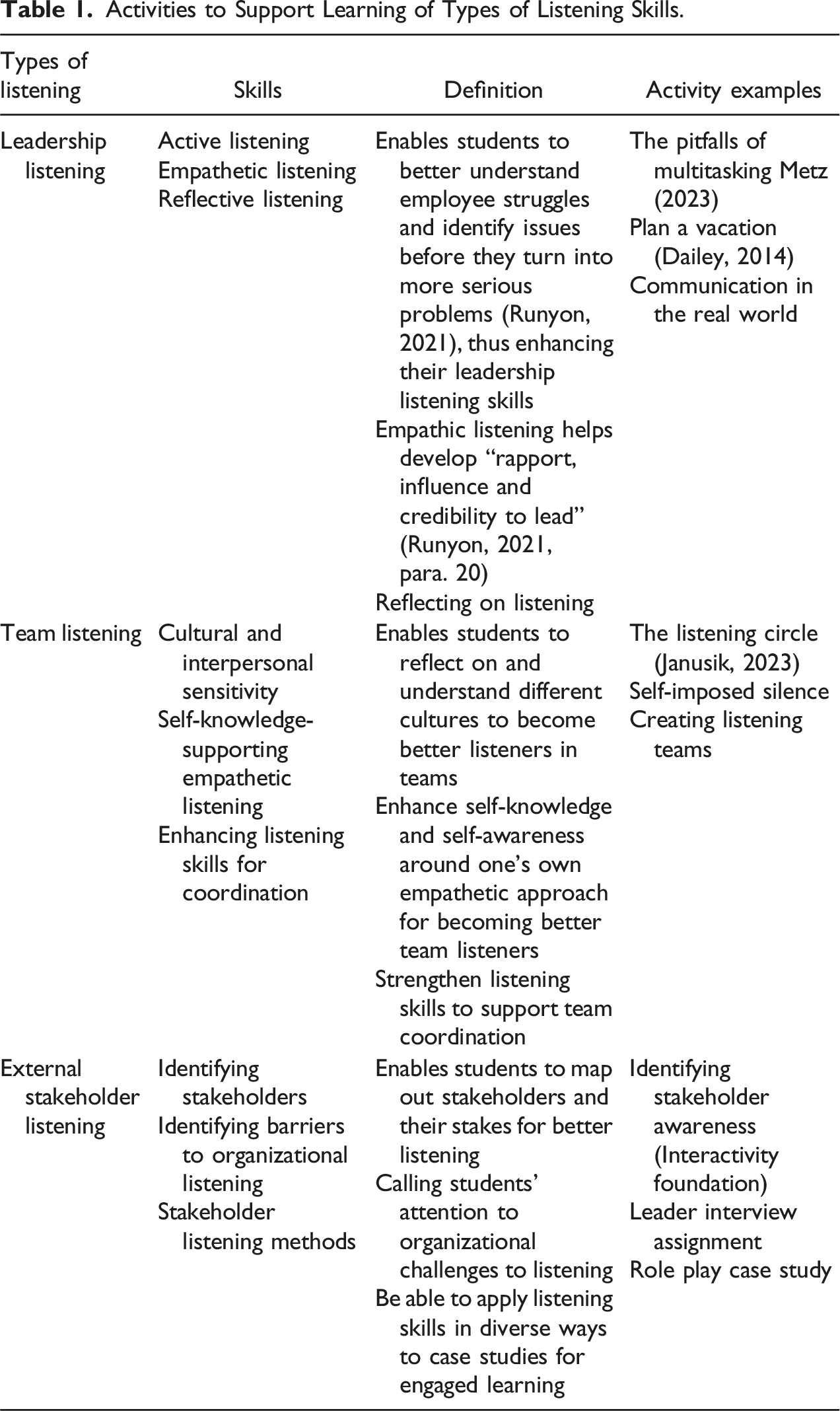
Activities to Support Learning of Types of Listening Skills.
Teaching Focus Area: Active Listening
Focusing on listening in real-world applications can help students better apply class content to their own lives. This can be a useful first step in learning to link class experiences to more professional leadership listening situations.
Activities like The Pitfalls of Multitasking help students quickly experience the negative impact multitasking has on their listening (Metz, 2023). In response to our increasingly high-information technological environment, this exercise requires students to multitask and then reflect on the experience and focus on how the multi-tasking influenced their ability to listen effectively. Students then develop strategies for reducing the negative impact of multi-tasking on listening in future encounters.
The Southwest Minnesota State University website (n.d) includes a number of listening activities that can be assigned to increase student awareness and practice of active listening within the classroom environment and foster effective active listening in organizational contexts. For example, students can be asked to use their listening skills to analyze a class lecture in another class and note ways the lecture enhanced effective listening. Students can also reflect on moments in the lecture they found hard to follow. Analyzing these moments of challenge can be key to understanding how difficult effective listening can be not only in the classroom, but in organizational leadership settings with complex structures and role relationships.
In a conflict-related activity (Cichon, 2001), students are placed in three different scenarios where they have to practice active listening with a peer, a subordinate, and a supervisor. In these teams, the speaker and moderator are aware of the goal of the discussion but the listener is not. Thus, the listener must use active listening tools to engage effectively in the discussion. Class discussion is important after this exercise and the moderators can share examples of active listening they witnessed and also target areas for improvement. According to Cichon (2001), this activity often reveals that in the scenario involving negative feedback, active listening approaches end up being more fruitful and help students veer away from resorting to providing excuses.
Post pandemic, organizations rely more on virtual communication, presenting new listening challenges for leaders. A way to help students adapt their listening skills for the digital environment is to embed listening into a standard class assignment. e.g., in an organizational communication course, it is common to ask students to interview a professional/leader in the student’s career of interest to learn more about the realities of the professional’s job and communication. A spin on this assignment could require the interview to take place on a digital communication platform and be recorded in a way that both faces are always shown on screen. Students can be tasked with figuring out how they can verbally and nonverbally signal and enhance their active listening in a virtual environment.
Teaching Focus Area: Empathetic Listening Perspectives
In preparing students for leadership roles, it is important to make them aware of how their own listening preferences influence interactions with others and may get in the way of empathic listening. Dailey (2014) has suggested an in-class activity where students are asked to plan a vacation, with planning groups formed based on their preferred listening style (e.g., people-oriented). They are told to think about how they would present their trip information to other people-oriented listeners. Once the teams have met, a more general class discussion can help students discover that groups with other listening preferences may have felt important details they would want were left out, highlighting how one’s own listening preferences can affect listening competence.
Teaching Focus Area: Reflecting on Listening
Having students reflect on their own communication experiences is another way to explore listening competence. In Communication in the Real World (University of Minnesota Libraries, 2016), it is recommended that students keep a listening journal for a day, noting every listening situation and reflecting on how well they think they used effective listening skills. Were they listening actively? Were the listening in an empathic way? Being able to reflect on real-world experience helps students see how listening needs will vary across contexts. Honest reflection is a way students develop awareness and take steps toward improvement. Further analyses of listening activity in organizational contexts can expand this activity to increase awareness of how listening is altered from a purely interpersonal interaction (between friends) to one where organizational rules, policies, routines, and power structures are in play. How do students listen at work? Are their listening habits different when they are responding to a customer complaint than when they are in a conflict with a friend or family member?
A related reflection assignment from Communication in the Real World expands these ideas to organizational environments. In this reflection, students are asked to analyze the listening environment at an organization and rate it as positive or negative. Students then write about the listening norms and expectations for competent listening that contributed (or detracted) from this environment and consider who set the tone for listening in this context. This assignment leads students to uncover the often-hidden role effective listening plays and also reminds students that the listening competence of organizational leaders helps set the tone for that environment.
Team Listening
Listening has been listed as one of the most relevant skills in organizational teams (Dunning, 2011) and authors have pointed to the importance of team listening to bind teammates together (Kluger et al., 2021). Effective team listening can support conflict resolution and idea generation in organizations. Team listening is especially complex because it consists of both individual level listening and dyadic listening (Kluger et al., 2021). While individual listening focuses on the role of the listener and their perspective toward listening, dyadic listening takes into consideration the reciprocal process of listening. For instance, because speakers may be more likely to share feedback if they trust that others are listening, effective team listening encourages reciprocity and self-disclosure.
There are also important negative consequences for listening failures in teams. Phenomena such as Groupthink (Janis, 1982) can result in silencing members, leading to poor decision making and harming team and organizational goals. Furthermore, when team members ignore others, toxic relationships and destructive communication may emerge and lead to inequities. As students become more aware of the role listening plays in team functioning and decision-making, they begin to recognize that listening is more than politeness.
Students need to engage with listening in the context of contemporary virtual teams as well. The move to hybrid industries, remote work, geographically dispersed work, and virtual teams are making it even more important for organizations to understand how team listening can affect the workplace (Janusik, 2023). In many of these contexts, employees have limited or no opportunities to meet each other face-to-face. Further, there are capacities and features of workplace technologies that can enable and challenge our listening abilities. For example, the ability to mute oneself (video and/or audio) can make it more difficult for others to interpret reactions during online meetings. The features that permit chat posting (to all or to individuals) during meetings increase the listening load. At times, individuals receiving messages through chat may not be as attentive to the spoken part of the meeting. It is also possible to multitask or become distracted by activities in one’s personal environment while muted from meetings, thus disabling full engagement in listening.
As organizational listening is more often accomplished through monitoring text-based communication, our students’ understanding should include consideration of chats, email, internal web-based communication, and platform use. Messages on multiple platforms and text-based technologies enable multiple flows of input, permenance of comments, and more frequent interactions. However, monitoring these channels, discerning who is “on” each thread, and learning how to “listen” for cues of attentiveness and understanding shorthand, humor, emojis, and other types of text-based communication add new layers to our typical listening routines and practices.
Team communication can also provide an opportunity for students to explore and understand different listening styles and capabilities that emerge due to intersectionality. Team composition and the implications for students to encounter differences in style and expectations for quality listening are areas for exploration. For example, students need to recognize that our culture, upbringing, and ethnicity often socialize us to listen differently (Ratcliffe, 1999). A study conducted by Roebuck et al. (2015) concluded that national culture and gender have an impact on workplace listening. Typically, the Dunning-Kruger effect (Dunning, 2011) emphasizes that most people view themselves as good listeners, while they view others to have poor listening skills. This perspective can cause team members to become insular and ignorant about other ideas because team members can overlook the fact that people listen differently. Even when team members think they are good listeners, others may have different understandings of what good listening means.
Students should be taught to view listening as a skill that can be improved with practice. Also, there is value in being flexible in terms of adapting listening behavior to the team’s culture or when listening to someone with different listening expectations. Effective team listeners invite others to collaborate by showing their willingness to listen carefully and respond to team members after reflection (Behfar et al., 2008).
Teaching a Critical Perspective on Team Listening
Our students would also benefit from a critical perspective around team listening that explores the assumption that everyone has equal access to being heard. It is important to address that when we choose to listen to certain team members, we can purposefully or inadvertently exclude others, sometimes avoiding the most important voices that can result in “othering.” Furthermore, how we listen to people in teams is critical because it can affect individual team members in different ways (e.g., self-silencing, feelings of isolation) and can set the tone for future team interactions that limit the perspectives, ideas, and contributions that are voiced and considered in the team’s decision making.
Key Skills in Teaching Team Listening
Important skills for team listening that can be developed in courses include developing curiosity and listening to understand, developing cultural and interpersonal sensitivity and empathic listening, and enhancing coordination through listening. These skill sets can help develop an equitable team dynamic by enhancing collaboration and reducing dysfunctional conflict. Team course instructors should focus on developing a team listening mindset and imparting these skills through practice, allowing students to participate in teams and become more culturally aware of others’ realities and orientations.
Three class activities are presented in the following sections (and summarized in Table 1). These can be adopted for teaching team listening to classes, where students can enhance team listening skills of developing curiosity and self-reflection, understanding cultural sensitivity, coordinating through team listening, and responding through reflection and empathy.
Teaching Focus Area: Listening Circles
The idea of a listening circle emerged from the ancient traditions that used a talking stick. Typically, listening circles can be conducted during listening classes to emphasize team listening. As discussed by Janusik (2023), the circle may consist of 10–25 individuals. The main rule is that the person holding the stick is the only one allowed to speak and should not be interrupted. The speakers are asked to speak from their heart, speak succinctly, speak with spontaneity, and without rehearsal on a particular topic at hand.
The most important part of this circle is the element of curiosity, where individuals should not judge or evaluate one another in a negative or a positive way. This activity can help students develop curiosity and self-reflection as students hear different point of views. While initially challenging, this activity provides a safe space for students to expand their perspectives and understand the value in hearing diverse viewpoints.
Instructors may lead the circles themselves or appoint other members to serve as moderators, thus also enhancing leadership listening skills in students. This exercise can be followed by journaling, where students can write down their thought process, identify their biases, and reflect on ways they can do better in the future. It is important for instructors to debrief after listening circles to discuss the importance of listening with an open mind. Constant practice in these circles can help students develop patience, empathy, and understanding for diverse perspectives.
Teaching Focus Area: Self-Imposed Silence During Team Discussions
In this activity, breakout groups of five to ten students are given a particular topic to discuss. Like the listening circle activity, students (listeners) are asked to take turns to maintain silence for a prolonged period during that discussion, and asked to observe the group dynamic and how the discussion evolves. At the end of the period, the listeners are asked to reflect on emotions they experienced, self-knowledge, understanding others, and observations about team listening. This enhances students’ awareness toward team listening.
Studies have shown that maintaining silence helps students actively listen to others (Johnson et al., 2003) and that students have take listening for granted. In this research, students listened actively to others and heard things they would not normally hear that helped them better comprehend people’s positions (Johnson et al., 2003). Silence helped individuals reflect on their listening awareness and supported them in developing beneficial listening skills.
Teaching Focus Area: Listening Teams
Developing listening teams (Hafisanto, 2023) is another way to emphasize cooperative learning models. In this activity, students are divided and each group has a distinct assignment to complete that requires working together; this prioritizes listening as a critical skill for completing the group project. For example, the instructor can create four groups, where three groups are expected to respond to a set of questions by adopting a specific perspective; thus, each of these groups are involved in role playing. When a question is posed by the instructor, the team members are allotted a set amount of time to come up with a response, based on the perspective they were given. The fourth team is made responsible for reviewing and drawing the final conclusions from what they hear (i.e., how team members engaged, which teams did better in terms of role playing, and how listening helped teams coordinate).
The dialogue between team members helps form listening skills that support coordination and also helps students understand empathy by exploring how different perspectives are formed around the role they are asked to play. Importantly, this further creates a dialectical process leading to active discussions around how team listening can help with problem solving. Students can also point out the hurdles and conflict that arose between team members and the roles they were playing, and how team listening or the lack of listening may have affected team dynamics.
External Stakeholder Listening
In our organizational communication courses, we often devote space to considering how organizations speak to external stakeholders (e.g., clients, customers, community members, vendors, suppliers, oversight agencies, partners) although we sometimes neglect how organizations and their leaders listen to these stakeholders. Organizational listening directed to external stakeholders often is accomplished through market research, stakeholder engagement, complaints handling, and social media monitoring and analysis (Macnamara, 2019). Businesses commonly use surveys and requests for feedback through websites, email, and smart phones among other technologies. Call centers, email, and chat technologies are commonplace ways for customers to pose questions, get help, and submit complaints. Nonprofits and governmental agencies and governments also employ tactics to listen to communities, citizens, and stakeholder groups such as town halls, citizen call-in lines, and . gov sites or social media pages.
Students should appreciate that a common approach to external organizational listening focuses on openness to and monitoring of organizational stakeholders and publics to maintain positive relationships while understanding critical audiences and environments. Organizations also often use external listening strategies in order to portray an image of an accessible and attentive organization. As Lewis (2022) argues: Permitting stakeholders to have a voice or enter into dialogue with an organization is often considered an ethical responsibility for contemporary organizations. Increasing opportunities for individual clients, customers, vendors, community members, and employees to voice concerns, ideas, input, opinions, feedback, reactions, and so on, is considered … to be morale-boosting and likely to give rise to increased cooperativeness and/or better relationships necessary to the organization’s success. Where feedback from stakeholders is expected to be negative, managers frequently use these opportunities to vent reactions and possibly correct misunderstandings or mischaracterizations. (p. 223)
Teaching a Critical Perspective on Stakeholder Listening
Although organizations will sometimes go to great lengths to create routines for stakeholder engagement, dialogue, and relationship building with key publics, they frequently do so more for show than substance. From his study of such activities, Macnamara (2015) concluded that, on average, around 80% of organizational resources devoted to public communication are focused on speaking, distributing information, and delivering messages. Listening to community members may come down to taking a “pulse reading” of public opinion rather than parsing concerns and engaging in discussion or deep listening (Lewis & Sahay, 2024). While many organizations are creating channels for stakeholders to have voice (e.g., social media), few, it seems, are creating parallel internal structures or processes to listen to those voices. Further, a good deal of the listening that does take place is focused on collecting narrow bits of information that trigger scripts for the organization to continue speaking (e.g., customer relationship management designed to gain repeat sales or upsell to customers). The point of this type of listening is to better execute an organization’s original thinking and decisions rather than to seriously call into question those plans or to learn something that would trigger internal reconsideration.
Our students should learn to appreciate the potential serious consequences that can unfold when listening is more of a ritual than a trigger for reexamination or reconsideration of decisions made. Listening failures often involve decision-makers’ and leaders’ lapses in reaching for potentially disconfirming and uncomfortable data, as well as a lack of rigor in analyzing what was heard and an unwillingness to seriously question leaders’ assumptions, plans, and preferred worldviews (Lewis, 2020).
Teaching Key Skills in External Stakeholder Listening
Organizations are often able to leverage the insights collected from consumers through surveys, focus groups, complaint and comment boxes (or online spaces), analysis of recorded consumer calls, and social media sources (Lewis & Sahay, 2024). The idea behind collecting “the voice of the consumer” [VoC] is to identify consumer needs to support product development and service improvement. Bieber (2018) has argued that VoC programs may be extremely effective in collecting input but are often not sophisticated in channelling that input into decisions. Specifically, customer experience expert Michael Hinshaw has pointed to research that “only 29% of firms with VoC in place systematically incorporate insights about customer needs into their decision-making processes. And nearly three-fourths don’t think that their VoC programs are effective at driving actions” (Bieber, “Introduction” section, para. 3, 2018).
Our organizational communication courses should include attention to means, methods, structures, systems, and processes for listening to external stakeholders. Lewis (2020) has argued that “organizations that are designed in ways that impede critical analysis; discourage questioning of long-standing reasoning; or block engagement with evidence, information, and data, will fail, despite the best efforts of excellent individual listeners.” (Lewis, 2020, p. XVIII)
Students can begin to appreciate the complexity of how organizations—as a whole or in parts—listen by exploring Macnamara’s (2018) architecture of listening as a way to help organizations develop a listening culture. The eight tenets of this theory incorporate creating a culture that is open, addressing the politics of listening, developing policies to specify and require listening, creating systems that allow for interactivity, using technologies that facilitate meaningful conversations, allocating resources (especially human resources to establish listening systems), cultivating and imparting skills that allow individuals and organizations to conduct large-scale listening, and using the information/voices of stakeholders and publics for policy-making and decision-making.
The next sections offer teaching activities (summarized in Table 1) that can be incorporated into organizational communication courses to highlight listening to external stakeholders. These activities help students develop awareness of those individuals/groups/organizations that seek to have their stakes in the organization addressed, identifying barriers to organizational listening, and developing methods to listen better.
Teaching Focus Area: Identifying Stakeholders
In our organizational communication courses, we can foster a deeper appreciation for stakeholders and stakeholder listening through first helping students to simply engage with activities to identify stakeholders, stakes, issues, values, and needs. One helpful activity is part of a collaborative discussion toolkit created by the Interactivity Foundation (See Appendix 1). The activity “Identifying Stakeholder Awareness” enables instructors or facilitators to lead students through identifying types of stakeholders in a specific case or situation. The activity centers around four types of stakeholders: Affected (those directly impacted by the issue), Helpers (helping those affected), Influencers (advocate for change), and Decision-Makers (with power to make change). Students create a chart of stakeseekers (who desire to be recognized) and stakeholders (who are recognized as having a stake) relevant to the specific case and then categorize them into these types. Students are encouraged to think broadly about stakeholder groups and to think about sets of stakeseekers/holders who may be easily overlooked or intentionally sidelined or minimized.
Implications for listening or failing to listen to various stakeholders can be a major focus of the debriefing. Students can be encouraged to consider the challenges and methods that might be used to create supportive contexts to receive input of various types or from specific groups of stakeholders. Discussion may focus on who should do the listening, how listening should occur, and useful channels for soliciting input and moving it towards users and decision-makers within organizations. This activity can both enrich reflection about identifying stakeholders and further understanding of their communication needs to have meaningful interaction with decision-makers or other units/groups.
Instructors may also incoroporate other activities in the toolkit focused on expanding perspectives, understanding values in context, and seeking divergent thinking and perspectives to name a few. The combination of exploring who stakeholders are, what they value, how they might be best invited to engage on a topic or issue enables rich conversation and exploration of listening in the context of outreach to external stakeholders.
Teaching Focus Area: Identification of Barriers to Organizational Listening
Once engaged about stakeholder listening, students typically can generate many strategies, tools, and ideas about how to seek and collect input, though they often lack an appreciation of organizational challenges. Calling students’ attention to significant barriers that commonly exist in organizations that discourage the wise analysis, consideration, and utilization of stakeholder input is an important next step.
In a leader interview assignment, students can explore with an organizational leader how they view listening. Instructors may point students towards key topics (e.g., those in Lewis’s 2020 book centered around activities, problems, principles, resources, approaches, insights, satisfaction, and espoused values). Lewis’s interview guide in the book’s appendix may also be useful in creating a list of specific questions to surface how the leader assesses listening, how stakeholders are listened to, when failures of listening occur, and how the leader enourages or supports listening.
Students who complete this assignment are exposed to a deeper level of reflection about how leaders consider the importance and functioning of listening in their organizations. Oftentimes, students comment on the lack of insight or reflection that leaders have on quality listening and its importance. At times, leaders are quite forthcoming with attitudes of hubris; this provides students’ insights into the advice discounting tendencies (noted above) that research suggests are quite common. At other times, students discover the frustrations leaders have with taking in input that is difficult to understand, process, or satisfy.
Teaching Focus Area: Stakeholder Listening Methods
As our students become more aware of complexities in how and when to listen, as well as complex dynamics in leaders’ orientations to listening, they are better prepared to apply what they have learned in a specific situation. A good culminating experience for students in a unit on organizational listening is a role play case study. There are many case study resources for instructional purposes in a variety of organizational communication texts and websites. Any case with a complex set of stakeholders with diverse needs and demands will likely be appropriate to apply listening concepts. Once a case is selected, the students can then enter a C-Suite role play exercise in a class session (or more). In the activity, students are asked to read the case prior to class or at the very beginning of class. Students are then divided into various C-suite teams led by VPs (COO, CFO, CIO, CMO, CTO, CHRO). It often works better if the instructor plays the role of CEO because the resulting power dyanmics will add to the realism.
In this exercise, the CEO calls a meeting of the C-suite officers and their teams. The teams are asked to discuss the situation the company finds itself in with complex and conflicting demands by various stakeholders (e.g., employees, vendors, consumers, community) and typically a serious set of potential negative consequences (e.g., threats of strikes, legal action, protest, limited supply chain). The CEO has just returned from a workshop where they learned about the importance of organizational listening. They want each area to analyse the company’s situation and develop listening strategies that can help the team develop solutions and strategies for survival and success. After a time for discussion in teams, the CEO reconvenes the entire team in the C-suite to discuss the suggestions.
A struggle for students in this role play is staying on the general topic of listening strategies. Most students immediately jump to solutions for the problem, skipping over listening to stakeholders. If they do incorporate listening, they often underappreciate the difficulty of listening to those stakeholders (e.g., methods, logistics, motivations) and they often fail to consider how the input will be processed and channelled within and across units to solve complex problems that may span from marketing, to HR, to manufacturing, to sales. The C-suite meeting is an opportunity for the instructor to call up these issues and challenge various departments to think through the complexity.
Conclusion
In this essay, we presented a rationale for enhancing pedagogical attention toward organizational listening. We discussed listening related to leadership, teams, and external stakeholder communication. While we noted that listening is a topic of high relevance and one that is typically invoked implicitly—and sometimes explicitly—we argue that the discipline has likely not been intentional enough in teaching students the importance and nuances of organizational listening, and the skills to analyze and improve organizational listening activity. It has thus become critical for us as organizational scholar-teachers to develop a strong pedagogy that incorporates organizational listening into and throughout our courses.
Students will come away with an increased appreciation for the infrastructure, orientation, and skills needed to practice collecting feedback, processing widely varying perspectives, and making use of stakeholder input in decision-making. This affects all levels of organizational activity including leadership, team functioning, and organizational relationship-building in the wider environment. Listening is a topic with high relevance for most organizational communication courses—including introduction to organizational communication, leadership/supervisory communication, team communication, decision-making, and public relations—so the examples presented in this essay could certainly be extended as needed. We encourage instructors who design and deliver these courses to enhance their attention to listening in order to heighten students’ awareness, skills, and practice of quality listening in organizations.
Footnotes
Declaration of Conflicting Interests
The author(s) declared no potential conflicts of interest with respect to the research, authorship, and/or publication of this article.
Funding
The author(s) received no financial support for the research, authorship, and/or publication of this article.
