



Abstract
A series of vertical fire suppression experiments were conducted by water film over external facade of concave structures based on a self-built experimental platform. The evolution of characteristic parameters—including average flame height and flame morphology—was investigated during typical insulation material(extruded polystyrene-XPS) flame propagation under varying structural factors (α) and external radiative heat flux conditions. The critical water film flow rates for protecting XPS materials from sustaining combustion under different α and external radiative heat fluxes were determined. The results indicate that the cooling effect of the water film can effectively suppress upward flame spread. Critical water film flow rate rise with increasing external radiative heat flux. When there is no external radiation, it is found that the critical water film flow rate changes little with α increase. When α ≤ 1.0, the critical water film flow rate increases with α increase. When α > 1.0, the critical water film flow rate remains essentially unchanged with the increase of α. The experimental findings provide critical insights for designing, implementing, and optimizing exterior wall water spray systems, thereby mitigating fire risks in high-rise structures and enhancing building resilience.
Keywords
Introduction
A simple list of thermoplastic materials current used for exterior walls in high-rise buildings.
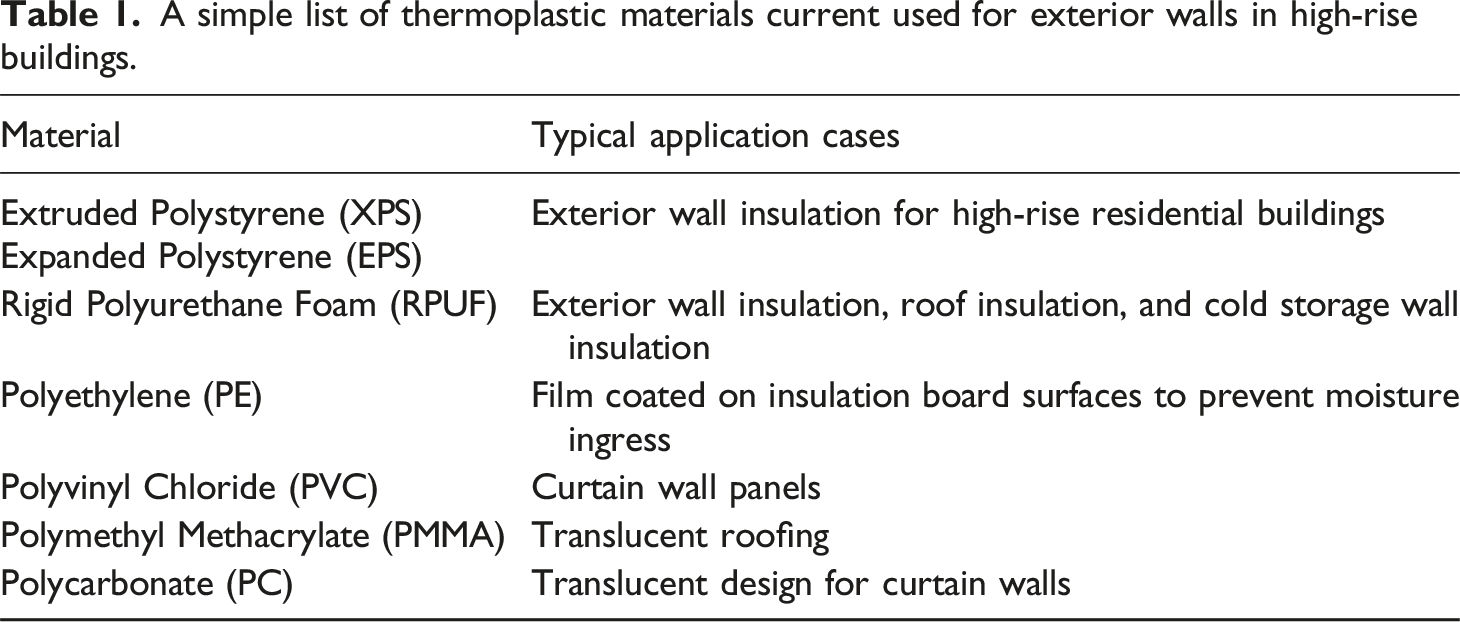
This study investigates vertical material combustion suppression through experimental analyses of pyrolysis inhibition mechanisms, predominantly examining water’s direct interaction with combustible surfaces during fire suppression processes. For example, Tamanini 16 used lateral water sprays directly on the pyrolysis zone of vertically placed wooden materials to study the suppression characteristics of the spray on combustion. Based on the mass change process of the combustible material during the suppression, he obtained the critical spray flow rate needed to suppress the material combustion. Magee et al. 17 conducted water suppression experiments on vertical plastic fires under external radiative heat fluxes, obtaining the critical sprinkler flow rates necessary to suppress the combustion of vertical plastic fires under various levels of external radiation. Xin et al. 18 conducted suppression experiments on vertically placed rolled paper fires and found that for smooth rolled paper surfaces, the water film formed by spraying created more rivulets, which was not conducive to suppressing the spread of rolled paper fire. Zhou 19 studied vertical fir wood panels of different thicknesses fire suppression using lateral water sprays. He found that the cooling effect of the water spray on the material surface is crucial for suppressing and obtained the critical water spray flow rates. Zhao 20 studied the effects of water application angles, water pressure/flow rate, and other conditions on fire extinguishing behavior. The investigation revealed an inverse correlation between nozzle discharge angle escalation and fire suppression duration in vertical combustion scenarios. Zhao et al. investigated the water suppression spray flow rate and angle on the combustion of vertical rigid polyurethane insulation materials when directly applied to their pyrolysis zone.21–23 Additionally, experiments were conducted on the water spray suppression effect under external radiative heat fluxes on rigid polyurethane material combustion. 24 It was found that there is a relationship between the critical water flow rate and the external radiative heat flux. Liu et al. compared the efficiency and effectiveness of water mist and spray systems. 25 This study determined that the fine water mist system had a significantly better suppression effect on central fires than the spray system, but its effective coverage area was smaller. Although the water spray system had a lower water utilization rate, it could effectively suppress fires over a larger area. Overall, researchers have extensively studied the suppression of material combustion when sprinklers were directly applied to the pyrolysis zone of materials. They have generally reached a consistent conclusion: the best fire extinguishing effect is achieved when the spray droplets are directly applied to the solid pyrolysis zone. Previous studies typically focused on the suppression of combustion in vertical flat materials without addressing concave exterior wall structures, which tend to accelerate fire spread.
In terms of water film flow and heat transfer effects, Zhao et al. 26 explored the spreading condition of the water film formed by the water curtain nozzle on the vertical plane and found that the continuous area and length increased with the flow rate before decreasing. Zhu et al. 27 conducted experimental studies on cooling aluminum alloy plates with water films at various temperatures. Costa et al. 28 studied the cooling efficiency of water sprays on vertical hot metal surfaces under different environmental pressures. Meredith et al. 29 conducted experimental studies on the flow state of water films on smooth stainless steel surfaces under external radiative heat fluxes. They obtained the relationship between the external radiative heat flux and the critical water film flow rate when the water film on the stainless steel surface completely evaporated. Zhao et al. 30 based on a self-built experimental setup for pre-wetting inhibition of insulation material combustion by water films, studied the influence of water film flow rates on the appearance of dry spots, deformation, and melting on the surface of polystyrene insulation materials under external radiation. It was found that the time at which dry spots appeared on the PS material surface, along with the occurrence of material deformation and melting, showed a trend of initially decreasing before stabilizing as the dimensionless radiative heat flux increased. In summary, scholars have focused on the high-efficiency heat transfer effects of water films, concentrating mainly on the cooling of metal plates or glass. Preliminary studies have been conducted on insulation materials fire suppression by water films formed through spray, limited to the combustion suppression effect of pre-wetting behavior with water films.
Therefore, based on the urgent need for fire protection in high-rise buildings, this paper takes typical thermoplastic insulation materials (extruded polystyrene-XPS) as the research object and investigates the water film suppression of external facade fire spread behavior in concave structures. Some parameters under different structural factors and external radiative heat flux were analyzed.
Experimental setup and procedure
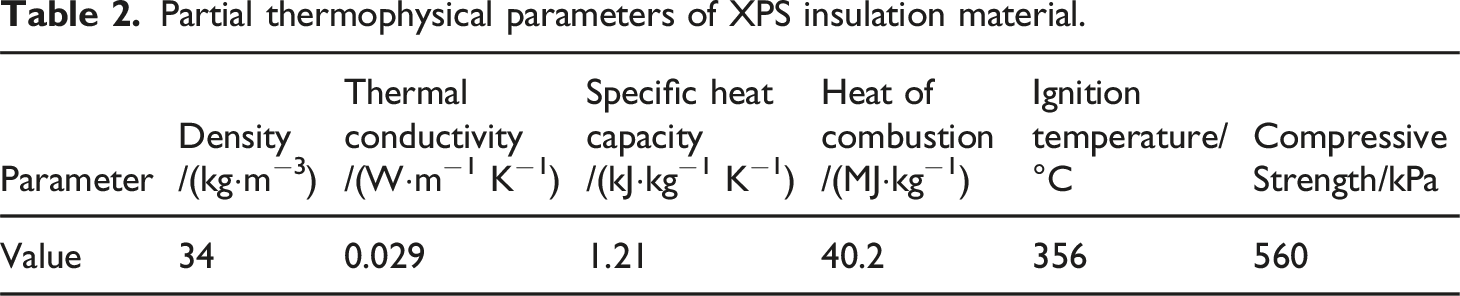
Partial thermophysical parameters of XPS insulation material.
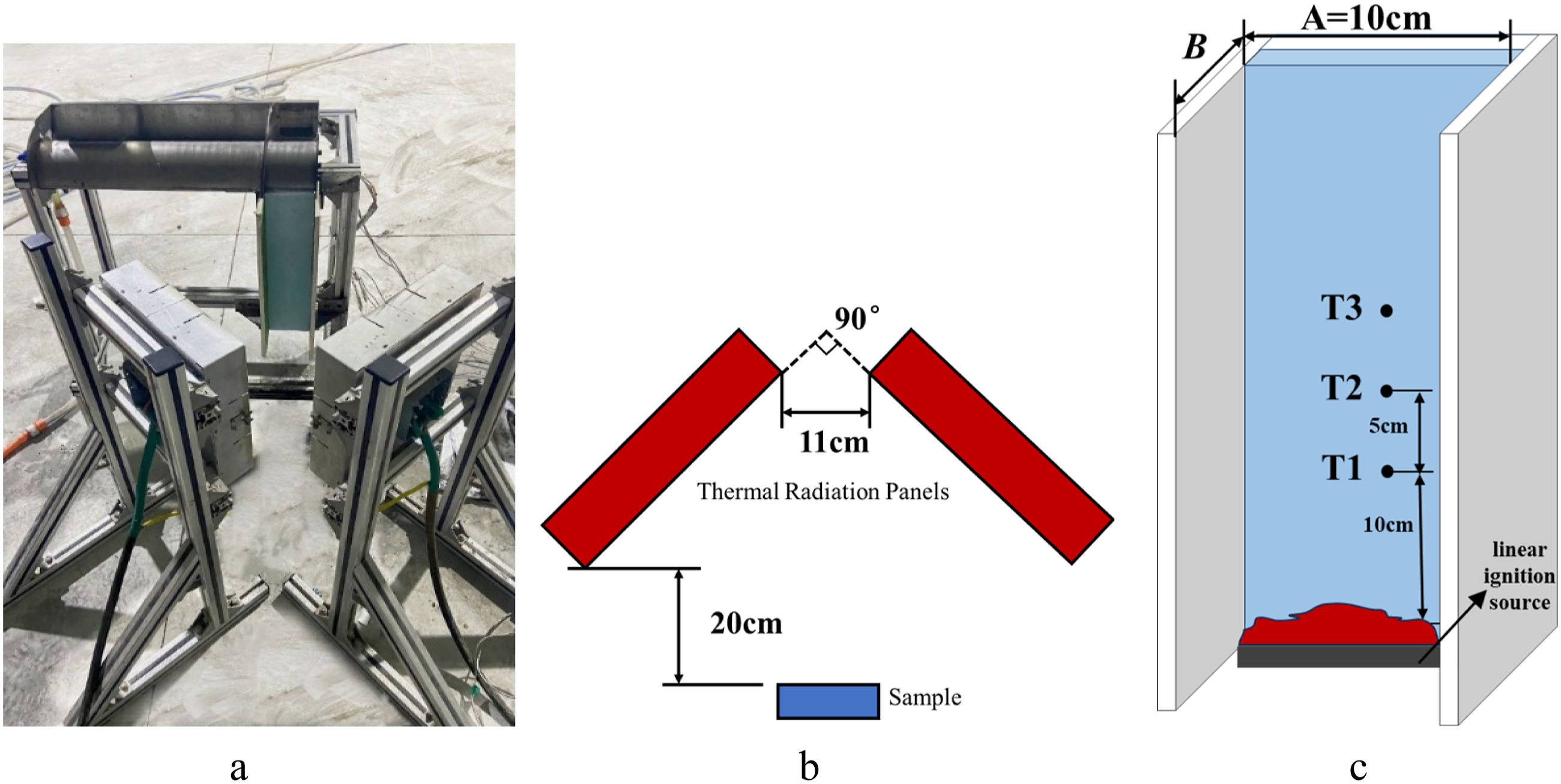
Experimental setup. (a-Scene Photo. b-equipment position. c-Thermocouple arrangement).
Experimental conditions.

In experiments investigating water film inhibition of fire spread across concave exterior walls, aluminum foil was applied to the sidewall tops to prevent water absorption by the gypsum board, thereby avoiding interference with experimental outcomes. Three measurement points (T-1, T-2, T-3) were vertically marked along the centerline of the insulation material’s back surface. K-type thermocouples were inserted at these positions, with T-1 positioned 10 cm from the bottom and consecutive points spaced 5 cm apart (Figure 1(c)). To prevent the thermocouple probe from penetrating the insulation board’s front surface and forming foam pits that might interfere with the water film flow process, insertion depths were strictly controlled. The thermocouples were pre-marked to ensure their tips maintained a 1–2 mm distance from the insulation material surface. The water film flow rate was controlled using a German SERA brand diaphragm metering pump, which increased from 1 L/h to 38 L/h in 1 L/h increments. The external radiation source consisted of two high-power density quartz surface infrared radiation panel. The two thermal radiation panels were positioned at a 90° angle in front of the material (Figure 1(b)). A K-type thermocouple was positioned near the central surface of the radiation panels to enable precise temperature monitoring and control. The calibration process was described in the conclusion section. The radiative heat flux measurements were conducted using a GARDON GTT-25-50-RWF circular-foil radiation heat flux sensor. The heat flow meter was equipped with a surface-mounted sapphire window for optical access. It was integrated with a water-cooling system connected to a circulating pump, ensuring stable sensor operation during prolonged thermal exposure. A digital camera was placed 2 m away from the surface of the insulation material to record the changes in flame shape and flame height throughout the entire experimental process. The flame height was obtained through batch processing of video images using Matlab.
Prior to experimental initiation, the liquid distribution box was water-filled, and the pumping system was calibrated to achieve predefined flow parameters. Thermocouples were inserted at the marked positions on the back of the insulation material, and a fire barrier was placed in front of the insulation material to prevent XPS from melting due to heat. Upon reaching peak internal temperature in the radiation panel, the digital camera and data acquisition system were simultaneously activated. Following this initialization, the XPS material was ignited before removing the ignition source. At the same time, the pump was turned on, and the water film began to flow downward. Upon complete combustion or water-film-induced extinguishment of the XPS specimen, the fire barrier was immediately repositioned to shield the test area. Following this safety protocol, the digital imaging system and data acquisition module underwent systematic deactivation. This sequence of operations formally terminated the experimental procedure. The experimental analysis examined surface temperature variations, average flame height, flame shape evolution, and surface morphology changes of XPS insulation material under varying external radiative heat flux intensities and water film flow rates. Through iterative experimental refinement, the water film flow rate range was progressively narrowed. This process ultimately identified the critical water film flow rate at which XPS combustion sustainability was completely suppressed. Each set of experiments was conducted at least three times.
Results and discussion
External radiation intensity calibration
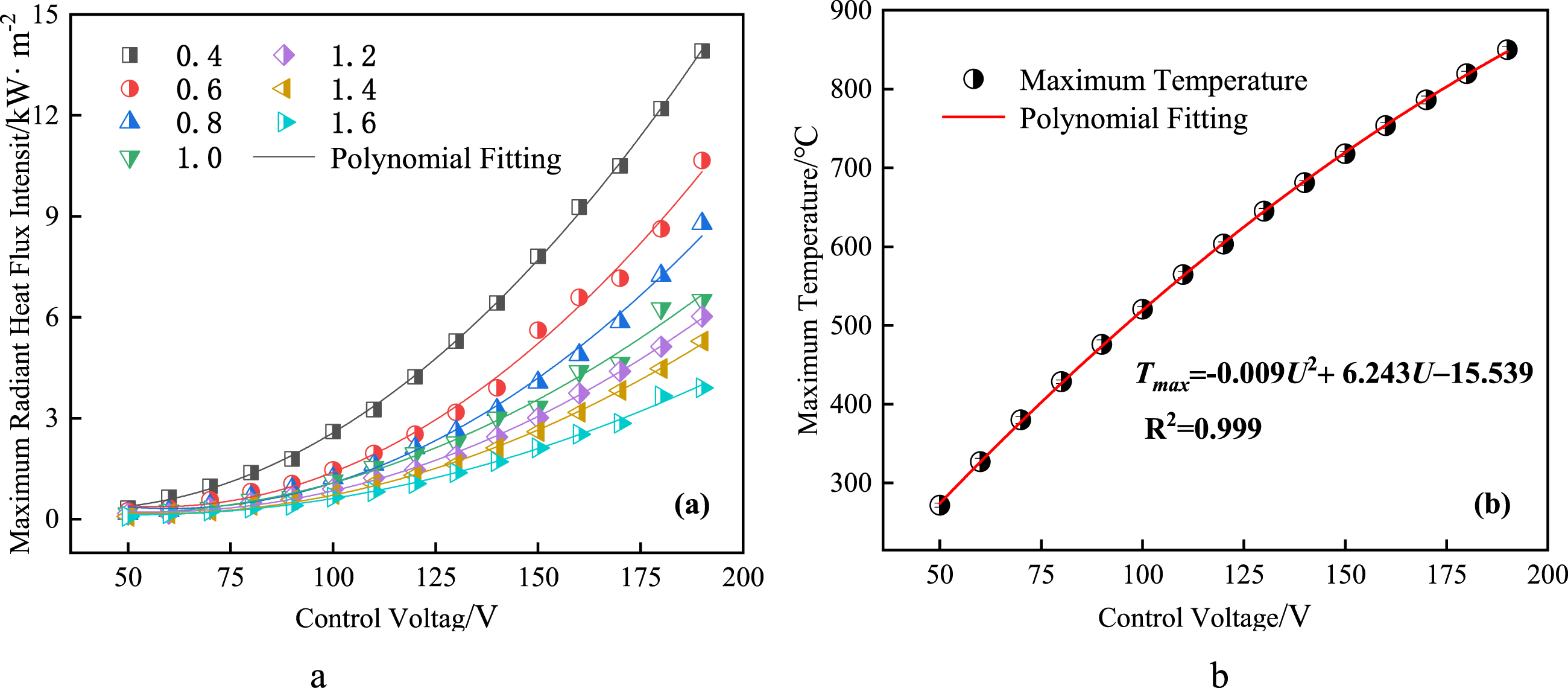
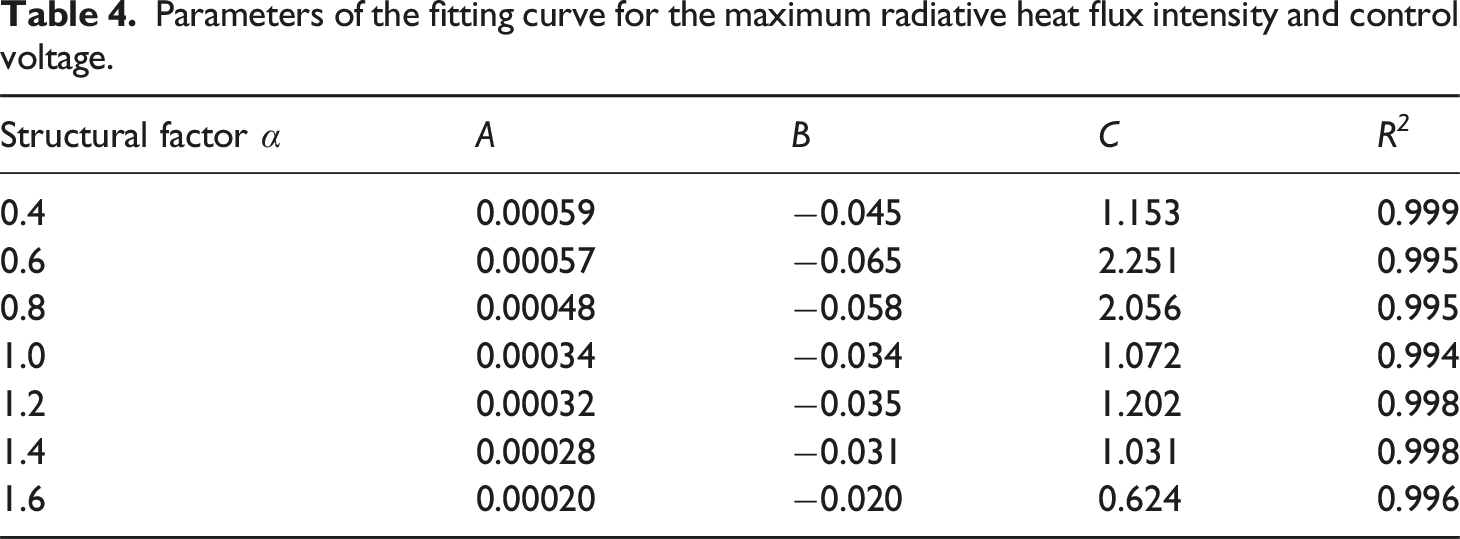
The calibration experiment for the external radiation system involved systematic measurements under controlled conditions. Researchers recorded both the central temperature of the thermal radiation panel and the radiative heat flux intensity received at the center of the insulation material. These measurements were conducted across control voltages ranging from 50V to 180V. Additionally, the experiment examined seven structural factors α values: 0.4, 0.6, 0.8, 1.0, 1.2, 1.4, and 1.6. The relationship between the control voltage and the maximum radiative heat flux intensity received at the center of the insulation material was fitted for different structural factors. Additionally, the relationship between the control voltage and the maximum temperature at the center of the insulation material was also established. The fitting results are presented in Figure 2. As shown in Figure 2(a), the maximum radiative heat flux intensity exhibits an exponential growth with increasing control voltage. Additionally, at a fixed control voltage, the maximum heat flux intensity declines as the structural factor rises. The increase in structural factor results in a wider sidewall. This expanded sidewall obstructs radiative heat flux from reaching the material’s surface, thereby reducing the heat flux intensity received by the insulation material. The relationship between the maximum radiative heat flux intensity and the control voltage can be expressed as equation (1). Fitting curve of control voltage with maximum radiative heat flux intensity and maximum temperature. (a- Fitting results of maximum radiative heat flux intensity. b- Fitting results of maximum temperature).
Parameters of the fitting curve for the maximum radiative heat flux intensity and control voltage.
The uniformity of radiation received by the material surface was evaluated by measuring temperatures at four peripheral points and the center of the combustible material. With measurement errors remaining below 5%, this demonstrates that the radiant heat flux distribution across the material surface is effectively uniform.
The fire suppression experiments investigated water film application along the concave structure of an external facade. Required voltage and maximum temperature for the experiment were calculated based on the relationship between the control voltage and the maximum radiative heat flux intensity and the maximum temperature. The voltage regulator was adjusted to the specified voltage. When the temperature in the data acquisition software reached a stable value, the experiment began. The radiative heat flux intensities measured at the material surface during the experiment were 0 kW/m2, 1.48 kW/m2, 2.12 kW/m2, and 2.96 kW/m2.
Surface temperature
The analysis focuses on representative cases with an external radiative heat flux of 1.48 kW/m2 and a structural factor α = 0.6. Figure 3 illustrates the corresponding variation curves of temperatures T1, T2, and T3 across different water film flow rates. At constant water film flow rates, temperature measurements show T3 consistently remains higher than T1 and T2. This temperature gradient demonstrates that flame thermal feedback persists with vertical elevation even under water film application. As the water film flow rate increases, the maximum surface temperature at T-3 decreases, indicating that the cooling effect of the water film on the material surface gradually increases. When the water film flow rate is 10 L/h, the maximum temperature is less than the ignition point of XPS (356°C), indicating that this water film flow rate may be the critical flow rate to suppress combustion. Temperature Changes with Time at Different Heights when α = 0.6. (a-9 L/h. b-10 L/h).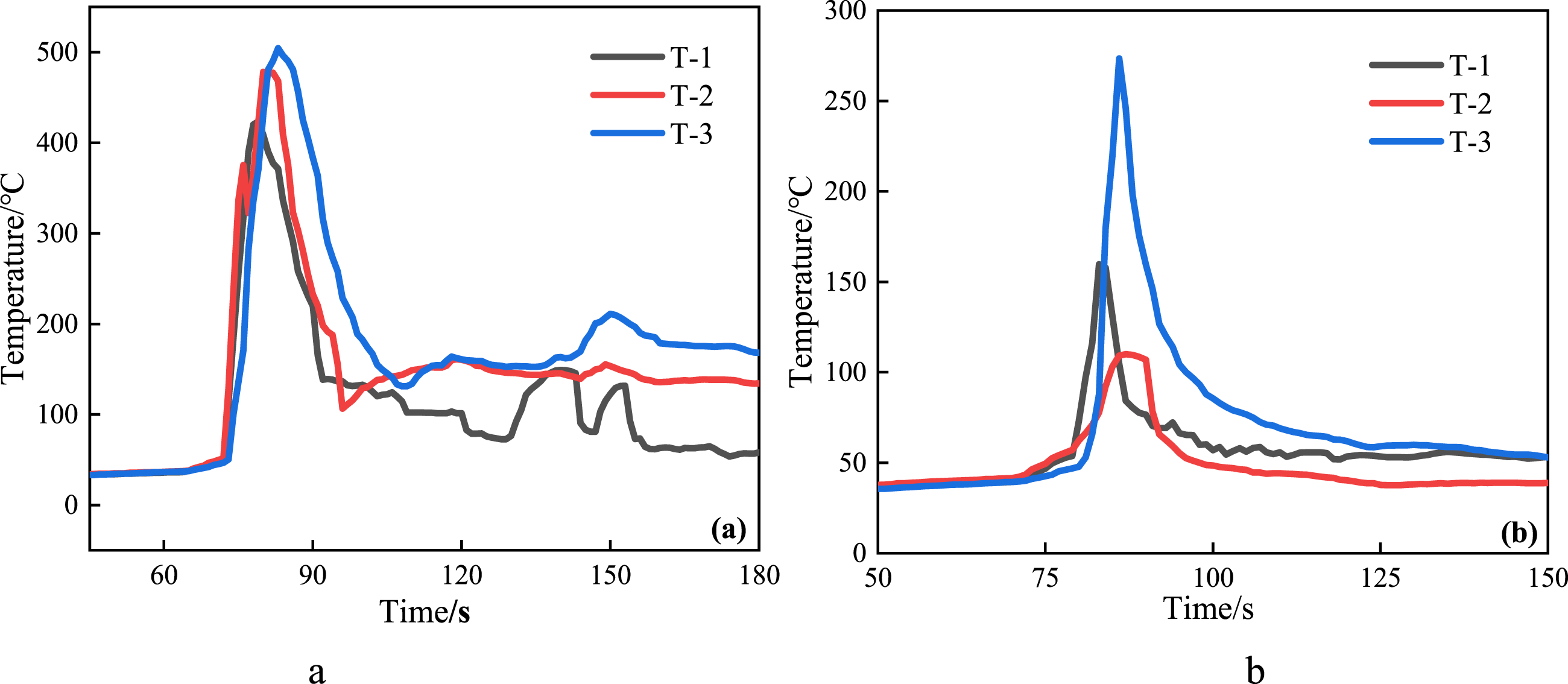
Consider temperature variations at the T1 position on the material surface under varying water film flow rates at α = 1.4 as a representative example. The corresponding data are presented in Figure 4. Figure 4(a) demonstrates that at a water film flow rate of 5 L/h under no external radiative heat, the maximum temperature at the detection point exceeds the XPS ignition temperature. Despite cooling-phase temperatures remaining below the material’s melting point (150°C), this thermal threshold surpasses critical combustion parameters. At a water film flow rate of 6 L/h, the maximum temperature remains approximately 50°C below the material’s melting point, suggesting this may represent the critical flow rate threshold. Notably, increasing the flow rate to 7 L/h results in significantly higher detection point temperatures compared to 6 L/h. This counterintuitive phenomenon likely stems from enhanced air entrainment at elevated flow rates, which intensifies combustion dynamics at the fire interface. Until the water film flow rate reaches 8 L/h, the cooling effect of the water film on the material surface dominates the fire spread process. Figure 4(b) reveals that under an external radiative heat flux of 2.96 kW/m2 and a water film flow rate of 26 L/h, the detection point temperature exhibits rapid escalation followed by stabilization near 700°C. This thermal behavior demonstrates two key phenomena: (1) the water film’s cooling efficacy becomes negligible under such conditions, and (2) external radiative forcing dominates the combustion sustainability of XPS material. At a water film flow rate of 27 L/h, the detection point temperature remains below the material’s melting threshold. This observation indicates that 27 L/h likely represents the critical flow rate required for effective fire suppression. Temperature Changes with Time at Different Heights when α = 1.4. (a-0 kW/m2. b-2.96 kW/m2).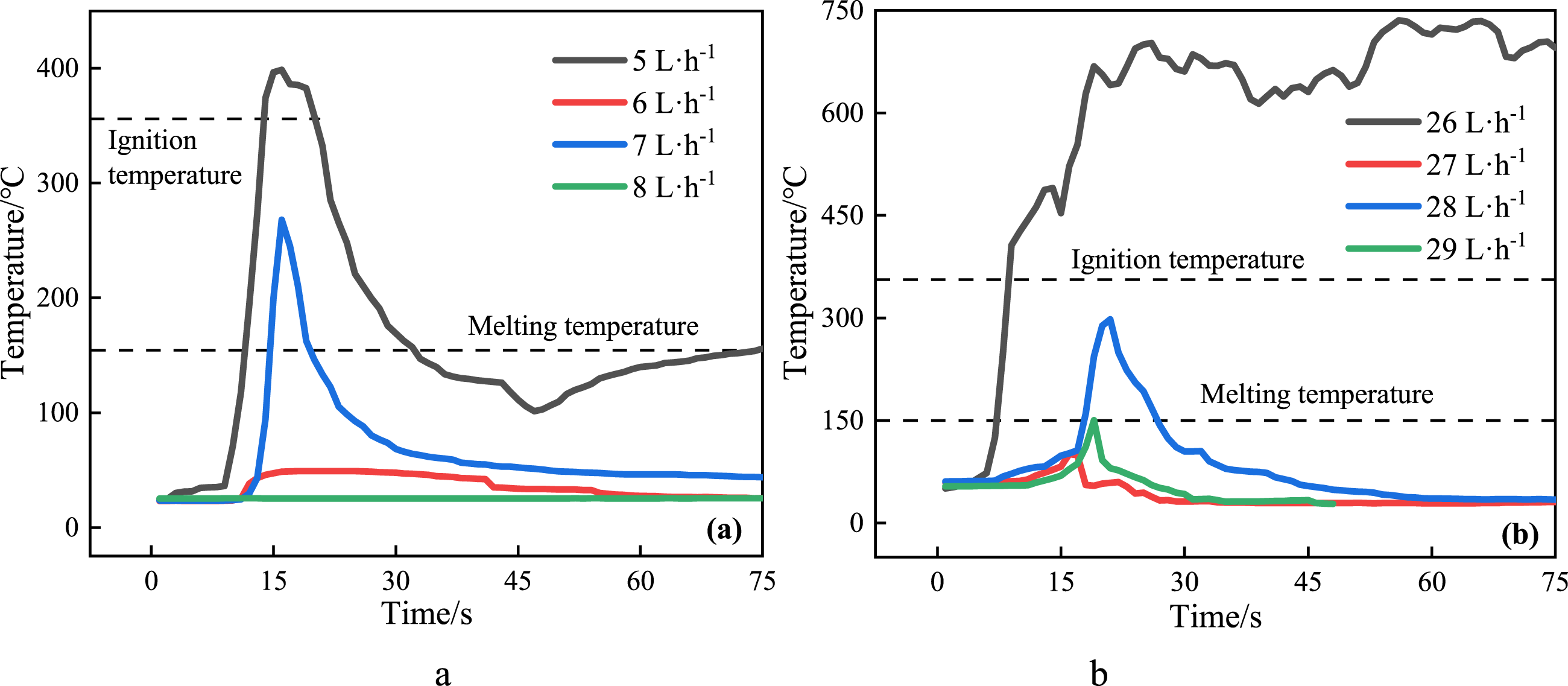
Flame height
Based on the preliminary determination of the surface temperature changes of XPS insulation materials, the critical range of water film flow rates that can prevent XPS from sustaining combustion has been identified. Figure 5 reveals that none of the tested water film flow rates successfully extinguish combustion in XPS specimens. Under these conditions, the average flame height initially increases but subsequently decreases during water film application, indicating transitional combustion dynamics. However, there are multiple peaks throughout the curve change process, indicating that under the combined effect of external radiative heat flux and water film, the oscillation of XPS flames increases. When there is no external radiation, the maximum average flame height decreases with the increase of water film flow rate. During pure combustion, the average flame height of the material is 65 cm, which is much higher than the average flame height at a water film flow rate of 5 L/h, indicating that applying a water film has a significant inhibitory effect on the fire spread of XPS materials. With the increase of external radiation, the maximum flame height during pure combustion tends to increase, and after applying the water film flow rate, the difference in maximum flame height compared to pure combustion is not significant. Variations of average flame height under different water film flow rates. (a-0 kW/m2. b-1.48 kW/m2. c-2.12 kW/m2. d-2.96 kW/m2).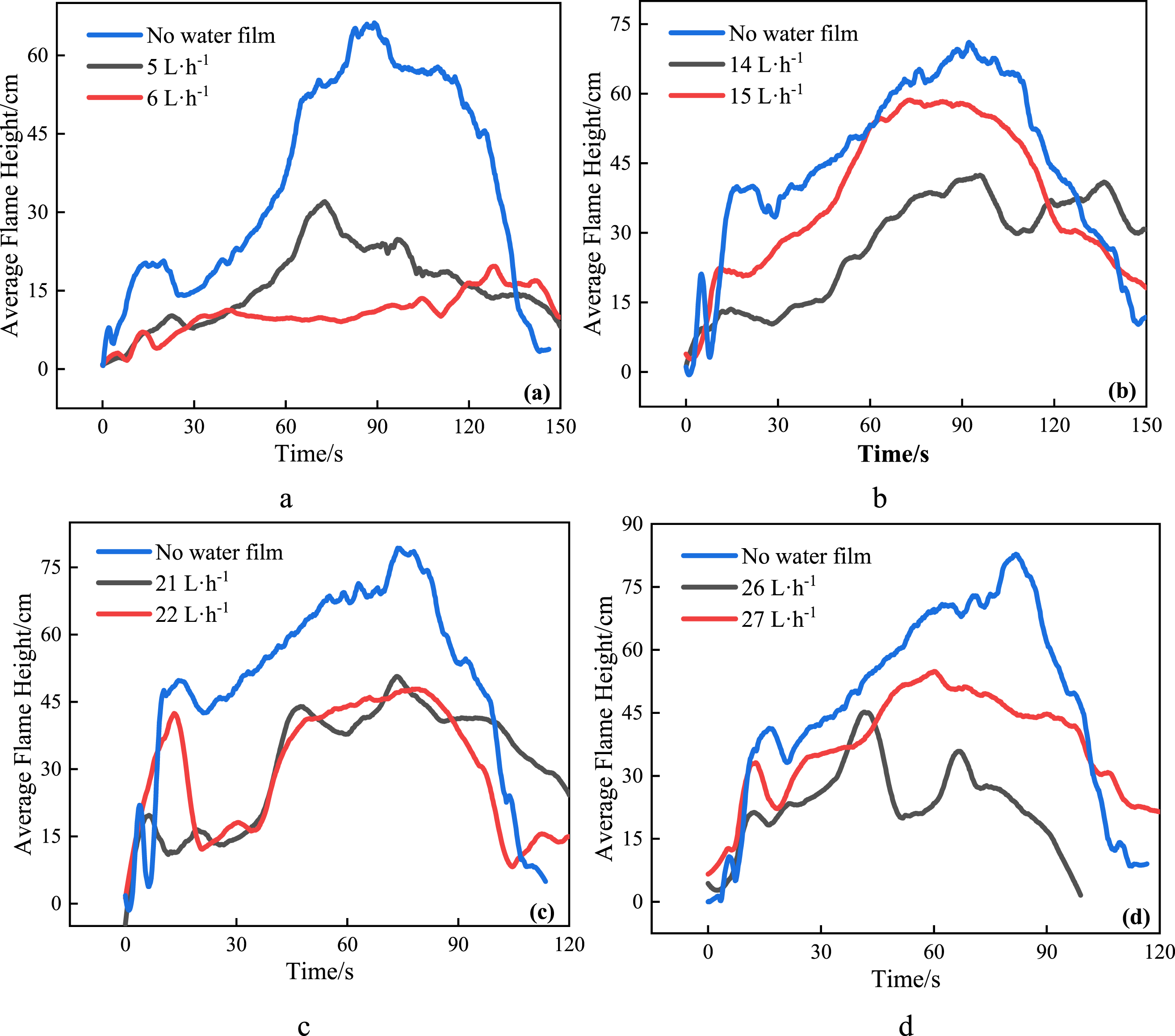
Flame Morphology
This study evaluates the suppression efficacy of water films on combustion in XPS materials with concave structural configurations. Flame behavior is observed under varying structural conditions and water film flow rates within the critical range determined by material surface temperature and average flame height changes. If the material continues to burn completely after water film application, this indicates that the corresponding flow rate is insufficient to inhibit XPS combustion. If the flame extinguishes before the material is fully consumed following water film application, this demonstrates that the flow rate could effectively suppress fire spread.
Flame morphology change with time under various external radiative heat flux intensities, α = 1.2.
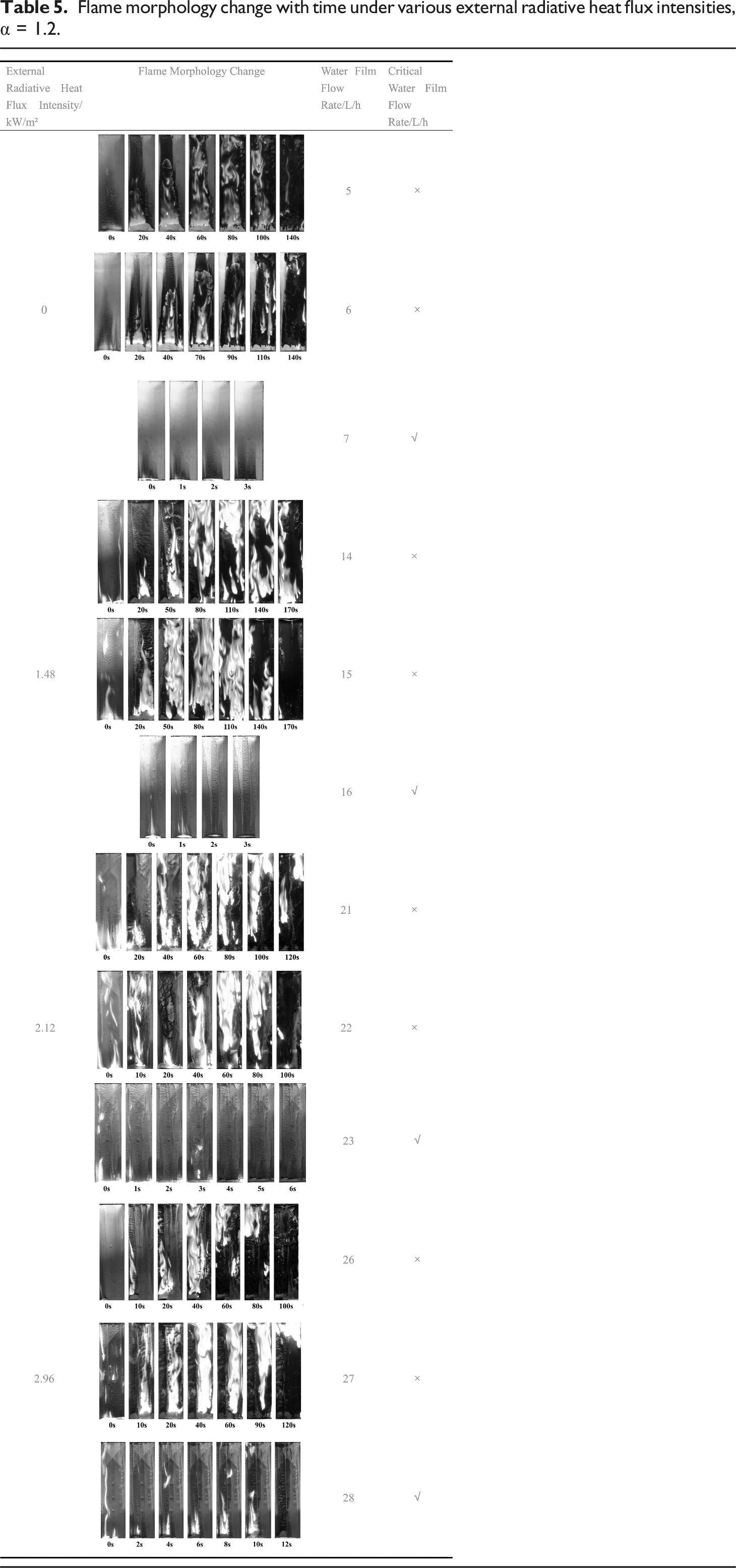
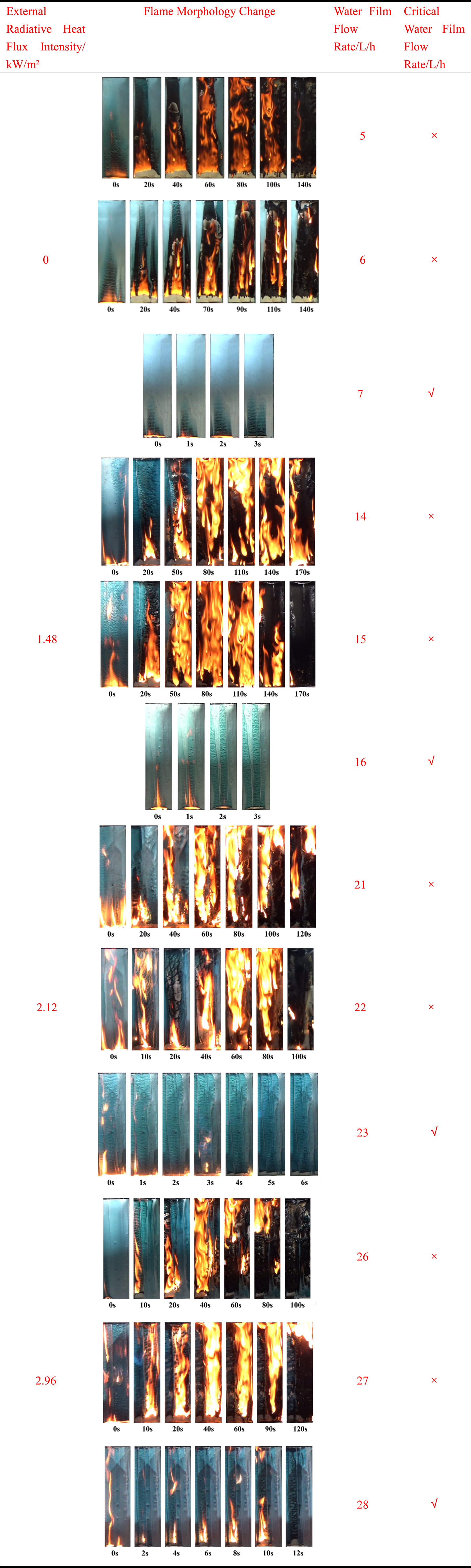
When the external radiative heat flux intensity is 2.12 kW/m2, it can be seen that the changes in flame morphology over time are essentially consistent with the analysis above. When the water film flow rate is 21 L/h, the XPS surface is protected by the water film. At 20s, the bottom flame cannot develop upward and gradually begins to spread upward from the inside, forming a hollow structure inside the material. The water film flows along the unburned surface, and the internal material receives a smaller amount of water flow, resulting in stable combustion. When the water film flow rate is 22 L/h, the material exhibits two combustion stages. In the first stage, the surface over-burning of the material intensifies following combustion before 10 seconds. Between 10 and 20 seconds, however, due to the lack of combustion medium in the central area, the flame cannot propagate upward, resulting in a rapid reduction in flame height. In the second stage (after 20 seconds), the flame continues to propagate upward due to external radiative heat flux and thermal feedback effects. When the water film flow rate is 23 L/h, surface over-burning occurs during the combustion process from 2 to 6s, indicating that both the flame and the water have reached a critical state, and ultimately the cooling effect of the water film dominates and extinguishes the surface fire. This water film flow rate is the critical water film flow rate. When the external radiative heat flux intensity is increased to 2.96 kW/m2, a water film flow rate of 26 L/h forms a hollow structure at 20s. When the water film flow rate is 27 L/h, surface over-burning commences at 10 seconds, followed by continuous upward combustion, indicating that this flow rate fails to effectively suppress flame propagation. When the water film flow rate is 28 L/h, although there is surface over-burning, it does not continue to burn, so this flow rate is the critical water film flow rate.
Overall, the changes in flame morphology at the critical water film flow rates listed in Table 5 can be categorized into three stages. In the first stage, the water film flows down from the top and covers the material surface, inhibiting the melting and pyrolysis of the surface material by the flame front elongated under the influence of external radiative heat flux. Due to the combined effect of bottom fire spread and water flow, the heat exchange process does not reach equilibrium, resulting in irregular surface fire on the material surface. In the second stage, the heat exchange among the water film, flame, and high-temperature wall surface reaches a dynamic balance. As time progresses, the water film continuously flows downward along the material surface, the temperature of the upper wall gradually decreases, surface fire is extinguished, and the turbulence of the flame weakens. The third stage is the flame extinction stage. Under the cooling effect of the water film, the vertical material temperature from top to bottom continues to decrease, and the water film directly extinguishes the flame along the material surface.
Critical water film flow rate
Critical water film flow rates under different external radiative heat flux intensities and structural factors (Unit: L/h).
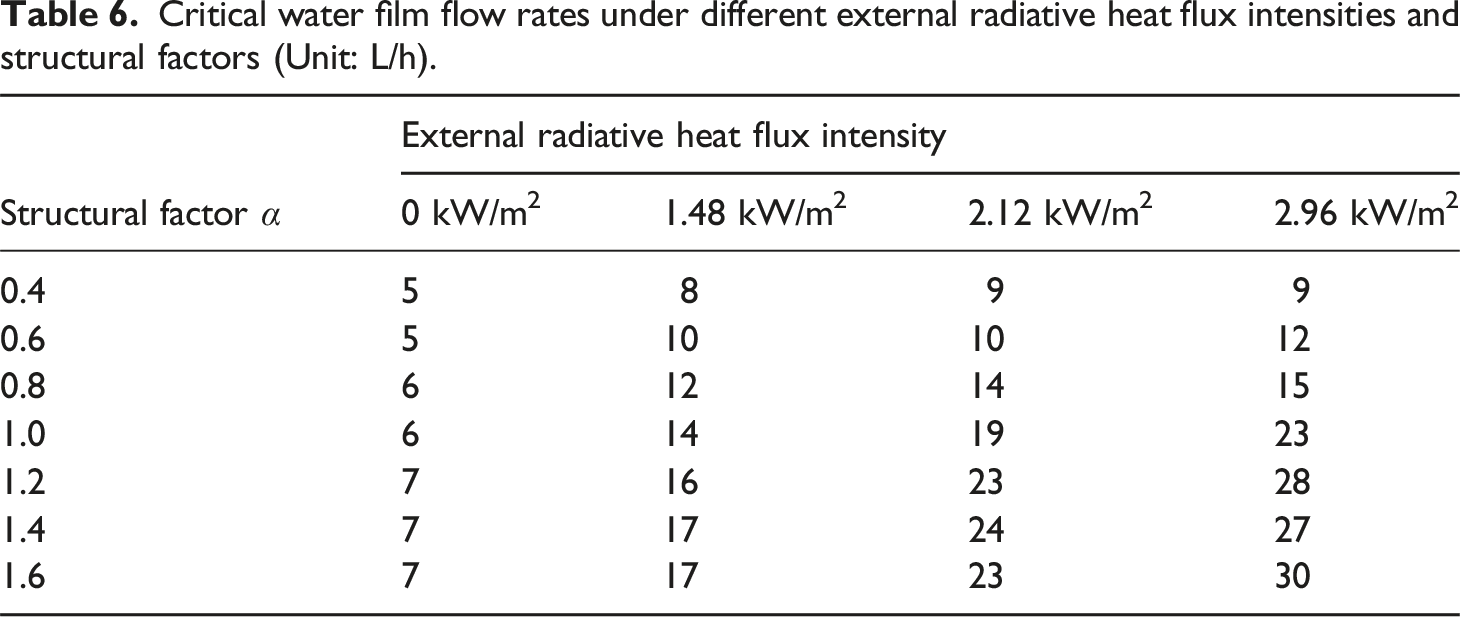
At the critical water film flow rate, an interesting phenomenon is observed. When the material surface is ignited, the yellow flame quickly extinguished upon the application of the water film. Then, a brief blue flame appeared and traveled upward along the material surface, having very little effect on its surface. The variations of the critical water film flow rates under different structural factors and external radiative heat flux intensities are shown in Figure 6. We can find that as the external radiative heat flux intensity increases, the critical water film flow rate and its growth rate required to protect XPS from sustaining combustion increase. Without external radiation, the change in critical water film flow rate is not significant with the increase of structural factor α. When α ≤ 1.0 with an external radiative heat flux of 1.48 kW/m2, the critical water film flow rate increases linearly with the structural factor. At α ≤ 1.0 under external radiative heat fluxes of 2.12 kW/m2 and 2.96 kW/m2, however, it exhibits exponential growth with increasing structural factor. When α > 1.0, the critical water film flow rate stabilizes with increasing structural factor, indicating that the structural factor’s influence on flame propagation has reached saturation. And at this point, the external radiative heat flux dominates the upward flame spread. This phenomenon is consistent with the results of previous studies.5,14,15 Variation of critical water film flow rate under different structural factors and external radiative heat flux intensities.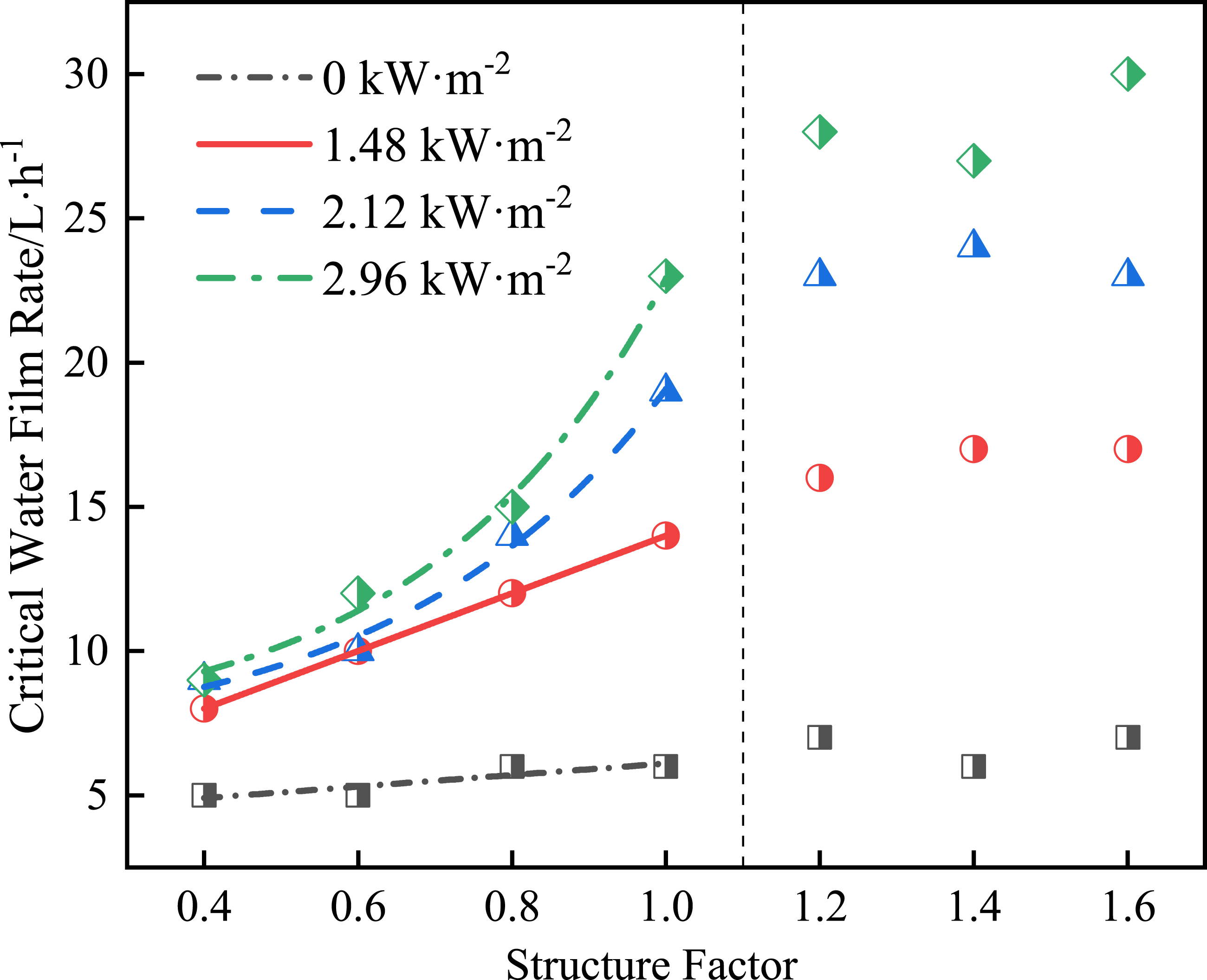
For α ≤ 1.0, the changes in the critical water film flow rate with the structural factor are fitted, and the corresponding curve expressions are given by equation (2).
According to the energy conservation on the material surface, it can be obtained as equation (3).
From the equation (3), it can be obtained that Critical water film flow rate versus radiative heat flux intensities under different structural factors. Slopes under various structural factors.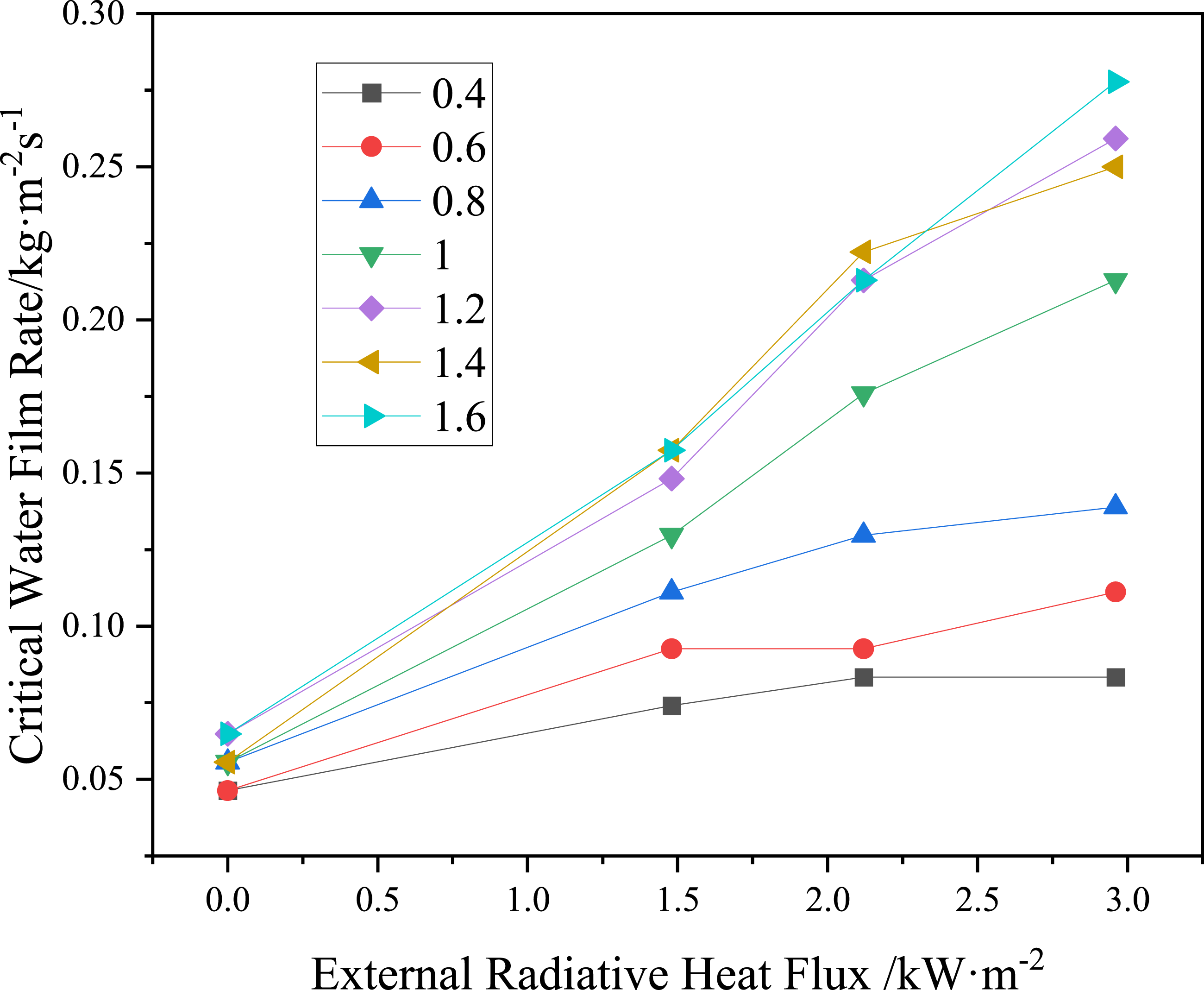
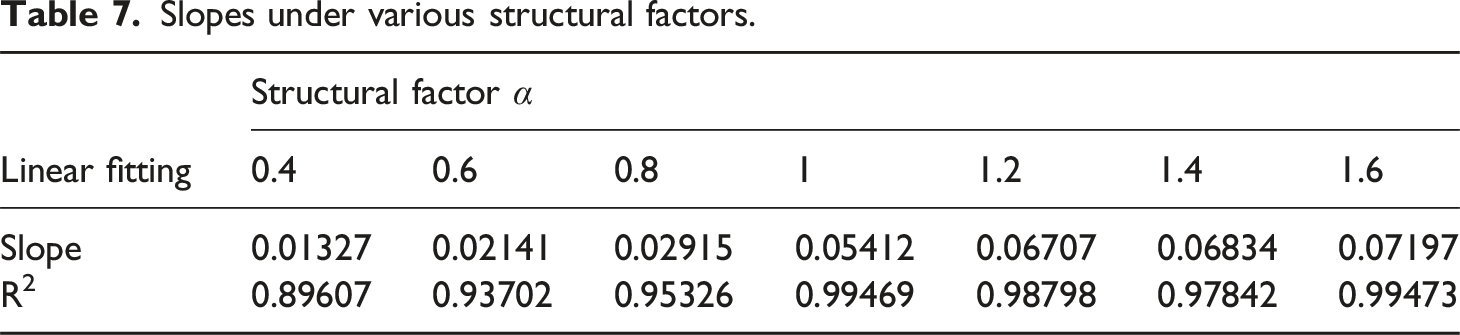
Through linear fitting(Table 7), it is found that
Conclusion
An experimental setup is constructed to analyze fire spread characteristics under seven structural factors and four radiative heat flux intensities. An experimental study is conducted to investigate water film suppression of vertical XPS flame propagation in a concave structure. The following conclusions are shown as the following.
The cooling effect of the water film can effectively reduce the material surface temperature, decrease the flame area, and inhibit the upward spread of the flame. The critical water film flow rate is attained when the water film prevents sustained combustion of XPS material. Critical water film flow rate increases with increasing external radiative heat flux.
When the water film flow rate is slightly less than the critical value, some melted XPS adheres to the back wall, prolonging the flame extinguishing time. When the water film flow rate is slightly larger than the critical value, surface overfire occurs.
Without external radiation, the change in critical water film flow rate is not significant with the increase of structural factor α. When α ≤ 1.0 with an external radiative heat flux of 1.48 kW/m2, the critical water film flow rate increases linearly with the structural factor. At α ≤ 1.0 under external radiative heat fluxes of 2.12 kW/m2 and 2.96 kW/m2, however, it exhibits exponential growth with increasing structural factor. When α > 1.0, the critical water film flow rate stabilizes with increasing structural factor.
Footnotes
Acknowledgements
The authors gratefully acknowledge this financial support.
Declaration of conflicting interests
The author(s) declared no potential conflicts of interest with respect to the research, authorship, and/or publication of this article.
Funding
The author(s) disclosed receipt of the following financial support for the research, authorship, and/or publication of this article: This work was supported by the Natural Science Foundation of Hebei Province (Grant No. E2022209101), the National Natural Science Foundation of China (Grants No. 52308532 and 5230041880) and Sichuan Science and Technology Program (Grant No. 2025ZNSFSC1287).
