



Abstract
Diaphragmatic hernia (DH) recurrence is a commonly reported disorder among bovines. Recently, studies have been reported using wireless devices (like ultrasonic and radio-frequency (RF) based pressure sensors) to detect DH. But hitherto, little has been reported on using polyvinylidene fluoride (PVDF)-based sensors mounted on the diaphragm of bovine to detect the recurrence of the DH post-surgery. In this work, the PVDF-hydroxyapatite (HAP)- chitosan (CS) composite in the proportion of 90-8-2 (wt.%) was used as a substrate for sensor fabrication based on microstrip patch antenna (MPA). Based on the results, the parts of the sensor, that is, substrate, patch, and the ground plane, were designed in the high-frequency structural simulation (HFSS) software assigned with the material properties of PVDF-HAP-CS (as substrate) and 17-4 precipitated hardened (PH) stainless steel (SS) alloy (as patch or ground plane). Upon simulation, it was observed that some deviation in resonance frequency occurred with/ without the natural bovine diaphragm, which was verified based on experimental analysis. The parts were 3D printed for validation through material extrusion (MEX) and direct metal laser sintering (DMLS) processes. Upon testing using a vector network analyzer (VNA), it was observed that the sensor without the diaphragm resonated at 3036.57 MHz with a return loss (S11) of −12.81 dB, whereas the sensor with the diaphragm resonated at 2019.35 MHz with an S11 of −21.06 dB. This shift in frequency with/without the diaphragm is measurable in the industrial, scientific, and medical (ISM) frequency band on a Bluetooth device to detect the reoccurrence of DH.
Introduction
DH is one of the most frequently observed maladies across bovines, and its recurrence is still a challenge for veterinary practices worldwide. 1 Due to ingestion of sharp metallic densities while grazing in open fields, the foremost stomach compartment (reticulum) of ruminants suffers most during the later stage of pregnancy upon the application of excessive pressure, which sometimes leads the patient to death. 2 To overcome challenges like remote health monitoring and minimizing post-operative complications of animals, the use of wireless medical devices like GPS-assisted wearable collars, IoT-enable conformal sensors, etc., has been broadly reported in the recent past to measure various physiological signals like glucose level, blood pressure, and body temperature of the patient. 3 RF-linked implantable medical devices recently gained significant interest for applications like biotelemetry as these were proven effective against restricted data transfer rates and limited communication range. 4 RF-linked devices like pacemakers comprise an integrated antenna used for communication through external monitoring devices. 5 MPA offers numerous properties desirable for biomedical applications, such as design and shape flexibility, conformability, ease of fabrication, low cost, and high-quality communication.6,7 Such devices comprise three layers, that is, a metallic patch and ground generally made up of copper and substrate (the intermediate layer) made up of any dielectric material. Also, previous studies reported using MPA for strain measurement applications like structural health monitoring. Variations in the scattering and dielectric parameters of the antenna were measured against the load applied externally and, therefore, provide information about the deterioration of the structure with the change in strain values. 8 Apart from that, these devices were also found effective for telemedicine and biomedical applications like measuring the movement of thoracoabdominal and respiratory vibrations. 9 During the last decade, the use of MPA-based sensors has increased extraordinarily due to the availability of a wide variety of substrate materials with low values of the loss tangent, better mechanical and thermal properties, and improved fabrication methods like lithographic and printed circuit boards.10,11 Nowadays, in implant fabrication and telemedicine, 3D printing has been explored widely to gain the benefits of low material wastage, rapid manufacturing, customized products, minimized defects, etc.12–14 Recently, the use of hybrid manufacturing, that is, 3D printing and inkjet printing, has provided a new direction for fabricating RF circuits in MPAs. 15 The use of metal-based additive manufacturing has been limited in the field for certain reasons, such as the improper adhesion of the substrate and the conducting parts due to the relatively low temperatures.16,17 Apart from that, the 3D printing process can tune the infill properties during fabrication, providing desired mechanical properties, flexibility, conformability, etc.18,19 Materials like polylactic acid (PLA), acrylonitrile butadiene styrene (ABS), polymethylmethacrylate (PMMA), low-density polyethylene (LDPE), polypropylene (PP), polyamide, ninja flex have been reported recently as the dielectric materials for the fabrication of MPA based sensors. 20 PVDF is a fluoropolymer with high degradation resistance, piezoelectric nature, enhanced biocompatibility, and reduced foreign body response. It is highly elastic, enabling the material to retain its porosity under external load.21,22 Recently, PVDF has been used as a prosthetic mesh material to repair complex ventral hernia, focusing on long-term recurrence. 23 Due to the piezoelectric nature and higher dielectric constant value of PVDF (9.5), it has recently been used for applications like energy harvesting, miniaturization, and flexible antennas.24,25 HAP is another biopolymer mainly used for implant fabrication due to its osteoconductive properties. Adding HAP to the matrix material results in enhanced biocompatibility and improved bioactivity, whereas reduction in fracture strength and fatigue strength leads the material towards brittle.26–28 PVDF composites containing HAP have been used for bone regeneration and enhanced proliferation applications. Adding a chitin derivative, that is, CS, improves antibacterial activities, faster wound healing, and improved biodegradability in the composite.29,30 Previously, some studies have reported using HAP and CS as filler materials in the PVDF matrix. Adding HAP-8% and CS-2% in PVDF-90% results in the optimum flowability required for the material extrusion process 31 PVDF provides the mechanical strength required for the high loading conditions during the later stage of pregnancy. It provides flexibility and is suitable for preparing the hernia mesh that can further be used as a biosensor substrate. 32 The literature review reveals that some studies have been reported about using PVDF composites to fabricate MPA-based implantable sensors. But hitherto, little has been reported about using PVDF-based sensors mounted on the diaphragm of bovine to detect the recurrence of the DH post-surgery. In this work, the PVDF-HAP-CS in the proportion of 90-8-2 (wt.%) was used as a substrate for sensor fabrication based on MPA. Finally, the fabricated sensor was tested on a network analyzer in the lab-scale environment with/without the diaphragm muscle of a bovine.
Materials and methods
In this work, PVDF pellets were blended with the HAP and CS nanoparticles in the proportion 90-8-2 (wt.%), respectively, to prepare the feedstock filament. Following that, the prepared blend was processed through a twin-screw extruder at screw temperature-210°C and screw speed-95 r/min, and a continuous feedstock filament of a uniform diameter of 1.75 ± 0.05 mm was prepared. The prepared filament has been utilized for MEX of PVDF-HAP-CS to fabricate the samples to measure dielectric constant, electrostrictive strain, corrosion behaviour, and substrate for MPA. The printing parameters of the MEX components were kept as heating bed temperature-75°C, printing speed-100 mm/s, and the temperature of the hot end-230°C. Parallelly, the patch and ground planes were printed using the powder bed fusion technique (DMLS). The patch has dimensions of 22.40 × 29.79 × 0.140 mm, the microstrip line feed is 13.79 × 1.5 × 0.140 mm, whereas the ground plane is 50 × 50 mm and has been provided with solid wall support (1 mm) in the 3D system software of the DMLS metal printer. The printing was carried out using a neodymium-doped yttrium aluminium garnet (Nd: YAG) laser in an inert atmosphere of Ar gas, and the printing parameters were scanning speed- 1200 mm/s, hatch distance −40 µm, and laser power-110W. The printed parts were cut off from the metallic base plate through a wire-cut electric discharge machining setup. The diaphragm (∼3 mm) sample collected from a buffalo carcass was cut into the required shapes using a surgical knife for multiple analyses. After the sample preparation stage, the dielectric, strain, and corrosion analyses were performed on the PVDF-HAP-CS substrate, natural diaphragm, and PVDF-HAP-CS substrate mounted on natural diaphragm. In order to identify the piezoelectric properties of the PVDF-HAP-CS and the diaphragm, the samples were tested on the electrostrictive strain and dielectric measurement apparatus (Make: Marine Instruments, New Delhi, India). For measuring the electrostrictive strain, the coin-shaped sample of ɸ20 mm and thickness of 1 mm was 3D printed through MEX, and a uniform layer of silver paste was applied over both faces.
The diaphragm sample and the combination of PVDF-HAP-CS + diaphragm were prepared using the exact dimensions. To ascertain the degradation behaviour of the prepared composite, the conductive material, and the diaphragm, the in vitro analysis, that is, corrosion analysis, was performed using the potentiostat (Make: PhadkeSTAT-20, Mumbai, India). The experiment was conducted at room temperature using a four-electrode unit cell, namely- the working electrode (sample to be tested), the counter electrode (graphite rod), the reference electrode (calomel electrode), and the floating electrode (ground). Three of them were dipped in the simulated body fluid (SBF) solution made up of NaCl (2.5% in 100 mL H2O) to perform the experiments for getting open circuit potential (OCP), polarization resistance (Rp), and Tafel plot analysis. After ascertaining the dielectric properties of the material, the MPA-based sensor has been designed in the HFSS software (Figure 1(a)) based on the dimensions obtained using the dielectric parameters (dielectric constant (εr) and loss tangent (tan δ) values). The simulation results were validated by testing the fabricated sensor on the two-port VNA (1-20 GHz). Figure 1(b) shows the sensor model along with the diaphragm. Figures 1(c) and (d) show the DMLS metal printing setup used in this study and live laser printing of the conductive parts. The top and side views of 3D metal printed parts are shown in Figures 1(f) and (g). The other steps involved MEX printing of PVDF composite (Figure 1(h)), assembly of a sensor (Figure 1(i)), and sensor testing on a network analyzer along with a diaphragm (Figure 1(j)). (a) Model of MPA-based sensor, (b) model of the sensor along with the diaphragm, (c) DMLS metal printing setup, (d) laser printing of the conductive parts, (e) top view of 3D metal printed parts, (f) side view of 3d printed parts, (g) MEX printing of PVDF based composite, (h) assembled sensor, (i) sensor testing on a network analyzer, and (j) sensor along with diaphragm testing.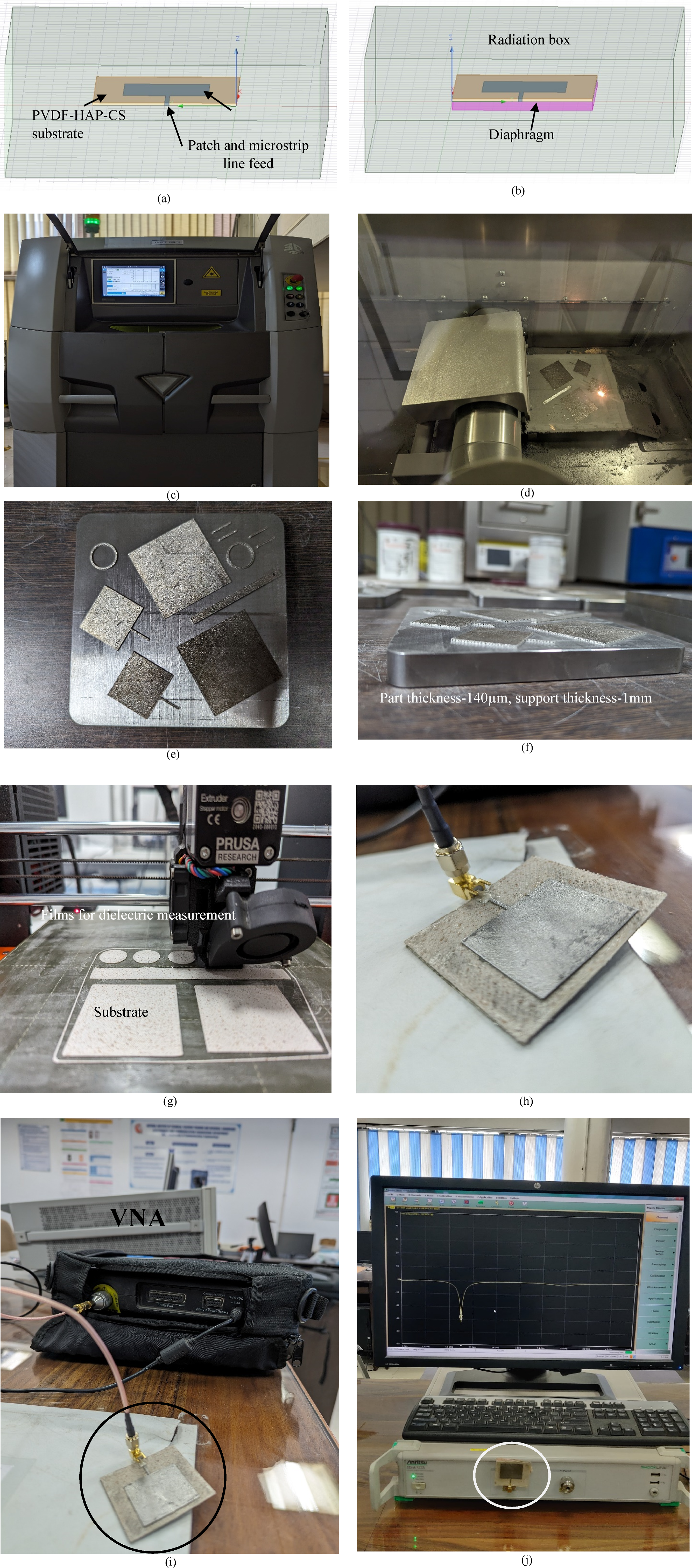
Results and discussion
The piezoelectric characterizations (Figure 2(a) and (b)) represent that the PVDF-HAP-CS sample possesses an εr ∼16.4 at initial settings and goes up to 14.4 with the increase in frequency (Figure 2(c)) and stabilizes after that, whereas the sample, along with the diaphragm possesses εr of 15.9 initially and goes up to 13.9 before stabilizing. Since the diaphragm is not a piezo material, its εr lies in the lower range. The trend showcases that, with the involvement of the diaphragm, the εr dips to a lower value because of the low conductivity. The tan δ results highlight (Figure 2(d)) that the value dips from 0.45 to 0.05 for PVDF-HAP-CS, then increases gradually up to 0.13 before stabilizing, whereas, for the combination of both, the tanδ falls from 0.75 to 0.11 and then increases linearly. For the diaphragm, the observed value of tanδ is 0.02. Since the measurements were taken for a low-frequency range, that is, 1-4 MHz, upon extrapolation, the dielectric parameters may be provided to meet the requirements for sensor fabrication as per MPA. Adding the stack of diaphragm layer to the PVDF-HAP-CS causes a decrease in the εr and the tan δ. The losses may be due to the increase in electric resistance offered by the diaphragm, leading to increased dielectric losses in the dielectric material and hindering the sensor’s performance.
33
Experimental setups and the observed characteristics curves for (a) Impedance analyzer, (b) capacitance measurement at different frequencies, (c) εr versus Freq., (d) tanδ versus Freq., (e) S-E measurement device, (f) S-E loop, (g) In vitro setup, (h) Tafel analysis, (i) S11 versus Freq. Note: The experiment was repeated 05 times to reduce the experimental errors.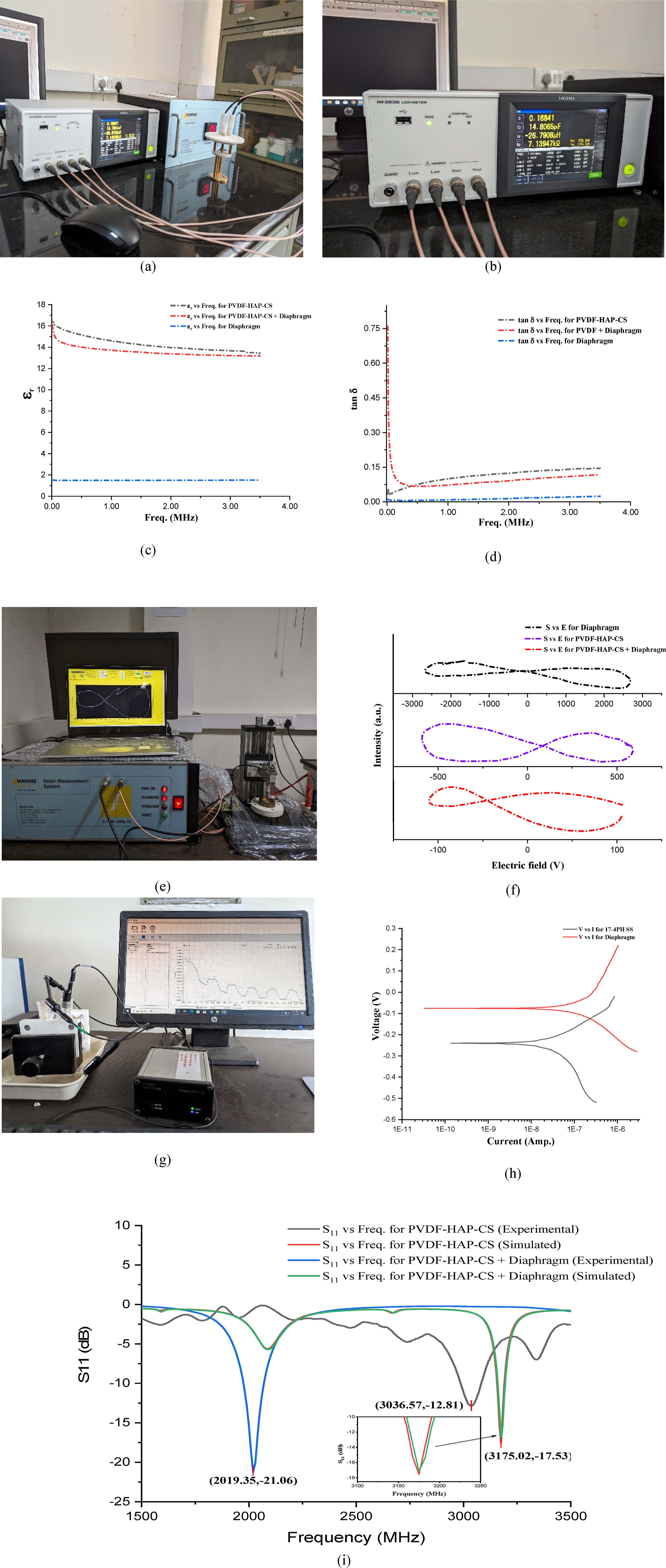
For the electrostrictive properties of the prepared composite, the prepared samples were tested against the applied electric field (Figure 2(e)) at different amplitude % for each sample (i.e., PVDF-HAP-CS, diaphragm, and the combination of both) due to their different build structures. Before the actual measurement, the dipoles of the samples were aligned by applying no. Of sweep cycles. The film (sample) under test undergoes the change in thickness upon applying an electric field, and that change is the measure of the strain modulus. Figure 2(f) represents that the diaphragm sample behaves as electroactive material at 75% amplitude of the electric field, that is, ±3 kV, and shows an impressive modulus value of strain, that is, 4%. The highly electroactive nature of the diaphragm may be because of the traces of the fluid used to preserve it. For the PVDF-HAP-CS composite, a more uniform curve was obtained at low amplitude, that is, 12.5% and the observed strain modulus was 1.9%. Meanwhile, for the combination of both, the distorted curve was obtained at a 2.5% amplitude of the electric field for the modulus value of 2%. From the observations, it may be concluded that the material exhibits minimal electrical energy converted into mechanical energy or vice versa; therefore, it is unfavourable for developing self-energizing sensors. 34


Observations from the in vitro analysis.
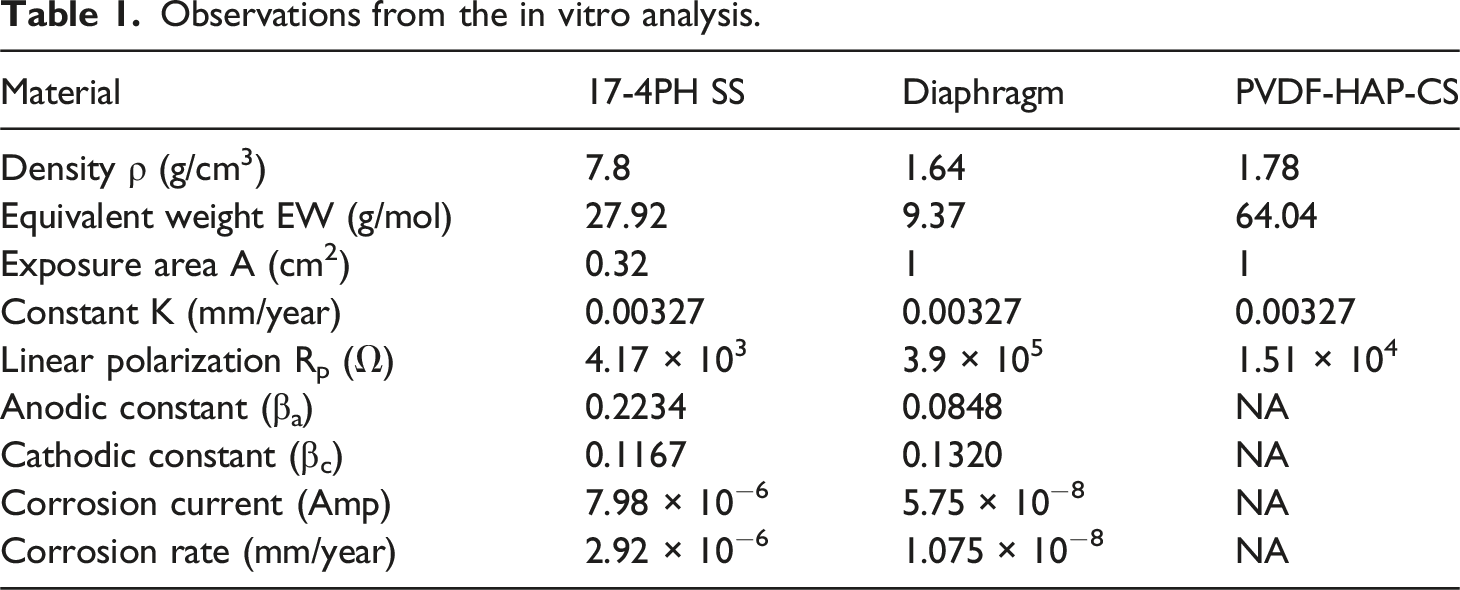
{Where Icorr is the corrosion current, βa is the anodic constant, EW is the equivalent weight in g/mol, βc is the cathodic constant, ρ is the material density, Rp is the polarization resistance, A is the exposed cross-sectional area, and K is the constant}.
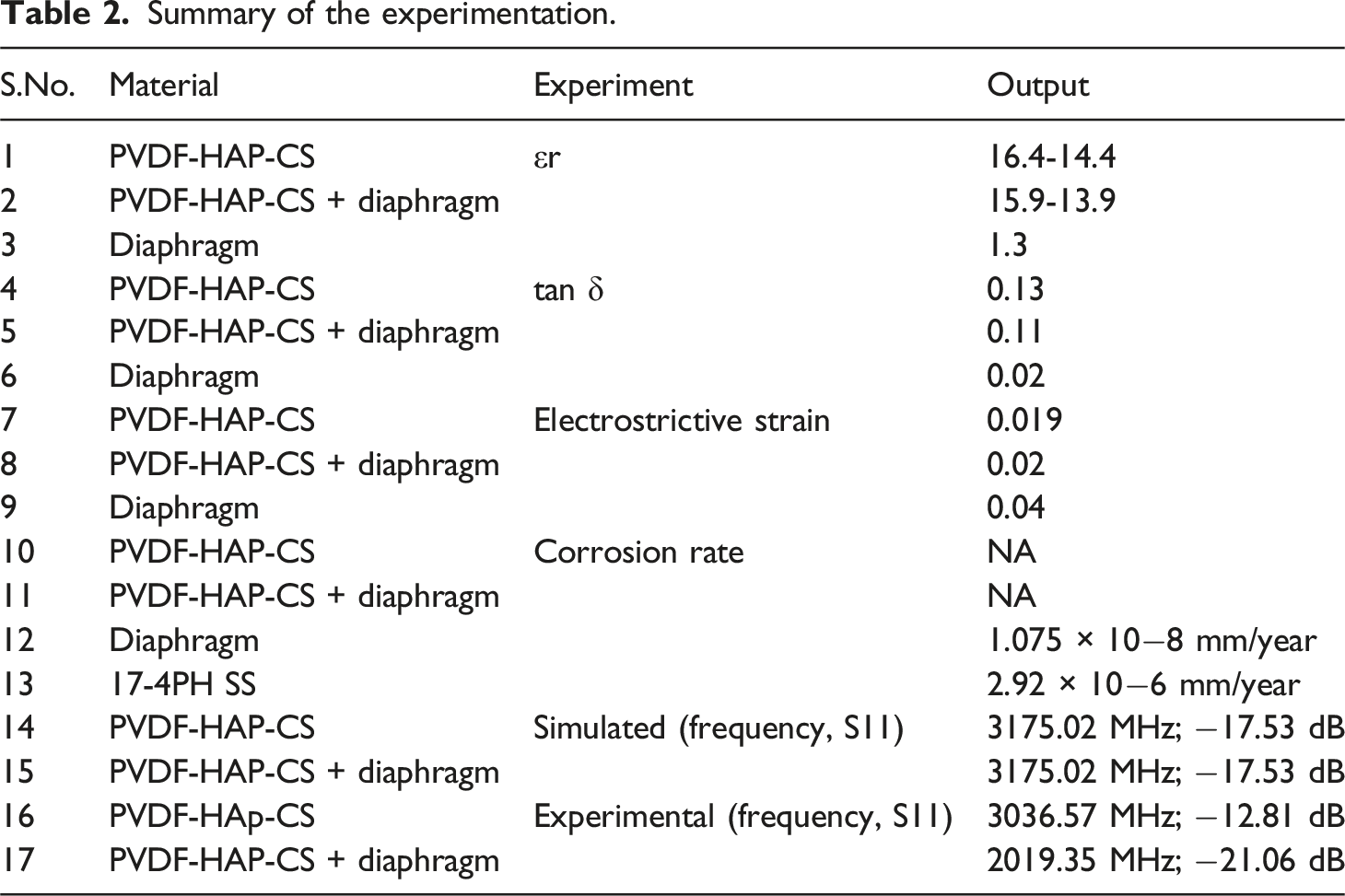
Summary of the experimentation.
Conclusions
The present work focuses on designing and fabricating the sensor for the health monitoring of patients post-surgery. Different characterizations were performed to evaluate the suitability of the material for sensor fabrication with/without the effect of the diaphragm in a lab-scale environment. The following conclusions were drawn from this study: • The piezoelectric characteristics obtained from the experiment suggest that the εr of the prepared composite is 16.4 to 14.4 with the increase in frequency, whereas for the combination of composite and the diaphragm, the εr varies from 15.9 to 13.9, and for the diaphragm, its value lies at 1.3. The higher value of εr reduces the size of the sensor and has a broad bandwidth and high gain. When using the combination of composite and diaphragm, the value lies on the lower side, which results in a narrow bandwidth with a single frequency peak. The tanδ results suggest that the values increase slightly over the increase in the frequency. The rise in tanδ indicates poor radiation characteristics and increases reflection losses while operating the sensor. • Electrostrictive strain measurements highlight that the strain modulus lies below 5%, which indicates the material’s unfavourable electroactive nature. Therefore, they are less suitable for self-energizing implantable sensors. The higher value of strain modulus for the diaphragm may be due to the presence of fluid traces, which were used to preserve the diaphragm. • The in vitro analysis suggests that the CR for the diaphragm appeared best among the three, followed by the composite and the alloy, that is, 1.075 × 10⁻⁸ and 2.92 × 10⁻⁶ mm/year. With such a low degradation value, the material is suitable for implantable sensor fabrication, as the previous studies suggest that the average life of a patient is 12 to 15 years. • The R-F characteristics have been analyzed for two cases, that is, with/without diaphragm, for both simulated and experimental cases. The simulated S11 versus frequency curves predominately overlap and radiate at 3175.02 MHz while showing a return loss of −17.53 dB. Upon validation, it was observed that there is a slight shift in frequency and S11 without diaphragm case, that is, 3036.35 MHz and −12.81 dB. A noticeable change in frequency was observed, that is, in 2019, 35 MHz had an impressive return loss of −21.06 dB. The massive shift in frequency may be easily traced through a Bluetooth device as it resonates in the ISM band and is hence suitable for the health monitoring of DH patients post-surgery.
Footnotes
Acknowledgement
Authors thank the Department of Science and Technology, Government of India, for financial support under the FIST project Level-0, Project No. SR/FST/College-/2020/997 and Prof. Arun Anand from Guru Anahad Dev Veterinary and Animal Science University, Ludhiana, India, for technical support.
Declaration of conflicting interests
The author(s) declared no potential conflicts of interest with respect to the research, authorship, and/or publication of this article.
Funding
The author(s) disclosed receipt of the following financial support for the research, authorship, and/or publication of this article: This work was supported by the Department of Science and Technology, Ministry of Science and Technology, India; SR/FST/College-/2020/997.
