




Abstract
This work goal is to develop a valuable biodegradable material for sustainable packaging. The utilization of agriculture wastes to produce biodegradable packaging films based on carboxymethyl cellulose (CMC) will reduce its price. CMC was prepared from sugar cane bagasse, and used to prepare composite films with mandarin and cantaloupe peels extracts of different ratios. The effects of these extracts on the mechanical and antimicrobial properties of the prepared films were evaluated. Thus, the films incorporated with 10% concentration of mandarin and cantaloupe peels extract exhibited excellent antimicrobial properties against gram positive, gram negative bacteria and pathogenic yeast than the other lower concentrated films. The physiochemical properties of each developed biodegradable films were characterized using Fourier Transform Infra-Red (FTIR) spectroscopy, X-Ray diffraction analysis (XRD), Scanning Electron Microscopy (SEM) and antimicrobial. The reflected work is a novel approach, and which is vital in the conversion of organic waste to value-added product development.
Introduction
Due to the plastic’s risk to each human being, communities, and the entire ecosystem, the plastic's size is extremely important.1,2 Due to unchecked population growth and unsustainable use of nonrenewable resources, a cumulative waste volume was produced. There are now only a few techniques for partially eliminating these wastes, such as landfills and ocean overflows of a variety of materials, some of which can decay in a certain amount of time while other detritus cannot disintegrate for hundreds of years.3,4 Governments have proposed rules, such as limits or bans on single-use plastic bags and straws, in response to growing environmental concerns about sustainability and end-of-life disposal issues. Therefore, it is vital to switch to sustainable, biodegradable, or compostable materials for food packaging instead of utilizing plastic packaging. Additionally, the ongoing COVID-19 epidemic has disrupted manufacturing and transportation systems globally, necessitating the production of substantially more food packaging material to meet the demand for food preservation. 5 As an alternative, the bio bags were thought to be just slightly different from conventional plastic bags. 6 It compared to ordinary plastic with all these related problems, but biodegradable plastic preserves outstanding characteristic features and is more dependable nowadays. 3
A family of natural carbohydrate polymers known as cellulose can be found in an almost endless supply of raw materials, including plants, agricultural waste, marine species' shells, and microbes.4,7–9 Depending on the origin of the plants, the plant cell wall of cellulose fibers comprises varying amounts of cellulose embedded as microfibrils in a matrix of hemicellulose, lignin, pectin, ash, and other extractives.4,5
The current project's goal is to create cellulose-based food packaging films. It might be one of the finest options for filling the hole left by the worldwide restriction on ordinary plastic.
There is a huge need for food packaging materials right now across several industries. Food packaging materials have a significant role in the preservation of food across the whole distribution chain. During marketing, food must be protected from mechanical damage and contamination. Antibacterial properties in materials have recently been developed. The most promising method for active packaging systems is antimicrobial packaging.4,8,10 Food preservation up until delivery to the buyer is an essential step. The key elements that the packaging materials affect during storage and distribution depend on their mechanical strength, microbiological activity, etc. Recyclability, material prices, disposable nature, and sustainability are further important considerations. 11 These biodegradable polymers are projected to take the place of conventional polymeric products in packaging applications in the next years.4,8,12,13
Nowadays, there is a regent need for effective antioxidants to prevent deterioration caused by microbes, besides; there has been considerable interest in recycling inexpensive agricultural wastes as sources for new by-products applications in order to pose positive environmental impact. Peels remain as primary waste and a main by-product of food processing which give rise to a serious environmental pollution. Citrus and melons are important crops in Egypt used mainly in food industries. Mandarin and cantaloupe are two of the most consumed fruits. Citrus peel which represents almost half of the fruit mass, containing more functional compounds than the edible parts, being a rich source of bioactive constituents including pectin, hesperidin, naringin, rutin, carotenoids and high concentration of flavonoids and phenolic acids is discarded as wastes.14,15 Citrus peel extract showed potent antibacterial activity against pathogens.16,17 So it is reasonable to be used in the formulation of antimicrobial by-products, similarly, melon is reported to have valuable activities. 18 This work was conducted to study the phytochemical content of mandarin and cantaloupe fruits peel and to assess their in vitro antimicrobial potential after in corporation with biodegradable carboxymethyl cellulose (CMC) based material. The physiochemical properties of the developed biodegradable films were characterized using Fourier Transform Infra-Red (FTIR) spectroscopy, XRD and SEM.
Materials and methods
All the methods in this study were carried out in accordance with relevant Institutional guidelines and regulations.
Quena Company for Paper Industry (Quena, Egypt) provided sugarcane bagasse (SS). Sigma-Aldrich (St. Louis, MO, USA) provided the paraffin oil. All materials and reagents were used without being purified further.
Cantaloupe and mandarin extractions
Fresh fruits (mandarin (M) (Citrus reticulata) and cantaloupe (C) (Cucumis melo)) were purchased from local market. Peels were separated, carefully washed under running tap water then by distilled water, cut into small pieces, dried in hot air flow oven at 40–50°C, grounded into fine powder and sieved. The two peels powder was separately extracted with 95% methanol. The extracts were filtered and evaporated using a rotary evaporator to obtain dry concentrates, which were kept at 4°C for further analysis. 19
Phytochemical screening
Each crude fruit peels extract (M and C) was tested qualitatively for the phytochemical compounds, alkaloids, carotenoids, saponins, flavonoids and tannins.
Carboxymethyl cellulose
SC (150 g) was prehydrolyzed through treatment with HCl (1.5%; 1570.3 mL) for 2 h at 120°C in stainless steel autoclave of 2 L capacity and electrically heated. The prehydrolyzed SC was washed with water. After that, 100 g of prehydrolyzed SC was treated with NaOH (20 g of NaOH in 300 mL water) at 170 °C for 2 h, to produce pulp. The produced pulp was brown cotton like shape in contrast to the straw shape of SC raw material. To remove lignin, the pulp (80 g) was bleached with HClO2 (3%; 2.4 g in 4750 mL water) in the presence of acetic acid (1.7 mL) for 2 h at 80°C. During the reaction process, the pH increased to 10–12. So, acetic acid was added to make the pH equal to 1–3 (acidic) to obtain pure α-cellulose. The obtained pure α-cellulose (2.5 g in 75 mL isopropanol) was treated with NaOH (40%; 3 g in 7.5 mL water) and monochloroacetic acid (3 g) for 3.5 h at 55 °C with stirring. The resulting CMC was mixed in 70% ethanol before being filtrated and dried.4,20
Preparation of Carboxymethyl cellulose/cantaloupe and Carboxymethyl cellulose/mandarin edible films
1 g of CMC was dissolved in 20 mL H2O to form a gel solution. The mandarin (M) and cantaloupe (C) concentrates were ultrasonicated in 5 mL H2O separately with different ratios of M and C (i.e., 2.5, 5, and 10%) which denoted as M2.5%, M5% and M10% for mandarin concentrate ratios, as well as, C2.5%, C5% and C10% for cantaloupe concentrate ratios and poured separately onto a teflon plate and dried at 40°C to attain a film of constant weight.
Characterization
The prepared samples were characterized by FTIR spectroscopy which was recorded by Mattson-5000 (Unicam, Somerset, United Kingdom) employing the KBr disk method in the wavenumber range of 4000–1000 cm−1.
The mercerization depth (MD) was calculated according to the following Equation:

Determination of the degree of substitution of Carboxymethyl cellulose
The degree of substitution (DS) value of CMC was estimated through our previous procedure. 20
The tensile properties of the prepared films were measured by Universal Testing Machine- LLOYD LR 10 k, England. The tensile strength (TS), Elongation at break (EB %), and Young’s Modulus (Y %) of the films, were determined according to ASTM D-638 at a crosshead speed of 5 mm/min. The samples were cut into blocks of 100 × 3 × 20 mm3 (longitudinal × radial × tangential). Five specimens were tested for each sample, and the average value was listed.
XRD analysis was recorded by Bruker D8 Advance X-ray diffractometer (Karlsruhe, Germany) using copper (Kα) radiation (1.5406 Å) at a 40 kV voltage and a 40 mA current.
Both of crystallinity index Cr.I. (%) and



Mechanical test
The tensile properties of the fabric specimens were measured by Universal Testing Machine- LLOYD LR 10 k, England. The tensile strength (TS), Elongation at break (EB %), and Young’s Modulus (Y %) of the films, were determined according to ASTM D-638 at a crosshead speed of 5 mm/min.
Reproducibility of the tests
To avoid sources of error inherent in a given measurement, every experiment was repeated 3 times.
Antimicrobial activity
The qualitative evaluations were done in nutrient broth according to Mustafa et al. 2016 and El-Anssary et al. 2021. All the methods were carried out in accordance with relevant Institutional guidelines and regulations. Inoculations of pathogenic microorganisms included the gram-positive bacteria Micrococcus leutus
The samples were splitted into two main groups; the first group was applied on 0.9 cm well of previously inoculated agar plates which were prepared using 1.0 cm cork borer applying (Disc diffusion method

Statistical analysis
Results were taken triplicate and expressed as a mean with standard deviation (mean ± SD). Analysis was conducted with Student’s t test with significance p value ≤.05.
Results and Discussion
Qualitative analysis of crude extracts
The preliminary phytochemical analysis of mandarin peels extract revealed the presence of alkaloids, carotenoids, saponins, flavonoids and tannins, which were previously detected. 24 The cantaloupe peels extract showed the presence of flavonoids which is in accordance with the phenolic and flavonoid compounds, including chlorogenic acid being previously identified. 25
Fourier Transform Infra-Red spectroscopy
The DS of CMC was 0.76. Figure 1 shows the FTIR spectra of the blank and different film samples. The characteristic bands of CMC at 3344, 2910, 1598, and 1417 cm−1 correlated to the stretching -OH, CH2 stretching, the anti-symmetric and symmetric stretching vibrations of COO−, respectively.4,20 A broad band at 3349–3365 cm−1 is attributed to O–H groups for mandarin, M1, M2, M3, cantaloupe, C1, C2, and C3. Spectrum peaks near 1577–1618 cm−1 region corresponds to C=O. Peaks near 2915–2931 cm−1 corresponds to the stretching vibrational frequencies of C–H bonds can be characterized as the presence of methoxy groups.
20
Absorption peaks at 781–844, 910–921, and 1402–1411 cm−1 can show presence of gallic acid and peaks at 1025–1039, 1261–1324, 1402–1411, and 1589–1602 cm−1 can show presence of tannic acid.
26
FTIR spectra of blank CMC film, Cantaloupe and Mandarin extract.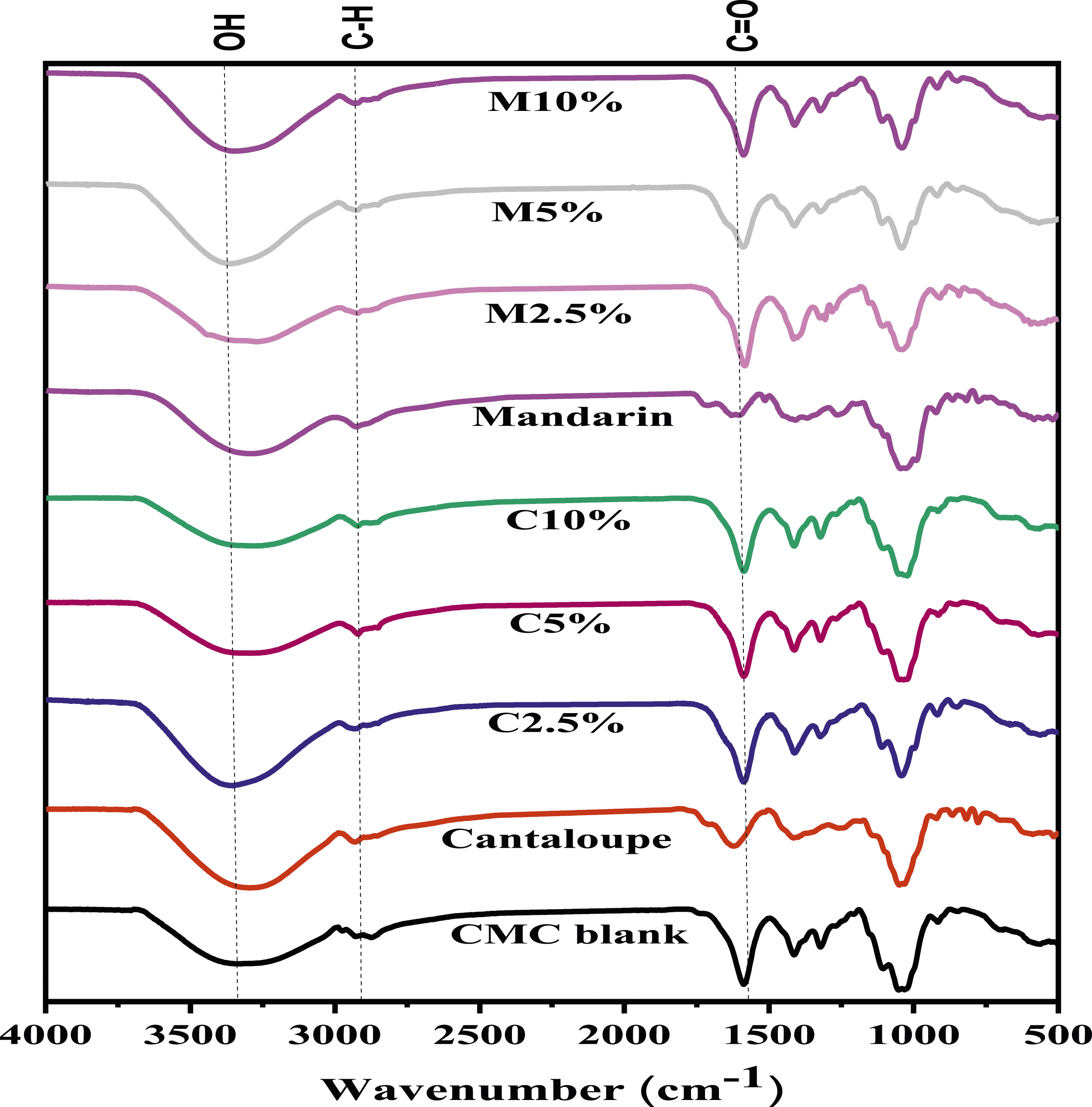
H-bonded OH stretching vibration of CMC appeared at 3344 cm−1 was shifted to lower frequency at 3309, 3030, 3034, 3330, 3311, and 3286 cm−1 for M2.5%, M5%, M10%, C2.5%, C5% and C10%, respectively. The change of the absorbance value of OH stretching vibration may be due to higher intermolecular H-bonding.8,20,21 The RAs of the O–H were 0.86, 0.74, 0.74, 0.73, 0.72, 0.78, and 0.82 for CMC blank, M2.5%, M5%, M10%, C2.5%, C5% and C10%, respectively. It is clear that the RAs of the O–H strongly decreased compared to that of CMC blank. This means that the cross-linking reaction takes place between the OH group of CMC blank and M.4,8
SEM analysis
The surface morphology of the blank CMC film, C10%, and M10% are presented in Figure 2 and show the effect of the extracts addition on the morphology of the films. The pore size of the synthesized blank CMC film (515 nm) was increased after the addition of extracts (i.e. 4.32 µm for C10% and 2.20 µm for M10%). The extracts are inter-located between CMC which in turn increase pore size. The increasing of pore size helps in exchanging of O2, CO2 between packaged fruits and the outer environment to prevent their damage. As it seen the pore size of M3 is lower than C3 but still higher than blank CMC film. SEM analysis of blank CMC film, C10% and M10%.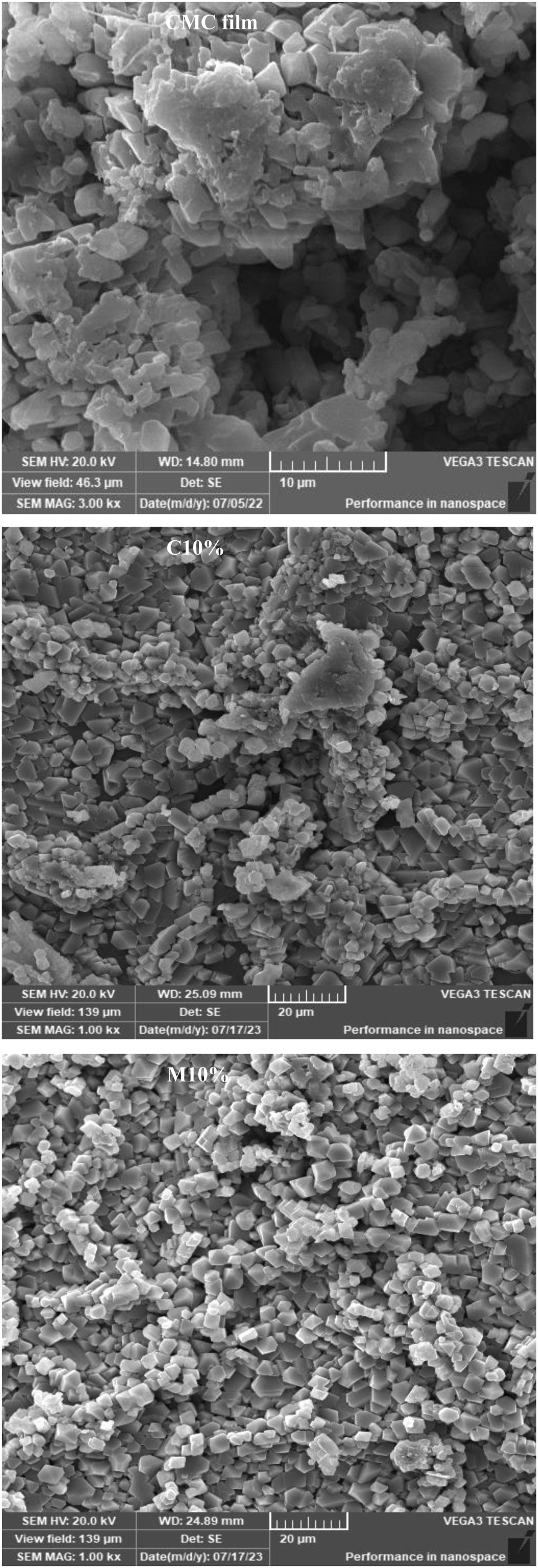
Mechanical properties
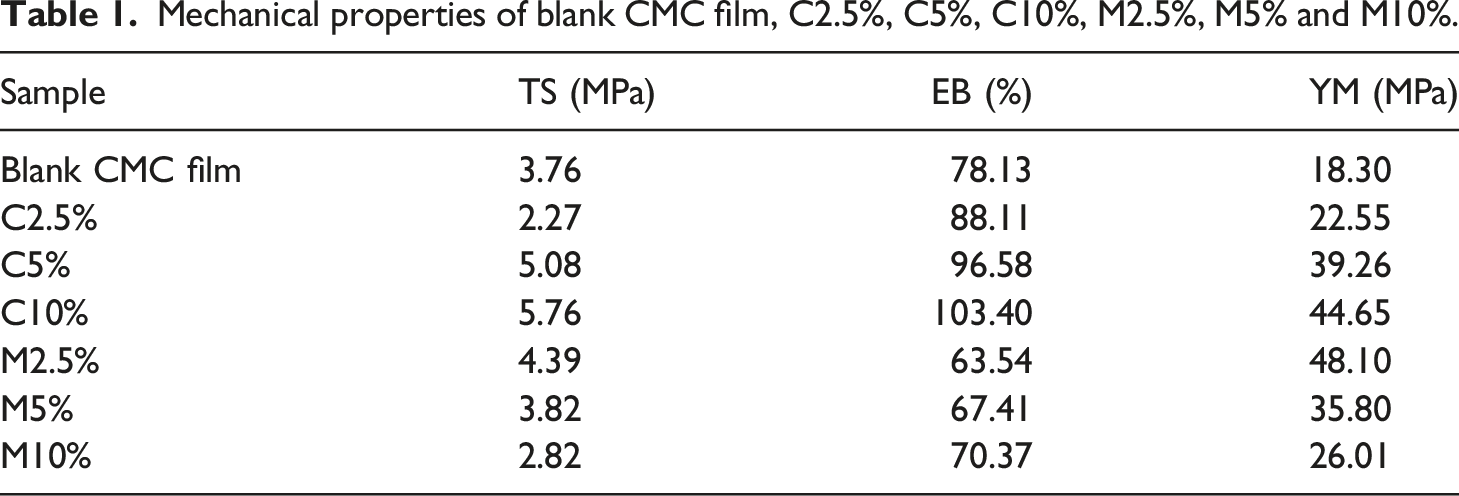
Mechanical properties of blank CMC film, C2.5%, C5%, C10%, M2.5%, M5% and M10%.
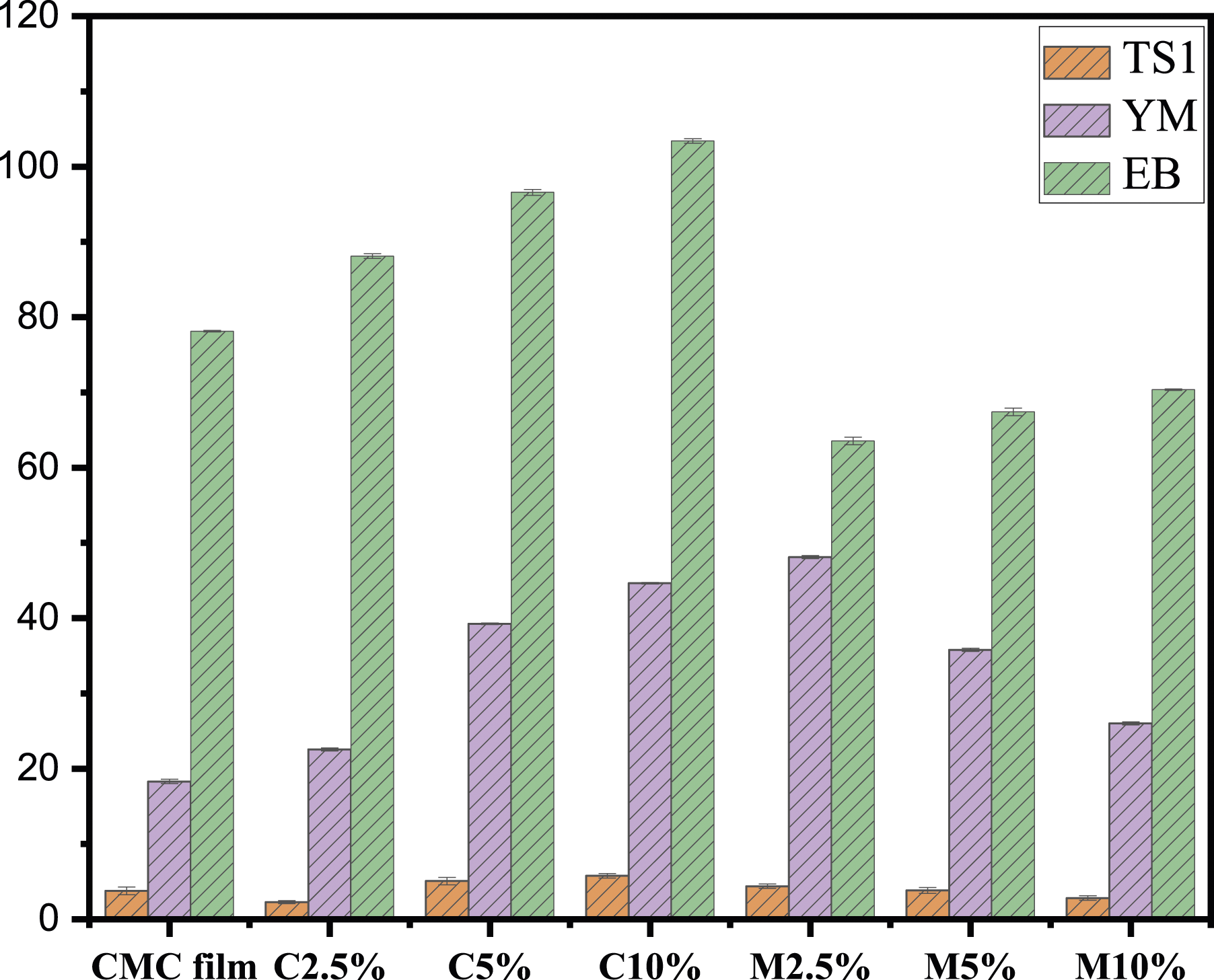
Mechanical analysis for blank CMC film, C2.5%, C5%, C10%, M2.5%, M5% and M10%.
Concerning EB%, it was typically seen that EB% increased with the addition of cantaloupe; for C2.5%, C5% and C10%, the rise varied from 112.77 to 132.34%. Cantaloupe has been shown to be effective plasticizers for CMC films due to their ability to enhance film EB % which make it a good plastic bag for food products. In contrary, increasing mandarin to higher loadings led to a decrease in the EB % (EB∼ – 68.52, – 81.32 and – 86.27% for M2.5%, M5% and M10%, respectively). This may be due to the strong interaction between CMC matrix and mandarin which suppress the mobility of the CMC chains. The rigidity of M10% was increased and allowed less flexibility, which is good for the rigid packaging applications for fragile food products such as yogurt. 4 The M extract contains epoxy and OH groups while C extract contains NH2 groups which interact differently with the free OH of CMC. C reacts with CMC via =NH- group which is reversible (i.e. elastic) while M when reacts with CMC give irreversible -O- group (i.e. rigid).
XRD analysis
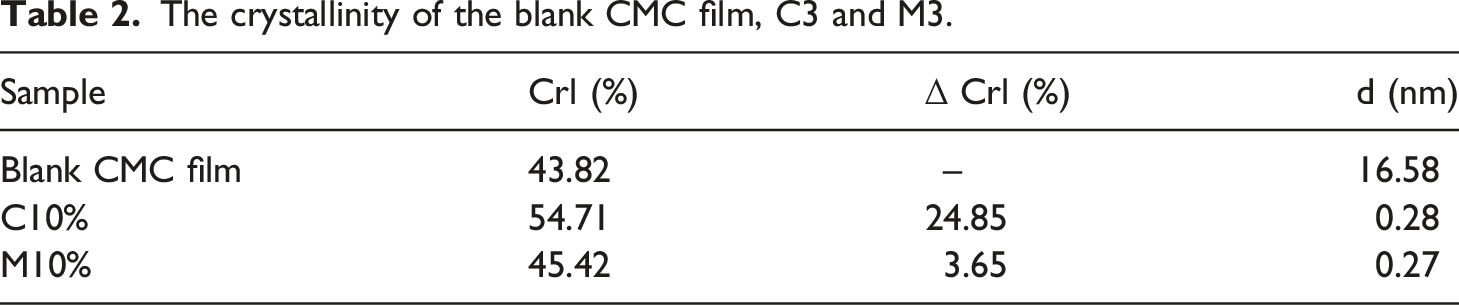
The XRD pattern of the blank CMC film, as shown in Figure 4, indicates reflections at 13, 19 and 21°θ. The broadening of 19 and 21°θ peaks indicates the amorphous structure of CMC.4,20 The crystallinity indexes (Cr. I %) calculated for blank CMC film, C10% and M10% were 43.82, 54.71 and 45.42%, respectively. It is clear that Cr. l (%) of C10% and M10% increase compared with that blank CMC film. This may be due to the H–bonding between cantaloupe and/or mandarin with CMC matrix. This is proved also by the high TS and YM calculated in the mechanical section, as well as, the OH peaks shifting in the FTIR which proved the presence of H–bonds. As shown in Table 2, d (nm) of C10% is increased compared to M10%. This is also proved by the high EB (%) calculated for them in the mechanical section. XRD spectra of blank CMC film, C3, and M3. The crystallinity of the blank CMC film, C3 and M3.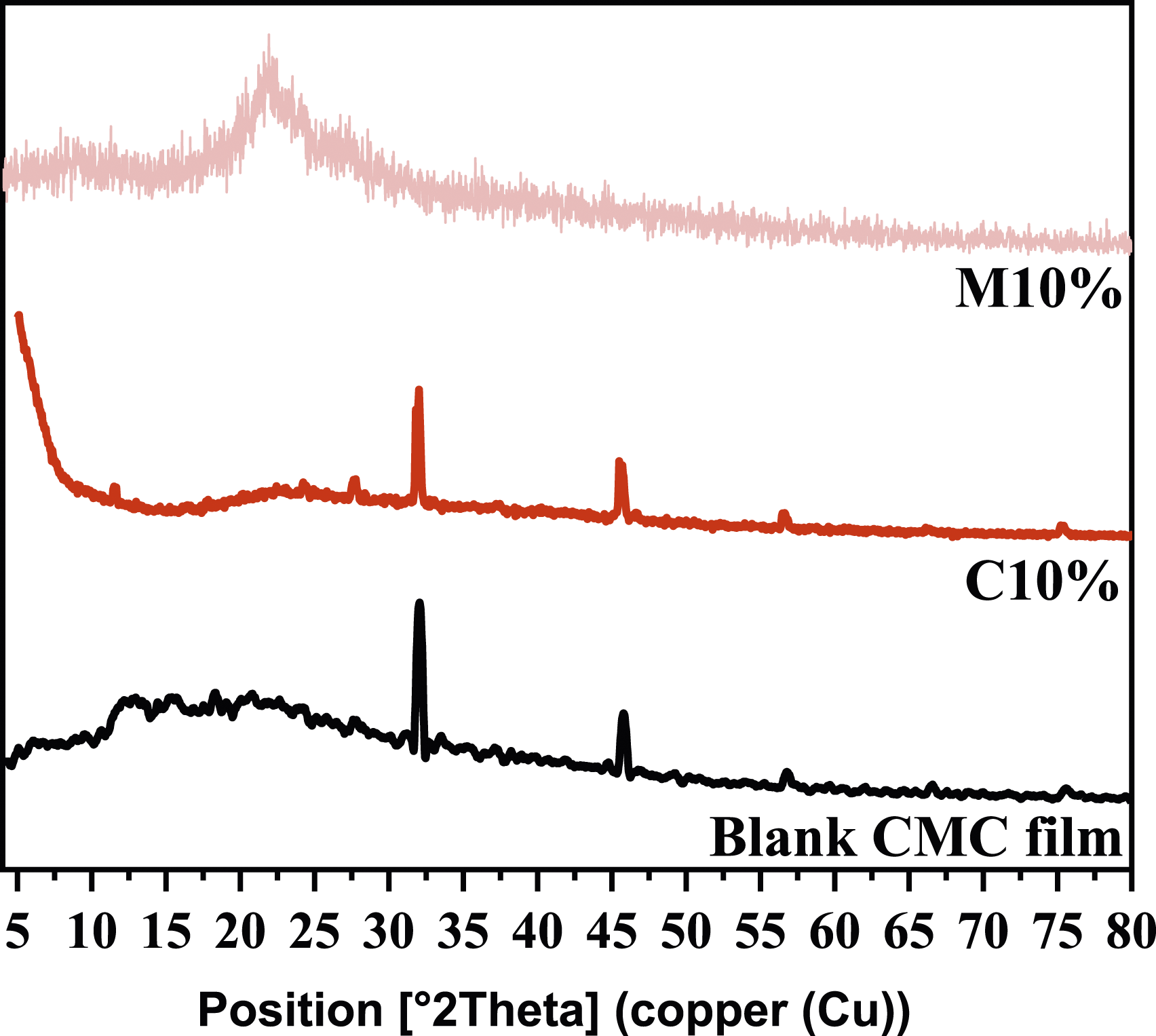
Antimicrobial properties
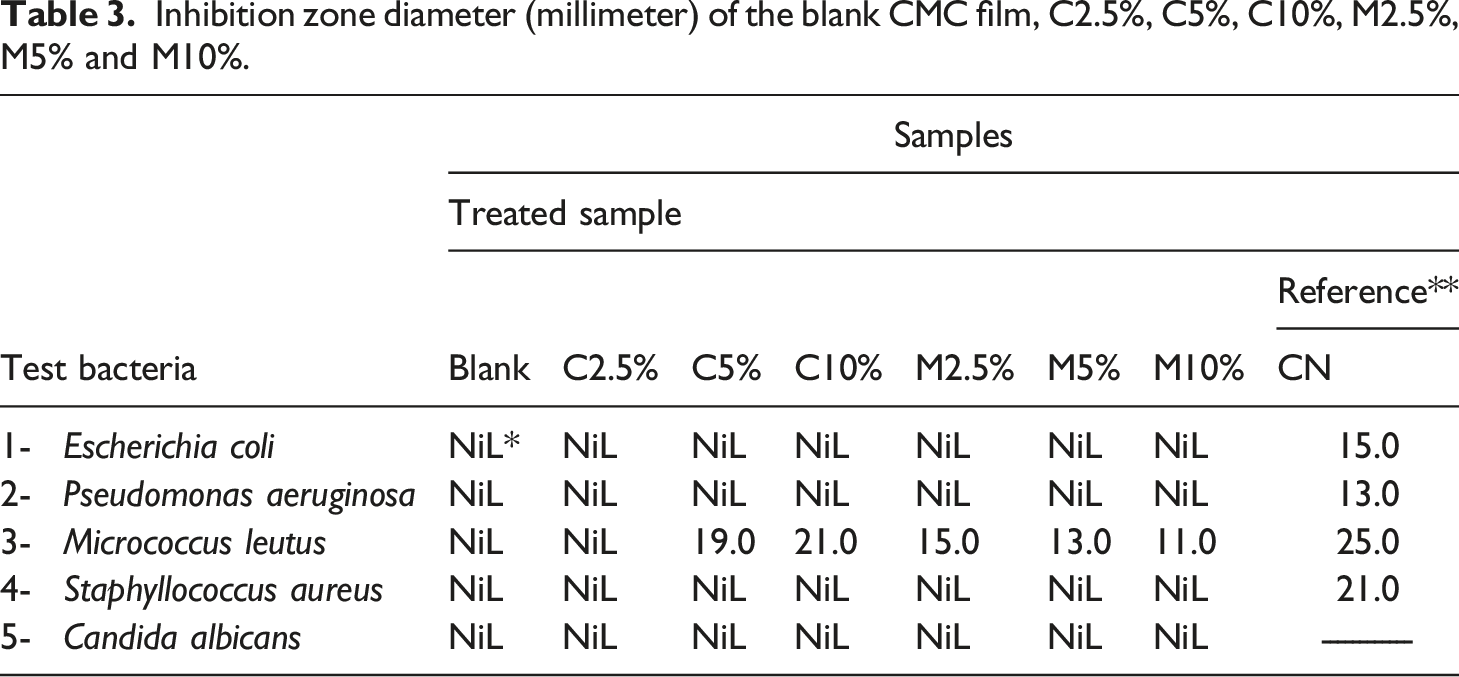
Inhibition zone diameter (millimeter) of the blank CMC film, C2.5%, C5%, C10%, M2.5%, M5% and M10%.
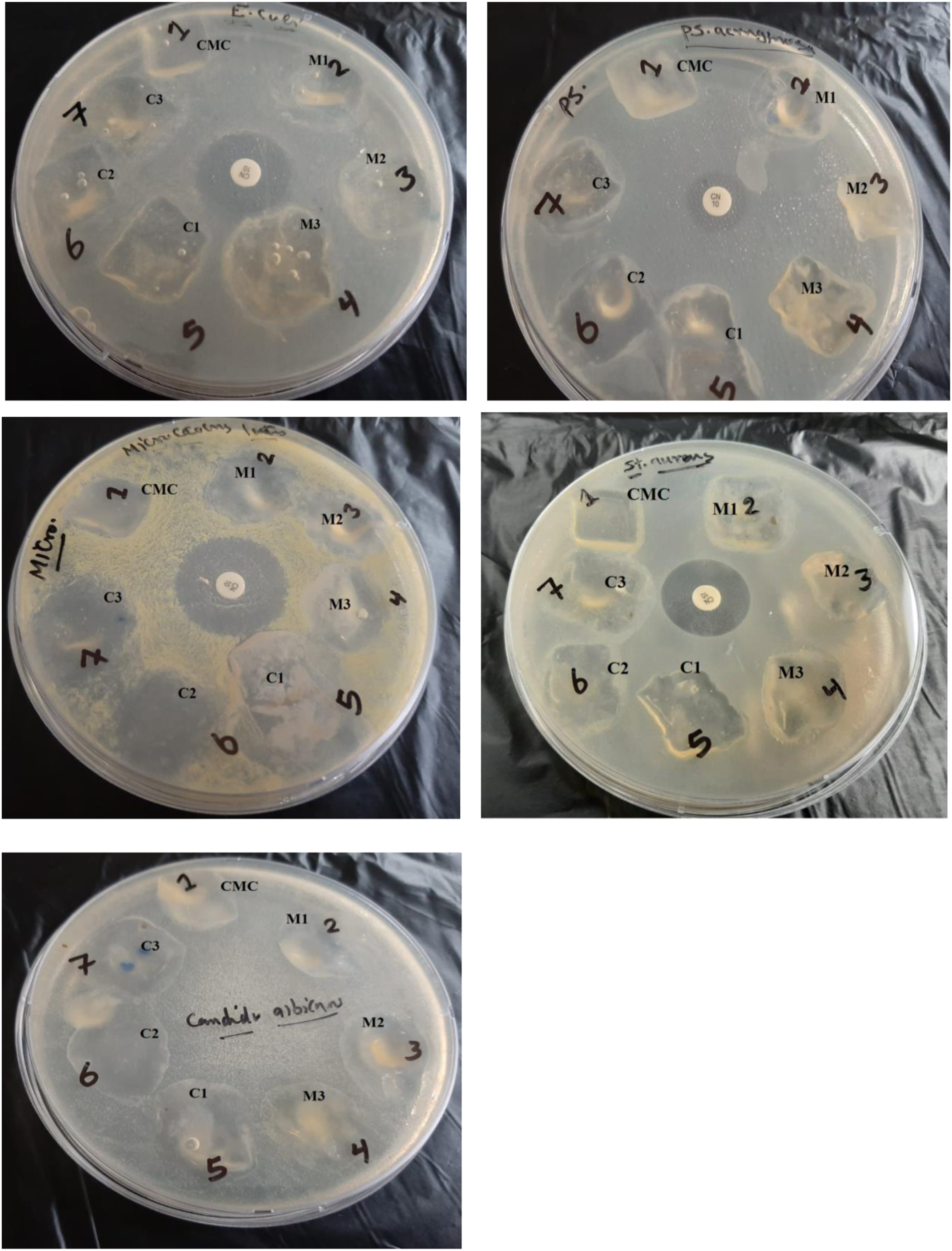
Antimicrobial activity of the blank CMC film, C2.5%, C5%, C10%, M2.5%, M5% and M10%.
(%) CFU reduction of tested strains after incubation applying the test films using shake flask method.
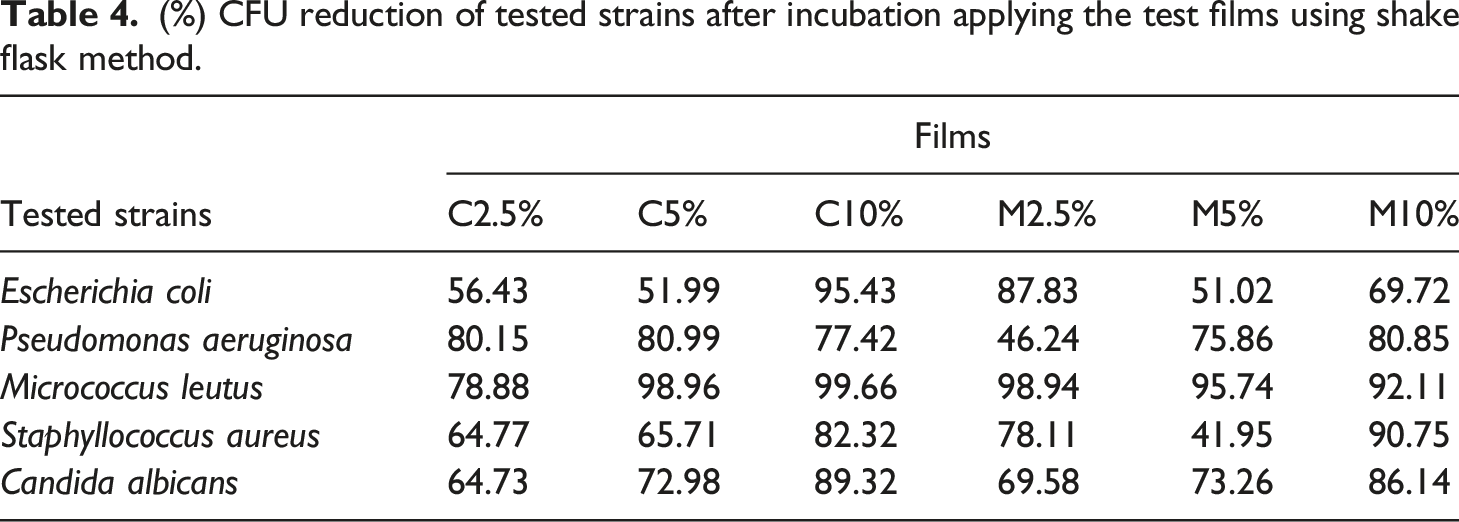
Citrus are widely popular all over the world. Common varieties of citrus include oranges, limes, lemons, grapefruits and mandarin. Their essential oil and extracts have shown inhibitory effects on the growth of some bacteria in the food industry, and those related to food spoilage. It was found that the mandarin essential oil to possess the broadest spectrum of actions, and played a direct role in its antibacterial mechanism.27,28 The bacterial cells treated with the films incorporated with 10% concentration of mandarin are likely found to be severely damaged and the original integrity of the cell membrane which is a pivotal structural component of a bacteria cell, is completely disappeared leading to the leakage of nucleic acids, protein and other intracellular substances. This may be attributed to the tannin-rich methanol extract, which caused the depolarization of the cells exposed to it, resulting in abnormal metabolic activities, structural distortion and serious destruction of the cells.
29
This effect confirms that mandarin extract can penetrate the bacterial membrane and act on the cell membrane to kill it, thus establishing its potential as a representative natural antimicrobial agent for food preservation.30,31 Cantaloupe is one of the most commonly consumed fruits worldwide because of its fine aroma and nutritional benefits, its peel can be used as a potential resource of various health-promoting compounds,
32
especially pectin which is a structurally complex macromolecule of partially esterified α (1-4) linked
Conclusion
CMC film was blended with C and M by ultrasonication. FTIR spectra shows that the relative absorbance of the O–H decreased compared to the blank CMC which means the crosslinking between C or M with CMC. SEM analysis shows increased pore size by addition of extracts. X-ray diffraction show that the crystallinity indexes increased due to H–bonding which occurs as a result of crosslinking. From mechanical tests it was shown that C acts as a plasticizer for CMC film due to the increased EB % values which make it a good plastic bag for food products, while M increased the rigidity of CMC which make it good for packaging fragile food products. From these results we can say that the effect of M on CMC film is different than the effect of C.
Footnotes
Acknowledgments
The authors appreciate the National Research Center, Egypt, for supporting this work.
Author contributions
M.E.-S.: Conceptualization, Validation, Formal analysis, Data curation, Visualization, Supervision, and Project administration. H.-A.S.T.: Conceptualization, Methodology, Sofware, Validation, Formal analysis, Data curation, writing— original draft preparation, Visualization, and prepared figures. M.M.A.: Conceptualization, Methodology, Validation, Formal analysis, Data curation, writing—original draft preparation, and Supervision. M.E.-M.: Conceptualization, Methodology, Formal analysis, Data curation, and writing— original draft preparation. All authors have read and agreed to the published version of the manuscript.
Declaration of conflicting interests
The author(s) declared no potential conflicts of interest with respect to the research, authorship, and/or publication of this article.
Funding
The author(s) received no financial support for the research, authorship, and/or publication of this article.
