Abstract
This paper aims to conduct theoretical modeling of tensile properties of thermoplastic composites developed from novel unidirectional recycled carbon fiber tapes. Unidirectional recycled carbon fiber tape structure is an innovative, sustainable and cost-efficient prepreg structure designed to develop carbon fiber reinforced plastics with the highest resource efficiency. In order to do modeling, existing theoretical models of tensile properties of unidirectional composites were reviewed in the first part of this paper. Subsequently, reviewed theoretical models were further modified by considering the tensile properties of fibers, fiber length, fiber orientation, fiber volume content and short fiber content to predict the tensile properties of composites based on novel tape structure. The results of this study reveal that the proposed theoretical models are in good agreement with the experimental results.
Keywords
Introduction
Composite tensile properties play a critical role in component design and its application for multiple engineering fields including aerospace, automotive and wind energy sectors.1–3 Generally, the tensile properties of composites are assessed by using experimental technique based on standard tensile test methods. In addition, theoretical models are also widely used to estimate the composite tensile properties. It is well established in the literature that theoretical modeling show good approximation for unidirectional composites based on continuous fibers. It is because unidirectional composites based on continuous fibers have homogeneous, uniform and periodic representative volume elements.4–6
Besides this, recycled carbon fiber are discontinuous in nature and fiber orientation in composite structure is influenced by the processing technology and its associated technological parameters. For instance, composite structure based on injection molding, nonwovens and hybrid yarn techniques possess random, partial and angled orientation rather than unidirectional orientation. In addition to this, fiber length distribution and fiber volume content in composite structure is also non-uniform.7–10 Therefore, composites based on discontinuous recycled carbon fibers possess heterogeneous, non-uniform and non-repeating representative volume elements. Consequently, estimation of tensile properties of composites through theoretical modeling is a challenging task.
Recently, a novel tape manufacturing technology has been developed in the Institute of Textile Machinery (ITM) and High-Performance Material Technology, TU Dresden that delivers novel tape structure based on recycled carbon and polyamide fibers with unidirectional fiber orientation. This novel, unidirectional and thermally staple prepreg structure is termed as “Unidirectional recycled carbon fiber tape”. This novel technology comprises of fiber opening, special carding, modified drawing and innovative tape forming processes that transformed recycled carbon and polyamide fibers into unidirectional tape structure as shown in the Figure 1. Subsequently, this novel tape structure were stacked and converted into thermoplastic composite through consolidation. The technology-structure-property relationship established that optimum combinations of technological, structural and consolidation parameters deliver composite structure with outstanding composite tensile properties. Further analysis reveals that fiber length, fiber orientation and short fiber content (SFC) have a significant relation with the composite tensile properties.11,12 Innovative technology for the developing unidirectional recycled carbon fiber tape structure.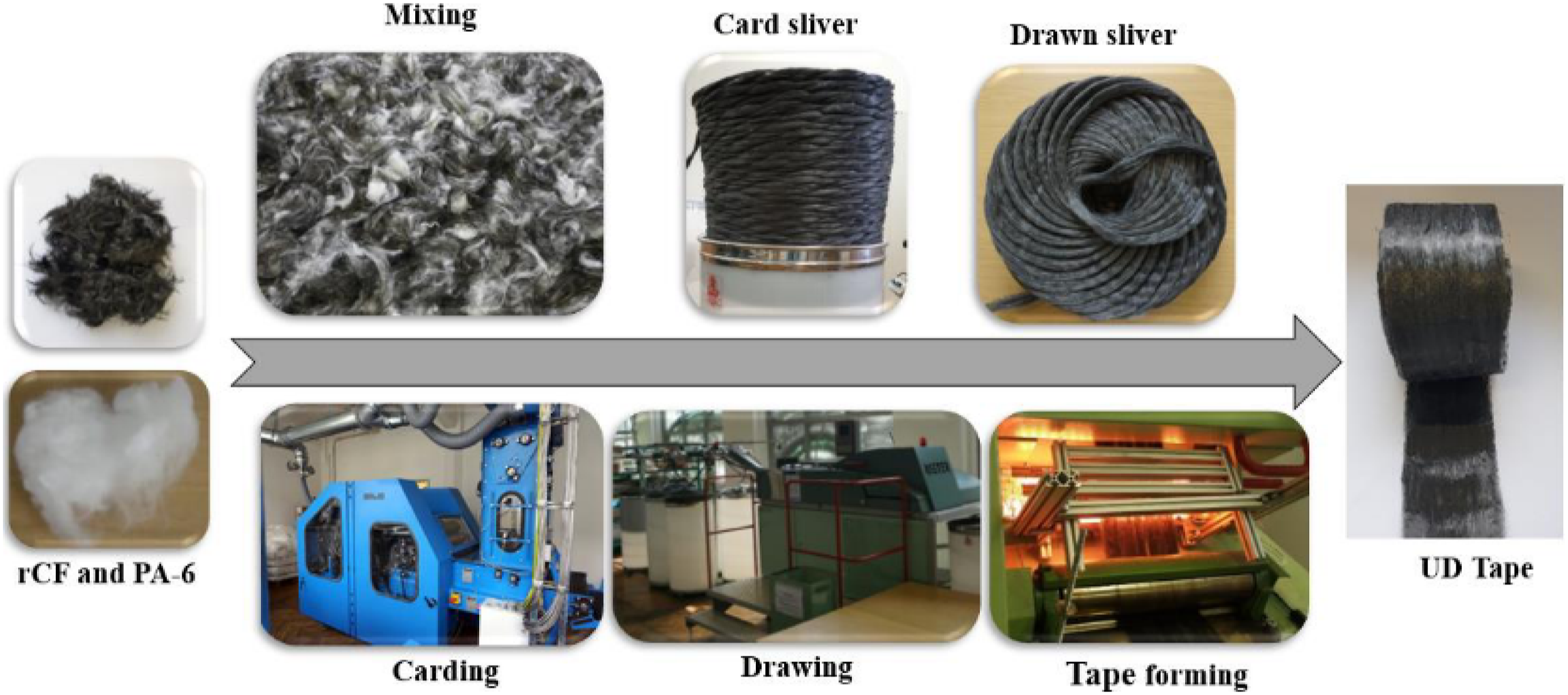
Fiber length, fiber orientation, fiber volume content and tensile properties of individual constituent are the established factors as reported in the literature to estimate the composite tensile properties. While the origination of short carbon fibers and its behavior during processing is an emerging concern that affect the composite tensile properties by disturbing the fiber orientation and uniformity in the structure. Therefore, there is strong need to modify existing theoretical models to estimate the composite tensile properties by considering short fibers content as an additional factor. Therefore, the aim of this research paper is to develop models that precisely predict tensile properties of fiber reinforced plastics fabricated through unidirectional recycled carbon fiber tape structure. For this purpose, existing theoretical models are reviewed and a modified model is proposed to predict tensile properties of unidirectional thermoplastic composite. Following section presents an overview on current theoretical modeling utilized for predicting tensile properties of unidirectional composites.
Theoretical modeling of unidirectional composites
Unidirectional composites are a transversely isotropic material where all fibers are oriented in loading direction. In order to predict tensile modulus and strength of continuous and discontinuous unidirectional fiber reinforced composites, multiple theoretical models are reported in literature. An overview of important theoretical modeling of tensile properties of unidirectional composites is presented in this section.


This model mainly considers fiber volume content to determine tensile modulus (


A theoretical model that considers fiber length as a factor to predict tensile modulus and strength of composites is Cox model13,14 as given in equations (3.1)–(3.4):


In Cox model,


Later on, Cox model is modified by introducing the fiber orientation factor in the equation. This modified model is termed as modified Cox (Mod. Cox) model as shown in equations (4.1) and (4.2).


Kelly and Tyson present the relationship between fiber length embedded in the matrix, fiber strength, fiber diameter and interfacial shear strength as given in equation (5):

Based on this relationship, stress transfer from fiber to matrix in composites depends on the critical fiber length. The critical fiber length is defined as the fiber length, at which stress can reach the tensile strength of the fiber. In the case fiber length is higher than the critical fiber length, the stress is transferred from fiber to matrix and composite properties linearly follow the strength of the fibers in tensile loading.
Based on Kelly and Tyson theory, theoretical model K-T
5
is developed by introducing critical length relationship in ROM as given in


In this model,
Further, Kelly and Tyson model was also modified (Mod. K-T) by introducing fiber orientation factor as in


A semi empirical model, known as





Halpin-Tsai model was also modified








Experimental methodology
Material
Developed material combinations.
Fabrication of tape and composite structure
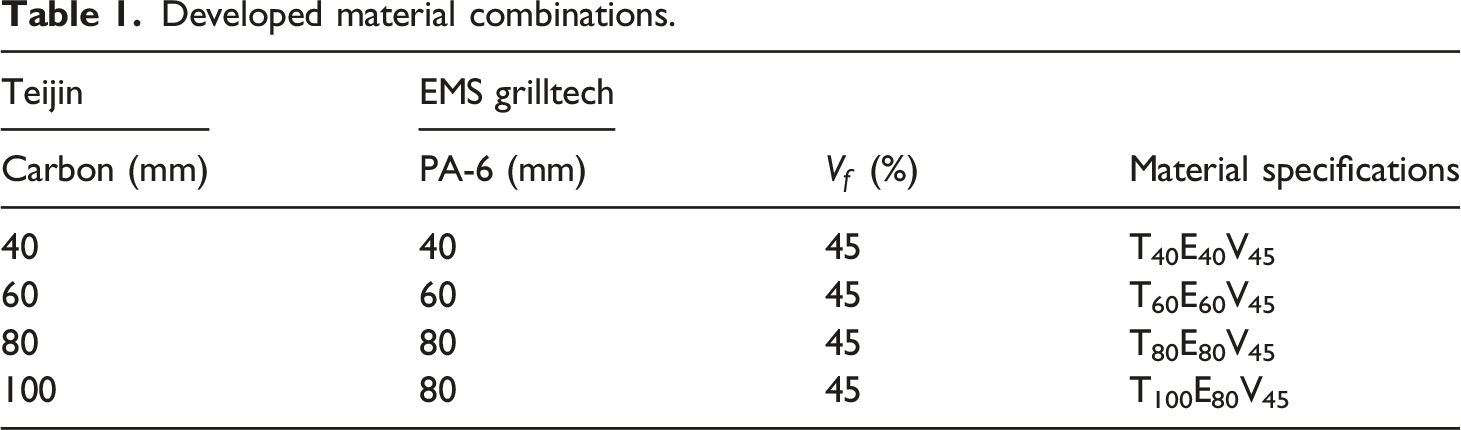
Innovative tape manufacturing technology, shown in the Figure 1, was utilized to develop unidirectional recycled carbon fiber tapes from different material combinations as reported in Table 1. Later on, multiple layers of the tapes were stacked in [0]s direction and consolidation was carried out by utilizing a laboratory scale press machine (P 300 PV from Dr Collin GmbH, Germany) to develop a unidirectional thermoplastic composite. The fabrication of thermoplastic composites from unidirectional recycled carbon fiber tapes structure is shown in the Figure 2. Development of thermoplastic composites.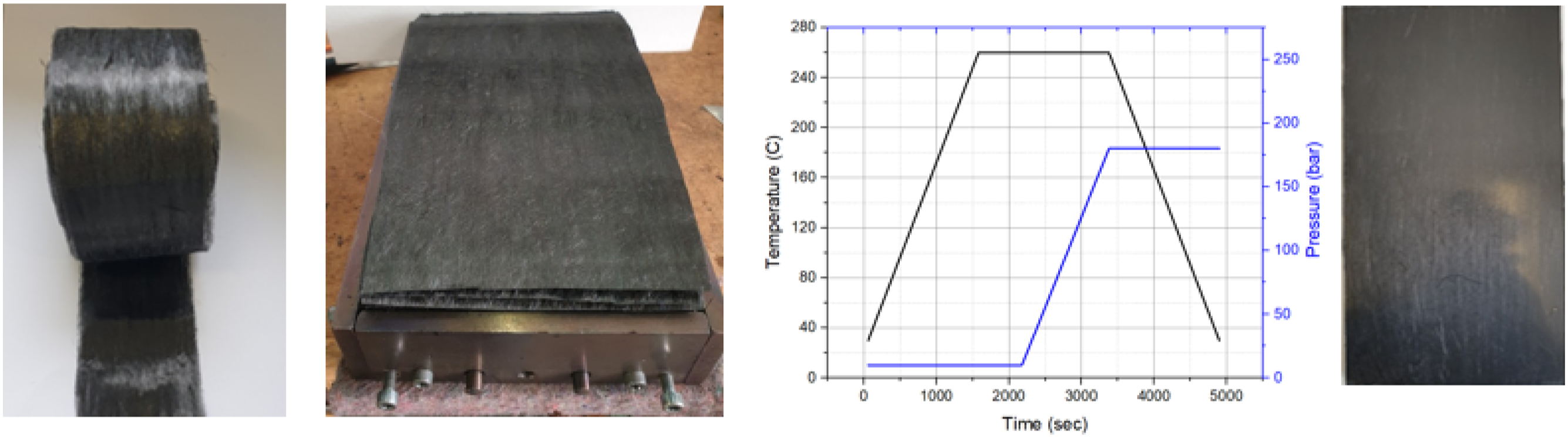
Material properties measurements
The tensile modulus (
Fiber length assessment
Thermoplastic composite developed in this study is composed of multiple layer of novel tape structure. Therefore, mean fiber length and SFC of recycled carbon fibers was measured from the developed unidirectional tape structure. For this purpose, tape structure without thermal fixation was developed and subjected to image analysis method18,19 for the assessment of mean fiber length present in the structure.
In image analysis method, tape structure ranging from 0.8-0.9 grams was used to develop a fiber beard. The fiber beard in a range of 150 ± 20 milligrams was scanned and grayscale densities of different class lengths were employed to draw a staple length diagram as shown in the Figure 3(b).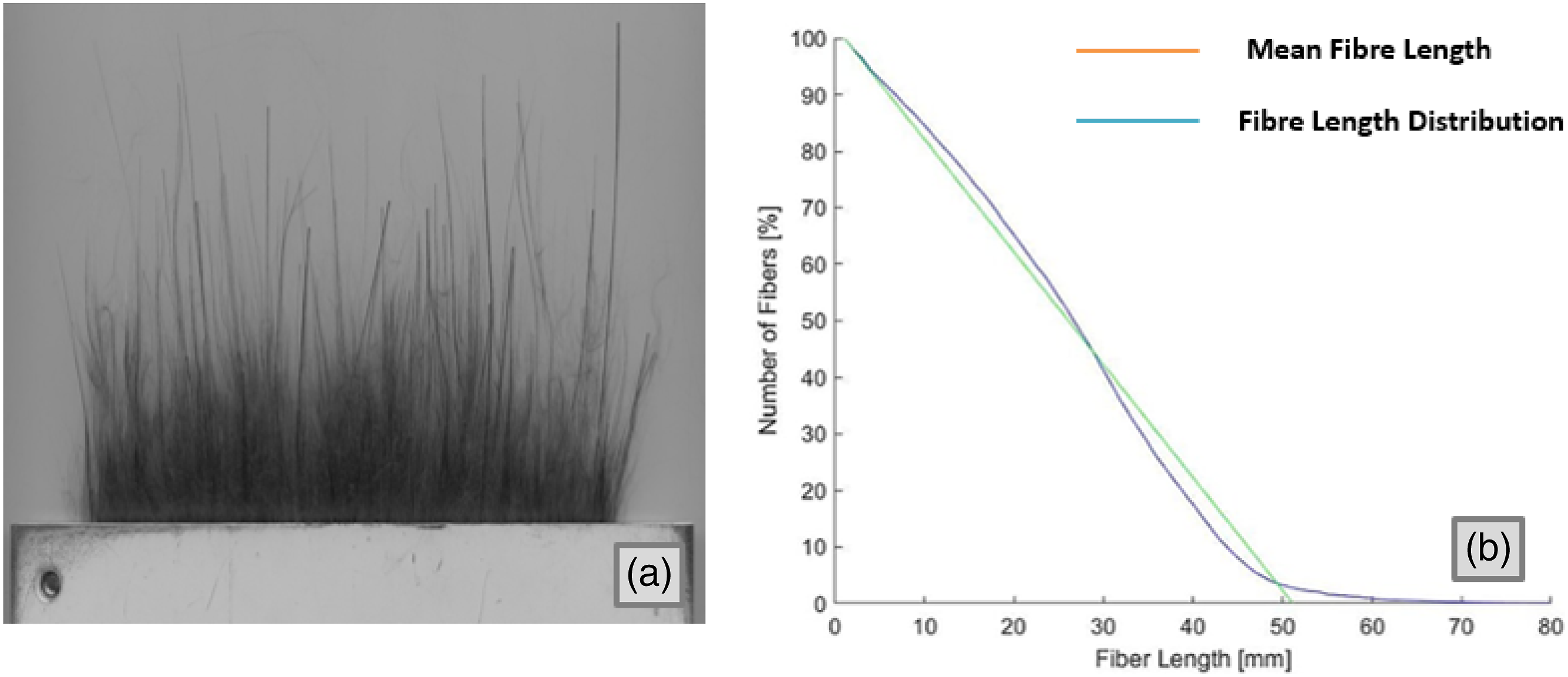
Assessment of SFC
In order to measure short carbon fibers in the developed tape structure, weight of combed fibers (C) originated from the beard preparation process and the beard weight of carbon fibers (B), as shown in the Figure 4(a), were used to estimate the percentage of short carbon fibers present in the tape structure though equation (11). Measurement of short carbon fiber content (a) beard preparation process (b) beard of short carbon fibers (c) staple diagram of short fibers.
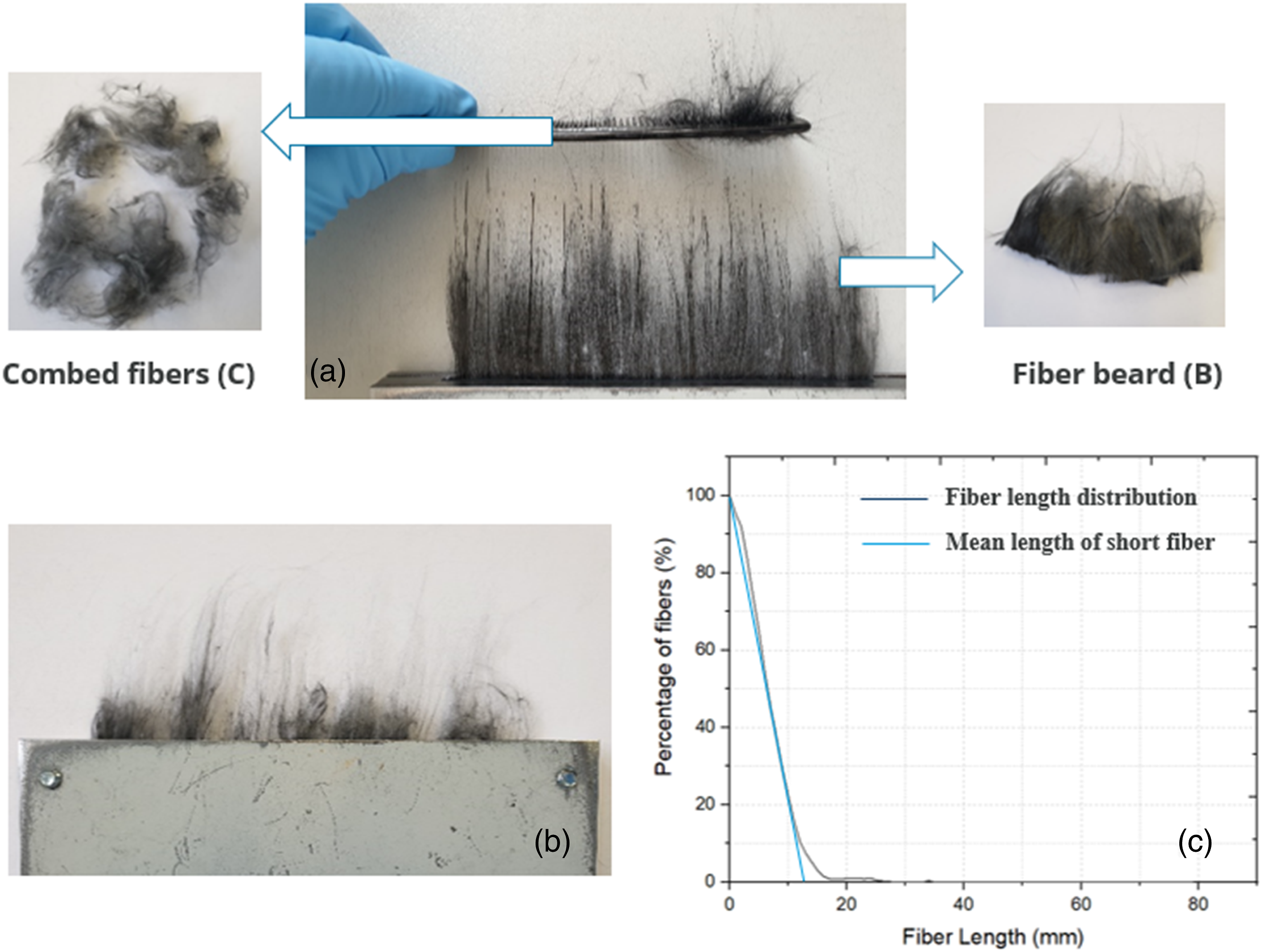
Later, combed fibers were further subjected to image analysis method to determine the length of the short carbon fibers as shown in the Figure 4(c). The staple diagram of the short carbon fibers confirms that the mean length of the comber fibers is 12.7 mm.
Fiber orientation determination
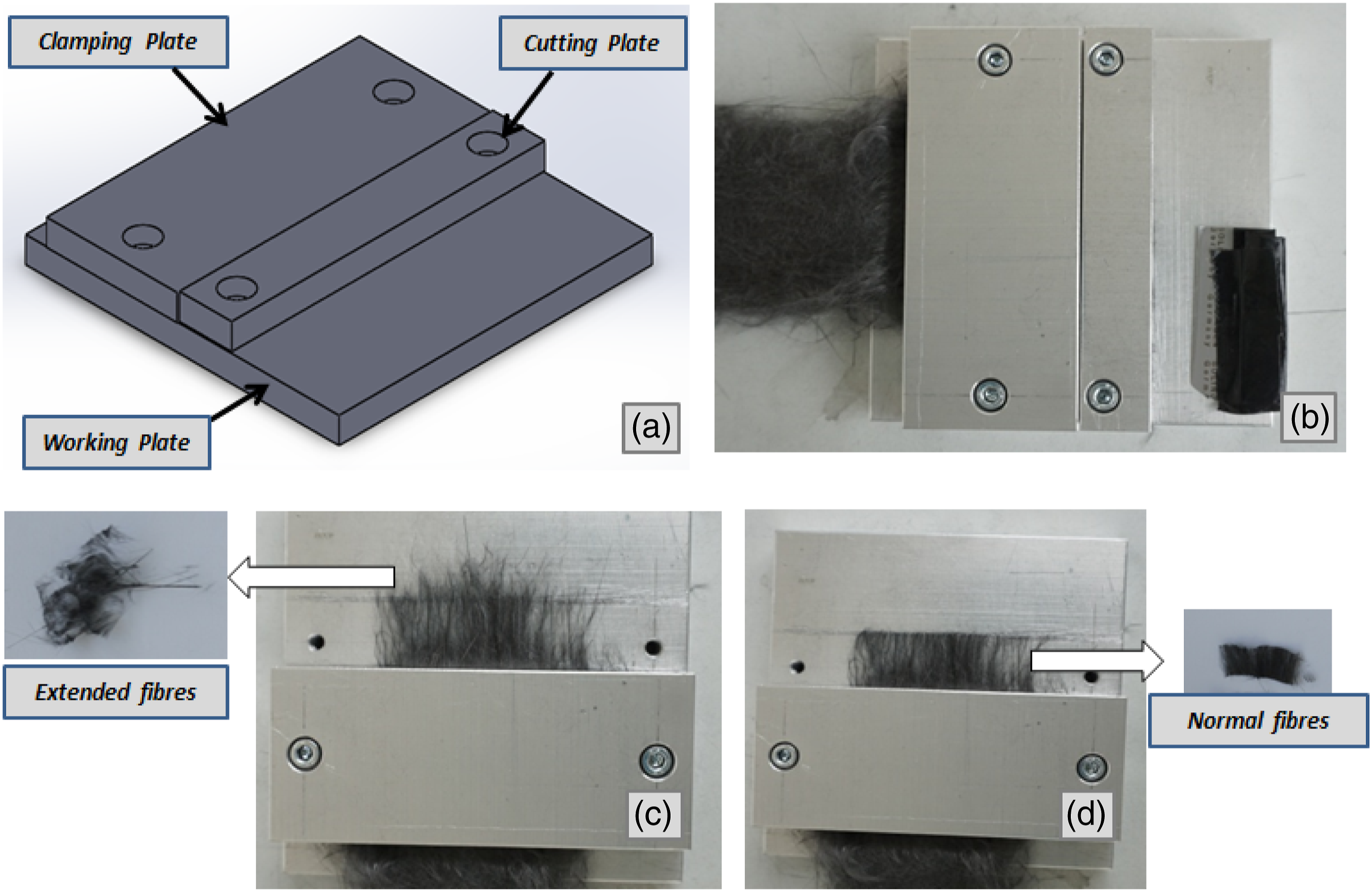
In this study, fiber orientation was measured in the unidirectional recycled carbon fiber tapes and composites structures. In the tape structure, fiber orientation was measured in the machine direction. For this purpose, tape structure without thermal fixation was subjected to Lindsley method for the determination of fiber orientation index. Lindsley method is composed of three metallic plates, one bottom plate termed as working plate and two top plates termed as clapping plate in addition to a cutting plate as shown in the Figures 5(a) to (d). The systematic procedure to determine the fiber orientation is reported in.19,20 The weight of extended fibers (E) and Normal fibers (N) in forward direction was used in equation (12) to estimate fiber orientation. Principle of Lindsley method (a) Lindsley apparatus (b) fiber placed under plates (c) extended fibers (d) normal fibers.
In case of composite, fiber orientation distribution in the structure was measured by using image-processing approach.
21
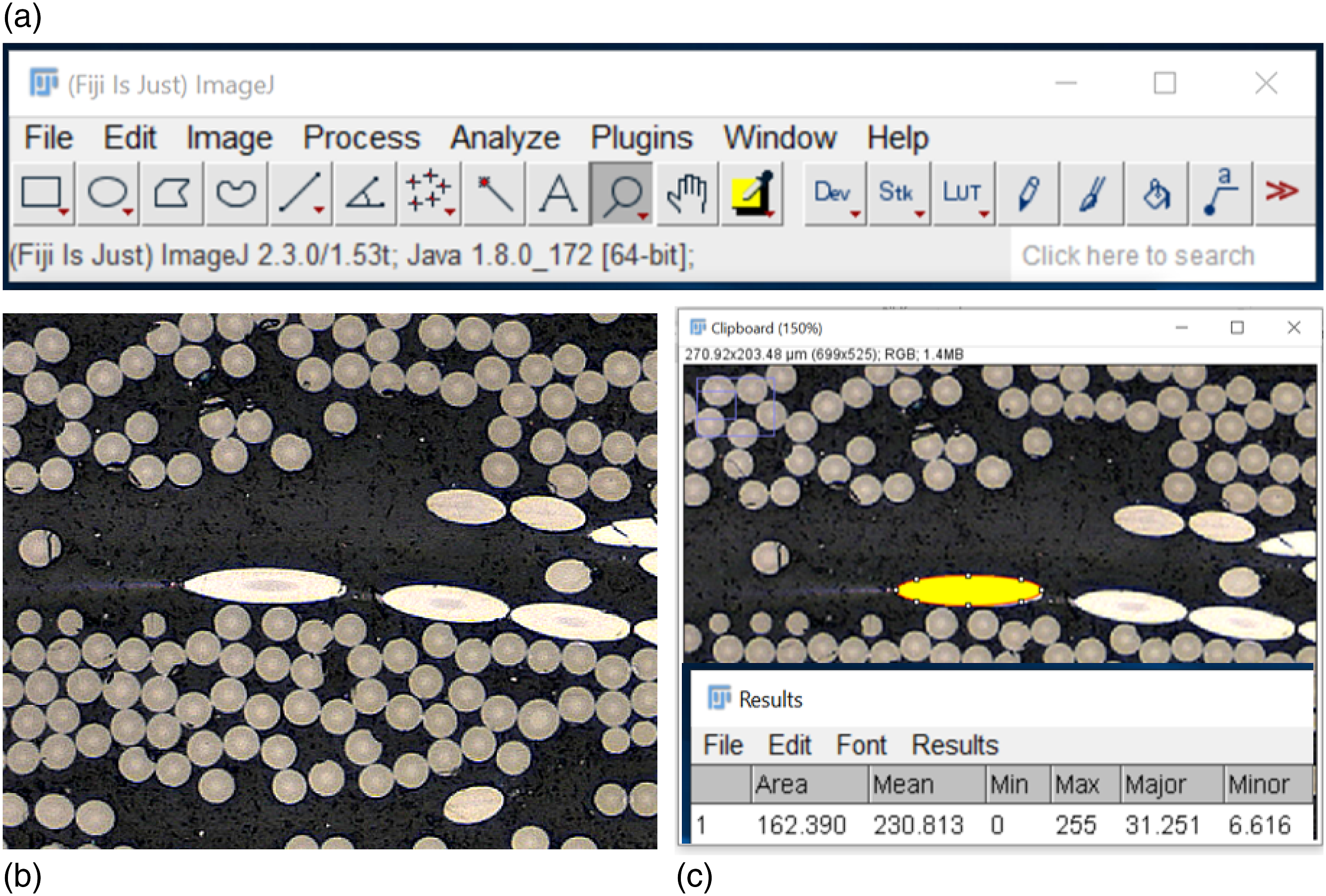
In this technique, composite cross-section was examined under the Axio Imager M1m microscope (Carl Zeiss, Germany). Later on, the major and minor axis of the fibers was determined by Image J software. In the end, the data of approximately 800 fibers was used to calculate the fiber orientation distribution (in degree angle) by using equation (13). The complete process of fiber orientation measurement is presented in Figure 6. Image-processing approach (a) Image J software (b) original composite cross-section (c) Measurement of highlighted fiber and its result for example.
Composites properties determination
The tensile properties of thermoplastic composites based on unidirectional recycled carbon fiber tape structure were carried out by DIN EN ISO 527–5 test method. For this purpose, specimens of 250 mm × 15 mm × 1 mm (l × w × h) were subjected to Zwick type Z 100 (Zwick GmbH and Co., Germany) testing machine. Furthermore, the fiber volume fraction in composite structure is determined according to DIN EN ISO 1172-1998 standard test method.
Development of theoretical model for composite based on unidirectional recycled carbon fiber tape structure
Current theoretical models, as reported earlier, estimate the tensile modulus and strength of composites by considering material properties (modulus and strength), composition (fiber volume content), and structural parameters (fiber orientation and fiber length). In contrast, recent study in the development of recycled carbon fiber reinforced plastics based on novel unidirectional tape structures also confirms the impact of SFC on tensile properties of composites. 11 Therefore, development of theoretical models is a focus of current research paper.
The process chain utilized for the development of unidirectional thermoplastic composites comprises of fiber preparation, carding, drawing, tape forming and consolidation processes as reported earlier. The carding, shearing and stripping actions of inherently brittle, non-crimped and shear sensitive fibers causes damage to the carbon fibers and originates short carbon fibers (less than 12 mm). Subsequently, these short fibers act like floating fibers in the drafting zones of drawing and tape forming processes and introduce an unpredictable motion that disturbs fiber orientation and fiber length distribution in the tape structure. It is also well established that short fibers float in fiber bundles under drafting circumstances. Investigations shows that amount of short fiber increases with increased infeed length of carbon fiber. The reason is the bending tendency of staple fibers that enhance fiber entanglement during carding. Ultimately, short fibers possess random orientation also become a part of the tape and composite structure. 11
In addition to this, short carbon fibers are responsible for non-uniform fibers distribution in the structure. This non-uniform distribution nucleates void content in the composite structure and it plays a critical role for the composite tensile properties.
22
Therefore, the new function short fibers (
ROM-SFC model

Cox-SFC model

K-T SFC model


SFC for the modulus and strength are calculated by using following functions
SFC =
Results and discussion
Structural parameters of composites
The tensile properties of unidirectional composites based on discontinuous fibers are depends on different structural parameters including material properties, fiber orientation, fiber length and fiber volume fraction present in the structure. Latest study on innovative unidirectional recycled carbon fiber tape structure reveals that SFC as structural parameter also play a significant role in the composite properties. Therefore, this section presents the results of structural parameters present in the thermoplastic composites based on unidirectional recycled carbon fiber tape structure.
Material properties
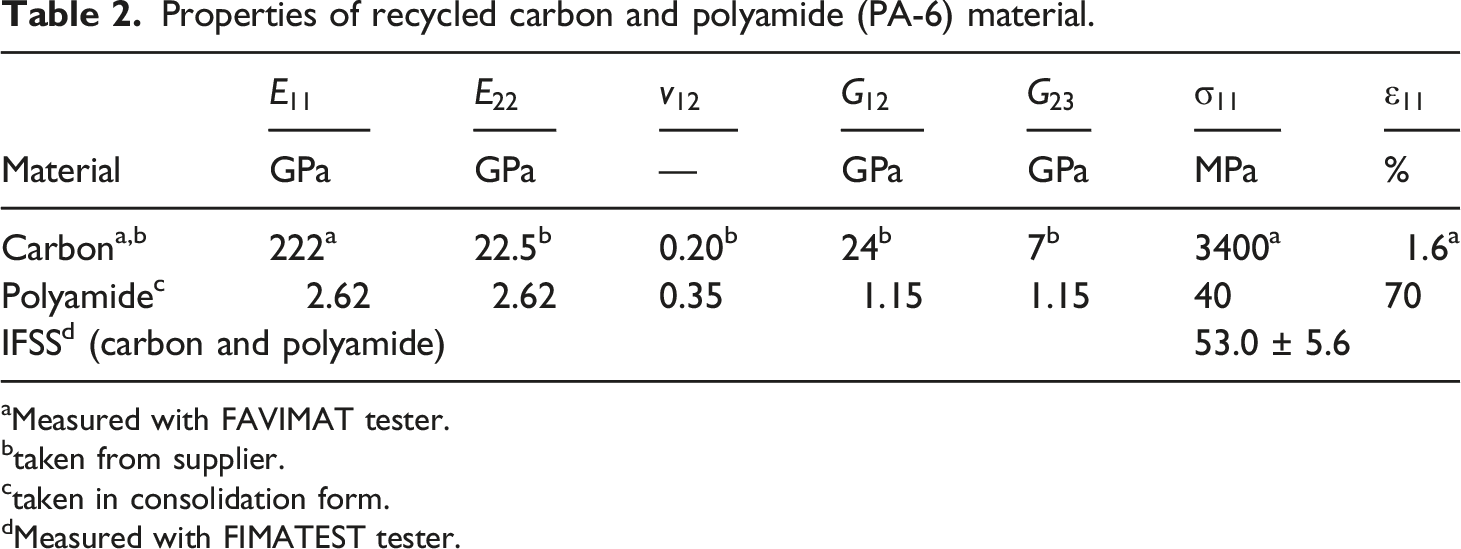
The distribution curve of tensile strength and modulus of Type-I recycled carbon fibers is presented in Figure 7. The curves shows that average tensile strength and E-Modulus of recycled carbon fiber used in this study are 3404 ± 683 MPa and 222 ± 16 GPa respectively. In case of polyamide, tensile properties were measured by developing a polyamide composite (in consolidation form) based on staple fibers. The summary of the material properties including interfacial shear strength is presented in the Table 2. Tensile properties of Type-I recycled carbon fibers (a) strength distribution (b) modulus distribution. Properties of recycled carbon and polyamide (PA-6) material. aMeasured with FAVIMAT tester. btaken from supplier. ctaken in consolidation form. dMeasured with FIMATEST tester.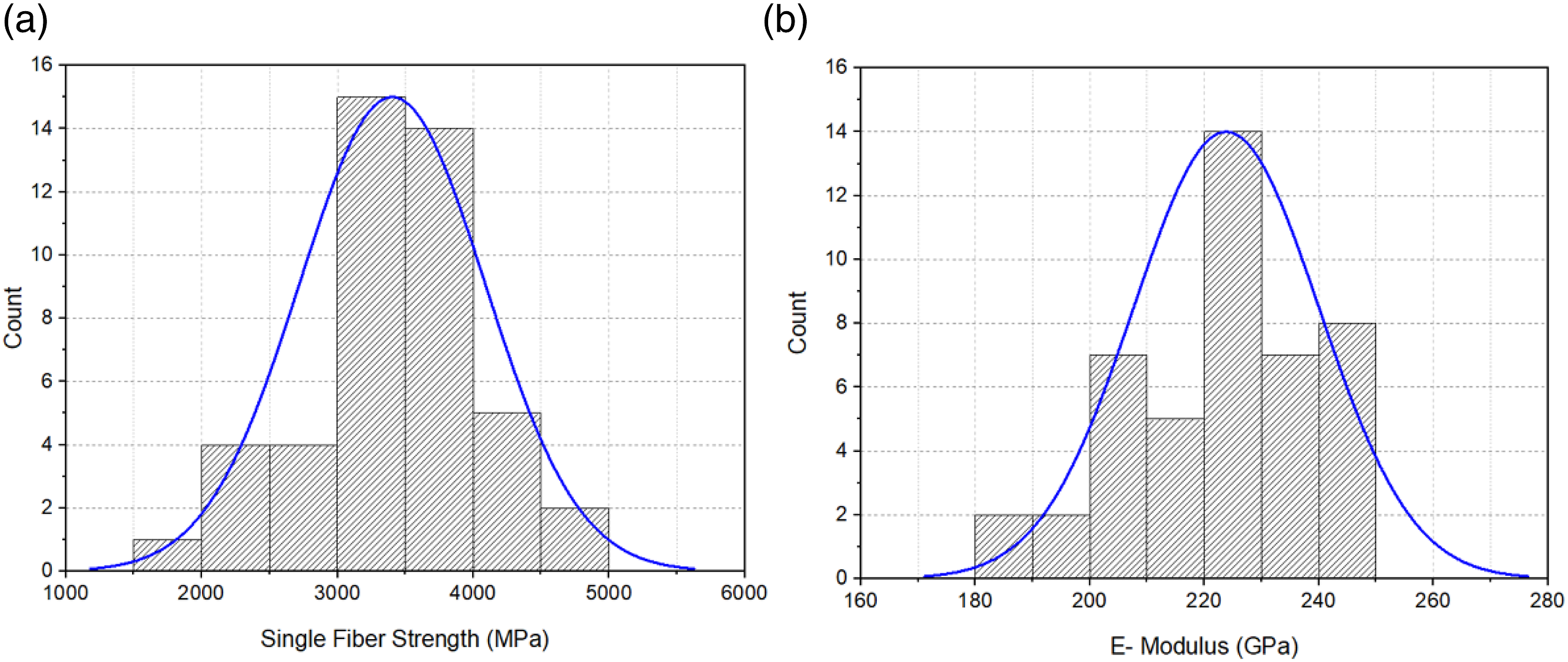
Fiber length
The results of mean length of the recycled carbon fibers embedded in the thermoplastic composites are shown in Figure 8(a). It is clearly seen from the graph that mean length of carbon fiber embedded in the T40E40V45, T60E60V45, T80E80V45 and T100E80V45 composites are 38 ± 2.4, 54 ± 3.4, 60 ± 1.8 and 78 ± 2.6 mm respectively. It is concluded from the results that length of carbon fibers shorten in the tape manufacturing process. This fiber shortening introduce short fibers in the tape structure that also become a part of the composite. The results of the SFC present in the tape structure are presented in the Figure 8(b). The graph shows that composite fabricated from T40E40V45 combination has negligible SFC. Fiber length distribution (a) Mean fiber length (b) Short fiber content.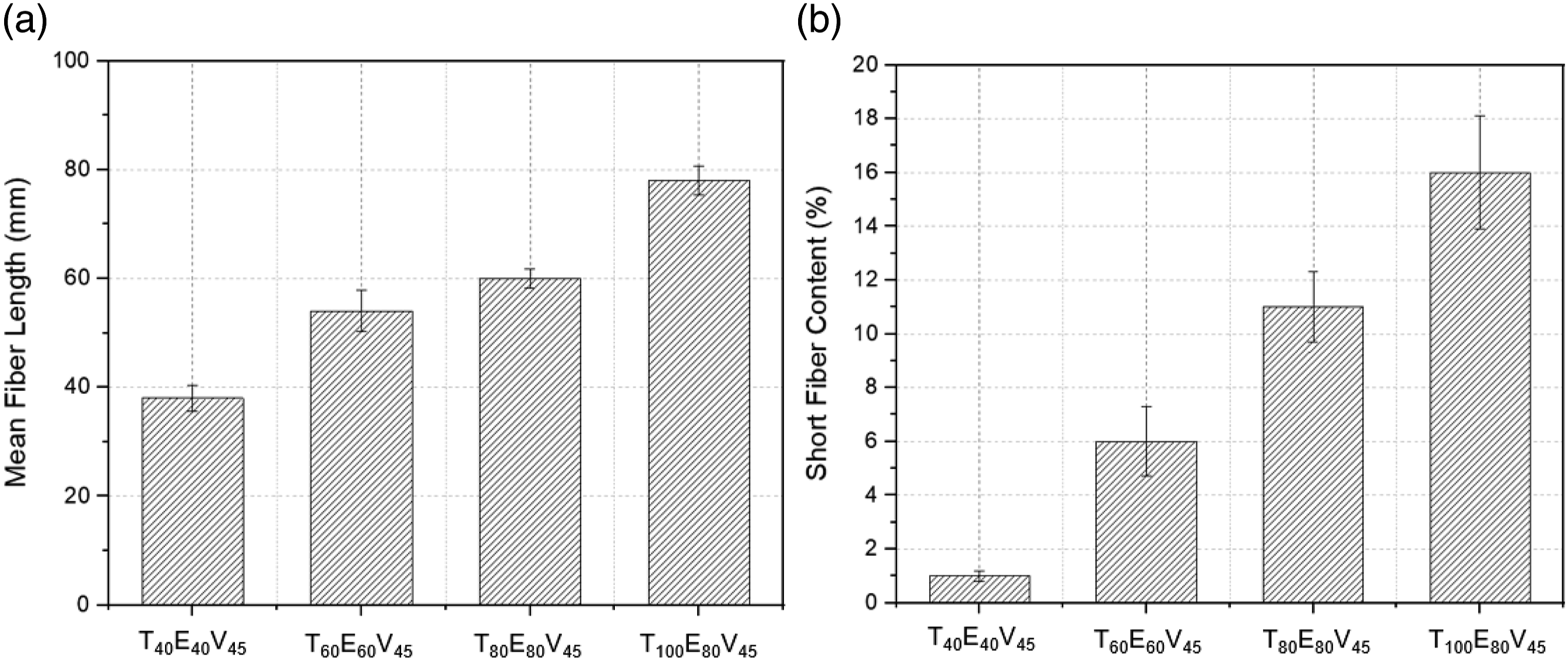
Fiber orientation
In this study, fiber orientation was assessed with two different techniques (Lindsley and Image processing) as reported earlier. Figure 9(a) presents the results of fiber orientation index present in the tape structure, which subsequently incorporated into the composite structure. The results disclose that fiber orientation index in the T40E40V45 tape structure is around 93 ± 1.5%. It reflect that around 93% of the carbon fibers embedded in the composite structure are unidirectional. Further data disclose that fiber orientation embedded in the T60E60V45, T80E80V45 and T100E80V45 composites are 90 ± 1.6, 87 ± 2.5 and 85 ± 2.4% respectively. This data reveals that fiber orientation showing downward trend compared to the length embedded in the composite. Fiber orientation distribution (a) Orientation index (b) Orientation angle.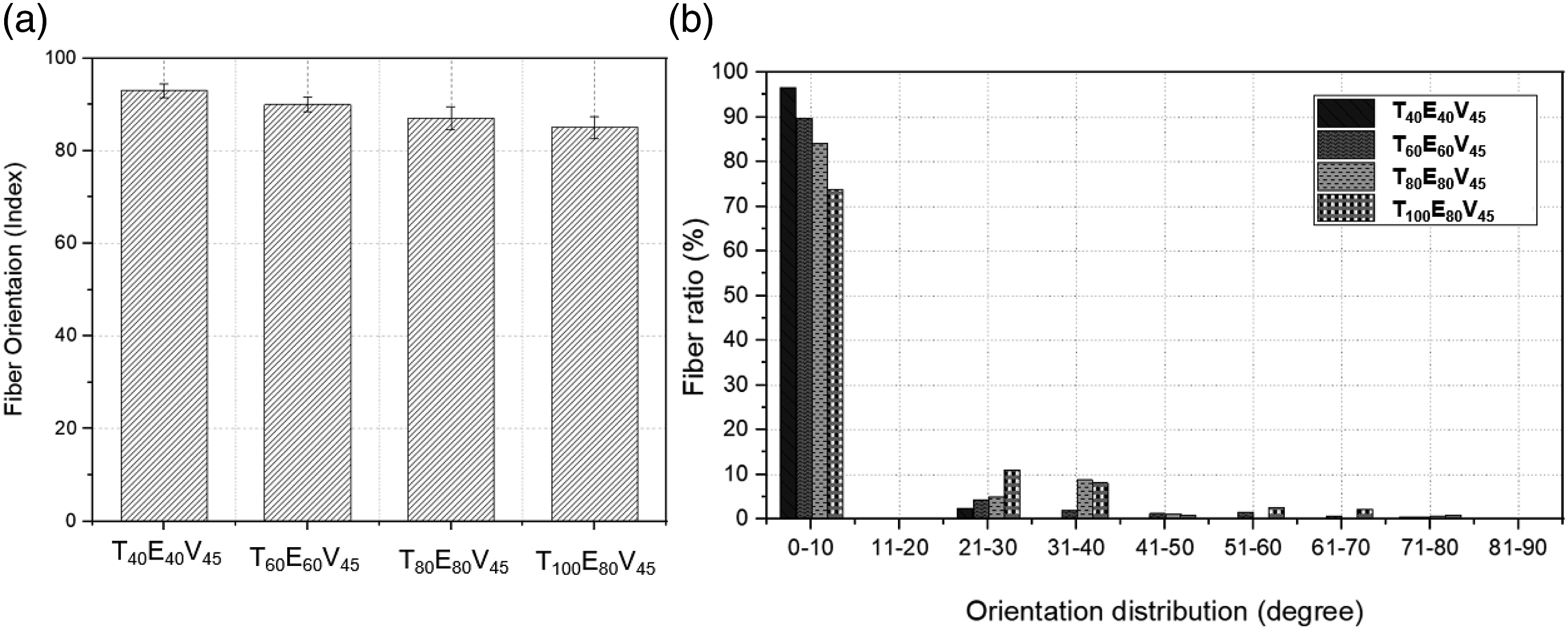
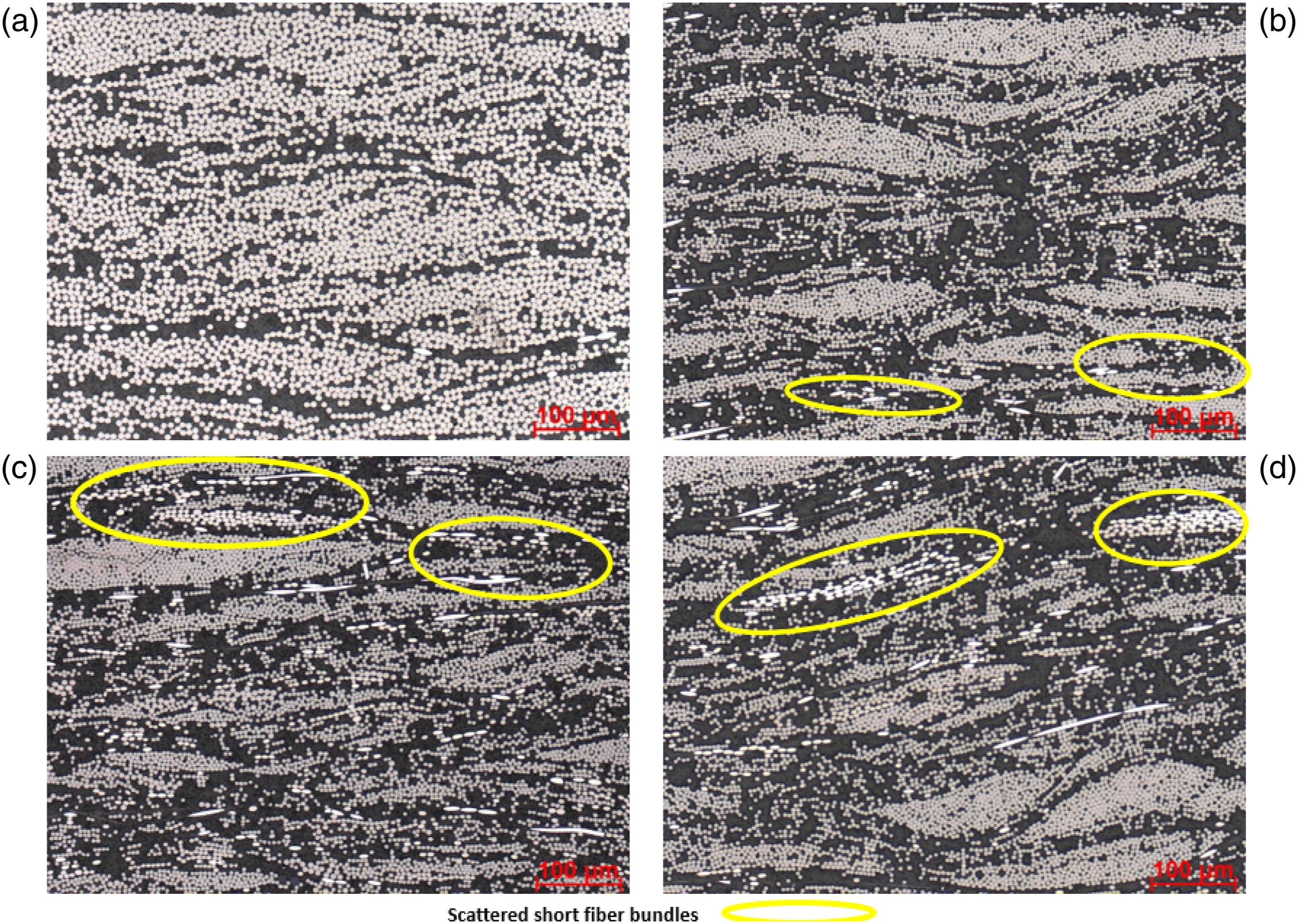
Figure 9(b) presents the results of orientation distribution in different composite structure based on image processing technique. The microscopic images of the respective composites also given in the appendix (Figure A1). The results disclose that fiber orientation distribution in the developed composite structures are relatively unidirectional. Majority of the carbon fibers present in the T40E40V45 composite are found in the range of 0–10 degree. Besides, T60E60V45, T80E80V45 and T100E80V45 composites have both unidirectional and scattered fibers. In scattered fibers, it is found that dominant orientation peaks of the random bundles of carbon fibers are 21–30 and 31–40 degrees. It reflect that longer unidirectional fibers present in the composite structure lies in 0–10 degree range while the floated short carbon fibers bundles scattered in the range of 21–30 and 31–40 degrees.
Fiber volume content
The fiber volume content of the developed composites was measured according to the standard test method. The results disclosed that fiber volume content of T40E40V45, T60E60V45, T80E80V45 and T100E80V45 are 45.6 ± 2.2, 44.4 ± 1.3, 45.7 ± 1.5 and 45.5 ± 1.9 respectively.
Validation of developed theoretical models
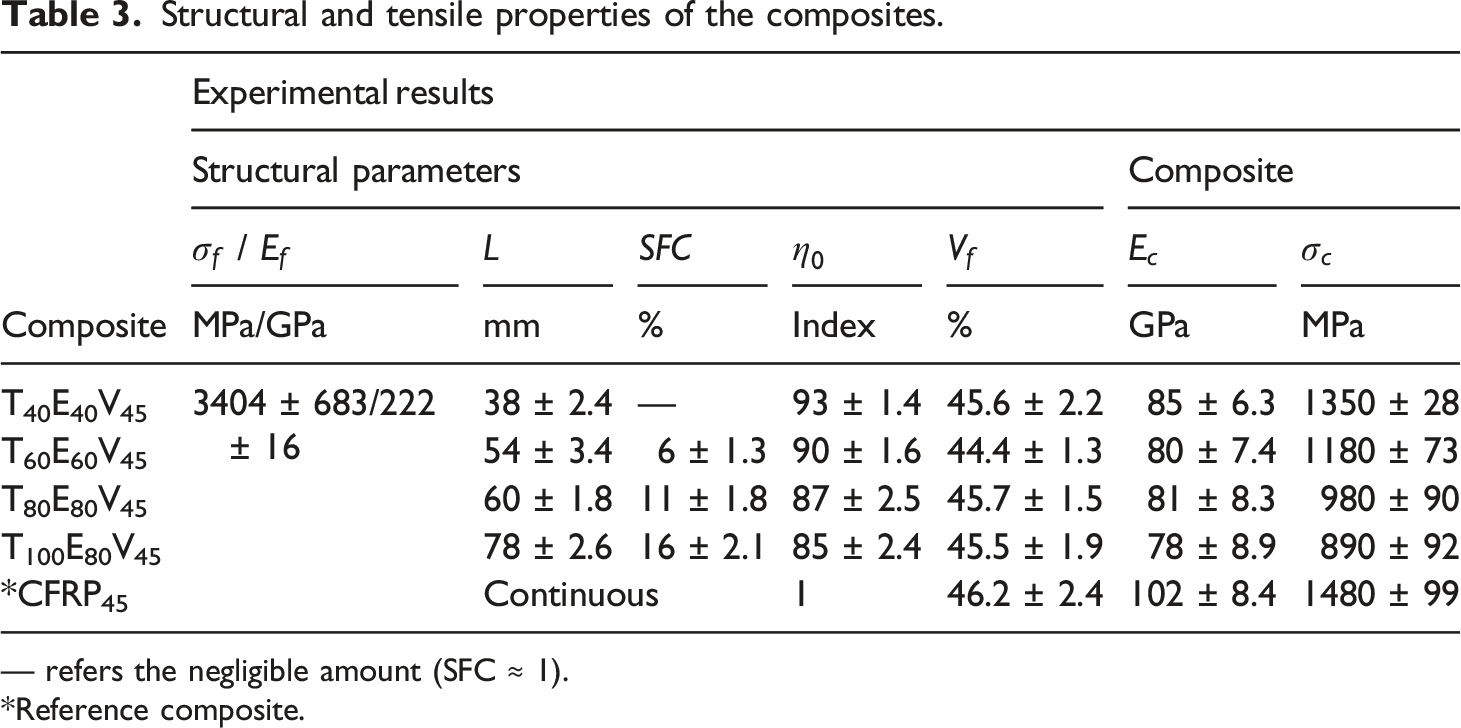
Structural and tensile properties of the composites.
— refers the negligible amount (SFC ≈ 1).
*Reference composite.
Based on the tabulated data, theoretical models are employed to estimate tensile modulus and strength of composites and a comparison is carried out with experimental results. Figure 10 presents composite tensile modulus versus fiber length embedded in unidirectional composites. The comparison shows that composite tensile modulus estimated from ROM, Cox, K-T, H-T, Bridging and Mod. H-T models is 15–30% higher than the experimental results. The range of modulus estimated from these theoretical models is 97–101 GPa. The Cox, K-T and H-T models are based on fiber length; Bridging model is based on homogenization technique while the H-T and Mod. H-T models are semi empirical models. The estimated composite modulus based on these models suggest that change in fiber length (from 40 mm to 100 mm) in composite has a slightly positive effect. The estimated value of composite modulus increases from 97 to 101 GPa with varying the carbon fiber length in composites. Theoretical and experimental analysis of tensile modulus of composites.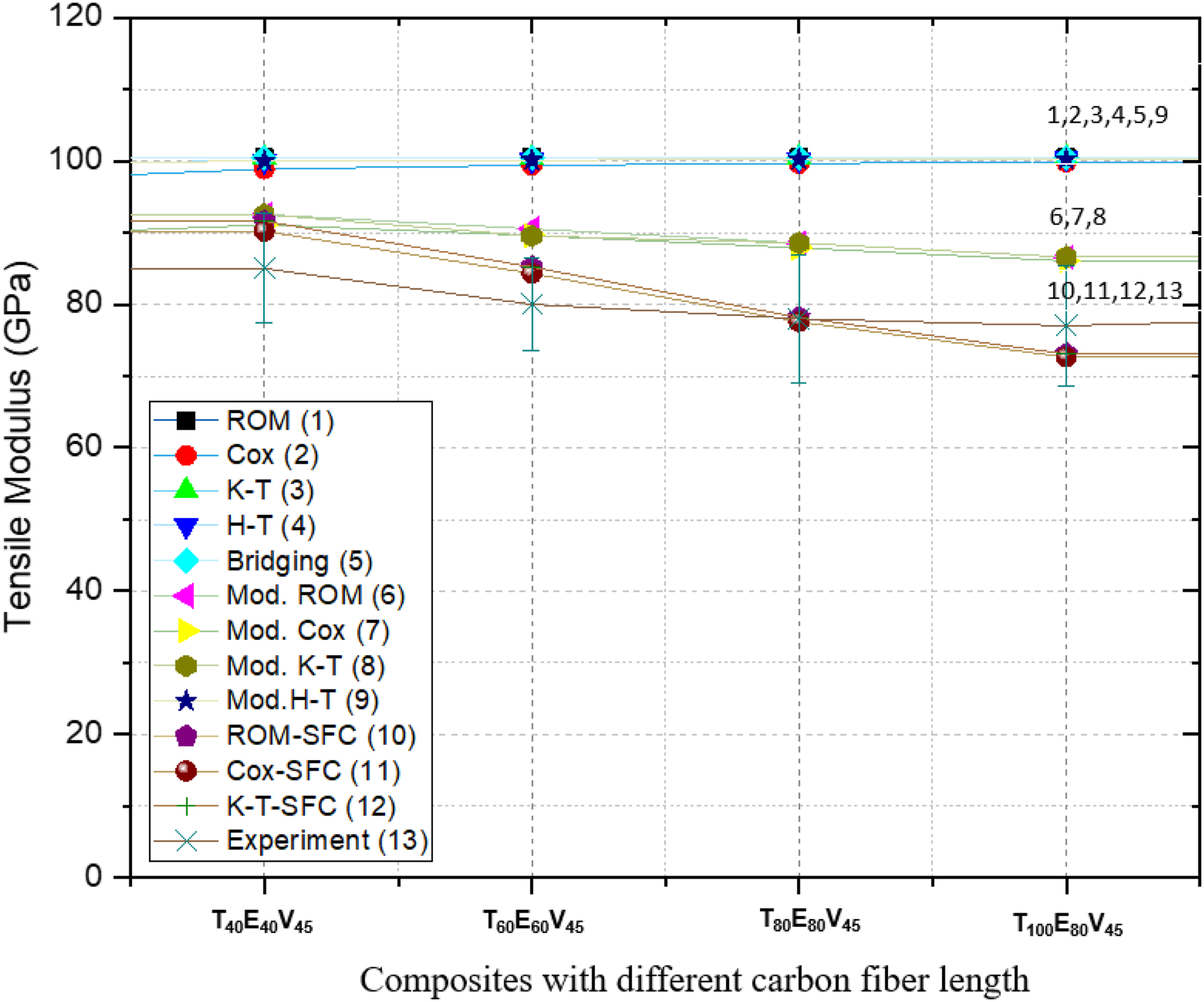
Furthermore, modulus of unidirectional composite estimated from modified models containing fiber orientation and fiber length functions such as Mod. ROM, Mod. Cox and Mod. K-T models show-decreasing trend. It can be correlated with the orientation of short fibers which is decreased with increases the infeed fiber length. These results also show that aforementioned theoretical models overestimated the modulus of the T60E60V45, T80E80V45 and T100E80V45 composites. Therefore, these models are further modified by introducing a SFC factor. The results show that composite modulus estimated from modified models contain fiber length, fiber orientation and short fiber factors (ROM-SFC, Cox-SFC and K-T-SFC models) predict the values ranging from 89 to 73 GPa, In fact, experimental results are also in the same range. From the analysis, it can be concluded that developed theoretical models, which include the factors fiber orientation, fiber length, fiber volume content and SFC accurately predict tensile properties of composite based on tapes structures. It is also concluded from the analysis that SFC in composite is as important as fiber length and fiber orientation and fiber volume content.
Figure 11 presents the composite tensile strength versus fiber length embedded in unidirectional composites. Results show that ROM, Cox, K-T, H-T, bridging and Mod. H-T models overestimate composite tensile strength as compared to experimental findings. The composite tensile strength predicted from these five models are in a similar range. It is because these models measured the composite strength by considering the fiber length and unidirectional fiber orientation. In contrast, the maximum orientation index in composites is around 93% in loading direction (Table 3) and it shows a decreasing trend with respect to fiber length embedded in the composite. Therefore, these models are unable to predict the composite tensile properties fabricated from unidirectional recycled carbon fiber tapes. Furthermore, modified models including fiber length and actual fiber orientation data has been exercised to predict composite strength. Curves show that Mod. ROM, Mod. Cox and Mod. K-T models also overestimate composite tensile strength especially for T60E60V45, T80E80V45 and T100E80V45 composites fabricated with 60–100 mm long carbon fibers. This is caused by the random fiber orientation of the short carbon fibers present in fiber-reinforced plastics. In contrast, T40E40V45 composite fabricated with 40 mm carbon fibers contain very low amount of short carbon fibers and models show adequate approximation with respect to experimental results. Theoretical and experimental analysis of tensile strength of composites.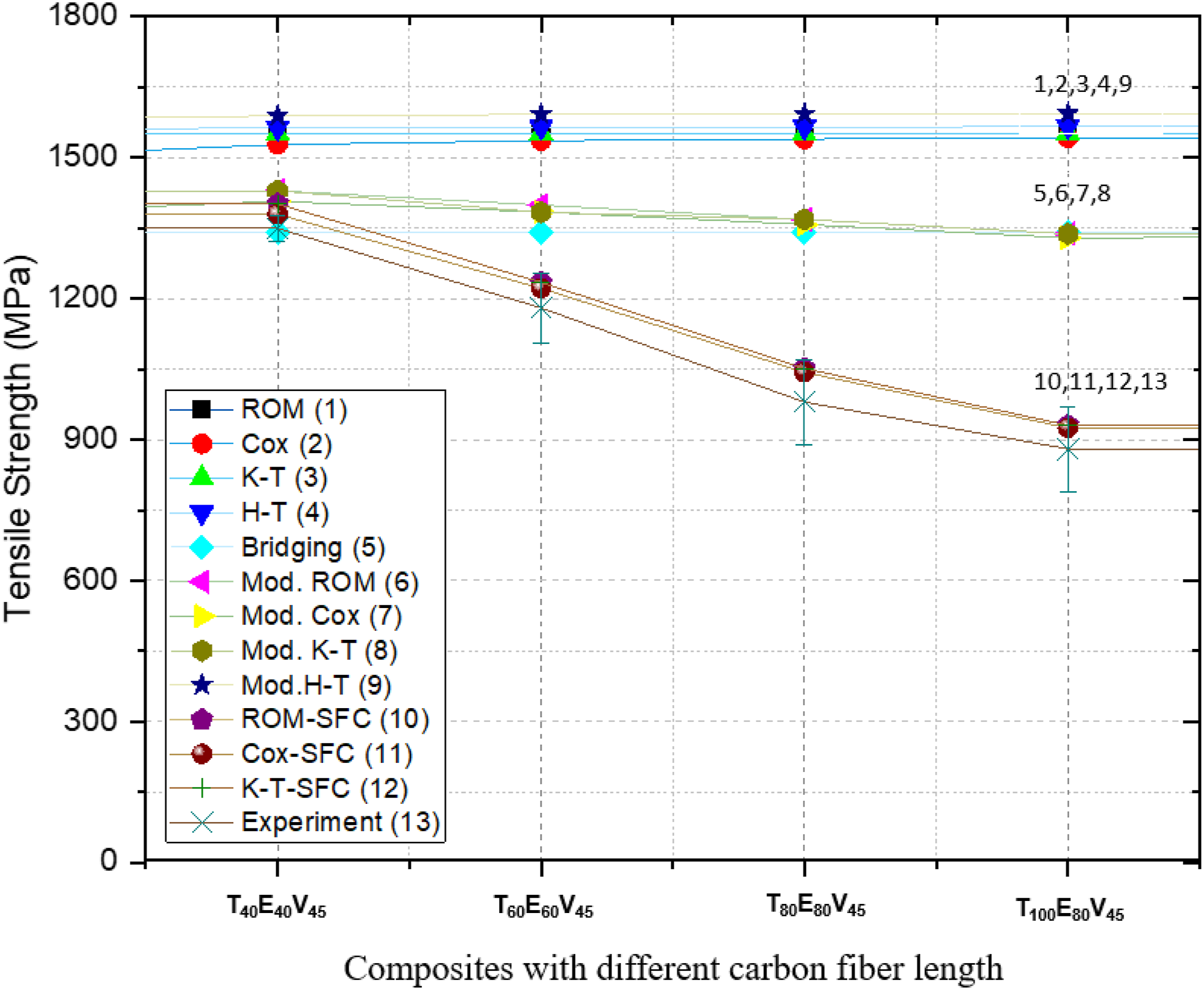
Theoretical model developed in this study by introducing the additional factor SFC, i.e. ROM-SFC, Cox-SFC and K-T-SFC, are utilized to predict composite tensile properties. The respective curves shown in Figure 9 indicate that proposed model show good approximation compared to experimental results. Analysis reveals that tensile strength of fiber reinforced plastics fabricated from tape structure depends on fiber orientation, fiber length, fiber volume content and percentage of short carbon fibers present in the composite. The results also emphasized that gentle processing of recycled carbon fibers is much more important compared to traditional processing and prevention of fiber damage helps to sustain composite tensile properties. The theoretical and experimental analysis confirm that tensile response of a high performance composite containing negligible content of short carbon fibers (T40E40V45) is comparable with reference composite fabricated with continuous carbon fibers (CFRP45) as reported in Table 3.
Conclusion
In this study, an attempt is carried out to estimate the tensile properties of fiber reinforced plastics developed from unidirectional recycled carbon fiber tape structure. For this purpose, theoretical models of unidirectional fiber reinforced plastics were further developed. The results show that developed theoretical models (ROM-SFC, Cox-SFC and K-T-SFC) based on material properties, composition, fiber orientation, fiber length and SFC functions accurately estimate the tensile properties of unidirectional composites based on recycled carbon fiber tape structure. The theoretical and experimental analysis also disclose that composite fabricated with novel unidirectional tape structure, containing negligible content of short carbon fibers, has similar tensile response as reference composite fabricated with continuous carbon fibers.
Footnotes
Declaration of conflicting interests
The author(s) declared no potential conflicts of interest with respect to the research, authorship, and/or publication of this article.
Funding
The author(s) disclosed receipt of the following financial support for the research, authorship, and/or publication of this article: This article presents parts of the results from the research program of German Federal Environmental Foundation [AZ-33809/01] and Industrial Collaborative Research [IGF-20515 BR] at the Technical University Dresden. The author would also like to acknowledge the Graduate Academy, Technical University of Dresden for providing a short-term “completion and wrap-up phase” grant.

Appendix
Microscopic view of composites (a) T40E40V45 (b) T60E60V45 (c) T80E80V45 (d) T100E80V45.