




Abstract
Carbon fiber (CF) reinforced thermoplastic and thermoset composites are on the rise for research and new technologies, consequently, the use by many industries for applications in diverse areas. The principal methodologies and technologies for reusing and recycling these composites and possible applications are reviewed based on available in the information in the existing scientific literature. This review aims to present the possibilities of recycling, reuse and application of these composites reinforced with CF. The composites show a high added value due to the cost of the raw material and the technology involved in its development, which deserves attention for its possible recycling, and thus, and closed-loop economy. Given the current concern for the environment, the future disposal of waste based on CF reinforced thermoplastic and thermoset composites deposited in sanitary landfills and incinerated are unlikely to continue. It is expected that with the new carbon-fiber reinforced-polymer (CFRP) waste management guidelines, most industries, and scientific research will develop viable and profitable methodologies for the reuse and recycling of this waste and that can be inserted into the economy for the manufacture of new components for the most diverse sectors automotive industry.
Introduction
In the mid-1960s, carbon-fiber reinforced-polymer (CFRP) was introduced to the world market application. It has been widely used in the automobile, 1 aeronautics, 2 construction, 3 renewable energy, 4 oil and gas, 5 and sporting goods sectors,6,7 due to its excellent mechanical, thermal, and electrical properties, in addition to durability and mainly light-weighting.8,9
The growing demand for high-performance materials combined with the reduction of CO2 emissions and, consequently, the need to reduce the structural weight of vehicles caused the global CFRP market to present annual growth of 6%. It was estimated that in 2025 the annual consumption would reach $27 billion,10,11 already estimating a drop in 2020 and 2021 due to the global economic recession led by the pandemic (COVID-19). This means, consequently, an increase in the demand for carbon fiber (CF) of approximately $2.8 billion by 2025 to obtain the CFRP and estimated demand of approximately 194 kt for CFRP in 2022. 12
The excellent mechanical, thermal, and electrical properties performed by CFRP and the growing applicability in various sectors can increase the amount of waste from these composites and, consequently, the concern with proper final disposal without compromising the environment. 13 According to Zhang et al. 14 only in the production process are generated approximately 40% of tailings, including pre-impregnated out of date, handling and use of raw materials and test materials, for example, and, thus, an annual increase of 20 kt of waste is estimated of CFRP until 2025.
Thinking about minimizing the generation of waste, the industries of composite material processing must, in a growing way, give a more adequate and profitable destination to all their defective products and waste generated in the production system. In this case, it can be cited the reuse and recycling to reduce the disposal of waste destined for landfills and/or incineration, such as prepreg scraps,15,16 protective prepreg packages,17,18 and post-processing vacuum bags. 19
In addition to generating tailings from the production system, product residues, after their useful life, such as aircraft and automobiles, need to be properly disposed of.20–22 In the aerospace sector, it is estimated that by 2050 all companies and suppliers will propose a system aimed at the reuse, remanufacturing, and recycling of their products at their End-of-Life (EoL) through the development of economically sustainable techniques and disposal management for CFRPs to obtain a circular economy.23,24 These products are currently disposed of in inappropriate places, incinerated and/or in landfills. These last two options are environmentally correct but have high costs and generate the release of pollutants into the environment in the short and long term.25,26
Carbon-fiber reinforced-polymers are widely used mainly in the aerospace and automotive sector. Since some companies in the aerospace sector, such as Airbus, have a producer responsibility system because during the production the company already selects the right materials to be used efficiently and, after the aircraft is delivered, continues to take into account the environment by optimizing aircraft operations and recycling EoL aircraft. In addition, the company has been reducing non-recyclable waste and, consequently, restricting the incineration and disposal of its waste in landfills and allocating approximately 95% of its waste for recycling, in addition to trying to reinsert 5% of this recycled material into the production process. 27 In the automotive industry, the BMW Group and Boeing company collaborate on a carbon fiber recycling (rCF) project. 28
In the automotive sector, there are already regulations, such as the European Union’s EoL vehicle directive requirement (End of Life Vehicle Directive 2000/53/EC, EU), which requires the waste recycling of at least 85% of EoL materials. This directive has forced automobile manufacturers to cooperate with the end of third parties to meet mandatory recovery, reuse, and recycling targets and meet EoL treatment obligations.29–31
In many developed countries, the government began to prohibit the disposal of CFRP waste in landfills. Thus, the industries needed to develop technologies for recycling and recovering part of this waste.32,33
This review aims to present methodologies for recycling CFRP reinforced thermoplastic and thermoset composites and possible studies for future applications of these materials in the automotive industry that have high added value due to the high technology involved in their development and, thus, could do the CFRP economy circulate.
Carbon fiber-reinforced thermoset and thermoplastic composites
In the late 19th century, Thomas Edison obtained CF from bamboo cellulose to produce filaments for electric lamps. 34 However, it was only in the mid-1950s that CF began to be used for application in the reinforcement of polymeric composites with commercial interest due to its tensile strength and Young’s modulus of 750 MPa and 112 GPa, respectively. 35 Currently, CF is obtained mainly from polyacrylonitrile (PAN) due to its high carbon content and can be classified in three ways, short, long, and continuous fibers.8,36,37
In recent years, there has been increased use of CFRP using thermoplastic polymers, such as poly(phenylene sulfide) (PPS),38–40 poly(ether-ether-ketone) (PEEK),41–43 polypropylene (PP),44–46 polyethylene (PE),47,48 polyamide (PA),49,50 polyethylene terephthalate (PET),51,52 and thermosets, such as phenolic formaldehyde53–55 and epoxy,56–58 because the CFRP presents numerous advantage, due to its high specific tensile strength, high modulus and outstanding wear resistance.8,59–61
Carbon-fiber reinforced-polymer can be applied in various sectors, such as in the aerospace area, 62 for example, in components that join with aircraft fuselage structures, 63 in aircraft wing ribs, 64 and fuselages themselves. 65 In the automotive industry,66,67 it can be used to manufacture automobile fenders, for example. 68
CFRP can be used in medical implants, 69 as shown by Neal et al. 70 which demonstrated the feasibility and advantages of CF reinforced PEEK composite implants in patients with primary and secondary osseous spinal tumors. The authors, indicated that the spinal implants appear safe and comparable to conventional titanium implants in terms of functionality. Qin et al. 71 analyzed the mechanical properties and the cytotoxicity of CF/PEEK composites used as implant materials, and the results indicated that the elastic modulus of CF/PEEK composites was much closer to that of human bone than metals and that it can be used in the future as orthopedic and dental implant materials.
Furthermore, CFRP is being widely applied in construction, mainly due to its, more excellent resistance to environmental degradation conditions, such as in saline environments, which directly affect the steel structures. Thus, the use of CFRP is intended to extend the useful life of structures.72–74 As is the case with the research of Ali et al. 75 , who proposed a feasibility study on the replacement of steel wires used in concrete beams and piles used in the construction of bridges in North America, which suffer rapid degradation due to the hostile environment where they are applied, by CFRP tendons. The authors found that CFRP was more resistant to weather conditions and successfully been introduced as prestressing reinforcement for pile applications.
Application of CFRPs in the automotive industry
Carbon-fiber reinforced-polymers have attracted the attention of the automotive industry due to their excellent mechanical properties, resistance to corrosion, and lightweight vehicular structures, new targets for lower CO2 emissions, which consequently interfere with the low fuel consumption of automobiles.8,11,76,77 In addition to the search for better efficiency in consumption, there is a concern with the environment, which can be encouraged by public policies of global ecological sustainability. In this way, lightweight automobile structures have become common. 78 Furthermore, CF production involves high energy consumption and cost, so these materials need to be disposed of correctly and profitably.
Many respondents and companies that use CFRP to manufacture their components are looking for profitable and eco-friendly correct destinations to use their high-cost waste at the EoL.79–82 Furthermore, due to the interest of companies and extensive research in technology and development, many products can be obtained from the recycling of these residues. They may even be returned to the production process of the same sector. 83 Thus, in recent years the interest in using the composites of EoL has increased due to the possibility of their reuse.84–86
A study by Boeing Company 87 estimated that CF can be recycled (rCF) at approximately 70% of the cost of produding virgin fibers ($8/lb to $12/lb vs. $15/lb to $30/lb), using less than 5% of the electricity required to produce virgin CF (1.3–4.5 kWH/lb vs. 25–75 kWH/lb). According to Oliveux et al. 88 the price of rCF has been estimated to be between $13 and $19/kg. Meng et al. 89 assessed the financial viability of rCF, and they observed that the CF recovery could be achieved at $5/kg or less across a wide range of process parameters, approximately 15% of the cost of producing virgin CF. Furthermore, the life cycle cost results show that rCF composites, especially unidirectional rCF composites, give substantial cost reductions over the virgin CF composites and even steel and aluminum.
According to Bledzki et al. 90 the demand for CF in the automotive industry has aroused interest in the recovery of CFs from composites. According to the authors, an automobile requires approximately 120 kg of plastic, 20% of them are composites. But given the new trends in the automotive sector combined with the reduction of pollution emissions, new engines, and electric cars, the advantages of using rCF end up prevailing over car manufacturers. The advantage of using a considerable part of recycled material is directly linked to cost reduction. However, the recovery of CF has some disadvantages, such as the time and cost of recovery, which must be taken into account.14,89,91,92
Currently, some companies are recycling and developing CF recovery methodologies, such as the BMW Group and Airbus. The BMW Group, for example, uses rCF in the manufacture of some of its automobiles, such as the i3 and i8, which are using rCF for the production of the reinforcement of the C-pillar with SMC (sheet molding compound) material. 79 Mercedes-Benz used rCF to obtain polyurethane (PU)/rCF composites to be applied in the rear and front bumpers for its luxury car AMG GTC launch in 2018. 81 In 2014, the Chevrolet Corvette used composites containing rCF in 21 body panel assemblies, including doors, decklids, quarter panels, and fenders. 82
Ford Motor Company is another automaker using recycled material recovered from aircraft and bicycle waste in its car parts to reduce costs. 80 This automaker used rCF and polypropylene (rCF/PP) composites in the 2018 Explorer Sport Utility Vehicle SUV for the rigid part of the A-pillar bracket, replacing the original acrylonitrile styrene acrylate (ASA) material. The newly adopted chopped rCF reinforced PP material can be molded directly with existing molds and compatible with thermoplastic elastomers. A-pillars made with rCF/PP composite were 14% lighter than their conventional post support system made with ASA composite. The composites were manufactured with 6 wt% of rCF, offering rigidity of up to 4000 MPa at a meager cost compared to their existing compounds. 80
In the sty of Meng et al. 89 the feasibility of reusing rCF in automotive components, such as vertical pillar and car hood under bending conditions, was verified, as demonstrated using relative to virgin CF composites and even steel and aluminum.
To obtain a light and low-cost material to be applied in the future in the automotive and aerospace industries, Ghanbari et al. 86 developed a methodology to use rCF in the development of PP/rCF composites. According to the authors, recent advances in rCF have created an opportunity to develop low-cost composite materials. Due to the high cost of CF, this is one of the most economical alternatives to achieving high mechanical properties for high-end applications. According to the results obtained, these authors verified the great potential of using rCF to manufacture high-performance and cost-effective PP composites.
To verify the feasibility of using rCF in developing injection molding compounds for automotive applications, Caltagirone et al. 93 performed a comparative study using rCF/Polyamide 66 (PA66) and compared it with a commercial compound. The authors evaluated the molded composite for mechanical performance, and relevant variables, such as the alignment and the aspect ratio of fibers in the composite, were compared to the commercial baseline material. This study sought to identify similar properties required by the composite material structure. From the results obtained, the authors verified that rCF shows identical performance to virgin fiber reinforcement, demonstrating that rCF can be a viable and sustainable substitute for short discontinuous fiber applications.
Bruijn et al. 83 developed the rotorcraft access panel door from post-industrial CF reinforced PPS waste to demonstrate a novel recycling route for thermoplastic composites. This material originated from the same part where the access panel will be assembled. The authors verified that compared to the current CF/epoxy hand lay-up solution, the resulting product is 9% lighter and significantly more cost-effective, besides being made of recycled material (fiber and matrix).
Faruk et al. 77 developed an automotive prototype (oil pan) from 100% recycled material using 20 wt.% rCF and 80 wt.% recycled polyamide to improve fuel efficiency by light-weighting and sustainability. The authors compared the developed prototype with a current production part and found that the prototype was 15% lighter than the current part, reduced processing time, and successfully passed the global thermal cycle durability test.
Other cost-effective and heating elements in lightweight applications were studied by Akonda et al. 94 The authors developed polypropylene (PP) composites reinforced with rCFs (which were recovered from composite parts), and waste wCFs (generated during post-manufacturing processes) were molded by hot pressing. This study showed that composites made from wCFs contained longer CFs (40 mm in length) and exhibited better electrical and mechanical properties (conductivity: 10.75 × 10³ S m−1; tensile strength 160 MPa and modulus 45 GPa) compared to composites made from rCFs.
Importance and the possibility of CFRPs recycling and closed-loop economy
The concern, pressure, and inspection by environmental agencies and increasingly strict legislation, intensified the need to preserve the environment and seek new reuse and recycling technologies for CFRP.
95
Since, with the increase in demand and use in production processes, the generation of CFRP waste has increased, awakening the interest in recycling, recovering, and forwarding to a correct, and nobler destination for these materials of high economic value, such as this is the case of CF and engineering polymers to closed-loop economy.
32
Figure 1 shows a flowchart of the CFRP waste management cycle, from manufacturing, generation, and possible destinations (landfill, incineration, and some recycling processes) to close the CFRP economic cycle. Flowchart of the CFRP waste management process, from the generation of waste in production, end-of-life, recycling possibilities, and the development of new materials to close-loop economy.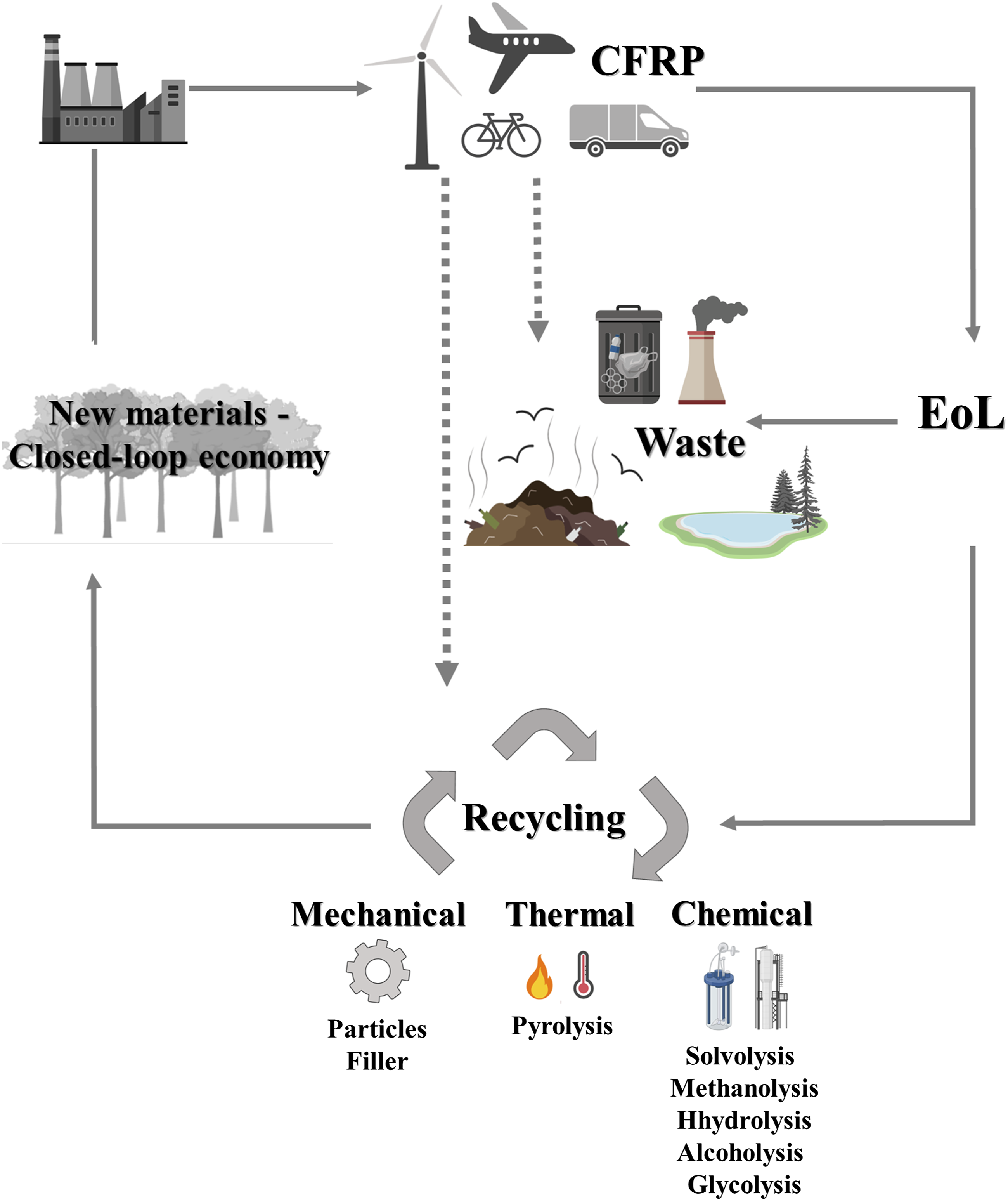
Carbon-fiber reinforced-polymers have a complex composition, involving fibers, matrices, fillers of various types, hybrid compounds, and crosslinked properties, such as the thermosets. Thus, it must be verified how viable the recycling of these composites is.96–98 Incineration and landfill turn out to be the destinations most used by industries, in addition to having high disposal values, and usually, these two destinations are interconnected.26,99 In the incineration process, it is possible to burn part of the waste resulting in energy, such as heat and electricity, which can be used in the local supply. After combustion of the incinerated residues, the other part results in ashes, responsible for approximately 8% of CFRP residues discarded in landfills. 100
Gharde and Kandasubramanian 101 carried out a comparative study of the means of disposal of fiber-reinforced plastic (FRP). The authors found that landfills are the most common and cheapest technique for discarding waste. Furthermore, it is creating a damaging impact on the environment and ecosystem. To reduce the generated waste from the composites after their service life, various effective techniques have been reported for the recycling and reuse of the components, like mechanical, thermal, and chemical recycling techniques. The authors concluded that mechanical recycling is more suitable for the FRP. In contrast, chemical and thermal recycling offers to retain of long fiber with significant properties as compared to the mechanical but, due to the chemicals and solvents, it creates a negative impact on the environment and consumes more energy due to the high-temperature processing.
However, there are works in the literature that already report methodologies that value waste and gases, for example, resulting from chemical and thermal recycling processes, as is the case of the study on a laboratory scale developed by Gastelu et al. 102 In this study, the authors recycled CFRP (rCFRP) residues by pyrolysis. They recovered the chemical compounds through the thermo-catalytic treatment of gases and vapors produced from the decomposition of the polymeric resin. Given the results obtained in the study, it was possible to value the material content of the polymeric resin, which represents an important advance in the recycling of CFRP by pyrolysis. CFRP tailings can be recycled by different processes, which depend on the quality and composition of the waste to be recycled, the desired product, and the costs to be invested.97,103
Recycling can be classified into four types (Figure 2).
104
Primary recycling is clean rejects from the production process, such as mold shavings and defective parts econdary, which consists of waste already discarded in dumps and requires good separation. Both methods consist of mechanical recycling, in which it does not recover fibers from the matrix; it will only cut, shred, milling waste, obtaining the particles that can be incorporated as a filler (or partial reinforcement) in a thermoplastic or thermoset matrix, for the production of other products. It may even return to the production system of the same sector but in non-structural products.83,105 Conventional composite recycling processes.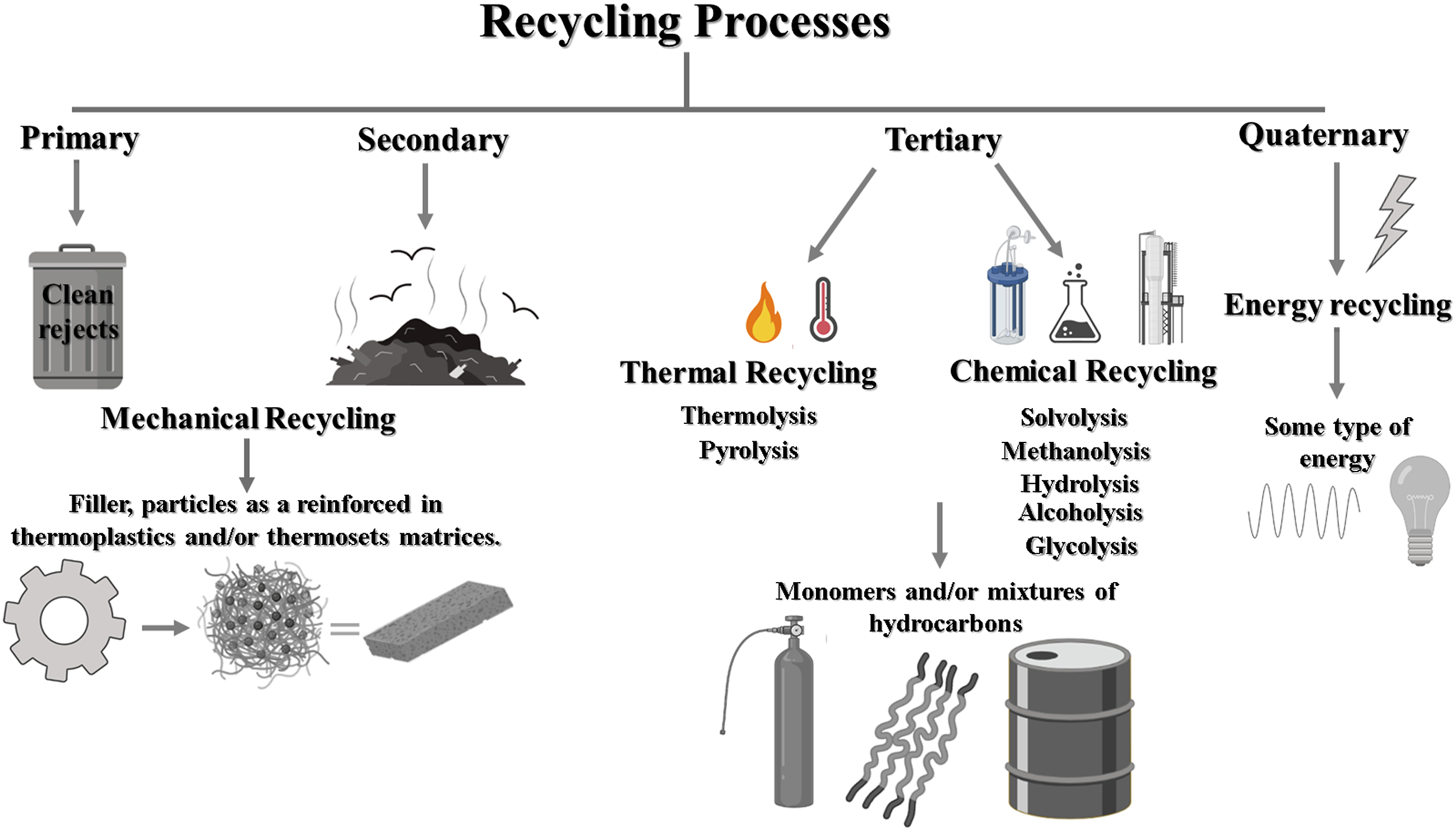
Tertiary recycling consists of the decomposition of waste by thermal recycling, such as thermolysis 106 and pyrolysis107,108 and chemical processes, such as solvolysis,106,109 methanolysis, 110 hydrolysis,111,112 alcoholysis, 113 and glycolysis 114 resulting in monomers and/or mixtures of hydrocarbons that can serve as raw material in refineries or petrochemical plants, to obtain noble products of high quality.115–117 And the last type of recycling is the quaternary, which consists of energy recycling. Its purpose is to take advantage of the high calorific value of waste, transforming it into some type of energy.
According to Pohjakallio and Vuorinen, 113 CFRPs are generally recycled through pyrolysis and solvolysis techniques to recover CF. Furthermore, recycling by pyrolysis has been commercially explored by companies with industrial-scale plants specialized in the recovery of CF. One such company is ELG Carbon Fiber, located in the UK, which recycles CFRPs by pyrolysis, resulting in clean, dry CFs. In 2015, the company produced approximately 1040 tons of CF products suitable for automotive applications, such as boot covers, tailgates, and spare wheel wells. 88 Another company that recycles CFRPs for CF recovery by pyrolysis is CFK Valley Recycling, located in Germany. At the end of the recycling process, a customized product is obtained that meets the application properties. 118
Recent studies involving CFRP recycling processes and obtained from recycling processes.
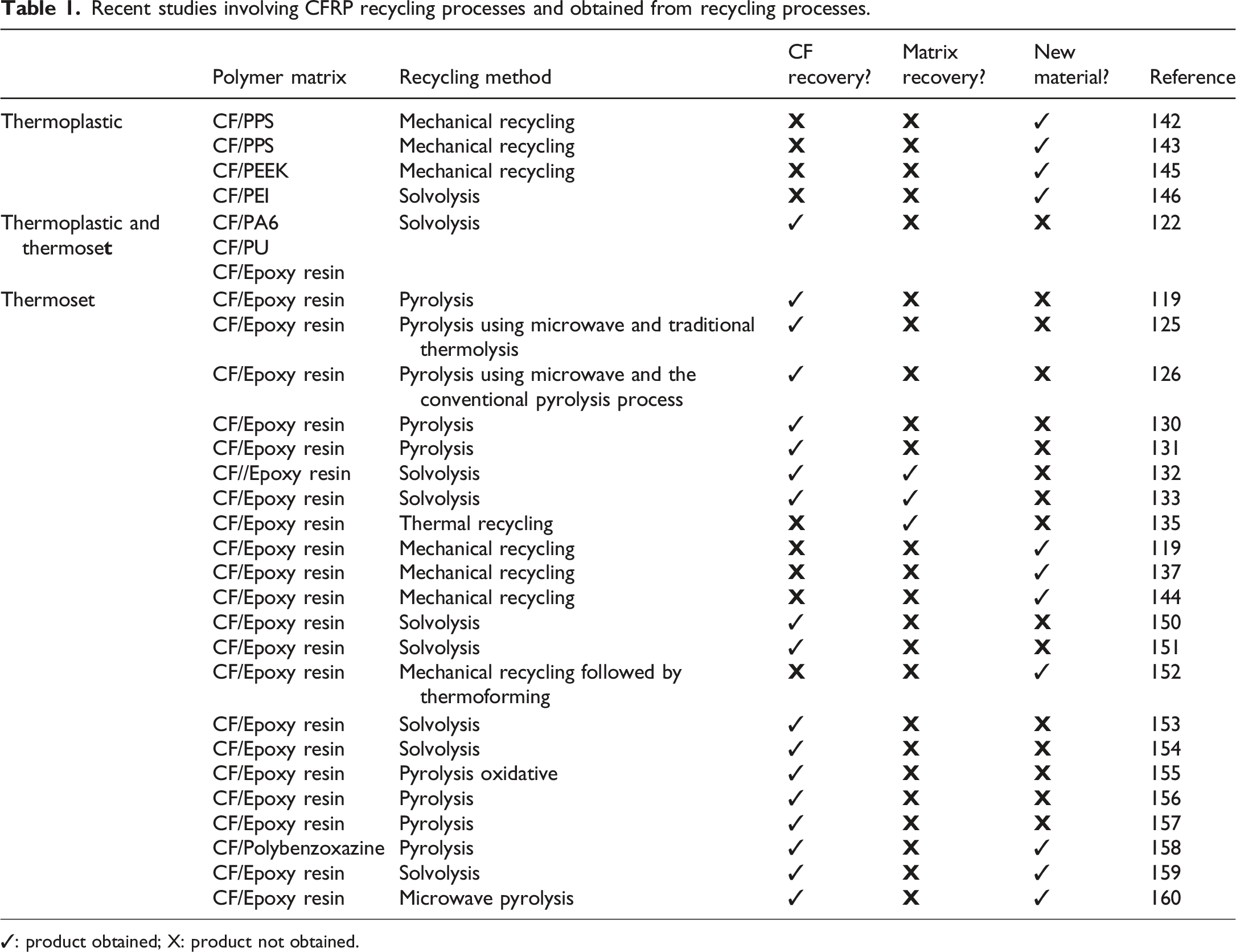
✓: product obtained; X: product not obtained.
In the study by Liu et al. 131 , a life cycle assessment, energy intensity of CFRP recycling, and environmental impacts using a supercritical fluid technology by n-butanol were performed. The authors verified that the energy consumption of CFRP waste recycling is 49.21 MJ/kg using the supercritical n-butanol method, which is far lower than that of virgin CF production (286 MJ/kg) and 31% lower than that of the steam thermolysis method (71.64 MJ/kg) in recycling 1 kg of CFRP waste, which validates that the supercritical n-butanol process is a potential strategy for recycling CFRP waste.
Mamanpush et al. 127 recovered the CF of the epoxy resin by pyrolysis using microwave and traditional thermolysis methods, with the recovery ratio of 94.49% and 93.47%, respectively. According to the authors, recycling using microwave heating was faster, with a higher recovery ratio and less energy consumption. Rodrigues et al. 132 recovered the CF from epoxy matrix composites through the conventional pyrolysis process and used rCF as an electrode material for supercapacitors.
Jeong et al. 121 already used the pyrolysis method to recover the CF from the epoxy matrix using a fast-recycling process, the pyrolysis method. The authors managed to recover the CF successfully, while retaining 65% and 100% of the fibers’ original tensile strength and modulus. This study shows that 100% recovery yield was achieved in 60 min of decomposition time and 140 min of total process time. Deng et al. 128 also used a fast-recycling method for recovering CF. The authors conducted out a comparative study between two techniques for recovering CF from epoxy/CF composites, using the microwave pyrolysis process and the conventional method. Thus, the authors observed that microwave thermolysis is faster, more efficient, requires less energy, and obtains cleaner recovered CFs than those recovered using traditional thermolysis. Kim et al. 133 obtained rCF from epoxy composites, with 80% of the strength of virgin CF, using an energy-efficient recycling technique that was developed using various reactive gases and pyrolysis.
Knappich et al. 124 had the challenge of trying to recover CF using solvent-based recycling processes for three CFRP samples comprising polyamide 6 (PA6), polyurethane resin (PU), and epoxy resin matrix. According to the authors, the recovery of CF from the matrices was achieved using multi-stage solvent extraction without reducing both the length and tensile strength of the recovered CF, which proved to be an efficient process, keeping the initial dissolution properties and, thus, being applicable in a closed-loop process.
The study carried out by Das et al. 134 intended of recover both the CF and the polymer matrix. Therefore, developed an efficient and complete method of recycling CFRP waste, which is composed of CF/epoxy composites, being possible to recover both the polymeric matrix and the CF. The recycled resin showed good mechanical properties and could be used with an adhesive grade epoxy. Furthermore, clean and long CFs were recovered with a tensile strength comparable to virgin fibers. According to the authors, through this methodology, it was possible to recover materials and the solvent under mild reaction conditions using non-hazardous chemicals, pointing to the effectiveness of this process as a more sustainable route to CFRP waste recycling, besides no gaseous emissions and mild reaction conditions make this process more environment-friendly.
Kim et al. 135 were also intended to recover the fiber and the polymer matrix. CF/epoxy resin waste was recycled using water at 1 atm. The depolymerization process was achieved by using an aqueous NaOCl solution, which could to recycle these CFRPs. The recovered rCF was used to produce rCF/PP composites, and the depolymerized epoxy resin was used to produce PU, which are high value-added products. Navarro et al. 136 recovered CF from epoxy/CF composites by solvolysis and performed oxidative epoxy depolymerization, resulting in the re-isolation of high-value monomers for resin recycling.Thus the authors found a route to recycling both fibers and matrices.
In the study carried out by Oshima et al. 137 the authors intended to thermally decompose residues of CFRP composites based on epoxy/CF-based. The authors had the objective of selective phenol recovery and hazardous gas removal using a zeolite catalyst. Since phenol is an industrially valuable product, the amount of CFRP waste is expected to increase year by year. Thus, the authors can show the possibility of improving the efficiency of the CFRP recycling process.
There is still limited literature describing the mechanical recycling of thermosets, through the incorporation of ground thermoset composite waste, in powder form, as filler and/or reinforcement in thermoset and/or thermoplastics matrices.119,138 This methodology for recycling thermosets is considered very promising in developing new materials from waste, as is the case of Song et al. 139 that mechanically rCFRP (epoxy/CF) waste. The authors ground the CFRP residues and incorporated (2.5, 5, and 10 wt% CFRP recycled) into an epoxy matrix and noted that the rCFRP has excellent reinforcing capacity for epoxy foams.
On the other hand, have some advantages over thermosets, such as easy processability, better fracture resistance, ability to be easily joined using welding techniques, and, consequently, the possibility of easier recycling.140,141
Smolén et al. 142 used rCFRP as fillers in polyester resin. The authors noted that viscosity increased for compositions containing rCFRP particles compared to neat resin. Furthermore, it was observed that the flexural strength improved compared to pure resin, but only for composites filled with a fraction containing particles below 0.2 mm in diameter and a fraction of particles of mixed diameter. For composites containing the aforementioned fractions, a significant reduction in dynamic friction coefficient and a reduction in wear (weight loss after the friction test) were obtained.
In addition, the CFRP residue grinding methodology and the particle size separation of the flakes to retain the long fibers, followed by the step that prevents fiber breakage, are crucial items for the processing of material, and the mechanical performance of the recycled parts. Therefore, Vincent et al. 143 studied the relationship between flake size and fiber length distribution (FLD). The authors found that the offcut layout barely influences the FLD compared to the flake size. Furthermore, the effects of shredding settings and sieving were studied, showing a strong correlation between machine parameters and FLD, whereas the offcut size was found to have no effect on FLD.
The study carried out by Bruijn, Vincent, and Hattum, 144 it was verified the feasibility of recycling flakes of semipreg CF/PPS, shredded to flakes of 20 mm x 20 mm, and compared them with samples of CF/PPS with virgin CF and with 3 mm pellets available in the market. The authors noted that the recycled materials’ strength and the stiffness increase with increasing fiber fraction, but are slightly below analytical predictions. At higher CF content, the properties level off, staying below those of continuous fiber laminates. No significant difficulties were observed during processing, underlining the robustness of the process studied.
In another study, Vicent et al. 145 presented the relation of parameters to improve of the mixing quality of recycled thermoplastic composites. The authors used composites of CF/PPS from scrap laminated consolidated with the size of a flake of 20 mm in size and containing fabric reinforcement, which makes them very different from regular pellets and, therefore, more difficult to mix. Processing was carried out using a low-shear blender, and the molten mixture was compression molded. According to the authors, the mixing process has been improved by increasing mixing time and speed. Furthermore, it was also suggested not to use fiber size greater than 15 mm on average to limit the variability within the mass.
Schinner et al. 146 ground the CFRP residues and used them as reinforcement in virgin PEEK matrix through two different processes, injection molds, and press molding compounds. According to the authors, both methods proved suitable for reusing CFRPs. The properties evaluated were compared to virgin PEEK and are on par with similar injection molding materials. Another approach investigated for reusing CFRP parts is a reforming process that does not change the evaluated material properties.
In order to recycle CFRP waste for use in 3D printing, Huang et al. 147 removed the CF from the epoxy resin by supercritical n-butanol to yield rCFs. Then, the authors ground the rCF by a ball mill, mixed it with PEEK powder, and extruded it to the composite filament. The filament was fed to the fused deposition modeling (FDM) printer for manufacturing printed pieces. The results indicated that the additive manufacturing-based approach offers a potential strategy for recycling the CFRP waste and rapidly fabricating the rCF reinforced plastics with complex geometry and function.
Li and Englund 148 got new products from post-industrial trimmings and PEEK/CF composite. The waste scraps were mechanically ground to different sizes followed by high-temperature thermo-forming to form panel composites; then mechanical tests were carried out to evaluate the influence of the size of the scrap and processing temperature. The results obtained show the increase of mechanical properties as particle size decreases. The authors showed that it is possible to close the loop and the fabrication of an actual part or component shows the potential for this recycling process and the products made.
Liu et al. 149 proposed a simple and effective technology for continuous fiber-reinforced thermoplastics (FRTPs) recycling, which can be carried out on a large scale. FRTPs waste was cut into small pieces and added in a resin solution of polyetherimide (PEI) (20 wt%) with N-methyl-2-pyrrolidone (NMP) using a hot plate magnetic stirrer (at 60°C for 24 h). The carbon fabric was pre-impregnated by a hand layup method, and the pre-impregnated fabric was placed in a vacuum oven at 220°C to evaporate the solvent. The prepreg preparation with the uneven surface obtained after evaporation of the solvent was smoothened with a hot-press machine.
Conclusions
In view of the present study, it was possible to verify that CFRP’s recycling through mechanical, thermal, and chemical processes can be a profitable and economically viable alternative, contributing to sustainable development and a closed-loop economy.
The importance of CFRP in applications in various sectors, especially in the automotive industry, was reported throughout the manuscript. It is believed that the increase in the use of CFRPs in the automotive industry has been driven by the need to develop lighter components, aiming to reduce the energy consumption of vehicles. However, this growing interest in the application of CFRP is allied to the increase in the generation of waste from industrial processes and components at the end of their useful life. In this way, new methodologies and techniques are necessary for recycling these composites since CF recovery methodologies from thermoplastic and thermoset matrices are already consolidated in the world market and are widely used, and rCF is reinserted in the production system of new components and artifacts.
Therefore, new methodologies and viable and profitable processes for recycling CFRP waste are on the rise, with a gradual increase in academic and industrial interest in verifying a good destination for these wastes with high added value, which can be used in new products from different sectors. In addition, due to environmental and social pressures and through the new CFRP waste management guidelines, industrial and academic interest in recycling these high value-added wastes has been growing, which can be reinserted as raw material for other components.
Abbreviations
Acrylonitrile styrene acrylate
Carbon fiber
Carbon fiber reinforced polymers
Enf-of-life
Epoxy resin
Fused deposition modeling
Fiber length distribution
Fibre reinforced plastic
Continuous fiber-reinforced thermoplastics
N-methyl-2-pyrrolidone
Polyamide
Polyamide six
Polyamide 66
Polyacrylonitrile
Polyethylene
Poly (ether-ether- ketone)
Polyetherimide
Poly (ethylene terephthalate)
Polypropylene
Poly (phenylene sulfide)
Polyurethane
Recycled carbon fiber
Footnotes
Acknowledgments
The authors would like to thank the Federal Government Program ‘Rota 2030’ linked to the “Development of Skills for Design and Manufacturing of Tooling for Composite Parts” n° 27194.03.03/2020.01-00 for the financial support; the Lightweight Structures Laboratory from IPT (Instituto de Pesquisas Tecnológicas do Estado de São Paulo) for the coordination, and also the Brazilian Funding Institutions FIPT (Fundação de Apoio do IPT), FUNDEP (Fundação de Desenvolvimento da Pesquisa) for the administrative support. The authors are also grateful for the free figure development program: Biorender.
Author contributions
LSM and MCR had the idea for the review article; GFMM and LSM performed the literature search and drafted the work; FRP, APL, and MCR critically revised the work.
Declaration of conflicting interests
The author(s) declared no potential conflicts of interest with respect to the research, authorship, and/or publication of this article.
Funding
The author(s) received no financial support for the research, authorship, and/or publication of this article.
