




Abstract
The aim of this work was to study the influence of nano-zirconium oxide, graphene oxide, and nano-zirconium oxide + graphene oxide hybrid system on the high-velocity impact behavior and interlaminar shear strength of basalt fiber/epoxy composite. Initially, the nano-zirconium oxide and graphene oxide were functionalized by using a silane-coupling agent namely 3-aminopropyltrimethoxysilane. In order to confirm the surface functionalization of nano-zirconium oxide and graphene oxide, Fourier transform infrared spectroscopy and energy-dispersive X-ray spectroscopy were carried out on both untreated and silanized fillers. Then, 15 types of specimens containing various amounts of nano-zirconium oxide (1, 2, and 3 wt.%), graphene oxide (0.1, 0.3, and 0.5 wt.%), or nano-zirconium oxide + graphene oxide hybrid in the matrix were prepared. The comparative results of the experiments showed that the specimen with 2 wt.% nano-zirconium oxide + 0.1 wt.% graphene oxide had the highest values of energy absorption, impact limit velocity, and interlaminar shear strength. The energy absorption and limit velocity of this specimen enhanced by 67 and 30%, respectively, as compared to the neat basalt fiber/epoxy composite, while its interlaminar shear strength increased by 77%. The fracture surfaces of the specimens demonstrated that the introduction of nanofillers in the matrix improved the adhesion between the basalt fibers and polymeric matrix. The findings of this work clearly showed that the simultaneous addition of graphene oxide and nano-zirconium oxide is a promising method for improving the high-velocity impact properties and interlaminar shear strength of fibrous composites.
Keywords
Introduction
The use of basalt fiber as a natural fibrous reinforcement in polymeric matrix is of interest since basalt fiber has outstanding properties such as good fiber–resin adhesion, sound mechanical properties, resistance to chemical attacks, high heat resistance, etc. Another feature of the basalt fibers is their non-toxic nature. Moreover, the strain to failure of basalt fiber is higher than the carbon fiber, while the basalt fiber has higher tensile strength than the E-glass fiber [1,2]. Recently, great efforts have been made to study the mechanical properties of basalt fiber-reinforced composites [3–6].
The mechanical properties of fibrous composites are affected by poor matrix properties as well as weak fiber/matrix interfacial bonding [7]. An effective approach to further improve the mechanical properties of fiber-reinforced plastics (FRPs) is incorporation of only a small amount of nanofillers such as graphene [8], carbon nanotubes [9], carbon nanofibers [10], nano-zirconium oxide (ZrO2) [11], nano-Al2O3 [12], nano-SiO2 [13], nanoclay [14], and nano-CaCO3 [15]. Jamali et al. [8] investigated the mechanical response of graphene oxide (GO)/basalt fiber/epoxy composites and reported that the values of tensile, flexural, and compressive strengths of 0.4 wt.% GO-loaded specimen were 16, 47, and 51%, respectively, higher than those of the neat ones. Khosravi and Eslami-Farsani [9] found that the highest values in tensile and flexural strengths of multi-walled carbon nanotubes (MWCNTs)/basalt fiber/epoxy composites were obtained at 0.4 wt.% MWCNTs. The influence of carbon nanofibers on the interlaminar shear strength (ILSS) of E-glass/polyester composites was studied by Hossain et al. [10] and reported that the multiscale specimens had higher ILSS compared to the neat composite. Halder et al. [11] reported that the addition of ZrO2 enhanced the tensile and flexural strengths of glass fiber/epoxy composite. The effect of nano-Al2O3 on the impact properties of short glass/carbon fiber-reinforced epoxy composites was evaluated by Mohanty and Srivastava [12] and reported that the maximum improvement in impact energy was attained through the addition of 2 wt.% nano-Al2O3. Gong et al. [13] found that the glass fiber/epoxy interfacial bonding has improved by the addition of silica nanoparticles within the matrix. The positive effect of 5 wt.% montmorillonite nanoclay on the tensile and flexural strengths of basalt fiber/epoxy composite was reported by Khosravi and Eslami-Farsani [14]. Moreover, Abdi et al. [15] indicated that with the introduction of 3 wt.% CaCO3, flexural and tensile strengths of basalt fiber/epoxy composite were improved by 28 and 20%, respectively.
In order to enhance the reinforcing effect of nanofillers in the composites, the fillers must be dispersed homogeneously [16–18]. Among the various methods to enhance the matrix filler compatibility, the silanization seems to be a very effective way [19,20]. The organosilanes are the most commonly used type of silane-coupling agents. The results of several works show that a remarkable enhancement in the mechanical properties can be obtained via the silanization of nanofillers [21–23].
Recently, some researchers have investigated the synergetic effects of different nanofillers on thermoset and thermoplastic polymers. For instance, the effect of graphene and MWCNT on the mechanical behavior of poly(ether sulfone) composite was investigated by Zhang et al. [24]. The results of Wu et al. [25] demonstrated that MWCNTs/graphene hybrid had better strengthening effect on epoxy compared to graphene and MWCNTs. The synergistic effect of graphene and CNTs on the mechanical properties of epoxy composites was also investigated by Chatterjee et al. [26]. Nuruddin et al. [27] studied the effect of graphene and nanoclay on mechanical properties of epoxy nanocomposites.
In aerospace, automobile, and defense applications (e.g. aircraft fuselage and airplane wings), the impact behavior of FRPs is a key issue, and great efforts have been made to study the behavior of FRPs under impact loading. It has been reported that the addition of a small amount of nanofillers can remarkably enhance the impact properties of FRPs. Rahman et al. [28] investigated the influence of MWCNTs on the ballistic impact response of E-glass/epoxy composites. They found that the energy absorption capability increased at 0.3 wt.% of CNTs. Velmurugan and Balaganesan [29] showed that the dispersion of nanoclay in the matrix of glass/epoxy specimen remarkably enhanced the energy absorption and ballistic limit of the composite. Esfahani et al. [30] studied the high-velocity impact behavior of nanoclay/glass fiber/polyester, and the highest value of energy absorption was obtained for the 1.5 wt.% nanoclay-filled composite. The influence of graphene nanoplatelets on the high-velocity impact behavior of basalt fiber/epoxy composite was investigated by Kazemi-Khasragh et al. [31].
There are few works published in the literature on the synergistic effects of nanofillers on the mechanical performance of FRPs [32–34]. To the best of our knowledge, no research work has been reported in the literature on the synergistic effect of nano-ZrO2/GO hybrid system with two different morphologies on the mechanical behavior of basalt fiber/epoxy composite. This was the main driving force for selecting the present work. In this study, various loadings of silanized GO and nano-ZrO2 were utilized to study the synergistic effect of hybrid system on high-velocity impact properties and ILSS of basalt fiber/epoxy composite. The properties of the specimens were investigated and compared with the composites filled only with GO or nano-ZrO2.
Experimental
Materials
The GO and nano-ZrO2 fillers were supplied by US research Nanomaterials Inc. (USA). Table 1 summarizes some specifications of the used nanofillers, while Figure 1(a) and (b) shows the scanning electron microscopic (SEM) image of GO and transmission electron microscope (TEM) image of nano-ZrO2, respectively. As shown in this figure, the morphology of the GO and nano-ZrO2 particles is flak-like and spherical, respectively.
(a) SEM image of as-received GO nanoplatelets; (b) transmission electron microscopy (TEM) image of as-received nano-ZrO2, and (c) chemical structure of APTMS. Some specifications of the GO and nano-ZrO2 nanofillers according to the manufacturer datasheets [35].

Satin weave basalt fabric (300 g/m2) was provided by Basaltex (Belgium). A medium-viscosity epoxy resin (KER 828) with epoxy group content of 5260–5420 mmol/kg and dynamic viscosity of 12–14 Pa s was supplied by Kumho P&B Chemicals (Korea). 3-Aminopropyltrimethoxysilane (APTMS) as a coupling agent was provided by Sigma-Aldrich (USA). The molecular weight of APTMS is 179.29 g/mol, and its linear formula is H2N(CH2)3Si(OCH3)3. Figure 1(c) shows the chemical structure of APTMS.
Silanization of nano-ZrO2 and GO
In this work, surface functionalization of ZrO2 and GO was conducted as follows: 3 g of ZrO2 or 0.5 g of reduced GO was dispersed in 100 mL of distilled water + ethanol solution (5:95, v/v) using a magnetic stirrer at 100 r/min for 10 min. Then, defined amounts of APTMS silane-coupling agent (3 g for ZrO2 and 2.5 g for reduced GO) were added to the dispersions, and the resultant mixtures were refluxed at 80℃ for 8 h. The modified powders were separated by centrifugation, washed with ethanol for three times, and dried at 80℃ for 12 h. The employed trend for reduction of GO has been reported elsewhere [23]. GO was reduced by hydrazine.
Fabrication of specimens
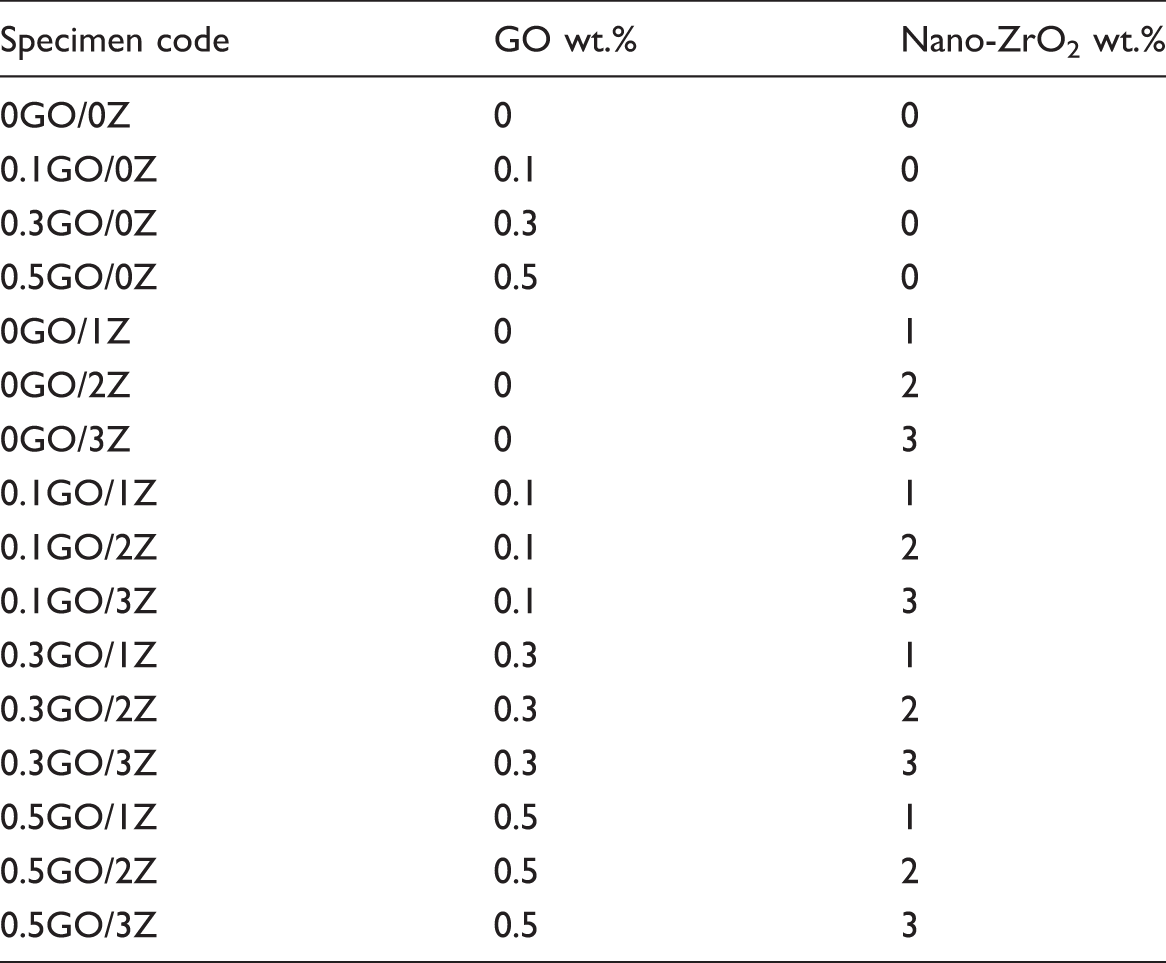
Composition of prepared specimens.
Short-beam shear test
The short-beam shear test is commonly applied to fibrous composites to investigate their ILSS. Herein, the ILSS of specimens (50 × 10 × 5 mm) was determined based on ASTM D 2344 standard. The span-to-thickness ratio was set to six. The specimens were loaded in three-point bending setup (Figure 2) at a cross-head rate of 1 mm/min. The values of ILSS were calculated using the following equation [36]
Experimental setup of the short-beam shear test.

P = Maximum force reached during test
b = specimen width
t = specimen thickness.
For more accuracy, three specimens from each category were tested, and the average values were reported.
High-velocity impact test
The high-velocity impact test on the laminates was conducted using a gas gun setup (Figure 3(a)). The specimens were fixed in a square-frame jig, as shown in Figure 3(b). The effective impact area was 100 × 100 mm. An Al-7075 cone-shaped projectile (Figure 3(c)) with a length of 30 mm and a mass (mp) of 27 g was used. During the impact test, the values of residual velocity of projectile (Vr) were recorded. The initial velocity of projectile (Vi) was chosen as 120 m/s. The absorbed energy (E) and ballistic limit velocity (V50) were calculated from the following equations [37]
(a) Impact test setup, (b) square-frame jig, and (c) cone-shaped projectile.


For more accuracy, the impact tests were repeated three times.
Characterization techniques
The structure of the untreated and silanized nanofillers was investigated by Fourier transform infrared spectroscopy (FTIR). The measurements were conducted using a Bruker equipment in the range of 400–4000 cm−1 with 4 cm−1 resolution. Also, a FEI Quanta 200 SEM equipped with an energy-dispersive X-ray spectroscopy (EDX) (Silicon Drift 2017) was used to show the presence of silane molecules on the surface of ZrO2 and GO after silanization. A Philips EM 208S TEM was employed to show the size and morphology of nano-ZrO2. The fracture surface of specimens after each test was examined using a KYKY 3039 M scanning electron microscope.
Results and discussion
FTIR and EDX results of modified nanofillers
Figure 4 depicts the FTIR spectra for the as-received and modified nano-ZrO2. The spectrum of both as-received and modified nano-ZrO2 shows the characteristic peaks of ZrO2 at 479, 570, 679, and 753 cm−1 [11]. The broad band at 3395 cm−1 is attributed to the O–H stretching vibration [14]. After the modification of nano-ZrO2 with APTMS, two new peaks of Si–O–Si bond stretching are seen at 1137 and 1037 cm−1 for modified nano-ZrO2 [38]. Moreover, a weak band of Si–O–Zr vibration is observable at wavenumbers of 970 cm−1 [39]. The appearance of band at 1615 cm−1 is assigned to the bending vibration of the NH2 group [15]. These all clearly indicate that the silane-coupling agent successfully grafted to the surface of nano-ZrO2.
FTIR spectra of the (a) as-received and (b) modified nano-ZrO2.
The FTIR spectra of the as-received and modified GO are shown in Figure 5. FTIR spectrum of as-received GO (Figure 5(a)) demonstrates a broad peak at around 3300 cm−1, which is attributed to the stretching vibrations of the –OH group on the surface of graphene [8]. The strong peaks at 1722 and 1608 cm−1 are assigned to the C=O and C=C bonds, respectively [23]. The weak band observed at 1302 cm−1 is due to the stretching vibration of the O–H in the basal plane of GO [8]. The adsorptions at 1143 and 1042 cm−1 are attributed to the C–O–C (epoxy group) and C–O bonds, respectively [8]. On the FTIR spectrum of the modified GO (Figure 5(b)), the appearance of the band at 3440 cm−1 (overlapping with the peak of –OH) is indicative of amino groups (–NH2) from the silane compound [40]. Furthermore, a new band appeared at 1034 cm−1 is assigned to the Si–O bond. These observations verify the presence of silane-coupling agent on the surface of GO.
FTIR spectra of the (a) as-received and (b) modified GO.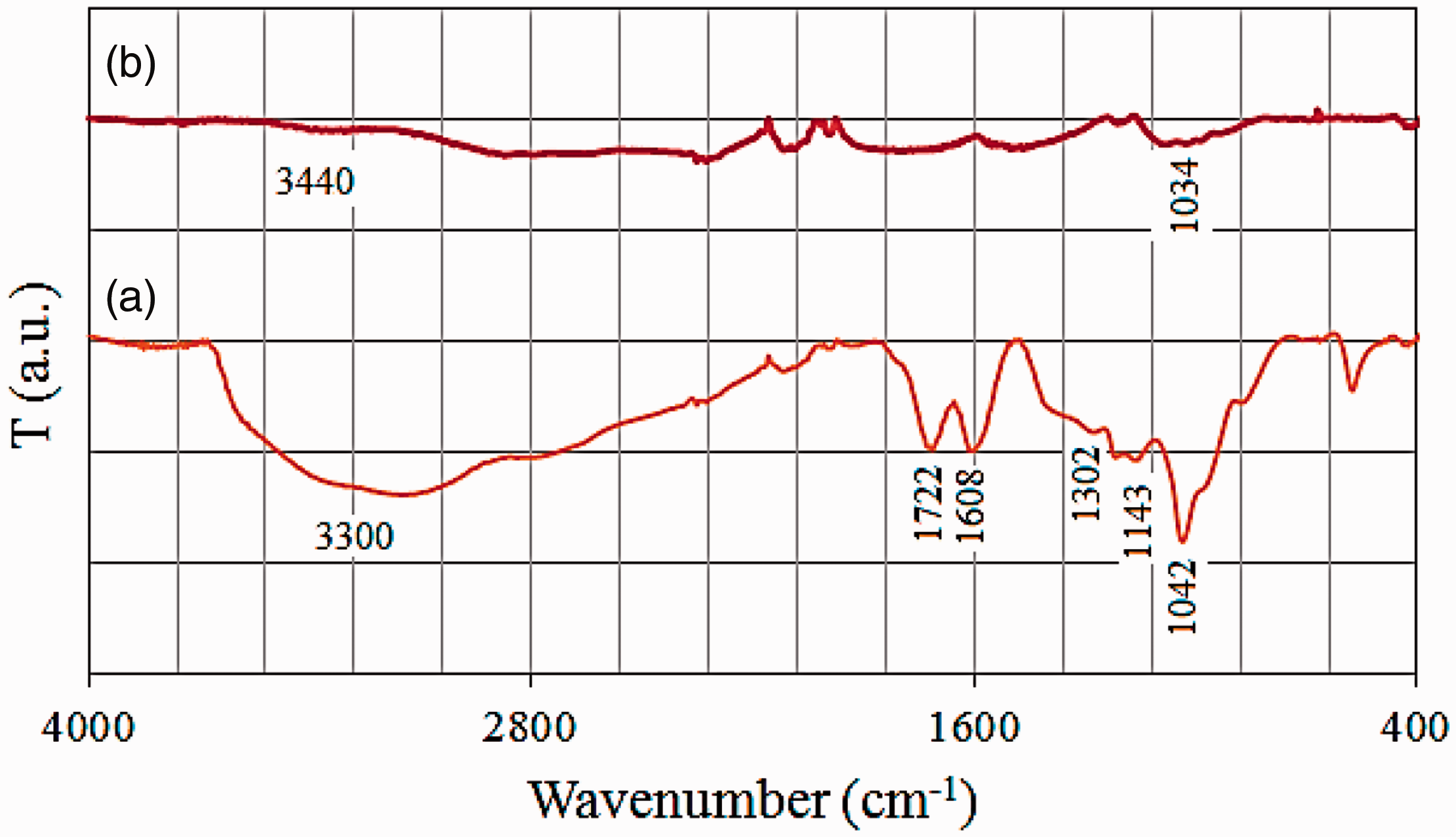
EDX and X-ray mapping analyses were conducted by SEM to explore the chemical composition of the powders. EDX analysis of the as-received and modified nano-ZrO2 is shown in Figure 6, while Figure 7 shows EDX analysis of the as-received and modified GO. Besides, Figures 8 and 9 illustrate the X-ray elemental mapping for the modified nano-ZrO2 and modified GO, respectively. It can be observed that the Si and N peaks originated from the APTMS compound are presented in the modified specimens. Considering X-ray elemental maps, a favorable distribution of Si and N can be clearly seen on the surface of modified powders.
EDX analysis of (a) as-received and (b) modified nano-ZrO2. EDX analysis of the (a) as-received and (b) modified GO. The elemental distribution in the modified nano-ZrO2. The elemental distribution in the modified GO.


ILSS of specimens
The results for ILSS obtained from the short-beam shear test are shown in Figure 10. This figure presents the values of ILSS of the composites at various filler loadings. It can be seen that the filler loading has a great effect on the ILSS of composites. For the GO-reinforced specimens, the use of individual GO is found to enhance the ILSS of basalt fiber/epoxy composite with a maximum improvement of 51% (at 0.3 wt.% GO), whereas with the addition of 2 wt.% individual nano-ZrO2, a maximum improvement of 26% is observed. On the contrary, the ILSS of the 0.1GO/2 Z-filled basalt fiber/epoxy composite is 71.2 MPa, which presents the highest ILSS with an improvement of 77% compared to the neat basalt fiber/epoxy specimen. These results clearly indicate the impressive influence of nanohybrid systems in improving the ILSS of fibrous composites. As it is well documented, the mechanical properties of FRPs depend on the matrix characteristics and fiber/matrix interfacial interaction [5,37]. Herein, the nanofillers can act as interlocking agents between the basalt fibers and matrix. Indeed, when the matrix is reinforced by the nanofillers, a greater fraction of the applied loading is tolerated by the matrix, and, as a result, the required load for fiber breakage increases. In FRPs, due to the high difference in coefficient of thermal expansion (CTE) of polymeric matrix and fibers, the thermal stresses are concentrated at the interface [14]. The presence of nanofillers within the matrix reduces the difference in CTE of matrix and fibers and helps to improve the interfacial bonding [5,10].
The values of ILSS of the composites at various filler loadings.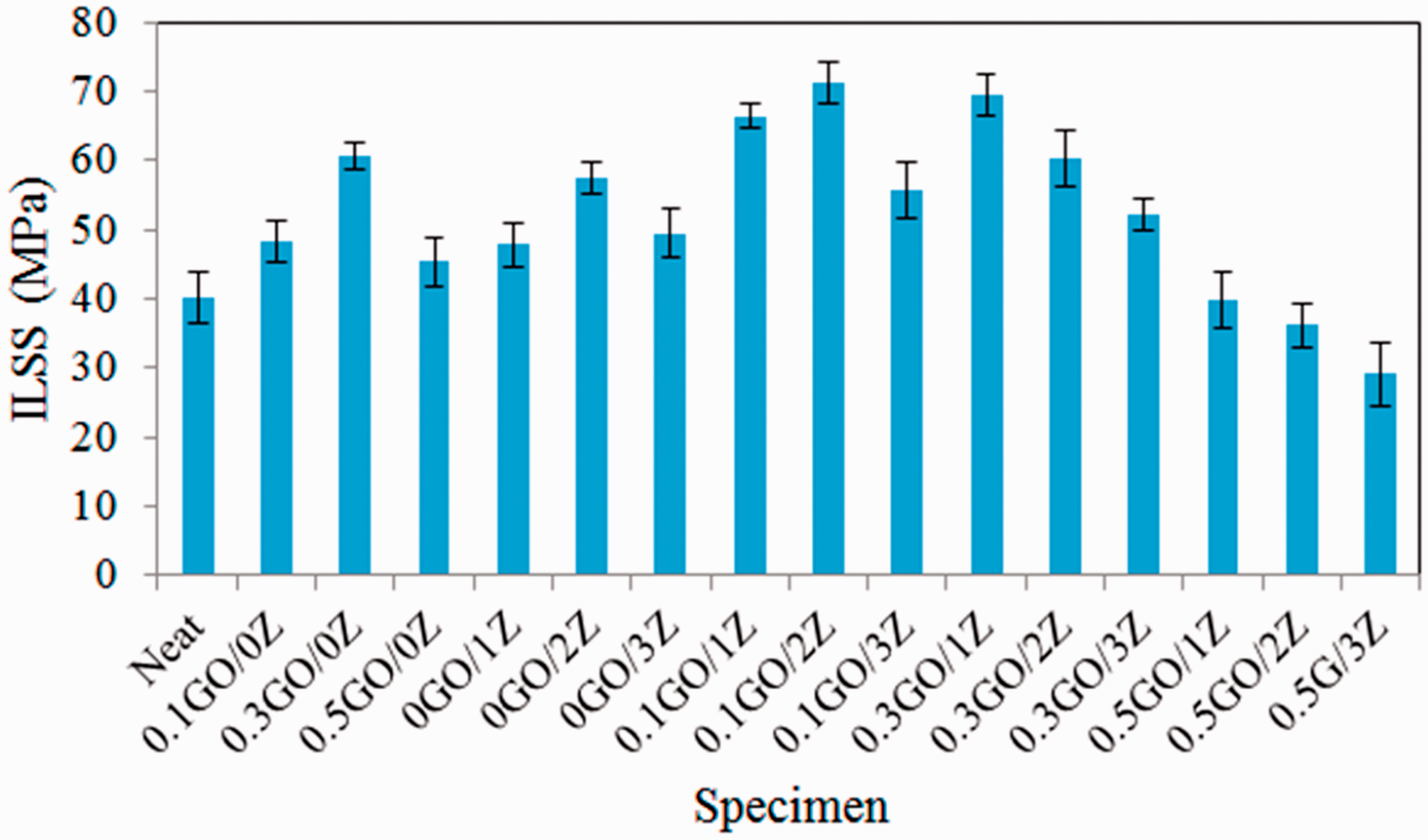
When the loading of fillers is over a critical level, they tend to agglomerate. The agglomerates can create stress concentration zones within the matrix or fiber–matrix interface which act as preferred sites for crack initiation. The presence of stress concentration zones at the interface helps to easier separation of fibers from the matrix and reduces the ILSS of specimen.
Fracture surface of the ILSS-tested specimens (neat and 0.1GO/2Z-filled basalt fiber/epoxy composites) was examined by using a scanning electron microscopy, and the micrographs are shown in Figure 11. For the neat specimen (Figure 11(a)), the surface of basalt fibers is clean, and a little trace of matrix can be observed on the surface of fibers. This implies that the interfacial bonding between the fibers and matrix is weak, and the interfacial debonding is the primary fracture mechanism for the neat specimen. In contrast, Figure 11(b) shows that there is a good adhesion between basalt fibers and nanocomposite matrix for the 0.1GO/2Z hybrid system. For this specimen, the primary fracture mechanism is matrix cracking.
SEM images from the fractured surface of the (a) neat basalt fiber/epoxy composite and (b) multiscale 0.1GO/2Z-filled basalt fiber/epoxy composite.
Figure 12 shows the SEM micrographs from the matrix fracture surface of the neat and 0.1GO/2Z-filled basalt fiber/epoxy composites. As indicated in Figure 12(a), the fracture surface of unfilled epoxy is smooth, manifesting its brittle nature [37]. This means that the resistance to crack initiation and propagation for the neat epoxy matrix is weak. In the case of the 0.1GO/2Z-filled matrix, a rougher fracture surface with several river-like lines can be observed on the fracture surface (Figure 12(b)). This implies that the presence of nanofillers within the matrix can play a key role as crack stopper. Moreover, in the multiscale composite (0.5GO/3Z) with a declined ILSS, the SEM image from the fracture surface (Figure 12(c)) verifies the formation of nanofiller agglomerates.
SEM images from the fractured surface of the (a) neat matrix, (b) matrix filled with 0.1GO/2Z hybrid system, and (c) matrix filled with 0.5GO/3Z hybrid system.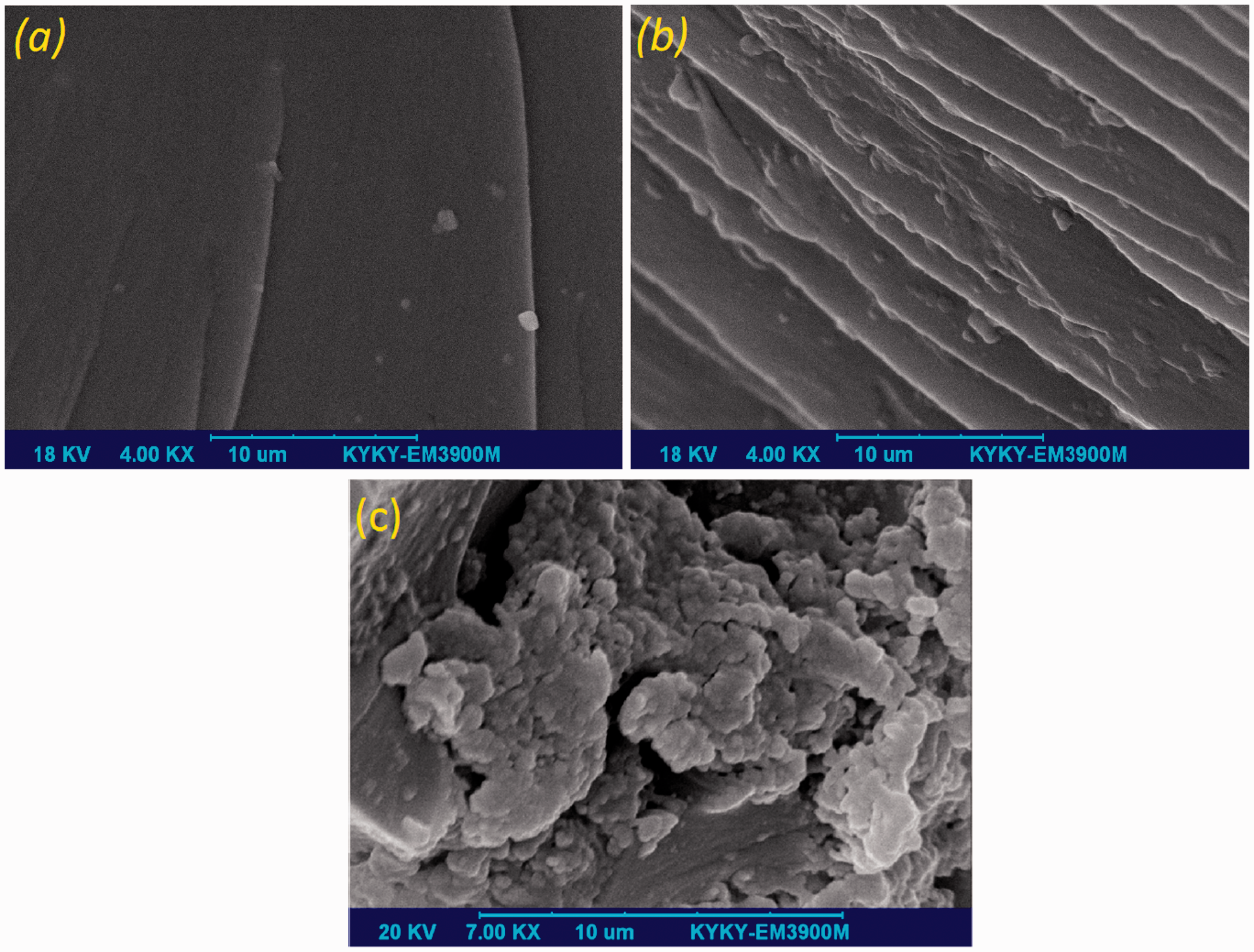
High-velocity impact test results
The energy absorption and limit velocity values of specimens containing various contents of nanofillers (GO, ZrO2, or GO + ZrO2) under high-velocity impact testing are shown in Figures 13 and 14. The values of energy absorption and limit velocity for the specimen containing 0.3 wt.% GO are 88.2 J and 81.2 m/s, which shows an increase of 35 and 16%, respectively, when compared to the neat specimen. Moreover, by the addition of 2 wt.% nano-ZrO2 to the basalt fiber/epoxy composite, the values of energy absorption and limit velocity reach to 92.9 J (42% increase) and 83.4 m/s (19% increase), respectively. It is worth noting that compared to the neat basalt fiber/epoxy composite, the addition of 0.1 wt.% GO + 2 wt.% ZrO2 enhances the values of absorbed energy and impact limit velocity by 67 and 30%, respectively. This shows that when GO nanoplatelets and nano-ZrO2 are used simultaneously, a pronounced enhancement in the impact properties of composite is observed. This agrees with the results of ILSS for the multiscale composites. The enhanced impact properties of basalt fiber/epoxy composites due to the nanofiller addition are attributed to the three main reasons. (i) The frictional slippage between the basalt fibers and matrix can be hindered due to the presence of nanofillers. Clearly, the improved interfacial bonding leads to an effective load transfer from the nanocomposite matrix to the basalt fibers. (ii) The GO and ZrO2 act as toughening agents in the matrix. They are considered as rigid fillers which prevent the crack propagation in a straight path through the crack deflection and crack pinning mechanisms. (iii) The GO and ZrO2 enhance the bending stiffness of the composites due to intrinsic higher stiffness of nanofillers compared to the polymeric matrix. As described earlier, the formation of agglomerates at higher nanofiller loadings is the main reason for the declined impact properties.
The values of energy absorption of the composites at various filler loadings. The values of impact limit velocity of the composites at various filler loadings.

Figure 15 displays the damage zone for the composites containing various contents of nanofillers (GO, ZrO2, or GO + ZrO2). It can be observed that the addition of nanofillers decreases the extent of damage and increases the damage tolerance. The damaged area for the neat specimen is 1215 mm2, and for the 0.1GO/2Z specimen, the value reached to 570 mm2 (i.e. 53% decrease).
The damage zone for the composites containing various contents of nanofillers. The values of E are the averaged values from three tests.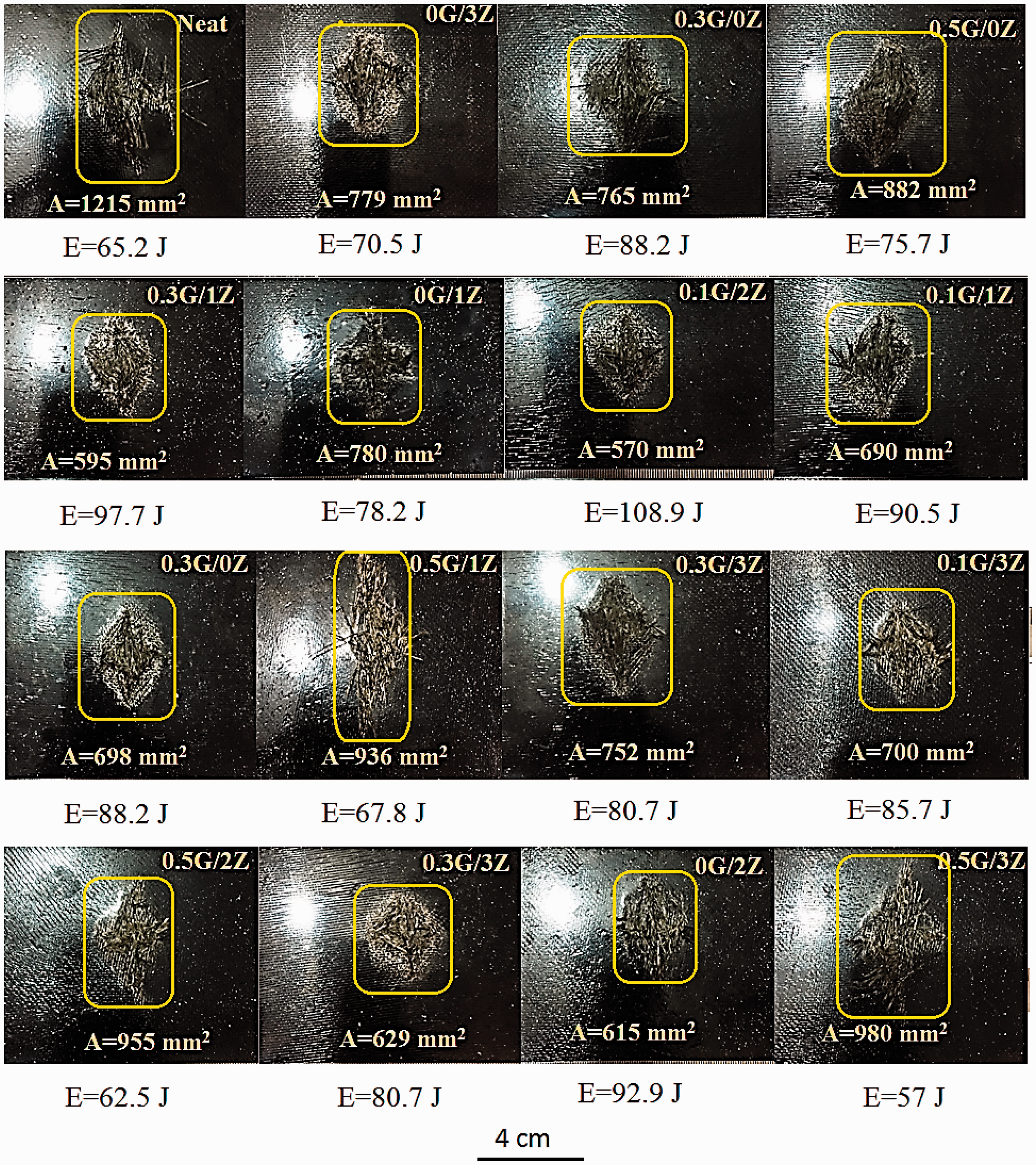
It is well known that the main failure mechanisms of impact-exposed FRPs are matrix cracking, fiber breakage, and delamination between plies [37]. The decreased damage zone due to the nanofiller addition is also reported by other researchers [28,37] and can be attributed to this fact that the introduction of nanofiller enhances the stiffness of composite, and, as a result, a greater energy in the elastic deformation can be absorbed. Moreover, the matrix cracking and delamination are decreased due to enhanced fracture toughness of matrix. At higher nanofiller loadings, the extent of damage is increased due to poor dispersion of nanofillers and formation of agglomerates.
Figure 16 illustrates the SEM micrographs of impact fracture surface of the neat and multiscale 0.1GO/2Z-filled basalt fiber/epoxy composites. For the neat specimen (Figure 16(a)), a weak interfacial bonding can be inferred from the image of fracture surface. As it can be seen in Figure 16(b), there is an effective interaction between the basalt fibers and matrix in the case of multiscale composite. These results are in line with those obtained from high-velocity impact test.
SEM micrographs of impact fracture surface of the (a) neat basalt fiber/epoxy composite and (b) multiscale 0.1GO/2Z-filled basalt fiber/epoxy composite.
Conclusions
GO, nano-ZrO2, and hybrid nano-ZrO2 + GO were dispersed within the matrix of basalt fiber/epoxy composite to investigate the high-velocity impact behavior and ILSS of the resultant multiscale composites. The results of this work can be summarized as follows:
The organosilane molecules were successfully grafted on the surface of GO and nano-ZrO2 particles, as indicated by FTIR and EDX analyses. The optimal composition of specimen according the obtained results was 0.1 wt.% GO + 2 wt.% ZrO2 which produced the highest values of energy absorption, impact limit velocity, and ILSS. The introduction of 0.1 wt.% GO + 2 wt.% ZrO2 in the matrix of basalt fiber-reinforced epoxy composite enhanced its energy absorption and limit velocity by 67 and 30%, respectively, in comparison with the neat specimen. The specimen prepared with 0.1 wt.% GO + 2 wt.% ZrO2-filled matrix produced 77% enhancement in ILSS as compared to the neat basalt fiber/epoxy composite. According to the SEM evaluations, an enhanced basalt fiber/epoxy interfacial bonding was observed in the case of multiscale composite.
Footnotes
Declaration of conflicting interests
The author(s) declared no potential conflicts of interest with respect to the research, authorship, and/or publication of this article.
Funding
The author(s) received no financial support for the research, authorship, and/or publication of this article.