




Abstract
Polypropylene (PP) composites reinforced with down feather whisker (DFW) with and without surface modification were prepared and characterized through a series of tensile tests. The reaction of isopropyl tri(dioctylpyrophosphate) titanate (NDZ-201) on the surface of DFW was investigated to improve the compatibility between PP and DFW. The chemical reaction between DFW and NDZ-201 was characterized using the attenuated total reflection attachment on the Fourier transform infrared spectroscopy. PP/modified DFW (MDFW) composites showed more uniform whisker dispersion in the PP matrix, higher compatibility and good tensile strength than pure PP and PP/DFW composites. It was worth noting that the Young’s modulus of PP/DFW composites was higher than that of pure PP but lower than that of PP/MDFW composites. Furthermore, the effects of DFW and MDFW on the microstructural and thermal properties of different composites were also investigated, respectively. These results indicated that DFW could be a potential natural reinforcement for the PP matrix achieved with the use of NDZ-201.
Introduction
In recent years, there has been great interest in preparing composites based on protein fibers to produce new biomaterials and reuse waste protein materials. 1 –5 Compared with synthetic polymers, these protein fibers are usually biocompatible, degradable and environmentally friendly. One important method of reusing protein fibers is the preparation of keratin solution, which was extracted from these protein fibers using complex chemical methods and then was blended with synthetic polymers to produce protein biomaterials. However, keratin solution is not stable in the process of extruding and hot pressing under high temperature due to the destruction of supermolecular structure, which is the way to put protein macromolecules together. It is necessary to find a new way to promote the usage of protein fiber for functional applications under high temperature. In this study, down feather was cut into down feather whisker (DFW), which has the length to diameter ratio of 20–50. DFW sustains the excellent properties of protein materials and has stable structure against high temperature. So, DFW can be blended with thermoplastics resin such as polypropylene (PP) to produce composites; PP/DFW composites of various shapes can also be produced without the limit of down feather dimensions. When DFW was added to PP matrix, the PP/DFW composites were expected to have the following properties: low density, degradability, good design and manufacture flexibility, and higher mechanical properties.
Down feather is usually of lower density and much cheaper than wool fiber and silk fiber. Interestingly, DFW has high length to diameter ratio and excellent absorption ability, which might reinforce the PP matrix and carry moisture, medical drug or pollutant, respectively. Therefore, the PP/DFW composites are expected to have the following properties: low density, degradability, good design and manufacture flexibility and hydrophilic property, which could be used in breathable plastic, hydrophilic fiber, agricultural sheet and even biomedical materials industries.
But DFW has hydrophilic surfaces that make it incompatible with PP. The interfacial adhesion between whisker and polymer is one of the major factors determining the ultimate mechanical properties of composites. To improve the weak interfacial adhesion between protein fibers and polymer matrix, a number of fiber surface modification techniques have been developed. These surface treatment agents include silane, titanate, stearic acid, glycidyl methacrylate and maleic anhydride. 6 –13 The surface of several fillers, such as mesoporous, plate-like talc (T), needle-like wollastonite (W), silicon dioxide, aluminum oxide, zirconium dioxide, titanium dioxide (TiO2, anatase), TiO2 (rutile), ferric oxide and iron(II,III) oxide, modified by a titanate coupling agent, showed better interfacial adhesion between fillers and synthetic polymer matrix. 14 –19 Fang and coworkers have proved the chemical reaction between soy protein isolate and isopropyl tri(dioctylpyrophosphate) titanate (NDZ-201). 20 DFW contains much hydrophilic groups such as hydroxyl, carboxyl and amino groups. Hydroxyl groups present in DFW can react with NDZ-201 to form Ti–O bonds, respectively. Moreover, long-chain hydrocarbon segments of NDZ-201 are compatible with PP. Therefore, this suggests that NDZ-201 is an excellent modifying agent to improve both the dispersion of DFW in the PP matrix and the interfacial adhesion between DFW and PP.
In the present work, the effects of NDZ-201 on the interfacial adhesion, mechanical and thermal properties of PP/DFW composites have been studied. In addition, attenuated total reflection attachment on the Fourier transform infrared (ATR-FTIR) spectra showed that NDZ-201 can react with the hydroxyl groups to form Ti–O bonds. The morphologies, microstructure and crystallinity of composites were also characterized.
Experimental
Materials
Isotactic PP (metal flow rate = 36 g/10 min) was obtained from Panjin Co. Ltd (Panjin, China). Down feather of duck was purchased from Maolong-Wuzhong Down Co. Ltd (Shaoxing, China). Acetone was purchased from Kedi Co. Ltd (Tianjin, China). Titanate coupling reagent NDZ-201 (C51H112O22P6Ti) was purchased from Nanjing Shuguang Chemical Group Co. Ltd (Nanjing, China).
Surface modification of down feather whisker
Down feather was cut into DFW on the self-made machine. DFW was cleaned using acetone for 2 h and then dried at 105°C for 2 h. A certain amount of NDZ-201 (5% by weight of DFW) was dissolved in acetone under room temperature for 5 min and then DFW was put into the solution and dispersed by ultrasonic at 80°C for 3 h. The modified DFW (MDFW) was filtered using filter paper and dried at 105°C for 5 h to remove residual NDZ-201. The process of chemical reaction between NDZ-201 and DFW is shown in Figure 1.
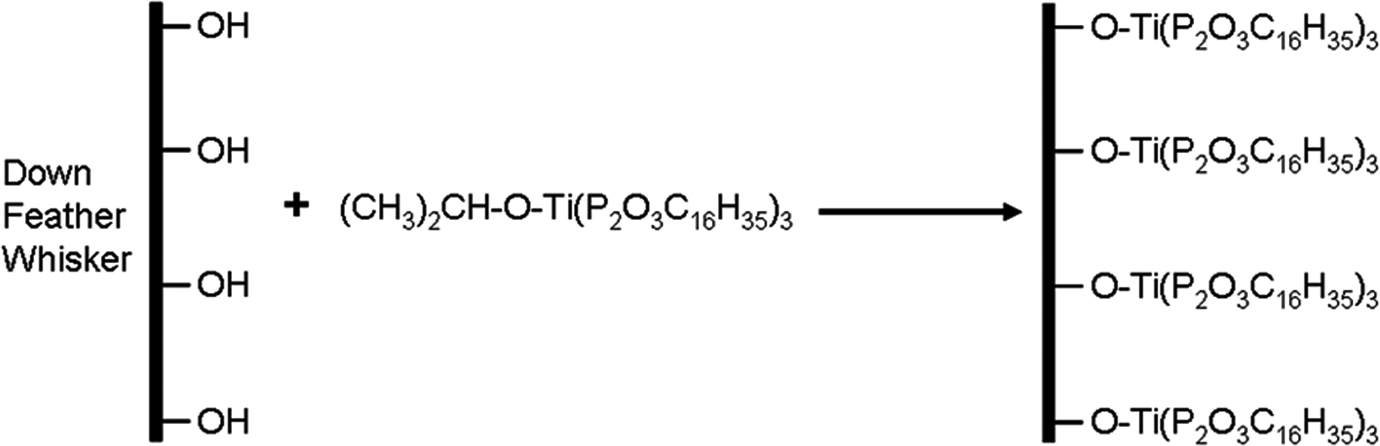
A schematic representation of chemical bonding of NDZ-201 on DFW. NDZ-201: isopropyl tri(dioctylpyrophosphate) titanate; DFW: down feather whisker.
Composites preparation
Composite pellets at various composition ratios were prepared in a twin-screw extruder (SHJ-18, Lanzhou Lantai Co. Ltd, China) using different routes:
Varying amounts of DFW (10%, 20%, 30%, 50% and 60% by weight of PP) were compounded with PP.
A certain amount of MDFW (20% by weight of PP) was compounded with PP.
After drying at 105°C for 2 h, these pellets were, respectively, sandwiched between Teflon-coated compression molder and hot-pressed into thin sheets at 190°C and 5 MPa for 5 min on the plate vulcanization machine (XLB-D350×350, Huzhou East Machine Co. Ltd, China). After pressing, the sheets were removed from the molder and cooled until they reached room temperature. This resulted in foursquare sheets with a thickness of around 0.5 mm and sides of 100 × 100 mm2.
Characterization
Scanning electron microscopy
Morphologies of DFW and cross section of composites were examined on a scanning electron microscope (JSM-5610LV, JEOL Co. Ltd, Japan) at 25 kV after gold coating.
FTIR spectroscopy
ATR-FTIR is a useful tool to analyze the surface chemistry of synthetic polymer. The ATR-FTIR measurements of MDFW were carried out on a Bruker Tensor 27 spectrometer (BRUKER Co. Ltd, Germany) with an attenuated total reflectance cell. Each spectrum was an average of 32 scans recorded at a resolution of 4 cm−1 in the range of 4000–600 cm−1.
WXRD of composites
Wide-angle x-ray diffraction (WXRD) experiments were performed on a D/MAX-IIIA (RIGAKU Co. Ltd, Japan) using Cu-Kα radiation (wavelength = 0.154 nm) to investigate the structure of composites. Generator intensity was 35 kV and the generator current was 30 mA. The composites were scanned within the range of 2θ = 5–50° in a scan step of 0.02°.
Thermogravimetric analysis of composites
DFW and MDFW were scanned using a TG 209 F1 (NETZSCH Co. Ltd, Germany) from 25°C to 600°C at a heating rate of 20°C/min in a flowing nitrogen atmosphere (10 ml/min).
DSC of composites
The thermal behavior of composites was performed using the differential scanning calorimetry (DSC 204F1 system; NETZSCH). The samples were first heated from 20°C to 200°C at a temperature speed of 20°C/min under nitrogen purge and kept at 200°C for 2 min, then cooled to room temperature and again heated up to melting (second run). The heat of fusion was calculated using the NETZSCH-Protues-Version-4.8.3 software. The degree of crystallinity was obtained from the ratio between the fusion heat values of the samples (ΔH
f) and 100% crystallinity isotactic PP (H
f
= 209 J/g) using the following formula

Tensile properties of composites
Relationship between stress and strain was determined using an Instron 5566 Universal Testing Machine, at a gauge length of 50 mm and a strain rate of 50 mm/min. The width and thickness of samples were 20 mm and 0.5 mm, respectively. Each sample was tested five times and the results were averaged.
Results and discussion
Characterization of DFW
The surface morphology of DFW is shown in Figure 2, which was taken by scanning electron microscopy (SEM). It was obvious that down feather was crushed into small pieces. Generally, most of them seem to be needles. It was observed clearly that most of the DFWs had diameters of 1–15 μm and aspect ratios of 20–50.
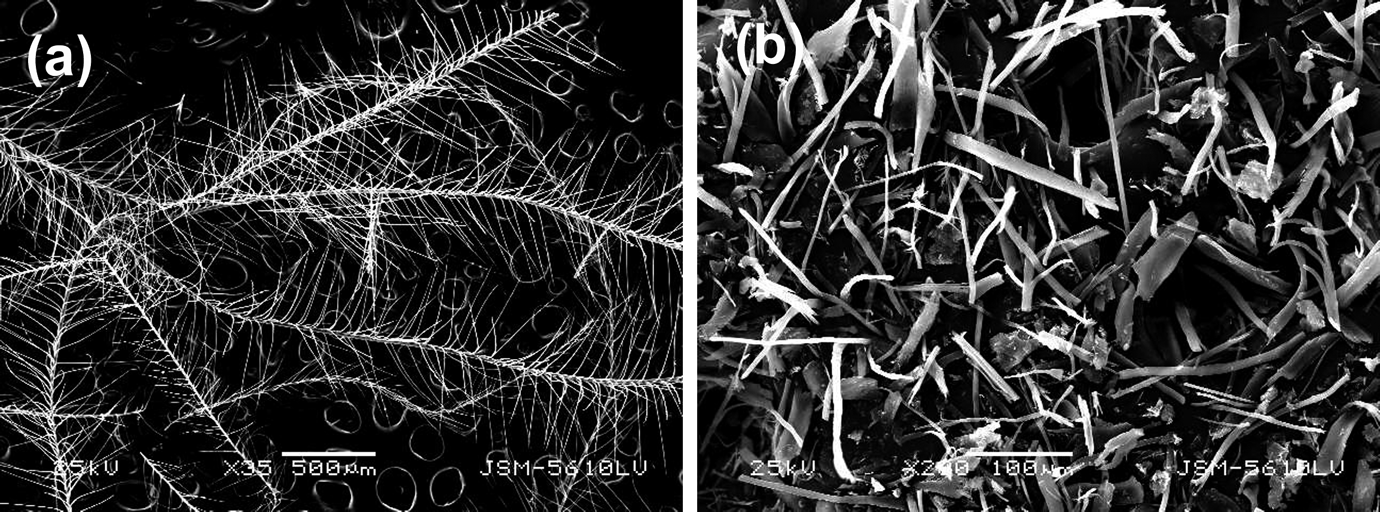
Scanning electron microphotographs of surface: (a) down feather fiber and (b) down feather whisker (DFW).
ATR-FTIR spectra of MDFW
The ATR-FTIR spectral data of NDZ-201, DFW and MDFW are presented in Figure 3. The spectral data of NDZ-201 showed the characteristic peaks at 2958 cm−1, 2885 cm−1, 2914 cm−1, 2850 cm−1 and 1012 cm−1, which are associated with CH3-antisymmetrical stretching vibration, CH3-symmetrical stretching vibration, CH2-antisymmetrical stretching vibration, CH2-symmetrical stretching vibration and stretching vibration of P–O of coupling agent NDZ-201, respectively. The spectral data of DFW showed typical peaks at 2930 cm−1 and 1645 cm−1, which corresponded to CH2-antisymmetrical stretching vibration and stretching vibration of C=O, respectively. The MDFW showed a new small marked peak at 1012 cm−1 corresponding to the stretching vibration of P–O bonds. It could be inferred that there was a molecular layer of NDZ-201 on the surface of DFW suggesting that NDZ-201 was grafted onto the surface of DFW successfully. In addition, the spectral data showed that NDZ-201 did not absorb any moisture (the absorption peak at around 3294 cm−1). So the reduction in moisture content of MDFW was also visible in the spectrum compared to that of DFW.
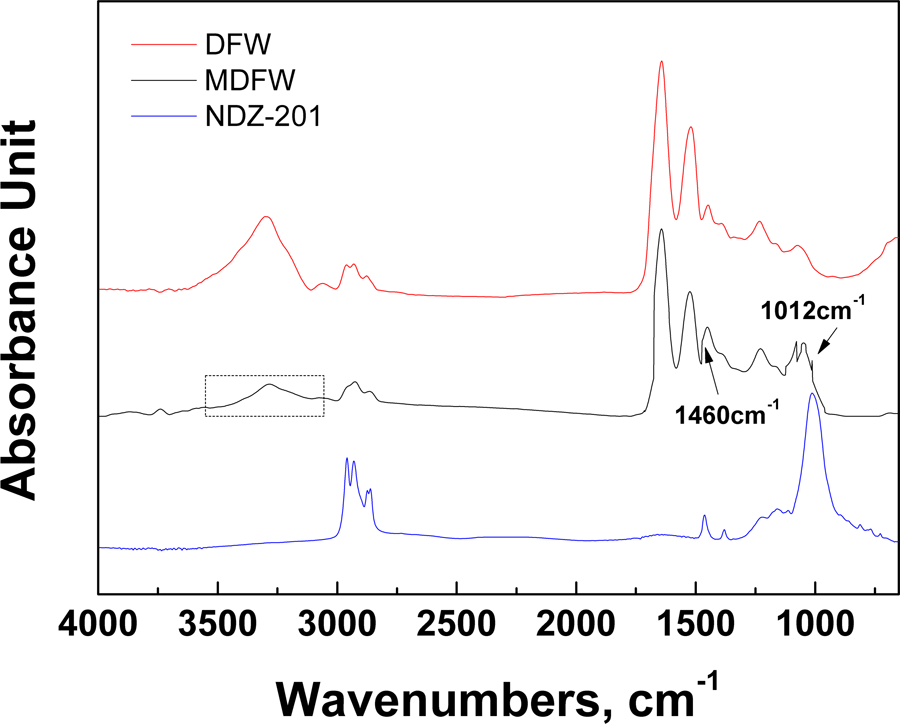
ATR-FTIR spectra of DFW, NDZ-201 and MDFW. ATR-FTIR: attenuated total reflection attachment on the Fourier transform infrared; NDZ-201: isopropyl tri(dioctylpyrophosphate) titanate; DFW: down feather whisker; MDFW: modified down feather whisker.
Thermogravimetric analysis of MDFW
The thermogravimetric and derivative thermogravimetric (DTG) curves of DFW and MDFW are shown in Figure 4. Both DFW and MDFW showed two evident mass loss stages. The first in the temperature range of 20–150°C was generally corresponded to the evaporation of moisture, and the second in the temperature range of 210–450°C was ascribed to the thermal degradation of both samples. From DTG curves, DFW showed one peak corresponding to the maximum thermal degradation rate. However, as for MDFW, the higher temperature peak shifted to high temperature. This suggested that NDZ-201 improved the thermal stability of DFW due to a large amount of phosphate groups present in the macromolecular backbone of NDZ-201. Interestingly, the mass loss of DFW in the temperature range of 20–150°C decreased after treatment with NDZ-201, suggesting that the DFW had higher moisture content than MDFW. This could be explained by the long-chain hydrocarbon segments of NDZ-201, which decreased the water absorption ability of modified DFW. In addition, the lower residue of MDFW was found at 600°C compared to that of DFW.
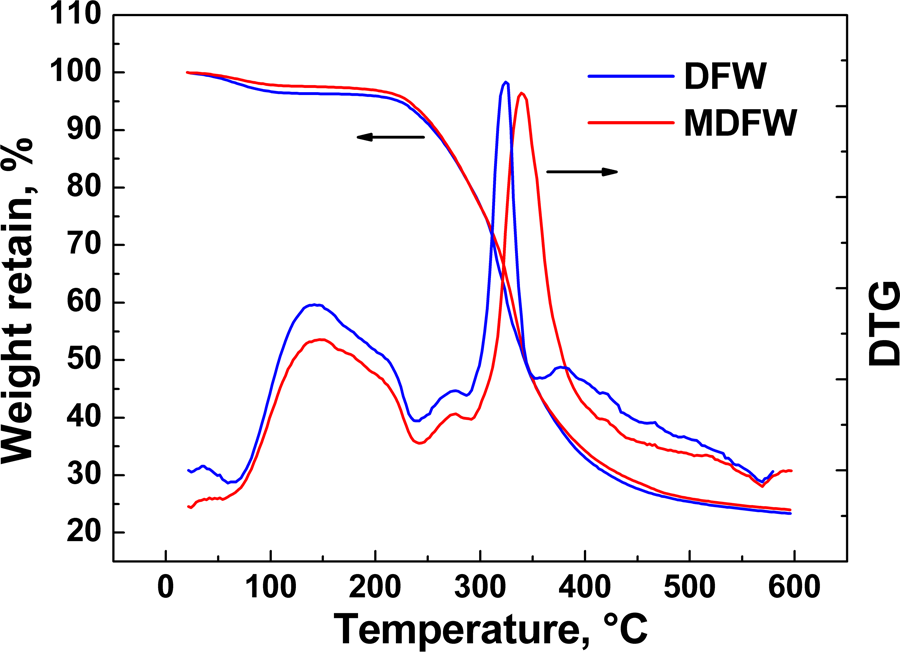
TG curves of DFW and MDFW. TG: thermogravimetric; DFW: down feather whisker; MDFW: modified down feather whisker.
SEM analysis of composites
The cross section morphologies of pure PP, PP/DFW composites and PP/MDFW composites are shown in Figure 5. Based on Figure 5(a), the cross section of pure PP was smooth. As the amount of DFW was 20% and 50%, DFW was separated from the PP matrix and not uniformly distributed in the PP matrix. But the cross section of PP/MDFW composites (Figure 5(d)) showed that MDFW was uniformly distributed in the PP matrix and mostly linked with the PP matrix. Furthermore, based on Figure 5(e) and (f), it could be seen clearly that there were gaps between DFW and PP matrix, but the gaps between MDFW and PP matrix could not be found in PP/MDFW composites. This indicated that NDZ-201 was an excellent coupling agent, which efficiently improved both the dispersion of whisker in the PP matrix and the interfacial adhesion between MDFW and PP matrix.
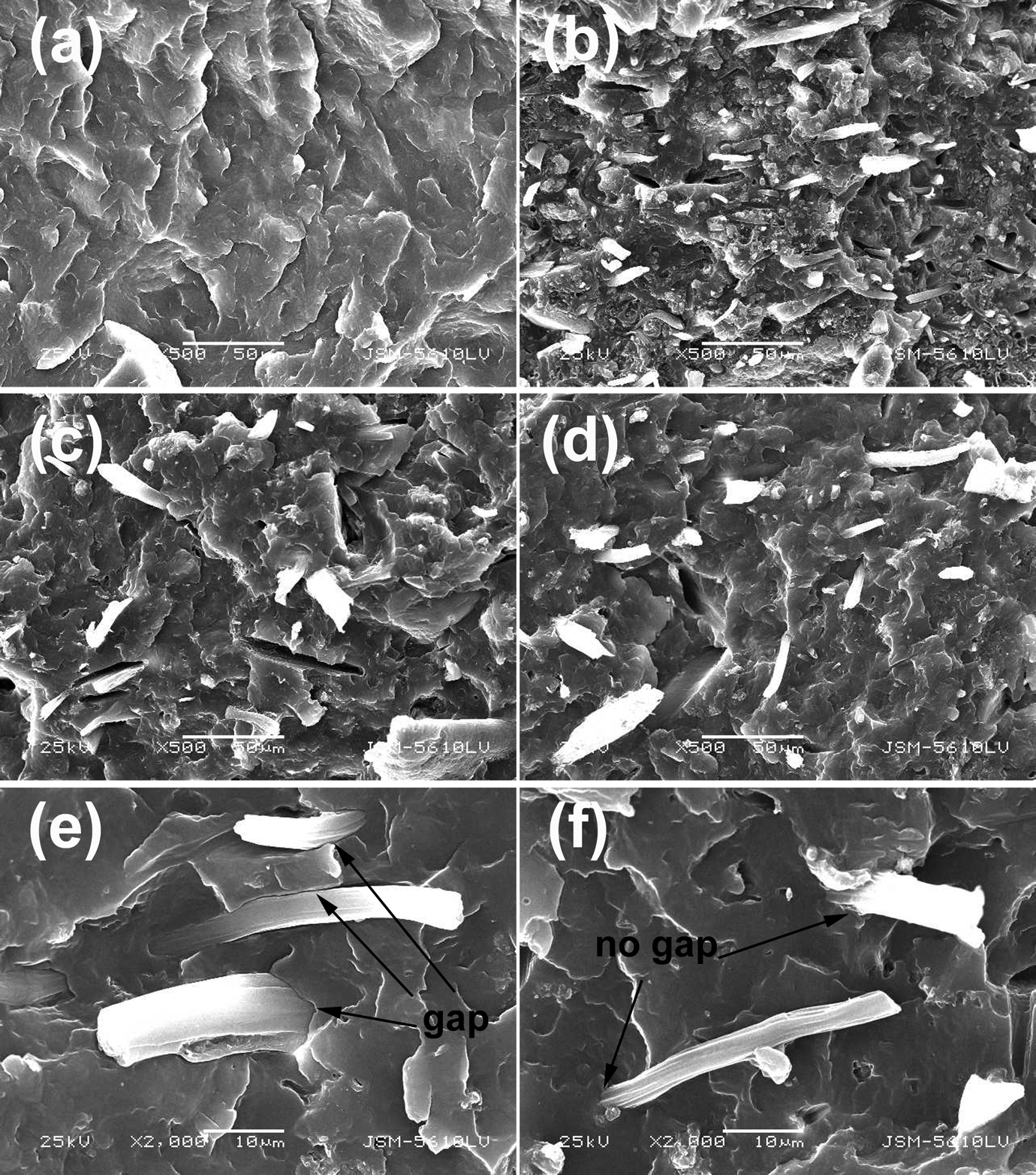
Scanning electron microphotographs of the cross section of composites: (a) pure PP, (b) PP/DFW composite (50:50), ((c) and (e)) PP/DFW composite (80:20) and ((d) and (f)) PP/MDFW composite (80:20). PP: polypropylene; DFW: down feather whisker; MDFW: modified down feather whisker.
WXRD patterns of composites
The WXRD patterns of pure PP, PP/DFW composites and PP/MDFW composites are shown in Figure 6. The curves of pure PP/DFW and PP/MDFW composites were moved up by 6000 and 3000, respectively. The WXRD spectrum of pure PP showed characteristics α-monoclinic crystal structure with a prominent 2θ peak at around 13.8°, 16.5°, 18.2° and 20.8° corresponding to the (110), (040), (130) and (111) planes, respectively. For both PP/DFW and PP/MDFW composites, α-monoclinic crystal structure of the PP matrix still existed but their diffraction intensity decreased when compared with that of pure PP.
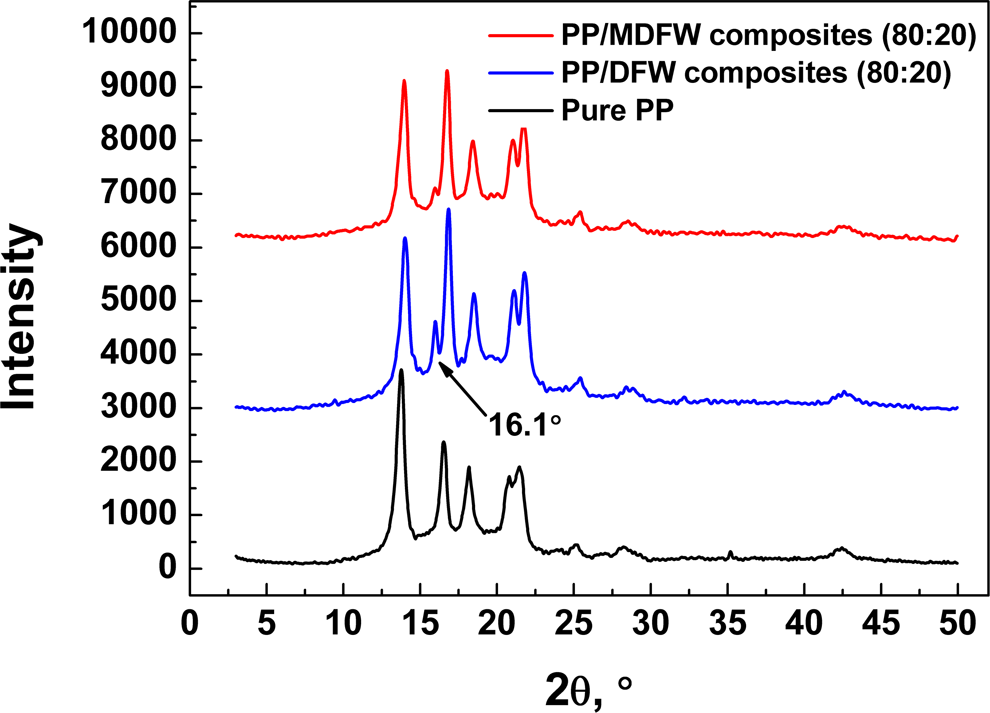
Wide-angle x-ray diffraction intensity of pure PP, PP/DFW composites (moved 3000) and PP/MDFW composites (moved up 6000). PP: polypropylene; DFW: down feather whisker; MDFW: modified down feather whisker.
A new peak appearing at around 16.1° was clearly found in PP/DFW composite. This indicated that the addition of DFW favored the formation of β-monoclinic crystals and the formation of β-monoclinic crystals followed a heterogeneous nucleation mechanism. Yongli et al. have reported that bamboo fiber-reinforced PP composites showed a new peak of x-ray diffraction at 16° ascribing to β-monoclinic crystals. For PP/MDFW composites, a small peak appearing at around 16.1° was detected. This suggested that long-chain hydrocarbon segments on the surface of MDFW were compatible with PP matrix and restrained the formation of β-monoclinic crystals in PP/MDFW composites. Moreover, the crystallinity of composites decreased due to the addition of DFW or MDFW, which had a small crystalline and a large amount of amorphous region.
DSC of composites
The DSC heating and cooling thermograms of pure PP, PP/DFW composites and PP/MDFW composites are shown in Figure 7, and the values of relevant thermodynamic parameters are summarized in Table 1. In the first heating run (Figure 7(a)), the curve of pure PP showed a typical melting peak at 167.1°C. Comparatively, the curve of PP/DFW composites showed a decrease of 2.6% in the melting peak of the PP matrix. For PP/MDFW composites, a slight decrease of 0.7% in the melting peak of the PP matrix was observed. This indicated that the crystallinity of the PP matrix in composites was reduced due to the addition of DFW, but the long-chain hydrocarbon segments of the MDFW surface could lower this damage. In the second heating run (Table 1), both temperature melting (T m) and crystallinity of the PP matrix in PP/MDFW composites increased when compared with that of the PP matrix in PP/DFW composites.
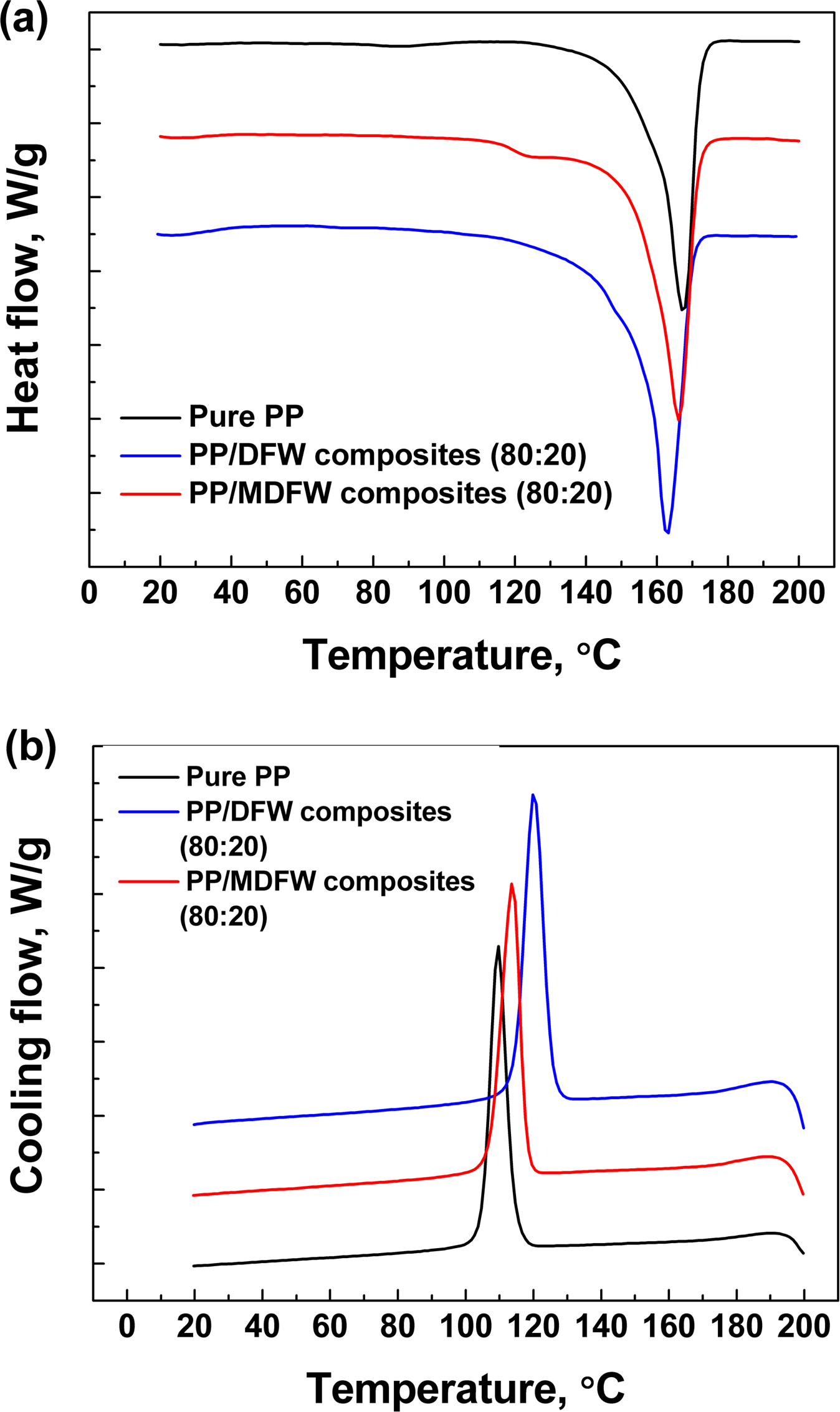
DSC thermograms of pure PP, PP/DFW composites and PP/MDFW composites: (a) heating run (20°C/min) and (b) cooling run (20°C/min). DSC: differential scanning calorimetry; PP: polypropylene; DFW: down feather whisker; MDFW: modified down feather whisker.
DSC temperatures and heats of transition for different composites.
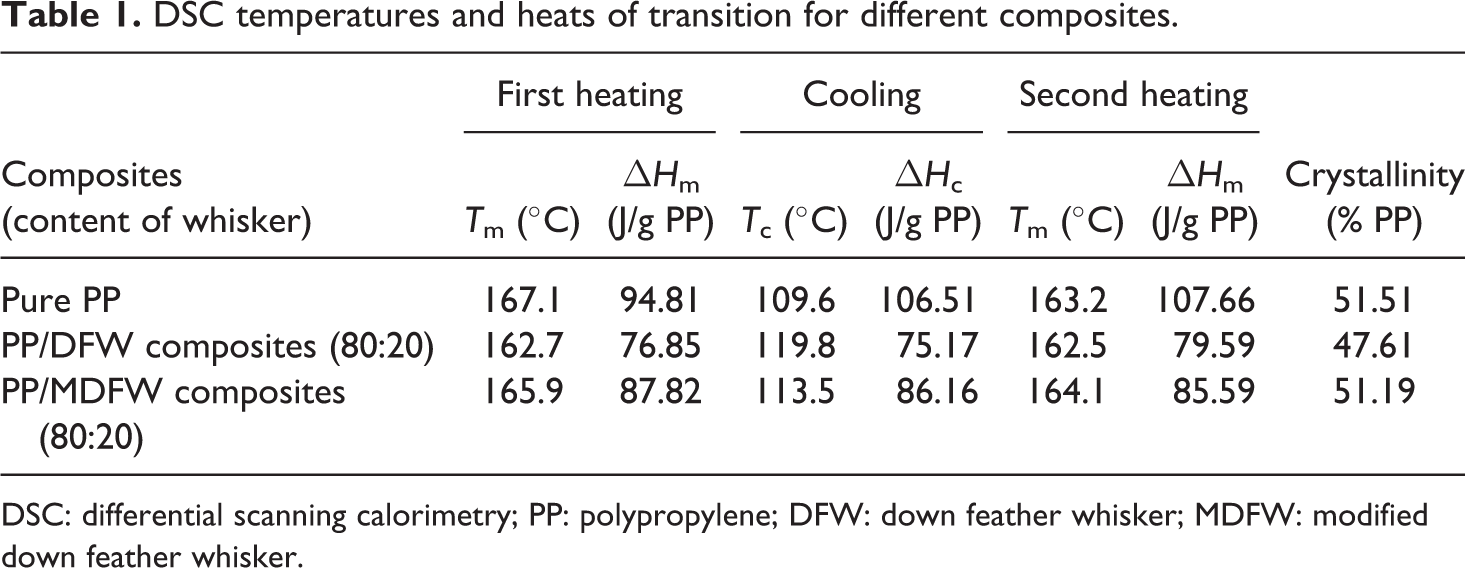
DSC: differential scanning calorimetry; PP: polypropylene; DFW: down feather whisker; MDFW: modified down feather whisker.
In the cooling run (Figure 7(b)), the addition of DFW increased the temperature of crystallization (T c) of the PP matrix. Comparatively, the T c of the PP matrix in PP/MDFW composites increased slightly. This could be explained as the nucleating ability of DFW, which accelerated the crystallization process of PP. However, the MDFW made of long-chain hydrocarbon segments had a less nucleating ability than DFW.
Mechanical properties of composites
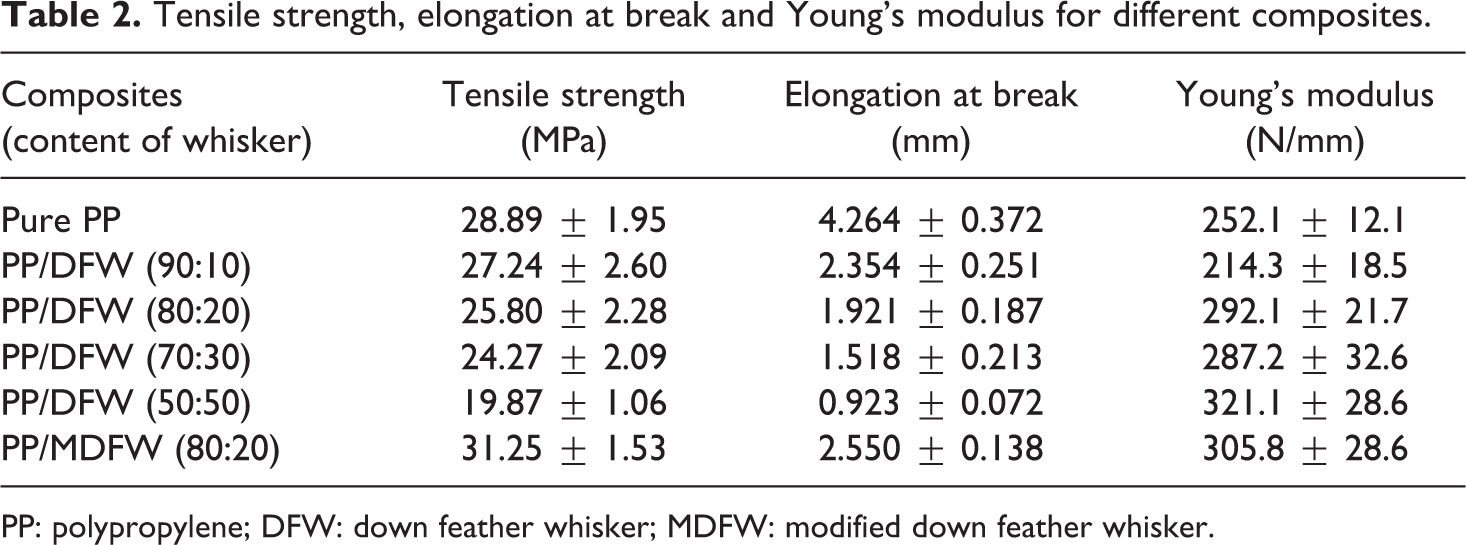
Average values of tensile strength, elongation at break and Young’s modulus for pure PP, PP/DFW composites and PP/MDFW composites are summarized in Table 2. It was obvious that the tensile strength and the elongation at break of PP/DFW composites decreased with the increase in the content of DFW due to the poor compatibility between DFW and PP matrix. For higher content of DFW, the polymer matrix formed did not cover them completely, producing voids that weaken the interface and obstruct the load transfer between DFW and matrix. For PP/DFW composites (80:20), the tensile strength and the elongation at break decreased to 26.80 MPa and 2.100 mm, respectively. It was worth noting that the maximum tensile strength of 31.25 MPa achieved with the PP/MDFW composites (80:20) revealed an important contribution from the MDFW to the tensile strength of composites. This is the result of the even dispersion of MDFW and good interfacial adhesion between MDFW and PP matrix. All the composites had Young’s modulus larger than pure PP as observed in Table 2. As the amount of DFW was 50%, Young’s modulus of PP/DFW composites could increase by 35.0%. In addition, Young’s modulus of PP/MDFW composites was larger than that of PP/DFW composites. Young’s modulus of all the composites increased due to the stiffening effect of DFW, which was stiffer than pure PP and diminished the matrix’s flexibility. Moreover, for PP/MDFW composites, improved interfacial adhesion between the two phases was another important fact to increase Young’s modulus. Therefore, in order to completely use the DFW’s potential as reinforcement, an even dispersion of DFW and strong chemical or physical bonds between DFW and PP matrix were necessary, to transfer the load between both the phases. This indicated that NDZ-201 was an excellent modifying agent to improve both the dispersion of DFW in the PP matrix and the interfacial adhesion between both the phases.
Tensile strength, elongation at break and Young’s modulus for different composites.
PP: polypropylene; DFW: down feather whisker; MDFW: modified down feather whisker.
Conclusions
The result of this study indicated that the addition of DFW led to an increase in the tensile strength of PP/DFW composites, and NDZ-201 acted as an effective modifying agent to improve the weak interfacial adhesion between DFW and PP matrix. As the amount of DFW increased, both the tensile strength and the elongation at break of PP/DFW composites decreased. However, The PP/MDFW composites showed improved tensile strength compared with pure PP and other composites suggesting improved interfacial adhesion between MDFW and PP matrix. All the composites showed an increase in Young’s modulus and smaller values in elongation at break compared with pure PP due to the stiffening effect of DFW, which was stiffer than pure PP and diminished the matrix’s flexibility. Furthermore, the Young’s modulus of PP/MDFW composites was higher than that of PP/DFW composites due to stronger interfacial adhesion between MDFW and PP matrix.
ATR-FTIR analysis showed that the esterification took place between DFW and NDZ-201. Based on SEM photos, MDFW was distributed in the PP matrix more uniformly than DFW, and PP/MDFW composites showed more compatibility than PP/DFW composites. WXRD and DSC results showed that the addition of DFW into the PP matrix led to a decrease in T m, which favored the formation of β-monoclinic crystals and accelerated the crystallization process of PP matrix. However, these effects of DFW were lowered when DFW was modified by NDZ-201. Moreover, MDFW showed more stable thermal properties than DFW because of the presence of a large amount of phosphate groups in the macromolecular backbone of NDZ-201.
Footnotes
Funding
This work was financially supported by the National Natural Science Foundation of China (Project no. 51203124) and the Major State Basic Research Development Program (973 Program; Project no. 2012CB722701).