




Abstract
School leaders fall into Michael Lipsky's category of street-level bureaucrats, meaning those who implement public policy on the frontlines and have significant discretion in how they do so. However, we know very little about how school principals exercise their discretion in implementing educational policy. Exploring school leaders from a street-level perspective can help both researchers and practitioners gain a better understanding of the political and institutional context in which they operate. Doing so should also provide insights into how they use their discretion to bridge the gap between the policy-as-designed and the policy-as-implemented on the frontlines. By providing empirical examples, we show how the decisions that school principals make based on their discretion have direct and indirect effects on shaping policy outcomes. This understanding, in turn, provides a framework with which to analyze the relationships between the staff, students and parents, thus improving our understanding of educational policy outcomes.
Introduction
Street-level bureaucracies that provide services in various areas such as education, social welfare and health care are all public service organizations whose employees implement public policy through the daily interactions they have with the citizens they serve (Hupe and Buffat, 2014; Lipsky, 1980; Maynard-Moody and Musheno, 2000; Sager et al., 2014). Street-level bureaucrats share several characteristics that define their work routine, which is filled with pressure, conflicts, heavy workloads and vague regulatory demands. They are the public face of state institutions, and their decisions play a significant role in shaping the dynamics between the state and society. As mediators between the decision-makers and the citizens to whom they provide public services, the managers in these organizations play a vital role in policy delivery.
There is a large amount of research indicating that school principals play a significant role in determining the organizational identity of the institutions they lead, promoting the professional development of teachers (Tran et al., 2022) and influencing their motivation to work (Finnigan, 2010), and the functioning and performance of students (May et al., 2012). However, there is a lack of conceptualization of how school administrators use their discretion as street-level managers who interact daily with students and parents in implementing educational policy.
According to the street-level bureaucracy theory, developed by Michael Lipsky (1980), frontline public administration employees are critical actors in determining public policy. Their extensive discretion allows them to determine how public policy is actually implemented, even if their decisions contradict the intent of the decision-makers (Hupe and Buffat, 2014). Through this autonomy, they can determine what type, quantity and quality of service to deliver (Cohen, 2018). Due to this ability, they can de facto assign different weights to values in the organizational culture such as social equity, justice and equality (Bell et al., 2020; Lavee, 2022; Lotta and Pires, 2019). Thus, looking at educational administrators from the perspective of street-level bureaucracy underscores the importance they have in prioritizing various values in society.
Our goal is to explore the role of school principals as street-level managers. Using this perspective will help us examine the political and institutional context in which these school leaders operate. We will also provide empirical examples of how they use their discretion to bridge the gap between the policy-as-designed and the policy-as-implemented.
The theoretical framework of street-level bureaucracy
The public administration literature considers educators street-level workers who implement public policy through the interactions they maintain with the students and parents to whom they deliver educational services (Baviskar, 2019; Binhas, 2020; Siciliano, 2017). Like other public servants on the frontlines of government, such as social workers, nurses and law enforcement employees, educators also face a lack of resources (Lipsky, 2010). They are forced to implement vague policies under organizational and political pressure, and deal with ever-increasing demands from citizens (Evans, 2010; Thomann et al., 2023). To handle the multiple challenges and conflicts they encounter at work (Sager et al., 2014), they use their discretion to determine the outcomes of the policies they deliver to citizens (Brodkin, 2012). Discretion is perhaps the most important element that distinguishes them from other civil servants.
Lipsky's groundbreaking book Street-Level Bureaucracy: Dilemmas of Individuals in Public Services in 1980 revolutionized the academic study of how street-level bureaucrats contribute to public policy outcomes. By emphasizing the organizational hierarchy that characterized public administration at that time, the book focused on the transition from traditional ‘top down’ approaches to public policy implementation to the daily dynamics street-level workers maintain with citizens (Lipsky, 2010). Lipsky argued that frontline workers in government organizations shape citizens’ lives and destinies, because their extensive discretion allows them to actually define how the policies designed by the decision-makers will be delivered to citizens through daily encounters with them. Lipsky (2010) makes two main claims. First, the significant discretion available to teachers, nurses, police officers and social workers is critical to the way they interact with citizens. Second, they will never be able to implement policy optimally because they lack the resources to do so. Thus, these street-level bureaucrats are required to adopt work practices and routines that allow them to do their jobs, which have a strong effect on the results of public policy.
Over the past few decades, there has been a large amount of research examining frontline employees in public administration from the perspective of street-level bureaucracy in various fields such as education (e.g., Bao et al., 2024), social welfare (e.g., Weiss-Gal, 2017) and health (e.g., Walker and Gilson, 2004). The purpose of these studies was to identify the factors that shape the discretionary decisions that influence policy outcomes. Examples include the street-level bureaucrats’ personal characteristics, organizational features and the institutional contexts within which they operate (Edri-Peer and Cohen, 2023; Gershgoren and Cohen, 2024). Hence, we focus on these elements as reflected in the school principal's role as a street-level manager.
Influences on street-level discretion: personal, organizational and institutional factors
The literature has underscored the role of the individual preferences of street-level bureaucrats in this regards. It has noted that these workers are not neutral actors. Their decisions are the result of their ideologies (Bell et al., 2020), attitudes (Kallio and Saarinen, 2014), emotions (Eshuis et al., 2023) and social identity (Grissom et al., 2015). In their influential study, Maynard-Moody and Musheno (2000) developed two narratives that describe how they exercise their discretion: as agents of the state or agents of the citizens. The first narrative depicts these workers as using their discretion to adhere strictly to the rules and procedures. In doing so, they often symbolize the public bureaucracy's hostility towards citizens. In the second narrative, they use their discretion to implement policy flexibly and in a manner that attempts to meet the needs of their clients. In doing so, these street-level bureaucrats are even willing to make personal sacrifices. It was found that despite the popular perception that frontline workers behave like rigid bureaucrats, many of them see themselves as agents of the citizens who want to serve their clients as best they can, even at the possible cost of the bureaucrats’ own well-being. Since then, studies have demonstrated how the personal preferences of these workers lead them to bend the rules or deviate from policies with the goal of helping their clients (e.g., Baviskar, 2019; Cohen, 2018).
The literature also emphasizes the way in which organizational elements are embedded in the decision-making processes of street-level bureaucrats. According to Brodkin (2012), street-level bureaucrats’ personal preferences are always mediated by broader organizational and institutional conditions. Prior studies, for instance, have pointed to the influence of the relationships these workers have with their managers and peers (Nisar and Maroulis, 2017), managerial support (Davidovitz and Cohen, 2022; Schechter et al., in press), their supervisors’ leadership style (Keulemans and Groeneveld, 2020) and the organizational climate (Destler, 2017).
Street-level bureaucrats also operate in broader institutional contexts, which is reflected in their decision-making processes when they deliver services. The few studies in these contexts use a state-level analysis and an international comparative point of view (Gofen et al., 2019). For example, the literature provides evidence about political influences on their discretion such as political control (May and Winter, 2009), the type of regime at the state level (Peeters and Campos, 2023), New Public Management (NPM) reforms (Brodkin, 2012) and the type of welfare market in which the frontline workers operate (Thomann et al., 2018).
The findings of these studies underscore the significant influence of micro, meso and macro factors in the workplace on street-level workers’ delivery of public services. Taking a holistic view of public policy involves analyzing the different factors influencing the work routines of public servants on the frontlines. Our use of this perspective will provide a new look at how school educators and leaders function as public servants and agents of public policy.
Educators as street-level policymakers
Teachers are the frontline public personnel who implement education policies by interacting daily with the students and their parents (Davidovitz, 2023). They have a great deal of discretion in how they deliver educational services to students. For example, they can decide the content of the lessons they teach, even if doing so contradicts the official curriculum.
Teachers have been the subject of numerous studies in the field of public administration research with regards to how they allocate services (Lavee, 2021), how reforms are implemented (Nisar and Maroulis, 2017) and how priorities are created between different groups of service recipients (Baviskar, 2019). In recent decades, NPM dramatically changed how public policy is delivered on the frontlines (Gassner and Gofen, 2018). As a result of these institutional changes, the recipients of educational services have been transformed into customers whom public servants must satisfy by providing quality educational services (Brodkin, 2012). Hence, by measuring goals, providing incentives and encouraging competition, educational policy has become more closely aligned with the private sector's values, and the role of educators has changed dramatically (Jarl et al., 2012). Although teachers share uniform generic characteristics identical to all frontline employees of the public administration, prior studies have emphasized the unique professional identity of teachers as street-level workers who use their discretion to shape their students’ critical thinking (Davidovitz, 2024), express their views on curricula and reforms (Hall and Hampden-Thompson, 2022) and shape educational values (Binhas, 2020).
Empirical findings demonstrate that educators at the street-level have become very active participants in the implementation of educational policy. For example, Baviskar (2019) examined the reasons why teachers prioritize academically promising students. The findings established a direct correlation between this decision and the limited resources available, as well as the extent to which the parents are involved in their children's education. From another direction, Davidovitz (2024) explored how teachers function as proactive representatives of minority students. According to the research findings, minority teachers actively represent students with whom they share a social identity by taking actions that benefit these students and influencing the attitudes of non-minority students.
The concept of policy enactment is very relevant to the current research context. The main assumption of this idea is that various stakeholders in the educational environment interpret and translate the enactment of policy rather than just implementing it (Braun et al., 2010). This analytical approach identifies educators and administrators as crucially important players in the policy process (Armstrong, 2003). It emphasizes the complexity inherent in the implementation of educational policy that is not separate from the organizational and institutional contexts in which these educators and administrators operate (Ball et al., 2012). This approach also identifies various roles that educators play when they find themselves reacting to the policy, intervening in it and enacting it under challenging contextual conditions (Gavin and Stacey, 2023). In general, policy enactment consists of two components: interpretation and translation. Policy interpretation refers to reading and understanding existing policies. Policy translation refers to enacting the policy, which is an active process that involves issues such as implementing initiatives, constructing plans or influencing the content of the lessons (Ball et al., 2012).
Policy enactment theory and street-level bureaucracy theory share several similarities. According to the public administration literature, frontline workers interpret and translate policy based on their perceptions, positions and ideologies (Bell et al., 2020; Kallio and Saarinen, 2014). The research also attributes significant importance to how these actors reinterpret existing policies and use their discretion in determining de facto how the policies should be implemented (Maynard-Moody and Musheno, 2000). It is also clear from a growing body of literature that these bureaucratic actors actively try to influence policy design processes through policy entrepreneurship actions (see e.g., Cohen, 2021). In line with policy enactment theory, an extensive body of research in the public administration literature focuses on aspects of the internal and external organizational context as reflected in the decision-making processes of the frontline employees of the public service. This research emphasizes that it is impossible to understand policy results without looking at the broader context in which the policy is implemented (Brodkin, 2012).
The educational literature has also considered educators as policy implementers from the theoretical perspective of street-level bureaucracy. In previous studies, the focus was on determining whether new reforms might affect the decision-making processes and autonomy of teachers (Hall and Hampden-Thompson, 2022). Grissom et al. (2015), for example, looked at the role of educators through the theoretical lens of representative bureaucracy to understand how demographic and social characteristics are reflected in teacher–student relationships. Public servants who passively represent a particular group, meaning that they share demographic or social characteristics with them, will be more likely to actively represent these clients, evident in the degree to which they promote the interests of client groups with whom they share an identity. Their study also demonstrated empirically that teachers who are demographically and socially representative of the students with whom they share a similar identity benefit their students.
Thus, these studies put the spotlight on teachers as significant policy agents who have a decisive impact on public policy implementation through broad organizational, political and institutional dynamics.
Principals as street-level leaders
Principals are positioned in a ‘structured social space’ with its own properties and power relations that overlap and interrelate with economic, power, political and other factors (Spillane et al., 2001). This active role in the school ecosystem allows principals to serve as street-level managers, working with school stakeholders on possible ways to make sense of the gap between the policy-as-designed and the policy-as-implemented on the frontlines.
Studies examined how managers in these organizations influence their subordinates’ decisions about how to deliver public services to citizens. It has been long known that implementing public policy successfully depends, among other things, on the managers’ performance and function (Evans, 2010; Klemsdal et al., 2022).
Public managers must deal with more ambiguous and contradictory policies and have less managerial power than managers in non-public organizations (Feeney and Bozeman, 2009). Additionally, public managers, and specifically those at the street-level, have a great deal of discretion, a constant lack of resources and are often required to find solutions ‘out of nowhere’. These factors loom large when they operate under minimal supervision (Gassner and Gofen, 2018). Previous studies have shown that they are subject to political pressures and demands from the local and central governments, which attempt to intervene even in the micro level of the interactions between the workers and citizens (May and Winter, 2009). Street-level managers play an essential role as intermediaries between broad social and institutional dynamics and the implementation of policy in the organizations they lead (Davidovitz and Shwartz-Ziv, 2024).
Previous studies in public administration have examined the role of school principals in shaping how policy is implemented at the street-level (Destler, 2017; Grissom et al., 2017). School principals have the power to ensure or undermine the teachers’ feeling of protection and support in the school environment. Thus, their actions in these contexts have substantial consequences for how teachers use their discretion and the coping strategies they adopt when delivering educational services to students and parents (Davidovitz and Cohen, 2022). Due to their position in the policy pyramid between the regulators (politicians and senior bureaucrats in the local government and educational institutions in the central government) and students and parents, school principals act as a conduit that allows institutional influences and politicization processes into educational organizations (Gassner and Gofen, 2018).
It is clear from public administration studies that school principals are crucial to creating a positive organizational climate by providing support to teachers in a way that empowers them to do their jobs (Destler, 2017). In addition, prior studies have noted that how principals respond to demands from above can create a disparity between service recipients and undermine fairness in the allocation of services through their influence on teachers’ practices (Davidovitz and Cohen, 2023). Similarly, there is also evidence of the principals’ ability to create discriminatory educational environments for minority students (Oberfield and Incantalupo, 2021).
The education literature has also explored school principals through the theoretical lens of street-level bureaucracy. In their study of the Australian early childhood sector, Sims et al. (2018) examined two key elements of leadership work (building and maintaining relationships as well as the tension between compliance and resistance) using sense-making and street-level bureaucracy theories. Educational leaders can challenge neoliberalism through their professional decision-making. However, in the current Australian context, many are more concerned about complying with their bureaucratic tasks. From a different direction, Grissom et al. (2017) found that Black students are more likely to be enrolled in gifted programs in schools with more Black teachers and school leaders. There is a similar relationship between Hispanic teachers and students. These findings indicate that the demographic or social affiliation of the principals plays a role in creating a just and inclusive environment for students. The results also underscore how representativeness in management is significant for the promotion of these values in schools. Using a different perspective, Hughes (2022) examined the role of chief executive officers through the theoretical lens of street-level bureaucracy. She argued for a new framing of the role of head teacher as expressed ‘at the street-level’ and beyond the ‘street’. In doing so, she developed a typology that demonstrates the practices these actors utilize with the market, their entrepreneurial behaviour and how they establish professional and business networks.
To justify the exploration of school principals through the theoretical lens of street-level bureaucracy, we provide empirical examples of how these actors use their discretion in a way that has direct and indirect effects on shaping policy outcomes. The examples presented here are part of a larger database that results from a study conducted by the first author between 2019 and 2023 in which the relationship between teachers and other stakeholders with whom they have professional interactions was examined as it relates to the processes for providing educational services.
The database used in our research is based on semi-structured, in-depth interviews conducted with 62 teachers from high schools, middle schools and elementary schools, who teach diverse subjects such as literature, history, physical education, mathematics, English, language, citizenship, biology, computers and art. The teachers described the behaviour of their school principals and assessed their principals’ performance. During the interviews, the participants were asked about their relationships with various stakeholders with whom they interact professionally within their work framework and about how they implement educational policies. They were also asked to describe their feelings towards the policies they are required to implement, as well as their attitudes towards decision-makers and the implications of these policies for their interactions with students and parents. The interviews were conducted subject to the approval of the University Ethics Committee, and anonymity was guaranteed to all participants. The interviews, lasted for one to two hours, were conducted face-to-face, or using the ZOOM software, and all were recorded and transcribed. The data were analyzed using the ATLAS.ti software (version 24.1.1). Using the thematic analysis approach (Braun and Clarke, 2006), we identified and characterized recurring themes and ideas. From these results, we determined the key motifs that represent the meaning that the participants attribute to the relevant phenomena. In this way, we were able to demonstrate the importance of the principals’ discretion in shaping educational policy outcomes.
First, we demonstrate how their use of discretion shapes the nature of their relationships with students and parents and with school faculty. We then highlight the representative value of the use of their discretion. We reveal how their decisions convey a message to students and parents about the nature of their relationships with the faculty. Furthermore, the school principals also represent the government. How their decisions are carried out may provide students and parents with an indication of the nature of their relationship with government officials.
Table 1 presents the types of functions of street-level managers’ use of their discretion, the explanation of each function, the expressions of each function and an empirical example that illustrates each expression.
The types of functions of street-level managers’ use of their discretion, the explanation of each function, the expressions of each function and an empirical example that illustrates each expression.
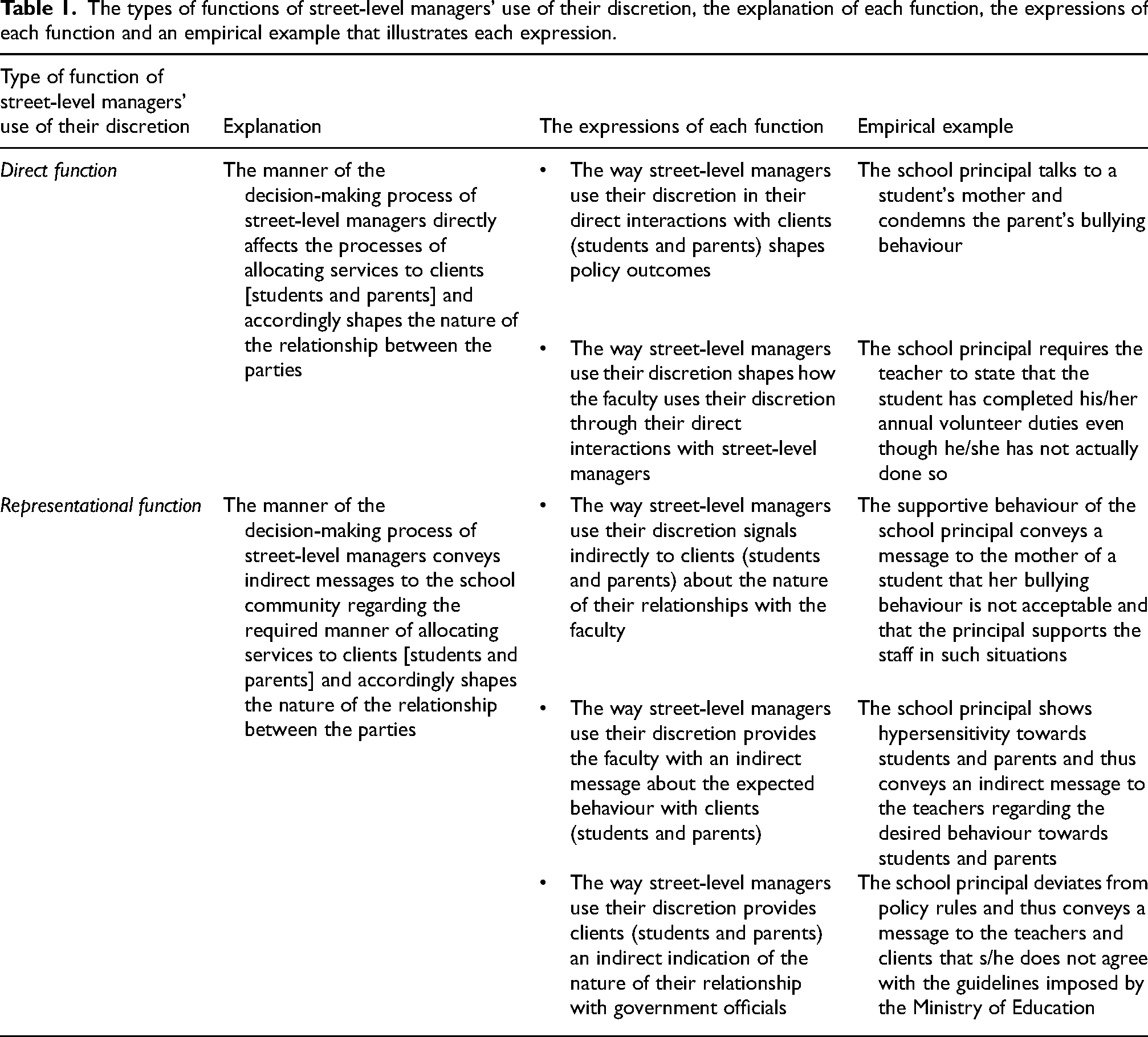
In the first example, we illustrate how the principals’ direct relationship with the students and parents defines how policy is implemented in the school. We also demonstrate that the by-product of their conduct also conveys a message to the target students and parents regarding the organizational mindset that exists between the principal and the teaching staff. Through the empirical data, we demonstrate the bureaucratic power available to school administrators and the way they use it in the professional meetings they hold with various stakeholders in the educational environment. We emphasize the importance of their discretion while looking at the broader organizational and institutional context in which they operate. For example, a high school history and math teacher described how his principal handled a situation in which a parent attempted to bully him, and he was backed up by the principal: ‘There was a mother who called the principal and told her that she did not want a certain teacher to teach her son… [I can say] in favor of my principal that she replied to the mother that she could transfer her son to another school if our decision didn’t suit her’.
In another example, a high school physical education teacher noted how the principal's decision-making processes shape the teachers’ actions, the teachers’ feelings towards the principal's behaviour, and the message that is conveyed to students and parents regarding the accepted priorities in the school. The principal is guided by the policy of the Ministry of Education. If there is a need to show sensitivity to the parents, there is more support for the parents than for the educational staff. These are things that affect me… In the case of our school, the principal really wants the success of the students. The interaction with the parents and students is very important to her so she will do everything [for their benefit] even if sometimes it comes at the expense of the teachers. …the principal always gives me an example. [She tells me] – ‘Try to think - if this was your own child, what would you do?’ I don’t always refer every case to the principal because sometimes she tends to think like me, but the very fact that I know her way of doing things, it resonates in my head and I know that I must adapt myself to her or be close to her way of doing things.
This story demonstrates that the nature of intra-organizational interactions is shaped by the principals’ perceptions of their role relative to the public. It also reveals how the principals’ use of discretion in day-to-day dynamics embodies within it the complexity of realizing the needs of the various players in the internal and external organizational arena.
The discretion of street-level managers allows them to respond to, reshape and even ignore instructions that come from the decision-making levels. Their unique hierarchical position places them in a mediating position between regulatory political actors and citizens. Therefore, they may also represent the broader relationship between public bureaucracies and the levels of decision-making. It also illustrates how principals’ actions affect social values allocation within service delivery. The way school principals use their discretion can promote or impede social equity or equality, for example, by creating a distinction between students to respond to the varying interests of different stakeholders. On one hand, these decisions may send a message to the school community that resources should be allocated according to certain priorities, even if it means discriminating between students to increase social equity and equality. On the other hand, these actions may normalize behaviour that deviates from the policy-as-designed. These actions may have far-reaching consequences for the school community's attitudes towards regulatory and government officials. They can also shape the degree of trust of the former in the latter, as well as play a role in the cooperation of citizens with state institutions.
For example, a high school language teacher described how the principal exercises discretion in individual cases and directs her to deviate from existing policy: ‘The principal tells me to change grades, to allow [a particular student or group of students] another deadline to improve a grade. She sometimes asks me to consider a certain student a little more, to understand the problems of that student and to give opportunities that are different from the opportunities that other students receive…’ A high school English teacher recounted how the principal directed him to break the rules even if it contradicted the policy guidelines: ‘[The principal required me] to state on a certain student's graduation certificate that he had completed his required duties for volunteering. Although the student had not completed [his obligation], I stated that he did’.
In more extreme cases, there is empirical evidence that principals use the discretion available to them in a way that distorts information and requires frontline employees to lie. As a middle school physical education teacher said: ‘Before there were school efficiency and growth index tests, she wanted our school to have a high average. So [following her demand] we prepared a presentation before the exams and explained to the students what the questions meant. Basically, we gave the student the questions that would appear on the exam’.
As we discussed in our review, political and/or regulatory pressures from above also shape the principals’ use of their discretion. The various encounters they have with different stakeholders in their professional environment may help us understand how they make decisions. The following vignette regarding a debate about allowing a disruptive student to go on a multi-day class trip describes a situation in which the principal's decision-making process may convey a message to the faculty that political considerations are a factor when allocating educational services. … the teachers in the school know that you cannot trust a certain student to [behave properly] if he goes on a trip, but the principal says that if we refuse this student's [request], she will receive a call from the municipality and they will demand that he join this trip. Even though it is written in the general director's circular [of the Ministry of Education] that a child in such a behavioural state should not go, there is a fear that the family will call [to complain] to the Ministry of Education.
On one hand, these messages may signal to the teachers that allowing the student to go on the trip is necessary to enhance or at least not hurt the school's status, which might provide future benefits to them. However, teachers who feel that principals make decisions based more on political factors than on upholding the school's rules may lose their motivation and develop a sense of distrust in their superiors both internally and externally.
Thus, looking at school principals through the lens of street-level bureaucracy allows us to identify the significant circles of influence relevant to their use of discretion. We have also demonstrated that the decision-making processes of these principals have direct and indirect consequences. Therefore, this framework is fruitful for exploring the broader dynamics between society and the state.
Future explorations and implications
Despite the evidence we have presented, future explorations about the connection between school principals as street-level managers and school improvement and effectiveness are needed. How does a principal serving as a street-level manager lead to school improvement? How do the principals’ actions as street-level managers impact the teachers’ agency? What key functions can principals who exercise their street-level leadership hand over to their co-professionals? Furthermore, we focused on street-level managers as principals. However, we need a much more expansive, holistic framework with which to explore this street-level perspective through the lens of teachers, mid-level leaders (grade-level coordinators, subject-matter coordinators) and superintendents as well. Looking holistically, as an organizational attribute, identifying the schools’ capacity for innovation, social equity, justice and equality at the street level requires a system-wide perspective.
Principals as street-level managers serve as local policymakers and boundary spanners, which would mean developing internal and external relationships in order to accomplish the school's objectives. As a boundary spanner, such a street-level principal could cultivate partnerships and collaborations as a platform for entrepreneurship (Benoliel and Schechter, 2017), thus promoting their school's cultural wealth, particularly in times of external policy demands (Wu, 2011). Moreover, during crisis situations, principals are required to take immediate and decisive actions (Karasavidou and Alexopoulos, 2019). Given that crises such as COVID-19 can undermine the safety, stability and well-being of the school and its community – exposing students, teachers and families to trauma, threat and loss (Smith and Riley, 2012) – the school principals’ pivotal role as street-level agents intensifies (Schechter et al., in press). To this end, professional development programs can develop school leaders’ understanding of their role as street-level agents between the inner and outer spheres of school life. Such programs can also enhance their understanding of what makes street-level agents act effectively, as well as how they can engage others to help achieve the schools’ goals through a shared process.
By conceptualizing principals as street-level managers, we can identify the unique aspects of their role as leaders of street-level organizations. They must react creatively to numerous demands from various sources, such as federal and state governments, local school boards, unions and community groups. They must also deal with a wide range of school-related issues such as the curriculum, use of time, testing methods, management, professional development and parental involvement. This perspective reveals how these principals mediate political and institutional processes, as well as how they influence how their faculty provides educational services. It enables us to conceptualize the agentic ability of school principals to overcome the gap between the policy-as-designed and the one required on the ground. Additionally, focusing on these actors from the theoretical viewpoint of street-level bureaucracy provides a deeper understanding of school leaders’ important role as mediating agents who help promote social equity, inclusion and equality in the organizational sphere.
Footnotes
Declaration of conflicting interests
The author(s) declared no potential conflicts of interest with respect to the research, authorship, and/or publication of this article.
Funding
The author(s) received no financial support for the research, authorship, and/or publication of this article.

Author biographies