




Abstract
This study highlights the growing significance of integrating digital technology into instructional leadership in schools. Educational administration research cannot ignore the fact that digital technology has become an integral part of human interactions and organizational processes in twenty-first-century workplaces. This paper aims to explore digital instructional leadership behaviours of principals during the COVID-19 pandemic and explain behavioural differences in leadership related to different levels of socio-economic school settings. Data were collected through an online study from 380 teachers in Bahrain. We used a series of two-sample t-tests between percentages to compare differences in digital instructional leadership behaviours. The study revealed that means of principals’ digital instructional leadership behaviours were generally higher in schools serving student populations with a high rather than low socio-economic background. Principals in schools serving student populations with low socio-economic background were higher than their peers only in one digital instructional leadership behaviours, and this was related to socio-economic gaps. The study contributes to better understanding of digital instructional leadership, an approach that is becoming highly prevalent because of the pandemic, and sheds light on how levels of principals’ behaviours vary in different circumstances. Overall, the findings attest to the presence of a digital instructional leadership divide.
Introduction
In the last decades, instructional leadership has become one of the dominant approaches to school leadership, both in research and practice (Berkovich, 2018a; Hallinger and Wang, 2015; Shaked, 2021). One of the leading models of instructional leadership in educational administration, if not the dominant one, is that of Hallinger and Murphy (1985). This model considers ideal leadership behaviours for principals to be focusing on routine and proactive involvement of leaders in defining school instructional objectives, managing the instructional program, and promoting a positive learning climate structured around quality instruction and achievements. Some scholars have changed instructional leadership from a principal-centred practice to a shared one in which the principal and teachers lead jointly (Marks and Printy, 2003). Others defined the construct in various manners, which has led to confusion in the literature (Neumerski, 2013; Rigby, 2014). Nevertheless, Hallinger and Murphy's (1985) model is considered the most popular and influential one in the field (Boyce and Bowers, 2018).
The study explores two underexplored aspects of instructional leadership. First, limited attention has been given to the application of instructional leadership in remote schooling (McLeod, 2015; Pollock, 2020; Sorenson et al., 2016; Berkovich and Hassan, 2022; Berkovich, 2023; Shepherd and Taylor, 2019). Remote schooling is an educational process or system in which distant teaching is carried out using various technologies. Currently, it is supported mostly by the Internet (Cioè-Peña, 2022). In this paper, our working definition of remote schooling includes both online learning in which teacher and student communicate remotely over the Internet and principals’ supporting actions of school operation, specifically teaching and learning. The COVID-19 pandemic transformed traditional schooling models, making remote learning prevalent (Longmuir, 2021; Palau et al., 2021; Pollock, 2020; Saultz and Fusarelli, 2017). Digital instructional leadership, supported by technology, enhances teaching and learning quality (Berkovich and Hassan, 2022; Berkovich, 2023). Research in Middle Eastern countries found that during the pandemic, principals’ digital instructional leadership promoted commitment, effectiveness, and reduced teacher turnover (Berkovich and Hassan, 2022; Berkovich, 2023).
Second, context is overlooked in school leadership research (Berkovich, 2018b; Hallinger, 2018). Factors such as national affiliation, policies, education system maturity, cultural values, and socio-economic background influence leadership (Berkovich, 2018b, 2018c; Daniëls et al., 2019; Leithwood et al., 2020; Shaked et al., 2021). Scholars advocate for a context-sensitive approach (Berkovich, 2018b; Miller, 2018; Shaked, 2021). The link between digital instructional leadership and challenging schooling environments is unexplored. In challenging circumstances, instructional leaders focus on school climate, resources, and time management to improve effectiveness (Gümüş et al., 2022; Hallinger and Murphy, 1983; Naicker et al., 2013). Low socio-economic status (SES) communities face digital divide challenges with limited equipment and technical abilities (Warschauer et al., 2004).
The current quantitative study focuses on exploring the digital instructional leadership behaviours of principals during the COVID-19 pandemic and on the leadership differences related to variations in challenging school contexts (i.e. levels of the socio-economic background of students). Data collected from school teachers using a cross-sectional quantitative survey was analysed using a two-sample t-test between percentages to identify significant differences in digital instructional leadership behaviours between high and low levels of challenging contexts. Next, we present the literature on the basic concepts of the study, outline the method, and present the findings. Finally, we discuss the implications of the findings.
Literature review
Digital instructional leadership
School effectiveness and its characteristics have been studied extensively in recent years, with findings indicating that school leadership plays a significant role in school performance. Instructional leadership has been among the most popular leadership models studied (Berkovich, 2018a; Hallinger, 2011; Sebastian et al., 2018) because of its established effect on the quality of teaching and learning processes and outcomes (Hallinger and Wong, 2015; Liu and Hallinger, 2018). The goal of principal's instructional leadership is to promote school effectiveness by supporting and motivating teachers to provide focused high-quality instruction and motivating students to learn (Boyce and Bowers, 2018; Shaked et al., 2021). The literature indicates that there are three sets of behaviours that comprise instructional leadership (Hallinger and Wong, 2015; Liu and Hallinger, 2018): (a) defining school goals and communicating them to school stakeholders; (b) managing school instructional programs: supervising and assessing instruction, monitoring students’ progress, and coordinating the curriculum; and (c) developing the school climate: encouraging teachers’ professional development, managing time, and providing incentives and rewards for quality teaching and learning.
Since the beginning of the twenty-first century, digital technologies have proliferated greatly and influenced not only everyday life but also other areas, such as education. Yet, despite certain predictions (Flanagan and Jacobsen, 2003), the effect of technology on core school leadership functions has been minimal. In recent years, more scholars have come to acknowledge that alongside on-site principal's instructional leadership, a new digital type of leadership has developed (Arar et al., 2022; McLeod, 2015; Pollock, 2020; Shepherd and Taylor, 2019; Sorenson et al., 2016). Literature on digital instructional leadership has been largely argumentative (McLeod, 2015; Pollock, 2020; Sorenson et al., 2016), and limited empirical evidence was produced, using self-report on principals’ acquaintance and self-assurance in the use of digital technologies in their instructional managerial work (Shepherd and Taylor, 2019). Digital instructional leadership is defined as leadership tactics backed by information technology that encourage and establish a consistent framework for promoting teaching and learning quality in a hybrid or remote schooling paradigm (Berkovich and Hassan, 2022; Berkovich, 2023). In regular instructional leadership settings and the digital instructional leadership examined here, principals reacted and attempted to influence both teachers and students.
While the effects of digital instructional leadership on teachers’ attitudes and students’ learning have been explored empirically in several national contexts (Berkovich and Hassan, 2022; Berkovich, 2023), research on its antecedents has not been conducted. The integration of technology in school instructional leadership requires the ability to use information technology, understand how to promote organizational change, envision of the functions of technology in teaching and learning, and provide support for teachers to grow professionally in their use of technology in instruction (Akcil et al., 2017; Jones and Dexter, 2018; McLeod, 2015; Shepherd and Taylor, 2019; Sorenson et al., 2016). Recently, scholars have stressed additional digital instructional leadership behaviours needed in times of social upheaval and widespread switch to remote schooling (Pollock, 2020). Scholars have also emphasized the importance of principals addressing the digital divide between social groups and home conditions both for the sake of learning and for helping teachers provide quality remote schooling (Pollock, 2020).
The digital divide refers to the division between individuals who have access to digital media and technology and those who do not (van Dijk, 2020). It was first coined in 1995 to describe the disparity in access to digital resources (van Dijk, 2020). Yet, it is not a simple binary concept but rather a complex one, with various dimensions and levels of digital exclusion and inclusion (Coleman, 2021). Van Dijk (2002) identified four levels of the digital divide: access, skills, outcomes, and external factors. These levels address different aspects, including physical access to devices and the Internet, digital literacy and skills, the effect of the use of technology on offline outcomes, and the influence of external factors and environments on digital exclusion. In education, the two latter may be viewed as the result of technology use on educational performance, which children more likely to be digitally excluded if their parents lack the time or digital literacy to support them (Coleman, 2021). Effective digital instructional leadership most likely needs to address most if not all four levels of digital divide.
Schools at different levels of challenging circumstances and instructional leadership
Hargreaves and Harris (2015) noted that ‘the impact of competent leaders is especially essential when schools function under challenging situations’ (p. 28). The term ‘challenging circumstances’ is wide and encompasses both the internal dynamic of school circumstances (including past performance) and external socio-economic circumstances, which are relatively stable (Gu and Johansson, 2013). We use challenging circumstances to describe the latter, that is, the socio-economic circumstances of the school. The literature acknowledges two levels of SES in schooling, student-level and school-level SES, which is often based on students’ SES (Perry and McConney, 2010). The present study focuses on the latter. School-level SES was identified as a key aspect of challenging school circumstances (Harris, 2002). According to Harris (2009), success in schools with highly challenging circumstances, such as low socio-economic background, is ‘against the odds’. By itself, SES is not the cause of lack of success, but it is often accompanied by one or more challenges, difficulty finding qualified teachers, clusters of minorities and immigrant students, lower quantity and quality of family support of learning, inadequate knowledge of the language of instruction, greater behavioural problems, and less effective teaching time (Childress et al., 2009; Harris, 2009). Difficult circumstances do not always limit the success of the school, but they make success more challenging: ‘one of the distinguishing features of schools in high poverty communities is the amalgam of problems that young people face and, by association, the problems that staff in the school must deal with on a daily basis’ (Harris, 2009: 86). It is reasonable to assume that in such situations school leadership matters most (Berkovich, 2018b).
The literature on the variation in instructional leadership levels and its relation to challenging settings has suggested several factors that affect the level of principals’ instructional leadership behaviours. Among these are time to engage in improving teaching, inadequate knowledge of effective teaching, value disagreements with the instructional agenda, and organizational norms that focus principalship on other domains (Goldring et al., 2015; Murphy et al., 2016; Shaked, 2021). There has been some indication that instructional leadership can be found in highly challenging schooling contexts with a low-SES background. For example, Muijs et al. (2004) reported that task-oriented leadership, which focuses on teaching and learning management, has been successful in improving schools that serve disadvantaged populations. Nevertheless, our knowledge of context and school leadership is lacking (Hallinger, 2018), and our knowledge of the relation between school leadership and different levels of challenging schooling contexts is scarce (Berkovich, 2018b).
Only a handful of studies explored the link between instructional leadership and various socio-economically challenging school circumstances. A small-scale study in seven elementary schools in the US found that instructional leadership was sensitive to school SES and that in low-SES schools, instructional leaders paid more attention to school climate (Hallinger and Murphy, 1983). Another small-scale qualitative research conducted in five high-performing low-SES schools in South Africa discovered that instructional leadership was used in a distributed form where the emphasis was placed on human resources, time management, and quality control of the inputs and outputs (Naicker et al., 2013). Two recent studies using large-scale datasets of international agencies also explored this relationship. Gümüş et al. (2022) used data from all countries participating in PISA 2015 and found that in secondary schools, instructional leadership significantly moderated the relationship between school-level SES (i.e. an average of students’ social, economic, and cultural status per school) and student achievement in math. Zuze and Juan (2020) used TIMSS data of South African secondary schools and grouped schools by SES (measured by the formal funding arrangement of the school): low SES = no-fee schools vs. high SES = better-resourced (fee-paying and independent) schools. They found that instructional leadership scores were higher in better-resourced schools than in no-fee schools, but statistical significance was not achieved. At the same time, because of the digital gap, schools serving low-SES populations lack adequate technology, and teachers and students have inferior technical skills on average (Warschauer et al., 2004). Further research is needed to better understand whether the levels of digital instructional leadership vary with setting.
Research context
The study was conducted during the COVID-19 pandemic in Bahrain. Bahrain is a small Gulf country. The country underwent significant changes in recent decades as a result of the oil business, including in the social, educational, health, economic, and political spheres. On the education front, the Ministry of Education has conducted several projects aimed at improving the educational system. The King Hamad Schools of the Future Project, for example, focuses on connecting schools to the Internet and furnishing them with digital technology, such as smart boards, providing instructors with IT training, and attaching educational technology specialists to each school (AlKoofi, 2016; Rajab, 2013). During COVID-19, the Ministry of Education took preventative measures to reduce the hazards of the pandemic, switching from physical to remote schooling through the use of digital applications in education, including MS Teams, Zoom, and ClassDojo (Al-Rawi et al., 2021; Taufiq-Hail et al., 2021).
In Bahrain, during the pandemic, school principals were responsible for overseeing the health and safety of the school community (Buheji et al., 2020). The Bahraini Ministry of Education granted principals the authority to decide how to reopen schools. Most principals opted for a hybrid learning model, which involved a combination of on-site face-to-face instruction and online instruction (Al Najjar, 2020). Under this hybrid model, students were divided into sub-groups that would rotate between 2 days of learning in school and 2 days of learning at home (Al Najjar, 2020). This approach sought to reduce the number of students present on-site at any given time, maintaining social distancing and mitigating the spread of the virus. As a result of this hybrid learning setup, school principals gained extensive experience in managing remote schooling and leading digital instruction for their teams.
Method
The present study was based on a quantitative cross-sectional survey on instructional leadership behaviours during the COVID-19 pandemic in Bahrain. Data were collected by the first author.
Sample and data collection
The study was based on convenience sampling. The benefits of convenience sampling are that it is one of the least expensive, least time-consuming sampling methods. Its drawback is that selection bias is possible and therefore the sample is not representative (Birks and Malhotra, 2006). Because of COVID-19 difficulties and constraints, the information was collected using an online survey form that was distributed on Facebook and WhatsApp to Bahraini teachers’ groups. A total of 380 teachers took part in the survey. A third of the teachers (31.3%) worked in elementary schools, 36.1% in middle schools, and the rest in high schools. Females made up 48.7% of the sample. The vast majority of the teachers (98.7%) held bachelor's degrees. Teachers ranged in age from 25 to 55 years (M = 40.27, SD = 8.51) and in general had extensive teaching experience (M = 13.83, SD = 8.14).
Measures
Digital instructional leadership of principals
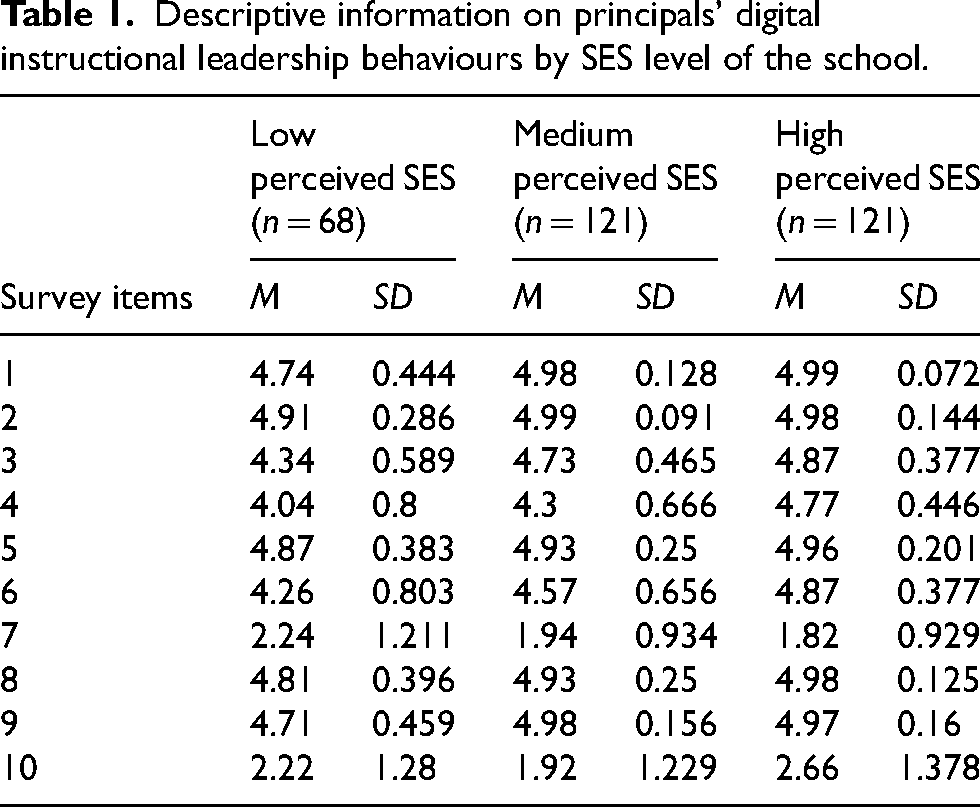
The digital instructional leadership scale for principals was utilized to evaluate digital IL (Berkovich and Hassan, 2022). The scale assesses principals’ use of digital instructional methodologies to support learning through homeschooling, with a focus on the COVID pandemic situation. The evaluation consists of 10 items that describe the principals’ digital strategies in the areas of staff motivation, professional development, addressing the digital divide, supervising and evaluating instruction, setting instructional goals for the school, and supervising and assessing instruction (See items in Appendix 1 and descriptive information in Table 1). On a Likert scale (1 = never, 5 = usually), participants were asked to rate how frequently they encountered these methods.
Descriptive information on principals’ digital instructional leadership behaviours by SES level of the school.
Different levels of challenging contexts.
We used teachers’ reports on school-level SES as an indicator of the level of challenge the school faced. SES has been defined as ‘a measure of one's combined economic and social standings’ (Nguyen and Le, 2022: 39). SES is a multidimensional construct (including income, wealth, education, and occupation), and dimensions often do not align with each other, therefore some scholars prefer to use a composite index to capture it (Shavers, 2007). The use of perceived SES as a composite index of SES was found to be correlated with some objective dimensions of SES such as education and income (Goodman et al., 2007). Prior research suggests that teachers’ perceptions of SES in schools are based on knowledge of social hierarchies (race and class). SES has also been found to be related to home support and the need for ambitious school expectations (Norman, 2016). SES was based on a teacher's response to the question, ‘What is the socio-economic status of your school?’ The response categories were low (1), medium (2), or high (3). A previous study using similar question and ranking categories with youths, tested the reliability of reported SES against information about their parents’ annual income and found a strong correlation (>.60) (Lee et al., 2013).
Data analysis
We conducted several analyses to better understand the relationship between principals’ digital instructional leadership behaviours during the COVID-19 pandemic and various degrees of school-level SES. First, we performed descriptive analyses to assess the prevalence of various digital instructional leadership behaviours by levels of challenging contexts. Second, in each item concerning digital instructional leadership behaviour, we grouped responses 4 and 5 to form percentage scores of the specific instructional leadership behaviour. We calculated percentages for each one of the three levels of the challenging contexts explored (high, medium, and low school-level SES). A series of two-sample t-tests between percentages were applied to compare percentages between levels of the challenging contexts.
Findings
The descriptive survey data (Table 1) shows that most principals’ digital instructional leadership behaviours were highly prevalent in all perceived school-level SES settings. Only two principals’ digital instructional leadership behaviours were rare in all settings: behaviours focused on promoting home conditions for learning and conducting all-school meetings (#7 and #10).
We conducted a series of two-sample t-tests between percentages to compare percentages between levels of the challenging contexts (Table 2). Analyses revealed no differences in about half the principals’ digital instructional leadership behaviours (#1, #2, #5, #8, and #9). Analyses indicated that the percentage of principals’ high-digital instructional leadership in behaviours #3, #4, #6, and #10 were significantly larger in schools with high perceived school-level SES than in schools with low perceived school-level SES. In only one behaviour (home conditions for learning, #7), the percentage of principals high on digital instructional leadership was larger in schools with low perceived school-level SES than in those with high perceived school-level SES. The largest differences in percentages were related to principals’ behaviours focusing on rewarding, recognizing, and ensuring the availability of technological resources. The smallest difference found was related to observation and feedback.
Results of two-sample t-tests between percentages (percentage of responses 4 and 5).
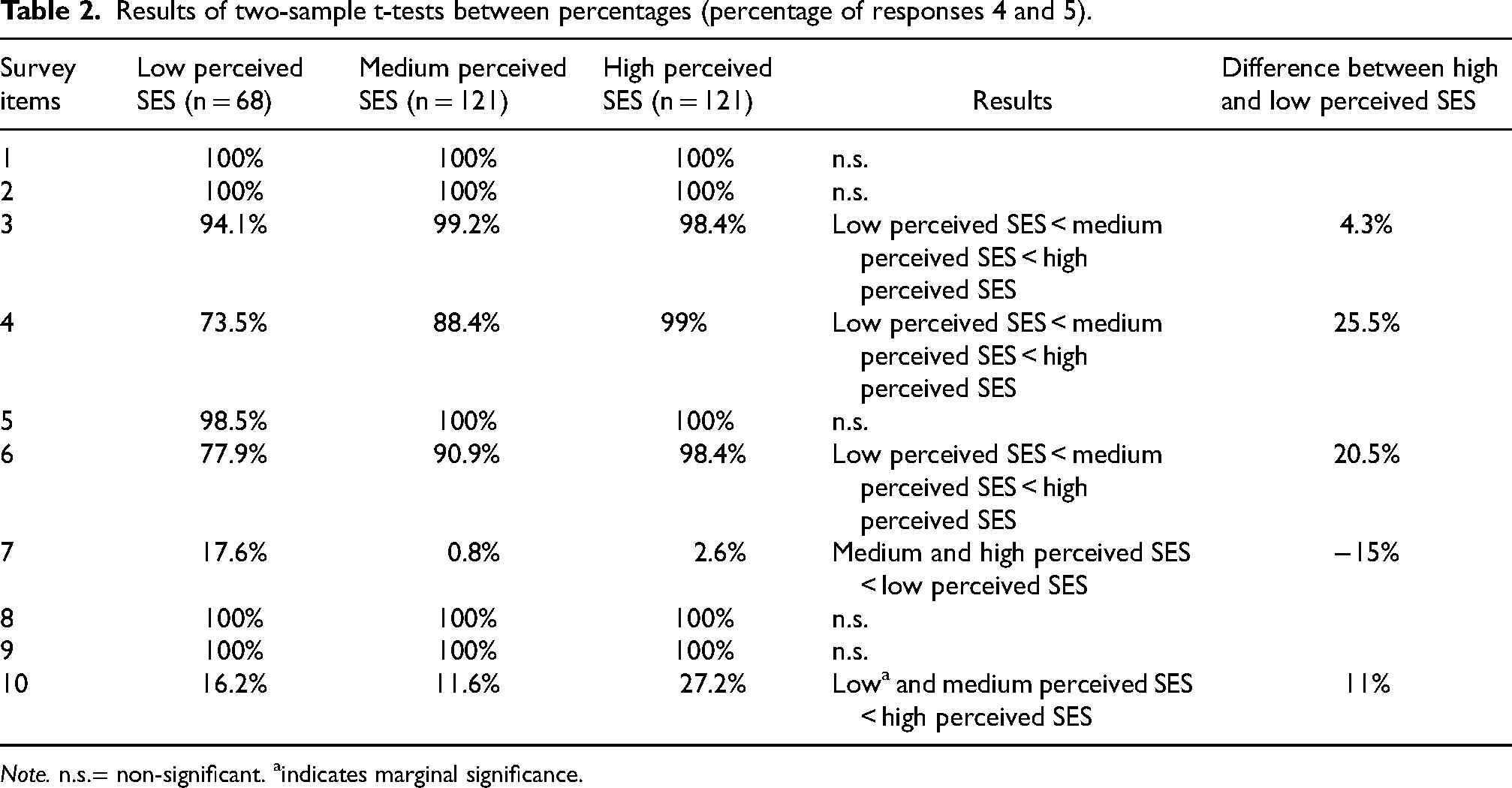
Note. n.s.= non-significant. aindicates marginal significance.
Discussion
The present study was conducted in response to recent calls to expand the knowledge base on context and school leadership (Hallinger, 2018). The study aimed to examine principals’ digital instructional leadership behaviours during the COVID-19 pandemic and the variation in that behaviour related to different levels of perceived school-level SES. We found a high prevalence of all digital instructional leadership behaviours, in contrast to prior claims that in regular schooling principals tend to avoid dealing with instruction because they begin to regard themselves as ‘not [being] in the teaching business’ (Murphy et al., 2016: 462). The present study is first to shed light on relations between perceived school-level SES and instructional leadership in digital settings. Prior research has primarily focused on instructional leadership in general (e.g. Gümüş et al., 2022; Hallinger and Murphy, 1983) or within schools with effective leadership (e.g. Naicker et al., 2013). Consequently, these studies do not offer a complete understanding of the relationship between various instructional leadership behaviours and perceived school-level SES.
The study makes several contributions. First, it expands our knowledge about the inhibiting factors of digital instructional leadership. In addition to the factors described earlier in the literature that cause school leaders to avoid or reduce the use of instructional leadership behaviours (Goldring et al., 2015; Murphy et al., 2016; Shaked, 2021), we found one inhibiting factor in remote schooling, which is perceived school-level SES. Principals working in schools with a low socio-economic background were found to use fewer instructional leadership behaviours (specifically, observation and feedback, rewarding and recognition, ensuring the availability of technological resources, and conducting all-school meetings). As the vast majority of digital instructional leadership behaviours were more prevalent in schools with high SES, this appears to attest to a digital instructional leadership divide. The divide may be related to the technical proficiency of the principal. Further study is needed on this topic. The findings reinforce the claims that current popular generic models of ideal school leadership behaviours (e.g. instructional leadership and transformational leadership) are in some ways flawed because they do not meaningfully integrate various key aspects of schooling context (Berkovich, 2018b; Miller, 2018; Shaked, 2021). Reflecting about the broader meaning of the digital instructional leadership divide for students, one can argue that low-digital instructional leadership will most likely result in lowering students’ performance (third-level digital divide, van Dijk, 2002) and in enhancing the adverse effects of external factors (e.g. lack of equipment, lack of suitable home conditions, lack of home support) on students’ digital and academic skills (fourth–level digital divide, van Dijk, 2002).
Second, the study indicates the uniqueness of principals’ digital instructional leadership in schools serving low socio-economic populations. The instructional leadership behaviour of these principals was more pronounced than that of their counterparts in schools with stronger SES in aspects concerning proper conditions for learning (i.e. quiet room, desk, printing ability, available adult to consult, etc.) in students’ homes. This manifests not only in principals’ functional commitment but also in their moral commitment to social justice, because it ensures equal access to schooling (Berkovich, 2014). In a way, it is an encouraging sign that in the face of an unprecedented crisis, principals rose to the moral challenge in these schools and embraced the task, although it was not formally their role. Thus, the present research supports existing studies in their claim about the centrality of what has been called ‘non-academic’ goals of principals, which in normal times are pushed aside by the dominant accountability policies (Shaked, 2021). We suggest that learning is a holistic phenomenon and that such seemingly ‘non-academic’ goals are key aspects in supporting quality learning. Promoting home conditions for learning is valuable not only for digital instructional leadership in challenging schools at a time of a global pandemic, but also in routine times.
The study has a few limitations. First, it is an exploratory survey on digital instructional leadership in the time of a pandemic; therefore, caution must be exercised in drawing conclusions about normal times and regular schooling. Second, the study was situated in Bahrain, where existing educational policy promoting the integration of technologies in schools may have contributed to the high prevalence of all instructional leadership behaviours. Third, the study is based on convenience sampling therefore the sample is not representative (Birks and Malhotra, 2006). Future research is advised to use random sampling that overcomes such issues. Fourth, this study did not control for other possible intervening contextual variables such as location, school type, principal gender, etc. Follow-up studies are advised to explore such possibilities. Fifth, the SES of the school was based on teachers’ evaluations, which may not be sufficiently accurate. More objective measures should be used in future research. Last, embedding multiple examples within several items of the digital instructional scale (specifically items 6 and 7) might have led to confusion among participants regarding their responses. This practice, however, is commonly used, as seen in many of the items in notable educational studies such as the OECD TALIS Principal questionnaire (e.g. ‘Shortage or inadequacy of digital technology for instruction (e.g. software, computers, tablets, smart boards)’ and ‘Shortage or inadequacy of physical infrastructure (e.g. classroom furniture, school buildings, heating/cooling, and lighting) – see OECD, 2018)’. Although this methodological choice is deemed acceptable, we acknowledge the possibility that this phrasing introduced ambiguity in participants’ responses to these items, mainly item 7. Therefore, we advise future researchers to adopt a more refined approach when exploring these issues.
Footnotes
Declaration of conflicting interests
The authors declared no potential conflicts of interest with respect to the research, authorship, and/or publication of this article.
Funding
The authors received no financial support for the research, authorship, and/or publication of this article.

Author biographies