



Abstract
Focusing on the interplay between community context and principals’ leadership, this study contributes knowledge of the situated dimensions of school leadership. Based on qualitative content analysis of the statements of 20 principals leading schools in low-socio-economic status communities in a highly segregated Swedish city, we address the research questions: (1) Which context-related characteristics of low-socio-economic status schools emerge, and what challenges do they entail? and (2) How do such characteristics and challenges affect and contribute to shaping the principals’ leadership? The findings indicate four community-context characteristics, which also characterise or affect the schools’ student and parent base and, in some respects, also the staff of the schools: high mobility, comprehensive linguistic and cultural diversity, comprehensive knowledge diversity, and extensive problem complexity. The analysis reveals that these characteristics entail work-related challenges with implications of both quantitative and qualitative nature, contributing to shaping a leadership that is present, gatekeeping, sheltering, collaborative, and compensatory and aimed at maintaining a resilient organisation. Considering the findings, the importance of recognising the particularities of context and the context-specific knowledge required is highlighted, as well as the potential value of tailored context-sensitive training and support for principals from local education administrations and universities.
Introduction
There seems to be broad consensus in educational leadership research that there are generic sets of leadership practices that are fruitful or even necessary for successful school leadership (Leithwood et al., 2020). The impact on leadership of various contextual conditions has, however, not been studied to the same extent even though the awareness that principals need to adapt their leadership based on the conditions of local contexts has increased in recent decades (Brauckmann-Sajkiewicz and Pashiardis, 2022; Bush, 2018; Hallinger, 2018; Leithwood, 2021).
When a research field grows in terms of an increased number of primary studies, synthesis follows on a secondary (review) level. Synthesising the results of numerous primary studies in any field of research inevitably involves a certain degree of decontextualisation. The ecological validity of synthesised results is rarely discussed in greater depth, which, in turn, can cause difficulties for policy and practice to apply the findings in their local contexts (Hirsh et al., 2022; Pawson, 2006). This problem is addressed by Hallinger (2018) when he urges us to bring context out of the shadows and study how successful leadership responds and adapts to different contexts. Similarly, Brauckmann-Sajkiewicz and Pashiardis (2022) argue that the effectiveness of leadership practices must be seen in relation to the contextual conditions underlying the practices, as various circumstances can facilitate or aggravate leadership practices which have been proven generally successful.
Globally, school leadership is practised in vastly diverse contexts, which contributes to the large variations in leadership practices. Hallinger (2018) exemplifies how the varied political governance and economic conditions in different countries set the framework for principals’ work and leadership practices. Further, Hallinger describes how institutional and community contexts matter and how a principal's leadership is affected and shaped by those factors related to where on a school improvement trajectory the local school is in its development.
Political and economic differences certainly exist between nations but also between regions within a country, not least if the management of the school is decentralised, as in Sweden (Rönnberg et al., 2019), which forms the national context for this study. Further, differences occur within regions, where, for example, rural schools may face challenges that are different than those of urban schools (Lipke and Manaseri, 2019); finally, there can be great variety within a big city (Leithwood, 2010). All 20 principals comprising the respondents in the present study are in the same national context, the same region, and the same big city. Thus, national and local political governance, and the resource allocation system, are the same for them. All have previously participated in the Swedish national principal preparation programme (cf. Brauckmann et al., 2023). Additionally, all 20 lead public compulsory schools located in areas classified as ‘vulnerable areas’, that is, in low-socio-economic status (SES) communities, in a city where ethnic residential segregation is among the most extreme in Europe (Östh et al., 2015). Thus, there is a community context similarity that unites them and, at the same time, separates them from schools located in high- and medium-SES communities in the same city.
This study constitutes an empirical example of how community context plays a role in shaping school leadership practice. In-depth knowledge of this can, in turn, potentially contribute to an increased understanding of what it takes to achieve generally established successful leadership practices under specific contextual circumstances – by principals themselves, local education administrations (LEAs), and universities providing education.
Purpose and research questions
Departing from a relational ontology, we understand development and learning as existing in the interplay between individuals and their world, driven by the unfolding logic of relational processes underscoring relatedness and interconnectedness (Stetsenko, 2008). Accordingly, we understand school leadership practices as partly learned and shaped in interplay with context.
This study aims to contribute to increased knowledge and awareness of the situatedness of school leadership practices. The research questions were:
Which context-related characteristics of low-SES schools emerge, and what challenges do they entail? How do such characteristics and challenges affect and contribute to shaping the principals’ leadership?
In this study, community is understood as the delimited geographical area, or neighbourhood (Leventhal and Brooks-Gunn, 2000), where a school is located. Several other contextual factors may certainly also influence and contribute to shaping leadership practices (cf. Hallinger, 2018), but we have chosen to focus here on community context.
Strong general claims
Since our study aims to make visible particularities connected to the community context and explore how such particularities potentially contribute to shaping principals’ leadership practices, there is reason to clarify which practices the research field has so far been able to establish as successful on a more general level. To this end, we have turned in particular to two reviews that synthesise the results of a number of underlying studies.
In 2008, Leithwood, Harris and Hopkins published the article Seven strong claims about successful school leadership based on research available at the time. In 2020, they revisited the seven claims to test their validity against another decade of research (Leithwood et al., 2020), concluding that the new evidence reinforces four of the original claims and, prompts minor revisions of two, and significant refinements of one. In the current study, we do not question the generality of the seven claims in the 2020 article. In fact, it is precisely because research has shown the potential of school leaders to significantly ‘effect features of the school organization which positively influences the quality of teaching and learning’ (claim 1, p. 6) that we started the network for school principals in which the empirical data in this study are collected. The claim stating that ‘[a]lmost all successful leaders draw on the same repertoire of basic leadership practices’ (p. 7) may at first sight seem to contradict the influence of context, but when considering the four comprehensive practice domains and the 22 specific leadership practices, clearly this claim is broad and inclusive. The third claim is particularly interesting for this study, as it reads ‘The ways in which leaders apply these basic leadership practices – not the practices themselves – demonstrate responsiveness to, rather than dictation by, the contexts in which they work’ (p. 9). Leithwood et al. (2020) mention, as an example, that while the construction of a shared vision is probably fruitful regardless of the context of the school and the school leader, the enactment may require greater communication and involvement with parents in low-SES community schools.
In a 2021 research review focusing specifically on equitable school leadership, the framework is – slightly modified – used by Leithwood for the identification of school leadership practices and dispositions likely to improve equitable conditions and outcomes for diverse and traditionally underserved students. As data in our study were collected within the frames of a network collaboration working for equitable access to high-quality education for students at risk of being marginalised, the 2021 review is particularly interesting. Here, Leithwood (2021: 2–3) describes, through five domains, how successful school leaders:
achieve motivation among staff by setting directions through visions, goals, and high-performance expectations, build relationships to and among staff, but also with students, parents, and external actors, and support the knowledge development of the staff, design their organisation so that it supports desired practices, including building productive relationships with families and other community actors, improve instruction through provision of instructional support, monitoring student learning, buffering staff from distractions, and participating in teachers’ professional learning activities, and secure internal and external accountability – having all staff members considering themselves responsible for contributing to equitable outcomes for students, and acknowledging the broad policy context's demands on the advancement of student achievement.
Further, the framework comprises four categories of dispositions, or personal leadership resources:
Cognitive (e.g. problem-solving expertise and knowledge of organisational improvement). Social (e.g. social appraisal skills and ‘emotional intelligence’). Psychological (e.g. optimism, resilience and proactivity). Ethics and values (e.g. fairness, honesty, integrity and safeguarding students’ best interests in decision-making).
Based on analysis of the 63 underlying studies, Leithwood (2021) concludes that equitable school leadership requires work to unite everyone around a common vision, promoting a culture of responsibility where employees distance themselves from attitudes, norms and practices that hinder equity and inclusion. Leaders develop strategies to recruit and retain competent teachers, who are the carriers of goals of equity and allocate resources to organising instruction adapted to the target group of students who otherwise run the risk of being left out. Central is the view of the students’ background as an asset in schoolwork rather than a disadvantage. The principals are closely involved in the core processes of teaching and learning and in the careful follow-up of results.
Central to equitable school leadership, according to the review, is the establishment of trusting relationships with and between students, teachers, and parents. Principals know that leadership practices aimed at home environments strengthen the conditions for students’ schooling; therefore, special emphasis is placed on building parents’ trust in the fact that the school is working in the best interests of their children. Furthermore, they build alliances and strong partnerships with the local community and external agents who can offer support and know-how.
Leithwood (2021) points to certain dispositions as particularly important for principals to achieve equitable leadership practices. Self-criticism and courage are required to counter all signs of racism, xenophobia, or other forms of discrimination. Crucial as well is their acquisition of deep knowledge about language learning, cultural and religious expressions and differences, special needs, or other aspects with relevance for an equitable education. Leaders’ beliefs in and strong desire to make a difference and their strong moral convictions concerning the right of every student to a good education and fair conditions stand out as central.
Contextualising the study
Below, a brief account is given of some framing conditions under which the principals included in the present study operate.
Since the 1990s, the Swedish school has transformed from being one of the world's most centralised education systems to becoming one of the more decentralised (Bunar and Ambrose, 2016). Until the 1990s, the state set up rules and principles for the implementation of education, but a change of government in 1991 led to a rapid and dramatic restructuring where responsibility for the implementation of education was transferred to the 290 municipalities (Rönnberg et al., 2019). Since then, students and guardians also have the right to choose their (desired) school placement. Resources are allocated to schools per student. In 2022, 15% of Sweden's compulsory schools are independent, most of which are part of larger stock company-run school groups (Lindqvist, 2022).
The free choice of school is mainly used by families where the parents have good finances and a high level of education. Resourceful parents know how to navigate the school market, and they often place their children on school waiting lists years before they are due to start school. Research has shown that a common motivation behind parents’ active school choice is that they want their children's classmates to be ‘the right kind of students’ (Ambrose, 2016).
The free school choice in combination with an increasing number of independent schools is an important reason behind the growing school segregation in Sweden. Schools located in socio-economically disadvantaged, or vulnerable, areas are losers in this system, as basically no one outside the area chooses such a school, often due to stigmatised ideas about the place and those who live there (Ambrose, 2016; IFAU, 2014). Since the 1990s, the grade differences between schools have grown significantly, which, according to the Institute for Labour Market and Education Policy Evaluation (IFAU), can largely be explained by the increased student sorting and housing segregation. The proportion of people with a migration background has increased in Sweden and, thus, also in the Swedish school system, from 11% in 2000 to 20% in 2021 (IFAU, 2014; SCB, 2022).
The Swedish Police define a vulnerable area as ‘a geographically delimited area characterised by low SES, where the criminals have an impact on the local community’ (Polisen, 2017: 4, our translation). In such areas, several risk factors exist among the population, such as unemployment, poorer health, school failures and lack of faith in the future. The physical living environment is classified as less good, and there are often conflicts between ethnic groups. The average age of the population is usually low, and there are large groups of young individuals who are easily affected by norm-breaking behaviours, where crime often is high (Polisen, 2017).
The circumstances described above prevail in those areas where the principals in this study work. It is worth emphasising that the context of this study, one of Sweden's largest cities, is not unique. Residential segregation and vulnerable areas exist in a whole range of Swedish cities, both large- and medium-sized.
Method
Data were collected within the frames of a network collaboration between a large LEA and a university conducting school leadership training. The goal of the collaboration, which began in 2020, is to establish a sustainable regional network that supports, challenges, and develops knowledge for all actors involved to ultimately achieve more equitable and inclusive education for all students in the city.
The network and network meetings
The network initially consisted of 20 compulsory school principals, three LEA officials, and four researchers from the university. Gradually, however, the number of principals has increased to 40. The principals were invited to participate in the network based on the socio-economic index for the schools they lead, 1 and principals leading the schools with the highest indices were included (high index indicates low SES).
From the start in August 2020 until May 2022, the network has conducted 12 meetings organised as 1- or 2-day seminars, including presentations from both network members and invited guests and workshops and dialogues in different constellations. All participants in the network have given their informed consent to research data being collected in connection with the network's various dialogues and activities. These have been consistently documented through audio recordings, photographs, and the researchers’ field notes. All data are handled in accordance with the Swedish Research Council's guidelines for good research practice (2017).
Participants, procedures, and data
The current study is based on five audio-recorded organised group dialogue sessions between principals conducted in August 2020 and January 2021. A total of 20 principals (Table 1) participated in the sessions (three to five per group), each lasting for about 2 h.
The respondents.
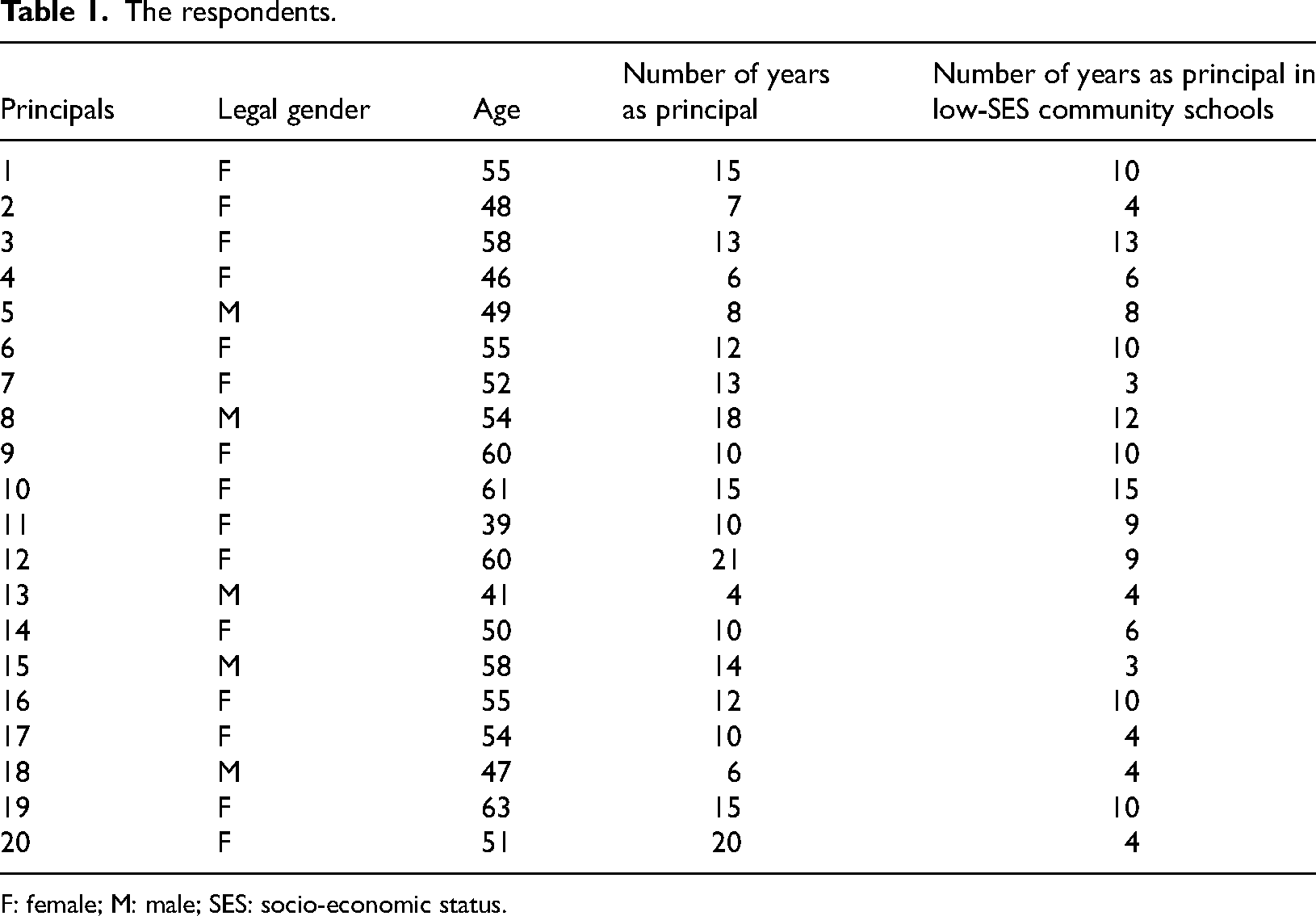
F: female; M: male; SES: socio-economic status.
In each group, one of the participating principals had the role of conversation moderator. The moderators had been carefully prepared to assume their conversation-leading role by the researchers. Group discussions of this kind, which can be classified as mini focus groups with respondent moderators, are preferably used when the number of participants is low but where the individuals in the group possess a high level of expertise regarding the topic of discussion (Kamberelis and Dimitriadis, 2005). The main reason for the use of participant moderators is related to the fact that the network and its activities are not exclusively aimed at research, but rather at collaboration for development in accordance with the activity theoretical models expansive learning and change laboratory (Engeström and Sannino, 2010). These frameworks imply that the collaborating actors cross boundaries of their different domains of expertise in the joint process of learning and transformation. We realise, of course, that the method of respondent-led conversations involves limitations, as we researchers could not ask follow-up questions that would have potentially provided additional or more in-depth information.
Prior to the sessions, all principals had prepared to introduce themselves and the characteristics of the school they lead and share their experiences of what it means to be a principal and lead a school in a low-SES community. Each participant had 20 min at their disposal. When everyone had presented, a joint dialogue followed in the groups, where the participants elaborated on questions concerning what they perceive they have in common (regarding leadership, framing factors, conditions, challenges, etc.) and whether it is possible to distinguish differences between leading a school in a low-SES community compared with leading a school in medium or high SES communities. Fourteen of the 20 principals had their own experiences of principalship at other types of schools to compare with (Table 1), while the rest based their comparisons on meetings and conversations over time with principal colleagues in areas not classified as vulnerable and with their experience of working as teachers in such areas.
Analysis
All audio-recorded data were transcribed verbatim, after which the transcribed material was analysed following a combination of Graneheim and Lundman's (2004) inductive qualitative content analysis approach and the directed content analysis approach elaborated by Hsieh and Shannon (2005). 2
The entire dataset was considered the unit of analysis, in which meaning units (i.e. content passages shedding light on areas responding to the research questions) were identified. Thus, we searched for passages where the respondents talked about aspects distinguishing the work at their schools or that have been in some way reinforced in their context and passages that provided information about the relationship between characteristics and challenges, on the one hand, and how leadership is shaped and learned in interplay with context, on the other hand.
In the next step, the meaning units were provided with codes regarding the nature of context-related aspects. The codes were then sorted into four groups, where the first two above all relate to research question 1 and the last two above all relate to research question 2: (1) context-related characteristics, (2) perceived challenges, (3) the nature and implications of the challenges and (4) the impact of challenges on leadership practice. One researcher had the main responsibility for this study's coding and grouping, but reconciliations and discussions between all four researchers have been ongoing, where all are deeply familiar with and have processed the same material for both this study and other studies in the same project. We have also chosen to use numerous excerpts to report the results, enabling the reader to assess the credibility of the analysis.
Results
The results below are presented in two parts. Part 1 is primarily based on an inductive analysis on a manifest level, with the primary aim of describing without major abstraction and interpretation the respondents’ collective perceptions of which context-related characteristics of low-SES schools emerge and what challenges they entail. Based on part 1, part 2 is then aimed at interpreting, synthesising, and discussing how leadership practice is shaped in the interplay between leader and context.
Part 1: Context-related characteristics and challenges
All 20 principals claim that there are context-related characteristics and challenges in schools in low-SES communities, which to a much lesser extent occur in schools in medium or high SES communities. Analysis showed that the characteristics and challenges can be linked to the geographical recruitment area, the student base, the parent base, and the school staff.
The principals particularly speak about four characteristics of the geographical recruitment area, which can be said to characterise or affect the student and parent bases of the schools: high mobility, comprehensive diversity of native languages and cultures, comprehensive knowledge diversity and extensive problem complexity. The last three are also described as characteristics of or affecting the staff group
The geographical recruitment area, the students, the parents, and the school staff
As mentioned, parents in Sweden have the right to apply for school placements for their children. Some schools (almost exclusively in high- and medium-SES areas) attract the interest of many students and parents. Such schools’ recruitment area is not limited to the immediate geographical area where the school is located; rather, students from other parts of a city can also apply for placement there.
However, this rarely occurs in the low-SES schools represented in this study:
The students attending the low-SES schools are almost exclusively children whose families also live in the immediate area. Much of that which is characteristic of the area is therefore also characteristic of or affecting the student and parent base.
The principals also describe staff-related differences. It is generally more difficult to recruit qualified staff for low-SES schools, and turnover is higher. Therefore, they quantitatively spend more time on advertising, interviews, introductory sessions and the like. More time is also required for psychosocial work environments and staff care measures to retain staff:
To a greater extent than at other schools, the staff at these schools are heterogeneous in terms of cultural and linguistic backgrounds. Moreover, some are residents of the recruitment area. Although this is described as enriching and a prerequisite for being able to meet and work with students and parents in an adequate way, it also involves considerations for the principals:
The context-related characteristics
Below is an account of the four characteristics along with implications they have for the principals’ work and leadership at the schools in question. The principals describe work-related challenges with implications of both a quantitative and qualitative nature.
Mobility
The great mobility in these areas, in terms of people moving in and out, implies that the school staff constantly meet new students to be educated and parents to interact with. While high- and medium-SES schools mostly retain the same student base through a 3-year school stage or even all-through compulsory school, a large proportion of the student base in low-SES schools is replaced during a 3-year period. So even if a low-SES school continuously has an approximate total number of students, the number of unique students present at the school over a 3-year period far exceeds the continuous approximate number. This is a clear example of how a characteristic of a specific context both quantitatively and qualitatively affects the work of the principals and their staff. More enrolment of students leads to more administration, more investigations into possible special needs, more health talks for the school nurse, more relationship-building processes with students and parents, more home visits, etc. Certainly, the teaching – thus the principal's pedagogical leadership – is also affected by the high mobility rate among the students. One can never assume that longer cohesive teaching and learning processes are possible, and, moreover, the composition of classes and groups is constantly changing:
The principals must learn to rest in the fact that uncertainty and change is the norm, and one of their most important tasks is to create an organisation that is strong enough to ensure continuity:
Both the fact that it takes more time and effort to constantly meet new students and parents and the fact that students sometimes disappear from school without notice create time-related and emotional stress. Therefore, the principals must learn to accommodate both their own and the staff's feelings of stress, insufficiency, and frustration.
Linguistic and cultural diversity
Although many Swedish schools today, regardless of community, have individual students who have recently come to Sweden as refugees or are second-generation immigrants, the prevalence in the schools in the present study is very high or even total. The geographical residential areas – thus also the schools – are melting pots of different languages and cultures. Multiculturalism is described as both a privilege and challenge by the respondents, implying both quantitative and qualitative differences for the staff's work and the principals’ leadership.
As much as possible, the principals must recruit teachers who have mastered languages spoken by many students at the school, while they must also master Swedish at a high level. They must ensure that all staff receive adequate training in, for example, language development teaching, and they themselves need to have deep knowledge of language learning and multilingualism to adapt their pedagogical leadership to the fact that the planning and implementation of teaching must consider a wide range of home languages and language proficiency levels among students:
Many respondents emphasise the importance of intercultural knowledge, both to meet students and parents respectfully and to see signs of cultural phenomena that are not accepted in Swedish society:
Knowledge diversity
The fact that students’ knowledge of the Swedish language, that is, the dominant language of instruction, varies greatly among the students at these schools, constitutes a challenge for the organisation of teaching. Another challenge is the fact that students’ knowledge levels in general vary greatly because of the highly varied experiences of schooling the students bring with them when they, at various ages, come to these schools. Students sometimes have insufficient or non-existent schooling behind them. Therefore, the organisation of teaching in these schools may differ greatly from common ways of organising teaching in classes where everyone of the same age can be expected to be at a somewhat similar level of knowledge:
The respondents describe how the range of formal educational backgrounds is also highly variable among the students’ parents, extending across the entire spectrum from illiteracy to the highly educated. The proportion of parents who are illiterate or low-educated is significantly higher in low-SES communities, in turn leading to a sharp increase in the school's compensatory assignment in these areas. The large spread of knowledge levels among students and parents also has quantitative and qualitative consequences for the principals and their staff. More resources must be set aside for, for example, compensation in terms of help with homework, while ordinary teaching needs to be organised qualitatively differently than according to current norms in age-homogeneous classes:
Problem complexity
Although all schools, regardless of recruitment area, face complex problems to some extent, the degree of problem complexity is greater in these schools. This is partly because of the diversity of languages, cultures and knowledge levels already described but also that the occurrence of extraordinary incidents linked to societal problems in the community is high:
Being a principal in a low-SES community means devoting much time to collaboration with other authorities and community actors in the immediate area. Various societal actors must work together to prevent and mitigate the effects of the development that housing segregation leads to. All principals describe this as a meticulous task, one requiring great dedication from everyone at their schools:
Although all principals attest to the necessity of positive collaboration with other actors, many of them also highlight that they have come to learn to carefully consider exactly which collaborations are beneficial for the students. They describe how they are often offered the ‘wrong’ kind of co-operation and support, often with a social orientation rather than an educational, in misguided benevolence to help vulnerable children:
Just as mobility has been described as a cause of feelings of insufficiency and frustration, so too are problem complexity and critical events. The latter can also be frightening for both students and staff. Again, the respondents describe how the psychosocial work environment and staff care initiatives must always be at the centre for the staff to continue working and, thus, maintain important continuity in the students’ education. The principals describe how they must be present and more visible to staff, students, and parents and that there is scarcely time for them to withdraw and perform office work:
At the same time, office work must also be done because of requirements from the LEA for all kinds of reporting that must be handled regularly. The respondents express frustration that the time for the important task of being a supportive pedagogical leader often suffers due to extensive office tasks.
Part 2: Leadership practice shaped in the interplay between leader and context
We argue that the respondents’ leadership actions or practices, as described above, in several respects can be understood as examples of such practices found to be generally successful in Leithwood et al.'s (2020) and Leithwood's (2021) reviews. For instance, the principals describe how they put considerable effort into creating trusting relationships with students, parents, and staff. They clearly articulate the necessity and value of building alliances and strong partnerships with the local community and other external agents. They describe that they are involved in the core processes of teaching and learning, and how they work to strengthen teachers’ knowledge of how the content and design of instruction can be adapted to their target a group of students. They see safeguarding teaching and student learning in the classroom as one of their most central missions and do their utmost to buffer staff from distractions.
There are, however, as pointed out by Brauckmann-Sajkiewicz and Pashiardis (2022), context variables tied to the schools’ recruitment areas that constrain their school leadership actions. The great mobility of the student base is perhaps the clearest example of such a variable, clearly affecting how leadership is shaped and practised. When the student base itself is so mobile and unstable and when critical events occur so frequently, it is necessary that stability and continuity be insured as far as possible in other ways. Therefore, to a large extent, principals’ leadership is marked by their work to maintain staff over time, which requires leadership that is present, gatekeeping and sheltering. Furthermore, the principals repeatedly talk about the creation and maintenance of a school culture as crucial to achieving stability. All staff must function as a solid collective with their eyes turned towards a common vision and distinct goals of what is to be achieved. Overall, the principals express very strong moral convictions concerning the right of every student to a good education, which is often also mirrored in visions and goals. Creating crystal-clear plans for work and for development of the organisation is also considered crucial. This is most likely an aspiration of principals in general, but for the respondents of the present study, the purpose is wider. Crystal-clear organisation is also a stabilising factor when change is the norm.
In addition, to a significantly greater degree, leadership needs to be focused on compensating for the fact that many students at these schools have poorer preconditions for their schooling because of factors that, in various ways, make it more difficult for many parents to support their children in schoolwork, as well as in meaningful activities outside of school. For the principals, the compensatory assignment also means extensive co-operation with other actors in the community, here aiming at a holistic approach to improved and safer living conditions for the residents in the areas.
Finally, these principals, just like all other principals, also need to focus on pedagogical leadership. The respondents claim that this central part of their assignment is more complex and knowledge-demanding in schools in these areas because of the context-related complexity. Theoretical knowledge of context-related phenomena, above all related to the diversity of languages, cultures, and cultural expressions, must, according to the principals, be acquired. The same applies to didactic knowledge about teaching in language- and culture-rich contexts, where the variation in knowledge levels among students of the same age is significantly greater than the range of variation at many other schools. The acquisition of such knowledge requires targeted training for all staff, including the principal.
Other knowledge is of a nature that it is difficult to acquire it by attending formal training. The principals’ ‘know-how’ and practical wisdom develop over time in clinical practice through encounters with people and critical events. Their leadership and knowledge seem to be shaped by the fact that their work continually confronts them with ethical and moral considerations or even dilemmas where they cannot ‘follow the manual’ but must instead try to balance as judiciously as possible.
Identifying a profession's tension fields and the types of dilemmas that are central for considerations before decisions and actions is, according to Agevall and Jenner (2008), a way to clarify the ‘core’ of the profession and to understand an often-unspoken quality dimension. We suggest, in addition, that dilemmas may differ within a profession and arise from contextual particularities. The identification of such context-related dilemmas in a profession is of potential importance for targeted educational interventions and support.
Four context-related dilemmas clearly emerge in our analysis:
Balancing between approving, respecting, seeking to understand and taking as a starting point the background and culture of students and parents versus making demands for assimilation and integration into Swedish society, language, norms, and values. Balancing between leading ‘with the heart’ for students and parents who often have trauma behind them and/or currently live under difficult circumstances Determining what supportive collaboration versus disruptive collaboration is. Although co-operation with other actors is necessary for the students’ attendance at school and contacts with parents to be optimised, time-on-task must be ensured, that is, that teaching time is not taken up by schedule-breaking activities offered by various well-intentioned organisations. Determining what the school should compensate versus not compensate for regarding deficiencies which, in many cases, are caused by home conditions or a troubled society. Such deficiencies are not really the responsibility of the school, but the consequences of not acting will spill over into students’ opportunities to participate in and acquire education.
Balancing these values and dilemmas in a judicious way is something that the principals need to learn. Because neither can be opted out of, a reasonable balance must be sought. Learning to balance dilemmas is about developing complementary attitudes (Agevall and Jenner, 2008), which includes the awareness of the fact that even a good value can become counterproductive if exaggerated. The respondents’ descriptions clearly show this insight. For example, it may sound harsh when a principal describes that they cannot spend too much time on everyone ‘sitting in a circle and lighting candles’ (principal 12) because someone has been shot or, as in the example with the culture workers and ceramics above, that the principals simply dismiss that kind of benevolent efforts. These are, however, examples of how the principals’ in-context experience over time has taught them that even something done with good intentions can become counterproductive and have negative consequences if exaggerated.
Conclusion and implications
With this study, we have sought to empirically exemplify how principals’ leadership interacts with community context. We have shown how four factors that characterise low-SES community contexts influence how principals’ leadership is learned and shaped, and how leadership practices are enacted. Establishing successful practices in a context where the circumstances differ markedly from the generalised norm requires in-depth specialised knowledge and the development of complementary attitudes through judicious balancing of context-specific dilemmas.
However, navigating and meeting the complexity that comes with high mobility, comprehensive diversity of languages, cultures, and knowledge levels, and extensive problem complexity, also require working hours (cf. Harris and Chapman, 2002). We believe that the clarification of both the qualitative knowledge dimension and the quantitative time dimension constitute a contribution to the discussion about what it takes to make generally established successful leadership practices work under specific circumstances – by the principals themselves as well as by actors providing training and support.
For principals to be able to establish successful educational practices in contexts that differ markedly from the generalised norm, targeted support from the LEA is crucial (Chapman and Harris, 2004). This in turn requires knowledge and recognition of contextual particularities at their level. Another study carried out within the network collaboration shows that the principals experience a low degree of context-specific, targeted support from the LEA. The support provided is designed according to a one-size-fits-all principle (cf. Bush, 2018), seemingly based on a mainstream school norm, and not considering the implications of the contextual particularities made visible in this study. Frequently, the principals find themselves dismissed as ‘whiny’ or even less competent when trying to make visible the fact that they have specific challenges of both a quantitative and qualitative nature.
In the same way that it is central for the principals and teachers at the schools in our study to do their utmost to fulfil their compensatory mission towards their students – aimed at the very specific needs the students are in – LEAs, in turn, need to fulfil a compensatory mission towards principals and teachers. Such compensation can hardly stop at the extra financial allocation that, to varying degrees, schools in low-SES communities receive. The compensation would also have to include support in terms of personnel who can relieve the burden of certain tasks (of which there is clearly quantitatively more at these schools), as well as knowledge-based support in terms of people who are immersed in current circumstances and can function as critical friends in analysis and development work. This can, however, also mean coaching and supervising efforts, for instance, meta-conversations about the fact that the context in which principals lead their schools will most likely present them with a series of context-related challenges or dilemmas that need to be handled judiciously. Being mentally prepared for context-related eventualities and having someone knowledgeable and experienced to turn to if the eventualities occur are examples of efforts that may function supportively and, by extension, potentially reduce principal turnover (cf. Lipke and Manaseri, 2019).
In the same way, formal principal training can become better at addressing and problematising on a meta-level the fact that the general knowledge that the principal preparation programme provides can only be seen as a foundation that needs to be supplemented with specific contextual knowledge that can be acquired, on the one hand, through targeted training efforts, and which, on the other hand, will be developed in context. Tailored continuing professional development (CPD) courses for principals who lead schools united by a family resemblance can be developed by universities conducting school leadership training, given that research continues to generate knowledge about the interplay between context and school leadership. We believe that such courses could constitute an important supplement to the basic and more general knowledge that novice principals receive in the mandatory principal preparation programme in Sweden. The education in the programme can possibly be described as context-sensitive in some small respect, as certain assignments are carried out in/in relation to the school context where the principals work (cf. Brauckmann et al., 2023). For the development of truly in-depth, context-specific knowledge, we believe that targeted CPD courses aimed at principals who have passed the novice stage would, however, be fruitful.
Finally, this study on the interplay between community context and principals’ leadership was carried out in a specific national context, where various circumstances regarding, for example, housing segregation or national governance of the school system, are likely to differ from those of several other countries. This is, of course, a limitation in terms of the generalisability of the results. Still, it is our hope that the study constitutes a contribution as an empirical example of how community context interacts with and thus needs to be recognised as a factor of importance for how principals’ leadership is learned and shaped.
Footnotes
Declaration of conflicting interests
The author(s) declared no potential conflicts of interest with respect to the research, authorship, and/or publication of this article.
Funding
The author(s) received no financial support for the research, authorship, and/or publication of this article.
