




Abstract
Drawing on data from 116 survey responses by School Business Managers, and 7 semi-structured interviews with education professionals carried out between October 2017 and February 2018, this article reports on findings from a research project focussing on the opportunities and constraints for career progression into leadership roles for School Business Managers (SBMs) in the state sector in England. The article considers the differing roles and responsibilities of SBMs, how leadership is perceived in schools, the visibility of the SBM role, career aspirations of the SBMs who were surveyed, and the perceived constraints to progression to leadership roles. Analysis of the data was carried out using an inductive research approach using mixed methods. Snowballing was used to obtain a meaningful sample size for survey responses. Interviewees were chosen on the basis of judgement sampling. The sampling design for the survey and the interviews was one of non-probability. Findings suggest that leadership roles for SBMs do exist but that there are considerable constraints to these being achieved, not least the lack of appetite amongst SBMs to do so.
Keywords
In 2001 the government launched a professionalization development programme to train 1,000 School Business Managers (SBMs) (previously known as ‘bursars’ who are responsible for managing the non-teaching activities required to run a school) by 2006, a target that was exceeded. In 2010 the Academies Act (Department for Education (DfE)) gave all local authority maintained schools in England the right to convert to academy status. The resultant significant increase in business management functions in those converter schools fell to SBMs to accomplish, thus increasing schools’ reliance upon SBMs.
Leadership opportunities for SBMs continue to increase as schools are encouraged to become academies and join a multi-academy trust (MAT) resulting in significantly increased statutory business management requirements. Evidencing this, Toop, the CEO of Ambition School Leadership (2017: 1) stated that, ‘The increase in numbers of MATs has created a range of career opportunities for SBMs that have not previously existed – from SBM to finance director, to chief operating officer at a MAT, to CEO – bringing a different professional background into the sector’. This was confirmed by the Institute of School Business Leadership (ISBL), the professional body for SBMs, in its School Business Professional Workforce Survey report which found ‘evidence of more career mobility for [survey] respondents in MAT structures/schools than single school settings’ (2020: 8).
The purpose of this paper is to explore whether these leadership opportunities really do exist and, if so, what are the perceived constraints for SBMs wishing to progress to these roles. The paper also explores what the appetite (defined as an ‘intention’ rather than just ‘interest’ in) among SBMs is to progress to leadership positions. This research is important because as more schools become academies and join MATs, the more senior leadership roles require business management skills not generally found in pedagogical leaders. The need for such skills has been further illustrated by the contribution of SBMs to school leadership during 2020 as a result of COVID-19 (The Key, 2020a). Both of these issues demonstrate the need for SBMs to step up into more senior leadership roles. Finally, given the increasing importance of the SBM role in the school sector and the existing paucity of research into SBMs (Armstrong 2016; Starr, 2012), this research adds valuable knowledge.
Perception of leadership in schools
Gronn (2002) argued that training for headteachers delivered by the National College for School Leadership (NCSL) had conflated the headship role with leadership resulting in the headteacher being perceived as the single heroic leader. Muijs and Harris (2007: 112) agreed that ‘a singular view of leadership continues to dominate, equating leadership with headship’. This continuing perception was cited as the most common barrier to SBMs being able to contribute effectively to school leadership in their areas of expertise (PricewaterhouseCoopers 2007; Woods 2009). This also chimed with Woods’ assertion (2009) of a lack of understanding by headteachers of the contribution of SBM expertise to pupil outcomes, leading to a lack of willingness to synergise the complementary knowledge and talents of support and teaching staff.
Headteachers have legitimate power (French and Raven, 1959) by virtue of their role but SBMs have expert and informational power in terms of financial expertise and information. O’Sullivan et al. (2000) recognized the potential for tension in the relationship between the SBM and the headteacher as the person who controls the finances may be seen as more powerful in certain circumstances. Despite this, Starr posits (2012:54) that it is headteachers’ legitimate power (French and Raven, 1959) that, ‘to a large degree controls the position and status of both business matters and business managers’. Similarly, Woods et al (2013) agree that the degree to which SBMs can effectively support school leaders is directly proportionate to the willingness of school leaders to allow them to do so.
While distributed leadership (Spillane et al., 2004) appears to be common in the form of the Senior Leadership Team (SLT), the reality is still one of a headteacher being the ‘heroic’ leader (Burns, 1978), a view echoed by Starr (2018) who states that the ‘flawed’ heroic leadership paradigm (Burns, 1978) is ‘entrenched’. Woods (2011) suggests that there are 3 different aspects which can affect the inclusion of the SBM in a distributed leadership model (Spillane et al., 2004). These include lack of familiarity with SBMs’ capabilities, perception of what the SBM role can contribute to pupil outcomes, and the notion of how leadership should be deployed in schools. For some headteachers, delegating sufficiently to allow the SBM to contribute effectively to the school’s operation can be challenging, particularly when ultimately the headteacher will be held responsible for all aspects of a school’s operation by the Office for Standards in Education, Children’s Services and Skills (Ofsted).
Schein (2004: 1) maintains that, ‘leadership and culture are two sides of the same coin’. So how does culture influence leadership in schools? Johnson and Scholes’ cultural web model (2002) is used to address this question in the context of this research. It identifies 6 inter-related elements of organizational culture that influence the cultural paradigm. These include the stories staff talk about to each other, new recruits and outsiders; symbolic aspects such as logos, job titles and language used; the organization’s routines (‘the way we do things around here’), formalized control systems such as performance management; power structures; and organizational structure.
The context within which SBMs are working has a significant impact on their leadership opportunities. For example, a large school or MAT may employ a model of distributed leadership (Spillane et al., 2004) which includes the SBM role, whereas leadership may rest with the headteacher alone in a small school. SBMs are also able to access ‘system leadership’ roles (defined as roles where leaders support other schools) by becoming, for example, a School Resource Management Advisor or chair of a regional SBM group.
For schools to benefit fully from SBMs’ leadership abilities there needs to be ‘holistic’ leadership whereby business management and pedagogy have equal status (Woods 2009; Woods, 2011). The fact that this has not yet been achieved is evidenced by the fact that the title ‘headteacher’ remains synonymous with school leadership. Gudykunst (2005) recognized that the language of different cultural groups can also be a barrier. For example, the financing of schools is now so complex that it can be difficult for SBMs to explain it to pedagogical staff who have had no formal finance training.
Visibility of the SBM role
The SBM role suffers from a ‘lack of visibility’ both in terms of what the SBM does and who they are (Woods 2009). Starr (2012: 72) posited that, ‘The public image of business management as a profession is scrambled’. Starr (2012) also felt that SBMs were struggling to assume an educational leadership ‘persona’, possibly due to their rapidly changing role. The SBM role also lacks clarity with variability of experience and qualifications, lack of agreed job descriptions and competencies, difference in levels of seniority and accountability (Morales, 2016).
Many school teaching staff would struggle to explain the role of the SBM; outside of the education system, the role is relatively unknown. Creaby (2018) found that in a survey of 10% of ISBL’s membership that only a fifth (52 respondents) believed that their role was understood by the wider school workforce and that SBMs were frustrated with how the role was viewed and valued by other school colleagues. Perception of the role is further hindered by the fact that, as Creaby (2018) found, the majority of SBMs do not actively self-promote, publicize or celebrate their achievements with staff across their school.
Woods (2014) posits that there is a continuum in terms of support of SBMs by headteachers with those who view SBM professionalization negatively as an attempt to move education towards business, through to those who view it positively as a means of enabling them to focus more on teaching. The view of each headteacher will have a significant impact on the amount of support an SBM is likely to receive from them, and thus their leadership career opportunities. An interview participant in Armstrong’s study on SBM professional identity (2016: 12) summed up this situation by stating, ‘…the perception is still very, very different in every school you go in. And that is often the headteacher that formulates that…’
Methodology
The research project that this paper reports upon consisted of an inductive research approach using mixed methods (Bryman and Bell, 2015). A quantitative survey was carried out among SBMs working in the state sector in England in late 2017 resulting in 116 valid responses. The survey consisted of 2 question sets: (1) participants’ context and current qualifications; and (2) participants’ perceptions, experience and career aspirations, where open-ended questions were used. The first question set was analysed using frequencies to generate a profile of survey respondents; the second question set was analysed using a thematic coding approach. The author then formulated questions based on the themes identified from the survey to explore in greater depth during the 7 qualitative semi-structured interviews. This mixed methods approach (Bryman and Bell, 2015) enabled the author to gain data relating to the micro perspective and the macro perspective.
In order to access the population sample, the author asked ISBL to disseminate a survey link via their fortnightly news e-bulletin to its 2,200 members. Consequently, the initial sampling frame was those SBMs who were members of ISBL and the sampling design was purposive. The sampling design for both the survey and the interviews was one of non-probability. Due to the low survey response from ISBL members, the author was forced to resort to snowballing. This, together with the sampling design, mean that the results of this study may not be indicative of the SBM sector as a whole. In addition, comparing national figures for school settings (DfE, 2012) to those of survey participants, primary schools were under-represented and secondary and special schools were over-represented.
With regard to the interviews carried out in early 2018, the author chose education sector professionals who could provide insight and different perspectives into the identified themes from the survey (judgement sampling as defined by Sekaran and Bougie, 2016). The use of education sector professionals that were either known personally to the author or with whom she had links, may have impacted on the ability to generalize the findings. In addition, as the frame and population for the interviewees were not identical, a degree of bias was introduced.
Findings and discussion
This section aims to discuss the findings of the project in relation to the research question of the opportunities, constraints and appetite of SBMs to progress to leadership positions. The research revealed 3 different themes that impact upon SBMs’ ability to progress to leadership positions: the professionalization of school business management in terms of career structure and progression; perception of the SBM role in terms of role clarity and potential; and cultural constraints and a lack of appetite for progression.
Career aspirations of SBMs
Figure 1 shows the future career aspirations of survey participants in terms of specific roles as identified and stated by participants. The most popular roles stated were those of Chief Executive Officer (COO) and Chief Finance Officer (CFO) although interestingly, an equal number of participants were looking to retire as attain a senior leadership role, reflecting the fact that one sixth of participants (14%) were aged 55 years and over.
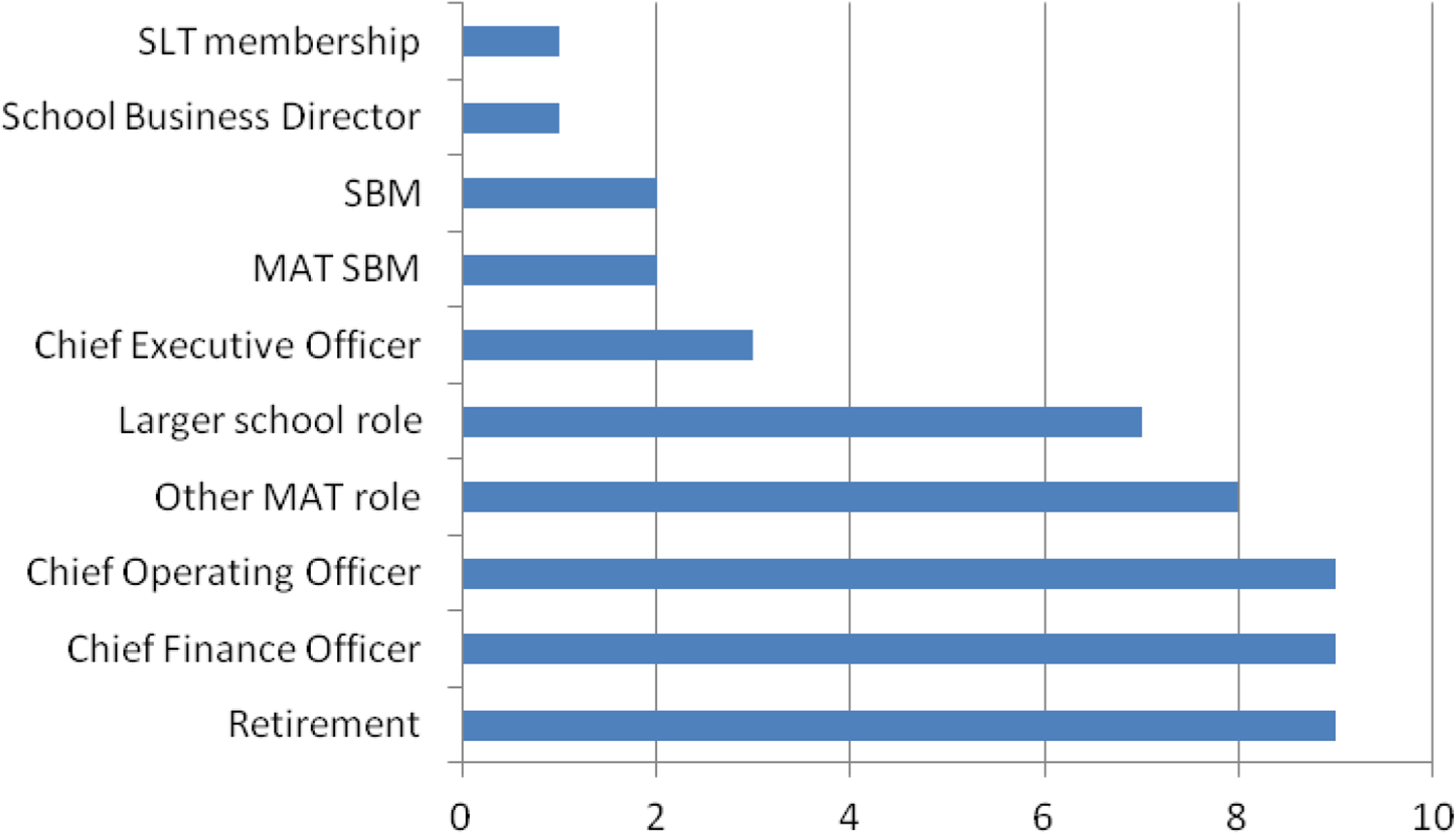
Survey participants’ career aspirations in terms of a stated role (n = 51).
The low level of response to this question (51 out of 116 survey participants) would appear to indicate a lack of intention to move into a self-identified leadership role. It may also reflect the fact that a definition of a ‘leadership role’ was not given in the survey information. Participants were simply asked if they considered their current role to be a leadership role and whether they were considering taking on additional leadership roles. However, 17 other survey participants who did not answer this question were already carrying out additional voluntary ‘system leadership’ roles which means that 41% of survey participants were actually carrying out or aspired to carry out a leadership role.
Constraints to progression
Analysing the cultural paradigm (Johnson and Scholes, 2002) within which SBMs are operating illuminated some of the issues that constrain SBMs’ progression to leadership roles (see Figure 2) as evidenced by the project’s findings.
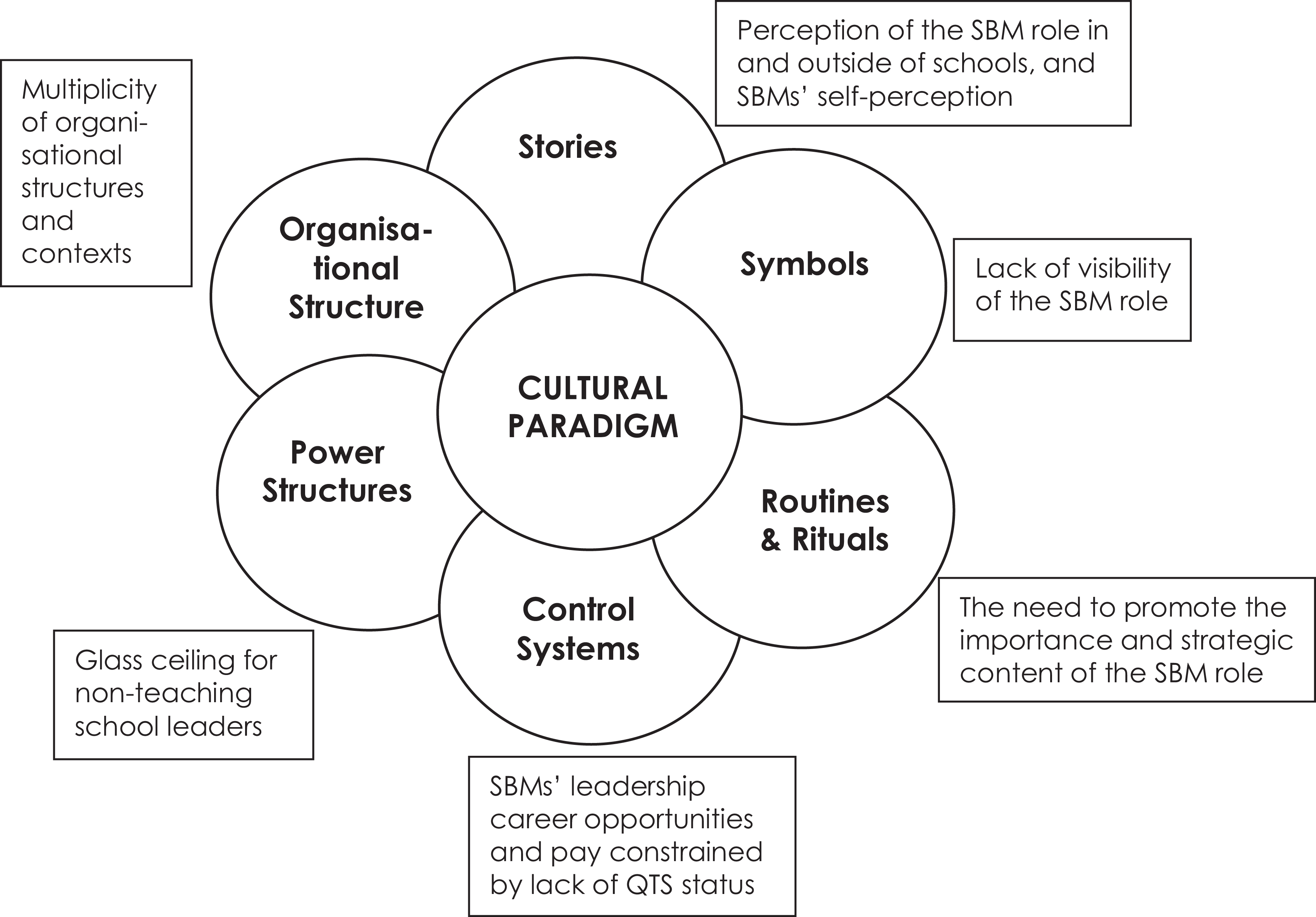
Johnson and Scholes’ cultural web (2002) annotated to show the paradigm within which SBMs are operating.
The cultural landscape is one in which it is automatically assumed that school leaders will come from a pedagogical background, as evidenced by the following research participant quote: At one time you had to break the ceiling that leadership was male. In schools now, it’s that leadership is not a teacher. Many in the teaching profession do not view the SBM as a professional for a number of reasons: (1) the role has evolved over time starting in many cases from the “school secretary” position (2) the role is ill-defined in the sense that it means different things to different people. For comparison, everyone has a clear understanding of what a teacher does. We need to somehow reframe what it means to be an SBM.
In terms of SBMs being able to access the highest leadership roles, for example, the CEO of a MAT, participants felt that the lack of Qualified Teacher Status was a significant constraining factor. The issue surrounding status as a result of qualifications also impacts on pay parity as SBMs cannot be paid on the Leadership scale in line with their SLT colleagues because they do not hold Qualified Teacher Status (The Key, 2020b). A further constraint is the lack of a level playing field in terms of SBMs being able to access relevant leadership qualification courses such as the National Professional Qualifications in Middle and Senior Leadership.
Other professions demonstrate career progression through defined job titles which give a clear indication of the role performed. For example, the National Careers Service website (2018) states the career progression opportunities for a teacher as a ‘curriculum leader, head of year, deputy head and head teacher’. In contrast, for SBMs the website states ‘moving to a larger school with a bigger budget’ as career progression (National Careers Service, 2016) emphasizing that there is no clear career progression for SBMs.
The issue of role definition is exacerbated as evidenced by the fact that just over half of the project’s 116 survey participants had ‘School Business Manager’ as their job title but the remaining 55 participants had 34 different job titles between them, indicating the range of role permutations and the difference in responsibility levels. This role diversity has led to confusion regarding the SBM role, impacting upon the professionalization of the role and how it is viewed by SBMs themselves and other educational stakeholders.
Conclusion
In order to address the inaccurate perception of the SBM role, SBMs need to find opportunities to engage with headteachers and governors instead of interacting with just the SBM community. This could be achieved by attending conferences run by the major teaching unions, which SBMs are eligible to attend, and the National Governors Association. As an example, in March 2020 the Association of School and College Lecturers ran its Business Leaders’ conference as a joint event with its Annual Conference which is attended by headteachers and deputy headteachers.
SBMs also need to strategically network with headteachers and governors to raise their profile. One way of achieving this is to attend WomenEd events, which is a grass roots organization aiming to connect existing and aspiring education leaders. It is acknowledged that this opportunity would not be open to men but women comprise the majority of the SBM workforce and women continue to be underrepresented in senior leadership roles in education (Mulholland, 2018).
With regard to accessing relevant qualifications, schools would be better served if there was a qualification which focused on
Increased clarity and promotion of the diversity and responsibilities of the role to those responsible for recruiting SBMs would increase the regard which SBMs are held. ISBL have contributed to this by producing a guide for headteachers and governors to the Professional Standards (2019). SBMs themselves also need to realize how they can utilize the Professional Standards to explain and promote their role to other school stakeholders.
Figure 3 summarizes the results of this research project, demonstrating the relationship between professionalization, the perception of the SBM role and leadership opportunities.
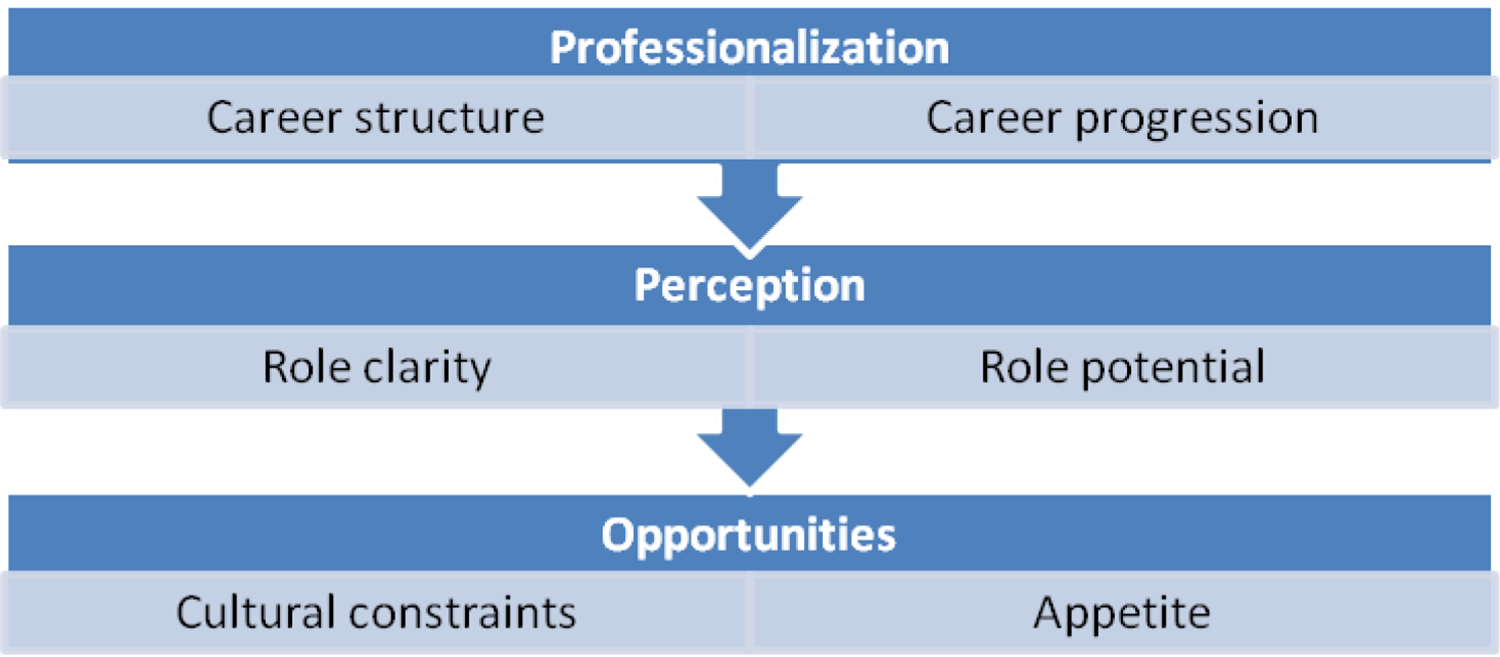
The relationship between professionalization of school business management, perception of the SBM role, and SBM leadership opportunities.
The DfE in its review of school efficiency (2013: 3) concluded that ‘one of the seven key characteristics of the most efficient schools is that they employ, or have access to, a skilled SBM who takes on a leadership role’ indicating the importance of the SBM role. However, in order to attain a leadership role, there must first be an appetite for it among SBMs, but this research project showed that only 41% of survey respondents were carrying out or aspired to carry out a leadership role. The other factors shown in Figure 3 may all contribute to this lack of appetite, but it would be valuable to research this area further.
Footnotes
Declaration of conflicting interests
The author declared no potential conflicts of interest with respect to the research, authorship, and/or publication of this articles.
Funding
The author(s) received no financial support for the research, authorship, and/or publication of this article.
