




Abstract
Challenge-based Learning (CBL) is a pedagogical approach that actively involves students in a realistic, problematic and meaningful situation related to their environment, which requires defining a challenge and implementing a solution for it (OIETM, 2015). The CBL methodology was applied by instructors with the support of students, part of the management programme from a Colombian university. The goal was to assess the validity of the methodology and examine solutions proposed by students to real-life problems in organisations. After assessing the challenge-based learning (CBL) it can be concluded, that a link to the entrepreneurial orientation exists. This link promotes the development of critical and constructive thinking, while encouraging students to analyse, design, develop and execute solutions for real-life problems, similar to those they will encounter as graduate students in any organisation.
Introduction
In 2018, at one of the accredited universities in Colombia, it was proposed to a group of students to participate of a challenge-based learning (CBL) experience within a pedagogical framework providing a leading role from students in a real-life problematic, meaningful and familiar context-based situation. This experience demanded for the identification and delimitation of a challenge where students were able to propose and apply a potential solution considering scholars (Kober et al., 2012; Olivares Olivares et al., 2018) support that students must be educated towards the development of competences that allow them to face context plagued with uncertainty, complexity and endless possibilities.
An essential characteristic of the CBL is that it must be built upon a multidisciplinary approach to produce an assertive solution. Moreover, once it is known the solution has been effective, the CBL context ought to allow for students to find rewards and be satisfied after having produced useful solutions. Therefore, it is important to highlight that CBL allows for:
– The use of basic communication skills,
– The application of knowledge in real-life situations,
– Information management,
– A reflexive, concrete and abstract experience, and
– The development of competences that allow for students to successfully endure complex environment full of limitless possibilities.
The CBL methodology provides students with the possibility to face real-life problems while being supervised by the instructor in order to learn about relevant issues and difficulties which are then given specific real-life solutions (Apple, 2008). According to The Innovative Education Observatory part of the ‘Tecnológico of Monterrey’ in Mexico (OIETM, 2015), CBL is a pedagogical approach that inspires students to work on a real-life problem relevant to students’ context which demands for a short, mid or long-term solution.
CBL and entrepreneurial orientation
The idea of CBL is founded upon adopting a learning approach from a generic theme where related problems are identified which pose challenges that students as a result must overcome. Such challenges demand for the contribution to concrete solutions that provide benefits to society as a whole or to a particular group. Based on Fletcher (2011, cited by Olivares Olivares and López Cabrera, 2017: 3), ‘this didactic technique reviews current teaching methods with the aim to determine the most effective practices to recreate learning environments that develop and nurture creativity’. To accomplish that, the use of technological tools, resources part of the subject as well as any external ones, as well as an instructor overseeing the process. CBL has its roots in experiential learning, which carries the main objective that students evidence a deeper long-lasting learning process when they actively participate in open learning experiences compared to passively-structured activities (Proctor, 2010; Villa and Poblete, 2007).
The ‘great challenge’ of this learning approach lays upon the proper application of the methodology to a specific subject, case in point, management thinking. The application of this methodology aims to provide students with useful results that highlights a well-defined method for future CBL application while being able to measure individual as well as collective participation. According to Fletcher (2011), instructors must promote diversity, identify and stimulate individual differences, and encourage risk acceptant environments to promote creativity while taking into account potential hazards that could undermine students’ integrity if the methodology is not carried out properly. CBL aims to challenge students to feel and live through a ‘real-life situation’, while exploring a subject-related theme and encouraging for the generation of solutions or ideas for a problem.
It is recommended for CBL to adopt real-life experiences or as close to a real-life experience as possible to develop interest and motivation in students. The CBL approach requires for the design of challenges that request solutions from students where they have to take decisions and produce judgement upon facts resulted from logic information that can be used to support their decisions and overall reasoning (OIETM, 2015).
Currently, educational models are outdated and fall short of what the real world demands, which generates in instructors the need for new methodologies that allow students to be able to find, criticise and construct their own knowledge base for any subject-related topic. Such learning is highly beneficial since students must develop critical thinking capabilities and skills as supported by Facione (1990, cited by Olivares Olivares Olivares and Lopez Cabrera ,(2017)) ‘critical thinking, is the development of a self-regulated judgement towards a specific purpose that provides results based upon interpretation, analysis, assessment and intervention explained through evidence, concepts, methods, criteria and context considered when that specific purpose was first established’. Olivares Olivares et al. (2018) and Olivares Olivares and López Cabrera (2017) find common ground with Facione’s description above while adding that those self-regulated judgements will have meaningful consequences in students’ professional decisions that support conflict resolution and collaborative work.
The main objective is to further develop and enhance ‘Management Thinking’ as a subject within the Business school in a Colombian university through the CBL approach. This objective will allow for instructors and researchers to properly identify and corroborate its validity at the higher education level in Colombia. Validity of the CBL approach is founded upon discussion and research processes carried out in the past that have allowed for the identification of significant problems constantly encountered in organisations. This approach also aims to provide students, through the CBL approach, with the necessary skills to develop a linking cognitive process among lesson-based knowledge and real-life organisational knowledge. The latter is constantly assessed through explanation, inference and interpretation through the proposal, redesign, and development of solutions for organisational-based challenges. This rationale is based upon human behaviour, according to Díaz Barriga et al. (2012) and Jara (2001), which describes that we systematise previous experiences to critically learn from them and enhance our own existence, link our learnings with previous similar experiences, and contribute to theory.
In order to apply the CBL methodology, this study took on the STAR Legacy which provides the environment for students to become involved and take part in a collaborative manner towards the resolution of a problem or challenge that they find relevant while giving self-assessment opportunities (Rowe and Klein-Gardner, 2007).
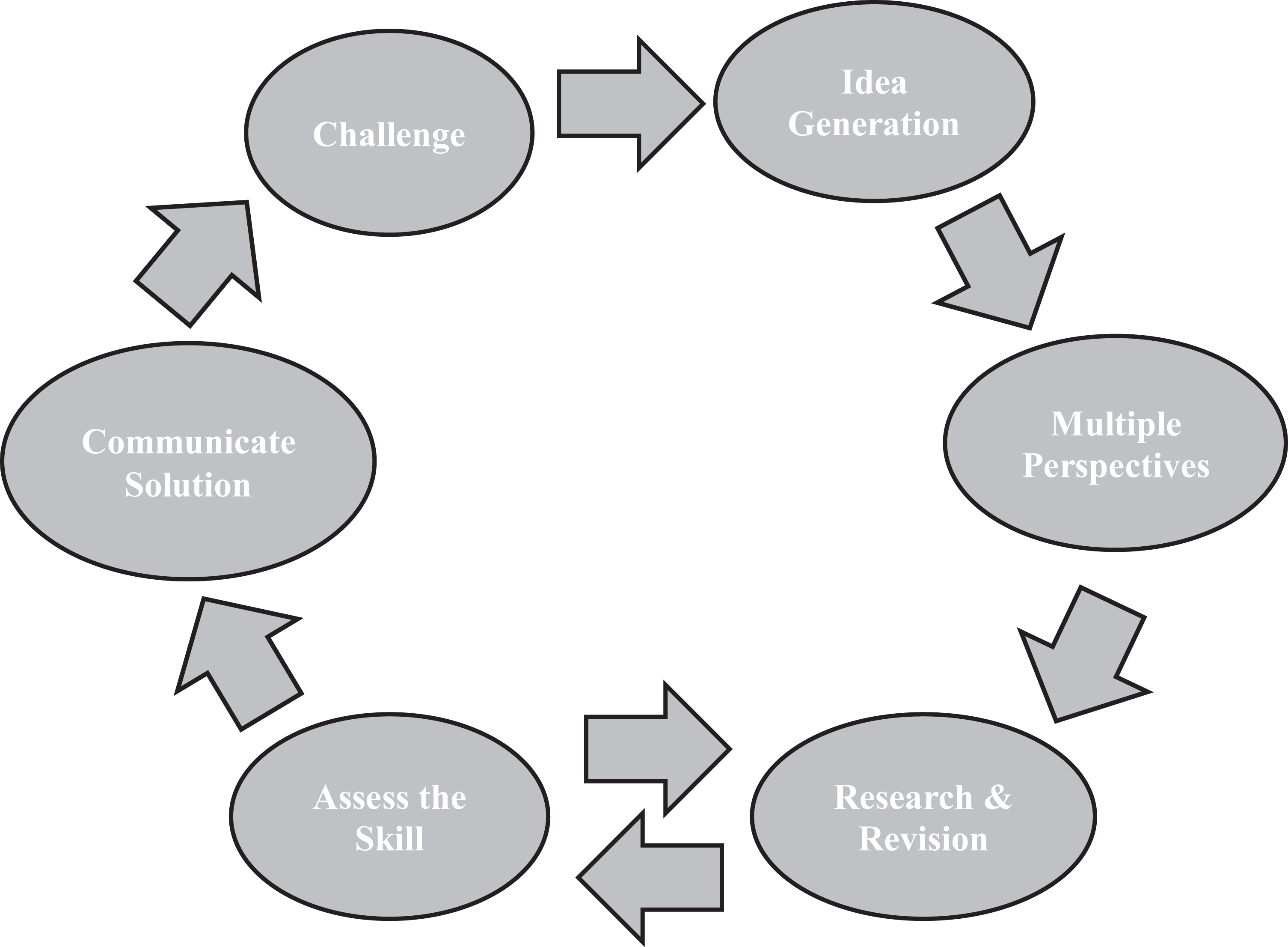
CBL model. Source: Authors.
The elements found in Figure 1 are:
– Challenge: Definition of the problem.
– Idea Generation: Brainstorming to tackle the problem.
– Multiple Perspectives: Consider several contexts and settings where this challenge has occurred and how it was approached.
– Research and Revision: Engage in research actions to pull out data and information for latter revision that allow for the identification of solutions based on relevant theories.
– Assess the skill: Formative self-evaluation done by the student supported by the proposed solution.
– Communicate solutions: Delivery and communication of results and viable solutions.
Students are required to go through each and everyone of the elements to adjust and improve upon the initially set challenge.
To apply the didactic strategy, the starting point includes the identification of the requirements for the different trades and careers across industries demanding job seekers and experienced employees to be prepared to face and handle challenges properly. In other words, the current work environment requires from professionals to develop initiatives, communicative skills, be assertive, and nurture a research approach. These skills and abilities are developed and strengthened at the university level through student-centred didactic methodologies. The CBL approach has shown positive effects, based on the premise that no one knows everything and no one is unaware of everything, coupled with the premise that cognitive conflict allows for the learning and strengthening of knowledge, values and attitudes which are validated by others, in this experience, the instructor. CBL instructors engage in a teaching-learning process where they can reflect upon students’ experiences through curriculum-based challenges where learning settings are nurtured, questions are asked, tutorials are delivered, and competences are evaluated and enhanced (Apple, 2008; Mendoza Molina and Bernabeu Tamayo, 2006).
Furthermore, entrepreneurial orientation understood as a strategy that facilitates innovation as part of an organisational restructuring, requires a formative process; business literature describes that for an effective entrepreneurial orientation, it is necessary to take three dimensions proposed by Miller (2011) and Covin and Slevin (1989): innovation, risk acceptance and proactivity. These authors support that entrepreneurial orientation is a multidimensional concept which involves three business-related actions: first, innovation, exemplified by the creation or enhancement of products, services, processes, businesses, markets, substitute materials, and structural changes in the organisation. Second, risk acceptance, described as the positive correlation of innovation levels and risk that the organisation is willing to take on due to the level of uncertainty and success probability. Third, proactivity, explained as the strategy to foresee and take advantage of opportunities that allow the organisation to satisfy potential market needs surpassing competitors and better utilising available resources. Consequently, there is a strong relationship among CBL and entrepreneurial orientation considering the benefits of motivating students to take on risks during formative environments that create and develop risk taking skills to allow students to face the business environment after graduation with a strong perception of what to expect and potential viable solutions.
Methodology
The application of the CBL approach began with a group of students from the management programme with a total of 11 work groups with 5 students in each group (3 students, part of the university, and 2 international students placed at locations around the world) for a total sample of 55 participants. Out of the 55 students, 33 were part of the university and the remaining were international students with the aim to provide solutions for the challenge throughout the academic term.
For the application of the CBL methodology, it is expected, according to Larmer (2014) and Olivares Olivares et al. (2017) that this be a learning opportunity for students to collaborate in under the supervision of the instructor to learn about relevant problems through the proposal of appropriate and real solutions. Initially, the CBL methodology is described and explained to the students, and then in all subsequent lessons, time is allocated to further clarify any doubts going forward. Each work group must choose an organisation and carefully identify a problematic situation that could represent an ongoing challenge for the organisation. Next, the problem would be discussed with the aim to generate questions and potential sources information based on existing management theories.
Consequently, the deployment of the CBL methodology entails the development of critical thinking towards analysis, assessment and interpretation of the evidence collected, methods applied and/or criteria utilised and adopted by the organisation. According to García Bejar (2014) the CBL methodology is deployed in three phases:
Phase 1
This is the preparatory period where the work to be done is described and the plan of action laid out. For this specific study, the allocation of work groups, the identification of the challenge, the generation of ideas, and the identification of relevant perspectives that can be considered for the challenge. It is in this phase that all the components of the challenge must be identified by all members of the work group including the main idea, the research question and the description of the challenge.
Activities:
– Identification of work group members.
– Clarification of main idea, essential questions are asked and description of the challenge.
– Search and identification of previous successful challenges from other researchers.
– Establish contact with an international party (basic information and affiliation).
– Presentation of rules, regulations, and responsibilities allocation, and lay out of timelines.
Phase 2
Development and validation, which consists of research, revision, and skills assessment. By the end of this phase main research questions, actions and resources useful for the success of the challenge must be identified, clarified, and internalised. Also, this phase must include the identification of the proposed solution, the assessment procedure for the proposed solution and its validation methods.
Activities:
– Capture of videos and/or activity logs.
– Delivery of information research results.
– Supporting documents for proposed solution.
Phase 3
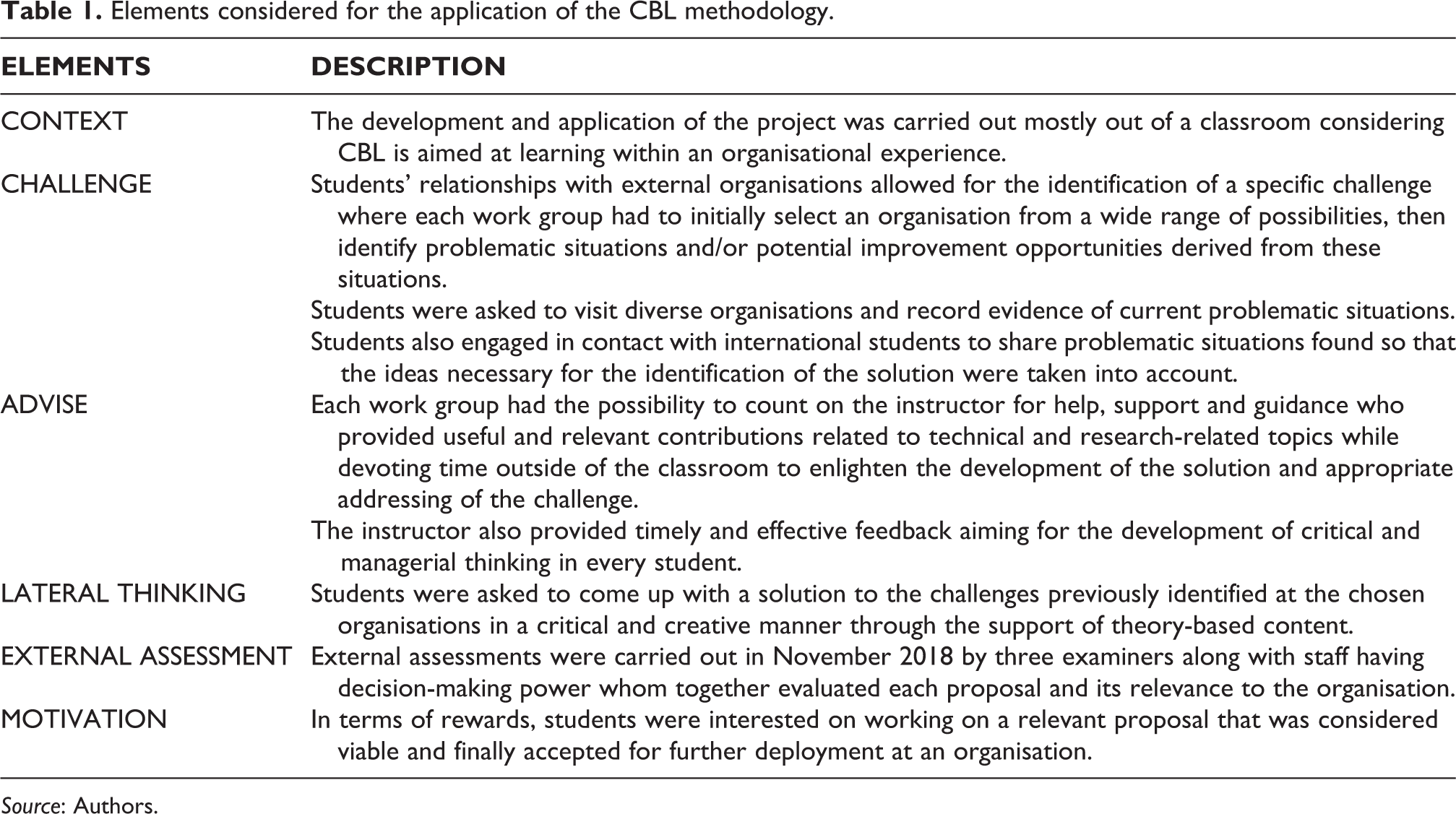
This phase encompasses the development of an article as a result of the implementation carried out. In addition to a formal document that describes the entire deployment of the CBL experience. The list of elements along with their description used during the deployment of the CBL methodology is summarised in Table 1.
Elements considered for the application of the CBL methodology.
Source: Authors.
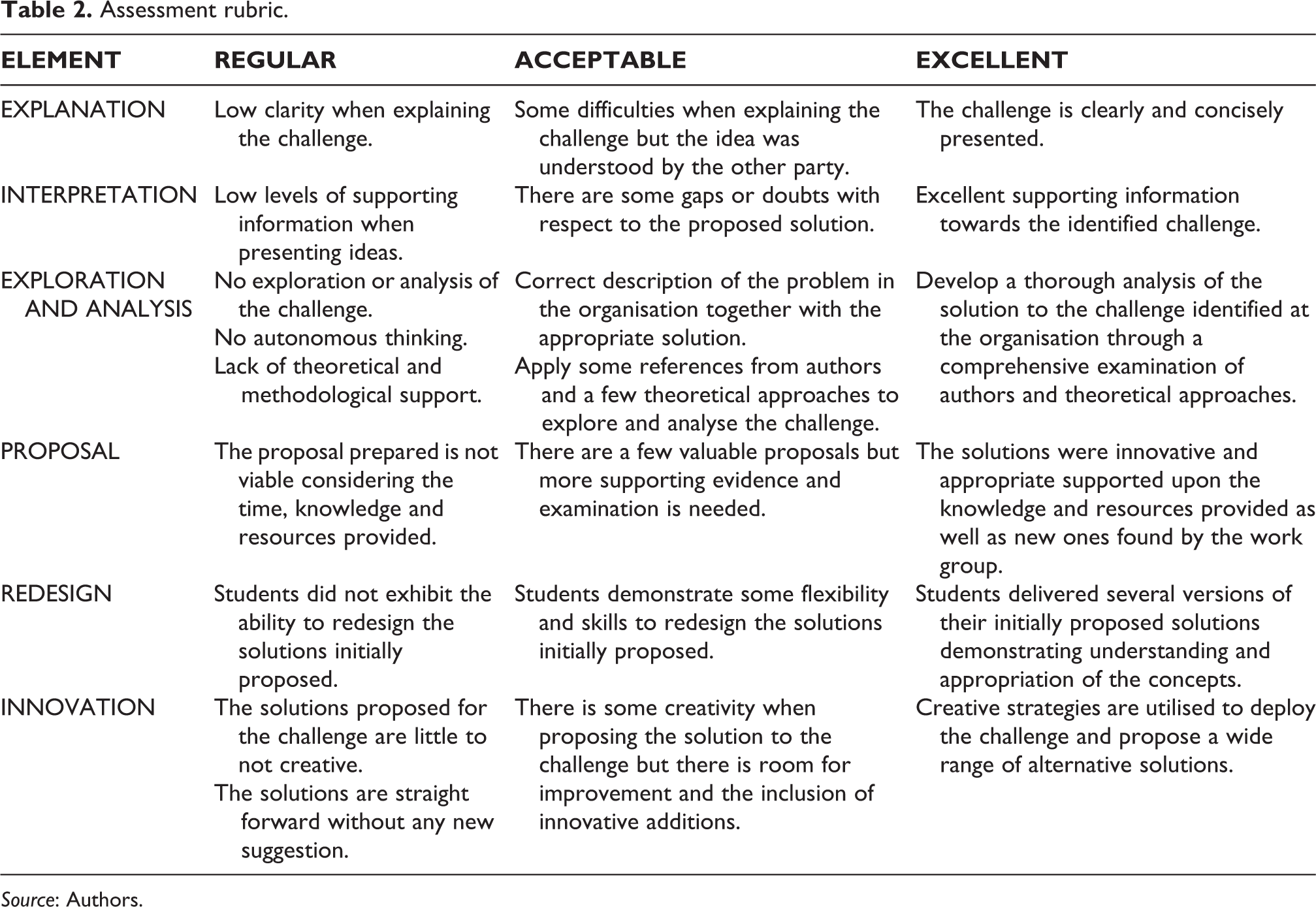
The rubric applied during the follow-up and assessment of challenges chosen by students is described in Table 2:
Assessment rubric.
Source: Authors.
Results
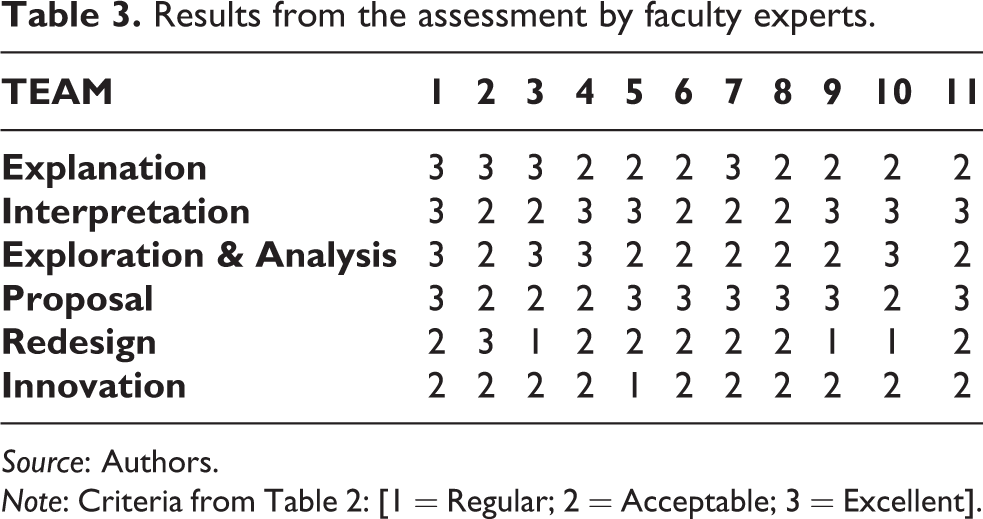
Once the CBL activity had been finalised, three members from the faculty, experts in organisational consulting, were called in to provide an assessment, based on the rubric presented on Table 2 for components such as explanation, interpretation, exploration and analysis, proposal, redesign, and innovation, for the challenge description and presentation together with the proposed solutions. Table 3 presents the criteria to evaluate each one of the challenges presented by the work groups. The assessment used a three-point scale where 1 was given to those groups that did not fulfil the criteria; 2 was given to those groups that provided an acceptable development of the challenge and potential solutions but with room for improvement; and 3 was given to those groups that truly identified, explored, and internalised the CBL methodology supported upon theoretical frameworks to provide comprehensive and real-life solutions to challenges in organisations.
Results from the assessment by faculty experts.
Source: Authors.
Note: Criteria from Table 2: [1 = Regular; 2 = Acceptable; 3 = Excellent].
These results allow for the high level of compliance towards the main aim which was to identify and develop a relevant real-life solution for an organisation through a discussion and research process. These results also evidence the appropriability and validity of the CBL methodology for management students prompting for the development of research proposals in other contexts such as other higher education programmes or different countries to corroborate and validate the CBL methodology further more.
Considering the application of the CBL methodology is still in its early stages within the business administration context in Colombia, limitations have arisen which hinder its full implementation. Limitations such as the identification, suitability and willingness to take part of an international participant whose native language was different from that of the Colombian students.
Moreover, students expressed their gratitude towards the participation of faculty experts who allowed them to identify and understand the importance of having the right theoretical and research methodology frameworks to properly address the real-life challenges encountered across several organisations. Such findings call for the active participation of members of staff involved in curriculum development and enhancement, particularly in the management programmes, towards a continuous identification and application of strategies that allow for the establishment of a closer relationship among theory and practice, thus, facilitating employability of students.
Discussion
A ‘challenge’ in itself attracts students since it is an opportunity to test their abilities and produce a meaningful outcome, thus, generating motivational learning. Despite implementation drawbacks due to the shift in paradigm, and approach that most management programmes are accustomed to, it is a complex task to develop and constantly drive institutional performance upwards. However, students have demonstrated the motivation and effort levels necessary to consider the application of the CBL methodology towards the acquisition of incentives and the continuation of its deployment since it is easier to continue than to stop and restart its application once again, precisely because it is a team effort.
Additionally, it is relevant to highlight that during the application of the CBL methodology, the conclusions proposed by other scholars (Olivares Olivares and López Cabrera, 2017; Olivares Olivares et al., 2018) became evident. Such conclusions argue CBL could develop critical and creative thinking skills, when proposing and implementing solutions, to real-life problems faced by organisations. One of the key areas of improvement on the application of the CBL methodology is a greater level of interaction with international participants as idea generation and exchange could be highly improved. This conclusion resulted from the experience during the application of the CBL methodology and the call for interaction from international participants whom were not able to communicate properly and fluently due mainly to two situations: one, the CBL methodology was new to them, and two, their communicative skills were poor in terms of the main language of communication being Spanish.
As mentioned earlier, the CBL methodology actively involves the student in a real-life, meaningful and context-related situation (OIETM, 2015); thus, it became evident that international participants had been excluded from the context part of the challenge initially proposed while considering that to become an active witness of the development of this ‘entrepreneurial-oriented’ teaching experience individual involvement and motivation is required.
Conclusions
The results evidence high percentage levels of fulfilment towards the main objective which allows for the recognition of the validity in the CBL methodology application and implementation for students in the business administration programme in Colombia. This study aims to create and inspire opportunities for the application and replication of the CBL methodology at other institutions in different contexts and countries to validate and corroborate its wide array of benefits and contribute further to the knowledge in management sciences.
Throughout the process of systematisation of experiences, a transforming and creative intention has been evidenced while distancing itself from previous passivity-plagued environments which did not provide meaningful experiences and were far from preparing management students for social and organisational realities. The transforming factor is not the systematisation of the experiences in itself, rather it is the identification and proposition of innovative solutions to current and real-life organisational challenges which allow for an appropriate application of theoretical frameworks discussed during lectures and seminars.
The CBL methodology encourages students to reflect upon legitimate problems faced at the organisational level demanding for the proposition of innovative ideas customised for everyday situations. Providing relevant and practical solutions for authentic organisational challenges increase internal motivational levels in management students allowing for the increase of deep learning and internalisation of knowledge, able to nurture critical and constructive thinking while positioning business administration programmes as a top choice for any new student through making it more interesting, dynamic and applicable.
Footnotes
Authors’ note
Fernando Chavarro Miranda is also affiliated with Researcher Juan de Castellanos University, Colombia.
Acknowledgements
The authors would like to thank all management students who dedicated their time, showed commitment, accountability and effort to make the application of the CBL methodology possible. The authors also would like to thank all international participants for having sincerely offered to help in a conscious and respectful manner; likewise, they would like to thank a special group of students (Laura Arango Santos, Lisett Carmona Amaya y Daniela García García) who provided support towards the systematisation of each and every one of the challenges and helped them with all the digitisation and collection of data for the entire ‘entrepreneurial-oriented’ teaching experience.
Declaration of conflicting interests
The author(s) declared no potential conflicts of interest with respect to the research, authorship and/or publication of this article.
Funding
The author(s) received no financial support for the research, authorship, and/or publication of this article.

Appendix 1
Participants’ affiliation and challenge proposed.
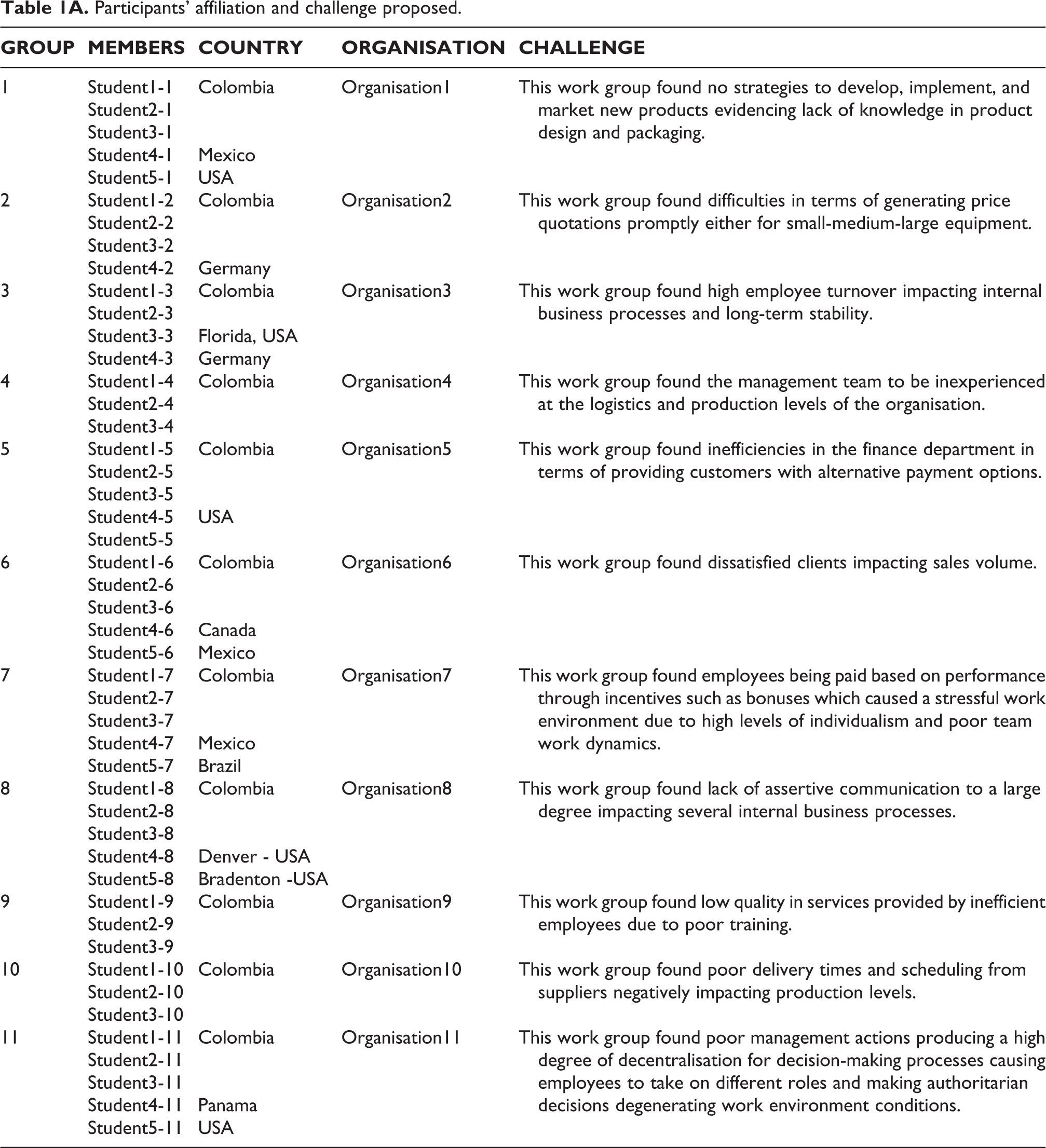
|
|
|
|
|
|
|---|---|---|---|---|
| 1 | Student1-1 Student2-1 Student3-1 |
Colombia | Organisation1 | This work group found no strategies to develop, implement, and market new products evidencing lack of knowledge in product design and packaging. |
| Student4-1 | Mexico | |||
| Student5-1 | USA | |||
| 2 | Student1-2 Student2-2 Student3-2 |
Colombia | Organisation2 | This work group found difficulties in terms of generating price quotations promptly either for small-medium-large equipment. |
| Student4-2 | Germany | |||
| 3 | Student1-3 Student2-3 |
Colombia | Organisation3 | This work group found high employee turnover impacting internal business processes and long-term stability. |
| Student3-3 Student4-3 |
Florida, USA Germany |
|||
| 4 | Student1-4 Student2-4 Student3-4 |
Colombia | Organisation4 | This work group found the management team to be inexperienced at the logistics and production levels of the organisation. |
| 5 | Student1-5 Student2-5 Student3-5 |
Colombia | Organisation5 | This work group found inefficiencies in the finance department in terms of providing customers with alternative payment options. |
| Student4-5 Student5-5 |
USA | |||
| 6 | Student1-6 Student2-6 Student3-6 |
Colombia | Organisation6 | This work group found dissatisfied clients impacting sales volume. |
| Student4-6 | Canada | |||
| Student5-6 | Mexico | |||
| 7 | Student1-7 Student2-7 Student3-7 |
Colombia | Organisation7 | This work group found employees being paid based on performance through incentives such as bonuses which caused a stressful work environment due to high levels of individualism and poor team work dynamics. |
| Student4-7 | Mexico | |||
| Student5-7 | Brazil | |||
| 8 | Student1-8 Student2-8 Student3-8 |
Colombia | Organisation8 | This work group found lack of assertive communication to a large degree impacting several internal business processes. |
| Student4-8 Student5-8 |
Denver - USA Bradenton -USA |
|||
| 9 | Student1-9 Student2-9 Student3-9 |
Colombia | Organisation9 | This work group found low quality in services provided by inefficient employees due to poor training. |
| 10 | Student1-10 Student2-10 Student3-10 |
Colombia | Organisation10 | This work group found poor delivery times and scheduling from suppliers negatively impacting production levels. |
| 11 | Student1-11 Student2-11 Student3-11 |
Colombia | Organisation11 | This work group found poor management actions producing a high degree of decentralisation for decision-making processes causing employees to take on different roles and making authoritarian decisions degenerating work environment conditions. |
| Student4-11 | Panama | |||
| Student5-11 | USA |