



Abstract
In this paper, we use the “gender as a social structure” framework to assess macro-, interactional-, and micro-level mechanisms explaining the stalled revolution in gender ideologies. Using the European Values Study 2008 data and latent class analysis, we look at the spread of gender ideologies and examine their association with national levels of gendered ascription of work and care roles, work–family compatibility, social inequality and societal affluence, individual characteristics, and cross-level interactions with gender and education in 36 (post-)industrialized countries. By including a large number of Central, Eastern, and South-Eastern European countries, we provide a new and comprehensive picture of the gender ideology landscapes of Europe, reflected in two unidimensional classes—egalitarian and traditional—and four multidimensional classes, covering more than 60 percent of respondents—family oriented, choice egalitarian, intensive motherhood, and neotraditional. By modeling key features of macro-level variation, we show how the spread of gender ideologies is associated with distinct contextual conditions. We consolidate previous findings on multidimensional gender ideologies, which were based on fewer countries.
Men’s and women’s social roles have undergone tremendous change in the second half of the twentieth century, but the hope for a continous and linear progress toward egalitarian gender relations offered by second-generation feminists has not been fulfilled. Instead, women’s progress in education and employment has left them with a double burden of combining paid and care work, resulting in persistent gender disparities in income, wages, and pensions. Together with the lagging pace of men’s participation in household and care tasks (Altintas and Sullivan 2016) and women’s underrepresentation in positions of authority, these developments constitute the “stalled gender revolution” (England 2010; Sullivan, Gershuny, and Robinson 2018). One reason for the stalled gender revolution is the persistence of essentialist gender ideologies, particularly the belief that fundamental innate differences exist between women and men (England 2010; Ridgeway and Correll 2004). Indeed, normative support for women’s access to public roles and resistance to male supremacy has developed faster than support for equal sharing and suitability of both genders for family responsibilities (Cotter, Hermsen, and Vanneman 2011; England 2010).
The attitudinal dimensions of support for public and private roles are frequently combined in unidimensional indicators. These indicators result from conceptualizing gender ideologies as a continuum ranging from the traditional “separate spheres” or “male breadwinner/female homemaker” model at one side to a fully egalitarian “dual earning/dual caring” model at the other side. According to this conceptualization, large parts of the (post)-industrialized world now appear to be stuck in the middle, caught halfway on the path to the end point of egalitarian ideals. Acknowledging that this unidimensional model is not an accurate representation of the reality of attitudinal change, a body of research has developed in recent years, which attempts to capture the multidimensional nature of current gender ideologies (Barth and Trübner 2018; Brinton and Lee 2016; Grunow, Begall, and Buchler 2018; Knight and Brinton 2017; Scarborough, Sin, and Risman 2019; Yamaguchi 2000; Yu and Lee 2013). These studies lend strong support to the notion that gender ideologies include mixed or ambivalent attitude profiles, characterized by egalitarian views on certain issues and traditional views on others. These ambivalent profiles—which, for instance, endorse women’s economic independence while also identifying motherhood and paid work as largely irreconcilable—can be regarded as empirical operationalizations of current discourses around gender, parenthood, and compatibility issues, including attention to intensive parenting (Faircloth 2014), neotraditionalism (Damaske et al. 2014), intensive mothering or mothers “opting out” of professional careers to focus on childrearing (Hays 1996). Such studies show the prevailing cultural persistence of gender essentialism (Charles and Bradley 2009; Cotter, Hermsen, and Vanneman 2011).
These debates all speak to the “stalled gender revolution” phenomenon, but are rarely conceptualized under a joint theoretical framework. A framework that lends itself to capturing these various developments is gender structure theory (Risman 2018; Scarborough and Risman 2017). Gender structure theory emphasizes the interdependent role of macro-level cultural and institutional factors, as well as interactional- and individual-level factors shaping gender relations in the domains of paid work, unpaid work and family, and gender ideology unevenly. We use this framework to study the state of gender ideologies, which are considered to hamper the gender revolution in a wide range of countries. Our cross-national and cross-level approach allows us to assess the role of forces on the macro and micro levels of society in shaping gender ideology profiles more in-depth. While our study provides novel empirical evidence to address the theoretical and conceptual aspects raised here, it also addresses important methodological issues concerning the study of contemporary gender ideologies. We aim to contribute to consolidating and expanding previous findings (Grunow, Begall, and Buchler 2018; Knight and Brinton 2017) by drawing on a similar analysis but using a substantially larger set of countries (N = 36). We thus provide a comprehensive overview of the prevalence and distribution of multidimensional gender ideology profiles across European countries representing a large range of cultural and political diversity.
Background and expectations
Previous Research on Multidimensional Gender Ideologies
Gender ideologies are seen as a major force in the stalling of the gender revolution (Meagher and Shu 2019; Scarborough, Sin, and Risman 2019). In particular, research shows that individuals have become more egalitarian-minded regarding women’s role in the public sphere while remaining traditional regarding men’s and women’s responsibility in the family, and vice versa (Cotter, Hermsen, and Vanneman 2011; Pepin and Cotter 2018). Gender ideologies thus encompass ambivalent multidimensional attitudes regarding men’s and women’s traits and responsibilities in work and care roles. The dominant approach to measuring this ambivalence has been the use of latent class analysis (LCA) to estimate profiles based on responses to survey items on gender attitudes. This method allows for combinations of egalitarian and traditional responses within profiles, contrary to unidimensional scale construction. Following the paper of Yamaguchi (2000) on Japan (using the Social Stratification and Mobility Survey 1995), two comparative studies using LCA have been published in the early 2000s: They examine China, Taiwan, Japan, and Korea, based on data from the International Social Survey Program (ISSP) (Lee and Eun 2005), and coastal China and Taiwan using the East Asian Social Survey (Tu, Liao, and Chang 2006). The results documented the existence of ambivalent attitude profiles combining liberal views on women’s economic participation with traditional stances about work–family compatibility. The focus on Asia in this literature reflects the tension in these societies between women’s high rate of educational attainment and labor force participation on one hand and traditional attitudes toward women’s domestic roles on the other.
In recent years, a growing body of research has used the same approach to test for ambivalent gender ideologies in postindustrialized Western countries (Barth and Trübner 2018; Brinton and Lee 2016; Grunow, Begall, and Buchler 2018; Knight and Brinton 2017; Scarborough, Sin, and Risman 2019). Two studies have used the European Values Survey (EVS) to examine multiple countries, one taking a longitudinal perspective and comparing changes over time across 18 European countries (Knight and Brinton 2017) and one focusing on variation in gender ideologies across welfare state types (Grunow, Begall, and Buchler 2018). In addition, one study used gender ideology profiles as a predictor of fertility rates in 24 OECD (Organization for Economic Co-operation and Development) countries using the World Values Survey (WVS; Brinton and Lee 2016). Next to these cross-national applications, two single-country studies focus on changes over time in Germany (Barth and Trübner 2018, using two waves of the German General Social Survey) and the United States (Scarborough, Sin, and Risman 2019, using the General Social Survey 1977–2016). All studies support the existence of ambivalent gender ideology profiles next to the traditional and egalitarian types. In the United States, two ambivalent profiles are described by Scarborough, Sin, and Risman (2019): One holds egalitarian views on the division of work and care but perceives motherhood as incompatible with paid work (labeled “pro-public anti-private ambivalents”); the second supports a gendered division of paid work and family responsibilities but sees no harm in mothers working (labeled “anti-public pro-private ambivalents”). Also in Germany, Barth and Trübner (2018) describe two ambivalent profiles, one with egalitarian views but critical toward employed mothers (labeled “conflicted egalitarian”). The other one embraces moderate-traditional views, particularly regarding working mothers of young children, but less strongly endorses a gendered division of labor compared with the traditional type (labeled “child-oriented traditional”) (Barth and Trübner 2018).
The multi-country studies used data from the World (or European) Values Survey but because the selection of countries, respondents, number, and choice of indicators varied, the results are not entirely comparable. All these studies, however, find two types of ambivalent profiles: The first group generally holds egalitarian views and differs from a fully egalitarian profile mostly in their support for women’s right to choose between being a housewife or working for pay. The label chosen for this group is “egalitarian essentialist” (Grunow, Begall, and Buchler 2018) or “flexible egalitarian” (Brinton and Lee 2016; Knight and Brinton 2017). The other ambivalent profile endorses items related to women’s “essential” nature as mothers and wives while holding egalitarian views on (dual) earning, male primacy, and men’s involvement at home. This profile is referred to as “pro-work conservatives” (Brinton and Lee 2016), “intensive parenting” (Grunow, Begall, and Buchler 2018), or “egalitarian familism” (Knight and Brinton 2017). These results point to the existence of a weak and a strong version of what Cotter, Hermsen, and Vanneman (2011) refer to as “egalitarian but traditional” cultural frames.
Existing research emphasizes different potential drivers of gender ideologies. Brinton and Lee (2016) focus on macro-level labor market characteristics, but with an emphasis on predicting fertility intentions. Knight and Brinton (2017) and Scarborough, Sin, and Risman (2019) assess a large number of micro-level demographic characteristics within each ideology profile and document changes over time. Across studies, women and members of higher socioeconomic classes tend to embrace egalitarian ideologies, whereas men and people from lower classes tend to hold ambivalent or traditional gender ideologies. Barth and Trübner (2018) also assess regional variation in gender ideologies. Grunow, Begall, and Buchler (2018) assess the prevalence of gender ideologies by focusing on countries representing ideal-typical welfare states and work–family policies.
Whereas these findings speak to the gender revolution debate, they do not systematically address how macro- and micro-level characteristics together account for the varying and uneven states of the gender revolution in (post)-industrialized countries.
Theoretical Framework and Expectations
We rely on Risman’s (2018) revised framework of “gender as social structure” to inform our analysis of gender ideologies and relate our findings to the stalled gender revolution debate (see also Ridgeway and Correll 2004; Scarborough and Risman 2017). This framework conceptualizes “gender as a social structure with social processes that occur at the individual, interactional, and macro levels” of society (Risman 2018, 22). In line with other recent multidimensional frameworks (Ridgeway and Correll 2004; Sullivan, Gershuny, and Robinson 2018), these levels are assumed to be interdependent, so that change on one level has consequences for the dynamics on the other levels. We consider these levels, as well as cross-level interactions, to understand the extent to which egalitarian, traditional, and ambivalent gender ideology profiles prevail in a given society.
Within the macro, interactional, and micro levels, gender change occurs in the domains of paid and unpaid work, the family, and gender ideology. For example, the rise in women’s educational levels and labor market participation has affected all three domains, by increasing the time women spend in paid work, decreasing their time spent in unpaid family work, and raising acceptance of women in the public sphere (Altintas and Sullivan 2016; Scarborough, Sin, and Risman 2019; Sullivan, Gershuny, and Robinson 2018). At the same time, these changes have affected, and were affected by, gender relations on the macro, interactional, and micro levels. Hence, Risman’s framework pays attention to the fact that gender (in)equality reflects various layers and processes of social change, some of which have been changing faster than others (Cotter, Hermsen, and Vanneman 2011; England 2010; Pepin and Cotter 2018; Scarborough and Risman 2017). Research further documents that lack of change in the private domain affects gender progress in the public domain, thus hampering the gender revolution and leading to cross-national variation in gender egalitarianism (Knight and Brinton 2017; Meagher and Shu 2019). We argue, in line with the gender structure framework (Risman 2018) and recent empirical applications thereof (Scarborough, Sin, and Risman 2019), that these conflicting dynamics are reflected in ambivalent gender ideologies.
The macro level of the gender structure entails material conditions, such as work–family policies and organizational structures as well as cultural notions of gender and parenthood. Both aspects guide, constrain, and “gender” individual action (Scarborough and Risman 2017). According to this perspective, individual gender ideologies are a combination of socialization, experience, and social interaction. Socialization, experience, and interaction in turn vary across larger social contexts, but also within a given context across intersections of class, race, and gender (Lareau 2011; Scarborough et al. 2021). When institutions fail to provide social groups with stable and coherent resources to pursue their ideas of work and family life, normative confusion arises in the form of multiple, unstable equilibria (Esping-Andersen and Billari 2015). Such unstable equilibria may manifest in ambivalent and competing gender ideologies.
We focus on a set of macro characteristics, which have been argued to support the spread of egalitarian gender ideologies. In particular, we consider the extent to which (1) work and care roles are ascribed by gender or framed as a matter of individual choice; (2) paid work and family responsibilities are (in)compatible; (3) resources are distributed (un)equally; and (4) societies are affluent (Esping-Andersen and Billari 2015; Risman 2018; Scarborough, Sin, and Risman 2019). We elaborate on how each macro characteristic relates to forming and maintaining gender ideologies in individuals.
Ascription of Work and Care Roles
A factor shaping the extent to which social roles are ascribed by gender is “male-breadwinner norms” (Gonalons-Pons and Gangl 2021), which have been identified as a cultural source of the “stalled revolution” (Charles and Bradley 2009; Cotter, Hermsen, and Vanneman 2011). In addition, we consider how far parental leave policies maintain women’s role of primary carer by assigning paid leave to mothers (Grunow, Begall, and Buchler 2018). If institutional and cultural conditions in a society ascribe gendered responsibilities in work and care, gender-essentialist views on men’s and women’s abilities and traits are perpetuated and gendered role expectations toward earning and caring are emphasized (Bass 2015). This may result in a higher prevalence of traditional and ambivalent gender ideologies supporting gender-separate spheres and women prioritizing domestic roles and motherhood.
Work and Family Compatibility
We further consider gender disparities in labor market outcomes as manifestations of context-level work–family (in)compatibility. In contexts in which work and family are difficult to combine because of rigid labor market settings or lack of family-supportive policies, gender ideologies are likely to reflect this tension through perceptions of conflict between motherhood, childrearing, and paid work. The relation between work–family incompatibility and gender ideologies will probably be stronger for women and the higher educated because these groups aspire to combining paid work and care (Bass 2015; Esping-Andersen and Billari 2015).
Social Inequality
Social inequality may impact gender ideologies through encouraging “intensive parenting” both in terms of resources and time. Intensive parenting has been argued to be driven by parental concern with children’s social mobility (Schneider, Hastings, and LaBriola 2018). High social inequality raises the stakes of achieving social mobility and increases competition among individuals. Higher need for parental investments often translates into maternal investments but may also place higher demands on fathers (Ishizuka 2019). The intensification of mothering or parenting in unequal societies should foster the rise of gender ideologies that combine emphasis on work–family incompatibility and the centrality of family responsibilities in men’s and women’s lives with egalitarian views on the division of labor and women’s public roles. Moreover, these tendencies appear especially pronounced among (higher) middle-class parents (Dotti Sani and Treas 2016). Thus, middle-class parents’ gender ideologies might be particularly reactive to social inequality.
Societal Affluence
Growing societal affluence has long been expected to instill liberal attitudes and support for equality in the population (Inglehart and Norris 2003). However, recent scholarship points to the persistence of gender essentialism and occupational gender segregation in the economically most highly developed countries. In these countries, economic pressures on women to maximize their earnings are lower than in less affluent societies, enabling them to choose gendered career paths and prioritize unpaid work (Charles and Bradley 2009; Cotter, Hermsen, and Vanneman 2011). More wealthy societies thus facilitate the proliferation of “choice feminism,” a type of contemporary feminism that encourages a variety of women’s life choices, including stay-at-home mothering, as politically acceptable (Thwaites 2017). This pattern may be reflected in gender ideologies characterized by egalitarian views but endorsing women’s right to choose between paid work or care, referred to in previous work as “egalitarian essentialism” (Grunow, Begall, and Buchler 2018) or “flexible egalitarianism” (Brinton and Lee 2016; Knight and Brinton 2017). We expect that multidimensional gender ideologies combining egalitarian views with support for female homemaking will be more widespread in wealthy countries.
Whereas these macro factors are expected to predict broad cross-national variation in the prevalence and size of ideology classes, such predictions will be far from perfect due to the recursive causal relationships across macro, individual, and interactional levels (Risman 2018). We thus need to consider these levels, as well as their interactions.
Cross-level interactions imply a degree of variability and agency at the individual level. Individuals may react differently to social contexts depending on their personal experiences and resulting preferences and resources. Importantly, co-existence of multiple dominant gender ideologies is explained by varying personal experiences, such as socialization in light of historical and cultural context; gender, race, and class intersections; interaction; and individual agency (Risman 2018). Based on the gender ideology literature, we include individuals’ gender, age, educational attainment, religiosity, labor force participation, marital status, and parenthood. One of the most robust findings in the literature is that women hold more egalitarian attitudes than men, which has been explained by gender differences in interests and experiences (Bolzendahl and Myers 2004). Gender differences in interests and experiences have also been argued to account for nonlinear cohort and age differences, with people born up to the 1960s holding more progressive gender attitudes than their predecessors and a flattening or even reversing trend for younger cohorts (Pepin and Cotter 2018). Higher-educated people have been shown to adopt egalitarian attitudes to which they have been exposed in educational institutions (Pampel 2011). Exposure is also considered as the mechanism through which traditional gender ideologies are transmitted in religious institutions and communities (Adamczyk et al. 2013). Being married and having children have been shown to be associated with more traditional gender ideologies, with support for both directions of causality: Holding more conservative attitudes increases the likelihood of marriage and childbirth (Guetto, Luijkx, and Scherer 2015), but experiencing these life-course transitions has also been shown to lead to more traditional views (Schober and Scott 2012).
Data and methods
We use data from the fourth wave of the European Values Study (EVS) collected between 2008 and 2010 to identify profiles of gender ideologies (EVS 2016). The EVS provides harmonized information on all countries of Europe with each participating country drawing representative multi-stage or stratified random samples of the adult population (18 years and older). Interviews were conducted face-to-face with a standardized questionnaire (exceptions are Finland [internet panel] and Sweden [postal survey]) (German Social Science Infrastructure Services 2016).
Sample
The analytical sample includes 36 countries available in the EVS 2008 and considered “full democracies” or “flawed democracies” in 2008, according to the Economist Intelligence Unit’s Index of Democracy (Economist Intelligence Unit 2008). Countries classified as “authoritarian regime” and “hybrid regime” (Albania, Bosnia Herzegovina, Turkey, Georgia, Russian Federation, Armenia, Belarus, Azerbaijan, Kosovo, Northern Cyprus) have been omitted because the gender ideology items are not expected to be comparable with those in the democracies, due to fundamentally different policy systems. We provide a list of the included countries in Table A1 in the Online Appendix. We apply listwise deletion and exclude a total of 4,753 respondents (9 percent) who have at least one missing value on the items included in our analysis. The effective sample size comprises 47,971 respondents.
Measures
Gender Ideology
Following Grunow, Begall, and Buchler (2018), we include seven items that cover relevant dimensions of gender relations and gender ideologies: the compatibility of motherhood and employment, women’s prioritizing of domestic tasks over paid work, dual earning, fathers’ suitability for care, and men’s responsibility for household chores. The four answer categories of the original response scale were dichotomized (strongly agree and agree versus disagree and strongly disagree) and coded so that each item reflects an egalitarian response. See Table 1 for full item-wording and descriptive statistics.
Descriptive Statistics of All Variables
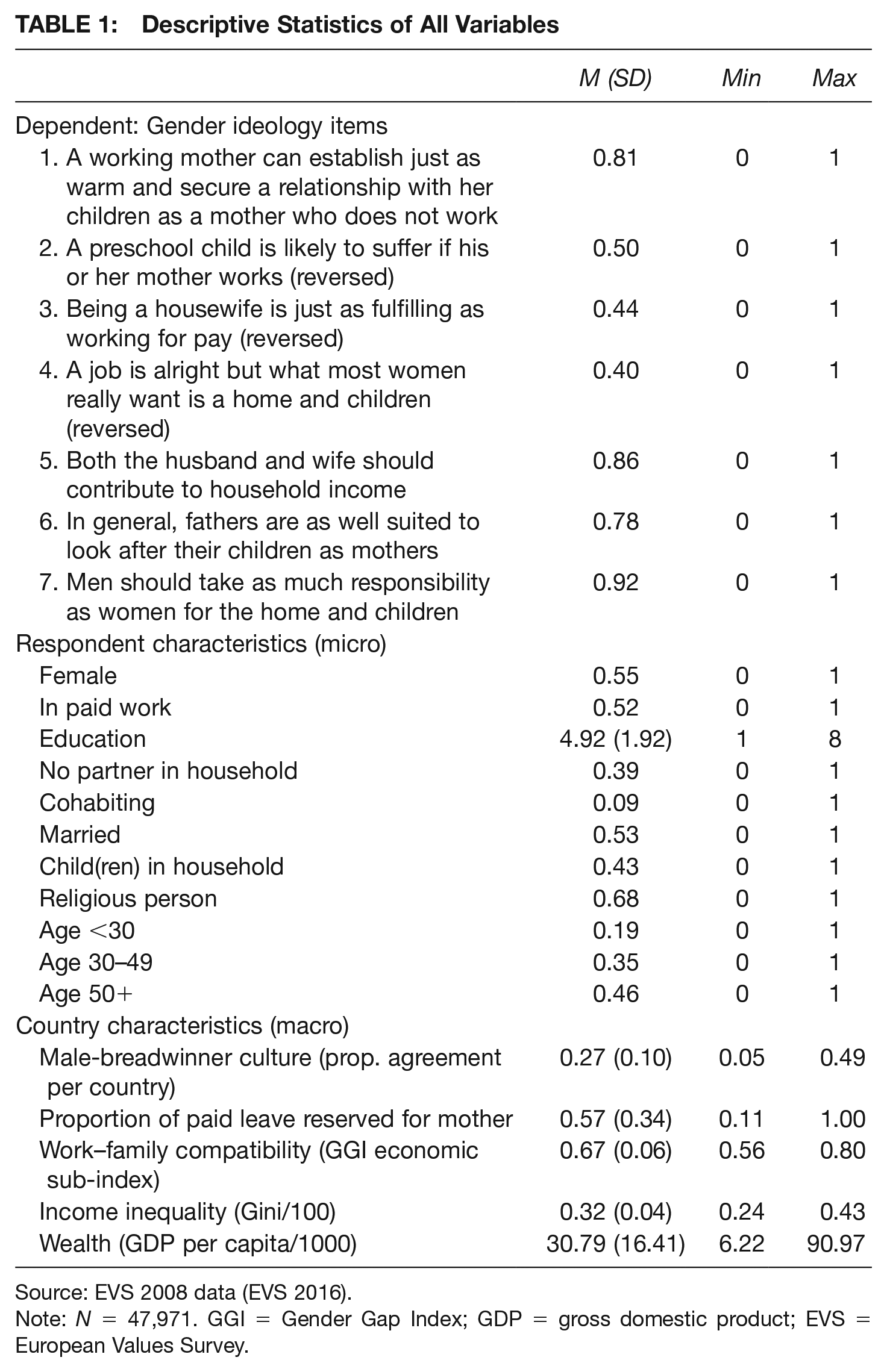
Source: EVS 2008 data (EVS 2016).
Note: N = 47,971. GGI = Gender Gap Index; GDP = gross domestic product; EVS = European Values Survey.
Individual Covariates
Gender is coded as female (1) and male (0), and employment status differentiates between any form of paid work (1) and not being employed (0). Education was measured by a scale ranging from (1) inadequately completed elementary education to (8) graduated from tertiary education. Partner status differentiates among having no co-residential partner, cohabiting, and being married. The presence of children in the household includes foster and adoptive children. Religiosity was assessed by the extent to which respondents described themselves as being a religious person (coded 1) rather than a nonreligious person or atheist (coded 0). Respondents’ age is measured by a categorical specification to account for nonlinear relations between age cohorts and gender ideologies. The variable differentiates among young adulthood (age < 30 years), prime family phase (30–49 years), and older age (ages 50+).
Descriptive statistics of all individual covariates are shown in Table 1.
Country-Level Covariates
Male-breadwinner norms
For each country, we calculate the average agreement with the statement “when jobs are scarce, men should have more right to a job than women” based on combined data from the waves of the EVS and WVS collected between 1999 and 2008 (EVS 2021) and the European Social Survey (ESS) collected in 2004 (ESS 2004) (n = 159,304). Importantly we exclude the EVS 2008 data (EVS 2016) which we use for our micro-level analysis of gender ideologies to ensure that the context-level norms are measured independently. Following Gonalons-Pons and Gangl (2021), we interpret aggregate responses to this survey item as an indicator of culturally shared male-breadwinner norms. Previous research suggested this also as an indicator of perceived labor market competition between men and women (Scarborough, Sin, and Risman 2019). The variable in our analysis denotes the country average of the proportion of respondents agreeing with the statement.
Proportion of paid leave reserved for mothers
We use information from the Women, Business and the Law (WBL) Index 2008, compiled annually based on regulations affecting differences between men’s and women’s access to economic opportunities (World Bank 2021c). The index contains eight sub-indices (mobility, workplace, pay, marriage, parenthood, entrepreneurship, assets, and pension). We use the indicators of the parenthood sub-index and divide the sum of paid leave days reserved for the mother by the sum of days of paid maternity, paternity, and parental leave available to a couple. The resulting variable denotes the proportion of leave reserved for mothers.
Work–family compatibility
We use the sub-index “economic participation and opportunity” of the Gender Gap Index (GGI) 2008 to measure macro-level work–family compatibility (Hausmann, Tyson, and Zahidi 2008). For two countries, Montenegro and Serbia, no estimate exists for 2008 or earlier, so the closest value available was used (2014 and 2012, respectively). The sub-index includes gender gaps in labor force participation, wage equality for similar work, estimated earned income, and in the share of legislators, senior officials, managers, professional, and technical workers. The variable is scaled from 0 to 1, with higher values indicating less gendered labor market inequality and thus better work–family compatibility.
Social inequality
We use the Gini index 2008 to measure inequality in the income distribution (World Bank 2021b). For countries with no estimate for 2008 or earlier available, the closest value available was used (for Croatia and Northern Macedonia, 2009; for Montenegro and Serbia, 2012).
Affluence
We obtain data on the 2008 GDP per capita, converted to current international dollars using purchasing power parities (World Bank 2021a).
Table 1 contains descriptive statistics of all macro variables, the scores per country are presented in the Online Appendix, Table A2. For sake of interpretability, we computed z-scores and used these standardized measures in the analyses.
Analytical Strategy
We use LCA to detect gender ideology profiles in the responses to the seven gender attitude items (Lazarsfeld, Henry, and Anderson 1968). Latent class models are estimated using Mplus version 7.31 (Muthén and Muthén 1998–2012), with population-size weights to adjust the country sample sizes to population-size differences (see Online Appendix, Table A1) and cluster-robust standard errors by country. In a first step, we estimated models with two to eight classes without covariates to find the preferred solution with regard to the number of classes. The preferred solution was chosen by a combination of the lowest (adjusted) Bayesian information criterion (BIC) value and the interpretability of the class structure (see Online Appendix Figure A1 for BIC values). Inspection of the bivariate residuals indicated that for some pairs of items the assumption of local independence was not met. By including residual covariances for these pairs of items, starting with the pair with the highest chi-square value, models with up to four residual covariances were estimated (Asparouhov and Muthén 2015). Results show that the class structure and sizes changed only slightly with the inclusion of more than one residual covariance. The best parsimonious model, based on the lowest adjusted BIC value and the absence of significant bivariate residuals, appeared to be a six-class model with two residual covariances.
We conducted two types of multivariate analyses based on the latent class estimates. In Mplus, we estimated multinomial logistic regression model using the automated three-step approach predicting the probability of class membership by country controlling for the individual covariates (Vermunt 2010). Class sizes at the country level are subsequently calculated as predicted probabilities holding individual covariates constant at their class-specific means (see Online Appendix Table A1). The geographical distribution of classes is depicted in maps based on the class sizes by country which were created using SPMAP (Pisati 2007) in Stata 15.1.
To assess the relationships between individual- and context-level predictors and class membership at the individual level, we exported the posterior probabilities of class membership for each individual from Mplus and used to estimate the likelihood of class membership in linear random-intercept models in Stata 15.1. We estimated one set of models with only the individual covariates and a second set in which all macro characteristics were added. Finally, we estimated cross-level models in which we included interactions between gender and education with each macro characteristic; these were estimated separately while controlling for the other micro and macro covariates. When cross-level interactions were estimated, random slopes for the individual-level variable involved in the interaction were estimated. Finally, the discrete most likely class membership for each respondent was used to calculate similarity indices per country (Cox 2016). We conducted various robustness checks; see Online Appendix summary A7.
Limitations
Before moving to the results, we discuss limitations of our approach, one of them clearly resulting from the restricted availability of suitable gender ideology items in current cross-national surveys. Our research uses items introduced in the 1970s and 1980s, and their formulation may not relate to younger generations’ experiences (Walter 2018). Moreover, the slant of items as egalitarian or essentialist/traditional affects respondent’s answers, as visible in the large differences in average agreement with the items we used. Another shortcoming of the available items results in our inability to distinguish between gender essentialism as indicated by support for the housewife role and “true” freedom of choice for both men and women in work and care, because there is no comparable item for men. We have used the most recent source of data that provided a large scope of countries and contained items on the dimensions of gender ideology we deemed most important: working mothers, dual earning, men’s involvement at home, and essentialism/choice. Unfortunately, the most recent wave of the EVS collected in 2017 included only a small subset of these items and no new ones. Together with our aim to include a broad range of countries, this is also the reason we present cross-sectional analyses, even though the gender revolution and multiple equilibria debates call for longitudinal data and analyses.
Another limitation we encountered concerns the measurement of macro characteristics, particularly the measurement of cultural norms, which is conceptually not clearly delineated from gender ideologies. This raises the more general question of how far we are able to capture the mechanisms invoked by our theoretical arguments by broad measurements at the country level. Despite these limitations, our analyses are able to show whether different gender ideologies exist in a large sample of countries and assess their association with macro-level context conditions.
Results
Our preferred LCA model resulted in six gender ideology classes containing 6–31 percent of the total sample. Two classes, the Egalitarian and the Traditional class (comprising 29.5 percent and 6.8 percent of the sample, respectively), show a unidimensional trend for all gender ideology items: All items in these two uni-dimensional classes consistently score the highest, respectively, lowest of all classes regarding egalitarian responses (see Figure 1 for the class pattern). The remainder of the sample (63.7 percent) comprises four multidimensional gender ideologies, which contain a mixture of egalitarian and traditional responses to the gender ideology items. The substantive interpretation of the classes on which the labels are based, their association with individual and macro-level covariates, and their geographical distribution are discussed in descending order according to class size.
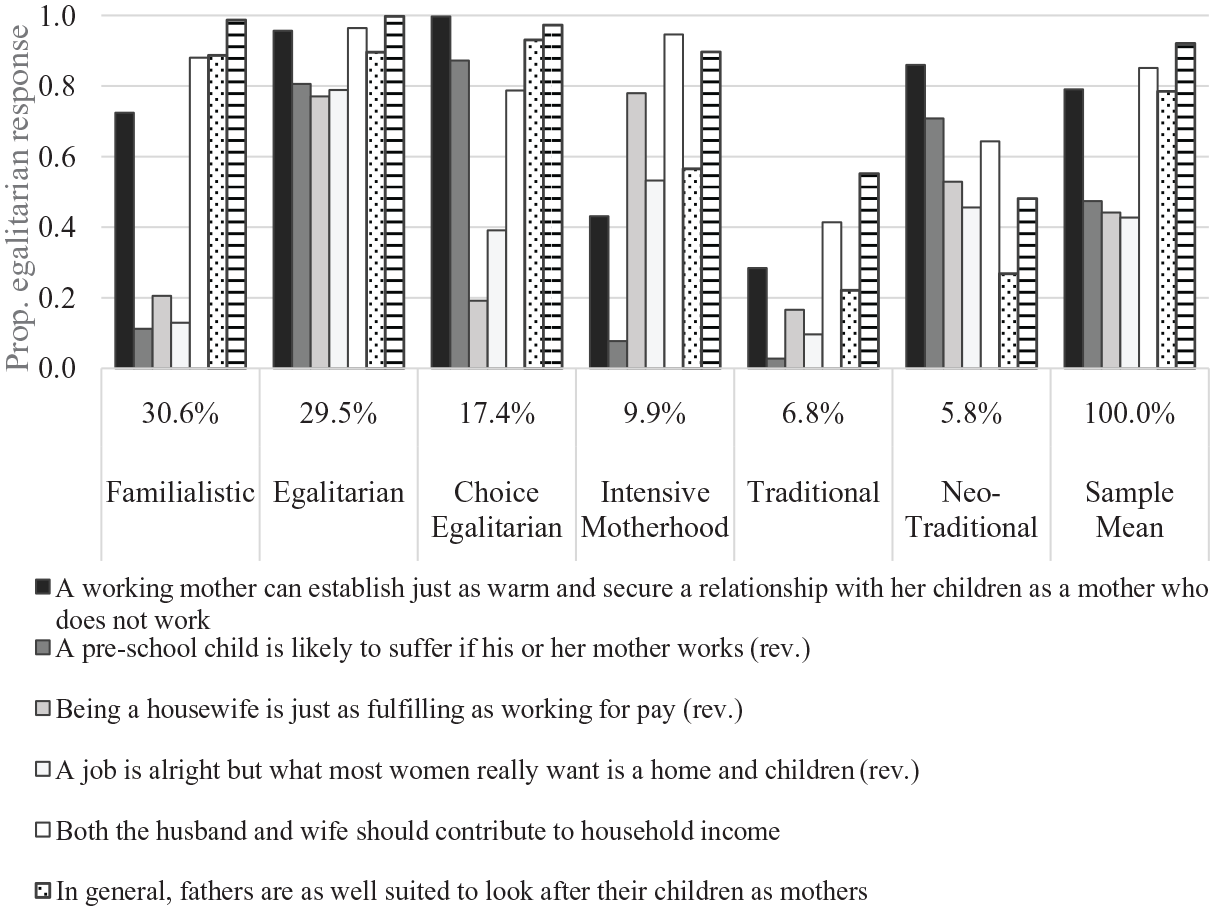
Conditional Probability of Agreement With Egalitarian Gender Ideology Items Per Class
Note that in the analyses of the likelihood of class membership reported in Table 2, the posterior probabilities are scaled from 0 to 100, so all coefficients reported in Table 2 and in the Online Appendix Tables A4 and A5 refer to percentage point changes in the likelihood of class membership. The cross-level interactions between the context characteristics and respondents’ gender and education are presented in the Online Appendix in Table A4 and A5 as the average marginal effects of gender (education) at low and high values of each context characteristic. The average marginal effects thus refer to the predicted percentage point difference in the likelihood of class membership associated with being a woman (vs. a man) or with a one-point increase on the education level. Positive average marginal effects thus indicate a higher class-likelihood of women compared with men, respectively, of the higher compared with the lower educated. In the text these are also referred to as gender gaps or gradients.
Results Obtained From Linear Multilevel Regression Models Predicting Class Membership Likelihood by Covariates at Micro and Macro Level
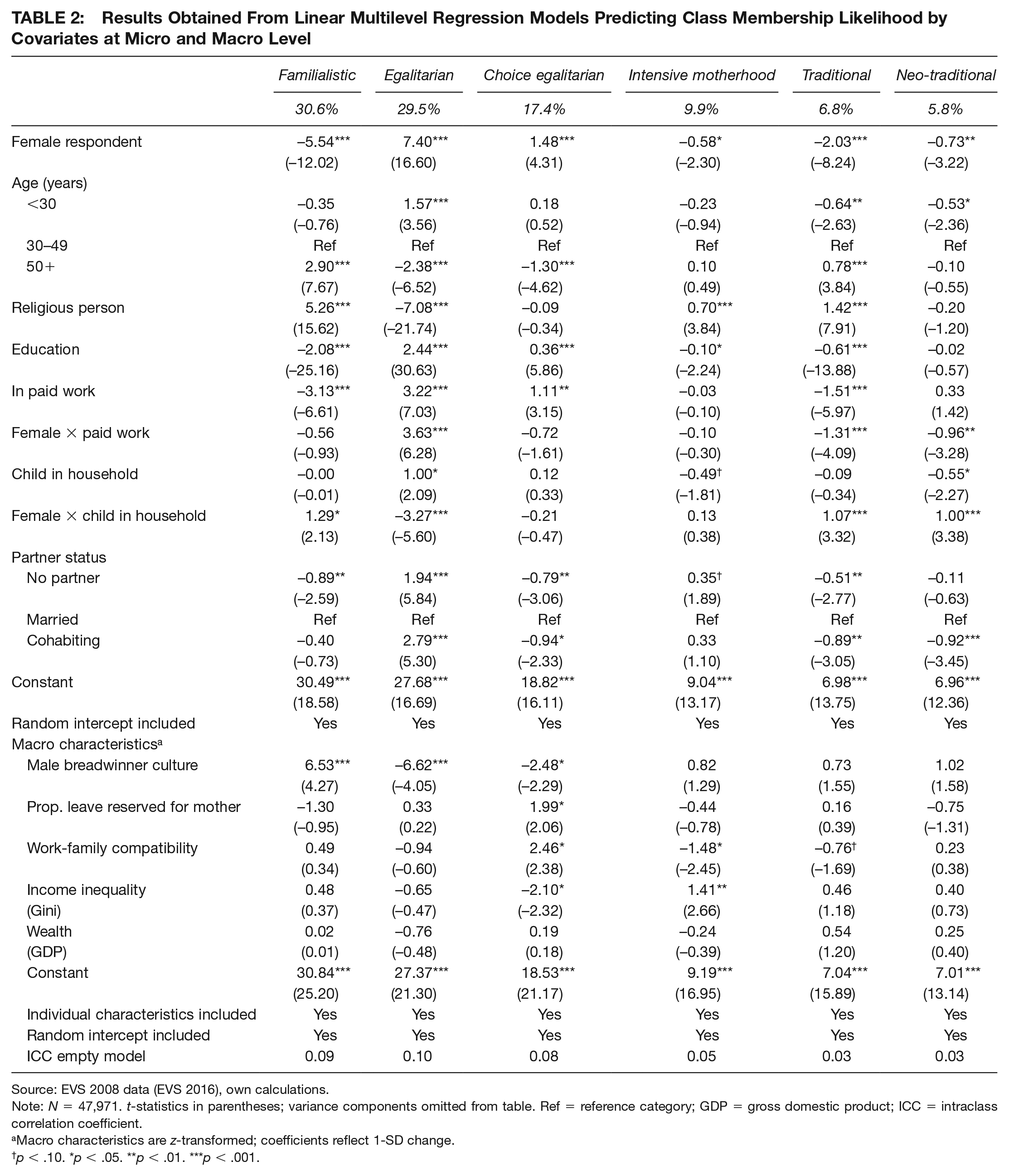
Source: EVS 2008 data (EVS 2016), own calculations.
Note: N = 47,971. t-statistics in parentheses; variance components omitted from table. Ref = reference category; GDP = gross domestic product; ICC = intraclass correlation coefficient.
Macro characteristics are z-transformed; coefficients reflect 1-SD change.
p < .10. *p < .05. **p < .01. ***p < .001.
The largest class, with 30.6 percent of the sample, is multidimensional and labeled “Familialistic.” This class strongly believes that preschool children suffer with a working mother and endorses the housewife role and women prioritizing domestic tasks while at the same time being supportive of dual earning as well as male childcare and domestic responsibility. This reflects a family-centered ideology, demanding that both genders be involved in the home and emphasizing the centrality of domestic tasks for women. This class is similar to the multidimensional class labeled by Knight and Brinton (2017) “egalitarian familism.” Respondent characteristics which predict a higher likelihood of membership in this class are being male, older (ages 50+), lower educated, not employed, and married rather than single. Among women, mothers have a higher likelihood to be part of this class. At the country level, stronger male-breadwinner norms predict a higher likelihood of membership in the Familialistic class, but there is no systematic association with other context characteristics (see Table 2). This is not in line with our theoretical expectations, as we expected stronger male breadwinner norms to be associated not only with the rejection of maternal employment, but also “separate spheres” ideologies, whereas this class endorses male caring as well as dual earning. The results of the cross-level interactions show that the tendency of men to be represented in this class is more pronounced in contexts which are affluent (gender gap –7.4 in affluent vs. –3.12 percentage points in less affluent countries; see Online Appendix Table A4). It is also more pronounced in countries that reserve a larger share of paid leave for women (gender gap –7.55 in countries with high vs. –3.01 percentage points in countries with low shares reserved for women; see Online Appendix Table A4). The negative educational gradient is larger in wealthy countries (–2.98 in affluent vs. –1.25 % points in less affluent countries; see Online Appendix Table A5). At the country level, the size of this class (i.e., the percentage of respondents from a particular country classified as Familialistic) varies between 73 and (close to) 0 percent (for all predicted probabilities, see Online Appendix Table A1). As can be seen in Figure 2, this class is particularly large in Eastern Europe: Ukraine, Malta, Poland, and the three Baltic states (more than 40 percent of respondents). As most of these counties were part of the former Soviet Union, this class appears tied to historical commonalities.
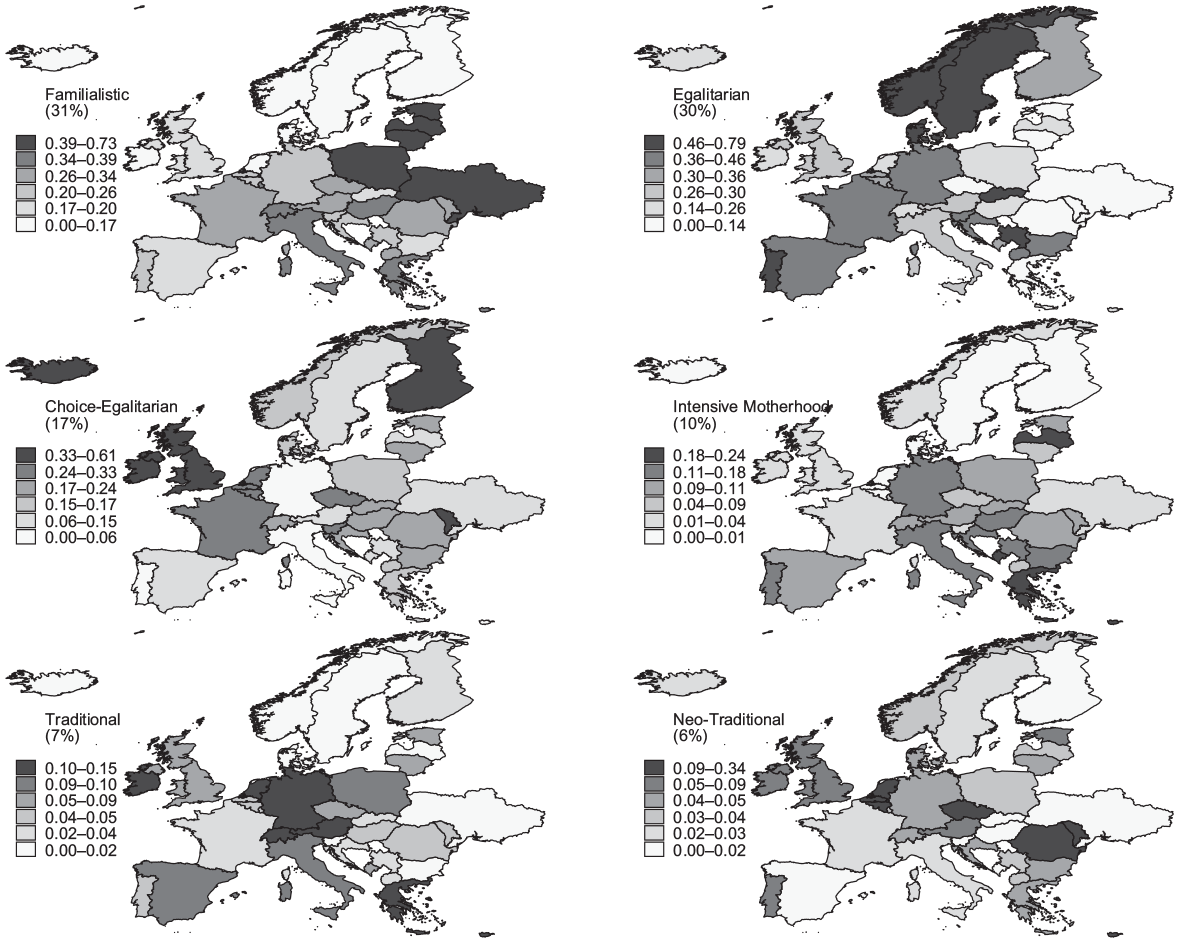
Geographical Distribution of Gender Ideology Classes.
The Egalitarian class is the second largest class in our analysis and comprises 29.5 percent of the sample. Respondents with higher likelihood of membership are likely to be female, young, not religious, higher educated, and employed. Women without children and working women are particularly likely to be classified as Egalitarian. In countries with a stronger male-breadwinner culture, respondents show a lower likelihood of membership of the egalitarian class (see Table 2). What stands out is that individual characteristics appear to be more important predictors of class membership than context characteristics. The size of the Egalitarian class at the country level ranges between 79 and (close to) 0 percent and it is particularly prevalent in Scandinavia (Denmark, Sweden, and Norway), but also in Slovakia, Portugal, and Serbia (see Figure 2). This diversity likely accounts for the absence of systematic associations with context characteristics (see Table 2).
The third largest class is labeled Choice Egalitarian and comprises 17.4 percent of the sample. It reflects egalitarian attitudes toward mother’s employment and men’s suitability for childcare and domestic tasks in combination with endorsing the housewife role and low support for prescribed dual earning. We interpret this as reflecting the discourse of “choice feminism” because it emphasizes individual choice and the acceptance of any chosen role: Women can work even if they have children, or they can be a housewife, and men are just as suited to care for children as women. This class corresponds closely to multidimensional classes described by previous studies (Brinton and Lee 2016; Grunow, Begall, and Buchler 2018; Knight and Brinton 2017). Respondents who are female, below age 50, higher educated, employed, and single or cohabiting (rather than married) have a higher likelihood of class membership. In addition, this class is more systematically associated with macro conditions than the other classes: It is widespread in countries where male-breadwinner norms are weaker, work–family compatibility is higher, levels of inequality are lower, and more paid leave is reserved for the mother. These associations point to the fact that this class thrives under conditions that are conducive to dual earning. We do not find support for our theoretical expectation that this class is more widespread in more affluent societies. However, the cross-level interactions show that gender and educational differences in class membership depend in part on the context: In countries with weak male-breadwinner norms, high wealth, and high proportions of leave reserved for mothers, women are more likely to belong to this class (relative to men), whereas gender gaps are small or nonexistent when these conditions are reversed (see Online Appendix Table A4). For education, we find that in wealthy countries and those with lower work–family compatibility, membership is more likely among higher educated, whereas no such gradient exists when wealth is low or work–family compatibility is high (see Online Appendix Table A5). The proportion of respondents in this class at the country level varies between 61 and (close to) 0. This class is largest in Iceland, Finland, Ireland, the United Kingdom, but also in Moldova and Slovenia, thereby not showing a particular geographical concentration (see Figure 2).
The three largest classes comprise nearly 80 percent of the European sample. The three remaining classes, while capturing relatively small proportions of respondents, tend to show high prevalence in a limited number of countries. The class fourth in size, capturing 10 percent of the sample, is labeled Intensive Motherhood. Responses in this group are critical of maternal employment and of father’s ability to care for children. Despite this, the class takes an egalitarian view on the housewife role, joint earning, and men’s contribution to household tasks (see Figure 1). Respondents with a higher likelihood of membership in this class tend to be male, religious, and lower educated and live in contexts characterized by low levels of work–family compatibility and higher levels of inequality (see Table 2). The association between this class and work–family incompatibility as well as social inequality is in line with our theoretical expectations that these conditions heighten perceptions of conflict between motherhood and employment. Our expectation that social inequality increases the centrality of childrearing among men and women is not reflected in the profile of the Intensive Motherhood class because fathers’ ability to care is not endorsed. The cross-level interactions indicate that men’s higher likelihood of membership (as indicated by negative gender gap) is more pronounced in countries with weak male-breadwinner norms, low levels of inequality, and high levels of wealth (see Online Appendix Table A4). In the same vein, the lower educated have a higher likelihood of membership in contexts with weak male-breadwinner norms. In contexts with strong male-breadwinner norms, the gender and education gap reverses, making women and the higher educated more likely to be classified in the Intensive Motherhood class. This class appears to be geographically concentrated in Southern and Eastern Europe, with the largest proportions of respondents located in Latvia, Greece, Cyprus, Montenegro, and Italy (see Figure 2). The size of this class at the country level ranges between 24 and (close to) 0 percent.
The Traditional class includes 6.8 percent of the sample. In this class, the responses to all items are the least egalitarian. Respondents in this class are more likely to be male, older (50+), religious, lower educated, not working, and married. Women with children in the household and non-employed women also have higher membership probabilities. In terms of the respondent profile, this class is the counterimage of the Egalitarian class. Moreover, membership in this class also appears more strongly tied to individual characteristics compared with the multidimensional classes and is not systematically related to macro characteristics. The cross-level interactions show that differences by gender and education are nevertheless in part conditional on the context: In countries with low work–family compatibility, gender and educational differences are stronger compared with contexts with high work–family compatibility; and in contexts with leave mostly reserved for the mothers, the gender gap relating to men’s higher likelihood of membership is larger (see Online Appendix Tables A4 and A5). Although this class includes only a small proportion of the sample (ranging between 0 and 15 percent), it is geographically concentrated in the German-speaking countries (Germany, Switzerland, Austria) as well as the Netherlands and Ireland, where it accounts for 12–15 percent of respondents (see Figure 2).
Finally, the smallest class, comprising 5.8 percent of the sample, is labeled Neo-Traditional. Responses for this class are critical of paternal childcare, male domestic responsibility, and joint earning, suggesting traditional views on men’s role in the family, whereas the responses to the other items suggest acceptance of working mothers, even when children are preschool age. With regard to its association with respondent and context characteristics, the Neo-Traditional class has lower membership probabilities among respondents who are female, young (ages 30+), cohabiting, and, in case of women, working and without children in the household (see Table 2). This class is not systematically associated with any macro characteristic, but, comparable with the Intensive Motherhood class, gender gaps are smaller in contexts with stronger male-breadwinner norms, most leave reserved for mothers, less work–family compatibility, and higher inequality (see Online Appendix Table A4). This class is most prevalent in a few South-Eastern European countries: Romania, Moldova, and the Czech Republic, but also the Netherlands (see Figure 2). The size of this class at the country level ranges between 34 and (close to) 0 percent.
In addition to the association of class membership with individual- and macro-level characteristics and the geographical distribution of classes, we examine to what extent countries are characterized by combinations of classes. Figure 3 displays the effective number of classes per country (inverse Simpson index). The countries with the lowest diversity in gender ideologies are Scandinavian countries (where the Egalitarian class is dominant) and Ukraine (where the Familialistic class is dominant). The countries with the highest diversity (around four classes) are located in South-Eastern Europe, but also the Netherlands is characterized by a high diversity of gender ideologies. In addition to the number of classes per country, the correlations between class sizes at the country level (see Online Appendix Table A6) show that larger proportions of respondents classified in the Familialistic class are associated with a lower proportion in the Egalitarian and the Choice Egalitarian class. Furthermore, in countries in which the Egalitarian class is prevalent, smaller proportions of respondents are classified as Neo-Traditional. The Intensive Motherhood class is larger in countries in which the Choice Egalitarian class is smaller—a tendency that corresponds to the opposite signs of the relevant macro predictors work–family compatibility and inequality.
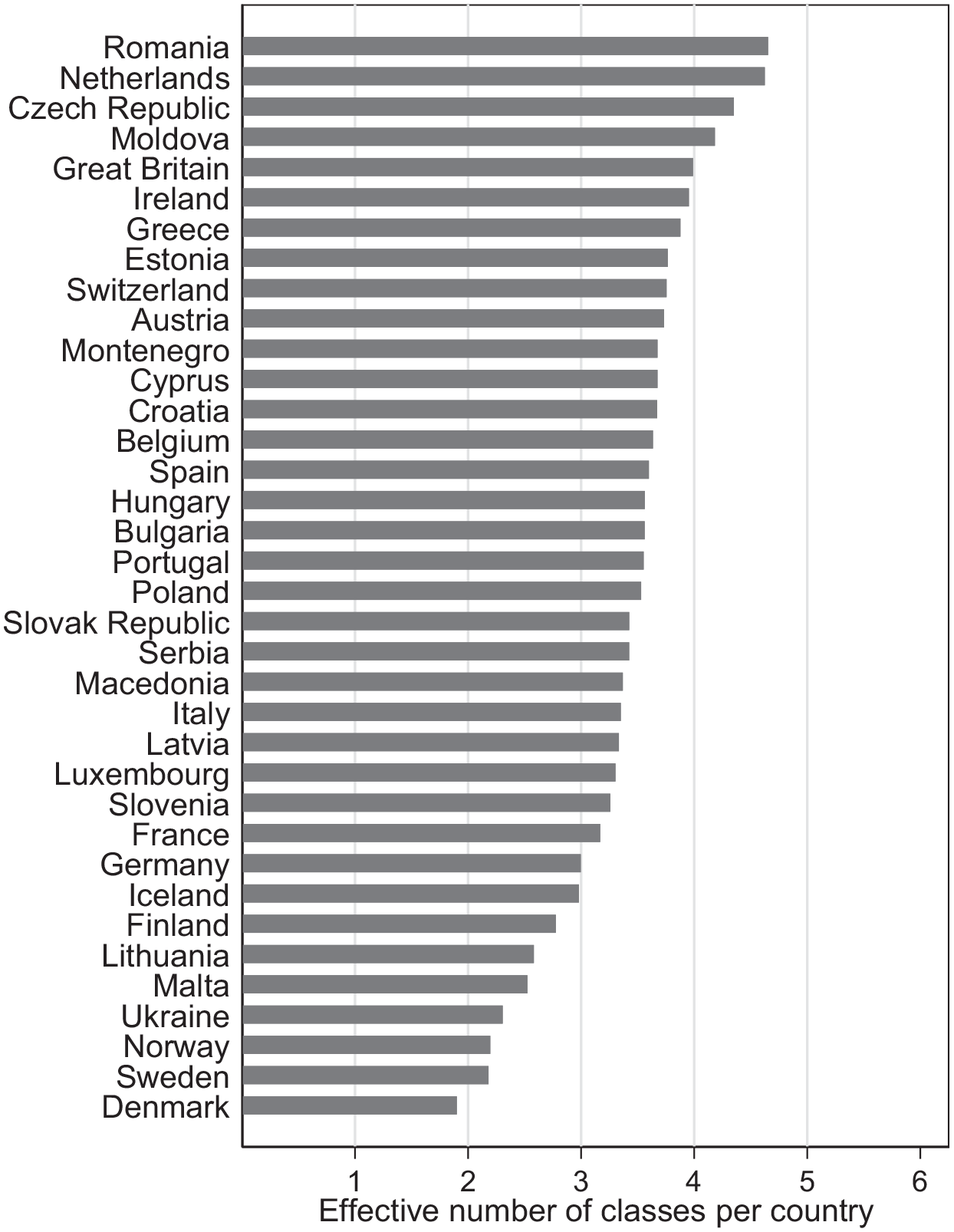
Diversity of Gender Ideologies by Country
Discussion
In this study, we examined the association between gender ideologies and macro- and micro-level mechanisms suggested in the literature as explanations for the stagnating and diverging trends in gender ideologies in (post)-industrialized countries associated with the “stalled gender revolution” (England 2010; Sullivan, Gershuny, and Robinson 2018). We conceptualized these mechanisms as national variation regarding (1) the institutional framing of work and care roles as gendered responsibilities or a matter of individual choice, (2) work–family compatibility, (3) social inequality, and (4) societal affluence. We used a particularly large sample of 36 European democracies, which enabled us to provide a comprehensive picture of the gender ideology landscapes of Europe. Specifically, the inclusion of a large number of Central, Eastern, and South-Eastern European countries provides new insights into the spread of gender ideologies in these contexts. In addition, we aimed to contribute to consolidating and expanding previous findings on multidimensional gender ideologies by replicating and extending available studies (Grunow, Begall, and Buchler 2018; Knight and Brinton 2017).
Our findings show, first, that merely 36 percent of Europeans can be classified as unidimensional Egalitarian or Traditional. The Egalitarian class is only the second largest group we identified, capturing 30 percent of the population, and only a very small fraction could be classified as unidimensional Traditional. The remaining four classes (containing more than 60 percent of respondents) represent multidimensional gender ideologies as they combine egalitarian views on certain issues with more traditional or ambivalent views on others.
Second, looking at class patterns, their geographical distribution, and the mutual relationship between class sizes at the country level we find two classes we interpret in line with Knight and Brinton (2017) as “varieties of egalitarianism.” The first one is represented by the Egalitarian class, and the second one is multidimensional and labeled Choice Egalitarian. Women, the higher educated, and younger respondents are more likely to be members of these classes, and they make up larger proportions of respondents in contexts where male-breadwinner norms are weak yet tend to be dominant in different countries.
The other three multidimensional classes and the traditional class may be thought of as varieties of essentialism in the sense that they share associations with covariates that are the counterimage of the egalitarian classes: Respondents tend to be male, older, lower educated, and religious. Also, these classes tend to be larger in countries with stronger male-breadwinner norms and lower work–family compatibility, and they tend to capture smaller proportions of respondents in countries in which the (Choice) Egalitarian class is more prevalent. At the same time, the substantive interpretation of these classes as well as their geographical distribution also points to important differences between the “varieties of essentialism” and thus to a more nuanced interpretation: that these classes capture overlapping constructs of gender and family roles, but are shaped by specific historical, cultural, and institutional conditions.
Third, our study expands and validates earlier research by replicating the design of a study that used a limited sample of eight countries (Grunow, Begall, and Buchler 2018). We show that the class patterns identified are remarkably similar when using the same set of items on a broader range of countries and widening respondents’ age bracket beyond the core phase of family formation. Our findings also correspond well with the patterns described by Knight and Brinton (2017) and Scarborough, Sin, and Risman (2019). We thereby contribute to establishing the robustness of findings within the relatively young field studying multidimensional gender ideologies.
Conclusion
Previous work addressing gender ideologies as a stalling force in the gender revolution has focused on the United States and other prosperous Western countries. We have applied this perspective, most notably Risman’s (2018) revised gender structure theory, to a much wider set of institutional contexts, which are shaping key forces of the gender revolution differently. Our findings show how gender ideologies are distributed in these various institutional contexts and to what extent the macro-level factors emphasized in the gender structure framework are associated with the spread of unidimensional and multidimensional gender ideologies. Despite the fact that individual countries follow their own logics of institutional and gender change, we conclude that the macro-level factors identified as relevant in the gender structure framework particularly help us understand the current variation in multidimensional ambivalent gender ideologies across European democracies. Egalitarian and traditional ideologies, in contrast, are associated more clearly with individual characteristics as well as interactions between individual and country characteristics.
Our findings, though based on cross-sectional data, may also contribute to the yet unresolved question of whether the landscape of gender ideologies we observe across Europe constitutes different stages of development toward gender equality characterized by multiple equilibria (Esping-Andersen and Billari 2015) or whether culturally shared ideal-types of gender relations or “gender cultures” produce stable varieties of essentialist and egalitarian ideologies (Lewis 2001). Our findings show that the co-occurrence of multiple gender ideologies is especially pronounced in Southern and Central/Eastern European countries, which fits the phase of unstable equilibria (Esping-Andersen and Billari 2015). The Nordic countries, in contrast, have largely established an egalitarian equilibrium as far as gender ideologies are concerned. The finding that work–family compatibility and male-breadwinner norms account for some of the variation in class sizes points to the role of policy makers and gender culture to promote or hamper the establishment of a new egalitarian equilibrium (Lewis 2001). The significant interaction effects between macro- and micro-level characteristics further indicate that these contextual conditions are important in uniting or dividing women and men as well as the higher and lower educated in the process (Esping-Andersen and Billari 2015), thus clearly shaping the interactional level at which gender relations are transformed, reproduced, and contested (Risman 2018; Scarborough and Risman 2017). Future research may assess the stability of these pluralistic ideology patterns over time and shed more light on this. Another avenue for future research involves how the interplay between individual and contextual gender ideologies produces behavioral or institutional outcomes and thus potential change in gender relations. One avenue of research might be whether types of gender ideologies held by a minority in one country compared with a majority in another country relate to individual outcomes in the same way (Gonalons-Pons and Gangl 2021).
While feminist thinkers have long questioned the legitimacy and validity of theorizing the family in terms of the separate spheres framework (Ferree 1990), the focus in scientific and public debates on gender equality and the stalled revolution often lies on the extreme ends of this continuum. Our study showed that a fully traditional ideology is supported by about one in 15 Europeans, whereas six of 10 hold a form of ambivalent ideology. Rather than focusing on the unidimensional end points, our understanding of contemporary gender relations, their complexities, and contradictions may be fruitfully enhanced if we focus on the spectrum of gender ideologies that crosscuts the two.
Supplemental Material
sj-docx-1-gas-10.1177_08912432231155914 – Supplemental material for Multidimensional Gender Ideologies Across Europe: Evidence From 36 Countries
Supplemental material, sj-docx-1-gas-10.1177_08912432231155914 for Multidimensional Gender Ideologies Across Europe: Evidence From 36 Countries by Katia Begall, Daniela Grunow and Sandra Buchler in Gender & Society
Footnotes
Authors’ Note:
Daniela Grunow would like to acknowledge funding from the Federal Ministry of Education and Research (funding code 01UG2114) and the German Research Foundation (FOR 5173, no. 439346934).

Supplemental Material
Supplemental material for this article is available online.
Katia Begall is an assistant professor of sociology at the Radboud University Nijmegen, the Netherlands. Her research interest focuses on the interrelation between paid work and family over the life course. She is particularly interested in the household division of tasks, gender ideologies, and work–family policies.
Daniela Grunow is a professor of sociology specializing in quantitative analyses of social change with a focus on gender, norms, ideologies, and work, at the Faculty of Social Sciences, Goethe University Frankfurt am Main, Germany. She is the director of the Institute for Empirical-Analytical Research (InFER) at Goethe University and spokesperson of several interdisciplinary projects and research groups funded by the German Research Foundation and the Federal Ministry of Education and Research. Her work has been published in multiple academic journals including Social Forces, Journal of Marriage and Family, and European Sociological Review. She has also edited several international books and special issues.
Sandra Buchler is a research fellow and lecturer at the Department of Sociology at the Goethe University Frankfurt am Main. Her current research focuses on gender attitudes, the transition to parenthood, how gender influences individuals’ and couples’ labor market careers, and occupational segregation by gender.
References
Supplementary Material
Please find the following supplemental material available below.
For Open Access articles published under a Creative Commons License, all supplemental material carries the same license as the article it is associated with.
For non-Open Access articles published, all supplemental material carries a non-exclusive license, and permission requests for re-use of supplemental material or any part of supplemental material shall be sent directly to the copyright owner as specified in the copyright notice associated with the article.
