




Abstract
The primary goal of this study is to identify patterns in the ways mothers adhere to, reject, and combine intensive mothering attitudes and behaviors. Mothers often face immense pressure to devote significant physical and mental effort toward childrearing, referred to as intensive mothering. At the same time, many mothers do not follow the actions or beliefs that gender norms suggest they should. It remains unclear how mothers holistically approach intensive parenting across many different facets. Using the 2014 Child Development Supplement from the Panel Study of Income Dynamics, I examined how a sample of mothers fell into intensive mothering profiles, or latent classes, and how class membership varied by demographic characteristics. Results showed four underlying latent classes of intensive motherhood: Relaxed Mothers (33 percent), High Investors (25 percent), Essentialist Mothers (22 percent), and Strained Mothers (20 percent). No group was intensive across all measures, contrary to common narratives in previous research and theory. Class membership varied by several characteristics, including education, age, income, race, single parenthood, and employment. By revealing how mothers are selectively intensive, this study expands on the ways mothers simultaneously “do” and “undo” gender norms in their parenting, as well as the sociodemographics that may predict these patterns.
Western mothers spend more time in childcare (Bianchi, Robinson and Milkie 2006; Dotti Sani and Treas 2016), breastfeed longer (Baker 2016; Faircloth 2009; Maralani and Stabler 2018), and report higher emotional challenge in childrearing (Ennis 2014; Liss et al. 2013; Sutherland 2010) today than in any other time in recent history. In the mid-1990s, Sharon Hays (1996) attributed these and other similar trends to a rise in “intensive mothering” beliefs, or the idea that the ideal way to raise children includes high money, time, and energy investments. Since this time, intensive mothering has become increasingly pervasive, to the point where it is now cited as the dominant ideology and modal way of mothering in many developed countries (Ennis 2014; Wall 2013). Despite rising egalitarianism and father involvement in family life (Sayer 2016), mothers are often conceptualized as the irreplaceable and primary parent (Ennis 2014; Hays 1996). As a result, modern motherhood is often physically, mentally, and emotionally sedulous. In light of these trends, scholars have described the expectation of intensive mothering as an increasingly strong and prevalent gender norm (Ennis 2014; Wall 2013).
At the same time, however, mothers do not always follow the actions or beliefs that gender norms suggest they should (e.g., Barnes 2016; Christopher 2012; Damaske 2011; Dow 2016). The resources required to be intensive may prohibit some mothers from doing so in every aspect of their parenting, even if they aspire to do so (Bowen, Brenton, and Elliott 2019; Leigh et al. 2012). Mothers must often be selective in the face of impossible or unachievable standards (Bobel 2004; Miller 2007), particularly when they face socioeconomic constraints (Bowen, Brenton, and Elliott 2019; Lareau 2003) or must juggle parenting with career demands (Christopher 2012). Others may reject the ideals of intensive mothering altogether (or in part) by reframing what they believe to be good mothering (Christopher 2012; Damaske 2011; Garey 1995; Johnston and Swanson 2006; Miller 2007; Romagnoli and Wall 2012). This leaves a significant sociological puzzle: The expectations of intensive mothering appear stronger than ever (Ennis 2014; Wall 2013), yet mothers seem to deviate from these norms in their own lives.
The ways in which mothers holistically adopt intensive mothering may therefore vary significantly, yet limitations in previous research make this difficult to discern. First, few studies model intensive mothering attitudes and behaviors together (for exceptions, see Ashton-James, Kushlev, and Dunn 2013 and Schiffrin et al. 2015). The literature often supposes that mothers who have intensive behaviors also hold intensive attitudes, and vice versa, which may cloud nuances in the ways mothers hold certain attitudes but not enact them. In other words, there may be different kinds of intensive mothers.
Second, although studies document variability in intensive mothering behaviors, many only examine one or two facets at a time, such as time spent with children (Dotti Sani and Treas 2016; Fomby and Musick 2018; Milkie, Nomaguchi, and Denny 2015) or breastfeeding duration (Faircloth 2009; Maralani and Stabler 2018). This gives important insight into specific areas of intensive mothering but cannot speak to how mothers may adopt one practice but not another, nor how these align with intensive mothering attitudes.
Finally, research that does take a more holistic approach is often done on samples narrow in demographic scope, focusing on mothers of a certain social class, race, or employment status (e.g., Barnes 2016; Dow 2016; Elliott, Powell, and Brenton 2015) and, in turn, limiting direct comparisons across these characteristics. If intensive mothering patterns are correlated with demographic characteristics, this may capture only a portion of the variation in intensive mothering. Therefore, it is critical to ask: (1) What are the typical patterns of intensive mothering that combine both attitudes and behaviors? (2) How prevalent are these different intensive mothering patterns? and (3) What types of mothers adhere to each pattern?
To address these questions, it is necessary to examine a set of intensive mothering variables in relation to each other. First, I review intensive mothering literature and recent debates on its variation. Second, using the 2014 Child Development Supplement (CDS; 2021) from the Panel Study of Income Dynamics (PSID; 2022), I use latent class analysis (LCA) to identify patterns in how individuals combine types and levels of 11 intensive mothering variables. Finally, I examine the relationships between the latent classes and various sociodemographic characteristics. Given that the United States has fewer institutional supports for mothers than many other Western countries (Collins 2019), such as paid maternity leave or universal subsidized childcare, the United States is a particularly important location to examine this topic. This study expands on previous research by clarifying how intensive mothering norms manifest in the modern mother’s lived experiences, exploring what may explain these patterns and unveiling nuances in how intensive mothering behaviors align with attitudes. In doing so, it informs our understanding of how contemporary American mothers simultaneously “do” and “undo” gender in their parenting (Deutsch 2007; Risman 2009; West and Zimmerman 1987).
Background
The Strength and Rise of Intensive Mothering
Many scholars argue that central to “doing” gender is “doing” motherhood (Arendell 2000; Ridgeway and Correll 2004) because mothering is often considered the peak of caretaking, and self-sacrifice is integral to the feminine ideal (Ridgeway and Correll 2004). One of the most salient, widespread gender norms placed on mothers today is the expectation to perform intensive mothering (Ennis 2014). Women are enjoined to actively foster their children’s abilities, devote as much of themselves to their children as possible, and place the child at the center of the household (Liss et al. 2013). They are pressured to spend copious amounts of time engaged with children—time that is viewed as more important for children than that of fathers, as gender norms deem mothers irreplaceable and the primary caregiver by necessity (Ennis 2014; Hays 1996; Liss et al. 2013). Experts regularly recommend that educational activities begin even before children enter school, urging mothers to play with children and read aloud to them to foster development (Macvarish, Lee, and Lowe 2014). In turn, with the rise in evidence-based parenting, many mothers now feel they must breastfeed (and breastfeed longer) to promote child brain development, despite the significant commitment and energy required of them to do so (Artis 2009). On top of this, society expects mothers to regard their parenting as highly rewarding and satisfying, albeit also exhausting (Gunderson and Barrett 2017; Liss et al. 2013).
Intensive Behaviors
As a result, many intensive mothering behaviors have increased significantly in the past several decades across nearly all developed countries. Since the 1970s, American mothers have nearly doubled (or even tripled) their overall time spent with children (Milkie, Nomaguchi, and Denny 2015), time spent in developmental child care such as reading to children (Sayer 2016), time playing with children (Gauthier, Smeeding, and Furstenberg 2004), and rate of breastfeeding (Baker 2016). Some research suggests certain intensive mothering behaviors—such as time spent with children, reading to and playing with children, and having ever breastfed—may be widely present across mothers of varying income, education, employment, marital status, age, and more (Bianchi, Robinson, and Milkie 2006; Centers for Disease Control and Prevention [CDC] 2021; Dermott and Pomati 2016; Hsin and Felfe 2014; Pepin, Sayer, and Casper 2018). Many scholars take these patterns as evidence that intensive mothering is the norm and the most common form of modern motherhood in the United States and other developed countries (Ennis 2014; Wall 2013).
Intensive Attitudes
Much research indicates that intensive mothering ideologies have risen in conjunction with the rise in intensive mothering behaviors (Pedersen 2016; Wall 2013). Mothers today are more likely than those of previous generations to endorse beliefs that their parenting should be child-centered and should produce satisfaction, greater rewards than costs, and personal fulfillment (Ennis 2014; Liss et al. 2013; Meeussen and VanLaar 2018; Nomaguchi and Milkie 2003; Sutherland 2010; Warner 2005). At the same time, today’s mothers are more likely to report that motherhood is emotionally and physically tiring (Liss et al. 2013; Rizzo, Schiffrin, and Liss 2013; Sutherland 2010). Mothers are expected to feel worn out from their parenting (Forbes, Donovan, and Lamar 2019; Liss et al. 2013; Loyal, Sutter Dallay, and Rascle 2017), with some mothers equating a lack of exhaustion with inadequate investment (Sutherland 2010). Fathers, in contrast, are often conceptualized as well-intentioned but incompetent, and consequently unable to provide the same quality of care as mothers (Damaske 2011; Hays 1996; Liss et al. 2013). This is frequently referred to as “essentialism” in the literature, stating that a facet of intensive mothering is belief that mothers are the more essential parent (Forbes, Donovan, and Lamar 2019; Liss et al. 2013; Rizzo, Schiffrin, and Liss 2013). Thus, not only do intensive mothering norms dictate how mothers should parent, they also dictate how mothers should feel about themselves as parents (Johnston and Swanson 2006; Miller 2007; Sutherland 2010; Wall 2013).
As with behaviors, some research suggests that attitudinal commitment to intensive mothering is widely shared across different social groups, including income, race, education, marital status, number of children, and employment status (Elliott, Powell, and Brenton 2015; Forbes, Donovan, and Lamar 2019). These findings support Hays’ (1996) arguments on the universality of intensive mothering ideologies; Hays asserts that Western mothers generally hold similar beliefs about what constitutes a good mother but have varying success at enacting them due to constraints.
Negotiating Intensive Mothering
However, despite the increased strength and prevalence of intensive mothering norms, many mothers still do not uniformly follow these demands (e.g., Barnes 2016; Christopher 2012; Dow 2016; Johnston and Swanson 2006). Societal gender expectations for the modern mother are often extremely difficult or impossible to achieve (Bobel 2004; Miller 2007). By definition, intensive mothering demands tangible and intangible resources, potentially forcing mothers to be selective in how they allocate their physical and mental time, effort, and money (Ennis 2014; Hays 1996). In additional to norms of intensive mothering, some women may hear competing cultural ideals, including ones that actively advocate for mothers to be less intensive (Barnes 2016; Dow 2016; Pedersen 2016). Therefore, rather than falling into an “intensive” or “nonintensive” binary, many mothers may fall somewhere in between, adopting certain aspects of intensive mothering while rejecting others.
Negotiating Behaviors
To meet high expectations for time spent with children, research shows that mothers may sacrifice time spent in other areas, including housework and leisure (Bianchi, Robinson, and Milkie 2006; Bianchi et al. 2012). Still, structural and resource constraints may prevent them from investing as much time in childrearing as they may (or may not) desire (Bowen, Brenton, and Elliott 2019; Christopher 2012; Lareau 2003; Leigh et al. 2012), even if they are still intensive in other areas. Because playing with children and reading to children are often done at different points in the day, women who are more likely to have nonstandard work hours (lower-income, lower-educated, Black, and single mothers) may be able to achieve one type of activity with children but not the other (Enchautegui 2013). Breastfeeding is less common among lower-educated and lower-income mothers due in part to their job inflexibility, lack of private spaces to pump breastmilk at work, and lower access to maternity leave (Artis 2009). Although some evidence suggests that total time with children is similar across employment status (Bianchi, Robinson, and Milkie 2006; Hsin and Felfe 2014), this may be changing as employed mothers work longer hours than in previous years (Hegewisch and Lacarte 2019). Finally, women may be less intensive in their parenting behaviors as a preference, not merely due to resource constraint.
Negotiating Attitudes
In response to high societal demands, women may reconstitute what characterizes a good mother (Christopher 2012; Damaske 2011; Garey 1995; Johnston and Swanson 2006; Miller 2007). Although mothers often base their decisions about work or family around what will fit with their own ideologies, they may also change their ideologies to fit their decisions or life circumstances (Damaske 2011; Johnston and Swanson 2006). Qualitative studies indicate that many women reframe less gender-traditional choices, such as maternal employment, as actively beneficial for children (Damaske 2011; Dow 2016), asserting that a good mother oversees and manages her child’s well-being (Barnes 2016; Christopher 2012). Several studies suggest that both parenting styles and conceptions of motherhood are more intensive in middle-class than in working-class mothers (Christopher 2013; Lareau 2003; Leigh et al. 2012; Schneider, Hastings, and LaBriola 2018; Taylor 2011), although some find an opposite association (e.g., Walls, Helms, and Grzywacz 2016). Mothers may also lessen their intensive mothering attitudes as they have more children and gain confidence in their parenting abilities (Bryanton et al. 2008; Walls, Helms, and Grzywacz 2016).
Moreover, qualitative studies suggest that some mothers experience competing cultural norms, significantly influencing how they view parenting (Barnes 2016; Dow 2016). For example, Black women describe mothering norms that include mothers’ health and happiness as an important goal (Christopher 2013; Dow 2016)—a narrative that stands in contrast to the idea that children’s needs should always come first (Hays 1996). Black mothers may also emphasize norms of interdependent childrearing, where extended kin and community members regularly help support mothers (Barnes 2016; Dow 2016). Highly educated and higher-income Latina mothers, in contrast, are more likely to show norms of extensive mothering than their less-educated, lower-income counterparts, particularly if they are employed in jobs they enjoy (Christopher 2013). Yet pressures of intensive mothering may not be absent from Black and lower-income Latina women’s lives (Christopher 2013; Elliott, Powell, and Brenton 2015; Walls, Helms, and Grzywacz 2016); rather, some women may experience a broader set of (potentially competing) norms. In sum, research emphasizes the increasingly pervasive norms of intensive mothering, yet it also shows that mothers routinely diverge from this norm due to personal circumstances or different community standards.
A Holistic Approach
Despite this, many studies focus on whether and how mothers are either intensive or not in a certain area, without exploring the holistic ways in which they may be both. Cultural pressures to mother intensively span numerous aspects of parenting (Hays 1996); thus, quantitative studies measure intensive mothering behaviors with a plethora of commonly used indicators, including time spent with children (e.g., Dotti Sani and Treas 2016; Fomby and Musick 2018; Milkie, Nomaguchi, and Denny 2015), reading to and playing with children (e.g., Dermott and Pomati 2016), breastfeeding (e.g., Faircloth 2009; Maralani and Stabler 2018), and more. Although some of these studies include multiple measures (e.g., Gunderson and Barrett 2017; Henderson, Harmon, and Newman 2016), many still use only one or two variables (e.g., Dotti Sani and Treas 2016; Maralani and Stabler 2018; Milkie, Nomaguchi, and Denny 2015). These studies are highly informative, yet they often can speak only to specific facets of intensive mothering, with little comparison of how multiple behaviors and attitudes are intertwined and conditionally associated.
Studies that do utilize several variables often cover intensive mothering attitudes but not practices (Forbes, Donovan, and Lamar 2019; Gunderson and Barrett 2017; Henderson, Harmon, and Newman 2016; Liss et al. 2013 for exceptions, see Ashton-JamesKushlev and Dunn 2013 and Schiffrin et al. 2015). These questionnaires are frequently used on convenience samples and in scales that measure intensive mothering on an assumed low to high continuum (Forbes, Donovan, and Lamar 2019; Liss et al. 2013; Walls, Helms, and Grzywacz 2016). Implicit in this methodology is the idea that all included variables tap into a single underlying concept: that if a mother is intensive in one area of her parenting, she is predicted to be intensive in the other areas.
Several qualitative studies conduct a more comprehensive examination of intensive mothering (e.g., Bowen, Brenton, and Elliott 2019; Christopher 2012; Dow 2016; Elliott, Powell, and Brenton 2015; Garey 1995); however, they are frequently restricted to mothers of a certain social class (e.g., Bowen, Brenton, and Elliott 2019; Elliott, Powell, and Brenton 2015; Johnston and Swanson 2006; Leigh et al. 2012), race (e.g., Barnes 2016; Dow 2016; Elliott, Powell, and Brenton 2015), or employment status (e.g., Christopher 2012; Garey 1995), limiting direct comparisons across these characteristics. Quantitative studies often test for these differences, but show inconsistent results, particularly on whether intensive mothering is a universal set of beliefs constrained by resources or a less ubiquitous ideation enabled by them.
According to prior theory, then, an intensive mother will spend high amounts of time engaged with, playing with, and reading to her children; breastfeed for a long duration; view mothering as rewarding but tiring; and view fathers as a secondary parent. It is possible that some mothers may fit all or even most of this description, but, as demonstrated above, it is likely that mothers pick and choose attitudes and actions that work within their own constraints, community norms, and personal preferences, even if those patterns may seem contradictory. Measuring intensive mothering as a scale may obscure how individuals uniquely combine varying types and levels of practices and attitudes.
Disentangling these competing claims may help us better understand how mothers navigate the cultural ideals that some have termed “impossible” and what predicts the likelihood that mothers will serve these demands (Bobel 2004; Miller 2007). With this study, I contribute to past literature by testing assumptions of the universality of intensive mothering and clarifying debates on mothering and its correlates in the literature.
Methods
Data are from the 2014 Child Development Supplement (CDS) of the Panel Study of Income Dynamics (PSID), a household survey of families in the United States. PSID households were eligible for the CDS if they had at least one child between the ages of 1 and 17 years living in the household. The CDS collected information on primary care givers (PCGs) in the household (N = 2,517) and each child living with them who was below 18 years. PCGs were defined as the household parent or adult with the most responsibility for taking care of children.
This study combines two components of the 2014 CDS: (1) surveys given to the PCGs about their household and parenting and (2) time diaries documenting activities for each child. More than 900 CDS households were randomly selected to participate in child time diaries over a 24-hour weekday and 24-hour weekend day. Unlike previous waves of the CDS, all children below age 18 years in the selected households participated in time diaries. The diaries identify what the child was doing, who else was participating in the activity, and who was around but not participating at the time of the activity. This information can be used to identify when mothers are engaged with their children (and what activity is being performed) and when they are accessible to their children. From this information, I created a data set with the PCG as the unit of analysis.
The analytic sample includes biological mothers who were identified as PCGs (n = 1,991), whose household was selected and completed the time diary for both days (n = 662), and who had at least one child ages 1 to 5 years (n = 306). The sample was restricted to mothers with young children for two reasons. First, it may be difficult to directly compare parenting across children’s stages of development. For example, parental investment in a young child may take the form of play or reading, whereas investment in an older child is more likely to include monitoring academics or shuffling the child to activities (Lareau 2003). Second, mothering is usually the most demanding during this time period (Umberson, Pudrovska, and Reczek 2010), so the greatest amount of variation may exist when children require the most care.
In this study, I examine several variables related to intensive mothering behaviors (time spent engaged with children, including total time, play time, and reading; breastfeeding) and attitudes (satisfaction from parenting, tiredness, and fathers as “secondary” parents). I first describe how the behavioral measures are conceptualized and operationalized and then turn to the attitudinal measures.
Behavioral Measures
I derived three behavioral measures of intensive mothering from the time diary data: total engaged time, engaged play time, and engaged reading time. Time variables were restricted to information about mother’s activities with children ages one to five years. Although accessible time with children—hours around them but not directly involved in activities with them—is sometimes included in studies of mothers’ time use (e.g., Fomby and Musick 2018; Milkie, Nomaguchi, and Denny 2015), this was not included in analyses because it did not distinguish between classes, and results were nearly identical with or without accessible time. Likewise, physical care time did not distinguish between classes and was excluded from analyses. Total engaged time reflected the number of hours per week mothers spent participating in activities with their young children. Playing with children included activities such as games, outdoor and indoor play, dress-up or pretend, playing with toys or dolls, and other unspecified play as characterized by the CDS documentation. Hours playing with children indicates time investment not related to physical care, child-related chores, or other activities born of necessity. Because it is not vital for a child’s physical well-being, play time may be more susceptible to parents’ time and energy constraints. Finally, although reading to children often takes comparatively little time, it is highly reflective of a parent’s intention and ability to actively foster their children’s intellectual ability even before they begin school (Dermott and Pomati 2016).
As is standard in this literature, the 24-hour weekday was multiplied by five and added to the 24-hour weekend day multiplied by two (Fomby and Musick 2018; Hsin and Felfe 2014; Milkie, Nomaguchi, and Denny 2015). Because the 2014 CDS sampled every eligible child in the household—rather than restricting the number to just two, as in previous waves—time involvement can be estimated at the level of the mother.
Scholars have criticized past studies for looking at maternal time investments as a linear measure, arguing that operationalizing intensive mothering with a continuous variable makes no attempt to actually specify levels that are intensive (Kalil and Mayer 2016). Therefore, total engaged time was coded as <20 hours, 20 to 35 hours, or 35+ hours per week to represent engaged mothering as the equivalent of a part-time or full-time job. Play time was coded as 0 hours per week, <five hours, and five plus hours, and reading was dichotomized as no time versus any time, based on their respective distributions. Multiple robustness checks tested different cutoffs for these variables, each returning similar substantive results (see the Online Appendix).
Finally, in a retrospective question, participants were asked to describe the number of months they breastfed each of their children who were one to five years old at the time of data collection. An average across children was taken and coded to reflect whether the mother did not breastfeed at all, breastfed for less than six months, or breastfed for six months or more.
Attitudinal Measures
Data from the PSID address three facets of intensive mothering attitudes—satisfaction from mothering, mothering as tiring, and essentialism. On a scale of one (not at all true) to five (completely true), participants were asked to identify with the following statements: “I find that taking care of my child/children is much more work than pleasure,” “I feel trapped by my responsibilities as a parent,” and “I often feel tired, worn out, or exhausted from raising a family.” These variables were collapsed into smaller categories to avoid small cell sizes (see the Online Appendix). It is possible mothers were hesitant to report that they felt trapped or that childcare was not completely enjoyable, as intensive mothering norms dictate women should feel satisfied from their parenting (Ennis 2014; Liss et al. 2013; Meeussen and VanLaar 2018; Nomaguchi and Milkie 2003; Sutherland 2010; Warner 2005). Therefore, responses could reflect more severe difficulties than are actually reported. Participants were also asked to rate whether they strongly disagree, disagree, agree, or strongly agree with three statements on the importance of fathers: “It is essential for the child’s well-being that fathers spend time with their children,” “A father should be as heavily involved in the care of his child as the mother,” and “Fathers play a large role in child development.” The second statement provides an important comparison of maternal investment relative to paternal investment and is strongly correlated with the other two father variables (0.76 and 0.78). Responses were almost entirely concentrated into the top two categories, indicating a common belief that fathers are important for their children’s lives—or at least there is a social desirability bias to say so. These variables were dichotomized as strongly agree versus less than strongly agree to indicate those who are less intensive and more intensive on this topic, respectively (Hays 1996; Liss et al. 2013). The Online Appendix contains comparisons of these measures with those from prior studies measuring intensive mothering attitudes (Forbes, Donovan, and Lamar 2019; Liss et al. 2013; Rizzo, Schiffrin, and Liss 2013).
Predictors
Sociodemographic variables included the PCG’s completed years of education, total number of children, age in years, annual household income, race/ethnicity, single parenting status (whether the PCG had a spouse or partner in the household), and employment status. Due to the small percentages who reported they were American Indian, Asian, Native Hawaiian or Pacific Islander, or other, race/ethnicity was collapsed into three categories: non-Hispanic Black, Hispanic, and non-Hispanic Other. Employment reflected whether the PCG did not work for pay, worked part-time (1–34 hours/week), or worked full-time (35+ hours). Education, number of children, age, and income were continuous.
Analytic Strategy
This study uses latent class analysis (LCA), a method in which individuals can be classified into mutually exclusive and exhaustive types, or latent classes, based on their pattern of answers on a set of variables. LCA identifies latent subgroups of individuals rather than associations among variables, and is often referred to as a person-centered approach (versus variable-centered) because configurations emerge from the data instead of being defined a priori by the researcher (Collins and Lanza 2009). Individuals are viewed as falling into different types of intensive mothering defined by unique patterns in how different attitudes and behaviors are combined. Observations receive probabilities of belonging to each class. Each class receives a conditional probability for each item response: Probabilities reflect the likelihood of an individual giving a certain response, conditional on their being in a given latent class. Particular attention is given to probabilities below 0.20, above 0.60 (for binary variables), and above 0.50 (for 3-category variables), because these indicate relatively low and high probabilities, respectively. Number of classes was determined by a combination of fit statistics (BIC [Bayesian information criterion], AIC [Akaike information criterion], G2, and Entropy R2), theoretical considerations, and interpretability of the class structure.
LCA provides several advantages over similar methods. First, if all items reflect a single, underlying latent concept, then the vast number of indicators used in the literature should all be interchangeable because they would measure the underlying concept equally well. Although this is not impossible, it is unlikely. Second, factor analysis encounters similar problems to using a single indicator. Factor analysis allows the researcher to identify underlying latent factors, but within each factor, individual indicators are assumed to work in the same direction—if an individual scores “high” on a given factor, they are predicted to score high on the indicators that constitute it. LCA identifies underlying classes that may score high on some indicators but low on others.
I first identify latent classes of intensive motherhood. Then, I assign each observation to a group based on which latent class they are most likely to belong to and examine how group membership varies by sociodemographic variables through t-tests and a multinomial logistic regression. All analyses are adjusted for oversampling and probability of selection into the CDS with weights provided by the PSID.
Results
I estimated solutions with two to six latent classes. Entropy, a measure of the delineation of classes ranging from 0 to 1 (with 1 being a clearer delineation), increased from two to four classes (0.80–0.89), but virtually leveled off at five and six classes (0.89 and 0.88, respectively). Four latent classes had the lowest BIC score, indicating that this number of classes garnered the best overall model fit. Five classes split a class in half, while four classes gave the clearest interpretation. Therefore, I selected four latent classes as the final model. Based on the respondents’ conditional response probabilities for each item, a label was assigned to each class to summarize the information, align them with previous research, and help interpret the findings.
Table 1 presents descriptives for the full sample and item-response probabilities conditional on class membership (see the Online Appendix for a discussion of descriptive statistics). The largest class in the sample, about 33 percent, were Relaxed Mothers. This group had no distinctive patterns for total engaged time or breastfeeding, but fairly low probabilities of five plus hours of play (0.13) and reading (0.37). They were the most likely of any class to say that childcare was “not at all” more work than pleasure (0.83), they did not feel “at all” trapped by parenting responsibilities (1.00), and they did not feel tired from raising a family (0.61). Although the latter two could indicate pressure to say that motherhood is satisfying, perhaps these mothers indeed feel parenting is a more enjoyable and less tiring task because they are, on average, unlikely to do it as intensively as other mothers. Across all three father variables, Relaxed Mothers showed high probabilities of strongly agreeing with father variables (0.88, 0.93, and 0.80), signaling that these individuals are less likely to believe mothers are the essential parent. Overall, this group was the least intensive of the four classes.
Descriptives of the Analytic Sample and Item-Response Probabilities Conditional on Class Membership
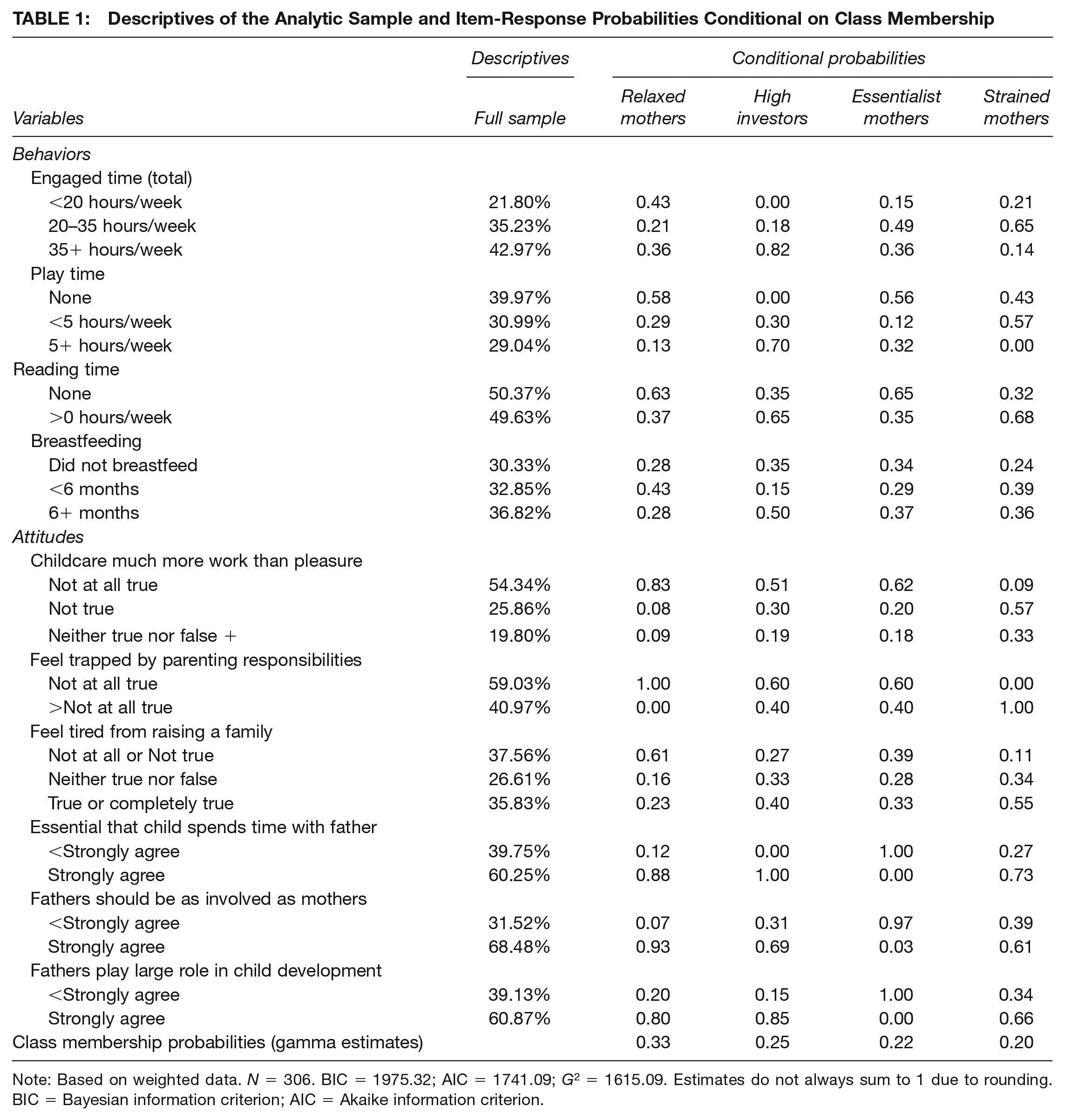
Note: Based on weighted data. N = 306. BIC = 1975.32; AIC = 1741.09; G2 = 1615.09. Estimates do not always sum to 1 due to rounding. BIC = Bayesian information criterion; AIC = Akaike information criterion.
I labeled the second largest class (about 25 percent of the sample) High Investors. Mothers in this group had a high probability of spending 35+ hours per week in engaged time with children (0.82). They were the most probable of any class to play with their child for five hours a week or more (0.70), read to their child (0.65), and breastfeed for six months or more (0.50). High Investors were most likely to report they do “not at all” think childcare is much more work than pleasure (0.51) and do “not at all” feeling trapped (0.60). They were not especially likely to report any level of tiredness, with probabilities similar to those of the entire sample. Like Relaxed Mothers, High Investors were very likely to report that they strongly agreed with the father variables (1.00, 0.69, and 0.85). These are the only items for which High Investors showed responses that were clearly actively nonintensive.
About 22 percent of the sample fell into the third class, called Essentialist Mothers. Mothers in this group showed mixed probabilities across behavioral items. They were likely to be engaged with their child for at least 20 hours per week (0.85), but this was the only behavioral item where they showed moderate or high tendencies. They were fairly unlikely to play with their children (0.56) or read to them (0.65). Like High Investors, Essentialist Mothers were likely to say childcare was “not at all” much more work than pleasure (0.62) and they did “not at all” feel trapped (0.60). Contrary to the other classes, they were highly unlikely to strongly agree with the father variables (0.00, 0.03, and 0.00), indicating that they may be more likely to view mothers as the essential parent over fathers.
The fourth and final class, Strained Mothers, held about 20 percent of the respondents. On intensive mothering behaviors, these individuals showed a mix of high, low, moderate, or nondistinctive probabilities. They were most likely to spend between 20 and 35 hours of engaged time with their child (0.65) but did not show distinctive patterns for breastfeeding. Strained Mothers were likely to read to their child (0.68) but unlikely to play with them for 5+ hours per week (0.00). In contrast with the three previous classes, this group was the most likely to indicate that they had lower satisfaction from parenting, felt trapped, and felt tired. The majority strongly agreed it is essential that children spend time with their father (0.73), that fathers should be as involved as mothers (0.66), and that fathers play a large role in child development (0.61).
Table 2 contains means and proportions of sociodemographic variables for the overall analytic sample and by each latent class. Relaxed and Essentialist Mothers, on average, had fewer years of education, were younger, had a lower annual household income, were more likely to be Black or Hispanic, had a higher proportion of single mothers, and were more likely to work full-time than High Investors and Strained Mothers. While Relaxed Mothers had significantly higher years of education, a lower likelihood of being a single mother, and a higher likelihood of working full-time compared with Essentialist Mothers, High Investors were not significantly different from Strained Mothers on any of the predictors examined.
Means and Proportions of Sociodemographics by Latent Class
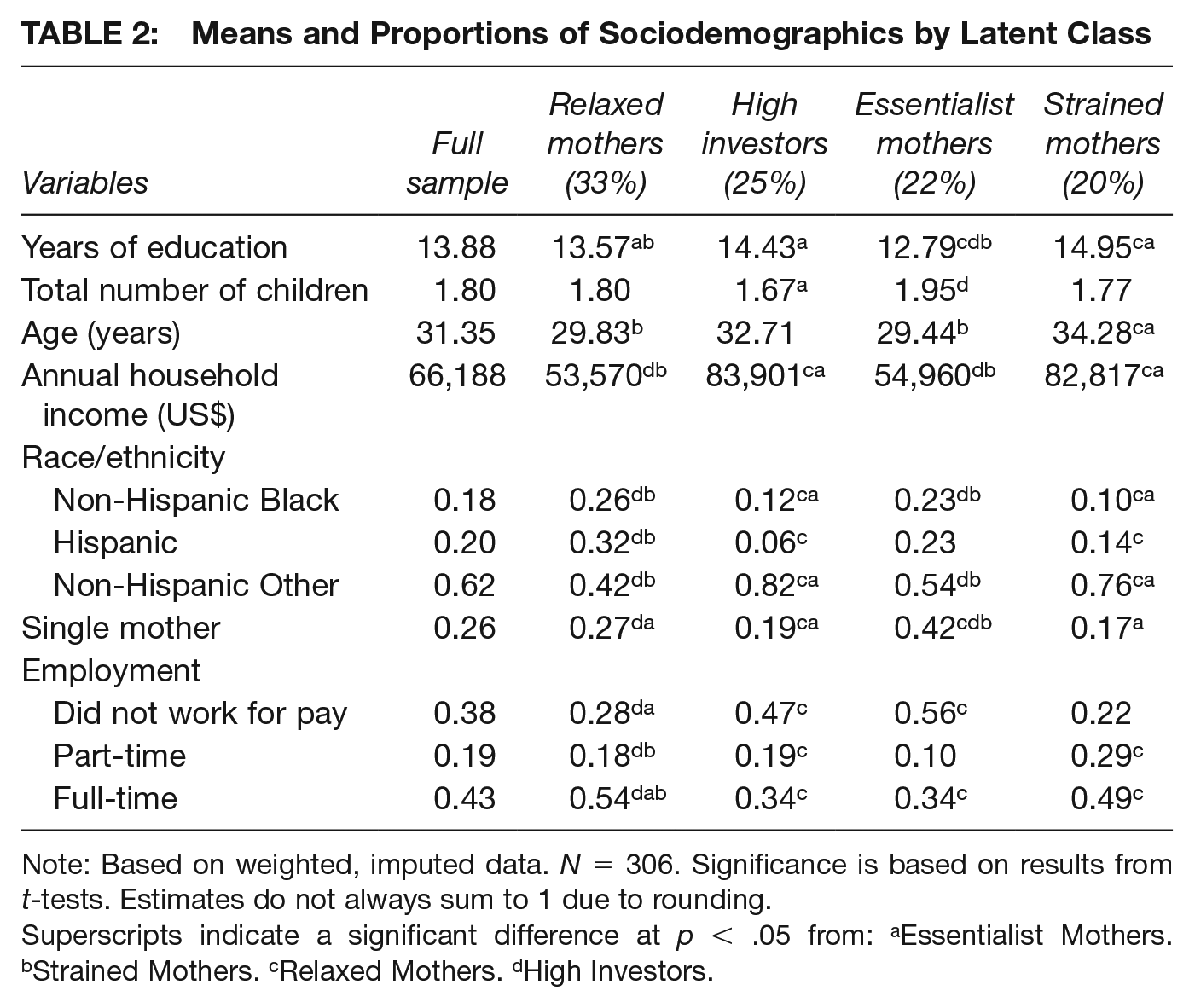
Note: Based on weighted, imputed data. N = 306. Significance is based on results from t-tests. Estimates do not always sum to 1 due to rounding.
Superscripts indicate a significant difference at p < .05 from: aEssentialist Mothers. bStrained Mothers. cRelaxed Mothers. dHigh Investors.
Table 3 displays a multinomial regression analysis predicting latent class membership, with Relaxed Mothers set as the reference outcome. Age, race/ethnicity, single motherhood, and employment status were predictive of latent class membership. For each additional year of age, the odds of being a High Investor or Strained Mother, relative to the odds of being a Relaxed Mother, increased by 9 and 12 percent, respectively (p < .05). Hispanic individuals, compared with non-Hispanic Others, had 91 percent lower odds of being a High Investor than a Relaxed Mother (p < .01), and single mothers had 76 percent lower odds than partnered individuals of being Essentialist Mothers (p < .05). Most notably, the odds of being a High Investor or Essentialist Mother were more than four times higher for those who did not work for pay than those employed full-time. A summary of results is included in Table 4.
Multinomial Logistic Regression Predicting Latent Class Membership, Relative Risk Ratios
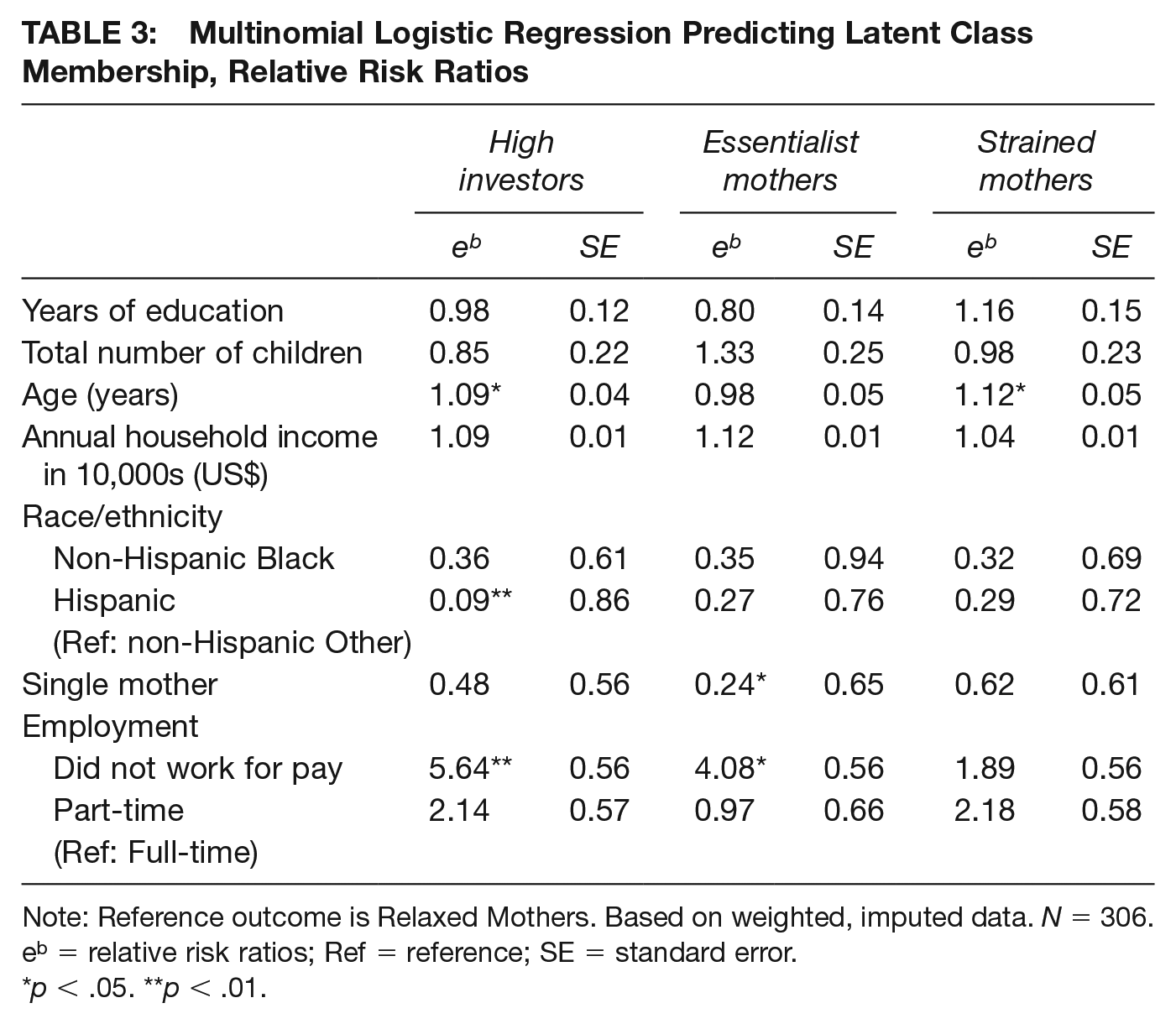
Note: Reference outcome is Relaxed Mothers. Based on weighted, imputed data. N = 306. eb = relative risk ratios; Ref = reference; SE = standard error.
p < .05. **p < .01.
Summary of Results
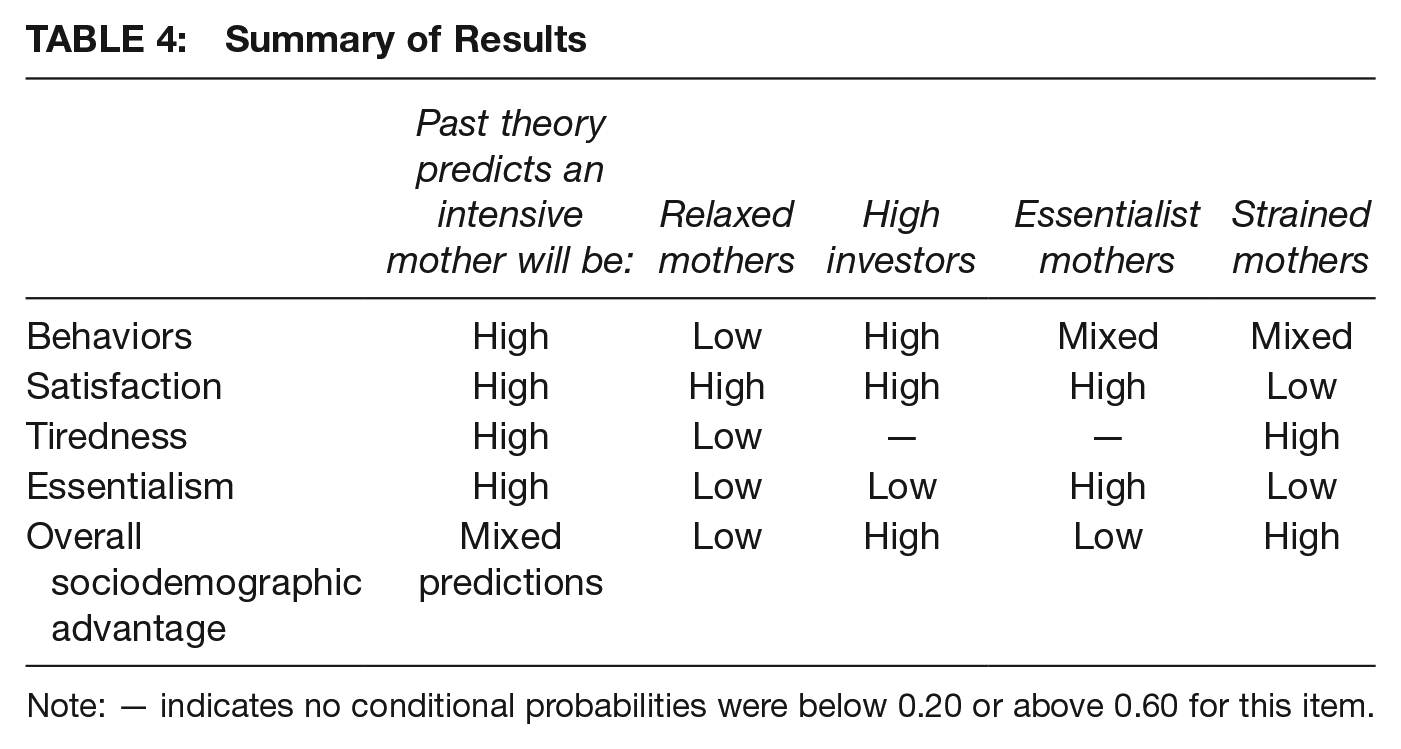
Note: — indicates no conditional probabilities were below 0.20 or above 0.60 for this item.
Discussion
Intensive mothering norms are stronger and more prevalent today than in any other decade in recent history (Ennis 2014; Wall 2013), yet women also routinely reframe and negotiate what good mothering looks like (e.g., Barnes 2016; Christopher 2012; Damaske 2011; Dow 2016; Johnston and Swanson 2006; Romagnoli and Wall 2012). To better understand the ways mothers navigate competing demands between gender norms, personal preferences, and resource constraints, I used LCA to identify patterns in the ways mothers adhere to, reject, and combine intensive mothering attitudes and behaviors. Then, I examined how these patterns varied by social characteristics to help explain how and why different patterns emerged.
Previous research frequently portrays and describes an intensive mother as someone who invests high amounts of time and resources into her children, feels personal satisfaction from parenting, reports that motherhood is tiring, and views fathers as secondary parents (Ennis 2014; Hays 1996; Liss et al. 2013; Meeussen and VanLaar 2018; Sutherland 2010; Warner 2005). Results showed, however, that no group completely embodied this description. To the contrary, Relaxed Mothers (33 percent), the modal latent class, were relatively low on intensive mothering overall. High Investors (25 percent) displayed high intensity on behaviors, but still retained some nonintensive attitudes. Essentialist Mothers (22 percent) were the only group to show more traditional attitudes toward fathers. Finally, Strained Mothers (20 percent) indicated relatively high emotional strain but reported low or moderate intensity on behaviors. Relaxed and Essentialist Mothers, on average, showed lower social advantage, including lower education, income, and age, and higher proportions of Black and single mothers. High Investors and Strained Mothers, in contrast, held more social advantage, including a higher average education, income, and age, and lower proportions of Black and single mothers. Age, race/ethnicity, single motherhood, and not working for pay were predictive of membership in one class over the other, with younger, Hispanic, single, and full-time employed mothers showing significantly higher odds of belonging to the Relaxed class.
These results suggest that negotiation of intensive mothering is not uncommon. But this conclusion also comes with important limitations. The sample size is relatively small (N = 306), limiting the statistical power which may be needed to detect significant differences on sociodemographic variables. Variables used in this study are also certainly not all possible aspects of intensive mothering, and, as is common, the survey data have a limited number of available variables. In particular, the PSID does not contain questions on beliefs about child-centeredness and child intellectual stimulation. The survey design also limits available measures for women’s time use; because the CDS time diaries were designed to capture children’s daily activities, no information is available on mothers’ activities when children are not directly engaged. Previous studies indicate that such care work is a substantial task for many women (Alby, Fatigante, and Zucchermaglio 2014; Randles 2021), and it remains unclear whether certain latent classes invest more time in this type of labor than others. These problems would ideally be fixed with tailored questions added to existing social surveys or with new, large-scale surveys that are designed to measure intensive mothering across demographic groups. Finally, the analyses focus on mothering of children in younger ages. Although these patterns may remain as children age, it is also possible that new latent classes emerge as children enter school. Future work should consider patterns of intensive mothering across child age groups. Given these limitations, the results should be viewed as a steppingstone in holistic quantitative studies of intensive mothering, rather than a definitive conclusion.
Nevertheless, several results are notable for both their contradiction and partial support of past findings and theory. First, based on the literature’s emphasis on intensive mothering as the most dominant model for parenting, it is surprising that Relaxed Mothers were the modal group. However, the percentages of High Investors, Essentialist Mothers, and Strained Mothers follow shortly behind. This suggests that far more complexity exists in intensive mothering than previously described, and there are likely multiple prevalent “types” of intensive mothers in the United States. An above-average proportion of Relaxed Mothers were Black (0.26, compared with 0.18 of the full sample), supporting recent conclusions that Black women often negotiate intensive mothering (Barnes 2016; Dow 2016). Yet substantial portions of Hispanic and non-Hispanic Other mothers may also fit a more relaxed parenting profile, with Hispanic Mothers significantly more likely to be Relaxed Mothers over High Investors. When viewing all mothers through a white, middle-class, advantaged lens, it is easy to classify nonintensive mothers as breaking from the societal norm. The results instead suggest that less intensity—whether in behaviors or attitudes or both—may in fact be fairly common in several social groups (Dow 2016).
Second, some intensive mothering attitudes may not be as closely connected with behaviors as originally presumed. Only one class reported slightly more traditional views of fathers (Essentialist Mothers), and they exhibited fairly mixed intensity on behaviors. Future studies should seek to tease apart the dimensions of intensive motherhood that may be tied to traditional gender ideologies and those that are not. Although prior theory predicts that Strained Mothers will invest the most time and energy in children, this also does not appear to be the case; it may be that Strained Mothers report the most emotional strain precisely because they do not meet intensive mothering norms in their behaviors, fitting a description of “trying but failing.” If so, this would support the “pernicious stressor” hypothesis, which theorizes that perceived investment deficits may drive emotional strain (Milkie, Nomaguchi, and Schieman 2019). Overall, each latent class combined facets of intensive mothering in unexpected ways, indicating intensive behaviors and attitudes are not always two sides of the same coin.
Third, a complicated relationship may exist between intensive mothering and social advantage. The most intensive class (High Investors) and the least intensive class (Relaxed Mothers) follow a clear division across social class. However, Essentialist and Strained were both moderate or mixed on intensity, and they held very differing levels of advantage. Similarly, high emotional strain does not appear to emerge from a lack of structural resources: Strained Mothers were demographically very similar to High Investors yet differ from them substantially on parenting patterns.
Fourth, although Relaxed mothers had low sociodemographic advantage, they still reported high fulfillment and low exhaustion. If these mothers were “trying but failing” to intensively mother, we would expect them to report more emotional strain than they did. Therefore, if “doing” motherhood is central to “doing” gender (Arendell 2000; Ridgeway and Correll 2004), then Relaxed Mothers may be taking a step toward “undoing” both (Deutsch 2007; Risman 2009). Without further investigation, however, it is difficult to discern whether Relaxed Motherhood is truly a motherhood of lower self-sacrifice. There may be other, hidden areas where energy is expended for the benefit of children, referred to as “inventive” mothering (Randles 2021). Alternatively, Relaxed Mothers may be more likely to treat their leisure time and self-care as an important priority, particularly if they believe intensive parenting is not necessary for child well-being or success.
Finally, High Investors suggest a revision in the role of fathers in intensive parenting for some mothers. Because these individuals are highly intensive in their behaviors, it may be difficult for fathers to match their level of involvement with children. Despite this, High Investors still show near universal support for more gender-progressive ideas on father involvement. Like Relaxed Mothers, this result indicates that High Investors may partially “undo” or “redo” gendered parenting norms by expecting fathers to be more invested than in the past, even as their actions suggest they remain the primary parent (Risman 2009).
These results have key implications for existing and future research and public policy on maternal investment. Although recent research on motherhood has focused heavily on intensive mothers, it may be just as crucial to examine nonintensive or less intensive mothers, as results suggest they could be a nontrivial part of the population. Moreover, the finding that Relaxed Mothers may be more common than anticipated has important policy implications. Without adequate, universal access to early childhood education and subsidized child care, the assumption that all mothers can and will be intensive parents is likely to create increasingly “diverging destinies” (McLanahan 2004): a growing disparity between the children of intensive and nonintensive parents. Elizabeth Paré (2016, 27) concluded that “cultural discourse still oversimplifies the reality of mothers’ and families’ lives, and continues to mask the variation of women[’s] roles in families.” By outlining holistic patterns of modern motherhood and their demographic correlates, this research attempts to unveil the ways previous theory on intensive mothering does and does not reflect mothers’ lived experiences. Future research should continue this pursuit, with particular attention to the ways individuals deviate from the tenets of intensive mothering.
Supplemental Material
sj-docx-1-gas-10.1177_08912432221114873 – Supplemental material for Negotiating “Impossible” Ideals: Latent Classes of Intensive Mothering in the United States
Supplemental material, sj-docx-1-gas-10.1177_08912432221114873 for Negotiating “Impossible” Ideals: Latent Classes of Intensive Mothering in the United States by Jane Lankes in Gender & Society
Footnotes

Supplemental Material
Supplemental material for this article is available online.
Jane Lankes is a graduate student in sociology and demography at The Pennsylvania State University and an incoming postdoctoral fellow at the Grand Forks Human Nutrition Research Center. Her research examines family, gender, and well-being, with focuses on motherhood and marriage.
References
Supplementary Material
Please find the following supplemental material available below.
For Open Access articles published under a Creative Commons License, all supplemental material carries the same license as the article it is associated with.
For non-Open Access articles published, all supplemental material carries a non-exclusive license, and permission requests for re-use of supplemental material or any part of supplemental material shall be sent directly to the copyright owner as specified in the copyright notice associated with the article.
