



Abstract
This study is the first to explicitly assess the connections between welfare state spending and the gendered and classed dimensions of unpaid care work across 29 European nations. Our research uses multi-level model analysis of European Quality of Life Survey data, examining childcare and housework burdens for people living with at least one child under the age of 18. Two key findings emerge: First, by disaggregating different types of unpaid care work, we find that childcare provision is more gendered than classed—reflecting trends toward “intensive mothering”. Housework and cooking, on the contrary, demonstrate both gender and class effects, likely because they are more readily outsourced by wealthier individuals to the paid care sector. Second, while overall social expenditure has no effect on hours spent on childcare and housework, results suggest that family policy may shape the relationship between gender, income, and housework (but not childcare). Specifically, family policy expenditure is associated with a considerably smaller gender gap vis-à-vis the time dedicated to housework: This effect is present across the income spectrum, but is particularly substantial in the case of lower income women.
Across countries and cultures, unpaid care work is essential to the well-being of individuals and families, as well as to the functioning of national economies. Lawson et al. (2020) estimate that the annual global monetary value associated with unpaid care work by women aged 15 and over is at least $10.8 trillion. Yet, notwithstanding this immense contribution, as well as a universal need for care at critical junctures during the life course (e.g., childhood, end of life, times of illness), care work remains “the quintessentially female identified activity” (England 2005, 383) and, partially as a consequence, is systematically socially and economically devalued. Across divisions of class, race, citizenship status, and partnership status, women provide the overwhelming majority of unpaid care work, and structural inequalities are woven into the social organization of care at myriad levels (see, for example, Dong and An 2015; Ferrant, Pesando, and Nowacka 2014; Hagqvist 2018).
Unpaid care work, which includes caring for dependent family members and time spent on cooking, cleaning, and other domestic chores, is a key factor explaining gendered disparities in income, occupational prestige, and upward mobility (Esping-Andersen and Schmitt 2020; Folbre 2012). Yet, in addition to highly gendered discrepancies in the provision of unpaid care, caring responsibilities are also highly classed (Gupta et al. 2015; Vagni 2020). This class dimension is typically explained by the fact that (1) higher income households are more likely to outsource this work to paid care providers—who themselves are likely to be low-income women of color, and (2) the gendered division of unpaid care is typically more equal in higher income households (Altintas and Sullivan 2016; Williams 2001). At the same time, welfare state scholars note that ongoing retrenchment of publicly provided benefits and services has led to increasing unpaid care burdens for women, with growing disparities tied to class (Healy 2020; León and Pavolini 2014; Stanfors, Jacobs, and Neilson 2019). Taken together, the literature thus suggests that unpaid care work leads to intersectional disadvantages for women (Pfeffer 2012; Williams 2001).
The present study contributes to the literature on gender, social policy, and unpaid care work using survey data from 29 European countries. We investigate the relationship between gender, class, and social expenditure 1 (both overall spending and spending on family policy) in reducing unpaid care work burdens tied to childcare and housework for respondents living with at least one child under the age of 18 years. In so doing, we address two key gaps in the existing literature. First, our study disaggregates direct and indirect forms of unpaid care work: The former encompasses face-to-face personal interactions with children (“childcare”), whereas the latter comprises auxiliary support for childcare, such as cleaning, cooking, and washing (“housework”) (Leopold, Skopek, and Schulz 2018). We unpack the gender and class dynamics at play in these two areas, drawing on research that highlights the potential impact of “intensive mothering” on patterns of care across the income spectrum (England and Srivastava 2013; Schneider and Hastings 2017). Second, unlike the few existing studies analyzing unpaid care work on a cross-national scale (e.g., Altintas and Sullivan 2016; Esping-Andersen and Schmitt 2020; Hook 2010), we explicitly assess the role of the welfare state, investigating how social expenditure and family policy spending are connected to the gendered and classed dimensions of unpaid care.
We conduct our analyses using data from the 2007–2008 and 2016–2017 waves of the European Quality of Life Survey. These data are ideal for our purposes because they offer fine-grained information on the time women and men spend each week on specific facets of unpaid care work, alongside a detailed measure of household income. Ultimately, two key findings emerge. First, by disaggregating different types of unpaid care work and analyzing the effects of gender and income on these tasks, we find that childcare provision is likely more gendered than classed, reflecting trends toward “intensive mothering.” In contrast, housework, a form of care work that is more likely to be considered “menial,” appears to be shaped by both gender and income—likely because it is more readily outsourced by wealthier individuals to the paid care sector. We find that childcare makes up a proportionately larger component of unpaid care work for wealthier women, suggesting that time spent educating children has become an important means of class reproduction within higher income families; this is not the case for housework, however, where paid services such as dry cleaners, prepared meals, and domestic cleaners are more readily used to reduce unpaid care work burdens by women who can afford them. Second, our investigation demonstrates that whereas overall social expenditure has no clear relationship with hours spent on childcare and housework, family policy expenditure does. Family policy is associated with a smaller gap between the time women and men dedicate to housework (but not childcare) regardless of income level, although the size of this effect is larger at the lower end of the income spectrum. Together, these results have significant implications for inequality tied to unpaid care work within societies. Our findings reinforce the importance of robust social spending on family policies to address women’s “double burden” (at home and in paid work) through targeted spending on programs such as child allowances and credits, childcare support, and single-parent payments.
Gender, Class, and the Devaluation of Unpaid Care
England (2005) provides a “Devaluation Framework” as partial explanation for the gendered division of care, whether it be paid (e.g., teaching, housekeeping, nursing) or unpaid (e.g., caring for dependent family members, cooking, cleaning, and other domestic chores). She notes that “cultural ideas deprecate women and thus, by cognitive association, devalue work typically done by women” (2005, 382). This economic, social, and cultural devaluation of highly feminized jobs leads not only to low levels of remuneration for paid care activities, but also to social policies that privilege the “male breadwinner and female homemaker” model—at the expense of childcare or financial supports directed at women who stay at home to provide care (Lightman and Kevins 2019; Salin, Ylikännö, and Hakovirta 2018). Thus, unpaid care work, long associated with “women’s work” (Coltrane 2000; Pfeffer 2012), can be viewed as “a systemic transfer of hidden subsidies to the rest of the economy that go unrecognized, imposing a systematic time-tax on women throughout their life cycle” (Antonopoulos 2008, 6).
Existing time-use studies demonstrate that women continue to spend significantly more time than men on unpaid caring activities across the Global North and South, with estimates typically ranging from two to four times greater time investment (Dong and An 2015; Ferrant, Pesando, and Nowacka 2014; Hagqvist 2018). Most research suggests that over time, there has been movement toward gender convergence in hours spent on unpaid care (Guppy, Sakumoto, and Wilkes 2019; Leopold, Skopek, and Schulz 2018) yet parity between women and men remains elusive. Scholars note that this gender convergence has been “asymmetric”: There has been a greater decline in the time women spend on unpaid care (due to factors such as atomization, declining fertility, the outsourcing of tasks to the paid care sector, and increases in rates of female labor force participation) compared with the increase in time that men spend on such tasks (Ji et al. 2017; Pailhé, Solaz, and Stanfors 2021). This, too, England (2006, 254) attributes to the devaluation of unpaid care, which disincentivizes men taking on these tasks as “the notion that these activities are inappropriate for men may deter them, and in addition, they lose respect and money for doing so.” In addition, some studies suggest that the gender convergence has “stalled” in recent decades (Craig, Churchill, and Wong 2019; Shu and Meagher 2018).
The class structure, too, has been shown to matter for the relationship between gender and unpaid care (Damaske 2020; England 2006). Overall, wealthier households perform less unpaid care work than poorer ones (Folbre 2012; Vagni 2020), likely due to a greater ability of the well-off to outsource this work to paid care providers—providers who are themselves likely to be immigrant and/or racialized low-income women (King-Dejardin 2019; Lightman 2020; Williams 2001). Yet the literature also finds that the gendered division of unpaid care is more equal within wealthier households (Ferrant, Pesando, and Nowacka 2014; Quadlin and Doan 2018; Sullivan 2000). Notably, however, this too is most often attributed to reduced hours of unpaid care work performed by higher income women, rather than to greater amounts of unpaid care work performed by higher income men (Gupta et al. 2015; Vagni 2020).
Scholarship examining class dimensions across different types of unpaid caring activities finds that not all unpaid care work is considered equally valuable. Rather, the reduction in hours spent on unpaid care by higher income households is driven primarily by outsourcing housework tasks that are considered menial, mundane, or “less enjoyable,” such as cooking, cleaning, or laundry (Coltrane 2000; Dotti Sani and Treas 2016; Gupta 2006). Childcare, in contrast, has demonstrated an opposite trend in the latter half of the twentieth century; women across a wide variety of Global North countries have increased the time they spend with their children, in a development termed “intensive mothering” (Ennis 2014; Faircloth 2014). Yet scholars note that this increase in time spent on childcare is disproportionately found among highly educated and high-income mothers, and in activities that promote “opportunities for learning” among their offspring (Altintas and Sullivan 2016; Cornwell, Gershuny, and Sullivan 2019, 307). As a result, Coltrane (2000, 1225) notes that “it is primarily men’s participation in the routine repetitive chores of cooking, cleaning and washing that relieves women’s burden.”
Thus, time spent on childcare, as distinct from other forms of unpaid care work, has become a status marker differentiating higher and lower class households; such class divides in time (and money) spent on children are thought to be an important factor in the intergenerational perpetuation of advantage (Lareau 1987; Schneider, Hastings, and LaBriola 2018). While housework is increasingly outsourced to the service sector by upper-class families (e.g., through laundry services, prepared meals, and domestic cleaners), the same trend is not observed in the time spent on childcare among high-income families (England and Srivastava 2013; Schneider and Hastings 2017). Yet routine housework tasks (e.g., cooking, cleaning, and other domestic activities) continue to be highly stratified in terms of both gender and class.
Welfare State and Family Policy Expenditure
Cross-national studies suggest that in addition to individual- and household-level characteristics (e.g., age, family composition), national-level factors also help to explain variation in unpaid care work performed by women and men, as well as across income levels (Altintas and Sullivan 2016; Cornwell, Gershuny, and Sullivan 2019; Hook 2010). Among other factors, social policies, in particular, are found to play a meaningful role in reducing unpaid care work burdens (Salin, Ylikännö, and Hakovirta 2018; Sullivan 2013).
Aggregate levels of social expenditure are a commonly used measure to examine how social policies may influence unpaid care work within and across countries—often with contingent gendered and classed effects (Van Hooren 2012). Yet although such studies often suggest that higher levels of social expenditure reduce gender disparities in unpaid care work, systematic cross-national analysis of these dynamics is lacking (Michel and Peng 2017; Timonen, Convery, and Cahill 2006). León and Pavolini (2014), for example, trace the ways that the 2008 economic crisis led to austerity measures and cuts to social expenditure in Italy and Spain, which in turn reinforced familialism and increased unpaid care burdens for women. Comparing time diary data from Sweden, the United Kingdom, and Canada, Stanfors, Jacobs, and Neilson (2019) suggest that Sweden’s more extensive social infrastructure diminishes the labor market effects of unpaid care: The authors find that fewer Swedish women and men are forced to reduce their paid work due to caregiving responsibilities. Finally, using European Social Survey data, Healy (2020) finds that higher levels of social expenditure are negatively related to traditional gender attitudes regarding the distribution of paid and unpaid work within families.
The majority of scholars who focus on the effect of social policy on unpaid care work, however, suggest that disaggregating social expenditure is crucial to analyzing its impact, with spending that targets family needs (e.g., child allowances and credits, childcare support, income supports during parental leave, sole parent payments) playing an especially pertinent role (Adema and Fron 2019; Razavi 2007). These policies can help societies to move away from a “male breadwinner” model and, in the process, increase the proportion of domestic tasks carried out by men (Hook 2006). Yet certain types of family policy programs are likely to be especially crucial for the division of unpaid care work. Countries with higher levels of provision of publicly funded childcare and father-specific parental leave, for example, have been found to have smaller gender disparities in unpaid housework and childcare (Cooke and Baxter 2010; Cornwell, Gershuny, and Sullivan 2019; Salin, Ylikännö, and Hakovirta 2018). What is more, cash benefits provided by governments likely serve to equalize opportunities across socioeconomic classes to outsource unpaid care work to the paid market (Adema and Ladaique 2009; England 2005).
Hypotheses
Existing literature thus suggests several hypotheses. Turning first to probable individual-level dynamics, gender and household income are identified as key factors correlated with the time an individual dedicates to unpaid caring, with additional variation based on the type of care work being undertaken (i.e., childcare vs. housework).
We expect women to consistently provide more unpaid care work than men: Research suggests a sizable gender gap in terms of the number of hours dedicated to childcare and housework, whether analyzed separately or together, and this gap typically persists across the income spectrum (i.e., regardless of socioeconomic class) (Dong and An 2015; Ferrant, Pesando, and Nowacka 2014; Hagqvist 2018). Crucially, however, past studies suggest that income nevertheless plays a role. Due to their lesser ability to “outsource” caring responsibilities, low-income individuals tend to devote more time than high-income individuals to unpaid caring duties (Quadlin and Doan 2018; Sullivan 2000).
Yet these class effects are unlikely to be as widespread as the gender gap, for two reasons. First, research suggests that the relationship between income and unpaid care work is driven by a shift in the number of hours that women dedicate to these tasks: Women tend to devote less time to unpaid care work as their income increases, whereas men tend to maintain a more consistent (low) level of unpaid care (Gupta et al. 2015; Vagni 2020). Second, we expect class to matter differently based on the type of unpaid care. Income is likely to reduce the amount of time women dedicate to (“mundane”) housework tasks, whereas the time they dedicate to intensive mothering tasks, such as childcare, is likely to be more stable (England and Srivastava 2013; Schneider and Hastings 2017). The effect of income should thus vary according to both gender and the type of unpaid care work being assessed.
In addition, we expect that the welfare state will shape the impact of gender and income on unpaid care (Michel and Peng 2017; Timonen, Convery, and Cahill 2006). Here, two potential explanations are relevant. On the one hand, more extensive social programs and benefits may help to insulate women from unpaid caring responsibilities by shifting the provision of care from families to the welfare state. If this dynamic is the central one, then the overall size of the welfare state will be an important consideration: More extensive public services and infrastructure (e.g., greater public provision of education, health care, and/or other social services) may reduce both the quantity of unpaid care work to be performed by individuals and the expectation that these tasks should be primarily done for free by women (Healy 2020; Stanfors, Jacobs, and Neilson 2019). Thus, from this perspective, greater social policy expenditure will be associated with smaller unpaid caring burdens, especially for low-income individuals, as state policy and social programs replace the family obligations that disproportionately fall on women who cannot outsource this care.
On the other hand, it may be that caring obligations are primarily—or even exclusively—shaped by social policy programs that expressly target the needs of families, whether via in-kind or cash payments (Adema and Ladaique 2009; Ferragina 2020; Razavi 2007). Public childcare provision and child allowances and credits are arguably the quintessential examples of why these policies may matter: Not only do they reduce the amount of unpaid childcare to be delivered, they also affect the financial resources available for families raising children—two factors that may affect time spent on unpaid care work and expectations about the gendered division of household labor (Adema and Ladaique 2009; England 2005). Family policy expenditure, rather than social policy expenditure more broadly, may thus be the key factor shaping gendered and classed dynamics.
In either scenario, the rationale here is that social policy matters due to its capacity to reduce the costs—both in time and money—that are associated with raising children. However, taking into account additional considerations regarding “intensive mothering” and the relative stability of childcare highlighted above, we suggest that the welfare state may be especially well placed to help low-income women reduce the amount of time they spend on indirect forms of unpaid care work in particular. This is explained by the fact that (1) regardless of whether or not the social spending is directly targeted at families, cash benefits, on their own, are likely inadequate to cover substantive amounts of paid childcare, and (2) for some women, using any government-provided cash benefit on childcare provision may be culturally unacceptable or less preferable, as compared with subsidizing their daily routinized tasks of cooking and cleaning (e.g., by buying meals or purchasing equipment/supplies to cut down on time spent cleaning). Crucially, however, we expect this dynamic to be classed as well, because for higher income families, any cash benefit is unlikely to make as large a difference in the resources they can allocate to outsourcing unpaid care.
Data
To test these hypotheses, we use data from 29 European countries that participated in the 2007–2008 and 2016–2017 waves of the European Quality of Life Survey (European Foundation for the Improvement of Living and Working Conditions 2018). These surveys were commissioned by the European Union’s (EU) Eurofound Agency, using in-person interviews carried out with a random selection of the adult population. We restrict our data set to the second and fourth waves of the survey to have access to the required survey weights and key variables.
Given our interest in family-related care obligations, we focus our analysis on those respondents living with at least one child below the age of 18 years. The sample thus includes all individuals, both partnered and non-partnered, who were living with either a child or a stepchild under 18. After removing observations with missing survey data for any of the required variables (22 percent of the larger sample), we are left with a total of 10,403 respondents (see Online Appendix Table A1 for a breakdown of the distribution of respondents across countries and waves).
Dependent Variable
Our investigation is centered on responses to two survey questions that assess time dedicated to unpaid caring activities. Specifically, respondents were asked “On average, how many hours per week are you involved in any of the following activities outside of paid work?” We focus on the two activities that were consistent across the second and fourth wave: “Caring for and/or educating your children,” capturing direct forms of childcare, and “Cooking and/or housework,” capturing indirect forms of care that are a corollary to having childcare responsibilities. Responses are top coded at 120 hours per week, to limit the risk that spurious outliers influence our results, and we exclude from the sample any respondent who replied “don’t know” or declined to answer either item.
We analyze responses to these questions first by looking at the total number of hours that respondents report spending on both types of unpaid care, and then by disaggregating the two components. Within our sample of adult parents living with at least one child under 18, a mean of 27 hours was dedicated per week to caring for and/or educating children (“childcare”), while a mean of 13 hours was dedicated to cooking and/or housework (“housework”). The mean total number of hours spent on unpaid care work per week, in turn, is 40. 2 We note that just 6.5 percent of fathers and 1 percent of mothers in our sample declared that they spent zero hours per week on unpaid care work on average.
Figure 1 illustrates the mean time dedicated to unpaid care work in our pooled sample (across countries), presenting a gender-based breakdown across a variety of social characteristics. Limiting our focus to statistically significant differences, 3 results suggest that higher income is broadly correlated with less time spent on unpaid care work among women (with a substantive division between the bottom and top half of the income distribution), but not among men. Education, place of birth, and living with a spouse, in turn, appear to matter for both men and women, although in opposite directions: Women with tertiary education tend to perform less unpaid care work than less-educated women, yet their male counterparts tend to perform more; whereas women with a spouse or those who were born outside of the EU tend to perform more unpaid care work than those without a spouse or those who were born inside the EU, while their respective male counterparts tend to perform less. Younger male and female respondents (those aged 18–39 years) are also more likely to spend more time doing unpaid care work. Finally, employment status also often matters for both men and women, although not all of the categories are statistically distinguishable from one another.
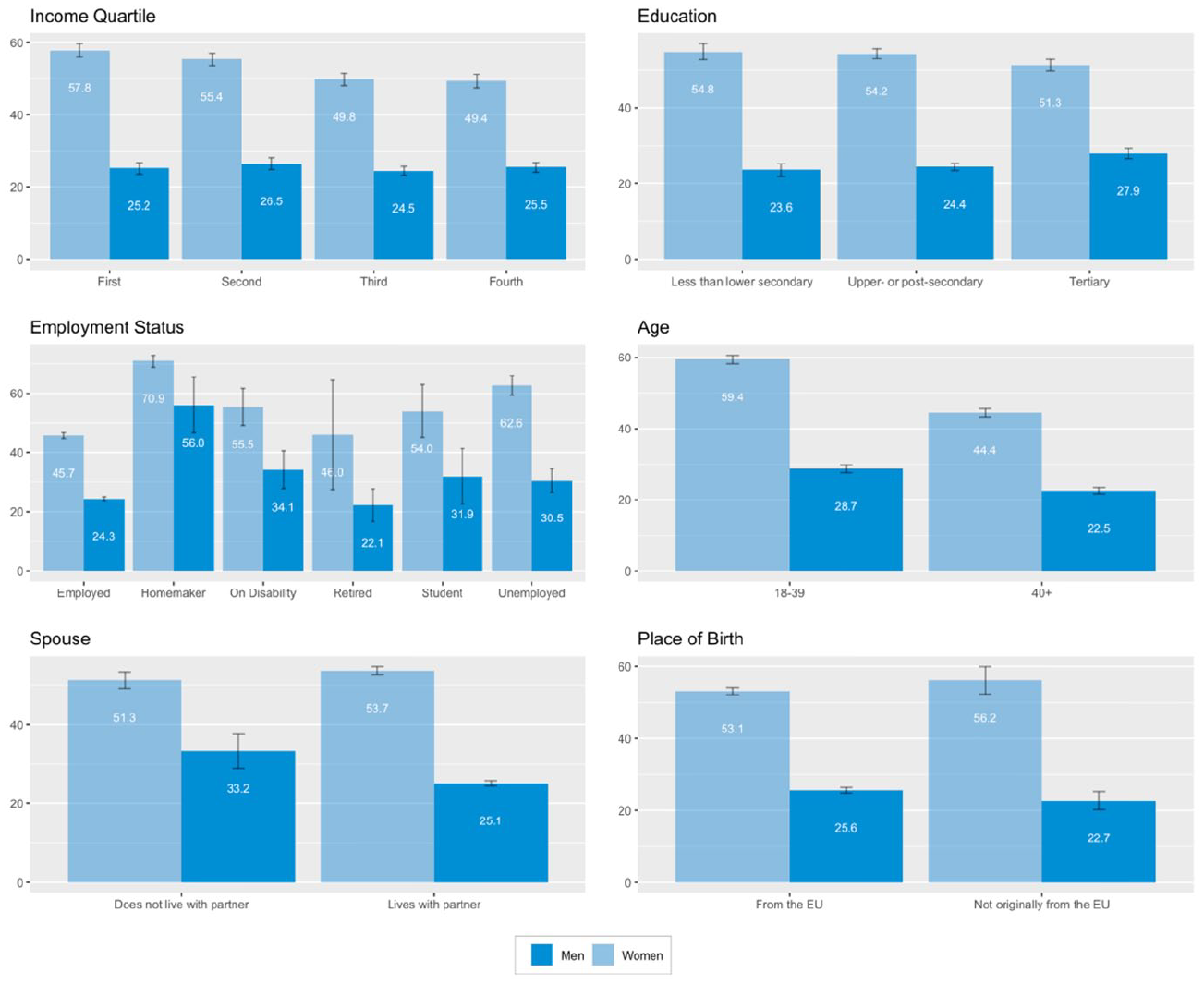
Mean Weekly Hours Spent on Unpaid Care Work, by Gender and Various Social Characteristics
Explanatory Variables
At the individual level, our main explanatory variables are gender and income. The gender split in the sample is 52.4 percent women and 47.6 percent men. Income, in turn, is measured using a question asking respondents to record their net monthly household income; responses were then equivalized to account for cross-country differences in purchasing power and converted into country-specific percentile values.
To provide an initial indication of how these variables might matter to our investigation, Figure 2 illustrates the mean weekly number of hours spent providing unpaid care, broken down by care type, gender, and income quartile. Several patterns are worth noting. First, across all gender and income groups, childcare makes up the majority of time dedicated to unpaid caring. Second, female respondents devote around twice as much time to unpaid caring as their male counterparts, regardless of income level, with an especially large gap among lower income individuals. Third, women with higher household income spend less time on unpaid care work than their poorer counterparts, whereas men dedicate similar amounts of time regardless of income level. Finally, childcare makes up a proportionately larger component of unpaid care work for wealthier women, at 67.0 percent for women in the fourth quartile, compared with 64.9 percent for women in the first quartile. There is no similar pattern among men, who consistently dedicate just over 70 percent of their unpaid care work to childcare, regardless of income level.
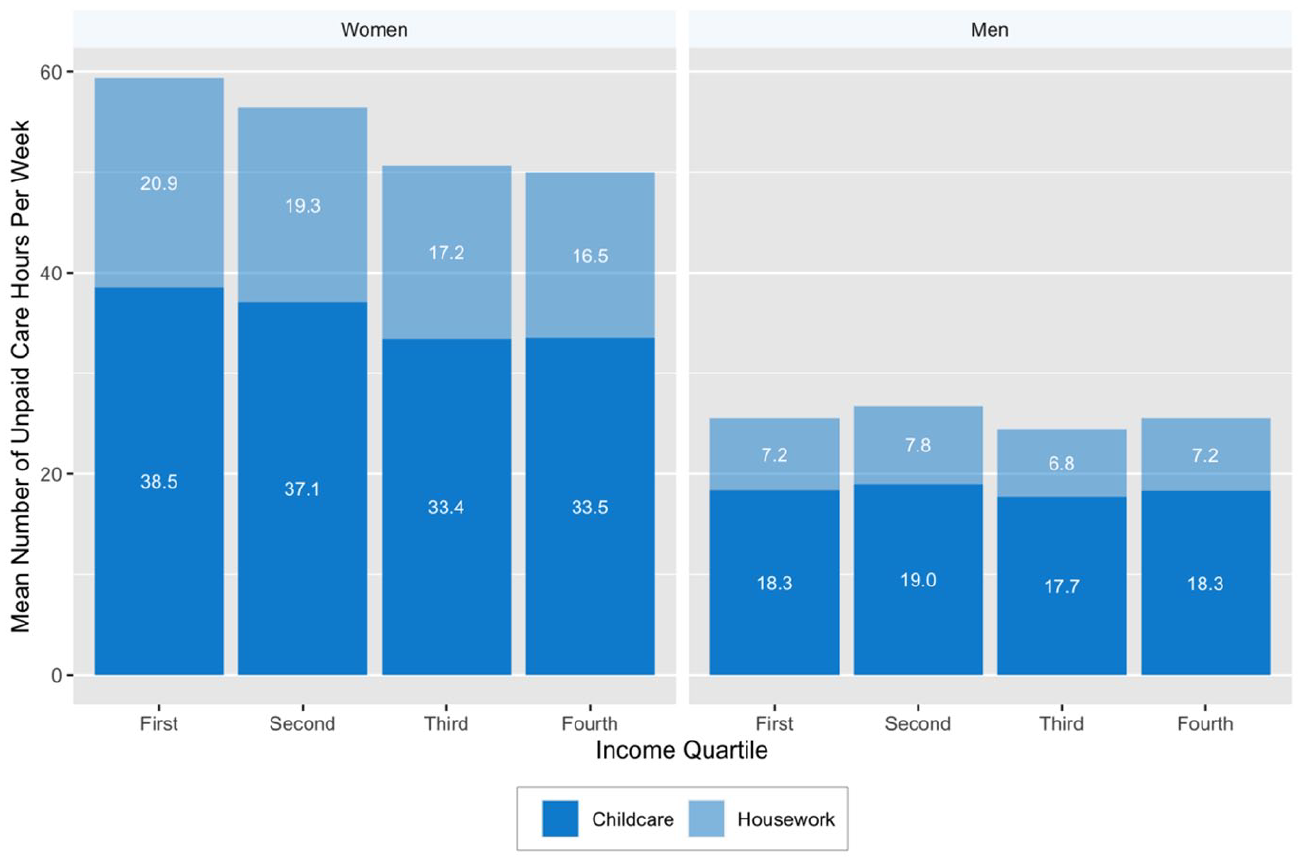
Time Spent on Unpaid Care Work, by Income, Gender, and Care Type
To address the impacts of macro-level social policies, our full analysis also includes variables capturing either overall social expenditure or family policy expenditure (e.g., Cornwell, Gershuny, and Sullivan 2019; Hook 2010; Salin, Ylikännö, and Hakovirta 2018). The full models thus account for the potential relevance of overall welfare effort, operationalized using total social policy expenditure; or targeted welfare effort, using the “family” subcategory of social policy expenditure, which includes government spending on “child allowances and credits, childcare support, income support during leave, [and] single parent payments” (Adema and Fron 2019). 4 Testing the two measures allows for both a broader and a narrower analysis of the relationship between social policy spending and hours spent on unpaid care, as well as the associated gendered and classed dimensions—for instance, unpacking whether social expenditure diminishes unpaid caring burdens, and for whom it might do so. These national-level data are all drawn from the Organisation for Economic Co-Operation and Development’s SOCX (Social Expenditure) database (see Adema and Fron 2019). 5
Figure 3 provides an initial indication of how social expenditure could be shaping gender’s impact on unpaid care work. Dividing the sample by gender, the figure illustrates the relationship between social expenditure and the (weighted) mean number of total hours spent, per country, on both childcare and housework. These bivariate results suggest two key trends: (1) Higher social expenditure is associated with fewer hours spent on unpaid care work, although this relationship is stronger for women than for men, and (2) the gender gap is predominant across all 29 countries in our sample. Figure 3 thus provides broad preliminary evidence of the gendered dynamic of social expenditure vis-à-vis unpaid care burdens.
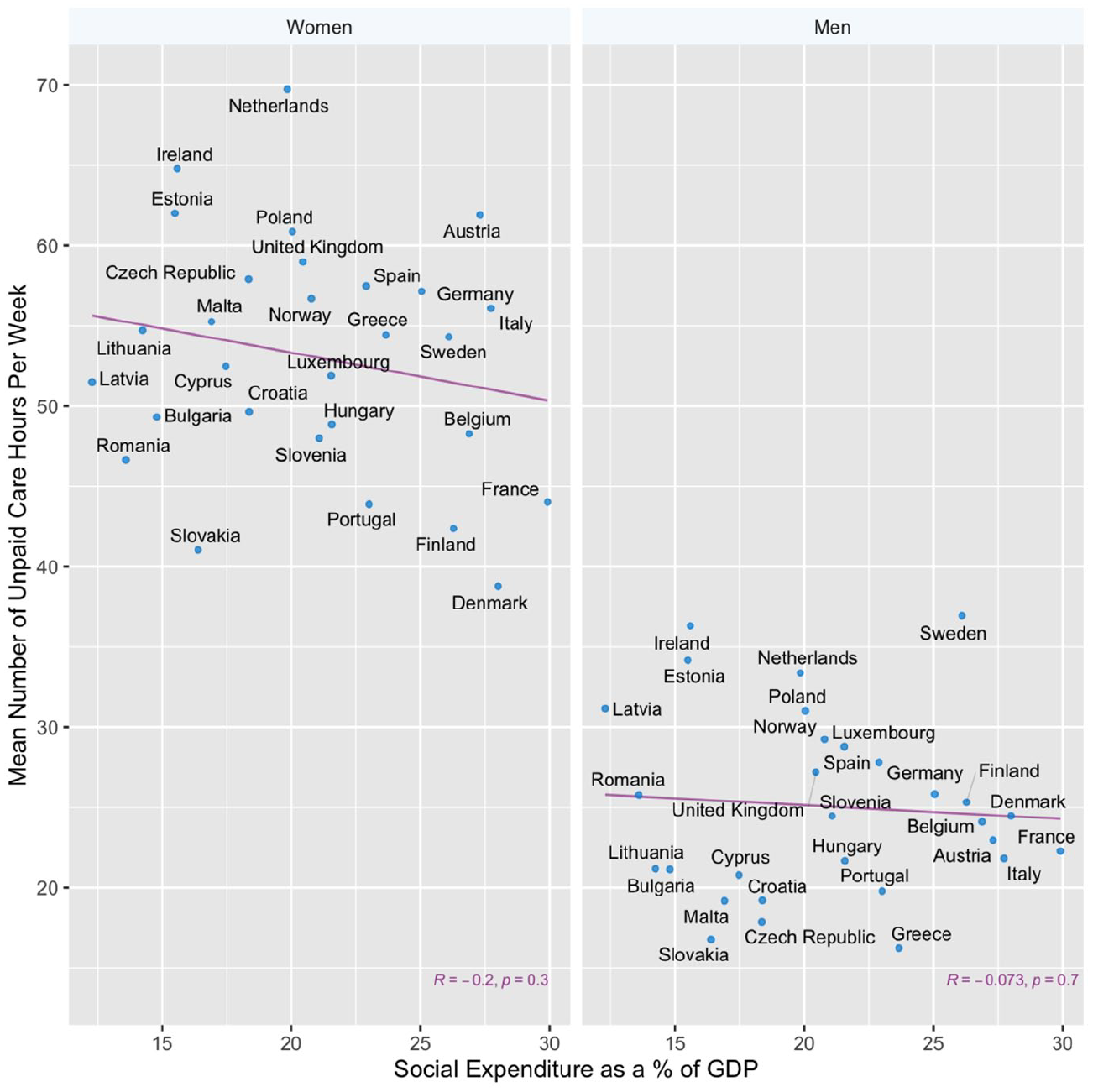
Social Expenditure and Average Time Spent on Unpaid Care Work, by Country and Gender
At the same time, however, Figure 3 also highlights considerable cross-country variation. This is seen not only in levels of social expenditure (which range from 12.3 percent of gross domestic product (GDP) in Latvia to 29.9 percent of GDP in France), but also in the number of hours spent on unpaid care work. For both women and men, we see that some countries are marked by particularly high (e.g., Ireland, the Netherlands) or low (e.g., Portugal, Slovakia) amounts of time dedicated to unpaid caring. We also see considerable variation in the size of the gender gap, which ranges from 14.3 hours in Denmark to 40.0 hours in the Czech Republic. (For further information on the distribution of unpaid care work across countries, including the gender and income breakdown, see Online Appendix Figure A1.)
Control Variables
Our models also include a standard set of control variables. At the individual level, we follow past scholarship (e.g., Altintas and Sullivan 2016; Esping-Andersen and Schmitt 2020; Salin, Ylikännö, and Hakovirta 2018) and incorporate controls for the basic demographic and socioeconomic factors that have been tied to time spent on unpaid care work: age (in years); education, split into a three-part categorization (lower secondary or below, upper secondary or postsecondary, and tertiary education); migration background, accounting for both immigration status (respondent and respondent’s parents born in country, coded 0; born in country but one or both parents born abroad, coded 1; born abroad, coded 2) and non-EU origin, as the closest proxy available for race (respondent not born in a current EU member state, coded 1); self-assessed health (ranging from “very good,” coded 1, to “very bad,” coded 5); hours worked per week in paid employment; employment status (employed, unemployed, homemaker, student, on disability, and retired); and household size (to complement the household income measure). Finally, we also include binary controls tied to the presence or absence of other individuals in the household who might either require care or help to provide it, namely, the number of children below 18 years in the household (one, two, or three or more); a spouse; a non-employed spouse; a non-related adult; a disabled adult; a child below 5 years; and a child 18 years or older.
In the full models, we then add two national-level controls that previous studies suggest structure the division of unpaid care work between women and men across countries (see, for example, Ferrant, Pesando, and Nowacka 2014; Salin, Ylikännö, and Hakovirta 2018): economic development, measured using logged GDP per capita in Purchasing Power Standards, 6 and economic inequality, measured using the Gini coefficient. In both instances, data are drawn from Eurostat (2018), taking values from the year prior to fielding in a given country. 7
Online Appendix Table A2 provides full summary statistics for the dependent and independent variables included in the models.
Analysis
Our analysis proceeds in two stages. The first, focusing solely on the individual level, is based on generalized least-squares models with country fixed effects and a binary variable to control for survey wave. The second, adding in the national-level variables, is based on nested models (with respondents nested in country-years, which are in turn nested in countries) using maximum likelihood estimation and incorporating survey weights. We thus follow current best practices in constructing the multi-level models (Schmidt-Catran and Fairbrother 2016). All findings are illustrated via figures to facilitate interpretation of the regression results, with the full regression tables presented in the Online Appendix. Note also that standard errors are clustered on countries.
Figure 4 presents the results of the analysis looking at individual-level factors alone, illustrating the findings from the regression tables presented in Online Appendix Table A3. By graphing predicted values, the figure demonstrates the expected relationship between income percentile (on the x-axis) and hours spent doing unpaid care work (on the y-axis), with women and men respondents illustrated separately. The confidence intervals, set at 83.5 percent, allow us to visualize statistically significant differences in predicted values at the 95 percent confidence level (i.e., p < .05; see Bolsen and Thornton 2014 for a discussion of the calculations behind this). The separate panels, in turn, show how this dynamic plays out for total hours of unpaid care (top panel), hours spent on childcare alone (middle panel), and hours spent on housework and cooking alone (bottom panel).
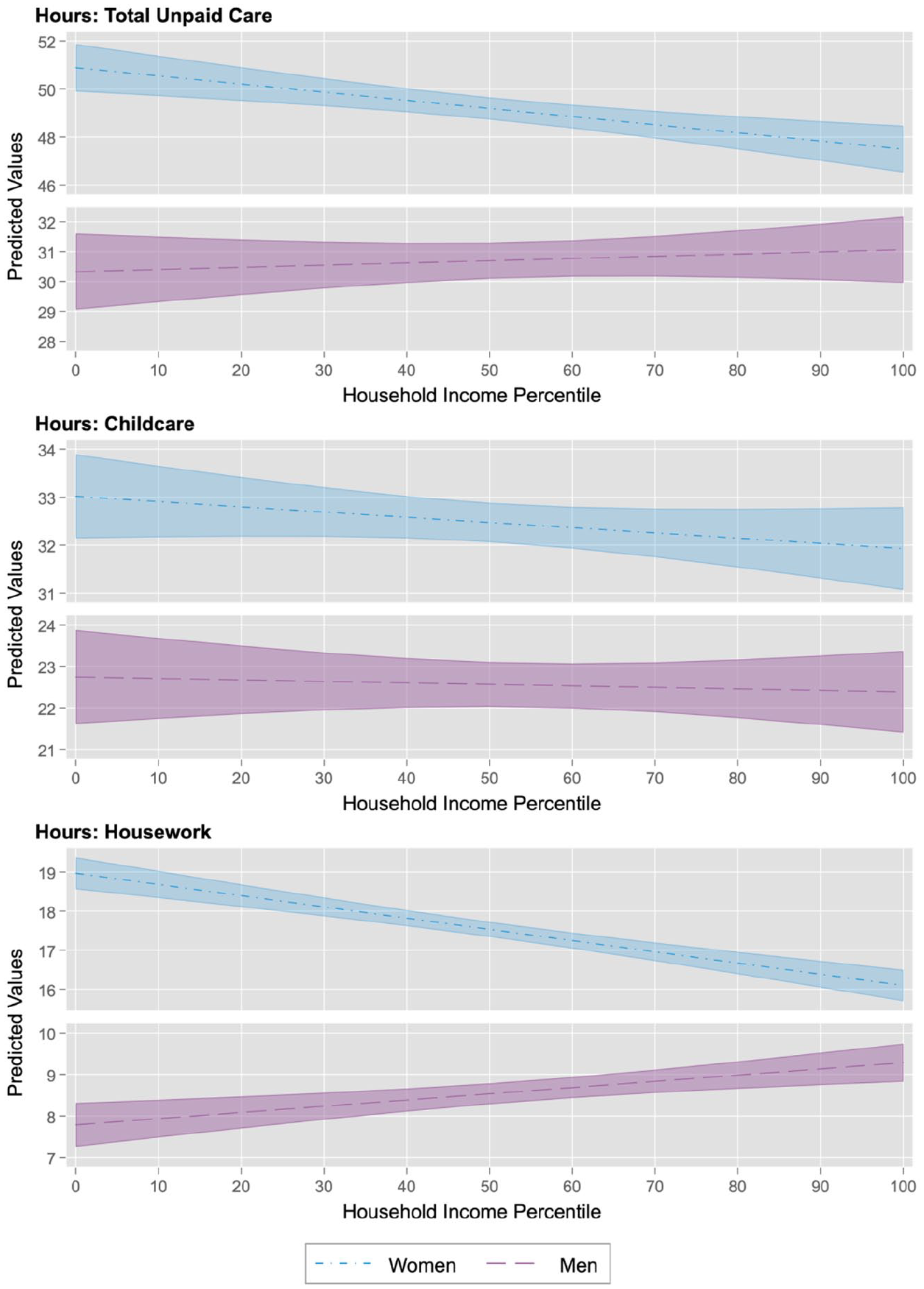
Household Income and Time Spent on Unpaid Care Work, by Gender and Care Type
Results highlight a gendered dynamic across all three models, with women consistently doing more unpaid caring then men when individual-level controls are included. Only the size of this gap varies: On average, women devote just under 50 percent more time to childcare than men (32.5 hours rather than 23.6), but more than double the amount of time to housework (17.5 hours rather than 8.5). The role of income, in turn, varies by both gender and the type of unpaid care work. Among women, higher income is associated with less time spent on unpaid care work (in total) and on housework—suggesting that this care is outsourced to paid individuals in scenarios of relatively greater wealth; its relationship to hours dedicated to childcare, by contrast, is not statistically significant. This reflects the expectations laid out in H1a and H1b, and reinforces prior research on “intensive mothering” among wealthier populations (Ennis 2014; Faircloth 2014). In contrast to H1c, however, income has a statistically significant association with the time men spend on housework, with higher income associated with a modestly higher number of hours spent doing these tasks (we return to this finding below). Finally, income has no discernible impact for men when it comes to the number of hours spent on childcare or the total amount of time dedicated to overall unpaid caring.
As for the control variables, we see three clusters of significant effects. First, various factors seem to matter regardless of the measure of unpaid care work that we analyze (i.e., overall, childcare, or housework): namely, the number of hours worked, household size, and whether or not one is a homemaker, lives with a parent, has a non-employed spouse, or is themselves unemployed. Second, a series of other variables matter for the overall measure of unpaid care and for childcare, but not for housework: age, education, immigration status, age of children (under 5, or 18 and above), and the survey wave. Finally, several other factors appear only to shape the number of hours spent on housework: namely, being a student, living with a non-related adult (who is not one’s spouse), and self-assessed health. These patterns are relatively consistent across all of our subsequent analyses and broadly reflect findings from existing research. 8
Next, we address H2 and examine the extent to which these dynamics vary based on welfare state spending. For our first step in this analysis, we add overall social expenditure to the interaction between gender and income (see Online Appendix Table A4). Results suggest that the same relationships between gender and income seen in Figure 4 are present after controlling for welfare state expenditure; the sole exception is that the positive relationship between income and the amount of time men spend on housework no longer attains statistical significance. Results also indicate, however, that total social expenditure has no clear association with hours spent on childcare and housework, whether we examine these direct and indirect care burdens individually or together. Findings thus do not support H2a.
Our final step in the analysis examines the role of targeted (family policy) expenditure on unpaid care work, with an interaction between gender, income, and family policy expenditure (see Online Appendix Table A5). Controlling for disaggregated expenditure in this way reveals several pertinent findings. First, gender and income continue to matter for unpaid care work, as it did after adding overall social expenditure to the model—with a large gender gap and a clear income effect on the amount of time women spend on housework. Second, while family policy expenditure does not shape time spent on caring for childcare, it is associated with fewer hours spent on housework (thus supporting H2b). A similar, albeit weaker, link is found when we look at the total amount of time spent on unpaid care.
Figure 5 presents the key results from the housework model. The graph shows the relationship between family policy expenditure (on the x-axis, illustrated between the fifth and 95th percentile values to exclude extreme values) and the size of the gender gap (on the y-axis), illustrating this dynamic for a low (10th percentile) and high (90th percentile) income level. The two panels thus present the predicted marginal effect of gender on the number of hours spent on housework, with 95 percent confidence intervals.
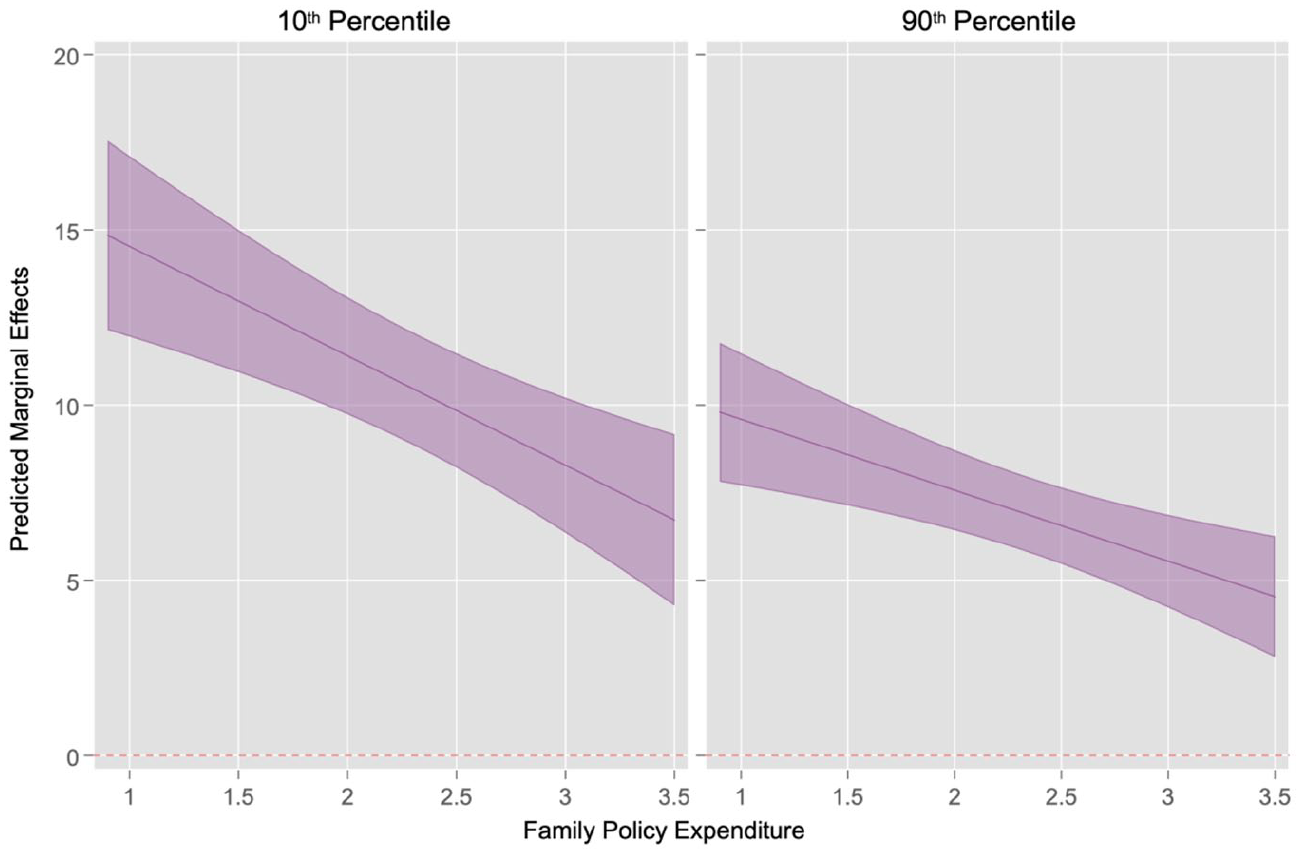
Family Policy Expenditure and Size of the Housework Gender Gap, at Low (10th Percentile) and High (90th Percentile) Household Income
Results suggest that family policy expenditure is associated with a smaller gap between the time women and men dedicate to housework, regardless of household income level. Yet even though family policy expenditure is correlated with a smaller gender gap on housework across the income spectrum, the predicted marginal effect is greater at lower levels of income: Comparing average women and men at different income levels, we find a drop in the gender gap from 14.8 to 6.7 (predicted) hours at the 10th percentile of the income distribution, compared with a drop from 9.8 to 4.5 (predicted) hours at the 90th percentile of the income distribution. While the two reductions are proportionately similar, the predicted effect is larger at lower income levels—suggesting larger time “savings” for women in these households. We therefore see a clear gendered and classed dynamic in unpaid housework: Family policy expenditure is associated with lighter unpaid housework burdens for women at all income levels, but this relationship is stronger for low-income women. Because this finding is limited to family policy expenditure (and is not found for social expenditure more broadly), our results suggest only partial support for H2c.
We confirm the robustness of these findings in several ways. For both the individual-level only and the full multi-level models, we examine whether results were driven by potential outliers (using remove-one jackknife tests). For the full models, we also conduct all of the analyses (1) excluding survey weights and (2) allowing the slopes of our key individual-level variables to differ across countries and waves (i.e., incorporating random slopes for gender and income into the models); this latter analysis allows us to account for additional variation in the effect of gender and income on unpaid care work across countries, as driven by cross-country differences that are unaccounted for in the model (e.g., culture, gender/social norms). As Online Appendix Tables A6 to A12 demonstrate, all major findings remain unaffected. The only exception is in the individual-level regression analysis, where the positive effect of income on the time men dedicate to housework no longer attains statistical significance—a result that nevertheless reflects findings from the full multi-level models presented above. 9
Discussion and Conclusion
In this article, we examined how gender, class, and national social expenditure (both overall and specifically on family policy) may shape the time individuals spend on unpaid childcare and housework. Building on existing large-scale and cross-national studies analyzing unpaid care (e.g., Altintas and Sullivan 2016; Esping-Andersen and Schmitt 2020; Hook 2010), we used England’s (2005) Devaluation Framework to assess the gendered and classed dimensions of unpaid care, as well as the role welfare states might play in diminishing care inequalities.
Our analysis relied on multi-level models using the 2007–2008 and 2016–2017 waves of the European Quality of Life Survey. Examining respondents living with at least one child below the age of 18 years across 29 European nations, two major findings emerged. First, we demonstrated the importance of disaggregating different types of unpaid care work, supporting prior arguments that not all unpaid care work is perceived equally. In the case of childcare provision, we found that the divides were more gendered than classed. This result supports scholarship about “intensive mothering” (e.g., England and Srivastava 2013; Schneider and Hastings 2017), which suggests that although time spent on childcare has been increasing among all parents, it has increased disproportionately for mothers within higher income households, since it serves as an important means of class reproduction (Ennis 2014; Lareau 1987). Our findings thus reinforce prior research suggesting that after-work-hours childcare is not being readily outsourced among highly educated and high-income mothers (even though many could easily afford to do so). This is typically attributed to shifting perceptions about the needs of children, cultural orientations toward mothering, and growing demands to provide children with a competitive advantage (Altintas and Sullivan 2016; Dotti Sani and Treas 2016; Nelson 2010). As Faircloth (2014) notes, this has led to mothers taking on a “God-like” role, and investing ever more time, energy, and material resources to ensure that the future opportunities of their offspring are maximized.
Conversely, in the case of housework and cooking, we found that time use varied according to both gender and household income—likely because such tasks are often considered “mundane” and are more readily outsourced to the paid care sector by wealthier women, through services such as housekeeping, dry cleaning, and prepared meals (Coltrane 2000; Dotti Sani and Treas 2016; Williams 2001). We thus found substantive differences in the time spent on indirect forms of care work, with low-income women spending the most time on these activities. This finding provides strong support for the need to disaggregate measures of unpaid care work when examining intersectional dynamics.
A major contribution of our analysis is that we provide pertinent nuance regarding the role of social policy vis-à-vis the interplay between gender, class, and unpaid care work across countries. Overall, social expenditure was found to have no clear relationship to hours spent on childcare or housework. However, when the focus was narrowed to analyze the effects of social policies specifically targeted on families (i.e., child allowances and credits, childcare supports, parental leave supports, and single-parent payments), we found a clear structuring effect on the relationship between gender, income, and housework (but not childcare). Notably, greater family policy expenditure was associated with a considerably smaller gap between the time women and men dedicated to housework; but while this relationship was present at all income levels, it was strongest at the lower end of the income spectrum—suggesting both a gendered and classed dynamic.
We attribute this finding to several factors. On one hand, family policy expenditure often results in more cash-in-hand for families, but likely does not provide enough additional funds to pay for substantive amounts of childcare for lower income households. On the other hand, cultural and social expectations surrounding childrearing may discourage many mothers from reducing time spent on childcare—but there is likely less concern about using any increased funds to reduce “menial” burdens tied to cleaning, cooking, or laundry. In this scenario, cash benefits can make a more substantial difference in the ability to outsource or reduce time spent on housework, especially for low-income women.
Taken together, our findings thus provide evidence of the role family policy expenditure can play in addressing gendered inequities in unpaid care work for all women—but especially those at the lower end of the income spectrum. In turn, these intersectional dynamics provide a powerful argument against welfare state retrenchment and suggest that investing in family policy can have meaningful impacts on reducing inequalities in unpaid care, particularly for lower income mothers.
There are nevertheless several limitations to our study, which in turn point out valuable avenues for future research. First, the data and methodological approach used here only allow us to highlight correlations; we are thus unable to say anything about the potential causal relationships and mechanisms that might lie behind our findings. Second, it is unlikely that we have revealed the full effects of family policy expenditure. Research suggests that family policies can increase women’s labor market attachment, thereby potentially shrinking the gender care gap by reducing the amount of time women can dedicate to unpaid care work (Ferragina 2020); yet these (mediated) effects are necessarily ignored in our models, since employment status and hours worked are considered to be key control variables (see, for example, Esping-Andersen and Schmitt 2020). As a consequence, we are likely missing a portion of family policy expenditure’s total effect on unpaid care work. Third, and notwithstanding our attempt to factor unobserved cross-country variation into our analysis, it may well be the case that cultural differences, for example, play an important role driving patterns of unpaid care work. Indeed, this point seems especially crucial given research suggesting that policies that are not aligned with cultural norms may only marginally affect the gendered division of unpaid care (Nakazato 2019). Fourth, because our analysis is limited to parents, the results cannot be extended to housework in general, as trends within childless households may differ substantively. Finally, our focus on disaggregated social expenditure is limited to a relatively broad group of programs—namely, family policy expenditure. Future work investigating specific types of family policies would therefore be especially valuable for further disentangling the relationships identified in this study.
To conclude, we note that our findings take on particularly acute significance in the context of the COVID-19 pandemic, which has fostered increased attention to unpaid care work. Early research suggests that this health emergency has amplified overall unpaid caring burdens within households, due to factors such as remote working conditions, a lack of childcare, increased home schooling, and heightened risks to aging populations (Oleschuk 2020). Although the precise gendered and classed dynamics of this heightened care burden are yet to be determined, emerging evidence suggests that it is women who are disproportionately undertaking this increase in labor, spurring suggestions that “the coronavirus is a disaster for feminism” (Lewis 2020). The findings in this study suggest that reinvesting in social policies that target families may be one concrete way to address this growth in unpaid care work, serving as an important step in post-pandemic recovery efforts. This, in turn, invites future research on the intersectional dynamics of unpaid care work, with particular attention to the caring burdens of Indigenous and racialized women, as a means toward reimagining a more equitable use of “human infrastructure” in the social organization of unpaid care.
Supplemental Material
sj-docx-1-gas-10.1177_08912432211038695 – Supplemental material for “Women’s Work”: Welfare State Spending and the Gendered and Classed Dimensions of Unpaid Care
Supplemental material, sj-docx-1-gas-10.1177_08912432211038695 for “Women’s Work”: Welfare State Spending and the Gendered and Classed Dimensions of Unpaid Care by Naomi Lightman and Anthony Kevins in Gender & Society
Footnotes
Authors’ Note:
The authors thank Dr. Pallavi Banerjee for her helpful comments on an early draft of this manuscript, as well as the three anonymous reviewers. Support for this paper was provided by Naomi Lightman’s Social Sciences and Humanities Research Council of Canada Insight Development Grant (File no: 430-2018-00062).
Notes
Naomi Lightman is Assistant Professor of sociology at the University of Calgary. Her research examines the intersections between gender, inequality, care work (paid and unpaid), and social policy. Her academic work has been published in variety of scholarly journals including European Sociological Review, Journal of European Social Policy, International Migration Review, and Social Politics. In addition, she actively collaborates with a variety of social agencies and government bodies. You can follow her on Twitter  .
.
Anthony Kevins is Lecturer in Politics and International Studies at Loughborough University’s School of Social Sciences and Humanities. His research centers on the relationship between public policy and public opinion, often with a focus on labor market vulnerability, inequality, and the welfare state. You can read more about his research on his website—which also includes non-paywalled, open-access copies of his published studies—and you can follow him on Twitter .
References
Supplementary Material
Please find the following supplemental material available below.
For Open Access articles published under a Creative Commons License, all supplemental material carries the same license as the article it is associated with.
For non-Open Access articles published, all supplemental material carries a non-exclusive license, and permission requests for re-use of supplemental material or any part of supplemental material shall be sent directly to the copyright owner as specified in the copyright notice associated with the article.
