




Abstract
We examine how and why some rural intra-provincial working migrant women in cities in central China used digital monitoring technologies in their mothering. The discussion draws on our 22 face-to-face interviews with the rural migrant mothers of at least one child ages 7–14 years. Our analysis highlights the intersectionally constituted time pressures arising from these women’s need to balance their responsibilities in paid work and childcare. We focus on how some of the mothers used smartwatches and home security cameras to pursue three core aspects of intensive mothering: being continually accessible to their children, supervising their children’s safety and well-being, and encouraging their children to study. We especially explore how these mothers used digital monitoring in navigating the time and space constraints to providing maternal care, practices that we call “time stretching.” The conclusion reflects on the implications of these women’s digital time-stretching efforts for feminist theories of mothering and care.
Zhangmei is a 36-year-old migrant who grew up in the countryside of Hunan province, in central China. When Zhangmei was 10, her parents migrated to Guangdong, leaving her and two siblings behind with relatives in the village. At our interview with her in October 2023, she attributed her departure from school at age 15 to feeling lost during these years. Now living in the provincial capital of Changsha, she had resolved to keep her 13-year-old son and 9-year-old daughter by her side and ensure that they would receive a good education. However, like the working mothers whom Lynet Uttal (1996) interviewed in the United States, Zhangmei’s possibilities to accompany her children in daily life were challenged by her need to do paid work. She worked from 8 a.m. to 6 p.m. 6 days a week at a clothes market. Meanwhile, her husband worked 7 days a week at a parcel depot.
Zhangmei had installed a home security camera in the living room of the family’s apartment, and she regularly checked the livestream on her smartphone app when she was at work or otherwise away from home. Of her son, she said: I installed the camera because I want to know what he is doing. Is he doing his homework or not when I’m at work?
She had also bought smartwatches to track her children’s locations and to call them as they traveled among home, school, and afterschool care venues—for instance, to the afterschool care center where her daughter received homework supervision and dinner each weekday, and to the tuition center attended by her son.
In China in the 2020s, Zhangmei was not alone among working migrant mothers in using digital monitoring devices to navigate between the ideals of “intensive mothering” on the one hand and the demands of paid work on the other hand. Intensive mothering, a term coined by Sharon Hays (1996), denotes an approach to mothering that requires women to devote immense amounts of time, emotional energy, and resources to childrearing, while prioritizing their children’s needs above their own. This article draws on our interviews with 22 rural migrant mothers who worked in cities in two provinces in central China in 2023; we explore why and how some of them used home security cameras and smartwatches in their intensive mothering efforts. Our analysis proposes the term maternal time stretching to conceptualize how these women tried to make their time at their places of paid work stretch to also cover meeting their responsibilities in their domestic worlds.
The discussion proceeds as follows. First, we consider different mothers’ usage of digital technologies to navigate the time–space challenges to their intensive mothering. In the second section, we introduce the implications of urbanization and digital transformation for migrant mothering in China. Third, we discuss the research sites and methods. Fourth, we explore the time–space challenges experienced by different women as they attempted to balance intensive mothering with paid work. In the fifth section, we examine interactions between individuals’ gendered care responsibilities and a consumer market for digital monitoring devices. Sixth, we consider some mothers’ use of home security cameras and smartwatches to accomplish core tasks associated with intensive mothering, and in the seventh section, we discuss migrant mothers’ negotiations with their children over digital monitoring. Thereafter, the conclusion considers the implications of migrant women’s digital monitoring and time-stretching efforts for feminist theories of intensive mothering and care work.
Situated Intensive Mothering, Technology, and Maternal Time Stretching
Hays’s (1996) research in the United States provides landmark insights into mothers’ difficulties in balancing expectations associated with intensive mothering and expectations associated with paid work. Her research highlights that women must contend with tensions between the values of intensive mothering such as care, altruism, and emotion, and the values that dominate in the world of work such as productivity, efficiency, and profit. She argues that the coexistence of these two cultural frameworks generates the “cultural contradictions of motherhood.” She further observes that even as her female research participants differed by their employment circumstances, class backgrounds, and marital statuses, they still made their claims to be good mothers with reference to intensive mothering ideology.
Subsequent research has revealed the influences of education-focused intensive mothering on maternal practices in different contexts, including in Western societies and in urban East Asia, highlighting the time and resource demands on mothers (Dermott and Pomati 2016; Kuan 2015). With respect to Chinese societies, scholars observe that a globally circulating intensive mothering ideology fuses with Confucian-influenced childrearing ideals that revere education. One indigenous childrearing ideal is that mothers should continuously guan—“govern,” “control,” and “care for”—their children while expressing emotional warmth for them, with the quality of women’s mothering indicated by their child’s academic performance (Chao 1994). Research also considers how intensive mothering in mainland China has been influenced by birth-planning policies operational from 1976 through 2016, when the Party-state appealed to women to devote their time to raising one or at most two “high-quality” children (Kuan 2015; Li 2022), as well as the mounting pressures on parents to ensure their children’s “viability in the fiercely competitive market economy” (Li 2022, 88).
Yet even as considerable research examines intensive mothering by middle-class women, other literature diversifies feminist understanding of intensive mothering, often by adopting intersectional and situated approaches either implicitly or explicitly. An intersectional approach recognizes the amplifying constraining and enabling effects of individuals’ social locations, which are structured by intersections of stratifiers such as gender, class, race, residency, rurality, and migrant status (Crenshaw 1991). Meanwhile, a situated approach considers the multi-scalar context in which the effects of these intersections play out (Dreby and Schmalzbauer 2013). Some of this research explores how working-class, low-income, and single mothers in Western countries practice good parenting in ways that reflect their time and resource endowments, approximating or involving alternatives to hegemonic middle-class intensive mothering norms (Dermott and Pomati 2016; Leigh et al. 2012). Other studies examine how marginalized migrant women revise their intensive mothering ideals according to their migration experiences and social locations in the host societies (Lan 2018; Lisiak 2018). Yet other research considers how rural migrant women in China’s cities adapt their mothering identities and practices while being subjected to middle-class child-centered narratives that resemble Western-intensive mothering ideology (Li 2022; Peng 2018). Consistent with Williams Veazey’s (2022) concept of “maternal migrant imaginaries,” with “imaginaries” being “the ways in which we not only think but feel our way around” our world (Lennon 2015, 1), this research recognizes that women’s approaches to mothering are influenced by “the experiential and abstract resources” stemming from their own childhoods, maternal norms in origin societies, and hegemonic practices in host societies (p. 1759).
Many migrant women’s efforts to balance paid work and intensive mothering are constrained by time and space challenges particular to their circumstances. However, time and space challenges intertwine because “time and space constitute an indivisible entity” (Adam 2000, 133–34). As McKie, Gregory, and Bowlby (2002) observe, individuals perceive and negotiate their possibilities for balancing their responsibilities in paid work and in caregiving within a reality structured by both time and space. Specifically, planning, activities, routes, routines, and relationships involve both temporal and spatial dimensions. Meanwhile, proximate care and long-distance care each entail different perceptions of and possibilities for balancing paid work and care. However, mothers who navigate proximate care and mothers who provide distance care can both use digital technologies to be simultaneously present in two places.
With respect to proximate care, some research conducted in Western countries examines how working mothers use digital technologies to intensify synchronicity in their daily time use. In 1993 Rakow and Navarro discussed how middle-class women in a small town in the United States used cellular mobile phones to not only do Hochschild’s (1997) “second shift” but also to do “parallel shifts”: Namely, they used the cellular phones to be accessible to their children while undertaking paid work. Reflecting technological changes, more recent research in Western countries has examined parents’ use of smartphones, location-tracking apps, and even home security cameras to reinforce their real-world supervision of their children in the context of busy working lives within social environments permeated by media-stoked anxieties about stranger danger (Katz 2001; Sukk and Siibak 2021). Meanwhile, other research considers middle-class mothers’ practical and affective labor in using digital technology when entrusting intensive mothering to proxies. For instance, Lui and Cheung (2024) discuss a mother in Hong Kong who watched the camera livestream of the nanny’s interactions with her child on her smartphone. She then messaged the nanny to instruct her about the care of her child.
A parallel literature explores how migrant women in and from the Global South use smartphones and webcams to remotely care for children from whom they are spatially separated for long periods (Chen 2022; Chib et al. 2014; Madianou, 2012, 2016; Peng and Wong 2013). These studies reveal that such migrant women use smartphones and webcams to do intensive mothering by regularly checking in with their children, supporting them in doing homework and guiding them in daily life (Chib et al. 2014; Madianou 2012; Peng and Wong 2013). These studies also discuss how some other migrant mothers use smartphones and webcams in their mothering collaborations with caregivers, usually grandmothers, to whom they have entrusted intensive mothering (Chib et al. 2014; Peng and Wong 2013). The mothers use video calls to consult with and to guide the caregivers, to reassure themselves about their children’s well-being, and to communicate with their children. However, even as these mothers mostly use their digital devices for communication purposes, the mediated interactions still afford them monitoring possibilities (Chen 2022; Madianou 2016). For instance, mothers look for any changes in their children’s appearance and for indications of how their children are being treated.
This article builds on these findings to investigate how migrant mothers use digital monitoring technologies to balance paid work and childcare. In doing so, our research offers fresh empirical and conceptual insights. The empirical insights pertain to the use of digital monitoring in the intensive mothering practices of understudied rural migrant women workers in central China. The exploration of their practices incorporates attention to different women’s usage of digital monitoring for both proximate and distance care, reflecting the mix of family configurations that increasingly prevail with the deepening of China’s urbanization (Guo, Lin and Zhu 2024). Specifically, some migrant women use digital technologies to care for co-resident school-age children whom they have brought with them to the city, but who they need to leave at home alone for a few to several hours per day when they are at their places of paid work. Meanwhile, some other women use digital technologies to care for children from whom they live apart for extended periods because of their migration for paid work.
We focus on rural migrant mothers’ use of home security cameras and smartwatches because these are the devices that our research participants most mentioned. Women’s use of home security cameras and smartwatches constitutes a notable shift in their maternal practices because these devices differ in their functions from the webcams and smartphones that have received most attention in the literature on mothering and migration. Chiefly, home security cameras and smartwatches have explicit surveillant functions in their design even as they offer communications affordances (Katz 2001; Sukk and Siibak 2021; Tan et al. 2022; Zhao et al. 2023). For instance, the home security camera enables the viewer to see clearly at a wide angle and provides continuously recorded footage that is accessible for 7 days. Meanwhile, children’s smartwatches, which resemble wrist-worn smartwatches minus Internet browsers, offer the functions of location monitoring, geo–ring-fencing, and route history records. The home security cameras and the smartwatches also have emergency alarms. Home security cameras and smartwatches are marketed to Chinese parents in ways that normalize monitoring as an element of good parental care, which echoes observations about the advertising of digital monitoring products to parents in other countries (Katz 2001; Sukk and Siibak 2021). A further influence on mother’s choice of smartwatches is school policies. Specifically, even as teachers in China require students to surrender electronic devices during the school day, they tolerate smartwatches more than smartphones.
Conceptually, our research contributes to feminist theories of care work by revealing how some migrant women attempt maternal time stretching as they use digital monitoring to stretch their time at their places of paid work to cover their home-based childcare responsibilities. “Maternal time stretching” differs from Rakow and Navarro’s (1993) idea of “parallel shifts” in its substantive focus and its engagement with a feminist reconceptualization of time. With respect to substantive focus, whereas “parallel shifts” captures how women used cellular phones to be continually accessible to their children, “maternal time stretching” refers to how women used digital devices not only to be accessible to their children but also to continually monitor their children. Next, whereas “parallel shifts” highlights women’s multitasking across spaces, “maternal time stretching” emphasizes women’s navigation of a structurally produced time crunch, with gender norms and marketization requiring mothers to be the ones who make their time go further.
The idea of maternal time stretching also engages with a feminist sociological reconceptualization of time (Leccardi 1996). Whereas the idea of parallel shifts sustains the dichotomous logic of public and private spheres as “one of the main pillars of the modern order” (Leccardi 1996, 174), maternal time stretching makes visible women’s subjective holistic experience of diverse intertwined temporal ontologies, including life course temporality, the circularity and repetitions of family time, and the efficiency imperatives of paid work time (Leccardi 1996). Women holistically experience these diverse temporal ontologies as they are enmeshed within relational networks (Holdsworth 2020) and within the ethical and emotional commitments of their “maternal migrant imaginaries” (Williams Veazey 2022). Furthermore, maternal time stretching recognizes women’s experience of time as malleable, integrated, and multistranded. Sociologists use metaphors of “weaving” (Davies 1990), “interlaced” (Leccardi 1996, 175), and a “spider’s web” (Leccardi 1996, 176) to capture the intertwined relational threads permeating feminine polychronic temporality. In a context where new communications technologies enable “simultaneity and instantaneity” (Leccardi 1996, 172), maternal time stretching extends this fabric metaphor.
The Chinese Context: Migrant Motherhood, Urbanization, and Technological Change
Rural migrant women’s use of digital technologies for maternal time stretching evolved in a historically constituted context. Following China’s abandonment of socialist autarky in the early 1980s, tens of millions of farmers began to migrate from their villages to seek work in newly emerging labor markets in the cities, prompting major changes in family configurations. Much research conducted in the 1990s and 2000s examines how migrant women tried to navigate between their desires to escape the life of rural drudgery endured by their own mothers and the patriarchal requirement that they return to the countryside to marry and raise children in their husband’s village (Chuang 2016).
By the twenty-first century, though, many rural mothers were eschewing expectations that they stay with their children. Census figures indicate that in 2000 more than 10 million children in China were living with their grandparents in the countryside because their parents had migrated without them (Lu et al. 2023). Subsequent census data revealed that in 2010, of the approximately 61 million rural children younger than 17 years who had been left behind by at least one parent, 46.74 percent had been left behind by both parents, and 16.87 percent had been left behind by lone migrant mothers (All China Women’s Federation [ACWF] 2013). Meanwhile, in 2020, 41.77 million rural children had been left behind by at least one parent (National Bureau of Statistics, UNICEF, and UNFPA 2023).
Migrants left their children behind partly because the household registration system (hukou), a vestige of China’s socialist planning system, has persistently tied citizens’ access to public goods and services to their registered place of residence. The hukou also designates individuals’ occupations as either agricultural or non-agricultural: The former’s welfare net consists of use-rights to farmland plots for subsistence security, whereas the latter enjoys state- and employer-provided social security packages. Facing challenges in access to public goods and urban school places for their children, especially in the larger cities, many rural migrants have felt compelled to delegate the day-to-day care of their children to grandparents or to other relatives in their hometowns, or else they have turned to private boarding schools (Murphy 2020).
However, with the deepening of urbanization, the spatial configurations of the urban-based families in which many rural migrant women do their mothering have been diversifying. Increasingly, rural families have been moving the location of their child-raising activities from rural to urban areas, with urbanization intensifying the “commercialization of social reproduction” (Liu 2023). One driver of the commercialization of social reproduction is the dismantling since the 1980s and 1990s of the collective provisioning of welfare, housing, and public services (Xiang 2021). Another factor, especially since the mid-2000s, is many local governments’ relocation of ever more schools from rural to urban areas and the concentration of the best quality educational resources in cities (Liu 2023; Wang and Teng 2022). Meanwhile, even as regulations vary within and across cities, since the early 2010s, local property ownership has increasingly substituted for or augmented hukou in determining where a child ranks on the admissions lists for a school, with other influences including the parents’ education level, employment status, and urban social security contributions (Liu 2023; Murphy 2020; Wang and Teng 2022). Parents buy property where they can afford it, with poorer rural families buying in smaller cities and better-off rural families buying in larger cities to support their children’s education. However, when rural-origin families buy property and send their children to schools in smaller cities, one or both parents may still remigrate to a larger city for work to finance the family’s urbanized childrearing strategy (Wang and Teng 2022). Intra-urban migration as well as rural rezoning have thereby contributed to 25.16 million children being left behind by migrant parents in urban areas in 2020. Meanwhile, in the same year, 71.9 million children had migrated to cities with their parents (National Bureau of Statistics, UNICEF, and UNFPA 2023).
In tandem with urbanization, digital connectivity has accelerated, creating the technological conditions for maternal time stretching. The most pertinent technological transformations include a rapid rollout of high-quality Internet connection, a smartphone penetration rate of more than 75 percent—which is a prerequisite for the use of digital monitoring apps—and the mass marketing of low-cost monitoring devices, the uptake of which is high (Huajing Analysis 2023). For instance, in June 2023, consumers bought 2,030,000 units of home-use security cameras online in China, an increase of 36.5 percent compared with June 2022, with urbanization driving demand (Luto Technology 2023). Meanwhile, in 2020, one-third of children 5–12 years old, most of them in cities, owned a smartwatch (Beijing Review 2023). However, little is known about how and why some migrant mothers use these digital monitoring technologies, a gap that this research addresses.
Research Methods
The following analysis draws on our 22 semi-structured face-to-face interviews with rural-to-urban migrant working mothers, supplemented with insights from conversations with other knowledgeable individuals. Approval for this research was granted by the Social Sciences and Humanities Interdivisional Research Ethics Committee at the University of Oxford. We conducted the interviews over three research visits between June and December 2023 in Hunan and Hubei provinces in central China, where existing networks made the research feasible. Most research participants were introduced by intermediaries who were the contacts of the second author or professors at the host university. Rural migrants in the cities of Hunan and Hubei are predominantly intra-provincial. This research thereby also contributes new empirical knowledge about intra-provincial migrant women, who have hitherto been overlooked in a literature that has mostly examined inter-provincial migrant women in China’s major coastal cities.
Intra-provincial rural–urban migration has always been important in China. Between 1995 and 2020, nationwide, one-third to one-half of rural–urban migrants moved intra-provincially (Wang et al. 2023). Moreover, since 2014, reflecting interior regions’ ongoing urbanization and megacities’ adoption of stringent policies against lower-educated migrants, the proportion of rural migrants staying nearer to their hometowns has increased. By 2023, 61.8 percent of rural–urban migrants in China moved within their provinces, while in interior provinces 48.3 percent of rural–urban migrants moved intra-provincially (National Bureau of Statistics 2024). Even as intra-provincial rural–urban migrants face significant obstacles to settling in cities, though, these obstacles remain less prohibitive than those experienced by inter-provincial migrants (Guo, Lin and Zhu 2024; Wang et al. 2023). Many rural–urban migrants therefore pursue intra-provincial migration as a more viable pathway to urban citizenship for themselves and their families.
Our 22 research participants each had at least one child aged 7–4 years, which is when a child usually has more autonomy but still needs adult supervision. We obtained informed consent from the research participants before the interviews. Interviews lasted 20 to 55 minutes. Questions covered their life histories, views of motherhood, approaches to their children’s education, participation in paid work, how they balanced paid work and childcare, spatial separations within their households, their family relationships, and their use of digital communications and monitoring technologies. We audio-recorded 18 of the interviews, which were transcribed from Chinese into English. In four further interviews where research participants preferred to talk without audio-recording, we wrote notes afterward. All research participants are referred to by pseudonyms.
Mothers ranged in age from 28 to 50 years, with a median age of 35. Their jobs included being pedicurists, masseuses, nannies, shop assistants, cleaners, seamstresses, and factory workers, while two were social workers. These women and their husbands had been born and had grown up in rural areas, except for a 28-year-old rural hukou woman who had lived alongside her rural migrant parents in Guangdong. Two women had completed primary school, six had completed junior high school, 11 had completed senior high school or a vocational equivalent, and three had graduated from university. On leaving education, 15 women had worked for several years in coastal factories. Seventeen women had a rural hukou. Four women had converted their hukou to a provincial capital to assist their child in gaining priority consideration in the allocation of a school place, and one university-educated woman had a Shenzhen hukou. Meanwhile, two other women’s husbands had converted their hukou to a provincial capital, again for their children’s education.
The women also varied in their families’ spatial living arrangements. Across the field sites, eight women lived apart from at least one child, and in five cases these children were left behind in the hometown county seat or village. Fourteen women lived with all their children. Four women worked in a provincial capital city while their husbands and children lived apart from them in smaller cities a few hours’ commute away. Six women lived with their children but apart from their husbands, while two women in provincial capitals were divorcees and the sole guardians of singleton daughters. More than half the interviewees had delegated at least part of their childcare to other individuals and institutions, including parents-in-law, mothers, aunts, boarding schools, and afterschool service and meal centers. Meanwhile, eight women were “active digital mothers” in that they used both home security cameras and smartwatches to monitor their children, while another eight mothers used only smartwatches. The research participants’ key characteristics are presented in Table 1.
Research Participants’ Characteristics
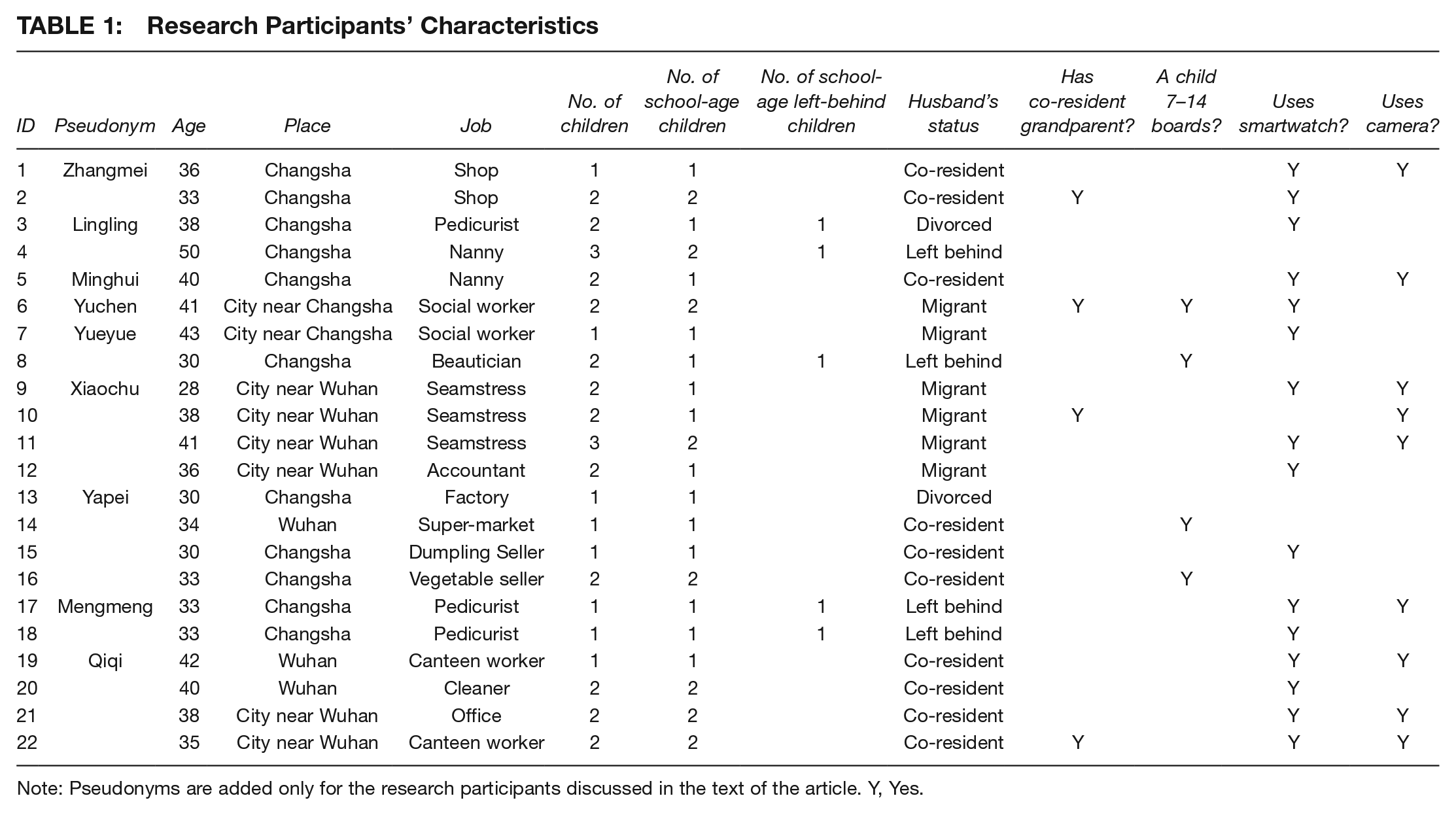
Note: Pseudonyms are added only for the research participants discussed in the text of the article. Y, Yes.
Following Charmaz (2006), we began our analysis by openly coding the transcripts of the interviews. We coded for recurring themes within the interviews while comparing across the cases, sensitized by our exposure to theories on mothering and care work and by our awareness of the burgeoning of digital monitoring in China. In the second stage, axial coding, we compared how our interviewees talked about motherhood, migration, paid work, digital monitoring, and childcare. In looking for thematic connections in our data, we homed in on the salience of the dual care work time demands on the migrant mothers, which resonate with Hays’s (1996) cultural contradictions of motherhood. We discerned that the migrant women who engaged in active digital monitoring were committed to education-focused intensive mothering, arranging online and offline tuition and extracurricular classes for their children. However, we further observed that, unlike our other research participants with co-resident elders, these “active digital mothers” received little help from others with childcare, so they felt the dual time pressures of paid work and childrearing more acutely. Our analysis suggests that these women used digital monitoring to stretch their time over their responsibilities in the worlds of paid work and home in their pursuit of intensive mothering.
The Situated Time Pressures of Migrant Mothers and Active Digital Mothers
Our research participants’ “maternal migrant imaginaries” (Williams Veazey 2022) help explain why some of them turned to digital time stretching. Integral to the women’s maternal migrant imagination was their view that they themselves had been “brought up” (dai) but not directly cared for or supervised (guan) by their parents. Instead, their parents had left them to play in the fields while they did farm work nearby, or, as in Zhangmei’s childhood, their parents had migrated without them. Many women had not progressed to senior high school or college because, in their view, they had lacked both sustained parental encouragement and financial investment in their education. Migrant mothers attributed their present-day experiences of financial insecurity, family-unfriendly working conditions, and socioeconomic marginalization to the legacy of these childhoods. These reflections intensified their commitment to engage in intensive mothering to elevate their children and themselves beyond a rural migrant status by ensuring that their children received a good education and could progress to a secure urban job. At the same time, though, these mothers felt a need to work long hours to earn money to provide materially for their children’s access to good schools and educational resources and for a decent urban future. The mothers’ time pressures arose because even as they felt obligated to support their children’s education through supervision and money, their space-bound bodies could not be simultaneously physically present in their places of domesticity and paid work.
Nineteen of the 22 women in our study considered themselves to be “mortgage slaves,” with 7 belonging to couples that had bought apartments in provincial capital cities and 12 belonging to couples who had bought apartments in cheaper, smaller cities. Reflecting the commodification of social reproduction under urbanization, these mothers saw buying an urban property as necessary not only to secure accommodation but also to obtain an urban public school place for their children. Migrant mothers also contributed to direct education-related expenses. Four mothers paid for afterschool childcare services, which provided homework supervision and dinner. Meanwhile, 18 mothers paid for tutoring and enrichment activities for their children, such as English, art, and music classes, including in in-person and online formats. A few parents also paid for in-school programs. For instance, in Changsha, the public junior high schools divided students into “information classes” and “ordinary classes”: Students had to pass a test to be admitted into the former, and parents paid 500 yuan per term for them to be allocated classwork on a school iPad. Moreover, parents who had younger and older children alongside a child age 7–14 years incurred further costs: Three families paid several thousand yuan per year in kindergarten fees, while five families paid costs for children in senior high school, vocational school, or university.
Most of our research participants had working-class jobs and spent 10–12 hours a day for 6 or 7 days a week in their workplaces. Two middle-class migrant women, both social workers, worked shorter hours than the others, but they still felt busy. The migrant women worked for long hours partly because, as migrants, they needed to help pay for public goods and services that local urban residents received at subsidized cost. A further reason is that their lower pay made overtime an important source of income. Indeed, intense economic pressure could lead to some women working especially long hours. For instance, 38-year-old Lingling worked two jobs in a restaurant and in a pedicure salon, sleeping only three hours a night. She had a 12-year-old foster son who she had cared for since he was 18 months old, after his mother had died. At the time of interview, this boy had been living in the hometown in a room near his school for several months, with Lingling’s elder sister bringing him food on weekends. Lingling also had a teenage daughter who was studying in a vocational school. Even as all the women worked long hours, though, a few had more flexibility that the others. For instance, the seamstresses and one cleaner could fit their piece-rate hours around their children’s school pick-up and mealtimes.
As mentioned, 8 of the 22 research participants were “active digital mothers” in that they used both home security cameras and smartwatches to monitor their children. Seven of these active digital mothers co-resided with their children in the city and one of them worked in a provincial capital while her child and husband stayed in a smaller city three hours commute away. The active digital mothers used home security cameras and smartwatches in a complementary fashion, the former to supervise their children while they were inside the home, and the latter to stay connected to their children when the children were outside the home. Meanwhile, eight other mothers used just smartwatches, which, depending on their family arrangements, were linked to their own smartphones and sometimes also the smartphones of fathers or grandmothers.
Some women identified a lack of adult help with childcare as the reason for their use of home security cameras and smartwatches. In five of the seven cases where active digital mothers co-resided with their children, the husbands lived and worked away from them. In two remaining cases, the husbands worked family-unfriendly hours 7 days a week. Yueyue, a 43-year-old social worker whose migrant husband worked in another city, indicated that her use of digital monitoring was in response to an absence of childcare help from other family members. She said of her 12-year-old son: In 2019 my parents-in-law returned to their village, and we needed to go to work so I bought him a smartwatch. We have peace of mind knowing where he is.
She added that the same year she had installed a home security camera in the main room of their apartment to call her son when his smartwatch ran out of charge. “If we’re doing weekend overtime when he’s home alone, I can call him through the camera and tell him to get up and eat,” she explained. Meanwhile, Zhangmei told us that unlike the long-term urban resident mothers of her son’s classmates, she had no parents-in-law to help her with childcare, so turned to camera monitoring.
Only one of the eight active digital mothers lived apart from her child. Mengmeng had installed a camera to keep an eye on her husband and 10-year-old daughter in the hometown. Mengmeng worked in Changsha as a pedicurist till late each evening, and she visited her husband and daughter twice a month for 2 days each visit. She had resorted to digital monitoring because, as is common among migrant mothers, she felt herself to have primary responsibility for her daughter’s care (Li 2022; Peng 2018). By contrast, the other migrant mothers who did not live with their children said that they did not need to use digital monitoring because their child was always supervised. Three of these mothers said that a grandmother always accompanied their child, so they did not need a camera. However, in two cases, the women’s children still had smartwatches because the children went to and from school by themselves. Meanwhile, three other women said that they had sent their children to private boarding schools for round-the-clock supervision, such that they perceived little need to use either smartwatches or home security cameras.
The Gendered Purchasing of Digital Monitoring Devices
“Active digital mothers” turned to digital monitoring in a milieu in which home security cameras and smartwatches had become readily available. China Telecom advertisements commonly equate digital monitoring devices with modern conveniences. Moreover, many advertisements feature gendered images of family life, which contribute to an expectation within consumerist discourse that women can obtain support from the market in meeting their domestic responsibilities (Shen and Jiao 2024).
Mothers often initiate the purchase of monitoring devices and take charge of their usage. In our research, of the 16 mothers whose child age 7–14 years had a smartwatch, 11 mothers had made the purchase. Meanwhile, as Zhao and colleagues (2023) observe, the functions of the children’s smartwatch are usually linked to the mother’s smartphone. Mothers also bought the home security cameras to monitor their children. For example, Zhangmei explained to us that buying the camera was her idea. “I didn’t need to discuss it with my husband,” she said. “He’s at work most of the time, so I take charge of family matters.” Like three other mothers, Zhangmei had bought her camera online via home delivery for approximately 120 yuan. These mothers noted that the home security cameras were easy to plug in and operate, “just like any other household appliance.”
Other families had been given their cameras as part of their home Internet subscription packages, which they had accepted and installed. For instance, Qiqi, a 42-year-old canteen worker with a 14-year-old son said: We installed a camera in the main room at home. We installed it when we got the internet and ipad for his online classes during COVID [in 2020]. So, the home security camera came with the package. . . . We never took it down . . . It’s very convenient. When I need to work here on weekends or during the holidays, I can see that he’s got out of bed.
Importantly, though, a handful of our interviewees also referred to husbands, brothers, or brothers-in-law who had bought home security cameras for installation in the homes of their patrilineal grandparents in the village. Consistent with literature on the gendered use of domestic technology (Livingstone 1992), therefore, women and men both bought and used home security cameras, but often in relation to gendered spheres of care work.
Digital Monitoring and Intensive Mothering
The active digital mothers used cameras and smartwatches to carry out three aspects of intensive mothering: (1) being constantly accessible as a caring presence for their children, (2) taking primary responsibility for their children’s well-being and safety, and (3) fostering good study and life habits in their children.
Constant Accessibility
Like the working mothers discussed by Rakow and Navarro (1993), the active digital mothers used the new technologies to enact their belief that as primary caregivers, they should be constantly accessible to their children. They used the devices to signal their continual connection to their children. Some mothers said that their children would phone or text them via their smartwatches if they needed anything. Meanwhile, the cameras demonstrated ongoing maternal presence and accessibility. For instance, Xiaochu—who was the mother of a 10-year-old girl and 5-year-old boy, who worked in a clothes factory, and whose husband worked as a courier in another city—explained that the home security camera with its intercom and alarm buttons meant that her children always knew she was there for them, even as she worked night shifts and on weekends. If her children needed to talk to her, they could shout at the camera, which would make her mobile phone ring. Even as the children seldom talked with her over the camera, she said they knew that if they urgently needed her, she would rush straight home.
The mothers further used the cameras to create a sense that family members were continually accessible to each other and together even as time–space constraints precluded physical co-presence. Research shows that the members of some spatially dispersed migrant families use webcams and smartphones to create a sense of “constant connection” (Madianou 2016), thereby challenging prevailing discourses about deviant migrant parenting that prioritizes money over family and childcare (Chib et al. 2014). However, monitoring cameras arguably enhance the adults’ feeling of constant connection more than other technologies because of the continuous livestreaming and playback function. For instance, Xiaochu explained that when her courier husband rested from his grueling shifts, he liked to “watch the footage, which is kept for seven days.”
Responsibility for Well-Being and Safety
Mothers also used digital monitoring technologies to reassure themselves about their children’s well-being and safety. They combined the use of home security cameras and smartwatches to feel that they were covering all the bases in supervising their children. They used the smartwatches and home security cameras to do “anticipatory monitoring,” which Tan et al. (2022) refer to as “being aware of loved ones and looking out for events.” A common example of mothers’ anticipatory monitoring was using digital devices to look out for the children’s arrival home. For instance, Minghui, a 40-year-old nanny, said of her 10-year-old daughter: If neither me nor my husband can fetch her from school, we can use the smartwatch to see where she is. With the smartwatch we can see if she’s arrived home. If she’s forgotten to wear her smartwatch, we can see on the home security camera that she’s gotten safely home.
A further example of mothers taking responsibility for children’s well-being and safety was their use of cameras to do the anticipatory checking that younger children had not wandered out of the apartment or had any accidents during extended periods without adult accompaniment, such as during school holidays. The mothers’ reassurance was enhanced because of the breadth and clarity with which they could see the room surroundings via the home security cameras. For instance, Xiaochu said: With a mobile phone video call, I can just see the face. But with the camera I can see the whole setting and what they’re doing.
Mengmeng was an active digital mother who lived apart from her child. Like the active digital mothers who lived with their children, Mengmeng had given her daughter a smartwatch and had installed a home security camera in the family apartment, so she could be continually accessible to her daughter and to reassure herself about her daughter’s well-being. She said: I installed a camera in my home two years ago. That way I have more peace of mind and talking with them is convenient. My daughter also has a smartwatch for keeping in touch. I call her every morning before she leaves for school.
Mengmeng further mentioned that she could see the time her daughter arrived at school each morning through the smartwatch’s location tracking. Her usage of digital technology recalls Madianou’s (2016) and Chen’s (2022) observations that some transnational migrant women use the “constant connection” afforded by webcams and smartphones to not only communicate but also to monitor their children and the care of the delegated caregivers. The reassurance that Mengmeng obtained from her monitoring, though, was increased by the continuous livestream and location feed of the new devices.
Fostering Good Study and Life Habits
A further maternal use of home security cameras was to foster children’s good habits in studying and life, this being a hallmark of education-focused intensive mothering. The active digital mothers observed that, unlike some full-time mothers, they did not have time to sit and watch their children doing homework. They therefore mobilized the potential “panopticon effect” of the home security cameras in ways famously theorized by Foucault (1977, 200–203). They wanted their children to know that they could be watched at any time and hoped that this would compel the children to exercise self-discipline regardless of whether they were being watched. The mothers especially felt a need to use cameras to monitor children who they thought had weak “self-discipline” (zijuexin). For instance, Minghui said of her 10-year-old daughter: If she was more zijue, we wouldn’t need the camera. Even though school doesn’t allocate too much homework, I want to ensure that she practices dance and English every day.
Moreover, Zhangmei explained that the camera was positioned at her son’s side of a worktable because he was not as zijue as his sister. Zhangmei also thought that her son’s classmates were extremely zijue and had more family-based advantages than he did. She used the camera to try to improve her son’s chance to be in the 50 percent of junior high students in Changsha who could test into public academic-track senior high schools. Meanwhile, the physical distance notwithstanding, Mengmeng could see her daughter have dinner and do her homework each evening.
Maternal Negotiations With Children Over Digital Monitoring
Active digital mothers often needed to negotiate with their children over the use of monitoring devices. Several factors influenced these maternal negotiations. Type of monitoring was one factor. Specifically, mothers could easily convince their children to wear smartwatches, but they had to negotiate with them over camera monitoring. Mothers also differed in their capacity and inclination to negotiate with their children about camera monitoring. In our research, mothers with the greatest capacity and inclination to negotiate with their children were those who most actively pursued education-focused intensive mothering and who had little childcare help from other adults. But a few women also differed from our other research participants in that they either had little capacity to negotiate with their children or else they rejected the idea of camera monitoring. Below we consider how different women perceived different forms digital monitoring as aligning or not aligning with their wish to be good and responsible mothers who kept their children as safe as possible.
As mentioned, mothers found it easy to get their children to wear smartwatches because smartwatches’ functions could satisfy the needs and desires of both mothers and children (Zhao et al. 2023). Mothers valued the location tracking and phone call functions. However, according to mothers, children mostly use the phone call functions. Several parents additionally said that their children liked to call and text their classmates outside of school. Moreover, children liked the digital wallets, where these were available.
When it came to cameras, though, active digital mothers’ and children differed in their feelings. In using cameras, the mothers saw themselves as simply extending the supervision of their children that they would do if they were at physically at home with them. They perceived little difference between telling a child in person to turn off the television and telling a child via the camera intercom to turn off the television. Moreover, they stressed that the cameras were in the living room (da ting) rather than in their child’s bedroom. But even when Minghui had placed a camera in her 10-year-old daughter’s bedroom, she still thought that her child’s privacy was preserved because, “she knows how to close the lens if she wants to get changed for a shower or if she wants to do something else.”
However, the active digital mothers’ vignettes also reveal that they imposed camera monitoring in the face of their children’s resistance. For instance, Minghui said that whenever her daughter turned off the camera, she would phone to tell her to turn the camera back on, at which times her daughter would silently obey. She added: Some of the parents in my daughters’ class have installed cameras, and they talk about how clever their children are to turn them off.
Similarly, Yueyue said of her 12-year-old son: If he watches TV he’ll turn the camera to the wall. He doesn’t want to be supervised all the time.
Meanwhile, when we were talking with Zhangmei, her son interjected: “she placed it above my head. I often turn it off.” These snippets indicate that the mothers’ use of home security cameras did not generate the warmth necessary to buffer the control aspect of guan.
Some mothers were assisted in their negotiations with their children over camera monitoring by two factors. First, the consistency between (1) the active digital mothers’ time and economic investments in their children’s education and (2) the stated aims of the camera monitoring—to check on the children’s well-being and ensure that they progress through education—increased the inclination and the possibility for some mothers to encourage their children to tolerate camera monitoring. For instance, Zhangmei believed that her son knew that his parents worked hard so that he could go to a good school. Second, pre-existing mother–child intimacy helped some active digital mothers negotiate with their children over camera monitoring. For instance, jokes between mothers and children about the children turning off the cameras indicated a degree of mutual accommodation: Mothers accepted the closure of cameras for short periods in exchange for the children turning the cameras back on again when instructed to do so.
However, our research includes one mother who had limited capacity to negotiate with her children about camera monitoring and two mothers who rejected the idea of camera monitoring. Lingling had little capacity to negotiate with her children over camera monitoring. In 2019, when Internet subscriptions were being rolled out in their hometown, Lingling had plugged in a home security camera that had been part of the package. However, her foster son and her then 15-year-old daughter had unplugged the camera because they did not want to be watched. Lingling could not insist on camera monitoring because she did not reside with her children. Moreover, the delegated caregiver was not sufficiently present or motivated to impose camera monitoring. By contrast, Lingling’s son readily wore the smartwatch that she had given him to monitor his location and well-being.
Two other mothers had some capacity to impose camera monitoring because they co-resided with their children, but they still rejected cameras. Yapei was a divorcee, and her principal concern was economic survival. She worked in an electrical appliance factory from 7.30 a.m. to 7.30 p.m. 6 days a week. In the early evenings and on Saturdays, therefore, her 13-year-old daughter stayed alone in their rented room. At these times, Yapei would give her daughter the use of a smartphone so that she could call her for reassurance if she heard any unfamiliar noises. However, even as Yapei struggled to ensure the full supervision of her daughter, she would never install a home security camera. She explained: I don’t have a camera because it’s too easy to have your privacy intercepted. I always tell my daughter to mind where her phone camera is pointing and to be careful about what images of her are captured. . . . I’ve seen many short videos about leaking privacy. . . . In the countryside no one pays attention, but in the city, girls need to pay attention wherever they are.
Like the active digital mothers, Yapei wanted to keep her daughter safe. But consistent with the insight that biography impacts “maternal migrant imaginaries” (Williams Veazey 2022), Yapei’s sense of vulnerability as an outsider influenced her view that the principal way to keep her daughter safe was to teach her about self-protection in a digital society full of strangers and potential tricksters. Some active digital mothers conceded the possibility of privacy leaks from home security cameras, but they considered leaks unlikely because they trusted the telecoms companies. Mothers’ use and non-use of home security cameras therefore both aligned with maternal commitments to keep their children safe.
Yuchen was a social worker whose husband earned a high salary in China’s west. She lived with her in-laws and her 8-year-old daughter while her 15-year-old daughter boarded at a high-quality private school on weekdays, returning home on weekends. Yuchen explained: Once when my girls were fighting, I suggested installing a home security camera. But they really objected. They felt that home should be their own space. My eldest daughter has cameras in all the classrooms at her school and the teacher uses the footage to say that such and such a classmate did not pay attention. My daughter therefore really opposed the suggestion of having a camera at home as well.
In rejecting home security cameras on grounds other than “no need,” Yuchen stood out from other mothers who received help with childcare from co-resident grandparents. But she also differed from the active digital mothers who rejected their children’s wishes for their home to be a sanctuary from camera monitoring because they felt a need to intensively monitor their children in the face of supervision gaps and unmitigated time pressures. Yapei and Yuchen’s concerns about camera monitoring thereby reveal the contradictions that parents face in using surveillance in contemporary digital societies.
Conclusion
Through migration, the organization of maternal caregiving has been changing. Economic pressures arising from the urbanization of rural families’ social reproduction and the unequal terms on which rural migrant women work and live in cities have caused many mothers to do ever longer hours in paid work outside the home, while some migrant women workers live spatially separated from their children. Even so, working migrant mothers have retained their primary responsibility for childcare. Moreover, the time–space challenges to their mothering have increased as these women use both paid work and intensive mothering to try to equip their children for assimilation into a competitive host society.
Our research explores how the time demands of paid work and childcare pulled on our research participants’ space-bound bodies in ways reflective of their situated social locations. We propose the idea of maternal time stretching to conceptualize how a subset of rural intra-provincial migrant mothers in central China’s cities used digital monitoring devices to navigate this time-pull on them. Specifically, we examine how, by means of time stretching, some of the women tried to discharge their home-based care responsibilities while they were at their places of paid work.
We observed that the mothers who used both home security cameras and smartwatches to monitor their children felt themselves to be under especially acute time pressures. They did so partly because, owing to their migration, they were separated from family networks, and they lacked financial resources to purchase childcare services. The period after children came home from school but the parents were still at work, late night overtime, weekends, and the school holidays were all child supervision pinch points. At these times, a combination of smartwatches and home security cameras enabled the active digital mothers to feel reassured that despite being at their places of paid work, they could achieve core aspects of intensive mothering, including remaining available to their children and covering all the bases in supervising their children’s well-being and safety.
The mothers who engaged in active digital monitoring were also committed to education-focused intensive mothering. In Chinese, the phrase peidu or “accompanying studies” refers to full-time mothers who devote themselves to doing domestic chores for their children so that the children can concentrate on their studies (Wang and Teng 2022). Meanwhile, a common practice of guan is for Chinese mothers to sit with their children as they do homework, both to accompany them and to keep them focused on their studies. In using smartwatches and cameras to monitor their children’s studies, the active digital mothers exemplified that “childcare is a state of mind” as much as a set of activities (Budig and Folbre 2004, 9). Digital devices allowed some mothers to feel they were doing intensive mothering while enabling them to affirm their identities as good mothers to their children, to themselves, and to other mothers with whom they discussed camera monitoring. Their purchase of the monitoring devices also signaled to their children their expectations that the children should follow routines, behave well, and study proactively.
The mothers’ use of digital monitoring technologies was partially a response to wider shifts whereby childcare work has become ever more the responsibility of nuclear families. China long ago abandoned its socialist feminist attempts to socialize childcare work. Concurrently, resembling a dynamic in other highly marketized societies, including the United States (Pugh 2005), China has seen the rise of localized versions of consumerist neoliberalism that urge individual women to be efficient, flexible, and innovative in consuming products to help them navigate their dual domestic and paid work responsibilities (Shen and Jiao 2024). Using digital devices represents mothers improvising as individuals to solve child supervision gaps. But as Pugh (2005) observes of advertised toys that purport to entertain and soothe children without claiming the mothers’ time, monitoring technologies similarly obscure the long hours children spend without direct adult interaction. Moreover, the structural causes of the mothers’ time pressures remain occluded by imperatives on families to work continually to advance.
Our exploration of the practices of rural intra-provincial migrant women in cities in central China enriches intersectional feminist literature on intensive mothering. We demonstrate that imperatives on mothers to both do paid work and supervise their children are influenced by their “maternal migrant imaginaries” (Williams Veazey 2022). Meanwhile, the time pressures on our research participants have arisen from situated intersections of their rural migrant status, their working conditions, gendered expectations, and intensive mothering ideology, with different women experiencing and resolving these pressures differently. We especially cast light on the new maternal practices of a subset of our research participants who turned to digital monitoring technologies to ensure that their children were always supervised.
Importantly, though, our analysis also considers the limitations to maternal time stretching. Remote monitoring via a combination of cameras and smartwatches could not provide children with the regular warm interactions that a practice of guan requires to buffer maternal supervision and control (Chao 1994). Moreover, active digital mothers’ accounts of their children’s resistance to the home security cameras reveal that the mothers insisted on camera monitoring while rejecting their children’s wishes for privacy at home. Using monitoring cameras, therefore, did not permit the active digital mothers to deliver care that responded to their children’s expressed needs; Tronto (1993) argues that good care entails caregivers listening and responding to the care-recipients’ needs. Instead, some mothers’ actions in giving their children attentive time by cooking for them, talking with them, and taking them to extracurricular classes, created sufficient parent–child intimacy for their relationships to withstand the intrusion of camera monitoring. This research confirms, from a new perspective, therefore, that time (along with attention) is the core ingredient of caregiving (Tronto 1993). Work regimes and welfare regimes take this time for granted—the lion’s share of which is provided by women. However, attentive time is so precious that it can be stretched only so far, and with uncertainty about whether the recipients will accept it as nurturing care.
Footnotes
Authors’ note:
This research was made possible by a grant awarded to Rachel Murphy by the John Fell Fund, “Digitally Visibilized Lifemaking in Migrant Families in China,” award number 0013756. Professor Ouyang Yao kindly hosted a visit by the first author to Hunan Normal University in June 2023, which enabled scoping for this topic. We are extremely grateful to the colleagues at the university of the second author, especially Professors Dong, Mi, and Xu who generously made introductions to research participants and to other intermediaries in October 2023 and November to December 2023. We are also grateful to the research participants for their valuable time and discussions. The paper has been strengthened immensely by two rounds of detailed feedback and guidance from the editors and four reviewers.

Rachel Murphy is a professor of Chinese Development and Society at the University of Oxford. She has a PhD in Sociology from the University of Cambridge, England. Her research examines migration, gender, technology, and family change in China.
Gaohui Wu is a lecturer in Public Administration, Central South University. He has a PhD in Management from Zhongshan University, China. His research focuses on poverty alleviation, governance, and social policy in China.