



Abstract
Studies of occupational sex segregation rely on the sociocultural model to explain why some occupations are numerically dominated by women and others by men. This model argues that occupational sex segregation is driven by norms about gender-appropriate work, which are frequently conceptualized as gender-typed skills: work-related tasks, abilities, and knowledge domains that society views as either feminine or masculine. The sociocultural model thus explains the primary patterns of occupational sex segregation, which conform to these norms: Requirements for feminine (masculine) skills increase with women’s (men’s) representation in the occupation. However, the model does not adequately explain cases of segregation that deviate from these norms or investigate the ways in which feminine and masculine skills co-occur in occupations. The present study fills these gaps by evaluating two previously untested explanations for deviations from the sociocultural model. The findings show that requirements for physical strength (a masculine skill) increase with women’s representation in professional occupations because physical strength skills co-occur with substantially higher requirements for feminine skills that involve helping and caring for others. These results indicate that the sociocultural model, and more generally explanations for how gender norms drive occupational sex segregation, can be improved by examining patterns of gender-typed skill co-occurrence.
Keywords
Despite great advances toward gender equality in recent decades, men and women working in the United States continue to dominate very different occupations. On average, from 2011 to 2015, more than 90 percent of Secretaries and Administrative Assistants, Childcare Workers, and Dieticians and Nutritionists were women, whereas more than 90 percent of Structural Iron and Steel Workers, Aircraft Mechanics and Service Technicians, and Industrial Truck and Tractor Operators were men. 1 Recent sociological explanations for this form of occupational sex segregation rely on what has been called the sociocultural model (Lueptow, Garovich-Szabo, and Lueptow 2001), which emphasizes the importance of popular associations between certain types of work and workers of a given gender. 2 These associations function as norms in that there is both an expectation of and approval when men and women perform work associated with their gender, and disapproval when they do not (Horne and Mollborne 2020). Studies using the sociocultural model often conceptualize such norms as gender-typed skills: work-related tasks, abilities, and knowledge domains that society views as either feminine or masculine (Cech 2013; Charles and Grusky 2004; Correll 2004; England 2010; Levanon and Grusky 2016). Examples include the view of helping and caring for others as “feminine skills” and of working with machines and mathematics as “masculine skills” (Anker 1997; Cejka and Eagly 1999; Koenig and Eagly 2014). The sociocultural model asserts that gender-typed skills give rise to occupational sex segregation. 3 Thus, the model predicts that the higher the requirements for feminine skills in an occupation, the more female its sex composition, and the equivalent for masculine skills and male sex composition.
The sociocultural model has strong support in the literature, but it does not account for cases of segregation that deviate from the predicted pattern. Broadly speaking, such deviance includes all occupations in which women’s (men’s) representation in the occupation does not increase with feminine (masculine) skills. Three main subtypes of such deviance can be identified: (1) representation is unrelated to gender-typed skill requirements; (2) representation decreases with gender-typical skills; and (3) representation increases with gender-atypical skills. None of these subtypes are examined in the literature, even though the study of anomalous cases is one of the most effective methods of improving theory in the social sciences (Pacewicz 2020). Accordingly, to further develop the sociocultural model, I examine one such anomalous case.
The anomalous case examined in this study consists of a positive association between a masculine skill—physical strength—and women’s representation in professional occupations. This association challenges the fundamental prediction of the sociocultural model that work requiring masculine skills will be performed primarily by men. I argue that this relationship can be explained by the co-occurrence of masculine and feminine skills in these occupations.
Examinations of the co-occurrence of gendered occupational characteristics have increased in recent sociopsychological literature. These studies investigate how occupations “map onto” the space of gendered characteristics to identify the combinations of characteristics that support work-related gender stereotypes and norms (e.g., He et al. 2019; Noonan, Lynn, and Walker 2020; Strinić, Carlsson, and Agerström 2022). However, this approach is rare in studies of occupational sex segregation, which instead examine the separate effects of gendered characteristics on occupational sex composition or on workers’ probabilities of occupational placement. The statistical models used in these analyses control for the effects of all other gendered characteristics, which usually include gender-typed skills (Charles and Grusky 2004; Levanon and Grusky 2016; Shauman 2006). The same is true of studies using gender-typed skills to examine the relationship between occupational sex composition and wages (e.g., Freeland and Harnois 2020) and in those using occupational sex composition to predict men’s and women’s probabilities of performing a given gender-typed skill or task (e.g., Fana, Villani, and Bisello 2021). Table A1 in the Online Appendix lists the studies just cited, grouped by topic and methods used.
This study thus contributes a rare analysis of the co-occurrence of masculine and feminine skills to the literature on occupational sex segregation. I find that in professional occupations, high requirements for physical strength skills co-occur with substantially higher levels of feminine skills (specifically those related to helping and caring for others). These occupations consist primarily of medical workers, such as registered nurses, physician assistants, and especially therapists (e.g., physical, recreational, radiation, occupational). Nonmedical workers include teachers (e.g., special education, preschool and kindergarten, teacher assistants), social workers, and counselors. The findings suggest that incorporating gender-typed skill co-occurrence into the sociocultural model enables it to explain patterns of occupational sex segregation that the original model cannot.
I first describe the case of women in professional occupations. I then discuss the two explanations for it that I evaluate in this study: the relegation and co-occurrence hypotheses. I first test the relegation hypothesis and then, finding no support for it, go on to test the co-occurrence hypothesis. To evaluate the hypotheses, I create occupation-level measures of gender-typed skills, sex composition, and wages, using occupation-level data from O*NET OnLine, and worker-level data from the March Current Population Survey, from 2011 through 2015 (Flood et al. 2020). I then examine the associations between these measures and physical strength requirements among professional and nonprofessional occupations. Last, I discuss the implications of gender-typed skill co-occurrence for future studies of occupational sex segregation and for policy.
The Empirical Case: Physical Strength and Women in Professional Occupations
Professional occupations are a privileged occupational group. They are high paying and prestigious, and they generally employ workers with at least a bachelor’s degree. The main subgroups of professional occupations are scientists and engineers, teachers, health care workers, legal workers, social occupations (e.g., the clergy and social workers), and workers in the media (e.g., writers, actors, camera operators). Within these categories, women dominate certain occupations, particularly in health care (e.g., registered nurses, dieticians and nutritionists, most kinds of therapists), teaching (e.g., preschool, special education), and social service (e.g., social workers, counselors). Popular images of the work performed in these female-dominated occupations do not emphasize high physical strength requirements, even though on a local scale (i.e., among professional occupations), these occupations possess markedly higher physical strength requirements than those with less-female sex compositions. This is likely because on a global scale (i.e., compared with all other occupations), professional occupations dominated by women possess only moderate requirements for physical strength (as I will show later).
The relationship between physical strength requirements and women in professional occupations is anomalous because it is the opposite of that predicted by the sociocultural model. According to the model, gender-typed skill requirements increase with the representation of the relevant gender in the occupation. The literature provides several explanations for this relationship (see Charles and Grusky 2004, Chapter 1, for an overview). On the individual level, for example, workers are encouraged to pursue gender-typical work (i.e., work primarily requiring skills associated with their own gender) and are discouraged from pursuing gender-atypical work. Similarly, employers are encouraged to hire and retain workers in gender-typical work and not those in gender-atypical work. On the institutional level, the gender-typed skills encoded in educational systems and personnel practices also work to sort men and women into different, gendered areas of work.
The sociocultural model would thus predict that physical strength, a masculine skill, increases with men’s representation in the occupation. Indeed, this pattern emerges across all occupations in the United States (Levanon and Grusky 2016). However, among professional occupations, the requirement for physical strength increases with women’s representation. Figure 1 displays this relationship, using worker data from the March Current Population Survey and occupational data from O*NET OnLine from 2011 through 2015 (I will discuss both data sources in detail later).
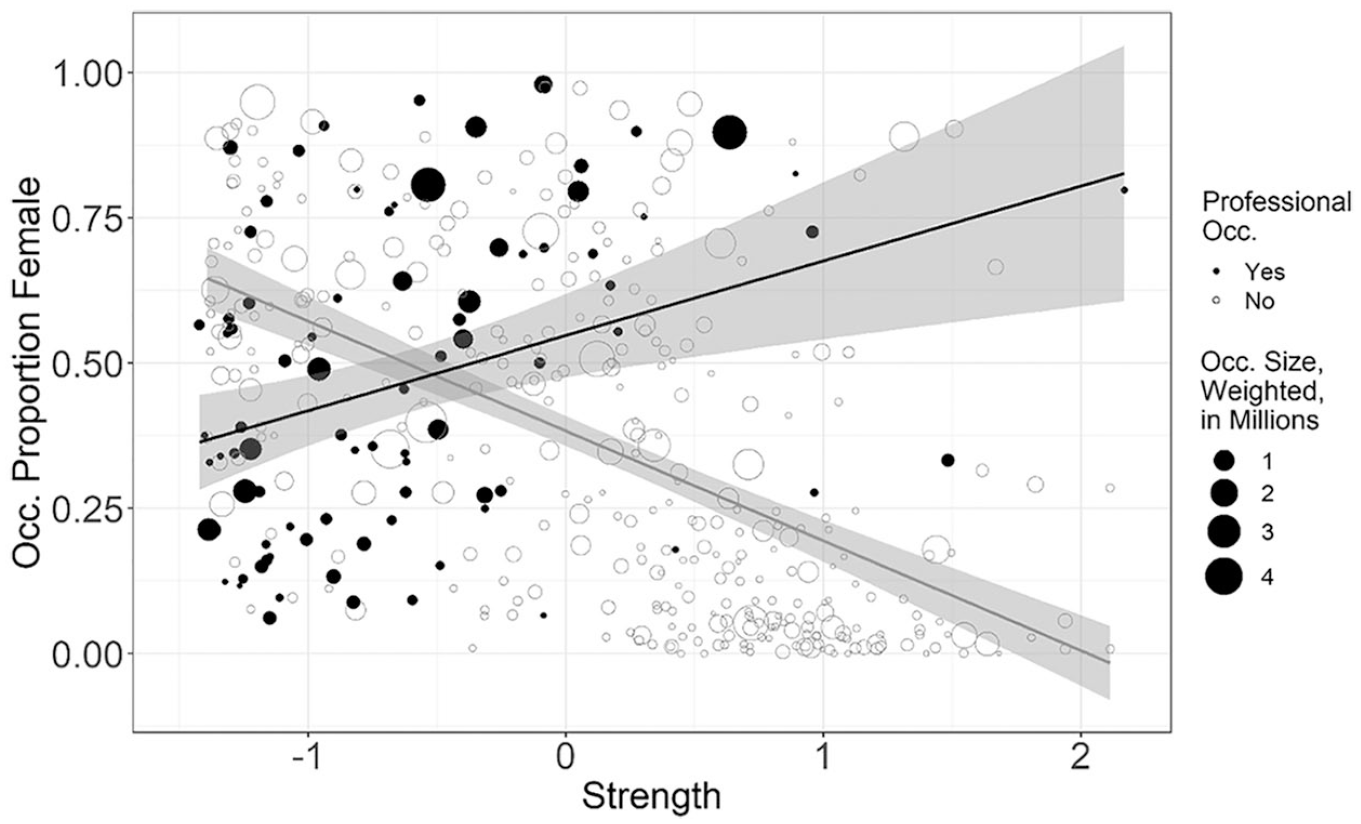
Relationship Between Physical Strength and Women’s Representation in Professional and Non-Professional Occupations
Each dot in Figure 1 represents an occupation. Black dots represent professional occupations, and gray hollow dots represent nonprofessional occupations. Linear regression lines for each of these groups are also plotted, in the corresponding colors, together with the 95 percent confidence interval for each line (the gray-shaded regions). Figure 1 provides clear evidence that the relationship between women’s representation and physical strength requirements is positive among professional occupations and negative among nonprofessional occupations.
Linear regression results can be influenced by the violation of linear regression assumptions, especially in smaller samples. I therefore assess the robustness of the results plotted in Figure 1 in two ways. First, I use R’s standard selection of “diagnostic plots” to visually check for nonlinear relationships, heteroscedasticity, non-normally distributed errors, and outliers. Second, I compare the linear regression results with those from two robust regressions (one using Huber weights and another using bisquare weights), as robust regression is used to correct linear regression errors due to heteroscedasticity and outliers. 4 The diagnostic plots and regression results for Figure 1 are reported in Figures A1a–b and Table A2 in the Online Appendix. The diagnostic plots display no serious deviations from the basic linear regression assumptions, and the linear and robust regression results do not substantively differ from one another. These analyses indicate that the linear regression lines and confidence intervals plotted in Figure 1 are reasonable representations of the relationship between women’s representation and physical strength requirements in professional and nonprofessional occupations.
Two previous studies also support the relationships shown in Figure 1, using data from earlier periods. However, as both studies had other aims, neither evaluated explanations for them. The first study used data on workers in the 2000 U.S. Census and found evidence of a positive relationship among professional occupations (Levanon and Grusky 2016). The second study used data from the National Longitudinal Study of Youth on workers who graduated college in 1993 (Shauman 2006), whose educational attainment makes them likely to work in professional occupations. The study found that physical strength requirements increase women’s probability of occupational placement significantly more than men’s probability.
The case of women in professional occupations also resists explanations based on differences between professional and all other occupations. On average, professional workers have higher educational attainments than workers in any other major occupational group in the United States. Although studies have shown that those with higher educational attainment hold more gender egalitarian views (Brewster and Padavic 2000; Pampel 2011), others have convincingly argued that such views do little to weaken occupational sex segregation (Cech 2013; Charles and Grusky 2004; Cotter, Hermsen, and Vanneman 2011; England 2010; Levanon and Grusky 2016). Nor is an adequate explanation given by the lower physical strength requirements among professional occupations compared with other occupational groups. As Levanon and Grusky (2016) note, these lower requirements might explain why women’s representation in professional occupations is higher than in other occupations, but not why they are numerically dominated by women.
Although the literature provides no clear explanations for this case, it does suggest a direction for investigation: Men avoid female-dominated occupations. Studies of segregation trends in recent decades demonstrate that men’s representation in female-dominated occupations has remained stable (Blau, Brummund, and Liu 2013), and that the few men who enter such occupations leave soon thereafter (Torre 2018). Yet it is not clear that men avoid these occupations purely because of their sex compositions (Coventry 1999; Pan 2015; Wright and Jacobs 1994). This lack of clarity indicates that men avoid other characteristics of these occupations, which structures the hypotheses I evaluate in this study.
Note that men’s “avoidance” of occupations is a shorthand term for the many actors whose actions collectively result in men’s low representation in those occupations. These actors include men who are more likely to apply for and accept positions requiring masculine work; employers who are more likely to hire and retain men in positions requiring masculine work; and parents, teachers, and popular media who are more likely to encourage men’s preferences for masculine work. Other actors include firm-level arrangements that provide more opportunities for men to perform masculine work and school-level arrangements that encourage men’s interests in masculine fields of study. Thus, men’s “avoidance” of certain occupations is by no means the sole product of the actions of working men.
In summary, the literature lacks explanations for the case of women in professional occupations, in large part due to the dominance of the sociocultural model. The sociocultural model offers no explanation for this case, as it assumes that occupational sex segregation follows gender-typed skill requirements. The literature does, however, emphasize men’s avoidance in explaining female-dominated occupations. In the following section, I discuss two explanations deriving from this emphasis, the relegation hypothesis and the co-occurrence hypothesis, which propose different reasons for men’s avoidance of female-dominated professional occupations.
The Relegation Hypothesis
The relegation hypothesis is proposed by Levanon and Grusky (2016). The hypothesis makes two assertions: (1) Physical strength skills are devalued among professional occupations; and (2) all workers will attempt to avoid occupations requiring devalued skills, but men will be more successful in this than women due to their greater labor market advantages. Thus, women are “relegated” to professional occupations with higher physical strength skills through men’s avoidance of these occupations. Here I discuss these assertions in greater detail, as well as support for them in the existing literature.
The relegation hypothesis first argues that physical strength skills are devalued among professional occupations. In the literature on occupational sex segregation, the two most common measures of (de)valuation are wages and prestige. Levanon and Grusky (2016) employ the former. In agreement with the first assertion of the relegation hypothesis, the authors find that physical strength skills have a negative relationship with occupational wages across all detailed occupations, but they do not examine this relationship specifically among professional occupations. As the authors themselves note, different groups of occupations likely value skills in different ways, and thus their findings do not imply that physical strength skills are devalued among professional occupations.
Second, the relegation hypothesis argues that, compared with women, men more successfully avoid occupations with high requirements for devalued skills. Although there is little research on how requirements for valued or devalued skills influence men’s and women’s occupational placement, there is strong agreement that men have more labor market advantages than women have (Reskin and Roos 1990), especially when competing for positions in high-wage and high-prestige occupations. First, men are popularly believed to be more deserving of positions in these occupations than women are (Ridgeway 1997). Second, most of the skills required in high-paying occupations are male-typed (Shauman 2006). Third, controlling for educational and skill requirements, wages are negatively related to women’s representation in occupations (England, Allison, and Wu 2007; Levanon, England, and Allison 2009). Fourth, men dominate the highest paying and most prestigious occupations, a phenomenon commonly referred to as vertical segregation (Blackburn, Brooks, and Jarman 2001). Accordingly, women will be less successful than men in obtaining positions in high-paying occupations and will effectively be relegated to low-paying occupations.
Support for the relegation hypothesis would imply that deviations from the sociocultural model can arise from the preservation of men’s advantage in wages and prestige in cases where those advantages contradict norms about gender-appropriate work. In other words, both men’s and women’s participation in gender-atypical work may be accepted as long as that work provides women with lower wages and prestige than men receive. Men’s advantage in wages and prestige, together with gender-typed skills, are key organizing principles in distributing men and women across occupations. In most cases, the two principles agree, with masculine skills returning higher wages and prestige, and men being most likely to perform work with higher requirements for those skills. However, there is little research on cases in which the two principles conflict. Support for the relegation hypothesis in the case examined here would point to the conditions under which such conflicts can arise.
The relegation hypothesis overcomes the limits of the sociocultural model by shifting the explanatory burden from norms about gender-appropriate work to wages and prestige. An alternative approach would be to adapt the basic elements of the sociocultural model to accommodate the case of women in professional occupations. This is the route taken by the co-occurrence hypothesis, to which I now turn.
The Co-Occurrence Hypothesis
Whereas the relegation hypothesis focuses on the relationship between physical strength skills and women’s representation in professional occupations, the co-occurrence hypothesis compares this relationship in professional and nonprofessional occupations. The co-occurrence hypothesis asserts that high local requirements for physical strength co-occur with substantially higher requirements for at least one feminine skill in professional occupations. Men will avoid the feminine skill requirements, as predicted by the sociocultural model. However, this pattern of avoidance also leads men to avoid professional occupations with high local physical strength requirements—a circumstance not described by the sociocultural model. In nonprofessional occupations, the predicted pattern of skill co-occurrence will be absent, and accordingly men will not avoid occupations with high local requirements for physical strength.
Among professional occupations, support for the co-occurrence hypothesis would consist of evidence that female-dominated occupations with high local physical strength requirements also have substantially higher requirements for at least one feminine skill. Thus, any combination of the four feminine skills measured in this study—Verbal, Helping, People, or Fine Motor (these skills will be discussed in detail later)—could support the hypothesis. The co-occurrence hypothesis does not predict that the professional occupations of interest will have substantially higher requirements for all feminine skills. Neither male- nor female-dominated occupations commonly possess high requirements for all masculine or feminine skills, respectively. For example, many occupations with high mathematical skill requirements are male dominated despite having low requirements for masculine skills involving physical labor (e.g., strength, endurance). Nor does the co-occurrence hypothesis predict that the professional occupations of interest will have substantially higher requirements for any specific feminine skill. Such a prediction would require more information than is currently available about how masculine and feminine skills co-occur in actual occupations.
Support for the co-occurrence hypothesis would also demonstrate that men avoid professional occupations with high local physical strength requirements and even higher requirements for any feminine skill(s). As mentioned at the outset, men’s avoidance of feminine skills is central to this hypothesis, so there should be clear evidence of a negative relationship between the implicated feminine skill(s) and men’s representation in professional occupations.
Among nonprofessional occupations with high strength requirements, the co-occurrence hypothesis predicts that high physical strength requirements do not co-occur with substantially higher feminine skill requirements. In such cases, the feminine skill requirements would not be high enough to repel men. Physical strength should therefore increase with men’s representation (just as predicted by the sociocultural model), because men are not avoiding even higher requirements for any feminine skill(s). Accordingly, nonprofessional occupations should exhibit no co-occurrence between physical skills and higher feminine skill requirements, together with a negative relationship between physical skills and women’s representation.
Support for the co-occurrence hypothesis would indicate that the sociocultural model can be extended by examining and incorporating patterns of feminine and masculine skill co-occurrence and by distinguishing between local and global skill requirements. These extensions would preserve the basic elements of the sociocultural model but allow it to explain more patterns of occupational sex segregation. In this extended model, occupational sex compositions can deviate from local gender-typed skill requirements as long as they follow those at the global level.
Importantly, the relegation and co-occurrence hypotheses are not mutually exclusive. Both hypotheses could be supported: Physical strength could be devalued, and also co-occur with one or more feminine skills. However, in this study, I find no support for the relegation hypothesis (see results below). Consequently, I go on to propose and evaluate the co-occurrence hypothesis.
Data
To evaluate the relegation and co-occurrence hypotheses, I plot and examine the relationships between the following occupation-level variables: physical strength skills on one hand, and wages, prestige, and feminine skills on the other. I also examine how occupational sex compositions vary with these relationships. To create the relevant variables, I employ two sources of data collected annually from 2011 through 2015: the March Current Population Survey (Flood et al. 2020) and O*NET OnLine (2020).
I use individual-level data from the Annual Economic and Social Supplement to the March Current Population Survey (ASEC), provided by the Integrated Public Use Microdata Series (Flood et al. 2020). The data are cross-sectional and nationally representative. I identify workers using the employment status variable in ASEC: those “at work” or “has a job” are considered workers. I then select those ages 15–64 years who self-identify as either male or female. Last, I divide the selected workers into professional and nonprofessional occupations, following Levanon and Grusky (2016, 613–14). Accordingly, the set of professional occupations consists of occupations in the “Professional and Technical” category used in the ASEC data, with all Technical occupations (n = 25) removed. The resulting data for professional workers consist of 87,073 individuals (58.5 percent female) in 91 distinct occupations. The data for nonprofessional workers consist of 346,252 individuals (46 percent female) in 360 distinct occupations. I use these data sets to create annual occupation-level measures of sex composition and wages, and average across years to obtain period measures for 2011 through 2015.
The occupation-level data on gender-typed skills and prestige come from five O*NET OnLine databases, one for each year from 2011 through 2015 (versions 16.0, 17.0, 18.0, 19.0, and 20.0). Each database consists of rankings of more than 900 detailed occupations on a wide variety of highly detailed work and worker characteristics. The rankings are provided by occupational analysts and job incumbents and aggregated within occupations. Updated databases are released once or twice per year in this period, although not all information for all occupations is updated every year.
I link the O*NET measures of gender-typed skills and occupational prestige to the ASEC data via detailed occupation title. Because the occupational coding systems used in both data sets are based on the Standard Occupational Classification (SOC), exact occupation title matches are common, and the linking process is straightforward. However, in some years there are occupations represented in the ASEC data for which no O*NET data are available, and vice versa. I drop 27 occupations (6,250 workers, 44 percent female) that lack data in at least one year of the period of interest: either O*NET (25 occupations) or ASEC (2 occupations). Six of the dropped occupations are professional occupations (n = 1,432 workers), four of which are “not elsewhere classified” (NEC) or “all other” occupations, i.e., catch-all categories for work that does not fit under more specific occupational titles. The titles of the six occupations are Religious Workers, NEC; Education, Training, and Library Workers, NEC; Entertainers and Performers, Sports and Related Workers, All Other; Therapists, NEC; Statisticians; and Podiatrists. The remaining 21 dropped occupations are also primarily NEC or “all other” occupations and are distributed evenly across the other major occupational categories (including administrative support, service, sales, production, and transportation).
The final data sets—those used in the analyses below—contain 85,641 workers (58 percent female) in 85 distinct professional occupations and 341,434 workers (46 percent female) in 339 distinct nonprofessional occupations.
Gender-Typed Skill Measures
Evaluating the relegation and co-occurrence hypotheses requires occupation-level measures of gender-typed skills. To create these measures, I assess those used in the two studies mentioned earlier that noted the case of women in professional occupations (Levanon and Grusky 2016; Shauman 2006). These studies provide a clear model for creating gender-typed skill measures: Both draw on conceptualizations of masculine and feminine characteristics in the social-psychological literature, use occupation-level data on work characteristics provided by either O*NET or its predecessor (The Dictionary of Occupational Titles), and employ confirmatory factor analysis (CFA) to create the measures. To assess their measures, I follow this model by reviewing the relevant social-psychological literature (e.g., Anker 1997; Cejka and Eagly 1999; Koenig and Eagly 2014; Lueptow, Garovich-Szabo, and Lueptow 2001); collecting the relevant O*NET variables (in most cases, the same ones used to construct the original measures); and using CFA to evaluate and, if necessary, to improve the measures.
Before conducting CFA, I rescaled the values for all O*NET variables to the interval from zero to one because the variables used are measured on different scales (either a five-point or seven-point scale). Some variables are even measured on two scales: Importance (five-point scale) and Level (seven-point scale). However, these scales were clearly designed to measure the same concept: When rescaled to the range from zero to one, they provide identical values. I therefore use only one of these measures (Importance) in my analyses. Where a single ASEC occupation code contains multiple O*NET occupation codes, and therefore multiple values for the same variable, I average the rescaled values across the O*NET occupation code.
In my CFA, I group O*NET variables in various ways to assess their fit. To identify cases of poor fit, I follow previous research (Shauman 2006) in using a factor loading of less than .7, together with cutoffs for various goodness-of-fit indices (i.e., chi-squared, root mean square error of approximation, standardized root mean square residual, comparative fit index, and Tucker–Lewis index). Table A3 in the Online Appendix lists and describes the O*NET variables used to construct the aggregate measure for each gender-typed skill (listed in gray rows) and reports the factor loading for each variable. 5 To combine the variables into an aggregate measure for each skill, I first normalize the values of the variables in each skill group so that they correspond to z-scores, and then average those values (DiStefano, Zhu, and Mîndrilă 2009; Shauman 2006). In the resulting measure, a value of zero represents the mean value of the skill across all occupations, and one unit represents one standard deviation from the mean. This measure can therefore be used to distinguish among high global values, across all occupations, and high local values, in the context of professional occupations. O*NET provides annual data, and accordingly the above procedure produces a value for each gender-typed skill for each occupation in each year from 2011 through 2015. To obtain a single period measure of each skill for each occupation, I average the skill values across years.
As seen in Table A3 in the Online Appendix, 10 gender-typed skills emerged from this process: Verbal, Helping, People, Fine Motor, Strength, Robustness, Technical, Math, Problem-Solving, and Authority. All skills are measured using multiple O*NET variables except for Fine Motor, which is measured with a single variable. The first four items in the above list are feminine skills. Verbal skills consist of measures of oral and written comprehension and expression. Helping skills represent work that provides assistance and service to others. People and Fine Motor skills capture the degree to which working with others (e.g., maintaining interpersonal relationships) and performing delicate manual labor, respectively, are required in the occupation. The remaining six items in the list are masculine skills. Strength and Robustness represent physical skills. Strength consists of variables measuring different types of physical strength, whereas Robustness measures the ability to withstand physically challenging conditions, such as exposure to weather, distracting or uncomfortable noise levels, and extreme temperatures. Math and Problem-Solving represent analytical skills. Math skills include quantitative reasoning and information processing, whereas Problem-Solving skills include measures of critical thinking, judgment and decision making, and the analysis and evaluation of systems. The last two items in the list are Technical and Authority skills. Technical skills measure requirements for working with equipment, tools, and machines. Authority skills are those involved in managing others, including coordination, leadership, and team building.
Study Limitations
In addition to the obvious limitations given by this study’s occupational, national, and temporal contexts, many important demographic characteristics are omitted, particularly those at the foundation of intersectionality studies: gender, race, and class. As in previous studies of occupational sex segregation, this study employs a simple binary conception of gender: masculine and feminine. However, more genders exist than those examined here, and furthermore, as studies of intersectionality have shown, the influence of gender is shaped by race and class. Thus, the influence of gender-typed skills on occupational sex segregation will vary by the composition of the occupation with respect to these and other demographic characteristics missing from the analyses shown below.
Also omitted from this study are the ways in which patterns of gender-typed skill co-occurrence map onto patterns of vertical segregation: men’s dominance of occupations with higher wages and prestige. Exploratory analyses (not shown) suggest that gender-typed skills are not strongly related to wages or prestige in professional occupations, which deserves further study, as do these relationships among nonprofessional occupations.
The results presented below are further limited by the O*NET data, from which the measures of gender-typed skills are drawn. Although O*NET offers arguably the most comprehensive data on gender-typed skills available in the United States, it lacks measures of feminine cognitive skills including intuition, perceptiveness, and imagination (Cejka and Eagly 1999; Levanon and Grusky 2016). In addition, the way in which this study (and previous studies) combines O*NET data into measures of gender-typed skills deserves further investigation (see next section). Different groupings of O*NET data may reveal different patterns of co-occurrence and views of the structure of gender-typed skills.
Last, the test of the relegation hypothesis presented below is limited in two main ways. First, I test the hypothesis using only gender-typed skills. Skills lacking a clear gender-type (e.g., resource management, assessing performance to make improvements, memorization, the ability to tell when something is wrong or likely to go wrong) are omitted. However, less obviously gendered skills may also be devalued, and women may be more likely than men are to work in occupations with higher requirements for those skills. Second, narrower occupational contexts may yield support for the relegation hypothesis. The category of professional occupations is broad and may encompass too wide a variety of work for there to be clear agreement on skill (de)valuation. Such agreement may emerge in groups that have similar knowledge domains, such as health care, legal, or media occupations. Further tests of the relegation hypothesis are needed to identify the conditions under which men’s labor market advantages divide men and women across occupations, separately from and in concert with gender-typed skills.
Descriptives
Before presenting the results, I provide some descriptive information on the gender-typed skill requirements and patterns of masculine and feminine skill co-occurrence in professional and nonprofessional occupations. My analyses feature measures of gender-typed skills that are averaged across the period of interest, but I investigated change in skill requirements by year and occupation to ensure that the aggregated measures do not mask important fine-grained trends. Table A4 in the Online Appendix displays the median value for each of the 10 skill measures for professional and nonprofessional occupations for each year from 2011 through 2015. Recall that the gender-typed skill values are normalized such that a value of zero represents the global average, that is, across all occupations; and the units represent standard deviations from that average. There is little annual change over this period: All gender-typed skills change by less than 0.15. The average range of median skill requirements is 0.03 for professional occupations, and 0.05 for nonprofessional occupations. There is also little change within occupations across the period. The range for each gender-typed skill requirement for most professional and nonprofessional occupations (around 80 and 300, respectively) is 0.5 or less. The skill ranges for the remaining occupations primarily lie between 0.5 and 1.
Table 1 displays descriptive statistics for the 10 gender-typed skills, calculated separately for professional and nonprofessional occupations. In supplementary analyses, I examined Q–Q plots and ran Shapiro–Wilk tests to assess normality in the gender-typed skill distributions. Figures A2a–b in the Online Appendix display examples of normally and non-normally distributed skills among professional and nonprofessional occupations. Dots in the gray-shaded regions of these plots are normally distributed. These analyses reveal that among professional occupations, half the skills are normally distributed (Verbal, Fine Motor, Robustness, Math, Authority), whereas among nonprofessional occupations, only two skills are normally distributed (Fine Motor, Math). Accordingly, medians are included in Table 1.
Statistical Descriptives for Gender-Typed Skills, Professional Versus Nonprofessional Occupations
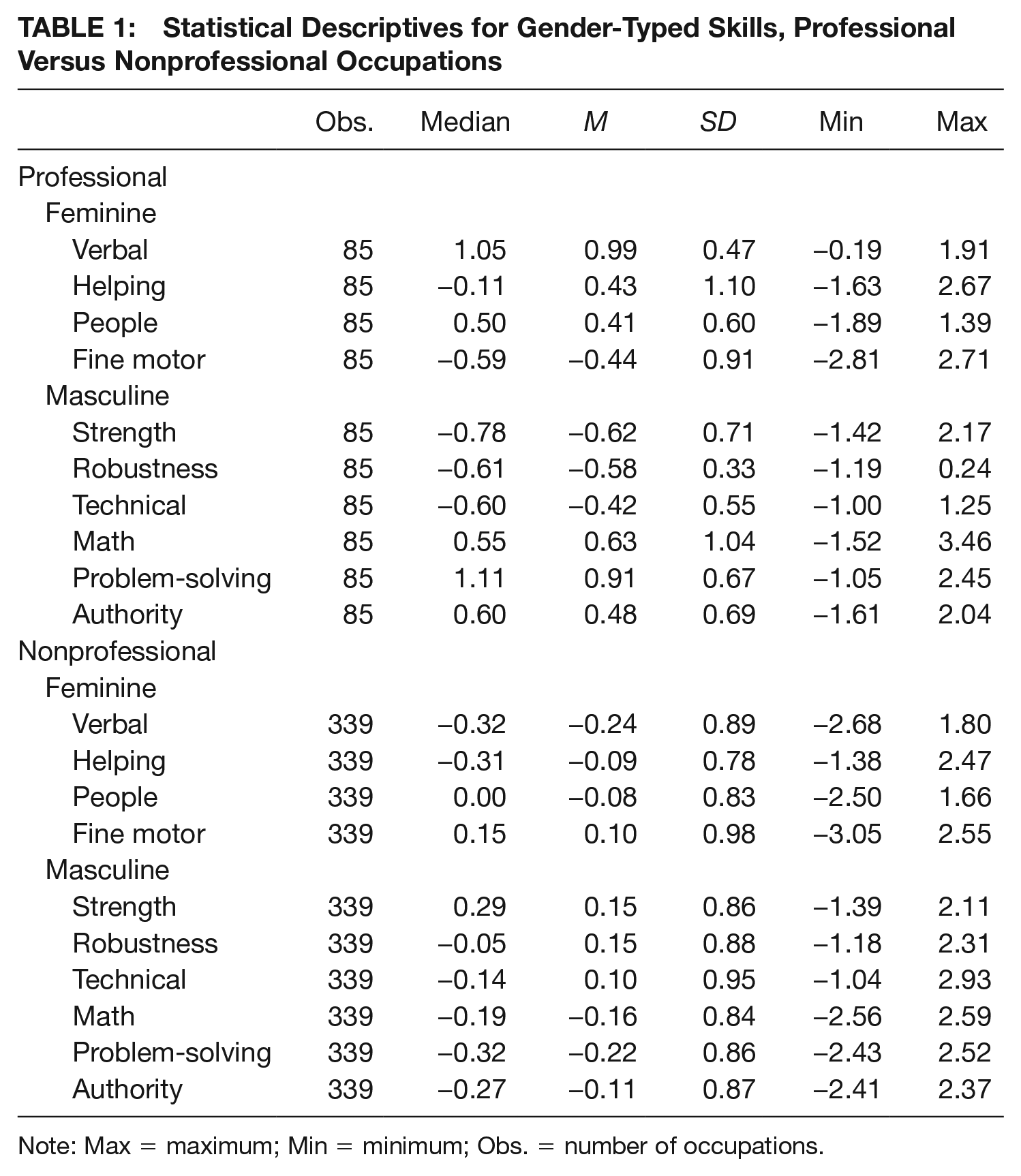
Note: Max = maximum; Min = minimum; Obs. = number of occupations.
Table 1 shows that compared with work in nonprofessional occupations, work in professional occupations has higher requirements for working with or communicating with others (Verbal, Helping, People), mathematical and analytical skills (Math, Problem-Solving), and managing others (Authority). Professional occupations also have lower requirements for manual skills, physical skills, and working with machines (Fine Motor, Strength, Robustness, Technical) compared with their nonprofessional counterparts.
Table 2 describes patterns of feminine and masculine skill co-occurrence in the form of a (Pearson) correlation matrix of all gender-typed skills in professional occupations. Gray-shaded correlations are significant at the .05 level, and bolded correlations indicate significant and positive relationships between feminine and masculine skills. 6
Correlation Matrix of Gender-Typed Skills, Professional Occupations
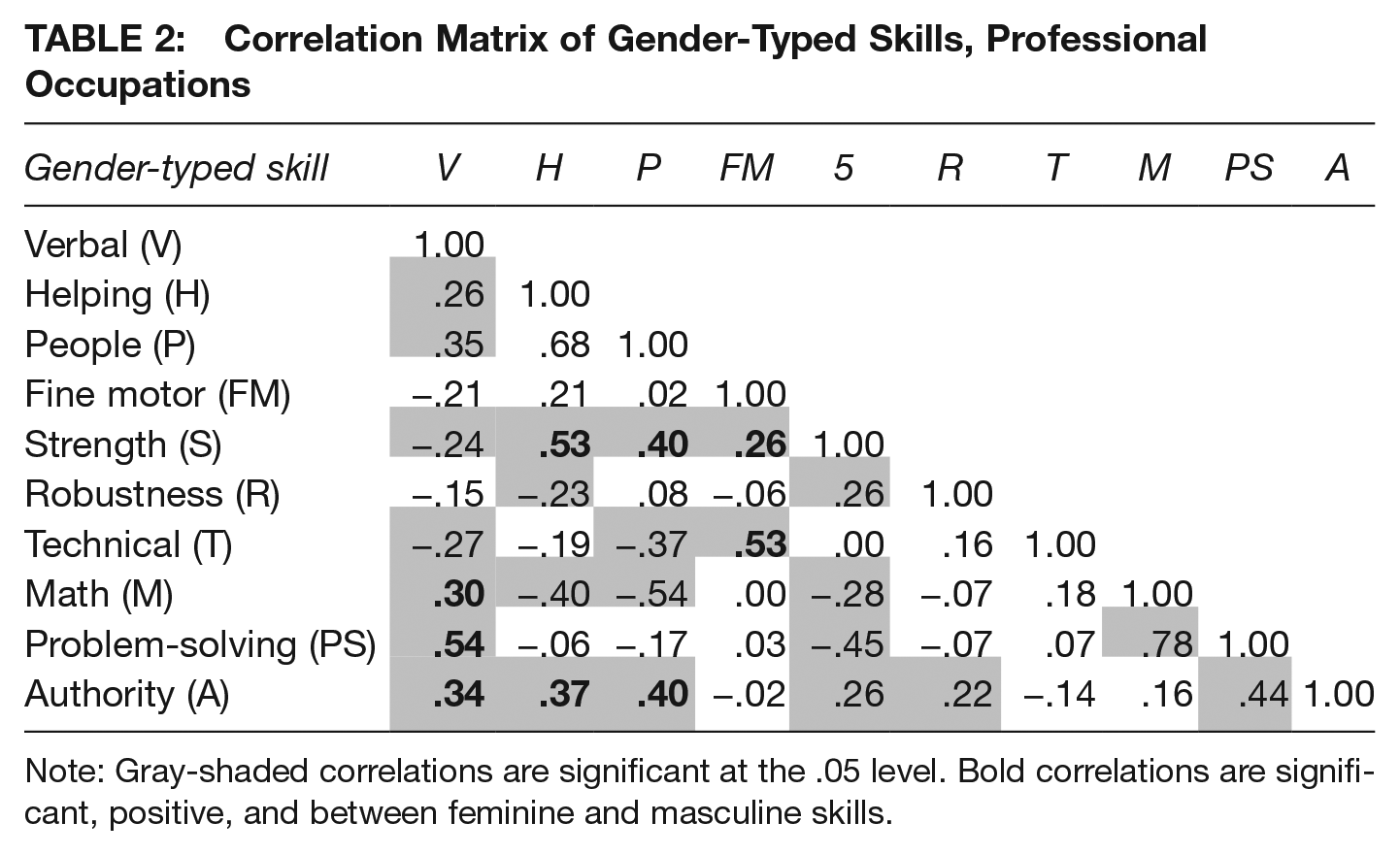
Note: Gray-shaded correlations are significant at the .05 level. Bold correlations are significant, positive, and between feminine and masculine skills.
Table 2 displays sizable, positive, and significant correlations between Strength and three feminine skills: Helping (.60), People (.40), and Fine Motor (.35). These relationships provide descriptive support for the co-occurrence hypothesis in that as requirements for Strength increase among professional occupations, so do requirements for three feminine skills. Table 2 also displays sizable, positive, and significant correlations between other pairs of feminine and masculine skills. Verbal skills are correlated with three masculine skills: Problem-Solving (.54), Math (.30), and Authority (.34). Fine Motor skills are correlated with two masculine skills: Strength (.26) and Technical (.53). Last, Helping and People skills are correlated with Authority (.37 and .40, respectively). Table 2 thus provides clear descriptive evidence of feminine and masculine skill co-occurrence.
Results
I use scatterplots to examine the relationships between physical strength skills and the variables of interest in the relegation and co-occurrence hypotheses. The scatterplots relevant to the relegation hypothesis illustrate the relationship between physical strength skills on one hand and occupation wages and prestige on the other. The scatterplots relevant to the co-occurrence hypothesis illustrate the relationship between physical strength skills and each of the four feminine skills described above. Detailed descriptions of each plot are given below.
Relegation Hypothesis
The first assertion made by the relegation hypothesis is that physical strength is a devalued skill among professional occupations. To evaluate this assertion, I examine the relationship between physical strength on one hand and occupational wages and prestige on the other. I construct a measure of occupational wages based on the ASEC income variable that reports individual earnings over the previous calendar year. I account for inflation by translating all values of this variable into 2014 dollars, and then compute the average for each occupation. To measure occupational prestige, I use the O*NET “Recognition” variable, which describes occupations that “offer advancement, potential for leadership, and are often considered prestigious.” I normalize values of this variable as described above for gender-typed skills.
Because the relegation hypothesis was proposed by Levanon and Grusky (2016, 591–93), I follow their method of assessing the relationship between a given gender-typed skill and occupational wages. I first regress physical strength against all other gender-typed skills, and then plot the regression residuals against the started logit of occupational wages. The threshold for the started logit is $15.11 per hour in 2014 dollars, which I calculated (accounting for inflation) from a threshold of $14.30 per hour in 1989 dollars (Hauser and Warren 1997, 201). The resulting plot illustrates the effect that one additional unit of physical strength has on occupational wages, holding constant the values of all other gender-typed skills. I follow this basic procedure in examining the relationship between physical strength and occupational prestige, but do not use a started logit measure for prestige.
Figure 2 displays the relationship between physical strength and occupational wages (left panel) and that between physical strength and occupational prestige (right panel). Visually, the plots presented here do not support negative relationships between these pairs of variables. In addition, linear and robust regression results reveal that the estimated coefficient for physical strength is not significant (see Table A5 in the Online Appendix). Together these results do not support the relegation hypothesis. Physical strength skills do not appear to be devalued among professional occupations, and consequently, the relegation hypothesis is not likely to explain why men avoid these occupations.
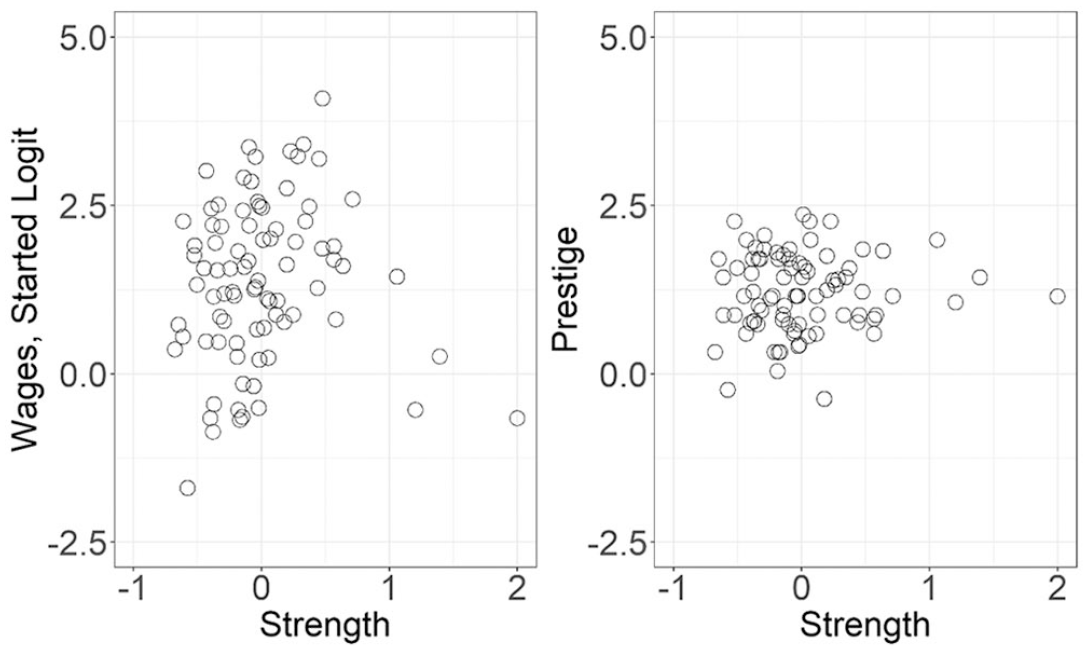
Relegation Hypothesis Scatterplots: Strength Regression Residuals Versus Occupational Wages and Prestige, Professional Occupations
Co-Occurrence Hypothesis
To evaluate the co-occurrence hypothesis, I examine the relationships between physical strength skills and all four feminine skills (Helping, People, Verbal, Fine Motor) for professional and nonprofessional occupations. As before, the skill values in these plots are normalized such that a value of zero represents the mean value of the given skill across all occupations, with one unit representing one standard deviation from the mean. The points on each plot represent occupations. The size of each point represents occupation size, measured as the weighted number of workers in the occupation. A linear regression line is drawn on each plot, together with the 95 percent confidence interval, represented by the gray-shaded area around each line. The color of each point represents the sex composition of the occupation, with black circles representing a higher proportion of men and gray circles representing a higher proportion of women.
My examination of the relationships in this section focuses on the following questions: (1) whether women dominate occupations with high local Strength requirements and even higher requirements for at least one feminine skill; and (2) whether there is evidence that men avoid that feminine skill or skills. Support for the co-occurrence hypothesis would consist of positive answers to these questions among professional occupations and negative answers among nonprofessional occupations.
Figure 3 supports the co-occurrence hypothesis among professional occupations, primarily in the relationship between Helping and Strength skills. The Helping plot of Figure 3 shows that women dominate professional occupations with high local Strength requirements and that these occupations possess substantially higher Helping requirements. Apart from the two occupations with the highest Strength requirements, Strength requirements among professional occupations range from negative 1.5 to positive 1. If the occupations are divided into two groups by drawing a vertical line through the plot at a Strength value of negative 1, most of the occupations in the higher Strength group possess substantially higher requirements for Helping (overall, by more than a standard deviation). The majority of occupations in this group are female-dominated (gray) and consist of therapists and nurses (e.g., Physical Therapists, Recreational Therapists, Registered Nurses).
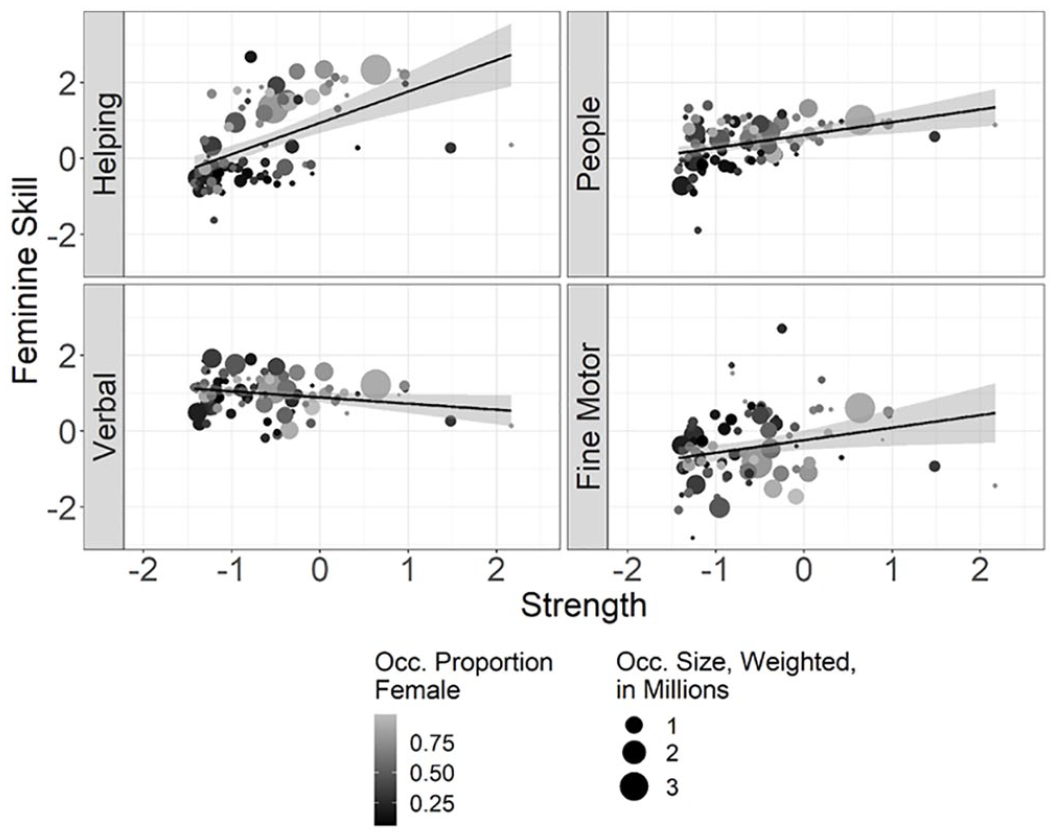
Co-Occurrence Hypothesis Scatterplots, Professional Occupations: Strength Versus Feminine Skills
There is also evidence that men avoid occupations with high Helping requirements. Men are poorly represented in those occupations and dominate occupations with low Helping requirements. This relationship becomes evident when moving from the top of the plot to the bottom: In general, the occupations become steadily more male (the dot colors transitioning from gray to black). The cluster of male-dominated occupations that lies below the linear regression line are primarily scientific and mathematical occupations (e.g., Computer Programmers, Civil Engineers, Astronomers and Physicists). The few female-dominated occupations below the linear regression line, with low requirements for both Helping and Strength skills, are mostly teachers (e.g., Preschool and Kindergarten Teachers, Elementary and Middle School Teachers). These patterns are consistent with the interpretation that men avoid occupations with higher Helping requirements.
The lower right quadrant of the Helping plot of Figure 3 is empty, which suggests that the strength of the relationship between Strength and Helping skills results partly from the lack of occupations with high Strength and low Helping requirements. Clearly, among professional occupations, high Strength requirements regularly co-occur with substantially higher Helping requirements. Accordingly, if men avoid professional occupations with higher Helping requirements, they will simultaneously avoid occupations with high local Strength requirements.
The People plot in Figure 3 displays trends similar to those in the Helping plot, but they are much less pronounced. Professional occupations with higher Strength requirements generally have higher People requirements, but the difference between the two is smaller than in the Helping plot. There is also less evidence that men avoid occupations with higher People requirements. Moving from the top of the plot to the bottom, occupations do become more male, but the transition is less clear than in the corresponding Helping plot. Overall, Figure 3 suggests that women’s representation in professional occupations with high local Strength requirements is driven more by the co-occurrence between Strength and Helping skills than by that between Strength and People skills.
The Verbal and Fine Motor plots of Figure 3 display different co-occurrence patterns. Verbal and Strength skills are negatively related, and women accordingly dominate professional occupations with lower Verbal than Strength skills. In contrast, men dominate professional occupations with the opposite skill requirements (higher Verbal and lower Strength skills), which indicates that men do not avoid occupations with higher requirements for Verbal skills. Fine Motor and Strength skills are weakly positively related, but here again men dominate occupations with higher Fine Motor requirements. Why is this the case? The co-occurrence hypothesis offers an answer.
Applied to this context, the co-occurrence hypothesis predicts that professional occupations with high requirements for Verbal or Fine Motor skills will have even higher requirements for at least one masculine skill. The higher masculine skill requirement(s) will accordingly attract men and repel women, just as predicted by the sociocultural model. Table 2 indicates that three masculine skills could fulfill this prediction regarding Verbal skills, because they have sizable, positive, and significant correlations with Verbal skills: Problem-Solving, Math, and Authority. Figure A5 in the Online Appendix displays scatterplots of these relationships. The figure shows that professional occupations with high local requirements for Verbal skills have substantially higher requirements for Math skills and, to a lesser degree, for Problem-Solving skills. These results thus suggest that men dominate professional occupations with high Verbal requirements because they co-occur with even higher requirements for Math, a masculine skill.
Regarding Fine Motor skills, Table 2 displays two candidates for the predicted pattern of co-occurrence: Strength and Technical skills. Figure 3 displays the relationship between Fine Motor and Strength skills, which does not support the co-occurrence hypothesis. However, Figure A7 in the Online Appendix displays the relationship between Fine Motor and Technical skills, which supports the hypothesis. Overall, male-dominated occupations have higher requirements for Technical than for Fine Motor skills (more black dots lie above the linear regression line). Female-dominated occupations do not display this pattern and have lower Technical skill requirements than male-dominated occupations. Moreover, the lack of substantive differences between the linear and robust regression results shown in Table A8 in the Online Appendix indicates that the relationship shown here is not driven primarily by heteroscedasticity or outliers. Thus, Figure A7 in the Online Appendix suggests that Fine Motor skills increase with men’s representation in professional occupations because they co-occur with higher requirements for Technical skills.
Returning to the co-occurrence hypothesis in the context of Strength skills, Figure 4 illustrates the relationships between Strength and all four feminine skills among nonprofessional occupations. In agreement with the co-occurrence hypothesis, Strength skills largely do not co-occur with substantially higher requirements for Helping, People, or Verbal skills in these occupations. Indeed, these relationships are all negative, and women dominate nonprofessional occupations with higher requirements for these feminine skills. The exception is Fine Motor skills, which increases with both Strength skills and men’s representation. Again, the co-occurrence hypothesis applied to this context provides an explanation.
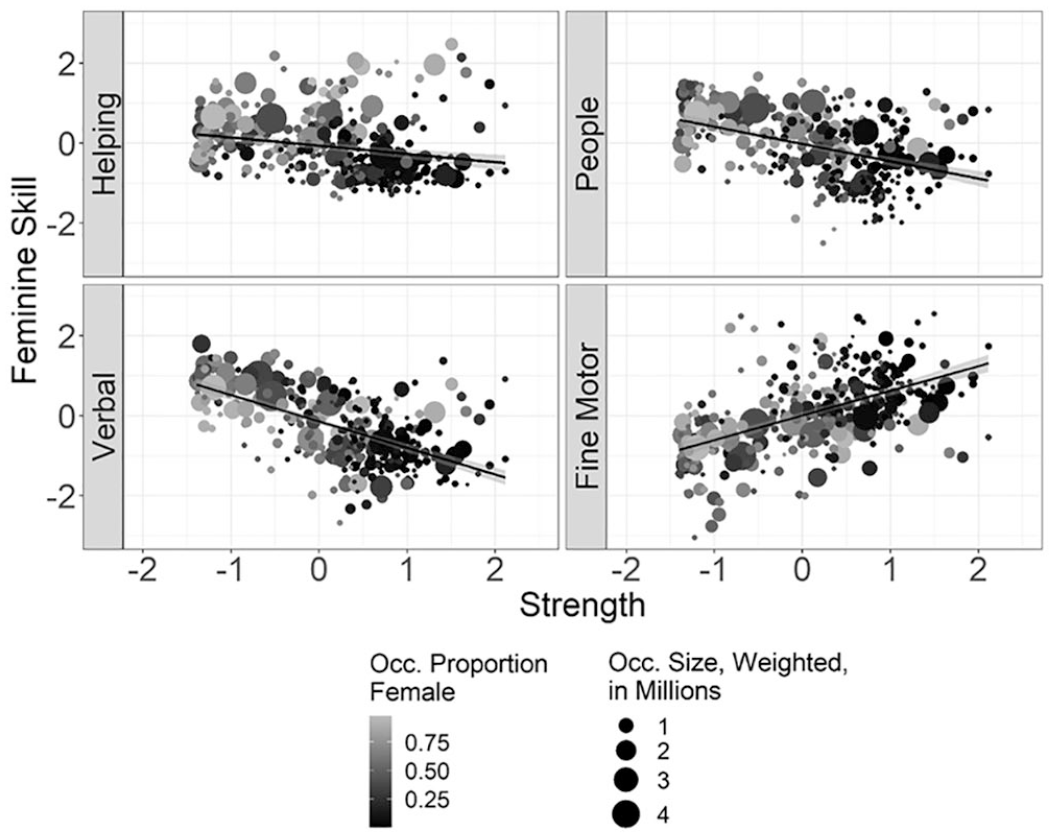
Co-Occurrence Hypothesis Scatterplots, Nonprofessional Occupations: Strength Versus Feminine Skills
Correlations between Fine Motor and each masculine skill among nonprofessional occupations are sizable, positive, and significant for three skills: Strength (.54), Robustness (.40), and Technical (.71). Figure A9 in the Online Appendix displays scatterplots of the relationship between Fine Motor and each of these skills. Two of the scatterplots in Figure A9 provide support for the co-occurrence hypothesis in this context. Men dominate occupations with high local Fine Motor requirements and even higher Technical and Robustness requirements. Female-dominated occupations are concentrated in the bottom half of these plots, suggesting that women avoid occupations with higher requirements for these masculine skills. Although men also dominate occupations with high local requirements for Fine Motor skills and even higher requirements for Strength skills, there is less evidence that women avoid occupations with higher requirements for Strength skills.
Discussion
Overall, the results of this study do not support the relegation hypothesis, whereas they do support the co-occurrence hypothesis. Contrary to the predictions of the relegation hypothesis, physical strength does not have a negative relationship with either wages or prestige. Thus, men’s avoidance of devalued skills cannot serve as a plausible explanation for why women dominate occupations with high local physical strength skills. In agreement with the predictions of the co-occurrence hypothesis, professional occupations with high local physical strength skills have substantially higher requirements for skills associated with helping and caring for others. This pattern of co-occurrence is absent among nonprofessional occupations.
These findings suggest that patterns of occupational sex segregation that deviate from the sociocultural model can be explained by examining the co-occurrence of masculine and feminine skills and by distinguishing between global and local gender-typed skill requirements. These extensions of the model would allow it to explain cases in which increases (decreases) in gender-typed skills are associated with increases in the “atypical” (“typical”) gender.
The results of this study also have implications for policies aiming to reduce occupational sex segregation. The findings presented here suggest that occupations dominated by a single sex can possess high local requirements for gender-atypical skills that go largely unnoticed by the general public. Female-dominated professional occupations have high physical strength requirements relative to other professional occupations, but this fact is not widely known. Given that gender-typed skill requirements influence occupational sex compositions (Levanon and Grusky 2016; Shauman 2006), one approach to increasing the representation of a minority gender might be to publicize these requirements more widely in popular and professional media. Such publicization could not only help to broaden the appeal of these occupations to members of the minority gender, but also to weaken norms about gender-appropriate work insofar as such norms are based on individuals’ knowledge of actual work.
To improve our understanding of how gender norms drive occupational sex segregation, this study suggests that investigations into the co-occurrence of gender-typed skills are needed. Previous studies examine the separate effects of gender-typed skills on occupational sex segregation, but the present study shows that real-world combinations of gender-typed skill requirements shape those effects. Similarly, the social-psychological research on which this and previous studies draw shows that respondents tend to agree on the gender-types of individual skills, but respondents’ agreement on the gender-types of skill combinations is less clear. Yet real occupations feature combinations of gender-typed skills, and researchers must face them to obtain more comprehensive explanations of how these gender norms drive occupational sex segregation. Working out the various associations among gender-typed skills and between combinations of gender-typed skills and occupational sex compositions are important steps toward this goal. The more knowledge we have of these associations, the better our understanding of the ways in which societies classify work according to gender will be.
Supplemental Material
sj-docx-1-gas-10.1177_08912432221102148 – Supplemental material for Gender-Typed Skill Co-Occurrence and Occupational Sex Segregation: The Case of Professional Occupations in the United States, 2011–2015
Supplemental material, sj-docx-1-gas-10.1177_08912432221102148 for Gender-Typed Skill Co-Occurrence and Occupational Sex Segregation: The Case of Professional Occupations in the United States, 2011–2015 by Constance Hsiung in Gender & Society
Footnotes
Author’s Note:
I thank Elizabeth Bruch, Sarah Burgard, Rachel Best, and Scott Page for their insightful comments on the dissertation chapter from which this paper emerged. I am also grateful to the Gender & Society editors and to the anonymous reviewers whose clear, instructive comments strengthened the arguments made here.

Notes
Supplemental Material
Supplemental material for this article is available online.
Constance Hsiung is a postdoctoral researcher in the Department of Sociology, Goethe University Frankfurt, Germany. Her research interests lie in the sociology of culture, gender, and work.
References
Supplementary Material
Please find the following supplemental material available below.
For Open Access articles published under a Creative Commons License, all supplemental material carries the same license as the article it is associated with.
For non-Open Access articles published, all supplemental material carries a non-exclusive license, and permission requests for re-use of supplemental material or any part of supplemental material shall be sent directly to the copyright owner as specified in the copyright notice associated with the article.
