



Abstract
The pervasive persistence of gender segregation has been documented in a myriad of social settings, implying that women and men primarily encounter peers of their own gender in daily life. While voluntary associations are often praised for their ability to bridge other social divides, previous research indicates substantive gender disparities in voluntary involvement. Yet we still know relatively little about the extent and origins of gender segregation in civic life. In this article, we study gender homophily in voluntary involvement and examine how structural features of friendship networks and traditional gender norms bring about gender segregation. Employing data from a German panel study (SC6-NEPS), we analyze cross-sectional patterns of gender segregation and run multinomial and binary logistic regressions to model joining and quitting transitions. Our results indicate substantive gender segregation across and within types of voluntary associations. The overall gender segregation is driven by homophilous transitions into associational contexts, not by selective quitting decisions. Gender-segregated friendship networks partially explain the tendency to join organizations dominated by one’s own gender. Traditional gender norms are associated with more homophilous joining transitions among men, but not among women. Overall, these findings imply that civic life perpetuates the structural significance of gender.
The pervasive persistence of gender segregation has been documented in different domains including workplaces, occupations, higher education tracks, as well as friendship and core discussion networks. Thus, except for the kinship setting, women and men continue to attain contexts that systematically provide more opportunities to associate with peers of their own gender in daily life (Charles 2011; England 2010; Levanon and Grusky 2016; Mehta and Strough 2009; Smith, Maas, and van Tubergen 2014; Tomaskovic-Devey 1993; Van Bavel, Schwartz, and Esteve 2018). The persisting gender segregation slows down efforts toward gender equality because women and men typically have access to different resources through their social networks (McDonald 2011), engage in gender-typed behaviors and activities (Mehta and Strough 2009), and are encouraged by their peers to make gender-stereotypical life course decisions (Raabe, Boda, and Stadtfeld 2019). While much attention has been paid to how gender segregation comes about in the professional and private domain, we know relatively little about how gender is perpetuated as a social structure through people’s leisure-time activities (Risman 2004, 2018).
Voluntary associations (i.e., locally bound organizations gathering people around different causes, including sports, culture, religion, and social issues) are commonly portrayed as vehicles for social capital formation and social integration that bring communities together and could potentially bridge social divides: They are in principle open to everybody and provide an institutionalized setting for cooperative action through active involvement ranging from mere participation to responsibility-carrying volunteer work (Putnam 2000). Thus, they could facilitate cross-cutting social ties among their members, provide access to social capital, and thereby improve job prospects down the line (Ruiter and De Graaf 2009). In this respect, civic life—the broad landscape of all voluntary associations—may serve to bring people from different walks of life closer to each other.
However, feminist scholars criticize such a conception of voluntary associations as all-rounded vehicles for community proliferation and point toward deeply gendered structures in civic life that solidify rather than bridge differences and inequalities between women and men. For example, Arneil (2006) stresses that women have long been excluded from involvement in voluntary associations offering connections to individuals in powerful positions—despite their traditionally large investment in community social capital. To date, it is well documented that women and men are typically involved in different types of associations and perform different voluntary work (Gidengil and O’Neill 2006; McPherson and Smith-Lovin 1986; Messner and Bozada-Deas 2009; Norris and Inglehart 2006; Popielarz 1999; Rotolo and Wilson 2007; Wemlinger and Berlan 2016) that match broader gender stereotypes and extend traditional patterns of labor division to community life (e.g., women-dominated social care organizations, men-dominated voluntary fire brigade). Thus, voluntary associations not only constitute institutionalized settings where women and men are “doing gender” in everyday life, (publicly) giving off traditional imageries of femininity and masculinity (Messner and Bozada-Deas 2009; West and Zimmerman 1987), but they also seem to further segregate social networks by gender and hence provide different resources to women and men, solidifying broader gender inequalities (Arneil 2006). For instance, associational contexts composed primarily of men may yield access to resources that are more valuable on the labor market (McDonald 2011; Molyneux 2002; Popielarz 1999; Son and Lin 2012).
Previous studies provide an important starting point for understanding gendered divides in civic life. However, they do not systematically examine the social processes that drive gender segregation, leaving calls for research on its structural and cultural origins unaddressed (Norris and Inglehart 2006; Popielarz 1999; Rotolo and Wilson 2007). Because these studies draw mainly on cross-sectional data on membership in relatively broad types of associations, we have no definite answer as to how and why gender segregation in civic life comes about.
Against this backdrop, our study makes two contributions. First, we corroborate and extend findings from a largely descriptive and cross-sectional literature on segregation across different types of associations (e.g., Norris and Inglehart 2006; Popielarz 1999). In doing so, we improve upon issues of measurement error in traditional voluntary participation survey modules by using respondents’ open descriptions of their voluntary involvement (Rap and Paxton 2021), enabling us “to test accurately for gender effects on [the detailed] domain of volunteering” (Musick and Wilson 2008, 184). We further extend this literature by examining gendered contact patterns within types of associations and assessing the role of joining and quitting transitions for overall gender segregation. Second, by studying how social networks and traditional gender norms bring about gender segregation, we examine how material and cultural factors, which are already known to structure gender inequalities in the private and professional sphere, reproduce gender as a social structure in civic life (Davis and Greenstein 2009; Ridgeway 2011; Risman 2004, 2018).
We test our hypotheses using large-scale panel data from a representative survey of adults in Germany, a country characterized by substantive gender inequalities and relatively high levels of voluntary involvement. Compared with many other European countries and the United States, in Germany, spouses are less likely to split the number of hours of paid work evenly and instead more frequently adopt a male breadwinner model involving women’s part-time work. Moreover, occupational gender segregation is relatively strong, and men typically work in higher-paying occupations (Hook and Pettit 2016; Lütolf and Stadelmann-Steffen 2023), resulting in a comparatively large gender wage gap of 19 percent in Germany (Schmieder and Wrohlich 2021). Related to these persistent differences, most Germans tend to hold comparatively traditional gender ideologies within the European context (Grunow, Begall, and Buchler 2018).
Furthermore, in Germany, voluntary associations play an important role in people’s leisure time and embeddedness in their local communities, as indicated by involvement rates higher than in two-thirds of European countries (Eurostat 2017), yet still lower than in the United States (Haerpfer et al. 2022). Traditionally, men participated more often in voluntary associations than women, and this gap used to be larger in Germany than in other European countries (Norris and Inglehart 2006; Peter and Drobnič 2013). Until recently, however, this gap closed almost entirely in Germany (Jacobsen et al. 2022; Simonson et al. 2022). Nonetheless, gender segregation across different types of organizations persists in Germany, as in most other countries. Although some areas of involvement are characterized by an equal representation of women and men (e.g., culture and music), many of the most popular areas are either men-dominated, such as sports, or women-dominated, such as religion, social issues, education (Norris and Inglehart 2006; Simonson et al. 2022). In short, we study the origins of gender segregation in civic life in a context characterized by high structural importance of voluntary associations and gendered patterns of voluntary involvement common in most countries.
Theory And Previous Research
In her framework “gender as a social structure,” Risman (2004, 2018) shows that gender functions as a stratification system that enables and constrains actors at the individual, interactional, and macro levels but that this system is made of individuals who embody and “do” gender at the same time. In the context of civic life, this implies that both the gendered social structure and individuals’ gendered selves may shape women’s and men’s choices regarding their voluntary involvement. Previous quantitative studies consistently demonstrate the existence of gender segregation in civic life; they show gender gaps in participation within relatively broadly defined types of associations in cross-sectional samples, but much of the segregation is not visible because segregation within these broad types is not addressed. We systematize the analysis of gender segregation in civic life by showing that in addition to the well-known segregation across types of associations, there is also substantive segregation within types of associations, which together make up the overall segregation in civic life. We then distinguish between joining and quitting voluntary involvements and argue that two elements of the gender structure—gender-homophilous friendship networks and internalized convictions about gender relations—affect individuals’ decisions to join associational contexts with specific gender compositions, which ultimately bring about gender segregation in civic life.
Segregation across types of associations refers to gender differences in involvement rates in different types of associations (i.e., categories of voluntary associations, such as sports or neighborhood organizations). Early work by McPherson and colleagues conceptualized such differences across types of associations as “localization” in social space (McPherson and Rotolo 1996; McPherson and Smith-Lovin 1986; Popielarz and McPherson 1995). Each type of voluntary association occupies a specific niche that attracts individuals with particular sociodemographic characteristics. Gender turned out as a particularly salient dimension in these analyses. Ever since, most research on gender segregation in civic life reports the overrepresentation of women in educational, health, religious, and social welfare associations and men’s disproportional engagement in recreational, political, employment, and technical associations across countries (Inglehart and Norris 2003; McPherson and Smith-Lovin 1986; Norris and Inglehart 2006; Popielarz 1999; Rotolo and Wilson 2007; Wemlinger and Berlan 2016). We replicate and extend earlier cross-sectional research on gender segregation across types of associations by assessing the gender compositions of comparatively detailed types of associations.
Segregation within types of associations refers to gender differences in the exposure of women and men through a given type of association. That is, on top of women’s and men’s sorting into different types of organizations, their attainment of specific associational contexts within organizational types (i.e., formal or informal subunits of an association, such as a team within a sports club or a socializing group within a religious organization) may induce additional gender segregation in civic life, which has been overlooked by previous quantitative research. For example, in a given type of organization, women may be more likely than men to encounter predominantly women, i.e., attain a women-dominated associational context, because they are (1) involved in a particular association of that type targeted at their own gender (e.g., women’s choir), (2) involved in a subunit of an association of that type targeted at their own gender (e.g., women’s team in a gender-integrated soccer club), or (3) engage in gender-stereotypical volunteer tasks that bring them in contact with other women in that association (e.g., preparing food in sports clubs; see Messner and Bozada-Deas 2009; Rotolo and Wilson 2007). In short, gender remains a salient boundary for social association even when women and men join the same type of association. We thus analyze gender differences in contact with women and men within the most popular types of associations.
Together, segregation across and within types of voluntary associations characterizes overall segregation: Gender differences in the exposure to women and men across different types of associations capture gender segregation in civic life in general. This overall level of segregation increases if women and men show stronger tendencies to be involved in different types of associations and if the extent to which they encounter mostly co-participants of their own gender through a given type of association rises. We focus on the overall segregation when testing our hypotheses because it assesses the general role of civic life in perpetuating gendered structures.
Joining and Quitting
Overall gender segregation in civic life can come about as individuals selectively join and quit associational contexts with different gender compositions—two distinct processes affected by different parameters (McPherson and Rotolo 1996; Rotolo 2000; Wiertz 2016): Individuals may be more likely to join associational contexts with many co-participants of their own gender because they already know more existing members and follow their preferences for gender-stereotypical activities. By contrast, quitting is rather affected by the social dynamics inside voluntary associations. Because individuals tend to form ties to others who are similar to themselves, participants may find it more difficult to integrate into organizations in which they belong to the gender minority and drop out at higher rates, as suggested by ecological approaches (McPherson, Popielarz, and Drobnic 1992; Popielarz and McPherson 1995). We might additionally suspect higher quitting rates among women in men-dominated contexts because of discriminatory organizational structures (Cortina et al. 2013).
The most established drivers of occupational gender segregation—gendered hiring preferences and discrimination, as well as employees’ stereotypical preconceptions about skills and occupations (Ridgeway 2011)—however, typically operate when individuals enter occupations, but selective exits induce segregation, too (Block 2023). Thus, it is important to pinpoint whether joining or quitting transitions induce segregation in civic life: If joining matters, organizational recruitment practices and individuals’ gendered preconceptions of organizations may be potential leverages for social change; if quitting matters, gendered dynamics within organizations and their consequences for early dropouts could be further investigated to improve durable mixing in organizations. To assess the relative importance of starting and quitting transitions for gender segregation, we test two hypotheses:
We now turn to the drivers of the gendered joining transitions. Here, previous research went little further than observing that sociodemographic characteristics, such as higher age, lower education, and a lack of employment, are associated with membership in gender-segregated (vis-à-vis gender-integrated) voluntary associations (McPherson and Smith-Lovin 1986; Popielarz 1999). We thus investigate how the gendered structure of friendship networks and gender norms—representing material and cultural aspects of the gender structure (Risman 2004, 2018)—bring about gender segregation in civic life.
Friendship Networks
Social networks play a crucial role for involvement in voluntary associations and might be an important driver of segregation therein. Roughly half of the volunteers in Germany indicate that they started their involvement after being asked by others (Müller, Hameister, and Lux 2017). The larger the individuals’ social networks are, the more likely they are to be tied to others who are involved in or know about voluntary associations. Especially friendship ties to volunteers should encourage one’s own probability of getting involved in at least four ways. First, involved friends provide access to (cultural) resources embedded in their voluntary associations, which may be a prerequisite for participation: Friends can serve as role models, for instance, by playing soccer and sparking a desire for it among their friends. Second, friends provide valuable information about possibilities of getting involved, thereby reducing the costs of finding the right voluntary association (e.g., time and effort). Third, they can enforce norms and expectations that encourage voluntary involvement and even involve the sanctioning of noninvolvement. Finally, people may evaluate voluntary involvement as more rewarding if their friends participate as well. In sum, the chances of being recruited are higher for people with more friends or larger core discussion networks, as supported by previous research (Bekkers et al. 2008; McPherson, Popielarz, and Drobnic 1992). These mechanisms should particularly operate among strong ties, such as close friends who exert more influence on individuals’ decisions than superficial acquaintances.
We apply these insights to study the causes of gender segregation in voluntary associations. In doing so, we shift the focus away from the link between network size and the propensity to be involved (in any voluntary association) to the relation between the gender composition of individuals’ friendship networks (outside of the voluntary association) and the gender composition of the associational contexts they join. We argue that individuals get selectively recruited for those voluntary associations their friends are involved in. Thus, because of the gender-segregated nature of close friendship networks (e.g., Mehta and Strough 2009), women and men might join associational contexts dominated by their own gender: Gender-segregated friendship networks systematically enable and constrain women (men) in acquiring cultural resources related to and information about women-dominated (men-dominated) associational contexts. Moreover, they expose women and men to role models and norms that encourage involvement in these associations.
Gender Norms
Gender norms can be described as “ideas about how women and men should be and act” (European Institute for Gender Equality 2021). They encapsulate attitudes toward women’s and men’s social roles in daily life and are linked to beliefs related to gender (anti)egalitarianism—“attitudes privileging men over women” (Knight and Brinton 2017, 1486)—and gender essentialism—the notion that women and men have innately different skills and interests. Together, anti-egalitarian attitudes and essentialist beliefs establish a cognitive framework of gender norms under which women and men are expected to adhere to different social roles. These preconceptions shape individuals’ understandings of their gendered selves and thus contribute to the structural significance of gender: Gender norms affect math performance (Salikutluk and Heyne 2017), choices of higher education tracks (Raabe, Boda, and Stadtfeld 2019), and employment patterns (Steiber and Haas 2012), ultimately contributing to gender segregation across educational tracks and occupations (Charles and Bradley 2009). In the context of civic life, we argue that individuals holding traditional gender norms should display more gender homophily when joining voluntary associations, building on arguments relating to the gendered perception of voluntary activities and the extension of existing social roles.
First, traditional gender norms might narrow the set of voluntary associations which are perceived as suitable for oneself. Akin to occupations, voluntary associations usually feature specific skills and target particular interests stereotypically associated with masculinity or femininity (Levanon and Grusky 2016; Rotolo and Wilson 2007). Religious, social care, and welfare organizations are often seen as encouraging stereotypically feminine traits such as nurturance, sensitivity, and supportiveness. Stereotypically masculine traits such as technical expertise, assertiveness, and physical strength are typically seen as more relevant in technical assistance organizations and many sports clubs. Within the broader domain of sports, there is widespread agreement on which sports are “masculine” (e.g., soccer, handball), “feminine” (e.g., gymnastics, dancing), or “neutral” (e.g., swimming). Whereas masculine-typed characteristics, such as strength, aggressiveness, or physical contact, are required by masculine sports, feminine sports feature feminine-typed characteristics, including aesthetics, expressivity, or grace (Chalabaev et al. 2013; Hardin and Greer 2009). Next to these essentialist perceptions, anti-egalitarian convictions might encourage women to join associations that directly serve people in their community (e.g., social care) and men to join associations related to powerful positions (e.g., local political parties).
We argue that the more individuals internalize traditional gender norms about different roles of women and men, the more they view definitions of masculine and feminine voluntary activities as binding and are convinced that they will not be suited for or excel in gender-atypical activities. Moreover, they may be more inclined to infer the suitability of an associational context based on its gender composition and thus display a stronger tendency to restrict themselves to associational contexts dominated by their own gender. In line with these ideas, Norris and Inglehart (2006) found that individuals endorsing traditional gender norms are involved in fewer voluntary associations.
Second, gender norms affect how couples divide domestic and paid labor, which has implications for their involvement in voluntary associations. A review by Davis and Greenstein (2009) suggests that “the division of household labor in heterosexual couples . . . is related to the woman’s gender ideology, the man’s gender ideology, or both.” A more traditional division of labor suggests gender-typed responsibilities according to which the woman’s role is centered mostly around obligations surrounding domestic labor and (child)care, whereas the man’s role is focused primarily on paid labor. These responsibilities are often extended in instrumental voluntary associations, such as parents’ organizations and elderly/disabled care organizations vis-à-vis unions and professional organizations (Rotolo and Wilson 2007). Taken together, we expect segregation in joining transitions to be stronger among individuals holding more traditional gender norms.
Data And Measures
We employ data from the adult cohort of the German National Educational Panel Study (SC6-NEPS; NEPS 2020) containing detailed information on respondents’ involvement in up to three voluntary associations at two time points, t1 and t2 (i.e., 2013/14 and 2017/18) (Blossfeld, Roßbach, and von Maurice 2011). Respondents indicated in an open question the name or the detailed type of their voluntary association(s) (e.g., “Red Cross” or “Volleyball club”) as well as a short account of the pursued activities and roles. For each respondent, we determined whether the descriptions of their voluntary involvement at t1 and t2 refer to the same or different associations and whether an involvement was started (not mentioned at t1, mentioned at t2), quit (mentioned at t1, not mentioned at t2), or sustained (mentioned at t1 and t2). We then categorized all affiliations into 43 distinct types of associations (see Supplemental Appendix Section A, Categorization and Coding of Voluntary Associations, Supplemental Table A1). Recent work suggests that respondents’ own descriptions are considerably less error-prone compared with classical survey schemes, which often contain up to 25 percent misclassified affiliations (Rap and Paxton 2021). Moreover, allowing respondents to freely name a voluntary engagement avoids the bias toward more traditional forms of voluntary involvement that is common in many studies (Arneil 2006). Additionally, the SC6-NEPS data contain information about the gender composition of respondents’ associational context: the share of women among the co-participants one encounters in a given association (with the response categories: none, almost none, less than half, approximately half, more than half, almost all, and all). By assessing the gender composition of those co-participants our respondents come in contact with (e.g., players in one’s soccer team) instead of the entire association (e.g., including the opposite gender teams one never interacts with), we get a more accurate measure of the gendered opportunity structure for the formation of meaningful ties in their specific associational context. In our analyses, we distinguish between men-dominated (less than half of one’s fellow participants are women), gender-integrated (half of one’s fellow participants are women), and women-dominated associational contexts (more than half of one’s fellow participants are women). 1
Based on this information from two time points, we constructed a variable capturing respondents’ joining transitions (“no new affiliation” [reference], “join a men-dominated associational context,” “join a gender-integrated associational context,” “join a women-dominated associational context”). Moreover, we determined for those who were involved at t1 whether they “remained involved” (reference) or “quit” their involvement. Multiple transitions can take place simultaneously (e.g., quitting one association while joining another one) but only five percent of the respondents in our sample underwent multiple transitions of the same type (i.e., joining two associations or quitting two associations). Among them, we select the transition of the voluntary association in which the respondent spent more time. Supplemental Appendix Section A, Supplemental Table A2 illustrates how the transition variables capture different affiliations at t1 and t2.
The gender composition of respondents’ friendship network is assessed by the question, “How many of your close friends are women?” (response categories: none, almost none, less than half, approximately half, more than half, almost all, and all), which we treat as categorical in our analyses. Gender norms are measured with individuals’ responses to the following five statements on four-point scales ranging from “strongly disagree” to “strongly agree”: “Men are better suited to some jobs than women,” “The share of women in politics should be as high as that of men,” “Men and women should have the same duties in the home,” “Women can use technical devices as well as men,” and “It’s the man’s task to earn money and the woman’s task to take care of the household and the kids.” As in other studies (e.g., Salikutluk and Heyne 2017), we recoded the responses so that higher values indicate more traditional gender norms and summarized them in an additive index ranging from 0 (most egalitarian) to 15 (most traditional). Principal component analysis confirmed that our items form a single factor with an eigenvalue above 1 (see Supplemental Appendix Section B, Supplemental Table A3). The factor loadings of each item exceed 0.3, which is often regarded as the threshold for reliable results (Hair et al. 1998).
Besides our main variables of interest, we control for respondents’ age (in years), education (no university degree [reference], university degree), religiosity (not at all religious to very religious), place of residence (Western Germany [reference], Eastern Germany), occupational status (full-time employed [reference], part-time employed, in education, domestic work, retired, and unemployed), 2 place of birth (Germany [reference], abroad), and the presence of children 0–5, 6–13, and 14–18 years old in the household (no [reference], yes). All independent variables were measured before transitions into and out of voluntary associations took place, at or before t1, ruling out the possibility of reversed causality. Our analytic sample for the dynamic analysis consists of 2,526 men and 2,740 women with valid responses on all relevant variables who participated in the survey at both t1 and t2 (see Supplemental Appendix Section C, Supplemental Table A4). For the cross-sectional description of gender segregation across and within types of associations, we used all 4,947 observed affiliations nested within 3,636 voluntarily involved individuals at t1. At t1, respondents are between 26 and 69 years old.
While the NEPS data provide a great level of detail about individuals’ voluntary involvement, it lacks information on the gender composition of individual voluntary associations (vis-à-vis types of associations and associational contexts). Such information would help to further disentangle the segregationist processes. Relying on types of associations will always contain some level of arbitrariness as to how these types are constructed—either when designing closed survey modules or when classifying responses to open survey questions. Nonetheless, we improve upon previous research by being transparent about how we construct these categories and leveraging information about contact patterns within associational contexts (see Supplemental Appendix Section A, Categorization and Coding of Voluntary Associations; Rap and Paxton 2021).
Analytic Approach
Our analysis involves three steps. First, we disentangle gender segregation across and within types of associations cross-sectionally. In doing so, we assess the gender composition of fine-grained types of associations as well as respondents’ exposure to women and men through their associational contexts within these types of associations. Second, we analyze women’s and men’s joining and quitting probabilities for men-dominated, gender-integrated, and women-dominated associational contexts using regression models to test our hypotheses on selective joining and quitting (H1a and H1b). Third, we calculate women’s and men’s predicted probability differentials for joining men-dominated vis-à-vis women-dominated associational contexts. We analyze to which extent the gender composition of their friendship networks can account for the observed differences (H2) and whether the predicted probability differentials are associated with individuals’ gender norms (H3).
The joining and quitting models rely on different samples “at risk” of undergoing the respective transition. While all respondents could potentially join an additional voluntary association between t1 and t2, only those who were involved at t1 can potentially quit their involvement. To study segregation in starting transitions, we run a multinomial regression estimating the log odds of joining an associational context with a particular gender composition

with
To study segregation in quitting transitions, we estimate a binary logistic regression modeling the logged odds of quitting a voluntary involvement observed at t1 before the second interview at t2 vis-à-vis staying involved, as shown in Equation 2 (Wiertz 2016). The predictor variables include one’s own gender

With
It is important to note that our models cannot completely rule out potential confounding of unobserved variables. For example, a latent preference to socialize with women may positively affect the share of women in one’s friendship network and one’s probability of joining a women-dominated organization. However, such a preference is, to a large extent, the result of the gender composition of one’s friendship network, so controlling for it would in fact suppress parts of the effect of interest. Yet, because we observe and account for a range of meaningful control variables and can credibly preclude the possibility of reversed causality, we are confident that our results provide informative estimates of the impact of different elements of the gender structure on segregation in civic life.
Additionally, our analytic approach does not capture any information about shorter involvement spells that begin and end between the two time points of the data collection. Although this implies that we likely underestimate the share of individuals who join associations between t1 and t2, we do not expect that this would threaten our main conclusions: Both previous research (Rotolo 2000) and our quitting analysis suggest only minor differences in the duration of women’s and men’s involvement spells in women-dominated or men-dominated associational contexts. Nonetheless, in an additional set of analyses, we substituted the joining transitions with static involvement at t1 as the dependent variable. The findings match the results of the original analyses very closely, implying that overlooking short-lived involvements is unlikely to introduce major bias to our analyses (see Supplemental Appendix Section D, Cross-sectional Analysis of Gender Segregation, Supplemental Figures A1 and A2 and Supplemental Table A5).
Results
Women and men are involved in civic life at similar rates (47 percent of women and 48 percent of men at t1; see Supplemental Appendix Section C and Supplemental Table A4). Yet Figure 1 reveals that different types of associations vary considerably in their gender composition. The width of the bars indicates the frequency at which each type of association was mentioned by the respondents. Women are overrepresented in parents’, social care, and religious associations, indicating an extension of domestic care responsibilities. By contrast, men are disproportionally involved in political, employment, hobby, and technical associations featuring more agentic activities. Whereas men are also overrepresented in most sports associations offering team or racket sports, women constitute the majority of participants in gymnastics, aerobics, horse-riding, and dancing clubs. Most types of community and social associations have rather even gender distributions (neighborhood, sociability/carnival, and youth associations).
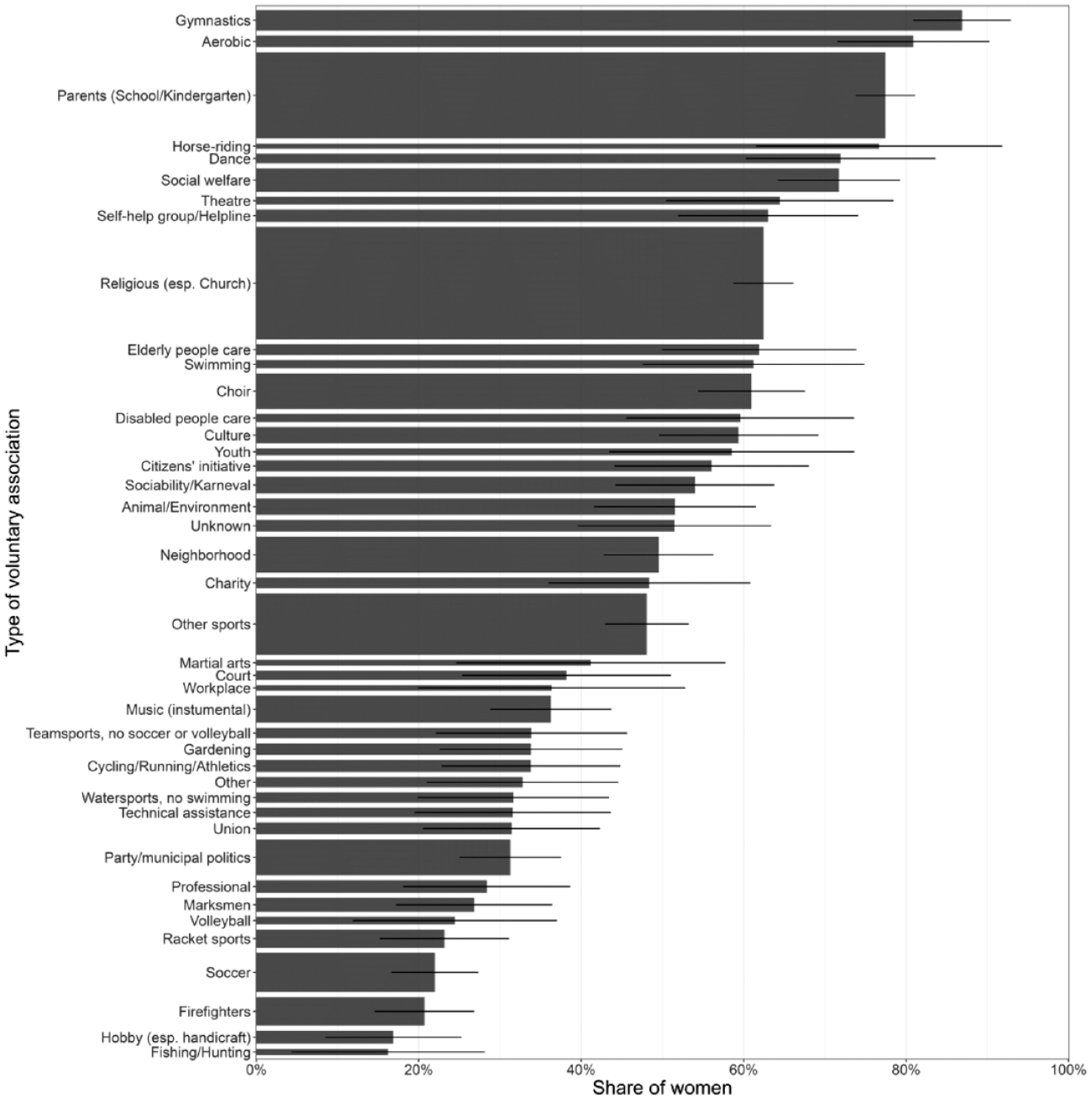
Share of Women Among Participants Across Different Types of Voluntary Associations
We now turn to segregation within types of associations showing differences between women and men in their immediate exposure to co-members of their specific association, which would remain overlooked if only the gender distribution of different types of organizations was concerned. Figure 2 reveals strong gender segregation within five of the seven most frequently mentioned types of associations. 3 For example, in religious associations, in which women tend to be overrepresented on average (see Figure 1), women more often attain women-dominated (70 percent) than gender-integrated (23 percent) or men-dominated associational contexts (7 percent). By contrast, men attain women-dominated (37 percent), gender-integrated (26 percent), and men-dominated contexts within religious associations (37 percent) at similar rates. There is also substantive gender segregation within neighborhood associations, which are, on average, characterized by relatively equal representation of women and men (see Figure 1). Both women and men are involved predominantly in associational contexts dominated by their own gender (see Figure 2). Similar patterns of segregation are apparent among soccer clubs, other sports associations, and choirs. They deviate substantively from a scenario in which women and men sort randomly into associational contexts implying that strong sorting mechanisms are at work within these types of associations. By contrast, in political and parents’ associations, women and men are equally likely to be involved in men-dominated, gender-integrated, or women-dominated associational contexts, respectively. These types of associations might offer less scope for internal differentiation of women and men because their activities are largely organized around a relatively narrow set of tasks and advocacy efforts. In sum, however, Figure 2 suggests strong gender segregation within most types of associations.
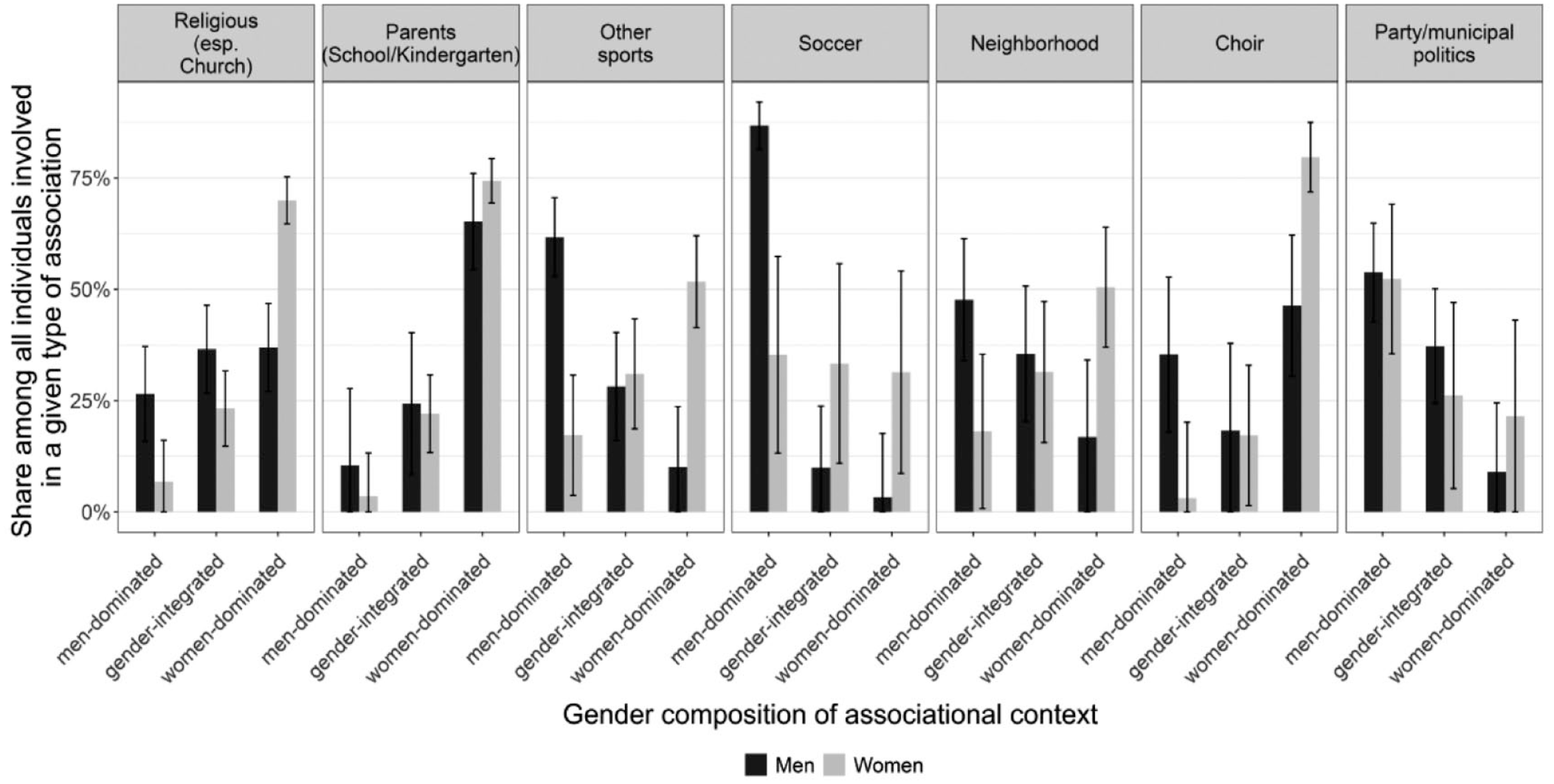
Share of Women and Men in Men-Dominated, Gender-Integrated, and Women-Dominated Associational Contexts Within Seven Types of Associations
Taken together, Figures 1 and 2 suggest that segregationist patterns across and within types of associations work in tandem to divide civic life along gendered lines, underlining the structural importance of gender for people’s leisure-time activities. It turns out that civic life is overall almost as strongly segregated as the close friendship networks observed in our data, implying that the capacity of voluntary associations to facilitate contact across gendered divides is seriously limited. That is, co-participants encountered in voluntary associations are nearly as likely to be of one’s own gender as close friends are (see Supplemental Appendix Section E, Comparing Gender Segregation in Civic Life with Friendship Networks, Supplemental Figure A3).
To test our hypotheses about how gender segregation in civic life comes about, we now turn to a dynamic assessment of transitions into and out of associational contexts. Figure 3 shows women’s and men’s predicted probabilities of these transitions derived from multinomial and binary logistic regression models containing only gender as a predictor. 4 In support of H1a, the left panel reveals that men and women systematically join voluntary associations through which they encounter people of their own gender. Men are about three times (or 8 percentage points) more likely than women to join men-dominated associational contexts (p < .001). Conversely, women are about 2.7 times (or 10 percentage points) more likely than men to join women-dominated associational contexts (p < .001). There are no meaningful gender differences in terms of joining gender-integrated associational contexts.
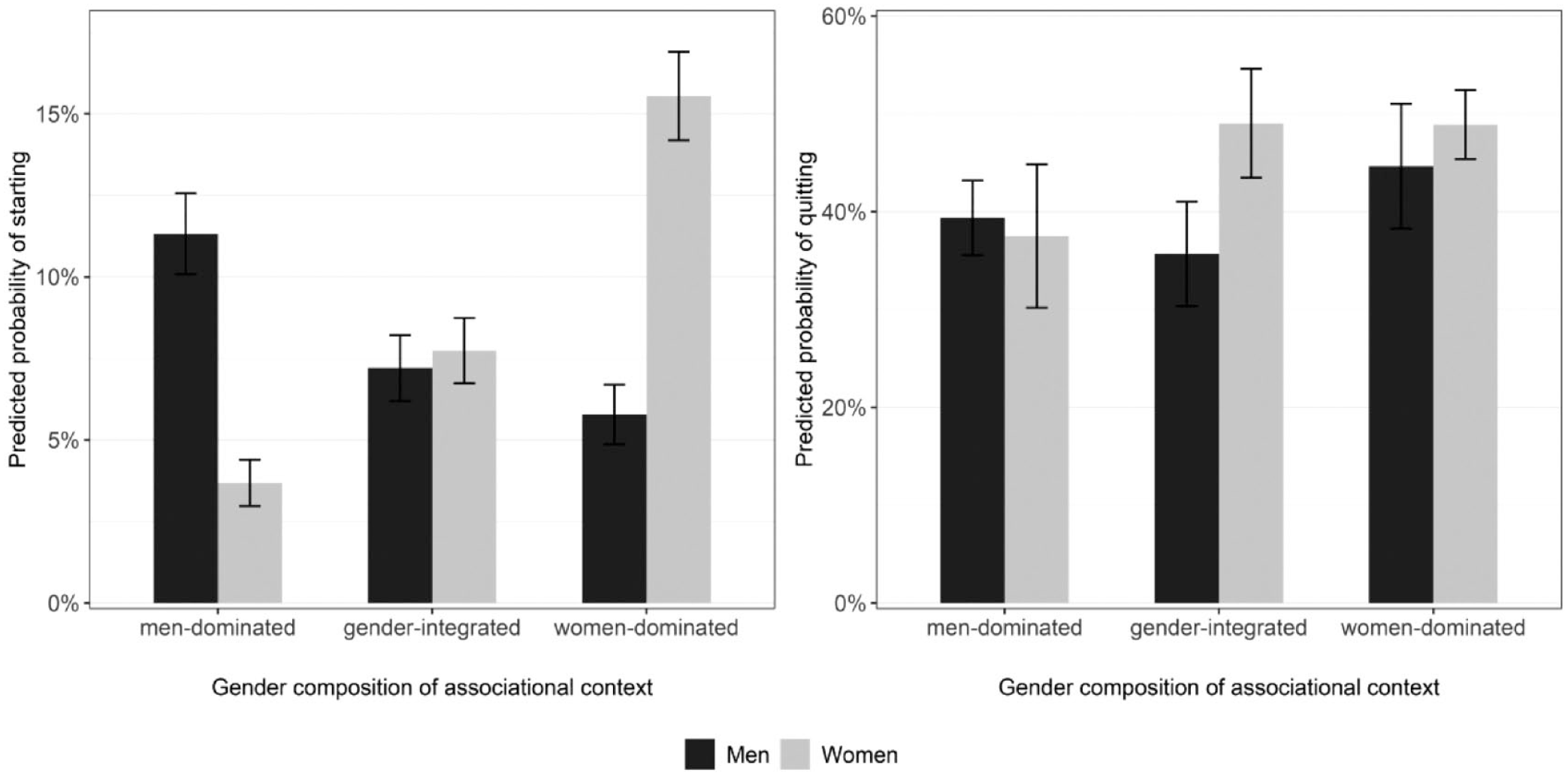
Starting and Quitting Transitions in Associational Contexts
If—in line with H1b—quitting transitions were a major source of gender segregation in voluntary associations, we would expect that men are more likely than women to quit women-dominated associational contexts and less likely to quit men-dominated associational contexts. However, the right panel of Figure 2 clearly deviates from this expectation. In men-dominated associational contexts, women and men are just as likely to quit their involvement (5 percentage point difference, p = .658). Similarly, there is no marked gender gap in the quitting propensity in women-dominated associational contexts (4 percentage points, p = .250). In gender-integrated associational contexts, however, we observe that women are about 1.4 times (or 13 percentage points) more likely to quit than men. This risk difference is considerably smaller than the differences in joining women-dominated and men-dominated associational contexts (3 and 2.7 times, respectively). Given the clear support for H1a and the lack of support for H1b, we conclude that selective starting, but not selective quitting, brings about gender segregation in civic life.
In Table 1, we turn to the drivers of selective joining by showing the differences in the predicted probabilities of joining a men-dominated versus a women-dominated associational context. Larger (absolute) differences correspond to stronger segregation. In the first row, these probability differentials are derived from the same baseline model as Figure 3, which contains only gender as a predictor. To illustrate, men’s probability of joining a men-dominated associational context is 11.3 percent, and their probability of joining a women-dominated associational context is 5.8 percent. Thus, men are 5.5 percentage points more likely to join a men-dominated vis-à-vis a women-dominated associational context—a substantial difference given the probability of joining any associational context of 24 percent. Women’s joining transitions are even more segregated than men’s: They are 11.8 percentage points less likely to join a men-dominated vis-à-vis a women-dominated associational context, given an overall joining probability of 27 percent.
Predicted Probability Differentials of Joining a Men-Dominated Versus a Women-Dominated Associational Context
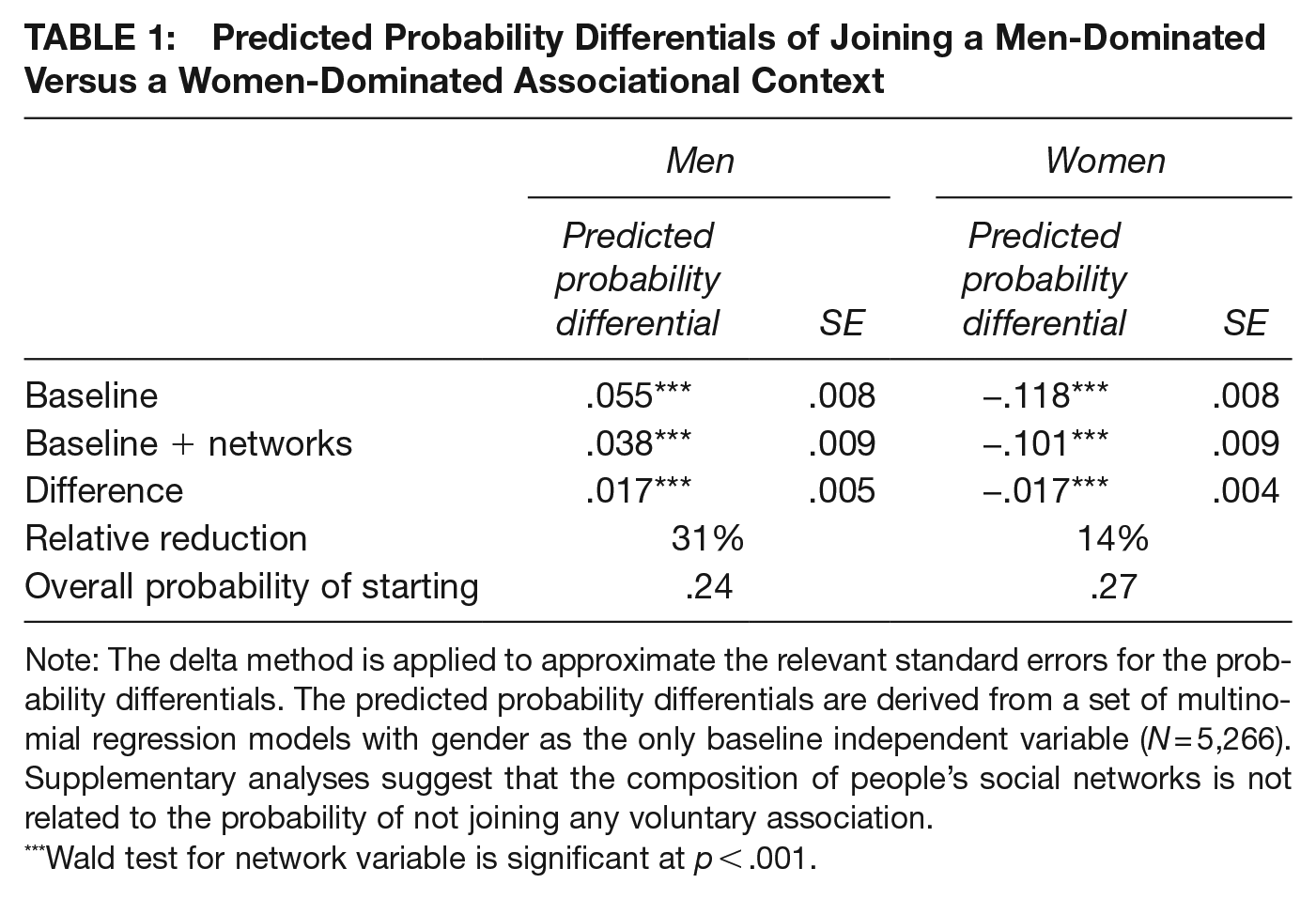
Note: The delta method is applied to approximate the relevant standard errors for the probability differentials. The predicted probability differentials are derived from a set of multinomial regression models with gender as the only baseline independent variable (N = 5,266). Supplementary analyses suggest that the composition of people’s social networks is not related to the probability of not joining any voluntary association.
Wald test for network variable is significant at p < .001.
If the observed gender segregation in joining transitions is driven partly by differences in women’s and men’s friendship networks (H2), the absolute differences in the probabilities to join men-dominated vis-à-vis women-dominated associational contexts should shrink after including the friendship network variable in the multinomial regression model. The second row of Table 1 supports this idea: After accounting for the gender composition of people’s friendship networks, the differences in the predicted probabilities of joining a men-dominated vis-à-vis a women-dominated associational context amount to 3.8 percentage points among men and –10.1 percentage points among women. The difference between the two model specifications of 1.7 percentage points among both men and women suggests that differences in the gender composition of friendship networks account for about 31 percent of the segregation in joining transitions among men and for about 15 percent among women. Note that we excluded further control variables from the analysis to avoid overcontrolling for correlates of the gender composition of one’s network, but adding them to the model does not change the results in any meaningful way (see Supplemental Appendix Section F, Supplemental Tables A6–A8, and Supplemental Figures A4 and A5).
In Figure 4, we show the differences in predicted probabilities across quartiles of the gender norm index. Men in the most traditional quartile are 8.5 percentage points more likely to join men-dominated vis-à-vis women-dominated associational contexts. In contrast, this difference is significantly smaller among those holding egalitarian (4.6 percentage points, difference between probability differentials = 3.9 percentage points, p = 0.006) or even very egalitarian gender norms (2.2 percentage points, difference between probability differentials = 6.3 percentage points, p < 0.001). Women join women-dominated vis-à-vis men-dominated associational contexts, as indicated by the negative predicted probability differentials. Yet the strength of these differences differs only to a limited and statistically insignificant degree across gender norm quartiles (e.g., the difference in probability differentials between very egalitarian and very traditional gender norm quartiles equals 2.3 percentage points, p = .210). In sum, we find support for H3 among men, but not among women.
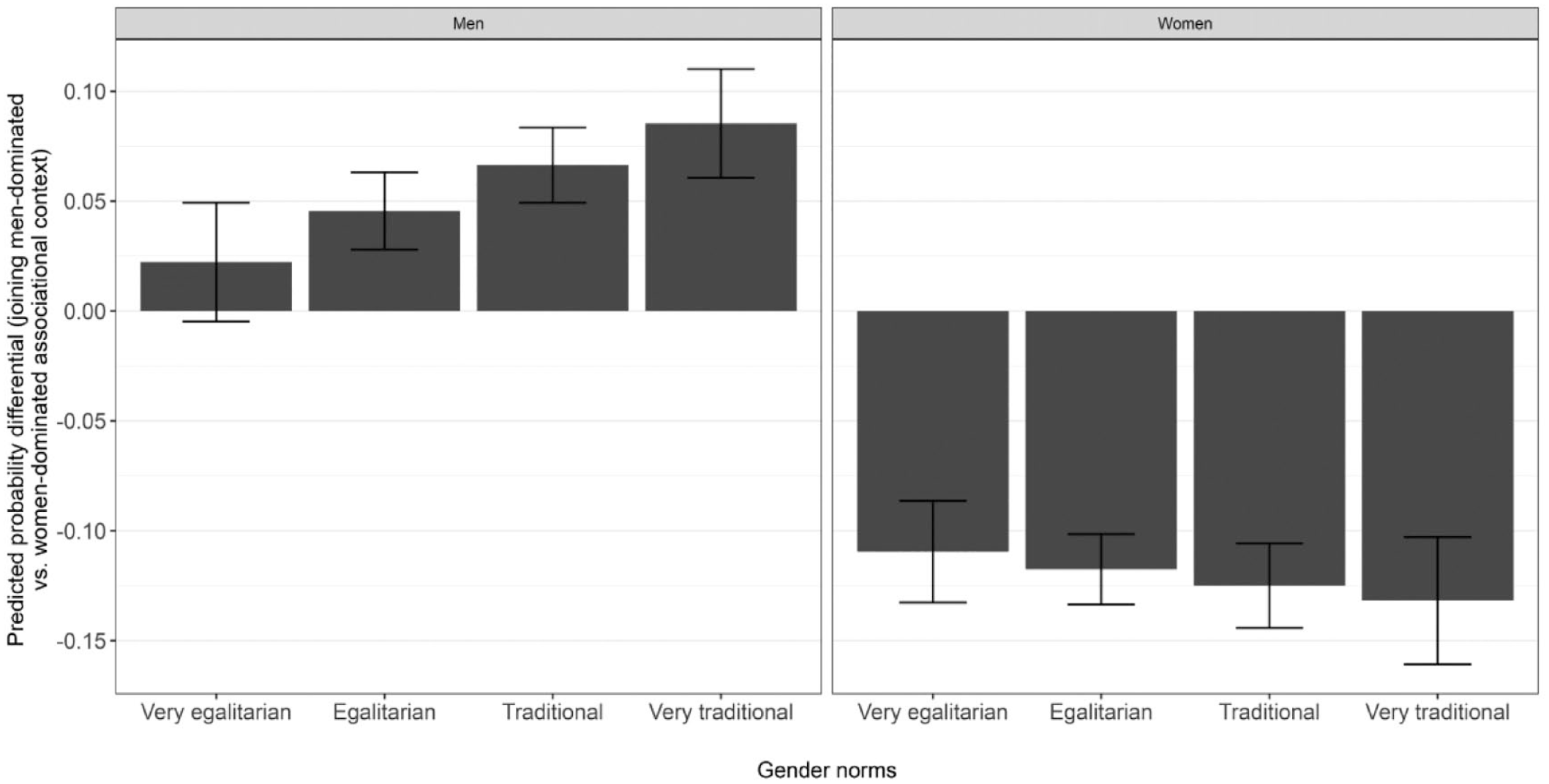
Predicted Probability Differentials of Joining a Men-Dominated Versus a Women-Dominated Association
Discussion
The pervasive persistence of gender segregation in social settings, such as occupations, workplaces, and friendship networks, inhibits social association between women and men and thereby slows down efforts toward gender equality. Voluntary associations are often celebrated for their capacity to bridge social divides that prevail in these other domains by facilitating contact between people with different sociodemographic characteristics. Yet their capacity to bridge gendered divides is usually limited. Because previous research has typically been restricted to showcasing gender gaps in different types of associations (e.g., Norris and Inglehart 2006), questions remain about how gender segregation in civic life comes about and which role different elements of the gender structure play in this process (Risman 2004, 2018). In this article, we, therefore, analyzed detailed survey data to get a fuller picture of gender segregation in civic life and to assess its underlying reasons, which suggest strong links to gender inequalities in other domains.
In the descriptive part of our analysis, we find evidence for substantive gender segregation across types of associations using a detailed classification scheme: Political, hobby, and employment associations are composed primarily of men, whereas women are overrepresented in parents’, social care, and religious associations. Sports associations are strongly segregated according to traditional conceptions of masculine- and feminine-typed sports. These patterns align with and expand upon findings of earlier studies on gender segregation in civic life (e.g., Norris and Inglehart 2006) and parallel women’s and men’s sorting into occupations featuring skills stereotypically associated with a particular gender (e.g., Levanon and Grusky 2016). Because women and men extend their respective involvement in care and paid work to voluntary associations, the gendered division of labor within households becomes more visible to others, potentially solidifying norms about women’s and men’s roles throughout the community.
There is also widespread gender segregation within types of associations. Within five of the seven most popular types of associations (i.e., religious organizations, soccer clubs, other sports clubs, neighborhood organizations, and choirs), women and men disproportionally encounter co-participants of their own gender. By contrast, we find little evidence for segregation within parents’ and political associations. This suggests that instrumental associations may be less gender-segregated than expressive ones because participants work more strongly together toward a well-defined goal (e.g., the welfare of their children in school). In sum, however, these patterns demonstrate that sorting processes across and within fine-grained types of organizations jointly produce the overall gender segregation in civic life, which prevents women and men from “encountering one another as peers in the same position”—much like in the field of occupational and workplace segregation (Ridgeway 2011, 97).
Furthermore, our results suggest that overall gender segregation in civic life is driven by selective joining rather than quitting transitions. Women and men systematically select into associational contexts in which their own gender is overrepresented. Especially among men, much of this tendency can be explained by the composition of their friendship network, supporting the notion that groups maintain their homogeneity because new members are recruited through homophilous social networks (McPherson and Rotolo 1996; McPherson and Smith-Lovin 1986). Thus, as in the labor market, gender-homophilous informal connections draw women and men into different organizational contexts, thereby inducing segregation (McDonald 2011; Trimble and Kmec 2011). Moreover, we find that the tendency to opt for men-dominated associational contexts is stronger among men holding traditional gender norms, paralleling associations of gender norms with more gender-stereotypical fields of study (Raabe, Boda, and Stadtfeld 2019), occupations (Steiber and Haas 2012), and household division of labor (Davis and Greenstein 2009). However, no such patterns are present among women. The explanatory power of friendship networks and gender norms might be weaker among women because their care work-related voluntary involvement is closely tied to their children, and women often establish connections to voluntary associations regardless of their gender composition (e.g., parents’ organizations or children’s leisure associations) (Einolf 2018). Thus, their voluntary involvement depends more on the connections established by their children and is less contingent on their friendship networks or gender norms.
Taken together, our results underscore that gender manifests itself as a social structure in civic life (Risman 2004, 2018). Women and men are socialized into preconceptions of stereotypically feminine and masculine leisure activities and responsibilities related to their gendered selves and socialize predominantly with people of their own gender in daily life. These broader cultural and material structures guide their decisions to join organizations in which they “do” gender (West and Zimmerman 1987). We show that gender segregation across organizational contexts can persist even in the absence of mechanisms related to hiring discrimination, gendered sorting into educational tracks, and devaluation of feminine occupations, which are often cited as powerful drivers of occupational segregation (Ridgeway 2011).
Conclusion
Overall, gender segregation in civic life may thus further solidify the structural significance of gender in society. Civic life often perpetuates stereotypes and structural gender inequalities, which may hinder gender equality in other domains, too. For example, observing women in school-related organizations and men in the voluntary fire brigade may encourage children to unconsciously internalize stereotypical gender ideologies from an early age. Moreover, if women and men participate in different associational contexts, gender inequalities in access to social capital and related outcomes are potentially exacerbated (McDonald 2011; Popielarz 1999; Trimble and Kmec 2011). Efforts to build communities in which everyone can thrive should thus be informed by evidence about the integration of women and men into voluntary associations and the underlying mechanisms of gender segregation in civic life, as provided, for example, in the present study (Arneil 2006).
We encourage further research on gender segregation in civic life: Future work could test to which degree our findings in the German context are replicated in other countries. Moreover, studying multidimensional sorting mechanisms in civic life would improve our knowledge of how gender intersects with racial and socioeconomic fault lines. Finally, analyzing the implications of gender segregation in civic life for structural features of women’s and men’s social networks and gender gaps in social capital could further enrich our understanding of how gender operates as a social structure in civic life and beyond.
Supplemental Material
sj-docx-1-gas-10.1177_08912432231195075 – Supplemental material for Gender Segregation in Civic Life: Women’s and Men’s Involvement in Voluntary Associations
Supplemental material, sj-docx-1-gas-10.1177_08912432231195075 for Gender Segregation in Civic Life: Women’s and Men’s Involvement in Voluntary Associations by Kasimir Dederichs and Nan Dirk de Graaf in Gender & Society
Footnotes
Authors’ note:
This article uses data from the National Educational Panel Study (NEPS): Starting Cohort Adults, doi: 10.5157/NEPS: SC6:11.1.0. From 2008 to 2013, NEPS data were collected as part of the Framework Program for the Promotion of Empirical Educational Research funded by the German Federal Ministry of Education and Research (BMBF). As of 2014, NEPS has been carried out by the Leibniz Institute for Educational Trajectories (LIfBi) at the University of Bamberg in cooperation with a nationwide network. We thank Richard Breen, Christina Pao, Carla Rowold, and Mathis Ebbinghaus as well as the participants at the ECSR Conference 2021 for their helpful comments on earlier versions of the paper. Moreover, we are thankful for the support in providing data access by the colleagues at the LIfBi. This work was supported by the Economic and Social Research Council grant ES/P000649/1.

Supplemental Material
Supplemental material for this article is available online.
Notes
Kasimir Dederichs is a PhD candidate at Nuffield College, University of Oxford. His research focuses on social integration and inequalities in voluntary involvement and has appeared in the European Sociological Review, Social Networks, and the Nonprofit and Voluntary Sector Quarterly.
Nan Dirk de Graaf is an Official Fellow at Nuffield College, Oxford. His research interests include social stratification, sociology of religion, pro-social behavior, and political sociology. With Dingeman Wiertz, he published the social science textbook Societal Problems as Public Bads (Routledge 2019); and with Klarita Gërxhani and Werner Raub, he edited the open-access Handbook of Sociological Science: Contributions to Rigorous Sociology (Edward Elgar 2022).
References
Supplementary Material
Please find the following supplemental material available below.
For Open Access articles published under a Creative Commons License, all supplemental material carries the same license as the article it is associated with.
For non-Open Access articles published, all supplemental material carries a non-exclusive license, and permission requests for re-use of supplemental material or any part of supplemental material shall be sent directly to the copyright owner as specified in the copyright notice associated with the article.
