




Abstract
The transition to clean energy needs rapid workforce development. Short-term retraining can fulfill workforce development needs for many clean energy occupations in the Occupational Information Network (ONET) database. The authors assessed the utility of unsupervised clustering to cluster clean energy occupations for resource-efficient retraining. Occupations to retrain using text similarity-based occupational similarity metrics are also identified. The authors found that the network-based approach to organizing occupations using text similarity can identify more occupations to retrain compared to standard occupational groupings, thus improving trainees’ employability and job quality prospects. This study demonstrates the utility of the ONET database as a reconnaissance framework for clean energy workforce development programs with equity and justice considerations. These approaches can also be adapted to workforce development for different sets of occupations to identify other occupations for retraining and designing cluster-wise workforce training programs.
Keywords
The accelerating clean energy transition in the United States, aided by an ambitious suite of once-in-a-generation federal policies branded under the Biden administration as the Investing in America Agenda, is creating an acute need for workers and workforce development (Renner et al., 2022; Sharma & Banerjee, 2021). While continued federal leadership in support of clean energy is uncertain under the second Trump administration, ongoing state and private-sector investments in clean energy solutions will continue and are likely sufficient to drive high demand for qualified workers in the near and long- terms. Some jobs in the renewable energy sector will be filled with new generations of workers, including some who are currently too young to even envision their future employment. Nearer term, however, there is an even greater need for time sensitive, responsive workforce development initiatives designed to help large numbers of currently employed individuals transition into green occupations, including workers within declining or even greenhouse-gas (GHG)-emitting industries. While the transition into specialized energy occupations with higher vocational and experience requirements maybe not be feasible for all incumbent workers, a sizeable share of clean energy occupations (32% according to U.S. Bureau of Labor Statistics [BLS] projections), are within the reach of the existing U.S. workforce, including workers with limited formal education and experience. This bolsters the case for focused institutional investment in support of occupational transition and the expansion of short-term vocational training and retraining opportunities.
In the United States, state and local workforce development systems are well-suited for this challenge. They implement a constellation of strategies to help individuals secure jobs and navigate their careers. At a basic level, they help individuals identify jobs that will enable them to use existing or transferable skills; they are essentially “matchmakers” and are a core component of federally and state-funded workforce services. But not all job seekers have the requisite skills needed to seamlessly transition into a new occupation or job. In this case, workforce development programs help workers identify and resolve skills gaps, either by enrolling individuals in a vocational training program or alternatively, by aiding employers in the creation and maintenance of work-based training systems that ensure newly hired employees gain skills that are in demand. Beyond this, the programs also create and illuminate career pathways such that workers within existing jobs and industries can climb a series of rungs along a well-illuminated career ladder. This includes helping new generations of workers access entry-level jobs that are linked to job ladders (Nelson & Wolf-Powers, 2010).
To complete each of these related strategies and know which to prioritize for a given set of workers or job seekers, workforce developers need detailed and up-to-date occupation-specific information, especially data that help them identify which seemingly unrelated occupations might overlap in terms of relevant knowledge and skills. There are numerous high-quality proprietary workforce data sets and services that support this need. But the rapid pace of occupational transformation created through environmental and technological change suggests an opportunity to leverage improved analytical techniques to make some of these data more transparent and publicly accessible.
This paper lends support to current and future workforce development efforts, especially short-term retraining to address the imminent need for a large clean energy workforce in the United States. For our analysis, we use the Occupational Information Network (ONET) database, a federally developed framework and database for organizing and displaying occupational data. We combine text similarity to identify a set of clean energy occupations into which workers with short-term training support could most easily transition. As part of this analysis, we also factor in occupational wage levels, identifying those clean energy jobs for which a transition will also meet “good jobs” goals, starting with jobs that pay well. In doing so, we recognize that transitioning from one occupation to another can, under the right conditions, provide benefits for workers, including equivalent or higher wages, along with an increased sense of accomplishment and job satisfaction (Antoni et al., 2015; Falxa-Raymond et al., 2013; Jackman & Moore, 2021).
To aid good job-centered workforce-development investments, we use agglomerative hierarchical clustering to identify overlapping knowledge and skills in clean energy occupations. With this added step, we offer focused guidance for workforce development agencies tasked with developing vocational training programs while navigating difficult budget constraints (Rutovitz et al., 2021). While the practical focus of this study is clean energy workforce development, our approaches are equally applicable to other sectors/industries.
Background and Related Work
Clean Energy Workforce Development in Context
Aided by recent climate friendly policies in the United States, such as the Infrastructure Investment and Jobs Act (IIJA) 2021, the Inflation Reduction Act (IRA) 2022, and Creating Helpful Incentives to Produce Semiconductors and Science (CHIPS) Act (2021–2022), an acute need for clean energy workforce development at scale has become apparent. Assuming full implementation, the IRA is projected to create more than 5 million jobs in the next decade (Pollin et al., 2022; Xie et al., 2023). Investments in workforce development, including vocational training, will be key to meeting ambitious clean energy growth projections. That initial workforce investment, and others that may build on it, will also matter for providing access to high quality, environmentally responsive jobs.
One way to address these workforce development needs is to focus support, including short-term retraining, on workers who would benefit most from transitioning to clean energy occupations. Workers in various industries will benefit from this assistance, including many of those in fossil-fuel-related occupations, as well as those in more established, yet lower-paying clean energy occupations, such as solar installation. Well-designed retraining programs can be effective, especially for younger workers (Mangelsdof, 2024). Targeted retraining can also focus on a subset of jobs and occupations that are considered high quality, ensuring that transitioning workers earn a higher wage and benefit from improved job security along with a greater sense of purpose through societally impactful work (Antoni et al., 2015; Cha, 2024; Falxa-Raymond et al., 2013; Jackman & Moore, 2021).
Some clean energy occupations require specialized education, skills, and experience that cannot be satisfied through vocational training. In this paper we are not focused on those occupations. Furthermore, some occupational transitions are not easy due to specialized skills and requirements of the source and target occupations. A realistic transition requires some degree of similarity between the occupations, so that the transitioning worker can perform tasks related to the target occupation (Scheuer et al., 2010). To narrow down potential occupational transitions for clean energy workforce development, we identify other occupations for which the transition to clean energy is realistic and the new job is a good one.
Related Occupations
Current workforce development practice relies heavily on standardized occupational classifications like the Standard Occupational Classification (SOC) codes to design training programs and identify career pathways. For example, the U.S. Department of Labor's Workforce Innovation and Opportunity Act (WIOA) programs typically organize training around SOC-based occupational clusters, with career counselors using these hierarchical groupings to suggest potential transitions (Torpey, 2015). While this structured approach has advantages for program administration, it can artificially constrain the identification of viable career transitions. Our proposed methodological approach using text similarity and network analysis could expand how workforce development programs identify transition opportunities. Rather than limiting transitions to predefined occupational hierarchies, this approach identifies connections based on actual skill and knowledge similarities between occupations. This matters for program design because it allows practitioners to develop training that bridges traditional occupational boundaries, potentially opening numerous and diverse career pathways for workers.
One way to identify realistic transitions is to identify pairs of occupations that have a degree of commonality. More commonality between occupations enables transitioning workers’ existing knowledge and skills to be augmented through training, which allows them to transition more easily to another occupation. The degree of commonality is also known as familiarity—the ability to apply current knowledge to new problems (Scheuer et al., 2010). The transition to clean energy occupations is easier if the source occupation already provides a degree of similarity to the occupational requirements of the clean energy occupation. In general, clean energy occupations and green occupations have greater requirements for particular skills and knowledge than other occupations (Consoli et al., 2016), making familiarity a crucial factor in expediting transitions.
Therefore, identifying occupations on which to focus workforce development and retraining requires assessing familiarity with tasks and skills that are most associated with clean energy occupations. A recognized approach to this involves comparing the descriptive text of occupational attributes and occupations to find where familiarity between occupations can be predicted by the similarity between those attributes (Benyamini & Gati, 1987). Text similarity functions as a proxy for occupational familiarity. Montobbio et al. (2021) linked human tasks and machine functions for various occupations using text similarity between descriptions of tasks. Martin-Caughey (2021) used text similarity between job titles and task descriptions to investigate within-occupation variation and gender segregation of tasks in jobs. Text similarity has also been validated as a reliable proxy for occupational familiarity in occupational transition using expert analysis (Dahlke et al., 2022). Curtis et al. (2024) identified transition into green jobs using text-based analysis of job changes. However, it is possible to go beyond the occupational descriptions and identify requisite skills and experiences desired in a corpus of job postings using Natural Language Processing, as was done by Jones et al. (2024) for battery manufacturing.
As a reinforcing analytical step, occupations can also be parsed into various forms, each with strengths and limitations for assessing occupational relatedness. These choices typically involve hierarchical, network-based, or circular approaches to modeling occupations. Circular models, initially proposed by Holland (1959), create a personal-occupational model with six vocational-interest/work environments, known as Realistic, Investigative, Artistic, Social, Enterprising, and Conventional (RIASEC). While circular approaches were useful in their time, they have recently been criticized for not representing occupational evolution and change (Deng et al., 2007).
An alternative is the hierarchical model proposed by Gati (1979), which organizes occupations in a nested model in which occupations represent the collection of their attributes with similarities depending on the similarity of those attributes and the proximity of relations between occupations representing the interpretable hierarchical tree structure. Hierarchical representation is widely accepted and implemented in information databases such as the SOC, in which occupations are hierarchically represented by their groupings: Major Group, Minor Group, Broad Occupations, and Specific Occupations. The ONET database has also adopted the modular approach of representing occupations as collectives of attributes, as presented in Gati (1979). Several studies also use existing industrial classifications and occupations related to them. For example, Thompson and Thompson (1987) used Standard Industrial Classification (SIC) codes and the percentages of various occupations within each industry classification and Chapple et al. (2004) defined high-tech occupations based on their representation in selected industrial codes.
Occupations can also be represented as a network. Network representations are predominant in studies related to occupational mobility, in which the boundaries of occupations are determined by occupational mobility (Lin & Hung, 2022). Several studies have used network representation in mobility-related analyses for purposes such as deriving social class categories, discovering mobility boundaries, and studying the impacts of labor automation on employment prospects, among others (Cheng & Park, 2020; del Rio-Chanona et al., 2021; Toubøl & Larsen, 2017).
Finding workers to retrain based on a hierarchical representation of occupations, would involve targeting occupations within the same grouping of occupations (for example, the major groups defined in the hierarchical organization of SOC). To retrain for Management Occupations, Other Management Occupations would be targeted. An Organisation for Economic Co-operation and Development (OECD) study on pathways from declining to thriving occupations exemplifies this approach by analyzing an example transition from satellite/broadband technicians to computer support specialists (Manca & Oses Arranz, 2022). However, occupations in other groups may also have enough familiarity in terms of knowledge, tasks, or skills to facilitate occupational transition. The latter approach disregards the hierarchical structure of occupations in standard classifications and instead leverages the pair-wise relation between occupations at the opposite end of a transition, like how the edges and nodes are represented in a network.
Workforce Development in Clusters
Network representation of occupations assumes individual transitions (edges) from one occupational field to another. We recognize the possibility of designing workforce development programs to prepare a trainee to explore multiple occupational transitions at a time. This idea is often referred to as “job clustering.” Byrd and Perkin, Jr. (1966) encouraged it by developing task-knowledge clusters within standard industrial classification groupings for use in curriculum design. A primary motivation for the idea is to adapt to technological change as requirements for occupations evolve and occupations cease to be in demand (Denisi, 1976). Clean energy occupations are still evolving, and occupations that currently do not exist will be created in the near future with developments in sectors like green hydrogen (Bezdek, 2020). Rather than developing workforce training for singular occupations, we might develop programs that enable trainees to perform tasks related to multiple, closely related occupations and, with that, also help trainees improve future job prospects. Training programs covering multiple occupations at a time can also make the workforce development resource effective in the long run as trainees can adapt more easily to new occupations. To design workforce training programs, we first need to identify clusters of occupations that have similar attributes relevant to occupational transitions.
One way to identify clusters of occupations is with unsupervised machine learning. Clustering occupations has been used in recent occupational studies for regional economic development analysis for which standard occupational groupings are not a good fit with applications used to describe the labor pool of cities or capture the impact of economic development (Chrisinger et al., 2012; Currid & Stolarick, 2010; Feser, 2003; Koo, 2005). In each analysis, bespoke clustering based on relevant occupational metrics served a better purpose than standard occupational groupings.
Despite this interest in occupational clustering, few studies have used it to inform workforce development training. The most recent analysis we found was a 1992 study that developed job clusters for projected jobs in the U.S. Air Force (Ballentine et al., 1992). The growing commitment to energy transition, reinforced through the historic levels of federal investment in clean energy, creates an opportunity to bring this kind of analysis to the fore. Reinforcing this point, the director of the Department of Energy's Office of Energy Jobs recently discussed training workers in job clusters to fulfill clean energy workforce development needs (Roberts, 2023). Our analysis is designed to encourage a collective response to that request.
Data
Our research is conducted at the occupation level. Occupation is defined as a broad family of closely related jobs. We leverage information available in the ONET database version 28.1, a framework and database for organizing occupational data (Hilton & Tippins, 2010). ONET was developed as an initiative from the U.S. Department of Labor and was launched in 1998. The ONET database released in 2019 lists 1,016 occupations, including Knowledge, Skills, Technology Skills, and Tools attributes for each occupation. Additionally, there is an Importance Score for each occupational attribute that was developed as part of the ONET Content Model, which collects and organizes information on occupational attributes at a granular level through large surveys of a representative sample of workers (Handel, 2016). The model defines Knowledge as “organized sets of principles and facts applying in general domains” and Skills as “procedures to work with given knowledge.” The Knowledge and Skills attributes represent organized principles, facts, and procedures that a worker needs to develop through training or experience to transition to another occupation. The ONET database has standardized these requirements into 33 Knowledge attributes and 35 Skills attributes (listed in Supplementary Online Appendices E and F). Each of the attributes has an Importance rating (ranging from 1 to 5) representing how important the attribute is for the occupation.
The database also has various similarity scores between all possible pairs of occupations. The scores are based on the Dahlke et al. (2022) report prepared for the Center for ONET Development. These scores are Work-Based Occupational Similarity, Knowledge Cosine, and Alternate Titles Cosine. The Work-Based Occupational Similarity provides an average similarity between task statements and detailed work activity. The Knowledge Cosine is the similarity between the profile of occupations created from the Importance ratings of ONET's 33 Knowledge domains. Alternate Titles Cosine is the similarity score between the occupations’ alternate titles.
The Relatedness score is a composite of these three similarity scores. To compose the Related Score, the three occupational attributes-based scores are converted into Z-scores. The final Relatedness Score is the Z-score of the sum of the Z-scores of the Similarity scores (see Supplementary Online Appendix C). The three Similarity scores capture similarities between different occupational attributes and are not always interchangeable. Occupations with similar work activities may not be similar in terms of Knowledge areas. However, the Relatedness Score, created by adding the remaining Similarity scores, has a high correlation (greater than 0.8) with the other scores.
We use U.S. Bureau of Labor Statistics (BLS) Occupational Projections Data 2022 to identify clean energy occupations amenable to workforce development by retraining using the information on Typical Entry Level Education, Work Experience in a Related Occupation, Typical On-the-job Training, Annual Median Wages, and Employment Percent Change (2021–2031). We use the same variables to identify other occupations that can transition to clean energy occupations. Our universe of occupations consists of 963 occupations resulting from matching 1,016 ONET-SOC 2016 occupations and 832 occupations with employment projection information in the BLS data set. Multiple ONET occupations were matched to 72 occupations in the BLS data set, resulting in more occupations than in the BLS data set.
Methods
We perform a series of analyses at the occupational level (Figure 1). We first identify occupations without specialized education and extensive experience requirements, meaning that we filter out occupations in the data set requiring a minimum of a bachelor's degree or 5 years of experience. We then identify the clean energy occupations using a series of criteria. Using Similarity scores between occupations and median wage differentials, we identify occupational transitions with pay premium to clean energy occupations (with and without the requirement of an immediate clean energy occupation in between). The clean energy occupations represented in these transitions are the occupations for which retraining is feasible through workforce development programs. We group the clean energy occupations using unsupervised clustering techniques. For each group, we identify occupational attributes to be covered in cluster-wise workforce development programs based on the differences in the skills and knowledge that are important for each clean energy cluster but not as important for the other occupations that can transition into that cluster. We elaborate each of these steps in the following subsections.
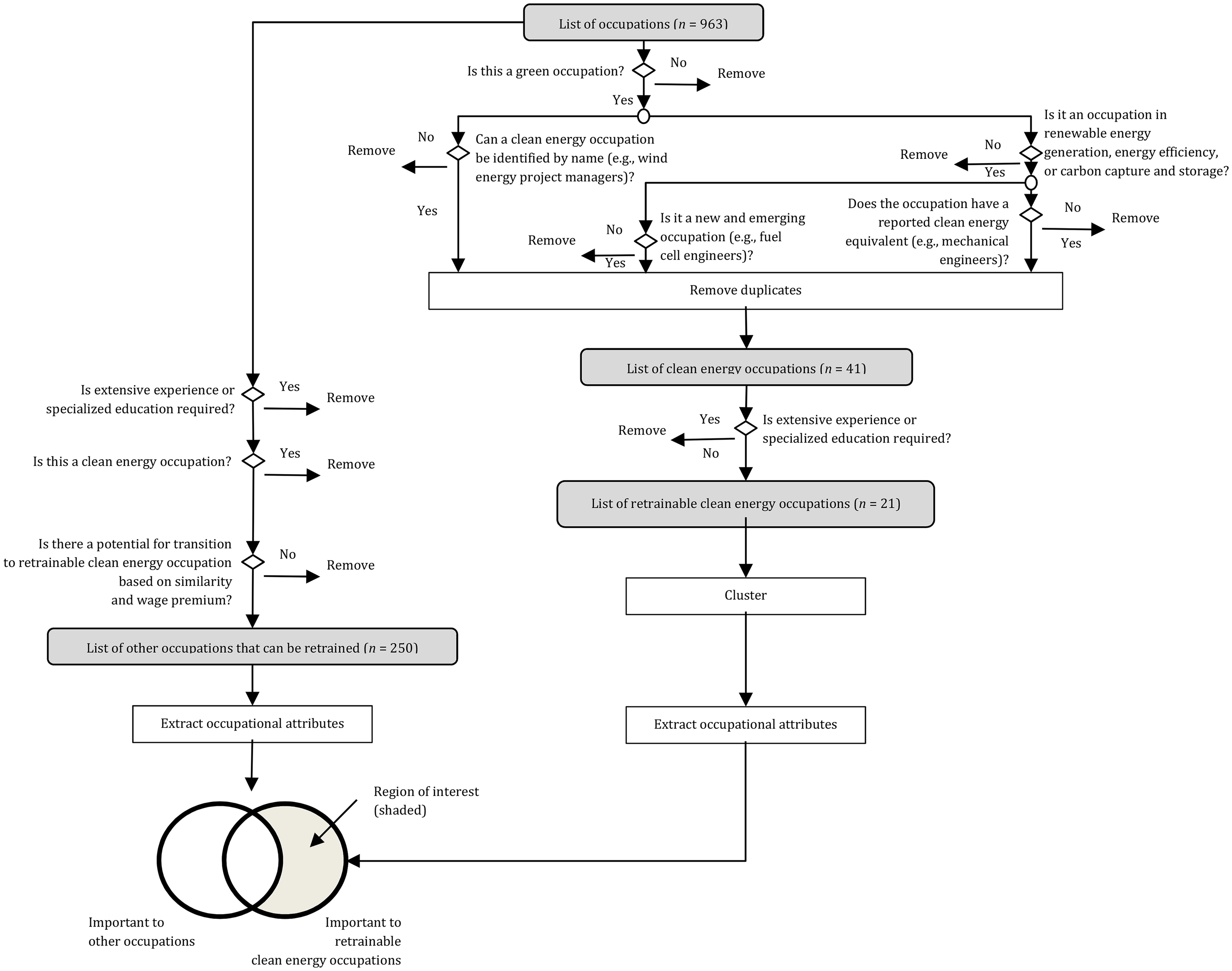
A Summary of the Methods. Note. We start with ONET dtabase and a list of Green Occupations (Dierdorff et al., 2011). We use occupational similarity and wage premium to identify feasible transition paths to Clean Energy Occupations and identify the list of Skills and Knowledge that should be part of a workforce development program. In this analysis, we are focused on occupations without extensive vocational and experiential requirements.
Feasible Transitions into Clean Energy Occupations
To identify feasible transitions into clean energy occupations, we first identify two sets of occupations: clean energy occupations and occupations that can transition into clean energy occupations. We use several criteria to separate these sets. We consider clean energy occupations to be those that are related to renewable and low-carbon energy generation, transmission and distribution, and energy efficiency, as well as allied services, research, consulting, and training. For the study's purposes, we also include nonrenewable but low-carbon nuclear energy-related occupations as clean energy occupations. Using a weighted keyword search of green topics, ONET identified 312 O*NET-SOC occupations (almost a third of the total) that are linked to at least one green topic. Green occupations based on the ONET report are described in Supplementary Online Appendix A. Since green occupations span a broad range of occupations from technology to managerial/administration, and this work is motivated by technology occupations directly related to fulfilling the labor shortage for the energy transition, we focus on clean energy occupations. Our targeted focus is driven by the urgency of meeting ambitious decarbonization targets set at international levels as well as recent national policies such as the Inflation Reduction Act 2022 and the CHIPS and Science Act 2022 (Doran, 2024; United States Congress, 2022). The clean energy transition represents a critical component of climate action, requiring a massive scaling up of clean energy infrastructure and workforce (Mayfield & Jenkins, 2021). Unlike broader green occupations that may include environmental conservation or sustainable business practices, clean energy occupations are directly tied to the infrastructure of renewable energy systems, grid modernization, and electrification—areas that face immediate and projected workforce shortages that could potentially bottleneck the pace of energy transition. By narrowing our focus to clean energy occupations, we can provide more actionable insights for workforce development initiatives specifically aimed at accelerating the deployment of clean energy technologies essential for meeting climate goals.
We first identify clean energy occupations from the list of green occupations in Dierdorff et al. (2011; defined in Supplementary Online Appendix A). Clean energy occupations are subsets of green occupations, which are occupations that are likely to be affected by green economy activities that lead to a reduction of energy consumption and improve environmental quality (Peters, 2014). To identify clean energy occupations from green occupations, we select all new and emerging occupations categorized in Dierdorff et al. (2011) from the following sectors: renewable energy generation, energy efficiency, energy and carbon capture, and storage, as well as occupations with reported clean energy titles from other sectors we considered. We then identify the unique occupations from the selections.
We identify other occupations that can transition into these clean energy occupations based on two criteria. The first criterion is that the occupation has a similarity score of 1.62 or higher (cutoff based on Dahlke et al., 2022) with at least one of the clean energy occupations. For example, Carpenters and Lighting Technicians can transition to Solar Thermal Installers and Technicians, with Similarity scores of 1.75 and 2.20, respectively. On the other hand, a transition between Automotive Glass Installers and Repairers and Solar Thermal Installers is not possible because of insufficient similarity with a Similarity score of 1.44 (see Figure 2).
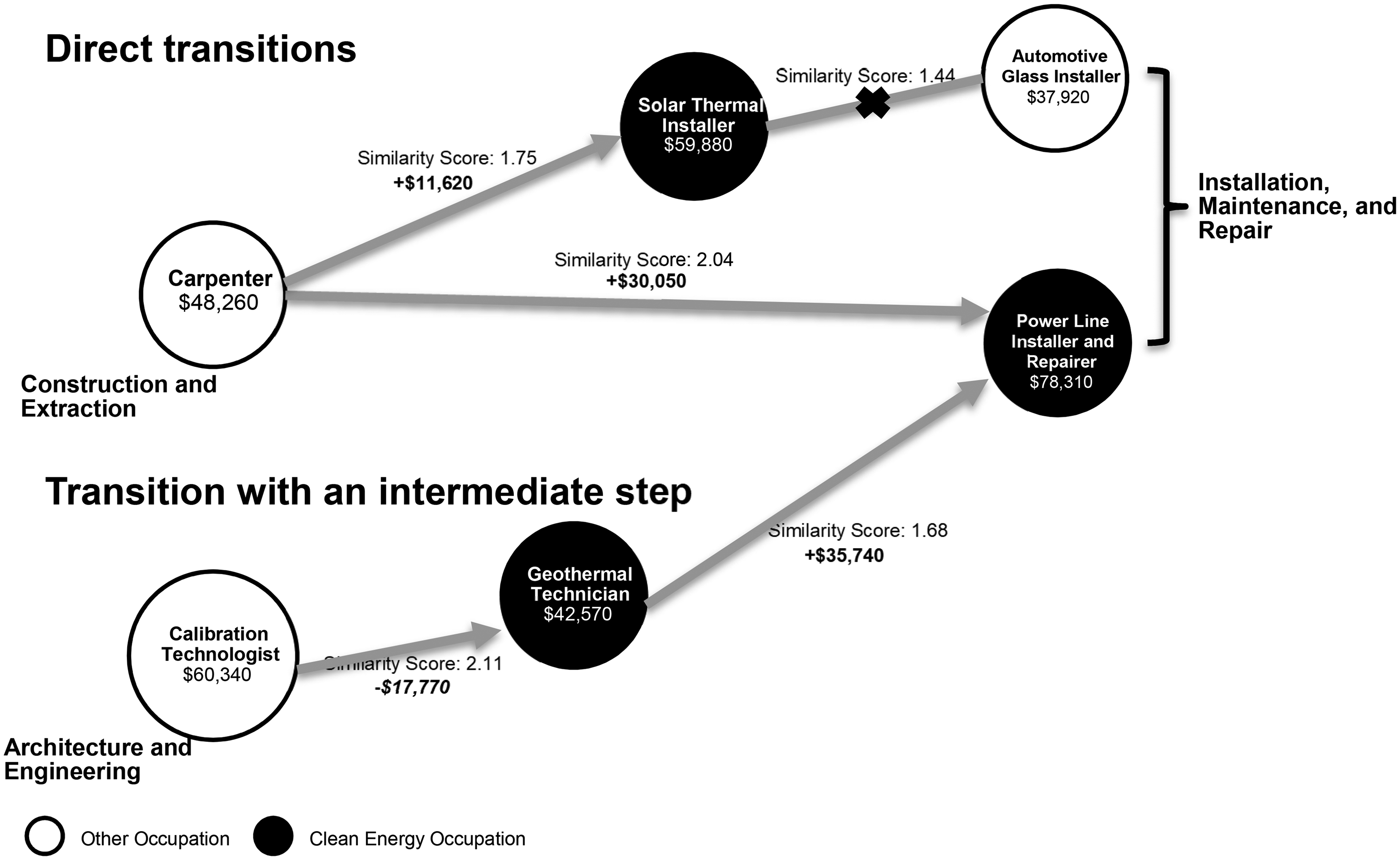
Illustrations of various Occupational Transitions Based on Occupational Similarity and Annual Income. Note. Occupational title is shown in the circle while the major group it belongs to is shown outside the circle. Transition from Automotive Glass Installer to Solar Thermal Installer is restricted by insufficient similarity score. Transition from Carpenter to Solar Thermal Installer as well as Power Line Installer and Repairer is enabled by both sufficient occupational similarity and potential for increase in annual income. Calibration Technologist can transition to a higher paying clean energy occupation Power Line Installer and Repairer by first transitioning to Geothermal Technician with sufficient occupational similarity and temporary reduction in annual income.
The second criterion is that the transition to clean energy occupation should enable wage growth in at most two steps. We use the annual median wages from the “Employment by detailed occupation” data set to identify the transitions that would result in an eventual wage premium (BLS, 2022). The transition of Carpenters (annual median salary of $48,260) to Solar Thermal Installers and Technicians (annual median salary of $59,880) results in an annual income increase of $11,620. Carpenters can also transition to Electric Power Line Installers and Repairs (with a similarity score of 2.04 and annual median salary of $78,310), resulting in an annual income increase of $30,050. Growth in income can also be achieved with an intermediate step if there is no direct path (Figure 2). For example, Calibration Technologists and Technicians (which is not a clean energy occupation and has an annual median salary of $60,340) can transition to Geothermal Technicians with a lower annual median salary of $42,570, as the first step in the transition. After some experience, they could move on to another clean energy occupation, Electrical Power-Line Installers and Repairers, with an annual median salary of $78,310—an income increase of $17,970.
Unsupervised Clustering of Clean Energy Occupations
We construct a distance matrix, based on the similarity score between pairs of clean energy occupations. The similarity scores are subtracted from 4.2, a value slightly higher than the maximum score of the identified clean energy occupations (4.13) and normalized between 0 and 1. Any remaining non-diagonal zeroes are converted to 1,000,000 as a proxy for infinite distance and any remaining diagonal non-zeroes are converted to 0.
We use this distance matrix to construct clusters of clean energy occupations using the agglomerative hierarchical clustering of the “cluster” package in R (Maechler et al., 2023). Hierarchical clustering is an unsupervised machine learning approach that identifies clusters of occupations at various levels, with one extreme containing one cluster for each node (here, occupation), and another extreme containing a single cluster for all nodes. In between, there are multiple groupings at various levels based on rules set for bifurcation of any two clusters. While other clustering techniques assign the number of clusters that are either predefined by the analyst or determined by the algorithm, hierarchical clustering algorithms provide different numbers of clusters at different levels of bifurcation. Thus, hierarchical clustering provides a way to interpret various clusters and select an appropriate clustering based on domain expertise and suitability for the purpose.
Identifying Key Attributes to be Covered in Targeted Workforce Development Programs
We then identify important occupational attributes, namely knowledge, general skills, technology skills, and tools, for clean energy occupations and others. We identify the attributes that need to be covered in targeted workforce development programs for each group by identifying the attributes that are important for clean energy occupations in the group but not for other occupations in the same group.
We identify knowledge and skills attributes that are important to clean energy occupations and other occupations using the Importance criterion for each attribute. On an Importance score of 1 to 5, we categorize attributes with scores higher than 3 to be important. The set union of all these important attributes is what the professionals that workers in these occupational groups should know. For the other occupations that can transition to clean energy occupations in the same group, we first identify knowledge and skill categories that are Important (score higher than 3) for more than half of the occupations in the group. The knowledge and skill categories to be considered in the workforce development programs for the cluster is the set difference of the former two: knowledge categories that are important for the clean energy occupations in one group minus the knowledge or skill attributes that are already important for more than half of the other occupations in the cluster. Since Technology Skills attributes do not have Importance criterion, we identify the attributes that are required for more than half of clean energy occupations in the cluster and identify the attributes to be covered in workforce training from the set difference with attributes required for more than half of other occupations that can transition.
Results
Of the 41 clean energy occupations (listed in Supplementary Online Appendix B), only 21 are amenable to workforce development by retraining. These are Technicians, Operators, Installers, and System Inspectors. Some of the occupations are specific to certain clean energy technology jobs (for example, Biomass Plant Technicians or Solar Photovoltaic Installers), while others such as Maintenance and Repair Workers, General or Power Plant Operators are not. We also identify 250 source occupations that can transition to clean energy occupations (see Supplementary Online Appendix D for a full list), with 26 occupations requiring an intermediate step. These occupations range from Chemical Technicians to Foundry Mold and Coremakers.
Clustering Clean Energy Occupations for Targeted Workforce Development
We use agglomerative hierarchical clustering to construct a dendrogram of the identified clean energy occupations; performing a divisive hierarchical clustering resulted in the exact same clusters at all levels of bifurcation. Based on the clusters at various levels, as visible in the following dendrogram (Figure 3), we select four to be an appropriate number of clusters because electing four clusters in this case ensures discernible separation in the dendrogram and enough similarity between the occupations and the number of occupations in a cluster. The names of the clusters are chosen to be representative of the occupations in each cluster: Energy generation and dispatch, Machine operation, Solar and thermal installation, and Nuclear and biofuel operation. The ONET major groups that have these occupations in different clusters are also labelled in Figure 3, demonstrating that clustering using occupational similarity regrouped occupations compared to ONET grouping. The clusters include both similar and dissimilar occupations. For example, Nuclear Technicians and Nuclear Power Reactor Operators belong to the same cluster, while Biomass Plant Technicians and Biofuels Processing Technicians belong to different clusters. Thus, using occupational similarity can generate unexpected but plausible clusters.
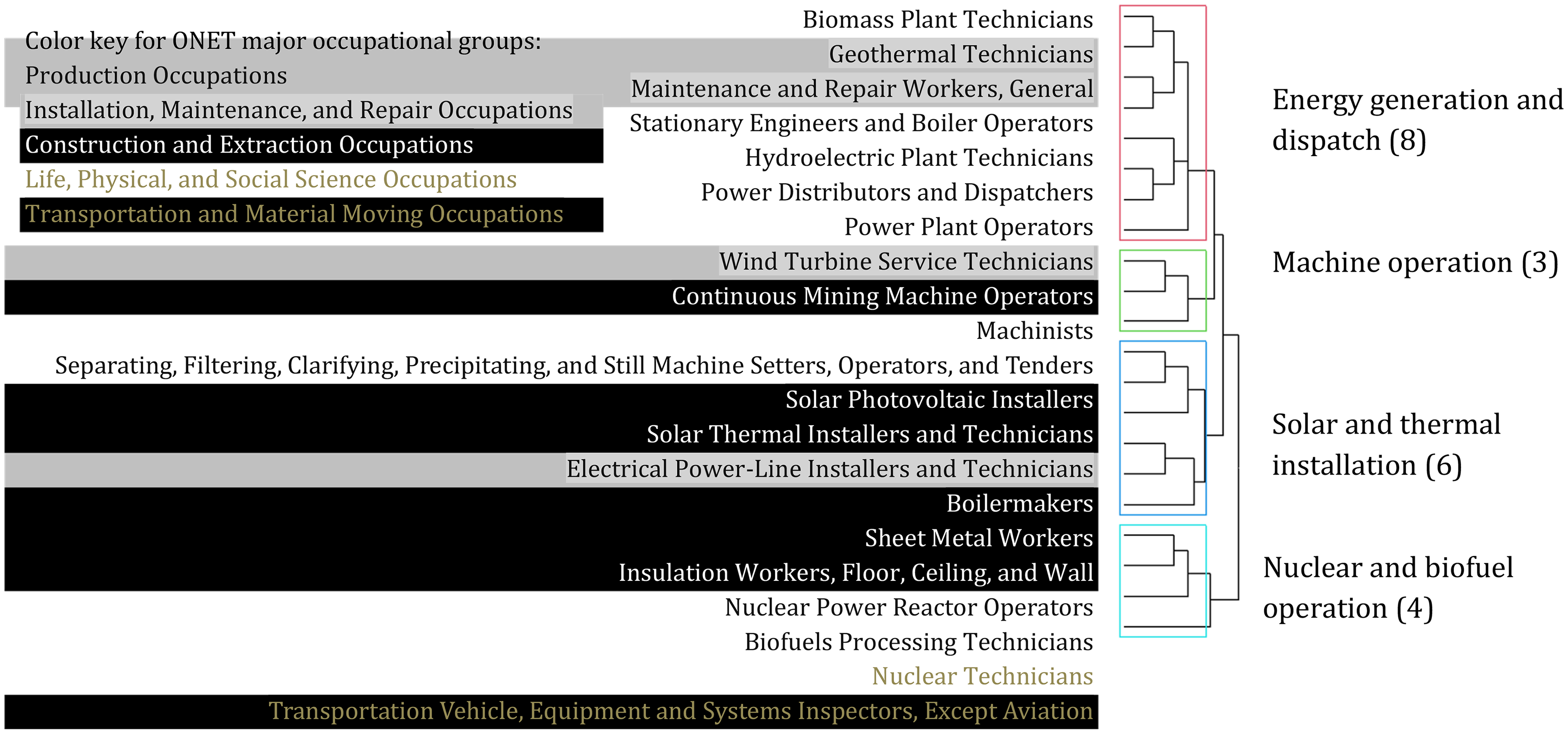
Dendrogram of Clusters of Clean Energy Occupations Produced by Agglomerative Hierarchical Clustering. Note. The tree structures show how the occupations are merged based on their text similarity scores. Four clusters were selected and named based on occupations in the clusters. Shadingsin the occupation titles represent belonging to a major group in ONET, showing both agreement and disagreement between cluster membership and major group membership. For example, five out of six construction and extraction occupations belong to the Solar and Thermal Installation Cluster, but occupations in other major groups are spread around the clusters.
Clean Energy Workforce Development by Retraining
We identify 250 occupations (listed in Supplementary Online Appendix D) that are potential candidates for retraining. Workers in these occupations can transition into a clean energy occupation with a wage premium. Of these occupations, 224 could transition directly into good paying jobs after some retraining. The remaining 26 would involve an initial switch to an intermediate clean energy occupation that is lower paying but is an occupational pathway that opens to a higher paying clean energy position. A typical occupation can potentially transition to an average of six clean energy occupations with at most one intermediate step. Based on the BLS Occupational Employment Projections for 2031, 32% of the clean energy occupations can be retrained while the remaining 68% will require a specialized degree or extensive experience.
While the identified clean energy occupations are from four major ONET-SOC groups, these other occupations are from 13 such groups (see Table 1 for their belonging in ONET major groups). This suggests that using text similarity criterion and a network-based approach can help workforce analysts identify a considerably larger catchment of occupations than relying on traditional groupings. Of the 250 occupations we identify, only 44 can transition to all clean energy occupations. This suggests that the clusters and occupations that can transition to occupations in those clusters are well-separated, so our approach can be useful to identify different clusters that are suitable for training different sets of occupations (see Figure 4). The occupations that can transition to all clusters belong to Production, Installation, Maintenance, and Repair. There are another 56 occupations where the options for transitioning are very narrow, meaning they can only transition to one of the clean energy occupational clusters.
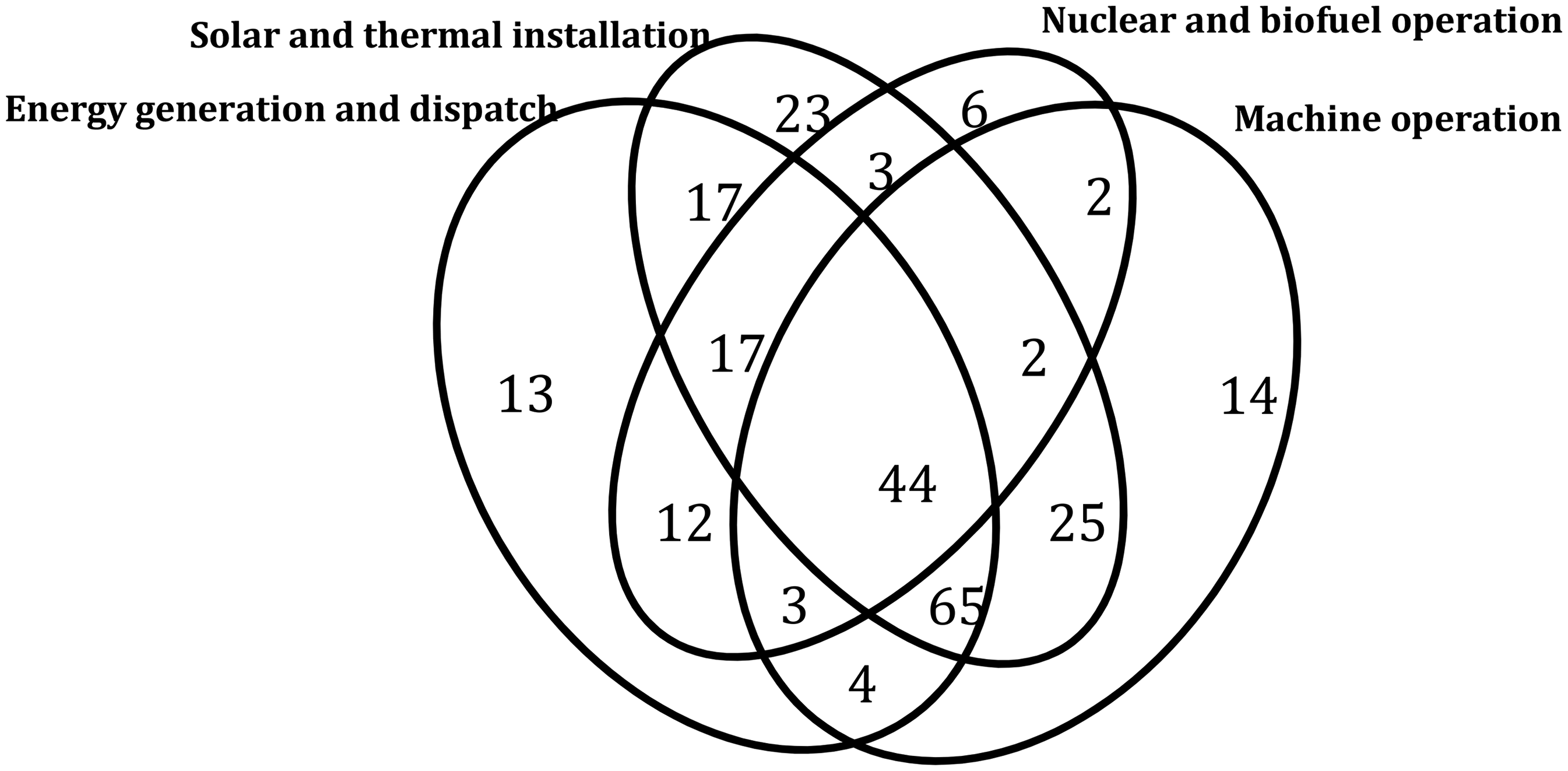
A Venn Diagram of the Number of Other Occupations That can Transition to at Least one Clean Energy Occupation in Each Cluster. Note. Only 44 occupations can transition to all four clusters. The number of cccupations that can transition to each cluster are separated reasonably well, supporting the practical validity of clustering.
Major Occupational Groups of Clean Energy Occupations Amenable to Workforce Development Through Retraining.
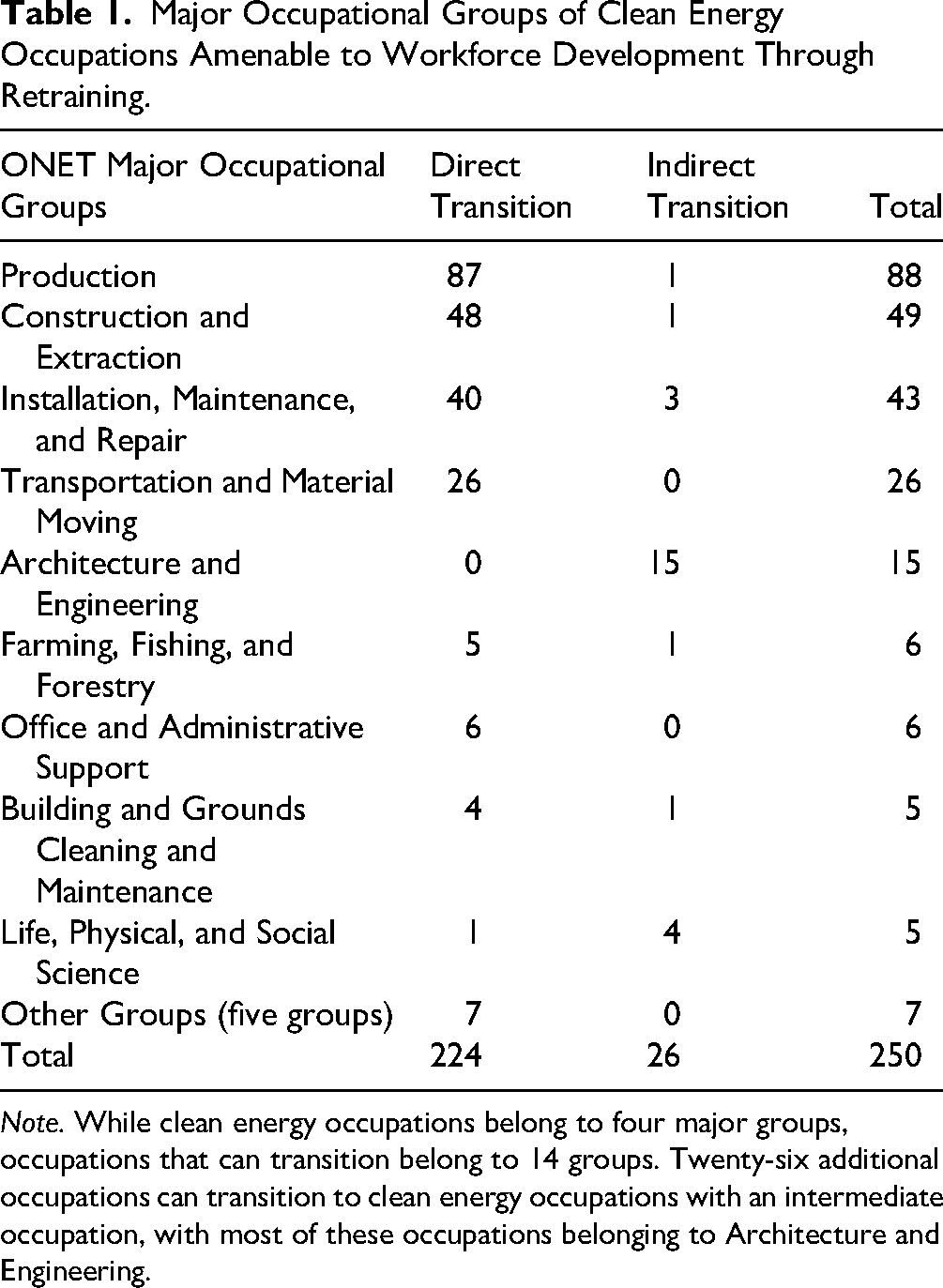
Note. While clean energy occupations belong to four major groups, occupations that can transition belong to 14 groups. Twenty-six additional occupations can transition to clean energy occupations with an intermediate occupation, with most of these occupations belonging to Architecture and Engineering.
Of the occupations that require an intermediate transition step, 15 of them belong to Architecture and Engineering. This is because these occupations have higher wages, in general, compared to others so transitioning into clean energy occupations will often require moving to a similar clean energy occupation with lower wages. For example, a Calibration Technologist is paid $12,080 more than a Carpenter and can only transition to a Power Line Installer by first becoming a Geothermal Technician (see Figure 2). This often involves a reduction in wages.
Key Attributes to be Covered in Cluster-Wise Workforce Development Programs
By selecting occupational attributes that are uniquely important to clean energy occupations, we identify those that need to be covered in workforce development programs for each cluster (Table 2). The separation of number of occupations that can transition to different clusters carried over to number of various occupational attributes to be covered in workforce development programs for each cluster (Figure 5). The common Knowledge attributes to be covered in training programs for all clusters (the intersection between four sets in the first Venn diagram) are Mechanical, English Language, Mathematics, Education and Training, Production and Processing, and Design. The common Skill attributes to be covered in training programs for all clusters are Operations Monitoring, Critical Thinking, Operation and Control, Monitoring, Judgment and Decision Making, Equipment Maintenance, and Quality Control Analysis—reinforcing the importance of both hard and soft skills in all clean energy occupations.
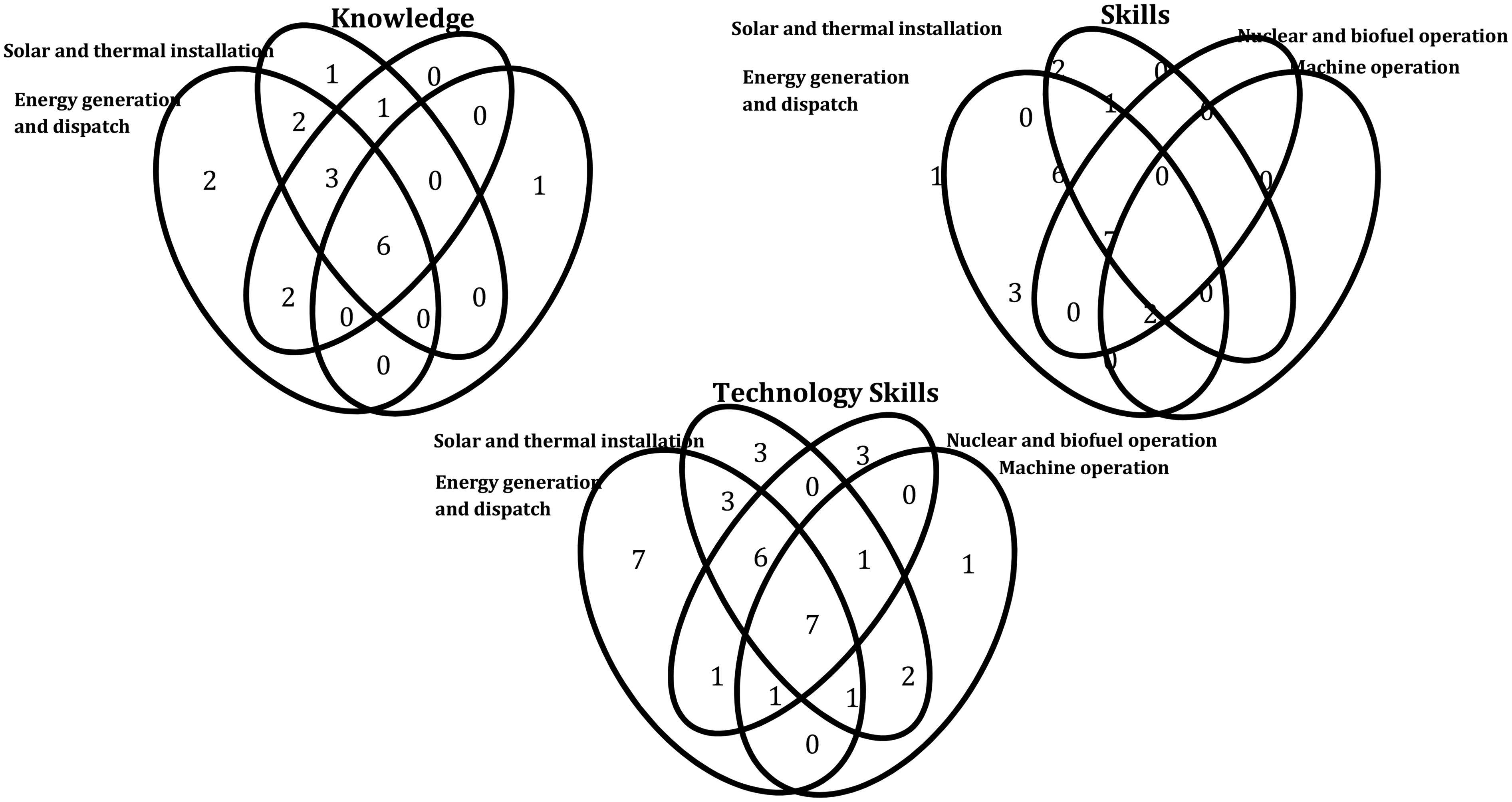
Number of Knowledge, Skill, and Technology Skills Attributes that are Important to Occupations in Different Clusters. Note. The separation observed in the number of occupations that can transition to different clusters carries over to these occupational attributes, supporting the practical validity of clustering clean energy occupations.
Top Five Knowledge, Skills, and Technology Skills Attributes to be Covered in Cluster-Wise Workforce Development Programs.
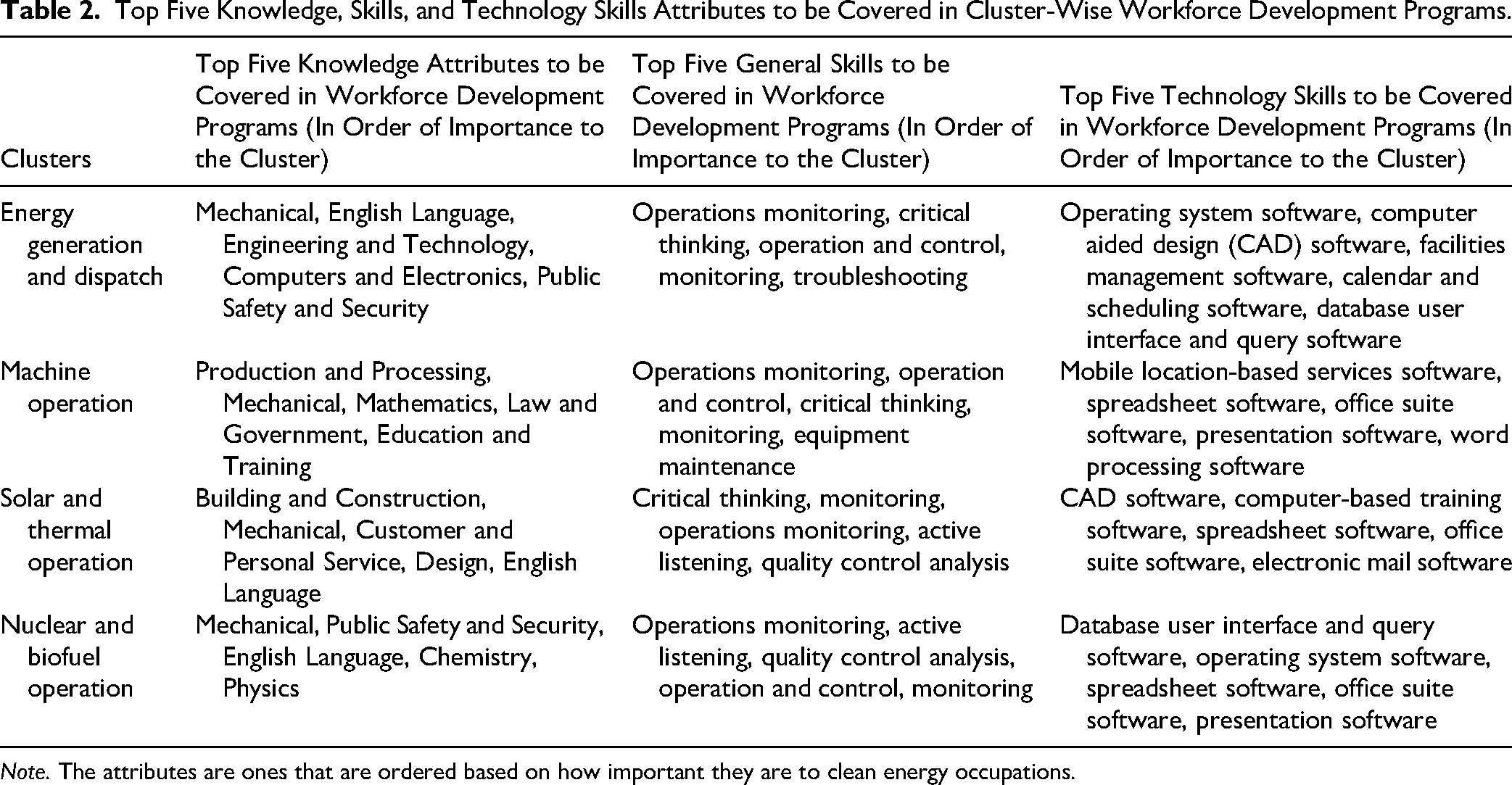
Note. The attributes are ones that are ordered based on how important they are to clean energy occupations.
Similarly, the common important technology skills are word processing software, electronic mail software, spreadsheet software, office suite software, presentation software, enterprise resource planning software, and analytical or scientific software. These technologies are common to most occupations and help make transition to clean energy occupations feasible for many other occupations. In addition to commonalities, unique occupational attributes relevant to each cluster further support the practical validity of clustering. For example, a knowledge attribute unique to Solar and Thermal Installation is Customer and Personal Service. Compared to occupations in other clusters with generation, dispatch, and operation responsibilities, Solar and Thermal Installers are highly likely to deal directly with customers. For the same cluster, unique skills include Installation and Equipment Selection, and unique technology skills include Customer Relationship Management software, inherently related to the Customer and Personal Service knowledge requirement.
Discussion
This study explores the potential of fulfilling clean energy workforce development requirements by retraining workers from other nonclean energy occupations. We found that 250 nonclean occupations could be good targets for retraining to help workers transition to clean energy occupations. In addition to fulfilling a workforce need in clean energy, we identified transition pathways that are likely to result in improved annual income.
The prospects of the clean energy occupations studied in this paper seem good. Over 85% of the occupations have higher median wages and 61% have positive growth projections (see Table 3) compared to other occupations in the data set according to the BLS projections (BLS, 2022). Most clean energy occupations can thus provide a pay premium, if not increased, employability prospects because of projected job growth. However, some occupations such as Geothermal Technicians are projected to have declines and low wages. It should be noted that these projections do not include the impact of the IRA and other climate change policies that were adopted after the publication of the projections. We expect higher employment growth for most of these clean energy occupations, as supported by analysis of jobs creation resulting from these policies (Pollin et al., 2022; Taminiau et al., 2023).
Clean Energy Occupations.
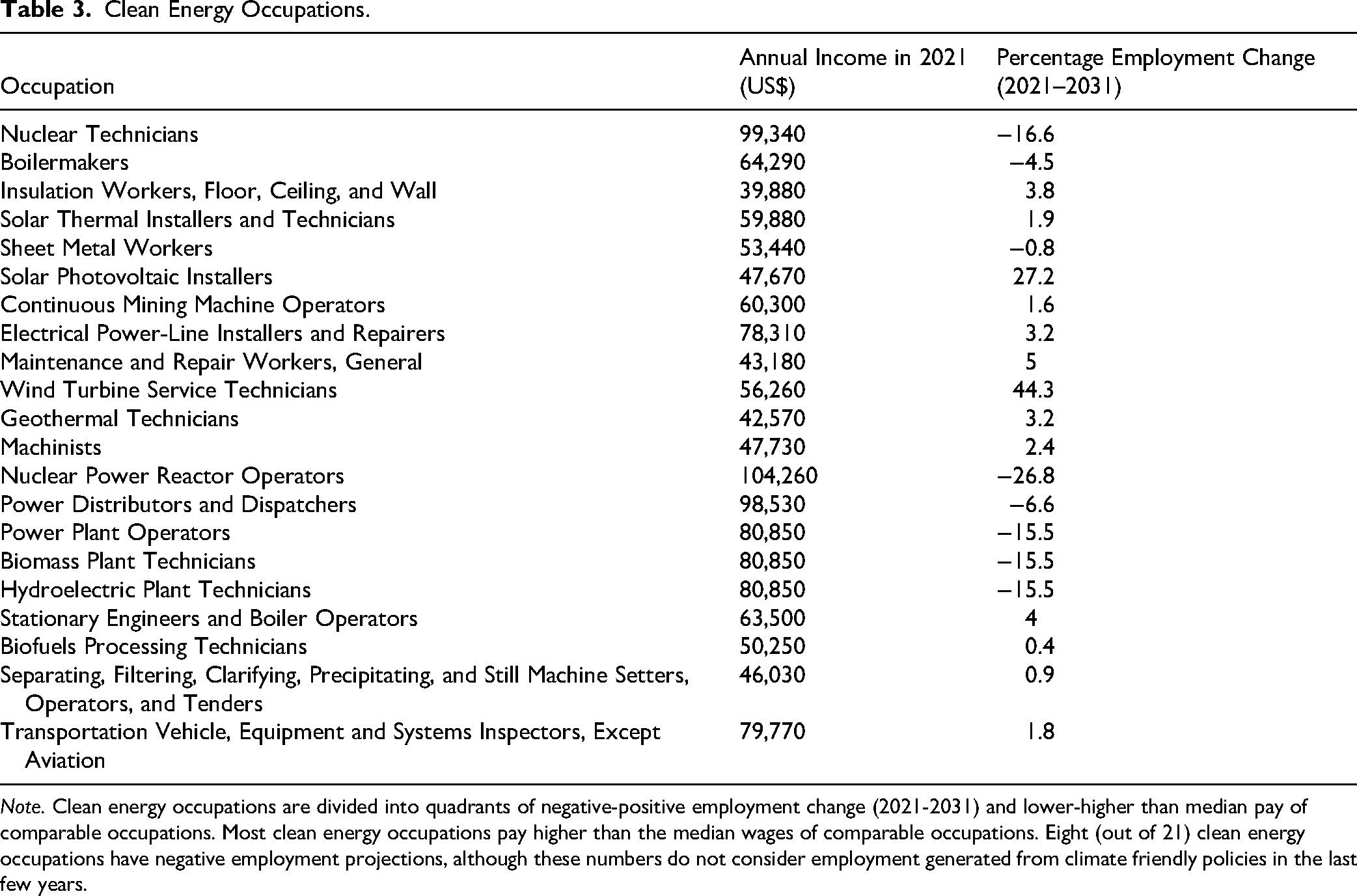
Note. Clean energy occupations are divided into quadrants of negative-positive employment change (2021-2031) and lower-higher than median pay of comparable occupations. Most clean energy occupations pay higher than the median wages of comparable occupations. Eight (out of 21) clean energy occupations have negative employment projections, although these numbers do not consider employment generated from climate friendly policies in the last few years.
The approach in our study can be used for workforce development in clusters utilizing standardized descriptions of knowledge, skills, and tasks in each occupation. As an example that illustrates the use of a cluster-based approach for workforce program design, along with additional considerations that might be needed, we use the Solar and Thermal Installation cluster. There are six clean energy occupations in the cluster, including Solar Photovoltaic Installers, Solar Thermal Installers and Technicians, and Insulation Workers, Floor, Ceiling, and Wall. We have identified occupational attributes that are important to the clean energy occupations in the cluster but not to the other occupations that can transition to these occupations. Each of the above attributes for all clusters are listed in Table 3. For the Solar and Thermal Insulation cluster, the Knowledge attributes include Building and Construction, Customer and Personal Service, Design, etc. General skills for the cluster include Critical Thinking, Monitoring, Active Listening, Quality Control Analysis, and Troubleshooting. Technology skills include Computer Aided Design, Spreadsheet, etc. Naturally, these are the attributes that should be heavily featured in workforce training program curricula. During implementation, these attributes should be considered starting points for designing the programs but not an ultimate list.
Contributions to Research
Our approach extends and complements other network-based workforce development and occupational analyses approaches used in the literature. Feser (2003) and Koo (2005) characterized regional economies based on occupational clusters created by using Knowledge attributes. Our study is similar with respect to the use of clustering within a network approach to group occupations but is different with respect to our using a composite score representing multiple occupational attributes. Additionally, our study also differs in terms of the universe of occupations chosen for clustering. We clustered a smaller universe of 21 clean energy occupations, limiting our selection to those amenable to workforce development by retraining, while Feser (2003) and Koo (2005) used the larger universe of hundreds of occupations to characterize regional economies, leading to differences in the clusters obtained. Use of clustering and a network-based approach can support various occupational analyses; however, the choice of occupational attributes, clustering technique, distance metric, and the universe of occupations depends on the task at hand informed by domain knowledge.
The Knowledge, General Skills, and Technology Skills identified as attributes to be covered in cluster-wise workforce development programs demonstrate the utility of grouping clean energy occupations and then targeting those that are suitable for retraining in each cluster. Aspects of similarity and differences in clusters are also reflected in the number of occupations that can transition to each cluster, as well as in the number of attributes that are important for occupations in the clusters. The prevalence of both hard and soft knowledge and skills attributes suggests that workforce development for even the technical clean energy occupations require coverage of soft occupational attributes such as English and Education and Training. While Education and Training might not seem intuitive for clean energy occupations, Training and Teaching Others is a common work activity listed in the detailed ONET description for clean energy occupations (e.g., Hydropower Technicians 1 , 2 ). Workers formally and informally helping their colleagues is a recognized mode of learning (Gerber, 1998). These identified attributes can serve as a starting point of training attributes for clean energy workforce development programs. The publicly available occupational descriptions with supporting standardized data sets serve as useful guides, or frameworks, for workforce development.
Implications for Practice
Current workforce development programs rely on local skill gaps, and emerging industries often target specific employers. Examples of these include Project QUEST in San Antonio, Texas, and JobPath in Tucson, Arizona, which focus their efforts on specific sectors such as Healthcare and Information Technology. Our proposed cluster-based approach that relies on training for multiple occupational transitions can help with uncertainties in employment projections and make for skill development programs that are robust. Furthermore, our approach that suggests transition through multiple steps might require a rethink of the design of the programs into continuous training opportunities for development, rather than one-off certificate programs. With the support of employers, the intermediate clean energy occupations can serve as career ladders in a clear pathway to a career with upward mobility (Fitzgerald, 2018). The presence of these multistep transitions, particularly those involving temporary wage reductions, points to a need for reimagining workforce development program structures. Traditional short-term certification programs may be insufficient for these more complex career paths. Each transition step likely requires its own training requirements and skill development period. Drawing from recent workforce development research (Fitzgerald, 2018; Liu et al., 2023), development programs could adopt a more flexible, long-term approach that supports workers through multiple training and employment phases.
There are several ways that an analysis like the one conducted in this paper can be used to strengthen, coordinate, and even streamline workforce development practice. First, state and local practitioners can use our analytical tool to design and extend training supports to help more workers move across occupational and industry lines. It can help identify and forge a pathway to better paying and more rewarding careers in clean energy for younger workers, as well as those workers currently in low-quality, low-paying jobs. With this kind of analytical tool, practitioners can help target training resources to workers who are currently underemployed, ensuring they have opportunities to participate in the clean energy transition.
Additionally, this type of analysis can bolster career pathways for workers that might need or desire more immediate long-term training. This might be the case for incumbent workers at later stages in their careers and with a strong desire to expedite career mobility to move more quickly to similar levels of financial stability and occupational rank. This is an especially notable challenge for practitioners who are focused on well-established incumbent workers within industries that are rapidly declining, being phased out, or decommissioned, including some legacy energy sources. Initiatives that extend training support to these workers are often described as “Just Transitions” because of their emphasis on financial stabilization. Skills and Knowledge mapping techniques may help these Just Transition efforts better design deep training supports to match current workers’ financial and household needs. Additionally, by recognizing this opportunity to adapt training pathways to meet the needs of different workers’ expectations and experiences, practitioners can also consider what additional nontraining supports might be needed to keep mobility in reach, including the option to offer trainees a guaranteed income or other time-limited supports (Liu et al., 2023).
Relatedly, this type of occupational analysis, when coupled with occupation-specific wage comparisons, as we have done in this paper, enables workforce intermediaries to focus their attention on those transitions that might lower, rather than improve economic stability and well-being (Fitzgerald, 2004; Giloth, 2004). For transitions that are likely to result in wage losses, intermediaries can develop additional workplace development resources for employers, including coupling training assistance to other activities that improve overall business performance so as to free up resources for raising wages and extending other employee benefits and supports (Lowe et al., 2023; Schrock, 2013).
Finally, we view this analysis as helping to support cross-industry and cross-regional coordination of training resources and programming (Lowe et al., 2011; Myers & Kellogg, 2022). Workforce development agencies at the state and local levels often face tight budget constraints that are likely to intensify in coming years. As a result, workforce agencies need to do more with less, which lends itself to the creation of multi-industry training systems that ensure resources, institutional supports, and learnings that can be shared across related industries. Actions to create this kind of multipurpose response are already in play.
In North Carolina, for example, training supports that were originally designed for biomanufacturing have been extended to support current and prospective workers in natural products and cosmetics manufacturing, as well as food and beverage processing industries (Lowe, 2021). More recently, the Minnesota Governor's Workforce Development Board has identified overlapping skills and knowledge requirements in medical devices, semiconductor design and manufacturing, and sustainable plastics, along with other advanced materials manufacturing. These shared competencies were identified through in-depth conversations and focus groups with industry leaders, workforce experts, and training providers, suggesting an opportunity to expedite and amplify this type of industry and institutional coordination through applied data analytics.
Nevertheless, pay premium may not be enough for occupational transition; we need to think about the transition more holistically and consider many other job quality factors such as satisfaction, stability, and voice (Horowitz, 2016). Most clean energy occupations have median wages that are higher than comparable occupations, and some of them have negative growth, suggesting that training in clusters can provide transitioning workers with alternatives to practice an occupation with higher growth if needed. Training in clusters can make retraining to clean energy occupations attractive by addressing potential concerns with clean energy occupations that have negative growth.
Since we use a standardized set of occupations and attributes in this work, and the goals of the workforce program designer and the exact background of the workers to retrain might differ compared to the identified list of occupations that can transition to occupations in the cluster, workforce program designers should account for bespoke factors and requirements. A factor that might affect the set of occupations to retrain is geography, as different economic regions have different clusters of occupations (Feser, 2003; Koo, 2005). Also, occupational requirements can evolve over time due to industry shifts, policy effects, and technological evolution. During workforce program design, employers, workforce intermediaries, and worker representatives can work together to first identify appropriate clusters of clean energy occupations suitable for retraining based on their regional economic characteristics of job growth projections and available workers to retrain. Sustained engagement with workers, employers, and workforce intermediaries is necessary to operationalize these techniques in practice, as exemplified by the Genesis program in Chicago, Illinois, in which increased engagement with frontline workers in the manufacturing sector drove process efficiencies while increasing job quality for the workers (Lowe, 2021; Lowe et al., 2021). In addition, considerations of other aspects of job quality such as stability and satisfaction might play an important part in the design of the retraining programs (Liu et al., 2023; Osterman et al., 2022). While most workforce development strategies are coordinated by workforce intermediary organizations, state actors can help remove frictions to coordinating multiple actors (Myers & Kellogg, 2022).
Limitations and Future Work
Custom workforce development solutions in practice will require ONET data to be augmented with more detailed descriptions and data. Furthermore, there are several limitations of ONET data resulting from the data collection and standardization process. The ONET database is created by surveying a random sample of workers in targeted occupations in randomly sampled organizations. While ONET adds to the database by adding information on green occupations, new and emerging occupations, etc., the updates are not regular. This leads to a lag in the data. ONET is a popular data set used in research and practice, but the limitations can sometimes inhibit occupational analysis. Handel (2016) highlighted some of the limitations, which include bias toward educated workforce because of the survey's mail-in format, lack of information about diversity of workers, and lack of specificity for some occupational attributes. Additionally, the Importance ratings used to identify the occupational attributes to cover in workforce development are based on a survey of employees. These ratings are useful; however, the attributes for the same occupation might differ in importance across organizations. ONET data can be a useful starting point in workforce development program design and other occupational analyses as this paper's results show. However, additional contextual information might be required to use it in different contexts. A similar analysis using a larger, more granular data set, such as job descriptions, could be more helpful in covering emerging occupations, with an increased specificity in skills and other attributes.
Further analyses such as a cost-benefit analysis over a longer-term career could be performed for a more accurate picture of whether transitioning provides longer-term benefits than career growth without transitioning. While we were not able to perform the analysis because of the limited scope of this paper and the unavailability of necessary information, current literature points to long-term benefits of transitioning. A cost-benefit analysis found that over a 40-year career, high school graduates in Youngstown, Ohio, can earn up to $81,529 more by pursuing a certificate/associate degree related to battery manufacturing occupations than occupations that only require a high school education (Jones et al., 2024).
Analytical choices made in the paper may limit the broader applicability of the approach and the results. We identified clean energy occupations from ONET using sectoral information and reported alternative titles from the list of green occupations. While this was the best approach to ensure that all selected occupations are clean energy occupations based on information available from ONET, there might be additional occupations relevant to the clean energy transition. We use text similarity as a proxy of familiarity, based on the scores generated and verified by Dahlke et al. (2022). Text similarity as a representation for occupational transition possibility is a new paradigm that should be examined for robustness and explored for usefulness in wider contexts using diverse data sets. To identify clusters of clean energy occupations amenable to retraining, we use agglomerative hierarchical clustering for its interpretability because the number of selected occupations is low so interpreting the hierarchies of agglomeration is tenable. For larger groups of occupations, other clustering techniques might be more suitable. Clustering also depends on expert judgment, cluster evaluation (using metrics such as Silhouette scores), and more analyst-driven criteria.
Finally, to identify Knowledge and Skills attributes for cluster-wise workforce programs, we use an opinionated approach of identifying criteria using the Importance scores of the attributes. This is only one of the ways to identify these attributes; based on the requirements of workforce development programs, different approaches can be chosen. This study presents an approach to identifying occupations to retrain and design workforce programs for job clusters, which can be adopted for different sets of occupations but will require heuristic expert judgment. This study focuses on technological clean energy occupations, but the energy transition requires other occupations that are relevant to most sectors/industries, such as accountants or general managers. Retraining such occupations by focusing on the knowledge gap related to clean energy can help address workforce development more widely.
A significant consideration in our analysis is the deliberate exclusion of occupations requiring more than 5 years of experience. This methodological choice effectively highlights transitions accessible through short-term training programs but raises important questions about career advancement paths for experienced professionals. While these transitions often offer higher compensation, they frequently require accepting positions with less seniority or responsibility than a worker's previous role. This structural challenge helps explain the stronger outcomes observed for early-career workers in clean energy transition programs (Mangelsdof, 2024). For workforce development initiatives to better serve experienced workers, additional research is needed on transition pathways that recognize and build upon accumulated professional expertise and not a complete career reset.
Addressing equity issues is not central to the scope of this paper, but there is potential to build on the analysis for addressing equity and justice issues in workforce development. Clean energy workforce development also creates opportunities to address equity and justice issues in the energy transition such as inadequate representation of racial and gender minorities (Carley & Konisky, 2020). A well-worn strategy for advancing justice is to provide minorities in fossil fuel-based industries, who are primarily employed in low-wage jobs, with workforce training to transition to a clean energy sector with better career prospects.
Retraining workers at GHG-emitting industries can improve the representation of minorities in clean energy jobs and directly address equity and justice issues (Harrahill & Douglas, 2019; Lin et al., 2020). However, empirical studies show that this strategy to advance energy justice does face serious challenges (Curtis et al., 2024), not in small part because the geographies of labor markets for clean energy and other sectors are different (Greenspon & Raimi, 2024).
Conclusion
The current pace of the clean energy transition requires large workforce development in a short time. We assessed the utility of using unsupervised clustering to identify and group occupations that can transition to clean energy occupations amenable to workforce development through short-term retraining. We identified clean energy occupations from the ONET database and filtered those to identify ones for which workforce development is amenable to retraining. We used agglomerative hierarchical clustering to group those occupations into four clusters. For cluster-wise workforce development, we identified other occupations that can transition to at least one of the clean energy occupations in each cluster, and identified occupational attributes—Knowledge, General Skills, and Technology skills—that can be covered in the cluster-wise workforce development programs.
This study demonstrates the utility of rearranging occupations based on their similarities to identify wider pathways of occupational transition and group similar occupations for cluster-wise workforce development. The ONET database can be used as a reconnaissance framework to design clean energy workforce development programs, within limitations. Our findings revealed that even though the identified clean energy occupations only represent four major occupational groups, the occupations that can transition to them belong to more than 10 major occupational groups. Occupational similarity can be used to cast a wider net to identify occupations to retrain than conventional occupational groupings. An exploration of occupations that can transition to various clusters also showed a variety in terms of other occupations that can transition to each cluster as well as the variety of trainable occupational attributes in workforce development programs for each cluster. This further validates the use of unsupervised clustering to group occupations for developing resource effective clean energy workforce development programs while improving employment prospects for trainees. The approaches used in the paper can also be adapted to workforce development for different sets of occupations to identify other occupations for retraining and designing cluster-wise workforce training programs with broader consideration of equity and justice issues while advancing the energy transition.
Supplemental Material
sj-docx-1-edq-10.1177_08912424251352743 - Supplemental material for Occupational Transitions into Clean Energy: A Workforce Development Approach Using Occupational Similarity and Unsupervised Clustering
Supplemental material, sj-docx-1-edq-10.1177_08912424251352743 for Occupational Transitions into Clean Energy: A Workforce Development Approach Using Occupational Similarity and Unsupervised Clustering by Kshitiz Khanal, Nikhil Kaza and Nichola Lowe in Economic Development Quarterly
Footnotes

Funding
The authors received no financial support for the research, authorship, and/or publication of this article.
Declaration of Conflicting Interests
The authors declared no potential conflicts of interest with respect to the research, authorship, and/or publication of this article.
Supplemental Material
Supplemental material for this article is available online.
Notes
Author Biographies
References
Supplementary Material
Please find the following supplemental material available below.
For Open Access articles published under a Creative Commons License, all supplemental material carries the same license as the article it is associated with.
For non-Open Access articles published, all supplemental material carries a non-exclusive license, and permission requests for re-use of supplemental material or any part of supplemental material shall be sent directly to the copyright owner as specified in the copyright notice associated with the article.
