




Abstract
The inability of labor markets to function effectively to satisfy the needs of employers and workers suggests that there is a growing need for policy interventions to promote workplace cultures of learning and innovation. Past research suggests that publicly funded incumbent worker training programs are a promising antidote against market failures. With only a handful of studies published in the last two decades, however, this is one of the least-researched types of business support programs. This paper examines the impact of a state program in California that uses a pay-for-performance approach to reimburse employers that train their employees: the California Employment Training Panel (ETP). Based on a mixed-methods study of ETP, the authors found that, overall, ETP had positive and significant impacts on company sales and firm size. The study suggests the need to abandon ideological debates and engage in more evidence-based policy discussions about incumbent worker training programs.
Employers in the United States have expressed concerns about a shortage of qualified workers for a long time, especially for digital skills and employability skills like problem- solving and critical thinking (Deloitte & The Manufacturing Institute, 2018; Stewart et al., 2017). Initial evidence suggests that the COVID-19 pandemic increased friction and churn in the labor market, especially for workers who were laid off in the spring of 2020 (Manuel & Plesca, 2021). Firms tend to underinvest in worker training because of high employee turnover and the fear that trained employees would be poached by other companies (Bishop, 1995; Lynch, 1992). At the same time, labor markets have become increasingly precarious for U.S. workers who have contended with wage stagnation, declining employment in middle-skill occupations, expansion of low-wage jobs, the fissuring of work arrangements (such as the expansion of gig and temporary work), and declining access to employer-provided benefits for low-wage workers (Acemoglu & Autor, 2011; Howell & Kalleberg, 2019; Weil, 2014). The inability of labor markets to function effectively to match and meet the needs of both employers and workers suggests market failures are occurring and that there is a growing need for policy intervention. However, the United States currently spends proportionally less than almost any other Organization for Economic Co-operation and Development (OECD) country on active labor market programs, including worker training and retraining initiatives (OECD, 2023). Policy makers worldwide are also concerned about how new technologies such as automation and artificial intelligence will continue to transform and disrupt the nature of work, which they anticipate will require countries to reorient their education and training systems to facilitate more lifelong learning and agile production processes (World Economic Forum, 2017).
This paper examines the impact of a state program that attempts to address skill shortages by incentivizing companies to train their employees: the California Employment Training Panel (ETP). Created through state legislation in 1982, ETP reimburses employers that invest in approved training for their employees. The program draws on funds from an employer tax collected alongside state unemployment insurance taxes and through other sources of state funding to support special training initiatives. In 2017, ETP commissioned an evaluation that consisted of a mixed-methods study of the program, including qualitative interviews, an employer survey, and an outcomes and impact analysis. This paper is based on that research and additional research that was conducted in 2019 and 2020. Our evidence suggests that, despite some challenges, ETP is a promising antidote to market failures in skill upgrading. ETP funding appears to have a large and positive impact on company sales and employment, both overall and for some subgroups. Employers experience the program as a valuable tool for building internal learning infrastructures, retaining employees, and boosting morale.
The first section includes a literature review of business support programs, including employee training programs. The next section provides background information about ETP and describes the characteristics of ETP-funded employers. Subsequently, we present the main findings from key informant interviews and an employer survey. Finally, the paper summarizes findings from a quasi-experimental impact analysis of ETP training investments. In the final section, we draw out the main implications of the study and discuss policy recommendations.
What Do We Know About the Effect of Public Support Programs on Companies?
In the last half of the 20th century, the U.S. government developed a myriad of policy mechanisms aimed at supporting its business sector. Virtually every federal agency and most states have developed programs to support businesses, while some programs—such as the Small Business Innovation Research (SBIR) and Small Business Technology Transfer (STTR) programs—cut across multiple federal agencies. These policy mechanisms can take various forms such as direct funding through grants, loans or loan guarantees, and consulting services (Gu et al., 2008).
For some of these programs, research has generated evidence that they produce desirable results. SBIR and STTR are two of these programs (Keller & Block, 2013). Studies by Lerner (1996) and Link and Scott (2012) showed that SBIR had positive impacts on company-level employment. Research also has shown that SBIR signals to other funders—especially the venture capital industry—that companies are viable. Toole and Czarnitzki (2007) estimated that receiving a Phase 2 SBIR award significantly increased the probability that companies would receive additional funding from venture capital firms. More recently, Howell (2017) estimated that SBIR companies received double the venture capital compared to non-SBIR firms. Feldman and Kelley (2006) similarly found that, although SBIR recipients were less likely to seek funding compared to non-SBIR companies, they were much more successful in securing it when they did. Finally, Silverman et al. (2015) found some evidence that commercialization success was associated with participating in SBIR's more advanced phases.
Another program that has received considerable attention is the Manufacturing Extension Partnership (MEP), which provides consulting support and managerial training to small businesses so that they can have up-to-date information on production and management techniques. A panel data analysis conducted by Jarmin (1998) showed that companies that received assistance from MEP in 1987 experienced higher growth in labor productivity compared to non-MEP firms about 6 years later. Another study by Jarmin (1999) showed that plants that participated in MEP were between 2.5% and 3.5% more likely to survive from 1992 to 1996 than non-MEP companies. In addition, workers at plants participating in MEP were less likely to be employed at a plant that did not survive. Research cited in Jarmin and Jensen (1997) showed the positive effects of MEP on a variety of other outcomes, including sales, reduced scrap rates, and value added. More recently, Brandt and Whitford (2017) showed that the effect of MEP increases with additional exposure to the program, suggesting that the solidifying of relationships caused by multiple interactions helps companies to undertake more complex projects with the potential for larger returns.
Before its untimely demise in 2007, the Advanced Technology Program (ATP) sponsored by the U.S. Department of Commerce, aimed to foster technological innovation, and received considerable attention (Negoita, 2015). An early study estimated that ATP-funded companies experienced an increase of up to 25% in patients after participation (Darby et al., 2004). A more recent study (Smith et al., 2018) found that the receipt of an ATP award had a positive impact on the firm's survival chances, number of employees, and research and development (R&D) budget.
There is also a sizable literature that studied the effect of state-level policy instruments such as tax breaks and R&D subsidies, which similarly tended to find positive impacts on firm-level outcomes (Bartik, 2018). For example, Bartik and Hollenbeck (2012) found that a R&D tax credit in the state of Washington contributed to job creation and increased earnings for participating companies.
Generally, however, the number of research studies and evaluations conducted in relation to business support programs has been much more limited than for other policy domains, such as labor, education, and human services. First, the conversation of whether these programs work is still conducted at a largely ideological level. Opponents of such programs typically labeled the programs as corporate welfare (Jaffe, 2002), which tended to make such programs avoid attracting attention to themselves, leading to what has been labeled a “hidden developmental state” (Block, 2008). Since evaluations are a surefire way to attract attention, it is not surprising they are not very common. In addition, compared to the relatively powerless recipients of workforce and human services programs (who tend to be low-income individuals), companies that receive business support services have more power to resist being evaluated, especially since, in some cases (such as experimental evaluations), companies selected to participate in control groups could be prevented from accessing programs they might need (Dalziel, 2016).
Nowhere is this dearth of research more apparent than in the case of publicly subsidized employer-provided training programs (otherwise known as incumbent worker training programs). With only a handful of studies in the last two decades, this is one of the least researched types of business support programs. This is not entirely surprising since the number of U.S. programs, as well as the level of funding they provide for training, is small compared to those of most other industrialized nations. Generally, investments in employee training are expected to generate several types of company-level improvements. Improved efficiency and quality/accuracy of the labor force are expected to increase labor productivity, and increased employee skills and knowledge are expected to increase competitiveness (Hollenbeck, 2008; Moore et al., 2003). Both increased productivity and competitiveness might then be expected to result in higher revenue. In addition, employee training might be expected to create new jobs or to save jobs from being eliminated (Hollenbeck, 2008), which can be expected to result in increased company size. This job creation also may increase economic security and mobility for workers and regions more broadly.
The scant available literature suggests that firms benefit from public investments in their employee training. Hollenbeck (2008) produced a detailed survey of state-funded programs, and Moore et al. (2003) and Hollenbeck and Klerk (2007) estimated the impact of state-level programs from California and Massachusetts on company-level outcomes. In general, past research suggests that employee training programs may have a positive impact on a range of company-level outcomes, such as the number of employees, labor productivity, scrap rates (Holzer et al., 1993), and employee-level outcomes such as earnings. However, most studies were conducted more than two decades ago, in labor markets that were very different from what companies experience today. Our study aims to contribute to this body of evidence by analyzing recent data from a state-sponsored employee training program.
Study Background and Methods
The founding purposes of ETP were to help retain businesses and jobs in the state, increase the competitiveness of companies in California, and enhance workforce skills. ETP is governed by an eight-member tripartite panel that has representation from labor, business management, and state government. ETP prioritizes approving applications for training funds that align with statewide priorities and special initiatives, such as training in priority industries, training for veterans, youth with disabilities, and small businesses in areas with high unemployment.
In 2017, ETP commissioned a mixed-methods evaluation of the program, meeting a requirement for periodic third-party program evaluation in the ETP legislation. The study examined how employers and workers were utilizing ETP investments, how ETP could promote continuous improvement, and how it could be updated to reflect current training needs, training delivery methods, and economic trends. The study included:
qualitative interviews: 23 semistructured interviews with key informants, such as agency staff, intermediaries, employers, and labor organizations, to understand how ETP is administered and to gather qualitative information relevant to the research questions. an employer survey: a survey of 673 employers participating in ETP programs about their training practices, skill needs, and partnerships.
1
quantitative analysis: an outcomes study of ETP administrative data and a quasi-experimental impact study at the firm level to understand the effects of the program on company sales and employment. single-employer contracts: an individual employer applies for funds independently or with the help of a third-party consultant. multiple-employer contracts: a third party—typically an industry association, community college, labor organization, workforce board, or similar intermediary—receives a master contract it can administer to multiple employers in smaller amounts.
ETP legislation allows considerable discretion to its eight-member panel and executive director to implement the program and establish rules about the types of training that are eligible for reimbursement, the rates of reimbursement, and the way employers are required to document training. Under current rules, employers, worker representatives, and third-party consultants or intermediaries can apply for ETP funding through two main contracting mechanisms (see Figure 1):
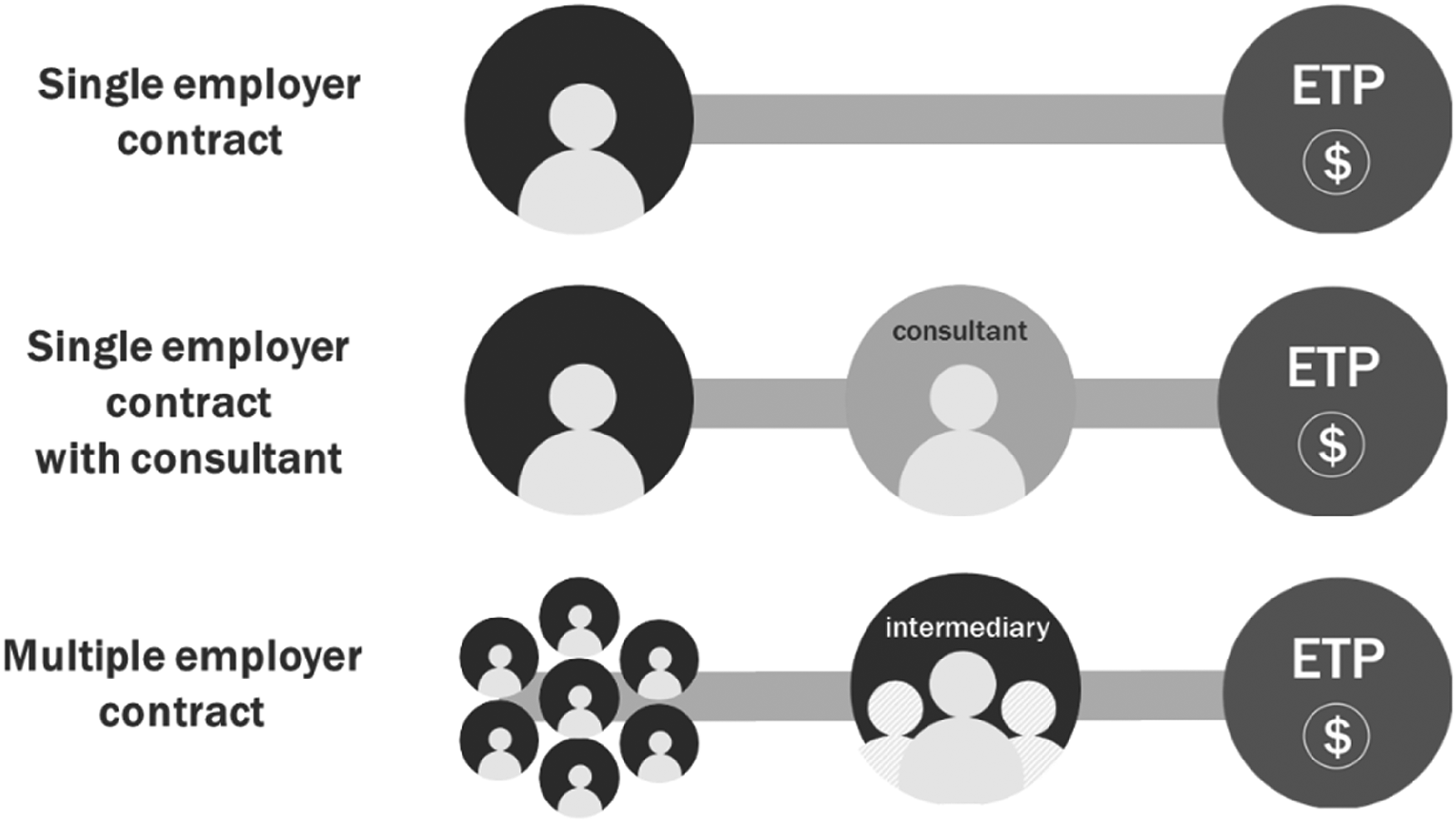
Three options for structuring ETP contracts.
ETP provides employers the flexibility to choose the training providers they want and, to some extent, to choose the type of training, although the eligibility rules and reimbursement rates vary. ETP allows employers to be reimbursed for classroom-based training, off-site training (e.g., at a community college or third-party provider), online training, and on-the-job training. 2
The administrative process for single-employer applicants includes the initial application, contract drafting and approval, monitoring and reporting, and reimbursement. Users initially apply for ETP online, and then an ETP field staff member will assist them with the full application, which was paper based at the time of our data collection. The application requires that the user document the training plan, a justification, and the expected wage increment, among other things. Because the process is complex and it can be difficult to interpret how the program's rules apply to a specific company's application, many single-employer applicants hire third-party consultants who are familiar with the program for assistance.
Applications for multiple-employer contracts are managed through the same basic process, but the applicant is a third party (herein referred to as an “intermediary”). The intermediaries either subcontract to employers in smaller amounts (providing easier access for small and midsized employers) or provide training directly through an apprenticeship program.
Once the contract is approved, users submit a list of trainees and then submit weekly reports to document training hours completed, which can be done in original hard copy or electronically with an approved learning management system. Typically, each contract covers a period of 1.5 to 2 years, and many companies have returned for additional contracts once the first contract was completed. ETP was upgrading its information systems to migrate more of the process online and make it more user-friendly because they received widespread feedback that the application process was confusing and time consuming.
Funding for ETP programs is disbursed based on a pay-for-performance model, meaning that employers do not receive funding until they demonstrate successful performance. Performance is assessed through the completion of training hours, completion of all planned training, and retention in employment at a well-paying wage rate 3 after 90 days from the completion of training.
Characteristics of ETP-Funded Employers
Between 2012 and 2017, ETP approved an average of 388 new contracts for training each year, with an average value of $208,165 per contract (California ETP annual reports, 2012–2017). ETP approved new contracts totaling an average of $80.7 million per year. The number of approved trainees varied widely from year-to-year, but it increased from roughly 62,000 in 2012 through 2013 to over 100,000 in 2016 through 2017—a trend associated with a significant increase in the total funding for approved contracts. According to ETP administrative data, the multiple-employer contract structure enabled more companies to access ETP funds, but the share of funds approved for those contracts was much lower. Ninety percent of companies receiving ETP funds used multiple-employer contracts to do so, from 2014 to 2016. However, ETP administered two-thirds of approved funding (by value) to companies through single-employer contracts.
The types of companies that participated in ETP through multiple-employer contracts were different from those that participated through single-employer contracts. Companies accessing ETP through single-employer contracts tended to be larger (about half had 250 employees or more). Almost half were in the manufacturing sector, followed by technical services (10.2%) and wholesale distribution (9.1%). Employers participating in ETP through multiple-employer contracts, on the other hand, tended to be smaller (fewer than a quarter had 250 employees or more), and roughly half were in construction. This is because many multiple-employer contracts were operated by labor unions or Joint Apprenticeship and Training Committees (JATCs) in the building trades to support apprenticeships. 4
Between 2014 and 2016, a total of 2,173 companies were funded by ETP. In these years, 22% of ETP-participating companies were large, 35% were midsized and 44% were small companies (administrative data, 2014–2016). 5 This distribution of approved funding by company size was skewed compared to how companies were distributed in California generally (Figure 2), with ETP funds disproportionately allocated to medium and large companies.
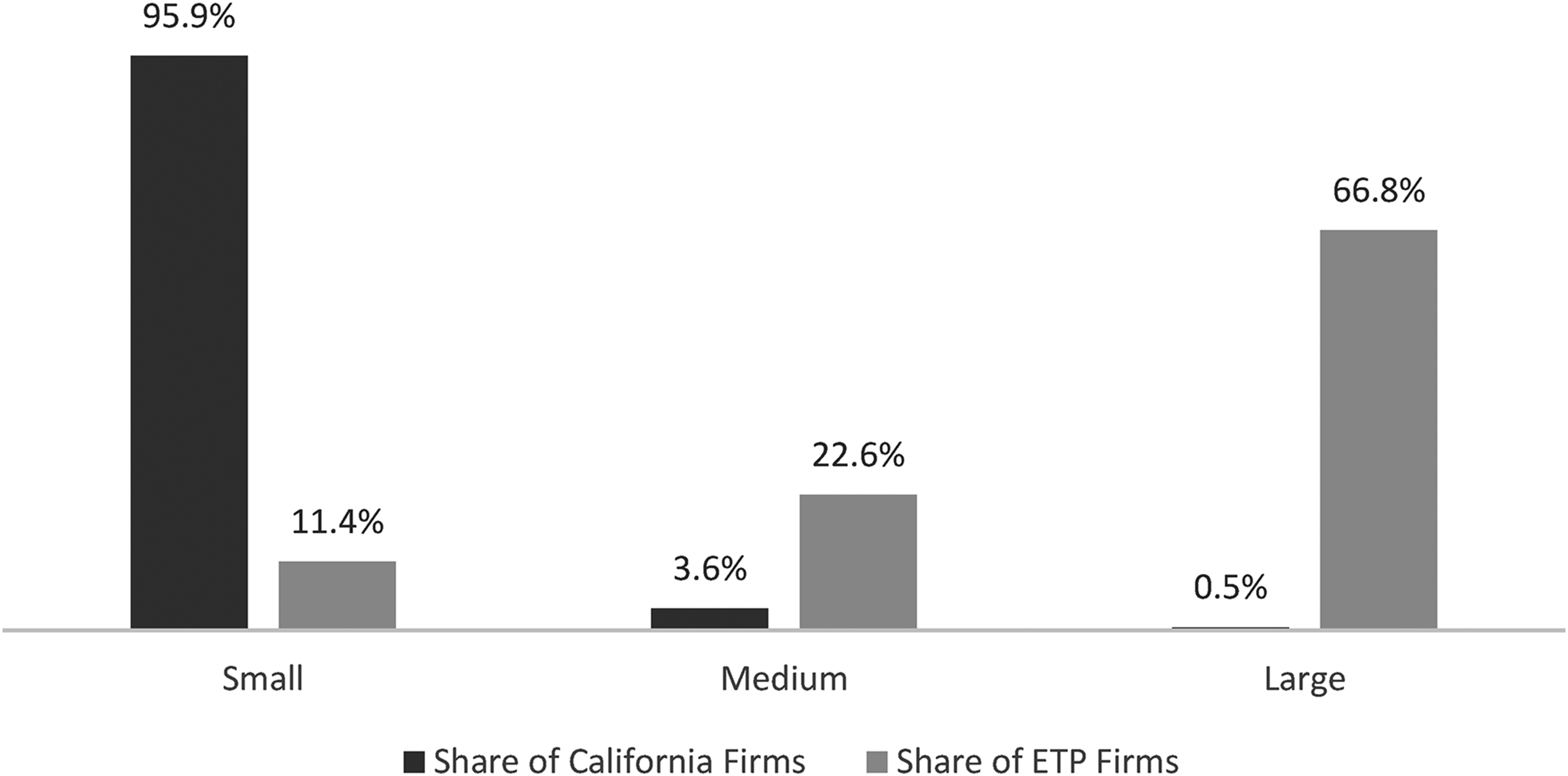
Distribution of ETP-funded companies by company size versus the size distribution of companies in California. Sources: California ETP administrative data for completed contracts (2014–2016) and California Employment Development Department (2020). Note: The authors used the following thresholds for business size: small (1–50), medium (51–250), and large (251+).
Although more of ETP's contracts were concentrated in the construction industry proportionally, the highest share of the funding went to the manufacturing sector (California ETP annual reports, 2012–2017). 6 On average, from 2012 to 2017, ETP approved 40% of new core funding for contracts in the manufacturing industry, distantly followed by construction (15%), high-tech and technical services (12%), and health care (10%). (See note 6.)
Women were underrepresented among ETP trainees; on average, nearly two-thirds of the incumbent workers trained through ETP-funded programs were men (California ETP annual reports, 2012–2017). This was likely because the industries and sectors in which many ETP-funded companies had operated in recent years, such as manufacturing and construction, tended to have a disproportionately male workforce. From 2012 to 2013, ETP funded a higher share of training in health care, which has a female-dominated workforce. In that year, the share of women receiving ETP-funded training increased to 44%.
Findings From Key Informant Interviews and the Employer Survey
Employers and labor organizations (“users”) reported many benefits to ETP participation. They said ETP funding helped them retain and motivate their workforce; establish or update internal human resources training systems; stay competitive by keeping their employees updated on the latest technologies; maintain more rigorous quality control processes; and train workers on new equipment or technology during major upgrades or expansions. Survey respondents provided many open-ended comments on how ETP involvement helped the company. Numerous respondents noted that ETP's support put “training in the forefront for our organization.” This focus on training included getting buy-in from senior leadership about training needs, providing trainings that had been put off in prior years, and simply “help[ing] make training consistent.” Employers also described benefits to employees, including increasing the self-confidence and self-esteem of employees who received training, improving morale, and developing leadership skills of staff members.
In the survey, large and midsize ETP clients reported offering more training in all content areas than small companies. For example, 55% of large companies and 48% of midsize companies reported offering basic computer skills training. In contrast, only about a third of small companies provided such training. 7 Similarly, 72% of large companies and 65% of midsize companies said that they provided soft skills training, compared with slightly over half of small companies. Since it is not realistic to assume that small companies need less training (and, in fact, there are many reasons to believe that they may need more), these findings suggest that small companies may underinvest in training, potentially due to resource constraints. This finding is consistent with previous research showing that use of training varies systematically by employer size (Frazis et al., 1995), and therefore suggests that small companies may have a greater need for support with incumbent worker training compared to midsize and large companies.
In interviews, small and midsize employers tended to report a greater impact of ETP funding. They said that ETP helped them formalize internal training systems and facilitate expansion. These employers also reported more observable outcomes from the use of ETP funds, such as adding more employees and increasing revenue. Large firms reported typically using ETP to supplement existing training, retain workers, and adapt to new technologies.
In the interviews and survey, informants reported that ETP's administrative processes and information systems were overly cumbersome. Eligibility, reporting requirements, and reimbursement rates were confusing to users and could be a barrier to access. Interview informants noted that administrative processes had become more efficient and flexible in recent years.
Overall, the qualitative and survey components of the study suggest that ETP provided a significant level of support to employers for the training of their employees—especially in the manufacturing and building trades sectors of California's economy, and particularly for single employer contracts. The companies that were funded by ETP tended to be larger and have a more male-dominated workforce compared to all workers and companies in California—most likely due to the cost and risk associated with participating, given the program structure and processes (administrative cost and funding risk due to the reimbursement model) and to occupational segregation in the sectors that participated most heavily. Users of the program reported a wide range of benefits from participating, such as building internal learning infrastructure and retaining and motivating existing workers. The next section summarizes the results from a quasi-experimental impact analysis on sales and company size.
Quantitative Impact Study
As described above, employers, staff, and intermediaries who administered ETP funds generally perceived that ETP was valuable. The impact analysis tested whether these perceived benefits could be measured quantitatively, if they held true more broadly across a larger number of firms that received ETP funds, and it estimated the size and consistency of the impact for different types of firms. To do this, we conducted a quasi-experimental impact analysis of ETP training investments based on a matching design. The results of this analysis are described fully in Negoita and Goger (2020) and are only summarized here.
We compared the outcomes of a sample of 1,000 companies that were funded by ETP in the 2017 through 2018 program year (the treatment group) with the outcomes of a comparison group of 3,000 similar companies that did not receive ETP funding using data provided by Dun and Bradstreet. The results suggested that ETP-funded companies had, on average, 22% more employees at the funding site 2 years after receiving ETP training funds. In addition, our analysis indicated that ETP-funded companies had a statistically significant 30% more employees overall, although there was more variation in this outcome, making the estimate less precise. ETP participation also appeared to have a statistically significant overall positive effect on company sales (47%), suggesting that ETP funding may have improved labor productivity and competitiveness, leading to an increase in revenue. These findings are also consistent with previous impact findings from an earlier study (Moore et al., 2003) 8 and, more generally, insights from the literature that incumbent-worker training programs have the potential to assist firms by helping create new jobs or saving jobs from being eliminated.
To provide additional insights into how ETP may have helped companies and workers, we analyzed impacts for certain types of companies. Importantly, we compared the impacts of ETP by firm size to investigate whether the ETP affected small, medium, and large companies differently. The results showed that ETP seemed to have a different effect on companies depending on their size. 9 We estimated negative impacts for the smallest companies (1–18 employees) in terms of employment and sales, although the finding on the impact on sales was not statistically significant. By contrast, companies in the next size bracket (19–50 employees) appeared to experience large and positive impacts on both outcomes, with each hovering around 40%. The positive impacts persisted for the next larger size category (51–100 employees), although they decreased in size compared to the previous bracket. Finally, the impacts for the largest category were small and not statistically significant. These results suggest that ETP participation has its strongest and most significant effect on companies that have between 19 and 100 employees—an encouraging result given that almost half of all ETP companies with complete employment data were in that range. This finding is consistent with insights obtained from qualitative interviews, which suggested that ETP participation tends to have a particularly strong organizational effect on small and midsize companies because it frequently causes them to boost their internal training systems as they enter a growth spurt.
The negative effects of ETP participation on employment and sales of companies with 18 employees or less were more concerning. These companies made up almost one-quarter of the ETP companies with complete employment data, and the trend appeared to be consistent across the industry sectors that were analyzed. It is possible that very small employers struggled to have the organizational capacity to train employees or to participate in ETP effectively, at least in the short run (i.e., within 2 years). For example, the administrative structure for participating in ETP (such as the pay-for-performance structure that requires employers to invest in training upfront and then wait for reimbursement) may have put very small firms in an unstable position compared to larger firms that had a greater ability to absorb the risk or cost of participating.
The relatively small impact of ETP on the size or sales of large companies was not very surprising, based on our qualitative evidence that ETP was just one among many funding sources available for training at large firms. In interviews, representatives from large firms said it was difficult to isolate the effects of ETP funding from other investments they were making in training. The employer survey also confirmed that large employers were much more likely to provide training to their employees than small employers (González et al., 2020).
Conclusion
Overall, this research supports the hypothesis that public investments in employee training can help address market failures that result from employers underinvesting in such training. ETP funding appeared to have a large and positive impact on company sales and employment, both overall and for some subgroups. Employers experienced the program as a valuable tool for building internal learning infrastructure, retaining employees, and boosting morale.
Findings from our employer survey suggested that small companies underinvested in employee training. It was promising, therefore, to see that ETP investments had the strongest impact on companies that were small or midsize businesses with between 19 and 100 employees. These findings suggest, more broadly, that this program model appears to work especially well for companies with those characteristics. Other states may want to consider using or adapting a similar program model with companies that fit this general profile and prioritize them for public investments due to their potential for job creation, job preservation, competitiveness, and productivity. Perhaps it is time to recognize that programs targeting small and midsize companies help maintain competitive markets and healthy business ecosystems, while large firms tend to have disproportionate market power, which can stifle innovation.
This study also found that ETP funding had negative impacts on businesses with fewer than 19 employees and that these businesses were least likely to invest in training overall. These findings suggest a need for state policy makers to better understand the types of support that microenterprises need most and pilot ways to make programs such as ETP more accessible from a cost and risk perspective.
The estimated impacts of ETP-funded training on companies with more than 100 employees were not statistically significant, and the confidence interval suggests that, even if they were positive, they would be small. Coupled with the fact that large companies already invest more in training compared to other types of companies, this raises the question of whether supporting very large firms is a judicious way to spend public money. A case could be made that allocating a greater share of the funding to small and medium companies not only places public funds into entities that are more likely to see greater impacts but also seems to contribute to a greater diversity (and viability) of local and regional economies, which is sorely needed to withstand shocks, such the one recently brought on by the COVID-19 pandemic.
More broadly, this study suggests that estimating the impacts of public programs on business ecosystems for learning, hiring, technological deployment, and human resources management requires better data and more research attention. In other words, it may finally be time to abandon ideological debates and engage in more evidence-based policy discussions about incumbent worker training programs (and business support programs, generally). Future research could provide valuable insights into how states can more effectively deploy public support to improve equity, growth, and innovation in the United States at the regional and national levels. First, states could pilot and evaluate alternative approaches for meeting the training needs of young and very small businesses, such as approaches of collectively pooling training costs through shared training centers, apprenticeship program supports, or business incubator programs. Second, more research can be conducted at the training participant level to investigate how the dosage, subject matter, and delivery models of training shape internal career progressions, perceptions of upward mobility, employee retention, and earnings changes. Third, given that ETP programs allow employers to choose the type of training they need, tracking and analyzing their training choices and satisfaction levels (both employer and trainee satisfaction) could generate very useful information for public education and training providers (from K-12 to bachelor's degree programs) to fill some significant curricula gaps and better align their courses and program offerings with the demand. Fourth, this study builds a strong case for further research on state-level incumbent worker training programs across the country and in different labor market settings to see if the findings are generalizable to different regional and cyclical labor market contexts such as the pandemic-related recession. Fifth, similar research could be conducted with larger samples, more detailed data sets, additional outcome variables (e.g., employee turnover rates, patent generation), and across longer timeframes to obtain more precision and a better sense of whether sustained investments over a long period of time have greater effects than one-off short-term investments, or if the impacts diminish over time.
Overall, we found promising evidence that state-level programs that incentivize employers to train their workforce show promise for addressing employer-driven concerns about skills gaps, stimulating job creation and upward mobility, increasing competitiveness, and creating a stronger culture of lifelong learning within the workplace. As such, these programs appear to be an important policy tool for states to consider and pilot to prepare business ecosystems and talent for the future of work. Crucially, programs such as the one studied in this paper could be a key component of a revamped U.S. skill-building strategy. Currently, the country spends less than 0.1% of its gross domestic product (GDP) on public workforce training—a market-oriented approach that appears to be generating persistent labor market failures. Furthermore, skill-building ecosystems that encourage companies to play a more engaged role in training the workforce of the future may help direct limited resources to where employers need them the most so that the system is more demand-driven. In the last 10 years or so, the tide has been turning in favor of sector-driven, demand-aligned approaches rather than “train and pray” supply-side training options. This turn is important because it is connected to efforts to boost U.S. manufacturing prowess in the face of important global competition challenges, most importantly originating from China. The passage of the Chips and Science Act in July 2022, which centered on boosting the production of computer chips in the United States (Block et al., 2023), also opened significant opportunities for investments in STEM education and training from K-12 to community college, undergraduate, and graduate education. This reinforces the sense that public investments can help generate a culture of ongoing learning in the modern workplace, which in turn helps employers tap into talented workers who are currently constrained by a lack of accessible opportunities for learning and getting into a quality job and career path.
Footnotes
Acknowledgements
Any opinions, findings, conclusions, or recommendations expressed in this publication are those of the authors and do not necessarily reflect the views of the California Employment Training Panel or the Brookings Institution.
Declaration of Conflicting Interests
The author(s) declared no potential conflicts of interest with respect to the research, authorship, and/or publication of this article.
Funding
The author(s) disclosed receipt of the following financial support for the research, authorship, and/or publication of this article: This work was supported by the California Employment Training Panel (grant number M8107, M9111921).
