




Abstract
Ohio's manufacturing industry sector partnerships (ISP) are economic development and workforce development efforts that rely on community development inputs. The authors posit that graduates of regional, sector-led, industry-specific workforce training programs constitute a common pool resource, as described by Elinor Ostrom, because while hiring graduates is rival, it is not excludable. This creates a workforce version of the tragedy of the commons because these programs often have experiential learning components in workplaces and require funding support, mentoring, and the long-term commitment of company leaders to a partnership. The training programs will flounder if participating employers do not earn a return on their resource expenditures. The output of the partnership program is trained workers, while its primary outcome is the production of goods and services. The economic mobility of the recipients of ISP training is a by-product, or secondary outcome, of the partnership's activities
Keywords
At the Ohio Manufacturers Associations’ November 2023 Workforce Summit, Geoff Lipnevicius, senior manager of workforce development at Lincoln Electric Company, described the regional labor market his company hires from as a pond, saying: “We (manufacturing employers) own that pond, and we are responsible for restocking it with fish.” At the end of the day, Brian Benyo, the catalyst behind the Mahoning Valley Manufacturing Coalition (MVMC) and co-founder of the Brilex Companies Group, built on Lipnevicius’ metaphor when he told the summit's 400 participants: 1 “Columbus and Washington could not solve our workforce problems for us. As manufacturers, we own that problem. Geoff is right. We own the pond. And we are responsible for stocking the pond.”
Developing a manufacturing workforce in the United States is a difficult slog due to the sector's long history of job losses, coupled with current training challenges presented by integrating analog and digital operations technologies (OT). 2 The number of manufacturing jobs in the United States peaked at 19.5 million in July 1979. After that date, a graph of employment in the industry resembles the profile of a ski slope—persistent drops briefly interrupted by a few plateaus. Manufacturing employment bottomed out 40 years after the decline started, leaving 11.4 million positions in April 2020. This decline in employment led to the erosion of vocational education capacity and businesses’ training ability.
Both Benyo and Lipnevicius described the need for manufacturing employers to collectively attract, train, and restock the regional supply of manufacturing labor. They understood that rebuilding a labor supply is the collective responsibility of self-interested employers. Most importantly, they acknowledge that employer-involved experiential training and education are critical to attracting skilled workers. The state of Ohio decided to help rebuild its industrial workforce by supporting regional industry sector partnerships (ISPs) following the lead of the manufacturing industry's trade association, the Ohio Manufacturers’ Association (OMA). 3 The OMA defines ISPs as “workforce development [strategies in which] … employers within a regional labor market work together to influence alignment around common solutions with education and training, economic and workforce development, and community organizations” (Ohio Manufacturers’ Association, n.d. -a). The definition recognizes that workforce development occurs at the intersection of community development on its supply side and economic development on its demand side. The output of the partnership program is trained workers; its primary outcome is the production of goods and services, while economic mobility is expected to be a by-product, or secondary outcome, of the activities of the partnerships.
The Ohio Manufacturing Institute at The Ohio State University was interested in how the governance of regional sector-led workforce partnerships would evolve and if our conceptualization of the graduates of these efforts as common pool resources (CPRs) was valid. The OMA granted us access to follow the development of the effort early in its conceptualization and later supported the work of a graduate research assistant in operationalizing Ostrom's (1990) design or managerial principles and measuring their implementation.
We address three questions in this article. First, do the graduates of sector-led workforce training efforts constitute a CPR as initially conceptualized by Vincent Ostrom and Elinor Ostrom (1977, pp. 7–49)? Second: Did the sector-led organizations organically develop Elinor Ostrom's (1990) design principles for managing the resource? Third: Does adherence to the design principles improve the organizations’ performance and staying power?
The article is organized into five sections. The first section provides the theory and logic for our argument that the graduates of these training efforts constitute a CPR. We adapted Elinor Ostrom's (1990) design principles for managing natural or environmental CPRs to workforce programs that serve regional labor markets, or laborsheds, in the second section. We also note three omissions to Ostrom's (1990) principles in this section relevant to regional workforce training efforts, incorporating them into our research and recommendations. We discuss how the principles were operationalized to fit regional workforce CPRs in the third section.
We integrate our findings into the literature on workforce sector partnerships in the fourth section. The antecedents to the ISPs were community-based workforce and social development programs. These earlier efforts emphasized worker and community development outcomes over business outcomes, while employers and industries participated as critical stakeholders in the program outputs. Notably, manufacturers did not dominate the leadership or decision making—this remained with the community-based training organizations. Ohio's ISPs originated with employers, and while the output remained trained graduates, the dominant outcome became the participating companies’ ability to produce goods and services profitably. In terms of the five areas of development (economic, workforce, community, housing, and commercial and industrial real estate), Ohio's manufacturing industry sector partnerships are an economic development effort that relies on community development and workforce development inputs (Hill, 2023).
A second difference between Ohio's ISPs and sector training partnerships fostered by community development advocates is geography. The original sector partnerships focused on low-income and high-poverty neighborhoods and communities, not regional labor markets. Based on Ostrom's (1990) framing of CPRs, we argue that employer-led ISPs should incorporate the geographies of labor supply and demand. If there are operational reasons to focus on smaller low-income neighborhoods as potential sources of labor supply, then that effort should be nested within a larger regional ISP. We conclude in the fifth section.
Do Regional, Sector-led Workforce Training Program Graduates Constitute a Common Pool Resource?
We posit that the graduates of sector-led regional training programs are neither a pure private good nor a merit good; instead, they are a CPR, as conceptualized by Vincent Ostrom and Elinor Ostrom (1977) and fully stated in Elinor Ostrom (1990). This hypothesis is based on three stylized facts. First, hiring graduates is rival because each graduate can only have one employer for each hour worked. Second, hiring a graduate is not excludable because hiring cannot be restricted to ISP member companies without a formal contract between the student and a participating employer. Any employer can offer a graduate a job. Third, the experiential nature of the training and managing an ISP requires the participation and resources of businesses.
Companies make resource commitments with an expectation of a return, which is their opportunity to hire graduates. Businesses also contribute the time of senior leaders to direct and support the training programs and participate in the governance of the ISP. If participants do not see a return on their investments, private sector participation will deteriorate and eventually collapse. The lack of excludability or some form of property right, therefore, is a market failure that generates incentives for nonparticipating businesses to become free riders.
The motivation for corporate involvement in a sector-led training program was made evident in 2015 by two CEOs who were members of the executive committee of the board of directors of Northeast Ohio's Manufacturing Extension Partnership affiliate MAGNET, as MAGNET was developing its Early College Early Career Program. 4 During a board meeting, both CEOs stated that their company's participation was predicated on their expectation that their companies would hire graduates, and those graduates were expected to meet current and long-term occupational needs and feed internal job ladders. The commitment of each company reflected a visible personal commitment of its CEO.
Risk aversion on both the demand and supply sides of labor markets is hypothesized to repress investments in human capital. On the demand side, employers will be reluctant to devote their employees’ time to training without some form of repayment contract or work guarantee so that employers can earn a return on their investment. The exception is company-specific training that is not relevant to other employers. On the supply side of the labor market, Becker (1993) recognized that higher lifetime earnings are not guaranteed for every education and training program graduate, meaning that future returns are uncertain. From this assertion, he deduced that risk aversion would lead individuals to underinvest in their human capital. This uncertainty also leads to risk aversion, triggering a reluctance to take on debt and engage in time-consuming education. Therefore, using public interventions to counter risk aversion by employers and employees is economically justifiable.
We contend that graduates from sector-led training efforts, where employers contribute their time and resources to generalized occupation-specific training, constitute a CPR similar to those conceptualized as natural resource CPRs by Vincent Ostrom and Elinor Ostrom (1977) and Elinor Ostrom (1990). A graduate's work hours remain rival and excludable, and they have independent agency when selecting a job. However, access to hiring graduates cannot be made excludable without contracts that bind the student to the pool of participating employers over a restricted period. 5
Free-riding employers will attempt to hire graduates without incurring the expenses of money or time incurred by participating in an ISP. The presence of free-riding employers will drive down employer participation and harm the sustainability of an ISP over the long term. While state or federal governments can pay the out-of-pocket cost of running an ISP, businesses will bear the opportunity cost of executive time, mentoring, and establishing in-plant experiential learning opportunities. Therefore, the presence of free riders sets up a common resource replenishment problem (or a commons dilemma) for the sector's members.
The design of Ohio's ISPs broadly matches Ostrom's (1990) description of institutions for effectively managing CPRs. The pool of graduates from ISP-directed programs functions as a CPR because the graduates’ labor is rival, but hiring the graduates is not excludable. This conceptualization provides insights that can help construct effective governance practices to aid the sustainability of ISPs. We explore these implications by applying Ostrom's (1990) eight design principles for CPR management to the operation of Ohio's manufacturing ISPs.
Ostrom's Design Principles
Elinor Ostrom (1990) derived eight design principles for managing sustainable CPRs after examining cases of natural resources governance (Ostrom, 1990, pp. 192–216). We adapted and applied her eight principles to employer-led workforce training in an advanced market economy using McGinnis (2011) as a starting point. McGinnis provides a simplified overview of Ostrom's Institutional Analysis and Development (IAD) Framework (see Table 1).
Elinor Ostrom's Design Principles Applied to Workforce Training Programs.
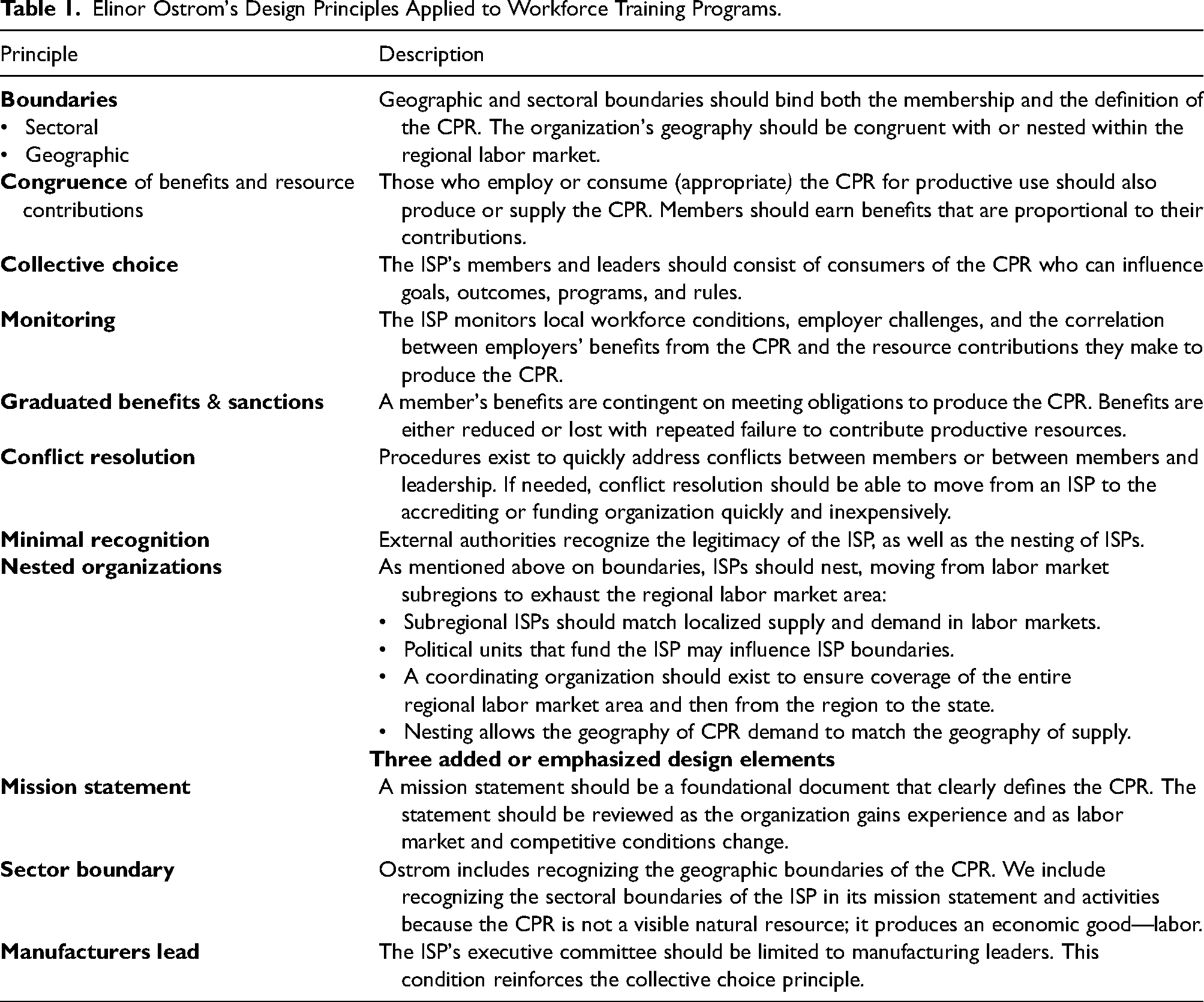
Ostrom (1990) observed that CPRs are resource systems where those who demand, or maintain and replenish, a resource are identifiable, and consumption of the resource is rival but not excludable. Ostrom labeled those who use the CPR appropriators and those who sustain the CPR providers. We use the terms employers, consumers, and demand for appropriators. We use the words producers, suppliers, and supply alongside Ostrom's label of providers. The modifiers we use are consistent with those used to distinguish between the supply and demand sides of markets. Ostrom emphasized that successful management occurs when the “appropriators [users] share generalized norms of reciprocity and trust that can be used as [the] initial stock of social capital” (Ostrom, 1990, p. 211). In other words, sustainable resource production depends on aligning social norms, expectations, and social pressure with an appropriate governance structure.
Regarding resource users (in our case, labor demand), the social capital of CPRs consists of norms about behavior, including honoring obligations, negotiating in good faith, and general reliability. Users and suppliers must share these norms while reinforcing them with long-term self-interest and effective governance. Sharing and reinforcing these norms is easier if the group of users is small and stable, implying that the need for formal governance grows as the number of users increases.
The tragedy of the commons occurs when the consumption or use of the resource is rival, and access is not excludable or preferential. The lack of excludability or preferential hiring can result in the collapse of the CPR due to opportunistic, free-riding users (Ostrom, 1990, pp. 30–31). Ostrom observed that the solution to the tragedy of the commons occurs when those consuming the resource—the demand side of the market – (1) hold a widely shared belief that harm will come to their interest group (in this case, a manufacturing industry) from failing to develop or sustain the resource; (2) value having continued access to the resource; and (3) believe that the CPR's failure will cause harm to themselves and peer group members (Ostrom, 1990, p. 211).
Three Omissions and Clarifications: Mission Statements, Sectoral Identification, and Manufacturers Leading
Ostrom's (1990) principles do not mention three items that can aid the governance of manufacturing ISPs. Ostrom does not write that the organization charged with sustaining the CPR should (1) state its reason for being—its mission, (2) require a sectoral identification that is relevant to the CPR, and (3) constrain its leadership (but not participation) to members of the sector or industry. We suspect that Ostrom did not mention the first two items because they are self-evident when managing natural resource CRPs. Not implementing the third can cause conflicts of interest when vendors are involved in governing the ISP, especially those who deliver training, secure placements, or provide social services.
There are two hypothesized reasons why the effectiveness of an ISP begins with local manufacturers leading the organizations. First, the leadership must understand the sector's near- and long-term occupational and skill requirements. Second, the ISP's leaders must provide resources critical to experience-based education and training (such as mentors, trainers, and part-time work opportunities—including employment, cooperative education rotations, and internships), and encourage their peers to follow their example. These activities require that the ISP leaders have the social authority that comes from being recognized as excellent manufacturers who lead with their actions.
We need to be clear about why the participation of workforce training organizations, such as community colleges, vocational schools, and other training vendors, in ISPs is welcome but not as the organization's governing leaders. ISP leadership must avoid conflicts of interest when contracting with vendors and workforce trainers. Avoiding conflicts of interest, however, runs counter to the primary mission of a vendor, which is to sell services. To put it simply, ISPs will need to be able to fire bad vendors, terminate irrelevant training, and initiate new programs as new technologies emerge and labor market conditions change.
Two Boundaries: Sector and Labor Market Geography
Sectoral (industry) boundaries are fundamental to the organization, mission, and performance of ISPs. The second boundary is the geographic definition of the CPR. Ostrom (2010, p. 149) stated that clear boundary rules enable “participants to know who is in and who is out of a defined set of relationships and thus with whom to cooperate.” Ostrom implied that natural resource CPRs should be governed in ways that match the geography of the user community while nesting logically within the overarching environmental catchment area. Natural resource CPRs respond to their geographic boundaries, and workforce CPRs should follow suit.
In the case of workforce development, the geographic boundary is the regional labor market – the area within which the workforce, or potential workforce, lives and works and where employers are located. An ISP's service area should incorporate the geography of labor supply and demand. An ISP cannot adequately serve labor supply and demand if its boundaries are smaller than the regional labor market. Also, conflicts will arise when funding is based purely on political geography because the CPR is rooted in economic geography; these two geographies are not co-terminus.
Nested Organizations
As is true with natural resource CPRs, if the economic geography of the regional labor market is too large for a single ISP to service, then economically and politically coherent ISPs should nest within an umbrella organization that spans the regional labor market. This expectation is the workforce version of Ostrom's eighth design principle: The geography of each ISP should nest so that the entire CPR is served (1990).
However, ISPs have complex fiscal and operating relationships that reflect the political and service geographies of their funding sources (philanthropy and local and state governments), which are often smaller than the regional geographies of labor supply and demand. Therefore, managing a workforce CPR presents a complicated, interconnected set of challenges because of the mismatch between political geography based on fixed municipal, county, and state boundaries and regional economic geography based on the overlap between where people live and work. ISPs must respond to the needs of local manufacturers within the context of their regional labor markets and the guardrails erected by their statewide funding and support systems.
Political funding rarely recognizes a mismatch between these two geographies. The first dimension of the mismatch is the multicounty (and, at times, multistate) geography of labor markets. The second is the political geography imposed by funders. Nesting becomes a way to align economic and political geography. ISPs should nest within a regional labor market, and the regions should nest as best they can within the state's boundaries.
Congruence Between Benefits and Investment
The congruence principle requires employers’ rewards from the CPR be commensurate with the effort and resources invested in producing or sustaining the CPR. In other words, companies that contribute more resources to developing, supporting, and supplying the CPR should have proportionally better access to employing the outptut--new workers. The ISP's organizational structure and activities become coherent when the congruence principle is joined with regional labor market and industry sector boundaries.
Collective Choice
Ostrom wrote that successfully governed CPRs are those where “most of the individuals affected by a resource regime can participate in making and modifying their rules” (Ostrom, 2010, p. 150). Those who contribute to the success of an ISP and employ the CPR created by the ISP should be able to participate in the organization's priority setting and decision making. However, executive governing powers should rest with employers who operate within guardrails established by the statewide ISP system because the dominant outcome is the competitive viability of the employer in the regional labor market.
Monitoring
ISPs should routinely monitor employers’ labor market activities and challenges, as well as the organization's performance. The ISP's monitoring function should be accountable to those who draw from the CPR and provide feedback to all sector partners, including service providers and students. Monitoring will likely start as informal and anecdotal and then transform into more formal and quantitative systems as these organizations mature. ISPs can formalize their accountability efforts by using a system of indicators that relate to the performance of vendors, employers’ assessments of the trained labor they hired, the satisfaction of graduated trainees, and responsiveness to more general labor market conditions. Ostrom also recognized that monitoring deters opportunistic behaviors and ensures the effectiveness of sanctions (2010, p. 151).
Graduated Benefits and Sanctions
There are two ways to enact a system of graduated rewards and sanctions. One is to increase benefits to match resource commitments through tiered membership. The second is a system of graduated sanctions that reduces members’ privileges if they renege on their obligations. Tapering benefits might be formal – such as not allowing delinquents to participate in events or the loss of membership – as well as informal, such as the ISP only engaging and featuring its reliable members.
Ostrom (2000, p. 138) stated that monitoring and sanctioning deters free riding: “In all known self-organized resource governance regimes that have survived for multiple generations, participants invest resources in monitoring and sanctioning the actions of each other so as to reduce the probability of free riding. … Sanctions will depend on the seriousness and context of the offense.” 6
Conflict Resolution
Access to low-cost and quick conflict resolution is a helpful management tool for complex collaboratives like ISPs and becomes an organizational necessity when ISPs must sanction their members. (Hopefully, the need to discipline members is rare). However, differing organizational perspectives and voluntary and sometimes ambiguous obligations can result in at least minor disagreements as the organization grows. A nested statewide geographic structure of ISPs can lend itself to quick and transparent informal arbitration and dispute resolution by the statewide organization.
Consistent with minimal recognition, external authorities should recognize the legitimate rules, enforcement mechanisms, and programmatic decisions devised by employers who govern the ISP. However, an ISP's programmatic decisions will be subject to broad public policy guidelines from ISP coordinating bodies and funders.
Minimal Recognition
External authorities must, at minimum, recognize an ISP's legitimacy as the CPR's steward and acknowledge the ISP's priorities within a systemwide set of operational guardrails. Ostrom (2010, p. 151) summarized her argument: “[W]hen users of a resource design their own rules, that are enforced by local users or accountable to them, using graduated sanctions that define who has rights to withdraw from the resource, and that effectively assign costs proportionate to benefits,” will solve collective action and monitoring problems “in a reinforcing manner.”
Hypotheses, Methods, Data, and Results
The three stylized facts about ISPs that we test as institutions designed for managing regional workforce training are:
The CPR is the flow of graduates who augment existing human capital stocks, Regional manufacturers are the source of demand for the CPR, and Regional manufacturers contribute leadership time and other corporate resources (money, equipment, trainee supervision, and mentorship) to help produce the CPR.
Our general hypothesis is that the ISPs’ governance rules will reflect many of Ostrom's design principles for the sustainable management of CPRs as they mature. We also hypothesize that those with higher Ostrom Composite Index scores will be more effective in meeting regional skill demand and be more able to survive by addressing more than the current shortage of semi-skilled machine operators.
When we undertook the fieldwork, the OMA recognized 19 manufacturing-sector partnerships with service areas within Ohio. 7 However, OMA did not endorse all of them. 8 We conducted semi-structured interviews online or by phone with leaders of 16 of these ISPs regarding their history and governance practices. We coded the responses to 21 statements based on how the answers conformed to Ostrom's design principles (1990). 9 Then, we performed a content analysis on their answers, comparing the governance practices across the 16 interviewed ISPs. We coded the responses to each question as zero (0) for disagreement, half (0.5) for partial agreement, and one (1) for complete agreement. The responses to the relevant statements were averaged to calculate a score for each of Ostrom's principles, which we report in Table 2. The last column in the table is the average of each ISP's subindex scores; we refer to this average as the Ostrom Composite Index (OCI) for each ISP. The index is the average score for the eight principles (sectoral and geographic boundaries are considered separately). We list the questions that measure components of each principle in the OCI in supplementary online Appendix 3 and the scores for all the responding ISPs in supplementary online Appendix 4. (The appendices are available in the online version of this article.) The values in the final three rows of Table 2 show the average and median index scores and the standard deviations for all interviewed ISPs.
Ostrom Composite Index for Ohio's Original Sixteen (16) ISPs.
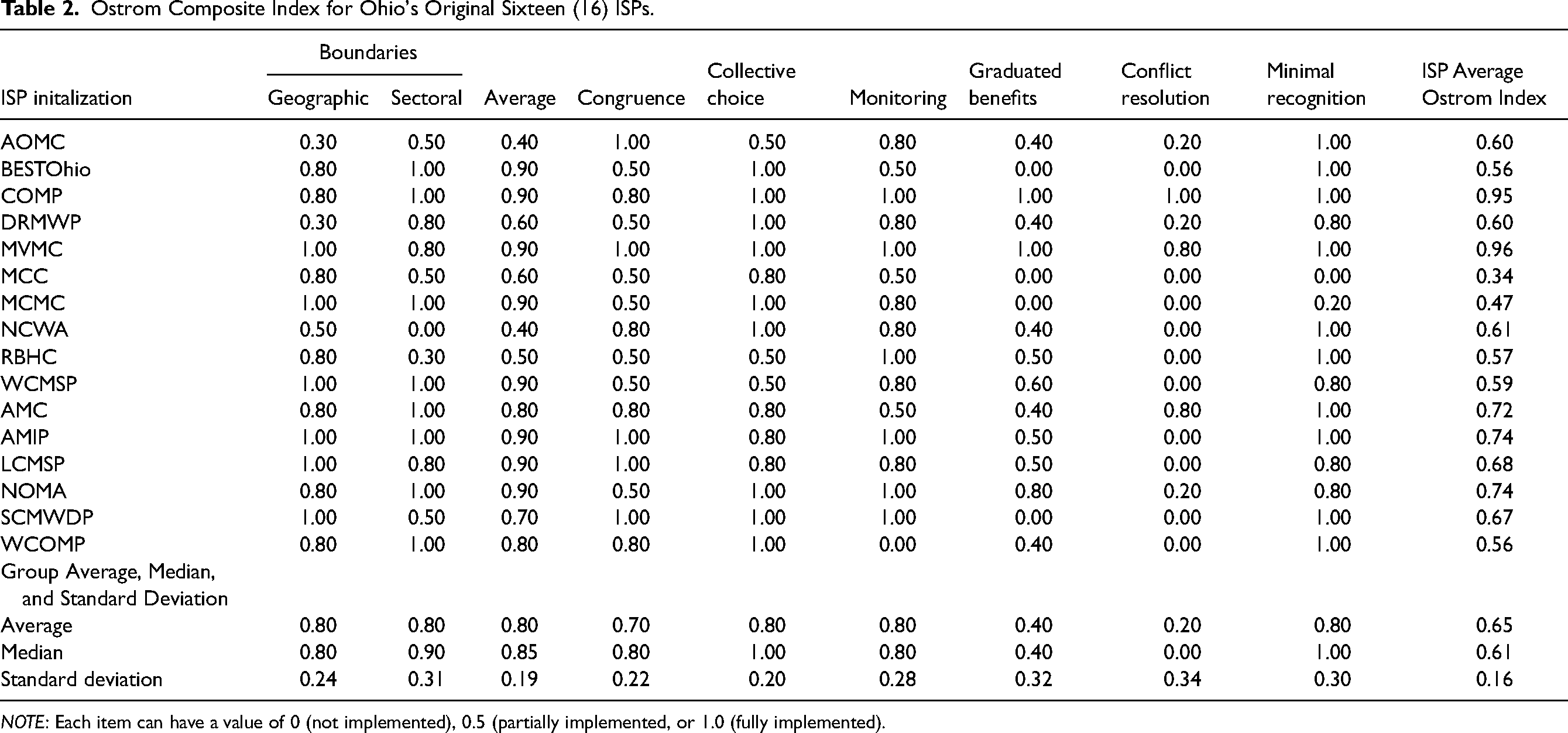
NOTE: Each item can have a value of 0 (not implemented), 0.5 (partially implemented, or 1.0 (fully implemented).
These results demonstrate that Ohio's manufacturing ISPs developed analogs to most of Ostrom's (1990) design principles for CPR governance; however, two of Ostrom's design principles were absent in most ISPs—graduated benefits and conflict resolution mechanisms. Five of the eight principles have an average index score greater than or equal to 0.7, indicating they were present in varying degrees. These are one of the boundary principles (labor market geography) and the congruence, collective choice, monitoring, and minimal recognition principles. Three governance principles (sectoral boundaries, graduated benefits, and conflict resolution) are either rarely present or are present in a limited way.
Two of the most universally adopted principles were collective choice and monitoring, which was expected, as most Ohio manufacturing ISPs prioritize an industry-driven orientation to their workforce training initiatives. Actively monitoring regional workforce conditions and employer concerns is critical to crafting training programs relevant to employers. Similarly, incorporating employers into the ISP membership and allowing them to influence programming decisions with a voting mechanism further ensures that the programs supported by the ISP are present in the organizations. Minimal recognition of the ISP by external authorities was also a widely observed principle. Adopting this principle is a requirement for securing state and shared federal resources that flow through the OMA. Winning grant funds helps ISPs attract members by demonstrating legitimacy.
The highest variation in index scores was for minimal recognition by a higher authority—which reflects the inclusion of the three ISPs that were not certified by the OMA (standard deviation of 0.30). This was followed by ISPs having sectoral boundaries (standard deviation of 0.31) and implementing conflict resolution mechanisms (standard deviation of 0.34).
Practically all ISPs defined service areas clearly, but most were willing to engage and sometimes actively recruit members outside their designated areas. Geographic boundaries are a complex issue in workforce training because laborsheds extend beyond the county where an ISP is located. This is true even if the member manufacturers are in the ISP's home county because their employees and potential employees can commute.
More surprising was the variability in sectoral boundaries. Few ISPs focused strictly on the manufacturing sector and restricted employer membership solely to manufacturers. Others focused their workforce training programs solely on the manufacturing sector but allowed employers from supply chain industries (i.e., vendors and service providers) or others that employ low-skilled labor that can benefit from work-readiness training and certification to participate. Yet, others conceptualized the regional workforce broadly, allowing employers from any industry to join and become board members. This variation shows differences in the scale at which ISPs envision regional laborsheds – and mirrors some of the literature on scale mismatches in natural resource governance.
The Mahoning Valley's MVMC and the Columbus metropolitan area's COMP were the only ISPs to strongly exhibit the remaining design principles: conflict resolution mechanisms and graduated benefits and sanctions. Each has unique traits that contributed to the emergence of these principles. These ISPs reported dealing with minor conflicts that resulted in removing member benefits at different points in their history and establishing conflict resolution procedures. MVMC's long lifespan and COMP's large labor market geography with many stakeholders may have made some conflict inevitable. Similarly, both have strict membership tiers with obligations in the form of dues and differential voting rights. Many other ISPs have informally tiered membership, with services often based on informal reciprocity. Reciprocity means that if members contribute time and energy, the ISP will send information and trained workers their way.
Overall, the Ostrom Composite Index scores show that most ISPs conform moderately to Ostrom's design principles. One ISP, North Central Ohio's MCC, displays a much lower composite index than the others, denoting minimal conformity to these principles. MCC was not an OMA-endorsed ISP and was not subject to the OMA's guidelines.
Conversely, two ISPs – COMP and MVMC – had composite index scores greater than 0.9, indicating nearly universal adoption of governance practices in keeping with Ostrom's design principles.
Contrasts Between Ohio's ISPs and Their Community-Focused Precursors
The concept of ISPs dates from the early 1990s and was codified by research conducted for the Aspen Institute by Mt. Auburn Associates on a small number of community-rooted training programs, including the Chicago Manufacturing Institute, Detroit's Focus: HOPE, and San Antonio's Project QUEST (Clark & Dawson, 1995; Conway, 2014). 10 The philanthropic community was primarily interested in these ISPs as community-oriented, antipoverty, skill-building organizations that provide economic mobility to their low-income participants.
The Mt. Auburn research team concluded the effectiveness of these early ISPs at “low-income [sectoral] employment development” was due to their ability to create “long-term, systemic change in a labor market on behalf of their low-income participants.” (Clark & Dawson, 1995, p. 30). The desired primary outcome was higher incomes for participants, which resulted from changes in the demand and supply sides of very localized market interactions. On the demand side, these neighborhood-level ISPs worked with employers to change hiring practices and encouraged employers to adjust job characteristics and develop job ladders.
The supply-side interventions focused on systems approaches to developing skilled workers, including personal developmental support.
These early ISPs understood that both supply and demand-side labor market mechanisms required sophisticated knowledge of a sector, which, in turn, required “a mutually beneficial exchange [based on] communication, trust, respect, and intimate knowledge” among all sector members (Clark & Dawson, 1995, p. 27). Today, these relationships would be called weak-tie social relationships and bridging and linking social capital, echoing Ostrom's (1990) observations of social capital's central role in managing CPRs.
Ohio's current ISPs differ in four ways from their neighborhood-oriented predecessors. First, Ohio's ISPs are sectorial organizations led by employers. However, the primary goal of the manufacturers is not to employ low-income individuals. Their primary goal is production—to provide customers with goods, services, and products at competitive prices. Doing so requires trained labor, and that is where the community development advocate's version of an ISP complements an economic developer's understanding of an ISP.
Second, while Ohio's ISPs serve low-income populations, they do not do so exclusively. Before the COVID-19 shock, many concentrated on educating and training industrial technicians and engineering technologists. This changed when there was a severe shortage of semi-skilled entry-level machine operators as the economy recovered from the COVID-19 shock.
Third, Ohio's ISPs most often work at the scale of regional labor markets, the geographies where people live and work. The original antipoverty ISPs operated in low-income neighborhoods close to their client populations.
Fourth, the original ISPs often supplied training and support services. Ohio's manufacturing ISPs tend to contract with vendors that provide those services.
The manufacturing ISPs are employer-led and respond to their members’ immediate employment problems. Nevertheless, if ISPs are to last beyond the workforce problem du jour and current program funding, they, their leaders, and state and national governments must respond to four challenges.
First, the purpose of ISPs in both practice and public policy must be clarified. Second, public policy must recognize and encourage experiential manufacturing education and training, including shadowing, part-time work, short-term industry-recognized certificate programs, apprenticeships, and higher education degree programs. The unifying thread across this workforce portfolio is supervised experiential learning. Third, ISPs must develop a sustainable collaborative operating culture based on economic self-interest, public financial support that complements private sector investments, and social rewards and recognition for participating employers. Fourth, the ISPs must address manufacturing workforce challenges that are immediate, as well as those that are important for the long-term survival of the sector.
Ohio's manufacturing ISPs are responding to tight labor markets, with employers as their primary constituents and the CPR as their product. Economic mobility is a by-product of their activities. Employers’ business success is the primary outcome. These two outcomes epitomize the intersection of community and economic development. The community development goal is social, generating income and labor market mobility for disadvantaged populations. The economic development outcome is the sale of goods and services.
We also observe that employer engagement in their ISPs exists on three levels, and our assessments going forward will register if each of these three types of private sector engagement exists. The hierarchy of employer involvement in their ISPs begins with informing the ISP of labor market conditions and training demands—manufacturers informing. The second level is to participate in the governance of the ISP—manufacturers governing. The highest level of involvement is the sector paying dues that support the administrative backbone of the organization—manufacturers investing.
Conclusion
Departing from the traditional views of regional workforce training as either a private or a merit good, we maintained that the outcome of the training supported by ISPs is the creation of a CPR. We interviewed leaders from 16 of Ohio's regional manufacturing ISPs to see whether Ostrom's design principles for the sustainable management of CPRs had evolved and were practiced by the ISPs. We use the word evolved because no ISP knew of Ostrom's research and writing on CPRs. If an ISP practiced a principle, it was developed organically or in response to OMA's endorsement process.
We found that ISPs commonly developed and used five of Ostrom's principles: geographic boundaries, congruence, collective choice, monitoring, and minimal recognition. Two principles, conflict resolution mechanisms and graduated benefits and sanctions, were only strongly present in two well-established ISPs. Sectoral boundaries were inconsistently applied.
The geographic boundaries of half of the ISPs are regional, while the others tend to be smaller than their multicounty labor market area. There are also many counties in Ohio where two ISPs provide services, reflecting either the political geography of their sponsors or funding. Interestingly, many county-based ISPs also mentioned accepting participating trainees from surrounding counties to service their county-based employer members. We expect that the ISPs will develop more Ostrom-like operating principles over time and that adopting these principles will enhance the sustainable management of regional workforce training initiatives.
We conclude by returning to the three questions that motivated this research. First, graduates of Ohio's sector-led workforce training efforts constitute a CPR. Second, the sector-led organizations organically developed five of Ostrom's design principles for CPR management. Sectoral boundaries were inconsistently applied, and conflict resolution mechanisms and graduated benefits and sanctions were only used by the two most mature ISPs. Third, we could not conclude that adherence to Ostrom's design principles improved performance or organizational staying power due to the young age of Ohio's ISPs.
Supplemental Material
sj-docx-1-edq-10.1177_08912424241293711 - Supplemental material for Ohio's Regional Manufacturing Workforce Partnerships: Governing a Common Pool Resource
Supplemental material, sj-docx-1-edq-10.1177_08912424241293711 for Ohio's Regional Manufacturing Workforce Partnerships: Governing a Common Pool Resource by Edward (Ned) Hill, Kenneth B. Poland and Camryn Reitz in Economic Development Quarterly
Footnotes
Acknowledgments
We appreciate the advice we received from Chris Spence of the New Growth Group, Iris Hentze and Kristine Goodwin of the National Council of State Legislatures, and Christiana McFarland, then with the National League of Cities and now with SRI International, at the outset of this research. We benefited from reviews and comments by John Magill, Tim Bartik, George Erickcek, and Susan Houseman. Comments made by two anonymous reviewers helped us clarify and focus the article.
Authorship
Ned Hill and Ken Poland contributed equally to this paper. Camryn Reitz structured and conducted the initial interviews with program participants. Her observations and initial survey instrument gave the project a firm foundation.
Disclaimer
The findings, conclusions, and recommendations expressed in this report are the product of research conducted by the authors and do not represent the views of the John Glenn College of Public Affairs, The Ohio State University, or the Ohio Manufacturers Association.
Declaration of Conflicting Interests
The Ohio Manufacturers Association (OMA) contracted with The Ohio State University's Ohio Manufacturing Institute to conduct this research. After its completion, the OMA hired Dr. Poland. Members of the organization were interviewed, and some OMA associates reviewed drafts for accuracy.
Funding
The article is derived from a report that was delivered by the Ohio Manufacturing Institute to the Ohio Manufacturers Association. The authors were not paid for preparing or for publishing the article.

Supplemental Material
Supplemental material for this article is available online.
Notes
Author Biographies
References
Supplementary Material
Please find the following supplemental material available below.
For Open Access articles published under a Creative Commons License, all supplemental material carries the same license as the article it is associated with.
For non-Open Access articles published, all supplemental material carries a non-exclusive license, and permission requests for re-use of supplemental material or any part of supplemental material shall be sent directly to the copyright owner as specified in the copyright notice associated with the article.
