




Abstract
Instagram is a social media platform where users upload digital images for others to like and comment on. Ostensibly, this seems to be a clear-cut reciprocal practice, but it is far more nuanced than it would initially appear. Drawing on over two years of digital ethnographic fieldwork with Instagram, this article uses images uploaded by the author to explore how digital selves are constructed in a digital landscape, how these manifestations of self-function as a research tool, and how, given sufficient material, a digital self can acquire agency in its own right. Building on a reflexive practice of self-portraiture, this article will identify the importance of engaging with the digital landscape anthropologically as a creator of content whilst also highlighting the dangers such a practice engenders. Finally, questions will be asked as to whether the digital field is one which the anthropologist never truly leaves.
“The reason some portraits don’t look true to life is that some people make no effort to resemble their pictures.”―Salvador Dalí
Introduction
When I began conducting ethnographic fieldwork with Instagram in 2015, Instagram was simply an image-posting platform — highly visual, yet silent and static. In the intervening years, new functions have been added and current users can add music to their photos, share videos, and even conduct live broadcasts. These features have added complexity to the arguments outlined in this article and will be fertile ground for future work. This article focused on the images I took and posted to Instagram as part of a two-year-long period of ethnographic fieldwork with the images included forming a quasi-march-of-progress style digital representation of the evolution of my digital character over time. This is not a photo-essay in the traditional sense, but an article with images that supplement the analysis, providing a glimpse into the field and highlighting the importance of image as an inherent part of anthropological scholarship.
The selfie, as explored by Miller et al. (2016), 158 and Miller (2015, 9–10; see also Caliandro and Graham 2020) is a form of image which is widespread and adopts subtly different meaning in varying contexts. Here conceptualized as a form of self-portraiture (following Murray 2022; see particularly Guinness’s chapter 2022, 40–59), I explore how the production of digital images of one’s offline self can function as both an ethnographic tool and grow into an online digital self which continues to exists and interact in the digital landscape even after the anthropologist creator has logged off and left the field. The images which I present as part of this article are all self-portraits, taken by myself, of myself, and posted to the Instagram account @anthrodandy as part of a long-term period of digital fieldwork (see Bluteau 2022a). All images were taken with an iPhone camera either using a self-timer feature or by hand. The initial time period for this fieldwork was twenty-four months during which time I published 850 images, and amassed over 500 followers, however, I have continued to develop this Instagram account beyond the original time scale for this research, and at the time of publication it is still active with over 1200 published images and over 900 followers. The first ten images I present here serve as a time lapse across the initial two years of research giving a brief insight into the development of the digital character @anthrodandy as both research tool and digital self, whilst the final five images are taken after the two-year mark to demonstrate the transformation of the digital self across a time period of nearly three years more clearly; the first image here was posted on October 3, 2015 and the last image on August 31, 2018.
Whilst all of the fifteen images included as part of this article were taken by the author, I also posted images to Instagram of myself which had been taken by other people at my request. These will not be discussed here, as the focus is on self-portraiture, but they formed a crucial additional element to crafting this digital character, by enabling wider shots to be employed placing the digital self in a terrestrial context. These images can be viewed online by searching for @anthrodandy on Instagram, where you will find all images published to date. All the images presented in this article are black and white and were posted to Instagram in this manner. These have been chosen for this article to retain a sense of coherence, however, many of the images posted to the Instagram account @anthrodandy are in color.
A Network of Sartorialists
This form of research was born out of the digital network I chose to work with; a network of sartorially inclined men who regularly posted images of themselves displaying their current outfit on Instagram, typically handmade suits and tailored garments. I had not set out to conduct research with this network. Indeed, at the outset of my fieldwork, I did not know such a network existed. I began my fieldwork offline, in the terrestrial world of shops and shopkeepers among the tailoring workshops of London’s Savile Row, the ateliers of more avant-garde tailoring establishments in Soho and Shoreditch, and in museum collections (see Bluteau 2021a; 2022b). However, it did not take long to observe the frequency with which some of these tailors reached into their beautifully cut pockets to photograph their latest creations or snap selfies to show off how they were dressed that day and post it to social media. I quickly followed the tailors I was visiting and spending time with, who had all gravitated to Instagram, setting up an account specifically for research, and began to interact with the daily posts of these tailors. Gradually, it became apparent that within the digital landscape of Instagram, a network of individuals who were either customers, fans or in some other way connected to these tailors, began to materialize (for more detail see Bluteau 2022c) with the most prominent users becoming, following Abidin and Brown (2018), microcelebrities within this succinct digital landscape (see also Abidin 2018; Marwick 2013). These individuals were from a range of geographical locations that was far wider that the tailor’s shops that were all crammed into the center of London.
Members of this network included users in the United States of America, South Korea, and numerous European countries as well as a considerable portion based in the United Kingdom. Much of the network was dominated by middle aged, and relatively affluent Caucasian men, but the rest of the network was made up from a diverse mix of age, gender, ethnicity, and socio-economic group. From the construction of the network and the reciprocal production of images and other discourse, the most important aspect of one’s acceptance into the network was one’s knowledge of a specific form of tailored dress and the ability to demonstrate this through the assemblage and photography of outfits that fitted into the schema of the network as well as displaying idiosyncrasies that were essential to be thought of as authentic. As a researcher, I was young for this network and given the economic status of many of the members I categorize this work as a form of studying up (following Nadar 1972).
As I engaged more with the practice of Instagramming, creating and posting my own content, and interacting with the tailors and those who appeared to be their customers, I observed that this was a network bound together through both digital reciprocal acts of affirmation (including likes, comments, reposts, see Bluteau 2022a, 64) and also through a collective aesthetic—something that Abidin (2021) might term intimacies. At this point, I realized that studying the tailors in their offline locations was only part of a wider narrative and that negating engaging with their digital content and followers would lead to a mono-dimensional, hollow ethnographic study.
Methodologically, I built on the work of Bourdieu and Wacquant (1992) and Wacquant (2004) employing an approach that foregrounded participation in the practices of my informants, whilst still identifying myself as a researcher through the information published as part of my Instagram bio. However, whilst I drew inspiration from pioneers of digital ethnography (see e.g., Hine 2015; Miller 2011; Postill and Pink 2012) to solidify the notion of a digital field, and contemporary practitioners (including Geismar and Knox 2021; Hammelburg 2021; Wang and Liu 2021) to work reflexively in a continually advancing field, I developed a method termed immersive cohabitation that included habitually producing these aforementioned digital images (see Bluteau 2021b; 2023). This practice allowed me to engage reflexively with the habit of creating images as my interlocutors did, whilst having a stream of regularly published digital content enabled interaction, intimacy, and reciprocity to develop. It is important to note that while the use of digital features for engaging in reciprocity, such as likes, comments, reposts, and the use of emojis (see Evans 2017) were crucial to conducting research in this digital landscape, a specific discussion of them sits beyond the scope of this article (for a more in-depth discussion, see Bluteau 2022a, 118).
Crafting Digital Selves
This article specifically explores how digital selves can be created by a researcher on a social media platform, and how this process leaves a digital self in the virtual landscape even once one’s fieldwork has ended. These selves develop over time, as the images included in this article demonstrate, and this development is part of the allure for both informant and anthropologist alike. However, it is worth remembering that, unless actively removed, these images remain present in the digital landscape for an indeterminate and possibly infinite length of time. With this in mind, this article will end by questioning whether the digital field is one which the anthropologist never truly leaves.
The crafting of digital selves, an idea which builds on the work of Kondo (2009), is central to my work. The notion that we can build, construct or acquire additional digital selves is crucial — and here I use the term “self” specifically, following Turkle’s (2005) notion of second self as opposed to the concept of doppelgänger described by Soliman (2015; see also Clowes 2020; Klein 2023) — but the suggestion that there reaches a point where these selves begin to exist independently of the researcher, and even that they might acquire agency in their own right, is one which I had not expected to encounter. Nevertheless, these were the findings of my research, and form a fundamental part of the discussion of the images presented in this article. Bourdieu’s (1977) notion of habitus is pertinent here, for the crafting of these digital selves for the regular user of Instagram is so habitual that the particularities of the images displayed, including prominently the forms of dress exhibited, become a cultural capital for the field of the digital network. In order to be admitted to the space in the digital landscape occupied by the members of this network, one must display images which are deemed worthy of recognition. Much of this is due to a display of collective taste, again following Bourdieu (1996, 6), but this is more nuanced than it may initially appear (see Ross 2019).
The Rules of Digital Self-Crafting
The images displayed in the network I worked with are not simply subscribing to an abstract form of taste associated with dressing in tailored clothing, but there is a complex unwritten web of rules, style guidelines and etiquettes which must be learned and subscribed to. A series of exchanges and understanding which Garsten and Lerdell would term “netiquette” (2003, 174). Navigating this allows access to a network of like-minded digital users on Instagram, interested in sartorial matters who habitually publish images of themselves and their outfits, and interact with each other. A major part of this interaction is producing the correct or ideal form of image. This needs to be learned over time, as on a predominantly image-based social media platform, the images produced by users are the primary form of discourse (as noted by Koliska and Roberts 2021, 4). Learning this practice is crucial and takes time, as demonstrated by the time-lapse of images presented here. This process affords the digital self, crafted by images, a history, trajectory, and suggestion of a future. These elements when combined with displaying the correct aspects of outfits as a form of cultural capital (see also Mears 2023) begin to allow a digital self to develop its own sense of movement within the virtual landscape. Consequently, as the images that represent it act as a form of discourse, I observed that a digital self with a sufficient volume of images and cultural capital can quite literally speak for itself, even when the offline creator has left the digital landscape.
Conceptualizing the images presented here and those produced by my informants as self-portraits is useful in understanding the disjunction which can exist between the images displayed on Instagram and the actualities of daily life for the offline user; whilst still acknowledging that the images presented include an image of the offline self. It also helps to differentiate this work from much of the other scholarly work which has engaged with selfie cultures. Unlike Abidin’s (2016) genre-shaping article on influencer selfies, for example, the images posted by the network I worked with are not necessarily commercial or intentionally subversive, however, they are a “social currency” (following Iqani and Schroedar 2015, 405). Furthermore, it is difficult to rationalize how digital selves are constructed in the virtual landscape, yet made up of images of an offline self. A self which performs a particular type of self-offline, which is displayed online, makes up the fabricated digital self through an accumulation of digital images. Self-portraiture then, as a concept, clarifies the conflict in this disjunction by allowing us to think about these selfies as representations of the self which form a new kind of self, in much the same way that artistic portraits do. If, for example, one was to take self-portraits by Vincent Van Gogh or Lucian Freud, the depiction of the self in the portrait is clearly that of the artist, yet it is also tangibly different to how they would appear in person. The same difference applies to the self-portraits presented in this article and by my interlocutors although this difference is less obvious. Nevertheless, the online and offline selves are part of a broader notional identity which an individual experiences, yet this identity has numerous independent selves which exist in different spaces and with the advent of image-based social media, in the online digital landscape too.
From a Character to a Self
Taking the time to pick items of clothing from ones wardrobe, construct an outfit, put those clothes on, take a photograph of yourself wearing that outfit, edit that photograph and then post it to Instagram with an appropriate comment, is not a quick process. Even for the practiced user, this takes a portion of time and thinking about the next post takes a good deal more. Furthermore, this process assumes that everything goes smoothly, that it isn’t raining, there is good lighting, an appropriate location can be found, that you have a photographer to hand or you can contort yourself sufficiently for a good photo, and that the image you take looks good after all that work. Interlocutors describe the constant thinking ahead that is required to ensure a continual stream of high-quality images is always available for posting. This is a process which parallels and adds to the notion of “time suck” described by Miller (2011, 78), with the online landscape impacting the offline user’s lived experience. The result is an online self which is effectively crafted by the offline user. This digital self may be succinct in character and appearance, but the process of crafting such a digital self means the online and offline selves, although separate are intimately connected.
Is One Second-Self Enough?
Whilst I have primarily referred to the digital self as a singular entity so far this is not representative of the field in which I conducted research where some interlocutors had multiple accounts each representing by a different, yet self-similar, digital self. The notion that there can be multiple selves builds on the work of Turkle (2005) and the notion of second self, as well as concurring with Kondo’s (2009) assertion that one can have multiple selves. However, it is Goffman’s (1980, 245) suggestion that we perform different versions of our self in different contexts that is particularly apposite. This article exposes the differentiation between: the offline, terrestrially bound self; the self that is the creator of the digital content; and the online, digitally constituted, self (or selves) that appears on Instagram. These, as has been established, are different selves in different contexts and as such necessitate different sorts of performance. However, for the digital self, there is another layer to this. An Instagram account of this kind is the home of a digital character made up of multiple micro-chapters, looks, or posts that together form a holistic self within the digital landscape.
This self begins as a character, but when a large enough volume of images have been posted the character becomes something more which I term an agential self. This does not mean that the digital self can create new content—it needs its offline self to do that—but it does begin to exert an agential force on both other online users and the offline self. Part of this is due to the interactions the digital self can have with other Instagram users. Even when no further content is being added, other users can interact with the online self, continuing to like and comment on posts. The highly visual form of self-portraiture on Instagram can be theorized as a form of discourse in its own right (see Bluteau 2022a, 83 following Foucault 1990) and as such posts ‘speak’ to other users even when there is no further content being created. Posts can influence other users too, shaping their own offline shopping habits and the aesthetics of their future posts—essentially, the online self continues to perform without the support of the offline creator.
A Research Tool
At the outset of this extended period of digital fieldwork with Instagram which I describe above, my intention was to conduct participant observation within a digital landscape to gain an understanding of how a certain group of bespoke tailors from London and their clients produced digital content and interacted online. However, after a relatively brief period of digital participant observation, it became clear that there was more to explore through a modification of my methodology, following Holy (1988), to become an observing participant in the digital landscape. To this end I began producing content, as my interlocutors did, which over time afforded me access to a wider connected network of online users interested in sartorial matters, but also allowed me to reflexively engage with the process and practice of being an Instagram user.
The first five images that accompany this article are taken from this early period in my digital fieldwork when I am beginning to become comfortable sharing images of myself and trying to learn what forms of image are deemed pleasing and desirable by my online informants (see Figures 1– 5). These images are poor quality, badly edited and experimental, lacking a coherence over character or dress type. As such they did not afford me a great deal of responses from other users or access to new areas of the network I wished to work with and I had to learn to adjust my style accordingly. I began to pay closer attention to the content that others users in my network were producing and began to adjust my content accordingly. This was a crucial step, and fundamental to completing this kind of research. My digital engagement including both habitual posting and the crafting of a digital self but there was also a substantial element of language learning that needs to be completed, Unlike traditional language learning, this process within Instagram took on a different range of challenges specific to image-based discourse. This included understanding how to create the type of image other members of the network I worked with looked upon favorably. This not only included the content of the image but also the type of editing that it had undergone, including the use of the filters available through Instagram which can overlay an image, and the accompanying text hashtags and emojis. Only once I had acquired an understanding of these aspects of the platform, and the manner in which my network used that platform specifically, could I begin to employ the posts I was making and the digital self I had crafted as a research tool.
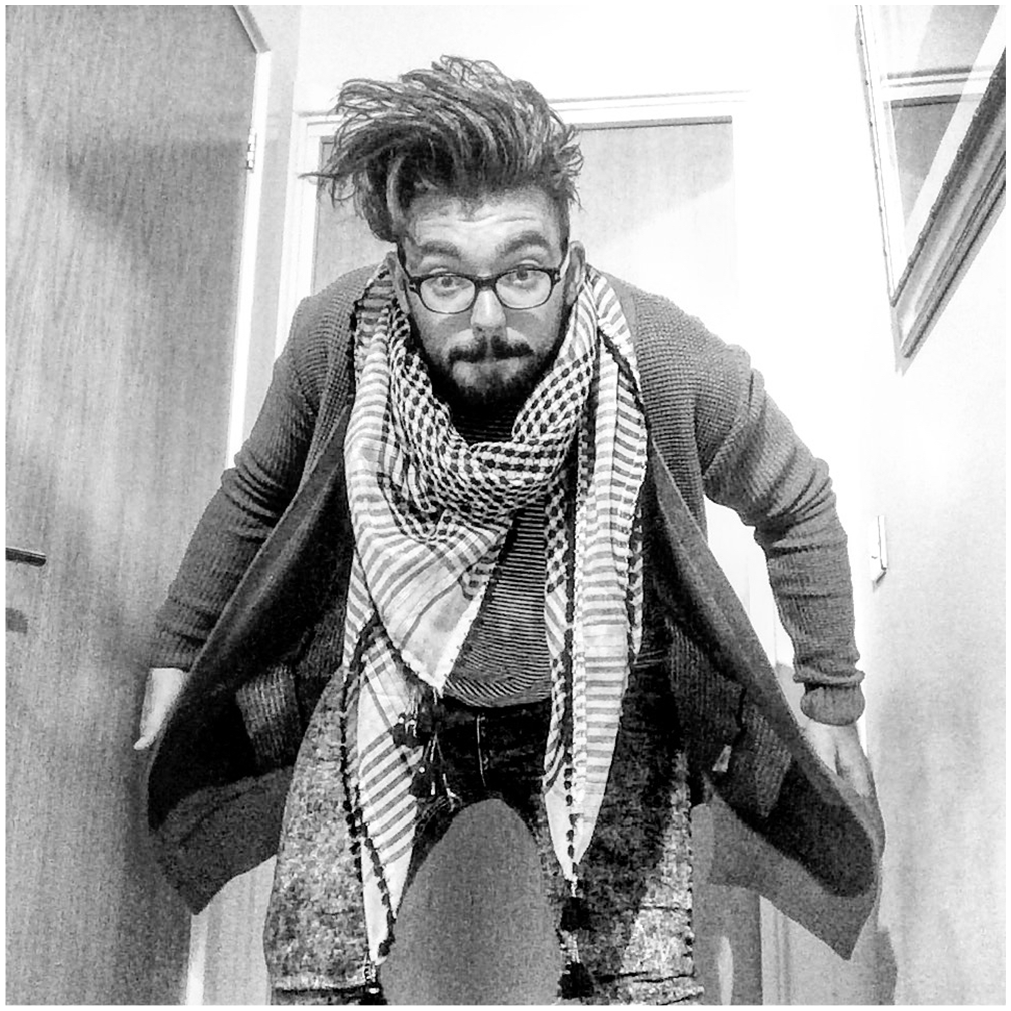
Bodyshot, wearing spectacles by Tom Ford, acid washed skinny jeans, a thigh length oversized cardigan and Shemagh style scarf.
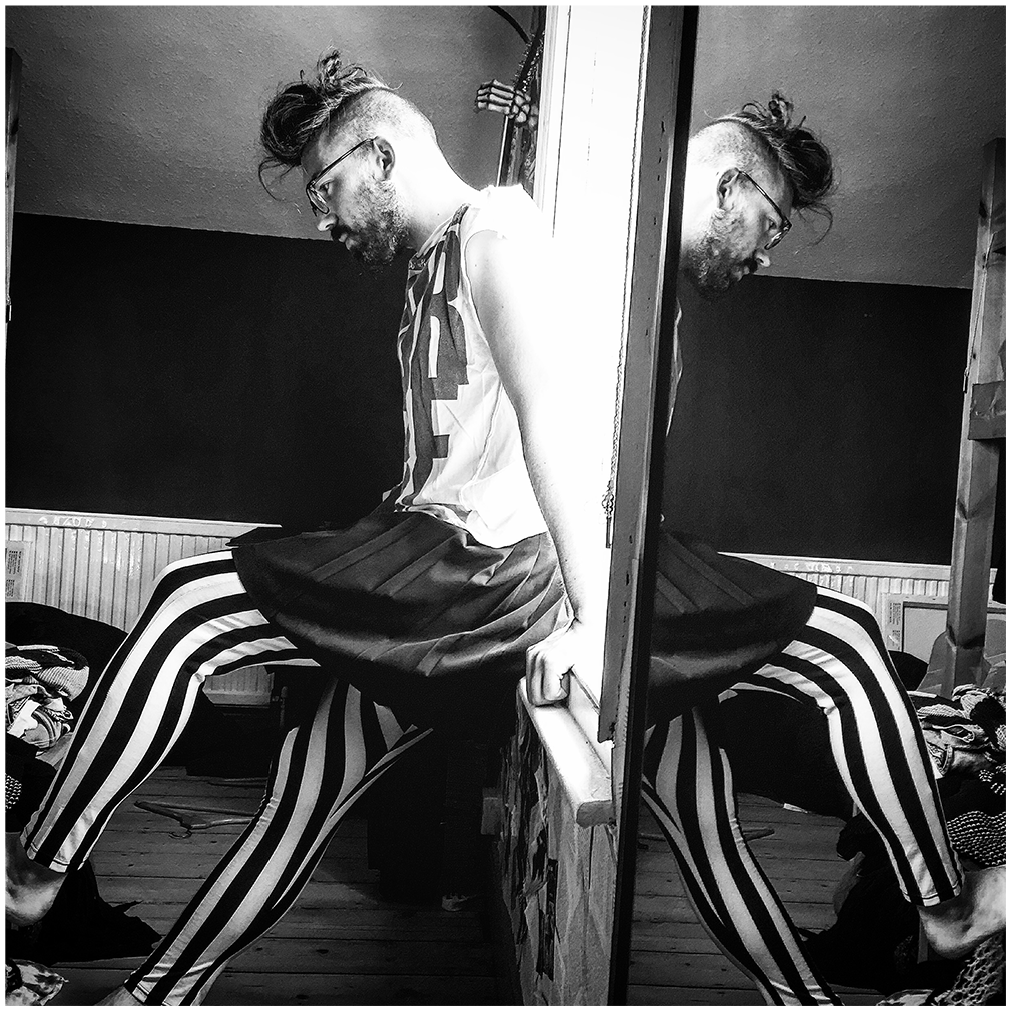
Bodyshot, wearing skinny trousers with an inch-thick black and white stripe from ByTheR, a black kilt by Comme des Garçons and a square shape t-shirt from Vivienne Westwood Worlds End with a bold print that reads “Do It Yourself.”

Headshot, wearing Oliver Peoples round spectacles, and a horizontally striped cardigan.

Torso shot, wearing a Paul Smith waistcoat with unusual lapel detailing and a pocket watch chain.

Torso shot, wearing a Paul Smith frockcoat with unusual lapel and cuff detailing.
Mimicry Becoming Creative Engagement
The first image included in this article was the second image to appear on the Instagram account @anthrodandy, posted on October 3, 2015, it was the first post to feature an image of myself (—although for clarity I had briefly used Instagram in 2013 in a personal capacity with only a few friends having access to the handful of disparate images that I had posted). This is crucial as it demonstrates the first open access appearance of a face which would become associated with the Instagram character @anthrodandy by my interlocutors. However, despite this intimate first step, these early images received limited reciprocal engagement and as such I looked to successful members of the network I was working with to see how these produced images differed from mine. This was the starting point for the creation of and transformation into an independent digital self. Up to this point, I had been merely producing images of myself or photographing interesting aspects of my outfits, but the next step was more holistic. I began to mimic the style of post I was observing in the digital landscape around me and in doing so began to produce content which was the foundation of a new self. This process is demonstrated by Figures 6–10, which are far more competent, employing better light, angles, details, and framing to create a set of content which allows the digital self to begin to have its own identity. These images are also more coherent than the first five, however, there is still a good deal of variation in terms of the look I am giving the character @anthrodandy. This demonstrates that while there has been a considerable amount of development, there is still an element of experimentation occurring here too. This transformation is part of the time-lapse shown across these images, but in addition to learning what kind of image is treated favorably by the network I was working with and would consequently allow me access, I discovered that beyond mimicking the style of image produced by other well-established members of the network, a necessary step for access, there needed to be a transformational step into producing a character with its own unique sense of style. This allows a sense of individuality to develop or the digital self, an aspect which is vital for attracting and retaining a set of followers, but the images must still present the kind of content the network wants to consume.
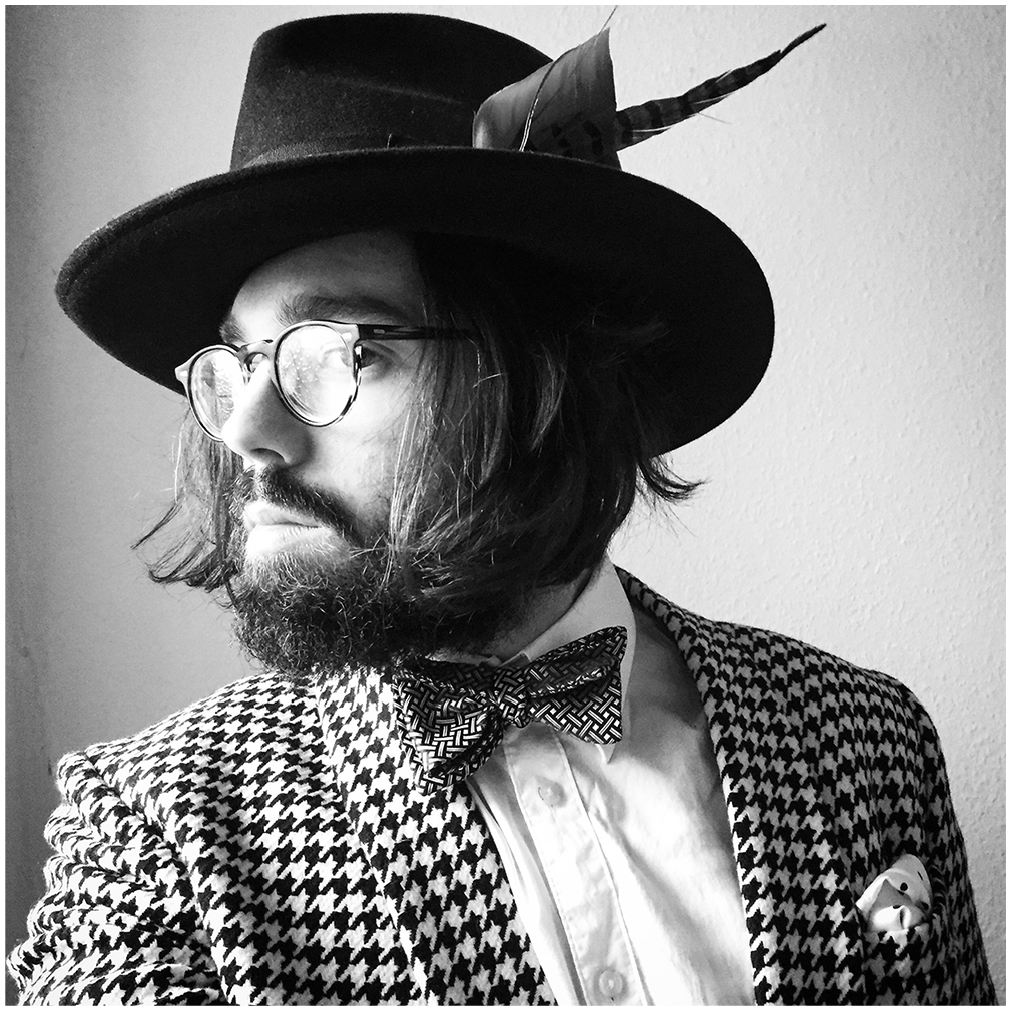
Headshot wearing Oliver Peoples spectacles, a Joshua Kane jacket, A Child of the Jago hat, DKNY shirt, and Alexander McQueen bow tie.

Headshot wearing Oliver Peoples spectacles and a tweed eight panel flat cap that is pulled over to the left side of his head resembling a beret. The image has a wistful quality.

Headshot wearing Alexander McQueen, dinner jacket, dress shirt, and a vintage bow tie.

Body shot, wearing a light-colored suit from Mark Powell with a large black and white overcheck.

Headshot wearing Joshua Kane hat and jacket and John Pearse tie.
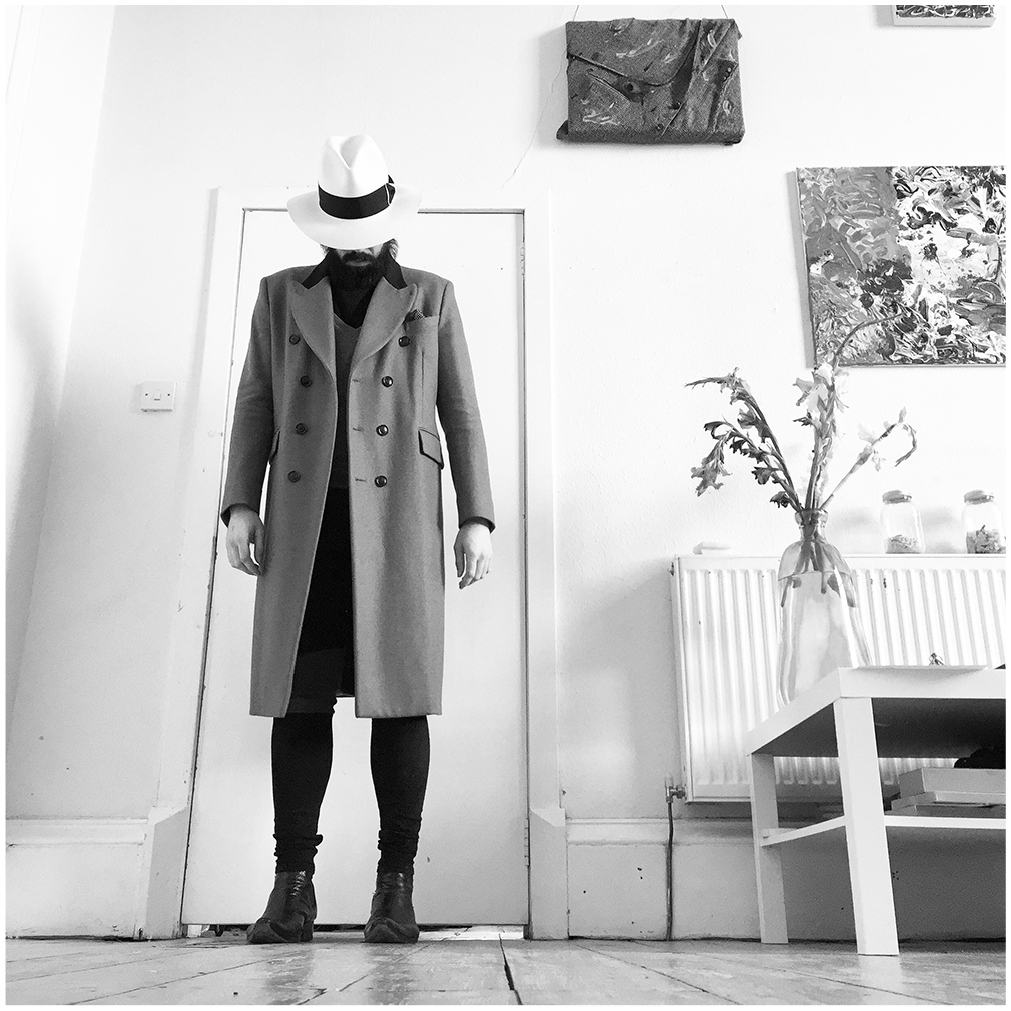
Body shot wearing Joshua Kane hat and coat.

Body shot wearing Mark Powell suit and shirt.

Body shot wearing Mark Powell suit, Huntsman tie, and bespoke shirt.
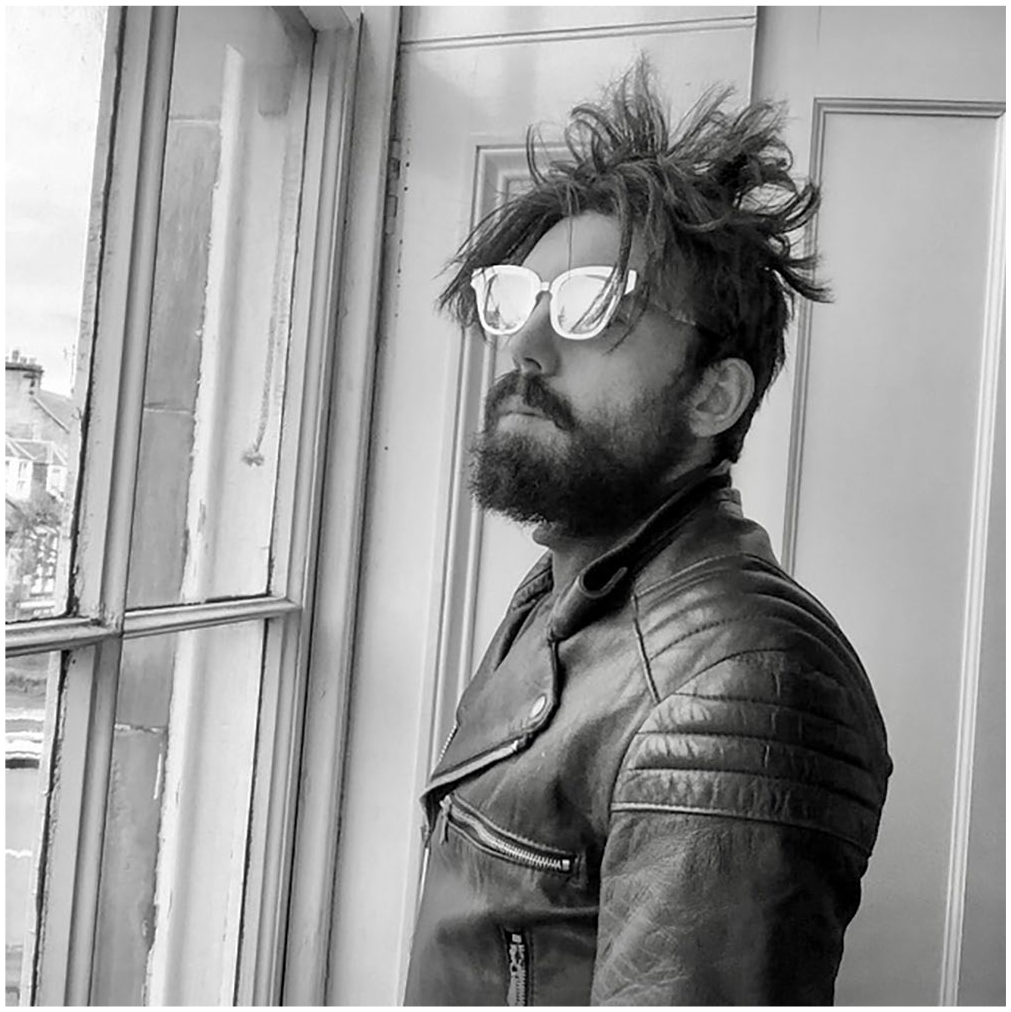
Body shot wearing Joshua Kane sunglasses and vintage leather jacket.

Body shot wearing vintage morning dress.
Development of the Digital Self
The final five images in this article demonstrate what @anthrodandy has become. Over time the images I produce on behalf of this digital self have become more professional, coherent and willfully stylish. This is the notion of individuality which I expressed in the previous section. Beyond mere mimicry, there is a degree of creativity here which embodies the unwritten rules of desirable content held by my network, but allows a sense of individual character to develop as well. This is the starting point for a fully-fledged digital self, but also forecasts the beginning of this digital self-acquiring agency. Over time, once this coherent digital self has been fledged into the digital landscape, the quantity of images habitually published give the digital self-history, movement, and independence. I was able to watch those selves I encountered age, gain digital maturity, follow them on their travels, and interact with them even when the offline creator is not online. In basic terms, this occurs in two ways, with through scrolling through the previous posts of a user, of by habitually interacting with new posts as and when they are posted like a serialized set of images. Once sufficient content exists, fleshing out the life and individual style of the digital self a transformation occurs, and the digital self acquires agency. This is the case for the last five images presented in this article.
Repetition Becomes a Digital History
One of the elements of this fieldwork which has become apparent through my own ethnographic engagement over time is the repetitive nature of the processes required to keep up with the necessary volume of content demanded by a network such as the one I worked with. At the start of this article, I outlined the way in which I would conceptualize the selfie as a form of self-portraiture. However, this is not quite right. As I repeatedly produced images for my Instagram they became more polished and well-crafted self-portraits. Yet there reached a critical mass of engagement where due to the number of images I had published, the images I continued to publish no longer reflected my offline self, but more acutely embodied the style, personality, and character of my online self. At this point, I was still producing self-portraits, but they were portraits of a different self; the digital self.
Boellstorff tells us that “even in virtual worlds traces of history endure” (Boellstorff 2012, 44)—with Instagram this trace of history is even more acute, as by scrolling back through one’s personal page it is possible to travel back in time, viewing all the posts one has made. Other users can do this too, and this easy to access historical narrative casts the state of the current digital self into sharp focus.
It took me a great deal of repetition (develop new post, post, interact, repeat) to craft a historical narrative for my digital self, laid out as a stream of images, but it has also led to something more profound. It is my assertion that digital selves, created by habitual offline users, ultimately come to acquire and exert their own agency. This was felt in the latter stages of my initial twenty-four months of fieldwork and has continued to develop as a result of my ongoing engagement with the digital landscape and my digital self. This agency is felt once a coherence and specific notion of identity has been developed for a digital self, and once a considerable number of images with a high degree of consistency to demonstrate this identity, have been published. In terms of this high number, I am suggesting in terms of at least 100 images, though it could be many more, and I published 850 images across the first twenty-four months of online fieldwork. Once this consistent history has been established, and the digital self has become a fully-fledged ontological entity, it gains the capacity for agency.
The Agential Self
My experience was that early forms of agential impulse from the digital self-confine themselves to the digital landscape. However, with time, this reach seemed to break down the barriers between online and offline and the digital self-began exerting its ever strengthening agency on the offline creator—this was also reported by the interlocutors I worked with. The initial forms of agential engagement in the digital landscape consist of the digital self-having a presence even when the offline user is not logged on, interacting, or uploading new content. There is sufficient material for the digital self to exist independently, with a coherent and cogent manifestation of self-existing in the digital landscape for others to view. Essentially, there is so much digital discourse in the form of posted selfies that constitute the digital character, that other Instagram users can feel as if they can interact with your online self and that they can build a relationship with that online self even if you (the offline creator) are no longer engaged in interaction or content creation.
If we conceptualize Instagram as a platform that employs images as discourse, digital selves crafted from images can therefore engage with one another using their own constituent parts as discourse irrespective of the continued engagement of the offline user. With this in mind, digital selves can act independently of their offline creators as while they do not create their own content, the existing content allows the online self to engage in a one-sided discourse with other active users simply by existing in the digital aether. As such, the beginnings of agency are granted to them, as there is the illusion of interaction even when they are not being actively added to by their offline creators.
The development of this initial form of agency is only the first step, however, and after the establishment of this independence, the digital self can grow stronger. Fundamentally, due to the ease with which others can view these well-crafted online images of your digital self, the time taken to construct aesthetically pleasing images, and the repetitive and temporally flexible nature of digital consumption, one’s digital self can become more real to one’s followers than the offline self. This can be conceived as a form of hyperreality, following Baudrillard (2003, 42), and I have previously argued that this means that with time the digital self can begin to impose itself (and also its self in terms of the expectations to be perceived in a particular manner) onto the offline creator (see Bluteau 2021b). This is due to a number of factors but includes the constant desire to present oneself like the digital self for photographs to be taken, the affirmation one receives on the images posted online, the comments one receives from friends and followers in the offline world when the idiosyncratic style of one’s digital self is not matched, and (as Bluteau 2025 notes) the nature of digital time itself. Boellstorff (2012, 52) notes that “specific social realities” are not bound to the terrestrial world any more, but here we can go even further, as Dalsgaard (2016, 96) does, to suggest that such realities are no longer held captive either online or offline, but rather exist in a fluid and enmeshed world where the boundary between online and offline has begun to dissolve.
There is a final, and reductively financial demonstration of the impact of the online digital self’s acquisition of agency over the offline self. The nature of the network of sartorially invested Instagram users with whom I have worked is an affluent one. It is not possible to continually post images of new tailoring or accessories from the kind of brands that the Instagram network is interested in looking at without considerable financial outlay. The kind of tailoring that is of particular interest tends to be bespoke, handmade clothing, that may retail for thousands of pounds. Fortunately, there is an acceptance that not all members of the network can afford this and there are some members of the network who will acquire their clothing second hand through vintage retailers or online auction websites. For some this is unspoken, for others this is a more blatant aspect of their online self, but the online auction website eBay is frequently referenced as a shopping destination for those looking for either specific and hard to acquire vintage items, or those with smaller budgets.
Irrespective of this more budget-friendly option, the garments required by the network are of the same quality irrespective of how they have been acquired. For the vast majority of the garments that are featured in the images posted to the Instagram account @anthrodandy, I purchased them on eBay, at a fraction of their retail price, but still frequently feeling at the limits of this researcher’s scant budget (see Bluteau in press). However, to continue to produce content to enrich the digital self, with new outfits and accessories purchases needed to be made. This is the final way in which the digital self-exerts agency over its offline creator. Much like a doll, the created self needs to be clothed, and with a limited budget, the offline self is compelled to spend increasing amount of time and money to attire the online self in the style that it has become accustomed. Fundamentally, the success of the digital self begins to impact on the lived experience of the offline self.
Leaving the Field
“. . .the virtual world remains even as individuals shut their computers off,” Boellstorff observes (2012, 43). What he does not tell us, however, is what happens when one has created a digital self which dwells online and whose constituent parts, in this case images, remain intact after the computers, smartphones, and cameras have been switched off. This is even more complicated in the case of Instagram, as other users can interact with your images, and therefore with your digital self, when the offline anthropologist is not online. This became overwhelming for me, and after twenty-four months of online engagement and the posting of 850 images, I made the decision to step away from Instagram. I felt that space was required to reflect on the fieldwork I had completed and to allow time for writing (there are echoes of this in Luvaas’ 2017 work). However, I did not close the account @anthrodandy, and still received notifications from other users still interacting with my digital self; not only on the more recent posts but also historical ones as well.
As the last five images demonstrate I have not abandoned my digital self altogether, and I have continued to add content after the initial two-year period of fieldwork had finished, albeit in a less regular and more sporadic manner. Despite this altered level of engagement, the images which I am producing are of a higher quality and continue to embolden my digital self without losing the agency it has acquired. This seems justified as even when I do not add new content for a number of weeks or even months my number of followers does not diminish, a phenomenon which I had observed at an earlier stage of my digital research when I took a break from posting. With this in mind, this article must question whether the digital field is one which the anthropologist with a digital self never truly leaves.
My supposition, that digital selves can dwell online in a digital landscape, contrasts with the notion posited by Burrell (2009, 193) who suggests that the digital world is uninhabitable. The research reported in this article takes the digital fieldsite as very much habitable and argues that it must be explored and inhabited by researchers using digital selves in order to conduct new anthropological research. Immersive cohabitation—a method where the practices of one’s interlocutors are mirrored by the researcher—facilitates this and allows for the online-dwelling digital selves to act as anthropological agents in the digital landscape where they dwell.
However, unlike a terrestrially bound fieldsite, the distinct nature of the digital field adds to the complex dynamics of fieldwork. Even if one deleted their account in its entirety, there are still ghosts of posts online, either through reposts, screenshots, or the memory and interaction of other network users. While some of these issues may be problematic for any type of ethnographic research (see Smith and Delamont 2023), a reflexive engagement with the necessarily phenomenological nature of the selfie (following Bollmer and Guiness 2017) has emphasized the active digital legacy that remains in the field after the researcher has left—an entity that is equally useful and problematic—and the knowledge creations that may be acquired when engaging in creative ethnographic praxis.
Conclusion
Reflexive practice has been a key tenet of this article, not only as a means of understanding the practice necessary for habitually engaging with Instagram but also as a way of understanding the timelines involved in the crafting of digital selves and the impact this can have on the anthropologist post-fieldwork. Digital communication is often lauded as a shrinker of worlds and reducer of distances, however, in the case of conducting anthropology in a digital fieldsite based within a social media platform, this is not necessarily the case. There are the same issues that plague offline researchers: language difficulties, cultural differences, and unspoken narratives to navigate, but as de Seta (2020) notes there are other pitfalls too that we must be wary of. This includes the problem of visibility, with a key difference in the virtual landscape being that the researcher is less visible and must try harder to make themselves visible (see Sou 2021; see also Forberg and Schilt 2023 for further discussion on the problem of visibility). It is through this process, typified by the production of images in this case, which allows the researcher eventual access through learning the necessary skills and identifying a network of interlocutors, but also forefronts the importance of crafting visibility within the chosen digital landscape, in a similar way to which Abidin (2020, 57) discusses how she took such efforts to “enact” various types of visibility during her fieldwork. The issue with this form of engagement is the time required. Time, by virtue of the algorithmic basis of social media, and the nature of platforms such as Instagram as a non-essential escape means that it can take far longer to form relationships with other users than it might in the offline world. Nevertheless, such an endeavor is worth the time invested and a necessary avenue to pursue. In an increasingly digitized modernity, anthropological research which fails to engage with the digital is blinkering itself and ignoring a daily activity of many in both western-centric fieldsites and beyond. This article has explored one way in which new ground can be broken in the exploration of digital worlds, analyzing diverse notions including the crafting of selves, agency, and the dangers inherent in a digital landscape. However, this is only a glimpse into one network on one social media platform in an ever-changing smorgasbord of digital choice. There is still much to do.
Footnotes
Declaration of Conflicting Interests
The author declared no potential conflicts of interest with respect to the research, authorship, and/or publication of this article.
Funding
The author received no financial support for the research, authorship, and/or publication of this article.
