




Abstract
Nursing education plays a pivotal role in shaping future nurse professionals who contribute to social justice and health equity. To achieve this goal, nursing teachers must employ effective learning strategies. One such strategy is norm-criticism, which promotes a critical reflection of the normative preconceptions that impact health equity. This study aimed to identify how nursing teachers approach norm-criticism during learning activities in a campus-based clinical learning environment with a norm-critical profile. Employing an ethnographic approach, we analyzed participant observational data using reflective thematic analysis. Our results revealed three overarching themes: “Teaching nursing disengaged from norm-criticism,” “Teaching norms and deflecting norm-criticism,” and “A hesitant norm-critical teaching.” This study concludes that the teachers did not have the tools or lacked knowledge in norm-critical teaching strategies, likely as consequence of inadequate faculty support and guidance. Ultimately, teachers should have access to norm-critical education and opportunities to learn how to carry out norm-critical teaching.
Keywords
Introduction
Social justice and health equity are fundamental features of nursing education (American Association of Colleges of Nursing 2021; The Swedish Society of Nursing 2017). Since socially generated health inequalities have deep and prolonged effects on patients’ lives, the linkage between nursing and society should be clarified early in nursing education (Thornton and Persaud 2018). Nursing education should provide students with strategies that promote critical reflection, health equity, and social justice, fostering nursing students who become contributors to equal nursing care (Kagan, Smith, and Chinn 2014). However, such strategies are limited in nursing education (Holmström et al. 2017; Sherman et al. 2021) and are often designated to its theoretical component.
The concept of norm-criticism has emerged as a suitable perspective in nursing education to generate critical reflections on social justice and health inequalities (Pelters 2018). The focus of norm-criticism is on scrutinizing and problematizing notions of “normality” and “abnormality” and delving into the underlying boundaries between them (Bengtsson and Bolander 2020, Reimers 2020). Nye, Tengelin, and Somayaji (2023) propose that nurse educators can make social justice and health inequalities visible to nursing students using a theoretical model of norm-criticism that emphasizes the interconnectedness of norms, otherness, and power, all of which impact human health. Within nursing education, norm-criticism has served as a pedagogical approach, enabling students to engage in critical reflections and discussions about normality (Kalonaityté 2014; Tengelin 2019). Previous norm-critical research has primarily focused on theoretical aspects (Classon Frangos 2021; Johansson and Theodorsson 2013; Tengelin et al. 2019), leaving practical aspects within higher education largely unresearched.
The division between the theoretical and practical components of nursing education has been discussed vigorously and has centered on how everyday nursing work corresponds with what is taught in nursing education, feeding into the notion of the “theory-practice” gap (Saifan, AbuRuz, and Masa’deh 2015). To address this gap, nursing educators have applied various teaching strategies such as incorporating placement practicums, skill labs, seminars (Benner et al. 2009), and drama (Arveklev et al. 2015) to provide qualitative nursing education. Despite efforts to close the “gap,” issues related to education on social justice and health inequalities have often been allocated to the periphery of education (Tengelin 2019; Valderama-Wallace and Apesoa-Varano 2020) and often within nursing ethics (Canales and Drevdahl 2014). However, studies have suggested that clinically oriented learning environments on campuses can be useful for educating students about social justice and health inequalities (Hitchcock et al. 2018; McGaughey et al. 2019). These learning environments, including skill laboratories and, simulation laboratories or centers (Abrandt Dahlgren, Fenwick, and Hopwood 2016; Msosa, Bruce, and Crouch 2021; Rooney et al. 2015), play a vital role in providing nursing students with both theoretical and practical learning experiences (Mthimunye and Daniels 2019). Learning environments support learning and education but are also social spaces where students can connect and share experiences (Abualrub and Stensaker 2018).
In this study, we introduce the concept of campus-based clinical learning environments (CBCLEs) not only to synthesize the various labels associated with clinically oriented learning environments but also to clarify that these learning environments are situated on university and college campuses. Traditionally, CBCLEs have focused on enhancing nursing students’ preparedness for clinical placements by emphasizing psychomotor skill development (e.g., vital sign evaluation, drug administration, and patient hygiene) through simulation and role-play activities (Cole, Flenady, and Heaton 2023; George, DeCristofaro, and Murphy 2020; McNett 2012). However, in recent discussions, nursing scholars and educators have advocated a broader approach. Song and McCreary (2020) propose that nursing students should be allowed to improve their soft skills (e.g., collaboration, communication, and critical thinking) and social skills (e.g., nursing advocacy, empowerment, and engagement in social issues) in CBCLEs. Elliott and Sandberg (2021) argue that CBCLEs can not only encourage nursing students to identify issues of social justice and health inequalities but also take meaningful action to address them.
Moreover, CBCLEs would not be functional without nurse educators who encourage nursing students to comprehend and integrate nursing theory and practice (Sandvik, Dahlström, and Koskinen 2022). Nurse educators in academia—academic nurse educators—play a crucial role in preparing and supporting nursing students for their professional development (Booth et al. 2016). According to Satoh, Fujimura, and Sato (2020), academic nurse educators must possess skills in communication, teaching, management, and ethics. They also point out that “The main role and responsibility of academic nurse educators is teaching and facilitating learning” (Satoh et al. 2020, 6). Consequently, academic nurse educators, as the predominant nursing teachers, are hereafter referred to as teachers in this article. Despite the importance of these teachers possessing the abovementioned skill set, researchers have highlighted a lack of competency among them in addressing social justice and health inequalities. For example, Habibzadeh, Jasemi, and Hosseinzadegan (2021) emphasize the need to enhance teachers’ competency in addressing social justice and health inequalities because teachers are often seen as role models by nursing students, especially in the areas of nursing ethics and nursing skills. Similarly, Elliott and Sandberg (2021) stress that there is uncertainty about the best teaching practices regarding social justice and health inequalities.
Additionally, in CBCLEs teachers usually draw from their professional subjective nursing experiences to contextualize and enhance learning activities for nursing students (Runcieman 2022). In nursing education, and especially in CBCLEs, learning activities center on the concept of experience, commonly guided by a Vygotskian theoretical conceptualization (Adedokun et al. 2017; Vygotskij 1978) and experiential learning theory (Dewey 1963; Kolb 2015).
Nursing teachers play an essential role in nursing education. However, understanding of how social justice and health equity perspectives are incorporated into CBCLEs remains limited. Previous research has mainly focused on ways to incorporate these perspectives into the theoretical elements of nursing education. Norm-criticism has emerged as a pedagogical strategy for teachers to address issues of social justice and health inequalities. Further research is required to explore how norm-criticism can be applied in practical nursing education contents and structures. Hence, this study aimed to identify how nursing teachers approach norm-criticism during learning activities in a CBCLE with a norm-critical profile.
Methodology
The design of this study was qualitative, inspired by a focused ethnographic perspective and involving participant observations. Ethnographic research involves immersing oneself in a particular cultural context, observing the social dynamics, and interacting with people to understand the practices and cultural processes (Bryman 2016). When applied in educational settings, ethnographic research can shed light on teacher–student interactions and broader social dynamics (Jeffrey and Troman 2004). Furthermore, focused ethnographies pay attention to particular issues or problems within a specific context and can range from weeks to less than a year, focusing on professionals’ roles, values, and social norms (Fush, Fusch and Ness 2017: Shannon, Soltani and Sugrue 2023).
Positionality of the Authors
The authors, all of whom are white and over 40 years old, are experienced teachers in health education in Sweden. Among them, three have Swedish ancestry, while one has Chilean ancestry. Additionally, three authors are affiliated with the university college where the examined CBCLE in this study is situated. The female authors are experienced researchers, and the male author is a PhD candidate enrolled in a research education program. All the authors contributed to outlining, data analysis, deliberations on the research process, and reflecting on the study’s implications. The authors’ positionality—socially, pedagogically, theoretically, and methodologically—is reflective of how their pre-understandings influenced the current study.
Henceforth, the study’s predominant narrative voice is that of the first author (I.A.C). While investigating “my organization,” I considered my positionality as either an insider (emic) or an outsider (etic) (Beals, Kidman, and Funaki 2019). As a former nursing teacher for advanced-level students and a staff member at the department in charge of the CBCLE, I assert that I am an insider researching my organization. However, my professional familiarity with the other teachers during the fieldwork was not extensive. Rather, our interactions were by the coffee machine or while having lunch in the same lunchroom. Nonetheless, I was a familiar face to them and perceived as a co-worker. This familiarity manifested during the participant observations and likely influenced the teachers’ approach toward me and the observed learning activities.
Field Site
In Sweden, nursing students undertake a bachelor’s degree program consisting of six semesters (SFS 1992:1434) intertwining academic studies with clinical studies. CBCLEs are common learning environments for teaching nursing skills without compromising patient security (The Handbook for Healthcare 2024). This study was conducted in a CBCLE that has been operational for approximately five years and covers an area of 392 m2. The CBCLE is unique in its composition because aspects relating to norm-criticism have been incorporated into the environment, both by design and through the learning activities implemented therein. While conducting the study, I intended to gain an understanding of the field site by carrying out a walk-through of the CBCLE. Below is, a description of the key observations.
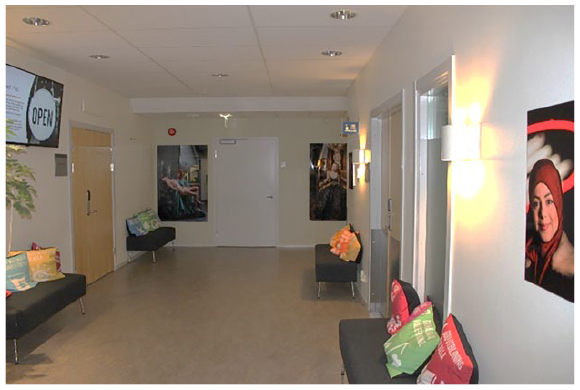
The entrance of the CBCLE features a large, gray, heavy door. Upon entering, a faint scent of hand sanitizer lingers. Just to the left of the entrance, there is a window nest to an Australian umbrella tree in a large pot. The elongated entrance room has a gray-brownish floor and the walls that run along both sides of the room are painted white, similar to most other walls in the CBCLE. The entrance room is quite dimly lit, and at the end of the room, there is a big wall painted in green color with a large gray metal door in the middle of it. Norm-critical photographic art adorns most walls, depicting diverse humans rarely seen in art. A TV monitor mounted on one of the walls provides relevant information. The entrance room also has gray couches accessorized with pillows, and each pillow has on of the goals from the “2030 Agenda for Sustainable Development Goals” printed on it. Connecting to the entrance room are three big wooden doors with gray metal signs labeled “Method room,” indicating what learning activities are expected to be conducted there. Looking into one of the method rooms, it resembles a hospital ward with neatly arranged beds in a row. Opposite the beds, there is a bench spans approximately 2.5 meters long and then there are floor-to-ceiling cabinets. Proceeding toward the green-colored wall in the entrance room, an opening leads to a narrow corridor.
Picture of the entrance room
Picture of the corridor
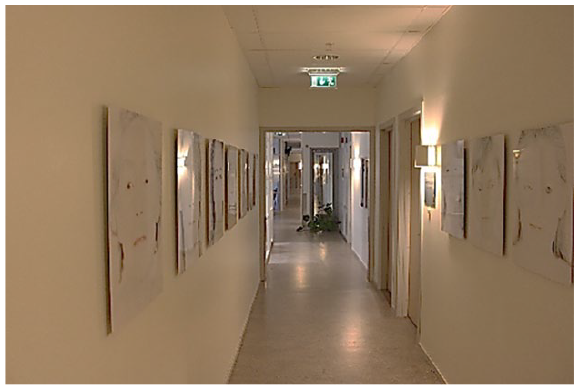
The gray-brownish floor continues throughout the corridor and the smell of the hand sanitizer eventually dissipates. The corridor is not in a straight line, and it is interrupted approximately in the middle by a metal-framed glass structure with a metal door that bulges in toward the corridor. A large green Monstera plant stands by the structure as a decoration item. On both sides of the corridor walls, norm-critical photographic art portrays human faces. These faces are pale and almost transparent, and the people in the pictures seem to be visually impaired. Moving forward in the corridor, on the right side, there are two rooms. The first room is a sluice room and the second is a medicine room. Besides the medicine room, there is a small section of wall that features another norm-critical photographic art piece. This picture depicts a person, from behind, with female attributes and holding a mirror. In the mirror’s reflection, one sees the face of a person with male attributes. The corridor brightens and opposite to the left side of the corridor is situated the first reflection room of the CBCLE. Three reflection rooms line the left side of the corridor. They are all separated from the corridor by glass walls, allowing one to look inside the rooms. The reflection room in the middle is smaller in size and has a large oval table that almost occupies the entire room. The other reflection rooms are of the same size. Both rooms are furnished with chairs along the side, leaving the center of the room open. Above the doors in both rooms, small TV monitors switch pictures at regular intervals. These pictures depict diverse people in various situations, including transgender people and humans fleeing from war.
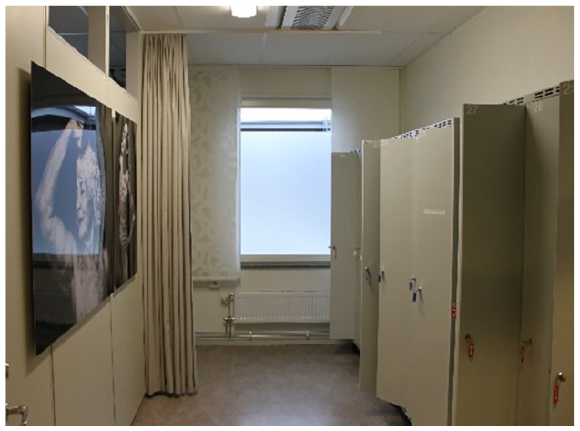
Moving forward along the corridor and opposite to the third reflection room, the simulation rooms of the CBCLE begin. The first simulation room is spacious with a bed in the center and surrounded by medical devices. Before the first simulation room in the corridor, there is a control center room that is used to control the computerized equipment of the simulation rooms. Thereafter, there may be either a large simulation room or three smaller ones, depending on whether the two large white separation walls have been unfolded. In continuation and across the simulation rooms on the left side, the CBCLE’s three unisex changing rooms are situated. The changing rooms, each with lockers on one side and a pale-gray wall on the other, are all adorned with norm-critical photographic art. The art expresses the diverse aspects of human nude bodies. Furthermore, each changing room has a drape that can be unfolded to ensure privacy during clothing changes.
Picture of a changing room
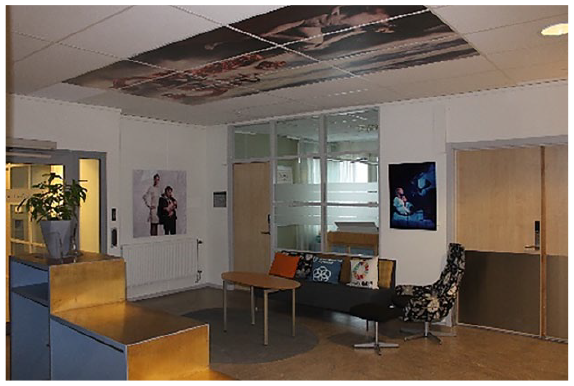
Further down the corridor, on the left side, there is a storage room, and a few meters ahead, the wall ends. Now, the corridor transforms into an entirely new space. This new continuation of the CBCLE is square, dimly lit, and resembles a waiting room. On the left side, there is a smaller oblong room with windowed walls, resembling a room within a room. At the far end of the room, a large wall with a gray metal framed glass door in the middle provides an exit from the CBCLE. Norm-critical photographic art displayed is on the walls surrounding the door. One piece features a white-skinned man lying down, with a dark-skinned man lying across him. The other piece depicts a well-dressed couple, a tall woman standing behind a man in a suit, and the man is holding a baby that he breastfeeds. The wall facing the corridor is divided into two sections. Directly opposite the corridor, there is a wall with a door that leads to the CPR, room and beside the door, there is another piece of norm-critical photographic artwork. This darker artwork shows two women in white nightgowns looking up at an angel holding a test tube. Following the wall with the artwork, there is a windowed wall with an incorporated door. In front of the windowed wall, there is a gray couch similar to that in the entrance room, with similar pillows. Directly to the left of the couch, there is a dark fabric swivel armchair with white and gray flowers and a corresponding footstool. A mid-sized oval wooden coffee table with gray metal legs stands before the couch. Beneath the table lies a large gray round rug. Looking up from the couch, a prominent painting appears on the ceiling. It is a norm-critical interpretation of Michelangelo’s famous “The Creation of Adam.” Additionally, in front of the couch, there is another norm-critical element of the CBCLE, which is an innovative counter. The counter is designed in three levels and adapted for people of different height.
Picture of the waiting room
From reflective notes, December 6th, 2022
Planning for the Fieldwork
Approximately one year before data collection, I immersed myself in the CBCLE to gain a deeper understanding of the field. I spent several days at the CBCLE familiarizing myself with the environment, learning activities, and staff. On the final two days, I assumed the role of a teacher in two learning activities. Throughout this period, I also established a connection with the coordinator of the CBCLE, who later became a gatekeeper (Hammersley and Atkinson 2007) to the field. Subsequently, it was decided that the study would take place during the autumn semester of 2022, from September to mid-January. All learning activities in nursing education were eligible for inclusion in the study, except those that graded or examined the students. Subsequently, written information about the study was sent to course coordinators to establish a pathway into the field and connect with the intended participants of the study. With assistance of the course coordinators, a convenience sampling (Polit and Beck 2021) approach was chosen, asking the teachers to participate in the study. Of the 20 eligible teachers involved in the learning activities, 14 teachers were available for observations during periods when I was able to conduct them. These 14 teachers, two male and 12 female teachers, were sent written information about the study and asked to participate. All the 14 participants agreed to engage in the study.
Furthermore, the nursing students involved in the learning activities were informed about the study approximately two weeks before in writing and asked for consent. Additionally, oral information was provided to students and teachers immediately before the learning activities began, following the ethical guidelines of the Declaration of Helsinki (World Medical Association 2013). Signed informed consent was obtained from all the participants and were securely stored. This study received ethical approval from the Regional Ethical Review Board in Linköping, Sweden (Dnr 2020-05828) in 2020.
Collecting Data in the Field
Today, I finally began my observations. I was very nervous at the beginning, but the observations went well. I tried to put my pre-understanding to the side and see and write down what was happening, although I looked at the heading of the observational sheet a couple of times to remind myself of the study’s research aim. On this first day of observation, no one talked about norm-criticism in any way or form, but the teachers’ way of presenting relatives and patients was interesting. Something I have to think about is how I’m going to act when asked to interact with the students and teachers. In the first lesson, a student wanted help finding a peripheral venous catheter. During the second lesson, the teacher included me while teaching the students by asking how I used to insert peripheral venous catheters when I was working as a nurse. Having conversations with the teachers and the students after lessons can be a challenge. Everyone was in a hurry to leave after the lesson, and they were not interested in answering any of my questions or talking to me. Hopefully, I will be able to have some conversations further ahead with them. (From reflective notes, September 25th, 2022)
The fieldwork took place between September and the last week of November 2022 and included fifteen participant observations of learning activities. The observations ranged from one hour and fifty-three minutes to four hours and five minutes. The fieldwork occurred in various locations within the CBCLE (i.e., method rooms, simulation rooms, and reflection rooms) during teaching hours and days of the teaching week. This was done to gain a broad picture of what was happening (Jeffrey and Troman 2004) at the CBCLE. The learning activities observed extended from the second to the sixth semester, excluding the first and fifth semesters, because there were no learning activities in the CBCLE during those semesters. Three of the participant observations were from the second semester when the students practiced administering medication through injections. In two of the learning activities in the third semester, the students practiced inserting a peripheral venous catheter on mannequins and attaching a crystalloid solution as well as administering a sedative drug in a central venous catheter. In five of the observations, the students in the fourth semester undertook a simulation and tended to an ill patient (i.e., a mannequin). The learning activities observed for the sixth semester, in a total of five observations, were from two different courses. During the first three observations, the students tended to a fictitious palliative patient. In two other observations, the students practiced compiling a nursing care plan by interacting with a fictitious patient. Four of the teachers were observed more than once as the observations were carried out over several months.
Initially, the strategy was to observe teachers and students without interacting, listen and watch their interactions, and identify norm-criticism. However, this process did not unfold as planned. In eleven of the observations, I was included in the learning activities as a teacher, either by students or the teachers. From Spradley’s (1980) definition of the five types of participant observations, those conducted at the CBCLE would be in line with the moderate involvement participation type (Spradley 1980). This meant that I was a participant observer fully involved in sequences of learning activities as a teacher in some of the participant observations and a participant observer as a spectator in others. Moreover, both teachers and students were aware of me observing them before, during, and after the learning activity, making the participant observations overt observations (Patton 2015). I was also able to engage in short unstructured conversations with five female teachers, which were included in the study data.
The process of gathering data for the study was documented by handwritten observational notes (i.e., empirical notes, methodological notes, reflection notes, and conversations with participants) and later on brought together into field notes (Hammersley and Atkinson 2007). Both the teachers and students followed five patient case scenarios. These scenarios provided the students with instructions for undertaking various tasks during learning activities. The patient case scenarios were also included as part of the study data. All the data were securely stored in a locked archive to prevent unauthorized access.
Analyzing Data From the Field
Reflective thematic analysis (RTA) was employed to analyze the data (i.e., field notes and, patient case scenarios). RTA was selected because the objective was to identify shared meaning patterns within the data while recognizing the researcher’s intersubjectivity and reflections as valuable contributions to the analysis (Braun and Clarke 2022). The iterative six-phase process involved multiple readings, coding, and analysis of conceptual clusters. The conceptual clusters were analyzed based on similarities and differences, as well as the researcher’s pre-understanding of the field, generating subthemes. The subthemes were then discussed and analyzed by the authors, resulting in the writing and re-writing of three overall themes. At this stage, extracts from the data and citations were incorporated to strengthen and demonstrate the relevance of the themes, and the participants were assigned fictitious gender-neutral names and pronouns. The three generated overall themes were discussed once more and labeled as “Teaching nursing disengaged from norm-criticism,” “Teaching norms and deflecting norm-criticism,” and “A hesitant norm-critical teaching,” and revisited against the study’s aim.
Teaching Nursing Disengaged From Norm-Criticism
The analysis revealed that the teachers did not know how to approach the perspective of norm-criticism in clinical learning activities. Norm-criticism was not verbalized by the teachers when communicating with their students. Rather, norm-criticism was descriptive and placed at the periphery of the learning activities, often coupled with different patient case scenarios that guided students in their learning activities. In some patient case scenarios, implicit traces of norm-criticism were embedded in the information provided to the students. In the patient case scenario of “Clary” born in 1942, it is stated:
Clary has always dreamed of going to university but feels that she hasn’t had the opportunity to do so. Clary used to be a farmer, and after taking care of her sick partner who had recently passed away, she feels now that it is time to realize her goals. Therefore, Clary has started to study at a university, where she has met plenty of exciting and interesting people. (From the patient case scenario of “Clary”)
In addition to patient case scenarios, the advancement toward touching upon a norm conceptualization by most of the teachers was realized during “structured” reflection episodes. The learning activities were based on the following pedagogical approach: a pre-reflection session, the clinical activity of training, and summing up the learning activity in a post-reflection session. During one of the observations, students cared for a fictitious patient in small groups, guided by a teacher. Later, the small groups merged to a larger group for a postreflection session in a different classroom on campus, led by Teacher Michele. The classroom was arranged with benches in a circle, and when the students and I entered, Teacher Michele encouraged us to sit down on the positioned benches. Throughout the postreflection session, various topics were reflected upon and Teacher Michele inquired about how the students used different nursing anamnesis keywords, asking:
“From the information you received, what do you think about sexuality? How many of you did bring it up with Svea [fictitious name of the patient]?.” The students are silent, and Michele adds “I think the keyword sexuality is not only a perspective that has to do with intercourse. Svea is an older woman and older women experience dry vaginal mucous membranes with age, it is very common. Dry vaginal mucous membranes can lead to discomfort and other complications, so it is important to ask about it. Now, this is an older woman, do you think it would have been different if it had been a younger woman?.” Some of the students look at each other but do not say anything; others remain silent, looking down at the desk in front of them. After a period of silence, Michele changes the discussion to nursing care plans. (From observation 7, October 16th, 2022)
The observed situation presented above is an example of a common way in which the teachers approached their teaching. During several of the reflection episodes, the teachers opened up for reflection and discussions about normative preconceptions, such as those relating to sexuality, age, and culture, but at the same time constantly boxing in the reflections or discussions within a pathophysiological frame. On the few occasions when the teachers mentioned norms in discussions with students, they primarily focused on norms concerning bodily functions or other physiological aspects, rather than considering the patient’s social life or status. Moreover, such mentions were descriptive, without engaging with the students by problematizing norms more deeply or critically. Rather, the students were often left alone to evolve or develop their own learning regarding the significance that norms played. During a postreflection session on caring for a palliative patient, Teacher Billie and the students reflected on the procedure of opening windows after a person has passed away.
- “We discussed the issue of opening the windows, for some people (referring to healthcare staff) it might have to do with religion and for others it has more to do with the environment,” Nour (student) answers. - “Well, opening the windows is something that is almost always done (pause). It is an old Christian tradition, but if the patient is Muslim, what do you do then?”, teacher Billie asks. Student Nour goes on to recount a personal experience of working as an auxiliary nurse and caring for a deceased Muslim patient, and after recounting their experience, Nour and the other students look at Billie. Billie smiles at the students and changes the focus of the reflection toward the routines that the students should follow. (From observation 3, September 28th, 2022)
The tendency to focus on norms in postreflection sessions may stem from certain aspects identified in the enduring discussion of the theory–practice gap within nursing education. Safian et al. (2015) highlight that humanities-related issues, such as human rights and social justice, tend to often be taught as nursing ethics and at an awareness level within the theoretical framework of nursing education. Similarly, Valderama-Wallace and Apesoa-Varano (2019) add that perspectives on social justice and health inequalities are often framed within community health and overshadowed by biomedical content, as they are perceived as more useful for students to know. Thus, in the context of the teachers at the CBCLE, it appeared be that it felt more “natural” for them to present and position the norm-critical perspective within a theoretical postreflection awareness context.
Teaching Norms and Deflecting Norm-Criticism
The analysis also indicated that the approximation of the teachers toward the CBCLE’s norm-critical profile was deficient during the “practical” sessions of the learning activities. However, occasionally the teachers used the concept of norms when interacting with the students. For instance, after a learning activity in which students and Teacher Minou discussed palliative care in a healthcare setting, Minou informed me:
Yes, most of them [referring to the students] have experiences as auxiliary nurses, which I think enriches the discussions. I can imagine that you got a lot from this session. It is easy to do when this topic is discussed [pauses], I mean when death is discussed. You could say that the topic is favorable because it becomes somehow natural to start discussing and reflecting on various issues that end up within norms. Here it was good because your group [refers to the student group I observed] discussed both religion and culture. (Excerpt from a conversation with Teacher Minou, September 27th, 2022)
As I observed, there was a clear indication that the teachers conceptualized norm-criticism as “norms” and that norm-criticism would emerge intuitively while the students reflected among themselves. Thus, norm-criticism by the teachers did not appear to be structured in any way or form. Further, I observed that norm-criticism was often connected to specific topics within nursing care and therefore not always perceived as relevant to all learning activities within the CBCLE. On one occasion, in the timelapse between two observations, I asked Teacher Sasha about their take on norm-criticism in the previous learning activity.
Sasha turns toward me and replies: “Well, I think this is a simulation situation and the focus is on teamwork, so maybe there won’t be so many norms [referring to norm-criticism] here” and laughs slightly and goes on by opening and inspecting different drawers of the emergency trolley. (Excerpt from a conversation with Teacher Sasha, November 1st, 2022)
During the observations, it was not only Sasha who articulated that norm-criticism was not recognized as relevant or given priority for the specific learning activity. The teachers were mostly focused on the purely momentaneous technical elements of nursing practice when teaching. This focus on the technical elements and disconnection from norm-criticism could result in missed opportunities for teachers to engage in norm-critical reasoning with the students.
After Teacher Lo has demonstrated how to administer an intramuscular injection, they turn to leave the student group that they engaged with. Cruz [student] looks pensively at Lo and asks “But, but, what about extremely overweight patients, how do you do it then [referring to administrating an intramuscular injection]?.” Lo looks back at Cruz while walking away and replies quickly “Then you find other places on the body” and starts to engage with another student group. (From observation 13, November 16th, 2022)
The observations revealed a tension surrounding the inclusion of norm-criticism. In some learning activities, such as caring for palliative patients, norm-criticism was not actively promoted by teachers but was welcomed if the students started discussions regarding patients’ religion or culture. Conversely, in the simulations, norm-criticism was not a priority and was even avoided. The tension associated with the aspects that can or cannot be included within clinical learning environments may relate to a wider discussion within nursing education. For instance, Chernikova et al. (2020) argue that simulation in skill labs or centers is effective in enhancing nursing students’ technical or manual performance skills. In contrast, simulation is perceived to be less effective in enhancing nursing students’ social skills (Chernikova et al. 2020). Taking a different, approach McGaughey et al. (2019) suggest that students’ social skills could be augmented by skill labs or similar learning environments. Further, there is a demand by healthcare professionals that healthcare students should be more trained in social and soft skills (advocacy, empowerment, social commitment, critical thinking, and collaboration) in clinical situations (AlThukair and Rattray 2022; Song and McCreary 2020). Although the focus of norm-criticism in the CBCLE aimed to enhance the students’ social and soft skills, the teachers’ approach to enhance this was lacking. However, even if the teachers did not expressed how they approached norm-criticism in their teaching, they never articulated that norm-criticism was something unusable or strange to them; rather, the approach to norm-criticism was more inquisitive:
The teacher looked at me and put both her hands behind her back and said; “I’m really looking forward to your study being completed. So, we can develop the norm-critical elements of the teaching here at the CBCLE; we want more norm-criticism even in the parts that are [looks up to the ceiling a bit and makes a pause], yes, yes, that are more clinical, like administering injections. It will be exciting to see what you have come up with when you are finished [referring to the study].” (Excerpt from conversation with Teacher Cuyler, November 16th, 2022)
A Hesitant Norm-Critical Teaching
Although the analysis displayed that the teachers did not use norm-critical perspectives in their teaching there were small glimpses of norm-critical content throughout the observations. While observing, I could follow an unfolding situation in which Teacher Dani employed a norm-critical teaching strategy by disrupting a student group during a role-play session, adding a new student, and interrupting their interactions.
Dani is standing by the door; suddenly Dani walks toward student Ahsen, who is standing by the bed closest to the door in the room. Dani stands close to Ahsen and says something in a low voice that I cannot hear. Both start to walk across the room, toward the student group by the bed at the end of the room, near the big window. Upon arriving, Dani informs:
-“This is Gösta-Karins’ second son, he just arrived from Germany where he lives.”
Students Pim and Shea, who are standing on each side of the bed, focused on talking to the mannequin lying down on the bed, look up toward Ahsen and Dani. Dani tries to look serious, but I can detect a slight smile, and Dani turns around quickly and walks away. Ahsen, now standing by the end of the bed, changes their facial expression, looks angry and shouts in a hysterical voice:
-“
Both Shea and Pim back away a bit from the bed and look confused, perplexed, and scared. Pim expresses “ehm, ehm, ehm” and looks at Shea without knowing how to react. (From observation 1, September 25th, 2022)
Clearly, Dani strategically added another student, who had received specific instructions to alter the student group’s dynamics. The strategy was to shift the direction that the students were taking with the fictitious patient because Dani wanted to add a new perspective to students’ learning. By introducing a “challenging relative” (i.e., student Ahsen) to the situation, an extended discussion emerged within the student group regarding power relations between nurses, patients, and patients’ relatives. However, Dani did not see the need to participate in the discussion, rather Dani “nudged” the learning activity toward a norm-critical discussion. Although the learning activities always included segments of structured reflections, small fragments of the norm-critical approach actually occurred during sessions when the students were involved in practical assignments and interacting with teachers. On one occasion, while collecting data for patient anamnesis from a fictitious patient, Stieve (student) was assisted by Teacher Alex in reflecting on how different patients are approached in healthcare depending on their gender.
- “Well, I’ve gone through her [referring to the fictitious patient Svea] breathing, nutrition, pain, and anxiety records. She seems to be oriented, and I got some information about her psychosocial status, ehhh,” Stevie breaks eye contact with Teacher Alex, and looks down on a document in front of them and adds quickly: - “Uhhh, reproduction, I didn’t go through that one [referring to anamnesis keywords] with her,” and looks up at Alex again. - “Why?,” Alex asks almost immediately, with a wondering facial expression. Stevie shrugs and looks unsurely at Alex. - “If you look at the keyword [referring to reproduction] in relation to this patient and her medication, several of her drugs result in dry vaginal mucous membranes,” Alex informs. Stevie thinks for a moment and replies: - “Well, now that you explain it like that, it is super relevant, but it’s not always asked [referring to Stevie’s own experience of healthcare practice]. Or it depends, you might ask if you have a male patient who comes in with potency problems.” Stevie becomes quiet, looks pensive, and nods slightly. (From observation 6, October 13th, 2022)
During the interaction between Alex and Stevie, Alex’s simple question “Why?” prompted a reflective moment for the student. As Schön (1983) describes, this was a “reflection-in-action” learning situation. Teacher Alex, by interacting with the students and asking Stevie to describe the keywords used and asking “Why?,” created a reflective moment that generated presumptive learning concerning gender biases in nursing practice for the student. In another observation, Teacher Bobbie also used the question “Why?” as a teaching strategy.
- “How come you want to administer it there [referring to a subcutaneous injection]?,” Bobbie asks Andy (student). - “Eh, eh, ehmm, at work, we administer insulin just below the belly button in the belly,” Andy replies with an unsure voice. - “Yes, yes that’s good, but why do you administer it there?,” Bobbie inquiries again. Andy looks at Bobbie and then toward Kai (classmate) and says, “I, I really don’t know why we administer it there at work.” (From observation 15, November 16th, 2022)
In this learning situation, Bobbie interacted with the student while administering an injection and the question “Why?” generated a moment of reflection for the students. Unlike the previous example, the “why” was not directed toward normative preconceptions of social norms but rather to promote critical thinking and scrutinize more habitual clinical practice. It also highlights a central aspect of all critical pedagogical endeavors, to make space and place for the learner to “relearn.” This aligns with Kumashiro’s (2000) explanation of critical pedagogies not only as education that presents normality and otherness but also as an activity that unlearns and relearns the learner’s conceptualization of norms that restrict humans. Apart from the question of “Why?,” other brief questions asked by the teachers during their interactions with students were identified as having fragments of a norm-critical strategy. On October 11th, 2022, as I was observing Teacher Kim interacting with a few students who were discussing how to connect an intravenous drip for a fictitious patient, Kim asked, “So what do
Discussion
To our knowledge, this is the first study that used participant observations to disentangle how nursing teachers approach norm-criticism during learning activities in a CBCLE. Despite the CBCLE’s rhetoric to use norm-criticism in supporting students to reflect on and scrutinize power structures and norms (University West 2023), the study reveals that the teachers struggled with norm-criticism and did not engage with it, seemingly due to uncertainty about what norm-criticism entailed. The observations exposed that norm-criticism was interpreted or labeled as just “norms,” mainly presented during prepared pre- or postreflection sessions, separately from the practical elements of the learning activities. Hence, not including norm-critical problematization into the learning activities. Occasionally, the teachers made tentative attempts to approach a “norm” conceptualization by asking about age, gender, religion, and so on. However, they never engaged in discussions with students regarding health inequalities or oppressive power structures. Rather, the teachers grappled with finding teaching strategies consistent with norm-critical pedagogics. Furthermore and surprisingly, the norm-critical artwork in the learning environment was never used by the teachers, before, during, or after the learning activities, despite of its prominent feature at the CBCLE and in the rhetoric around it. Then, this leads to the question, how come the teachers did not engage or use norm-critical perspectives in their teaching?
The topics of social justice and health inequalities have been challenging to incorporate into nursing education, especially into the nontheoretical elements of nursing education (Habibzadeh, Jasemin, and Hosseinzadegan 2021). Norm-criticism, which is within the spectrum of social justice and health inequalities (Nye et al. 2023; Pelters 2018), was not something the teachers perceived as prioritized to focus on during their teaching in the CBCLE. Subsequently, when teachers initiated structured reflections or discussions in the CBCLE, the “norms” could sporadically be mentioned and discussed. By taking this approach the teachers actually designated the norm-critical perspective to be something theoretical and separated from the practical elements of the learning activities. This way of approaching norm-criticism as theoretical is in line with Valderama-Wallace and Apesoa-Varano’s (2020) explanation that when issues regarding social justice and health inequalities are addressed in nursing education, they are confined within the theoretical parts of the education. Additionally, the teachers by assigning norm-criticism to the pre- or postreflection sessions of learning activities reinforced the notion of a theory–practice gap within nursing education, as described by Zieber and Wojtowicz (2020). Notably, within the area of work-integrated learning CBCLEs are viewed as possible learning spaces where theory and practice can be integrated and the concern of a theory–practice gap within education could be resolved (Björck 2020). Work-integrated learning encompasses pedagogical strategies to integrate theoretical knowledge with nursing students practical experiences by merging traditional lectures with experiential learning activities, such as practicums and learning activities in CBCLEs, to align nursing education with nursing practice (Berndtsson, Dahlborg, and Pennbrant 2020; Gamble, Guinea, and Williams 2012). However, from what was observed in this study the way the teachers approached their teaching still lingers in the traditional way of teaching or training at CBCLEs; in essence, training nursing students in psychomotor skills to be work-ready nurses (Cole et al. 2023).
The result of this study showed that even if there were incitement and directions to provide a nursing education that included social justice and health inequalities in the educational structure, the teachers conducted their daily activities within conventional teaching praxis. Nursing education has since the 1980s been jointed with a biomedical science-empiricism paradigm shaping nursing research, practice, education, and focusing on training nursing students on standardized technical skills (Mazzotta 2016; Valderama-Wallace and Apesoa-Varano 2020). Moreover, it has been argued that even though nursing education is arranged and primarily conducted within academia, it unquestionably harbors requirements from other stakeholders, such as the government and healthcare system, to produce and re-produce trained standardized nurse-workers (Collier-Sewell and Monteux 2023). Therefore, one explanation of the teachers’ nonapproach to norm-criticism and their predisposition to teach in the CBCLE in a traditional manner might have to do with their own experiences of being socialized and educated into the nursing profession. Additionally, the teachers were all experienced nurses before shifting to teaching in academia and would most probably been entwined with the institutionalized norms of the healthcare system. As Booth, Emerson, Hackney, and Souter (2016) put forward, nursing and education are two different disciplines, and being proficient in nursing does not naturally ramificate to have an aptitude in educating nursing students.
Throughout the observations, it became evident that the teachers drew from their nursing experiences to contextualize their teaching, a common practice in CBCLEs and nursing education (Runcieman 2022). The teachers focused on sharing their own experiences as professional nurses and encouraging students to present their healthcare experiences, aligning with experiential learning principles (Dewey 1963; Kolb 2015). However, experiential education involves more than just sharing and providing experiences to students; it also requires a process of reflecting on experiences to be transformed into learning and knowledge (Joplin 1981). Breunig (2019) stresses that teachers’ self-positioning and self-reflection are often overlooked in experiential education, potentially perpetuating educational norms. Rossouw and Frick (2023) argue that all educational praxes harbor norms, unofficial and unwritten ideals, and agendas that the students unintentionally learn and adopt, also referred to as the “hidden curriculum.”
The hidden curriculum could be another explanation for why the teachers did not engage with norm-criticism while teaching, but it could also be an explanation of the few spurs of norm-critical teaching that were observed. Strikingly, the few occasions when norm-critical teaching occurred were when students were engaged in or had just finished practical assignments, not in the pre-or postreflection sessions. During one episode a teachers used interruption as a strategy to augment students’ educational experiences. Thus, assisting students in problematizing fictitious caring situations and creating opportunities for them to reflect upon power relations in healthcare. This approach aligns with Biesta’s (2013) concept of educators as change agents, who by using the “pedagogy of interruption,” bring something new into a learning situation to activate reflections and critical thinking. Similarly, Nye et al. (2023) also cover “interruption” when conceptualizing their norm-critical theoretical model. Hence, by interrupting nursing education in a “radical” way with norm-criticism, teachers and students are given the opportunity to critically reflect on privileges, social power, and authoritative power structures, helping them to unveil and counteract oppressive structures. Furthermore, in sporadic instances, the teachers used the “why” question to support reflective moments for students, in line with Schön’s (1983) “reflection-in-action” conceptualization. The “why” question in this context has its roots in the didaktik tradition (not to be confused with the English didactics) and it is one of four questions; why, what, how, and by what (Duit 2015). Didaktik is part of the European theory of education of Bildung, which aims to transform learners into emancipated responsible citizens through self-reflective, critical, and socially oriented learning (Sjöström and Eilks 2020).
Given the study’s focused ethnographic inclination, additional qualitative data (e.g., through qualitative in-depth interviews) and investigations conducted over several years would have been beneficial and could have yielded richer results; these limitations could be addressed in future research. Even though this is a small-sized focused ethnographic-inspired observational study it makes a valuable contribution to norm-critical research. By focusing on observing what was happening during the learning activities and relying on informal conversations, our expectation was to grasp a deeper understanding of the norm-critical day-to-day practices of the CBCLE. As Tope, Chamberlain, Crowley, and Hodson (2005) highlight, interviews are useful for ethnographic data gathering, yet, observations are more advantageous when gathering data that is subtle, such as organizational practices. Thus, through conducting participatory observations and not including in-depth interviews to the dataset this study has shown unfavorable implications of the day-to-day practices at the CBCLE. Since the authors are supportive of the norm-critical movement, the reflexive thematic analysis and the writing-up process of the study have been challenging, especially in presenting the unfavorable result in an impartially and justly manner. Throughout the writing-up process, the authors have engaged in profound, sincere, and transformative reflective discussions with each other concerning the norm-critical elements of the CBCLE. However, the result of the study contributes insight that may be valuable to nursing education researchers and practitioners, demonstrating how norm-criticism can be manifested in a clinical learning environment informed by experiential learning education.
Conclusion
In conclusion, this qualitative focused ethnography-inspired study aimed to identify how nursing teachers approach norm-criticism during learning activities in a CBCLE with a norm-critical profile. Our study identified that the teachers did not know how or lacked the tools to use norm-critical teaching strategies, although small traces of norm-critical conceptualization could be observed throughout the observations. Ultimately, the norm-critical perspective in the CBCLE appeared to be interlinked to particular teachers’ ability or and willingness to engage with the perspective but also to insufficient structural support to do so. It seems to be that in the same way the teachers left the students to their own devices to conceptualize norm-criticism, the teachers have been left themselves in the same situation by faculty structures. This is in accordance with the findings of Valderama-Wallace and Apesoa-Varano (2019): when it comes to the incorporation of social justice and health inequalities within nursing education, nursing teachers are often left on their own to find teaching strategies that work, without support from faculty structures. Consequently, nursing teachers lack competency in addressing social justice and health inequalities in nursing education (Habibzadeh et al. 2021). However, the quest to incorporate issues of social justice and health inequalities into nursing education is not only dependent on teachers’ ability to teach regarding these subjects. It also requires a profound structural change in the current ahistorical and hierarchical nursing curricula that is in alignment with faculty strategic plans and teachers’ practices (De Sousa et al. 2024). Therefore, we suggest that if the proposition is to incorporate norm-criticism into the CBCLE in a sustainable and more serious way, attention should be given to teachers’ opportunities to expand their competency and knowledge of norm-critical teaching strategies by faculty structures. In the same way that norm-critical pedagogy emphasizes educating students in self-consciousness and equipping them with analytic skills to reflect on the norms they will encounter in their professions, it also emphasizes the importance of supporting teachers in self-reflecting on the values that inform their teaching (Giroux 2010; Kumashiro 2000; Tengelin 2019). Consequently, faculty structures should put in place a robust norm-critical curriculum for teachers to reflect on their positionality, power, and the basic processes that guide their “hidden curriculums,” as well as giving the teachers tools to learn how to carry out norm-critical teaching.
Footnotes
Declaration of Conflicting Interests
The author(s) declared no potential conflicts of interest with respect to the research, authorship, and/or publication of this article.
Funding
The author(s) received no financial support for the research, authorship, and/or publication of this article.
