




Abstract
The gym is a well-established location for the promotion of health and is imbued with a range of norms regarding, e.g., body size, gender, and age. Applying a norm-critical stance, the study aims at exploring the normative frame of gym exercise, a) investigating norms framing the understanding and b) performance of gym exercise and the potential for deviance. 24 semi-structured in-depth interviews with Swedish active, reasonably healthy, recreational (= normal) gym-users aged 27–76 have been analysed using qualitative content analysis. Data-derived norms describe gym exercise as an individual, committed, responsible, surveyed endeavour, characterized by knowledge and awareness regarding efforts, techniques, goals and body limits. Performance norms oblige exercisers to push themselves, seek improvement, never quit and get bodily noticeable results in terms of certain pains and adjust their performance to a contextually defined standard. Due to the flexibly interpretable normative frame of exercise and its equally flexible socio-spatio-temporal localization, the gym is compartmentalized into fluid performance zones. This norm spectrum can be connected to a healthistic discourse and provides a multitude of occasions to experience (not) belonging to ‘the norm’. Hence, basically everybody may or may not be deviant, depending on the context.
Emanating from a qualitative interview study openly exploring all kinds of meaning-imbued pains experienced by ‘normal’ Swedish gym-users in the gym, this paper describes exercise norms. These exercise norms provide the basis for painful feelings of not belonging due to a norm breach, as one of the non-physical pains described in the study.
Background
The gym has been described as a highly standardized, commercialized, regulated, predictable and – despite local variations – global enterprise (Andreasson and Johansson, 2018). It is considered a signifier of healthy lifestyles and provides a popular environment for health-promotive exercise, in which understandings of health and fitness are conflated by equating being fit with being healthy within a pathogenic, dichotomous logic that holds the individual as consumer and producer of fitness/health responsible for their state as a result of a never-ending fitness project striving for health. Gym exercise has hence been regarded as connected to a moralizing healthistic discourse, which is firmly rooted in neo-liberalism, the medicalization of health and a health promotion mirroring those two (Andersson, 2024).
Moralizing healthism (and its respective of health) is “a moral discourse” (Crawford, 1984: 76) characterised by norms (for the applied understanding of ‘norms’ in this paper, please see the section on norm-criticality), addressed as values of individual responsibility, control/ discipline, performance and competition (Andersson, 2024; Coen et al., 2020; Håman et al., 2017; Ross, 2023; Tulle and Dorrer, 2012). These normative values represent a way of self-government that results and shows in healthy lifestyle choices. The individual is simultaneously held accountable for this self-government and attracted by its implicit promise of personal growth and fulfilment as a result of one's health practice (Andersson, 2024; Andreasson and Johansson, 2016, 2018, 2019; Bladh, 2022; Crawford, 1980; Håman et al., 2017; Nash, 2018). Hereby, health and associated practices such as self-disciplining gym exercise have been elevated to be a goal in itself in this pursuit of happiness turned “pursuit of health” (Crawford, 2006: 401). Alternative health norms represented in gym-users’ exercise exist (such as balance and well-being, as advocated by personal trainers, Håman et al., 2017) but may lack impact. Advising caution regarding excessive health practices, concerning, for example, exercise (ibid), hints at ambiguous standards in health and points to the need for individuals to introspect by applying a norm-regulated internalized inspecting gaze for self-surveillance (cf. Foucault, 1980).
Within this discourse of healthism (Crawford, 1984), a person's body is considered the showpiece of that person's health and healthy lifestyle (Bladh, 2022; Crawford, 2006; Tolvhed, 2016). As health proves, the body is included as a subject of surveillance by an internalized but also externalized gaze (i.e., directed at other people's bodies). That is especially prominent in studies concerning particular bodies such as overweight or gendered bodies (e.g., Bladh, 2022; Coen et al., 2020; Ross, 2023). The health-representing body in the gym is supposed to conform to a homogenized global body ideal, which is characterised by fit, young, energetic and attractive looks and often linked to well-defined muscles and thinness (Andreasson and Johansson, 2019; Sossa, 2022).
To sum up, the gym promises to provide a space to accomplish health and a health-representing body, but due to the conflation of health with fitness and the constant, self-disciplining work demanding character of the health/fitness project, there is no way to actually achieve fitness for good, perpetuating gym work as a way to show moral character. To be able to do so, gym-users need to learn certain practices, attitudes and feelings related to health, fitness and the body and be socialized into the gym culture (Crossley, 2006; Lev, 2023).
The Swedish gym culture has not been investigated in detail, but appears to be distinguished from a global gym culture by an increased gender equality (cf. Bladh, 2022; Håman et al., 2020) and elaborated neoliberal health promotion focuing on the independent self (cf. Andreasson et al., 2016; Håman et al., 2017; World Value Survey, 2023). The former is assumed by reason of the generally high esteem for gender equality in Sweden, the fact that in northern European countries women's fitness participation outnumbers that of men (Scheerder and Helsen, 2020) and a more diverse body ideal moving from a focus on aesthetics to strength performance (Bartholdsson and Vixner, 2019), even if the picture is far from clear-cut (Håman et al., 2020). The latter is supported by an individualized Swedish health care system that empathizes individual health promotion in terms of gym and fitness exercises (Andreasson et al., 2016), which may support a recent, contributing aggressive exercise and fitness competition trend (Håman et al., 2017) and a distinct popularity of fitness, exceeding that of continental Europe (Scheerder and Helsen, 2020). Hence, the Swedish gym appears to match “minimal government intervention, market fundamentalism (…), individual responsibility” as health-promotively relevant cornerstones of neoliberalism (Ayo, 2012: 99).
The gym as a normative melting pot
Gyms are environments framed by norms and provide a “landscape of exclusion” (Richardson et al., 2017: 18), which complicates their goal to be places for everyone (Andreasson and Johansson, 2019; cf. Pelters, 2024). Apart from norms regarding health, the norm spectrum in the gym relates to orders of power such as ethnicity and class (Bladh, 2022; Dogan, 2015) as well as age (Sossa, 2022) and disability (Turnock, 2021). They privilege the young, white, affluent middle-class represented by an appealing, able-bodied appearance (Bladh, 2022; Sossa, 2022).
Predominantly, however, previous research (e.g., Bladh, 2022; Gibbs et al., 2022; Håman et al., 2020) highlights the impact of gender norms, in particular representations of hegemonic or hyper-masculinity, represented in behaviour as well as spatial and other boundaries in the gym (Bladh, 2022; Håman et al., 2020). Normative values such as a persevering toughness and strength in body and mind, accompanied by aggression, competitiveness and pain endurance (Bladh, 2022; Dogan, 2015; Nash, 2018) characterise representations of this hegemonic masculinity in the gym.
Masculinity-related norms match the gym's “no pain, no gain culture” (Sossa, 2022: 119), in which crucial characteristics of traditional bodybuilding exercise – intense exertion-oriented muscle training, asceticism and competition – are still at play despite gyms’ development into representatives of the “fitness revolution” (Andreasson and Johansson, 2019: 8). In this normative environment, certain pains are embraced and enjoyed as a result of learning processes to become a bodybuilder (Monaghan, 2001) or experienced gym-user (Lev, 2023), alternatively as a signifier for successful self-realization (Nash, 2018) and accurate performance-enhancing exercise (Pelters, 2024). Cherishing pain represents self-mastery, achievement and transformation for strength and recreational athletes alike. Hence, true exercise is understood as characterized by some physically painful discomfort (Håman et al., 2020; Pelters, 2024).
It can be concluded that the gym is characterized by multiple orders of power, predominantly those referring to health and masculinity, as well as a multitude of exercise-related norms. Most of these have, however, been investigated with relation to groups of exercising participants characterised by specific body features such as female sex or old age and labelled as ‘deviant’ in hierarchical categorial binaries such as male/female. What is missing to date is an encompassing overview of exercise norms applied by bodily nonspecific, regular ‘normal’ gym-users who employ gym exercise as a recreational activity. These people represent the moral majority setting standards for all and distinguishing ‘the normal’ from the deviant ‘Other’ (Bromseth and Darj, 2010). Hence, this paper aims to uncover exercise norms framing the ‘right’ way for gym exercise, as experienced by ‘normal’ gym-users, as well as potentially resulting deviant groups.
Methods
Theoretical approach: Norm-criticality
Norm-criticality emanates from queer theory and critical education, is based on a post-structural ontological stance and a Foucauldian understanding of power and discourse (Bromseth and Darj, 2010). The eponymous term ‘norm’ may in general be understood as either representing a statistical standard or a desired ideal (cf. Sandell, 2010). Norm-criticality builds on the latter approach, hence focusing on what is desirable rather than usual, which highlights morality and power as implicit components of norms. More precisely, norms are here understood as often implicit, at times however explicit, self-evident, expected rules regarding desired ways to act, think and feel ‘normally’ concerning the phenomenon they relate to. These rules pinpoint and upgrade certain desired values/virtues as normative characteristics of these ways of acting, thinking and feeling and, in turn, implicitly devalue others.
Norms (as a combination of rules and values/virtues) are hence understood as tools that are used in the discursive practice of normalization to structure discursive elements (acts of speech, actions, feelings, symbolically functioning items and so on) to (re-)construct accepted ‘truths’ about what is possible to think, write, speak and valued as right/good and wrong/bad regarding the phenomenon (in this case: of gym exercise) which by abiding to these rules and values/virtues is re-/constructed as a specific reality. Norms function hence in a normative, i.e., prescriptive instead of merely descriptive way by providing both practical and moral guidelines. They may, in their entirety, be addressed as a normative frame. The (re-)constructed truths contribute to a certain discourse, i.e., they constitute and, in acting according to them, confirm and (re-)construct this discourse (cf. Bromseth and Darj, 2010; Pelters, 2025).
This leads to the question of how norms and deviance can be identified. If the normal is characterized as self-evident, natural, desirable yet stereotypic ways of being, feeling, thinking, acting, inducing often formulaic ways of referring, these and similar judgements are at least suspicious of being normative. Moreover, attention should be paid to what is sanctioned and who is on the side of those sanctioning, respectively, being sanctioned. As a consequence, those conforming to norms (aka ‘normal’ people) do not experience either unwanted, negative attention caused by their ways or any discomfort regarding them. They may, however, regard themselves as being in a position to point out certain other ways as in-/appropriate or un-/acceptable, hence defining/labelling them, usually without experiencing noteworthy objection in a specific context. Any disruption of these ‘normal’ ways may then again be noticed and experienced by its witnesses as embarrassing for those conforming or shameful for those unconforming (aka the ‘deviant’), often eliciting the felt need of the latter to explain or admit something, respectively to avoid or terminate a discomforting situation, both to alleviate the discomfort. In short, breaking norms causes inevitable discomfort and unwanted attention, following them does not (cf. Jenness and Goodman, 2021).
This understanding of norms and their identification has a bearing on who is understood as ‘normal, as ‘normal’ people apparently do not experience discomfort or are (negatively) noticed due to norm breach just by dwelling in the specific context, in which they are considered to be ‘normal’. Moreover, in a norm-critical context, ‘normal’ people do not only represent a statistical standard but also an ideal and are thus in a powerful position to set/define norms (and their totality, the normative framework). They constitute a majority that represents moral predominance, a so-called moral majority, is awarded privileges and precedes people who are considered devaled, inferior, and deviating from others in a hierarchical relation. Choosing such a group of ‘normal people’ as an analytical starting point is one of the tenets of norm-criticality (cf. Pelters, 2018). It should, however, be noted that the basic idea that ‘normal’ people are those conforming to norms raises questions concerning what norms count in this regard, how the normality to abide by is selected, as gyms entail many implicit and explicit norms that may count and be embodied. It shall hence be underlined that this study applies the lens of ‘pain’ to consider normality, and that other perspectives may highlight a different set or even sets of norms that may just as well be effective in the gym.
Lastly, the analytical potential of the norm-critical perspective includes
Describe implicit (and explicit) norms Uncover the discourse (re-)constructed by norms Analytically deduce potentially deviant groups.
The first and last investigative potentials will be pursued in this study, with the latter providing a means to criticize the aforementioned norms (ibid).
Recruitment and participants
For the purpose of the study, the normality of gym-users was interpreted in terms of belonging to an alleged standard that takes its point of departure both in statistics and a desired ideal, utilizing the former to strengthen the latter. A participant was characterized by being:
An active, regular gym-user: To be regarded as a ‘regular’ at the gym, an active exercise practice that matches the majority of gym users is deemed crucial. Participants self-reported working out regularly 3–4 times a week on average, hence fitting into the gross of gym users according to a current report (SATS, 2025). They exercise both independently and participate in gym classes, and often combine different types of exercise in their training routine. All of them were quite experienced with several years of exercise experience, which makes them “established insiders” (Mansfield and Maguire, 1999: 91) in the gym environment. Giving exercise's routine and regularity, this criteron taps hence into the gym as a representation of a healthy living (Andreasson and Johansson, 2018). Reasonably healthy: Considering the reputation of the gym as a health-promotive environment (Andersson, 2024), being healthy was regarded as the norm. All participants described themselves as ‘reasonably healthy’ at the time of the interview, i.e., none of them had an illness identity and exercised for therapeutic purposes. Adult, recreational athletes: Most gym-users are adults and use the gym for recreational purposes (SATS, 2025), with the latter being an even more distinct sign of normality with regard to the original study as strength athletes are known to have a different attitude towards pain (cf. Cranswick, 2019). Moreover, recreational rather than competition-driven exercise is closely tied to health promotion, as symbolized by the gym (Pelters, 2024).
To conclude, participants represent a statistical standard that simultaneously is connected to a desired ideal by applying the symbolic idea(l) of what the gym stands for as a benchmark, which turns participants into reasonable representatives of healthistic individuals described by Crawford (1980, 2006). Moreover, these criteria have been chosen to actively exclude seemingly ‘deviant’ groups characterised by specific bodies, to facilitate the emergence of ‘normal’, not bodily-biased understandings of the moral majority. These two strategies serve as a justification for labelling participants as ‘normal’. Otherwise, the group represents an all-white sample of (with one German exception) Swedish men and women with varying, yet visually able bodies ranging from well-trained to overweight and covering an age span of 27–76 years of age.
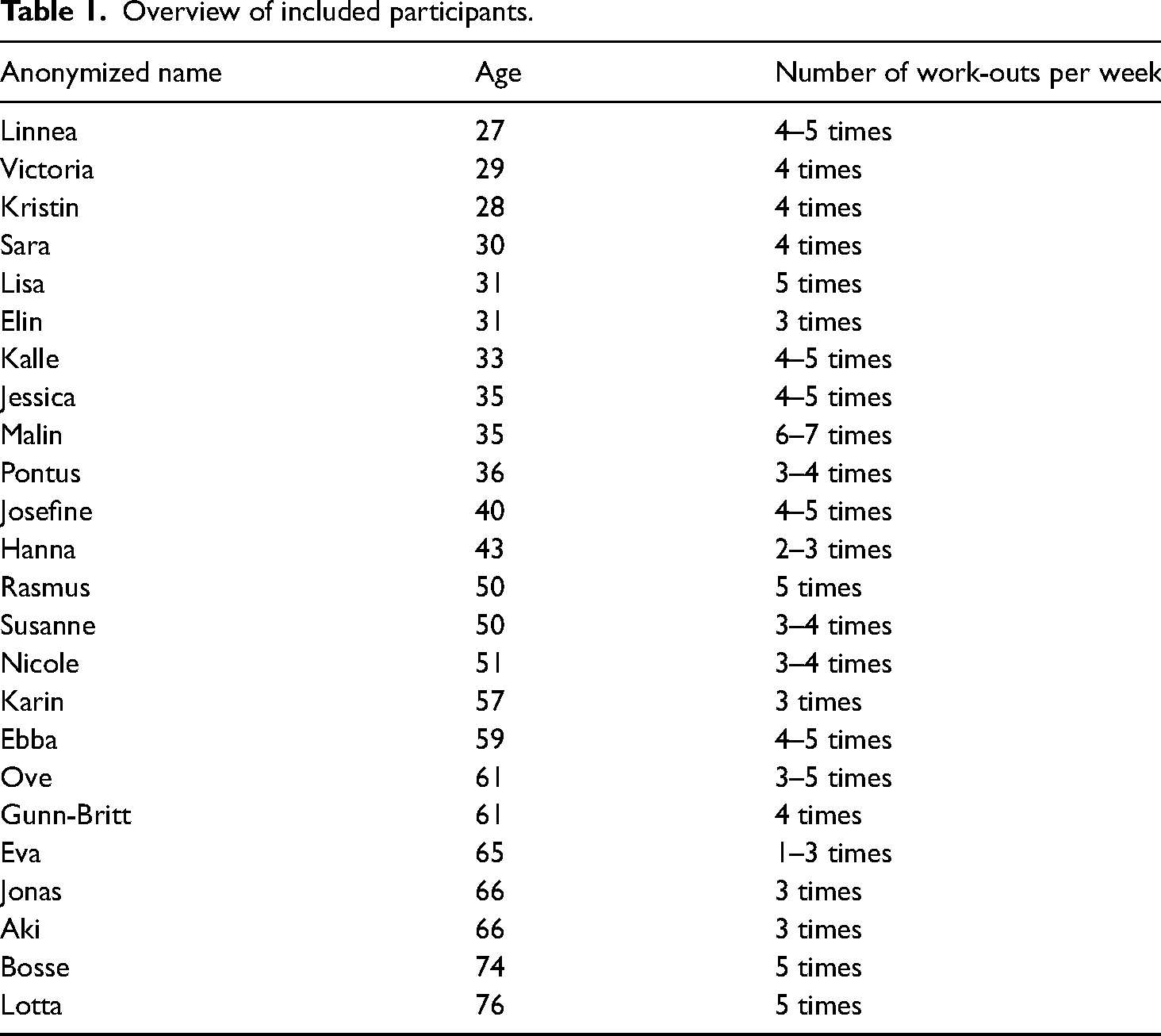
Recruitment took place in two ways: First, 8 of 10 gyms located in a commuter town close to the Swedish capital, representing a range from national chains to local enterprises, agreed to inform their members about the study. Here, the author was allowed to utilize their own gym experience to recruit participants after jointly completing gym classes, positioning the researcher as ‘one of us’ and thus facilitating access. Second, a note about the study was published in a local newspaper. After 24 interviews, theoretical saturation was achieved in terms of a lack of new information emerging from the data (see Table 1 for an overview of participants; names are fictitious).
Overview of included participants.
Data collection
A qualitative approach using individual in-depth semi-structured interviews for data collection (Bryman, 2016) has been chosen due to the study's explorative nature. Interviews took place in separate rooms at gyms, the local library, people's homes and the university department, depending on participants’ choice of a safe, familiar and convenient environment. These interviews lasted between 28 and 85 min (most lasting between 40–55 min). The interview guide and applied prompts (e.g., memes) focused on all kind of pains, which participants could think of, in accordance with the original study aim. Interviews started off with associating freely on pain in connection to exercise, followed by questions concerning experiences, perceptions, feelings and reflections on pain in a gym environment. The interviews were recorded and transcribed verbatim.
Analysis
An inductive qualitative content analysis (Graneheim and Lundman, 2004) has been conducted, consisting of a coding, categorizing and thematising stage. While on the categorizing stage, feelings of not belonging due to conduct-related mishaps or misinterpretations emerged from the data as a specific pain, which was interpreted as signals of a norm breach resulting in the pain of not fitting in. Data belonging to that pain category was then extracted, reread, recoded and recategorized to identify relevant exercise norms and the phenomena they regulated. The usual process of a content analysis was hence rerun on the extract of the original data material, which described the pain of not fitting in, with resulting norms as sub-categories. This process was guided by the question ‘What is the implicit rule that determines an appropriate action, thought or feeling?’. Specific attention has been paid to formulaically reiterated slogans and tenets, descriptions of (in-)appropriate conduct and references to people whom participants do or do not appreciate. Once rules were defined, the value/virtue focused on each of them was extracted, and rule/virtue combinations were grouped into the phenomena, which they (re-)construct and which constituted categories in this analysis, while always retracing these results in the data material. Relevant data units could differ significantly in size, ranging from words to parts of or complete, even several sentences, which can be seen in the result section's quoting style. The results were validated in discussions with colleagues who are experienced qualitative researchers. Two formal, seminar-style and several informal discussions with colleagues as critical friends took place at different stages of the analysis, with the formal one's being placed at the beginning and towards the end of the analysis and the informal one's being dispersed during the analytic phase. Being in this continuous dialogue with colleagues was not least intended to avoid the impact of the researcher's own gym experience on the analysis.
Results
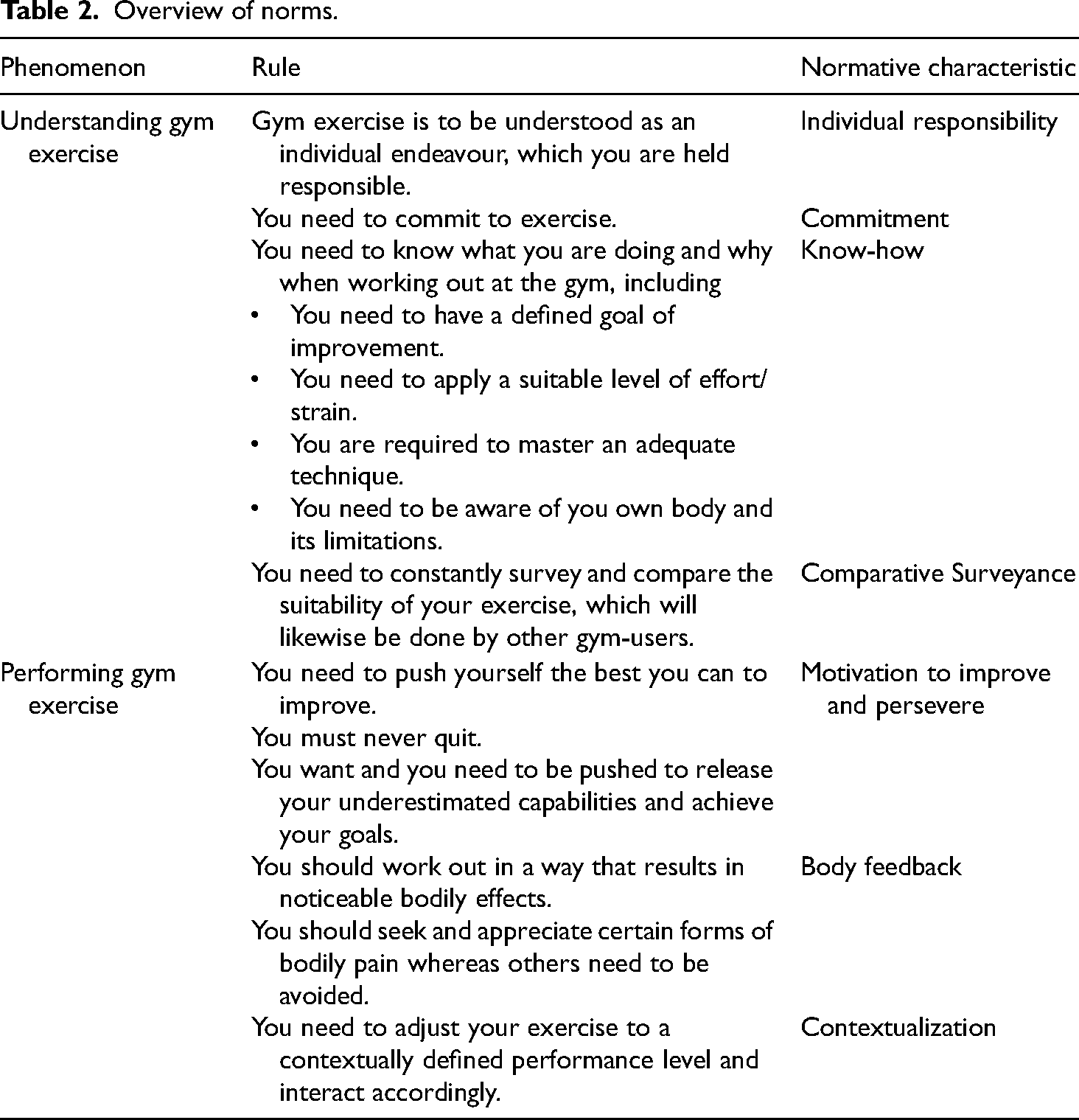
Norms construct two phenomena: how gym exercise should be understood and how it should be performed on the (gym) ground, with the former being defined by normative characteristics highlighting individual responsibility, commitment, know-how and comparative surveyance and the latter by motivation to improve and persevere, body feedback and contextualization (see Table 2 for an overview of norms).
Overview of norms.
Understanding of gym exercise
Individual responsibility
The basic understanding of exercising at the gym is determined by the rule: Gym exercise is to be understood as an individual endeavour, which you are held responsible for. This focus on individual responsibility becomes apparent in multiple ways, one of the most obvious being the constant mantra of instructors emphasising “it's your class, you do what you want” (Ebba when acting as instructor).
This rule also becomes visible in that people recurrently and routinely think about exercise as exclusively depending on their own choice. Susanne provides an example of that way of reasoning by answering “I decide myself” to the interviewer's question “Who organizes your exercise?”. The only justification for curbing someone's self-determination is when that person visibly trains in a potentially harmful, technically wrong way – and even in these occasions, people are reluctant to correct other people. This behaviour indicates the priority of self-determination, whereas the reaction of taking offence or feeling embarrassed when corrected hint, as reported by Victoria in the quote below, at the derogatory power of corrections as a form of social control, which potentially endanger prioritized people's right of self-determination and their responsibility for what happens on the gym floor, even when risking self-harm. Interviewer: When you see it [a risk of injury) (…) do you say something? Victoria: No, I was about to say I don’t dare. Then they would think I was embarrassing or think (…) ‘who are you?’ (…) people may also think it [the correction] is embarrassing.
Commitment
The first rule characterising this self-determined exercise is focused on a person's attitude and may be phrased: You need to commit to exercise. The scope of this routinely incited commitment norm is twofold. Firstly, it applies to showing the discipline to make it for the gym at all and work out regularly, or as Susanne puts it: Sometimes you just have to make up your mind (…) you have to overcome it [adversities for exercising], because if you start saying “no-but it's late, it's dark, I'm hungry, I'm tired” yada-yada-yada (…) that will never end. (…) this persistence (…) that's what makes you get results.
This will-power also includes a dimension of focus that exceeds the exercise at hand and refers to utilizing the gym correctly, i.e., for exercising instead of ‘off-target’ labelled purposes such as socializing. This is demonstrated by Aki, who derogatorily calls people who use the gym as a place for social gatherings “the social club”, thereby metaphorically separating them from regular gym club-members. This focused commitment needs, however, to be directed at the right, not any kind of exercise. For example is it regarded necessary to match goals and practice to enable oneself to uphold commitment, which is exemplified by Bosse describing a failing (and often ridiculed) group of people buying membership cards as a lead in their New Year's resolution as starting “with good premises (…) then (…) strive too hard and it doesn’t end well”.
Know-how
That individually suitable ‘right’ exercise proves to be understood as guided by know-how, following the norm: You need to know what you are doing and why when working out at the gym. This rule comprises four dimensions of knowledge and awareness, which the individual is expected to actively navigate:
Firstly: You need to have a defined goal of improvement. The necessary role of a goal for staying on track in one's exercise is highlighted in every interview, for example, by Pontus’ stating “It is important to (…) understand why you do what you do. What do you want to get out of what you do?”. It is, moreover, imperative that these individual goals are in one way or the other directed towards improving one's performance. That is for example indicated by the continuously applied strategy to peep not at all people but at those who are a little better than oneself, to arouse the stance “if he can do it, so can I” (Jessica), contrasted by relegating not improvement-oriented exercise by describing it in disdainful tones as e.g., “dawdling” (Hanna) or by posing the rhetorical question “if you don't challenge yourself, what does it really yield?” (Aki). Improvement goals are hence inherently social, despite their individual appearance, necessarily relative, and may vary to a great extent from Rasmus’ permanent target “to set a personal record” to Aki's maintenance of physical functionality: “there are a lot of people in my age group [at the gym] (…) who have had knee surgeries or shoulder surgeries, you name-[it] (…) [this is] tragic in a way, and I'm probably here to try to avoid ending up in that situation”. Improvement may hence show itself absolutely, compared to oneself, or relatively, compared to others.
Secondly: The level of effort/strain needs to be suitable. This is attained by negotiating the line between too little and too much effort: Lifting too much weights is generally not deemed wise and may, for example, cast you into doubt as a presumably “non-serious” so-called “ego lifter”, i.e., “someone who exceeds their own capacity, their own ability (…) to get some kind of attention from those around them” (Kristin) and risk considerable damage in the process. This position and practice are usually ascribed to teenage boys. On the other hand, too little weight is not appreciated either and may be deemed “too wimpy” (Lisa), calling into action instructors to push a person to “dare to load weights” (Linnea). This practice is explicitly ascribed to girls and women as a sign of underestimating oneself: “I think women play it safe. They take lighter dumbbells because they probably won’t accomplish [to lift more].” (Karin). Deviation from the suitable effort norm may hence be gendered, rendering it the only norm for which gender is presented as relevant in the data material.
In this context, technique plays a crucial role as a third dimension, represented in the norm: You are required to master an adequate technique. Technical competence is considered a prerequisite to be in a responsible way able to determine and expose yourself to a suitable level of strain. It marks “the difference between when people have the technique or when they have to go easy and learn the technique and [then] be able to dare to load weights when executing an exercise routine. So it's always a balancing act” (Linnea). Deviance is here marked by deliberately risking to hurt oneself for the sake of lifting a higher weight. Victoria describes this contrast between doing right and wrong as connected to local gym cultures: “In other places (…) [they] don't care as much about technique as long as you lift heavy. Whereas here, technique is more important so that you do it right, so that you don't end up in this painful situation [damage].”
Determining the right balance between technique and effort is hence connected to a suitable level of ambition for one's bodily capability as a 4th dimension of know-how, expressed in the norm: You need to be aware of you own body and its limitations. Deliberately “(…) listen to your body when it says no” may represent a challenge, which, however, appears to comprise feelings of relief as well: “For me, it's almost a struggle to try to reduce this [tendency to strive for overachievement] at times when I'm not at my best and that I don't have to go all the way then (…) I've tried to learn and listen more to my body in recent years. It can be difficult when you get into a ‘mode’” (Josefin). The norm is confirmed by presenting deviations in terms of neglected body limitations as at least questionable and related to damage or excessive hurt, even if they are verbally downplayed: Rasmus: then two guys from the hockey team appeared who are both significantly bigger and stronger than I am and then you sort of ended up (…) with a competition (…) after this session I couldn't walk for a week for sure (…) so that is maybe taking it a little too far
Comparative surveyance
The following norm highlights the implicit necessity to observantly control an exercise's suitability (in accordance with the targeted know-how) and the social embeddedness of this control. It reads: You need to constantly survey and compare the suitability of your exercise, which will likewise be done by other gym-users. Only if individual responsibility, commitment and know-how are aligned, gym-users’ exercise will be deemed suitable, turning them into responsible exercisers in their own and in other gym-users’ eyes. Indications of such constant ongoing survillance are present in every interview.
They may on the one hand, concern gym-users who judge the (mis-)match between different dimensions of their own exercise practice, like Rasmus assessing the challenge “to do 500 kilos in the three basic exercises” gone wrong as “It feels really stupid. Stupid in every way. Partly because it ruined the goal. And partly I felt stupid, foolish. I didn't really listen to my bod; you got some warning signals, but I was too hungry.”
By means of ubiquitous “peeping” (Lisa), on the other hand, fellow gym-users are surveyed and judged, which reveals a question of status. Whereas some may be elevated – e.g., into the position of a “role model” (Karin) – others, and by far more judging from the interviews, will face derogatory judgments diminishing status when someone's aggregated exercise is judged as “unduly” (Sara) or “big will and small brain” (Bosse). People hence risk ending up as the deviant, an unwanted position, which people actively try to avoid: Lisa: You think that you are expected to do everything right and that if you load too little weight then you are too wimpy (…) I think many people are afraid of that and then rather strive for too much (…) I think people might endure this [too much weight loaded] when they really shouldn't because they're afraid of what others will think. “I try to peep [at others] with a positive attitude [as motivation] (…) but then (…) some days where you just feel so bad (…) it doesn't feel right in the body at all (…) it just ends with a negative attitude”
This norm renders the social dimension of understanding exercise most obvious. It is, however, noteworthy that even the norms of individual responsibility, commitment and know-how – as individualized and in accordance with the tenets of neoliberalism and healthism (cf. Crawford, 1980, 2006) as they seem – are, indeed, socially affected, even determined as they are framed by social learning and feedback processes (cf. Crossley, 2006; Lev, 2023). This social dimension becomes even clearer when looking at norms about performing gym exercises.
Performing gym exercise
The following set of norms describes how exercise is to be performed on the ground.
Motivation to improve and persevere
The necessary mindset on the gym floor alludes to ideas of (self-)urge and endurance, with the basic rule being: You need to push yourself the best you can to improve. Striving for peak performance may aim at very different levels of achievement, but is expressed in one way or the other by every participant. The spectrum reaches from Rasmus’ “I should always be the first, I should always be the best at everything” to Gun-Britt's estimation “I can't just trudge around, but have to expect a little pain here and there” to be able to reach her goal “to do a pull-up before the age of 65” and Ebba's appreciation for those “who come even though they probably don't really, maybe fit in [to the ongoing class] but still try, dare to [challenge themselves]”. This all-in norm is moreover accompanied by a demand not to stop until exercise is over, which represents “the golden rule: You must never quit.” according to Ebba.
It is worth noting that both pushing and persevering, although phrased as rules directed at the individual, often allude to an implicit social environment and support, which frames an individual's performance. This necessary social support may be understood as either a competition (for Rasmus) or an inspiration, as it is for Ebba, describing “I can pick someone out (…) and then think ‘damn, how capable they are, I have to try to attain this now’ (…) just to trigger myself”. But irrespective of that, pushing people are often depicted as imperative for reaching peak performance: “It's rare that I come to that [peak level] (…) when I train alone (…) [with someone else] you feel pushed in a positive way” (Linnea). The social environment, hence, appears to have a crucial impact on self-pushing, leading to the rule: People want to be pushed to achieve their goals, even if different ways of pushing may be deemed suitable in different situations, as Hanna explains: I also know I'm a bit lazy. I partly need to push myself, but I also need a coach to push me. (…) to shout militarily style and that's my taste. (…) when I'm a coach myself, I'm a little calmer (…) I don't want to push the group too hard.
Body feedback
To determine if a way of exercising is suitable, the body will provide feedback in terms of desirable noticeable bodily effects, hence gym-users follow the rule: You should work out in a way that results in positively noticeable bodily effects – or as Pontus explains: “it [exercise] should be noticeable [in the body] and that is this positive pain, that they [gym-users] have exhausted the muscles sufficiently”. Aiming for a suitable level of bodily noticeability feeds back to observing one's body limits while exercising in accordance with the right goal/effort (and implicitly technique) package. This results mostly (even well-being after work-outs may be included) in acceptable, even enjoyable ‘good pains’ both during and after exercise, even if the level of necessary noticeability may vary greatly, comprising e.g., both Malin's “I want to sweat and be exhausted. Lie and breathe on the floor and recover” and Aki's “you get lactic acid (…) so you kind of reach the limit”.
Noticeability is qualified by another norm, stating: You should seek and appreciate certain forms of bodily pain whereas others need to be avoided. The good pains represent the coveted improvement and mainly consist of effort burn, qualified as “a pleasant pain” (Rasmus), and reasonable muscle soreness, which according to Ebba is: “the best form of pain (…) because then (…) I have really struggled and used new muscles”.
1
Bad pains on the other hand are usually connected to acute damage and excessive muscle soreness and represent an impediment of exercise and life. Elin explicates the importance of determining the border between good and bad pains, in which the connection to responsible body awareness, but also the imperative of pushing oneself shows: I have been afraid of when the body says no (….) I'm afraid of when it feels like you're starting to vomit, I'm afraid of when it kind of feels like you can't take it anymore (…) that's why I'm being so vigilant. Is this dangerous pain, can I really hurt myself because then I have to back off (…) or is it harmless pain, and then I have to stop being a coward and keep going.
Contextualization
Finally, in order to navigate exercise as both an individually and socially contextualized endeavour – a duality emerging clearly when people are evaluating/evaluated and/or pushing/pushed – the responsible individual exerciser is required to relate one's exercise to a context and follow the norm: You need to adjust your exercise to a contextually defined performance level and interact accordingly.
In doing so, different performance standards, based on different understandings of exercising, may arise in different groups. One such standard is represented by “young boys [who] compare themselves. ‘You go & maximize (…) do a 100 kilo deadlift, do a 150 kilo deadlift’ (…) incite their friends ‘Yeah, let's go’”(Veronica) and by exclamation demand their buddies to adjust to a type of exercise characterised by reckless maximizing. Another standard can be found in an environment, in which instructors “push to make you extend your own limits (…) but not at all costs (…) it's still technique first” (Elin). Even in this case, the expected performance level and understanding of exercise is clearly communicated, enacted and normalized as compulsory – and yet completely different, although both exist in the gym. As all gym norms may, in general, imply different potential levels of commitment, responsibility, knowledge, awareness, performance motivation and bodily feedback, normative negotiations may hence result in a multitude of different yet equally suitable ways to exercise at the gym, to begin with, depending on the actual social context of exercising.
However, the performance standard of contexts does not only shift due to a social impact but is also affected by time and space. This can be on the one hand exemplified by classes, which are designed on different exercise levels to attract people, who are implicitly expected to choose and hence “fit in” to a class with a matching level, as Ebba pointed out above. As these classes occupy the same space but take place at different points in time, the required performance level in these zones may shift considerably. Another example is the way Gun-Britt deals with “men who make more noise at the gym than I do when I give birth”, men whom she experiences as “invading my space”: “I'm leaving. If it starts to sound like that, I change place [in the gym].” In not questioning the entitlement of that person to sound the way he does but going someplace else in the gym, she implicitly creates zones for different ways to perform exercise, spaces that are not fixed, as both ‘grunting men’ and Gun-Britt may take their way to perform with them on a tour around the gym. These zones are also consolidated by allotting different statuses to grunting, ranging from being regarded as “grotesque” (Nicole) or “despicable” (Gun-Britt) to appreciation, as “some at the gym (…) appear to have given themselves a kind of status (…) often the ones who lift a lot [weight], grunt a lot and when they're done, they (…) look at themselves in the mirror” (Lisa).
Hence, different ways of exercising appear to be required in different times and places in the gym, necessitating people to be aware of whom they share their gym context with and interact in a way that concurs with the valid level of performance in that specific context of time, space and sociality.
The gym space as fluid performance zones of graded normativity
Depending on how the above-described norm spectrum is interpreted and situated in actual social, spatial and temporal contexts, a multitude of different yet equally suitable ways to exercise are imaginable at the gym. As has been shown, these normative guidelines are not fixed because the currently suitable, normatively ‘right’ exercise performance packages are intertwined with and shift depending on the social, spatial and temporal features of the context. As a result, fluid zones of graded normativity appear.
Several of them may exist simultaneously as a partitioning of the architectural, functional and hierarchical disciplinary space of the gym (Markula and Pringle, 2006, referring to Foucault) into smaller but still disciplinary space-units. Every single zone may contain a different yet matching interpretation of a range of norm fulfilment that is considered suitable and valid for those dwelling in that zone. Hereby, the idea of exercising together alone (ibid.) appears to be transformed by means of a necessary adjustment to a common standard performance range as a benchmark that creates temporary communities. If the current standard is met, gym-users may both experience belonging in terms of being in place (cf. Ross, 2023, with reference to Cresswell) and performance-related challenges due to the combination of the range of potentially matching performances and a normative improvement orientation, which may not be experienced when exercising alone (cf. Linnea's account).
Moreover, as the dwellers move, these zones may move around with them and thereby transform parts of the gym into the respective performance zone. This appears to be the case, although a certain zonal stability can be assumed due to the spatial interdependence of these zones with areas in the gym. These moving performance zones hence provide an alternative view on the division/construction of the gym space, compared to previous research, stating that certain, pre-determined and quite stable areas exist within the gym that have a decisive impact on how people may move around and exercise in the gym (see e.g., Bladh, 2022; Coen et al., 2020; Ross, 2023). Moreover, these stable areas and equally pre-determined movement schemata connecting these areas (despite a certain permeability, Håman et al., 2020; Ross, 2023) are described as dominated by specific groups of gym-users who may vary according to, e.g., gender (e.g., Bladh, 2022; Coen et al., 2020) or body volume (e.g., Ross, 2023), with hegemonic masculinity being especially highlighted as having a predominant impact on the construction of the gym space and how it may get under people's skin.
In contrast to these insights, respective categorial belonging did not emerge from the data as a decisive characteristic for how exercise in the gym is understood and performed in the present study. It may be, therefore, worthwhile to pursue the notion that for some people, basically ‘category-insensitive’ fluid performance zones may be an alternative way of describing the gym as an affective body movement space (cf. Coen et al., 2020). Such an insensitivity to gender (and possibly other stereotyping categories) as relevant for performance may indicate a vagueness regarding whom to expect/include in these performance zones. This insensitivity may serve as a potential chance for a variety of gym users to exercise. But it may also contain the potential risk of an inadvertently stereotype-based way of dealing with often stereotyped, even discriminated, people that may make these people feel not seen and therefore not belonging/out of place.
Discussion - deviance despite and because of normative flexibility
The existence of flexible performance zones facilitates the accommodation of quite different groups of gym-users in the gym, as is observable in previous research. This involves bodybuilders and recreational athletes representing an exertion-oriented ‘no pain, no gain’ culture (Gibbs et al., 2022; Monaghan, 2001; Pelters, 2024) and other healthistic proponents of discipline-focused hard training (Andersson, 2024) as well as those promoting an understanding of health as balance and well-being (Håman et al., 2017) or seeking to norm-critically enclose this masculinely connoted way of training (Bladh, 2022). Moreover, both (primarily male) people applying grunting as an expression of ambition (Lev and Hertzog, 2022) and women who train despite feeling intimidated by these grunting men (Turnock, 2021) dwell in the gym. The gym may also be occupied by people of varying ages resorting to certain exercise-related pains as positive expressions of bodily improvement (Lev, 2023; Pelters, 2024) but also by those not willing to sufficiently submit to pain (Frew and McGillivray, 2005) or elderly who use the gym rather as a place for social gatherings than for self-optimizing exercise and have a differing view on physical capital (Sossa, 2022; Tulle and Dorrer, 2012). As, however, even the most flexible, accepting normative frame does not include everybody (cf. Pelters, 2018), deviance and exclusion are inevitable.
In this respect, it is noticeable that exercise norms, as described by ‘normal’ gym-users, emphasize improvement (as e.g., represented in individual goals), responsibility for their own and others’ performance packages and surveillance, directed at one's body and the community. They hence lack the aggressive and self-reliant focus of bodybuilding on limitless exertion and its almost hostile view of others as adversaries (cf. Andreasson and Johansson, 2019). Instead, present-day exercising appears to be marked by moderating and contextualizing processes, which conforms to the characteristics of the healthistic discourse (Crawford, 1980, 2006; Foucault, 1980) but may also point towards the relevance of an alternative health discourse emphasizing balance (Håman et al., 2020). This might indicate the relevance of studying ‘normal’ gym-users as these people could be in a better position to reject ‘pure’ healthism and turn to alternative interpretative frames, due to them having already embodied responsibility by being healthy. That appears, however, not to be the case for the participants of this study, as the uncritically presented norms prove their apparent status as healthistic individuals (cf. Crawford, 1980, 2006). In contrast, participants positioned as vulnerable (e.g., female, overweight, older, cf. Coen et al., 2020; Ross, 2023; Tulle and Dorrer, 2012) may not be given the privilege to do so. Several opportunities to become a deviator exist in a norm spectrum emphasizing improvement, responsibility and surveyance, as neglecting or exaggerating any of those three may lead to being considered ‘wrong’ and unsuitable to dwell in a (certain) gym context.
People indulging in an unlimited, i.e., irresponsible, quest for improvement constitute a first group of deviators. Here, the hard-core athlete may be regarded as a prototype. In the data, this group is exemplified by groups of younger boys agitating each other to limitless effort (see Kristin's account). CrossFit athletes who exceed the level for responsible improvement and glorify a puking-inducing work-out (Nash, 2018) or people (often women) demonstrating excessive exercise behaviours (Håman et al., 2020) are representatives established in previous research. It is symptomatic that both groups often resign to and/or are connected to specific gyms with a different frame of acceptable exercise (such as CrossFit cages), whereas they do not appear to be as welcome in all ‘fitness revolution’ gyms. Moreover, their evaluation as deviant appears to be indicated by the rejection of doping-classified drugs (linked to former ideals of body building) in these mainstream gyms (cf. Andreasson and Johansson, 2019). Hence, this deviating group might be most represented in research focusing on hardcore gyms and exercise (such as Gibbs et al., 2022).
A second group of deviators may be called the contented and consists of people who are regarded as not striving ‘enough’ (in the eyes of others) or appear to lack improvement-related goals, i.e., those who – in contrast to hard-core athletes, – under- instead of overdo it. In the data, this group appears as those not really pushing themselves or using the gym as a social meeting place instead of a facility for exercise, earning their exercise a reputation as not really making sense (see Aki's statement). This group has also been noticed in previous research, for example, due to an unsuitable focus on fun (Andersson, 2024). It might be assumed that the reservation against older gym-users – and the idealization of youthfulness – may in part be related to them being regarded as representing the contented (cf. Sossa, 2022; Tulle and Dorrer, 2012). Both the first, hardcore and the second, ‘softcore’ group of deviators are accused of lacking seriousness and appear to be related to responsibility and improvement, but not to issues regarding visibility and survillance.
Unlike these, a third group can be distinguished for whom the demand for (self-) ance is key. I suggest calling them gaze avoiders who may experience problems navigating the gym environment with its multitude of reflective surfaces and feedback from customers. In the data, this group is represented by exercisers being afraid of other gym-users’ judgment (cf. Lisa's fear of appearing too wimpy), which may be related to performance but may also include concerns regarding clothes or body shapes. In previous research, this specific group of deviators has been widely acknowledged (e.g., in Bladh, 2022; Coen et al., 2020; Ross, 2023) and frequently discussed in terms of stigmatization (see e.g., Argüelles et al., 2022; Schvey et al., 2016).
These deviators hence represent the most noted group of the three, whereas all gym-users reflect the demand to master normative requirements, as can be adumbrated in the need for being socialized into the normative gym environment (Lev, 2023; Monaghan, 2001). The demand of normative mastery may also indicate that the group of deviators may potentially comprise far more people than the obvious gaze avoiders, contented and hard-core athletes, i.e., potentially everybody who more or less permanently does not abide by the normative standard of the gym. This potential has been previously highlighted when reflecting on fluid performance zones as implying an assumed insensitivity for the performance relevance of stereotyping/stigmatising categorization, which may in turn open up for and support an all-encompassing view on deviance.
This varying potential to experience deviance in the gym resonates with other research (e.g., Nikolajsen et al., 2021), implying that unconscious ableism, ignorance, and preconceptions (here: regarding people with disabilities) may hinder actual inclusion despite good intentions to make deviating exercisers feel welcome in the gym. Hence, the potential to experience deviance highlighted in the present study may entail specific challenges for certain groups of gym-users that may feed into or build upon already existing categorial stereotypes, despite the gym's “fitness for all” rhetoric. Other examples may be the exaggerated, even ‘toxic’-appearing masculinity of men with a certain class or ethnic background (cf. Gibbs et al., 2022), which may resonate with the label hard-core athletes. Moreover, older people (e.g., Sossa, 2022) or those with disabilities joining specific classes may be mistaken for representing the contented, interested in social gatherings instead of serious’ exercise. Such interrelations need to be explored in more detail to understand more about how gyms may live up to their claim to be an inclusive place for all (cf. Bladh, 2022). A complication in this regard may, however, consist of the contradiction that norms which construct some gym-users as deviators may represent desired features of exercise for others.
Two potential approaches may help: The spatiality of the gym with its fluid performance zones, deliberately used, may possess the potential to provide free zones for many who may otherwise have been considered deviant, simply by dodging those who may label them as such. Norm-critical training may provide another possibility to raise awareness for exercise norms and deviating groups, to avoid norm-reinforcing lapses on the part of instructors, who may also serve as role models for participating exercisers, hopefully inducing a ripple effect. In doing so, some commercial gyms’ marketing strategy to present themselves as inclusive could actually come to life, instead of representing lip service while still, consciously or not, maintaining exclusionary practices.
Limitations and research prospects
Potential limitations may be related to the specific local setting and included participants of this study. Considering, however, that the recruitment site accommodated many different gyms, different groups of ‘normal’ gym-users may be represented in the data. In addition, the participants match descriptions of regular gym-users (SATS, 2025), and the results of the study match previous research. All of this argues for the broader significance of the study.
Highlighting this partial result on exercise norms from a study whose focus is on pain as a different topic, might have contributed to highlighting specific aspects and hence also potential limitations. However, normative expectations are known to contribute to painfully stigmatizing experiences for those not fitting those norms in gyms (cf. Argüelles et al., 2022; Coen et al., 2020), hence a close relationship between exercise norms and certain pains can be assumed. Moreover, the gym culture is regularly described as a ‘no pain, no gain’ culture, turning pains in general into important characteristics of gym exercise, which are not only highlighted as a consequence of the study focus. Both arguments suggest that drawing conclusions based on this specific body of data is justifiable.
It is also notable that most exercise norms do not concern the body directly but refer primarily to cognitive processes and attitudes. Hence, the body is strangely absent in the described normative frame – especially compared to other studies of exercising in the gym, in which the body appears to be constantly present, either in an impeding (cf. Ross, 2023) or enjoyable way (Lev, 2023). This pseudo-absence can be observed despite the fact that the body, of course, always is involved in actual exercise routines and serves as proof for normatively correct exercise conduct, pointing to the need to investigate this peculiar situation, which might be specific for the target group of ‘normal’ gym-users.
Another potential limitation of the study is its basic understanding of the concept of healthism as a discourse (instead of ideology, narrative, etc.). While each of these potential understandings may have its benefits (and hence losses if not chosen), the one chosen here –healthism as discourse – adheres to Crawford's own understanding (1984). That is motivated by this derivation, i.e., abiding by the originator of the concept, as well as by its congruence with the tenets of norm-criticality.
A final potential challenge of this article is its application of ‘normal’ as a category of study, most salient in its focus on ‘normal’ gym-users, as the idea of existing ‘normal’ gym-users may risk reinforcing norms and hence limit the study's critical potential. Three arguments may contain this concern. First of all, there is no deviance without normality and talking about the former requires the existence of the latter. The existence of norms, then again, implies the existence of a group being in a position to set (and represent), not only reproduce norms. Otherwise, no one would represent normality (which, of course, is a looming risk). As those violating norms are usually addressed as deviators, reasonable representatives of the norm-setting group should logically and honestly be described as ‘normal’. This is considered to apply to the participants of this study, not least as they present the depicted norms in non-critical ways. Second, not addressing normality directly includes the risks to provide a somewhat contorted picture (as specified studies such as Ross, 2023, or Tulle and Dorrer, 2012 indicate) and, in particular, misses gaps in which deviation may unintentionally occur (compared to what specific bodies experience, as discussed). Moreover, including these nonconforming gym-users to elicit their specific understandings of exercise norms in order to diversify the norm spectrum would have been an actual violation of the research plan to elicit exercise norms as experienced by ‘normal’ gym-users. The reason is that these have been depicted in previous research (ibid) as deviating groups in the gym, experiencing (at least partially) unwanted attention, discomfort and sanctions. Third, to prevent reinforcement of norms by the act of stating them, their description is only a first step, to be followed by critical interrogation (see discussion section). Focussing on normality and ‘normal’ gym-users is, hence, deemed appropriate.
Having said all this, I want to encourage further research to pick up on the topic of deviance in the gym, investigate the intersections of deviations depicted in this paper in relation a) to ‘the usual suspects’ of race, disability, class, or gender etc., b) to one another in terms of prevalence and c) to the gym environment as a shaped space for exercising and self-identification. Moreover, it appears to be of particular interest to question many gyms’ claims of inclusivity in the light of the results of this and other research problematizing a “fitness for all” rhetoric, to increase its attractieness and promote fitness if not for all, then at least for more people.
Footnotes
Acknowledgments
I would like to thank the participants for sharing their thoughts and the funder for supporting the study.
Data availability statement
The dataset is available from the corresponding author on reasonable request.
Declaration of conflicting interest
The author declared no potential conflicts of interest with respect to the research, authorship, and/or publication of this article.
Ethics approval and informed consent to statements
The study achieved ethical approval by the Swedish Ethical Review Authority (Dnr 2022-07323-01). Written informed consent to participate and to publish the results within the boundaries of protected confidentiality and anonymity was obtained from the participants.
Funding
The author disclosed receipt of the following financial support for the research, authorship, and/or publication of this article: This work was supported by the Swedish Research Council for Sport Science [grant number CIF 2022/10 - P2023-0100]. The funder had no involvement in the conduction of the study.
