




Abstract
Since the outbreak of COVID-19, there has been a major increase in anxiety and depression. For many, online music fandoms have offered an important platform to combat loneliness and aid well-being. In this study, I use autoethnography, supported by psychosocial theory on recovery and sociological theory on music fandoms, to track my personal journey of recovery (2020–2022) from a mental health crisis through the support of the Rory Gallagher Instagram fan community. Specifically, I investigate how the community acts as a positive support mechanism for well-being, how my relationship with Rory and his music has changed since joining the community, and how knowledge of Rory’s own personal struggles, coupled with my own experiences, have empowered me to become a mental health advocate. Overall, the study brings attention to the importance of online music communities as informal, holistic regulating agents for mental health conditions and offers alternative ways for health services to approach mental health care.
Keywords
January 4, 2021
I’ve been standing in the hallway with my shoes on for half an hour now. I’ve got butterflies in my tummy, my hands are shaking and there’s a thin sheen of sweat forming on my forehead. All I need to do is reach out and grab the doorknob, yet I’m frozen. Paralyzed. The outside world has become so scary and all I want to do is retreat into my shell and hide away. But I know it’s not healthy. Fifteen more minutes pass. I’m still standing there. I take three deep breaths. Then, with clammy palms, I somehow manage to open the front door. On wobbly legs, I descend the stairs. And then I’m outside. The cold winter air hits my face and I gasp. I try to start walking, but my feet won’t let me. I feel sick, my mouth is bone dry, my heart is racing. After just 30 seconds, I admit defeat and come back inside. This is perhaps the lowest point of my life. I throw myself down on the bed, put on Rory Gallagher’s “A Million Miles Away” and I begin to cry. As soon as the song finishes, I start it again. And again. And again. I don’t know how long I end up listening to it, but it’s so cathartic. Eventually, I sit up, reach for my notepad and scribble down a few lines: I cry at what’s become of me | But is it wrong to also feel comfort? | Knowing you felt the same | Somehow without intention | I’ve built my own Conrad Hotel around me. 1 Setting down my pen, I grab my phone and log into Instagram. Through my tears, I smile at the photo of Rory that has just been posted. He looks so angelic. I leave a comment saying exactly that. For a fleeting moment, my world feels bright again. I am grateful for the temporary respite from my troubled mind, yet I anxiously wonder how long it will be until the next panic attack comes.
This autoethnographic vignette briefly highlights the difficulties of living with a mental health condition and how music and online fandoms can offer support and comfort in times of crisis. In the field of music psychology, there is a long history of research on the positive physiological and psychological effects of music on mental well-being (Bunt and Stige 2014; Rolvsjord 2010). Research shows how listening to or playing music can be beneficial for mood, cognition, and behavior, helping sufferers manage their physical and mental health, improve self-esteem and confidence, and build interpersonal relationships (McFerran and Saarikallio 2014; Rebecchini 2021). The growing fields of rock music studies and metal music studies have also identified similar benefits of music-related activities, whether playing in a band (Shadrack 2021), attending concerts (Hogan 2021), dressing in particular subcultural clothing (O’Hagan 2021), or making fanzines (Bestley and Burgess 2018). However, to date, little attention has been paid to online music fandoms and how these communities can serve as a positive environment for mental health and well-being (with the exception of Quinn 2019). Research on TV fandoms has found that they can give a greater sense of purpose to members by cultivating a sense of identity, self-determination, and a feeling of belonging (Anderson et al. 2021). It stands to reason, then, that similar feelings may be generated by music fandoms and that they could even aid in processes of recovery from a mental health crisis.
Since November 2020, I have been an active member of the Rory Gallagher Instagram fan community (hereafter, RGIFC). Rory (as I prefer to call him in this paper, given my close relationship with his music) was an Irish blues/rock musician who served as the singer and guitarist of the power trio Taste (1966–1970) and went on to pursue a successful solo career until his untimely death in 1995. Since the reissues of Rory’s back catalog in 2018, there has been a renewed interest in his music, particularly among young people, many of whom turn to online platforms like Instagram to express their fandom. One such example is Denise, who established the first unofficial Rory Gallagher Instagram fanpage at the beginning of the COVID-19 pandemic. Unemployed and feeling fed up with lockdown restrictions, Denise started to post daily photos of Rory, accompanied by quotes, facts, or personal reflections about him and his music. Slowly, the fanpage grew and led to several offshoots, including my own Instagram account, which I turned into a dedicated Rory page in February 2021. Soon, a small community formed around this cluster of fanpages, with the same core group of 15–20 women interacting daily, whether through public comments or private messages.
When I joined the RGIFC, I was deep in a mental health crisis and struggling to see a way out of the darkness that had become my everyday life. I had been diagnosed with an anxiety disorder when I was 17 years old and had experienced many ups and downs over the 14 years since, but I had never felt so bad as I did at this time. The pandemic, the loss of a close family member, and two bouts of unemployment all combined into a spiral that was threatening to sink me. Although I did not realize it then, joining the RGIFC was the first step on my road to recovery, to getting back to the familiar level of anxiety that I had learned to live with rather than drowning under the oppressive force that it had become. As Lapsley, Nikora, and Black (2003, 47) note, the first stage of recovery is “barely perceptible, an undertow gathering strength before the tide turns.” It is only when a person has reached rock bottom that a “fundamental process of change” occurs, propelled by a sense that a choice must be made between living (i.e., moving forward) and dying (i.e., stagnation). The people and processes of the RGIFC offered me this lifeline.
Contrary to much research that has focused on the negative impacts of social media on mental health (Abi-Jaoude, Naylor, and Pignatiello 2020; Braghieri, Levy, and Makarin 2021; O’Reilly et al. 2018), my personal experience has been quite the opposite. Through the support of members, as well as a deeper engagement with Rory and his music, I have undergone a metamorphosis over the past two years: from a weak young woman scared to reveal her true self to an empowered individual who has rebuilt a new sense of self through mental health advocacy. Having an open, nonjudgmental platform to voice my inner thoughts has been both therapeutic and comforting, helping me transition from an identity defined by illness to one defined by health-based forms of social participation (cf. Hense and McFerran 2017). As a sociolinguist and ethnomusicologist, I was keen to delve deeper into the reasons why the RGIFC has been so effective in aiding my recovery, and this is exactly how the present study came about.
Since the outbreak of COVID-19, there has been a 25% increase in anxiety and depression (World Health Organization 2022). With health services stretched and under increasing financial pressure, it is important to look at holistic ways to manage mental health conditions. Thus, understanding how online music fandoms can contribute to improved mental well-being, particularly in times of crisis, is of considerable importance. In this study, I use autoethnography, supported by psychosocial theory on recovery and sociological theory on music fandoms, to explore how the RGIFC has offered me a light at the end of a tunnel during a major mental health crisis. Through this method, I also investigate how my relationship with Rory and his music has changed over the past two years since being part of the RGIFC, as well as the extent to which Rory’s own personal struggles with depression and anxiety have bolstered my ability to speak publicly about my own mental health challenges.
Autoethnography is a qualitative research method that aims to “describe and systematically analyze personal experience in order to understand cultural experience” (Ellis, Adams, and Bochner 2011). This approach challenges canonical ways of doing ethnography by using one’s own experience in a culture reflexively to “bend back on self and look more deeply at self-other interactions” (Ellis and Bochner 2000, 740). The result is a deeper understanding of the epistemological characteristics of the community under study and their resulting representations, cultural experiences, and constructions of knowledge (Butz and Besio 2009). My autoethnography is organized into a series of “turning points,” or epiphanies, which mark “dramatic moments” in my story of recovery where I underwent a profound personal change, even if I did not perhaps realize it at the time (Lapsley et al. 2003, 38). According to Shadrack (2020, 10), these turning points enable an interrogative and interpretative perspective, where the autoethnographer can acknowledge what was happening in the past yet apply a retroactive examination to make sense of it. While the turning points I select are generally optimistic, they do not imply that my process of recovery is clean or linear; as Rethink (2005) points out, recovery often feels like “two steps forward, one step back.” My choice to select them lies in the fact that they stand out vividly as milestones in my journey and correspond with the core elements of the connectedness, hope and optimism, identity, meaning, and empowerment (CHIME) psychosocial recovery framework proposed by Leamy et al. (2011). Recognition is also given, however, to less positive aspects of the recovery journey identified by Stuart, Tansey, and Quayle (2017), such as difficulties, acceptance and mindful awareness, and returning to or desiring normality. My autoethnography also incorporates the work of Hill (2014) on imaginary communities and musical identities to add theoretical/analytical rigor and challenge critiques directed at the methodology in terms of excessive emotion, bias, or even narcissism and navel-gazing (Anderson 2006; Ellis 2009). Overall, the study will bring attention to the importance of online music communities as an informal, holistic regulating agent for mental health conditions, particularly in times of crisis. Its findings, thus, have both theoretical and practical implications in terms of improving our current knowledge of online platforms and their potential for “good,” as well as showcasing how online music communities in particular can offer alternative ways for health services and charities to approach mental health care.
Music, Mental Health, and Online Fandoms
The COVID-19 pandemic has undoubtedly had a detrimental impact on mental health and well-being. According to a major national survey by the UK mental health charity Mind (2021), around one-third of adults and young people feel that their mental health has worsened considerably since March 2020. A study by the World Health Organization (2022) has also found a major increase in global cases of anxiety and depression over the past two years, linking this to social isolation, loneliness, fear of illness and death, inability to work, and financial worries. The mental health of young people, particularly women, has been disproportionally affected, with this group being most at risk of suicidal and self-harming behaviors (ibid). People with preexisting mental disorders have also experienced a disproportionate decline in their overall well-being compared to the general population (Murphy et al. 2021; Lewis et al. 2022).
For many, music has offered an important way of coping with the pandemic. Numerous global studies have been conducted on this phenomenon and all have unanimously agreed that listening to music has been highly beneficial in aiding mood regulation, reducing stress levels, and decreasing feelings of anxiety around COVID-19 (Carlson et al. 2021; Fink et al. 2021; Granot et al. 2021; Hennessey et al. 2021; Martínez-Castilla et al. 2021; Ribeiro et al. 2021; Ziv and Shabtai 2021). Research carried out by Vidas et al. (2021) on Australian university students, in fact, found music to be just as an effective stress-coping mechanism as exercise, sleep, and change of location. Recent studies have also identified multiple other psychosocial benefits of music during the pandemic, whether as a means of relaxation, a form of company, a source of escapism, or even a desire for nostalgia (Cabedo-Mas, Arriaga-Sanz, and Moliner-Miravet 2021; Krause et al. 2021; Yeung 2020). In countries with strict lockdown regulations, such as Spain and Italy, musicians took to their balconies to play music, which was found to increase social resilience and national morale (Calvo and Bejarano 2022), while the growth in virtual livestream concerts built a sense of collective participation and community-making, providing solace for those feeling socially isolated (Parsons 2020; Lee and Kao 2020). All these studies build upon a long-established body of research on the link between music and well-being, which forms the backbone of music therapy—a type of expressive arts therapy that uses music to enhance the psychological, physical, cognitive, or social functioning of individuals (APA 2022).
Beyond the act of listening to music, engagement in collective music-related activities has also been shown to have positive effects on a person’s mental health (O’Hagan 2021; Shadrack 2021). With people unable to meet face-to-face during the pandemic, the digital sphere, thus, has become a space for many people to socialize and partake in conversations around the music. Vandenberg, Berghman, and Schaap (2021) have studied the comments of attendees at livestreamed techno concerts in the Netherlands, noting that the concerts encouraged social solidarity and collective consciousness. Equally, Fraser, Crooke, and Davidson (2021) have investigated the comments on eight YouTube performances, finding that users valued the performances for building social cohesion and intercultural understanding. Jaber, Garry, and Phelan (2021), on the other hand, have researched the lived experiences of participants in the online Irish World Music Café, identifying how social connections and creative engagement were fostered. For many others—including myself—music groups on social media have offered a key resource for managing well-being during the pandemic, enabling participants to engage in daily conversations with like-minded others around their favorite musician/band.
Since the growth of social media in the early 2000s, online fandoms—whether TV, music, or sport—have become a major focus of cross-disciplinary research within the fields of sociology, media and communication studies, cultural studies, and gender studies. Popular topics have included cult TV programs and films like Buffy the Vampire Slayer (Kirby-Diaz 2009), Harry Potter (Tosenberger 2008), Doctor Who (Booth and Kelly 2013), Star Wars (Proctor 2013), and Lord of the Rings (Pullen 2006), as well as music stars like REM (Bennett 2011), U2 (Obiegbu, Larsen, and Ellis 2019), Autechre (Brett 2014), Robyn (Edlom and Karlsson 2021), Jimmy Buffett (MacDonald Weeks 2012), and BTS (Ringland and Wolf 2021). Most of these studies have focused on the ways in which online fandoms foster collective identities and feelings of loyalty, as well as how hierarchies are formed and knowledge is transmitted among community members.
Gender has also been an important aspect of fandom studies, particularly women, and how online communities often have a positive effect on their psychological well-being (Bury 2005)—perhaps contrary to popular belief. Anderson et al. (2021), for example, have found that women gravitate toward online sci-fi communities because of their nonjudgmental nature and see them as emotional coping mechanisms. Kunert (2021) made similar findings in her study of female football fans on Tumblr. Online fandoms have also been seen as a safe space for women to explore their sexuality, such as by sharing fan fiction (Hoad 2017) or discussing sexuality with peers (Meggers 2012), even leading to changes in their sexual behavior or own attitudes toward sex.
Although personal well-being clearly feeds into many of the above studies, to date, mental health has been surprisingly overlooked as a main area of research (with the exception of Quinn 2019). Indeed, the groundbreaking books on fandoms (e.g., Duffett 2015; Grey et al. 2017; Lewis 1992) only pay cursory—if any—attention to the link between online fandoms and mental health. Even with mental health awareness increasing since the beginning of the pandemic, just one study has been carried out on the topic by Lee et al. (2021) in the context of K-Pop group BTS. At a time of increasing pressure and budget cuts within the health care sector, it is important to investigate alternative methods of managing mental health. The findings of Lee et al. (2021) suggest that online fandoms could indeed offer such possibility, but further studies are needed. This supposition is the basis for the current autoethnographic study of the RGIFC.
The RGIFC as an Imaginary Community
Exploring rock and metal fandom, Hill (2014) has argued that the dominance of subcultural theory and generic notions of fans has often dismissed the role of women, reduced their experiences to that of groupies or prioritized “sensational” aspects of fandom, such as clothing, meeting places, and parental resistance. This has resulted in widespread neglect of women’s “private” modes of being a fan, such as listening to records at home, reading music magazines, or communicating online with other fans. According to Hill, a new framework is necessary to take into account the “wider spectrum of fannish activities” and to address “the feeling of togetherness and shared passion that fans report” (Hill 2014, 173).
As a starting point, Hill highlights the term “community,” noting its employment in research on sci-fi fandom (e.g., Bacon-Smith 1992; Jenkins 1992) and its usefulness for discussing fan activities that do not occur in public spaces. She also states how many researchers of online fandoms (e.g., Gruzd, Wellman, and Takhteyev 2011; Lampa 2004; Morimoto and Chin 2017) have adopted Benedict Anderson’s concept of the nation as an “imagined community,” which he defines as a place “always conceived as a deep, horizontal comradeship” regardless of the actual inequalities that might exist (Anderson 1983, 7). The term “imagined community” has been critiqued by Hills for its failure to take into account the different “coincidences” that unite people online, that is, emotional responses to an object rather than temporality of information and consumption. He instead suggests “community of imagination,” which emphasizes the “common respect for a popular cultural representational space” (Hills 2001, 154) that exists between members. While Hill (2014) sees “community of imagination” as a promising concept, she identifies several concerns when applied to music fandom: it does not account for the diverse media platforms through which members communicate, nor the often simultaneity of these communications, while its overt focus on objects of fandom plays down the relationships between fans and the ways in which communities are structured and cultures develop.
To address these concerns, Hill proposes the term “imaginary community,” the active form acknowledging how the community is a “communion of equals [. . .] separate from mainstream society” yet the idea of the community is “continually reproduced” (ibid., 185). For Hill, fandom is not about buying CDs or attending concerts, but rather one’s intense response to music, as well as their emotional attention to it and the idea of the artist. Thus, an imaginary community turns fandom into a place for individuals who “love music, who have strong emotional reactions to it and for whom music is very important in their everyday lives” (ibid., 178). While Hill acknowledges that this idea of an imaginary community is idealistic and nostalgic and can even exist “in contradiction with the experiences of community members” (ibid., 179), she contends that it highlights how communities are thought of as harmonious and emphasizes the personal and phenomenological experiences of being a fan. This, in turn, extends an understanding of fandom from an external expression to an intimate experience into which private activities—in the home and in the mind—are incorporated, thereby turning them into social activities and putting women and their relationship with music and other fans back into focus.
I consider the RGIFC to be an example of an “imaginary community.” Although made up predominantly of women, our status moves beyond the label of “fan girls” often given to female fans, while our interactions transcend objects of fandom and extend into broader global issues—albeit anchored in Rory—whether art, religion, politics, or mental health, all of which are essential in relationship building and developing trust with one another. Furthermore, while we engage in private activities of fandom, we often share these simultaneously with one another on Instagram through real-time commentary as we watch concerts, create artwork, write fan fiction/poetry, or update our Pinterest boards. Moreover, although we come together on Instagram, many of us are also active on other social media platforms and frequently make references to content posted in these spaces within our Instagram interactions, thereby overlapping media boundaries. Conversations on the RGIFC are also often highly emotional, centered not just around our reactions to Rory’s music, but also to him as a person and the tragic circumstances surrounding his death. 2 We frequently relate our own personal experiences to Rory and offer support and comfort to one another and have even developed our own in-language and private references that would not be understood by those outside our group. In this article, I demonstrate how Hill’s concept can be taken further, showing not only how an “imaginary community” can be empowering for women, but that it can be particularly empowering for women to understand and speak about mental health.
♫ Lost Inside Yourself, You’ve Gotta Break Out Soon ♫: My Entry to the RGIFC
In their study of recovery from disabling mental health problems, Lapsley et al. (2003, 47) describe the beginning as an emotional and physical “stripping.” They note that this stage starts “in the bleakest times” when a person is “held in thrall” by mental ill health and hope seems distant, yet at the same time, they sense a “survival instinct” or “stubbornness” within that makes them want to break free from their current situation. This is exactly what happened to me on November 15, 2020, when I made the decision to join Instagram and create my first post about my favorite musician: Rory Gallagher (Figure 1).
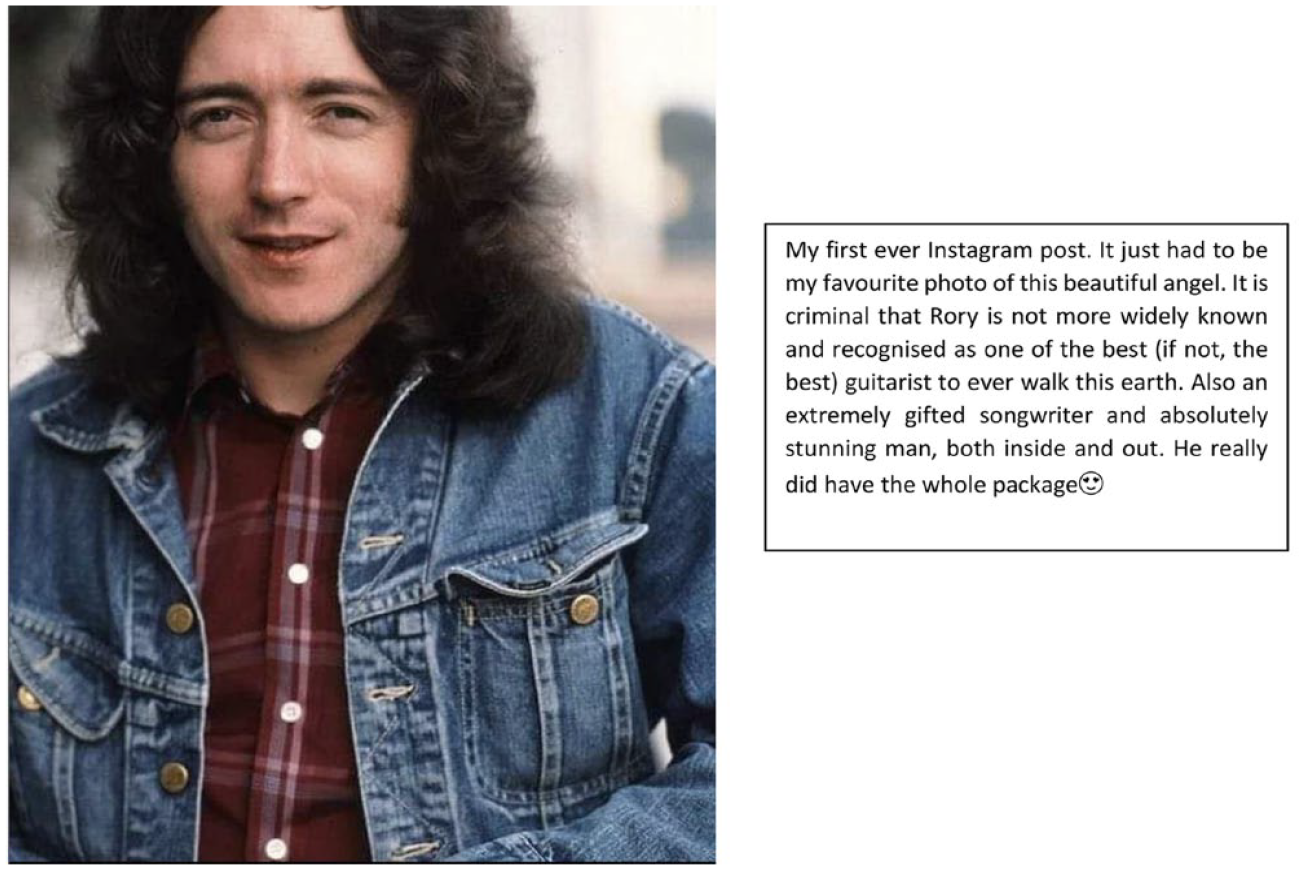
My Entry to the Rory Gallagher Instagram Fan Community, November 15, 2020.
While its tone was light and optimistic, little did readers know that I was writing the day after the worst panic attack I had ever experienced. A panic attack that had made me lose my vision in the middle of the street and left me struggling to get back home, frantically clinging onto garden walls and lampposts to guide my way. My anxiety had been slowly veering out of control since the beginning of the pandemic and now I was in the throes of a full-blown mental health crisis. The only thing keeping me more or less afloat was Rory Gallagher. No matter how bad I was feeling, listening to Rory’s music or looking at photographs of him could momentarily stall my racing thoughts.
When I finally made it home that scary evening, the first thing I did was put on his 1973 album Tattoo. As I listened, I realized that I was feeling deeply lonely. I have always been an introvert and loved my own space, but the months of lockdown and my worsening mental state made me crave some form of social interaction. I particularly missed talking about music—my biggest passion. So, the very next day, I signed up to Instagram and posted the message in Figure 1. At this point, I thought that I simply wanted a platform to voice my thoughts about music, even if nobody was reading them. However, I now realize that I was, in fact, seeking a “healing place” (Lapsley et al. 2003, 47)—much as others might turn to clinics, hospitals, or religious retreats—and that Instagram offered me the possibility of rebuilding the sense of self that my anxiety was taking away from me. To my surprise, within 10 minutes of posting, I received a reply from Denise who invited me to join her Rory fanpage.
My decision to join was life-changing.
Denise was extremely welcoming and asked me to pick my favorite Rory video so that she could create a special post to introduce me to the community. I selected Rory’s 1983 acoustic performance of “Ride on Red” from Ireland’s Eye. The video received dozens of comments from fellow members, welcoming me to Instagram and complimenting my choice of song. The seeds of friendship were sown as we discussed the video together and, for the first time in months, I felt a sense of belonging as I navigated my way into a liminal space where I could be Lauren the Rory Lover, not Lauren the Anxious. Pan (2021, 34) notes that social support is a critical part of the recovery process, particularly in its early stages. Connectedness (as Leamy et al. 2011 call it in their CHIME model) is established through positive relationships with others, which leads to social inclusion, acceptance, and community integration. Being separated from family and suffering from intense agoraphobia, the RGIFC offered me this sense of connectedness. In the real world, I have always struggled with social interactions, but suddenly in the Instagram world, things were easier. I could talk freely and did not feel self-conscious or embarrassed.
As the cold, dark winter months rolled on, I started to live for these interactions on the RGIFC, and, around 11:00 am every day, I would log in, keenly awaiting Denise’s daily post. She would post challenging questions, from what is your favorite Rory guitar solo? to what would you say if you ever met Rory? which really encouraged me to “step out” of my anxiety for a while and focus on something other than strange bodily sensations. These questions would spark long discussions in the comments sections with fans from all across the world, most of whom were young women. Often, these were the only conversations that I would have in the whole day. According to Yanos, Roe, and Lysaker (2010), intense periods of isolation during a mental health crisis can lead people to start defining themselves by their illness, which can overshadow other aspects of their identity and lower hope and self-esteem. Social participation can combat these feelings, challenging the notion that mental illness means incompetence and inadequacy. As I began to interact more with the other women in the RGIFC, I sensed my identity shift beyond one of illness and I reveled in the opportunity to show other sides of myself that were usually buried under my layers of anxiety.
About one month later, I plucked up the courage to reach out to Denise directly through private message and introduce myself properly. As we spoke, I unexpectedly found myself opening up to her about my anxiety problems and told her how much her fanpage was helping me cope with the pandemic. I was relieved not only that Denise responded warmly and offered words of support but also that our conversation then swiftly moved back to Rory and her latest post. Her attitude made me feel like a human being, not some kind of alien, and consolidated the fact that anxiety was just one small part of my identity, not the defining characteristic, as I had believed for so long. Although I had been unable to leave my house for several weeks, on Instagram, I was beginning a process of (re)connection with the social world (Tew et al. 2011) and Denise was integral to that. After that first private message, she started to check in with me every day, doing so by sending me photos of Rory rather than explicitly asking me how I was feeling. This strategy was effective, offering a way for me to let her know that I was okay without having to overly draw attention to my anxiety.
♫ I’ve Made Up My Mind. That’s Where I Belong ♫: The Gallagher Girls Are Born
April 13, 2021, marked a pivotal moment in my relationship with the RGIFC. It was the moment when I realized that these women who had been my daily interlocutors over the last six months were more than just that; they had grown to become real friends. And so, the Gallagher Girls—as we started to call ourselves—were officially born.
My life had changed so much since I had first joined Instagram. It was still characterized by frequent panic attacks and a fear of leaving the house, but now the RGIFC had given me an active social life; in fact, the most active social life I had ever experienced (see Lee et al. 2021 for similar findings). After my initial private message to Denise, I had gradually reached out to more people and, soon, I had built a network of 15–20 women who I started to speak to both privately and publicly every day. A new routine was established, where I would set my alarm early so that I could catch up with Instagram before work, and then I would log in throughout the day whenever I could to keep up with my messages. In February 2021, I had turned my Instagram account into a dedicated Rory fanpage, rather than a personal music account, and I now posted daily content, which I spent vast amounts of time preparing. The meticulous tasks of researching, writing, and editing—often accompanied by Rory’s music—served as forms of self-care, giving me a sense of purpose and, consequently, improving my self-esteem and resilience (see Batt-Rawden 2007 for similar findings). Despite my ongoing mental health struggles, I was filled with a glimmer of hope and optimism for the first time in years. My fanpage was helping me find my voice and cease to be a “victim of circumstance” (Lapsley et al. 2003, 73). Through my posts about Rory, I was learning more about myself and, although it could be painful at times, I was unconsciously using them to articulate personal thoughts that I did not yet have the strength to acknowledge.
The night I wrote the post in Figure 2, I had been watching Rory’s concert at the 1994 Montreux Jazz Festival and finding it hard to control my emotions, so I turned to Instagram to let them out. Although my post talked about the difficulties I experienced watching Rory’s anguish on screen, what I now realize reflecting back is that the sadness I was feeling stemmed from the fact that I recognized myself so much in him as I watched. By this point in Rory’s life, he was experiencing great difficulties with his mental health; just a few weeks before Montreux, he had had suicidal thoughts and, immediately after the concert, he had locked himself in his hotel room and refused to come out for three days (Davenport 2018; Muise 2002). That contrast between the powerful Irish warrior onstage and the fragile man falling apart behind the scenes could have been me. I was crying for him just as much as I was crying for myself. After a few optimistic weeks, I had suffered a major setback. Just earlier that day, I had tried to go for a walk, but after two minutes outside, I had a panic attack and returned home. I had spent the afternoon curled up watching Rory’s Montreux concert, furious at myself for being so weak. Looking back now at the post I wrote that evening, I see the paradox: my words were so full of compassion and empathy for Rory, yet I could not treat myself with the same kindness and respect. My call to “reach out, give [Rory] a big hug and help him somehow” was probably also a call to myself; I wanted more than anything for someone to do that to me. And in a way, my call was answered by the Gallagher Girls.
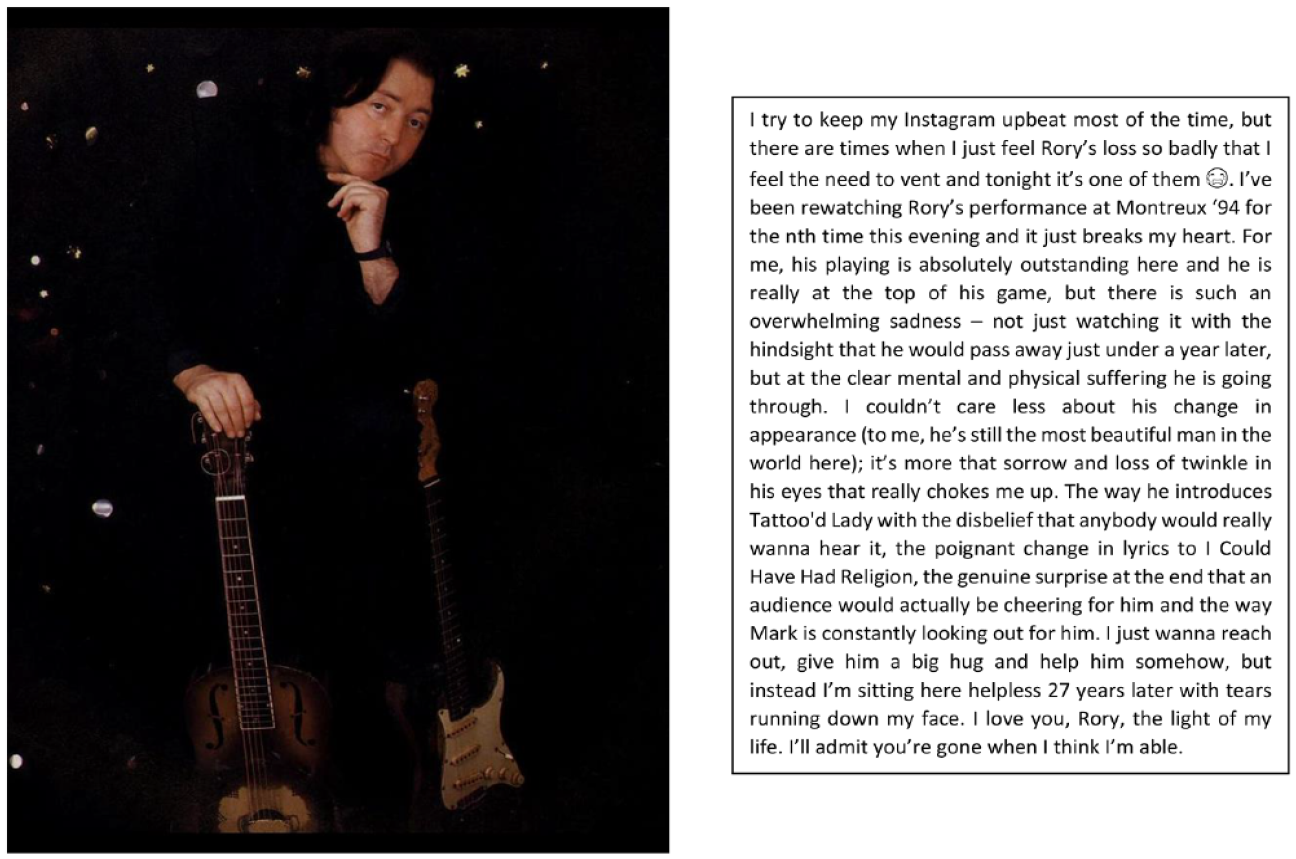
The Gallagher Girls Are Born, April 13, 2021.
Following my post, so many women rallied around and spoke publicly about how they had also had the same thoughts and feelings when watching Montreux. Several members also messaged me privately to see if I was okay. Soon after this date, I created a close friends list to share more personal Instagram Stories and set up a group chat with five of the women to whom I felt closest. Ironically, the Montreux post, which had been unconsciously inspired by a negative experience on my path to recovery, had, in fact, turned into something positive and enabled me to establish friendships and restore my agency (Lapsley et al. 2003, 73). This represented a shift in my interactions on the RGIFC: while Denise’s fanpage had first connected me with other Rory fans, I had now paved my own way and found myself speaking more frequently in the private domain as my friendships grew.
We confided in one another about the “awakening” that Rory had brought to our lives, whether on a musical, social, cultural, sexual, or even religious level. Just as with Denise, I also found myself able to talk openly about my anxiety with them, and, again, I was comforted that they treated it as just one small part of me. I had been badly bullied at school, which had left me traumatized and prevented me from forming close bonds with others. I could not believe that, now at 30 years old, I had found this type of friendship, let alone with five women dispersed geographically across the world. I felt like I was recovering from those teenage years of which I had been deprived and reveled in acting like an adolescent with them, gossiping, laughing, teasing, ogling photographs, creating memes, and participating in silly games and quizzes. We developed our own idiolect with many secret words and emojis, adopting “Roryisms”—as we called his way of speaking—in our daily conversations.
While such acts of online escapism have typically been viewed negatively as a means of seeking distraction from outside realities, Kosa and Uysal (2020) argue that they can, in fact, be “healthy” and aid emotion regulation, mood management, coping, and recovery. For me, the escapism I sought through Instagram was not about avoiding the world around me, but rather trying to develop the resilience to face it again, and, through our daily interactions, the Gallagher Girls were providing me with the necessary support to achieve this goal. When I attempted to walk up the street on my own, Alice 3 would make sure to be online so she could talk to me the whole way and encourage me. If I made it a little further to the supermarket, Kayden would send me Rory playlists or interviews to listen to as I shopped. On my successful return home, Sophia would greet me with a barrage of Rory photographs as my “reward.” But they were also there for the bad times. On the day I had a panic attack in the middle of the post office, it was Marie’s reassuring words that helped me back home safely. When I subsequently felt too scared to try and go out again for the next week, it was Abigail who brought the outside world to me by making videos of her shopping trips and any items that reminded her of Rory: check shirts, Muddy Waters LPs, Raymond Chandler books. 4 And whenever I put “A Million Miles Away” in my Story, Rachel knew it was a silent sign that things were not right and would immediately ask me what had happened.
While this could have slipped into a relationship of dependency, the Gallagher Girls, in fact, stimulated my personal initiative and drive to persevere. So much so that one day, I found myself asking them if they wanted to meet on Zoom and, to my surprise, they said yes. From this date on, the six of us started to arrange regular Zoom calls, moving our friendship beyond the boundaries of Instagram and into “real life” as we saw what each other looked like and heard each other’s voices for the first time. Naturally, Rory was at the center of our conversations, but he had become more like a root that enabled us to branch off into other interrelated topics: music, cinema, art, politics, and religion. Together, we began exploring Rory-related hobbies. I worked my way through a list of his favorite books and movies, reviewing them informally with the Gallagher Girls; I started to paint and draw, write poetry and stories (things I had not done since I was a child and forgot how much I enjoyed) and shared them; I enrolled in a short online course about the history of the blues. I thought I had always had a good understanding of who I was, but, through Rory and the RGIFC, I was learning so much about myself. Developing new skills and rediscovering old ones was enabling me to view myself more positively and imbuing me with personal goals that stretched beyond my mental health recovery (Lapsley et al. 2003, 72; Leamy et al. 2011). My new friendships were hope-inspiring and showed me that there was more to life than my anxiety.
♫ You Light Up the Darkest Night, Like a Pearl Out of the Sea ♫: Mental Health Awareness
Roughly one month after my Montreux post and the birth of the Gallagher Girls, I could feel a noteworthy progression in my recovery. Through our daily interactions, I was becoming more self-reflexive and (re)developing an awareness of self from a physical, conceptual, and emotional perspective (Davidson and Roe 2007). I particularly reflected about the cruel irony that Rory—and the connections made through him—was assisting me so much with my mental health, yet he never received the proper support to battle his own demons. Unable to go back in time and help him, I was determined to at least do something positive in his memory to help others. Speaking candidly about my anxiety problems in the private domain had built my confidence and I felt the next logical step was to go public. I decided to move my Instagram page beyond just being about Rory’s music and draw on his personal experiences (and my own) to raise mental health awareness (see Park and Hoffner, 2020; Calhoun and Gold, 2020 for positive effects of celebrity self-disclosure of mental illness). I launched this new focus on May 10—the start of World Mental Health Week.
In the post shown in Figure 3, I made myself vulnerable by speaking about my anxiety problems, linking these to Rory and highlighting how his bravery and resilience have influenced my life. When I first became a Rory fan, I had dwelled over my many similarities to him in terms of personality and challenges, sometimes at the risk of shaping my own behaviors and experience of self (see Hense and McFerren 2017 for similar findings). Now, with a renewed sense of purpose, I was able to take these similarities and use them positively to promote a new socially integrated identity that emerged out of my anxiety and contributed to healthy reflections of mental health within the RGIFC. In this way, I sought to overcome stigma and gain a new social role, which Leamy et al. (2011) see as major components in the recovery process.
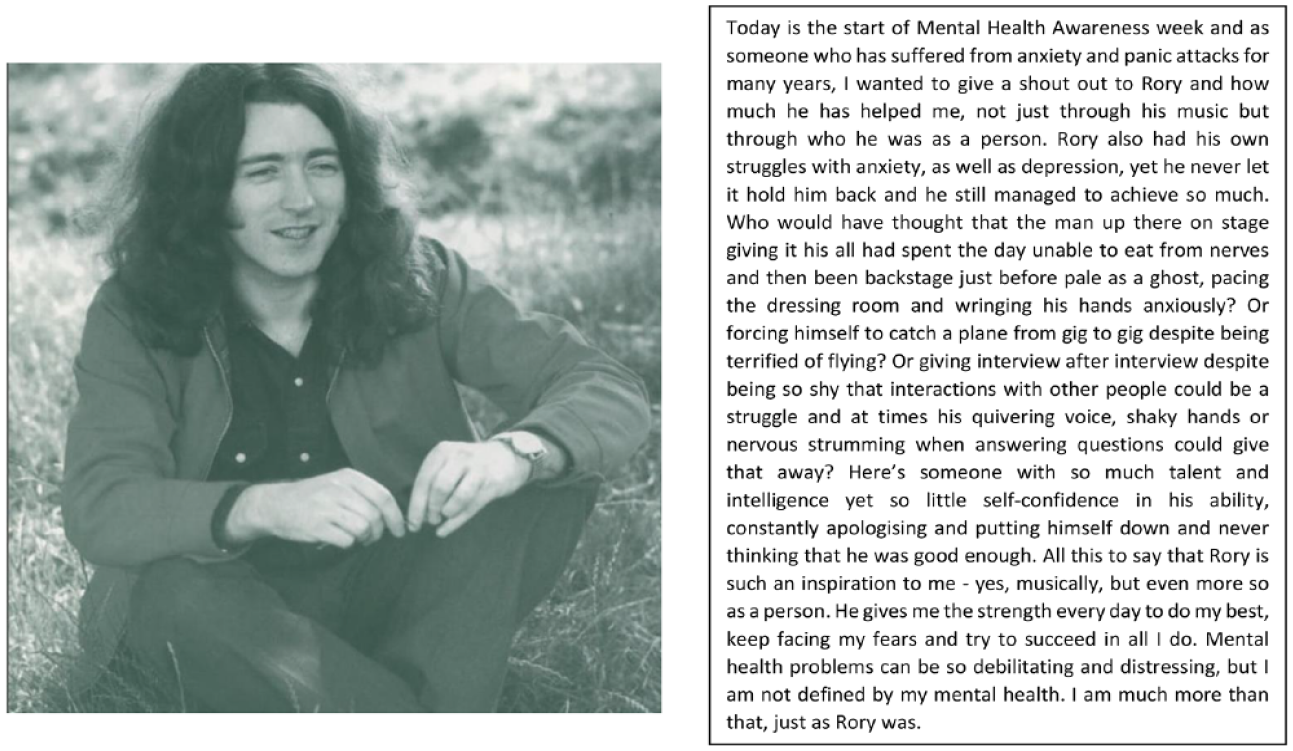
Mental Health Awareness, May 10, 2021.
To my surprise, it was like a wall had been torn down. Not only did the Gallagher Girls respond compassionately, but it seemed to spark a chain reaction of other more casual followers opening up publicly about their own mental health challenges. I could not believe just how many people had also gravitated toward Rory because they recognized a kindred spirit in him. Through them, I learned that it was not just me who engaged in certain Rory-related activities to manage my mental health. Others also could only enter a supermarket with Rory blaring in their headphones or needed to listen to his soft voice when they struggled to sleep at night or woke up with night terrors. Like me, they also put his photos on their desk to manage online meetings or wore check shirts to feel comforted. Sharing these deeply internalized expressions of fandom was powerful, highlighting the harmony and strong emotions generated within the imaginary community (Hill 2014).
Given how well the May 10 post went, mental health now became a central feature of my account and the RGIFC turned into an informal support group, where we shared Rory content that was directly related to his mental health (e.g., certain quotes, stories, videos), as well as more general well-being tips and resources, and cocreated Spotify playlists on certain self-care themes (e.g., songs of comfort, songs of happiness). Promoting mental health awareness served as a form of active recovery for me, enabling an examination, articulation, and navigation of my own pain, yet using this to help others and, in doing so, “emerge moth-like” back into the real world (Shadrack 2020, xvi).
My desire to make a meaningful change now extended beyond Instagram; I formed a connection with Heavy Metal Therapy—a community interest company about mental health and music—and wrote an article about how Rory had aided my management of anxiety. Around the same time, I also got in touch with Rory’s brother Dónal to share my experiences, which indicated the start of a regular correspondence with one another. When World Mental Health Day came in October 2021, I launched a campaign dedicated to the last 10 years of Rory’s life, drawing attention to the challenges that he faced at this time and how he still managed to achieve so much musically.
The response was even bigger than in May and my inbox became flooded with messages of support, particularly from older men, thanking me for addressing the “elephant” in the room—men’s mental health—and sharing their own stories. As this age and gender group are the least likely to seek formal mental health support (Chatmon 2020), it was extremely positive to see that the RGIFC offered them a safe space to speak out. One message in particular from a 64-year-old man saying that my daily posts were the only thing keeping him going through the pandemic particularly moved me. Everything that Denise’s page had offered me when I first joined Instagram, I was now offering to others. This recognition was strangely healing, and I wanted to explore these feelings further still.
♫ Lost at Sea Like a Sailor, You Found Me You Were My Savior ♫: The Birth of Rewriting Rory
According to Leamy et al. (2011), formulating meaning from a mental health crisis is the most powerful component in the promotion of recovery. Once meaning has been established—and with it, acceptance and mindful awareness—the next stage is to appropriate the experience for greater insight, personal responsibility, emotional growth, and control over one’s life (Christiansen 1999). This process had begun for me in May with the post to mark World Mental Health Week. However, it was not until November that I reached a stage of empowerment over my anxiety when I created the Rewriting Rory project with a fellow Gallagher Girl, Rayne.
Inspired by the successful discussions around Rory and mental health in the RGIFC, Rewriting Rory aimed to take this further with the following three core objectives: (1) to foster a greater appreciation of the later years of Rory’s career, (2) to bring about a change in the typical “rise and fall” narrative perpetuated about his life, and (3) to advocate mental health awareness. On November 13—almost a year since the day I started my Instagram journey—we launched the Rewriting Rory website with a bold opening post that challenged people to think about Rory’s final decade with more compassion and sensitivity (see Figure 4). With the website, we sought to have a more permanent place of memory than Instagram, offering a potentially enduring impact on how Rory’s legacy—and in turn, mental health—is understood.
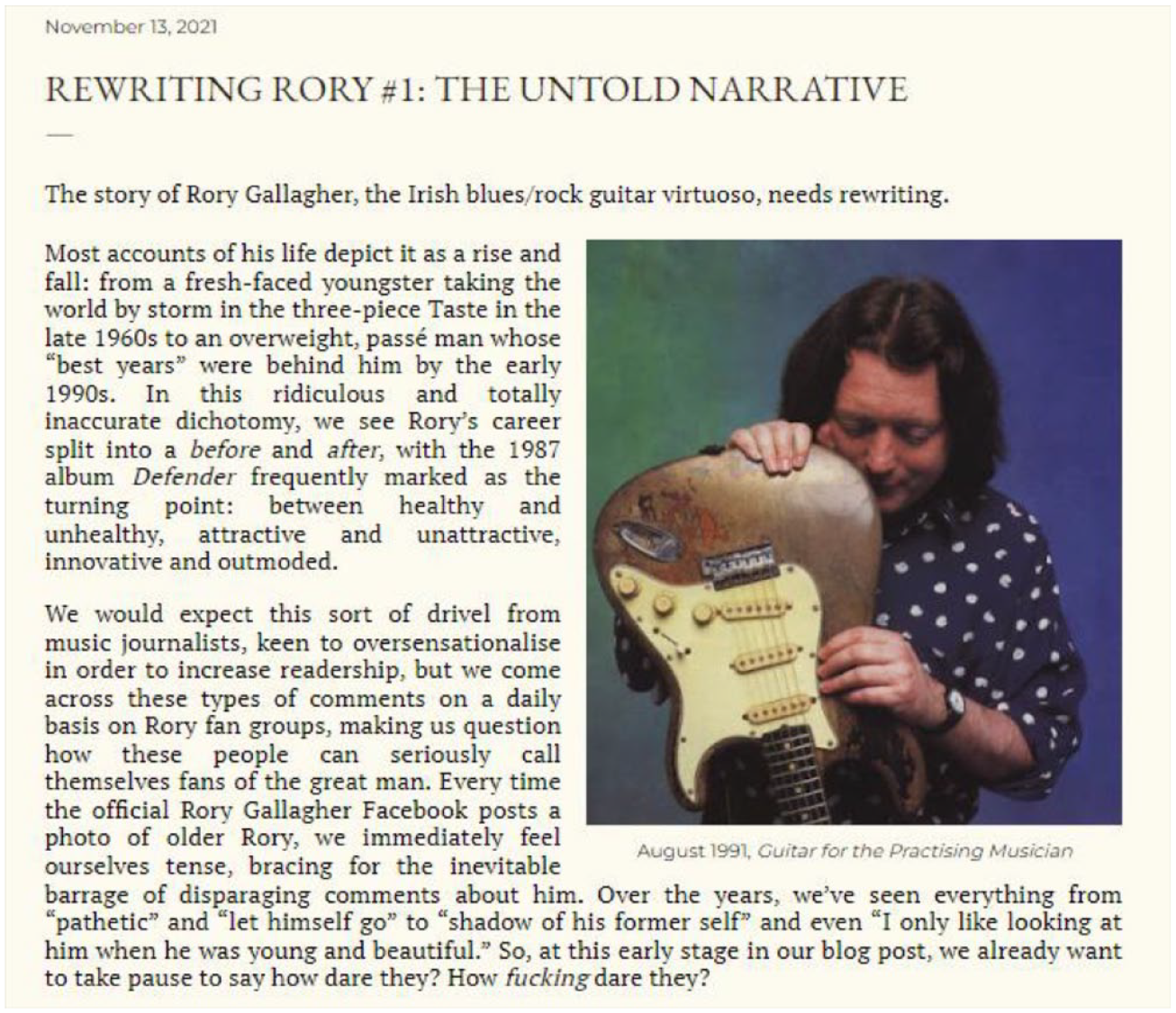
Rewriting Rory, November 13, 2021.
More than 15 months later, Rewriting Rory is bigger than we could ever have imagined when we first sat down to brainstorm this idea. Now, we publish monthly articles and have a large mailing list of subscribers, while our website has moved beyond just a blog to offer previously unpublished interviews and photographs, translated articles, and fan memories. Not only has the project strengthened my bond with Rory as I learn more about his life, but it has also pushed me out of my comfort zone as we come into contact with many of Rory’s friends, family members, and acquaintances and conduct interviews with them. Drawing inner strength from this experience, I have begun to apply these skills in real life (cf. Picton et al. 2018), engaging in activities that I have not done since 2019: meeting up with friends, going swimming, and eating in a restaurant. Slowly, my world is opening up again and the panic attacks are now coming less often, giving me room to breathe rather than constantly hyperventilate.
Rewriting Rory has also made me aware of the importance of fostering healthy practices to maintain recovery when it comes to potential triggers and warning signs of relapses (Lapsley et al. 2003). In our work, we often encounter heavy stories about Rory, which can weigh me down, particularly when I recognize myself in them. Here, having Rayne with whom to share the burden and offload emotions is a great source of comfort, as well as acknowledging the need to take a momentary step back and find ways to mitigate the effect, whether through exercise, playing guitar, or watching TV. Recovery is a trial-and-error process, which requires time and vigilance (ibid), but Rewriting Rory has reconciled me with this. It has given me self-determination and autonomy and sparked a transition in my identity. As I start to finally see the light at the end of the tunnel in my recovery process, I know that I am coming out of this crisis much stronger and as a different person from who I was before.
Instagram also remains a supportive factor in my recovery, with many Rory fanpages now collaborating on the topic of mental health and sharing the responsibility of such advocacy work. During the last Mental Health Awareness Week, for example, in May 2022, four separate accounts came together with me to post photos of older Rory, accompanied with body positivity messages and the hashtags #breakthestigma #itsokaynottobeokay and #mensmentalhealth. I am proud to be a mental health advocate, to use my own experiences to help others and no longer hide the real me. While anxiety is something that will always be part of my everyday life, I owe my recovery from this particular crisis to Rory and the RGIFC.
♫ I Hit the Floor, but I Got Up on the Count of Nine ♫: On the Road to Recovery
Buying a loaf of bread in Sainsbury’s. Hyperventilating on Queens Street. Visiting Bristol Zoo. Crying in Victoria Park. Having coffee in Starbuck’s. Crushing chest pains in Morrison’s. Going trampolining with my nephew. Losing my vision in the swimming pool. Day trip to Tintern Abbey. Feeling faint in HMV. Watching Belfast at the cinema. Shaking uncontrollably in HSBC. Walk around Caerleon. Numbness in hands at the vaccination center.
My road to recovery is long. I am gradually emerging from the darkness, but I still have some way to go. On Monday, I might find the strength to buy a takeaway coffee, only to be so zapped of energy that I cannot go out for the next three days, or the bright lights in a supermarket or a bustling crowd will trigger me and I fear a major relapse. But I keep persevering. Stuart et al. (2017) recognize that the final stages in the recovery process are a desire to return to normality and the regaining of some control over life, and that is exactly where I have been now for some time. The RGIFC and the informal self-care that they offer are still major parts of my daily life and provide me with the perfect balance of support, humor, hope, esteem, agency, and healthy escapism to overcome my crisis in ways that formal therapy has never been able.
So, what have I learned from my journey? First, nobody should ever underestimate the power of music and a musician on somebody’s life, nor online interactions and what they can offer a person, particularly at a vulnerable time. When I signed up to Instagram in November 2020, I could never have imagined what a life-changing decision that was. I was initially looking for connectedness, a place to share random musings on music, but through the connectedness I found, I then became filled with hope and optimism for my recovery, which only grew further as I rebuilt a positive sense of identity through my fanpage. As my fanpage progressed into mental health advocacy and the Rewriting Rory project was established, I learned to draw positive meaning from my mental health crisis in order to overcome stigma and gain a new sense of purpose by helping others (cf. Leamy et al. 2011).
Ultimately, I started my journey thinking that it was Rory’s music that aided my mental well-being, but through the RGIFC, I have come to realize that it is Rory as a person and the opportunity to share these feelings with others that has this therapeutic effect. In the past, I have attended in-person mental health support groups and always ended up walking out, finding that they aggravated, rather than alleviated, my social anxiety. Yet, the RGIFC is different. Anchoring our discussions of mental health in the context of Rory seems to give us the courage to talk freely, while also enhancing our deep connection with him. Speaking out about my mental health, first privately and then publicly, has also, in turn, improved my relationships with family and friends who no longer put down the quirks of my behavior to being “rude” or “strange” and understand why I am acting in a certain way. My journey has been a personal process of healing, although it has not been without challenges along the way. Yet in these setbacks, the Gallagher Girls have always been there to support me, as well as celebrate my achievements, no matter how big or small. People may have come and gone or interacted more or less over the last two years, thereby continually reproducing what the RGIFC stands for; however, the feelings of equality, freedom, and acceptance that it gives have remained constant. In all of these ways, the RGIFC sits firmly into, and even extends, Hill’s (2014) definition of an imaginary community.
The negative sides of social media are so often spoken about, but the platforms can also have many benefits, especially in the context of fandoms. Actively engaging in an online community, rather than just passively reading posts, has served as an effective way for me to manage a complex mental health problem and aid my recovery from a particular crisis, and may offer a useful coping strategy for others experiencing similar difficulties. Specifically, personal engagement with other members—first publicly and then privately—can offer connectedness and lay the foundation for a friendship. Initially, initial interactions are likely to be around the source that brings the community together (e.g., a certain musician, actor, etc.), which generally acts as a source of happiness, boosting mood, and helping regulate emotion. Then, once in an environment of safety, members may feel ready to share more about themselves. In my case, opening up about my anxiety problems, but exploring them within the context of Rory, was a catalyst that led to closer bonds with other community members as they empathized, offered nonjudgmental support, and put themselves “out there” too. This exploration of my anxiety in new ways, rather than repressing its unpleasant feelings, helped create a better understanding of self by enabling me to move beyond an identity defined by illness, be myself in a way that I cannot be in the real world, and even reclaim other parts of myself that I thought had been lost.
Once a friendship group is established online, ample positive opportunities can emerge to stimulate well-being and connectedness, from posting about private activities in real-time as they take place (e.g., watching concerts) or taking up new hobbies and feeding back on them through regular online meetings (e.g., book clubs). Some of these activities may even move beyond the initial social media platform (to Zoom, in my case, but also to real-life meet-ups in the case of others in the RGIFC). Systems of rewards can also be established to mark the accomplishments of certain community members (e.g., for managing to go to the supermarket) or certain cues (in our case, a song or a photo) can be used to check in on somebody unobtrusively. The international nature of an online group also means that feelings of solitude are minimized because at least one person is usually available to talk, whether in the United States, Europe, or Australia. This knowledge that I was not “alone” was essential in offering me resilience and giving me the courage to start going outside again. The act of running a fanpage and preparing posts is also beneficial in restoring a sense of agency to oneself, as well as constituting an act of self-care that fosters a deeper relationship with the subject. It can also lead to unexpected and exciting projects, in my case, the establishment of Rewriting Rory and collaborations with Heavy Metal Therapy and with other Rory fanpages. Overall, participation in an online community can serve as an active recovery, a self-reflexive journey that facilitates the formulation of positive meaning from a crisis and uses this to grow emotionally and gain better control over one’s life.
With health services overstretched, there is a growing recognition of the need to find alternative sources of support for mental health conditions. In recent years, social prescribing—defined as “connecting people to activities, groups and support that improve health and well-being” (National Academy for Social Prescribing, 2023)—has seen an increased uptake, with the London Wetlands Centre running a course on wildlife beauty (Carrington 2021) and the city of Brussels offering free museum visits (Rankin 2022) for sufferers of anxiety and depression, for example. While this focus on the outdoors is positive, it is less beneficial for those who suffer from agoraphobia or social anxiety. Therefore, the social prescribing of online fandoms could offer an important step in recovery and rehabilitation. Specifically, a formalized program of support to teach interested people how to find relevant fan groups on social media and engage with them, how to create a fanpage, and how to produce content could be beneficial, perhaps using the success of the RGIFC as a template. Participants could also keep reflective journals about their experiences over time to feedback periodically to a qualified professional with whom they can track progress and plan ways forward.
Central to its effectivity is making mental health support an outcome rather than a main focus so that the environment is less intimidating than a traditional mental health support group and any conversations emerge holistically from the central subject of the fanpage. While the RGIFC mainly consists of female members, its general structure and the online platform of Instagram itself may make the environment more accessible for men who are less likely to seek mental health support due to a persisting stigma surrounding masculinity norms (Chatmon 2020). In recent years, there have been numerous social initiatives to make men feel more comfortable in talking about mental health, from the use of video games (Cheng et al. 2018) to doing woodwork in Men’s Sheds or talking when seated side-by-side to mimic a pub environment (Porter et al. 2022). Online music communities could equally serve as a good starting point to form connections with like-minded others and develop conversations on mental health through the experiences of a particular musician, rather than foregrounding one’s own experience. Knowing that one’s role model—particularly if they come from a typically “masculine” area like rock music—has also experienced similar difficulties can be liberating for men in particular and make them feel less uneasy about opening up, as I have witnessed firsthand on the RGIFC and through Rewriting Rory.
If there is one positive to have come from the COVID-19 pandemic, it is that more open conversations are starting to be had around mental health. Now, therefore, seems the perfect time to conduct more studies into the potentials of online music fandoms and work with practitioners to establish them as a social prescribing option, particularly to reach groups who are typically unwilling or unable to access traditional mental health support.
Postscript: Redemption Blues
July 26, 2022, Cork, Ireland
I enter St Oliver’s Cemetery. I don’t know where he is, but I feel a magnet drawing me toward him. I turn right and my pace starts to increase as I spot the five gold beams of his headstone—a replica of the Melody Maker Best Guitarist Award he won in 1972. I practically float toward it and then sink to my knees. I kiss the cold metal and run my fingers across his engraved name. “I’ve finally made it here, Rory,” I whisper. I pull out all sorts of gifts from my bag and place them at his side: a bolo tie, a neckerchief, an Irish flag, 12 white carnations (each with an individual message of love), poetry, a portrait drawn by my friend Ellen. I talk. I smile. I weep. I laugh. Then, I put on my headphones and immerse myself in “A Million Miles Away.” Eyes closed. Just him and me. All alone. Nobody else around us. This time, the song is not one of sorrow, but one of hope. Because I am miles away from home and yet, for the first time in years, I don’t feel afraid. In fact, it feels strange to say, but I don’t think I’ve ever felt happier than at this moment. I am calm. At peace. Strangely anxiety free. Thank you, Rory. Thank you for everything.
Footnotes
Acknowledgements
I wish to thank all of the Gallagher Girls in the Rory Gallagher Instagram Fan Community without whom this article would not have been possible. I also want to particularly thank my good friend Rayne Morales, the cofounder of the Rewriting Rory blog and whose excellent unpublished undergraduate study on the RGIFC served as an initial source of inspiration for this paper.
Declaration of Conflicting Interests
The author declared no potential conflicts of interest with respect to the research, authorship, and/or publication of this article.
Funding
The author received no financial support for the research, authorship, and/or publication of this article.
Notes
Author Biography
 ).
).