




Abstract
The need to reverse the harmful economic, social and environmental effects of car-dependent cities has intensified as evidence of its costs on health, communities, local economies, and climate change goals becomes more apparent. Part solution must be a focus on reducing the need for private car use and increasing instances of active and sustainable transportation such as walking. Walkability is the measure of how walking-friendly an area is for individuals and includes concerns such as the built environment and connectivity to key amenities and additional transport options. This study presents an autoethnography of walking in Galway. By “experiencing” the author’s walk to work, it points to the lack of concern for the crucial features of walkability that would make this an attractive option for many in the city. The aim is to better inform community actors and policymakers on how to enhance urban design and planning with respect to walkability.
We can’t change anything until we get some fresh ideas, until we begin to see things differently.
Introduction
A legacy of planning and designing cities and towns for the car rather than people has left many urban centers congested with traffic, with detrimental noise and air pollution and disproportionate amounts of scarce public space devoted to the private automobile (Gehl 2010). The negative consequences of such persistent automotive use also lead to a disconnection in and between local communities and an increase in urban decay (Kay 1998). Cars have tended to dominate many urban landscapes, and driving has become the normal, habitual, imagined means of travel, while other active and sustainable modes of transportation received limited consideration by key policy- and decision-makers in the latter half of the twenty century (Hynes 2017; Sloman 2006). There is a pervasive pattern of car dependence in many cities and towns, ironically engendered through the ways in which they enable people’s independence, and individuals across the world have come to organize their daily lives and routines around the use of a private car (Carrabine and Longhurst 2002). Travel by car is generally perceived as making participation in favored daily activities easier and allows for travel at times of convenience. Individuals in various different urban settings and societies have varying needs for private car use in organizing their daily routines therefore; there are reasons to believe that limiting or restricting car-use in favor of alternative methods of transport will have both instrumental and psychological consequences for some (Lättman, Friman and Olsson 2020). But excessive car use leaves many city and town streets bleak, unattractive, and, at times, unsafe places to walk. This is leading to growing economic, social, and environmental harm, impacting the health and well-being of residents, and diminishing overall quality of life in these communities. Moreover, it has long been argued that cities should have much more intricate economic and social concerns than merely automobile traffic (Jacobs 1961). With such societal and ecological burdens from so many cars, municipalities are now beginning to realize that by creating cities for people, encouraging individuals to walk and cycle, and reducing the number of overall car journeys, they can create healthier communities (Frumkin, Frank and Jackson 2004; van Wee 2019), increase social capital (Leyden 2003; Rogers, Gardner and Carlson 2013) and retain and attract business and investment into urban centers (Chaudhuri and Zieff 2015; Hahm, Yoon and Choi 2019; Kumar and Ross 2006; Lawlor 2018).
Walkability is defined as the extent to which the built environment is friendly, safe, accessible, and pleasant for pedestrians (Moura, Cambra and Gonçalves 2017), and is viewed as a fundamental aspect in the promotion of healthy, sustainable, and inclusive communities (Jun and Hur 2015; Lee et al. 2018; Richard et al. 2008). This research uses an autoethnographic approach to investigate urban walkability in the context of Galway, a small city of some 80,000 residents (CSO 2016) on the west coast of Ireland. It seeks to inform community actors and local transport policy- and decision-makers as to their unwitting inattentiveness to the detail and features of walkability, and to the perceptions and realities, this is having in discouraging individuals to walk in and around the city. This research invites greater responsiveness to indicators of walkability that can help improve quality of life and lead to the promotion and development of strong and healthy communities. Such studies are critical to our overall understanding of mobilities given that local characteristics and topographies continue to be undertreated in the literature and research but must be understood as existing transport cultures (Hynes and Seoighthe 2018). Indeed, transitions towards sustainability can only occur with community-based approaches that consider such local cultures and conditions (Newman and Kenworthy 1999). Autoethnography offers a worthwhile way of conducting research as it provides a methodology that legitimizes and encourages the inclusion of the researcher’s self and culture as an ethical and politically sound approach, while also considering the complex interplay of one’s own personal understandings, power and status, interactions with others, and the written word (Etherington 2004). Moreover, autoethnography acknowledges and accommodates subjectivity, emotionality, and the researcher’s influence on research, rather than just hiding from these matters or assuming they do not exist in the first instance (Ellis, Adams and Bochner 2011).
A Stroll through the Literature!
As urban populations continue to increase (UN 2019), the evidence that the natural and built environments, as well as the social fabric of urban communities, are critical determinants of health and well-being becomes more marked (refer to Nieuwenhuijsen and Khreis 2019). Almost all aspects of the built environment are shaped by policy-related decisions but rarely does attention to preventative health measures form a key consideration in the decision-making processes in relation to how we plan, develop and build our cities and towns. The quality of urban design affects us physically, socially, and mentally (Badland et al. 2014; Raman 2010; Ritchie and Thomas 2013), and planning decisions affect issues such as our weight, our carbon footprint, how we shop and how social we are with others, as well as having important positive economic utility (Leyden and Collins 2015). The relationship between walking and the city is multiple and complex, with engagements ranging from the rational and planned to the poetic and sensual (Middleton 2018). Middleton’s analysis highlights the significance of how people articulate their everyday pedestrian practices and how these experiences are often framed in relation to emergent everyday politics such as how individuals appropriate space on foot, and broader concerns with the “right to the city” (Middleton 2018, 311).
Research supports the hypotheses that living in areas that encourage and promote walking will positively influence sense of community (Lund 2002; Wood, Frank and Giles-Corti 2010). The built environment creates and uses networks, interactions, and connections to improve citizens’ sense of community, as well as help promote access and enable the emergence of new information, ideas, stimuli, and resources. But an urban environment and community do not appear fully formed; they emerge over time through many small decisions by numerous actors responding to a host of desires, needs, imperatives, and constraints. Planners, developers, elected officials, community activists, transport engineers, environmental agencies, builders, and ordinary citizens are all key stakeholders, and most of the policies, standards, assumptions, markets, and professional practices we now use emerged in the twentieth century at a time when the built environment was designed to prioritize the private automobile and when issues related to walkability were simply not a consideration (Grant 2013). The modern city and town were designed and developed largely to accommodate cars. But we are now, in the twenty-first century, caught up in a perfect storm of intersecting health, social, environmental, and economic challenges that require system-level changes that cross many disciplines and populations in rethinking and retrofitting our towns and cities in a sustainable manner (Dannenberg, Frumkin and Jackson 2012). The way a city is planned and organized must foster the development of a healthy environment through remodeling scarce public space for use by communities of people rather than just cars. Urban planning, thus, must be rooted in embodied human experiences, and walkability must be seen as an ethical imperative for refocusing urban planning on connecting people in their cities and towns (McFarland 2015). It is generally agreed that the concept of community is, in one way or another, tied to place because of the powerful relationship that exists between both; and the evidence suggests the feelings for place are structured from daily routines and experiences with the built and natural environments (Bow and Buys 2003). But there are also legitimate concerns and barriers to the promotion of walking in some areas, and residents who perceive their neighborhood as unsafe may limit their physical activities (Foster et al. 2014). In a systematic review of studies on four continents—America, Oceania, Asia, and Europe—focused on perceived impediments to active transport to school, the main reported concern was that of the built environment but other issues of significances were traffic safety, distance, crime-related safety and social support (Aranda-Balboa et al. 2020).
Walking and walkability tend to be undervalued in conventional transport planning and thinking and as a result, pedestrian pathways and facilities are frequently given low priority by local, regional, and national decision-makers. While there is often recognition that neighborhoods must be safe, must have good access to schools, employment, and the range of essential services and amenities, there is much less acknowledgment that something as mundane and basic as walking needs to be reflected upon (Talen and Koschinsky 2013). Studies have shown that walking more is likely to encourage people to participate more in collective and community activities can prevent social isolation, loneliness, and depression, and can help increase social capital (Babyak et al. 2000; Frumkin et al. 2004; Leyden 2003; Rogers et al. 2011). There is also clear evidence that physical activity, such as walking, has substantial health benefits (Ekkekakis 2013; Giles-Corti et al. 2016; Hart 2009; Kelly, Murphy and Mutrie 2017). The physical characteristics and landscapes of residential neighborhoods and urban centers, particularly the connectedness of streets and neighborhoods and the proximity of destinations, can greatly influence walking behaviors (Owen et al. 2007), and areas with poor walkability characteristics tend to have significantly less walking and more driving than more walkable localities (Litman 2017). Further, walkable neighborhoods and places are positively linked to economic performance and real estate development and values as a result of their attractiveness to permanent and temporary urban residents (Leinberger and Alfonzo 2012).
Frédéric Gros, writing in A Philosophy of Walking (2015), deliberates about walking, often assumed to be the most banal mode of travel or exercise, elevating it to a pursuit that inspires creativity, evokes freedom, and often quieting a troubled soul. Evoking Henry David Thoreau and his proposed New Economics (1971 [1854]), Gros maintains that Thoreau’s ideas were formed during an era of large-scale production and the beginning of all-devouring big capitalism and the industrial exploitation of not only workers but also of nature and its resources. Thoreau suggested that instead of asking what return a given activity will produce, the question should be what its costs are in term of quality of life. This is a way of “distinguishing between profit and benefit” (Gros 2015, 89). Our current economic thinking considers walking as thoroughly useless, as time wasted in which no wealth is produced. Yet its benefits in absolute terms to individuals, community, and society can be immense. Studies suggest that walking boosts creativity (Feinberg 2016; Oppezzo and Schwartz 2014; Overall 2019), enhances spatial attention and memory performance (Labonté-LeMoyne et al. 2015; Salas, Minakata and Kelemen 2011), and prevents cognitive decline in the elderly (Ahlskog et al. 2011; Kirk-Sanchez and McGough 2014), in addition to a number of other psychological benefits (Johansson, Hartig and Staats 2011). Indeed, Gros points to the fact that many of our most prolific and creative writers, philosophers, and social thinkers—Rousseau, Kant, Rimbaud, Robert Louis Stevenson, Nietzsche, and Gandhi—were ardent lifelong walkers.
While there remains some debates over the term “walkability” and the related idea of a walkable place (refer to both Forsyth 2015; Lo 2009), the General Theory of Walkability suggests that urban walking must satisfy four main conditions: it must be useful, safe, comfortable, and interesting, and each of these qualities are essential but none alone is sufficient (Speck 2013). 1 Useful suggests that essential aspects of a person’s daily life are located nearby and organized in such a manner that walking serves that individual well. Safe refers to the street’s design; keeping the walker safe from cars and other travel modes such as cycling and personal mobility devices, poorly positioned street and road signage, waste bins, badly constructed pedestrian pathways, and other impediments that may hinder a person’s safe passage. The person walking, more importantly, must “feel” safe in their endeavor. 2 Comfortable means that the built environment is designed in such a way that urban streets are pleasant and pleasing to the individual walking, in contrast to wide yawning spaces, and interesting denotes that streets should consist of unique and aesthetically appealing buildings filled with all facets of agreeable humanity. Southworth (2005) proposed six criteria that need to be present for the design of a successful walkable neighborhood: connectivity, linkages to other transport modes, fine-grained land-use patterns, safety, the quality of walking surface, and path context. 3 The London Planning Advisory Committee developed a multidimensional 5C’s arrangement that has been widely adopted: connected, convenient, comfortable, convivial, and conspicuous (Gardner et al. 1996). Building upon these five dimensions, Moura et al. (2017) proposed two additional factors—coexistence and commitment—arguing that some important attractiveness-related features of the built environment were not captured by the existing 5C’s. Walkability, in any case, must not be viewed as a singular or universal entity but one made up of many synchronized and intersecting local cultures, features, and dimensions. Therefore, to determine and reach a deeper understanding of some of the key walkability features, in the context of Galway, the methodological approach underpinning this research was one of autoethnography and framed around Moura et al.’s 7C’s. The reader will, thus, gain insight into the local features and characteristics of walkability through the author’s storytelling of his walk to work through some of Galway’s urban forms. It will also serve to direct local and regional policy- and decision-makers with regards to the need for closer attention to the detail and geographies of walkability, while contributing to the larger body of literature on walkability and its connections to urban community building and resilience.
Methodology: understanding autoethnography
Autoethnography is an approach to research and writing that seeks to describe and systematically analyze one’s own personal experiences in order to understand cultural practices and insights (Ellis 2004; Holman Jones 2007). This approach challenges established ways of doing research and representing others and instead treats research as a political, socially-just, and socially-conscious act (Adams and Holman Jones 2008). In undertaking such an approach a researcher uses tenets of autobiography and ethnography to do and write autoethnography thus, as a method, it is both process and product (Ellis et al. 2011). The method promotes a genre in which research stems from the individual’s own living and lived experiences and connects this with the broader socio-cultural context (Reed-Danahay 1997). Individual experience is recognized as an essential part of the broader social world which shows interconnectedness of personal life with wider culture (Mykhalovskiy 1996). Sparkes (2002) suggested; in presenting individual stories we create a challenge to the limitations of available narratives by providing new ones, and these collective stories have transformative possibilities at a socio-cultural level. Critics of autoethnography hold it accountable to criteria normally applied to traditional ethnographies, or to autobiographical standards of writing (Delamont 2009; Ellis 2009; Le Roux 2017). But Autoethnographers value the need to write and represent research in evocative and aesthetic ways, and believe research are socially-just acts. Rather than a preoccupation with accuracy, the goal should be to produce analytical, accessible texts that can change us and the world we live in for the better (Holman Jones 2005). Indeed, since all methodological approaches have their limitations, competent researchers and evaluators of research must acquire not only the ability to use and understand the application of various research skills but also the acumen to judge when some kinds of research are likely to prove more productive and germane than others.
In Ways of Walking (2008, 2), editors Tim Ingold and Jo Lee Vergunst contextualize the social importance of walking: [W]e walk because we are social beings, we are also social beings because we walk. That walking is social may seem obvious, although it is all the more remarkable, in this light, that social scientists have devoted so little attention to it.. . . Thus careful, ethnographic analysis of walking, we suggest, can help us rethink what being social actually means. This is a task that remains to be done.
A successful urban walking environment embodies the social context of walking but “can also accommodate the multifunctionality called forth by users’ daily practices and that responds to their equally multi-layered representations” (Lavadinho and Winkin 2008, 165). By learning through direct experiences in their environment individuals can make informed decisions about issues affecting that environment from a position of knowledge (Curtis 2016). Considering the “right to the city” in relation to mobility and the frequently contested use of urban space on foot opens up new ways of thinking about everyday urban politics and urbanism (Middleton 2018). Walking is itself never simply about traversing a route and getting from one place to another: the journey itself is performative, an act of place-making, and an active engagement with the environment around us (O’Neill and Hubbard 2010). Hence, this autoethnographical study seeks a deeper understanding of walking and walkability features through the representation of the narrative and experience of walking to work in Galway. Furthermore, the author’s experience, as a transport and mobilities social scientist, will add depth to an overall understanding of current urban design, practices, and planning with respect to walkability in this city. But such an approach has additional obvious limitations as urban walking, in general, is experienced differently by individuals based on their age, gender, physical condition, race, and other such personal considerations. The choice of one single walk to work will also draw criticism, but the key objective of this study is not to comprehensively cover every aspect of walkability in Galway but rather reveal some of the obvious realities for people choosing to walk in and about this urban form. Providing a first-person social scientific perspective and narrative of walkability features in relation to specific locations clearly highlights deficiencies in planning, design, and in the support for walking in the city.
Walking the Walk
The day began, as usual, with a quick cup of coffee listening to the morning news on the radio. It was nearing the end of October, summer was now a distant past but it was a fine morning without much sign of rain. I have lived in the city center for over 30 years now and my favored way of getting to work was to walk, and occasionally cycle. This particular morning, however, having left my bike at work the previous day and with no sign of rainfall, I was content to don my jacket and walk on this particular bright crisp morning. I have always been observant of social life on my walks around town, a modern-day purposeful urban flâneur 4 so-to-speak, but my deep interest in mobilities and transport and their impacts on the environment and community have sharpened these perspectives over the years.
Upon leaving my terraced house I only have to walk 10 yards before I’m faced with my first obstacle. An entrance to a private flat complex cuts the pedestrian pathway, and this is the first of numerous instances that I encounter in which car traffic is given primacy over walkers. Bing weary of speed some drivers use this entrance, I check left and right for any incoming or outgoing traffic and walk across. Walking another 20 yards I’m confronted with my next Obstacle. The main private bus terminal is located in the Seán Duggan Centre at the end of the street and buses entering this center are again given priority over walkers. On this particular morning, a young lady just ahead of me is pushing a child in a pram and is forced onto the road as one of these buses, waiting for the barrier to lift, blocks her path (Figure 1). This is not an unusual occurrence and one I have experienced myself many times in the past. I’m conscious of the diesel fumes coming from the bus tailpipe as it waits at the barrier; the heavy sound of a bus engine idling and distinctive smell of diesel fumes. Once I have navigated this particular bus terminal entrance, I make my way to the pedestrian lights at a busy three-way junction at the intersection of Forster Street and Uí Eithir Road. Traffic coming from three different directions creates a sense of cautiousness and heightened safety awareness.
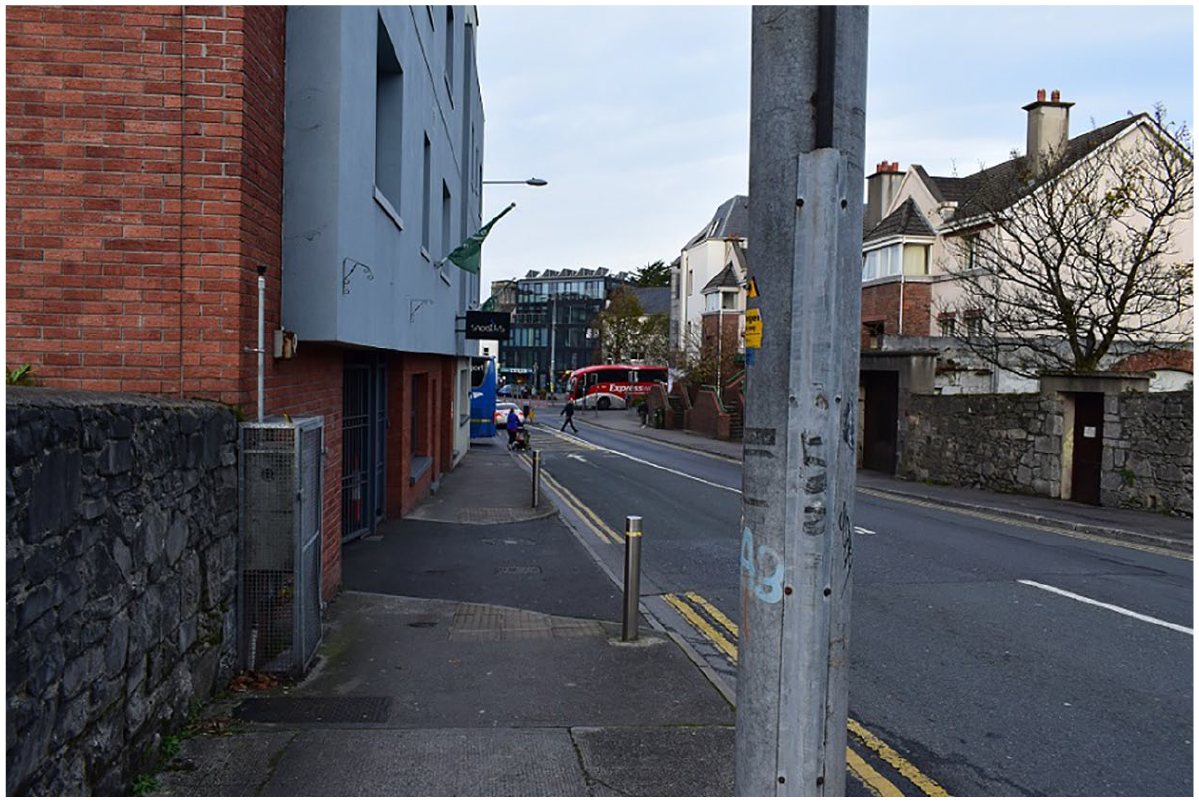
Entrance to the Coach Station.
My goal at these traffic lights is to cross the road in an “L” shape, but once the lights turn green for walkers to cross they stay this color for just approximately 6.5 seconds before turning to a flashing amber light. While they do remain flashing amber for a short period, there is inadequate time for walkers to safely cross the “L” shape of the road without hastening the pace and while I am, thankfully, of good health and fitness I can’t help imagine what kind of additional stress this places on the disabled, elderly or infirm. The cynic in me maintains that these lights are designed in this specific way so as to “hurry” the walker across the roads and facilitate the swift resumption of vehicular traffic at this junction. I am aware of all the engines idling at this crossing, with some slightly revering in anticipation, adding to my tension at this junction.
My journey then takes me through the grounds of the old St Patrick’s church and into St Patrick’s Avenue. The links between walkability and the built environment are of immense importance and key features of walkability include connectivity, comfort, and conviviality. While St Patrick’s Avenue does, indeed, offer an important convenient and connected route to work for me, the ambiance of this neglected area of the city is stark. This avenue was once a vibrant city center community but at the height of the so-called “Celtic Tiger” 5 the entire community was bought out by property spectators, who were seeking to rebuild the area and develop high-end retailing and accommodation. This gentrification project was halted in its tracks with the economic crash of 2008 and ownership of the properties have since changed hands. However, houses here largely remain boarded up, with cars randomly parked along the avenue and blocking some pedestrian access (Figure 2). This has now become an unkempt and ignored area of the city center and an unsafe place to be once darkness falls. I can’t help feeling uncomfortable walking through this area; the sights and sound of neglect and abandonment abound.
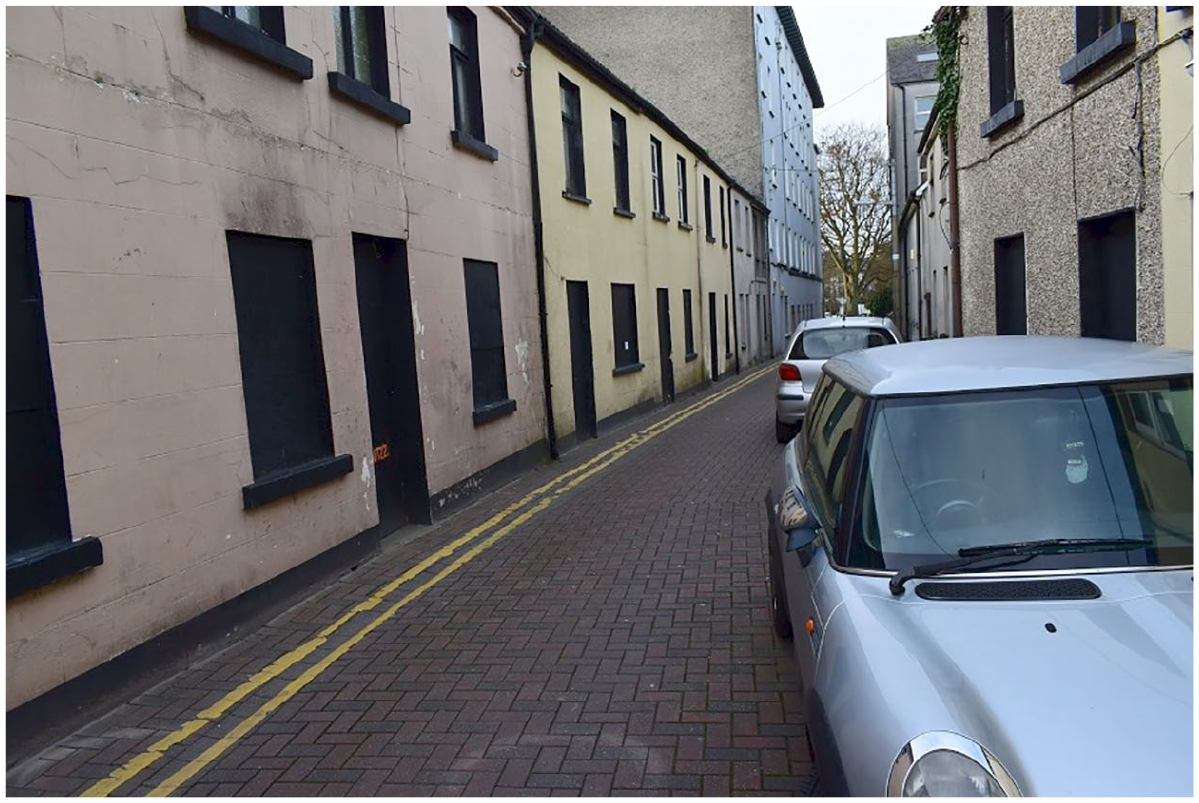
St Patrick’s Avenue.
I enter Eyre Square, the focal point of the city. There is a heightened sound of traffic and movement as this is also the central public transport hub. Diesel buses, idling and awaiting passengers, dominate the public space while traffic moves freely around the square. Traffic reigns over this space, with the resultant sounds and smalls. This area underwent a major (and controversial) 6 refurbishment in the early part of the millennium but much of the materials used were imported from China and have been criticized for being not “fit for purpose” for the Irish climate. The paving slabs used on the pathways, once wet, become extremely slippery and dangerous, and this indeed is my own personal experience. I watch my footing and cross the road at the pedestrian crossing at the top of Eyre Square. I’m struck by the excessive road signage that clutters the area. These road signs are dirty in appearance and confusing in their message and signal neglect and bewilderment to me. Making my way down Eyre Street I’m struck by the number of obstacles that walkers face daily. Poorly designed and located rubbish bins, lamp posts, parking meters, and other such tedious obstacles “litter” the footpath in an uncaring and unconsidered manner, particularly when it comes to walkers’ comfort and convenience. I have the distinct feeling that nobody considers or thinks about people who walk these streets; we don’t matter. At the end of street, a small road emerging from St Brendan’s Avenue again cuts the pedestrian footpath, again prioritizing traffic.
My walk takes me into Woodquay. This is perhaps the most underutilized area of the city, but with some of the greatest potential for improvement with regards to public space, liveability, and quality of life. Most of this space is given over to parked cars for most of the day and evening. A place in the heart of the city for cars, with no space left for people! 7 Eliminating cars from this area and filling this public space with seating, cafés, shrubs, and flower beds, would positively transform this area significantly benefiting the people who live and work here, and nearby. This is a conversation that is long overdue if the city is to mature in a progressive and sustainable way. Looking at this area, I get the sense we reserve the best of our scarce public space for cars.
Just off Woodquay, St Anthony’s Place is the site of persistent illegal parking, a phenomenon that blights this and other areas of the city. Galway is not unique in this respect, but the continuous use of the pedestrian footpath for parking, and the tacit acceptance of such behavior, makes walking in the city particularly unpleasant at times. My personal experiences of this 8 would indicate that parking on footpaths and obstructing walkers in this manner is an accepted normalized behavior, with little or no regard given to the people who choose, or are forced, to walk the city on a regular basis. In not considering walkers space, drivers delegitimize this way of traversing the city and are officially sanctioned and comforted in their inconsiderate actions by a lack of enforcement.
Walking onto Francis Street I’m now moving towards the pedestrian lights at the Courthouse junction. Crossing both sets of lights I tentatively amble towards the back of the courthouse because of the very slippery paved surface, which at this time of the morning is already completely saturated with cars (Figure 3). Most of these vehicles belong to individuals working in the judicial system and operating out of the Courthouse and I often think about the confused message their behavior must send to the citizens of the city, particular those drivers summonsed to pay parking charges at this very building. My route then takes me across the Salmon Weir Bridge (Figure 4) and my overwhelming sensory feeling is one of un-comfortability and possible danger. This historic bridge, constructed in 1818 and now a protected structure, was never built for the type and volume of traffic it now
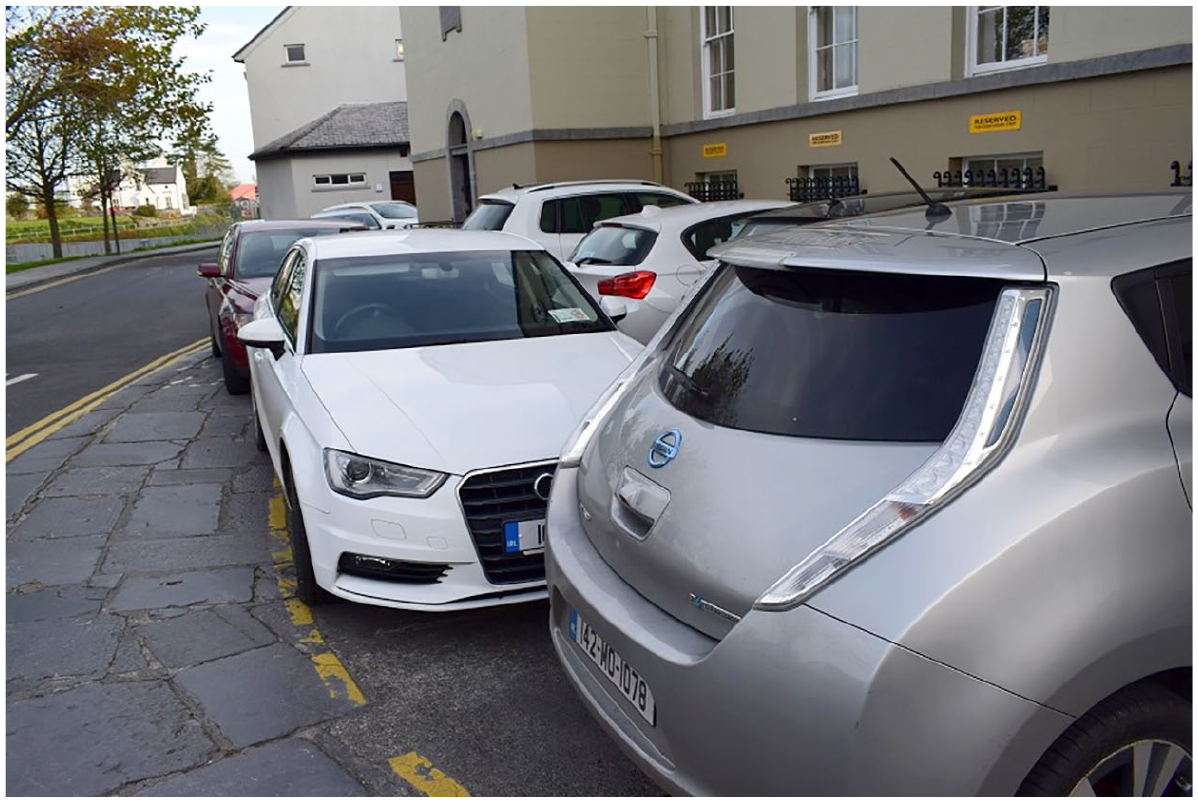
The Rear of the Courthouse.
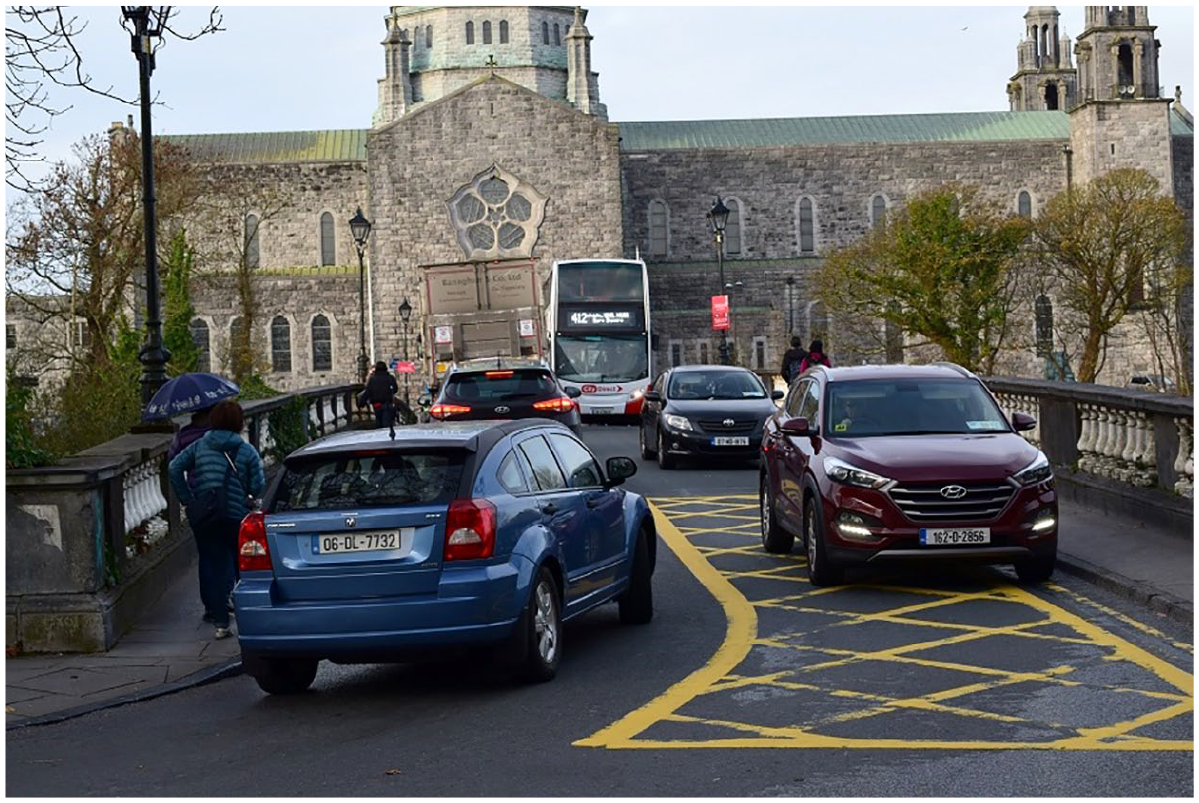
The Salmon Weir Bridge.
experiences on an hourly and daily basis. For walkers, the very narrow footpaths and the proximity of large vehicles, particularly buses, puts our very safety at risk. As this is the main corridor to the university, hospital, and the iconic Galway Cathedral, it is an extremely busy route for pedestrian traffic and although there have been some recent discussions about providing a new bridge for walkers and cyclists, there is disagreement among city councilors about its cost and purpose. 9 Such cost and purpose with regards to roadbuilding and maintenance seldom occurs in the city, which gives me the belief that my safety and comfort, as a walker, is a low priority.
At the opposite side of the bridge, I take an immediate right turn and shortly thereafter enter the university grounds, but my walk to work is not yet over. My observations and experience of walking through the university campus grounds would suggest that the authorities here also neglect walkers in favor of car traffic and on-campus parking. A university of its size, with so many walking and cycling students and staff, should prioritize these active and sustainable modes of travel but I have only come across one sign that comes anyway close to this position. This is to be found at a car parking location in front of the Old Engineering Building and while it does indicate a “shared zone” the stated “pedestrians and cyclists have the right of way over motorists” is written so small it is unreadable from any reasonable distance. But at this time of the morning, there is a certain quietness and calm before the rush of vehicle traffic arrives. The noise of the city has dissipated somewhat and I’ve become more aware of the sounds from nature and the chattering of students.
Walking through the campus I’m struck by the numbers of walkers and cyclists, but also by the absence of any significant indication that these people are prioritized in a hierarchy of transport users. We appear to be somewhat of an afterthought in mobilities planning on-campus. In several places and junctions, walkers must give way to traffic, and where there is priority given—such as at pedestrian crossings—there is a lack of signage to indicate the purpose and intention of such crossings. Indeed, where signs are visible these are ambiguous in their intent and often faced towards walkers and not oncoming traffic. I next must confront what is perhaps the most dangerous intersection on campus, and one that has received little action to protect and prioritize walking over the recent past. The underpass bridge which separates the Central and South Campus has only one narrow footpath yet caters to a substantial number of students and staff at various times of the day during term time. Yet, priority is given to two-way traffic at the expense of individuals on foot, who are frequently forced onto the road and oncoming traffic. Is it not possible for much of this scarce space be given to the more vulnerable walkers and the traffic be restricted to a stop-and-go system? My office in the Áras Moyola building is just a short distance across an attractive pedestrian walkway after the underpass. A mental map diagram of the walk is provided in Figure 5.
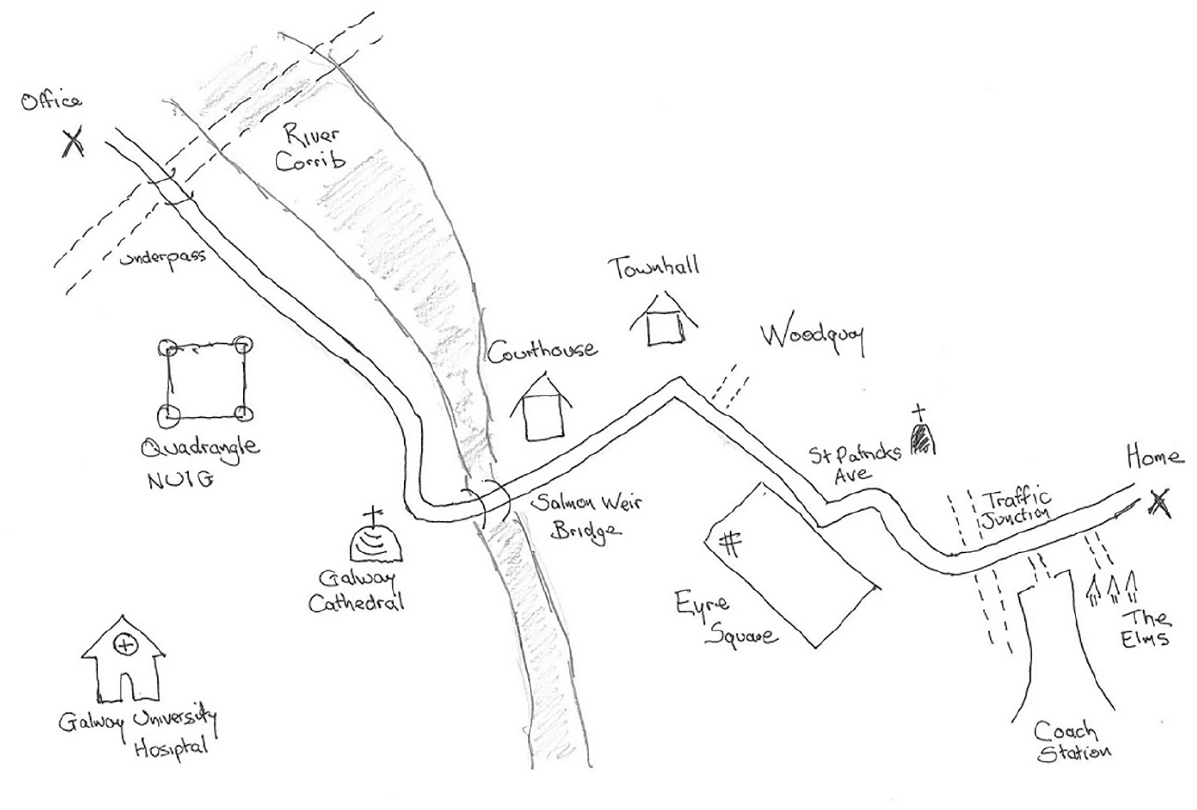
A Mental Map of the Walk to Work.
Talking the Talk
Walking through an urban landscape is frequently done in an unconscious manner so deficiencies and problems with key features of walkability need to be signaled in a more intentional way. Once revealed in a more deliberate and conscious fashion, such features become objectively observable and measurable to those seeking to improve the geographies of urban walking. Such purposeful walks act to highlight the practices that have allowed automobility to become institutionally embedded in the city, at the expense of the development of more sustainable and active modes of travel. A bias in favor of automobility positions the concerns of private motorists at the top of the transport hierarchy and discourage other active and more sustainable modes of travel, particularly walking and cycling. But a window of opportunity for change in the city remains open. Census figures indicate Galway city and suburbs has the highest number of commuters who walk to work, compared to other cities in the country (CSO 2017), yet little or no provision for the regular upkeep of footpaths or practical support for this means of mobility has materialized in recent local transport policy documents. 10 Many of the detailed features and characteristics of walkability, and more often their failings, remain “hidden in plain sight” and it requires a conscious and mindful effort to expose these barriers and pressures that hinder the acceptance and validity of walking as a legitimate mode of transport in the city. This author argues, while it may well be the role of engineers in the city 11 to resolve the infrastructural deficit with regards to walkability they must first truly appreciate and understand, from a social scientific perspective, what these difficulties are, and how these pedestrian practices are performed.
This autoethnography narrative was only a snapshot in time of the author’s routinized walk to work, but it does point to entrenched car-centric planning and practices, and an indifferent and hostile environment for walking in the city. It also stands as a call for much more robust social scientific investigation and understanding into all aspects of walkability, bearing in mind the local, cultural, and social issues, to prevent further attrition into the future. Walkability is not a “one size fits all” intervention; we must remain cognizant of the need to embed such research in the realities and context of prevailing and unique local conditions and transport cultures. Furthermore, if we accept that walkability is a key facet in promoting and supporting community development we must strive to identify and remedy weaknesses that are apparent and seek to protect the positive aspects of our built and natural environments that encourage walking as an active mode of transport.
The findings of previous research suggest a sanguine and almost indifferent attitude towards the geographies and characteristics of walkability in Galway (Hynes and Seoighthe 2018), but such conclusions diverge greatly with the author’s own real and practical experiences of walking in and around the city for many years. Mobilities in and around the city remain dominated by the automobility regime and walking, cycling, and indeed public transport, largely subservient to car-centric approaches, thinking, decision-making, and policy design. Inconsiderate and illegal parking is endemic in many parts of the city, and this has led to disquiet and concern from residents living in affected areas, 12 and frequent inconvenience for walkers. It is common to find sections of footpath in various states of poor repair, and an increase in personal injuries claims due to the condition of footpaths and pedestrian walkways is a drain on the city council’s expenditure. 13 The location of pedestrian crossings at a distance from more natural crossing areas or “desire lines” 14 would suggest that urban planners seek to minimize the slowing and stopping of traffic in favor of allowing pedestrians risk injury crossing roads between the various flows of traffic. Moreover, several key intersections on the outskirts of the city center have no pedestrian crossing facilities whatever, effectively cutting off large residential areas of the city to people who choose to walk. 15
Based on the 2016 census figures; the average distance (km) between residential dwellings to everyday services in the city is; Bank (1.9), Post Office (1.8), Pharmacy (0.9), Supermarket or Convenience Store (0.8), Primary School (1), and Secondary School (1.7) (CSO 2019). These are comparatively minor distances that most able-bodied individuals could walk to and from without great difficulty. So why then does Galway have sporadic chronic traffic congestion that doesn’t reflect a city of its size and population? We need to face an uncomfortable truth; placing the car at the top of our transport hierarchy has, and will continue, to do long-term harm to the economic image of the city, and to the personal health of individuals and social cohesion of our communities. To redress this imbalance, we must first recognize that our built and natural environments are not pedestrian-friendly and so are not conducive to what a walkable urban environment should be. A recognition and acknowledgment of this is the first step. The recent Galway City Council Public Realm Strategy, 16 launched in August 2019, and the Galway Transport Strategy (Galway City Council, 2016) are welcome moves in this direction. But these largely focus on walking within the public realm of the city center only, ignoring the residential areas of the city and access to and from the city center. The reality remains that little or no attention is given to local transport policy or thinking to connecting the entire city in a safe, convenient, and comfortable way for individuals who choose to walk.
The car-centric nature of transport decision-making and cultures in Galway, together with the poor conditions of some walkways and the absence of interconnectivity with regards to walking to work, school, or college, or for shopping, sporting, or other such leisure activities, makes walking in Galway decidedly impractical at times and often unappealing. Walking remains marginalized in terms of practical policy consideration, design, and investment thus, badly positioned shop signage, street and road furniture, discourteous driving and illegally parked vehicles, and poorly maintained and infrequently cleaned city streets may well continue to be the norm for the foreseeable future. Such a simple yet important activity as walking is often overlooked in the strategic planning of the city: it is seen as making very few demands on the environment and thus appears to need only a minimum of attention and investment. But prioritizing the needs and wants of the car over people who choose to walk will continue to have long-term consequences, particularly in relation to personal health, community building and resilience, and our climate change goals and obligations. Making walking a more feasible and attractive proposition for more people will require us to rethink how we design and build our cities and communities; and we should start by consciously pointing to all the ways that our build environment impact our decisions on where and when to walk, or not to walk.
Conclusions
Faced with the growing harmful effects of car-congested cities and towns, more and more municipalities and regions are adopting strategies to reduce or eliminate the need for the use of private cars in urban areas in favor of more active and sustainable alternatives such as walking, cycling, and public transport. But while cycling and public transport are argued to need some significant infrastructural change and investment, the same arguments are rarely, if ever, put forward with regards to walker needs. Walking in Galway is seldom recognized as meaningful by key decision-makers, or factored into overall transport system planning, policy, or investment and, in Ireland in any case, land use planning and development has not yet successfully encouraged compact land use that is conductive to better active transport provision. Walking must be viewed as a desired urban transportation option and an integral part of the transport network and worthy of significant thought and investment, rather than as a niche interest or urban planning afterthought.
This study of the practical everyday realities of walking in Galway may well differ from that of decision-makers and planners who, this author argues, have yet to fully appreciate and understand the perception of the city in terms of walkability, liveability, and quality of life. 16.4% of people in the city and suburbs walk to and from work (CSO 2017) yet little consideration is given to these citizens in terms of a vision for how walking in and through the city can be improved. By revealing obvious deficiencies, this study is also a “call to action” for community actors to come together and take collective action to develop and improve the positive aspects of walkability that will help build and sustain communities. Such actors must become more aware of the social and health benefits of walking and seek to alleviate the obstacles that prevent some communities from accessing amenities, facilities, and the city if they choose to walk. There is also greater need for more social scientific attention and research into the detail of walkable neighborhoods with regards to transport policy design and implementation, but also the features and characteristics that apply in the context of walkability and its connection to community development and resilience. Local studies, in this regard, are vital to our overall understanding of the cultural and social significance of walkability, and there is no better way to see and appreciate this than taking a walk.
Footnotes
Acknowledgements
The author wishes to acknowledge the assistance provided by the Social Science Research Centre (SSRC) at NUI Galway in allowing the use of the center’s facilities.
Declaration of Conflicting Interests
The author declared no potential conflicts of interest with respect to the research, authorship, and/or publication of this article.
Funding
The author received no financial support for the research, authorship, and/or publication of this article.
