




Abstract
This article is an attempt at reading the city through what gets extended and/or suspended in it in a time of an interruption, or a glitch. It does this while thinking about Cairo's curfew during the summer of 2020. I focus on this short pause that disrupted what is perceived to be regular urban life in a place like Cairo. Centering a collaboration with the Egyptian visual artist Azza Ezzat, we read some snapshots of this seemingly minor interruption through three ordinary objects that inhabit the city’s skyline: kites, billboards, and bridges. Through these three objects that suspend at the interstices of a skyline, I trace suspensions and extensions of infrastructure, broadly defined. My contention is that the glitch of the curfew helps to make apparent ongoing processes and infrastructures that keep a post-revolutionary Cairo going (for better or for worse). I propose that the material and affective affordance of the glitch provide a lens that disinvests from the logics of exception and states of emergency that have dominated research on the country and even on the city.
In a situation, things hanging in the air are worth describing.
Kathleen Stewart (2011)
This article is an attempt at reading the city through what gets extended and/or suspended in it in a time of an interruption, or a glitch. Building on the work of Lauren Berlant (2011, 2016, 2022), I suggest that the ‘glitch’ offers urbanists a mode of writing about the politics of cities, in precisely the times that are rendered by onlookers as exceptional. For Berlant (2016: 393), a glitch “is an interruption within a transition” that gestures towards the infrastructures of ordinary life; it promises neither repair nor restoration. I stay with the politics of the glitch, while thinking about Cairo during a short period of a curfew that was imposed for a few months as one of the measures akin to a lockdown in Egypt. In Egypt, initial reaction to the Coronavirus disease-2019 pandemic did not result in a total lockdown but with a very short imposition of a curfew that restricted movement in the night (March–June 2020). This article focuses on this short pause during the spring/summer curfew of 2020 that disrupted what is perceived to be regular urban life in Cairo. A three-month curfew might seem drastic for some and insignificant for others. Nevertheless, and aside from its length, a curfew intercepts accustomed rhythms of experiencing the city. This article attends to this interception.
Cairo is one of the many cities where the rhythm of everyday urban life is typically depicted as dense, busy, and protracted (Abaza, 2020). It joins other urban spaces in which material infrastructure, and its breakdown, mediates an affective attachment not only to the promise of a good life, but also to the potential for dissent (Arefin, 2019; Mounzer, 2020). I propose that a glitch allows us to attend to the sutures that run at the seams of this apparently dense and busy urbanism. In so doing, a glitch defamiliarises ambivalent attachments to the city. In simple terms, this article asks what type of relations, infrastructure, and desires extend during this ordinary interruption? To probe this, I read some of the strands of this seemingly minor interruption through three ordinary objects that inhabited the city’s skyline during the curfew, and which retell some of the entanglements that have been patterning urban life post 2011: kites, billboards, and bridges. In doing this, I am inspired by the possibilities of untethering geography’s material imaginary from the solidity of the ground (see Engelmann, 2020). Geography, as Sasha Engelmann (2020: 11) notes is “haunted by air”, and this article traces these aerial hauntings in Cairo, even if the three objects are indeed materially tethered to the ground. This tension of tethering and untethering, or air and ground, is articulated through myriad practices of extensions and suspensions 1 ; it also signals towards a collective sense of shifting and unsteady grounds in Cairo (Elyachar, 2022: 2). Through these three ordinary objects that suspend at the interstices of a skyline, I trace ambivalence, interruptions, and extensions of infrastructure, broadly defined.
These three objects hang in the air and flirt with competing desires for, and fantasies about, the city. Yet, I do not use them as figures that help capture the city, rather as constellations that fracture through multiple and competing registers. To push the method of experiencing the city in a glitch, the article also attunes to epistemological glitches (Leszczynski and Elwood, 2022), interruptions in accustomed and taken-for-granted rhythms of modes of knowledge production on cities. Primarily, the article weaves in artwork by the Egyptian artist Azza Ezzat. Ezzat’s practice relies on visualizing elements that compose urban scapes typically using media of ink and paper. To be clear, I do not analyze Ezzat’s artwork, which was developed specifically for this project, 2 but I juxtapose the artwork alongside three vignettes in the hope of disrupting a neat and linear narrative about urbanity in Cairo, and I attend to this specific relationship between artwork and text towards the end of the article. The vignettes draw on social media sources, as well as news items, which I rewrite as semi-fictional texts (see Zalewski, 2013 on the use of vignettes as feminist methodology). I build on cultural and creative geographies, which center works with art and artists on one hand (Foster and Lorimer, 2007; Hawkins, 2013, 2015, 2019; Tolia-Kelly, 2012; Tolia-Kelly and Raymond, 2020), and experimentation with narrative form as scholarship on the other (McKittrick, 2020), but I draw these interventions more closely to urban geography. My aim is to work with academic language that resists logics of capture and mastery (Simone, 2022; Singh, 2017), and therefore is more attuned to non-disclosure and opacities (Nassar, 2021). This impacts the structure and form of the writing, and indeed the article sits with interruptions in form, empirical sources, and foregrounds contradictory and ambivalent resonances. It also intentionally relegates as secondary the task of fixing and pinning down contextual legibility.
I first start with an account of how and why I read the curfew through the lens of the glitch and how it sits within a broader endeavour of reading the city affectively. I then move to the three objects presented through juxtaposing the artwork and vignettes. First, I start with the fleeting attention to flying kites’ tournaments that took place on bridges, flyovers, and rooftops during the curfew before the state banned this practice. This focus on kites gathers many ordinary patterns of urban living, play, toying with (in)visibility, and entangling with existing material infrastructures, sometimes quite literally. I then move to two material infrastructures that were momentarily entangled with these kites. By focusing on the suspension of advertisements in billboards, I use a particular point in which outdoor advertisement was deemed not profitable enough to be rented, so they remained empty. I treat the vacant billboards moment as a glitch that orients our attention to the multiple temporalities inhabiting the outdoor advertisement that uses infrastructures and built environment. Finally, I focus on what many have noticed as a bridge, highways, and flyover mania that characterizes changing urban planning in Cairo especially post-2013 (Ashoub and Elkhateeb, 2021; Dessouki, 2020; Higazy, 2021). The time of the curfew was punctuated by the extension and inauguration of a series of these projects. Through bridges and flyovers, I attend to the promise, as well as loss, inherent in flyover and highway infrastructure. The penultimate section reads Cairo’s urban extensions and suspensions off the three objects. I conclude by thinking through how Cairo in the curfew can speak back to grammars through which the city is captured in our academic registers.
Reading the city through the glitch
I use the glitch in the sense developed by Lauren Berlant as embedded in infrastructural thinking (2011, 2016, 2022). For Berlant, “[a]ll times are transitional. But at some crisis times … politics is defined by a collectively held sense that a glitch has appeared in the reproduction of life. A glitch is an interruption within a transition, a troubled transmission” (2016: 393). The glitch, as used in the 2016 essay, built on Berlant’s earlier thinking about the impasse in Cruel Optimism (2011), and was given more space in the last book On the Inconvenience of Other People (2022). Whether as a passing appearance or a more expanded concept, what the glitch does in Berlant’s writing remains consistent; as an interruption within a transmission a glitch can act as a “revelation of what had been the infrastructure of the lived ordinary” (Berlant, 2022: 95). In my reading, this notion of the glitch weaves together (at least) two important threads: attuning to affective and material infrastructure and entangling the ordinary within times of crisis.
First, a glitch makes apparent a condition of ordinary infrastructural failure (Berlant, 2016: 393), infrastructure here being the ongoing patterns that manage contingency, violence and ambivalence. In other words, for Berlant, infrastructure is what keeps us bound to an awkward proximity to the world (Berlant, 2016). If infrastructure is the ongoing patterns that keep us bound to an ever moving (sometimes stretching, a lot of times ambiguous) world, then it grows to encompass a myriad of material, affective and corporeal relations that keep us going. This notion of infrastructure does not obfuscate how ‘maintaining’ infrastructures is entangled with grammars of state power, colonialism and capitalism as well as adaptations, inversions and joy (Chua et al., 2018; De Coss-Corzo, 2021; Elyachar, 2010, 2014). Infrastructure is also always in the realm of remaking, interruption, and glitching (Silver, 2016; Simone, 2022). In Berlant’s terms, it is always looser than how it appears (2022). Infrastructures, therefore, entangle the mundane, repetitive, ephemeral and almost out-of-sight work of patterning, improvising and patchwork along with spectacular and promising fantasies (Larkin, 2013; Silver, 2014; Simone, 2018). Rather than think these entanglements through clear demarcations, the glitch allows us to attend to their ambivalent extensions.
Second, the interruption of the glitch might be often addressed by sociality extending itself beyond the glitch. This is not to say that this extension is necessarily a repair or restoration, or that a glitch is not ordinary. It is also not to say that a glitch is only an articulation of arrest or stall; rather it opens up space for alternative formation, speculation, forgetting (if the glitch is fantasmic) or even re-inhabiting the ordinary (Berlant, 2011, 2016). Glitches and suspensions pop out of the ordinary and bring forth momentary intensities which can fold in any different direction (Stewart, 2007). A simple pleasure or a flight from boredom might all be folded within the disguise of ordinary things. Attending to the ordinary orients us towards what Stewart (2007: 48) calls “little fantasies” that tug at our attention: such as an advertisement, the dream house in the suburb, a community, an escape, scenes of possible life, and the banality of the built environment (2007: 48–58, 128). This focus highlights the quiet and silent work of the ordinary that appears from afar as if it is continuous and stable. This emphasis on how the glitch sits within the ordinary and crisis is what makes Berlant’s notion of the glitch unique, as it does not proscribe the glitch with ruptural or revolutionary promises as might be read through other glitch literatures and debates. 3 A glitch therefore allows for a sitting with an interruption that is both strange and familiar, momentous and banal, one that is swirling and landing, inhabited by the time and fantasy of the state and of capital but not necessarily tethered only to them.
Drawing on this conceptualization, I understand the 2020 curfew as a glitch to depart from the theoretical language that scripts curfews in the register of (a state of) emergency (see also Adey et al., 2015; Belcher et al., 2008). This is not to say that there is not a good reason to interrogate the state of emergency that curfews articulate and bring about. Most research on curfews looks at it from a legal perspective focusing specifically on childhood and juvenile issues (Collins and Kearns, 2001). Muhamad Junaid (2020) stretches this to understand life under curfews in Kashmir, and rightly notes how a curfew relies on an infantilizing imaginary. As an emergency measure of control, curfews are seen as less researched (Brass, 2006), but when extended beyond the strictly legal repertoire, we see these emerging in contexts of colonialism or settler colonialism such as Palestine, Kashmir, and Ireland. Indeed, a curfew is a legal, spatial, and temporal order that shuts down the bustling of movement and economic activities and turns them into ghostly spaces of absence and emptiness. This emptiness is precisely what struck many as they faced the myriad shifts that came to mark what it means to live through 2020 in some parts of the world (see Fall, 2020; Jones, 2022 and sessions organized by Laketa, Fregonese and Gokariksel in AAG 2021; Lancione and Simone, 2020a). Yet, emptiness is not always really empty. Aspects of the curfew I am interested in, such as a quiet lull in the streets at an unexpected time, might be treated as stillness. Yet a still, to borrow from Kathleen Stewart, is also filled with resonances and quivering which give “the ordinary the charge of an unfolding” (Stewart, 2007: 18). Through thinking with the glitch, we are oriented to think about what extends within and through this emptiness and how these interruptions and extensions sit within the ordinary. We are also able to attend to less-pronounced patterns that nevertheless are fundamental to ways in which we inhabit the city.
Scholarship that brings the glitch critically to urban geography usually does so within a computational register by thinking about that which does not compute (Alvarez Leon, 2022; Leszczynski, 2020; Mahmoudi and Sabatino, 2022; Pallett, 2022). In this article, I am not as invested in centering this computational register though I indeed share the common aim to “upset ways of knowing cities” (Richardson, 2022). To read Berlant’s conception of the glitch spatially, I find that thinking about cities as topologies inspiring to stay with the folding and unfolding of affective urban experience. The “city as topological” is a framing that I borrow from Anna Secor (2013). Topology is oriented to the characteristics that space maintains as it gets distorted, transformed, bent, decomposed or (dis)connected. Secor’s exploration of the topological city attends to examples of films that depict modes of spatial extensions when a city is vast and difficult to traverse; or when it is experienced as a fantastic space defying common sense of linearity of time or the materiality of space; or the city that the mind can fold such as in a dream-space (Secor, 2013). Through these modes, the city emerges as a field in which power and desire are constituted. Reflecting on these cinematic experiences, Secor (2013: 431) asks if they speak about “what we want but fail to get from our stubbornly fixed cities … cities that refuse to yield up to our fantasies or to allow us passage into their storied worlds and bygone eras?” or if they speak to how we do actually experience the urban as “folded both spatially and temporally?” Secor puts her hand at what thinking about the city affectively and materially might allow and look like. In a glitch, space is being folded, stretched, made and remade. How is that folding of space and time an object and/or a symptom of certain desires and fantasies? Understanding the city affectively has implications for the kind of politics we are attuned to, even if, and especially, when the more visible and legible politics seem to retreat from our gaze. By thinking of the city as a topology and the curfew as a glitch, I propose that some of the disorientation brought about by changes of rhythms of leisure, material breaking and remaking of urban space, and gaps in air that refold temporal imagination present an occasion to examine a city like Cairo, and that through this examination we are more attuned to strands that reach out to how subjects might be affectively attached to this space.
Kites
A TikTok video zooms in on a cell phone taped to a kite, the background song is the mahragran ‘This is Cairo, Cairo Up’! 4 The kite is released and takes up to the air with four young men around it. I might have expected a clear bird’s eye view, but it is dizzying like a sudden twist in a roller coaster. Then the kite is stable, and we see the rooftops and the parking spots and four young men growing smaller and waving to their suspended TikTok camera before they reel the kite in. The video is called Drone al-Ghalaba which I translate here as “our makeshift drone”. 5 This is not the literal translation; ghalaba typically means the poor or wretched, but this is not really what this term inspires in this context. “Our makeshift drone” is the term kites have picked for themselves on social media as they lift their owners’ cell phones to snap Cairo—as well as other places in Egypt—from above. These videos appeared in the Spring of 2020 when Cairo had an evening curfew. The time and scales of the curfew were revised and changed regularly and at times simply to accommodate some semblances of normality while other previously unimaginable interruptions were taking place. For example, during the month of Ramadan (April–May 2020), the curfew was relaxed to allow movement after sunset. Muslims who observe Ramadan would break their fast at sunset, and whether or not people are fasting, many hinge some of their social life on these collective gatherings. A couple of hours before sunset (and the curfew that is to follow) is when kites would take to the sky in daily battles and contests amongst different districts, buildings, or teams within the neighborhoods. For many, these contests made a “joyful skyline” of Cairo. These kites, their competitions and battles were best spotted on al-Sahel Bridge, where there is a skyline and space for maneuver while avoiding lamp poles and billboards in which the kites usually get tangled, such as in Azza’s work (Figure 1). It would not take long before people commenting on the TikTok video—released on twitter and shared through Facebook—start asking if this drone-like view is a threat to national security. Comments would turn into a briefing request in the parliament about potential national security threats of kites and at the time no one would take it seriously. By July, kites were banned, seized and their flyers fined in Cairo as well as Alexandria (Arab News, 2020). The pretexts were personal safety as well as national security reasons.
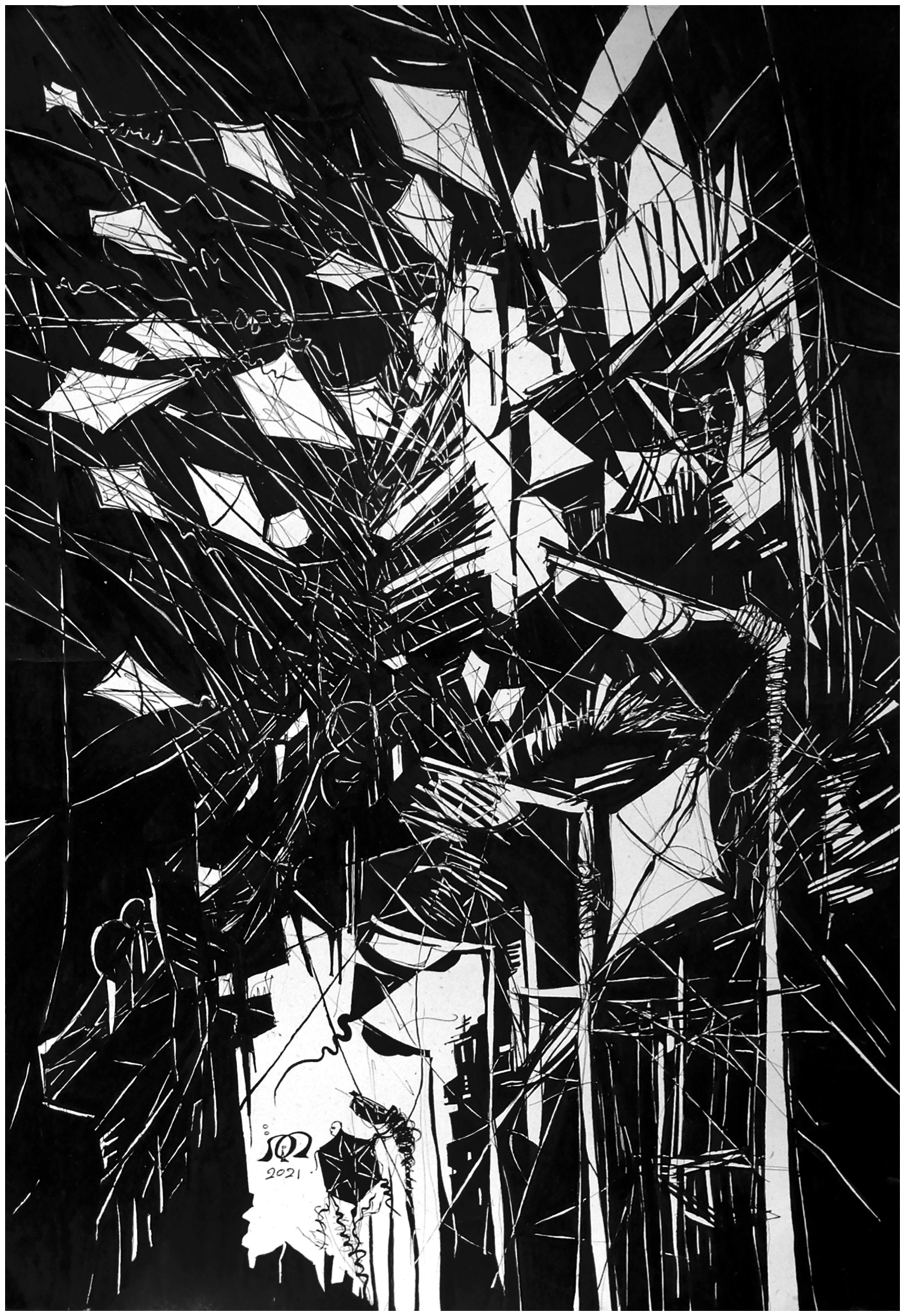
Kites (Artwork by Azza Ezzat, 2021).
Billboards 6
It is midday, maybe early afternoon. The usual route typically includes one, if not two overpasses. Maybe it is Boulaq Abu-El ‘Ela, or the 6th of October bridge. The traffic flows and that is in itself an unusual occurrence, but the skyline is certainly uncanny—all the billboards are empty. Having mushroomed in the past few years to occupy all the sidewalks, white shiny plastic frames flow past the car as it speeds forward. The bigger overpowering ones appear as vertical metal grids, and the buildings behind them appear in perspective behind these ghostly skeletons. A cell phone snaps the picture and uploads it on a social media platform. Comments and retweets trickle: “just before the start of Ramadan, it must be the preparations for all the new campaigns!” Ramadan is the billboard high season, when the competition amongst advertisement campaigns takes on the importance of regional tournaments. “The economy is collapsing. It is the end of the world”. Someone replies to the picture saying that the “perforated skyline looks quite cool, actually, like an art project in the sky”. Could anyone have been prepared to navigate a bridge without billboards? in Cairo? during Ramadan? An empty billboard could perhaps be a one-off occurrence caught in the middle of billboard changes, market shifts, and updated marketing campaigns. But this is an orchestrated emptiness that tugs at the attention, like Stewart’s “big stories thrown up … on the side of the road” (Stewart, 2007: 93). A void appears in the sky. The city’s skyline slips through these empty framings, after being hidden from view, making “Billboards” (Figure 2) Azza’s and my favorite piece of the three. Once they are empty, Azza can play with the city’s composition. Billboards are sites of fantasy whether empty or full. Imagine with me a luminous rectangular patch in the sky with dozens of white lamp bulbs left vacant as a canvas to the next big thing between rental handovers. It might be a Gordon Matta-Clark intervention, or an emptiness unattended to; wherever it is, it inspires some wonder. In May 2015, the project “A Gallery as Big as a Town” took over most of Tehran’s commercial and political billboards to post reproduction of artwork for 10 days (The Other Iran, 2015). Before that, in 2007, Sao Paulo’s Mayor Gilbert Kssab implemented a clean city act stripping the city from 15,000 billboards, leaving some phantom empty structures (Rapid Transition Org, 2019). In July 2020, the Financial Times ran a piece on the pictures that Daniel Tchetchik took of blank advertising displays during lockdown who described them as huge monoliths from Stanley Kubrick’s 2011, “A Space Odyssey” (Brown, 2020). In 2020 Egypt, these gaps crept more modestly and therefore more surprisingly, not only in social media footage, but also in statistics that keep a watchful eye on the market. The curfew in Greater Cairo was announced on 15 March 2020 and in one week the billboard advertising market dropped by 45% compared to the same week in the previous year. Some (AhramOnline, 2020; Daly, 2020) called it a blip.
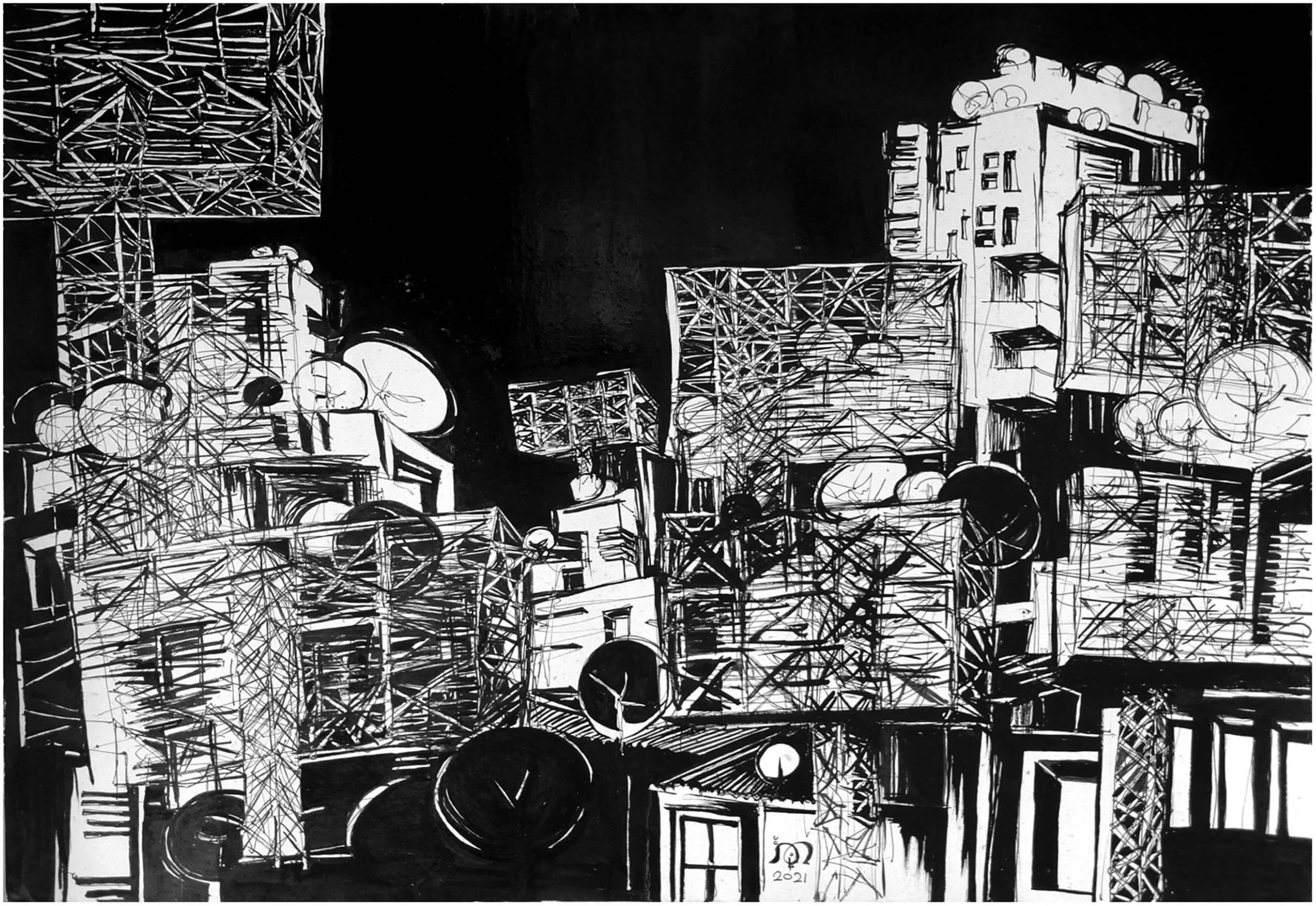
Billboards (Artwork by Azza Ezzat, 2021).
Bridges
It is June 2020, and my social media feed brings up yet another inauguration of an elevated highway. At the center is an empty white screen that looks like a flip chart. It is surrounded by three men and three women all in masks, and one in military guise. There are plant pots on tarmac and the sun bounces off the asphalt as the inaugurators pose for the picture. In the distance is the monument of the unknown soldier, a series of empty billboards and an unusually flowing road which this new flyover is surpassing. 7 I fixate on the inauguration which poses to no one; June was just coming close to the end of the curfew and the streets were empty. Emptiness in itself could be a fantasy with its own promise. During the curfew, a local anchor in Cairo dispatched his account to the New York Times with the headline “Cairo badly needed a detox. Lockdown supplied one, at a steep price” (New York Times, 2020). The dispatch starts with an alluring picture of Cairo’s downtown street empty under curfew. Cairo needed a detox for the turbulence, chaos, clogs and blemish with the curfew as an imposed rejuvenating deep cleanse. This is a gaze that might echo a logic that wants to “clean” cities like Cairo out of all its mess. It is within this emptiness and for the sake of this emptiness that these highway axes are dominating all the social media chatter. One is smuggled into international attention as a funny catastrophe and makes it outside the Egyptian social media, as Mehwar Al-Fardouse scrapes the adjacent building blocks (The Times, 2020). Other flyovers cut across Cairo’s oldest cemeteries (Aljazeera, 2020). Meanwhile, the state transmits its fantasy of infrastructure by planning, building, and inaugurating more. During the curfew, bridges and highways extended all through the city and bore across, over, and through the fabric (the urban fabric), even if they were going nowhere, and no one was there to take them to any place. As a fantasy, it was a mediated spectacle done with fugitive speed and performed to almost no one. As a promise of efficiency, it sat within a wave of loss (ElShahed, 2020; Madbouly and Nassar, 2021), mourning, and even ridicule of the infrastructural mania. Unused and unwitnessed, yet they were viscerally and affectively experienced as upturning the city as we knew it. They were inaugurated with masked spectacles and empty placards and reshuffled (dis)orientations. As Azza would tell me in one of our conversations, between protracted venturing out of her house, she would step out to an alien city that was rendered strange every time through construction work (Figure 3). With the lull of the curfew the city’s topography was aggressively changing, rendering one’s bearing unrecognizable.
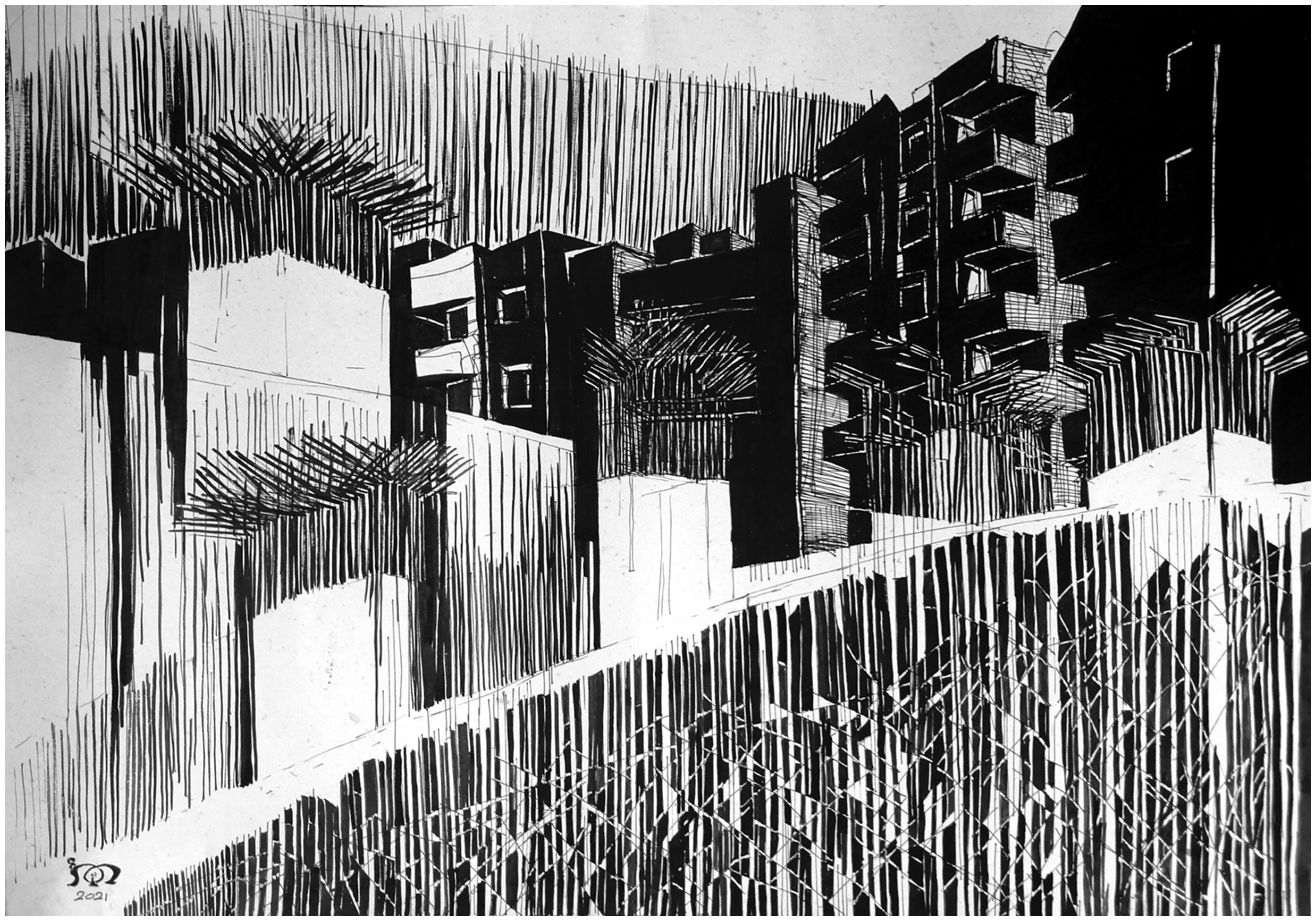
Bridges (Artwork by Azza Ezzat, 2021).
Cairo’s extensions and suspensions
What patterns of urbanism do these infrastructures sit within? What kind of extensions and suspensions do they gesture towards? The first object to tug at my attention was the hovering of a kite. Through this hovering, I received the series of images of suspensions of kites (in the two meanings of suspended in air and suspended by law) as an entry way to unpack, rather than capture, a fleeting occurrence in the city scape. Suspension, as Timothy Choy and Jeremy Zee note, is at once a suspension of assumptions, but also an injunction to an art of noticing (2015: np).
Throughout the past decade (and even for longer), Cairo was seen as exhausted and exhausting (Abaza, 2020; Elyachar, 2022). This visual and affective mode has been instigating a flight out of the megacity for some time, but it has intensified in the past decade with a project of a new capital becoming a national raison d’étre of the state (Lindsey, 2017; Selim, 2015), or the flight of the bourgeoisie through the ever-present desire to live in Cairo’s desert extensions (Mitchell, 1999). This flight mode is typically seen in Cairo as an extension outwards (to new satellite cities, to summer houses, or to a new capital). The bridge and highway mania the city is witnessing services this tendency. What might garner less attention are forms of extensions and suspensions upwards and in-between; practices that shake, trouble and are in excess of the city form (see Simone, 2022). The city lives through the myriad of objects, contestations, commodification and imagination of Cairene skies and its occupiers. As Peter Adey notes, the air with what gets thrown into it “effectively moves the weight of the city upwards” (2014: 296). In Cairo, as in elsewhere, the sky is as a space of desire, performance, and promise in as much as it is divisive, securitized and patched up. Extended steel rods orient to a future construction that is to come (Marji, 2022), and rooftops are a key visual trope of filmic rendition of Cairo (Amin, 2020) and a holding of possibilities (Fayed, 2016), a platform from which one can be in a city.
Thus, Azza and I attune to the materials hanging in and entangled in the air within the curfew. As Michele Lancione and Abdoumaliq Simone write from within the same moment “an attunement to the surroundings may allow us to ‘space out’ in ways that can contribute to a renewed sense of intimacy with and through the extended world we inhabit” (Lancione and Simone, 2020b: np). The joy of ‘spacing out’ and then the fear circulating about the extension of kites as makeshift drones, assemble on one hand the players’ knowledge of the city as a play field, those who are awkwardly attuned to the entangled and patchy extensions of bricks, woods, steel and cables, to come full circle to face some of the securitisation logics Cairenes know of and maneuver around all the time.
Attending to the kite, extended, and then grounded, helps articulate this instant that I have characterized as a glitch through suspension. To invoke Choy and Zee (2015) again, suspension describes a threshold in which particles become in unstable atmospheric relation, particles are dispersed into a medium with an eventual settleming. This minor moment of flying kites on bridges and then grounding them, happens during a short curfew that sits within a protracted pandemic, aggressive urban extension of the city, and a post-revolutionary authoritarian makeup that forecloses possibilities of dissent. This extension of things, phones, and gazes to the sky speaks to forms of infrastructural extensions to the air that carry with them desires and attachments, such as for joy 8 that the practice and image gather and that can be easily missed.
Similarly, vacant advertising space is not a novel or unprecedented occurrence. Yet, treating the suspended billboards moment as a glitch orients our attention to the multiple temporalities inhabiting the outdoor advertisements; billboards that use existing urban infrastructures. Here, the glitch interrupts a relentless transmission of urban fantasy and desire to escape the city. For some time now, anthropologists and urbanists have paid attention to Cairo’s outdoor advertisement as a specific form of structuring desire of an alternative urbanity than the one they materially and structurally—and quite literally—spring from, by noting how billboards have increasingly grown to focus on advertising real estate (Abotera and Ashoub, 2017; Ghannam, 2014; Hendawy and Saeed, 2020). Abotera and Ashoub (2017) focus on the ways that the proliferation of billboards advertising gated communities in the desert extensions of Greater Cairo develops a consistent fantasy of urban greenery. Due to the vagueness of regulations concerning the construction of billboards, these billboards acquire density rather rapidly as they extend to the sky and in the air. As infrastructures of desire, billboard advertisement is a lucrative business for the governorate of Cairo, with 20% of the advertisement permits issued going to the general treasury. 9 It layers the city’s main roads with a hierarchy of value that shifts with the space of advertisement, its type, with high-seasons, urban development and its rate, and with traffic congestion: the more congested, the higher in price. By understanding them as infrastructures of desire, I hint to their capitalizing on the already ongoing reshaping of the city in ways that make roads, highways, and bridges acquire value even as they promise—sometimes quite literally— to “live above it all” (Abotera and Ashoub, 2017: np).
Outdoor advertisements are not only windows to a desired promise of a future good life to be achieved elsewhere. Some might be a historical register that sutures the city, and its materiality to its past lives. In the mid-2010s, Amr Abotawila and Sondos Seif ran an initiative to photograph Cairo’s dead walls (Abotawila and Seif, 2015). Dead walls are those walls designed in a building to not have windows and openings as they would be adjacent to a neighbouring building. Due to unregulated building heights, these dead walls create spatial openings in the city skyscapes, which in the past have acted as the perfect canvases for painted or hand painted advertisements. Abotaweila and Seif wrote in 2015 explaining the rationale and desire to archive the now peeling advertisements that in a lot of cases would refer to products no longer in circulation. For him this archiving initiative had the purpose of resisting a nostalgia to a particular golden moment in imagining Cairo, rather acknowledging that it is dynamic and evolving. While these hand-painted advertisements could snapshot a visual memory of a city, their peeling presence on the wall had the ambivalent presence/absence of a trace that fades in the background of Cairo of the here and now. Billboards, and particularly the way they advertise real estate, have been a central visual and material culture register of the transformation of Cairo and its neoliberalisation. This is not only a matter of the commodification of air, although it is indeed that, but also a register that troubles the space-time of the city. At the same time, as urbanists and residents of the city continue to worry about its expansion, they also worry about its disappearance. These phantom interruptions in the skyline speak to a wish to archive the city, precisely during a time in which its cultural and material archive is uncontrollably withering away. Through the minor glitch of the billboards, attended to by Azza (Figure 2), my contention here is that this emptiness in the skyline attunes us to the aggressive way in which the city’s skyscape has been populated by contested temporalities.
While cities in a pandemic invoke an image of slowing down or emptying out, I propose that this emptiness is ambivalent. While emptiness rendered outdoor advertisements momentarily obsolete, thus allowing these gaps in the skies, they have accelerated other infrastructural extensions that play into other fantasies of escaping Cairo, such as the bridges and flyovers. These extensions articulate the desire to dismantle what is now known as old Cairo for the benefit of its newer extensions. Iterations of this fantasy extend from the 19th century modernity’s anxiety about crowdedness (Mitchell, 1991) and indeed was present in the Cairo 2050 project to which the 2011 revolution put a halt, only to be reinvigorated again with the project of the new administrative capital (Lindsey, 2017). It is within this paradoxical fantasy of an empty city, that we can understand the unprecedented infrastructural wave of bridges and flyovers that extended within the curfew in Cairo, at once capitalizing on empty streets, and on the desire to empty the city.
To not capture a curfew
Rather than a crisis or an exception, my own personal experience of being in a lockdown in a town in the ‘Global North’ translated as something I have known very well before. As Simone points out, while the withdrawal from the sensuousness and busyness of the streets was new and unprecedented for some, for others, it might have been experienced as repetitive and even intimately known from before (Simone, 2020). This resonant experience is tied to the preceding rearranging of Cairo’s time, rhythms, and lifeworlds throughout multiple curfews during the last decade with the twists and turns of the revolution (Elyachar, 2014, 2022) which make the term al-hazr (Arabic for curfew) a familiar lexicon among Cairenes. 10 Within this interruption, repetition, distance, and proximity, how might the 2020 curfew speak back to the grammars through which we capture Cairo and similar cities in our academic registers? Instead of a conclusion, I want to end here with methodological reflections on working against capturing logics. 11
I start here with how attending to objects suspended in the sky might contribute to that ethos, by returning to Kathleen Stewart’s epigraph about attunement to things hanging in the air. Suspension, as noted earlier, is an injunction to notice and attend without the certainty of where (or if) things will settle to fit our theoretical ambitions. I used the focus on kites to sit first with suspension and resist an epistemology of capture, therefore paving the way to addressing the other two objects with less credulity. Billboards and Bridges trouble linear temporality, the time of the state or the future perfect tense of infrastructure by dwelling on the alternative uses or fragilities of these infrastructures. I also think with them here as infrastructures of urban fantasy, of desire, joy or ambivalence. The reader’s first encounter with the three objects and constellation in/on this article happens through the ink artwork of Azza Ezzat—a mode of affective and visual encounter that is explicit about its partiality, and that hopefully also glitches my voice and my account. In this reading, I attempted to juxtapose multiple and contradictory renditions of the city; shards and fragments of accounts, aesthetics, policies, and prior scholarship (see McFarlane, 2021). These come from contradictory sources, news pieces, and social media, but are all received here as momentary flickers of chasing something unfolding in city life. These juxtapositions are all woven together through the three images which purposefully remain scarcely commented on. As well as accounting for the city as one composed of fragments, cuts, and things that do not compute, the aim here is to sit uncomfortably with jagged and fragmented transmissions through which I was experiencing my city from afar, or through which a Cairene might have experienced a curfew.
However, these ink images are not simply additional fragments, but are a result of a deliberate conversation between me and Azza, and here might be an appropriate moment to comment briefly on the nature of our collaboration and situate it in her practice. I have had a series of conversations with Azza about how to make this collaboration work for both of us as two Egyptians: one academic based in the UK and the other a visual artist based in Egypt. Geographers collaborate with artists all the time, and in the process, they co-create some of the most creative discussions in the discipline (e.g. Foster and Lorimer, 2007; Tolia-Kelly and Raymond, 2020). One element to note here is that while institutional time frames tend to imagine these collaborations as project-based and short term, they often sit within longer-term relationships. When I approached Azza with a small grant fund, we had already known each other for several years, and I was familiar with her artwork, as she was with my scholarship. We discussed the potential of co-authorship for this article, which Azza did not agree to, and this is important to note as some solutions for acknowledging collaborative knowledge production (such as co-authorship) might not translate through different contexts and practices as we imagine they might. Instead, the more meaningful outcome for her practice was obviously to have all the artwork paid, which is where the funding went to, and to retain rights to use, reuse, and reimagine the artwork as part of her portfolio, exhibitions and further collaborative practices and engagement with the city. The artwork developed in 2020 has been in ongoing exhibitions in Egypt until the final revision of this article and now sits within her own broader practice. 12
Until very recently, and through this phase of our collaboration, Azza’s practice relied on experiencing the city through cycling during the months of the curfew as a means to counter the primacy of automobiles in the city. There is a lot of important literature that has investigated questions of mobilities, visuality, and materiality (Bissell, 2009). There is also recent literature that unpacks the many ways cyclists experience or perform the city as well as how they are enveloped in the elemental geographies of air as they move through urban space (Simpson, 2019). Keeping this literature in mind, however, I want to situate Azza’s practice in a city like Cairo, which is significantly different than these accounts. Cycling in Cairo is not common and indeed impractical and quite dangerous. Many working-class men would cycle in Cairo to run errands, such as short distance deliveries, although this has been increasingly replaced by motorcycles. Middle-class cyclists would cycle in weekends as part of reclaiming the city within middle class or historical neighborhoods. But it is almost exceptional for a woman to cycle for transportation across sprawling neighborhoods. Azza conceptualizes this as a game of reclaiming some right to the city. This is a game she began to play to navigate, and even recreate, the city (Ezzat, 2022). Her point is that the real of the cityscape adopts a different rhythm of visuality and appearance to her as a cyclist, than it would for pedestrian, or a car-driver and it is that rhythm that influences the composition of elements in her work. The artwork that Azza has worked on for our project and included here is her attempt to experiment with her own jagged, glitchy, topological encounter with the city within, before and after the curfew. The artwork therefore is compositional in the same way that my writing is—fragmented, condensed and sometimes folded onto itself. While I rely empirically on news reports and social media, I centre visual representation and appropriation as a way to engage with the city from afar. In my conversation with Azza, I want to recognize the pitfalls of my distance while writing about the city I am from, and work on. The problems of appropriation of these travelling images, therefore, is not lost on me, and the slippages inherent in their awkward recasting throughout the article are meant to foreground this uneasiness of academic rendering of a familiar urban home away from which we (I) were in lockdown. In short, in this aesthetic and poetic rendition of Cairene skies, neither Azza nor I seek to capture the city, rather negotiate our engagement with its ordinariness in less than ordinary times.
While this experiment sits within a curfew, I suggest that it has broader implications. We snap a point of time in which academics maintained scholarly, intellectual, political and affective investments in their cities and had to negotiate learning from these cities in ways that do not rely on capturing logics that we could take for granted, such as through a promise of authenticity through fieldwork (cf. Günel et al., 2020). This might appear as a specific glitch in geographic knowledge production in the “Global North”. One where fieldwork and fieldtrips—the core tools for research and pedagogy—were strained. Where many were forced to rework their conventional tools of assuming that travel, fieldwork, and ethnography are accessible to all on one hand, and are essential for a “grounded” development of expertise, of knowing wholly on the other. Yet, this is not a glitch. Many geographies are momentarily, or protractedly, written off as sites of knowledge production through conventional fieldwork because they become politically risky, or are inaccessible to their scholars and inhabitants (inaccessibility here understood broadly as embodied, financial, political, ecological, etc.). While this writing off might have appeared as an interruption experienced during lockdowns, it is known intimately and ordinarily by many scholars. Many sites are roped in an enforced knowledge gap, rendering empirical work in the conventional sense problematic. My concern for a while (Nassar, 2018, 2021) has been to think of ways of not writing off our spaces of intellectual care once they become inaccessible. I bring these methodological lines to think about Cairo after 2011 precisely because it is important to find conceptual language to attend to a space that seems to be receding from academic attention just because it is not scripted as revolutionary or catastrophic (yet? anymore?).
In this article, I experimented with thinking and writing about the city affectively, precisely as a topological space that folds and unfolds with competing fantasies, desires and attachments especially when some familiar rhythms of urbanization are suspended. I wrote about that from what I conceptualise as a glitch, a perceived lull and interruption during which several material things literally extend to or suspend in the sky, and with them a constellation of accelerations, anxieties, interruptions, joys that make and break the city. I draw inspirations from Lancione and Simone’s (2020a, 2020b) commentaries on thinking the pandemic from places of the global majority (here from Cairo), as a way to think about urban geography beyond regimes of epistemological capture. I propose that thinking with the glitch (materially and affectively) provides a lens that disinvests from logics of exception and states of emergency that have dominated research on the country and even city. While the framing of exception has its uses, it could explain away instances of violence and gloss over how the ordinary extends and continues within ‘exceptional’ events. Theoretically, therefore, the glitch, as adopted from Berlant, helps in attuning to the urban ordinary beyond the capturing logics of exception. We attend to processes, logics, and relations of playful reworkings that sometimes succeed in complicating extended logics of government. In other words, a glitch of the curfew helps to make apparent the ongoing processes and infrastructures that keep post-revolutionary Cairo going (for better or for worse). This ordinary occurrence in urban living entangles the seemingly neat divisions of the exceptional and everyday, and the before/interruption/after separation of the pandemic. It helps us ask, for whom is this a crisis? What does it enable? What does it foreclose?
Footnotes
Acknowledgements
I am deeply grateful to Azza Ezzat for generously embarking on this ongoing collaborative adventure with me. I would like to thank Omnia Khalil, Heba Khalil, Nada El-Kouny, Lisa Tilley and colleagues in the Geography Department RHUL who participated in the brown bag work-in-progress session for reading multiple versions for this article and for generously engaging with it. Iterations and segments of the article were presented (usually remotely) in the Millennium conference, MESA, Elements of Border and Infrastructure Seminar Series of the Hagop Kevorkian Center for Near Eastern Studies, LSE Covid, Care and the City: Perspectives from MENA, Global Mobility Humanities Conference, the Urban Inhabitation in the Anthropocene Symposium and BRISMES. I am thankful for the invitations and feedback on these presentations, particularly from Ari Jerrems, Harshavardhan Bhat, Sasha Englemann, Pete Adey, and Julia Elyachar. As a pandemic article, it owes a debt to a community of care that came together in 2020: Penelope Anthias, Marijn Nieuwenhuis, and Leonie Newhouse. Finally, I would like to thank the reviewers of the article for their careful engagement and Kate Derickson for the editorship. All remaining faults are my own.
Declaration of conflicting interests
The author(s) declared no potential conflicts of interest with respect to the research, authorship, and/or publication of this article.
Funding
The author(s) disclosed receipt of the following financial support for the research, authorship, and/or publication of this article: The development of the artwork was funded by a small grant from the Research Development Fund of the Department of Geography at Durham University, titled “Bridges, Billboards and Kites: Material and affective infrastructures in Cairo’s curfews”, 2020. Research for this article is supported by the British Academy Postdoctoral Fellowship PFOS21\210376.
