




Abstract
Employing European Social Survey data (ESS Round 7) from 20 countries (N = 20,464), we tested several pre-registered hypotheses regarding the associations between basic personal values—as conceptualized by Schwartz’ Values Theory—and vote choice in national elections. To operationalize vote choice, we relied on the Chapel Hill Experts Survey for expert ratings of party positioning on ideology, policy, and populism. Personal values, and particularly universalism, were associated with the cultural gal-tan (green-alternative-liberal vs. traditional-authoritarian-nationalist) dimension (8% shared variance) and the economic left-right dimension (4% shared variance). The associations with gal-tan were even stronger when the dimension was salient in the party agenda. Associations between specific policy positions (e.g., multiculturalism, redistribution) and values were very similar to those between values and ideology. Voting populist was weakly associated with lower universalism and higher security (1% shared variance). The associations were generally stronger among the more educated and in western European countries. Our results suggest that Universalism values could help explain why the “left” and the “gal” poles tend to go together and are also more generally consistent with accounts of political conflict and cleavage centered around cultural issues and rooted in values.
Plain language summary
Basic personal values are broad desirable goals that motivate people's action and serve as guiding principles in their lives. To date, there has not been much research on how values relate to voting behavior. Employing data on personal values and expert ratings of the ideologies and policies of the parties for which one has voted, we show in 20 European countries (20,464 participants) that personal values, and particularly universalism; that is, caring for the welfare of all people, were associated with the cultural gal-tan (green-alternative-liberal vs. traditional-authoritarian-nationalist) dimension of ideology (8% shared variance) and the economic left-right dimension (4% shared variance). The associations with gal-tan were even stronger when the dimension was emphasized in the party agenda. Associations between specific policy positions (e.g., multiculturalism, redistribution) and values were very similar to those between values and ideology. Voting populist was weakly associated with lower Universalism values and higher Security values (1% shared variance). The associations were generally stronger among the more educated and in western European, as compared to post-communist, countries. Our results suggest that Universalism values could help explain why the left and the gal poles tend to go together and are also more generally consistent with accounts of political conflict and cleavage centered around cultural issues and rooted in values.
Introduction
Voting behavior, like any complex behavior, is influenced by multiple interrelating causes and contributors. Within the framework offered by Schwartz’ Values Theory (Schwartz, 1992), we will investigate to what extent basic personal values can help understand voting. One of the defining features of values is that values are broad goals that guide and motivate behavior by providing criteria of what is desirable (Rokeach, 1973; Schwartz, 1992). In the realm of politics, values have been argued to both provide a cognitive framework that organizes political preferences and identities and as a motivating force for their expression (Barnea & Schwartz, 1998; Rokeach, 1973). However, only a handful of studies have linked values to voting behavior. These studies have been limited in several ways. Except for two studies on populist voting (Baro, 2022; Marcos-Marne, 2022), they have all been single-country studies—thus not allowing for conclusions regarding generalizability—and have operationalized vote choice subjectively, idiosyncratically and non-systematically—with the exception of a one-country Israeli study, which, like the present study, employed expert ratings of party ideology and policy to facilitate a more systematic understanding (Barnea & Schwartz, 1998).
We acknowledge that there is much literature on the associations of basic personal values with other political psychology constructs, such as political values, political attitudes, policy opinions and ideological self-placement. However, we argue that such constructs cannot stand in for actual voting behavior. Our purpose is to contribute to both the breadth and the depth of our understanding of the associations between values and voting. Specifically, we will investigate (i) if associations between personal values and voting generalize across various political contexts, (ii) how strong these associations are, (iii) whether some values are more predictive of voting than other values, and (iv) what aspects of party ideology—for example, economic or social issues—speak to personal values.
Employing European Social Survey data from 20 countries (N = 20,464), we tested several pre-registered hypotheses regarding the associations between basic personal values and expert rated ideological and policy positions of the voted for party in the previous national elections. We also examined some potential moderator variables, such as the individual’s level of education and the country’s communist past.
Basic personal values
Basic personal values are broad desirable goals that motivate people’s action and serve as guiding principles in their lives (Rokeach, 1973; Schwartz, 1992). They are thought to affect people’s preferences and behavior over time and across situations and have been argued to find expression in all domains of life and to underlie attitudes and opinions (Rokeach, 1973; Sagiv et al., 2017). What distinguishes values from other constructs related to the self is their hierarchical organization—values are ordered in hierarchies according to their subjective importance as guiding principles. Each person has a relatively stable personal hierarchy of value priorities in which some values are more and other less important. The higher a value is in this hierarchy, the more likely the person is to rely on it as a guiding principle when making important decisions and choosing actions.
The currently most prominent theory of values is Schwartz’ Value Theory. Schwartz (1992) set out to organize the plethora of different values found in the research literature and in everyday life. He argued that several distinct values often share the same fundamental motivation. For example, freedom, independence and choosing one’s own goals all share the motivation for autonomy of thought and action. Building on prior research on values and on the universal requirements of individual needs and societal survival, he identified ten basic personal values. These were: power, achievement, hedonism, stimulation, self-direction, universalism, benevolence, tradition, conformity, and security. Table S1 (SM) presents the definitions of the ten basic personal values and provides examples of value-items.
A distinguishing feature of values as compared to other self-constructs are the dynamic relations among the motivational types of values (Schwartz, 1992). Actions that promote each type of value have psychological, practical, and social consequences that may facilitate or clash with the pursuit of other values. The conflicts and compatibilities among the various values create a circular continuum, organized according to the motivations that the values express. Schwartz’s circular model, presented in Figure 1, has received support in more than 300 samples from over 80 countries (Schwartz, 2012). This consistency in the structure of values (i.e., in the patterns of their interrelations) indicates that the meaning of the value is similar across cultures. Schwartz (2012) summarized the circular structure in terms of two basic bipolar dimensions along which personal values are organized—openness to change versus conservation and self-transcendence versus self-enhancement (see Figure 1). Theoretical model of relations among ten motivational types of values (copied from Schwartz, 2012, with https://creativecommons.org/licenses/by-nc-nd/3.0/).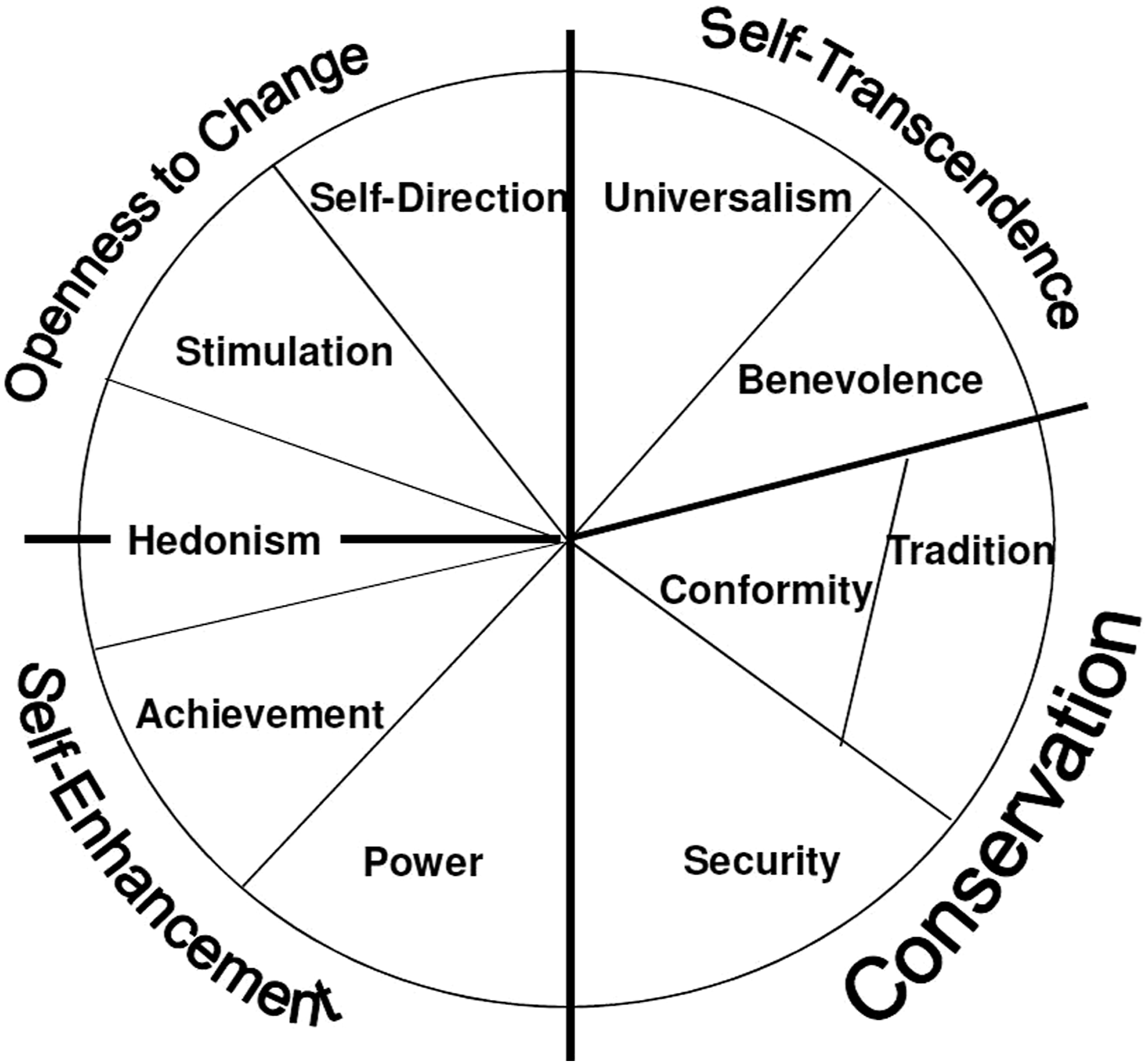
Personal values and politics
Establishing the groundwork for future research on the relationship between values and politics, Rokeach (1973) associated political types (e.g., communist, fascist) with combinations of values that were more or less important to these types (equality, freedom). The most comprehensive literature on the relationship between values and politics now exists within the framework provided by Schwartz’ Values Theory; the basic personal values have been connected to several political psychology constructs in many countries. However, much of that literature stems from the US, where political ideologies have historically been thought to be unidimensionally structured along a single dimension labeled interchangeably “left-right” or “liberal-conservative,” with the “left/liberal” pole advocating social change and rejecting inequality and the “right/conservative” pole resisting social change and accepting inequality (Erikson & Tedin, 2003). In a particularly extensive research program, Goren et al. (2016, 2022) showed that among US citizens, the self-transcendence and conservation poles of the two value dimensions (see Figure 1) predict, in opposite directions, scores on self-reports of symbolic ideology, economic conservatism, racial conservatism, cultural conservatism, civil liberties, and foreign policy opinions.
Moving from the US to a more global context, those on the “left” generally attach more value to universalism, benevolence, and self-direction, whereas those on the “right” attach more value to conformity, tradition, security, and sometimes power and achievement (Caprara et al., 2006; Devos et al., 2002; Piurko et al., 2011; Schwartz et al., 2010; Vecchione et al., 2013). However, this research is somewhat difficult to interpret, because “left” and “right” take on different meanings in different regions or countries and among different groups of people (Bauer et al., 2017). In Europe, the context of the present research, neither political parties (Bakker et al., 2015; Jolly et al., 2022) nor mass publics (e.g., Feldman & Johnston, 2014) align their economic and social or cultural attitudes on one “left-right” dimension. Rather, there are two independent dimensions: one dimension covering attitudes towards fiscal and economic policies, which we will refer to as economic left-right, and one dimension representing attitudes towards and social or cultural issues, which we, following Jolly et al. (2022), will refer to as gal-tan. The “left” pole of the left-right dimension is associated with redistributive policies, market regulation, and the expansion of welfare and education, the “right” pole with support of low taxes, entrepreneurship, and free market economic policies. Regarding gal-tan, “gal,” an acronym for “green, alternative, liberal,” refers to support for more expansive personal freedoms—greater civil liberties; same-sex marriage; a greater role for citizens in governing; etc. At the other pole, “tan” referring to “traditional, authoritarian, nationalist,” rejects these ideas and favors law and order; family, religion, and customs; traditional morality and a national way of life (Hooghe et al., 2002). For an illustration of how European political parties fall on the two dimensions, see Figure S1 (SM).
Personal values and voting
One of the central tenets of values theorists is that values guide behavior—the guiding role tends to be part of the very definition of values (e.g., Rokeach, 1973; Schwartz, 1992). But values do not, of course, relate to all behaviors, and there is, perhaps, less research on whether values relate to voting behavior than could have been expected. On a general note, although there is extensive literature on the associations between personal values and various conceptualizations of ideology and attitudes, this literature cannot directly speak to the question of whether personal values are associated with voting—there is no one-to-one correspondence between attitudes or ideology and voting. The notion of attitude–behavior consistency has been under attack since Mischel’s (1968) famous critique, and arguments for why we need to study actual behavior appear regularly (e.g., Baumeister et al., 2007).
Employing self-rated political ideology or political attitudes as stand-ins for voting behavior is particularly problematic. Regarding ideology, a fundamental challenge for interpreting much of the previous research on values and politics is its reliance on left-right ideological self-placement—the standard measure of ideology in most large-scale comparative surveys such as the European Social Survey (this survey is particularly popular in values research as it includes Schwartz’ (2003) Human Values Scale). From the outset, research on individual-level ideology has faced criticism alleging that the political attitudes of the mass public are not organized enough to be described in terms of ideology. As Converse (1964) famously put it, most people are “ideologically innocent” and generally do not know “what goes with what.” For instance, it is inconsistent to simultaneously support absolute free speech and the banning of certain books (e.g., children’s books that depict LBGT relationships), but this contradiction does not stop people from supporting both positions. Consistency has not, contrary to what one could have believed, increased in the mass public since Converse (1964) made his claims—most people continue to be ideologically incoherent and show weak to nonexistent organization of their political attitudes (e.g., Lupton et al., 2015; Zaller & Feldman, 1992).
Research connecting personal values to political attitudes can also not substitute for research connecting personal values to vote choice. Voting behavior is complex and has multiple causes—there is a vast body of literature on election research that has identified a plethora of different factors other than attitudes, such as partisanship, candidate physical attractiveness, familiarity, candidate sexual orientation, that are associated with vote choice. Moreover, given the contradictory political attitudes that people hold, attempts to interpret attitudes as stand-ins for voting behavior are undermined by the contingency of which specific attitudes have been assessed. For instance, have attitudes towards free speech, or attitudes towards the banning of children’s books depicting LBGT relationships been measured? Or, attitudes towards free health care, or towards higher taxes? Depending on which attitudes are measured, one may arrive at very different expectations with regards to how values would be associated with voting.
Turning to the empirical evidence on personal values and actual voting behavior, the only cross-cultural studies on values and voting have focused exclusively on voting populist—across two studies conducted with ESS data, low universalism and high security were the only values consistently associated with voting populist (Baro, 2022; Marcos-Marne, 2022). In the literature, populism has alternatively been thought of as an ideology, a strategy, and as a communication style (Van Kessel, 2014). Work on populism often follows Mudde and Kaltwasser (2017) in assuming that populism interprets politics as a struggle between the pure people and the corrupt elite. Importantly, populism is commonly thought of as a “thin” ideology in the sense that it always combines with different “thick” or “host” ideologies that provide populism with programmatic content (Mudde & Kaltwasser, 2017). Our purpose is to connect personal values with that which has been left out by the two studies on values and voting populist—that is, the “thick” part of party ideology and the programmatic content of the party (see Figures S2 and S3 for an illustration of how the “thin” ideology of populism has attached itself onto European parties with very different “thick” ideologies).
Besides these studies, there are a handful of single-country studies on values and voting. These come from Italy, Switzerland, Israel, and the Netherlands. In Italy, center-left voters have in two studies been higher in universalism, benevolence, and self-direction, whereas center-right voters have been higher in security, power, achievement, conformity, and tradition (Caprara et al., 2006; Schwartz et al., 2010). Similar results, employing a subset of values, have been found in Switzerland (Leimgruber, 2011). A challenge for interpreting these results is that they construe political ideology as a unidimensional left-right continuum, give no definition of this continuum, and do not tell the reader how parties were classified as either “left” or “right.” However, lending credence to these results is that the associations between personal values and voting “left” or “right” are in the same direction as results linking values to ideological self-placement on a left-right scale (e.g., Caprara et al., 2006; Piurko et al., 2011).
An approach akin to ours was employed in Israel, in a study in which independent specialists in the field of political behavior rated parties on three dimensions of political ideology: classical liberalism, state and religion, and economic egalitarianism. Voters for parties rated as supporting liberal and secular positions attributed higher importance to self-direction values and lower importance to tradition and conformity values (Barnea & Schwartz, 1998). Party positions on economic issues were unrelated to personal values. Finally, in the Netherlands, universalism was, in small student sample, associated with voting for the green party (Verplanken & Holland, 2002).
Moderator variables
The associations between values and voting may not be uniform. Values could guide voting only for some people or in some contexts. The literature suggests three potential moderator variables. People with different values may hope for different election outcomes and could vote in the hope that their vote could help bring about the outcomes they prefer. Or, the act of voting can itself be rewarding by being value-expressive; that is, serve the voter’s desire to express his or her values and his or her desired identity (Bryan et al., 2011; Downs, 1957). However, voting to bring about an outcome one values or to express one’s value presupposes that the voter knows what the party stands for. Education increases individuals’ awareness and knowledge of the political issues at stake in a country, the ideological stances relevant to them, and the distinctions among political alternatives (e.g., Neuman, 1986). This all implies that the more educated may show stronger associations between personal values and vote choice. Moreover, the more educated show higher levels of ideological constraint (for a review, see Lupton et al., 2015). For instance, if one values equality, and wishes to vote for better health care for all, something all parties may promise, it might be important to also know what the party thinks of taxes. The more educated, given that their political beliefs or attitudes are more ideologically constrained, may be aware of which tax policies free health care for all is (un)compatible with, and may thus vote more in alignment with their valuing of equality.
Causality could also run in the opposite direction. For instance, someone more educated, may—having voted for a party that promises to lower taxes—be aware that lowering taxes tends to go together with less welfare spending for the poor, which may in turn challenge the person to reconsider their views on how important equality (a universalism value) is for them (not very important, after all). By contrast, someone less educated may have voted for the same party for the same reason but may not be aware that lower taxes go together will less welfare spending and will thus not be challenged to reconsider his or her views on the importance of equality (still very important). The association between personal values (in this case universalism) and the ideology of the voted for party (right-wing economic policy) would be stronger for the former, more educated, person. That is, the more educated may be more constrained by “what goes with what” in terms of how their political attitudes are organized, and this constraint may generalize to values, allowing or forcing them to align their values with their voting behavior.
The salience that a party gives to certain issues could be expected to, increase the associations between party policy regarding those issues and personal values. For instance, a person who votes for a party for whatever reasons (e.g., because the party leader has a nice voice), may notice that the party strongly pushes for more environmental regulation (the party gives salience to this issue), and may thus him- or herself come to adopt a more favorable attitude towards environmental regulation, and even come to consider nature (a universalism value) important. This implies a strengthening of the association between values and the salient ideology of the voted for party. By contrast, if the party does not give salience to environmental regulation, but, for instance, traditional Christian morality, then the associations between party position on environmental regulation (which the voter never learns of) and the universalism values of the voter will not strengthen (but tradition values may change).
Finally, the associations between personal values may be different in Western Europe and in post-communist countries. In post-communist samples, systematic differences from other samples with regards to how values are organized have been observed (e.g., universalism and security values, which are typically opposed in the values circle, cluster together; Bardi & Schwartz, 1996). If the meaning of values is somewhat different in post-communist countries, then the associations to other variables, such as voting, may also be different.
The Present Research
With exception of two studies on voting populist (Baro, 2022; Marcos-Marne, 2022), there have been no prior cross-cultural studies on values and voting. The five other studies described above have all been single-country studies. Our cross-cultural perspective allows us to index generalizability across contexts and determine the general predictive utility of values on voting. Moreover, previous studies have relied on either a unidimensional and undefined (Caprara et al., 2006; Leimgruber, 2011; Schwartz et al., 2010) or an idiosyncratic (Barnea & Schwartz, 1998) understanding of political ideology. This research tells us very little about what in party ideology it is that speaks to voters with certain personal values—economic issues, social issues, or both?
Part of the explanation for the scarcity of research on personal values and voting behavior could be that the latter may often be difficult to operationalize—this research agenda begs the question of how to characterize the voted for party. For a quantifiable metric, we relied on the Chapel Hill Experts Survey (CHES; Bakker et al., 2015), an authoritative assessment of European political parties’ positions on ideological and other dimensions. Expert surveys such as the CHES are often used to measure complex phenomenon that cannot be directly observed (e.g., to assess levels of democracy, judicial independence, freedom of speech). The CHES experts are professional political scientists who have published extensively on party politics and related themes. Ratings are collected from around ten experts in each of the participating countries. The reliability and validity of their ratings of party positions in terms of ideology and policy has been established in several studies; for instance, the CHES ratings have been validated against analyses of party manifestos, other expert rating surveys, rhetorical analyses, and public opinion (Bakker et al., 2015; Hooghe et al., 2010; Polk et al., 2017).
Besides rating parties on the dimensions of economic left-right and gal-tan, discussed above, the CHES provides a general left-right rating (which we will refer to as “left-right”). Some of the above reviewed prior research on values and voting has referred to such a general left-right dimension (Caprara et al., 2006; Leimgruber, 2011; Schwartz et al., 2010). Based on these studies, we derived H1, which expects (general) left-voters to be higher in universalism, benevolence, and self-direction, and (general) right voters to be higher in security, power, achievement, conformity, and tradition, (for the verbatim pre-registered hypotheses, see Table S2). We derived H2 and H3 by assigning the above mentioned eight values to either the economic left-right or the gal-tan dimension. Valuing status (power) and admiration (achievement) is expected to be associated with voting for parties that promise not to intervene too much in an individual’s attempts to accumulate wealth and prestige (vote economic right). By contrast, valuing the welfare of others—both whom one personally knows (benevolence) and whom one does not know (universalism)—is expected to be associated with voting for parties that promise economic protections for everyone (vote economic left). Valuing independent thought and action (self-direction) is expected to be associated with voting gal, whereas tan voting is expected to be associated with valuing a stable society (security), and following customs (tradition) and rules (conformity). Based on two previous studies conducted with ESS data (Baro, 2022; Marcos-Marne, 2022), we expect low universalism and high security to be associated with voting populist (H4; voting populist was assessed by the extent to which the voted for parted was rated as anti-elite by the CHES).
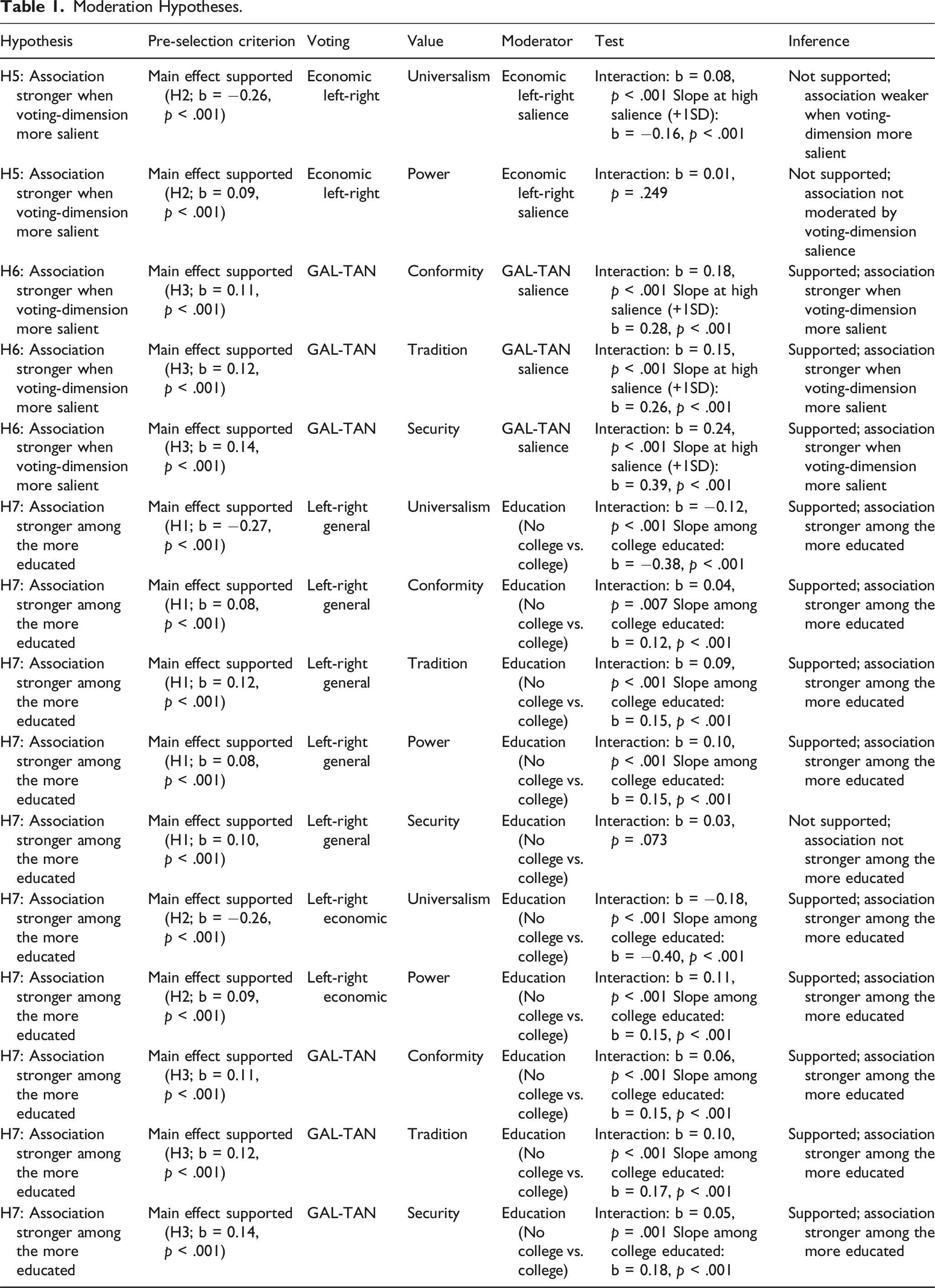
Moderation Hypotheses.
We also pre-registered our intent to exploratively examine associations between personal values and 15 party policy positions and the salience of (anti-)corruption in the agenda of the party for which one has voted, whether one has abstained from voting, and possible regional differences in any associations (see Table 1 for Exploratory Research Questions one to five; ERQ1-ERQ5). Regarding ERQ4, please note that we by mistake omitted pre-registering our intent to investigate Western Europe versus post-communist differences also in terms of the ideological position of the party, not only the salience of populist themes or party policy positions, which ERQ4 refers to.
Methods
Transparency and openness
We report how we determined our sample size, all data exclusions (if any), all manipulations, and all measures in the study, and we follow JARS (Appelbaum et al., 2018). This study’s design and its analysis were pre-registered. Data were analyzed using R, version 4.2.1 (R Core Team, 2023) and the packages r2mlm (Shaw et al., 2023) and lme4 (Bates et al., 2015).
All research questions, measures, exclusion criteria, analysis plans, and hypotheses were pre-registered at: https://osf.io/3pq4x.
Some of the supplementary material, data, power calculations, and analysis scripts with which all results can be reproduced are stored at: https://osf.io/n3w92/.
Participants
The sample comprised 37,623 participants from 20 countries that participated in the year 2014 European Social Survey (ESS Round 7). Israeli participants were excluded because 2014 CHES (Bakker et al., 2015) ratings of parties were not available for Israel. Participants were included if they had voted (n = 25,738; 68.4%). A total of 4094 (15.9%) participants who did not respond to the question regarding vote choice or named a party not rated by CHES (Bakker et al., 2015) were excluded. 1180 participants were excluded because of other missing data, making the final sample size n = 20,464 (51.9% women, Mage = 52.9, SDage = 16.9; country-specific sample sizes ranged from 513 (Switzerland) to 1974 (Germany)).
Personal values
The ten basic personal values identified by the framework of SVT (Figure 1; Table S1) were measured with the 21-item Human Values Scale (Schwartz, 2003). Universalism was measured with three items, all other values with two items (see Table S1 for all items). Reponses were collected on a 6-point scale and aggregated (mean values) across items for each value. Reliability scores of the scales in the Human Values Scale range across countries from alpha = .40 to alpha = .72 (Schwartz et al., 2015).
As recommended by Schwartz (2003), value scores were centered around participant’s mean response to all 21 items. This centering was applied in the analyses in which values were examined one at a time, separately from other values. This centering was not applied when the personal values were entered into regression analysis together with the other values; when using all values as predictors in a regression, it is appropriate to use raw (uncentered) scores, because the analyses themselves correct for differences in scale use—when all of the variables that are typically used for centering (the procedure recommended by the ESS coding guide) are included as predictors in a regression model, the regression coefficients for each of these variables is automatically adjusted for each individual’s mean response across variables (i.e., the values are already centered by being entered simultaneously into a regression model, so we do not center them anew).
Expert ratings of party ideology and policy
In the ESS, participants reported for which party they had voted in the last election of [country’s] primary legislative assembly in [month/year]. These choices were translated into numbers by means of experts’ ratings of the ideological and policy positioning of the party that the participant had voted for in the previous national election.
For each party, corresponding scores on general left-right, economic left-right, gal-tan, 16 more specific policy positions (e.g., taxes, immigration), were obtained from the 2014 CHES ratings (Bakker et al., 2015). For instance, the gal–tan item was: “Parties can be classified in terms of their views on democratic freedoms and rights. ‘Libertarian’ or ‘postmaterialist’ parties favor expanded personal freedoms, for example, access to abortion, active euthanasia, same-sex marriage, or greater democratic participation. ‘Traditional’ or ‘authoritarian’ parties often reject these ideas; they value order, tradition, and stability, and believe that the government should be a firm moral authority on social and cultural issues.” All items are fully described on the CHES website (https://www.chesdata.eu/). All scores ranged from 0 to 10 (e.g., scores on gal-tan range from 0 = Libertarian/postmaterialist, 5 = center, to 10 = Traditional/authoritarian). The salience of economic, gal-tan, anti-elite and anti-corruption issues for the party were also rated on scales from 0 (Not important at all) to 10 (Great importance).
The confirmatory hypotheses (H1-H3, and H5-H7) refer to the three dimensions of political ideology that are rated by CHES: general left-right, economic left-right, and gal-tan (green-alternative-libertarian vs. traditional-authoritarian-nationalist). The populism of the party was measured as CHES rated anti-elite salience (H4), and this approach should be compatible with the most common definitions of populism (Van Kessel, 2014).
To illustrate how European parties fall on these dimensions, scatterplots of the economic left-right, gal-tan, and anti-elitism dimensions are included in the SOM (Figures S1-S3). Furthermore, for our pre-registered but explorative analyses, we employed CHES ratings of 16 more specific policy positions (e.g., deregulation of markets, immigration policy, urban vs. rural interests).
All expert ratings of party ideology and policy were given on an 11-point scale. Mean values across raters were used as indicators of parties positioning. Votes for coalitions of two or more parties were coded as the mean of the CHES ratings of the parties forming the coalition. The raw ratings for parties were standardized.
Moderator variables
Hypotheses 5 and 6 put forth that the salience of ideology in the party’s public stance moderates the main effects between values and ideology (H5 for economic left-right and H6 for gal-tan). The CHES ratings of the salience of economic left-right and of gal-tan were in the same format as CHES ratings of ideological and policy positions (Bakker et al., 2015), and were treated equally.
Hypothesis 7 put forth that education moderates the associations between values and voting behavior. A binary variable (no college degree / college degree) was constructed based on the highest level of education reported in the ESS. Participants with tertiary level degrees (at least Bachelor’s degree) were considered college educated (n = 5587; 27.4%).
Exploratory research question 4 (ERQ4) asked whether the associations between values and voting vary between Western European and post-communist countries. The Czech Republic, Estonia, Hungary, Lithuania, Poland, and Slovenia were classified as post-communist (n = 4764; 23.2%) and the remaining 14 countries as Western European (n = 15,718; 76.8%).
Statistical analysis
Data were analyzed with a set of linear multilevel models in which the position of the party for which one has voted, in terms of political ideology or more specific policy position, was the dependent variable (DV). Country was used as the upper-level random effect cluster. In all models, random intercepts were included to account for the between-country variability in each DV. Gender and age were controlled for.
For testing hypotheses 1 to 4 and for addressing the exploratory research questions that concerned main effects, each DV was predicted in two ways. First, by entering each of the ten values separately (one-at-a-time) into the model (using values centered around the respondent’s mean response). Second, by entering all ten values simultaneously (using non-centered scores). To assess fixed effects at the individual level, each value was centered around the country-mean prior to analysis. To test our hypotheses, we examined the direction and statistical significance of the associations between the ten personal values and the DVs. For a hypothesis to be supported, we required consistent results across analyses in which each personal value was first entered individually and then in conjunction with the other values. When entered together, values could act as confounders, mediators, or colliders for the hypothesized associations (Wysocki et al., 2022). A significant change in the regression coefficient when going from the one-at-a-time model to the ten-value model would suggest a complicated association between that value and voting. We aimed to identify only robust and straightforward associations.
The effect size for the associations between values and voting was estimated as proportion of within-country variance in vote choice that could be explained by the fixed slopes of personal values (R2(f1)w; Rights & Sterba, 2019), calculated with the r2mlm package (Shaw et al., 2023). For effect size estimates for single values that index proportion of within-country variance explained via fixed slopes and random slope variation/covariation, and estimates of slope heterogeneity across countries, see the above referred to OSF site.
For testing the hypotheses on individual-level moderators (ideology salience and education; H5-H7), the main effect of the moderator variable and the interaction between the moderator and the focal value variable were entered into a value-specific model (in which the main effect for the value was examined without controlling for other values). For a hypothesis to be supported, we required the interaction term to be in the expected direction—stronger when ideology was salient or among the more highly educated—and statistically significant. Ideology salience (H5 and H6) was country-mean centered prior to analysis. The binary education moderator (H7) was coded as −0.5 (no college degree) or 0.5 (college degree). To control for between-country differences in college degrees, country-level proportion of college degree (between 0 and 1) was also entered into the model.
For testing whether the associations between values and voting differed between Western European and post-communist European countries, we first introduced random slopes into the value-specific models. The random effect correlation between slopes and intercepts was modeled when problems with convergence did not occur. When random slopes indicated significant variation across countries in the value-DV associations (tested with Likelihood ratio test between models with and without random slope), the binary country-level predictor (Western Europe vs. post-communist; coded 0.5 and −0.5) was introduced into the model as a main effect along with the cross-level interaction between the value and this binary moderator. To examine whether associations between values and DVs were stronger in the West, the statistical significance and valence of cross-level interaction was examined.
For examining the associations between values and not voting versus voting (among those eligible to vote, see ERQ3), binary multilevel logistic regression was used to both analyze each value separately and in the context of all other values. The approach was identical to the one described for values and vote choice.
Analysis weights were used for all analyses. These weights correct for differential selection probabilities, nonresponse, noncoverage, sampling error, and account for differences in population sizes across countries (Kaminska, 2020). All analyses were run with the lmer-function in the lme4 package (Bates et al., 2015) with Satterthwaite’s approximation for degrees of freedom.
Statistical power
For hypotheses 1-4, with the sample size expected in the pre-registration (22,000; the final obtained sample size was 20,464), we expected to have sensitivity to detect effect sizes as small as r = .02 with .80 power with type-I error set at .05. For examination of whether correlations were moderated by salience or education at the level of individuals (H5-H7), we expected sensitivity to detect effect sizes as small as f-squared/r-squared = .0005, with .80 power and type-I error set at .05. See a priori power calculations at the above referred to OSF site.
Results
The results for the pre-registered hypothesis tests and exploratory research questions are presented below. For a more detailed breakdown of the results—fixed and random effect estimates, variance decomposition, estimates of accounted for variance—please see the Shiny app available at: https://vjilmari.shinyapps.io/voting_values/. Included are also the interaction models (college degree/no college degree, West Europe vs. post-Communist). For proportion of variance attributable to differences between countries (ICCs), see Table S3. For a closer visual examination of country-specific estimates and their heterogeneity, please see supplementary figures at the above referred to OSF website.
Pre-registered confirmatory research questions
In terms of general left-right voting (H1), as predicted, left-voters were higher in universalism, and right voters were higher in security, power, conformity, and tradition (Figure 2 panel A). Although benevolence, self-direction and achievement all showed the hypothesized associations, these were rendered insignificant when they were entered into the analyses together with other values. Unstandardized fixed slope estimates between values and voting left-right (panel A), economic left-right (panel B), GAL-TAN (panel C), or anti-elite (panel D). The effect size is indexed by the proportion of within-country variance explained by values (ΔR2; incremental to age and gender).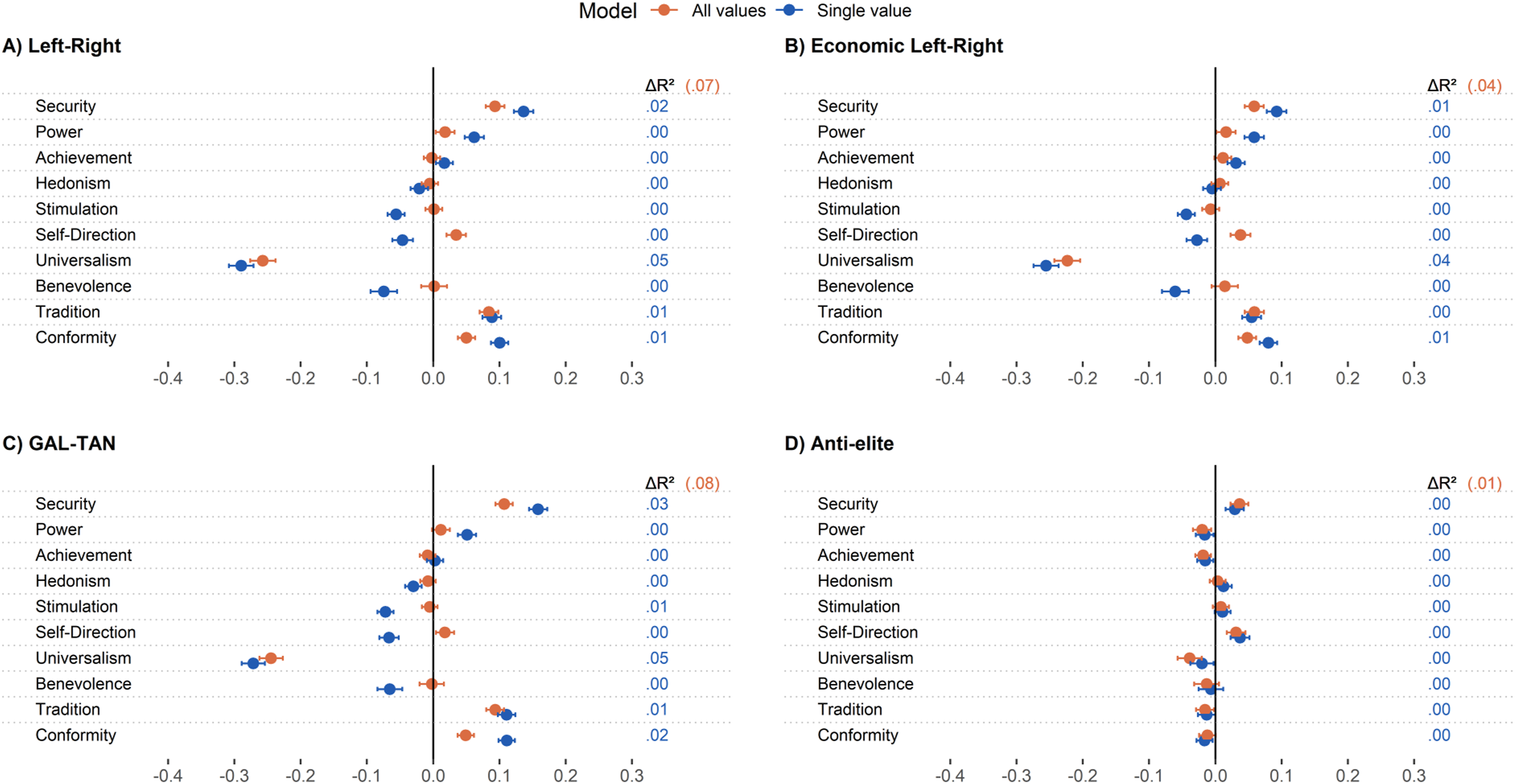
Regarding the economic left-right, as expected (H2), economic left-voters were higher in universalism, and economic right voters higher in power (Figure 2 panel B). Although benevolence and achievement both showed the hypothesized associations, these were rendered insignificant when they were entered into the analyses together with other values.
Regarding gal-tan, and again as expected (H3), tan voters were higher in security, conformity, and tradition (Figure 2 panel C). Although self-direction showed the hypothesized association with gal voting, this was rendered insignificant when self-direction was entered together with other values. This was due to universalism values, which are adjacent to self-direction values (Figure 1), and were strongly associated with voting gal.
Regarding anti-elite voting, as expected (H4), the salience of anti-elitism in the agenda of the voted for party was associated with lower universalism and higher security (Figure 2 panel D).
To limit the number of tests, we only tested for moderation (H5-H7) if we first found support for the hypothesized main effect. Perhaps the primary reason to investigate moderation effects is to investigate the boundary conditions of a main effect. Boundary conditions “place limitations on the propositions generated from a theoretical model. These temporal and contextual factors set the boundaries of generalizability, and as such constitute the range of the theory” (Whetten, 1989, p. 492). When there is no main effect, there is neither a pressing need to develop a theoretical model (the absence of an effect may often not require explanation), nor to investigate the boundaries of that theoretical model.
Regarding the salience of economic (H5) and social or cultural issues (H6) in the party agenda, we found the expected interaction effect only for the latter. Security, conformity, and tradition, all of which were associated with tan, were more strongly so when the salience of this dimension was high (Figure 3). Simple slopes estimates at high salience (mean+1SD) were b = 0.28, b = 0.26, and b = 0.39, for conformity, tradition, and security, respectively (all p < .001, all interaction term were also significant at p < .001). Corresponding simple slope estimates at low salience (mean–1SD) were b = −0.07, p = .007 for conformity, b = −0.05, p = .001 for tradition, and b = −0.09, p < .001 for security, respectively. The results of all pre-registered moderation hypothesis tests are presented in Table 1. Simple slopes of conformity (panel A), tradition (panel B), and security (panel C) on voting GAL-TAN by low (mean – 1SD), average (mean), and high (mean + 1SD) levels of GAL-TAN salience.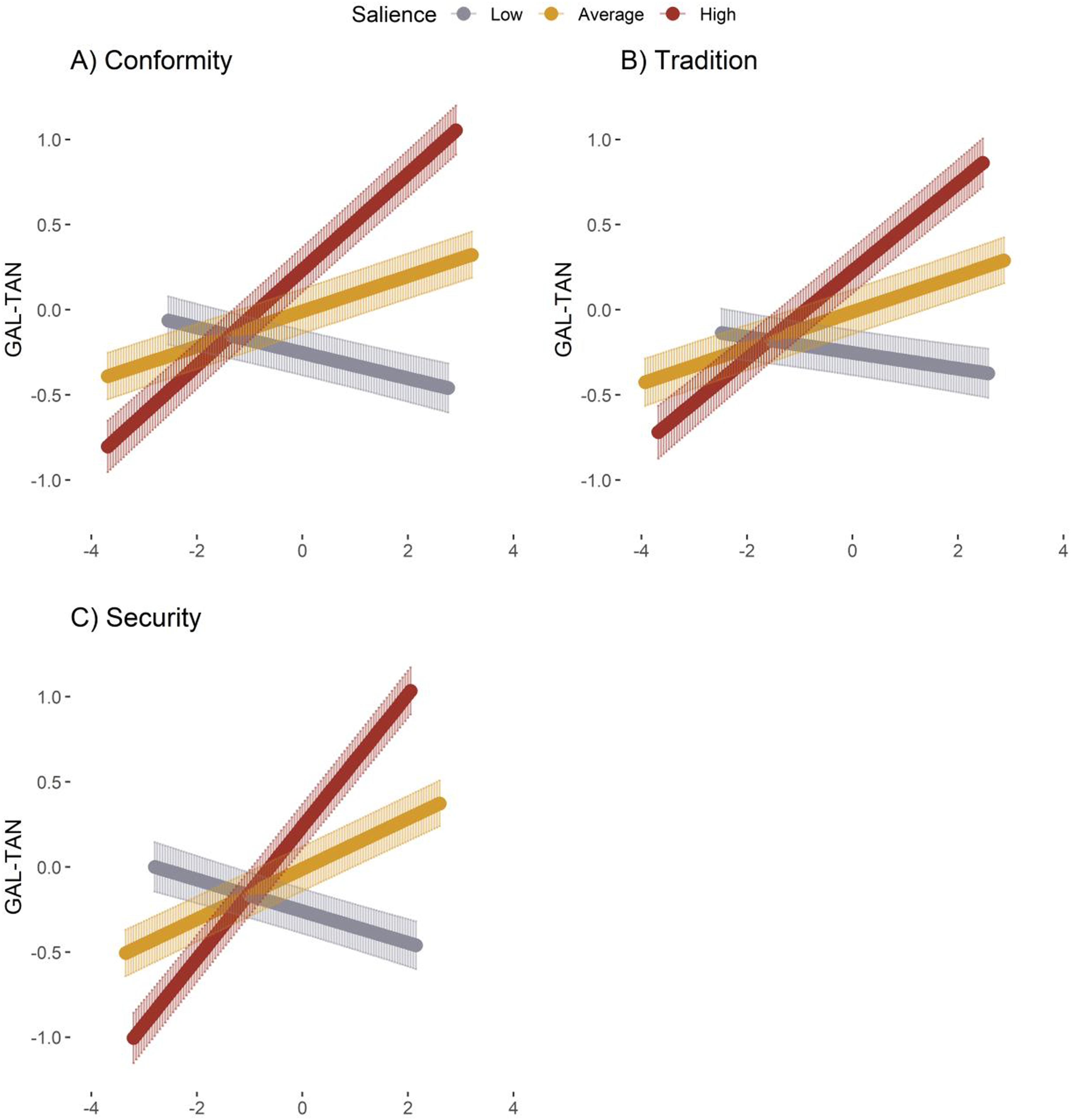
Regarding education, as expected (H7), the associations between personal values and the ideology of the party for which one had voted were stronger among the more highly educated (Tables S4-S6). Regarding the associations between general left-right and universalism; conformity; tradition; and power, these were all stronger when education was high. Similarly, the associations between economic left-right and universalism and power, as well as between gal-tan and conformity, tradition, and security, were all stronger when education was high.
To illustrate the moderating effect of education, the proportion of within-country variance accounted for by all values was separately calculated for college educated and non-college educated subsamples. These proportions are presented in Figure 4. Among the college educated, values accounted for 13%, 10%, 13%, and 1% of the within-country variance of voting general left-right, economic left-right, gal-tan, and anti-elite, respectively. Among participants without college degrees, with the exception of voting anti-elite, values did not account for half as much variance (5%, 3%, 5%, and 1%). Proportion of within-country variance accounted for by values and by covariates (age and gender) across all respondents, according to the individual’s level of education, and according to the country’s communist past.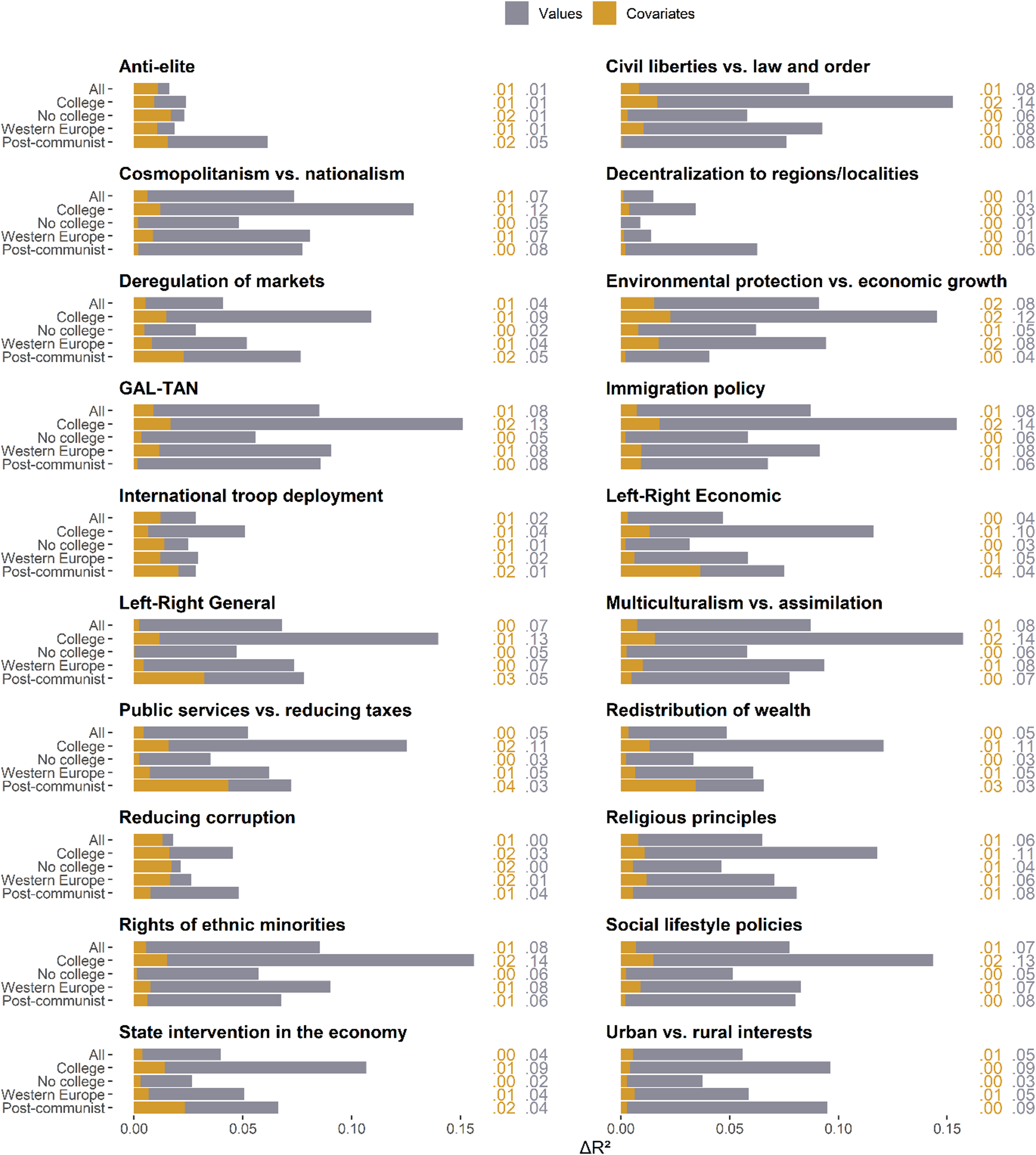
Pre-registered exploratory research questions
Regarding our exploratory research questions, personal values were not associated with anti-corruption in the party agenda (ERQ1; the total within-country variance accounted by values was .00; Figure S4). However, values were associated with several of the policy positions of the voted for party (ERQ2), especially those associated with the gal-tan dimension. As shown in Figures S5-S19, topics such as migration, multiculturalism, and ethnic minorities showed the strongest associations. Regarding specific values, universalism showed the strongest associations, followed by security, conformity, and tradition.
Regarding the decisions between voting and abstaining (ERQ3), those who voted scores higher on universalism, benevolence, and self-direction. By contrast, those who did not vote scored higher on security (Figure S20).
Our fourth exploratory research question pertained to differences between Western European and post-communist countries (ERQ4). Mostly, the associations between values and voting were similar in direction, but stronger in Western Europe (Figure S21, Shinyapp). However, this was not always true. For instance, regarding the economic left-right dimension, tradition values were in Western Europe associated with voting right, and in post-communist countries with voting left. As another example, in Western Europe, valuing power was associated with not voting for an anti-elite party, but the opposite pattern was found in post-communist countries. In general, what was true in Western European countries was not always true in post-communist countries. The proportion of within-country variance accounted for by values in Western European and in post-communist European countries is illustrated in Figure 4. The differences between these regions in terms of explained variance are notably more mixed and generally smaller than the differences between educational groups. To illustrate differences between specific Western European and post-communist countries, we plotted associations between universalism values and vote choice with regards to party ideology and party populism in all 20 countries (Figure S21).
Regarding the fifth exploratory research question (ERQ5), the moderating effect of education was also present when looking at party anti-elitism or party policy positions. The associations were, as a rule, stronger among the more educated (Figure 4 shows the total variance accounted for, more specific estimates can be obtained with the Shinyapp).
Discussion
Our results show that personal values are, across Europe, associated with voting behavior. The associations were particularly strong for universalism values, which were associated with voting for parties that were ideologically left in terms of economics or liberal in terms of gal-tan. Security, tradition, and conformity values showed the opposite pattern, but the associations were somewhat weaker. The associations between personal values and more specific policy positions followed the same pattern. Values were particularly strongly associated with the gal-tan dimension, and these associations were even stronger when this dimension was salient in the party agenda. Voting populist was associated with lower universalism and higher security, but these associations were much weaker than those described above. Almost all associations were stronger among the more educated. In post-communist countries, the results were generally smaller in magnitude and sometimes opposite in sign.
Values and vote choice
Personal values shared eight percent variance with the gal-tan positioning of the voted for party. Equally strong associations were found between personal values and several of the policy positions associated with this dimension, such as those related to immigration, multiculturalism, ethnic minorities, law and order, and the environment. The associations between personal values and party economic ideology, and related policy positions—for example, redistribution, taxes, and state intervention—were around half as strong. Among those with a college degree, personal values accounted for 13% of party gal-tan positioning. The magnitude of this association could be considered surprising. Although values are often assumed to motivate behavior (Schwartz, 1992), the empirical evidence suggests that value–behavior correlations tend to be weak, especially when looking at single behaviors rather than averages (for a review, see Cieciuch, 2017). In a recent study looking at correlations between values and self-reports of over two hundred behaviors in various domains, such as supporting others, social interactions, hobbies, and finance, the only associations that were as strong as the ones we report on were between values and religious behaviors, such as praying (Skimina et al., 2019). This is particularly noteworthy as our measure of behavior was likely to be much less tainted by biases than typically used self-report measures. Studies on values and behavior typically rely on items such as “Do [ing] risky things for the thrill of it” (purportedly measuring behavior that expresses stimulation values; Schwartz & Butenko, 2014). However, such items are prone to be affected by the same subjective biases and other limits of introspection that contribute also to self-ratings of values, inflating the possible associations between personal values and actual behaviors. Having respondents merely report for which political party they voted for in the previous national elections, and then relying on experts ratings to assess what that party stands for, should circumvent many of the problems inherent to self-ratings. Our results thus suggest that one of the behaviors that show the strongest associations with personal values is voting behavior.
Based on two large US surveys on public opinion that included a measure of personal value, Goren et al. (2016) suggested that the self-transcendence and conservation poles of the two value dimensions, being more socially focused as compared to the more personally focused poles of self-enhancement and openness to change, guide opinion formation across the leading issue areas in American politics. Our results are rather consistent with this idea, although we do want to emphasize that causality could also work in the opposite direction—changes in voting may precede changes in values (see also Goren & Chapp, 2017). Nevertheless, the strongest associations were for universalism values (one of the two self-transcendence values), followed by tradition, conformity, and security (the conservation values). Furthermore, values were associated with most policy positions, with some interesting exceptions, such as decentralization policy.
In Goren et al.’s (2016) results, being economically right was not strongly associated with conservatism values. This is consistent with other results from the US, which have shown that on the political right there are groups of people with very different political, psychological, moral, and demographic profiles (Ellis & Stimson, 2012; Feldman & Johnston, 2014). One popular explanation for this has been the mobilization of the religious right in the 1970s and President Reagan’s ability to appeal to both economically and socially conservative voters, attracting these previously separate factions to the republican party (Micklethwait & Wooldridge, 2005). However, we found a similar result in a European context—only one value predicted voting for left parties (universalism), but four values predicted voting for right parties (security, power, conformity, and tradition). Our results suggest the need for an explanation that goes beyond the particularities of US history.
Whereas there is diversity on the right, on the left there appear to be only those who value universalism. The definition of universalism values in Schwartz’ theory of basic values (1992) is understanding, appreciation, tolerance, and protection for the welfare of all people and of nature. Valuing all people and nature comes with constraints. Classism, racism, imperialism, patriarchy and other forms of inequality are interrelated and inseparably connected to each other through interlocking webs of oppression (Hooks, 1984; a contemporary iteration could add anthropocentrism to the list, making the connection with nature more apparent). Those for whom universalism values are important, if they are to be consistent, cannot oppose some forms of oppression and condone others. On the right, there is less constraint—laissez faire capitalism can be combined with either moral traditionalism or with moral liberalism, and one is not, in the name of equality, forced to reproach all systems of oppression. Our results suggest that universalism values could serve to fuse economic and social ideology, bringing together the left pole and the gal pole. This result dovetails nicely with those found by Rokeach (1973) and those who drew on his earlier dominant theory of values. Rokeach (1973) suggested that socialists, conservatives, communists and fascists can be differentiated according to their value for freedom and equality. However, empirical research suggested that it was only equality (a universalism value) that was important, separating socialists and communists from conservatives and fascists, as everyone thought freedom was important (e.g., Cochrane et al., 1979).
Besides values, there are a plethora of different concepts and theoretical frameworks that have been applied to understand the psychological underpinning of ideological differences—for instance, social dominance orientation, right-wing authoritarianism, close-mindedness, dogmatism, mental rigidity, regulatory focus, terror management theory, system justification theory etc. (for a review, see Jost et al., 2009). However, we believe that the framework offered by Schwartz’ values theory has an important advantage simply because it sets out to cover a wide range of human motivations. This is important because ideologies are complex and may be becoming ever more so. One, and maybe not even two, dimensions are not enough to represent the organization of political attitudes in the mass public—for instance, populism may be forming a third dimension of political competition in Europe (Marcos-Marne, 2022). Moreover, how specific attitudes (e.g., economic) cohere with other specific attitudes (e.g., cultural) varies from context to context, depending on what bundles of attitudes the political parties offer on the ideological “menu” (Jost et al., 2009; Sniderman & Bullock, 2004). To complicate things even further, new issues (e.g., vaccinations, masks during a pandemic) are constantly being politicized in a phenomenon known as “conflict extension” (Layman et al., 2010). All this suggest that to cover the breadth of ideological differences, a broad instrument, such as that offered by Schwartz values theory, may have an advantage over narrower measures.
Values, gal-tan, and polarization
Values, and specifically universalism, was particularly strongly associated with party position on the gal-tan dimension as well as with policy positions related to this dimension, such as immigration, ethnic minorities, civil liberties, and lifestyle choice (e.g., homosexuality). Also supporting the idea that values are particularly relevant to the gal-tan dimension was that the salience of gal-tan issues in the party agenda moderated the strength of the associations between this dimension and personal values. Importantly, the effect was found only for gal-tan, not the economic left-right. Voting in terms of economic left-right was not as strongly associated with values, even if the party emphasized these themes in their messaging. This all suggest that personal values may speak more to the social or cultural dimension of politics than to the economic.
The associations between personal values and the gal-tan dimension of politics could shed light on political polarization. The traditionalist-conservatist backlash against liberal values has deepened cultural and political polarization across Europe (Furedi, 2017). The issues (e.g., multiculturalism, sexuality) that have been fought over directly pertain to values (especially universalism, but also tradition, security, conformity), which could help understand the bitterness and controversies that have marked the previous decades.
Values are often thought of as closely tied to one's identity: when values clash, people feel that their identities are threatened (Kouzakova et al., 2012). It may even be inconceivable for people to concede on issues related to their values (Tetlock, 2003). People in value conflicts, as compared to resource conflicts (e.g., economic conflicts), show physiological markers of experiencing threat, feel personally more involved, avoid trade-offs, and end up with poorer outcomes (Kouzakova et al., 2012). This all implies that politics could induce more polarization and aggression when it is explicitly about values, not economic interests. However, one could also argue that this is false dichotomy—discrimination in, for example, education and employment against minorities is very much an economical question, at least for the afflicted minorities.
Also supporting the idea that personal values may play a role in polarization were our results regarding the moderating effects of education. The associations between values and voting behavior were, as expected, stronger among the more educated. We know from previous research that educated people are more partisan, and that they possess the cognitive skills to reject facts inconsistent with prior dispositions (Joslyn & Haider-Markel, 2014). For instance, the more education Republicans have, the more likely they are to be climate change deniers (U.S. Global Change Research Program et al., 2017). This implies that education may not work in decreasing polarization. An alternative way could be to reframe arguments in terms of values that appeal to the people on the other side of the argument (Feinberg & Willer, 2019). For instance, if arguing for pro-environmental action, some skeptics may be more influenced by an appeal to security values than by an appeal to universalism values.
How universal are the associations?
By accounting for heterogeneity across countries, the random effects model that we employed allows us to claim that our results are generalizable across Europe—given that the sample of 20 countries included in our analyses can be considered a representative sampling of European countries. However, this does not imply that the results are identical across countries. Indeed, there may be some systematic differences between Western Europe and post-communist countries. Looking at the economic left-right dimension and associated policy preferences, in post-communist countries, tradition, conformity and security values were positively associated with voting for a party rated as economically left and as favoring more redistribution. In Western Europe, by contrast, these values were associated with voting for economically right-wing parties and for parties that rejected redistributive policies (for a similar pattern obtained with research employing self-rated ideology and attitudes, see Barni et al., 2016; Piurko et al., 2011; Thorisdottir et al., 2007). In post-communist countries, conservative values could foster people’s tendency to want to preserve a political past that was more supportive of welfare states and redistribution (e.g., Pop-Eleches & Tucker, 2013).
Besides the above systematic differences between Western Europe and post-communist countries, there were differences that seemed more spurious and difficult to interpret. However, another more systematic difference was that values were generally more strongly associated with voting in Western Europe. One reason for this could be the underdeveloped party arena in post-communist Europe. Modern democracies depend on strong, stable, coherent, and multifunctional parties, that articulate preferences and interests, aggregating them into comprehensive platforms. Parties in post-communist Europe have been weakly institutionalized, fragmented, feeble and unrepresentative (e.g., Powell & Tucker, 2014). On a more general note, Western Europe and post-communist Europe are, from a more global perspective, rather similar. Yet, we found differences between them. This implies that our results should not be generalized to other regions. Instead, future research should investigate possible cultural moderator variables between values and vote choice.
Limitations
Some other limitations besides generalizability to the other regions warrant mention. First, we relied on Schwartz’ (1992) original theory of ten basic values. His revised theory of basic individual values (Schwartz et al., 2012) is intended to be more powerful both in the prediction and explanation of behavior. We believe the revised theory could be especially useful in the context of politics, as new issues become politized (Layman et al., 2010) and old issues are packaged together in new ways (Jost et al., 2009; Sniderman & Bullock, 2004). For instance, to help predict or explain environmental authoritarianism (Moore & Roberts, 2022), it would be useful to disentangle valuing nature from valuing tolerance, both of which are encompassed by the basic value of universalism. Similarly, the measure of populism that we employed was rather crude (CHES ratings of anti-elitism). More nuanced measures could perhaps reveal stronger associations (the effect sizes that we and other have obtained with the current measure are very small).
On a more theoretical note, we acknowledge that although our study is primarily predictive, we do venture into explanation in building our hypothesis concerning the moderating role of education primarily around the idea that the political attitudes of the educated are more internally consistent, allowing them to better align their personal values with the ideology of the party (for a discussion on the very different goals of predictive and explanatory research see, Mõttus et al., 2020). However, we acknowledge that there could be other reasons for why the values of the more educated align more strongly with the ideology of the party they vote for (e.g., family background, class, or demographic cleavages could play a smaller role in vote choice among the more educated). Our explanation must thus be regarded as tentative. On a more positive note, this does seem like a topic that future research could usefully investigate.
Our results, of course, cannot speak to causality. How people vote could influence their values, values could guide voting behavior, some third variable could influence both values and voting behavior, or, most likely, all of the above. Future research could try to uncover the psychological processes through which values may motivate voting behavior (or vice versa). For instance, is voting according to one’s values experienced as rewarding?
Concluding Remarks
People base their voting choices on a plethora of factors. Not only well-established demographic factors, such as age, gender, class, urban-rural divide, ethnicity, religiosity, and education are known to play a role, but more surprising influences such as candidate voice pitch, facial appearance, and body posture, and clothing (Dumitrescu, 2016). In light of such results, which suggest the impact of rather superficial factors on vote choice, it can be considered positive that values, ideologies, and policy positions may also matter (of course, our results do not speak to causality—voting may influence personal values). Particularly universalism values were strongly associated with vote choice, and they could play a role in explaining both the asymmetry of vote choice—more constraint on the left—and political polarization. Personal values also more generally speak specially to concerns regarding cultural issues, including the rights of ethnic minorities, lifestyle, and the environment. This fits well with accounts of political cleavage that have suggested a new dimension of political conflict cutting across the old divisions, which were centered more around economic issues. Given that vote choice was so strongly associated with personal values, our results support the idea that new cleavages in at least Western European mass publics could be rooted in values—or different voting behavior in different groups may lead to value conflicts; we do not know the direction of causality. How the here identified psychological cleavages involving basic personal values fit into the evolving backdrop of new social-structural cleavages, such as educational expansion and aging of the population, should be a fascinating topic for future research.
Supplemental Material
Supplemental Material - Basic Personal Values and Vote Choice in 20 European Countries
Supplemental Material for Basic Personal Values and Vote Choice in 20 European Countries by Jan-Erik Lönnqvist, and Ville Ilmarinen in European Journal of Personality
Footnotes
Declaration of conflicting interests
The author(s) declared no potential conflicts of interest with respect to the research, authorship, and/or publication of this article.
Funding
The author(s) disclosed receipt of the following financial support for the research, authorship, and/or publication of this article: The research was supported by the Academy of Finland Grant (338891 to VI).
Open Science Statement
All research questions, measures, exclusion criteria, analysis plans, and hypotheses were pre-registered at the permanent and openly accessible URL: https://osf.io/3pq4x. Some of the supplementary material, data, power calculations, and analysis scripts with which all results can be reproduced are stored at the permanent and openly accessible URL:  .
.
Supplemental Material
Supplemental material for this article is available online.
References
Supplementary Material
Please find the following supplemental material available below.
For Open Access articles published under a Creative Commons License, all supplemental material carries the same license as the article it is associated with.
For non-Open Access articles published, all supplemental material carries a non-exclusive license, and permission requests for re-use of supplemental material or any part of supplemental material shall be sent directly to the copyright owner as specified in the copyright notice associated with the article.
