




Abstract
Solving societal problems often requires elected politicians to make uncertain investments, which only provide benefits in the future. However, research on future-oriented democratic policymaking has primarily focused on structural explanations and voter behaviour, paying less attention to politicians’ attitudes. In this study, we examine politicians’ future orientation and its potential link to electoral success. Using the latest Finnish data from the Comparative Candidate Survey, combined with voting-advice application data and register-level candidate information, we analyse how candidates’ future orientation correlates with their personal vote shares and ideological positions in the 2019 parliamentary elections. Our findings indicate that future-oriented political candidates, willing to invest in the future despite costs to present wellbeing, tend to be younger, more leftist and green-alternative-liberal. However, the relationship between future orientation and vote-winning is weak, suggesting that office-seeking politicians face neither punishment nor reward for their future-regarding stances.
Keywords
Many of the most pressing contemporary problems require future-oriented policy solutions, which can pose challenges for achieving near-term policy benefits simultaneously. Such solutions require that democracies must make uncertain investments, in order to receive paybacks in a distant future. Making future-oriented policy is, however, easier said than done. In addition to system-level factors, such as short electoral cycles and opposition from organized interests (e.g. MacKenzie, 2021), a general human tendency towards preferring immediate rewards seems to push democratic decision-making towards short-termism, or democratic myopia (e.g. Urminsky and Zauberman, 2015).
To address this concern, a growing literature examines individual-level future orientation in political behaviour. So far, it has focused on voters, in terms of a general attitude towards future orientation in politics (Rapeli et al., 2021), policy-specific preferences (e.g. Christensen and Rapeli, 2021) and electoral behaviour (e.g. Fowler and Kam, 2006). In this study, we expand the scope to include the group of actors responsible for outlining policy – that is, politicians. First, we assess the extent to which politicians hold future-oriented attitudes and how these vary in terms of their ideological positions and age. Second, we examine whether future orientation is associated with the politicians’ electoral fortunes. We use data from Finland from the most recent wave of the Comparative Candidate Survey (CCS), fielded among the candidates immediately after the 2019 parliamentary elections, in combination with data from voting-advice applications (VAAs) with policy stances expressed by candidates, and register-level data on candidates from the same election. The VAA data come from the national broadcasting company YLE and the leading national newspaper Helsingin Sanomat (HS). This allows us to connect future orientation with individual-level vote earning in terms of preference votes, ideological positions and a wide range of control variables. The Finnish open-list proportional electoral system with mandatory preferential voting provides us with an optimal context to study connections between political attitudes and vote earning for individual candidates (Von Schoultz, 2018).
The significance of studying the future orientation of politicians is that there is a connection between thinking about the future and acting accordingly (see e.g. Seginer, 2009). Future orientation is connected to the motivations behind an individual’s actions and achievement goals (Nuttin and Lens, 1985), and, as policymakers with the authority to decide over societal development, the personal future orientation of politicians is likely to have a significant impact on the futures of entire societies. Understanding the (lack of) future orientation among politicians across ideological spectra contributes to the scholarly understanding of the capacity of democracies to make long-term policy. So far, scholars have largely neglected the attitudes of politicians, focusing instead on structural explanations and voter behaviour. However, by turning the focus towards politicians’ future orientation, how it is structured along candidate age and ideological dimensions and how it correlates with vote earning, we can better understand how democratic systems make political choices in terms of intertemporality – that is, regarding the trade-off between policy benefits in the present and in the future. Politicians who represent different ideological perspectives are likely to differ in terms of how strongly they support investing in the future compared to the present, and the extent to which this can be linked to vote winning is likely to significantly shape the future wellbeing of entire democratic societies.
We find that candidates who are more future-oriented and willing to invest in the future even at a cost for today’s wellbeing are mostly younger, more left leaning and more likely to be positioned on the green-alternative-liberal (GAL) end of the spectrum. However, there is no significant relationship between future orientation and vote winning. Although the results demonstrate a tendency for future-oriented candidates to have higher odds of winning votes, traditional drivers of electoral success, such as political experience, largely overrule this effect. Overall, future orientation does not pay off at elections, but does not hurt political candidate’s electoral success either. Consequently, the lack of a punishment effect for future-oriented thinking can be seen as challenging the conventional wisdom, according to which myopic electorates force democratic politics towards short-termism. On the other hand, it does not pay for politicians to be future-oriented and to emphasize future wellbeing.
Future orientation and voter behaviour
In psychology, future orientation is widely perceived as a personal disposition, which can be significant for how individuals think about politics and act politically. From a psychological perspective, an individual’s actions in the present are based on past experiences and an anticipation of the future: future orientation, or future time perspective, integrates an individual’s expectations of the future with behavior in the present (Nuttin and Lens, 1985). There is a strong motivational aspect in future orientation. Human behaviour in the present is shaped by the goals set for the future, which creates a close relationship between the motivation that drives behaviour and the anticipated or desired future (Seginer and Lens, 2015). Hence, future orientation can be described as ‘the degree to which and the way in which the future is anticipated and integrated in the psychological present of an individual’ and a ‘cognitive-motivational personality characteristic that results from goal setting’ (Lens et al., 2012: 322). This means that people who are future-oriented are likely to show behaviours which are motivated by a stronger consideration for the future than people who are more focused on the present. Research from different fields has demonstrated that people are, for instance, different in terms of what they think is a long time and how they plan for the future (Lynch et al., 2010). Some of this variation could be explained by education. The future is uncertain and grasping it requires cognitive complexity – that is, the ability to consider the many different sides of a matter and to create linkages between different things (e.g. Boukes et al., 2021; Van Hiel and Mervielde, 2003). Education is positively associated with cognitively complex thinking (Milburn and McGrail, 1992), suggesting that it could also predict future-oriented thinking. In addition, parenthood could lead people to demonstrate a stronger future orientation. Sociologists have demonstrated the significance of intergenerational solidarity as a social norm even in high-income contexts where the children-per-woman ratio is low (Bengtson, 2001; Graham et al., 2017). Having children could therefore be linked to feeling more responsibility and compassion for the future and not just for the present. A person’s financial situation is also susceptible to affecting future orientation. Investment in the future while bearing the costs for present-day wellbeing requires a certain level of financial security (Rapeli et al., 2021). Therefore, it is plausible that individuals who are better off financially also display more future-oriented policy thinking.
Applied to the realm of political behaviour, future orientation potentially affects the extent to which a person thinks and acts in a future-regarding manner. This applies to the behaviour of both ordinary citizens and political elites. However, political scientists have been slow to adopt the terminology suggested by psychologists and futurists. Rapeli et al. (2021) offer an exception when they examine future orientation as a general political attitude, instead of an issue-related policy preference. What they term, in a slightly speculative manner, ‘future-oriented political thinking’, seeks to capture the extent to which a person thinks that democratic policymaking should focus on present versus future wellbeing. They demonstrate that voters hold understandable and consistent views about the balancing act between present and future benefits, and that people who are more future-oriented in their everyday thinking are often also more future-oriented in their political reasoning, suggesting that future orientation has an impact on political behaviour and therefore also on the outcome of democratic politics.
Indeed, the most widely cited reason for shortsightedness in democratic decision-making in the extant literature is voter myopia – that is, the tendency of voters to place heavier emphasis on present rather than future concerns (MacKenzie, 2021: 8). This should not necessarily be interpreted as neglect of the future. As Jacobs (2016) explains, voters have only limited capacity to gather politically relevant information, and only information about the past is certain. This incentivizes voters to emphasize politicians’ past performance instead of promises about the future, which, in turn, incentivizes politicians to focus on tangible and immediate policy rewards.
Although the literature on economic voting has established that short-term retrospective evaluations influence voters’ behaviour, rather than long-term expectations for the future (e.g. Lewis-Beck and Stegmaier, 2013), other voter-oriented research points towards a relatively modestly myopic electorate. Evidence from survey experiments conducted in the US points out that a lack of trust in political institutions is the main determinant behind voter myopia. This suggests that people are not necessarily as shortsighted as they are suspicious of the ability of the political process to deliver positive output in the distant future (Jacobs and Matthews, 2012, 2017). Based on a conjoint experimental survey design with Finnish data, Christensen and Rapeli (2021) also show that people appear more concerned about the certainty of receiving policy benefits and about their costs, rather than the timing of the reception. Overall, political scientists seem to converge on the significance of trust in the capacity of political institutions as the driving force behind future orientation among voters.
But what about politicians? Although the future orientation of voters has received plenty of attention, scholars have not yet properly examined future orientation among politicians, despite that candidates’ preferences between short- or long-termism likely influences their issue positions and, if they are elected, ultimately the policies that are adopted in representative democracies. The forthcoming analysis extends existing scholarship by conducting a test of the extent to which politicians are future-oriented and how it affects their electoral prospects.
Candidates’ future orientation, ideological orientation, age and personal vote earning
As demonstrated above, the existing literature suggests that future orientation in voter behaviour is mainly conditioned by (lack of) political trust. Politicians’ behaviour, on the other hand, is theorized to be conditioned by their electoral ambitions (Downs, 1957). Voters are, according to a widespread assumption in the research literature, focused on near-term policy achievements, which incentivizes politicians to emphasize present rather than future wellbeing (MacKenzie, 2021). Politicians are likely to be aware that voters often do not fully trust them, and politicians are also likely to be aware of voters’ myopic tendencies – that is, they are inclined to emphasize present rather than future policy benefits. This awareness of the electoral realities may vary as a function of political experience – that is, the length of previous involvement in political decision-making. Although previous research is lacking, we find it plausible to think that future-oriented political thinking diminishes with political experience. The underlying mechanism, as we argue, is that experience of political wheeling and dealing makes politicians more realistic about how party-based politics works. As demonstrated, the canonical argumentation in the literature suggests that democracies have a strongly presentist bias, mainly due to short-sighted voter expectations and self-serving protection of sectoral interests by parties and interest groups. The more experience a politician has of this, the more likely they are to focus on delivering policy benefits in the present, because they know that delivering future benefits is both unlikely and extremely difficult. Consequently, we suggest that political experience is associated with a realistic approach to policymaking, which, in turn, has a heavily presentist focus.
Therefore, it seems unlikely that a heavy emphasis on future-oriented politics would be a particularly safe electoral strategy from the viewpoint of the candidates. This leads us to a general assumption that due to myopic bias among voters, future orientation among politicians is not positively associated with electoral success (H1).
As argued, all individuals, including candidates, have their personal way of perceiving the relationship between the present and the future. However, candidates might value the future and the present differently, depending on their ideological leaning, which, in turn, could have consequences for their electoral fortunes. The Finnish political spectrum continues to be heavily influenced by an overarching left/right divide. Approaching future orientation from a left/right perspective suggests two alternatives. According to the traditional understanding, leftist candidates stand for societal reform and progress, whereas rightist candidates seek to preserve the status quo. On the one hand, an orientation towards societal evolution is arguably almost by definition future oriented, because it entails pursuing a future that looks different from the present. In contrast, an emphasis on the status quo implies a firmer focus on the present, because it is considered the preferred state of things, even for the future. On the other hand, the future might be equally important for those on the political right, even if they wish, to some degree, to see it unchanged from the present state. Some of those political issues, which are most closely associated with rightist ideology in terms of issue ownership, such as national economy or national security, require a long-term policy perspective.
All things considered, future orientation involves an important normative aspect, which relates to intergenerational justice and a willingness to take responsibility for the wellbeing of those future peoples who are affected by our current actions (e.g. Caney, 2018). From this standpoint, leftist ideology, which emphasizes solidarity with the weak and the powerless, seems more likely to connect positively with future-oriented reasoning, despite the point that policy issues emphasized by the political right also have a future-oriented dimension. This is consistent with psychological research, which demonstrates a robust link between leftist political attitudes and altruism (Zettler and Hilbig, 2010), and which even manifests itself in voting choices (Zettler et al., 2011). Given that future orientation, even in politics, inevitably requires costly investments in a future that one may not get to experience, the altruistic leftists seem more likely to be future oriented.
In addition to the left–right dimension, the green/alternative/libertarian and traditional/authoritarian/nationalist (GAL-TAN) ideological dimension also structures the political space in modern western democracies. Calling it the ‘new politics’ dimension, Hooghe et al. (2002) originally demonstrated the existence of green/alternative/libertarian and traditional/authoritarian/nationalist dimensions. Subsequent research has, under various guises, shown that GAL-TAN is not incorporated into left/right, but co-exists parallel to it. Moreover, it seems that GAL-TAN is currently overtaking left/right as the ideological cleavage that most clearly structures political thinking according to, for example, age and educational social groups in Europe (Marks et al., 2021). Similarly, as with left/right, it seems plausible that candidates differ in their future orientation also in regard to GAL-TAN. The emphasis on environmental issues and progressive societal values in the GAL pole suggests more future orientation, whereas prioritizing traditional social values at the TAN end implies the opposite. Consequently, we assume that leftist and green-alternative-liberal candidates are more future oriented than candidates who are rightist and traditional-authoritarian-nationalistic (H2). We also assume that candidates with leftist and green-alternative-liberal orientations are more likely to win more votes if they are future oriented (H3). Hence, we assume that there is an electoral pay-off for leftist/GAL candidates for ‘future-orientedness’, because their voters share the same future orientation.
In addition to ideology, candidates’ age could interact with future orientation to affect vote winning. As the literature on future-oriented (political) thinking shows, a person’s relationship with the future often varies during their life course and politicians are unlikely to be any different, even if their behaviour is affected by concerns of electoral success. For any individual, young age could be positively associated with future orientation simply because a longer expected remaining lifetime makes a person more likely to focus on the future. People who expect to live to see the future are likely to want to invest in it. On the other hand, the legacy motivation effect (e.g. Zaval et al., 2015) – that is, considering what kind of a world one is going to leave behind to the coming generations –
could be stronger among elderly people. Indeed, evidence from experimental designs shows that priming people to think about the closeness of the end of their lives makes them more future-oriented (Wade-Benzoni et al., 2010). This seems to align with the literature demonstrating that people tend to hold more egocentric views about life in general in their youth, but become more altruistic towards the end of their lives (e.g. Roberts et al., 2010).
Although there are two competing and equally plausible assumptions regarding age, in the context of political candidacy, assuming a positive association between young age and future orientation seems more plausible. As Peterson et al. (2020) show, there is a small but discernible tendency for people to become more conservative as they reach an older age. This could imply that young candidates, who also might strategically target young voters because these often prefer young(er) candidates (Sevi, 2021), could have more future-oriented political profiles. Consequently, we assume that younger candidates are more future oriented than older candidates (H4) and that younger candidates are more likely to win more votes if they are future oriented (H5).
Research design
We use a unique dataset that combines candidate responses from the Finnish sample of the CCS with their issue positions in YLE and HS VAAs, and with register information about the candidates’ election results at the 2019 elections. The CCS is a multi-national project that surveys candidates running for national parliamentary elections using a common core questionnaire. The survey covers topics such as recruitment, campaigning, issue positions and other topics that concern the relationship between candidates, voters and parties. The Finnish contribution to the third module of the CCS was fielded as a post-election study after the parliamentary elections on 14 April 2019, using a mixed-mode design (paper and online). The response rate was 31%. The data has been weighted according to mother tongue, age, gender, party, constituency and electoral success to correct the deviations from the total candidate population. The VAAs of YLE and of HS, privately owned and the most popular daily newspaper in Finland, were the two principal VAAs used by candidates and voters in the 2019 parliamentary elections. VAAs are a popular tool among Finnish voters to search for suitable candidates in elections. They enable voters to directly compare their positions with candidates’ responses on several policy issues, and are widely used by candidates to reach out to voters, and by the electorate to identify a suitable candidate to vote for. In our data, over 97% of candidates answered the YLE VAA and over 90% of candidates answered the HS VAA.
Finland is an ideal case to study the association between individual candidates’ future orientation and vote earning due to its open-list proportional electoral system with mandatory preferential voting. Votes are cast for individual candidates nominated by parties, and the number of preference votes determines the order in which candidates get elected within party lists. Although parties are highly relevant actors that structure political decision-making, the strong electoral system incentivizes politicians to cultivate a personal vote (Carey and Shugart, 1995), and their personal campaigns, individual experiences and individual issue positions matter for their chances of getting elected (Isotalo et al., 2020). Consequently, Finland seems a suitable case for studying the linkage between the future orientation of the individual candidate and their vote share. As such, Finland offers a useful benchmark for similar analyses of less candidate-centred electoral systems, where the party line is more pivotal than the values represented by individual candidates.
The Centre party, the National Coalition and Blue Reform formed a right-wing coalition government prior to the 2019 elections. The 2017 governmental crisis 1 and several controversies during Prime Minister Sipilä’s incumbency made the government exceptionally unpopular, leading to its premature dissolution one month before the 2019 elections. Juha Sipilä’s cabinet continued as a caretaker government until a new government was formed after the elections. The Centre party and Blue Reform suffered significant electoral losses in 2019, but the Centre party secured a place in the following centre-left coalition government.
We restrict our analyses to candidates from the 10 main parties that held at least one seat in Parliament before the 2019 elections: the Social Democrats (SDP), the Centre (KESK), the National Coalition party (KOK), the Finns (PS), the Left (VAS), the Greens (VIHR), the Christian Democrats (KD), Swedish People’s Party (RKP), Blue Reform (SIN) and Movement Now (LN). These parties represent an ideologically broad base, and arguably have real electoral significance. Consequently, 199 candidates (26%) from minor parties were excluded, reducing the gross sample size to about 560 candidates.
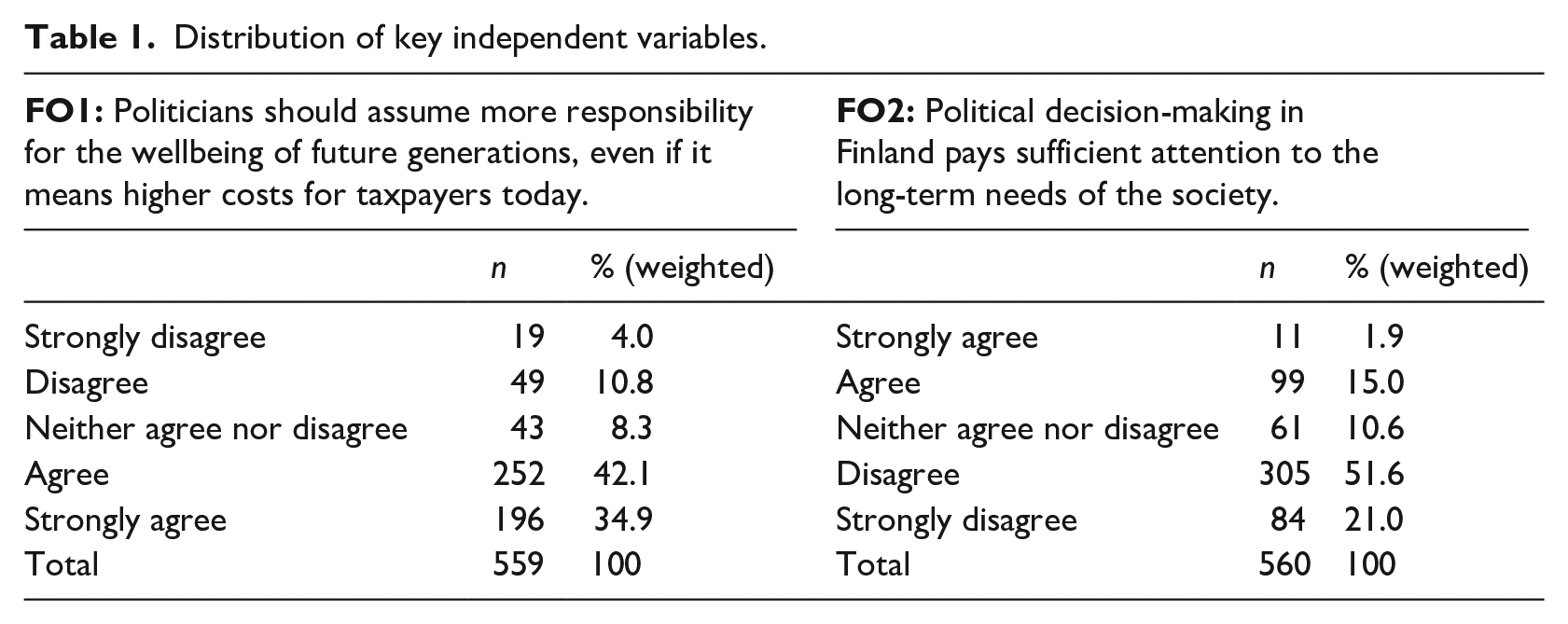
In the analyses of electoral fortunes, the dependent variable is the candidate’s share (%) of list votes (prefshare) at the 2019 elections. We use a log-transformed version of the variable due to its skewness to a low numbers of votes. The key independent variables measure candidates’ future orientation by two aspects. First, their preference for long-term investment versus short-term benefits 2 in politics (‘FO1’). Second, by their satisfaction with the extent of future-oriented decision-making in Finnish politics 3 (‘FO2’). Both variables are measured on a 5-point Likert scale (strongly disagree to strongly agree). The measurement of FO2 was reversed so that higher values indicate more demand for future orientation in Finnish politics. The two items represent distinct aspects of a candidate’s future orientation, evidenced by their weak bivariate correlation (rho = .19). Notably, FO2 expresses the candidate’s satisfaction with future orientation in Finnish politics, whereas FO1 captures the candidate’s own preference for long- versus short-termism in politics. 4 Ideally, future orientation would be measured by various indicators, but data availability limits us to FO1 and FO2. On the other hand, their distinctiveness ensures that at least preferences (FO1) and perceptions (FO2) of future orientation are both captured by the analyses.
Table 1 lists the distributions of FO1 and FO2. Most candidates declared a preference for long-term decision-making even at the cost of present-day taxpayers (agree or strongly agree in FO1) and desire more focus on the long-term needs in political decision-making in Finland (disagree or strongly disagree in FO2). Clearly, the long-term needs of society are important for candidates, at least in principle.
Distribution of key independent variables.
We use self-placement on the left–right and GAL-TAN axes to examine how ideology influences future orientation and vote earning (H2 and H3). Ideological positions were obtained from an exploratory factor analysis (EFA) on a polychoric correlation matrix, built from the candidate’s answers to the VAA questions that relate to the left–right and GAL-TAN divides in politics. Appendix A contains the items that were considered in the EFA (see online supplemental material for appendices). Their substantial relevance to the left–right or the GAL-TAN dimension were cross-checked with previous research (Isotalo and Järvi, 2020; Isotalo et al., 2020). The EFA results supported a two-factor solution (Eigenvalue >n1) that together explained over 90% of the total variance among the factors. An oblique (promax) rotation was performed, which allowed the two factors – left–right and GAL-TAN – to be correlated. The two statements on North Atlantic Treaty Organization (NATO) membership were dropped from the analysis, since they loaded poorly (< .4) on both factors, indicating their distinctiveness from the left–right and the GAL-TAN dimensions. Appendix B contains the results of the final EFA. Based on it, we computed standardized, regression-based factor scores for candidates’ left–right and GAL-TAN positions. Subsequent confirmatory factor analysis showed similar results to the EFA (see Appendix C).
To address H4 and H5, we consider the candidate’s biological age in relation to future orientation and earning votes. Age brackets spanning over 15 years are used in the analyses (18−34; 35−49; 50−64; 65 and older), roughly corresponding to the different phases of the life course (e.g. Elder and Shanahan, 2006). 5 We control in the analyses for the influence of the candidate’s personal circumstances: education, parenthood, their economic situation, political experience (see Appendix D for details). Due to the strong dominance of highly educated candidates (64%) and low occurrence of candidates with primary education only (< 3%), education is dichotomized where 1 = tertiary and 0 = upper secondary education or lower. Parenthood is indicated by having underaged children in care. 6 The economic situation of the candidate’s family is measured subjectively in the absence of objective indicators in the data. Political experience is introduced as a crude measure of cumulative experience in different party offices or functions (variables A6a–g and A6j in CCS). 7 The outcome index ranges from 0 (no experience) to a maximum of 7 (past or current) offices with a Cronbach’s alpha of .71 and an average inter-item correlation of r = 0.20. Finally, the number of candidates on a party or alliance list is strongly correlated with the number of votes a candidate receives, and will also be controlled for in the models.
Future orientation according to age and ideology
Figures 1 to 3 show the weighted percentages of candidates’ future orientation by age group and ideology. Most of the younger candidates (18–34 years old) strongly prefer long-term orientation even at the cost of present-day wellbeing (FO1), while the proportion of moderate agreement, as well as disagreement, increases in the older age groups. This reflects the earlier assumption that young people have more at stake in the future. Interestingly, there is an increase of agnostic candidates in the oldest age group. Although not directly suggesting a legacy motivation effect, it still indicates that presentism at least does not linearly increase with age. FO2 shows a similar pattern, with strong or moderate dissatisfaction dominating across age groups (1(b)), yet relative satisfaction and indecisiveness tend to increase among older politicians. The bivariate associations between future orientation and age are significant for both variables (FO1: Pearson X2 = 42,5; p < .001; FO2: Pearson X2 = 31,6; p < .01).
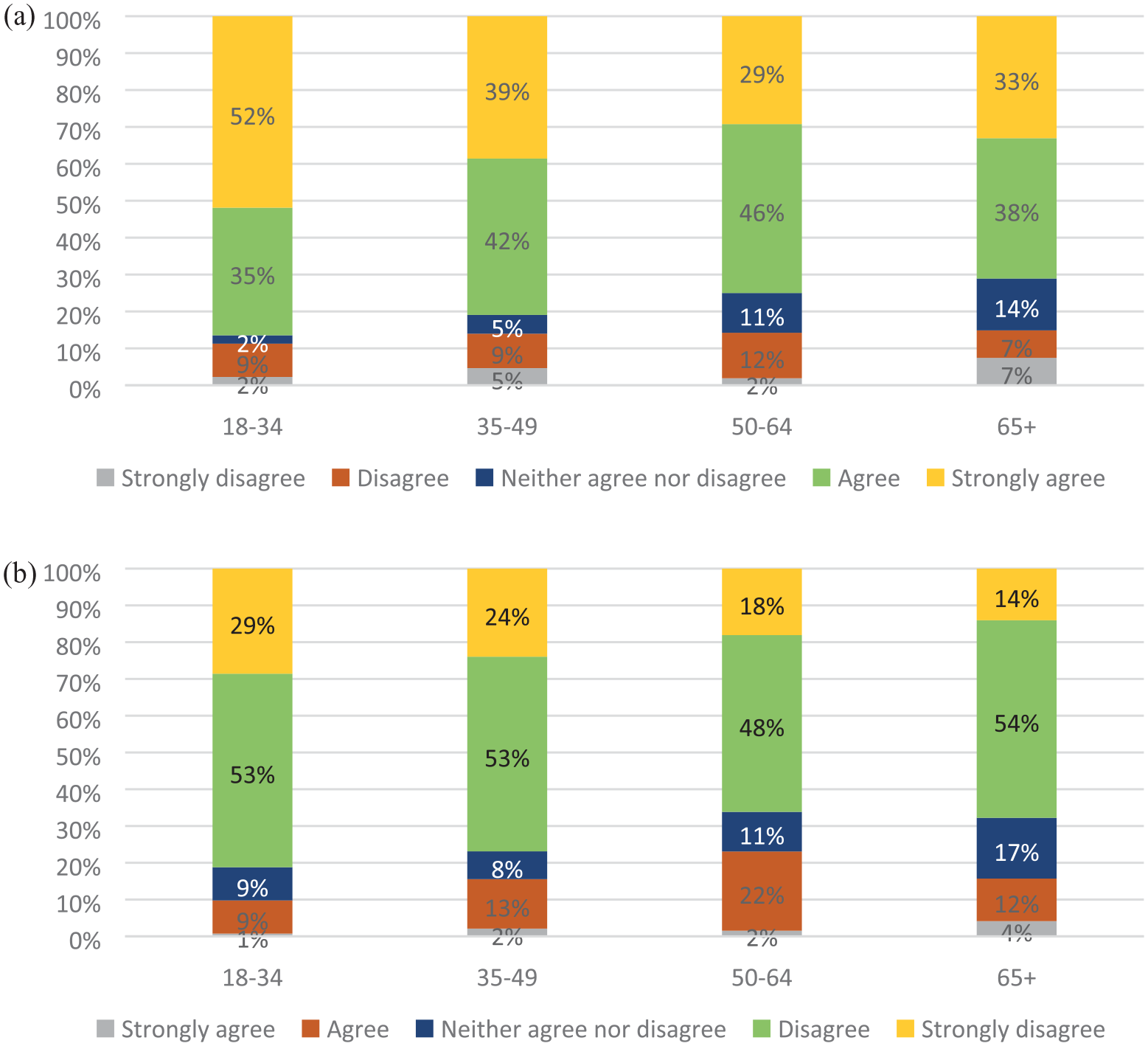
Future orientation by age: (a) preference for long- versus short-term benefits (FO1), by age group; (b) satisfaction with future orientation in politics (FO2), by age group.
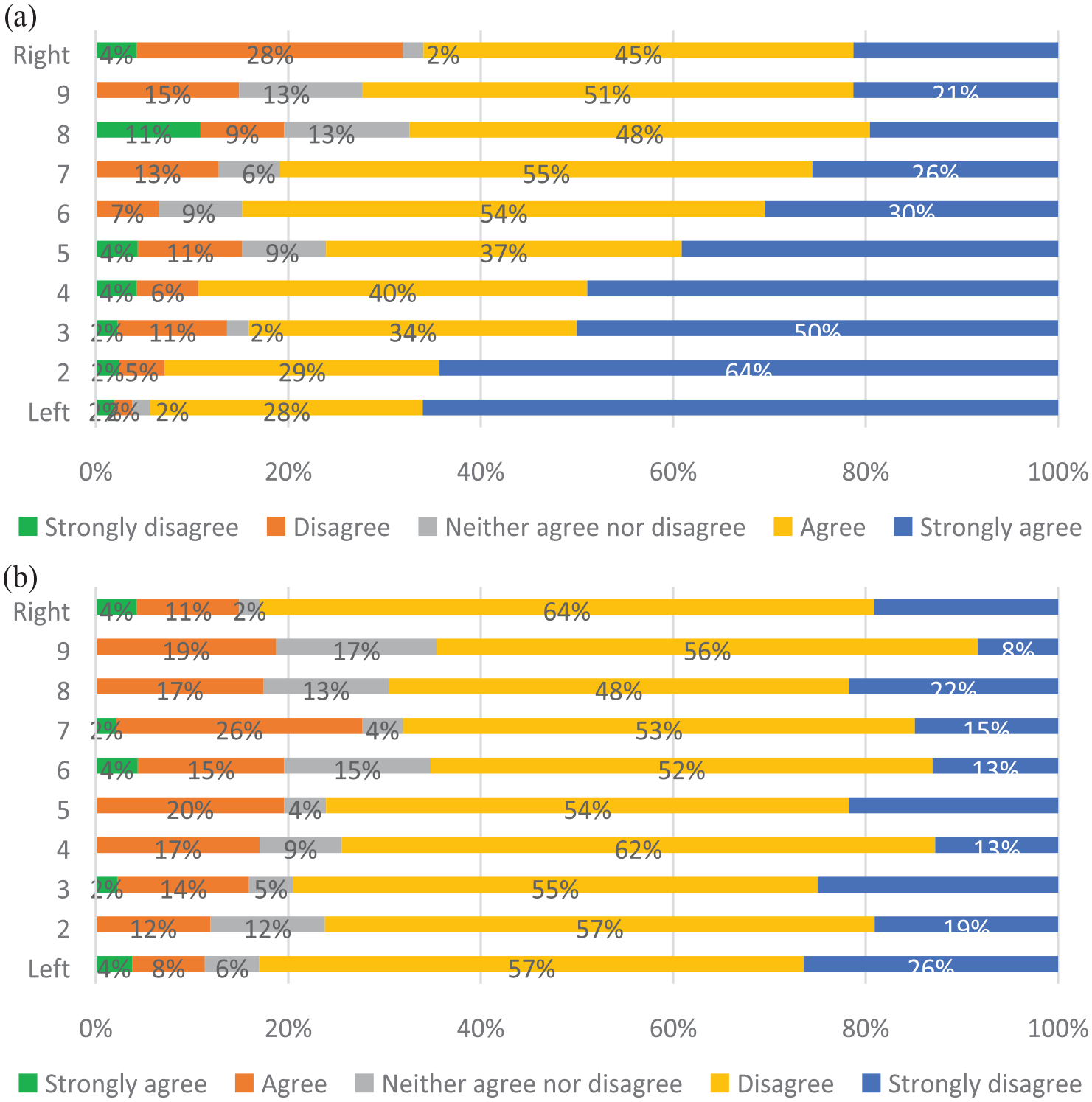
Future orientation by left-right placement: (a) preference for long- versus short-term benefits (FO1), by left–right position; (b) satisfaction with future orientation in politics (FO2), by left–right position.
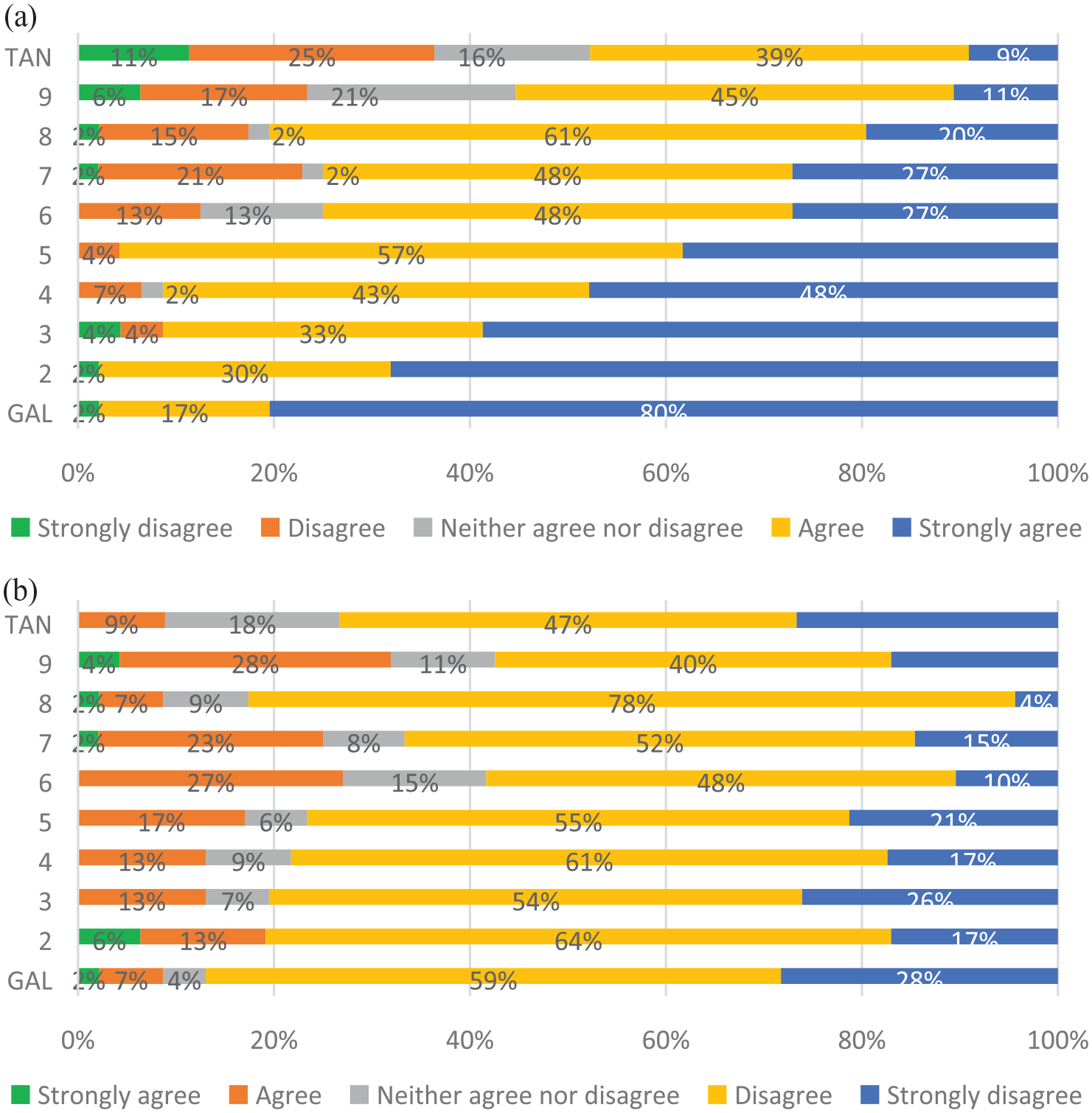
Future orientation by GAL-TAN placement: (a) preference for long- versus short-term benefits (FO1), by GAL-TAN position; (b) satisfaction with future orientation in politics (FO2), by GAL-TAN position.
Figures 2 and 3 show future orientation by ideological positioning. 8 The majority of left-leaning candidates (1–4 on the scale) have a strong preference for long-term investment despite short-term costs, whereas they are only about 20–30% among the right-leaning politicians (7–10 on the same scale). Conversely, there is a tendency for growing disagreement or indecisiveness as the ideological position shifts more to the right. These patterns reflect the assumption that leftist ideology is more forward-looking by seeking societal change. Left–right orientation emerges as significant for candidates’ future orientation (Pearson X2 = 99,2, p < .001). By contrast, we do not find a significant relationship between left–right ideology and FO2 (Pearson X2 = 39,1, p > .05). We cannot discern a clear pattern of (dis)satisfaction with long-termism in Finnish politics across the left–right spectrum (2(b)). As far as perceptions of long-termism in Finnish politics are considered, left–right ideology seems to be less of a cleavage.
As with 2(a), GAL-TAN placement is relevant for how much politicians prefer future benefits compared to immediate rewards (FO1). Candidates whose issue positions strongly converge with GAL orientation (1–4 on scale) also declare strong preference for long-term over short-term benefits, whereas less than a third of the most TAN-oriented candidates (7–10) do so (3(a)). As discussed earlier, it seems plausible from the data that the focus on the environment and social evolvement, as opposed to traditional values, explains the variation in future orientation. Yet, just as for the left–right dimension, (dis)satisfaction with the focus of Finnish politics does not show any clear patterns across the socio-cultural divide (3(b)). Most candidates are dissatisfied with the extent of focus on the future in Finnish politics across the socio-cultural dimension. GAL-TAN positioning is furthermore only weakly related to candidate satisfaction (Pearson X2 = 62,2, p < .01).
In summary, although there is relatively broad agreement among parliamentary candidates on the importance of future-oriented decision-making, we still find divisions among candidates, based on age and ideological orientation. These differences stem mainly from their readiness to compromise current wellbeing for the benefit of future generations (FO1). Candidates who are most willing to invest now to only reap benefits in the future are mostly younger, more leftist and more GAL. This aligns with H2 and H4. Meanwhile, candidates with different ideological positions clearly vary less in terms of their satisfaction with the extent of future-oriented politics in Finland. Most candidates express relative dissatisfaction with the extent of long-termism in Finnish politics, despite likely having divergent views on what a more future-oriented policy would entail. Still, dissatisfaction with current politics slightly hinges on age, as relative satisfaction increasing among older candidates. Rather than an ideological divide, there might be a generational divide in the level of satisfaction with current policymaking in Finland. Overall, however, the link between age, ideology and a politician’s satisfaction with the focus of decision-making is weak at best.
Future orientation and vote earning
If the younger, more leftist and GAL-oriented politicians are generally more future-oriented, does this also translate into vote earning? Do future-oriented candidates benefit or lose out when their popularity is put to the test? We predict vote winning by survey-weighted ordinary least squares (OLS) regressions and estimate the influence of future orientation net of many other personal characteristics. We also examine whether age and ideological positions moderate the association between future orientation and vote earning.
For regressing vote winning on future orientation, we transform FO1 and FO2 into dummies where FO1: 1 = strongly agree or agree; 0 = neither nor, disagree or strongly disagree; and FO2: 1 = strongly disagree or disagree; 0 = neither nor, agree or strongly agree. This allows us to separate between future orientation as a strategical focus from preference for short-termism, or having no clear opinion on the matter. We build the models stepwise (see Appendix E for full results of all models). We see that even in the least restrictive models, candidate future orientation is not a strong predictor of vote earning. When considering future orientation and list competition only (M1), the former positively associates with vote earning, but the relationship is not particularly strong. The inclusion of personal circumstances (M2), ideological placement (M3) and political experience (M4) cancel out the initial positive association found between future orientation and vote winning. The results are in accordance with the expectations formulated in H1: candidate future orientation does not generally translate into vote earning. It seems that voter myopia overrides any potential benefits a focus on the long term could have on electoral success. Meanwhile, we do not find any evidence that future orientation would hurt electoral success either. This is just as striking, as most of the literature that discusses voter myopia assumes that a long-term focus at the cost of present-day wellbeing would penalize candidates. Instead, we do not find any evidence of an effect of future orientation, whether positive or negative. Future orientation does not reward candidates, but does not punish them either. Figure 4 shows the odds of earning more votes in the most restrictive model (M4 in Appendix E).
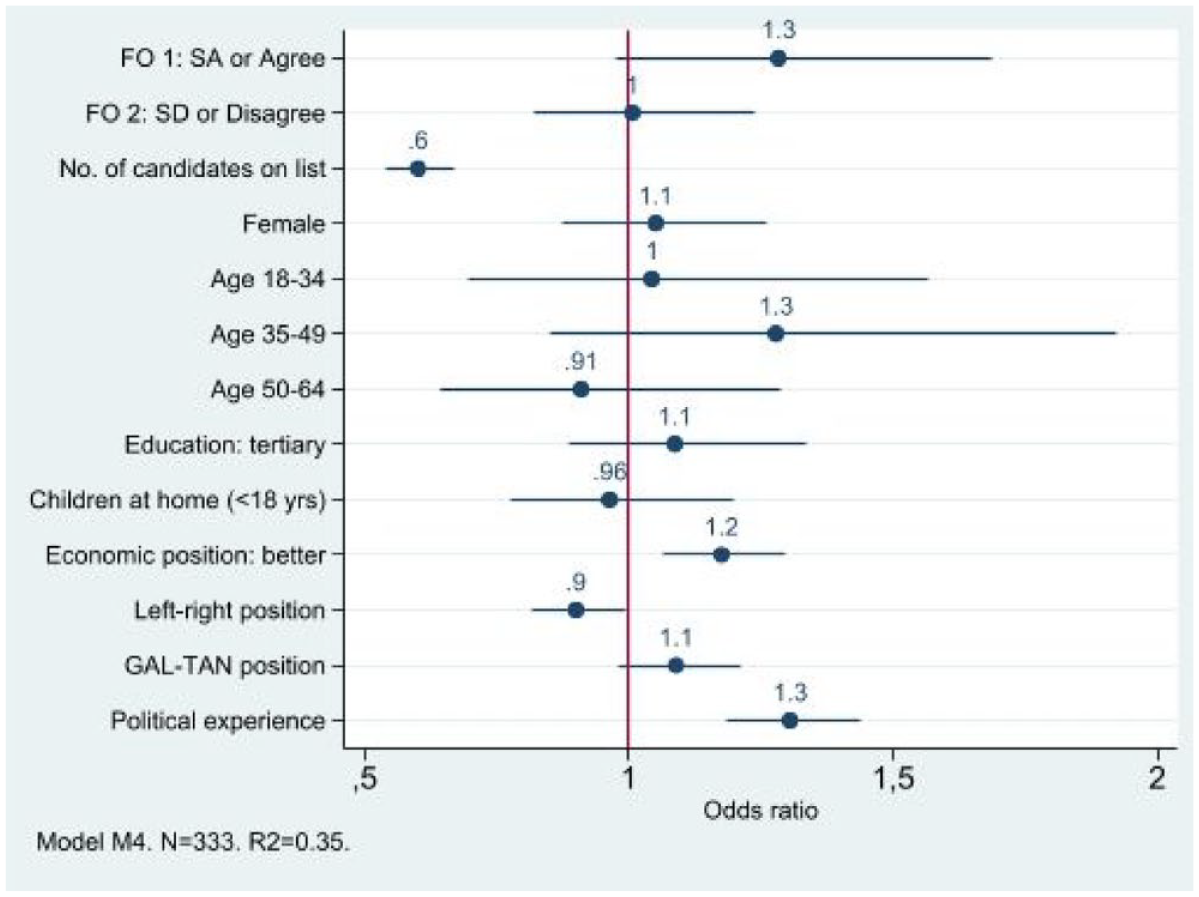
Regressing vote winning on future orientation.
Since younger, more leftist and more GAL candidates are more future-oriented, would they gain more at elections than other candidates from their strategic focus? The inclusion of interaction terms in model M5 (see Appendix E) surprisingly suggests that age or ideology has no significant influence on the relationship between future orientation and electoral success. Although future orientation is characteristic of the younger, leftist and socio-culturally more liberal candidates, a long-term focus does not appear to be a better electoral strategy for them compared to other candidates. Consequently, the expectations in H3 and H5 are not met. It seems that the link between candidate future orientation and vote winning does not hinge on age or ideology.
Robustness checks
We control for party affiliation to test whether the association between future orientation and vote winning is conditioned by party affiliation, and not only ideology (see Appendix F). The main results are robust to the original model. We also estimate a model without FO2 (satisfaction with the focus of Finnish politics) since it actually measures candidate perceptions of politics instead of a candidate’s own preferences (see Appendix G). The results for FO1 are robust and the explained variance in the model remains virtually unchanged compared to the original model. Clearly, the political candidate’s personal preferences about temporal focus (FO1) still seem to better link (albeit weakly) to electoral outcomes than their satisfaction with the focus of politics overall (FO2). Further, we test whether future orientation had bearings on not only vote winning, but also the likelihood of being elected at the 2019 elections (see Appendix H). We find no evidence that future orientation would directly help in getting elected – nor that it would hurt it – although the low number of elected candidates in the data (n < 50) may underestimate the relationship. Fourth, we estimate the models while distinguishing between agnostic candidates (responding ‘neither nor’ in FO1 and FO2) from long-termism and presentism (see Appendix I). It suggests that providing no clear answer may be a good strategy for younger candidates notably, as taking a stand for either long- or short-termism (FO1) hurts these candidates’ predictions of earning votes. We interpret this as a consequence of how future orientation neither benefits nor hurts a politician’s electoral success. In these circumstances, younger candidates might just gain strategically more from avoiding choosing between long- versus short-termism. Additionally, we control for government incumbency of the candidate’s party prior to elections, since candidates from these parties were likely penalized to some extent in the 2019 elections due to the unpopularity of the incumbent government (see Appendix J). The relationship between FO1 and vote winning is slightly stronger when government incumbency is taken into consideration. Maybe expressing a desire to pursue a future that is different from the present provides cues for voters that future policymaking by these politicians will be different from the failed attempts of the previous government, and, in this way, it relates positively to vote earning.
We also include campaign budget in an additional model (Appendix K), since a higher budget likely enhances a candidate’s campaigning and thus increases the chances of obtaining more votes (Isotalo et al., 2020; Maddens et al., 2006). We created a simplified 6-category variable of the original 11-category measure. The highest and lowest budget values were combined to ensure sufficient effect sizes in all categories. The inclusion of campaign budget does not change the direct association between future orientation and electoral success, but it somewhat strengthens the interaction between long-termism, age and vote earning. Keeping all other factors constant, a preference for the long-term instead of the present (FO1) relatively decreases the odds of vote winning in some of the younger age groups. As future orientation is relatively less common among the older age group (see Figure 1), perhaps candidates who distinguish themselves in this age group by being more future focused than their competitors have a certain advantage in the eyes of some voters, which could ultimately translate into earning votes. Although speculative, it seems plausible that the weak positive impact on vote earning of future orientation among these candidates could be due to a tendency in older age to start thinking about the coming generations and to want to ensure their future wellbeing (the ‘legacy’ and ‘altruism’ effects). Finally, we estimate the original models on a sample that includes all candidates who ran for election in 2019 (see Appendix L). This includes candidates of smaller parties that were not represented in Parliament prior to the 2019 elections (n = 199, 26%). Even when considering a broader range of politicians, future orientation is not related to vote winning. The linkages between a political candidate’s strategic focus and their performance at elections does not seem to change between runners of established parties and political outsiders.
Discussion
To advance the scholarly understanding of shortsightedness in democratic policymaking, in this study we have explored politicians’ views on future-oriented policymaking and the extent to which it is connected to their vote-winning prospects. We have demonstrated that a distinct majority of candidates nominated in Finnish parliamentary elections think that future-oriented policy receives too little attention and that it should be prioritized in decision-making even though it would imply a higher economic burden today. So there appears to be fertile ground for a more future-oriented political agenda to develop over time. We have, however, further demonstrated that the extent to which politicians take on future-oriented perspectives varies according to ideology and age. With not all politicians being equally willing to prioritize future goals over current needs, such decisions are likely to become subject to political power struggles, which, in turn, will make it challenging for office-seeking politicians to stay in power, to persist in their emphasis on future concerns.
We have also analysed the extent to which individual politicians’ electoral prospects are connected to their views on future-oriented decision-making and if this relationship is moderated by age or ideology. Overall, we find only a weak positive effect of future orientation on vote earning, which essentially disappears when the effects of other drivers of vote earning are controlled for. In the absence of a meaningful relationship between our variables of interest, we conclude that long-term orientation does not improve, but does not penalize either, candidates’ chances of winning votes.
The Finnish context, with its open-list proportional electoral system with mandatory preferential voting, provides an excellent opportunity to study how the attitudes of individual politicians are connected to their personal electoral prospects. However, generalizing to other electoral contexts may be risky. In party-centred systems, for example, it would make sense to study the future orientation of (aspiring) politicians from the viewpoint of intraparty competition, in order to find out whether being future oriented is a merit or an obstacle in the struggle to get nominated. However, regardless of system characteristics, we hope to inspire more research into the future orientation of politicians, both candidates and incumbents. Additionally, examining future orientation through only two items is undeniably a shortfall. Ideally, there should be more fine-grained data to better understand how politicians prioritize between long-term goals and short-term rewards. Survey experiments have great potential in further unveiling the trade-offs politicians are willing to make for the long-term needs of the society. Finally, the conventional wisdom that attitudes do not imply behaviour cannot be ignored, and, although some candidates express more future-oriented opinions than others, the leeway in their actions is limited by party programmes and the realities of political bargaining. Although we cannot be sure if more long-term focus among politicians actually leads to more long-term decision-making, attitudes are, at least, suggestive of behaviour, and investigating politicians’ trade-offs between the present and the future is an indication of the future paths for political decision-making.
Besides underlining the need for more research on politicians’ temporal political dispositions, the implications of our findings are twofold. Firstly, our findings largely corroborate the canonical scholarly understanding, according to which there is a mutually reinforcing dynamic in democratic electoral politics: voters, who are more supportive of immediate rather than prolonged policy benefits, push politicians seeking re-election towards downplaying future orientation. There does not seem to be an electoral pay-off in being very future oriented, which incentivizes politicians to emphasize short-term policies. From the viewpoint of the need for future-oriented policy choices, this is obviously bad news. Secondly, the findings imply a clear political divide regarding future orientation. It runs between future-oriented leftist and GAL politicians and their rightist, TAN counterparts. In our data, the electoral implications of the divide seemed modest, but politicians representing the opposing ends of the ideological dimensions obviously have widely contrasting views of how much emphasis should be placed on future wellbeing (at the cost of current wellbeing). There seems to be potential for political conflict in the different temporal emphases across the ideological spectrum, and many future elections in western democracies may be fought between politicians representing contradictory views on future orientation.
Supplemental Material
sj-docx-1-ips-10.1177_01925121231200124 – Supplemental material for Does it pay to think about the future? Future orientation, ideology, age and vote earning among political candidates
Supplemental material, sj-docx-1-ips-10.1177_01925121231200124 for Does it pay to think about the future? Future orientation, ideology, age and vote earning among political candidates by Annika Lindholm, Lauri Rapeli and Åsa von Schoultz in International Political Science Review
Footnotes
Acknowledgements
We would like to thank the three anonymous reviewers for their helpful comments that allowed us to improve an earlier draft of this research.
Funding
The authors disclosed receipt of the following financial support for the research, authorship and/or publication of this article: This work was supported by the Academy of Finland grant numbers 312676, 333013 and 316239, and Future of Democracy: A Centre of Excellence funded by the Åbo Akademi University Foundation.

Supplemental material
Supplemental material for this article is available online.
Notes
Author biographies
References
Supplementary Material
Please find the following supplemental material available below.
For Open Access articles published under a Creative Commons License, all supplemental material carries the same license as the article it is associated with.
For non-Open Access articles published, all supplemental material carries a non-exclusive license, and permission requests for re-use of supplemental material or any part of supplemental material shall be sent directly to the copyright owner as specified in the copyright notice associated with the article.
