



Abstract
Common reductionist contractions in thinking or writing about personality and individual differences are to conflate personality, dispositional traits, the Big Five, and self-reports. To avoid conceptual confusions and communicate more effectively, we should bear in mind: (a) Personality is much more than dispositional traits or basic tendencies, (b) basic tendencies are more than just Big Five traits, and (c) self-reports of traits—which capture explicit self-concepts—are just one out of many approaches to trait measurement. These distinctions should be reflected in our thinking, writing, and communication. Attending to them can help clarify what has been studied and (re-)contextualize our knowledge bases. Personality psychology is a science, and scientific language must be accurate, precise, and nuanced.
Plain language summary
Personality, dispositional traits, the Big Five, and self-reports are often mixed up. To avoid confusions and communicate more effectively, we should bear in mind: (a) Personality is much more than traits, (b) traits are more than just the Big Five, and (c) self-reports of traits—which capture self-concepts—are just one out of many approaches to measuring traits. These distinctions should be reflected in thinking, writing, and communication. Attending to them can help clarify what has been studied and what we know. Personality psychology is a science, and scientific language must be accurate, precise, and nuanced.
Misconceptions and miscommunications are rampant in communications about personality, be it from experienced personality psychologists or those who only occasionally use personality variables in their own research. Some may know better but use simpler, shorthand language to be succinct and conserve space; others may not be well-versed in personality psychology and believe those shorthand writings. Though perennially lamented, recent work highlighting the need for more consensus (Leising et al., 2022), better formal grasp of verbal theories (Fried, 2020; van Rooij & Blokpoel, 2020), and cutting through our jingle-jangle jungle of terms (Lawson & Robins, 2021) is gaining traction. There thus seems to be a renewed interest in doing better. Nonetheless, even on much more basic grounds than specific theories or constructs, many of us
1
are guilty of such sentences evading our mouths, pens, and keyboards (Table 1): “Personality was assessed with the Big Five.” “Participants reported their personality using the Big Five.” “Big Five personality changed across time.” “The genetic basis of personality [ = Big Five] was examined.” “Abilities/interests/values/attitudes/etc. were correlated with personality [ = Big Five].” Examples of Communication Varying in Precision, Reductionism, and Word Count. Note. All examples assume that the research in question used self-reported Big Five data. This also includes Examples #4 and #5 that do not reference the Big Five at all. The term “dispositional trait” could also be substituted with “basic tendency” if one wanted to avoid using the term “trait” too narrowly only for specific individual difference variables. The term “reported explicit self-concepts of dispositional Big Five traits” could also be substituted by “self-reported responses to Big Five items” if one were to take a more measurement-focused approach in communication. Notably, the responses to items tap explicit self-concepts.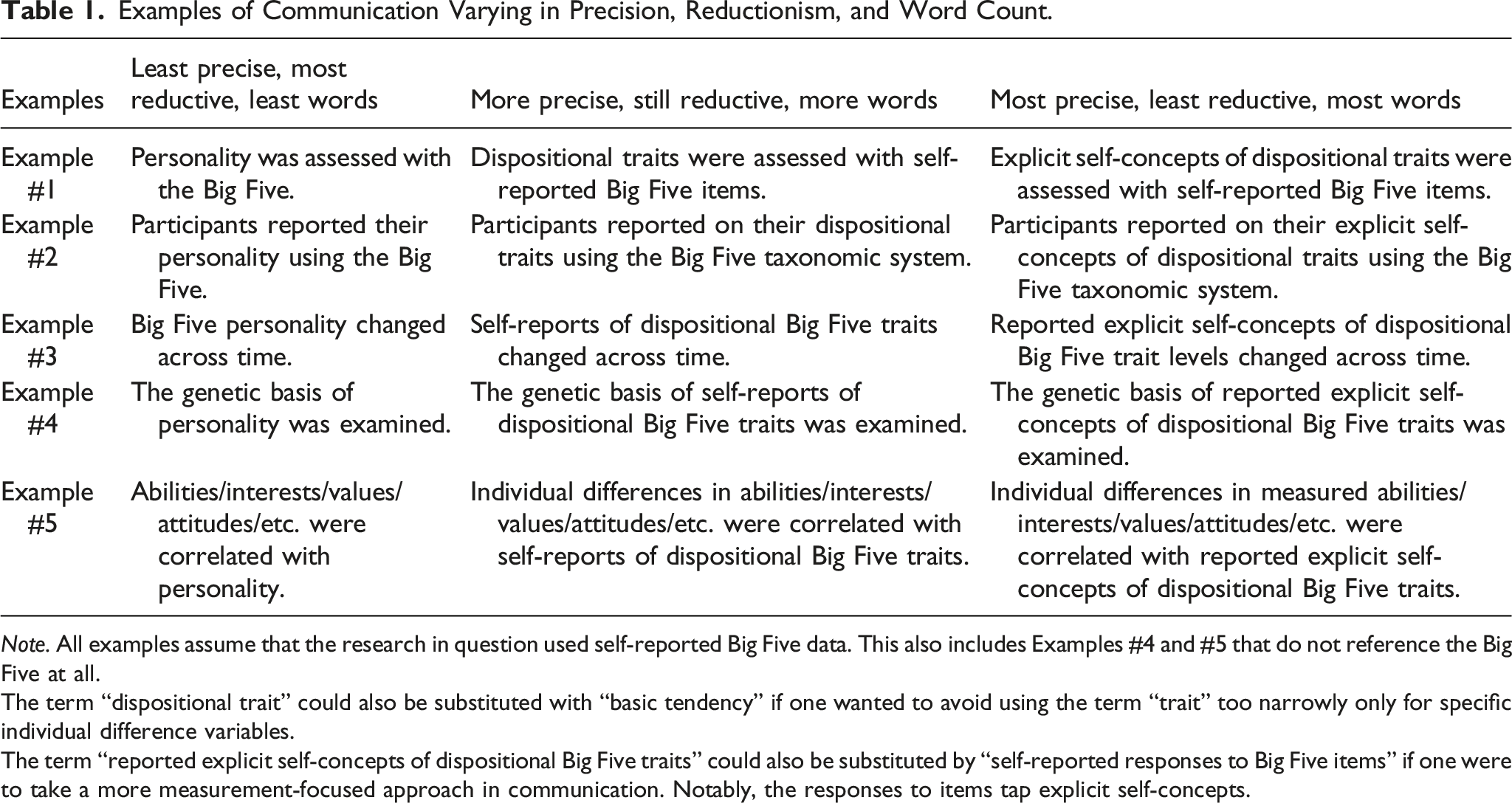
These and other similar sentences abound in the literature, including communications by personality psychologists (e.g., to each other as well as to researchers from other fields or practitioners) and by those from other fields (e.g., seeking to “assess personality” with a few traits). In such instances, personality is—intentionally or unintentionally—reduced to being solely about dispositional traits (often without even operationalizing what exactly “traits” are); dispositional traits are reduced to one specific taxonomic system (mostly the Big Five); and in terms of measurement, usually self-reports are treated as the only source into gleaning knowledge about participants’ trait levels. These reductionist contractions are problematic in several respects.
Issues with reductive contractions: Personality ≠ Traits ≠ Big Five ≠ Self-reports
Issue #1: Personality ≠ Traits
First, personality is vast. It encompasses a host of individual difference variables, such as at least (see McAdams & Pals, 2006): morphology (e.g., genes, neurobiological structures, and attractiveness); dispositions (e.g., temperament, basic tendencies, and intelligence); characteristics adaptations (e.g., needs, goals, attitudes, values, interests, virtues, skills, and relational tendencies); and narratives (e.g., self-concepts and life-stories). In some traditions within personality psychology, only certain individual difference variables are termed “traits,” such as most often basic tendencies (e.g., the Big Five), while others are not (e.g., most characteristic adaptations). Other traditions, however, emphasize that any individual difference variable harbors more or less state- and trait-related variance, respectively (Kandler & Rauthmann, 2022). Still, basic tendencies—such as the ones encompassed in the Big Five or HEXACO systems—are one out of many personality characteristics. Personality is so much more than just a collection of “Big Few” traits (Mõttus et al., 2020).
Issue #2: Traits ≠ Big Five
Even within the domain of basic tendencies—those touted as dispositional “traits”—the Big Five taxonomy (John, 2021) is one out of several possible taxonomic systems. There are also others (e.g., HEXACO: Ashton & Lee, 2020), even with good validity and cross-cultural evidence (e.g., Thalmayer & Saucier, 2014). Moreover, the hegemony of the Big Five system—as useful and organizing as it is (Bainbridge et al., 2022) and as many measures it has produced—has been (e.g., Block, 2010) and still is questioned by some (e.g., Condon, 2023). There are quite likely more basic tendencies of interest when examining dispositional cores of personality (Kandler & Rauthmann, 2022) than just those collected in traditional “Big Few” taxonomies (e.g., Paunonen & Jackson, 2000). Notably, even the Big Five domains themselves are not monolithic but fall into different aspects (DeYoung et al., 2007), facets (Irwing et al., 2023), and nuances (Mõttus et al., 2017) that, when measured, provide at least a fuller picture of the Big Five trait universe (see also the AB5C model for two-way blends between Big Five domains: Hofstee et al., 1992).
Issue #3: Traits ≠ Self-reports
Third, most personality-relevant variables can be assessed by various data sources and methods, such as but not limited to the BIOPSIES sources: actual Behavior and their traces (online, offline, archival records, passively sensed, etc.); Indirect measures (e.g., implicit association tests and projective tests); Observation (e.g., by trained coders, clinicians, and expert assessors); Physio-biological measures (e.g., genetic, neurological, endocrinological, and physiological); Strangers’ impressions (by laypeople at zero-acquaintance); Informant knowledge (by well-acquainted friends, family, etc.); Experience and ecological sampling (e.g., ambulatory assessments and daily diary); and Self-reports (e.g., on questionnaires and in interviews). As is evident, self-reports are one of many sources, though perhaps most widely used in our field (Robins et al., 2007).
Self-reports of basic tendencies—such as those about the Big Five—tap people’s explicit and generalized self-concepts of their dispositional trait levels—in other words, what people think (and can verbally or in writing articulate) of themselves in general or of their typical affects, behaviors, cognitions, and desires (ABCDs: Wilt & Revelle, 2015). However, they can only serve as self-construed proxies of general, recurrent, typical, or patterned ABCD tendencies; they do not represent those directly. Of course, self-reports show overlaps with other sources (Paulhus & Vazire, 2007) and boast predictive validities (e.g., Paunonen & Ashton, 2001; Soto, 2019), but they just offer one glimpse into people’s actual tendencies. 2 Further, even when intending to measure a given variable as a trait (e.g., instructing the person to provide descriptions of how they generally are), there is state- and trait-related variance in ratings gathered at one measurement point (Steyer et al., 1999). Thus, systematic, stable, and reliable trait variance—which seems to be what many personality psychologists are interested in—needs to be empirically pealed out across multiple items administered at different measurement occasions and assessed by different sources (e.g., informant knowledge, self-reports; see, e.g., Mõttus et al., 2023 for an application) to hope to approximate a “true” trait. In addition, traits will have to be conceived of in descriptive and explanatory sides (Fleeson & Jayawickreme, 2021), taking also into account to what extent we are seeking to use personality-related variables for description, explanation, or prediction as separable goals (Mõttus et al., 2020).
Plea: Let’s do better!
I have outlined three issues as “reductive contractions”: (a) that personality is reduced to being only about dispositional traits or basic tendencies, (b) that dispositional traits are reduced to the Big Five taxonomy, and (c) that self-reported assessments are treated as the dispositional traits themselves. These contractions can happen in conceptual thinking and language each in isolation (i.e., Personality = Traits, Traits = Big Five, and Traits = Self-reports each separately), but they are often also found intermingled (i.e., Personality = Traits = Big Five = Self-reports in concatenation; see examples in Table 1), simply because a lot of research uses self-reported Big Five scores.
This reminder piece does not critique the practice of using self-reported Big Five scores—they can be an important and interesting window into people’s individual differences; but they should not be sold as people’s “personalities.” Reductive contractions, as specified in Issues #1-3 above, can be spotted both within core personality-psychological literature (perhaps because we have become accustomed to shorthand writings as those compiled in Table 1) and beyond (perhaps because some believe our shorthand writings and do not know better, or because they also engage in shorthand writing despite knowing better). However, benefits in shorter communication are offset by losses in accuracy and precision, leading to murkiness and talking or writing past each other. For example, certain portions of the literature concerned with “personality” have indeed amassed fascinating knowledge about people’s responses to items tapping their explicit self-concepts regarding their Big Five trait levels; however, in such instances one cannot claim to have left that narrower scope and studied “personality” per se. 3 Attending to the issues outlined here and taking them seriously can help re-contextualize our knowledge base, bringing us more in line with what has actually been studied and the insights we can (purport to) glean (see examples in the middle and right column of Table 1).
Hence, a plea addressed at personality psychologists: Let us set good examples in our literature to reduce conceptual conflations and language contractions (see some suggestions in Table 1). Addressed at others occasionally using personality variables: Please be aware of contractions and keep in mind that self-reported Big Five traits cannot be all there is to personality.
Conclusion
What has been collated here is likely 4 neither surprising nor controversial, but given the ubiquity of the issues compiled here, a reminder about them as well as plea to do better seemed in order. Specifically, we need to be clear on: (a) personality is more than dispositional traits or basic tendencies, (b) traits are more than the Big Five, and (c) self-reports of traits (such as the Big Five) capturing explicit generalized self-concepts are just one possible source of trait measurement. Keeping these relations in mind and using more precision in our thinking as well as written and spoken communication should be beneficial to our field. We will understand each other better, and we will be better understood by others. Our knowledge can thus be applied better and unfold its full potential, given that our field is a vibrant and interesting hub science (Morf, 2002).
Footnotes
Declaration of conflicting interests
The author(s) declared no potential conflicts of interest with respect to the research, authorship, and/or publication of this article.
Funding
The author(s) received no financial support for the research, authorship, and/or publication of this article.