




Abstract
We examined whether people can accurately judge the experienced power, dominance, and prestige of others based on short texts, and what linguistic cues are related to these hierarchy-related variables. Past research suggests that personality is reflected in language, but hierarchy—another important feature in human relationships—has not been fully considered. In two studies with a zero-acquaintance setting, judges (N1/2 = 105/202) read self-descriptions of speakers (N1/2 = 200/200) and completed peer ratings of speakers’ power, dominance, and prestige. Speakers completed the same scales as self-ratings. We found substantial associations between the hierarchy concepts and several word categories (e.g., sense of power was negatively related to tentative words in self- and peer reports). For power and prestige, judges and speakers used the same linguistic cues for their assessments. Further, judges converged strongly in their assessments and showed high self-other agreement for all variables. We conclude that social hierarchy concepts are enacted in language and can be perceived from minimal verbal information. The findings show the importance of distinguishing between various hierarchy concepts when analyzing language correlates and have implications for testing power theories with linguistic material and the understanding of perceptions regarding hierarchy differences and following downstream consequences.
Introduction
Language does more than neutrally inform hearers or readers. It is inevitably an instrument for enacting, recreating, or subverting power. —Ng & Bradac, 1993, p. 1
In modern life, power is exercised through language. CEOs and generals “rally the troops” through speeches, banners, and written messages. For those seeking power without a formal position, verbal communication may be even more important: From community organizers to middle managers, people must convey through language that they are powerful and worth following—and in the new world of remote work, where so much influencing occurs via Slack and email, this may be even more true. Yet, we know surprisingly little about how people’s sense of power, or their strategies for pursuing and using power, relate to their use of language. With notable exceptions, power is rarely proclaimed explicitly in communications, though social relations are reflected in and constituted by language (e.g., Foucault, 1980). How does individual power affect use of language? And does language use differ based on the individual’s approach to power relations?
Research offers convincing evidence that linguistic patterns correspond to hierarchical positions (Brown & Levinson, 1978; Ng & Bradac, 1993). People speaking upward in a hierarchy tend to adopt more polite, and those speaking downward more impolite, language (Brown & Levinson, 1978). Linguistic and paralinguistic cues signal power (e.g., Fragale, 2006; Ng & Bradac, 1993; Tannen, 1995), including a higher rate of interruptions by the powerful, and more hedges (“umm...”) by those with low power, as well as lower speech pace and intensity, and vocal acoustics (Ko et al., 2015).
However, important issues remain unaddressed. First, power is not a property solely of formal hierarchies; many important effects of power are driven by individuals’ personal sense of power more than their structural positions (Tost, 2015). Past work has operationalized power as hierarchical position when studying language effects, and we know less about how self-perceived power (i.e., social influence) affects language use. Second, though various language-related behaviors have been well catalogued, recent technological advances enable psychologists to examine features of language use at a far more granular level. Semantic analysis can identify how language reflects properties such as attentional focus, emotionality, honesty, and social relations (Tausczik & Pennebaker, 2010). Indeed, Tausczik and Pennebaker review a small set of studies connecting word use with power differences; however, the findings are very limited. Third, individuals choose different means to pursue and exercise power: Some use dominance to intimidate others into yielding, whereas others adopt a prestige strategy of providing value in exchange for willing support (Cheng et al., 2013; Henrich & Gil-White, 2001). These different approaches to power are likely associated with different ways of signaling power through language (Körner, Overbeck et al., 2022; cf. Fast & Overbeck, 2022). Finally, moving beyond the perspective of speakers, how is their use of language interpreted by others? If certain patterns of word use characterize those with power, prestige, and/or dominance, do others interpret that language consistent with the sender’s self-perceptions?
The present research aims to shed light on the interrelation of hierarchy and word usage and thus illuminate interpersonal perception of self-perceived power, dominance, and prestige, using short self-descriptions as thin slices of behavior. Separating various hierarchy constructs follows calls for more conceptual clarity (Overbeck, 2010; Suessenbach et al., 2019). In fact, powerful people may differ in their linguistic style not only from powerless people, but also from dominant (vs. submissive) people and from those who have (or do not have) prestige. Because the words we choose can have important consequences for how successful we are in life (Tausczik & Pennebaker, 2010), it is important to understand whether self-perceptions regarding sense of power, dominance, and prestige are mirrored in language. Further, the words we choose affect how others deal with us, and thus we aim to explore whether (1) people differ in their word choice when providing short self-descriptions depending on their self-perceived power; (2) strangers relate specific words to speakers’ sense of power, dominance, and prestige; and (3) the strangers are accurate in these judgments.
Concepts of social hierarchy
In almost every type of relationship, whether romantic, professional, or friendly, hierarchies occur (Agnew & Harman, 2019). We focus on sense of power, dominance, and prestige because they have been intensively studied, can be clearly operationalized, and are important for relevant outcomes in relationships. Whereas power can be understood as a dimension or consequence of social rank, dominance and prestige are typically seen as antecedents of rank (Blader & Chen, 2014; but see Fast & Overbeck, 2022), where rank is a person’s position in a social hierarchy.
Power has been defined in several ways. Common to all these definitions is the social aspect of power. For example, Weber (1947) called power “the probability that one actor within a social relationship will be in a position to carry out [their] own will despite resistance, regardless of the basis on which this probability rests” (p. 152; cited in Ng, 1980). The perspective of understanding power as potential for influence in a social context is mirrored in power definitions in political sciences (Dahl, 1957) and organizational sciences (Salancik & Pfeffer, 1977).
In psychology, power is also referred to in a social context. Power is defined as either the potential for influence (see, e.g., Anderson et al., 2012; French & Raven, 1959; Simpson et al., 2015) or as asymmetric outcome control (Fiske, 1993) resulting from control over valued resources (Blood & Wolfe, 1960; Fast & Overbeck, 2022; Keltner et al., 2003). Control over valued resources can also be understood as objective power, given the ability of a power holder to elicit desired responses from others regardless of their preferences (e.g., a CEO can use power over the promotion prospects of employees to compel action). However, the experience of power is not wholly driven by objective resource control (see Fast & Overbeck, 2022; Tost, 2015) but is also determined by individuals’ subjective personal sense of power. Sense of power is the perceived capacity to influence others and make decisions in social interactions (Anderson et al., 2012). Objective and subjective power are positively correlated, and acquiring objective power activates subjective power (Tost, 2015). In some cases, objective and subjective power have been reported to have the same consequences (e.g., Fast & Chen, 2009). However, other studies have found sense of power more predictive of outcomes than objective power (e.g., Bugental et al., 1997; Körner & Schütz, 2021). For example, sense of power experienced in the relationship is positively associated with relationship quality, whereas positional power does not show a significant association (Körner & Schütz, 2021). Among the most robust effects of experienced power are increased approach orientation (Keltner et al., 2003), more abstract and global thinking (Magee & Smith, 2013), and goal-directed cognition and behavior (Guinote, 2017).
Social rank 1 that affords power can be achieved via two routes. The first, dominance, uses fear, threat, and coercion to intimidate others and overcome their will (Cheng & Tracy, 2014; Henrich & Gil-White, 2001). Dominance is related to aggression, narcissism, agency, and low agreeableness (Cheng et al., 2010) and is seen as socially undesirable. By contrast, prestige is a positively-valued strategy whereby rank is granted willingly to someone with superior knowledge, expertise, and abilities. People with high prestige are respected and admired by others. Prestige is associated with self-esteem, extraversion, agreeableness, and conscientiousness (Cheng et al., 2010; Körner et al., 2023). Dominance and prestige are not only strategies to attain rank; their unique and stable patterns of associations with personality traits, emotions, and behavior (see e.g., Körner, Röseler et al., 2022; von Rueden et al., 2019; Witkower et al., 2020) suggest that they represent stable tendencies for navigating social hierarchies. 2 Moreover, recent research suggests high temporal stability of experienced dominance and prestige (Körner et al., 2023). The ubiquity of hierarchies means that dominance and prestige should be relevant in many contexts, and may affect language usage. In the following, we use the term hierarchy-related variables as an umbrella term for felt power, dominance, and prestige.
Social hierarchy and language
How hierarchy-related variables affect language use
Many nonverbal cues are associated with power and related concepts (Hall et al., 2005). With respect to language, the overwhelming majority of relevant research has examined paraverbal behavior, such as vocal pitch or interruptions, yielding distinctions between “powerful” and “powerless” speech styles. Hedges, intensifiers, tag questions, hesitations, deictic phrases, and polite forms characterize powerless speech, whereas the absence of these forms reflects a powerful style (Fragale, 2006; Ng & Bradac, 1993). These styles have interpersonal consequences. In both lab studies—where power is manipulated through role-plays—and actual organizational contexts, low-power people use more linguistic politeness (e.g., verbal hedges or past tense) than others (Morand, 2000; also see Fragale et al., 2012). Further, the powerful style increases credibility in court settings (e.g., Erickson et al., 1978) and applicants using that style are more likely to be hired (Parton et al., 2002). Thus, power-relevant language can have direct implications for success in life.
Beyond the “styles” literature, relatively little research has studied associations between word usage and hierarchy. Use of first-person plural pronouns is positively related to social rank (measured as power, status, or leadership), whereas use of first-person singular pronouns and tentative words (e.g., “maybe”) is more characteristic of people lower in social hierarchy (Kacewicz et al., 2014). Still, the published literature provides only initial evidence of systematic power differences in word use. Our first research aim was thus to study whether power is embedded in and reflected by language. As language is a fundamental aspect of enacting hierarchy, we use hereafter the term enacted through language and refer to short self-descriptions as language material. We were not only interested in whether language is related to self-perceived power but also to perceptions of power based on language.
How language use affects perceived hierarchy
To date, research on interpersonal perception of hierarchy has predominantly studied nonverbal and paraverbal behaviors. It is well established that people use different nonverbal cues to assess others’ power and dominance (Carney et al., 2005; Hall et al., 2005) and can distinguish hierarchy-related concepts (e.g., dominance from power; Ridgeway, 1987). Moreover, a speaker’s powerful or powerless speech style is used by others to make status conferrals, suggesting that verbal behaviors may predict rank-related judgments (Fragale, 2006). Similarly, higher pitch, loudness, and variability in loudness lead to status conferral (Ko et al., 2015). Yet, a recent review examining cues of rank (Desmichel & Rucker, 2021) cited only one work that analyzed power and word usage: Use of abstract language led to heightened perceptions of power (Wakslak et al., 2014).
Linguistic approaches of the present study
To analyze written texts, we used Linguistic Inquiry and Word Count software (LIWC; Pennebaker et al., 2015). LIWC is the most-used language analysis software in psychology and thus allows for comparison of results with previous findings. Based on power theories, we expected associations between sense of power, dominance, and prestige and certain linguistic categories. For example, sense of power is related to positive affect (Keltner et al., 2003), prestige to cognitive brilliance, and dominance to intimidation (Cheng et al., 2013), such that powerful people may use more positive emotion words, people high in prestige more cognition-related words, and dominant people more swear words.
LIWC is understood as a closed-vocabulary approach because words are assigned to predefined categories. In addition to this approach, we also used an open-vocabulary approach. This method does not rely on a priori word categories; instead, all single words are considered, allowing additional features of language to be extracted (Park et al., 2015; Yarkoni, 2010). For example, sense of power might be strongly related to the word “control” in self-descriptions because power by definition comprises control (Keltner et al., 2003).
Interpersonal perception of social hierarchy variables
People are very accurate (as assessed by convergence between self- and peer ratings; Anderson et al., 2006, 2008) in assessing differences in the ranks of employees depicted in photographs (Schmid Mast & Hall, 2004) or after working on a group task for 45 minutes. Judges (i.e., perceivers) also show high accuracy when using paraverbal characteristics such as loudness and vocal pitch to judge relative status (Ko et al., 2015).
Another indicator of accurate social perception is consensus among judges. Acquainted fraternity-member judges showed high consensus in power and status judgments (Anderson et al., 2001), whereas another study reported nearly zero consensus among unacquainted judges rating targets’ dominance and prestige (Liu et al., 2016).
Despite high accuracy in some contexts, people are not very accurate in identifying the specific cues driving their assessments (Hall et al., 2005); beliefs about cues related to power and truly diagnostic cues show only partial overlap. Cues seem to be used as a thin slice, efficiently processed without awareness (Smith & Galinsky, 2010; see also Choi et al., 2005).
Our brief review of research on lay perceptions of social hierarchy suggests that perceivers use nonverbal, paraverbal, and verbal cues to infer information about rank. However, perceivers show low awareness of using these cues, and evidence of accuracy is limited. Our second aim in this work is to study the interpersonal perception of another person’s sense of power, prestige, and dominance using linguistic cues in zero-acquaintance settings (i.e., do judges interpret cues accurately with respect to these properties?). We thus extend researchers’ earlier focus on status; further, we seek evidence of accuracy, relying on the Brunswik lens model.
Brunswik’s lens model
Brunswik’s lens model provides a methodological framework for studying interpersonal perception (Back & Nestler, 2016; Brunswik, 1956; Osterholz et al., 2021). Observers (judges) assess the traits of other people (speakers or targets) using cues (e.g., physical appearance, vocal behavior, language, websites, and room features; see, e.g., Marcus et al., 2006) to form personality judgments; these can be compared to specific criteria to determine accuracy. The process can be decomposed into two components: Cue validity refers to associations between targets’ traits and cues (in our studies, language cues), and cue utilization refers to associations between observers’ inferences of targets’ traits and cues (see Figure 1). The framework is widely used in interpersonal perception research on personality, with varying cues (e.g., Back et al., 2008; Borkenau & Liebler, 1992; Brauer & Proyer, 2020; Fong & Mar, 2015; Gifford, 1994; Marcus et al., 2006; Naumann et al., 2009; Stopfer et al., 2014; for an overview see Back & Nestler, 2016), and was applied to the perception of hierarchical standing based on vocal acoustic cues (Ko et al., 2015). Brunswik’s lens model.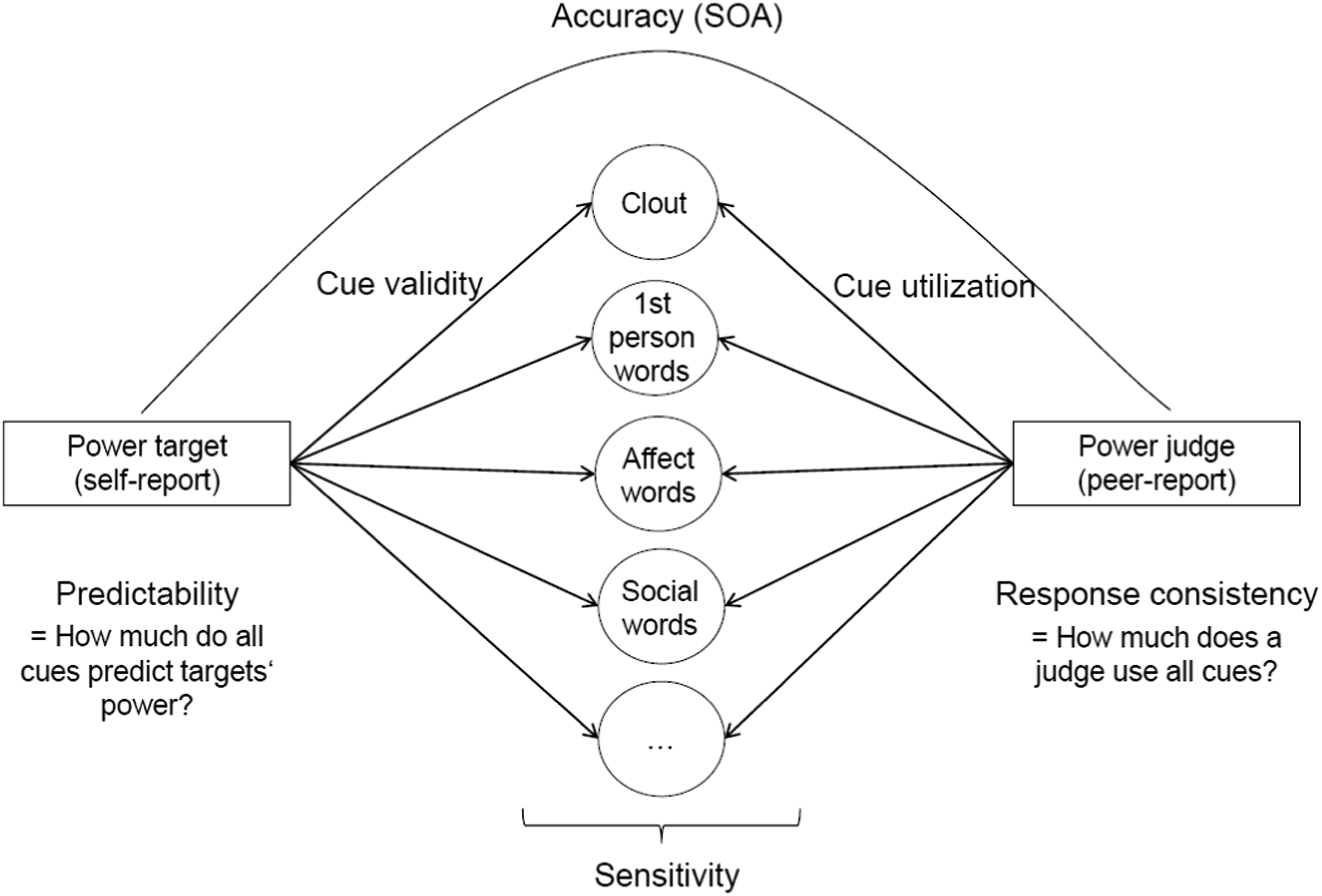
Accuracy and consensus in personality and hierarchy research
The lens model can explain how accurate judgments can be achieved (Leising & Back, 2020). We assessed the quality of personality judgments through two indices: self-other agreement and consensus (Funder & West, 1993; Letzring et al., 2021). Self-other agreement (SOA) describes the similarity of targets’ self-ratings to judges’ ratings of the target. SOA indicates how accurately judges use cues (cue utilization) that were provided by targets (cue validity) to perceive the targets as the targets see themselves, that is, self-observer agreement (Back et al., 2008; Kenny, 1994). Consensus describes whether judges converge in their ratings. High consensus implies that qualities exist and can be perceived similarly across observers.
Overview on research on the interpersonal perception of personality using linguistic material as cues.
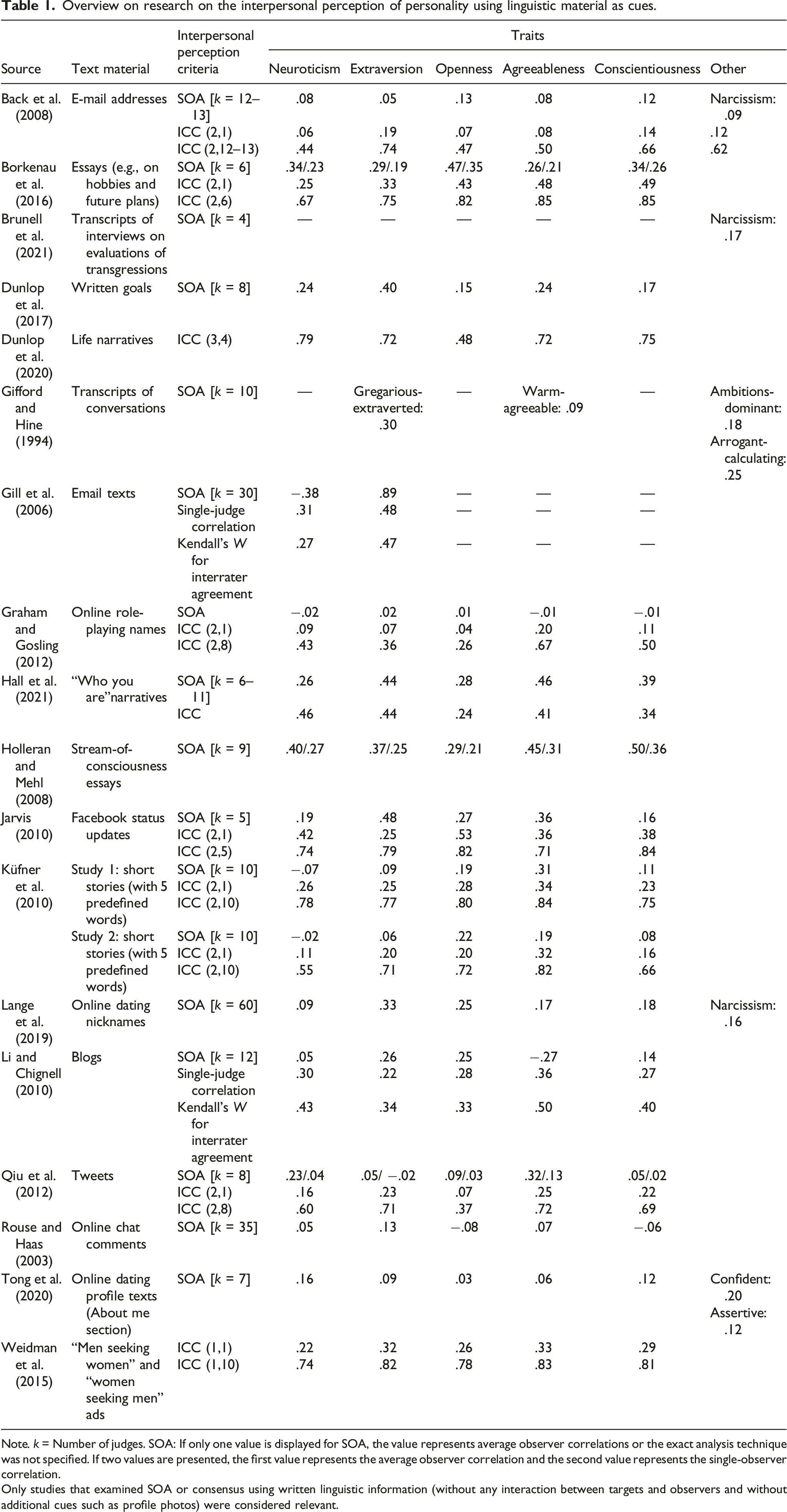
Note. k = Number of judges. SOA: If only one value is displayed for SOA, the value represents average observer correlations or the exact analysis technique was not specified. If two values are presented, the first value represents the average observer correlation and the second value represents the single-observer correlation.
Only studies that examined SOA or consensus using written linguistic information (without any interaction between targets and observers and without additional cues such as profile photos) were considered relevant.
Yet, accurate judgments can also evolve because of factors unrelated to the trait in question. The evaluation factor (i.e., how observers view or how much they like a target; Leising et al., 2010, 2015, 2021) could inflate SOA coefficients in our studies. That is, targets describing themselves positively in self-descriptions and self-report scales may simply be judged more accurately by observers because the observers provide more positive ratings for a target who delivers a positive self-description. We thus analyzed whether positivity affects SOA coefficients in both studies. These specificity analyses aim to dismiss the alternative possibility that our variables (sense of power, dominance, prestige) are perceived accurately because they represent some kind of well-adjusted, positive self-presentation (or the opposite thereof). If, as predicted, relationships are observed over and above the effects of positivity, we can conclude that judges recognize unique, observable traits with characteristics beyond valence.
Altogether, the studies reported here build on previous findings on the social perception of personality, further extending our insight into interpersonal perception of hierarchy based on word use. For example, dominance is highly correlated with agency, and prestige with both agency and communion (Cheng et al., 2010), despite the fact that these constructs do not overlap with interpersonal circumplex scales (Körner et al., 2023). The interpersonal circumplex (Locke, 2010) is also strongly related to extraversion and agreebleness (McCrae & Costa, 1989). Personal sense of power is strongly positively related to extraversion, emotional stability, and narcissism (Anderson et al., 2012; Körner, Heydasch et al., 2022). Our findings have the potential to add to these interpersonal perception studies on personality traits by showing that vertical concepts are also related to language and can be accurately perceived.
Overview
We conducted two studies in which speakers provided short written self-descriptions. Self-descriptions have been successfully related to personality characteristics (e.g., Hirsh & Peterson, 2009) in studies of interpersonal perception (e.g., Borkenau et al., 2016). Thus, we expected self-description texts to relate to concepts of hierarchy. Judges read the self-descriptions and assessed speakers’ sense of power, dominance, and prestige. We tested which word categories were used by judges as cues to assess speakers’ hierarchical standing. This allows for addressing the first research question of how hierarchy-related variables relate to language use in self- and peer-reports.
Further, we used a zero-acquaintance setting; that is, judges did not know the speakers and had only those thin slices of information on the speakers’ standing. Judgments in everyday life often arise from scarce information; and quick and accurate assessment of where strangers stand, and how they may behave, with regard to hierarchy is necessary for appropriate navigation through hierarchies and behavior toward others. In this vein, we studied criteria of interpersonal perception such as accuracy and consensus by addressing the second research question.
The studies were preregistered (https://osf.io/p8z2b; https://osf.io/zkexn; positivity control: https://aspredicted.org/df2pn.pdf) and data and code are available online (https://osf.io/dwnxt; https://github.com/Querela/Language-of-Power).
Study 1
In Study 1, we used self-description texts as cues. As the study was exploratory in nature, we had no specific hypotheses; instead, we sought associations between word categories and self- as well as peer-reported hierarchy variables. Further, we tested whether a target’s sense of power, dominance, and prestige can be perceived accurately by observers and whether observers show consensual judgments. Additionally, we computed the overlap between cue validity and cue utilization correlations (i.e., sensitivity).
Method
Participants and procedure
Hirsh and Petersen (2009) reported an average correlation of .23 between personality and LIWC categories. An a priori power analysis for correlation coefficients (r = .23, two-tailed α = .05, 1−β = .90) indicated that 194 participants were needed. Rounding up, we collected data from 200 speakers drawn from the general population (74.5% female, 25.5% male; age: M = 46.56, SD = 15.03, 18 to 78). Speakers were recruited via an email list that advertises psychological studies to interested members of the public. Speakers were offered participation in a lottery to win books as incentive. They completed demographics and briefly described themselves; these self-descriptions constituted the stimulus materials for judges. Speakers were instructed, “Please describe yourself using up to five sentences. There are no requirements for this task—with the exception of the maximum number of five sentences.” Self-descriptions were on average 49 words long (SD = 29, Range 15 to 269, Mdn = 43). 3 LIWC recognized 84.47% of all words (Mdn = 85.33%). We use the term “speaker,” although these materials were written, because speakers produced language that was subsequently perceived by judges. Lastly, we assessed hierarchy-related variables.
The judges sample comprised 105 mostly students from a German university (80% female, 20% male; age: M = 25.12, SD = 7.71, Range 18 to 62). They received course credit for participation. Each judge read the descriptions of 10 randomly-drawn speakers and completed peer ratings of each. 4 We aimed for five ratings per speaker (N = 100 judges, plus five to balance cell sizes following randomization). Familiarity ratings confirmed that no judge knew any speaker.
In addition, we recruited 30 judges (87% female, 13% male; age: M = 21.90, SD = 3.08, Range 19 to 33). They rated the positivity of participants’ self-descriptions using a single item (“How positively does the person present him/herself in the self-description?”) with a response scale ranging from 1 = “not at all positively” to 7 = “very positively.” Judges were university students who received course credit or financial compensation for the task. They rated the self-descriptions of both studies (total N = 400). Completion of the task required approximately 3 hours. Judges converged strongly in their assessments on how positively they evaluated the self-descriptions from both Study 1 (ICC[2, 1/30] = .49/.97) and Study 2 (ICC[2, 1/30] = .32/.93) targets.
Measures
Study 1: Descriptive statistics, Cronbach’s alphas, and correlations among the variables.
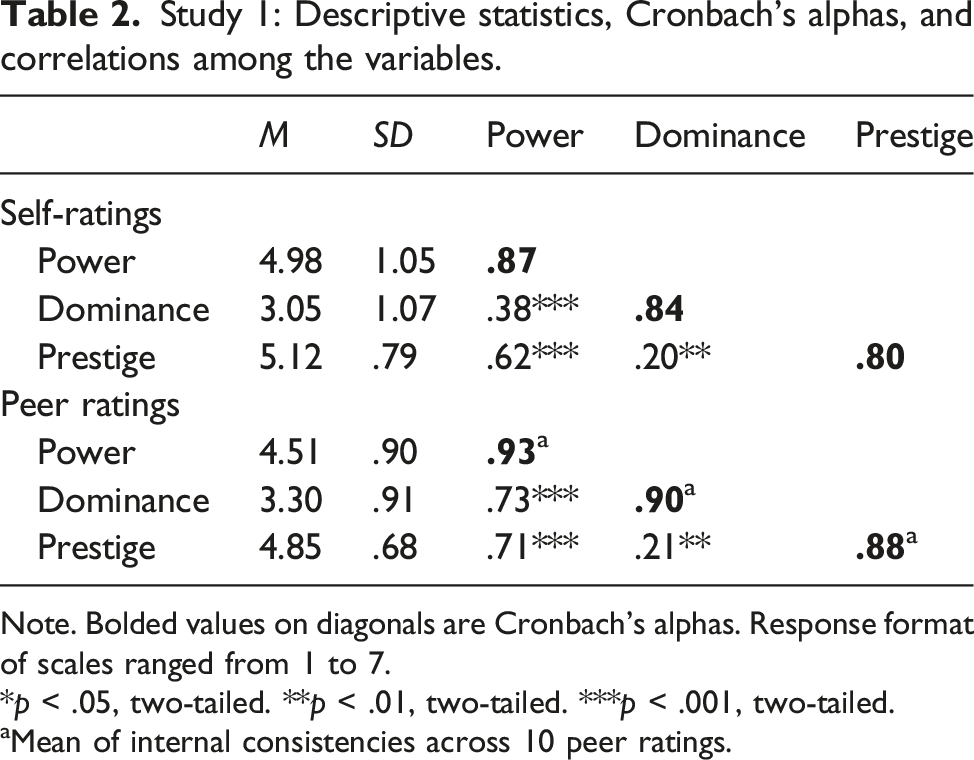
Note. Bolded values on diagonals are Cronbach’s alphas. Response format of scales ranged from 1 to 7.
*p < .05, two-tailed. **p < .01, two-tailed. ***p < .001, two-tailed.
aMean of internal consistencies across 10 peer ratings.
We next administered the Dominance-Prestige Scales (Cheng et al., 2010) for the targets. Dominance items address the use of force and coercion to seize status (8 items, e.g., “Some people are afraid of me”). Prestige is status granted by others due to superior skills and expertise (9 items, e.g., “My unique talents and abilities are recognized by others”). The response scale was identical to that of the PSPS.
We considered these stable traits because sense of power shows high temporal stability (Körner, Heydasch et al., 2022) and the same seems true of dominance and prestige as stable tendencies to navigate hierarchies (e.g., Witkower et al., 2020). Moreover, we selected these scales because they are heavily used in research on social hierarchy and so we are able to establish further a common language and a common research focus in social hierarchy research (Leising et al., 2022).
We pretested peer-rating versions of the scales (e.g., for sense of power, we asked, “His/her ideas and opinions are often ignored”—reverse-scored) by assessing internal consistency and testing whether individuals could use the scales to report anticipated perceptions of another person’s hierarchical standing. In total, 83 people (84% female, 16% male; age: M = 26.66, SD = 12.17, Range 18 to 71) participated. They read descriptions of famous persons and completed the peer-rating scales. The famous persons were chosen to be well known to our judges sample of mainly German psychology students. We considered Steve Jobs high in sense of power and Henry Molaison (H.M.) low in power. Donald Trump was considered high in dominance, whereas Ranga Yogeshwar was considered low in dominance. Roy Baumeister was the example for a person high in prestige and Kollegah for low prestige. Please see the Online Supplement for the descriptions of the persons.
The peer-rating versions showed sufficiently high Cronbach’s alpha coefficients for sense of power (Jobs, .76; Molaison, .70), dominance (Trump, .72; Yogeshwar, .77), and prestige (Baumeister, .82; Kollegah, .73). Between-target comparisons showed that Jobs (M = 6.34, SD = .57) was rated significantly higher on power than H.M. (M = 3.58, SD = .81), t(76) = 22.17, p < .001, d = 3.11. Trump (M = 6.14, SD = .59) was perceived as much more dominant than Yogeshwar (M = 3.39, SD = .76), t(80) = 23.30, p < .001, d = 3.22. Finally, the prestige of Baumeister (M = 6.01, SD = .60) was rated much higher than that of Kollegah (M = 4.01, SD = .79), t(77) = 16.98, p < .001, d = 2.58. The analyses supported a reliable and valid use of peer-rating versions (i.e., judges assess targets) for the PSPS and Dominance-Prestige Scales.
The Linguistic Inquiry and Word Count software (LIWC2015; Pennebaker et al., 2015) measured word usage. LIWC comprises a dictionary with more than 90 grammatical and psychological word categories and a processing algorithm that counts words. Output variables are percentages of words of a certain category in each text. Misspellings in self-descriptions were corrected before analysis.
Analysis strategy
Linguistic analyses
Study 1: Zero-Order correlations disattenuated for LIWC reliability among linguistic categories and self-rated as well as peer-rated power, dominance, and prestige.
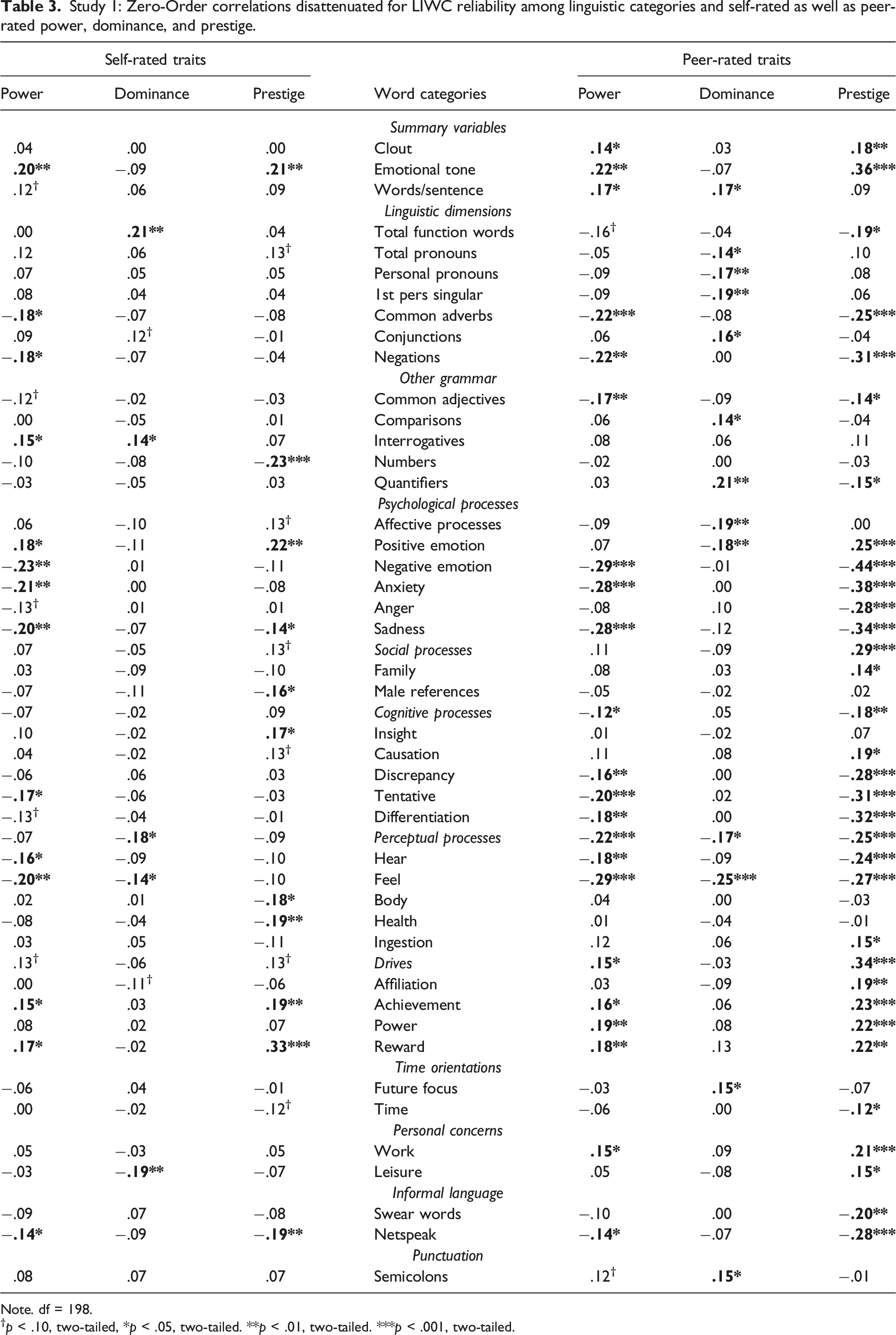
Note. df = 198.
†p < .10, two-tailed, *p < .05, two-tailed. **p < .01, two-tailed. ***p < .001, two-tailed.
For the open-vocabulary approach, we used spaCy (https://spacy.io/; Honnibal et al., 2020) for tokenization and part-of-speech tagging. We filtered out numbers, punctuation marks, and function or stop words (words such as articles or conjunctions that are highly frequent but less informative). The remaining words were counted and assigned relative frequencies per document by using TF-IDF (term frequency times inverse document-frequency; Baeza-Yates & Ribeiro-Neto, 2011). Then, we first performed straightforward comparisons of relative word frequencies between who provided the assessments (self-ratings vs. peer-ratings) and per variable (i.e., sense of power, dominance, and prestige; divided by score into low, medium, and high quantiles), which showed various differences in word usages (see https://github.com/Querela/Language-of-Power/tree/main/word-importance). Then, we identified the strongest word-level correlates for each hierarchy variable. To assess the reliability of our analysis, we performed a split-half correlation for all words (as seen in Yarkoni, 2010, e.g., self-descriptions were randomly assigned to one of two halves, and the correlation between the two parts was then computed) which generally remained above .50 (or .30–.40 when filtering out stop and function words) and considered acceptable for our purpose and amount of texts.
In addition, we conducted several other NLP analyses: We predicted hierarchy variables by using regression and classification approaches and in particular modern language models such as SetFit to deal with the issue of small data sets. We calculated semantic similarity and performed vector analyses with LIWC categories and word embeddings. We also conducted cluster analyses with topic models (LDA and HDP). For reasons of space, relevance, and limited reliability due to the relatively short self-descriptions, we present the results online at https://github.com/Querela/Language-of-Power.
Interpersonal perception analyses
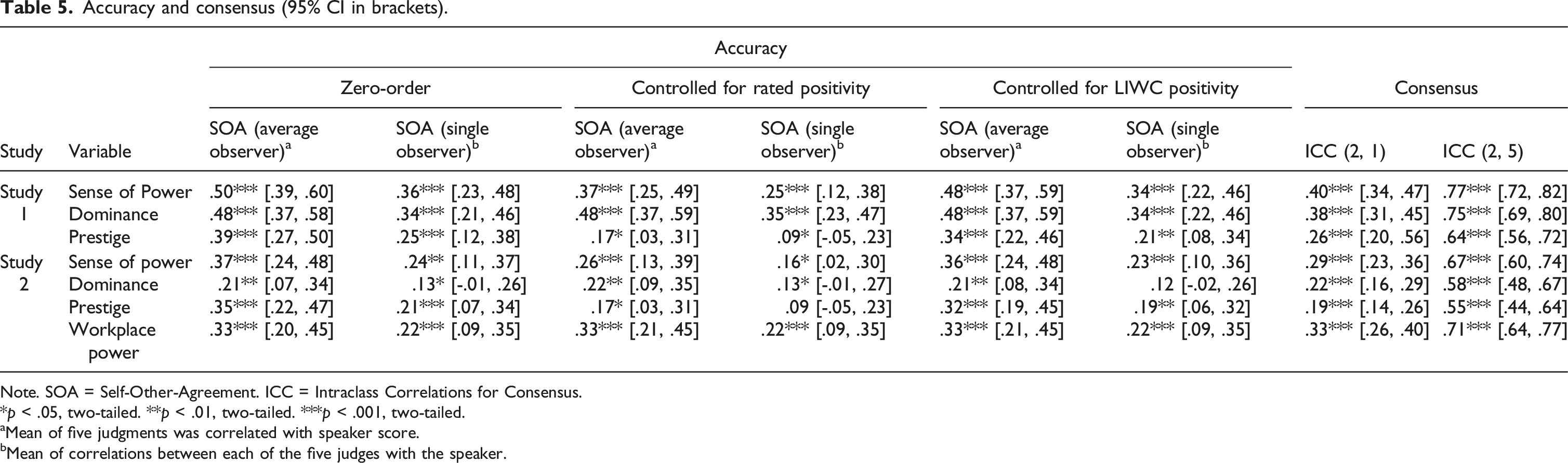
Accuracy (SOA) was computed using Pearson correlations: (a) for the correspondence of the speaker’s self-ratings with the mean peer ratings across all judges (average observer accuracy) and (b) for the correspondence of the speaker’s self-ratings with each judge’s ratings separately (single observer accuracy; see Table 5). For the latter, we applied Fisher’s r-to-z transformation to the five speaker-judge correlations. Then, we averaged and z-to-r transformed the values to get an unbiased estimator (Corey et al., 1998). In addition, as specificity analyses, we computed partial accuracy correlations controlling for positivity of the self-descriptions (using (a) the judge ratings of positivity and (b) the emotional tone LIWC variable that reflects how positive the tone of the word choice is). 5 For consensus, we computed intraclass correlations (ICC[2, k]) for single and aggregated (average observer) judgments. These procedures closely follow other studies on interpersonal perception using the Brunswik model (e.g., Back et al., 2008; Brauer & Proyer, 2020).
Lens model analyses identified cues used in making judgments of speakers: The correlations between speakers’ LIWC categories (or individual words) and social hierarchy ratings constitute cue validity, or the degree to which linguistic cues meaningfully reflect one’s sense of power, prestige, and dominance. The correlations between speakers’ LIWC categories (or individual words) and judges’ social hierarchy assessments constitute cue utilization, or the degree to which linguistic cues were treated as useful signals of a speaker’s power. Further, the coefficient of determination (R2) produced by regressing power, dominance, and prestige of speakers on LIWC categories offers an index of predictability. Predictability represents how much a hierarchy variable is expressed through linguistic cues. By contrast, response consistency represents how consistently judgment models are applied by each judge. Response consistency is statistically expressed as the coefficient of determination (R2) produced by regressing peer-rated power, dominance, and prestige on LIWC categories. Because R2 increases with the number of predictors, we provide as an additional, conservative approach the R2 based solely on the five strongest correlations between each hierarchy construct and LIWC results. Note that we use only the LIWC categories for predictability, response consistency, and sensitivity; these analyses were preregistered, and the open-vocabulary approach would necessitate using more than 2,000 words. That said, results for the indices in question are more reliable and robust when using a smaller number of language categories (i.e., LIWC).
Sensitivity, the correlation of cue validity and cue utilization, indicates that judges use correct cues to assess speakers’ qualities. Sensitivity was computed in three ways to provide comparability with the different analysis techniques used in the literature: First, in line with convention (e.g., Funder & Sneed, 1993) we computed column vector correlations (rv) after Fisher’s r-to-z transformation of the validity and utilization correlations. Second, we report sensitivity coefficients based on absolute correlation coefficients to account for the arbitrariness in the sign of the correlations (Back et al., 2008). For both analyses, we also provide sensitivity coefficients at the level of single judges. We r-to-z transformed the vector correlations. The mean of the resulting coefficients across the five judges was then back-transformed from z to r. Third, we computed sensitivity based on the predicted values of cue validity and cue utilization (Back & Nestler, 2016; Hursch et al., 1964). For example, we regressed all linguistic categories on self-reported power and saved the predicted values. Then, we regressed all linguistic categories on the average peer-reported power and saved the predicted values. The correlation of the predicted values from both regression analyses represents sensitivity. Again, we provide sensitivity coefficients at the level of both aggregated and single judgments. For interpretation, we use the latter analysis technique because this has been reported to be the most unbiased approach (Back & Nestler, 2016).
Note that we present p values only for completeness and disregard them for interpreting results. Instead, we interpret all correlations as follows: .10 as small, .20 as medium, and .30 as large (Funder & Ozer, 2019).
Results
Descriptive statistics, correlations among social hierarchy variables, and reliability coefficients appear in Table 2. Reliabilities were acceptable for all scales among speakers and peers.
Social hierarchy and language use
Cue validity
Regarding LIWC results, we found that speakers’ sense of power related positively to positive emotional tone and the use of positive emotion words (rs ≥ .18), and negatively to overall negative emotion, anxiety, and anger words (rs ≥ .20; see Table 3). Self-rated power also related negatively to tentative (r = −.17) and positively to achievement and reward words (rs ≥ .15).
Dominance related negatively to leisure words (r = −.19). Along with power and prestige, dominance related negatively to feel words (rs ≥ −.10; e.g., “touch”).
Prestige, like power, related positively to positive emotional tone and positive emotion words in self-descriptions (rs ≥ .21). Prestige also correlated positively with achievement and reward words (rs ≥ .19) and negatively with netspeak (informal language used on the internet, e.g., “lol”, “ok”; r = −.19).
Top correlations between social hierarchy variables and individual words.
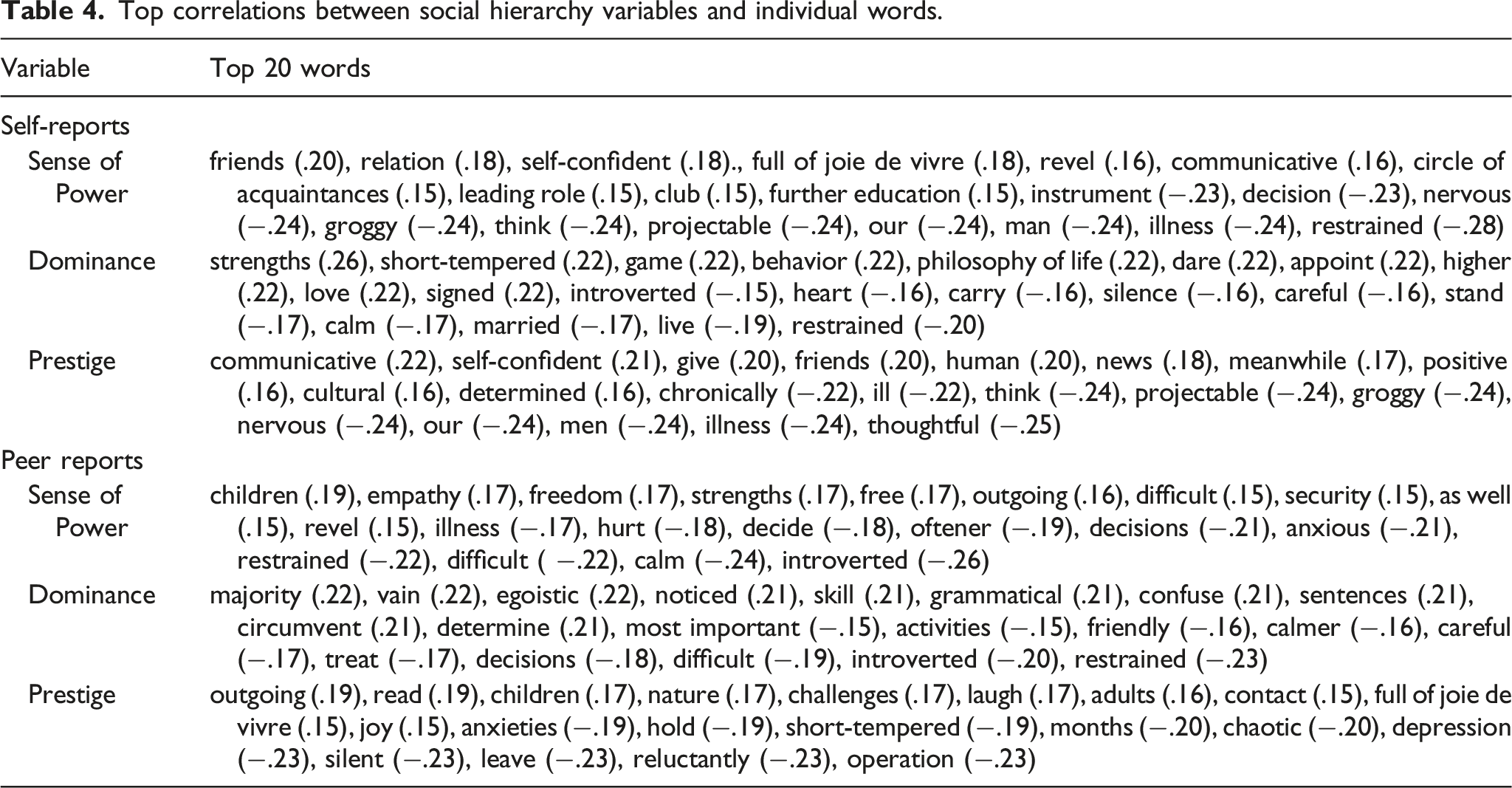
Dominance showed correlations that correspond with intuitive understanding of the dominance construct. For example, the strongest positive associations were found with “strengths” and “short-tempered,” and negative associations with “calm,” “introverted,” “careful,” and “restrained.”
Prestige was positively related to individual words that denote social topics (e.g., “communicative,” “friends,” and “human”) and confidence and positivity (“self-confident,” “positive,” negative relationships with “groggy” and “nervous”).
Cue utilization
We next examined the peer ratings. More use of positive emotional tone words (r = .22) and less use of negative emotion, anxiety, and anger words (rs ≥ −.28) were positively associated with judges’ ratings of speaker sense of power. Use of negations (r = −.22) and tentative and differentiation words (rs ≥ −.18) were associated with lower ratings of speaker power. Finally, speakers who used more power, reward, and achievement words tended to receive higher ratings of power 6 (rs ≥ .16).
Speakers who used more affective process and positive emotion words were judged lower in dominance (rs ≥ −.18). Further, use of perceptual process and feeling words was negatively associated with rated dominance, as well as power and prestige (rs ≥ −.17/-.25).
Speech characterized by clout (r = .18) and positive emotional tone (rs ≥ .25) was associated with higher ratings of speaker prestige, whereas speakers using negative emotion, anxiety, anger, and sadness words tended to be judged lower in prestige (rs ≥ −.28). Negative associations pertained also to negation words (r = −.31), netspeak, and swear words (rs ≥ −.20). Speakers whose language contained social process, affiliation, achievement, power, and rewards words were rated higher in prestige (rs ≥ .19). Regarding cognitive processes, using causation words was associated with higher (r = .19), and tentative, discrepancy, and differentiation words with lower (rs ≥ −.28), peer ratings of prestige.
Among the 20 strongest associations of peer-reported sense of power with individual words (open-vocabulary approach), we found many words that are in line with theoretical reasoning: For example, sense of power was positively related to freedom words (“freedom” and “free”) and social processes (e.g., outgoing” and “revel”) and negatively to “anxious,” “restrained,” and “introverted” (see Table 4).
Speakers who often used words such as “vain” or “egoistic” were rated as dominant, whereas words such as “friendly,” “careful,” and “introverted” were used as cues to rate speakers low on dominance.
Like in the self-reports, we found in peer reports that words addressing social processes (e.g., “outgoing,” “children,” and “contact”) and positivity (e.g., “joy,” “laugh,” and “full of joie de vivre”) were seen as typical for prestige. Also “read,” which might infer intellectual abilities, and “challenges,” which might relate to achievements, were positively related to peer-rated prestige. By contrast, “depression,” “anxieties,” and “short-tempered” were used to attribute low prestige to targets.
Criteria of interpersonal perception
Accuracy and consensus (95% CI in brackets).
Note. SOA = Self-Other-Agreement. ICC = Intraclass Correlations for Consensus.
*p < .05, two-tailed. **p < .01, two-tailed. ***p < .001, two-tailed.
aMean of five judgments was correlated with speaker score.
bMean of correlations between each of the five judges with the speaker.
Judges could reliably discern power from speakers’ language: Consensus for single and average judgments was high for sense of power (ICC[2, 1/5] = .40/.77), dominance (ICC[2, 1/5] = .38/.75), and prestige (ICC[2, 1/5] = .26/.64). As expected, the scores of aggregated ratings were higher.
Results of Brunswik’s lens model analysis.
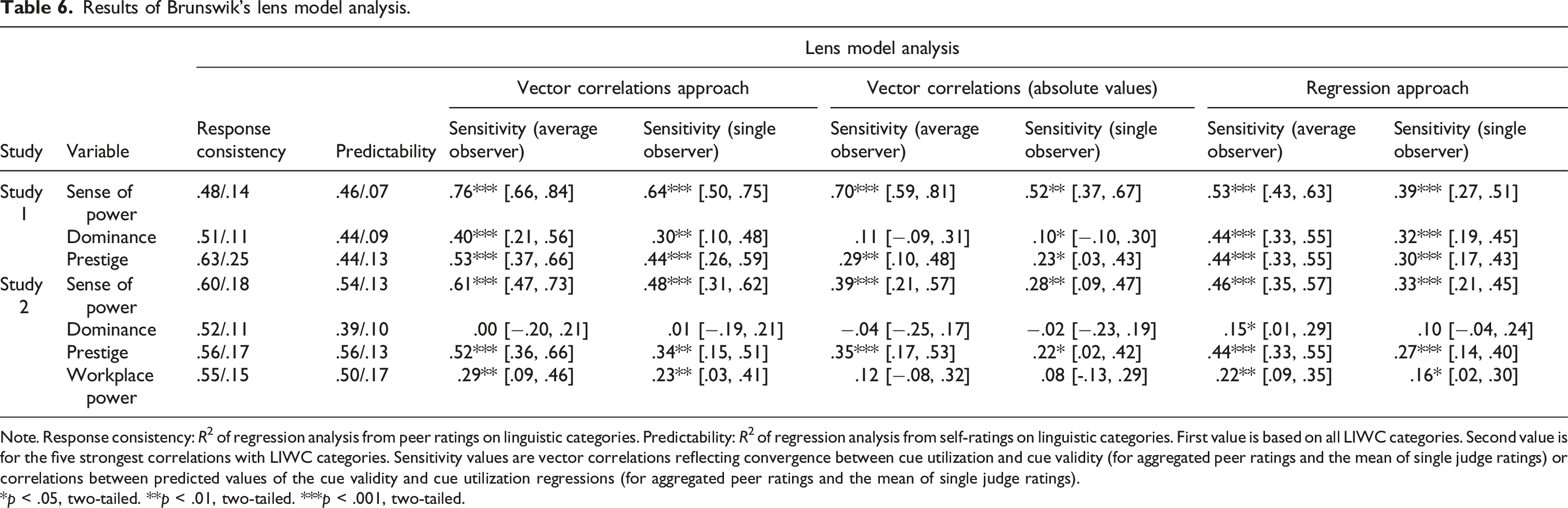
Note. Response consistency: R2 of regression analysis from peer ratings on linguistic categories. Predictability: R2 of regression analysis from self-ratings on linguistic categories. First value is based on all LIWC categories. Second value is for the five strongest correlations with LIWC categories. Sensitivity values are vector correlations reflecting convergence between cue utilization and cue validity (for aggregated peer ratings and the mean of single judge ratings) or correlations between predicted values of the cue validity and cue utilization regressions (for aggregated peer ratings and the mean of single judge ratings).
*p < .05, two-tailed. **p < .01, two-tailed. ***p < .001, two-tailed.
Discussion
Overall, Study 1 suggests that hierarchy is enacted in language (i.e., written self-descriptions). We found several relevant associations between both word categories and individual words and self-perceived power, dominance, and prestige. Strong associations between personal sense of power and emotion words indicate that people who feel powerful were more likely to use positive emotion words (e.g., “full of joie de vivre”) and less likely to use negative emotion words (e.g., “groggy”), consistent with the approach/inhibition theory of power (Keltner et al., 2003). The negative link between power and tentative language is consistent with past findings that power is positively related to confidence (See et al., 2011) and with the literature on powerful versus powerless speech styles (Kacewicz et al., 2014; Ng & Bradac, 1993). Finally, the higher self-perceived power, the more likely speakers referred to achievement and reward words. This evokes the approach/inhibition theory of power, which posits that power increases attention to rewards (Keltner et al., 2003).
The more people rated themselves as dominant, the less they wrote about leisure and perceptual processes and the less they used words such as “calm”, “introverted”, or “careful”. As people who use dominance aim at creating a hard-working, competent image (Anderson & Kilduff, 2009), they may avoid discussing leisure or showing a deliberative attitude (cf. Magee, 2009). Dominant people seem less attentive to inner feelings, probably because they are more concerned with controlling the external environment (Cheng & Tracy, 2014). Further, dominance is negatively related to openness and openness is related to attention to perceptions and aesthetic sensitivity (Hirsh & Peterson, 2009).
The associations of prestige with positive tone and with individual words such as “self-confident” and “positive” support literature showing that happiness can be a cause or consequence of prestige-based rank (Steckler & Tracy, 2014). Prestige arises from superior skills and expertise that promote achievements; consequently, it is unsurprising that people who refer to achievements or rewards also see themselves as higher in prestige (Cheng et al., 2010). By contrast, netspeak may be too casual and connote lack of education rather than intellectual brilliance, which may explain its negative association with prestige.
Judges used linguistic cues to assess speakers’ perceived power. Results largely mirror speakers’ self-descriptions (cue validity): Consistent with the approach/inhibition theory of power (Keltner et al., 2003), judges attributed higher power to speakers who used positive emotion words and lower power to those who used negative emotion words (e.g., “anxious”). Negations and tentative and differentiation words served as cues for low sense of power, consistent with findings that power leads to confirmatory information processing (Fischer et al., 2011), confidence (See et al., 2011), and implemental mindsets (Magee, 2009). The latter study also showed that judges rate speakers higher in power when they display action orientation. Moreover, tentative words are related to inhibition (Tausczik & Pennebaker, 2010), and as low power activates the behavioral inhibition system (Keltner et al., 2003), it makes sense that judges infer low power from these words (e.g., “restrained”). Tentative and discrepancy words may indicate low self-concept consistency and as power increases self-concept consistency (Kraus et al., 2011), people using these words may be seen as less powerful.
Dominance was attributed to speakers using few positive emotion words (e.g., “friendly”). Due to the low social desirability of dominance in many contexts (Cheng et al., 2010) observers may not see dominance as linked to positive affect. By contrast, prestige was closely tied to positive emotion words (e.g., “joy”) in observer ratings, probably because people with prestige are seen as friendly and less negative (Liu et al., 2016). The finding that people who take action are perceived as being powerful (Magee, 2009) seems also to apply to prestige because less negation, tentativeness, discrepancy, and differentiation were seen as signals of readiness to act and initiative. Finally, the use of words related to social process, affiliation, and achievement to infer prestige echoes the prosocial nature of that concept. For example, the individual words “outgoing”, “challenges”, and “laugh” were used to judge people high in prestige. Prestige is associated with communion, agreeableness, and expertise (Cheng et al., 2010), and thus judges may attribute prestige to people who describe themselves as prosocial and competent.
We found that accuracy was high for all three variables, meaning that judges’ ratings largely corresponded to speakers’ self-ratings. Even after accounting for positivity of target’s self-descriptions, accuracies remained high for power and dominance. With respect to prestige, accuracies decreased when including positivity in the specificity analyses. Prestige is strongly related to positive self-presentations (Cheng et al., 2010), which likely accounts for the apparent decrease in accuracy when we hold positivity constant between the self-descriptions. That is, much of the “signal” in prestige judgments—which involve judging how much the target can deliver value to the judge—is likely positivity. Beyond positivity, it may be difficult for judges to discern reliable, diagnostic cues of value. Nonetheless, even for prestige, we found strangers able to form reasonably accurate judgments based on short written self-descriptions.
Further, judges converged in their ratings of speakers’ sense of power, dominance, and prestige. Evidence on accuracy and consensus is thus in line with previous research that studied the social perception of status with photos or in group settings (Anderson et al., 2006, 2008; Schmid Mast & Hall, 2004) and dovetails with research studying personality judgments with textual cues (e.g., Gifford & Hine, 1994). Taken together, concepts of social hierarchy seem to be firmly rooted in language—they are linked to self-descriptions of speakers and how judges rate them, and they are interpersonally well perceived, despite the fact that judges did not know the speakers and only thin slices of behavior were provided.
Study 1 provided initial evidence for language correlates of sense of power, dominance, and prestige in self-descriptions, and suggested that these variables can be accurately judged at zero acquaintance based on short texts. Yet, as this is the first study using a Brunswik lens model approach with linguistic cues of hierarchy, replication of the findings is desirable. The design of Study 2 was similar to that of Study 1. We employed a self-disclosure task but used a different topic. Speakers were asked to describe themselves in their occupational roles, because social hierarchy differences are especially pronounced in working life (see trait activation theory; Tett & Guterman, 2000; see also Leikas et al., 2013). Further, we added a scale measuring workplace power to test whether the associations we found between power and language categories generalize across power measures. Further, because we changed the context to working life, we expected to find substantial associations between self-descriptions and workplace power.
Study 2
Based on theory and the findings of Study 1, the following preregistered hypotheses were formulated: (1) Self-rated power is expected to correlate positively with emotional tone and positive emotion words, and negatively with negative emotion, anxiety, sadness (Keltner et al., 2003), and tentative words (Kacewicz et al., 2014; See et al., 2011). (2) Self-rated dominance is expected to correlate negatively with leisure words. (3) Self-rated prestige is expected to correlate positively with emotional tone, positive emotion, achievement, and reward words (Cheng et al., 2010, 2013; Körner et al., 2023). Because people with high prestige put an emphasis on upholding their status and want to avoid negative evaluations (Maner, 2017), self-rated prestige is expected to correlate negatively with netspeak (informal internet-style language). (4) Peer-rated power is expected to correlate positively with emotional tone (Keltner et al., 2003) and power words, and negatively with negations (Fischer et al., 2011), negative emotion, anxiety, sadness (Keltner et al., 2003), tentative (Magee, 2009; See et al., 2011), and differentiation words (Fischer et al., 2011). (5) Peer-rated dominance is expected to correlate negatively with affective processes (Cheng et al., 2010) and positive emotion (Liu et al., 2016). (6) Peer-rated prestige is expected to correlate positively with clout (Cheng et al., 2013), emotional tone, positive emotion (Liu et al., 2016), social processes, affiliation, achievement, power, and reward words (Cheng et al., 2010), and negatively with negative emotion, anxiety, anger, sadness (Cheng et al., 2010), and netspeak (Maner, 2017). We also expected to find values for SOA, consensus, and sensitivity comparable to those in Study 1.
Method
Participants and procedure
We collected data from 200 speakers (61% female, 39% male; age: M = 41.22, SD = 12.87, 18–66) recruited via an email list and personal contacts. Participation in a lottery to win books was used as incentive. All speaker participants were working people. The online survey was the same as in Study 1, but the writing task asked participants to self-describe with respect to their occupational role, and we added a power measure. Speakers were instructed: “Please describe yourself in your professional role (approx. 5 sentences). In doing so, please address the following: What tasks or activities does your professional role involve? How is your work evaluated by others? How do you deal with other people in a professional context?” Self-description length averaged 52 words (SD = 34, Range 8 to 234, Mdn = 44). 7 The LIWC dictionary recognized 75.06% of all words (Mdn = 76.65%).
Judges were 202 mostly students from a German university (69.31% female, 30.69% male; age: M = 25.55, SD = 10.99, Range 18 to 68). They received course credit for participation. Judges read the occupational descriptions of five randomly-drawn speakers and completed peer-rating measures. Thus, each speaker was rated by five judges. No judge indicated familiarity with the peer-rated speakers.
Measures
We again used the PSPS (Körner, Heydasch et al., 2022) and the Dominance Prestige Scales (Cheng et al., 2010). Additionally, we assessed workplace-specific power with the Perceived Power Scale (Yu et al., 2019). The 6 items (e.g., “I have a great deal of power at work”) were answered on a scale ranging from 1 (strongly disagree) to 7 (strongly agree). Judges answered the items of the peer-rating version (e.g., “He/She has a great deal of power at work”).
Results
Study 2: Descriptive statistics, Cronbach’s alphas, and correlations among the variables.
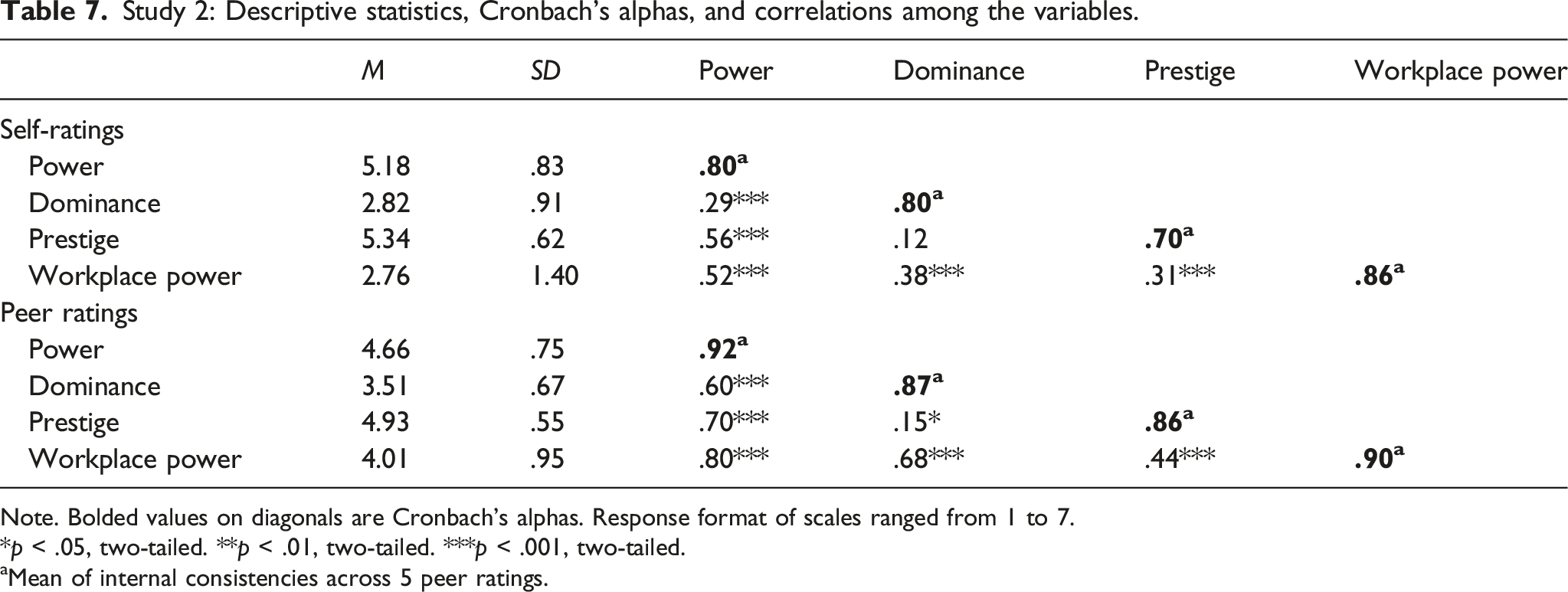
Note. Bolded values on diagonals are Cronbach’s alphas. Response format of scales ranged from 1 to 7.
*p < .05, two-tailed. **p < .01, two-tailed. ***p < .001, two-tailed.
a Mean of internal consistencies across 5 peer ratings.
Social hierarchy and language use
Cue validity
Study 2: Zero-order correlations disattenuated for LIWC reliability among linguistic categories and self-rated as well as peer-rated power, dominance, prestige, and workplace power (WP).
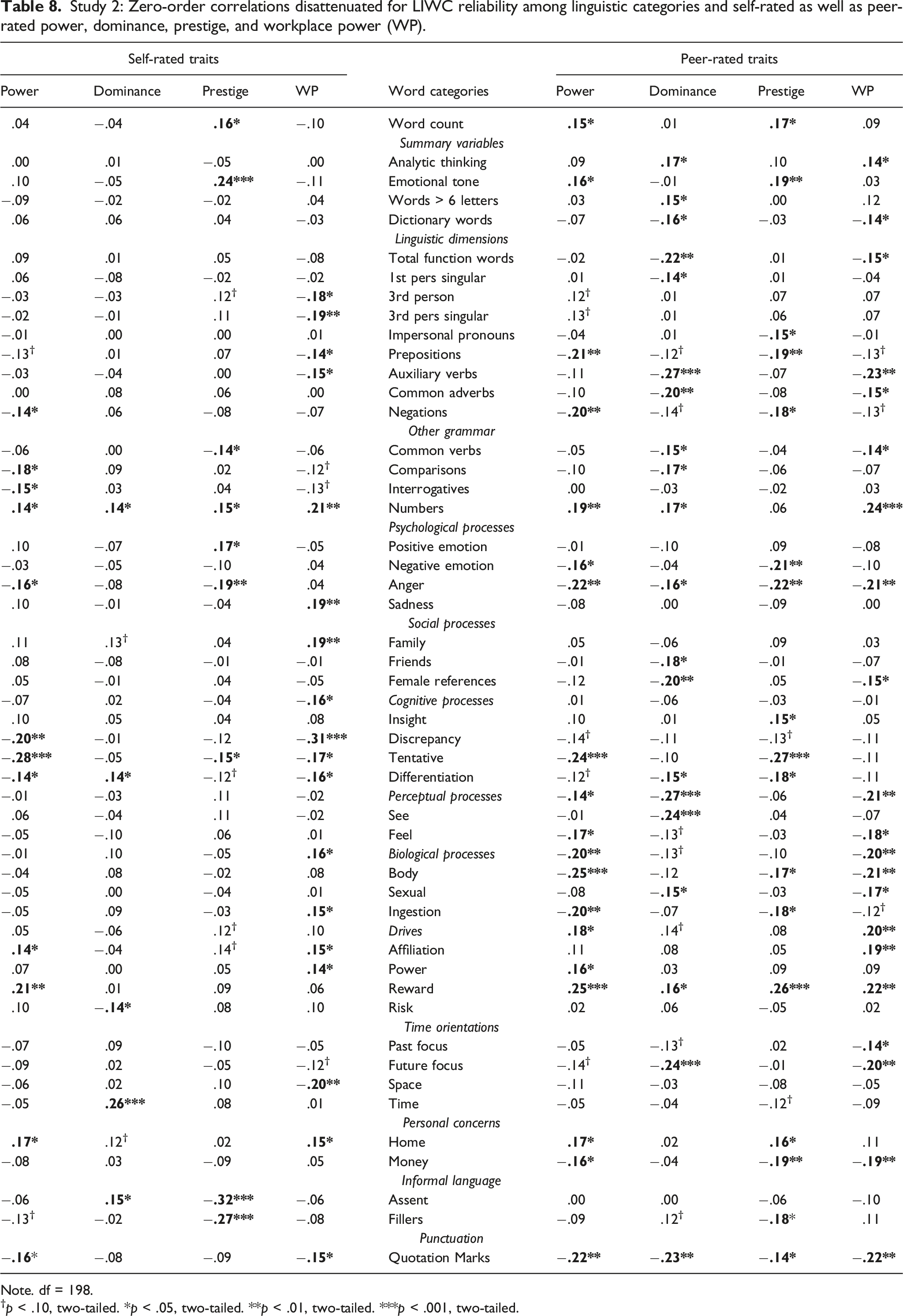
Note. df = 198.
†p < .10, two-tailed. *p < .05, two-tailed. **p < .01, two-tailed. ***p < .001, two-tailed.
The expected association between dominance and leisure words was not observed. Instead, dominance correlated with assent (r = .15), and all hierarchy-related variables were positively associated with numbers (rs ≥ .14; see Table 8).
Prestige was, as predicted, positively associated with positive emotional tone and positive emotion words (rs ≥ .17), and negatively associated with anger words (r = −.19). Prestige was further negatively related to assent and filler words (rs = −.32/−.27). Prestige showed only small-magnitude correlations with drives, such as reward.
Exploratory analyses showed that workplace power correlated positively with sadness and family words (rs = .19) and negatively with tentative and discrepancy words (rs = −.17/−.31). Like the other hierarchy-related variables, workplace power correlated negatively with differentiation words (rs ≥ −.12) except for dominance (r = .14).
Top correlations between social hierarchy variables and individual words.
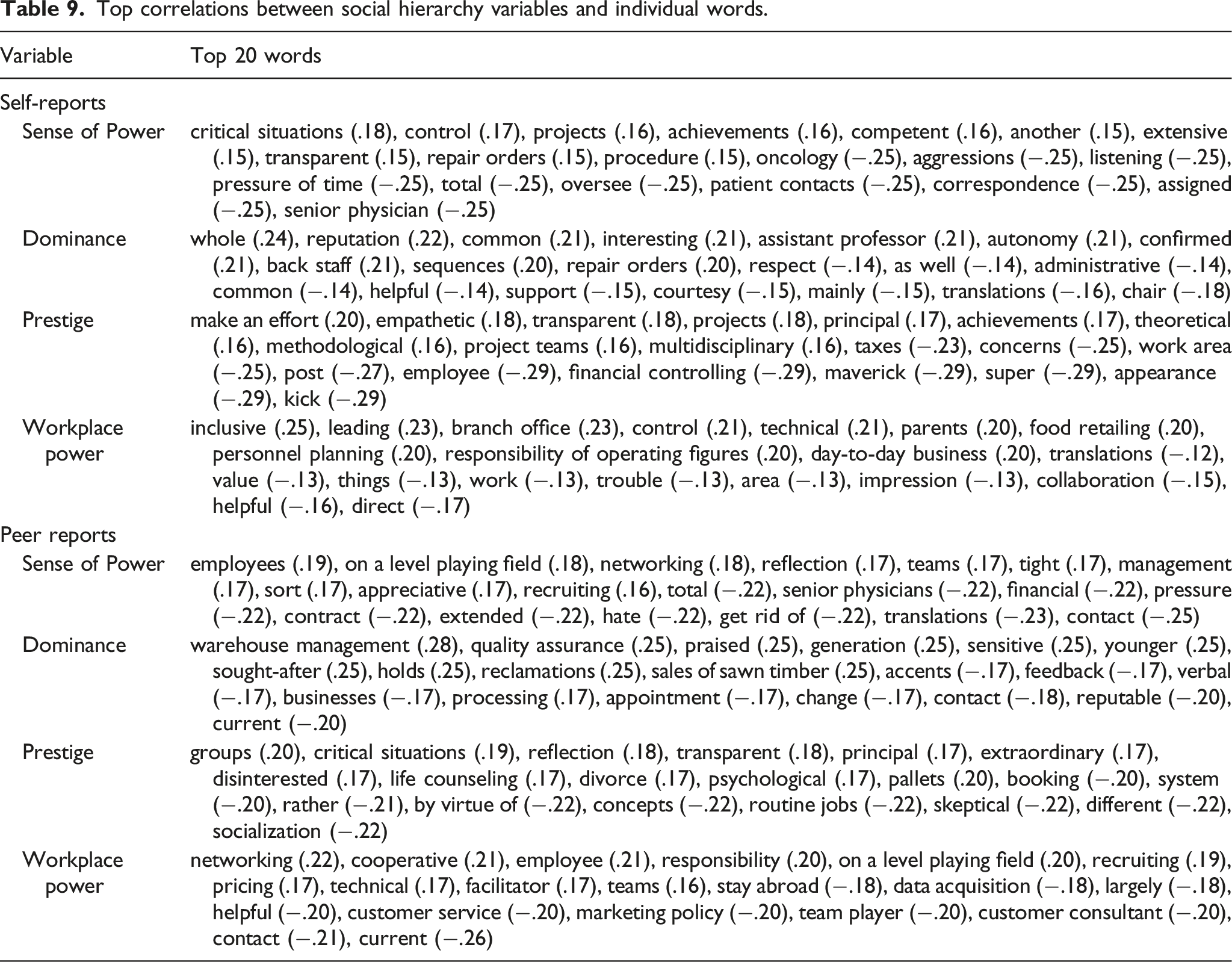
Dominance showed small-to-medium-sized correlations with some words that might be expected (e.g., negative associations with “helpful”, “support”, and “courtesy”) but also some that were less expected (e.g., positive associations with “reputation” or “assistant professor”).
People self-reporting high prestige tended to use theoretically-consistent individual words, such as “empathetic”, “projects”, and “achievements”, and self-reported low prestige corresponded with “maverick”.
Workplace power was linked to many words that can be associated with that concept (e.g., “leading”, “branch office”, “control”, “personnel planning”, “day-to-day business”). By contrast, the word “collaboration” was negatively correlated with workplace power.
Cue utilization
Peer ratings generally showed much larger correlations than self-ratings did. Speakers using emotional tone, numbers, power, and reward words were rated higher in power (rs ≥ .16). Those using negations, negative emotion, anger, tentative words, and biological processes were rated lower in power (rs ≥ −.16).
Use of affective process words did not affect judgments of dominance; however, use of words concerning friends, female references, and perceptual processes was associated with lower dominance judgments (rs ≥ −.18).
Speakers using positive emotional tone and reward words tended to be judged higher in prestige (rs > .19); those who used negations, fillers, negative emotion, anger, tentative, and differentiation words were judged lower (rs ≥ −.18). Language use involving clout, positive emotion, social processes, power, and affiliation showed the predicted positive associations with prestige, but these were low in magnitude (rs ≤ .13). We observed no associations of netspeak and achievement words with prestige.
Speakers’ use of numbers, reward, and affiliation words led to higher ratings of workplace power (rs ≥ .19), whereas use of anger, female references, perceptual, and biological processes led to lower ratings (rs ≥ −.15).
Using the open-vocabulary approach, we found that speakers’ use of the individual words “employees”, “networking”, “management”, and “recruiting” led to higher ratings of sense of power.
Peer-reported dominance was negatively linked with the use of the word “reputable”. For dominance, the strongest correlations with individual words can only partially be explained by theory. For example, “warehouse management”, “quality assurance”, and “praised” showed the strongest positive associations with dominance.
Prestige showed a few associations with individual words in line with theory: For example, words such as “critical situations”, “extraordinary”, and “routine jobs” (negatively) were used to judge speakers high on prestige.
Peer-rated workplace power (just like in self-reports) showed the strongest associations with individual words. “Networking”, “cooperative”, “responsibility”, and “recruiting” were positively, and “customer service” and “data acquisitions” negatively, associated with speaker’s peer-rated workplace power.
Interpersonal perception
The average observer accuracies were lower than in Study 1, but still medium to high for all variables (.21 ≤ SOAs ≤ .37). Single observer accuracies were lower but still small to medium in size (SOAs ≥ .13; see Table 5). As in Study 1, we tested accuracies when controlling for positivity. For sense of power, accuracies decreased slightly (−.11 ≥ ∆SOAs ≥ −.01) but remained significant. Accuracies remained almost identical for dominance and workplace power (see Table 5). With respect to prestige, as in Study 1, results depended on the method: With the emotional tone control variable, average and single observer accuracies decreased only slightly (−.03 ≥ ∆SOAs ≥ −.02); however, with judge-rated positivity, accuracies decreased more strongly (−.18 ≥ ∆SOAs ≥ −.12). Again, single observer accuracy for prestige was nonsignificant when judge-rated positivity was included in the analysis.
Replicating the findings of Study 1, judges generally agreed on their perceptions of the speakers. Consensus was highest for workplace power (ICC[2, 1/5] = .33/.71), followed by sense of power (ICC[2, 1/5] = .29/.67), dominance (ICC[2, 1/5] = .22/.58), and prestige (ICC[2, 1/5] = .19/.55).
Overall response consistency (.52 ≤ R2 ≤ .60) and overall predictability (.39 ≤ R2 ≤ .54) were high for all constructs (see Table 6). The coefficient of determination based on the five most predictive LIWC categories was lower but still substantial (response consistency: R2 ≥ .11; predictability: R2 ≥ .10). Sensitivity based on aggregated peer ratings was high for sense of power (rv = .46) and prestige (rv = .44), somewhat lower for workplace power (rv = .22), and small for dominance (rv = .15). Sensitivity based on the single observer ratings were, as expected, smaller in size; nonetheless, good convergence was found for sense of power and prestige (rv ≥ .27), also somewhat for workplace power (rv = .16), though barely for dominance (ry = .10).
Discussion
The patterns identified in this study largely replicated those of Study 1. The hypotheses were mostly supported. Yet, in Study 2, sense of power was not as closely related to emotional tone or positive and negative emotion words overall as expected. Perhaps the occupational nature of the writing task suppressed use of emotion words because emotion expression is often discouraged in work contexts (Mann, 2007). The open-vocabulary approach also supports this interpretation because most words were not affective but instead referred to specific work-related topics (e.g., medical work and project work). Further, use of numbers was positively related to all variables, perhaps because higher-ranked people show more global thinking (Magee & Smith, 2013) and have a certain number of subordinates; further, working with numbers may be related to power.
Dominance was not strongly linked to the use of specific words; prestige, by contrast, was as expected related to positive emotional language. However, unexpectedly, prestige was not linked to achievement and reward words. Perhaps boasting about accomplishments may be detrimental for the prestige strategy to be successful, but using positivity instead signals friendliness and prosociality (cf. Cheng et al., 2010).
Study 2 further established that not only personal sense of power, but also workplace power, is associated with language use in self-descriptions. Both speakers with low sense of power and with low perceived workplace power described themselves with tentative and discrepancy words. Across contexts, word categories that are markers of powerless speech (Ng & Bradac, 1993) were used less by powerful participants—consistent with the fact that power carries confidence, assertiveness, and action orientation (e.g., Galinsky et al., 2003; Körner & Schütz, 2023).
In contrast to the self-ratings, in peer-ratings sense of power showed robust associations with positive emotional language, consistent with expectations of the approach/inhibition theory of power (Keltner et al., 2003). Dominance was not related to affective process words as it was in Study 1, which may again reflect the occupational context of Study 2. Words referring to friends or women were seen as typical for low dominance, reflecting the antisocial nature of dominance and its negative association with communion (Cheng et al., 2010), which is typically linked to femininity (Moskowitz et al., 1994). Prestige showed almost all expected associations.
Workplace power was associated with reward and affiliation in peer ratings (e.g., “networking” and “cooperative”). Because powerful people focus on rewards—indeed, control of rewards is part of the definition of social power—it is not surprising that judges relate words of these categories to powerful people. That references to women were associated with low power ratings may reflect gender role stereotypes (Schein et al., 1996).
For all four studied variables, SOA between speakers and judges was substantial and consensus among judges was high. Again, in the specificity analyses accounting for positivity in self-descriptions, we found that SOA coefficients were medium to high for sense of power and workplace power and low to medium for dominance. Only for prestige was accuracy low when we controlled for judged positivity. These results mirror those of Study 1. Accurate perception of prestige appears to occur, in part, because people who describe themselves positively also rate their prestige higher, and judges seem to pick up this positive information in self-descriptions, consistent with the notion that positivity signals the value the target can provide. In contrast, when we used emotional tone as the positivity variable, SOA remained identical. Future studies might thus further test which factors affect accurate interpersonal perceptions of prestige and to which degree.
Altogether, sense of power, workplace power, prestige, and even dominance were accurately perceived, but for dominance judges used different cues than speakers did. The poor sensitivity may also have reflected the many small or very small correlations between LIWC categories and self-rated dominance than the other variables. We speculate that speakers infer dominance more from the overall content of the written texts rather than from the usage of specific words.
Mini meta-analysis
To provide aggregated coefficients across the two studies, we conducted a mini meta-analysis (Goh et al., 2016, see also Fetterman et al., 2019; Kacewicz et al., 2014; Kreibich et al., 2020). We used a fixed effects approach (i.e., effect sizes were weighted by sample size). This approach is appropriate when analyzing fewer than five studies. All correlations were Fisher’s z-transformed for analyses and back-transformed for presentation.
Language correlates of hierarchy-related variables
Replicated word cues across studies 1 and 2.
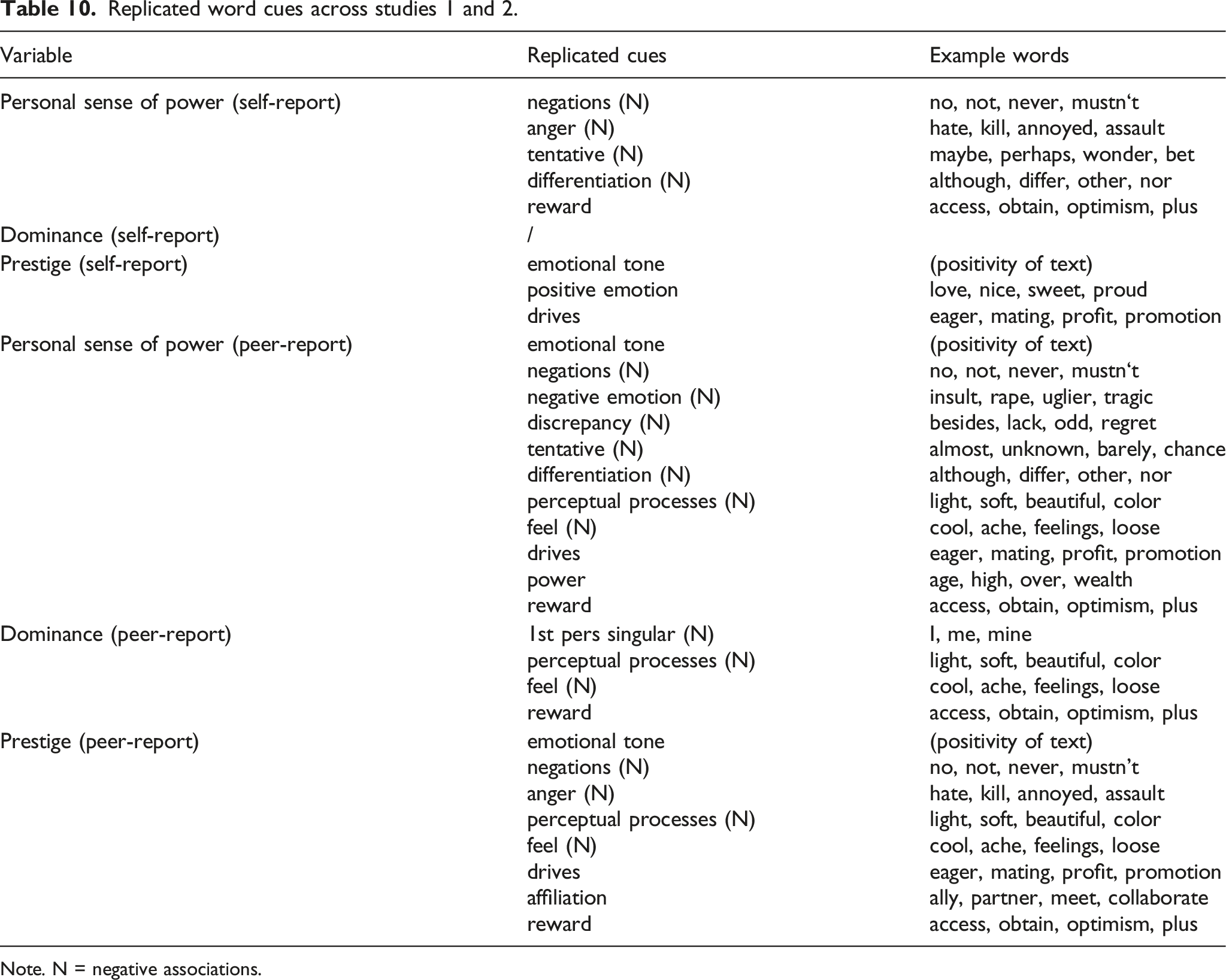
Note. N = negative associations.
For cue utilization, the correlations were higher. Judges used emotion, negation, tentative, feel, and reward words as cues to assess speakers’ level of sense of power (rs ≥ |.19|). Perceptual process and feel words showed the strongest associations with peer-rated dominance (rs ≤ −.19). Emotion, negation, discrepancy, tentative, differentiation, drive-related, reward, and swear words were mainly used to assess speakers’ prestige (rs ≥ |.20|). This pattern of results was also found when analyzing cues that replicated across studies (see Table 10). For sense of power, cue utilization correlations were similar to cue validity correlations, but additional cues were replicated (e.g., power-related words showed a positive, and discrepancy words a negative, link to peer-rated sense of power). For dominance, perceptual processes and feel words (negatively related), as well as reward words, replicated across studies. Yet, these word categories seem not to be specific to dominance because they replicated also for sense of power and prestige. Thus, social hierarchy variables in general showed robust associations with those words. For prestige, negations, anger, perceptual processes, and feel words showed negative links in both studies, whereas emotional tone, drives, affiliation, and rewards words showed positive links in both studies.
Interpersonal perception of hierarchy-related variables
Accuracy was medium to high for single observer and average observer ratings (SOAs ≥ .23/.35; see Table S4 in Online Supplement). Even with the positivity control, accuracies remained medium-sized for power (SOAs ≥ .21) and dominance (SOAs ≥ .23). Accuracies for prestige differed depending on how we accounted for positivity (SOAs ≥ .09 with judged positivity; SOAs ≥ .20 with LIWC positivity) and were largely nonsignificant. Further, judges’ assessments converged strongly (ICC(2, 1/5) ≥ .23/.60). Finally, the cues used by speakers and judges correlated strongly for personal sense of power and prestige, indicated by the sensitivity coefficients for single and average observer ratings (rvs ≥ .23/.44). By contrast, the correspondence between cue validity and cue utilization correlations was lower for dominance (single observer: rv = .21; average observer: rv = .30).
General discussion
This research addressed two questions: (1) Is social hierarchy enacted through language? (2) Can hierarchy-related qualities be discerned by others in a zero-acquaintance setting based on linguistic cues? To answer, we conducted two studies eliciting self-descriptive texts as stimuli and personal sense of power, dominance, prestige, and workplace power as hierarchy variables.
Across two studies, we found (using both predefined broad word categories and, in an exploratory fashion, individual words) that people’s frequency of word use varies as a function of their subjective sense of power, dominance, and prestige. The meta-analytic findings indicate that participants who feel powerful referred more often than others to rewards when describing themselves, and wrote in a more positive emotional tone. These findings accord with the approach/inhibition theory of power (Keltner et al., 2003).
Further, across studies, personal sense of power was negatively related to tentative language, which dovetails with the literature concerning powerful versus powerless speech styles (see Ng & Bradac, 1993). Contrary to past research, we did not find a link between power and pronouns (Kacewicz et al., 2014). This non-replication may have occurred because we used self-descriptions, whereas previous studies used emails, letters, and informal chats. Moreover, previous research did not clearly distinguish among specific hierarchy variables.
Self-rated prestige was related to positive emotions, rewards, and less tentative language, although links to social processes and a lower occurrence of netspeak supported the notion that prestige has a prosocial and intellectual nature, at least in our sample (Cheng et al., 2010). By contrast, dominance showed smaller associations with word usage in self-descriptions, suggesting that dominance is less enacted through language than power and prestige are.
Cue utilization and cue validity showed similar associations, which means that the hierarchy-related words used in self-ratings were also used by judges to make inferences on the constructs in question. Still, correlation coefficients for hierarchy variables were, on average, larger with observer ratings than with self-ratings. Apparently, judges relied on cues with only partial validity, that is, cues less strongly related to self-ratings. This finding echoes other research (e.g., Hall et al., 2005; Marcus et al., 2006) showing that utilization coefficients are typically larger than validity coefficients. Put differently, beliefs about the linguistic signatures of hierarchy seem to converge more than actual associations—which may also reflect the judges’ having only short self-descriptions as grounds to assess the speakers.
Showing that what people write about themselves is related to their position in a hierarchy has broad implications for theory and practice. Several theories focus on social power and rank attainment. Empirical findings testing these theories center mainly on self-ratings, behavior and physiology tested in experimental settings, or nonverbal cues. Our research suggests that future analyses of social hierarchies should also consider linguistic and conversational cues. Further, in the long run, the findings could be used in automatic language processing of everyday communications (e.g., job interviews) to diagnose someone’s sense of power. Such an approach could further be relevant in clinical contexts, where it could help identify linguistic patterns of low-power clients and evaluate effects of empowering interventions. In organizational contexts, leaders may consider adjusting their own linguistic patterns, for example, by using fewer tentative and discrepancy words to increase their appearance of power and competence. Potentially, this could even have positive downstream consequences on organizational function.
Second, we found that social hierarchy concepts can be accurately inferred from minimal textual information. With an average SOA coefficient of .37 across our studies and variables, it can be concluded that self-perceptions of hierarchy concepts are more accurately identified than Big Five traits by strangers using varying cue materials (.20; Connolly et al., 2007) and higher than SOA for leader behavior among acquainted leader-observer-dyads (.30; Lee & Carpenter, 2018), though smaller than SOA for status perceptions based on photographs (.60; Schmid Mast & Hall, 2004). With higher acquaintanceship level and more information than short texts, SOA for hierarchy-related concepts will likely increase. Moreover, for most variables, SOA coefficients were barely affected by positivity. Thus, accuracies were not particularly impacted by how much judges might have liked the target (see Leising et al., 2015, 2021). That said, for prestige the results were somewhat mixed; future studies might focus on factors that may affect accurate interpersonal perceptions of prestige. The cues used by speakers and judges clearly corresponded above chance, as reflected in the sensitivity analyses. Only with respect to dominance did the cues used by speakers and judges differ somewhat, but even then accuracy was considerable. Possibly, judges relied more strongly on the content of the self-descriptions than on the use of specific words.
We also observed striking social consensus. The judges largely agreed on their perceptions of the speakers (.68); this level of consensus is almost as high as that found in a meta-analysis of judgments of Big Five traits within different levels of acquaintanceship (.74; Connolly et al., 2007). Another meta-analysis reported single observer accuracies of .36 for strangers assessing the Big Five aggregated across different cue material, and .18 for judges with different acquaintanceship levels to the targets using only textual information (Connelly & Ones, 2010). This is similar to the average single observer consensus found in our studies (.30). To conclude, judges converge to a high degree when they assess others’ sense of power, workplace power, dominance, and prestige, suggesting that social hierarchy concepts can readily be observed in everyday life.
The high values for the interpersonal perception criteria have important consequences. It is important to perceive another person’s standing in a hierarchy. People often want to learn and copy the skills and expertise of people high in prestige (Henrich & Gil-White, 2001) and thus need to perceive others’ prestige accurately. Dominant people can harm others, and to avoid becoming a victim may require one to correctly recognize someone’s dominance. Powerful people can provide resources and impact others’ behavior; thus, it is helpful to recognize the power of a counterpart even with minimal information. Because hierarchies are an important aspect of virtually every social interaction, it seems plausible that people develop skill at judging others on this dimension. High accuracy is adaptive, to avoid coercion by dominant others or to effectively communicate and navigate hierarchies (e.g., making requests toward powerful and not powerless persons). Further, how other people are perceived can have downstream consequences: For example, if observers judge a speaker to be high in sense of power, they may also judge this person to be an effective negotiator or leader (cf. Gan et al., 2018).
Strengths, limitations, and future directions
To our knowledge, this is the first research showing that certain linguistic word categories are robustly linked to hierarchy-related variables. Using both a closed-vocabulary and an open-vocabulary approach, we identified several relevant word cues. Moreover, using two independent samples for each set of judges and targets helps us to bolster the replicability of the findings. We hope that our research will provide new avenues for studying social hierarchy in and with language. However, drawbacks exist in our use of short written self-descriptions:
We used self-disclosure texts as sources for hierarchy-related variables, but other samples, such as emails or essays, could also be used to identify word patterns related to sense of power, dominance, and prestige—and the patterns could differ from the findings presented here. Yet, we would expect similar results from other textual sources because the way people write and talk is a stable and important aspect of personality (Holtgraves, 2011; Pennebaker & King, 1999). Another issue is context. LIWC analyzes the occurrence of words, but their context in a sentence is ignored. Thus, in the future, word-co-occurrence analyses might be used to deal with context effects.
Further, our judge samples comprised mainly students and our target samples were also highly educated. It may be that different word correlations would emerge in samples with other educational or occupational backgrounds; that is, different samples could uncover different specific cues of value. This may be most relevant to prestige: Prestige should indeed reflect positivity across specific samples and contexts, but the specific properties that define this positivity are probably context-dependent (e.g., “coolness”-related words may be an additional relevant property of prestige in youth samples).
Moreover, our sample sizes and the length of the self-descriptions was relatively small to perform open-vocabulary approaches other than the one we present in the manuscript. With larger sample sizes for both participants and more extensive texts, additional NLP analyses would be possible; techniques such as topic modeling or classification modeling (using self-narratives as input and hierarchy variables as targets) should be applied in future research.
Our studies were correlational; future studies may benefit from employing longitudinal designs to tackle the question of causality. For example, does the experience of prestige change the words people use or do the words people typically use help them to climb in hierarchy? Possibly, both routes are relevant.
Regarding interpersonal perception, we showed that hierarchy-related variables can be accurately and consensually perceived from textual information in a zero-acquaintance setting. We used a thorough methodological framework and provided coefficients for accuracy, consensus, and sensitivity with up-to-date analysis techniques. This extends interpersonal perception research on hierarchy as well as personality. However, we did not control for other potentially relevant individual factors, such as personality or narcissism, when analyzing language correlates and accuracy coefficients. Replication studies could employ such measures to account for shared variances.
Future research on the interpersonal perception of power, dominance, and prestige may test accuracy and consensus with sources beyond linguistic or nonverbal cues (Schmid Mast & Hall, 2004), for example, with possessions or interior decoration. Such analysis may be most informative regarding the dimension of dominance; the correspondence between cues of dominance used by targets and those used by judges varied in our studies. Adding behavioral data (e.g., assessing dominant behavior with dyadic diary methods) to assess accuracy may be helpful. Upcoming studies may also include ratings of peers, family members, or colleagues in addition to strangers, to test whether acquaintanceship and closeness matter. Finally, studies may consider other languages and test whether effects vary between cultures (e.g., dependent on power distance, Hofstede et al., 2005).
Conclusion
Written information is ubiquitous in human life, just as hierarchy differences are. We found that felt power, dominance, and prestige are enacted through language: When describing themselves, people use certain words dependent on their experience related to hierarchy. We hope that our research may stimulate further research to approach the broad but somewhat neglected field on interrelations between linguistic styles and hierarchy. Further, we found that strangers can accurately infer the felt power, dominance, and prestige of speakers based on minimal written self-descriptive information and largely agreed on their judgments. The findings suggest the existence of consensual hierarchy stereotypes, which may have important downstream consequences for interpersonal relations.
Footnotes
Author’s note
The studies were preregistered (https://osf.io/p8z2b, https://osf.io/zkexn). Data, syntax, and materials are available at https://osf.io/dwnxt/ and  . We have no conflicts of interest to disclose. All procedures performed in studies involving human participants were in accordance with the ethical standards of the national research committee and with the 1964 Helsinki declaration and its later amendments or comparable ethical standards. This article does not contain any studies with animals performed by any of the authors.
Declaration of conflicting interests
The author(s) declared no potential conflicts of interest with respect to the research, authorship, and/or publication of this article.
Funding
The author(s) received no financial support for the research, authorship, and/or publication of this article.
Open science statement
The study materials, data and analysis scripts used for this article can be accessed at https://osf.io/dwnxt and https://github.com/Querela/Language-of-Power. The studies were preregistered (https://osf.io/p8z2b; https://osf.io/zkexn; ).