




Abstract
The affective lives of adolescents are unique in that momentary affect in this age group is more negative and variable. This study examined how neuroticism and romantic relationships (i.e., relationship involvement and relationship quality) relate to adolescents’ daily affective experiences. In a weeklong experience sampling period, 408 German adolescents (MAge = 16.83) reported up to five times per day on their positive and negative affect. We estimated mixed-effects location scale models to analyze interindividual differences in adolescents’ affect level and variability. Adolescents with higher neuroticism experienced lower levels of positive affect, higher levels of negative affect, and higher variability of positive and negative affect. Whereas adolescents with a romantic partner did not differ from their single peers with regard to affect level, they experienced higher affect variability, although evidence for these effects was weak. Finally, among adolescents who were currently involved in a romantic relationship, those with higher relationship quality experienced more variability in their positive affect if they scored higher in neuroticism. Across models, effect sizes systematically differed between affect level and variability, positive and negative affect, as well as neuroticism facets. We discuss these findings in light of adolescents’ affective dynamics, affective development, and personality-social relationship interactions.
Introduction
Momentary affect—defined as basic, consciously accessible states with a certain valence—is at the heart of people’s day-to-day experience and lays the foundations for any more complex emotion (Ekkekakis, 2013; Russell, 2003). Compared to children and adults, it has been proposed that the affective life of adolescents is characterized by increased moodiness (Rosenblum & Lewis, 2003), and a series of studies using the experience sampling method (ESM) suggests that, on average, adolescents’ momentary affect is more negative and changes more frequently (Larson & Sheeber, 2008; also see Maciejewski et al., 2015, 2017). As such, adolescence appears to be a unique and relevant age period to study both individuals’ affect level (i.e., how negative or positive affect is on average) and affect variability (i.e., how much affect fluctuates across time and situations).
Whereas scholars have highlighted that adolescents differ in their affective experiences (Bailen et al., 2019; Maciejewski et al., 2015), the factors contributing to these interindividual differences in affect level and variability are not well understood. In part, they might arise from adolescents’ relatively stable patterns of thoughts, feelings, and behaviors, that is, their personality traits (Roberts et al., 2006). In particular, the personality trait neuroticism has been linked to more negative momentary affect on average and higher affect variability (e.g., Eid & Diener, 1999; Kuppens et al., 2007), which partly results from stronger affective responses to social cues (Denissen & Penke, 2008b; Mueller et al., 2021). Moreover, interindividual differences in affect might arise from adolescents’ adaptation to new social roles (Larson & Richards, 1994). As one of the hallmarks of adolescence, the engagement in romantic relationships might be key in explaining interindividual differences in momentary affect (Collins et al., 2009; Larson et al., 1980). Combining these research strings, this study aims to investigate how neuroticism and different aspects of romantic relationships (i.e., relationship involvement and relationship quality) jointly explain interindividual differences in adolescents’ affect level and variability. To reach this goal, the current study uses ESM data from 408 German adolescent participants (age range: 14–22) with and without a romantic partner who provided over 8000 momentary affect ratings over the course of a week.
Affect in adolescence
In adolescence, individuals are confronted with multiple changes, including a shift in hormone levels, developing cognitive abilities, and more complex social experiences, such as the first initiation of romantic relationships (e.g., Dahl et al., 2018; Suleiman et al., 2017). In the long run, these changes are thought to enhance emotional capacities, such as the ability to experience and reflect on (mixed) emotions, to regulate or dissemble emotions, and to interact in an empathic manner (Furman et al., 2008; Rosenblum & Lewis, 2003; Zimmermann & Iwanski, 2014). As such, the transition from childhood to adulthood represents an important period for affective development, making adolescence a particularly compelling age for the study of affect. 1 In daily life, adolescents’ affect has been characterized by comparatively greater negativity and greater variability (Bailen et al., 2019; Larson & Sheeber, 2008), potentially stemming from greater reactivity (Spear, 2009). Less is known, however, about the role of personality and first romantic relationship experiences in predicting interindividual differences in the level and variability of momentary affect during adolescence.
Moreover, it is unclear whether the same patterns apply to different affect dimensions: Although it is possible to distinguish among an almost infinite number of specific emotional states (e.g., anxiety, joy, and interest), researchers generally agree that these can be subsumed under the two dimensions positive affect and negative affect (Watson & Clark, 1997). In this tradition, positive and negative affect have been conceptualized as independent constructs rather than opposite ends of the same scale (Watson & Clark, 1997). Accordingly, exploring affect level and variability separately for positive and negative affect is important.
Neuroticism and momentary affect
Defined as the tendency to feel anxious and easily stressed (Barlow et al., 2014; Soto & John, 2017), neuroticism has been coined the Big Five personality trait with the most profound implications for an individual’s affective life. A large number of theories (for an overview, see Denissen & Penke, 2008b) propose that neuroticism is related not only to higher affective negativity but also to stronger affective swings, lower capacities for affect regulation, and higher stress reactivity.
Various ESM studies with adult samples (mainly university students) have supported the theoretically proposed associations between neuroticism and interindividual differences referring to both individuals’ affect level and variability on the daily and momentary level (e.g., Eid & Diener, 1999; Kuppens et al., 2007; Miller et al., 2009). First, neuroticism was shown to be positively associated with negative affect level and negatively associated with positive affect level (cf. Geukes et al., 2017). Second, results have suggested a link between neuroticism and higher affect variability, although this association is still a subject of debate (Hisler et al., 2020; Kalokerinos et al., 2020; Wenzel & Kubiak, 2020) and is more established for negative than positive affect (Geukes et al., 2017; Mader et al., 2023). Whereas comparatively few studies have examined the associations between neuroticism and momentary affect in younger age groups, recent research provides initial evidence that they may generalize to adolescence. First, two ESM studies found that the association between neuroticism and higher levels of momentary negative affect could also be established in large sample of Dutch adolescents (Borghuis et al., 2020) and among adolescents with depressive symptoms (Boele et al., 2022). Second, in another ESM study that was based on data from Dutch adolescents, Reitsema et al. (2022) found that adolescents with higher neuroticism also experienced lower levels of positive affect and higher affect variability. Whereas research on personality development shows that most young adult’s neuroticism decreases, empirical studies point to temporarily increases of neuroticism for some adolescent individuals (disruption hypothesis; e.g., Aldinger et al., 2014; Borghuis et al., 2020; c.f. Göllner et al., 2017; Israel et al., 2023). Accordingly, understanding how the trait relates to momentary affect in adolescence in more detail appears to be particularly important.
Romantic relationships in adolescence and momentary affect
Romantic relationships are defined as ongoing, voluntary social interactions that are mutually acknowledged by two individuals, and have a peculiar intensity often marked by verbal and physical expressions of affection (Collins, 2003). The developmental task framework and related theories on life-span development (Erikson, 1968; Furman & Wehner, 1994; Havighurst, 1948) unanimously propose that forming first relationships with romantic partners is one of the central developmental tasks in adolescence. According to these theories, romantic relationship involvement represents an opportunity for adolescents to experiment with adult roles and to discover new forms of emotional and physical intimacy. Being in love (for the first time) can, on the one hand, evoke positive emotions and heighten adolescents’ self-esteem (Bouchey & Furman, 2003; Furman & Shaffer, 2003). On the other hand, the novelty of romantic experiences, insecurities or confusions about relationship aspects, and conflicts with the romantic partner can be overwhelming and stressful (e.g., Laursen, 1995; Welsh et al., 2003). Thus, romantic relationships can be regarded as a potential source of both (very) positive and negative affect and can provide an important context for affective experiences in adolescence (see Furman et al., 2008; Rosenblum & Lewis, 2003).
Relationship involvement
In daily lives of adolescents, romantic relationships are a major topic of daydreams and conversations (Furman & Shaffer, 2003). By the age of 14 or 15, most adolescents have made some experience with dating and enter their first romantic relationship as this period proceeds (Carver et al., 2003). At the same time, research indicates great interindividual differences in romantic relationship experiences, including adolescents who are not romantically active at all (Gonzalez Avilés et al., 2021). Thus, although adolescence represents an age where romantic relationships gain unique relevance, actual romantic experiences fall into a relatively broad age range. That raises the question of whether relationship involvement (i.e., whether or not a person has a romantic partner) relates to interindividual differences in adolescents’ momentary affect. Tracking the dating behavior of German adolescents between ages 10 and 20, Gonzalez Avilés et al. (2021) found that individuals participating in moderate dating were more satisfied and felt less lonely than peers who were continuously single but did not differ from late starters of dating or from those with frequently changing dating partners. Thus, differences in relationship involvement were related to interindividual differences in well-being. So far, however, only little is known about whether and how the affective lives of adolescents with and without a romantic partner differ on a momentary level.
To our knowledge, no previous research has investigated the association between relationship involvement and the level of momentary affect. In one seminal ESM study, however, Larson et al. (1980) found that adolescents with a romantic partner experienced stronger affect variability, measured as within-person standard deviation (i.e., SD), than their single peers across one week. Despite providing vital evidence for the potential impact of romantic relationships on momentary affect in adolescence, the findings of Larson et al. were based on only a small sample (N = 75) and did not differentiate between positive and negative affect. Moreover, the methodological knowledge advanced over the last years, and using within-person SDs for analyzing affect variability is no longer recommended (see Geukes et al., 2017; Wenzel & Kubiak, 2020). Given that, to our knowledge, the association between romantic relationship involvement and affect variability (Larson et al., 1980) has not been replicated using appropriate affect measures and up-to-date statistical methods so far, it remains a topic for investigation.
Relationship quality
Romantic experiences in adolescence do not only differ by romantic relationship involvement per se but, importantly, also by the quality of adolescents’ romantic relationships (Collins et al., 2009). Relationship quality refers to the degree of support that romantic partners experience from each other and can range from high levels of affection, intimacy, and nurturance at the upper end of this dimension to frequent conflicts, irritation, and antagonism at the lower end (Galliher et al., 2004). In studies that investigated romantic relationships in adolescence and emerging adulthood, higher perceived relationship quality has been linked to a number of broader affective outcomes, such as higher happiness (Demir, 2008) and lower depression (Mirsu-Paun & Oliver, 2017). Moreover, Rogers et al. (2018) found that adolescents who reported more conflict and negative feelings toward their romantic relationship in a diary study also reported higher negative affect on the same day. As such, relationship quality might be an important contributor to the level of momentary affect in adolescents’ daily lives. In addition, given the more frequent occurrence of stressful events such as relationship conflicts (see Galliher et al., 2004; Laursen, 1995), lower relationship quality might provoke higher affect variability. Altogether, the literature and previous empirical research suggest that relationship quality can play an important role for adolescents’ affect in everyday life. Accordingly, interindividual differences in perceived relationship quality might explain interindividual differences in affect level and variability in those adolescents who have a romantic partner.
The joint role of neuroticism and romantic relationships
According to the dynamic-interactional paradigm (Neyer & Asendorpf, 2001), personality traits and social relationships co-develop over time and reciprocally interact. Specifically with respect to neuroticism, the theoretical framework on motivational individual reaction norms underlying the Big Five (Denissen & Penke, 2008a) argues that the heightened stress reactivity of individuals with higher neuroticism primarily pertains to the reaction to social stressors, such as being criticized or rejected (also see Holmes, 2002). Accordingly, the interplay of adolescents’ neuroticism and their romantic relationships (i.e., their relationship involvement and relationship quality) might additionally contribute to their momentary affect beyond the independent effect of both variables.
Although these specific interaction hypotheses have not been tested yet, three studies based on adult samples provide initial evidence for a moderating role of neuroticism in the association between romantic relationship variables and momentary affect. First, a study on imagined social and non-social threats found that individuals with higher neuroticism are more sensitive to social stressors (Denissen & Penke, 2008b). Therefore, momentary affect in adolescents with higher neuroticism might be more closely associated with potential social threats related to their romantic relationships, such as the fear of being left by one’s partner. Second, results from an ESM study by Mueller et al. (2019) suggest that individuals with higher neuroticism feel less happy when interacting with their romantic partner compared to other types of interaction partners. The study authors argue that this finding might reflect that individuals higher in neuroticism feel particularly insecure when ambiguous situations involve their partner. Third, another ESM study provides initial evidence that people with higher neuroticism are also more sensitive to social cues with positive valence: Using a sample of older romantic couples, Mueller et al. (2021) found that higher neuroticism reinforced the positive coupling between individuals’ own and the partners’ momentary positive affect.
Altogether, neuroticism appears to reinforce associations between social variables and momentary affect, especially in the context of romantic relationships. Accordingly, the degree to which romantic relationship involvement relates to adolescents’ momentary affect level and variability might be moderated by their neuroticism. Similarly, among those adolescents who are in a current relationship, neuroticism might shape the way in which relationship quality relates to momentary affect variables.
The current study
Using momentary affect ratings from more than 400 adolescents (two combined ESM samples), the goal of the current study was threefold: First, we aimed to examine how neuroticism relates to adolescents’ affect level and variability. Second, we aimed to investigate to what degree adolescents with and without a romantic relationship differ in their affect level and variability and how romantic relationship quality may explain differences in momentary affect variables among adolescents who are in a current romantic relationship. Finally, we aimed to investigate whether neuroticism moderates the effects of romantic relationship involvement and relationship quality on adolescents’ affect level and variability. In line with the conceptualization of positive and negative affect as separate constructs (Watson & Clark, 1997), we analyze and report them in a parallel manner as two measures of adolescents’ momentary affect. Given the current state of evidence, we specified hypotheses about interindividual differences in the level of momentary positive and negative affect in adolescence but investigated potential differences with regard to adolescent positive and negative affect variability in an exploratory manner.
Referring to the first research question and based on previous research that was mainly established using young adult samples (e.g., Borghuis et al., 2020; Eid & Diener, 1999; Geukes et al., 2017), we expected that higher neuroticism relates to lower levels of positive and higher levels of negative momentary affect (Hypothesis 1.1) as well as higher affect variability (Hypothesis 1.2). Referring to the second research question and based on the findings by Larson et al. (1980), we expected that adolescents in a current romantic relationship experience stronger affect variability than those without a romantic partner (Hypothesis 2.1). Given the lack of previous findings and a clear theoretical outline, we refrained from making predictions regarding an association between romantic relationship involvement and adolescents’ average affect level and addressed this aspect of the second research question in an exploratory manner. Looking at adolescents who are currently involved in a romantic relationship, we further expected that, in line with previous findings (e.g., Demir, 2008; Mirsu-Paun & Oliver, 2017), higher relationship quality is associated with lower levels of negative and higher levels of positive momentary affect (Hypothesis 2.2). Moreover, given the reduced likelihood of stressful events (e.g., Galliher et al., 2004), we expected that higher relationship quality is associated with lower affect variability (Hypothesis 2.3). Referring to the third research question and based on the heightened responsiveness of individuals with higher neuroticism to social cues (Denissen & Penke, 2008b; Mueller et al., 2021), we expected that adolescents with higher neuroticism would exhibit stronger associations between romantic relationship involvement and both affect level (Hypothesis 3.1) and variability (Hypothesis 3.2). Moreover, we expected that adolescents with higher neuroticism would also exhibit stronger associations between relationship quality and both affect level (Hypothesis 3.3) and variability (Hypothesis 3.4).
In personality research, a growing number of scientists has highlighted the advantages of studying personality traits on the facet level in addition to examining broad personality factors: By capturing more specific behaviors, thoughts, and feelings, personality facets might help us get a more nuanced understanding of interindividual differences in psychological outcomes (Mõttus, 2016; Mõttus et al., 2020). Supporting such claims, a recent study by Wieczorek et al. (2021) provides empirical evidence for distinct roles of personality facets in the context of adolescents’ daily social interactions. Therefore, we investigated the effects of the facet scores of neuroticism (based on the Big Five Inventory-2, Danner et al., 2019; anxiety, depression, volatility) in addition to the effect of the overall score in an exploratory manner. Furthermore, and in line with previous research on momentary affect (e.g., Geukes et al., 2017; Kroencke et al., 2020), we controlled for longitudinal trends in affect across the ESM measurement period by controlling for a linear time effect in all models (Bolger & Laurenceau, 2013). Finally, we tested the overall robustness of our results by including a number of control variables. First, regarding characteristics varying within persons across time, we controlled for the presence of an interaction partner (i.e., whether the participant was with another person at the time of the survey) and whether momentary affect was measured on weekdays or weekends. Second, in analyses restricted to participants in a current romantic relationship, we additionally differentiated between the presence of the romantic partner and the presence of any other interaction partner. Third, regarding characteristics varying between persons, we controlled for gender, age, and the sample from which the participants originated.
With the current study, we aimed to extend previous research in four important ways. First, we tested whether associations between neuroticism and momentary affect (i.e., level and variability) that have been established in adult samples replicate in adolescent samples both with regard to the overall score of neuroticism and its facets. Second, we moved beyond broad measures of socio-emotional well-being and took a closer look at how romantic relationship involvement relates to both the level and variability of adolescents’ momentary affect while differentiating between positive and negative affect and using up-to-date statistical methods (i.e., mixed-effects location scale models; Hedeker et al., 2009). Third, we looked beyond romantic relationship involvement per se and zoomed into interindividual differences between adolescents who were currently involved in a romantic relationship by investigating the role of relationship quality for momentary affect variables. Finally, by examining how neuroticism (and its facets) may moderate the associations between romantic relationships and momentary affect, our study offers a first approach to bridge the previously largely unconnected fields of affective experiences in the context of personality research and romantic relationships in the developmentally relevant period of adolescence.
Method
Hypotheses and data analyses were preregistered at https://osf.io/rxnwh/ via the Open Science Framework (Center for Open Science, 2011-2023). There were no deviations from the preregistered study plan. We analyzed combined data from two longitudinal studies with adolescent samples and similar designs: SELFIE (Wagner et al., 2021) and SchoCo (Wagner et al., 2022). To maintain high comparability in terms of the timing of measurements, we used data from the first measurement point (T1) and the first ESM week of both samples. In SELFIE, data were collected from students in their final year of high school (age: M = 17.69, SD = .98), who completed the introductory session either in the laboratory in Berlin or online. In SchoCo, data were collected online from adolescent students attending different school tracks (age: M = 15.89, SD = 1.21). In both studies, the first measurement point was followed directly by the ESM week. On our OSF page (https://osf.io/84ahu/), we provide supplemental materials, including data, code, and additional results.
Participants
In the original data sets, 220 adolescents in SELFIE and 241 participants in SchoCo took part in the introductory session and the ESM period, resulting in 461 participants who were treated as a combined sample in our study. Given that our research questions concerning affect variability required repeated measurements, we excluded 53 participants who provided fewer than three ESM reports. 2 Consequently, our final sample consisted of 408 adolescents (81.62% female) aged 14–22 years (M = 16.83, SD = 1.41) who provided an average of 20.49 (SD = 9.91, Range: 3–35) entries during the ESM week. This resulted in a total of 8349 momentary affect ratings. Whereas most (71.32%) participants of our final sample were single, a subsample of 117 adolescents was currently involved in a romantic relationship, providing a total of 2589 momentary affect ratings. At the time of assessment, most adolescents (88.73%) attended high school.
Comparing participants of the two original studies within our final sample, we found that, in comparison with adolescents in SELFIE, adolescents in SchoCo reported lower levels of positive affect, d = −.21, 95% CI [−.26, −.17], higher levels of negative affect, d = .48, 95% CI [.43, .52], as well as fewer daily social interactions in general, d = −.18, 95% CI [−.22, −.13], and with romantic partners, d = −.11, 95% CI [−.15, −.06], with small to medium effect sizes. They also scored higher in neuroticism, d = .33, 95% CI [.14, .53], anxiety, d = .27, 95% CI [.08, .47], depression, d = .35, 95% CI [.15, .55], and volatility, d = .22, 95% CI [.02, .41], and were less likely to be involved in a current romantic relationship, d = −.39, 95% CI [−.59, −.19], younger, d = −1.64, 95% CI [−1.89, −1.39], and more likely to be female, d = .31, 95% CI [.12, .51], with small to large effect sizes. Comparing participants who were in a romantic relationship at the time of the assessment and those who were single, we found that adolescents with a romantic partner reported more frequent social interactions, d = .12, 95% CI [.07, .17] were older, d = .48, 95% CI [.26, .70], and less likely from the SchoCo study, d = −.43, 95% CI [−.65, −.21], with a small to medium effect sizes, but no differences with regard to the remaining study variables 3 (for full information about the t-tests for the comparison of adolescents with different degrees of relationship experience, please refer to Tables A1 and A2). We consider these sample differences in the Discussion.
To evaluate the statistical power in our multi-level models, we conducted a simulation-based power analysis for varying sizes of standardized fixed effect estimates (β = .30, β = .20, β = .15, β = .10, β = .05) at an alpha level of .05 and for simulated values of both outcomes (i.e., positive and negative affect). We simulated power for the between-person effects of neuroticism, romantic relationship involvement, and their interaction on the level of momentary affect and for the within-person effect of time on momentary affect. We did this separately for the complete sample and the sub-sample of participants in a current romantic relationship. The R code for the simulation was adapted from Kroencke et al. (2020) and can be retrieved from our OSF page together with the results for all standardized effect estimates. In the complete sample, our simulation indicated satisfactory power (ranging from 85% to 100%) to detect small effects with standardized β-coefficients equal to or larger than .10. In the sub-sample of participants in a current romantic relationship, our simulation indicated limited power (ranging from 40% to 100%) to detect β-coefficients equal to or smaller than .10, yet satisfactory power (ranging from 93% to 100%) to detect effects with β-coefficients equal to or larger than .20.
Procedure
Ethical approval for the SELFIE and SchoCo studies was granted by the German Psychological Society (DGPs) and by the ethics committee of the psychological institute of the University of Hamburg. The procedure of both studies was similar: Participants first completed a number of questionnaires during a computer-administered introductory session and then entered a weeklong ESM period. During this time, participants received five questionnaires per day (9 a.m., 12 p.m., 3 p.m., 6 p.m., and 8 p.m.) on their smartphones, including questions concerning adolescents’ momentary affect and their social interactions. All questionnaires were implemented with the open-source software formr (Arslan et al., 2020). The study set-up did not allow for missing values apart from the option to skip questionnaire prompts during the ESM period, resulting in different numbers of ESM reports across the participants. Both studies were promoted via social media platforms, personal outreach to schools, and leaflets in public spaces. In SELFIE, participants received monetary compensation that was proportional to the number of completed questionnaires and ESM reports, personalized feedback, and the chance to win prizes when completing the entire study. In SchoCo, adolescents had the chance to win gift vouchers and sweets in a lottery after each measurement point and received personalized feedback after completing the entire study.
Measures
If not specified otherwise, the same measures were used in SELFIE and SchoCo, and the corresponding data of the two original studies can thus be easily combined. The complete wordings and response formats of the items used in the current study can be obtained from the codebooks provided on the OSF pages of the SELFIE (Wagner et al., 2021) and SchoCo studies.
Demographics
In the demographic questionnaire that was part of the introductory session, participants indicated their age in years and identified themselves as female (0) or male (1). In addition, we coded each participant’s original sample as SELFIE (0) or SchoCo (1).
Neuroticism
Neuroticism and its facets anxiety, depression, and volatility were measured with the German version of the BFI-2 (Danner et al., 2019; Soto & John, 2017). Each facet was measured with four items, resulting in 12 items reflecting neuroticism. Items were answered on a scale ranging from 1 (strongly disagree) to 7 (strongly agree). Internal consistencies as indicated by total omega were .90 for the overall score of neuroticism and .70, .86, and .82 for the anxiety, depression, and volatility facet, respectively.
Romantic relationship variables
Relationship involvement
To indicate their current relationship status, participants had to choose whether they (a) had never been in a committed relationship so far, (b) were not in a committed partnership at the moment but had been in the past, or (c) were currently in a committed relationship. Based on these answers, relationship involvement was coded as a dummy variable, grouping participants who never were in a romantic relationship and those who were in a relationship in the past but not at the moment into the single category (0), and assigning those reporting a current romantic relationship to the relationship category (1).
Relationship quality
In SELFIE, relationship quality was measured with the relationship assessment scale (RAS; Hendrick, 1988), while a composite of six items was used in SchoCo. In both cases, answers were given on a scale ranging from 1 to 7, with higher values indicating higher relationship quality. Based on a pilot study (for full details, please refer to our preregistration: https://osf.io/rxnwh/), we selected items of both original studies that were comparable in terms of content and matched them with each other. For example, we matched the items “In general, how satisfied are you with your relationship?” (SELFIE) and “With the relationship to my partner, I am very satisfied” (SchoCo). This procedure resulted in four combined items that we aggregated to a relationship quality score with a total omega of .83.
Positive and negative momentary affect
During the ESM period, momentary affect was measured with twelve items following the form “How [adjective] do you feel right now?”. Participants provided their answers to each item on a scale ranging from 0 (not at all) to 10 (very much so). Momentary negative affect was computed as the aggregate of six items measuring how overwhelmed, angry, jittery, disappointed, depressed, and downcast the participants felt. Momentary positive affect was computed as the aggregate of six items measuring how happy, interested, energetic, relaxed, balanced, and appreciated the participants felt. Similar indices have been used in previous research (Geukes et al., 2017; Kuppens et al., 2007; Mueller et al., 2021). Across measurements, internal consistencies as indicated by total omega were .89 for positive affect and .92 for negative affect.
Social interaction characteristics
At each ESM measurement, we assessed a number of additional variables. Whenever participants provided a momentary rating, they were asked whether any other person was present and who this person was. From these answers, we computed two dummy variables: First, the presence of a social interaction partner was coded as not present (0) or present (1). Second, the presence of the romantic partner was dummy coded as not present (0) or present (1).
Time point characteristics
We computed two variables indicating temporal characteristics of the ESM. First, the measurement dates that were automatically recorded by formr were categorized as either weekday (Monday to Friday; coded with 0) or weekend (Saturday and Sunday; coded with 1). Second, we computed a time variable that specified the linear progress of the ESM assessments as a number ranging from 1 to 35 corresponding to each of the five measurements per day, which were scheduled for seven days.
Data analysis
All analyses were conducted in R version 4.0.4 (R Core Team, 2021) using R Studio (RStudio Team., 2021; R Core Team, 2021) as well as in Mplus version 8 (Muthén & Muthén, 1998) by means of the MplusAutomation package (Hallquist & Wiley, 2018). To answer our research questions regarding the effects of personality and relationship variables on the level and variability of momentary affect, we used mixed-effects location scale models (MELSMs; Hedeker et al., 2009; for an application of this approach in studies with a similar design, see Geukes et al., 2017; Kroencke et al., 2020; Rast et al., 2012). To account for the nested data structure, models were specified on two levels: Measurement occasions (Level 1) were nested within individuals (Level 2). The MELSM approach has four attractive properties that make it well suited for studying interindividual differences in the level and variability of state variables. First, it allows estimating both the level (represented by the random intercept) and the variability (represented by a random residual variance that can vary across persons) of momentary affect within one model, avoiding some of the problems that can occur in two-step approaches (see McNeish, 2021). Second, it accounts for the fact that a person’s affect level and variability are confounded by allowing the random effects to be correlated. Not accounting for this correlation can lead to biased results (Baird et al., 2006; Wenzel & Kubiak, 2020). This way, MELSMs overcome an important limitation of prior approaches to estimate intraindividual variability, such as the use of within-person variance (e.g., SDs). Third, it allows investigating the effects of person-level predictor variables (e.g., neuroticism) on affect level and variability. Finally, the MELSM approach allows controlling for linear trends over time, which are represented by the random slope of the time variable.
We estimated our MELSMs using Bayesian estimation because previous research has illustrated that they outperform the (frequentist) maximum-likelihood approach when the number of momentary measurements varies strongly across participants (van de Schoot et al., 2014), which was the case in our data (range of assessments: 3–35). As another advantage, Bayesian approaches emphasize the use of comprehensive summaries of the posterior distributions of the estimated parameters in the form of expected values and credible intervals (Gelman et al., 2013). Consequently, in the main analyses, we focus on these summaries and include binary statements only as a rough guide, which is particularly relevant given the large number of parameters that we estimate in our analyses. In each MELSM, the random effects (i.e., random intercepts, random slopes of time trends, and random residual variances) are assumed to follow a multivariate normal distribution. As a further specification, all continuous between-person predictors and the time variable were centered on their respective grand means.
To address our three research questions, we examined the main and interaction effects of neuroticism and romantic relationships in a set of MELSMs for each of the outcomes, momentary negative and positive affect, based on the recommendations of and the Mplus code provided by McNeish (2021). Addressing Research Question 1, in the first set of MELSMs, affect level and variability were regressed on adolescents’ neuroticism. To address the parts of Research Questions 2 and 3 that referred to the main and moderated effects of romantic relationship involvement, we extended this first set of MELSMs, such that affect level and variability were regressed on adolescents’ neuroticism, their relationship status, and the interactions between neuroticism and relationship status. 4 The last set of MELSMs addressed the parts of Research Questions 2 and 3 that referred to the main and moderated effects of relationship quality, instead of relationship status. To this end, we only used the sub-sample of participants who indicated that they were currently involved in a romantic relationship and predicted affect level and variability from adolescents’ neuroticism, their relationship quality, and the interaction between neuroticism and relationship quality.
As a follow-up, we re-ran all MELSM sets including a number of control variables. At Level 1, models controlled for the presence of a social interaction partner and weekday versus weekend. At Level 2, models controlled for age, gender, and sample of the original study. In the third MELSM set that was based on the sub-sample of participants with a romantic partner, the presence of the romantic partner was included as an additional control variable at Level 1.
In Mplus, MELSMs were computed using the Bayes estimator with Markov Chain Monte Carlo (MCMC) methods, a default of two chains and Mplus’ default diffuse priors (Asparouhov & Muthén, 2010; McNeish, 2021). We evaluated the convergence of our models based on the potential scale reduction factor (PSR; Gelman & Rubin, 1992; Zitzmann & Hecht, 2019) and the inspection of trace and autocorrelation plots. Based on this evaluation, we specified 20,000 iterations per chain for all models, which included a burn-in period of 10,000 iterations. For these specifications, the PSR indicated good convergence for all models, with the maximum values per model ranging from 1.000 to 1.003. The trace and autocorrelation plots illustrated good convergence and mixing, with autocorrelations that were near zero after about 5–25 iterations (see the supplemental materials on our OSF page). Throughout this article, we report the medians and 95% credible intervals of the posterior distributions for the parameters of interest, and we regard coefficients as statistically significant if the corresponding 95% credible intervals did not include zero.
5
In addition and as an indicator of effect size, we calculated
Results
Means, standard deviations, and intercorrelations of within-person variables.
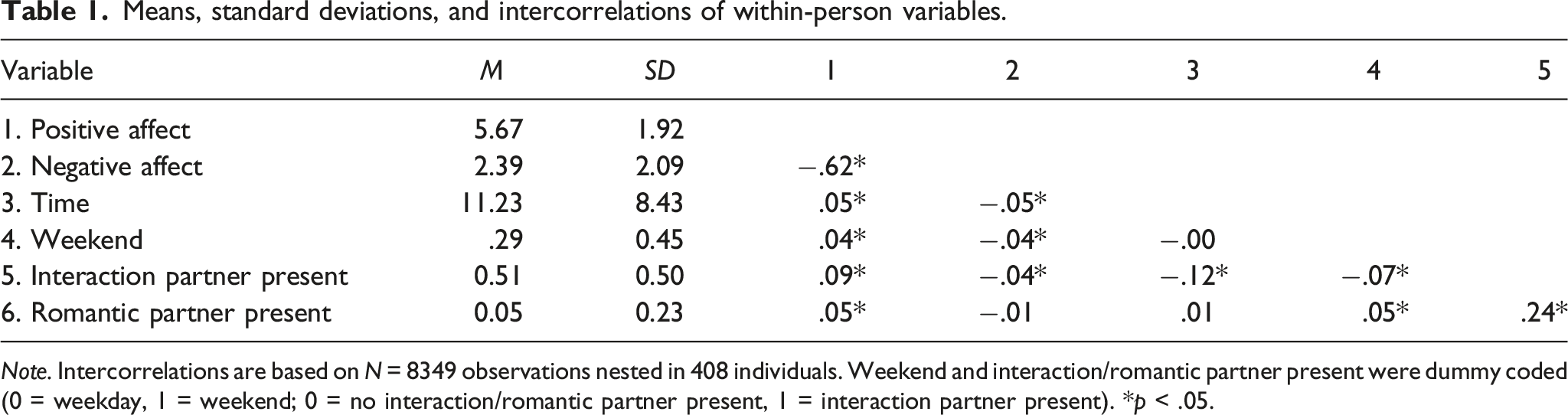
Note. Intercorrelations are based on N = 8349 observations nested in 408 individuals. Weekend and interaction/romantic partner present were dummy coded (0 = weekday, 1 = weekend; 0 = no interaction/romantic partner present, 1 = interaction partner present). *p < .05.
Means, standard deviations, and intercorrelations of between-person variables.
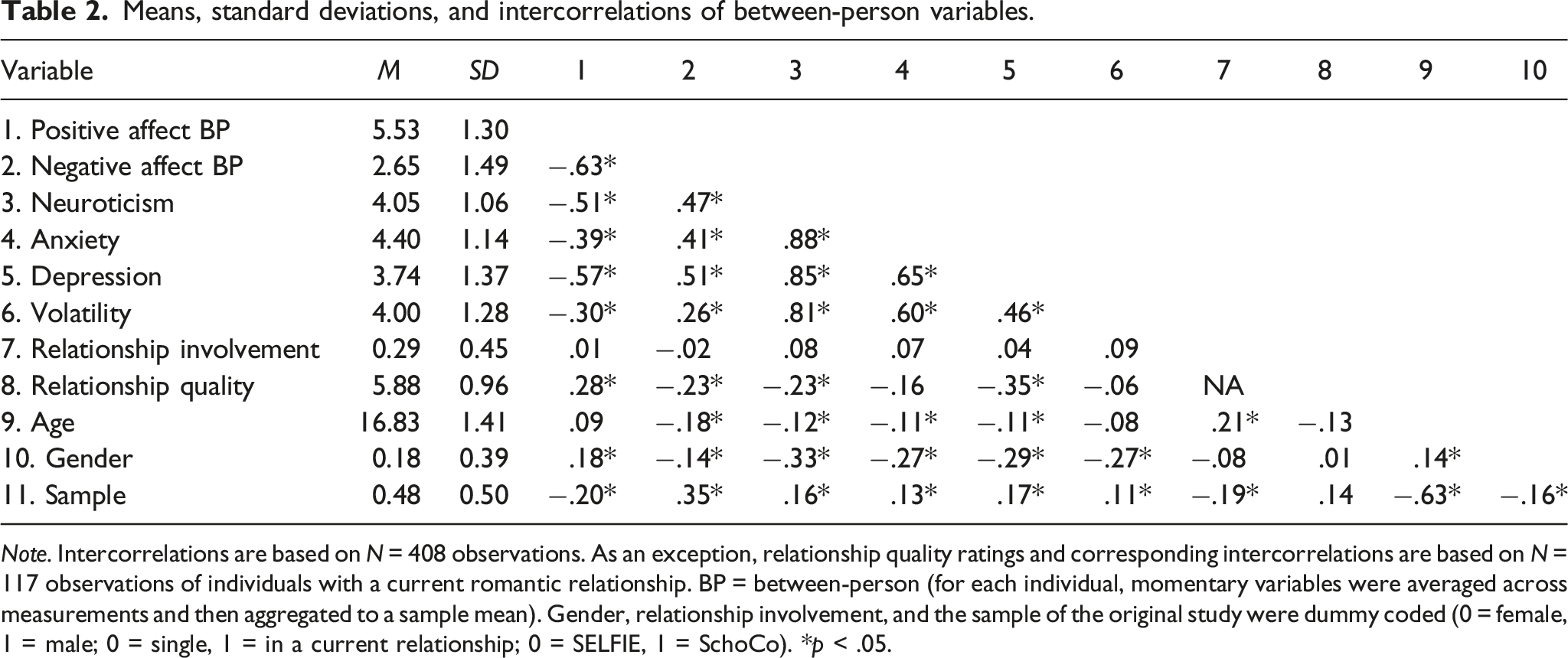
Note. Intercorrelations are based on N = 408 observations. As an exception, relationship quality ratings and corresponding intercorrelations are based on N = 117 observations of individuals with a current romantic relationship. BP = between-person (for each individual, momentary variables were averaged across measurements and then aggregated to a sample mean). Gender, relationship involvement, and the sample of the original study were dummy coded (0 = female, 1 = male; 0 = single, 1 = in a current relationship; 0 = SELFIE, 1 = SchoCo). *p < .05.
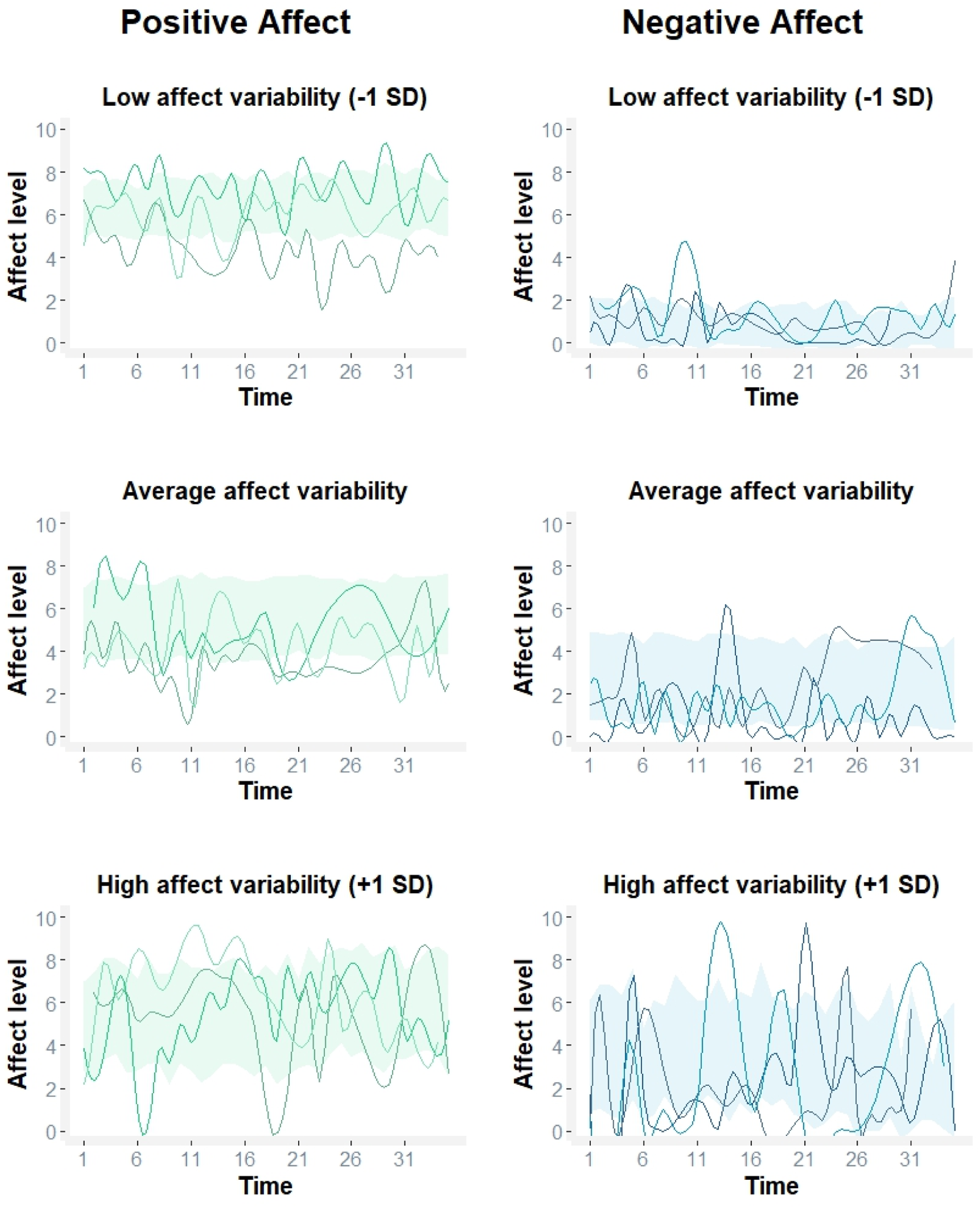
Exemplary Illustration of Adolescents’ Momentary Affect Across Time.
The association between neuroticism and momentary affect
Momentary affect regressed on neuroticism and covariates.
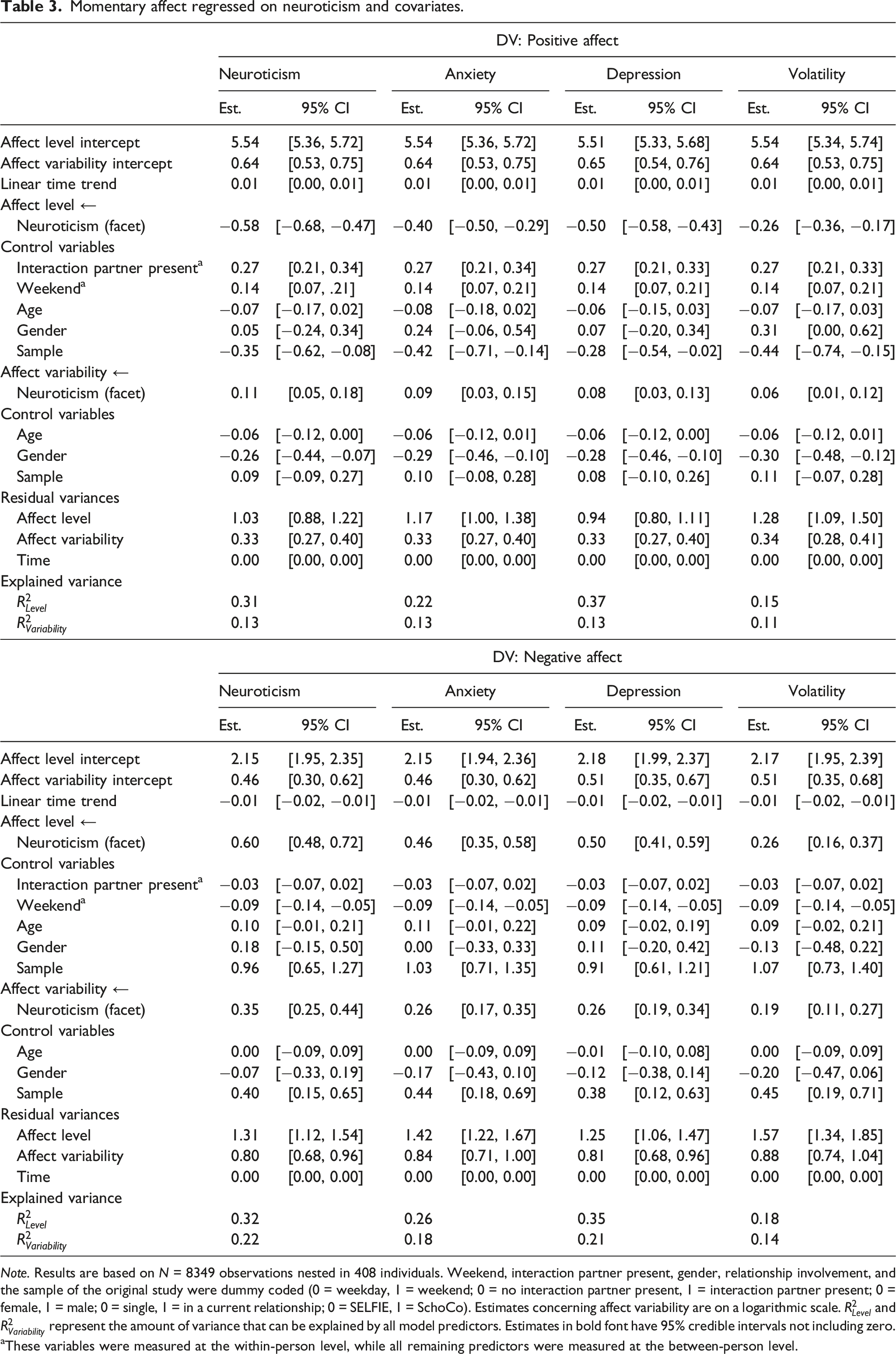
Note. Results are based on N = 8349 observations nested in 408 individuals. Weekend, interaction partner present, gender, relationship involvement, and the sample of the original study were dummy coded (0 = weekday, 1 = weekend; 0 = no interaction partner present, 1 = interaction partner present; 0 = female, 1 = male; 0 = single, 1 = in a current relationship; 0 = SELFIE, 1 = SchoCo). Estimates concerning affect variability are on a logarithmic scale.
aThese variables were measured at the within-person level, while all remaining predictors were measured at the between-person level.
Among the covariates included for statistical control, we found a number of additional significant associations with adolescents’ momentary affect. At Level 1, the presence of a social interaction partner was associated with higher levels of momentary positive affect but was unrelated to negative affect. Moreover, adolescents’ affect appeared to change on weekends, as indicated by the positive effects of weekends versus weekdays on the level of positive affect and negative effects on the level of negative affect. At Level 2, male participants displayed less variability in positive affect, while there was no gender difference with respect to adolescents’ affect level or their variability of negative affect. Finally, participants of the SchoCo study showed lower levels of positive affect, higher levels of negative affect, and higher variability of negative affect.
Altogether, neuroticism related to interindividual differences in both adolescents’ affect level and affect variability, and these associations remained robust when controlling for covariates. Moreover, analyses revealed that the strength of these effects differed across the considered momentary affect variables (i.e., affect level vs. affect variability), across the measures of momentary affect (i.e., positive vs. negative affect), and across the neuroticism facets (i.e., anxiety, depression, and volatility).
The role of romantic relationship involvement
Momentary affect regressed on neuroticism, relationship involvement, and covariates.
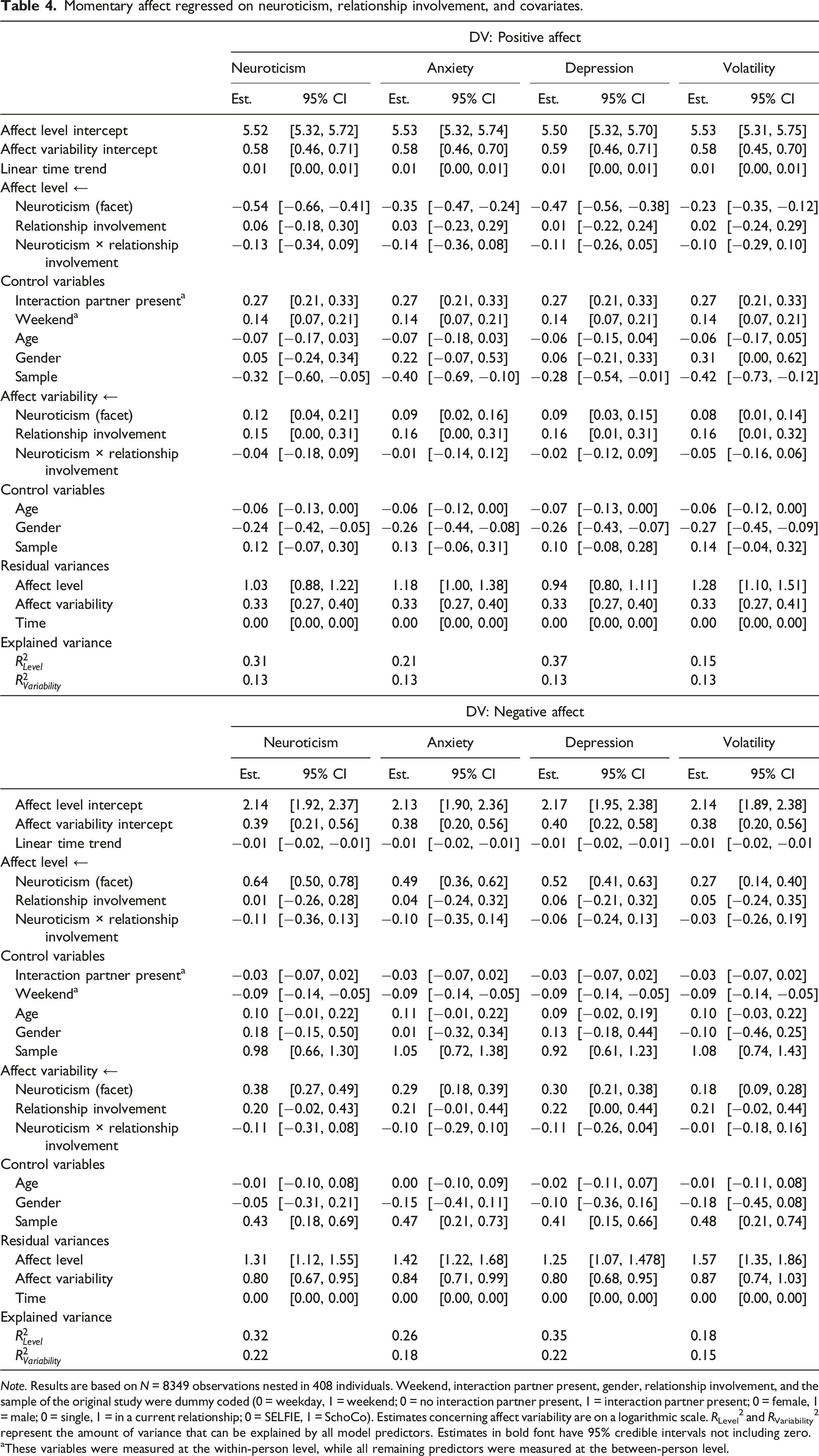
Note. Results are based on N = 8349 observations nested in 408 individuals. Weekend, interaction partner present, gender, relationship involvement, and the sample of the original study were dummy coded (0 = weekday, 1 = weekend; 0 = no interaction partner present, 1 = interaction partner present; 0 = female, 1 = male; 0 = single, 1 = in a current relationship; 0 = SELFIE, 1 = SchoCo). Estimates concerning affect variability are on a logarithmic scale. RLevel2 and RVariability2 represent the amount of variance that can be explained by all model predictors. Estimates in bold font have 95% credible intervals not including zero.
aThese variables were measured at the within-person level, while all remaining predictors were measured at the between-person level.
Corresponding to our second research question regarding the main effect of romantic relationship involvement, we did not find any differences in the level of momentary positive and negative affect between adolescents in romantic relationships and their single peers. Looking at affect variability, in contrast, our findings indicated that being in a romantic relationship was associated with higher variability of positive affect. While adolescents in a romantic relationship also tended to experience higher variability of negative affect, this effect was only significant in the model predicting momentary affect from depression. Overall, it should be noted that evidence for the association between romantic relationship involvement and higher affect variability was only weak: First, across models, lower bounds of the 95% credible intervals of the estimated effect sizes were usually close to zero. In the models without control variables, zero was even included in all corresponding 95% credible intervals (see Table A4). Second, compared to our first set of MELSMs, additionally including romantic relationship involvement as a predictor of adolescents’ momentary affect level and variability did not increase the amount of explained variance as indicated by the models’
Sub-sample analysis: The role of relationship quality
Momentary affect regressed on neuroticism, relationship quality, and covariates.
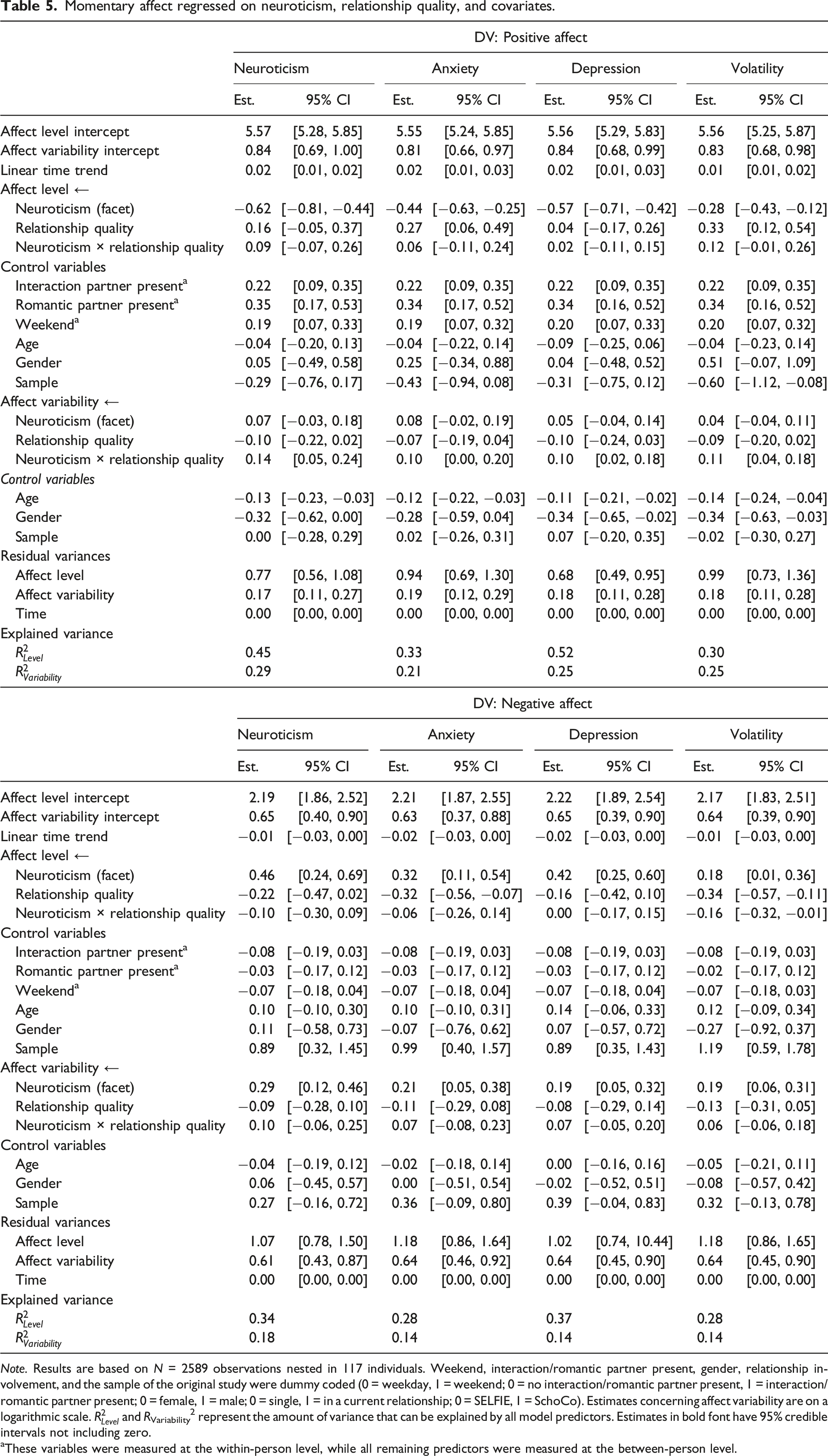
Note. Results are based on N = 2589 observations nested in 117 individuals. Weekend, interaction/romantic partner present, gender, relationship involvement, and the sample of the original study were dummy coded (0 = weekday, 1 = weekend; 0 = no interaction/romantic partner present, 1 = interaction/romantic partner present; 0 = female, 1 = male; 0 = single, 1 = in a current relationship; 0 = SELFIE, 1 = SchoCo). Estimates concerning affect variability are on a logarithmic scale.
aThese variables were measured at the within-person level, while all remaining predictors were measured at the between-person level.
Furthermore, the subsample analysis revealed a number of relationship quality effects: First, corresponding to our second research question, we found that higher relationship quality was related to higher levels of positive and lower levels of negative momentary affect in the models predicting momentary affect from the neuroticism facets anxiety and volatility. In contrast, relationship quality was no significant predictor of adolescents’ level of momentary affect when concurrently considering depression or the overall score of neuroticism. Second, also corresponding to our second research question, higher relationship quality tended to relate to lower levels of affect variability. This effect, however, was not significant in any of the models: Although the coefficients for the associations between relationship quality and adolescents’ variability of both positive and negative affect were slightly negative in all models, the corresponding 95% credible intervals consistently included zero. Third, and corresponding to our third research question, we found a positive interaction effect between neuroticism and relationship quality on adolescents’ variability of positive affect across all models. Thus, although neuroticism and relationship quality largely did not show significant main effects on positive affect variability, adolescents reporting both higher neuroticism and higher relationship quality also reported more variability in momentary positive affect.
Looking at the amount of explained variance, the consideration of relationship quality as predictor explained a substantial amount of variance together with neuroticism and covariates within our sub-sample. As indicated by
Discussion
The current study investigated the combined effects of neuroticism and romantic relationship variables on affect level and affect variability in adolescence. Analyzing extensive ESM data, our results revealed four main findings: First, adolescents with higher neuroticism experienced lower levels of positive affect, higher levels of negative affect, as well as higher variability of both positive and negative affect. Second, in addition to these personality effects, being in a romantic relationship was not systematically related to interindividual differences in affect level, but related to higher affect variability, although evidence for these effects was only weak. Third, among participants with a current romantic partner, our findings pointed to an interaction between neuroticism and relationship quality, such that adolescents with higher relationship quality experienced more variability in their positive affect if they scored higher on neuroticism. Finally, as an overarching pattern, we found that effect sizes differed between affect level and variability, positive and negative affect, and neuroticism facets. Below, we discuss these findings together with their theoretical implications and directions for future investigations in more detail.
Neuroticism effects on adolescents’ affect level and variability
Regarding our first major aim, findings on the association between neuroticism and momentary affect were mainly consistent with previous studies using adult samples (Eid & Diener, 1999; Geukes et al., 2017; Kuppens et al., 2007; Miller et al., 2009). Thus, our study adds to the evidence that neuroticism relates to interindividual differences in both a person’s affect level and variability and that these relationships generalize to adolescence (Borghuis et al., 2020; Reitsema et al., 2022). Given that neuroticism has been found to temporarily increase during adolescence (e.g., Aldinger et al., 2014; Borghuis et al., 2017; c.f. Göllner et al., 2017), these links between the trait and momentary affect seem to be particularly important for this age group. Specifically, increases in neuroticism might explain why many adolescents experience more negative and more variable affect in their daily lives compared to younger children or adults (Bailen et al., 2019; Larson & Sheeber, 2008; Spear, 2009).
Moreover, our results refine this picture in several important ways: First, neuroticism generally explained more variance in adolescents’ affect level compared to their affect variability. This is consistent with current discussions emphasizing that the trait’s link with affect level is well-established, whereas its link with higher affect variability is more controversial (Hisler et al., 2020; Kalokerinos et al., 2020; Wenzel & Kubiak, 2020). Potentially, the measurement of affect variability is less reliable, as it may be more prone to other influences, such as the applied analytical method (Mader et al., 2023; Wenzel et al., 2022). Second, in the analyses with the complete sample, neuroticism explained more variance in the variability of negative affect compared to the variability of positive affect. This finding is in line with the definition of neuroticism, which emphasizes the trait’s relevance for experiencing and handling stress (Barlow et al., 2014; Soto & John, 2017) and resonates with empirical research pointing to a heterogeneous relationship between neuroticism and positive affect variability (Geukes et al., 2017; Mader et al., 2023). Along this way, our results also emphasize the relevance of differentiating between the constructs of positive and negative affect (Watson & Clark, 1997). Third, out of the three neuroticism facets measured in this study, depression seemed to be most closely linked to adolescents’ affect level and variability. Being more or less volatile, in contrast, had the smallest effects. Whereas the findings with regard to affect level align with the construct definitions of depression and volatility (Soto & John, 2017), the comparably weak association between volatility and affect variability surprises since these concepts are closely related. Consistent with our results, Kroencke et al. (2020) also found only a weak association between volatility and variability of negative affect in an adult sample. Taken together, these findings raise the question of what the volatility facet, as implemented in the BFI-2, captures (Danner et al., 2019; Soto & John, 2017). As one possibility, it might only capture the variability of more specific types of momentary affect (e.g., anger), which were not reflected in our indices of positive and negative affect. As a second possibility, people might have only limited insights into the variability of their own affect, resulting in reduced validity of self-reported trait volatility in general. To clarify these questions, future research should focus on the measurement of volatility and its role for momentary affect.
Distinct patterns of romantic relationship involvement and quality
The second major aim of this study was a better understanding of how romantic relationship variables contribute to adolescents’ affective experiences. Looking at romantic relationship involvement and relationship quality, two distinct patterns emerged. First, whereas relationship involvement showed no association with adolescents’ affect level, it was associated with interindividual differences in affect variability. In line with the findings by Larson et al. (1980), adolescents with a romantic partner reported higher affect variability than their single peers. Refining this picture, our results indicated that this association mainly pertained to the variability of positive affect, while it was less pronounced for the variability of negative affect. The experience of being involved in a romantic relationship, thus, seems to contribute to interindividual differences in adolescents’ affect variability beyond what could be attributed to differences in neuroticism. At the same time, the effect sizes of romantic relationship involvement obtained in our study were only small and, in the case of the variability of negative affect, not always significant. Accordingly, differences in neuroticism might be more relevant for adolescents’ momentary affective experiences than romantic relationship involvement. Nonetheless, romantic relationship involvement might be relevant for adolescents’ affective lives on a larger time scale, such that it contributes to the development of their emotional capacities by broadening the spectrum of daily affect and providing a context for learning emotion regulation strategies (see Furman et al., 2008; Rosenblum & Lewis, 2003; Zimmermann & Iwanski, 2014). To examine this possibility, studies combining repeated ESM phases (i.e., measurement-burst designs) with repeated trait assessments across years are required (see Borghuis et al., 2020; Mueller et al., 2021).
Second and in line with research on broader affective outcomes (Demir, 2008; Mirsu-Paun & Oliver, 2017), perceived relationship quality with current romantic partners was associated with interindividual differences in the level of adolescents’ momentary affect beyond the effects of anxiety and volatility. Specifically, adolescents who evaluated their romantic relationship more positively experienced higher levels of positive affect and lower levels of negative affect. When simultaneously considering the effects of depression, either as facet score or within the overall score of neuroticism, these effects were similar in size but not statistically significant. Accordingly, whether adolescents were more or less depressed appeared to be more relevant for their affect level than the quality of their romantic relationship. With regard to the variability of adolescents’ momentary affect, we hypothesized a mitigating effect of higher relationship quality. On a descriptive level, relationship quality and affect variability were indeed negatively associated, yet this link was only significant when predicting the variability of momentary positive affect from the overall score of neuroticism. Thus, contrary to our expectation, relationship quality and affect variability were not meaningfully related in our adolescent sample. Alternatively, this finding might reflect a ceiling effect: On average, adolescents in our sample reported high levels of relationship quality, indicating that most of them were generally satisfied with their romantic relationships. Consequently, stressful events such as relationship conflicts that might have provoked higher affect variability (see Galliher et al., 2004; Laursen, 1995), were probably rare during the ESM week. To examine this possibility, future research should track momentary affect in adolescent samples with more variance in relationship quality and across several weeks.
The interplay of neuroticism and romantic relationships
Going beyond the main effects of neuroticism and romantic relationship variables, our third research aim was to investigate their interplay. Based on personality theory (Denissen & Penke, 2008a; Holmes, 2002) and empirical findings on reactivity to social cues (Denissen & Penke, 2008b; Mueller et al., 2019), we expected stronger relationship effects in adolescents with higher levels of neuroticism. With regard to neuroticism and romantic relationship involvement, we found no evidence for such moderating effects. Thus, the role of having a romantic partner for adolescents’ affective experiences did not differ between individuals with lower and higher neuroticism. Among adolescents with a current romantic partner, however, we consistently found that individuals with higher relationship quality experienced more variability in positive affect in their daily life if they scored higher in neuroticism.
The positive interaction between neuroticism and relationship quality can be interpreted in at least two ways. First and despite the lack of significance in main effects, higher relationship quality tended to go along with lower variability in adolescents’ momentary positive affect. The interaction suggests that this association might be attenuated or even reversed for adolescents with higher neuroticism, such that the positive affect of individuals with (very) high trait levels fluctuates strongly even if the quality of their romantic relationship is high. Whereas this interpretation converges with the canon of literature emphasizing affective variability as a core component of neuroticism (e.g., Barlow et al., 2014; Denissen & Penke, 2008b), it leaves open why we found no corresponding interaction effect with regard to negative affect. Second, our findings can be considered in the context of previous research on later life highlighting that neuroticism might act as a potential resource in close relationships through heightened sensitivity to positive social cues (Lay & Hoppmann, 2014; Mueller et al., 2021). Along these lines, the positive interaction between neuroticism and relationship quality might reflect that adolescents with higher levels of neuroticism are more sensitive to positive situations in their romantic relationships, yet only if the relationship is perceived as being of high quality. If so, adolescents with higher neuroticism might benefit particularly strongly from positive encounters with their romantic partners and therefore experience more variability in their positive affect. This interpretation is further strengthened by the fact that no corresponding effects were found with regard to the variability of negative affect. Whereas previous studies (e.g., Mueller et al., 2021) have focused on aging couples, our study provides initial evidence that, besides its link with more stressful experiences, neuroticism might also take on a beneficial role in adolescent romantic relationships at least under certain circumstances. Future studies should further investigate links between adolescents’ variability of momentary affect and characteristics of situations with their romantic partners to further examine the role of neuroticism in this life stage.
In addition to these interpretations, we would like to highlight that the interaction between neuroticism and relationship quality contrasts with the lack of evidence for an interaction between neuroticism and relationship involvement. Together, these findings suggest that the theoretically proposed moderating effect of neuroticism on the association between social relationships and momentary affect (Denissen & Penke, 2008a) might primarily apply to social cues with a certain valence (i.e., positive or negative; see Denissen & Penke, 2008b; Mueller et al., 2019), but not to broader social features, such as having a certain type of relationship or not.
With regard to the amount of variance explained in affect variability, our results converge with extant work indicating that personality primarily relates to interindividual differences in the variability of momentary negative affect (Eid & Diener, 1999). Extending this previous finding, our study illustrated that accounting for social relationship features and their interaction with personality might explain similar amounts of variance in the variability of positive affect. Specifically, positive affect variability was predicted by their interaction and not the independent effects of neuroticism and relationship quality. Accordingly, the variability of positive affect might be better understood by the conjoint consideration of personality and social relationship variables.
Limitations and future directions
Although the current study had several strengths, such as the use of ESM data from two adolescent samples and up-to-date statistical methods, it also had a number of limitations that need to be considered. First, the correlational design of our study does not allow for causal interpretations. Despite measuring neuroticism and romantic relationship variables earlier than momentary affect and controlling for a number of potential individual and situational confounders, we cannot rule out that the association between predictor and outcome variable was mediated by other (unobserved) variables or driven by selection effects. For example, we argued that relationship involvement contributes to higher variability of momentary affect in adolescence because it poses a new, particularly exciting social experience during that age period. It might also be the case, however, that adolescents with higher affect variability are more likely to enter a romantic relationship. Similarly, we assumed that, among adolescents who are in a romantic relationship, lower relationship quality contributes to higher variability in momentary affect given the higher frequency of stressful events, yet higher affect variability might also cause lower evaluations of relationship quality, given that affectively volatile individuals might be difficult to predict. To approach causal explanations, future studies need data to employ research designs that can track the formation and dissolution of romantic relationships at the time intervals at which they occur. Such a data base would allow researchers to focus on reciprocal links between personality traits or relationship characteristics and momentary affect dynamics (Hutteman et al., 2015; Quintus et al., 2021) or to adopt propensity score matching designs to account for potential selection effects (Rosenbaum & Rubin, 1983; Wagner et al., 2015).
Second, our power was limited to detect small effects. This was especially critical with regard to our smaller sub-sample of participants with a current romantic partner. Therefore, these findings should be interpreted with caution and require replication in larger samples including a greater number of adolescents who are currently involved in a romantic relationship.
Third, as another limitation pertaining to our sample, all our participants lived in Germany and were relatively homogeneous with regard to gender (over 80% female) and educational background (over 80% on the highest school track). Since the links of neuroticism with affect level and variability seem more basic and have also been shown in other age groups (e.g., Geukes et al., 2017; Kuppens et al., 2007), we expect that they also hold for adolescents with other sociodemographic backgrounds. The role of romantic relationship variables in adolescents’ affective development and their interplay with neuroticism, in contrast, may be more sensitive to societal expectations, which can vary by culture, gender, and education (Connolly et al., 2014; Seiffge-Krenke & Gelhaar, 2008). To test whether our findings generalize to other segments of the adolescent population, future studies using more diverse samples are required.
Finally, it is worth mentioning that we found some differences between participants of our two original study samples, such that adolescents from the SchoCo study reported lower levels of positive affect, higher levels of negative affect, and higher variability of negative affect. Since data collection of the SchoCo study took place during the COVID-19 pandemic, this might be interpreted as heightened stress that participants experienced during this time (e.g., Magson et al., 2021). Whereas we controlled for these effect in our statistical models, it highlights the potential relevance of the historical/sociological context and points to possibilities for future research of including environmental predictors of momentary affect in addition to personality and relationship variables.
There are several opportunities for extending the present study. With regard to personality traits, we focused on neuroticism as the “most affective” of the Big Five traits (Barlow et al., 2014; McCrae & Costa, 1989) and the trait with the strongest theoretical predictions regarding interactions with social relationships (Denissen & Penke, 2008b). Nonetheless, other Big Five traits might also be relevant for adolescents’ level and variability of momentary affect. Accordingly, future studies should explore the role of the remaining Big Five personality traits for adolescents’ momentary affect in social and non-social contexts. Moreover, with respect to the facets of neuroticism, we were interested in the predictive effects of each facet and its interplay with romantic relationship variables. In the future, studies might further delve into the unique contributions of anxiety, depression, and volatility for individual differences in momentary affect by investigating their respective effects within the same model.
With regard to the variability of positive and negative momentary affect, we focused on adolescents’ general tendency to fluctuate in their affect. Future studies could extend our approach by differentiating between affect variability across versus within certain types of situations (Geukes et al., 2017). Specifically, Geukes et al. distinguish the three processes inconsistency (i.e., internal sources of variation that are independent of external cues), responsiveness (i.e., flexible responses to the unique situational characteristics, and (c) rigidity (i.e., consistent reactions). For example, neuroticism might be associated with a higher inconsistency of affect within all types of situations. Being involved in a romantic relationship, in contrast, might be associated with especially strong affective responsiveness when adolescents interact with or think about their romantic partner, but less so in other situations such as training with their sports team or studying for school. This way, future research could help to further disentangle adaptive and maladaptive forms of affect variability. Given that such analyses require the distinction of at least three different contexts and, within each context, at least three momentary affect measurements per participant, the data of the present study was not suited to answer such questions. Future research could therefore extend ESM periods to more days and should invest in more differentiated assessments of the situational context.
Conclusion
The current research aimed at bridging personality and social relationship research by jointly investigating the role of neuroticism and romantic relationship variables for both adolescents’ momentary affect. Our findings highlight the relevance of neuroticism—especially its facet depression—and, in a less pronounced way, of romantic relationship involvement and romantic relationship quality for affective experiences in adolescence. Our results further suggest that the interplay of neuroticism and relationship quality might be particularly important to understand individual differences in the variability of adolescents’ positive affect. Building on our differentiated research approach that distinguishes between affect level and variability, positive and negative affect as well as personality facets, the findings of this study call for more nuanced research in the future to better understand the specific conditions of affective experiences in adolescence as well as the processes that contribute to long-term affective development.
Footnotes
Author contributions
Larissa L. Wieczorek played a lead role in conceptualization, data curation, formal analysis, methodology, project administration, writing of original draft, and writing of review and editing and a supporting role in investigation and software. Katharina Utesch played a supporting role in methodology and writing of review and editing. Simon Grund played a leading role in validation and a supporting role in formal analysis, methodology, and writing of review and editing. Jenny Wagner played a lead role in funding acquisition, investigation, resources, and supervision and a supporting role in conceptualization, methodology, project administration, writing of the original draft, and writing of review and editing.
Declaration of conflicting interests
The author(s) declared no potential conflicts of interest with respect to the research, authorship, and/or publication of this article.
Funding
The author(s) disclosed receipt of the following financial support for the research, authorship, and/or publication of this article: This research was funded by the German Research Foundation (DFG) via Grant WA 3509/3-1 awarded to Jenny Wagner.
Correction (December 2023):
The paper was updated to correct leading zeros in the tables.
Open science statement
This study was preregistered at https://osf.io/rxnwh/. On our OSF page (https://osf.io/84ahu/), we provide supplemental materials, including data, code, and additional results. The complete wordings and response formats of the items used in the current study can be obtained from the codebooks provided at the OSF pages of the SELFIE (Wagner et al., 2021) and SchoCo study (Wagner et al., 2022).
