




Abstract
This study investigated whether physical affection is causally associated with momentary intimacy and security by manipulating physical affection. We used a GPS-based smart-phone application as ecological momentary intervention that prompted participants to show physical affection to their partner when they were in the same location. We also investigated whether attachment style and attachment functioning moderated the effects of the manipulation. Thirty-nine couples were assigned to experimental (N = 20) and control (N = 19) groups for 2 weeks. Multilevel dyadic data analysis revealed significantly higher momentary intimacy in the experimental group, even when spontaneous physical affection was controlled; there was no significant change for momentary security. While attachment style did not moderate the effect of manipulation for either outcome, attachment functioning significantly moderated the effect on security. This is the first study to show evidence that physical affection, when instructed by a device, is causally linked to increased momentary intimacy in daily life.
Keywords
Physical affection (PA), defined as “touch intended to arouse feelings of love in the giver and/or the recipient” (Gulledge et al., 2003, p. 234), is fundamental for human functioning and health. It is indispensable for the healthy development and socialization of infants (Montagu, 1971; Rubin, 1963), is related to beneficial effects in adulthood, such as decreased cortisol and stress, and is associated with well-being in romantic relationships (for review, see Gulledge et al., 2007; Jakubiak & Feeney, 2017).
Although there is some evidence that PA causally increases well-being (Jakubiak & Feeney, 2017), and may hold promise as an intervention for mental, physical, and/or relational problems, to our knowledge no study has manipulated PA in a momentary manner in people’s daily lives, whereby the impact of the manipulated behavior was measured immediately following the behavior. Hence, developing ecologically valid and easy-to-use methods for momentary PA interventions, and investigating whether PA can be externally and momentarily manipulated seems necessary. In this study, we propose one such method using a smart-phone application to prompt couples to show PA and investigate its impact on momentary relational well-being (intimacy and security). The use of smartphones would improve ease of distribution, allowing wide-spread use of our intervention.
Physical affection from an attachment perspective
Stable and supportive human relationships constitute a fundamental need (Baumeister & Leary, 1995), and the communication of affection is thought as the main behavior responsible for the formation, maintenance and quality of human relationships (Floyd, 2002). Affection exchange theory predicts that humans are born with the need to receive and the capacity to convey affection (Floyd, 2019). Communication of PA is theorized to serve superordinate motivations of survival and reproduction, by providing security and intimacy in pair-bonds (Floyd, 2001).
The first and most primary form of affection humans experience is PA, as skin is the only fully developed sensory system at birth (Gallace & Spence, 2010). Furthermore, since an infant’s birth PA fulfills attachment needs by instilling a sense of security so that other needs can be satisfied (Hazan & Shaver, 1994). Attachment system is a behavioral homeostatic system that regulates safety and feelings of security through bonding (Sroufe & Waters, 1977). Early experiences with caregivers create internal working models that contain information regarding the reliability of others and lovability of the self that correspond to avoidant and anxious attachment styles respectively (Hazan & Shaver, 1987). These semi-malleable models color close human relationships throughout life, particularly romantic relationships.
PA can be best understood within this attachment framework, as romantic relationships is the main attachment bond in adulthood (Hazan & Shaver, 1987). According to Jakubiak and Feeney’s theory (2017), once perceived as affectionate, PA leads to feelings of security which fuel trust in the partner’s availability and responsiveness, leading to a “willingness to increase interdependence and closeness in the relationship” (p. 6) which is felt as intimacy. From an attachment perspective, these security and intimacy feelings constitute the cornerstones of the benefits of PA (Reis & Shaver, 1988).
A number of studies support this theorized association between PA, intimacy and security in romantic relationships (Debrot et al., 2013; Jakubiak & Feeney, 2016; Mackey et al., 2004; Mikulincer & Shaver, 2009), albeit experimental support for a causal association is lacking. Furthermore, while adult attachment impacts individual preferences, attributes and attitudes toward PA (Brennan et al., 1998; Chopik et al., 2014; Jakubiak & Feeney, 2016; Tucker & Anders, 1998), there is no consensus on how these differences affect the benefits individuals derive from PA (Jakubiak & Feeney, 2016; Stanton et al., 2017). Insecure individuals may benefit less from PA interventions because avoidant individuals are resistant to closeness, and anxious individuals have ambivalent perceptions of their partner (MacDonald et al., 2013). Alternatively, insecure individuals may benefit the most, as consistent exposure to PA may instill security and alter their dysfunctional relational tendencies (Stanton et al., 2017).
Current study
In this study, we used a smart-phone application to investigate whether we can manipulate PA to reap benefits of spontaneous PA on intimacy and security, and whether attachment style and attachment functioning (the extent one uses their partner to function as an attachment figure) moderated the effects of prompted-PA. We hypothesized that:
As there is no consensus regarding how attachment constructs moderate the effects of PA, we explored the following question:
Method
Participants and procedure
Couples were eligible only if they were together at least four nights per week, owned a smart-phone with Android version 5.0 or higher, and spoke English 1 . Participants’ mean age was 27.91 (SD = 8.46) and 23.1% of couples were married. Relationship length was less than 1 year for 14.1%, 1–5 years for 60.3%, 5–10 years for 16.7% and more than 10 years for 9.0%.
Participants were recruited through online and offline advertisement. One hundred and eighty-four couples showed interest in the study; 50 completed the T1 questionnaire; 39 couples (20 experimental; 19 control) completed the study. 2 As compensation, participants were provided a total of 400 euros via vouchers through lottery. We had .79 power to detect an effect of β = .30 for the actor, given the recruitment of 39 couples and an actor-partner correlation of the independent variable of r = .30 (Ackerman et al., 2016).
The study was approved by the university ethics committee. All couples used the smart-phone application for 2-weeks, and they were randomly assigned to experimental and control groups. When randomly prompted by the application with the statement “Please show physical affection to your partner in any way you deem appropriate,” the experimental group showed PA to their partner (if not declined; see below), then completed a short questionnaire (Online Supplement 2) on the smartphone. The control group was prompted with “Please fill in the following questionnaire” to completed the same questionnaire, except for 2 additional items measuring perceived affection and enjoyment of touch only responded by participants in the experimental group (Online Supplement 1). All participants completed a battery of questionnaires before (T1) and after (T2) the 2-week period. The questionnaires were identical, except T2 included three manipulation check questions for everyone and two perception of touch questions for the experimental group (for all items used Online Supplement 3).
The application assessed participants’ location through GPS every 30-minutes and determined whether they would receive a notification randomly if they were in the same location. Participants could accept or decline the notifications and could receive unlimited number of notifications until one partner accepted four notifications per day. Participants received no further notifications for 1 hour after a response. The application was specifically developed for this study using JAVA.
Each participant received an average of 32.79 (SD = 15.32, Range = 4–69) notifications over 2 weeks. Participants accepted notifications 62.8% (M = 20.42, SD = 12.72), and declined 19.67% (M = 6.45, SD = 9.12) or ignored 18.12% (M = 5.94, SD = 6.56) of them.
Measures
We assessed 3 momentary intimacy with “How intimate with/close to your partner are you feeling right now?” (M = 5.54, SD = 1.24) and momentary security with “How secure/safe are you feeling right now?” (M = 5.58, SD = 1.05) via 7-point Likert sliders flanked by 1 and 7 following the prompts. We measured spontaneously given and received PA with “Since the previous notification, did you show your partner/did your partner show you non-verbal support (touch)?” via binary yes/no buttons following the prompts. The Experiences in Close Relationships-Revised (ECR-R; Fraley et al., 2000) measured global attachment avoidance (M = 2.68, SD = .51, 18-items) and anxiety (M = 2.73, SD = 1.15, 18-items) on a 7-point Likert scale (1 = Strongly Disagree to 7 = Strongly Agree; α = .86 and .96 respectively) at T1. The Attachment Features and Functions Measure (Tancredy & Fraley, 2006) measured attachment functioning (M = 6.31, SD = .49, 16-items) by assessing attachment functions (proximity seeking, separation anxiety, safe haven, and secure base) toward the partner on a 7-point Likert Scale (1 = Strongly Disagree, 7 = Strongly Agree; α = .87) at T1. We only recorded the application data for accepted prompts.
Results
A multilevel Actor-Partner Interdependence Model with dyad as the unit of analysis (Kenny et al., 2006) in R was conducted. The effect of intimacy and security at the previous instance of measurement was controlled for by including a time-lagged intimacy and security variable in the model.
Momentary intimacy and attachment moderation
The groups did not differ neither in demographic variables nor in variables of interest before the manipulation of physical affection (all ps > .256). As hypothesized, group assignment positively impacted momentary intimacy (b = .38, p = .04), even when controlling for spontaneous PA (Figure 1). Furthermore, both receiving (b = .63, p < .001) and providing spontaneous PA (b = .28, p = .034) as well as partner’s report of receiving PA (b = .31, p = .009) were positively associated with own intimacy. Partner’s attachment anxiety was negatively associated with own intimacy (b = −.19, p = .025). None of the attachment variables moderated the effect of group assignment for intimacy (all ps > .069).
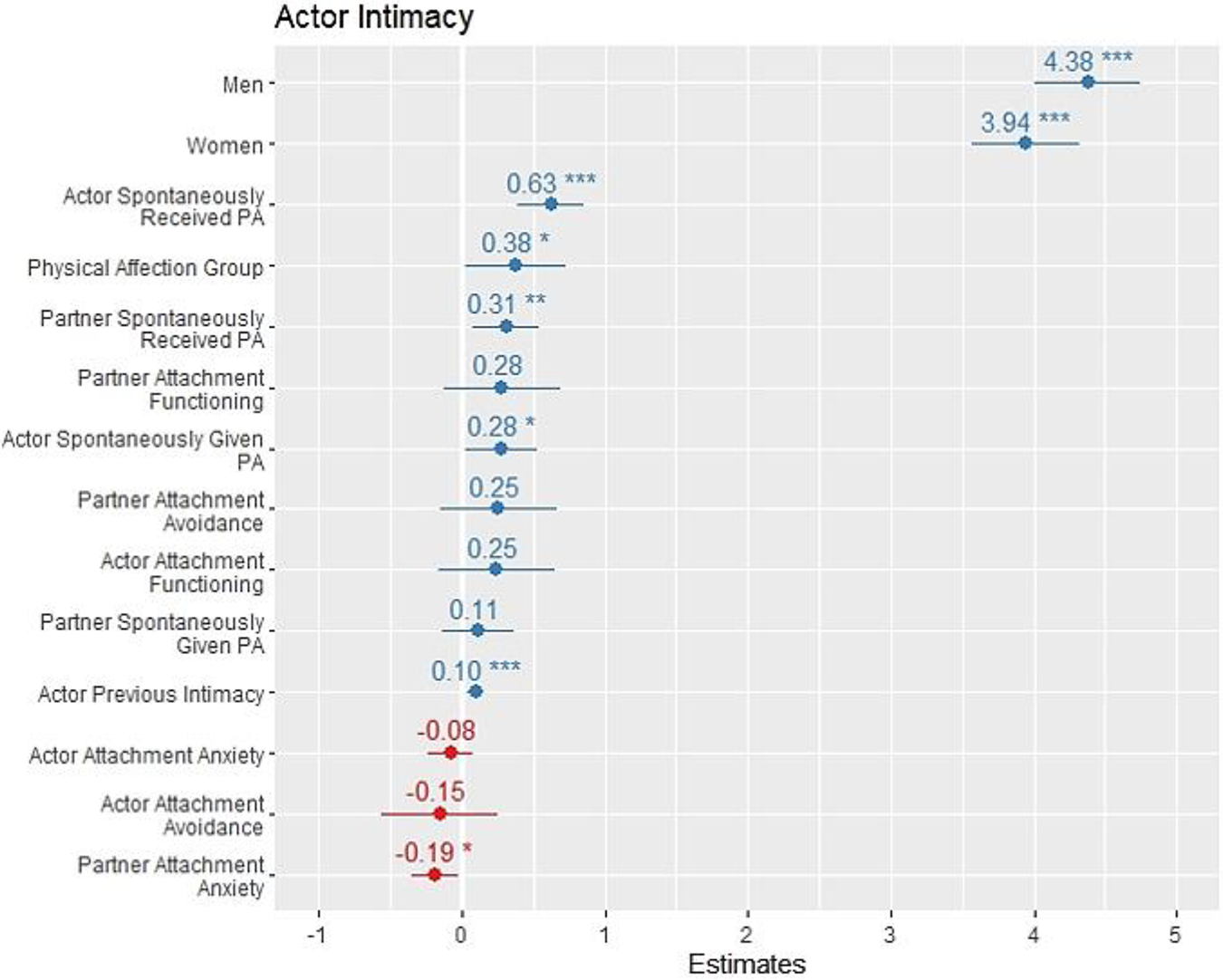
Dot whisker plot for variable coefficients of momentary intimacy APIM. *Significant at p < .05; **significant at p < .01; *** significant at p < .001.
Momentary security and attachment moderation
Contrary to our hypothesis, group assignment had no significant impact on momentary security (b = .14, p = .430; Figure 2). No spontaneous PA variables showed a significant effect (all ps > .055). Actor attachment anxiety was negatively associated with own security (b = −.18, p = .010).
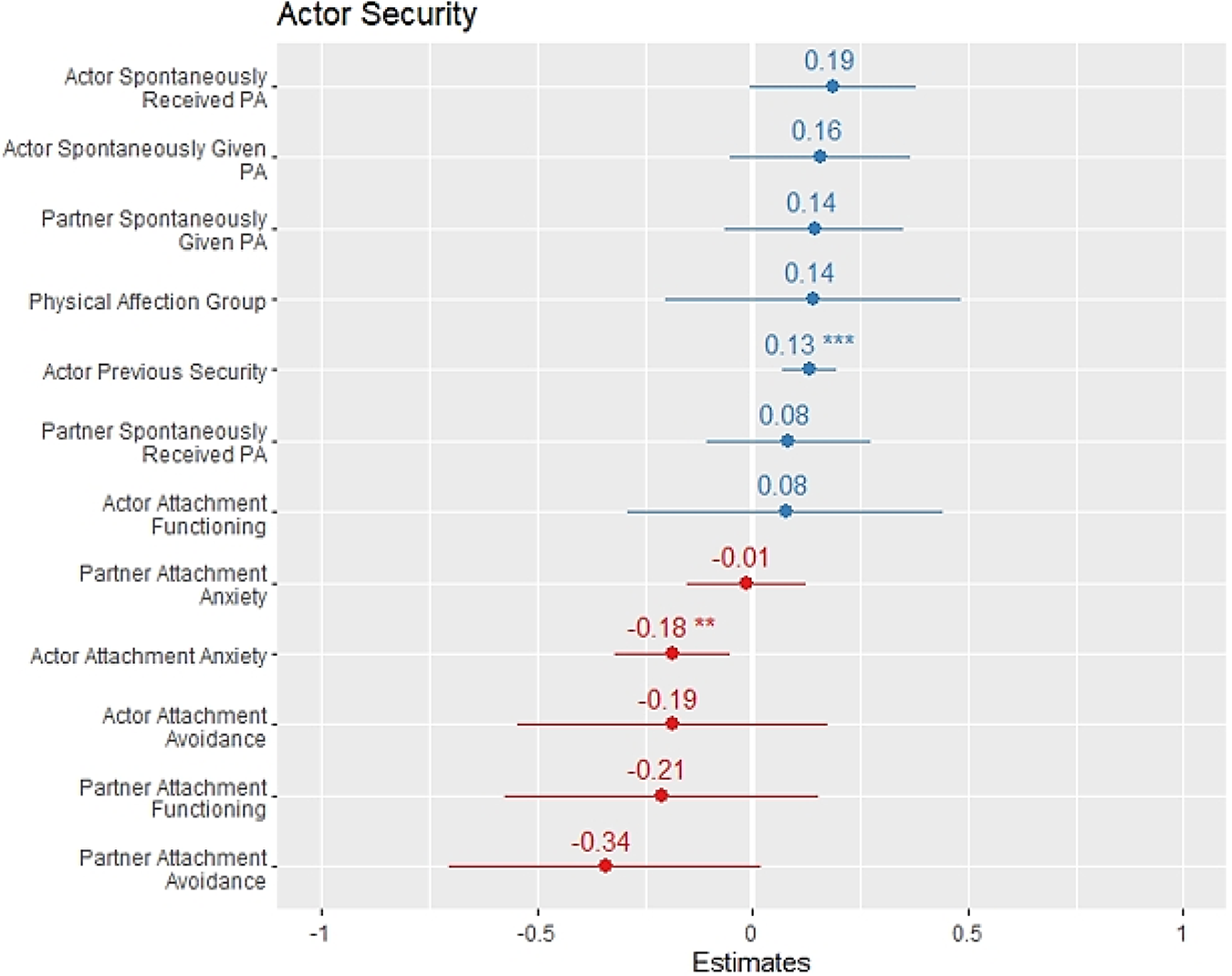
Dot whisker plot for variable coefficients of momentary security APIM. *Significant at p < .05; **significant at p < .01; ***significant at p < .001.
While attachment anxiety and avoidance did not moderate the effect of group assignment (all ps > .236), own attachment functioning significantly showed a cross-over moderation (b = .68, p = .026; Figure 3). Group assignment had no effect for those with relatively low in attachment functioning (b = −.02, p = .948), while it had a significantly positive effect for those participants relatively high in attachment functioning (b = .50, p = .048). Similarly, attachment functioning had no significant association with security in the control group (b = −.41, p = .128), while having a significant positive association in the experimental group (b = .66, p = .015)
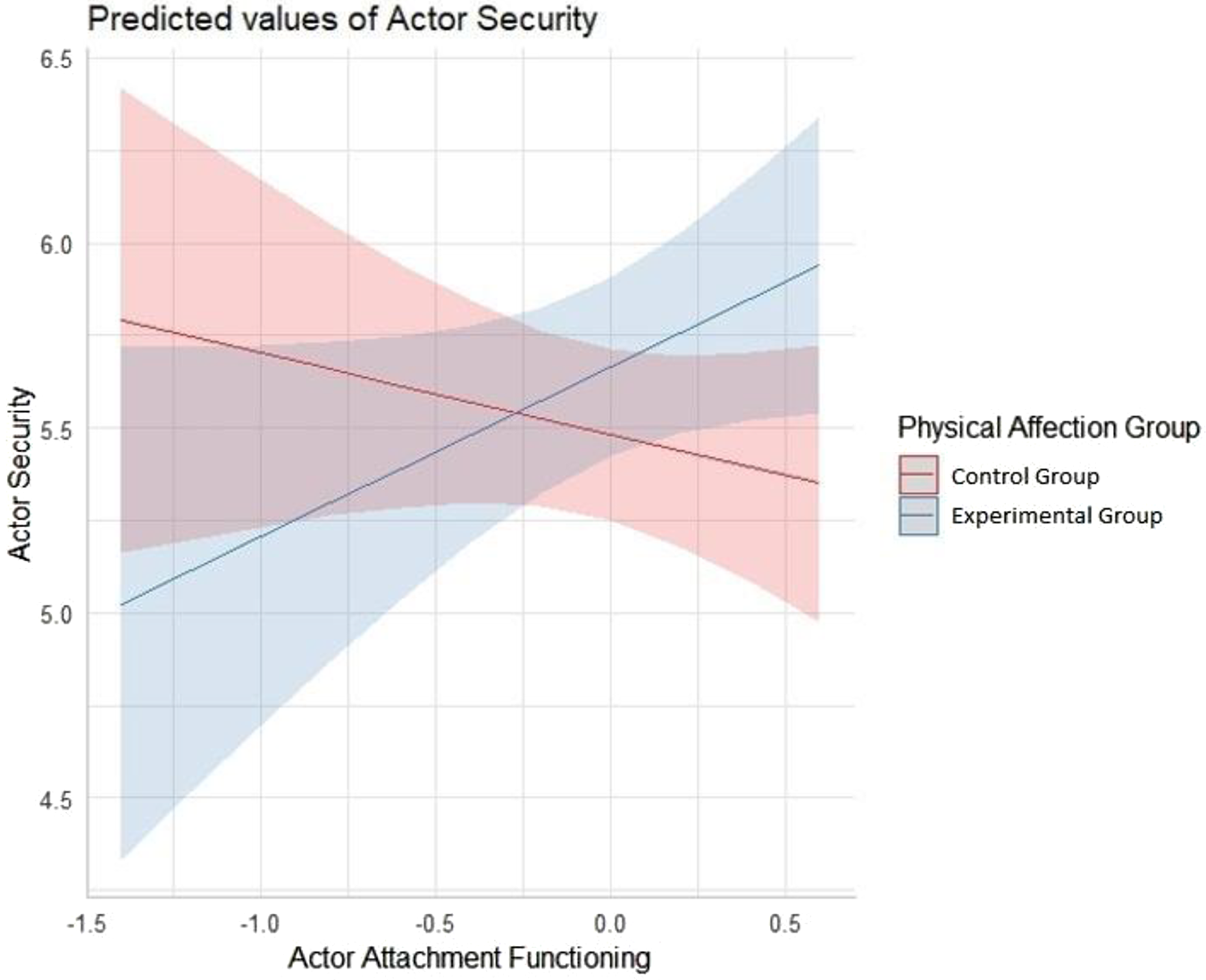
Moderation of group assignment by attachment functioning on momentary security (b = .68, p = .026).
Discussion
This study investigated whether PA could be externally manipulated to increase the momentary intimacy and security in couples’ using a smart-phone application, while examining whether attachment style and functioning moderated the effect. Results indicate that manipulating PA to elicit momentary intimacy using smart-phones is indeed possible. However, while we found no direct effect for security, we detected a moderation by attachment functioning. PA increased security feelings only among those relatively high in attachment functioning, suggesting that the presence of a certain baseline level of functioning attachment bond is needed for prompted-PA to elicit security. We did not find a significant change in relationship quality from pre- to post-intervention; momentary increases in intimacy were not sufficient to boost relationship quality (Online Supplement 1); longer interventions might be necessary to improve it.
These findings have theoretical and methodological implications. First, they support the existence of a causal association between PA and intimacy. Second, they demonstrate that proximity-detecting smartphone applications could be a valid research and intervention tool. Our findings also support Affection Exchange Theory’s (Floyd, 2001) assertion that PA benefits both receivers, and providers. Notably, PA could have been considered as inauthentic (i.e., deceptive affection; Horan & Booth-Butterfield, 2013). However, this seems fairly implausible because participants could decline or ignore the prompts and, indeed, did so regularly. Regardless, research indicates that deceptive affection is associated with relational health, possibly because internal feelings are modified to reflect the enacted behavior (Trask et al., 2016). This modification of feelings might require a high-quality relationship, which was the case in our sample (Online Supplement 1). Further research with dissatisfied/dysfunctional relationships could untangle these processes.
There was a direct effect of manipulated PA for intimacy but not for security. This is perhaps due to the study’s demand characteristics, as participants could have guessed that we were expecting increases on intimacy, but not on security. Alternatively, the effect on security might be smaller because it is harder for individuals to detect changes in their daily security under non-threatening situations. Moreover, our small sample might be underpowered to detect such a small effect. This could also explain why spontaneously receiving PA was only marginally associated with security.
The lack of moderation by global attachment anxiety and avoidance could indicate that individuals benefit from PA regardless of their attachment style. Notably, however, in line with Brennan and colleagues’ work (1998) who found that avoidant individuals prefer low amounts of PA, supplementary analyses (Online Supplement 2) indicated that individuals who reported more attachment avoidance were significantly more likely to decline the notifications. Even though avoidant individuals may need it the most, our results show the difficulty of reaching them with a PA intervention. It is worth noting that we did not collect data when prompts were declined, leading to systematically missing data for avoidant individuals. As such, findings on moderation by attachment avoidance should be approached cautiously.
Our results have potential practical implications for PA interventions, particularly if future research validates our findings using more diverse samples. For example, they might be used in couple therapy to improve intimacy and create better ground for conflict resolution. Whether PA interventions can target mental or physical problems could also be investigated. In conclusion, our results demonstrate that smart-phone PA interventions could be used to investigate causal effects of PA in an ecologically-valid manner.
Supplemental material
Supplemental Material, Supplement_1_-_Analyses_on_Additional_Outcome_Measures - Can we use smart-phones to increase physical affection, intimacy and security in couples? Preliminary support from an attachment perspective
Supplemental Material, Supplement_1_-_Analyses_on_Additional_Outcome_Measures for Can we use smart-phones to increase physical affection, intimacy and security in couples? Preliminary support from an attachment perspective by Kerem Besim Durbin, Anik Debrot, Johan Karremans and Reine van der Wal in Journal of Social and Personal Relationships
Supplemental material
Supplemental Material, Supplement_2_-_Goup_assignment_and_attachment_avoidance_on_declining_notifications - Can we use smart-phones to increase physical affection, intimacy and security in couples? Preliminary support from an attachment perspective
Supplemental Material, Supplement_2_-_Goup_assignment_and_attachment_avoidance_on_declining_notifications for Can we use smart-phones to increase physical affection, intimacy and security in couples? Preliminary support from an attachment perspective by Kerem Besim Durbin, Anik Debrot, Johan Karremans and Reine van der Wal in Journal of Social and Personal Relationships
Footnotes
Authors’ note
The content of this study was presented at EASP Tech and Relationship Conference in Annecy, France.
Acknowledgments
I am grateful to Doruk Kilitçioğlu for developing the application and helping me design it, despite his very busy schedule. Nothing would have been possible without him. I am thankful to Marieke Tollenaar for the support she has provided while I conducted my research, and to the Unit of Clinical Psychology of Leiden University for funding the research.
Funding
The author(s) disclosed receipt of the following financial support for the research, authorship, and/or publication of this article: This research was funded by Leiden University Clinical Psychology Department.

Open research statement
As part of IARR’s encouragement of open research practices, the authors have provided the following information: This research was not pre-registered. The data used in the research are available. The data can be obtained by emailing
Supplemental material
Supplemental material for this article is available online.
Notes
References
Supplementary Material
Please find the following supplemental material available below.
For Open Access articles published under a Creative Commons License, all supplemental material carries the same license as the article it is associated with.
For non-Open Access articles published, all supplemental material carries a non-exclusive license, and permission requests for re-use of supplemental material or any part of supplemental material shall be sent directly to the copyright owner as specified in the copyright notice associated with the article.
