




Abstract
International educational mobility is a life event that confronts sojourners with many challenges, such as adapting to a new living environment abroad. Whether these cultural adaptation processes are successful is contingent upon different factors. In the present study, we focused on the role of personality as well as host- and home-cultural behavioral engagement in the psychological adaptation of high school students during an academic year abroad. To that end, we analyzed data from the first four waves of the project Mobility and Acculturation Experiences of Students (MAPS) (N = 1299 students in a year abroad) using a cross-lagged panel model (CLPM) and a random intercept cross-lagged panel model (RI-CLPM) to address these associations at the interpersonal and intrapersonal level. The analyses revealed the complex interplay between personality, host- and home-cultural behavioral engagement, and adaptation at both the interpersonal and intrapersonal levels of analysis. Moreover, host-cultural behavioral engagement also mediated the predictive effects of personality traits on the psychological adaptation of sojourners in the CLPM. Theoretical implications for personality and acculturation research and practical inferences for supporting students studying abroad are discussed.
Keywords
Offered in many schools around the world, student exchanges serve as an important instrument to improve young people’s understanding of other cultures and ways of life. They provide unique opportunities to learn a new language or to improve communication and intercultural skills, and for personality and identity development (e.g., Greischel et al., 2018; Petersdotter et al., 2017; Wolff et al., 2020; Wolff & Borzikowsky, 2018; Zimmermann et al., 2021; Zimmermann & Neyer, 2013). However, they also imply fundamental changes in students’ ecological systems (Bronfenbrenner, 1977, 1994; Ward & Geeraert, 2016) as student sojourners leave their families and friends behind to live abroad in a new parental home, visit a new school within a new school system, and find themselves immersed in a new culture with a foreign language at a very young age (14–18 years old). As individual differences such as personality traits are emphasized by such environmental disruptions (Caspi & Moffitt, 1993), they might explain differences in how students behave in their new environment and how they psychologically adapt to their new living situation, that is, the extent to which they feel comfortable and happy or anxious and out of place in a new culture (Demes & Geeraert, 2014; Searle & Ward, 1990).
Although previous studies provided cross-sectional evidence for associations between acculturation and psychological adaptation (i.e., Berry et al., 2006; Ward & Kennedy, 1993) and that personality factors predicted the acculturation and adaptation of migrants (Demes & Geeraert, 2015; Swagler & Jome, 2005; Ward et al., 2004; Zhang et al., 2010), it is still unknown how these associations apply to high school student sojourners and which mechanisms underlie them. The present study aimed at obtaining a more in-depth understanding of the transactional linkages between acculturation behavior (i.e., host- and home-cultural behavioral engagement), psychological adaptation, and personality of high school students during an academic year abroad. Therefore, based on the theoretical and empirical background of the acculturation literature and personality research, we suggested that (1) acculturation and psychological adaptation are related to each other over time and that (2) personality is associated with the acculturation process and the psychological adaptation of high school students during an academic year abroad. We also investigated (3) gender differences, and (4) the possible indirect effects of acculturation behavior as a mechanism that mediates the relationship between the big five traits and the sojourners’ adaptation as well as the possible indirect effects of psychological adaptation as a mechanism that mediates the relationship between the big five traits and the acculturation process. We tested these assumptions with the help of a large longitudinal data set of N = 1299 student sojourners. We applied a traditional cross-lagged panel model (CLPM) and a random-intercept cross-lagged model (RI-CLPM), in order to shed light on both interpersonal and intrapersonal associations between the study variables. This article is among the first studies in the field of acculturation research to disentangle between-person differences and within-person dynamics with regard to the relation of acculturation behaviors and adaptation as well as their predictors.
Acculturation and adaptation abroad
As school students move abroad, they immerse in the process of acculturation. For decades, this process has been a crucial issue in understanding cross-cultural encounters and migration experiences (i.e., Yoon et al., 2012). At the individual level, acculturation takes place when an individual member of a cultural group comes into regular contact with members of another cultural group (e.g., Berry, 2005). According to Berry (1974, 1980), acculturation is the product of the interaction of two independent dimensions corresponding to individuals’ orientation towards the new (host) culture and towards their own (home) culture. For each orientation, acculturation attitudes (“Do I want to approach the host culture/uphold my home culture?”) and acculturation behavior (“What do I do to approach the host culture/uphold my home culture?”) should be differentiated (Arends-Tóth et al., 2006). In that regard, host-cultural behavioral engagement is understood as the individuals’ behavioral involvement in the new culture—for example, by spending free time with natives, using their language, or adjusting their behavior to the new culture in different contexts, such as the new school (Klok et al., 2017; Serrano-Sánchez et al., 2021a, 2021b). Home-cultural behavioral engagement covers those behaviors intended to maintain contact with the culture of origin, such as spending time keeping in touch with the people left behind or other fellow citizens, using the mother tongue, or behaving like they do at home (Serrano-Sánchez et al., 2021a).
Adaptation abroad is understood as the result of this acculturation process and describes the changes in thoughts, emotions, and behaviors a person or group of people experiences when immersed in a new cultural context (Berry, 1974, 1997; Berry et al., 2006; Ward & Kennedy, 1993). Searle and Ward (1990) proposed a two-dimensional model of adaptation abroad. The first dimension, sociocultural adaptation abroad, concerns the practical consequences of the change, that is, to what extent migrants are able to successfully cope with everyday life in the host culture (Searle & Ward, 1990). The second dimension of adaptation and the focus of this study, psychological adaptation, relates to the emotional consequences associated with the change of culture and describes how migrants experience this change, and whether they feel comfortable and happy or anxious and fearful in the new culture (Searle & Ward, 1990). As Demes and Geeraert (2014) pointed out, most previous studies used unspecific measures, such as general well-being or depression scales, to operationalize psychological adaptation without considering the migration or sojourn setting. In order to increase the ecological validity of this measurement, Demes and Geeraert (2014) proposed a context-specific measure of psychological adaptation. Their brief psychological adaptation scale covers topics such as homesickness, not knowing how to act, excitement, insecurity, and loneliness in the context of a cultural relocation (Demes & Geeraert, 2014) and was thus considered a useful measure to be implemented in the present study on high school student sojourners.
Although many high school students participate in exchange programs (e.g., weltweiser, 2019), little is known about the association between host- and home-cultural behavioral engagement and the psychological adaptation of adolescent sojourners (Serrano-Sánchez et al., 2021a). Research investigating college students converges on the conclusion that host-cultural behavioral engagement appears to be a key factor in the adaptation and learning processes of student sojourners, for it is associated with better psychological adaptation, that is, higher levels of well-being and lower levels of stress, loneliness, depression, and anxiety symptoms (e.g., Berry & Sam, 1997; Ward & Chang, 1997; Ward & Rana-Deuba, 1999). Consequently, academic exchange programs aim to help students immerse themselves in the new foreign culture by supporting the development of host-cultural behaviors. The relevance of home-oriented behavior for psychological adaptation abroad, on the other hand, is less clear and its results are mixed (e.g., Berry et al., 2006; Hofhuis et al., 2019; Tonsing, 2014; Tsai et al., 2000).
As current acculturation models positioned adaptation as the result of the acculturation process, the inverse (longitudinal) effects of adaptation on behavioral engagement in host and home cultures were thoroughly neglected. However, the results of research on well-being suggest that well-being has motivational consequences that guide behavior (Luhmann & Hennecke, 2017). Psychological adaptation could therefore be a prerequisite for becoming involved in the host society or its lack might foster an orientation towards one’s home society. We thus exploratively investigated whether psychological adaptation may predict host- and home-cultural behavioral engagement.
When investigating these associations, it is important to delineate the level of analysis, that is, between-person versus within-person. In that vein, acculturation behavior can be interpreted both as a stable behavioral orientation (i.e., as a trait that describes between-person differences) and as more fluctuating behavioral practices (i.e., as states that reflect within-person processes over time). Whereas the host- and home-cultural behavioral orientation is a general way to behave towards the host or the home culture, host- and home-cultural behavioral practices are specific goal-directed behaviors and part of a transactional process between the adolescent sojourners and their environment abroad. From this perspective, one might ask, for example, whether adolescent sojourners with a higher host-cultural behavioral orientation adapt better to living abroad than those students with a lower host-cultural behavioral orientation (between-person level) or whether sojourners adapt better when they increase their engagement in the host culture compared to their usual engagement (within-person level).
In a similar way, psychological adaptation abroad, like well-being (Eid & Diener, 2004), may also consist of both trait-like stability and state-like variability. On the one hand, psychological adaptation abroad at a trait level (between-person level) refers to how satisfied an adolescent sojourner is in general with his or her experience and performance in the new country (compared to other sojourners). On the other hand, psychological adaptation abroad at a state level (within-person level) refers to the feelings and satisfaction of an adolescent sojourner at a particular moment in his or her stay abroad or within a restricted period of time during it (compared to their average psychological adaptation).
That is, stable individual differences in host- and home-cultural behavioral engagement may relate to stable individual differences in adaptation, whereas state changes in both kinds of variables within persons over time may reveal a different pattern of associations (for further examples on analyses that differentiate between- and within-person association see e.g., Dietvorst et al., 2018). To the best of our knowledge, no previous studies have implemented this differentiation in the investigation of associations between acculturation and adaptation.
The role of personality in the process of acculturation and adaptation
Even though the acculturation framework also considers pre-existing interindividual differences such as personality traits (i.e., Berry, 1997), very few studies have investigated the role of personality with regard to the acculturation process (i.e., Ward et al., 2004). This is astonishing, as there are good reasons to assume that traits play a role in how people acculturate. As previous research has shown, personality traits may influence the way in which people behave and interact with their environment, as well as how they feel, serving as a protective or risk factor for adaptation problems (John et al., 2008). Experiences abroad imply social environmental disruptions as a result of the change in physical context and few normative rules of behavior. In novel, ambiguous, and uncertain situations, without a clear framework of action and in the absence of role models, people are forced to act without understanding which behaviors may be the most adaptive to cope successfully. In these situations, personality differences appear to be more accentuated, since each individual will tend to use their own schemes and models of action in their attempt to convert the strange situation into a familiar one (Caspi & Moffitt, 1993). Against this background, it is our goal to understand what role the different personality factors play in engaging in host- and home-cultural behaviors and whether the behavioral engagement provides a mechanism through which personality traits influence the psychological adaptation abroad.
Personality and acculturation behavior
The definitions of the big five factors by Costa and McCrae (1992) and empirical findings suggest the following specific associations between personality traits—that is, agreeableness, conscientiousness, extraversion, openness to experience, and emotional stability—and host-cultural behavioral engagement, whereas the relationship between traits and home-oriented behavior is less clear. For example, agreeable students are characterized by empathy, humility, and tend to show more tolerance and respect to others and to human diversity (Butrus & Witenberg, 2012). They are also particularly concerned with fitting in and better able to navigate host-cultural norms (Geeraert et al., 2019). We expected, therefore, that higher levels of agreeableness are positively related to host-cultural engagement with natives and the performance of host-oriented behavior in general. Those students who are high on the conscientiousness factor are good planners and organizers and have excellent self-control and a strong commitment to their objectives and goals, showing higher school engagement (Bosselut et al., 2020; Heaven et al., 2007). Conscientiousness also has a role in behavioral control (Conner & Abraham, 2016). As involvement in the host culture is an explicit goal of exchange programs, we expected higher levels of conscientiousness to be related to higher goal commitment and, as a consequence, higher levels of host-cultural behavioral engagement. Furthermore, findings from acculturation research also point to the effects of personality traits in the adoption of host or home orientation in terms of attitudes and behaviors. In their study with first- and second-generation students of Chinese descent, Ryder et al. (2000) revealed that students with higher levels of conscientiousness tended to obtain higher levels of both host and home orientations. Extraverted students are self-confident and excel in initiating social contacts, looking for the company of others, spending less time alone, and engaging in more conversations (Mehl et al., 2006). Previous studies have consistently shown the positive relationship between extraversion and the friendship selection process of just-acquainted individuals. For example, in university freshmen, higher levels of extraversion were related to the selection of more friends in the new university environment (Selfhout et al., 2010). Against that background, we expected that higher levels of extraversion would be positively related to the engagement in social contacts in the new host environment. This is also in line with findings from acculturation research, which showed that, amongst students, higher levels of extraversion were related to higher levels of host orientation towards the new culture (Ryder et al., 2000). Students with higher levels of openness to experience naturally tend to search for new experiences. Additionally, openness involves divergent thinking and unconventional attitudes and is related to tolerance (Butrus & Witenberg, 2012). In line with earlier research (Ryder et al., 2000), we expected higher levels of openness to facilitate the cultural transition and engagement with the host culture, as individuals high in openness may perceive the cultural experience as interesting and challenging. Lastly, emotional stability is defined as the resilience with which a student faces challenging situations in life. Emotionally stable students are less anxious and know how to manage personal crises. They are also more likely to use a foreign language (Guntzviller et al., 2016). As a result, we expected higher levels of emotional stability to be associated with higher levels of host-cultural behavioral engagement, as emotional stability will support the management of the new situation. Furthermore, Ryder et al. (2000) also demonstrated that higher levels of emotional stability amongst students were related to a higher host orientation and a higher home-orientation.
Personality and psychological adaptation abroad
The relationship between the big five personality traits and psychological adaptation has been considered in two strands of literature that have been largely developed separately: studies on the generic relationship between traits and indicators of well-being in personality research; and studies on migration outcomes from the field of cross-cultural psychology. The first research strand with non-migrant samples showed that conscientiousness, extraversion, and emotional stability are positively related to different aspects of psychological adaptation, such as well-being or life-satisfaction, and negatively with others, such as depression or stress (for reviews, see Anglim et al., 2020).
The cross-cultural research perspective provides evidence that personality differences can be related to psychological adaptation in the context of international mobility and migration. Thus, higher levels in psychological adaptation were related with higher levels in agreeableness, conscientiousness, extraversion, and emotional stability (Demes & Geeraert, 2015; Geeraert et al., 2019; Hirai et al., 2015; Swagler & Jome, 2005; Ward et al., 2004; Zhang et al., 2010). For openness, there are contradictory results identifying both positive (Hirai et al., 2015; Poyrazli et al., 2010; Zhang et al., 2010) and negative correlations (Demes & Geeraert, 2015) with psychological adaptation. However, an explanation for these associations, that is, which (behavioral) mechanisms account for the relationship between personality and adaptation, has not yet been thoroughly researched.
The present study
With the present research, we addressed the lack of longitudinal studies on the acculturation and adaptation processes of sojourners by analyzing data of N = 1299 adolescents from Germany who spent a school year abroad with CLPMs of four measurement occasions. We aimed to investigate, over the course of the school year abroad, the prospective relations between host- and home-cultural behavioral engagement, psychological adaptation abroad, and personality traits prior to the exchange. In particular, we aimed to examine (1) the interplay of host- and home-cultural cultural behavioral engagement and psychological adaptation at a between-person level and at a within-person level. We expected host-cultural behavioral engagement to have direct positive predictive effects on psychological adaptation, whereas the predictive effects of home-cultural behavioral engagement were exploratively analyzed. The reciprocal associations between host- and home-cultural behavioral engagement as well as predictive effects from adaptation on both engagements were exploratively investigated. We also tested (2) the predictive effects of personality traits on psychological adaptation and host- and home-cultural behavioral engagement. Against the background of previous findings, agreeableness, conscientiousness, extraversion, openness, and emotional stability were expected to be directly positively related to psychological adaptation and host-cultural behavioral engagement. The associations of these personality traits with home-cultural behavioral engagement were exploratively investigated. Since previous research showed that gender and time spent abroad are related to host- and home-cultural (behavioral) engagement and adaptation (Berry et al., 2006; Kuo & Roysircar, 2004; Nesdale et al., 1997; Yu & Wang, 2011), we investigated their relationship with our study variables in our models (3). Finally, we also explored possible indirect effects (4). On the one hand, the possible mediating role of host- and home-cultural behavioral engagement in the relationship between personality traits and psychological adaptation was investigated. Host-cultural behavioral engagement was expected to (partially) mediate the outlined associations between traits and adaptation, whereas we did not have specific hypotheses with regard to the mediating function of home-cultural behavioral engagement. On the other hand, we were also interested in the possible mediating role of psychological adaptation in the relationship between personality traits and host- and home-cultural behavioral engagement, which we tested exploratively.
The described prospective relations were tested through both a traditional CLPM and a RI-CLPM. On the one hand, the traditional CLPM is used to examine the prospective associations between variables controlling for their stabilities, that is, earlier levels of the variables (Cole & Maxwell, 2003). In other words, the primary goal of the CLPM is to investigate the associations between variables over time (Kearney, 2017; Selig & Little, 2012). However, in doing so, the CLPM does not differentiate between interpersonal and intrapersonal variance (Curran & Bauer, 2011). Hence, in addition, a RI-CLPM was used as it includes both variance components that reflect variance in the predictors and outcomes that is stable across waves (between-level) as well as changes over time in intrapersonal measurements (within-level; Hamaker et al., 2015). In other words, the primary goal of the RI-CLPM is to estimate within-person autoregressive and cross-lagged effects (Mulder & Hamaker, 2021). We thus used the RI-CLPM, to investigate the longitudinal interplay of host- and home cultural behavioral engagement and psychological adaptation by disentangling between-person and within-person associations (Hamaker et al., 2015; Mulder & Hamaker, 2021). Due to their different properties, both models address different phenomena and results should be understood as complementary rather than contradictory information.
Methods
Participants
Data for this study were taken from the first four waves of MAPS (Mobility and Acculturation Experiences of Students), a longitudinal study carried out between June 2016 and September 2017. 1 From the 1461 registered participants, 1299 participants completed at least one of the questionnaires between t0 and t3 and were included for the present analyses (78% female, participants between 14 and 18 years of age, Mage = 15.47, SDage = 0.74). A total of 1225 participants took part in t0 (conducted 2 weeks before the departure date), 1144 in t1 (8 weeks after leaving Germany and arriving in the new country), 1030 in t2 (10 weeks after t1), and 865 in t3 (10 weeks after t2). We did not find any indications of panel attrition (ds = −.14 to .08) being engendered by any of the predictors and covariates included in this study by comparing the sample of participants who provided complete data for all measurements to those who did not. Hence, the implementation of full information maximum likelihood (FIML) estimation procedures for dealing with the missing data was considered appropriate (Graham, 2009).
Of the sample, 69.5% completed their stay abroad in a country where English was an official language. The most popular country of destination was the United States (42.4%), followed by Canada (10.5%). Overall, the students reported a rather good confidence in their host country language abilities before departure using a 7-point Likert-type scale (M = 4.7, SD = 1.7).
Our sample was largely comparable to the reference sample assessed by weltweiser (2019)—a German independent educational advisory service that provides expert information on stays abroad and international educational opportunities—in 2017/18 in terms of age range (between 13 and 18) and preferred destination country. However, our sample showed a greater female presence (78% vs. weltweiser’s 65% female participants).
Procedure
The recruitment of high school students registered for an international exchange program for the academic year 2016/17 was assisted by weltweiser and numerous student exchange organizations in Germany. They first received an invitation email, which included the participation conditions and information on data protection protocols, a brief description of the study, information on the incentives, and a link to the online registration platform. The students registered indicating their gender, age, a valid email address, and an approximate departure date, which was used to time all successive measurement occasions. Two weeks before the indicated date of departure, participants received an email with a personalized link inviting them to complete the first questionnaire (t0). The following measurement occasions were timed 8 weeks (t1; 10 weeks between t0 and t1), 18 weeks (t2), and 28 weeks (t3) after the date of arrival, respectively. Participants were given up to 3 weeks to complete a questionnaire after the first invitation; otherwise, the account was closed until the next invitation email was due. In each wave, participants were reminded of any pending questionnaires by up to two email reminders, which were sent out one and 2 weeks after the initial invitation date.
The implementation of the online questionnaires was carried out using the online open-source survey framework formr.org (Arslan et al., 2020). The participants were informed about the research purposes and that participation in this research was anonymous and voluntary. Furthermore, they were informed about the data protection standards and the possibility to withdraw from participation whenever they wanted without any disadvantages. Informed consent of the participants was implied through survey participation. Participation was not financially remunerated, but participants were invited to take part in a lottery game with a non-cash prize after each wave.
Measures
Host- and home-oriented acculturation behavior
As part of MAPS, we developed a new scale that was based on the Brief Acculturation Orientation Scale (BAOS) by Demes and Geeraert (2014). Our instrument validly captures host- and home-cultural behavioral engagement in life domains that are important for sojourning high school students (Serrano-Sánchez et al., 2021a, 2021b). Students answered seven analogous items on their host- and home-cultural behavioral engagement, respectively (i.e., 14 items in total) on all measurement occasions abroad (t1, t2, and t3). The items captured concrete host- and home-oriented behavior in the previous 4 weeks, such as voluntary social contact (“I spent my free time with friends from my host/home country”), language use (“I have used the language of my host/home country”), behavior at school (“I have behaved toward my classmates/teachers as it is common in my host/home country”), and behavioral accommodation (“I did things the way people from my host/home country do them”). Responses were given on a scale from 1 (very rarely) to 5 (very often), and were averaged to yield mean scores, where higher scores reflected a higher frequency of host- or home-oriented behavior during the last 4 weeks. The CFA models, each containing seven items, revealed a good model fit for host-cultural behavioral engagement (t1), with χ2 (1184) = 37.474, p < .001, CFI = .979, and RMSEA = .040, and for home-cultural behavioral engagement (t1), with χ2 (1184) = 60.365, p < .001, CFI = .974, and RMSEA = .058.
Psychological adaptation
Psychological adaptation was measured using eight items based on the brief scale for psychological adaptation (Demes & Geeraert, 2014). On a seven-point scale (1 = never, 7 = always), participants reported how they felt in terms of their psychological adaptation during the last 4 weeks (“I felt out of place, like I don’t fit into my host country culture”, reversed item). Items were averaged to yield mean scores, where higher scores reflected higher levels of psychological adaptation in the last 4 weeks.
Personality
The German 21-item Big Five Inventory (BFI; Rammstedt & John, 2005) was employed on the first measurement occasion before departure to assess agreeableness (4 items, “I easily trust others, believe in the good in people”), conscientiousness (4 items, “I do tasks thoroughly”), extraversion (4 items, “I am enthusiastic and can easily get carried away by others”), openness to experience (5 items, “I am interested in many things”), and emotional stability (4 items, “I am relaxed and do not let stress disturb me”) personality traits. Items were rated on a five-point scale (1 = strongly disagree, 5 = strongly agree) and averaged to yield mean scores.
Analytical strategies
We first calculated descriptive statistics, scale reliabilities, and bivariate correlations using SPSS Version 26. Afterwards, we tested for longitudinal measurement invariance of the time-varying variables (host- and home-cultural behavioral engagement and psychological adaptation) to ensure that the same underlying constructs are being measured in each wave and, thus, could be reliably compared across time (Chen, 2007; Meredith, 1993). Once the measurement invariance was established, we ran a CLPM and RI-CLPM to test our hypotheses.
The CLPM (Figure 1) included the predictive effects of personality at t0 on psychological adaptation and host- and home-cultural behavioral engagement at each measurement point abroad, the cross-lagged effects between psychological adaptation and host- and home-cultural behavioral engagement as well as their respective stability paths (autoregressive effects). In addition, the predictive effects of the covariates gender and duration of stay abroad on psychological adaptation and host- and home-cultural behavioral engagement were included for all measurement occasions. We specified correlations between residuals at t1, t2, and t3 to account for covariances at specific measurement occasions. Additionally, using a bootstrap procedure (1000 bootstrap samples), we tested the potential role of host- and home-cultural behavioral engagement as a mediator of the relationship between personality traits and psychological adaptation, and the potential role of psychological adaptation as a mediator of the relationship between personality traits and host- and home-cultural behavioral engagement. Cross-lagged panel model (CLPM) reflecting the longitudinal relationships between host- and home-cultural behavioral engagement and psychological adaptation abroad, and the predictive effects of personality traits and covariates. Note. PA = psychological adaptation abroad; HsBE = host-cultural behavioral engagement; HmBE = home-cultural behavioral engagement; t0 = wave before departure; t1, t2, t3 = waves abroad. For reasons of parsimony, the direct paths from the big five variables and the covariates on the engagement and adaptation variables at t2 and t3 are not displayed.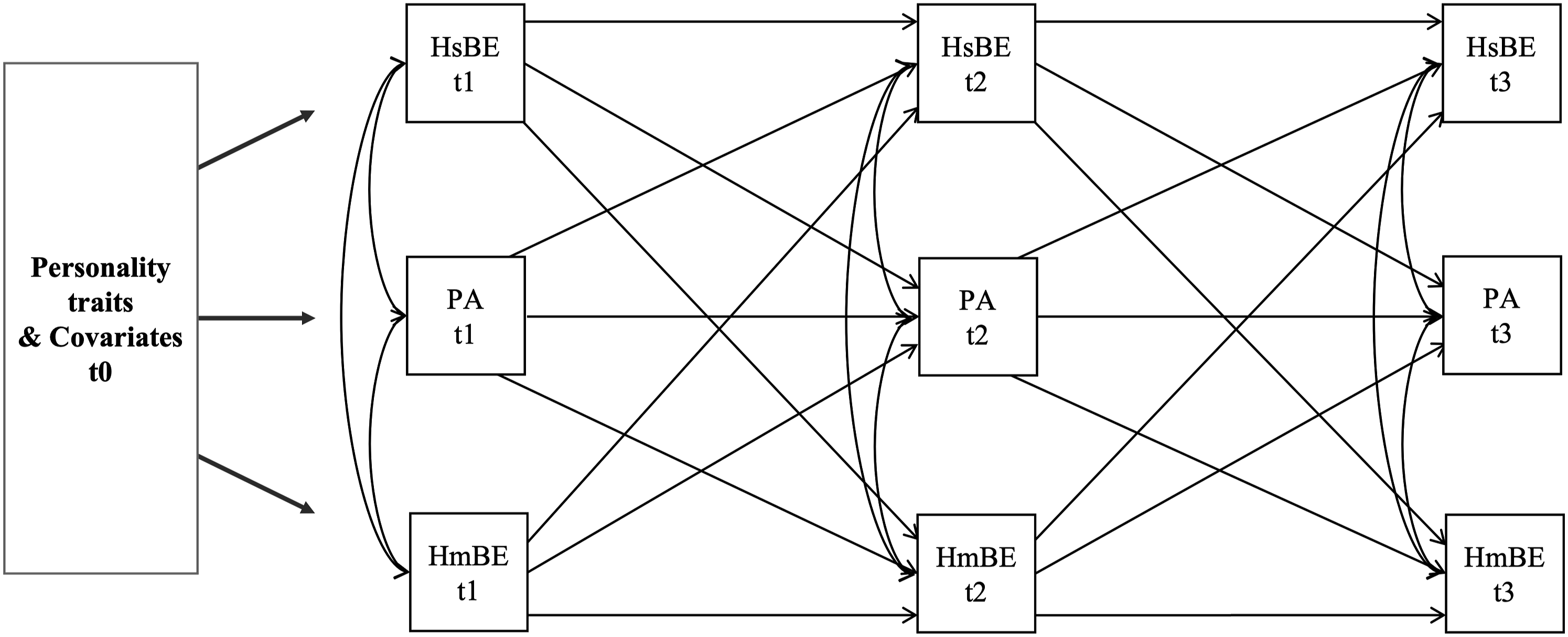
For the RI-CLPM (Figure 2), we followed Mulder and Hamaker (2021) and created latent factors by regressing the observed scores for host- and home-cultural behavioral engagement and psychological adaptation on their own factors, with loadings constrained to one. A total of 12 components resulted from the four latent factors per variable: one random intercept for the general between-person variances, plus three within-person wave-specific variances. The random intercept factors capture the time-invariant component of each variable. The covariances between the random intercept factors reflect the extent to which stable between-person differences in each of the three variables—host-cultural behavioral engagement, home-cultural behavioral engagement, and psychological adaptation—were associated (Rodríguez-Hidalgo et al., 2020). Next, we specified the structural relations between the within components. Autoregressive paths were included to represent the within-person carry-over effect or inertia, that is, the within-person stability in each variable (Mulder & Hamaker, 2021; Mund & Nestler, 2019), whereas cross-lagged paths represent how the temporary deviation from the trait level of one variable at a specific measurement occasion predicts the temporary deviation from the trait level of another variable at the next measurement occasion (Mulder & Hamaker, 2021; Orth et al., 2021). In addition, within-time correlations reflect within-person change associations and indicate to what extent deviations from the person-specific mean in one variable were accompanied by simultaneous deviations from the person-specific mean in another variable (Mund & Nestler, 2019). Finally, we included personality traits and the covariates gender and duration of stay abroad as time-invariant predictors of between-person and within-person components. To that end, the between-person random intercepts were regressed on the personality traits. The resultant coefficients indicate the extent to which people with certain personality traits consistently tend to engage in host and the home culture oriented behaviors and how personality traits relate to between-person differences in psychological adaptation. Additionally, we regressed the within-person wave-specific variance components of host- and home-cultural behavioral engagement and adaptation at t1 on the personality traits, which allowed us to test for possible mediating associations. Random intercepts cross-lagged panel model (RI-CLPM) reflecting the longitudinal relationship between host- and home-cultural behavioral engagement and psychological adaptation abroad with latent factors partialling out between-person variance. Note. Circles represent latent constructs. PA = psychological adaptation abroad; HsBE = host-cultural behavioral engagement; HmBE = home-cultural behavioral engagement; RI = random intercept; t0 = wave before departure; t1, t2, t3 = waves abroad.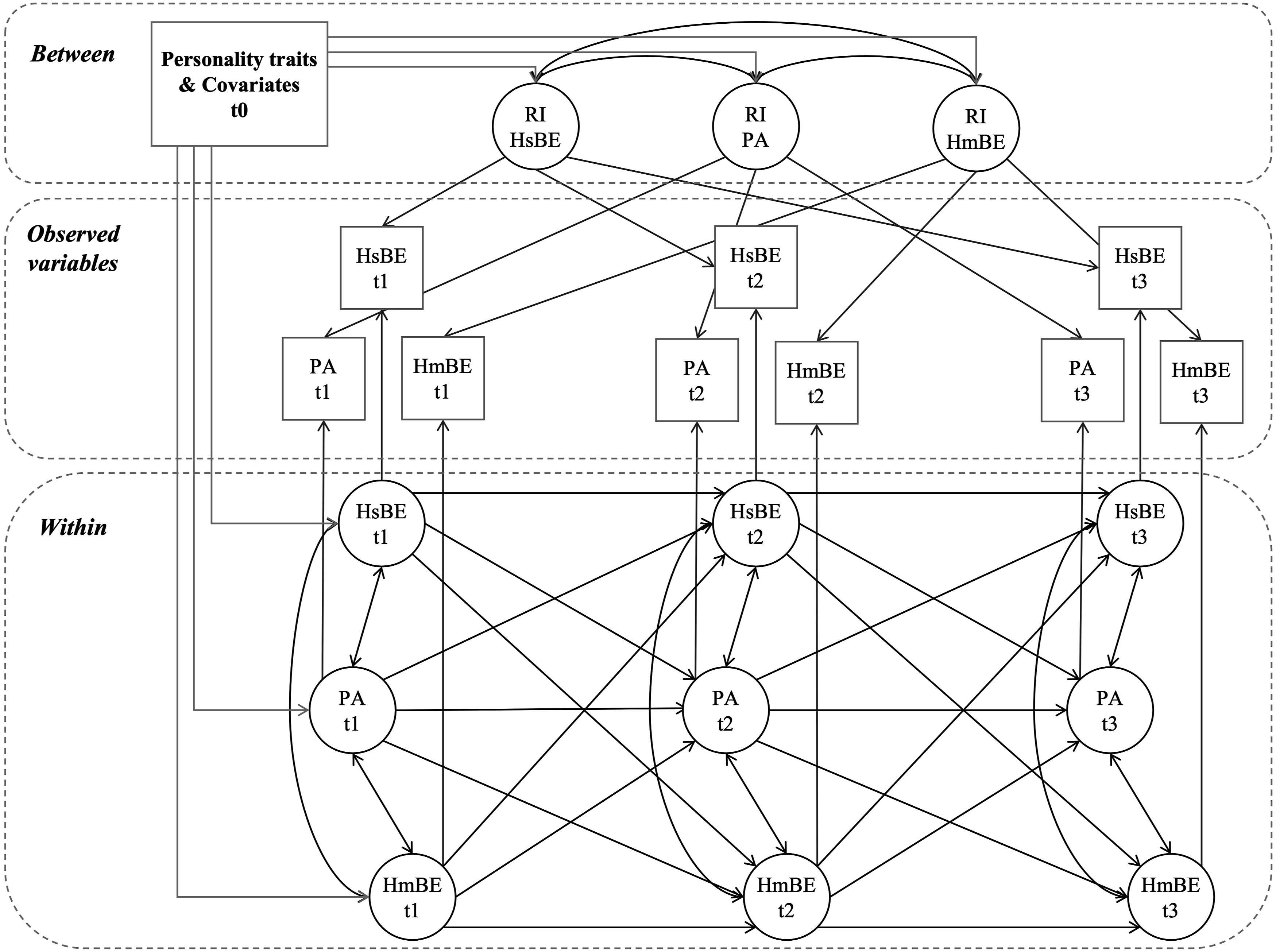
Analyses for the CLPM and the RI-CLPM were carried out using structural equation modeling with the lavaan R package (0.6–9) developed by Rosseel (2012) in R Studio Version 1.4.1717 (RStudio Inc., 2009–2021). We used FIML to account for missing values. The model fits were evaluated using the chi-square statistic, the comparative fit index (CFI), the root mean square error of approximation (RMSEA), and the standardized root mean square residual (SRMR). Comparative fit index values > .95 and > .90, RMSEA values < .05 and < .08 and SRMR values < .08 and < .10 reflected good or acceptable model fit (Marsh et al., 2005). We estimated all models using the Satorra–Bentler method for model estimations (Satorra & Bentler, 2010), which provides maximum likelihood parameter estimates and a mean-adjusted chi-square, which are robust to violations of normality.
As previous research suggests, it is important to consider issues of multiple testing. Although the models that we used present the major advantage of examining multiple associations and time points, testing multiple parameters in one structural equation model may inflate the Type I error rates (Cribbie, 2017). Thus, in addition to reporting statistically significant findings of p < .05, we applied the Benjamini-Hochberg (BH) procedure to all models tested using a cutoff for the false discovery rate of q < .05 (Benjamini & Hochberg, 1995) and described which changes the correction implied.
Finally, using the pwrSEM app in RStudio (Wang & Rhemtulla, 2021), a posteriori power analyses were performed. Because of the number of parameters and the complexity of the longitudinal models carried out, we concentrated our power analyses on assessing our ability to detect the indirect effects in the CLPM and RI-CLPM. The mediational pathways provided a rough gauge for the sensitivity of the current sample size as these are likely the least powered. With the sample given and at alpha = .05, the power to detect the indirect effects with values of b = −.02 and b = −.04 in the CLPM were 90% and 85%, respectively. In the RI-CLPM, the power to detect the indirect effect of b = .03 was 89%.
Results
Means, standard deviations, cronbach’s alphas, and bivariate correlations.
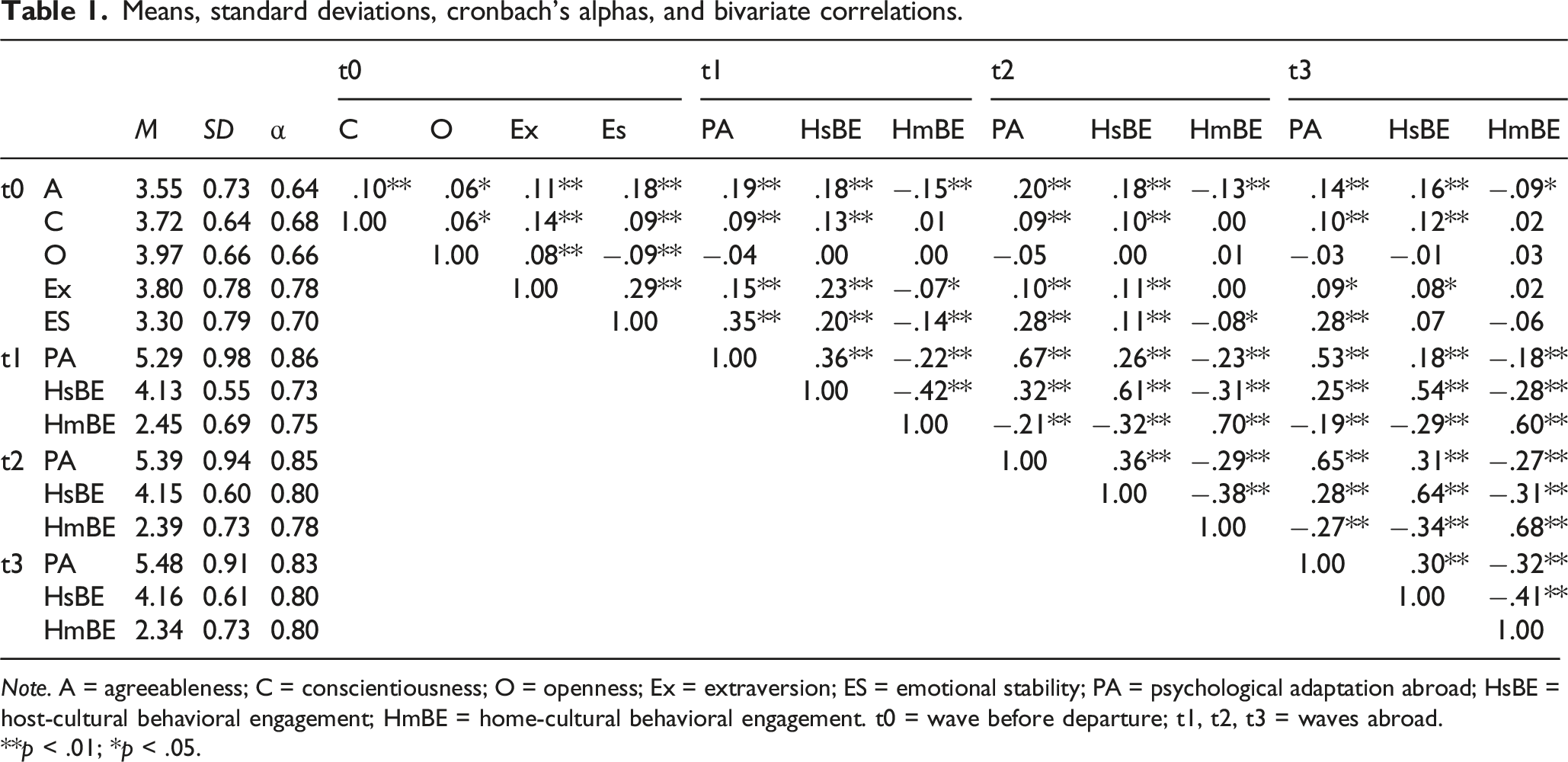
Note. A = agreeableness; C = conscientiousness; O = openness; Ex = extraversion; ES = emotional stability; PA = psychological adaptation abroad; HsBE = host-cultural behavioral engagement; HmBE = home-cultural behavioral engagement. t0 = wave before departure; t1, t2, t3 = waves abroad.
**p < .01; *p < .05.
Longitudinal measurement invariance
Confirmatory factor analysis for host- and home-cultural behavioral engagement and psychological adaptation and tests of longitudinal measurement invariance.
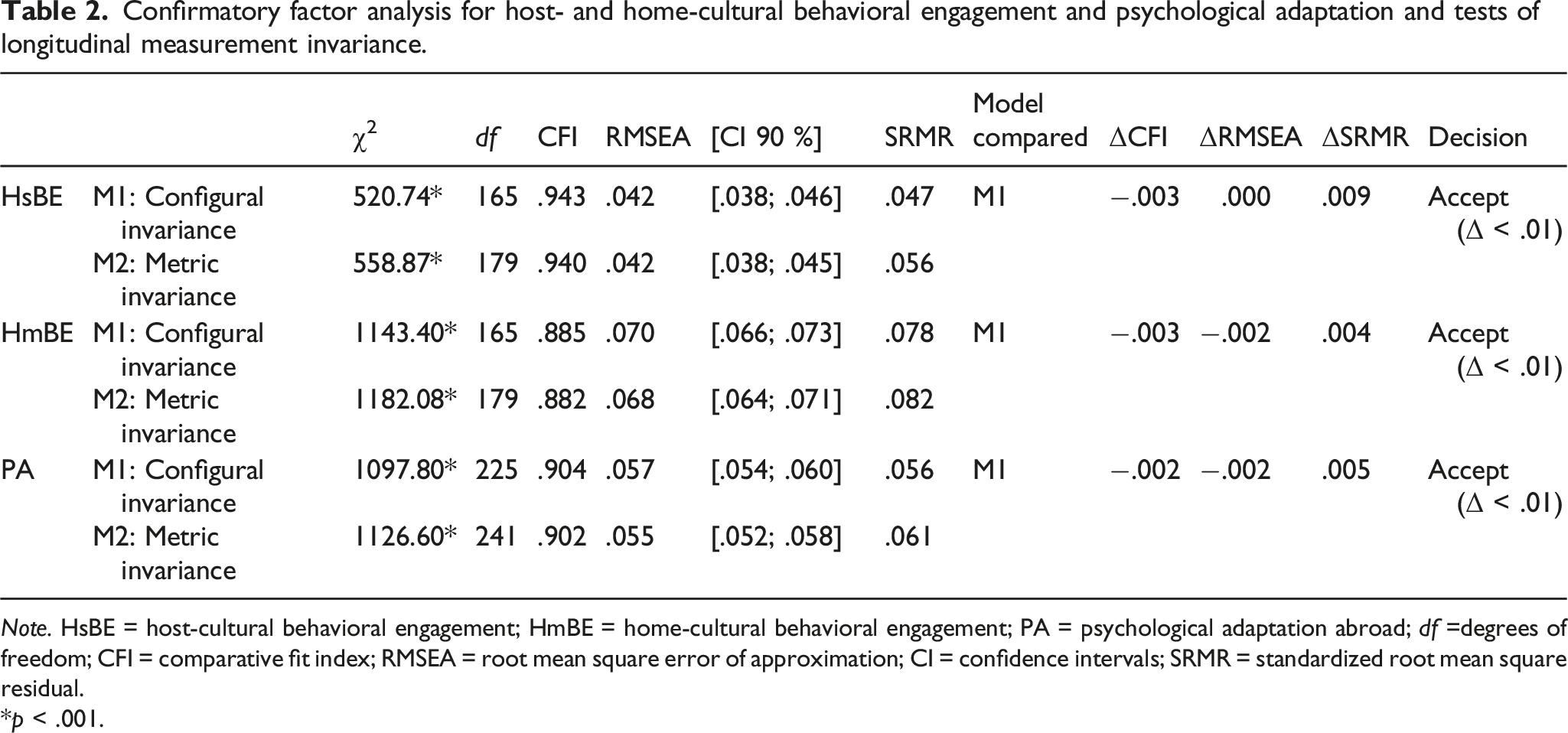
Note. HsBE = host-cultural behavioral engagement; HmBE = home-cultural behavioral engagement; PA = psychological adaptation abroad; df =degrees of freedom; CFI = comparative fit index; RMSEA = root mean square error of approximation; CI = confidence intervals; SRMR = standardized root mean square residual.
*p < .001.
Cross-lagged panel model
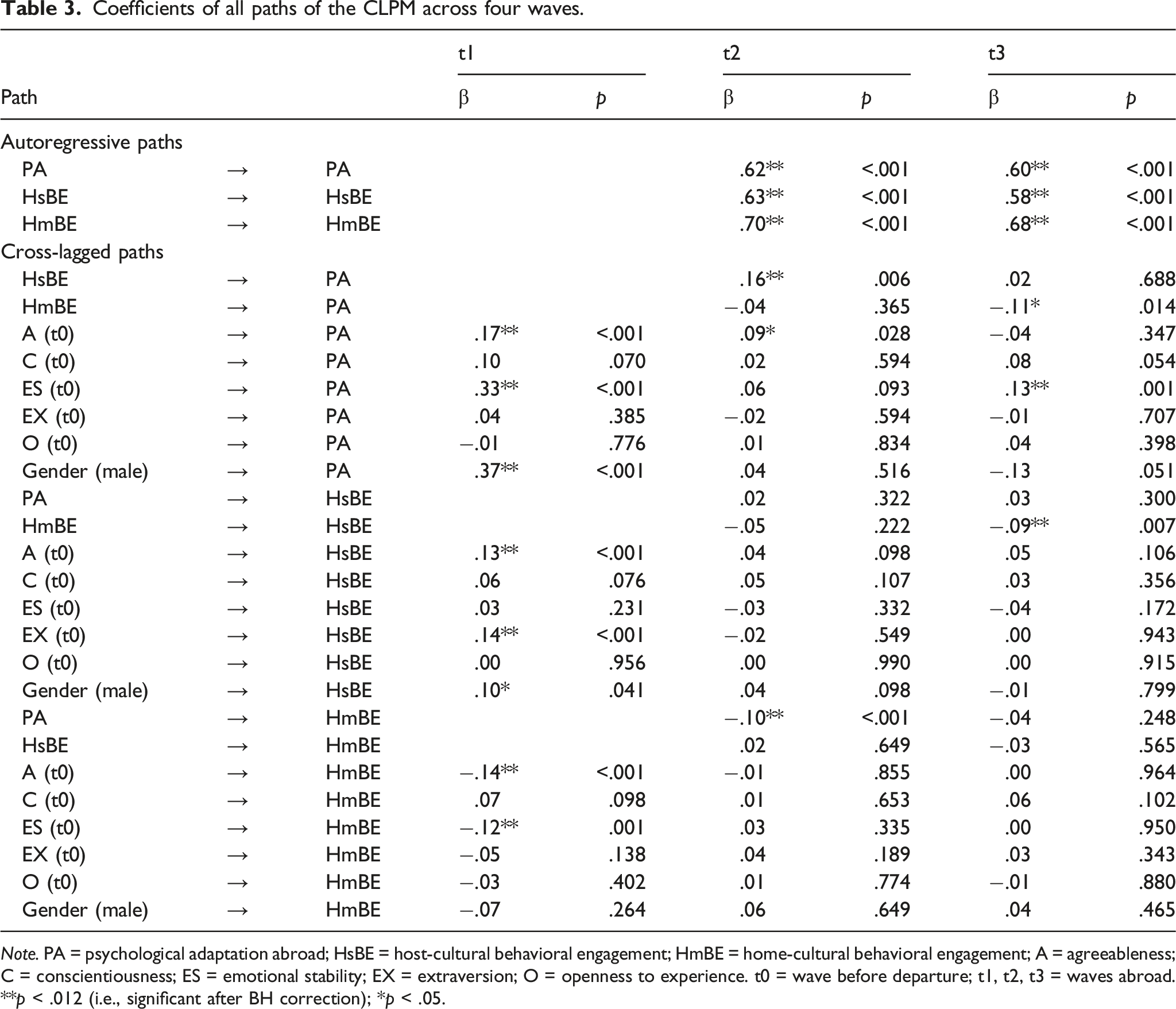
Coefficients of all paths of the CLPM across four waves.
Note. PA = psychological adaptation abroad; HsBE = host-cultural behavioral engagement; HmBE = home-cultural behavioral engagement; A = agreeableness; C = conscientiousness; ES = emotional stability; EX = extraversion; O = openness to experience. t0 = wave before departure; t1, t2, t3 = waves abroad.
**p < .012 (i.e., significant after BH correction); *p < .05.
Reciprocal associations between host- and home-cultural behavioral engagement and psychological adaptation
In line with expectations, host-cultural behavioral engagement at t1 revealed a positive association with psychological adaptation at t2, that is, during the first measurement interval abroad (β t1–t2 = .16, p = .006). Moreover, home-cultural behavioral engagement at t2 was negatively related to psychological adaptation at t3 (β t2–t3 = −.11, p = .014). Yet, it has to be noted that the p-value (slightly) exceeded the critical p-value of .013 after BH correction. The analyses also confirmed that home-cultural behavioral engagement at t2 had a negative association with host-cultural behavioral engagement at t3, that is, during the last interval abroad (β t2–t3 = −.09, p = .007). Finally, we also discovered a negative association between psychological adaptation at t1 and home-cultural behavioral engagement at t2 (β t1–t2 = −.10, p < .001). The estimates of the within-time residuals, that is, time-specific correlations between host- and home-cultural behavioral engagement and psychological adaptation abroad, ranged from r = –.16 to r = .14 (all p < .005; see Table A1 in the online appendix).
Predictive effects of personality traits on psychological adaptation and host- and home-cultural behavioral engagement
Agreeableness and emotional stability measured before departure (t0) were directly positively related to psychological adaptation at the first measurement abroad (t1) (β = .17, p < .001; β = .33, p < .001, respectively). Controlling for previous levels of psychological adaptation, emotional stability maintained its direct positive association with psychological adaptation at t3 (β = .13, p = .001) whereas agreeableness also yielded a positive association with psychological adaptation at t2 (β = .09, p = .028). Yet, the latter association was not retained after the BH correction. Furthermore, agreeableness and extraversion at t0 were positively related to host-cultural behavioral engagement at t1 (β = .13, p < .001; β = .14, p < .001, respectively), whereas agreeableness and emotional stability at t0 showed a negative association with home-cultural behavioral engagement at t1 (β = −.14, p < .001; β = −.12, p = .001, respectively).
Gender differences
Our results showed that male students experienced a better psychological adaptation (β = .37, p < .001) at the beginning of the stay abroad (t0–t1). These students also experienced higher levels of host-cultural behavioral engagement (β = .10, p = .041) at the beginning of the stay abroad (t0–t1), yet this effect was not sustained after BH correction.
Indirect effects
The analyses confirmed that the personality traits agreeableness and extraversion were related to higher levels of psychological adaptation by time-lagged indirect positive effects via host-cultural behavioral engagement, that is, personality traits measured before departure (t0) predicted host-cultural behavioral engagement at the first measurement abroad (t1), which in turn predicted psychological adaptation at t2. Using 1000 bootstrapped samples, we found that the unstandardized indirect effect of agreeableness (b = .02, bootstrapped 95% confidence interval (ci) ranged from .005 to .042) and extraversion (b = .023, ci ranged from .007 to .047) were significant.
Beyond this, the personality traits agreeableness and emotional stability were related to lower levels of home-cultural behavioral engagement by time-lagged indirect negative effects via psychological adaptation, that is, agreeableness and emotional stability measured before departure (t0) positively predicted psychological adaptation at the first measurement point abroad (t1); this in turn negatively predicted the performance of home-cultural behavioral engagement at t2. We tested the significance of this indirect effect using 1000 bootstrapped samples. The unstandardized indirect effect of agreeableness was b = −.02 (ci ranged from −.030 to −.006) and the unstandardized indirect effect of emotional stability was b = −.03 (ci ranged from −.049 to −.015).
The model explained a substantial part of the variance in psychological adaptation (
Random intercept CLPM
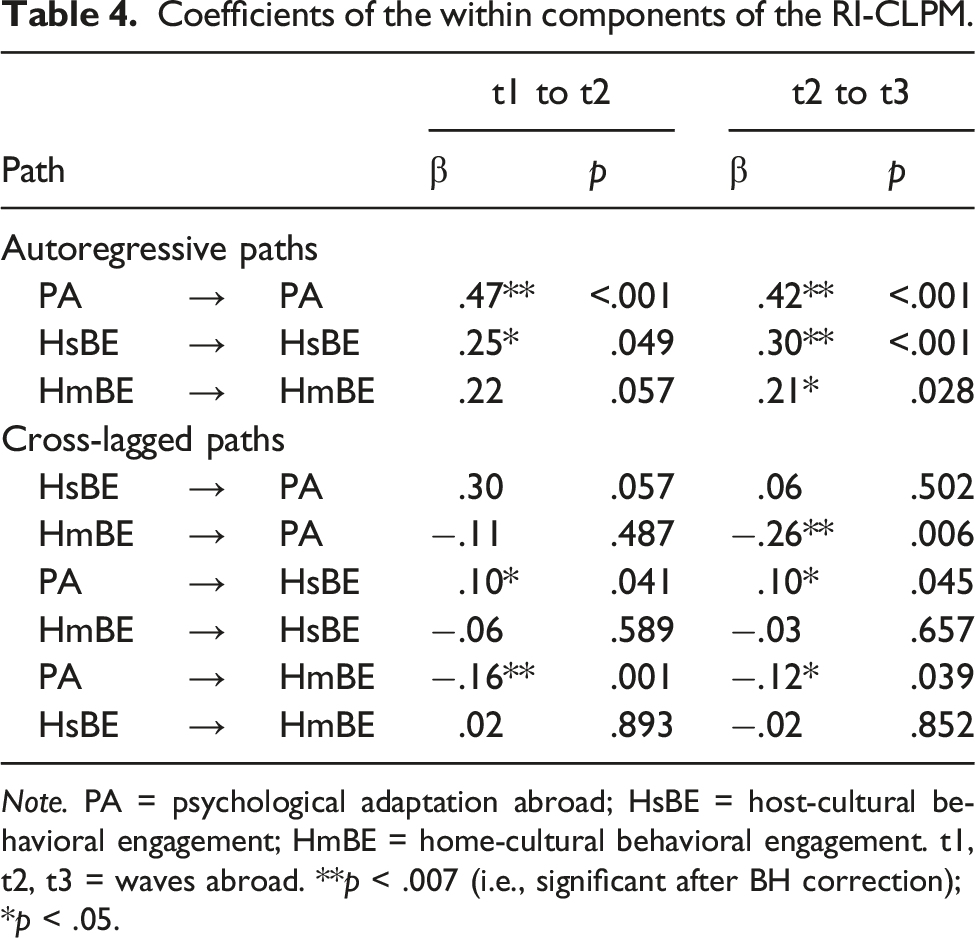
Coefficients of the within components of the RI-CLPM.
Note. PA = psychological adaptation abroad; HsBE = host-cultural behavioral engagement; HmBE = home-cultural behavioral engagement. t1, t2, t3 = waves abroad. **p < .007 (i.e., significant after BH correction);
*p < .05.
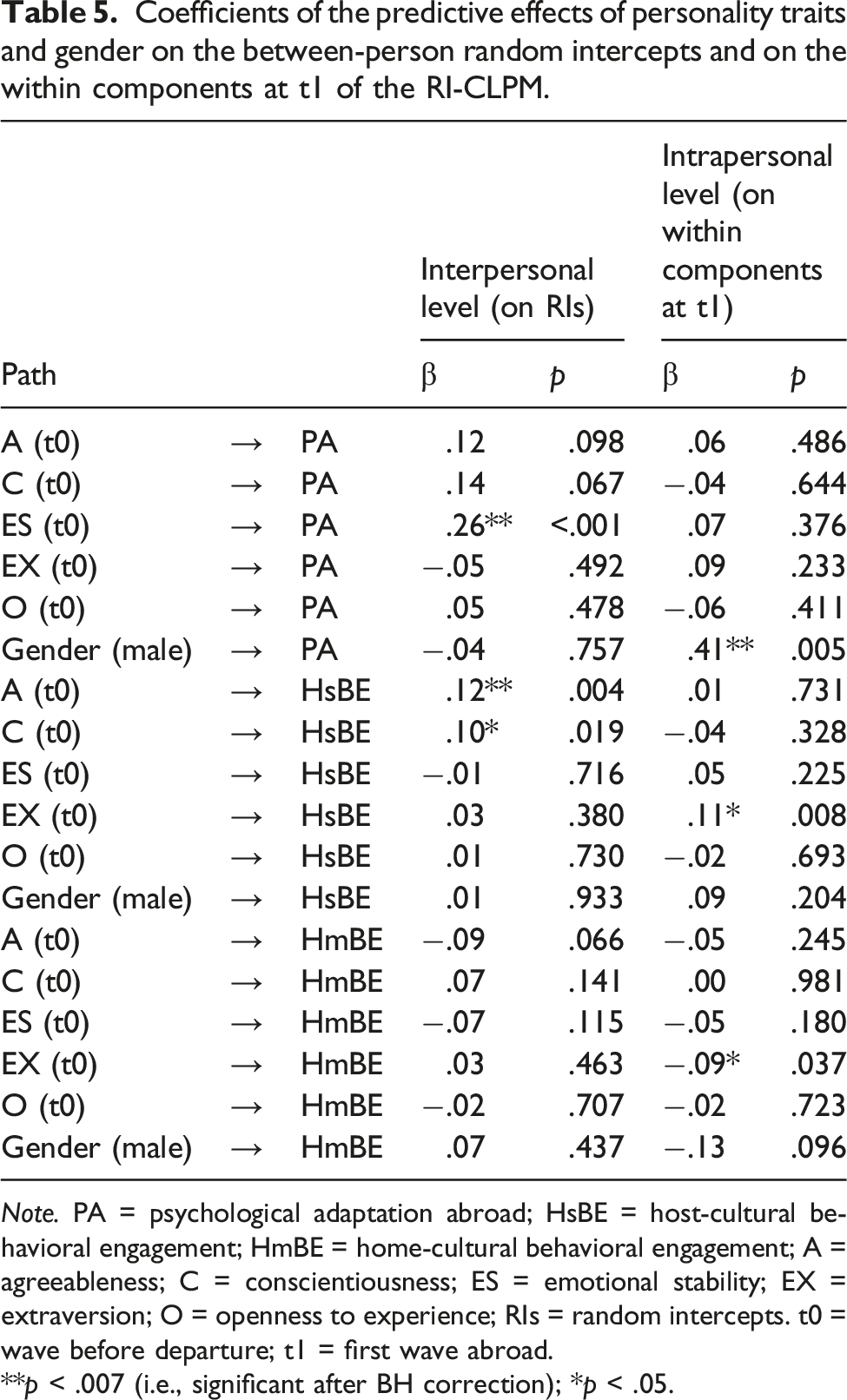
Coefficients of the predictive effects of personality traits and gender on the between-person random intercepts and on the within components at t1 of the RI-CLPM.
Note. PA = psychological adaptation abroad; HsBE = host-cultural behavioral engagement; HmBE = home-cultural behavioral engagement; A = agreeableness; C = conscientiousness; ES = emotional stability; EX = extraversion; O = openness to experience; RIs = random intercepts. t0 = wave before departure; t1 = first wave abroad.
**p < .007 (i.e., significant after BH correction); *p < .05.
Reciprocal associations between host- and home-cultural behavioral engagement and psychological adaptation at the within-person level
Focusing on the intrapersonal associations (Table 4), we found that psychological adaptation was positively related to later host-cultural behavioral engagement across both measurement intervals (β t1–t2 = .10, p = .041 and t3 β t2–t3 = .10, p = .045, respectively). Additionally, psychological adaptation abroad was negatively related to later home-cultural behavioral engagement during both intervals abroad (β t1–t2 = −.16, p = .001; β t2–t3 = −.12, p = .039). Yet, after the application of BH corrections only the association between positive affect at t1 and home-cultural behavioral engagement at t2 was sustained. In addition, home-cultural behavioral engagement at t2 had a significant negative association with psychological adaptation at t3 (β t2–t3 = −.26, p = .006). The estimates of the within-time residuals, that is, time-specific correlations between host- and home-cultural behavioral engagement and psychological adaptation abroad, ranged from r = –.07 to r = .10 (p < .10; see Table A1 in the online appendix).
In addition to the results presented in Table 4, the interpersonal correlations among host- and home-cultural behavioral engagement and psychological adaptation abroad identified by the RI-CLPM revealed a negative significant relationship between the intercepts of both types of engagement (r = −.09, p < .001). A non-significant correlation was found between the intercepts of host-cultural behavioral engagement and psychological adaptation (r = .04, p = .256) and between the intercepts of home-cultural behavioral engagement and psychological adaptation (r = −.05, p = .161).
Predictive effects of personality traits on psychological adaptation and host- and home-cultural behavioral engagement
By examining the predictive effects of the personality traits on the between-person random intercepts, we found that agreeableness and conscientiousness were positively related to the random intercept of host-cultural behavioral engagement (β = .12, p = .004; β = .10, p = .019, respectively). Yet, the association between conscientiousness and host-cultural behavioral engagement was not sustained after BH correction. Additionally, emotional stability was positively related to the random intercept of psychological adaptation abroad (β = .26, p < .001). At the within-person level, only extraversion showed a positive association with host-cultural behavioral engagement as well as a negative relationship with home-cultural behavioral engagement at t1 (β = .11, p = .008 and β = −.09, p = .037, respectively). Yet, both effects were not significant after the application of the BH correction.
Gender differences
At the within-level, gender was associated with psychological adaptation after 8 weeks (t1) abroad (β = .41, p = .005) with males showing higher adaptation levels.
Indirect effects
We did not find any indirect effects between personality and the within-person levels of host- and home-cultural behavioral engagement and adaptation in our model.
Discussion
International educational mobility confronts adolescents with a series of events that disrupt their “previously existing social equilibria” (Caspi & Moffitt, 1993, p. 247). In such situations, personality characteristics are assumed to have a strong influence on how people behave and feel. The main focus of the present study was thus to investigate the relations between acculturation behavior (i.e., host- and home-cultural behavioral engagement), psychological adaptation, and personality traits—that is, agreeableness, conscientiousness, extraversion, openness, and emotional stability—of German adolescent sojourners studying abroad. Furthermore, we investigated gender differences and the indirect effects between personality, acculturation behavior and psychological adaptation abroad.
In order to achieve these goals, we carried out a traditional CLPM and a RI-CLPM. Through both methods, we investigated the interplay of acculturation behavior and psychological adaptation. However, it is important to recognize that cross-lagged estimates from a CLPM and a RI-CLPM yield different pieces of information, as the cross-lagged estimates of the CLPM reflect both interpersonal and intrapersonal variation, while the cross-lagged estimates of the RI-CLPM comprise relationships at the intra-individual level (Mund & Nestler, 2019; Orth et al., 2021). In the following, we integrate and discuss the findings from both kinds of models with regard to the main research questions.
Acculturation and psychological adaptation of high school students abroad
The CLPM revealed a significant positive association between host-cultural behavioral engagement at t1 and psychological adaptation at t2 which shows that, after arriving in a new country, a higher level of behavioral engagement in the new cultural setting seems to pay off in terms of a better psychological adaptation abroad. The CLPM also showed a negative association between home-cultural behavioral engagement at t2 and psychological adaptation at t3, which, however, was not significant after BH correction. Yet, it might be informative to consider this finding since the RI-CLPM revealed a consistent negative association between home-cultural behavioral engagement at t2 and psychological adaptation at t3 at the intra-individual level. This suggests that the observed contingency might be rather due to intraindividual associations between these variables than interindividual differences (Mulder & Hamaker, 2021). That is, temporary increases in engagement with the home country (as compared to the individual mean) by the end of the year abroad are associated to respective (temporal) decreases in the psychological adaptation abroad. The fact that the observed associations between the two behavioral orientations and psychological adaptation were not consistent throughout the full period abroad may be an indicator of transition effects. That is, whether host- or home-cultural behavioral engagement is important for adaptation is contingent upon the phase of the sojourn and the transition (i.e., the transition abroad or the transition back home) that is to be mastered. Nevertheless, the differences between the effects sizes for the t1–t2 versus the t2–t3 associations were rather small, hence the robustness of this pattern of results needs to be further explored.
Furthermore, the CLPM yielded a negative association between psychological adaptation at t1 and home-cultural behavioral engagement at t2. This pattern was also reflected in the RI-CLPM results which corroborated a negative association between psychological adaptation at t1 and home-engagement at t2 at the intraindividual level. This suggests that students turn towards their home countries by more intensified home-oriented behaviors (in comparison to their usual/later behavioral engagement) when they struggle to adapt upon arrival in a new cultural environment (i.e., they experience a lower level of adaptation as compared to their individual mean). Overall, the CLPM and the RI-CLPM revealed a similar pattern of negative associations between psychological adaptation and home-cultural behavioral engagement. Hence, the relative contribution of differences between individuals to the observed relationships can be deemed rather small in comparison to the intraindividual components (Mulder & Hamaker, 2021). Put differently, home-cultural behavioral engagement unfolds its psychological relevance in relation to intraindividual fluctuations in behavioral practices rather than stable interindividual differences.
Regarding host-cultural behavioral engagement, the overall pattern of results was less clear. Whilst the CLPM suggested an association between host-cultural behavioral engagement at t1 and adaptation at t2, this relation was not substantiated at the intraindividual level. Yet, attributing this finding to stable associations between the constructs at the interpersonal level does also not seem warranted as there was no association between the random intercepts of host-cultural behavioral engagement and psychological adaptation in the RI-CLPM. Hence, this relationship might reflect an association at the interindividual level, which is contingent upon the phase of the sojourn, that is, the first weeks of settlement in the new culture. However, further research is needed to substantiate this tentative interpretation.
Finally, as in previous research within MAPS (Serrano-Sánchez et al., 2021a, 2021b), the CLPM revealed that home-oriented behavioral engagement was negatively associated to host-cultural behavioral engagement across the later interval abroad (t2–t3), questioning the theoretically implied independence of host- and home-cultural behavioral engagement (e.g., Berry, 1974, 1980) at the interpersonal level. The significant negative correlation between the random-intercepts of host- and home-cultural behavioral engagement in the RI-CLPM also indicates that, during the stay abroad, participants who engaged more with the host culture engaged less with their home-culture. However, we did not find any cross-lagged relationships between both variables at the within-level. This finding extends previous analyses (Serrano-Sánchez et al., 2021a) as it suggests that while at the intrapersonal level, transient (state) changes in one behavioral engagement do not imply (state) changes with regard to the other behavioral engagement, individuals’ general behavioral patterns (at the between-level) are negatively related. That is, individuals seem to be able to temporarily integrate both behavioral orientations into their everyday lives while simultaneously showing a stable tendency toward the one or the other over time.
Relationships between personality, acculturation, and psychological adaptation
In both models, the CLPM and the RI-CLPM, personality traits were related to acculturation behavior and psychological adaptation abroad, confirming that personality is associated with how students feel abroad and how they behave and interact with their new cultural environment. These findings were largely in line with those reported by other researchers (Demes & Geeraert, 2015; Geeraert et al., 2019; Hirai et al., 2015; John et al., 2008; Poyrazli et al., 2010; Ryder et al., 2000; Swagler & Jome, 2005; Ward et al., 2004; Zhang et al., 2010). Regarding the specific associations, our results partially confirmed our expectations. On the one hand, the CLPM revealed that across the transition, agreeableness and emotional stability were positively related to psychological adaptation abroad at t1, whereas emotional stability was consistently related with adaptation at t3. On the other hand, the RI-CLPM revealed positive associations between emotional stability (but not agreeableness) and the between-person random-intercept of psychological adaptation at the interpersonal level, indicating that students with higher levels of emotional stability were generally better adapted to their living environment abroad than those with lower levels of emotional stability. No associations between the personality traits and t1 adaptation at the intraindividual level were substantiated. To conclude, these findings suggest emotional stability as a relevant personality factor to explain interindividual differences in sojourners’ adaptation across the full course of the sojourn. Yet, as all other traits, it did not serve to predict (state) variations in adaptation during the first weeks abroad. That is, the association between agreeableness and adaptation identified in the CLPM might reflect an association at the interindividual level which is, however, limited to the early phase of the sojourn.
With regard to host- and home-cultural behavioral engagement, the CLPM yielded positive associations between agreeableness and extraversion and host-cultural behavioral engagement at t1. Likewise, negative associations between agreeableness and emotional stability and home-cultural behavioral engagement at t1 were substantiated. The importance of agreeableness with regard to the explanation of host-cultural behavioral engagement was corroborated by the RI-CLPM as it showed a positive association between this trait and the random-intercept of host-cultural behavioral engagement at the interpersonal level. That is, students with higher levels of agreeableness continuously engaged more often in host culture oriented behaviors than students with lower levels on this trait. However, no such associations were identified for other traits or home-cultural engagement suggesting that the observed CLPM effects cannot be attributed to stable contingencies at the interpersonal level but only seem to unfold during the early period of the sojourn. Notably, this pattern fits in with the notion of Caspi and Moffitt (1993) that personality traits are emphasized by environmental disruptions and may thus be more prominent in explaining interindividual differences in behavior during the early stages of the sojourn just after the transition abroad.
At the intraindividual level, only the associations between extraversion and host- and home-cultural behavioral engagement were significant at < .05, but they were not substantiated after BH correction. Hence, we may conclude that similar to the pattern observed for adaptation, the big five do not seem to be important with regard to the explanation of intraindividual (state) variation in acculturation behavior during the first weeks abroad.
We did not find any significant relationship with openness for any of the dependent variables in our sample, either positive or negative. The lack of such findings might be due to the fact that the items for openness in the BFI-21 are highly focused on openness for aesthetics, and neglect openness for actions, ideas, or feelings, which might have been more relevant in the present research context and should be considered in future studies. Likewise, the use of short scales for the big five did not only imply limitations with regard to the internal consistency of the scales but also prevented conclusions regarding associations at the facet level that may yield additional insights to be considered in further research.
Gender differences in acculturation and psychological adaptation
Both the CLPM and the RI-CLPM yielded gender differences in psychological adaptation after the transition (t1). These results revealed that male students—as compared to females—were more prone to increased levels of psychological adaptation at the beginning of the year abroad (in line with the findings of Berry et al., 2006). As Yu and Wang (2011) discussed, gender stereotypes, such as that men tend to be more assertive whereas women tend to be more modest and tender (as a result of socialization processes), could explain the gender differences in adapting during the first weeks abroad. However, this supposed disadvantage of female students at the beginning of the stay abroad does not hinder their participation in international mobility programs, which is usually greater than that of male students (e.g., weltweiser, 2019). More research would be needed to better understand the implications of gender differences over the course of the acculturation and adaptation process.
The indirect effects between personality, acculturation, and psychological adaptation
Host-cultural behavioral engagement was found to (partially) mediate the relationships between agreeablenes, extraversion and psychological adaptation abroad in the CLPM. This finding helps us to understand the mechanism by which personality relates to psychological adaptation abroad. In addition, psychological adaptation (partially) mediated the relationship between agreeableness, emotional stability and home-cultural behavioral engagement. Hence, personality traits not only predict psychological adaptation abroad via behavioral engagement but are also related to behavioral engagement via psychological adaptation, as there are indirect personality effects in both directions. This could be considered as an extension to the findings by Luhmann and Hennecke (2017), who investigated how subjective well-being predicts behavior but did not include personality traits into their research rationale.
Finally, we did not find any significant indirect effects in the RI-CLPM which may be interpreted as tentative evidence that the indirect effects observed in the CLPM can be mainly attributed to differential associations at the between-level, that is, people with certain personality characteristics consistently tend to behave in certain ways which predisposes them for a more (or less) successful adaptation abroad. On the contrary, personality traits do not seem to increase or decrease adaptation at a specific occasion (i.e., at the beginning of the year abroad) by stimulating temporary deviations from the usual behavioral pattern (or vice versa).
Limitations and recommendations for future research
Although our study provided new insights into the longitudinal relationship between host- and home-cultural behavioral engagement, psychological adaptation abroad, and personality, some limitations related to both the sample and the design of the study have to be considered.
Since our sample comprises German adolescents during a high school year abroad, it is not clear to what extent our results can be generalized to older samples, non-German subjects, or other mobility settings. Additionally, self-selection effects may play an important role. As previous research revealed (Greischel et al., 2016), adolescent sojourners may show higher pre-departure levels of agreeableness, emotional stability, and extraversion than their non-sojourning peers. This may imply restrictions of variance regarding the big five, which in turn could lead to an underestimation of the correlations between the personality traits and host- and home-cultural behavioral engagement and psychological adaptation abroad in this specific mobility setting and sample. Our results may also not be transferable to other mobility settings in which the decision to leave the home country depends on external circumstances rather than individual interest and motivation, since self-selection effects may be less likely in these cases.
Comparing our findings on psychological adaptation abroad with (meta-analytic) results from studies that assess the effects of personality on psychological well-being in all kinds of life contexts shows that the effects sizes seem to be of similar (small to medium) size, for example, with regard to associations between the big five and positive affect or negative affect (Anglim et al., 2020). This speaks to the fact that personality is relevant with regard to the adaptation abroad, yet, in contrast to our expectation, it is not more important here than in other life contexts. There may be different reasons for this. For example, students may predominately experience uncertainty immediately upon arrival in the new country. Hence, our measurement occasion at 8 weeks into the sojourn may have been too late to capture this dynamic. On the other hand, uncertainty experiences may not be as prominent as expected given that most students traveled to an English-speaking country that they might experience as culturally similar to their home country, Germany. To further explore whether associations between personality and adaptation outcomes are indeed accentuated in view of the cultural transition, more frequent assessments immediately after the transition and studies in host countries that imply more intense cultural distance experiences may be a promising endeavor.
Along the same lines, in terms of study design, further measurement occasions after returning home (after t3) would be helpful to investigate the long-term associations between cultural behavioral engagement and the psychological adaptation of students at home. Furthermore, the return to the home country could be considered as another critical life event. Besides this, although host- and home-cultural behavioral engagement referred to performed behavior and its longitudinal change, all measures were retrospective self-reports by the students. This may have led to measuring errors or biases, as students might have over- or underestimated the way they were engaging in the host or home culture. Further investigations that include other sources of information about the behavioral engagement of the students, such as ratings by peers, host and home relatives, or teachers may thus provide a worthy endeavor.
Finally, future research may also consider time-variability in personality traits to investigate the interplay of personality traits with acculturation behavior and psychological adaptation abroad, both at a between-level and at a within-level.
Conclusion
The present study shed light on both interpersonal and intrapersonal associations between host- and home-cultural behavioral engagement and psychological adaptation. It also showed that personality is important with regard to the international exchange experience of high school students, as personality traits related to the students’ psychological adaptation as well as their host- and home-cultural behavioral engagement.
Our findings have theoretical implications for research on the acculturation framework and personality research. First, with regard to the acculturation framework, our study emphasizes the importance of differentiating between styles of acculturation behavior (trait level) and behavioral practices (state level) and between trait and state conceptions of psychological adaptation abroad, as we found different associations, in particular between host-cultural behavioral engagement and psychological adaptation at between-individual (trait) and within-individual levels (state). The results also confirm Berry’s model (1997) as they show that pre-existing interindividual differences, such as personality traits, are related to the way in which students acculturate and that this affects their adaptation abroad. Despite the long history of this acculturation model (and the newer models that followed it, e.g., Ward & Geeraert, 2016), there was a lack of empirical evidence for the model’s propositions, in particular with regard to the (longitudinal) indirect effects of individual characteristics on adaptation via acculturation (behavior). The results also point to the model’s limitations, such as its static nature, and its neglect of the bidirectional relationship between acculturation and adaptation over time.
Second, from the perspective of personality research, our study confirms the importance of personality traits for how adolescent sojourners studying abroad behave and feel. This corroborates the assumption that each student tends to use his or her own schemes and models of action in his or her attempt to adapt to the new cultural setting due to the uncertainty of the situation and the lack of role models (Caspi & Moffitt, 1993). It furthermore shows that the behaviors and actions that students choose to deal with the new situation are related to their well-being.
The study also has critical practical implications for how students could improve their psychological adaptation abroad and how parents, teachers, and student exchange organizations could help them. For example, students could benefit from language courses and trainings that increase their (intercultural) social skills, which may enable them to obtain an overall higher level of host-cultural behavioral engagement throughout their stay abroad (Serrano-Sánchez et al., 2021b). This may also help to overcome the barriers that personality factors could imply. Furthermore, encouraging a reflective approach to home-cultural behaviors, especially during the advanced stay abroad (t2–t3), could also lead to a better psychological adaptation abroad.
We hope that future research may build on these findings and consider further individual and institutional factors that may influence mobile individuals’ experiences abroad and facilitate their psychological adaptation.
Supplemental Material
Supplemental Material - Personality, behavioral engagement, and psychological adaptation of high school students abroad: A longitudinal perspective on between-and within-person dynamics
Supplemental Material for Personality, behavioral engagement, and psychological adaptation of high school students abroad: A longitudinal perspective on between-and within-person dynamics by Juan Serrano-Sánchez, Julia Zimmermann and Kathrin Jonkmann in European Journal of Personality
Footnotes
Declaration of conflicting interests
The author(s) declared no potential conflicts of interest with respect to the research, authorship, and/or publication of this article.
Funding
The author(s) received no financial support for the research, authorship, and/or publication of this article.
Data accessibility statement

Supplemental Material
Supplemental material for this article is available online.
Notes
References
Supplementary Material
Please find the following supplemental material available below.
For Open Access articles published under a Creative Commons License, all supplemental material carries the same license as the article it is associated with.
For non-Open Access articles published, all supplemental material carries a non-exclusive license, and permission requests for re-use of supplemental material or any part of supplemental material shall be sent directly to the copyright owner as specified in the copyright notice associated with the article.
