




Abstract
International student mobility (ISM) is an important educational means to promote the international (job market) potential of university students. Beyond that, it constitutes a context of personality development in young adulthood. With the present research, we tried to integrate the perspectives of applied and personality research in addressing the following questions. First, we scrutinized the robustness of ISM effects on personality development as we controlled for effects of sociodemographic characteristics and implemented a waiting group design (N = 3070). Second, we explored ISM anticipation effects as well as the moderation of ISM effects by previous international mobility experiences. Finally, in view of the public discourse on the benefits of “Erasmus crowds”, we assessed the roles of international and host relationships with regard to the personality development of sojourners. The results largely corroborated the robustness of ISM effects on personality development. No ISM anticipation effects occurred, and effects of current ISM engagement were largely unaffected by previous international mobility experiences. Finally, international contact experiences were associated with personality development above and beyond effects of host country contacts. Implications for the understanding of personality development and potential inferences for the organization and improvement of ISM programs are discussed.
Keywords
Over the past decades, statistics documented a vital involvement of university students in international student mobility (ISM). In Germany, almost 30% of the students in later semesters have moved abroad during their studies for a limited period of time, e.g. to complete some of their degree courses at a foreign university or to do an internship abroad (DAAD & DZHW, 2019). On that account, the conditions and consequences of ISM participation have been addressed in educational and applied research that was initiated by higher education institutions, ISM funding organizations, and governmental institutions that predominately pursued the aim to promote ISM participation and to optimize funding schemes (European Commission, 2014). At the same time, psychological research on person–environment transactions established ISM as an important life event in young adulthood that has substantial effects on the development of the Big Five traits (Niehoff et al., 2017; Zimmermann & Neyer, 2013) and more specific personality characteristics (Petersdotter et al., 2017; Zimmermann et al., 2020). Unfortunately, despite their common interest in this contemporary subject, the distinct research perspectives on ISM effects have mostly developed separately which seems a lost opportunity for several reasons.
First, ISM provides an interesting context to address some open questions regarding the theoretical understanding of personality development. For example, previous research on personality dynamics in the context of life events emphasized the need to more thoroughly explore how the anticipation as well as the interplay of (repeated) life events affects personality development (Asselmann & Specht, 2020; Bleidorn et al., 2018; Denissen et al., 2019). ISM represents a life event that is planned in advance, and previous research showed that many young people repeatedly engage in (different forms of) international mobility experiences over the course of their educational career (e.g. Lörz et al., 2016; Netz & Jaksztat, 2014). Hence, ISM qualifies as a unique setting to address these voids in personality research. In particular, the present research design allowed to assess potential anticipation effects of future ISM as well as the moderation of ISM effects by previous international mobility experiences. It will thus help to shed light onto the developmental implications of anticipated and repeated life experiences for the development of the Big Five.
Second, some findings on ISM from (applied) research in related disciplines have pointed toward issues that have not yet been considered in previous psychological studies on ISM and personality development. For example, it was shown that ISM engagement is selective with respect to sociodemographic factors such as gender, educational, and cultural backgrounds (e.g. Netz et al., 2020; Salisbury et al., 2011). Therefore, it should be clarified to what extent these (and further) differences between mobile and nonmobile students might affect ISM effects on personality development.
Finally, research on ISM effects might bring about results that are interesting to both personality researchers as well as experts in the field who promote and implement educational mobility programs. A question that has vividly been debated in the public discourse on ISM refers to the pros and cons of sojourners’ contact experiences in groups of international students. In particular, it was questioned if the “Erasmus crowds” imply any (developmental) benefits as compared to the contact with host country members. From an applied perspective, the main interest in this question is sourced in concerns about the optimal arrangement of ISM program structures and contact opportunities amongst sojourners, their fellow international students, and host country members. From a theoretical perspective, the investigation might, on one hand, help to validate the assumptions of the functional network model (Bochner et al., 1977), which suggested differential functions of contacts to host country members versus contacts to other internationals (i.e. people who are neither from sojourners’ home countries nor from the host country). However, their distinct roles as mechanisms of personality development still await further clarification. On the other hand, at a more general level, the investigation of the distinct effects of host country and international contacts may also be informative with regard to the generic discourse on the specific role of different relationship types in personality development (Reitz et al., 2014).
To conclude, with the present research, we set out to address the outlined issues in order to help advance the current understanding of personality development in the context of life events in general and ISM in particular. Furthermore, we hope to provide some impulses with regard to current debates on the organization and improvement of ISM programs.
Personality development and life events
Over the past decades, research on personality development provided broad evidence for substantial rank-order (Roberts & DelVecchio, 2000) and mean-level changes (Roberts et al., 2006) in the Big Five traits over the life span and described young adulthood as a particularly dynamic period (Robins et al., 2001). Previous research also showed that a maturation pattern—i.e. increases in conscientiousness and agreeableness as well as a decline in neuroticism—could be observed in many countries around the world (Bleidorn et al., 2013). By contrast, findings for openness and extraversion were less consistent, and these traits yielded rather modest age differences (Soto et al., 2011).
Personality dynamics can be traced back to both genetically determined biological influences as well as environmental effects (Kandler et al., 2012, 2019). An example of environmental effects is changes that result from the experience of life events. Life events can be viewed as specific transitions that evoke new behavioral, cognitive, or emotional states (Luhmann et al., 2012, 2014) that are often related to changes in social roles and relationships (Neyer & Lehnart, 2007). According to the sociogenomic model of personality, these state changes accumulate over time and, thus, facilitate personality change in a bottom-up fashion (Roberts et al., 2017; Roberts & Jackson, 2008). Previous research showed that personality development occurred in response to various age-graded life transitions such as educational transitions (Lüdtke et al., 2011), work-related transitions (Denissen et al., 2014), changes in living arrangements (Jonkmann et al., 2014), romantic relationships (Lehnart et al., 2010), and parenthood (van Scheppingen et al., 2016) and as a consequence of further life events such as unemployment (Boyce et al., 2015) and different forms of international mobility experiences (Greischel et al., 2016; Niehoff et al., 2017; Zimmermann & Neyer, 2013). However, recent studies also pointed to some research needs as, for example, the role of anticipation effects, i.e. personality changes that occur in advance of a life event, and the interplay between (repeated) life events have not yet been thoroughly researched (Asselmann & Specht, 2020; Bleidorn et al., 2018; Denissen et al., 2019).
Anticipation effects might manifest as a result of psychological investments or behavioral changes that occur before the event itself takes place (Roberts et al., 2004) and are thus most likely with regard to life events that can be planned in advance. Their investigation has important implications for understanding the effects of the events themselves. If, for example, personality changes in response to a certain life event were preceded by anticipatory changes in the opposite direction, the impact of the event itself would be misinterpreted. However, even different life events that were planned in advance may differ with regard to their potential to promote anticipatory state changes. Anticipatory state changes in thoughts, feelings, and behaviors are only possible if people are aware of the (behavioral) demands and experiences that the upcoming event will bring about. For example, young adults who are in their final year at school might adjust their working behavior and increase in conscientiousness, as they know that this is essential to successfully master the transition into workforce. However, for other life events, e.g. the engagement in ISM, the (behavioral) demands might be less clear, and the students might not be able to anticipate how ISM will change their lives. Therefore, the potential of such less scripted life events to evoke anticipatory personality change might be limited (Neyer et al., 2014).
Another open question refers to the effects of repeated life events. To the best of our knowledge, there are no studies that specifically addressed the effects of repeated life events on the development of the Big Five traits. On the one hand, life events are assumed to exert their effects on personality development as people engage in new patterns of thoughts, feelings, and behaviors. Hence, the repeated experience of an event might be associated with less trait change as cognitive, affective, and behavioral adjustments have already taken place in response to the first experience (and have eventually become part of the personality structure). This notion would also be in line with the core tenets of the maturity-stability principle (Donnellan et al., 2007; Roberts et al., 2001) which posits that individuals with more mature personalities change less over the course of young adulthood as they experience less normative demands for further changes. In line with this assumption, a recent study showed that ISM effects on the development of multicultural effectiveness were attenuated by previous international mobility experiences (Zimmermann et al., 2020). On the other hand, previous research also pointed to the importance of the idiosyncratic experience of life events (Hutteman et al., 2014; Lodi-Smith & Roberts, 2007). Against this background, effects of repeated life events might be independent from each other if the events differ in their subjective experiential qualities. Previous studies on the effects of repeated life events on life satisfaction corroborated that repeated events may have increasing, decreasing, or comparable effects depending on the nature of the event (Luhmann & Eid, 2009). Likewise, the effects of a specific repeated event may differ across investigated characteristics. For example, the first pregnancy was shown to have a stronger impact on the development of mothers’ relationship satisfaction than later ones, whereas effects on self-esteem were comparable across repeated pregnancies (van Scheppingen et al., 2018). However, the distinct effects of repeated life events in general and reiterated ISM participation in particular on the Big Five traits still await empirical clarification.
ISM as a life event in young adulthood
Over the past decades, ISM was established as an important event in the lives of many university students all over Europe and beyond (European Commission, 2014). There is accumulating evidence that educational mobility experiences in adolescence (Greischel et al., 2016) and young adulthood (Niehoff et al., 2017; Zimmermann & Neyer, 2013) constitute a life event that is relevant with regard to personality development. In particular, previous studies with young adults yielded consistent effects with regard to increases in agreeableness and decreases in neuroticism that match the maturation pattern. Whereas Zimmermann and Neyer (2013) identified positive effects on openness change, Niehoff et al. (2017) reported accentuated increases in extraversion. None of the studies reported any sojourn effects on conscientiousness change.
However, several open questions refer to the robustness of these findings. First, previous studies showed that ISM is selective not only in terms of personality characteristics (Niehoff et al., 2017; Zimmermann & Neyer, 2013) but also with respect to sociodemographic factors such as age, gender, educational, or cultural background (e.g. Netz et al., 2020; Salisbury et al., 2011). Related to that, the social causation hypothesis suggests that sociodemographic characteristics are associated with variation in physical, social, emotional, and cognitive functioning and might thus also be reflected in personality differences (Conger & Donnellan, 2007). Yet, a meta-analysis yielded negligible effect sizes for all traits but openness which was positively related to indicators of parental education and a compound measure of socioeconomic status by a small effect (Ayoub et al., 2018). Nevertheless, as sizes of ISM development effects in previous studies were also small, it could be deemed questionable if incremental ISM effects are sustained once sociodemographic differences are taken into account.
Beyond that, despite extensive research on (sociodemographic) variables that determine the self-selection into ISM (for a review on sociodemographic characteristics, see Netz et al., 2020), there might still be some further potential confounds that have not yet been considered. Hence, a research design that allows for further robustness checks will help to scrutinize the trustworthiness of ISM development effects. To that end, we extended previous control group designs (Greischel et al., 2016; Zimmermann & Neyer, 2013), which mostly used two study groups (i.e. control students and present sojourners), by a third study group of future sojourners (i.e. a waiting group) who will engage in ISM in the semester sequencing the study period. As present and future sojourners can be assumed to be more similar to each other than mobile and nonmobile students, comparing the developmental trajectories of both mobile student groups provides an opportunity to safeguard findings on ISM development effects against potential unobserved confounding effects.
Contact experiences in ISM
Life events are inherently entwined to transitions in social relationships (Neyer & Lehnart, 2007; Neyer et al., 2014). Accordingly, studies also provided first evidence that effects of ISM on personality can be traced back to the fluctuation in sojourners’ (international) relationships (Greischel et al., 2016; Zimmermann & Neyer, 2013). Whilst the relationship fluctuation, i.e. numbers of contact gains and losses in the respective relationship categories, represents a quantitative contact indicator, the theory of intergroup contact (Allport, 1954) emphasizes that the quality of contact experiences is essential. In particular, contacts to members of other (cultural) groups that are perceived as being equal, cooperative, pleasant, intimate, and voluntary are assumed to work against negative intergroup attitudes and prejudice (Crawford & Brandt, 2019; Islam & Hewstone, 1993). Theoretical approaches to prejudice such as the dual process model considered personality traits as distal determinants of prejudice (Sibley & Duckitt, 2010). Accordingly, previous meta-analyses corroborated negative associations between prejudice and the Big Five traits agreeableness and—to a lesser extent—openness. Findings on extraversion were inconsistent and revealed either small negative or no associations. Consistently, there were no significant meta-analytic effects for conscientiousness or neuroticism (Crawford & Brandt, 2019; Sibley & Duckitt, 2008). Against the background of the theory of intergroup contact and the dual process model, we explored if the quality of sojourners’ relationships was relevant with regard to their trait development as a distal outcome.
In previous studies, the term “international relationships” was used to refer to relationships with people from any country but the sojourners’ home country (i.e. Germany) (Greischel et al., 2016; Zimmermann & Neyer, 2013). However, in their functional network model, Bochner et al. (1977) suggested that at least three different networks of sojourning students had to be differentiated as they fulfilled distinct functions. They distinguished between conational contacts to people from the sojourners’ country of origin, the host network, and the international network that endorses relationships to other people who are not from sojourners’ home countries and not from the host country. Whereas host contacts were supposed to be essential for support in academic matters, international relationships were assumed to be predominately important with regard to leisure time activities. In the meantime, there is empirical evidence for the distinct functions of host and international relationships, with regard to the realization of sojourn goals (Zimmermann et al., 2017). Whereas educational sojourn goals (e.g. “I want to spend part of my study time abroad to get to know other teaching and learning methods”) were related to the cultivation of host national relationships, a focus on animation (e.g. “I want to spend part of my study time abroad to get to know new people”) and personal growth (e.g. “I want to spend part of my study time abroad to show myself that I can handle difficult situations”) goals facilitated international relationships. However, in the public discourse on ISM benefits, international contact experiences have often been critically evaluated, and the benefits of so-called “Erasmus crowds” were questioned. A differentiated analysis of the effects of the relation between the quality of host and international contacts and trait development may thus not only be of theoretical value but also bear important implications for the implementation of funding schemes and the facilitation of international contacts in ISM.
The present study
To address the outlined research questions, we implemented a longitudinal study (N = 3070) that was carried out as a collaborative research project between the FernUniversität in Hagen and the German Academic Exchange Service (DAAD). We implemented an extended control group design with three study groups (i.e. control students without mobility plans, present sojourners who engaged in ISM during the study period, and a waiting group of future sojourners who went abroad in the semester sequencing the study period) who were queried at two time points over the course of the winter term 2017/2018.
First, we assessed ISM effects on personality development and scrutinized their robustness. To that end, we not only compared change trajectories of present sojourners and controls but carried out additional comparisons between present sojourners (treatment group) and future sojourners (waiting group). Furthermore, effects of sociodemographic characteristics (age, gender, educational background, and cultural background) on the intercepts and the change parameters of all personality traits were included in the analysis to further explore selection effects. In line with previous research (Niehoff et al., 2017; Zimmermann & Neyer, 2013), we expected to find substantial positive effects of ISM participation on the development of openness, extraversion, and agreeableness as well as a negative effect on neuroticism. In addition, we assessed ISM effects on the development of conscientiousness for explorative reasons.
Within the same analysis, we also investigated the occurrence of anticipation effects. As we assumed that ISM represents a rather low-scripted life event (Neyer et al., 2014), it might be difficult for sojourners to anticipate concrete investments or (behavioral) changes. This situation might, however, be different for sojourners who have already gained previous international mobility experiences and thus know what to expect abroad. Hence, we investigated both the effects of future sojourns on personality development as well as their moderation by previous international mobility experiences. Likewise, to uncover the interplay between previous and current life events, we investigated if effects of present sojourns were moderated by previous international mobility experiences. As outlined above, current theories on personality development as well as earlier findings on the development of life satisfaction (Luhmann & Eid, 2009) corroborate opposed conclusions with regard to the pattern of such interactions. Hence, we did not formulate any specific hypotheses concerning the direction of effects.
Finally, we aimed to add to previous findings on the crucial role of social relationships with regard to the development of student sojourners by providing a more differentiated perspective on the effects of host and international relationships. In particular, as both host country and international relationships represent incidents of intergroup contact, we expected positive associations between relationship quality and adaptive development in both cases. In view of previous research on the association between contact experiences, prejudice, and the Big Five, we expected that associations between relationship quality and trait development were most likely with regard to openness, extraversion, and agreeableness. The hypotheses were not preregistered.
Methods
Participants and procedure
As part of the longitudinal control group design, N = 3070 students from German higher education institutions were followed over the course of one semester. The participants represented three different groups, i.e. control students who had no mobility plans, present sojourners who engaged in ISM during the semester that defined the period of data collection (i.e. the winter term 2017/2018), and future sojourners who had arranged for an ISM experience for the semester sequencing the period of data collection (i.e. the summer term 2018). The participants were contacted via different means such as international offices and student initiatives at more than 350 institutions that represent the vast majority of higher education institutions in Germany (for further details on the recruitment strategy, see Zimmermann et al., 2020).
As a first step, participants had to register for study participation via an online registration questionnaire, where they provided some basic demographic background information as well as information on their current country of residence, the status of their university enrolment, and potential ISM plans for the upcoming academic year 2017/2018. Only participants who both lived in Germany at the time and confirmed being enrolled at a German university were admitted to the study sample. Information on ISM plans was used for a preliminary assignment of the registered participants to one of the three study groups, i.e. control students (no ISM plans), present sojourners (ISM plans for the winter term 2017/2018, i.e. the study period), and future sojourners (ISM plans for the summer term 2018, i.e. the semester sequencing the study period).
Invitations to the first measurement (t1; from 5 July 2017 until 19 November 2017) were timed depending on the preliminary group assignment, i.e. 24 hours after registration for control group members, two weeks before the date of departure for present sojourners, and during the first weeks of the winter term 2017/2018 for future sojourners. All e-mails contained a personalized link that allowed participants to interrupt and continue the completion of the t1 questionnaire at their convenience.
All participants who responded to the first invitation by at least starting the t1 questionnaire were invited to the second measurement (t2; from 8 January 2018 until 23 April 2018). This time, members of the control group were invited at 22 weeks after the date of their t1 invitation, present sojourners at 20 weeks after their individual (past) date of departure (i.e. 22 weeks after the t1 invitation), and future sojourners at 2 weeks before the (future) date of departure that was reported in the t1 questionnaire. At both measurement occasions, nonresponders were reminded of the pending questionnaire seven days after the first invitation by an automatized e-mail reminder. The mean time intervals between t1 and t2 were M = 162.00 days (SD = 28.70) for controls, M = 156.03 days (SD = 11.50) for present sojourners, and M = 124.57 (SD = 33.97) for future sojourners. An overview of the study design is presented in Figure 1.
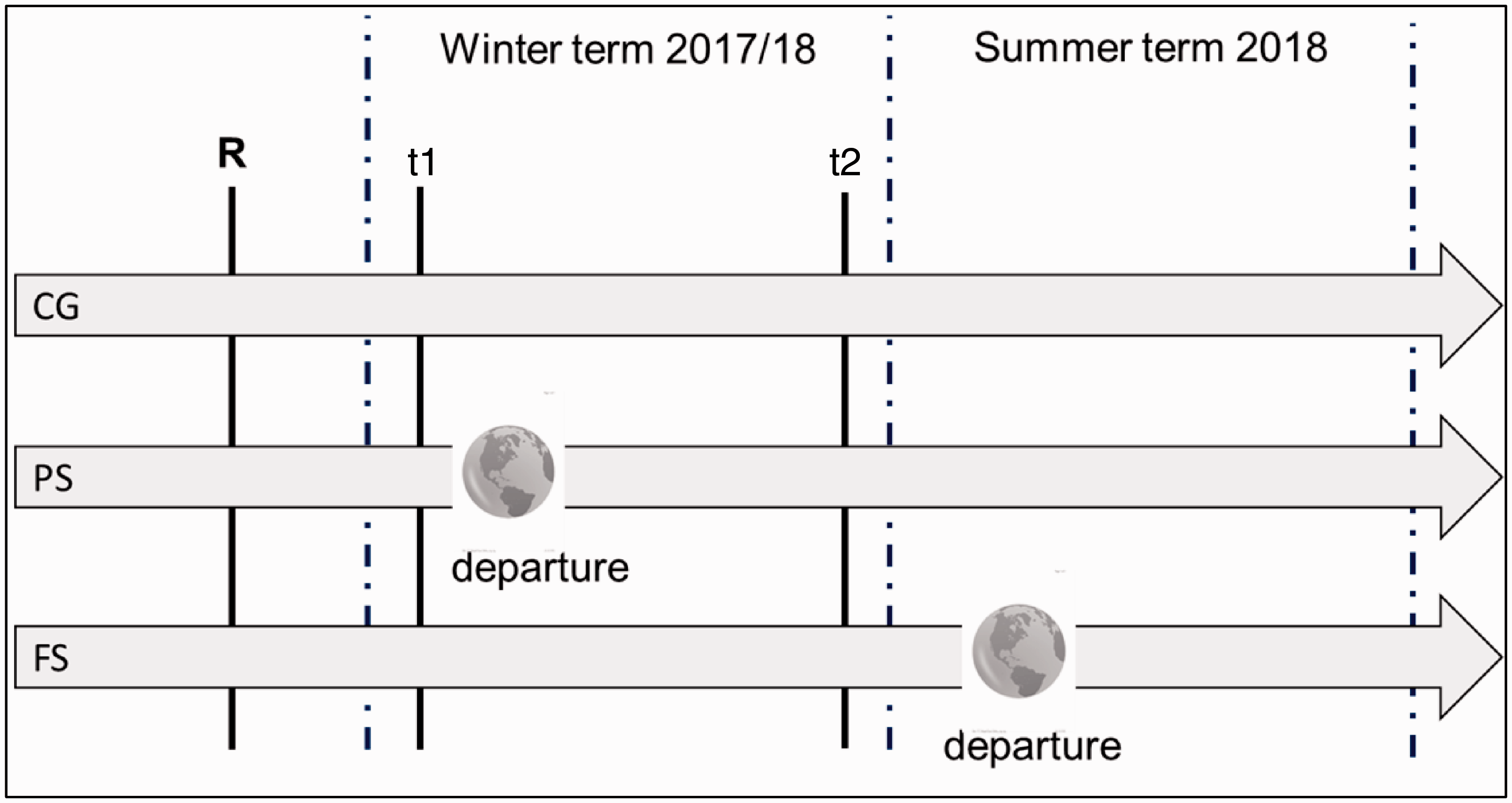
The study design. This figure illustrates the timing of measurement occasions for the three study groups.
From N = 7662 participants who successfully registered for the study, N = 4806 completed the t1 and N = 3576 the t2 questionnaire. Overall, N = 3455 participants had completed both questionnaires (i.e. t1 and t2). In a next step, participants were assigned to the three study groups if they complied with the respective criteria. In particular, participants who indicated at t2 that they lived in Germany, had not engaged in ISM during the winter term 2017/2018, and did not intend to go abroad during the summer term 2018 were assigned to the control group (N = 1323). Participants who stated at t2 that they currently lived in Germany but had been abroad for a period of more than 30 days (defined minimum limit to distinguish between ISM and vacations) but less than 292 days (the longest duration that was technically possible given the time lag between the t1 and t2 measures) during the winter term 2017/2018 or who indicated to currently live abroad, to have arrived at their foreign residence more than 30 days ago, and to intend to stay abroad for a maximum duration of 792 days (defined maximum limit to distinguish between ISM and permanent migration) were classified as present sojourners (N = 1264). Finally, participants who stated at t2 that they currently lived in Germany and had not been abroad during the winter term 2017/2018 but confirmed to plan to move abroad for more than 30 but less than 792 days during the summer term 2018 were assigned to the group of future sojourners (N = 483). This resulted in a full panel sample of N = 3070 participants who fulfilled the study criteria and were used in all further analyses. The mean age was M = 22.88 (SD = 3.23), 27.1% of these participants were male, and 5.9% had a migration background as at least one of their parents was born outside of Germany (Willige et al., 2017). Further information on the sociodemographic characteristics of the three study groups is summarized in Table A1 of the online appendix available at https://osf.io/5wdxq/.
Comparisons between participants who only completed t1 (N = 1736) and the panel sample (N = 3070) revealed only negligible differences for the Big Five personality traits (ds between .03 and .13) as well as all covariates (age (d = .05), professional qualification of the mother (d = –.05), professional qualification of the father (d = –.00), sex (φ = .04), migration background (φ = –.07), and previous international mobility experiences (φ = –.00)).
The vast majority of sojourners spent their time abroad in European host countries (i.e. 85%), almost 50% of them in one of the top five favorite host countries (i.e. Spain, France, UK, Italy, and Sweden). An inspection of intraclass correlation coefficients (ICCs) did not reveal substantial between-country variance in all five traits at either of the two measurement occasions (ICCs between .00 and .03).
Importantly, all subjects were adults; they were informed about the research purposes and procedure and that participation in this research was voluntary and anonymous. Furthermore, they were informed about the data protection standards and the possibility to withdraw from participation whenever they wanted without any negative consequences. Informed consent of the participants was implied through survey participation which was a standard practice at the time of data collection. Data protection standards were guaranteed by the data protection officer of the German Academic Exchange Service (DAAD).
Measures
Sojourn status
The sojourn status of participants was transformed into two dummy-coded variables with control students as the reference group.
Demographic background information
Participants were asked to indicate their age and gender (0 = male, 1 = female) as well as their parents’ highest professional qualification (1 = no professional qualification, 2 = vocational education, 3 = university degree) as an indicator of the family’s educational background. Furthermore, participants’ migration background was inferred from information on the places of birth of both parents. Participants with at least one parent born outside Germany were categorized as having a migration background (Willige et al., 2017). The item was dummy-coded (0 = no migration background, 1 = migration background).
Previous international mobility experiences
At t0, participants were asked if they had ever lived abroad for a period of at least one month before the study onset. The variable was dummy-coded (0 = no previous international mobility experiences, 1 = previous international experiences). The most frequent forms of previous stays abroad were longer journeys or other private stays abroad (22.1%), participation in school exchange programs (17.6%), and previous ISM experiences (17.1%).
Big Five personality traits
At both measurement occasions (t1, t2), participants were presented with a German short version of the Big Five Inventory (BFI-S; Gerlitz & Schupp, 2005). The BFI-S contains 15 items that participants answered on a scale ranging from 1 (does not apply at all) to 7 (applies perfectly). Cronbach’s alphas were .68 (t1) and .61 (t2) for openness, .60 and .68 for conscientiousness, .84 and .84 for extraversion, .52 and .52 for agreeableness, and .73 and .73 for neuroticism and are thus comparable to the values obtained in an earlier study that used a representative sample to assess personality development across the life course (Specht et al., 2011).
Quality of contacts to host country members and other internationals
To measure the quality of present sojourners’ contacts at t2 to (a) members of the host country and (b) other internationals (i.e. people who are not from Germany and not from the host country), we implemented an adapted German version of the General Intergroup Contact Quantity and Contact Quality Scale (Islam & Hewstone, 1993). Participants were asked to rate on a scale from 1 (does not apply at all) to 7 (totally applies) to what extent they perceived their (previous) contacts as being “equal,” “cooperative,” “pleasant,” “superficial” (reverse coded), and “voluntary.” We computed two mean scores that reflected the quality of host country contacts and contacts to other internationals, respectively. Confirmatory factor analyses confirmed an adequate fit of the theoretically implied one-factor model with χ2(5) = 58.50, p < .001, comparative fit index (CFI) = .958, root mean square error of approximation (RMSEA) = .092, standardized root mean square residual (SRMR) = .027 for the host contact scale and χ2(5) = 38.17, p < .001, CFI = .968, RMSEA = .072, SRMR = .022 for the international contact scale. Cronbach’s alphas were .78 (host contact) and .76 (international contact), respectively.
Analytical strategy
To address the research questions regarding ISM effects, we used moderated latent change models (McArdle & Nesselroade, 1994; Steyer et al., 1997). In these models, latent change variables are used to represent the change between two measurement occasions, whereas the latent intercept represents the initial level of the variable under study. As a feature of the latent modeling approach, both the intercept and change estimates are uncontaminated by random measurement error. The variances of the latent intercept and the latent change variable reflect interindividual differences in the initial level and the development of a construct. For a reliable interpretation of all latent parameters, it is crucial to ensure that changes are not due to modifications in the relation between the manifest indicators and latent factors (Bollen & Curran, 2006; Vandenberg & Lance, 2000). On that account, we implied strong measurement invariance, i.e. equal factor structure, factor loadings, and intercepts over time in all models and evaluated the appropriateness of this assumption based on nested model tests and model fit indices for the restricted model (Meredith, 1993). According to Hu and Bentler (1999), RMSEA ≤ .06, CFI ≥ .95, and SRMR ≤ .08 provide criteria for a good model fit. We allowed for correlations between residuals of the same indicators across time to account for residual effects that cannot be ascribed to the latent factors under study (Brown, 2006; Marsh & Hau, 1996).
We specified a multivariate latent change model that included latent intercepts and change variables for all five traits (for an exemplary conceptual model, see Figure 2). We allowed for correlations between all intercept and change variables. Both the latent intercept and latent change variables were regressed on all covariates and the two dummy-coded sojourn status variables. Effects of the exogenous variables on the latent intercepts can be interpreted as differences in the initial levels of the dependent variable between participants that are attributed to the respective exogenous variable. We included these effects for descriptive reasons. Effects of the exogenous variables on the latent change factors indicate that differences in the development can be attributed to the respective exogenous variable. Effects of the sojourn status variables on the latent change variables inform on differences in the development between control students and present sojourners or between control students and future sojourners, respectively. Hence, these effects reflect the focus of our research questions. In order to assess differences between the two sojourning groups, we repeated the analyses with the subsample of all sojourners and assessed if present and future sojourners differed in their initial levels or their development of the Big Five over the course of the study. In order to assess if previous international mobility experiences moderated effects of present (ISM development effects) or future (ISM anticipation effects) sojourns on personality development, we additionally included interaction terms between previous international mobility experiences and the sojourn status variables into the regressions. For the analysis of contact effects, the sample was restricted to the present sojourners as they are the only ones who can report on their (previous) experiences with host and international contacts. In this model, the latent change variables were regressed on the established covariates and on two indices that reflected the quality of host cultural contacts and international contacts, respectively.
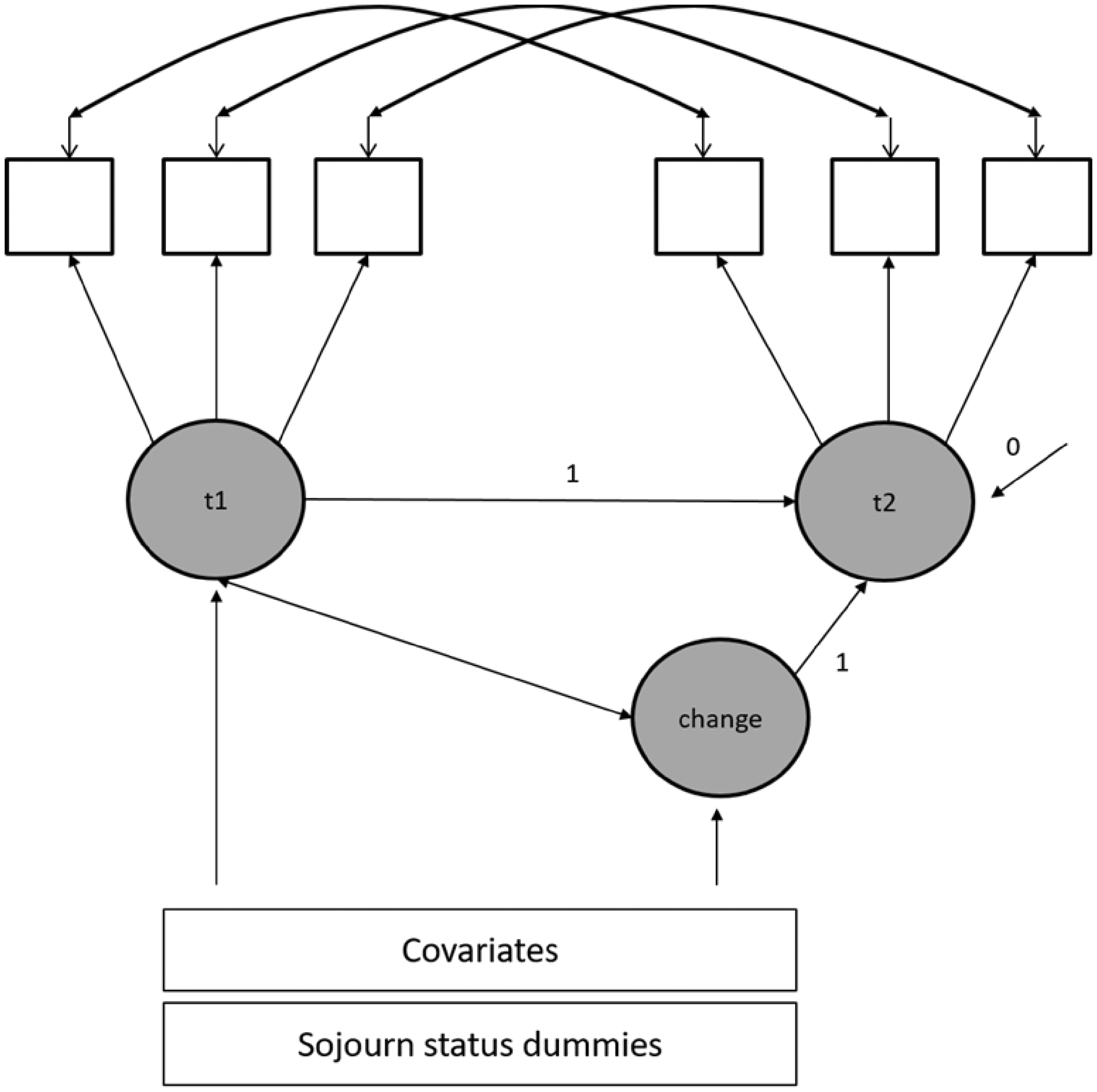
Conceptual model to assess ISM selection and ISM development effects for the Big Five traits. For reasons of parsimony, an exemplary univariate latent change model is shown. The original model was a multivariate latent change model, which allowed us to simultaneously include trait levels at t1 as well as change of all Big Five traits in one model.
All analyses of change were also controlled for the potential effects of interindividual differences in the measurement interval t1–t2 (i.e. the number of days between t1 and t2). To account for nonnormality of item distributions, we estimated all latent change models using the Satorra–Bentler method for model estimations. The analyses were carried out using SPSS 25 (IBM Corp. Released, 2017) and Mplus version 7 (Muthén & Muthén, 2015). Due to the implementation of completeness checks in the online questionnaires, only few cases of missing values (mostly on the covariates) occurred. We dealt with missing information using the full information maximum likelihood (FIML) procedure as implemented in Mplus. Effect sizes were calculated using Psychometrica’s online tool (Lenhard & Lenhard, 2016). All input files for the main analyses can be accessed via the open science framework at https://osf.io/5wdxq/.
Results
Table 1 provides some descriptive insights into the personality dynamics in the three study groups amongst participants with and without previous international mobility experiences. 1 At the descriptive level, the largest (positive) changes for openness were observed amongst present sojourners with and without previous international mobility experiences. By contrast, patterns for inexperienced and experienced present sojourners differed with regard to changes in extraversion and neuroticism. In both cases, inexperienced sojourners changed more than their fellows with previous international mobility experiences. Similarly, inexperienced present sojourners revealed the largest positive changes in agreeableness. However, future sojourners without previous international mobility experiences showed changes of comparable size, yet in the opposite direction. Surprisingly, the largest change in conscientiousness was observed amongst future sojourners without previous international mobility experiences who decreased in this trait over the course of the study period.
Descriptive information on the Big Five traits for participants with and without international mobility experiences in the three study groups.
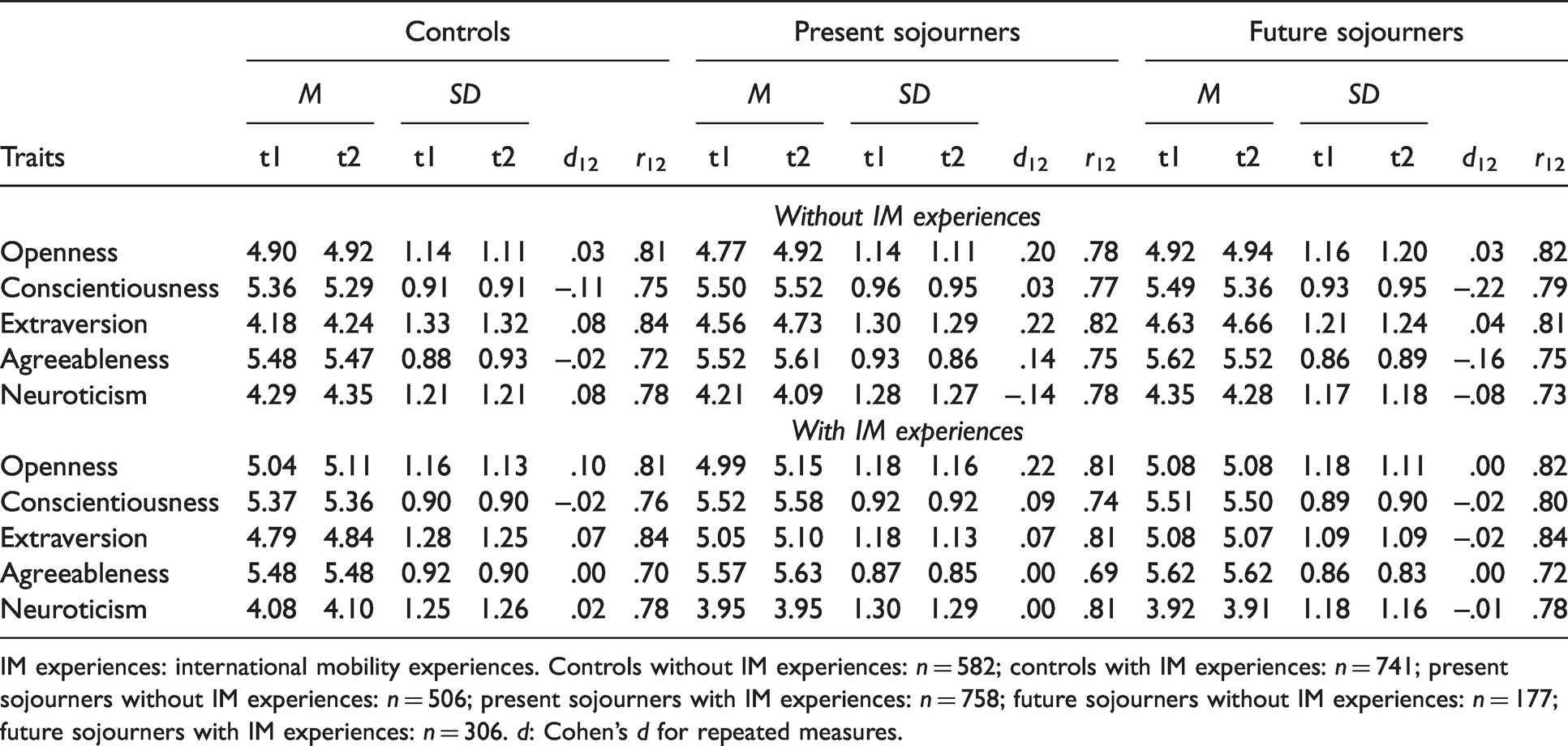
IM experiences: international mobility experiences. Controls without IM experiences: n = 582; controls with IM experiences: n = 741; present sojourners without IM experiences: n = 506; present sojourners with IM experiences: n = 758; future sojourners without IM experiences: n = 177; future sojourners with IM experiences: n = 306. d: Cohen’s d for repeated measures.
Tests of measurement invariance across time revealed that equality constraints on the factor loadings (i.e. weak factorial invariance) did not affect the model fit (see Table A6 in the online appendix). By contrast, additional equality constraints on the factor intercepts (i.e. strong factorial invariance) resulted in a significant chi-square difference test (Δχ2(10) = 77.56, p < .001). However, as chi-square tests are sensitive to sample sizes, it is recommended to (additionally) base decisions on the fit of nested models on comparisons of the descriptive fit indices (Cheung & Rensvold, 2002). In the present case, the descriptive fit indices yielded only minimal differences between the weak invariance model (χ2(541) = 3541.29, CFI = .930, RMSEA = .043, SRMR = .047) and the strong invariance model (χ2(551) = 3618.00, CFI = .928, RMSEA = .043, SRMR = .047), still implying a good fit for the latter. 2 Against that background we concluded that the establishment of strong invariance was justified and used this model for further analyses (see Table 2). In addition, tests of measurement invariance across groups were carried out for explorative reasons. Yet, the inspection of (descriptive) fit indices suggested comparable scale properties in all groups (for more information, see Table A7 in the online appendix).
ISM development and anticipation effects (multivariate latent change model with three study groups: present and future sojourners versus controls).
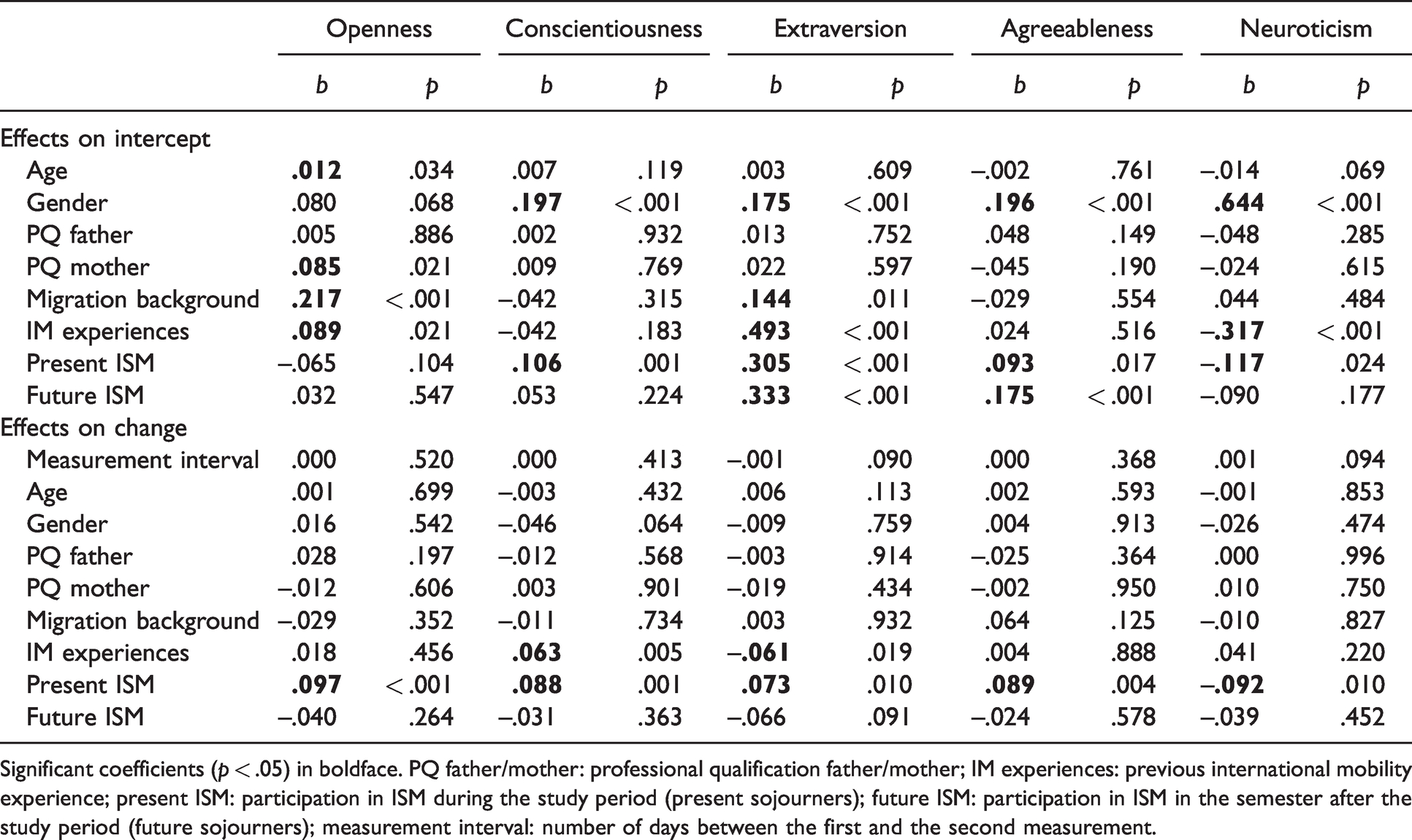
Significant coefficients (p < .05) in boldface. PQ father/mother: professional qualification father/mother; IM experiences: previous international mobility experience; present ISM: participation in ISM during the study period (present sojourners); future ISM: participation in ISM in the semester after the study period (future sojourners); measurement interval: number of days between the first and the second measurement.
Analyses of the intercept effects (upper section of Table 2) yielded a positive effect of age on openness at the study onset. Furthermore, significant gender effects on conscientiousness, extraversion, agreeableness, and neuroticism reflected higher levels of females in all of these traits. With regard to the educational background, only the professional qualification of the mother had a positive effect on the initial level of openness. Participants with a migration background showed higher levels of openness and extraversion, and those who reported previous international mobility experiences obtained higher values in openness and extraversion but lower scores in neuroticism. Finally, with regard to the engagement in ISM, positive self-selection effects were observed for conscientiousness (present sojourners), extraversion (present and future sojourners), and agreeableness (present and future sojourners) as well as a negative self-selection effect for neuroticism (present sojourners).
Most relevant with regard to our first research questions are the observed effects on change (lower section of Table 2). None of the sociodemographic covariates showed an effect on change in any of the trait domains. Previous international mobility experiences revealed a positive effect on change in conscientiousness and a negative effect on change in extraversion. In line with expectations, present ISM participation yielded positive effects on change in openness, extraversion, and agreeableness and a negative effect on change in neuroticism. In addition, a positive effect on conscientiousness development was sustained. As expected, no anticipation effects of future ISM participation were observed. In addition, results from the multivariate latent change model (χ2(531) = 2339.25, p < .001, CFI = .924, RMSEA = .044, SRMR = .050) that compared the two sojourner groups largely corroborated the pattern of ISM development effects (see Table 3). In this analysis, positive effects of present ISM participation on change in openness, conscientiousness, extraversion, and agreeableness were confirmed. Unexpectedly, the negative effect on change in neuroticism was not significant.
Robustness check of ISM development effects (multivariate latent change model with two study groups: present versus future sojourners).
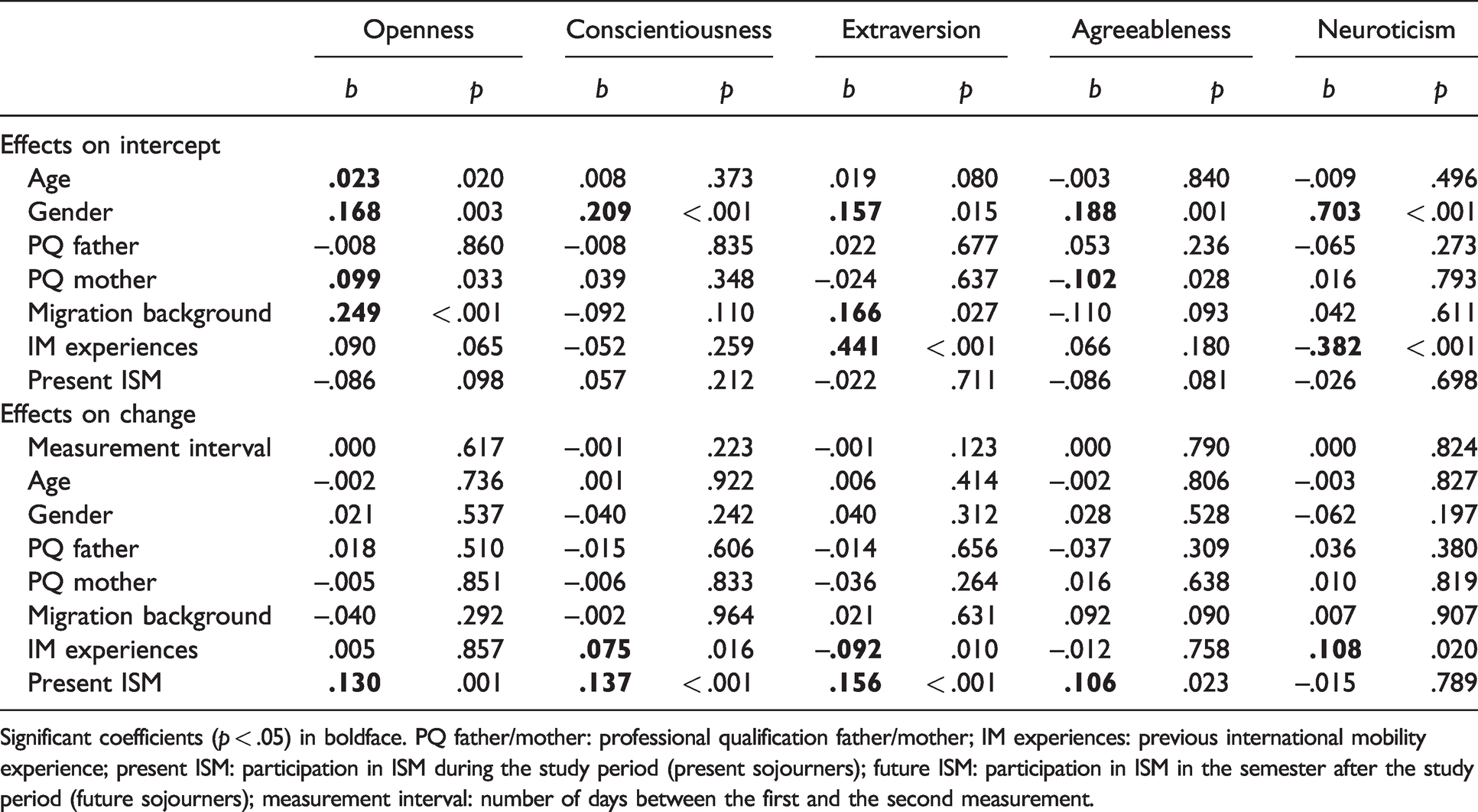
Significant coefficients (p < .05) in boldface. PQ father/mother: professional qualification father/mother; IM experiences: previous international mobility experience; present ISM: participation in ISM during the study period (present sojourners); future ISM: participation in ISM in the semester after the study period (future sojourners); measurement interval: number of days between the first and the second measurement.
To answer the question if previous international mobility experiences moderated the effects of present or future sojourns, we implemented a multivariate latent change model (χ2(591) = 3670.12, p < .001, CFI = .928, RMSEA = .041, SRMR = .045) with the same set of covariates but additionally included interaction terms between previous international mobility experiences and the two sojourn status dummies. None of the interaction effects on the intercepts obtained statistical significance. With regard to the change variables, a single interaction effect between previous international mobility experiences and present ISM participation was substantiated for neuroticism (b = .167, p = .017). However, this effect could not be sustained in the analysis that compared present to future sojourners (b = .066, p = .503) (for further information, see Tables A3 and A4 in the online appendix).
Finally, we assessed the effects of contact to host country member and other internationals on personality development with the help of a multivariate latent change model (χ2(565) = 2029.67, p < .001, CFI = .916, RMSEA = .046, SRMR = .052). The results are summarized in Table 4. The analysis confirmed substantial positive effects of international contacts on the development of openness and extraversion as well as a negative effect on neuroticism. That is, a higher quality of international contacts was associated with stronger increases in openness and extraversion as well as a steeper decline in neuroticism.
Differential associations between contact experiences and trait change (multivariate latent change model with present sojourners).
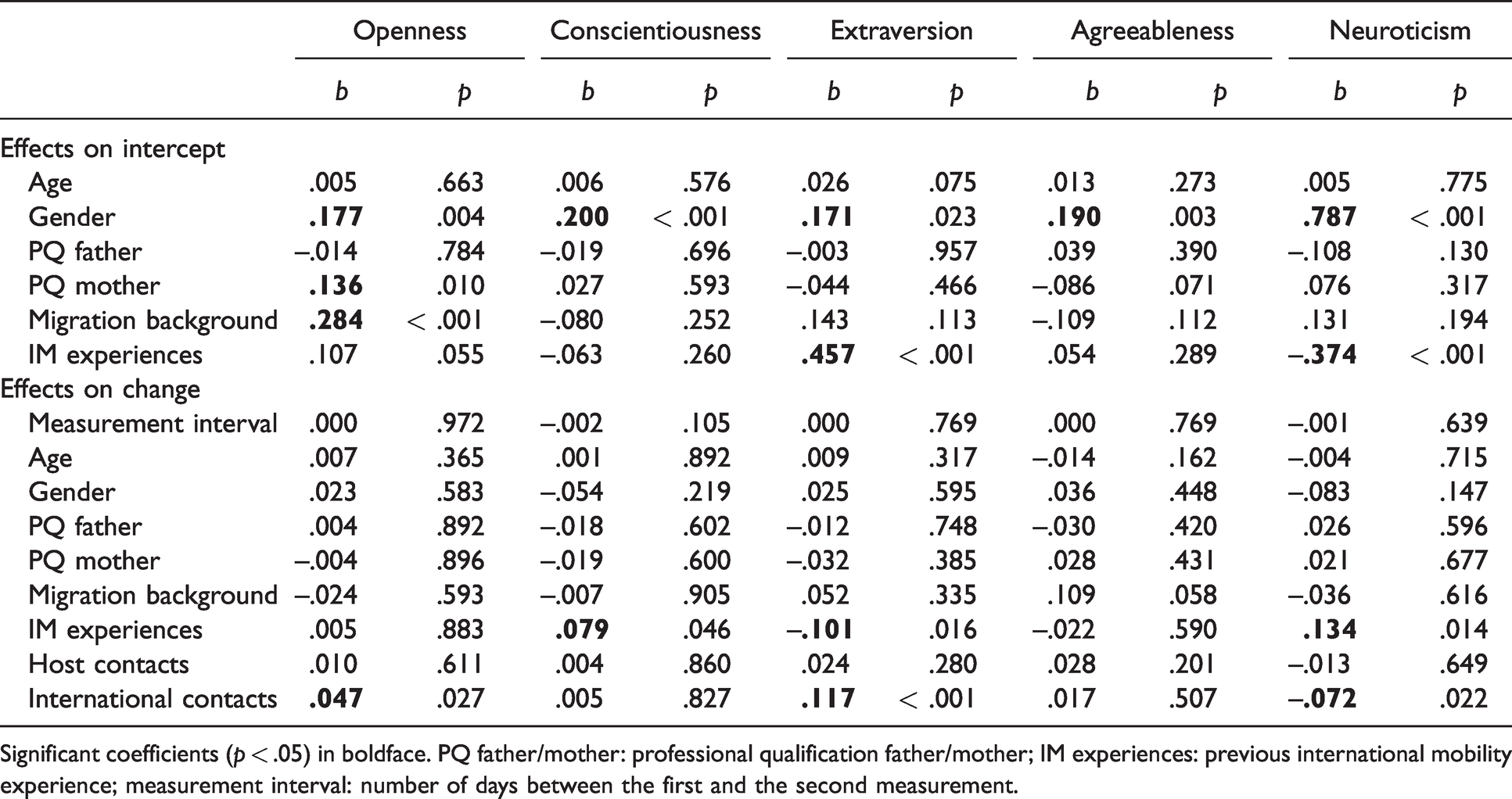
Significant coefficients (p < .05) in boldface. PQ father/mother: professional qualification father/mother; IM experiences: previous international mobility experience; measurement interval: number of days between the first and the second measurement.
Discussion
The present study pursued several research questions. First, we investigated ISM development effects in order to replicate earlier findings and to assess their robustness. To that end, we incorporated sociodemographic characteristics that were shown to be associated with the self-selection into ISM into the change models and implemented a waiting group design that allowed for additional comparisons between present and future sojourners. Second, we explored the role of anticipation effects as well as the interplay between previous international mobility experiences and current ISM engagement. Finally, we analyzed the distinct effects of the relationship quality in host and international contacts on sojourners’ development.
ISM development effects
In line with expectations, the analyses confirmed ISM effects on personality development that were in agreement with the maturation pattern: sojourners showed stronger increases in agreeableness and a steeper decline in neuroticism than control students. Moreover, as hypothesized, ISM had positive effects on the development of extraversion and openness. Unexpectedly, also a positive effect of ISM on the development of conscientiousness was identified. Importantly, these effects were sustained above and beyond the effects of sociodemographic characteristics and previous international mobility experiences (see Table 2). With the exception of neuroticism, the pattern of results was maintained when the two sojourner groups were compared: Present sojourners showed stronger increases in openness, conscientiousness, extraversion, and agreeableness than future sojourners. Change trajectories for neuroticism did not differ between these two groups (see Table 3).
Overall, the results on ISM development effects approved our hypotheses and corroborated the consideration of ISM as an important life event that promotes personality maturation. Yet, some findings require some further consideration. For example, we did not expect to find an effect on change in conscientiousness. This effect might reflect some changes in the structure and status of ISM over the past years. Because of the ongoing standardization of university education across Europe and beyond, engagement in ISM does no longer impede the study progress as course credits can be transferred between most European universities. Hence, studying abroad is not an extended vacation (anymore) but might imply even more rigorous learning schedules as in most cases a foreign study language has to be mastered. Hence, increases in achievement behavior might occur that were shown to be related to increases in conscientiousness (Bleidorn, 2012; Göllner et al., 2017).
Notably, our analyses showed that the observed ISM development effects were largely unaffected by potential confounds. The investigated sociodemographic characteristics did not yield any effects on personality change. Likewise, additional comparisons between the change trajectories of present and future sojourners did not alter the pattern of results with the exception of neuroticism. In this case, the effect of present ISM experiences could not be maintained (see Table 3). However, interestingly, the analysis yielded a substantial positive effect of previous international mobility experiences on neuroticism change as well as a negative effect on the neuroticism intercept. That is, sojourners who had already spent some time abroad showed lower levels of neuroticism at the study onset and decreased less over the course of the study period than those without any previous international mobility experiences. An inspection of the descriptive effect sizes (Table 1) yielded coherent results as it showed that pre-post change in neuroticism amongst participants with previous international mobility experiences was close to zero in all three study groups. By contrast, present sojourners without previous international mobility experiences showed the expected pattern of decreases in neuroticism whereas negligible increases (controls) and decreases (future sojourners) were observed for the other two groups. This pattern was also reflected in the analyses on the interplay between previous and current international mobility experiences as the interaction between previous experiences and present ISM engagement was the only incident of a significant moderation (for further information, see Table A3 in the online appendix). However, similar to the ISM main effect, the interaction effect was not sustained in the model that compared present and future sojourners (for further information, see Table A4 in the online appendix).
To conclude, the results suggest that effects of the present ISM engagement on neuroticism change are complex in view of the more rigorous methodological approach. However, substantial effects of previous international mobility experiences on the intercept, i.e. the level of neuroticism at the study onset, corroborated the general importance of international mobility experiences with regard to the development of neuroticism. A tentative explanation for the observed intercept effect could be that (only) first experiences abroad have substantial impact on neuroticism decline, whereas later international mobility experiences are less influential. However, the present analyses are limited as we do not have information on the number, the duration, the purpose, and the exact timing of previous international mobility experiences. To that end, future studies that provide more extensive information on the timing and sequence of international mobility experiences are needed to fully understand this pattern. For all other traits, effects of present ISM engagement can be deemed to be independent from previous international mobility experiences. This finding might be of particular interest to institutions that are involved in the organization and funding of ISM programs as it suggests that the (repeated) investment in ISM is worth it—at least with regard to the adaptive development in most traits.
Previous, current, and future international mobility experiences
With regard to effects of future sojourns, the present analyses yielded no significant results in terms of anticipation effects or the interplay between future sojourns and previous international mobility experiences. This finding has implications both for the understanding of personality development in the context of ISM as well as the conceptualization of this particular life event. On the one hand, the fact that there are no (reverse) anticipation effects suggests that the identified ISM development effects can indeed be interpreted as fundamental changes in response to the experience abroad and are not obscured by preceding (inverse) changes in view of the upcoming life event (Asselmann & Specht, 2020; Luhmann et al., 2014). On the other hand, our suggestion that effects of future ISM engagement might depend upon previous international mobility experiences as experienced sojourners might be better prepared to anticipate psychological investments was not corroborated. This might have several reasons. For example, repeated experiences of ISM might still differ with regard to their subjective experiential qualities. Another reason might be that the previous international mobility experiences of our participants differed with regard to the concrete circumstances and reasons for the stay abroad. As described above, the most frequent forms of previous international mobility experiences were longer journeys or other forms of private stays (see Table A2 in the online appendix). As these provide different experiential contexts (e.g. with regard to living arrangements, opportunities to make contacts, duration of the stay in one place), their potential to prepare participants for later ISM engagement might have been limited.
Contact experiences and personality development
Finally, the analysis of contact effects revealed that a higher quality of international contacts was associated with stronger increases in openness and extraversion as well as an accentuated decline in neuroticism. Unexpectedly, host country contact quality was unrelated to personality change. A potential explanation might be that international and host relationships may refer to different types of role relationships. For example, contact experiences with host country member were previously shown to be important with regard to academic matters (Zimmermann et al., 2017). This particular network might also include hierarchical contacts to teachers and instructors, whereas international contacts most likely refer to peers, i.e. other students. These potential differences might attenuate the relationship between host country contacts and personality change (Reitz et al., 2014). Unfortunately, the present data set does not include information that allows for an empirical exploration of this hypothesis. Future research might address the composition of sojourners' host and international networks with regard to different role types in order to gain insight into these matters. With regard to practical implications, a potential impulse for institutions and practitioners who are concerned with the optimization of ISM program structures might be not to prevent the formation of “Erasmus crowds” but to create or extend contact opportunities that increase the quality of these contact experiences such as tandem-learning programs or other forms of collaborative activities.
Limitations and future research
This research has some limitations that need to be considered. First, a limitation with regard to the assessment of contact effects is that contact experiences were retrospectively assessed and reflected only the perceptions of the sojourners themselves. Hence, the causal relationship between change in personality traits and the quality of relationship experiences cannot be established, that is, in the present study, it remains unclear whether the relationship effects reflect socialisation by relationship experiences or self-selection into social environments. Furthermore, in order to be able to differentiate between effects of individual dispositions and relationship dispositions (Back et al., 2011), more fine-grained measurements of the social behaviors and perceptions of both interaction partners—ideally in the form of ambulatory assessment data that allow tracking concrete interaction experiences—constitute a worthy endeavour for future research.
Beyond that, some concerns with respect to the sample need to be addressed. We aimed at adequately representing the heterogeneity in both sojourning and nonmobile students by recruiting nationwide and across different fields of studies. However, it was not possible to obtain detailed information on how many institutions circulated our information and which student groups they addressed. In order to accommodate concerns of data protection, no information on the higher education institutions (except for the type of the sending institution) was collected from the participants. Consequently, we cannot provide conclusive information on the distribution of participants across institutions.
With regard to the host countries, a majority of participants spend their time abroad in European countries. A more heterogeneous sample including host countries that represent a greater cultural distance to Germany might be aspired in future research, e.g. to investigate the moderating role of cultural distance with regard to ISM effects on personality development. Likewise, it is an open question to what extent the presented results apply to samples with different (cultural) backgrounds who engage in distinct forms of international mobility (e.g. permanent migration).
In addition, as it is always the case in research that is based on voluntary participation effects of self-selection by psychological or sociodemographic characteristics might have occured. We tried to accommodate these concerns by keeping the participant-directed information on the study purposes and content as general as possible and by including variables that are well known to account for selective participation (e.g. gender) as covariates in all analyses.
Finally, the present research does not allow concluding on the persistence of the observed trait changes and their effects on life paths and future life events. Even though a previous study provided first insights into the long-term developmental implications of ISM by a five-year follow-up study (Richter et al., in press), further studies that track participants over the full course of their educational career and beyond are a worthy endeavour to better understand the dynamic interplay of personality, ISM, and further life events in (young) adulthood and beyond.
Conclusion
Despite these limitations, the present study provided further insights with regard to the role of ISM in personality development. In particular, the robustness of previous findings on ISM development effects was scrutinized and largely supported. The results also suggested that the consideration of previous experiences might be important for the understanding of the developmental effects of (later) life events. With regard to the mechanisms of personality development in the context of ISM, the present results speak in favor of developmental benefits that are associated with high-quality international relationships. To conclude, we hope that the present research may contribute to the theoretical understanding of personality development and provide some impulses with regard to current debates on the organization and improvement of ISM programs.
Supplemental Material
sj-pdf-1-erp-10.1177_0890207020988439 - Supplemental material for Growth all along the road? Personality development and international contacts of (in)experienced sojourners
Supplemental material, sj-pdf-1-erp-10.1177_0890207020988439 for Growth all along the road? Personality development and international contacts of (in)experienced sojourners by Julia Zimmermann, Henriette Greischel, Kathrin Jonkmann and Franz J. Neyer in European Journal of Personality
Footnotes
Acknowledgments
We thank Judith Sarah Preuß for her most valuable help with the data preparation and with the preparation of the manuscript.
Data accessibility statement
All input files for the main analyses can be accessed via the open science framework at  . The full data set and codebook will be made publicly available via the osf platform once all publications that were planned as part of the cooperation project have been completed (i.e. presumably by 2022). In the meantime, further information may be obtained from the first author. This article earned Open Data and Open Materials badges through Open Practices Disclosure from the Center for Open Science. The data and materials are permanently and openly accessible at https://osf.io/5wdxq/.
Declaration of conflicting interests
The author(s) declared no potential conflicts of interest with respect to the research, authorship, and/or publication of this article.
Funding
The author(s) disclosed receipt of the following financial support for the research, authorship, and/or publication of this article: This research was supported by the German Academic Exchange Service (DAAD) in the context of a cooperation project with Julia Zimmermann. The content is solely the responsibility of the authors and does not necessarily represent the official views of the German Academic Exchange Service (DAAD).
Supplemental material
Supplemental material for this article is available online.
Notes
References
Supplementary Material
Please find the following supplemental material available below.
For Open Access articles published under a Creative Commons License, all supplemental material carries the same license as the article it is associated with.
For non-Open Access articles published, all supplemental material carries a non-exclusive license, and permission requests for re-use of supplemental material or any part of supplemental material shall be sent directly to the copyright owner as specified in the copyright notice associated with the article.
