



Abstract
Person-culture fit perspectives posit that individuals have higher self-esteem when their values match the values of the sociocultural environment in which they live. The current study tested this hypothesis by examining the associations between value congruence and self-esteem in a large-scale sample in the United States (N = 48,563). Multilevel response surface analyses revealed no evidence of value congruence effects on self-esteem, such that the agreement between individual- and state-level values did not positively predict self-esteem for any of the 10 basic values. Instead, we found positive (stimulation, security) and negative (conformity) linear associations between individual-level values and self-esteem. We also found positive curvilinear relationships between individual-level achievement and tradition values and self-esteem, and negative curvilinear relationships between individual-level self-direction, hedonism, power, benevolence, and universalism values and self-esteem. In addition, state-level values moderated the relationship between values and self-esteem for tradition, universalism, and conformity values. In federal states with stronger endorsement of tradition values, individuals’ tradition values were more positively associated with self-esteem. In contrast, in states with stronger endorsement of universalism values, individuals’ universalism values were more negatively associated with self-esteem. Lastly, individuals’ conformity values were negatively associated with self-esteem, particularly in states with weaker endorsement of conformity values.
Values are trans-situational goals that serve as guiding principles in one’s life. According to Schwartz’s (2017) basic human values taxonomy, the basic values contain four higher order values: openness to change values, self-transcendence values, self-enhancement values, and conservation values. Value endorsement has been proposed to affect self-esteem (i.e., evaluating one’s own worth) across a broad range of psychological theories (Bilsky & Schwartz, 1994; Pyszczynski et al., 2004; Ryan & Deci, 2000; Schwartz et al., 2010).
Pioneering works focused on the relationship between value priorities and self-esteem suggest that values that facilitate the realization of one’s goals boost self-esteem, whereas values that hamper personal goal achievement hamper self-esteem (Feather, 1991; Lönnqvist et al., 2009). Recently, theorists have highlighted the importance of value congruence, that is, the agreement between individual and societal values (Schwartz & Sortheix, 2018). There are two primary approaches to theorizing about and operationalizing value congruence. The first—which we call personal value congruence—posits that the psychological fit between individuals and their sociocultural environment occurs at the level of personal values and should thus be examined independently for each distinct value (Sagiv & Schwartz, 2000). The second—which we call value system congruence—argues that the psychological fit between individuals and their sociocultural environment is a function of overall value profiles that consider all values at once and focus on the relative emphasis placed on some values compared to others (Lee et al., 2011; Ungvary et al., 2018). Following previous research (Benish-Weisman et al., 2020; Du et al., 2019; Sagiv & Schwartz, 2000), we adopt a personal value congruence approach in the current work.
Despite the differences in these two approaches, both are based on theories of value congruence, which propose that value congruence can shape self-esteem above and beyond the direct impact of value priorities on their own. This idea has been recently tested in a few studies (Benish-Weisman et al., 2020; Du et al., 2019); however, the findings did not consistently support the idea of value congruence.
In the current work, we suggest that methodological shortcomings and generalizability issues have limited the existing research on value congruence. We address these limitations with a preregistered large-scale test of the association between value congruence and self-esteem by using national survey data from 51 federal states in the United States. Moreover, we adopt a stringent procedure to evaluate value congruence effects (Edwards, 2002; Humberg, Nestler, et al., 2019), which offers a more rigorous assessment of the relationship between value congruence and self-esteem.
Value Priorities and Self-Esteem
Schwartz (1992) identified four higher order values, subsuming 10 basic human values: openness to change values (encompassing the basic human values of self-direction, stimulation, hedonism), self-transcendence values (consisting of benevolence, universalism), self-enhancement values (including achievement, power), and conservation values (containing security, conformity, tradition).
Among the four values, openness to change values and self-transcendence values represent growth needs (e.g., self-actualization, curiosity) that individuals will continue to pursue even when they have attained high levels of satisfaction (Bilsky & Schwartz, 1994). Individuals are motivated to achieve goals to satisfy needs for growth, and this motivation leads them to attribute importance to values representing growth needs (Sagiv & Schwartz, 2000). Moreover, achieving goals is also beneficial in enhancing self-esteem (Crocker & Wolfe, 2001). Therefore, given the connections with goal realization, values representing growth needs (i.e., openness to change values, self-transcendence values) should be positively associated with self-esteem (Bilsky & Schwartz, 1994; Lönnqvist et al., 2009).
In contrast, self-enhancement values and conservation values represent deficiency needs (e.g., health, safety), which are particularly important for individuals who cannot achieve their goals and reflect their desires to compensate for deprivation (Sagiv & Schwartz, 2000). Specifically, individuals who attribute greater importance to these values are more likely to have personal experience with a low sense of control, feeling unsafe, and threatened social relationships. Because these deprived feelings are associated with lower self-esteem, values representing deficiency needs (i.e., self-enhancement values and conservation values) should be negatively associated with self-esteem (Bilsky & Schwartz, 1994).
A few studies have drawn from this previous research by examining the associations of value priorities and self-esteem, yielding mixed findings. Feather (1991) found that achievement and self-direction values were positively associated with self-esteem, while stimulation, security, and conformity values were not significantly associated with self-esteem among Australian university students. Lönnqvist et al. (2009) found that self-enhancement values (achievement, power) and openness to change values (self-direction, stimulation) were positively associated with self-esteem. In contrast, self-transcendence values (universalism, benevolence) and conservation values (tradition) were negatively related to self-esteem in five European countries. In a longitudinal study (Fetvadjiev & He, 2019), self-direction was positively associated with self-esteem (aligning with recent longitudinal research linked openness to change values to enhanced subjective well-being; Grosz et al., 2021), whereas conformity was negatively associated with self-esteem.
In these studies, researchers solely considered value endorsement at the individual level, without accounting for value endorsement at the level of the sociocultural environments in which these individuals are embedded. Emerging research on value congruence aims to fill this theoretical gap by incorporating both individual- and culture-level values in the same model.
Value Congruence and Self-Esteem
Value congruence differs from value priorities. Although values by themselves predict self-esteem, the match between personal values and societal values may also shape self-esteem (Fetvadjiev & He, 2019). Specifically, individuals can maintain and enhance self-esteem through adhering to cultural values and social norms (Du et al., 2013; Pyszczynski et al., 2004). Moreover, when individuals’ values are consistent with societal values, they can reduce uncertainty and obtain social validation, further increasing self-esteem (Bleidorn et al., 2016; Fulmer et al., 2010). Indeed, there is evidence that when personal beliefs, values, and personality are similar to those of the people in one’s surroundings, individuals experience greater psychological adjustment, in the form of higher psychological well-being (Götz et al., 2018), life satisfaction (Jokela et al., 2015; Khaptsova & Schwartz, 2016), self-esteem (Bleidorn et al., 2016; Fulmer et al., 2010; Götz et al., 2018; Khaptsova & Schwartz, 2016) and even tend to live longer (Ebert, Gebauer, et al., 2020).
For basic human values, the relationship between value congruence and self-esteem may be affected by whether values are universal or culture-specific. The universal-value perspective posits that individual differences within cultures can account for the greatest share of variation in value priorities, whereas little differences exist between cultures (Fischer & Schwartz, 2011). Following this reasoning, the relationship between value congruence and self-esteem will be consistent across cultures, and therefore, findings in a culture may be generalized to other cultures. In contrast, the culture-specific-value (or culture-comparative) perspective suggests a broad value convergence within cultures but substantial differences between cultures (Hofstede, 2001; Oishi et al., 1998). For example, Oishi et al. (1998) found that more independent individuals tended to endorse achievement, power, and self-direction values, but not benevolence and universalism values, suggesting that self-enhancement values are more prevalent in individualistic cultures, whereas self-transcendence values were endorsed more strongly among individuals in collectivistic cultures. Therefore, in line with this perspective, findings in one culture (e.g., an individualistic culture) may not be generalized to other cultures (e.g., a collectivistic culture). Given the limited research on this topic, it remains unclear whether the relationship between value congruence and self-esteem is universally consistent or culture-specific.
Until now, to the best of our knowledge, two empirical studies have investigated how value congruence predicts self-esteem by focusing on the interplay between individual- and culture-level values. Du et al. (2019) explored this question among adults in 78 societies worldwide and observed value congruence effects on national pride in 6 of 10 values (i.e., achievement, security, conformity, tradition, benevolence, and universalism). That is, the agreement between individual- and society-level values was associated with greater national pride. This finding indicates the beneficial role of value congruence in self-esteem. However, it is worth noting that national pride represents a form of self-esteem that individuals evaluate based on their social groups, that is, collective self-esteem. Group-oriented collective self-esteem functions differently from individual-oriented self-esteem (Crocker et al., 1994; Du et al., 2017). Therefore, we cannot generalize the findings of Du et al. (2019) on collective self-esteem to individual-oriented self-esteem. Another issue in this study is the use of multi-country samples. Although multi-country samples may increase the generalizability of findings, it is also plausible that the results are confounded by many third variables (e.g., cultural differences in language, and geography). A multi-region test within a country would be helpful to address this limitation.
In another study, Benish-Weisman et al. (2020) examined the relationship between value congruence and self-esteem among Israeli adolescents. This study revealed value congruence effects on self-esteem in self-enhancement and self-transcendence values. That is, when adolescents’ self-enhancement and self-transcendence values fit with their classmates’ values, they showed the highest levels of self-esteem. This finding was partly consistent with Du et al. (2019), indicating that value congruence in self-enhancement and self-transcendence is beneficial for self-esteem. However, the extent to which these findings from an adolescent sample generalize to adults is unclear because values can differ between adolescents and adults (Lönnqvist et al., 2009).
In addition to the generalizability issue, the two existing studies (Benish-Weisman et al., 2020; Du et al., 2019) have methodological limitations, despite improving on traditional approaches. Specifically, both studies used Response Surface Analysis (RSA; Barranti et al., 2017; Humberg, Nestler, et al., 2019) to test the effects of value congruence. The traditionally used method for testing value congruence is to correlate difference scores with outcome variables, which provides biased tests of congruence effects (Edwards, 1994; Edwards & Parry, 1993; Humberg, Nestler, et al., 2019). RSA overcomes limitations of the traditionally used method and allows researchers to test more elaborate effects (Edwards, 2002; Edwards & Cable, 2009; Humberg, Dufner, et al., 2019; Humberg, Nestler, et al., 2019). Therefore, both studies had methodological advantages compared to previous research in terms of using the RSA method.
However, both studies have relied on single RSA parameters (Barranti et al., 2017), which are insufficient to test for the existence of congruence effects (Edwards, 2002; Humberg, Nestler, et al., 2019) and may thus lead to misinterpretations. To overcome this limitation, Humberg and colleagues have clarified that the correct procedure for examining congruence effects must consider multiple parameters (Humberg, Nestler, et al., 2019). Therein, congruence hypotheses are supported if the agreement between individual- and state-level values positively (or negatively) predicts self-esteem. The current research followed this approach by re-examining the associations of value congruence with self-esteem using state-of-the-art multilevel RSA procedures (Nestler et al., 2019) in a large-scale cross-regional sample in the United States.
Values in U.S. American Culture
Until now, little work has been done on the relationship between values and self-esteem in U.S. American culture. Based on the universal-value perspective, Fischer and Schwartz (2011) stressed that the variance in values across countries is small, suggesting that the way Americans endorse values should be similar to observations from other countries. In other words, previous findings on global populations may generalize to U.S. Americans. On the other hand, in line with the culture-specific-value perspective, some studies suggest that cultural orientations may determine the importance and function of values (e.g., Oishi et al., 1998). U.S. American culture is very individualistic, so individualism-oriented values, like achievement, power, and self-direction, may influence Americans more than values that are less individualistic in orientation, such as benevolence and universalism. Therefore, whether value congruence exerts a positive impact on self-esteem may depend on the type of values that are especially relevant in a given cultural context.
Against this backdrop, the cross-cultural literature (Fischer & Schwartz, 2011; Oishi et al., 1998) appears to provide explicit support for only one hypothesis: For the value of achievement, value congruence will be associated with higher self-esteem. Regarding other values, the literature suggests contrasting predictions. According to the universal-value perspective (Fischer & Schwartz, 2011), value congruence, in terms of security, conformity, tradition, benevolence, and universalism, would be associated with higher self-esteem. In contrast, according to the culture-specific-value perspective (Oishi et al., 1998), value congruence in the United States would be related to higher self-esteem in terms of power and self-direction. Therefore, we refrain from postulating any other a priori predictions for the remaining nine values and adopt an exploratory approach instead.
The Current Study
The current study aimed to provide an empirical test of a theoretically important but scarcely studied question: Whether and how value congruence predicts self-esteem. We simultaneously tested the associations of both value priorities and value congruence with self-esteem, using multilevel polynomial regression with RSA, a state-of-the-art statistical approach, which allows us to identify potential effects of value congruence, above and beyond direct effects of value priorities.
To achieve these research goals, we used a large-scale sample of 48,563 adults from 51 regions (50 states and Washington DC) in the United States. Value congruence was operationalized as the agreement between individual- and state-level values, in which state-level values were the aggregate of individual-level values within each state.
We examined whether and how congruence between individual- and state-level values would be associated with self-esteem. We hypothesized that for the value of achievement, value congruence would be related to higher self-esteem. For other values, we refrained from postulating any other a priori predictions and adopted an exploratory approach instead. The hypothesis and the analytical procedure were preregistered on the Open Science Framework (https://osf.io/df87x/) prior to data analysis.
The current study contributes to the literature in two ways. First, it offers the first large-scale test of value congruence within a country, thus alleviating concerns about third-variable confounding issues in existing cross-national research. Second, it adopts a stringent procedure for RSA and addresses methodological limitations in previous research, thereby offering more precise insights into the multifaceted associations between basic human values and self-esteem.
Method
Data
The current study draws from the TIME Magazine Basic Human Values Dataset (Götz et al., in preparation). The TIME Magazine Basic Human Values Dataset was collected online between December 2017 and October 2018, with the approval of the Psychology Research Ethics Committee of the University of Cambridge (application number: PRE.2017.094). The data are proprietary and may not be publicly shared but are available from the second and fourth author upon request. The study was carried out as an online survey hosted and launched by TIME Inc. (https://time.com/5063406/star-wars-character-quiz/) and advertised through websites and social media channels (e.g., Facebook, Twitter) by TIME Magazine and its media partners (e.g., People, Entertainment Weekly). As such, it provided TIME Magazine with a tool that would allow interested people to find out their best-matching character from the Star Wars saga. Participants were free to complete the survey without sharing their data and had to opt-in if they wished to share their data for scientific purposes. The survey was only available in English. Upon completion, participants received automatic customized feedback, informing them about the Star Wars character that provided the best fit with their philosophy of life and the characters that offered the second and third best fit. Overall, completion of the survey took approximately 10 minutes. After receiving their matched Star Wars character, participants were provided with a more detailed outline of the aims of the associated research project.
In the survey, participants completed a short battery of sociodemographic questions (e.g., age, gender, income, ethnicity, and country/state of residence) and various scales to assess basic human values and personality traits.
Participants
Overall, the TIME Magazine Basic Human Values Dataset encompasses 92,886 participants. For the current study, we included all participants who (a) reported living in the United States and indicated their state of residence and (b) were between 16 and 99 years old. This selection process resulted in a sample size of 48,563 participants from 51 regions in the United States (i.e., the 50 federal states and Washington, DC). Because four participants did not provide data of values and were excluded from further analyses, the final sample included in the analyses encompassed 48,559 participants from 51 regions (28,305 females, age ranging from 16 to 99, age mean = 27.08, age SD = 11.03). Participant numbers by state range from 60 in North Dakota to 6,565 in California (see Table 1). The percentage of total respondents from each state in our sample was highly correlated with the percentage of the U.S. total population for each state in 2017 (r = .97, p < .001), as captured by the estimates from the United States Census Bureau (2018). Likewise, the percentages of African Americans (r = .88, p < .001), Asians (r = .99, p < .001), Hispanics (r = .99, p < .001), and Whites (r = .96, p < .001) from each state in our sample were also strongly correlated with the estimated percentages of the respective ethnicities per state in 2017 as reported by the United States Census Bureau (2018). Taken together, these analyses suggest that our sample was generally representative of the U.S. population by state.
Demographics and state-level means.
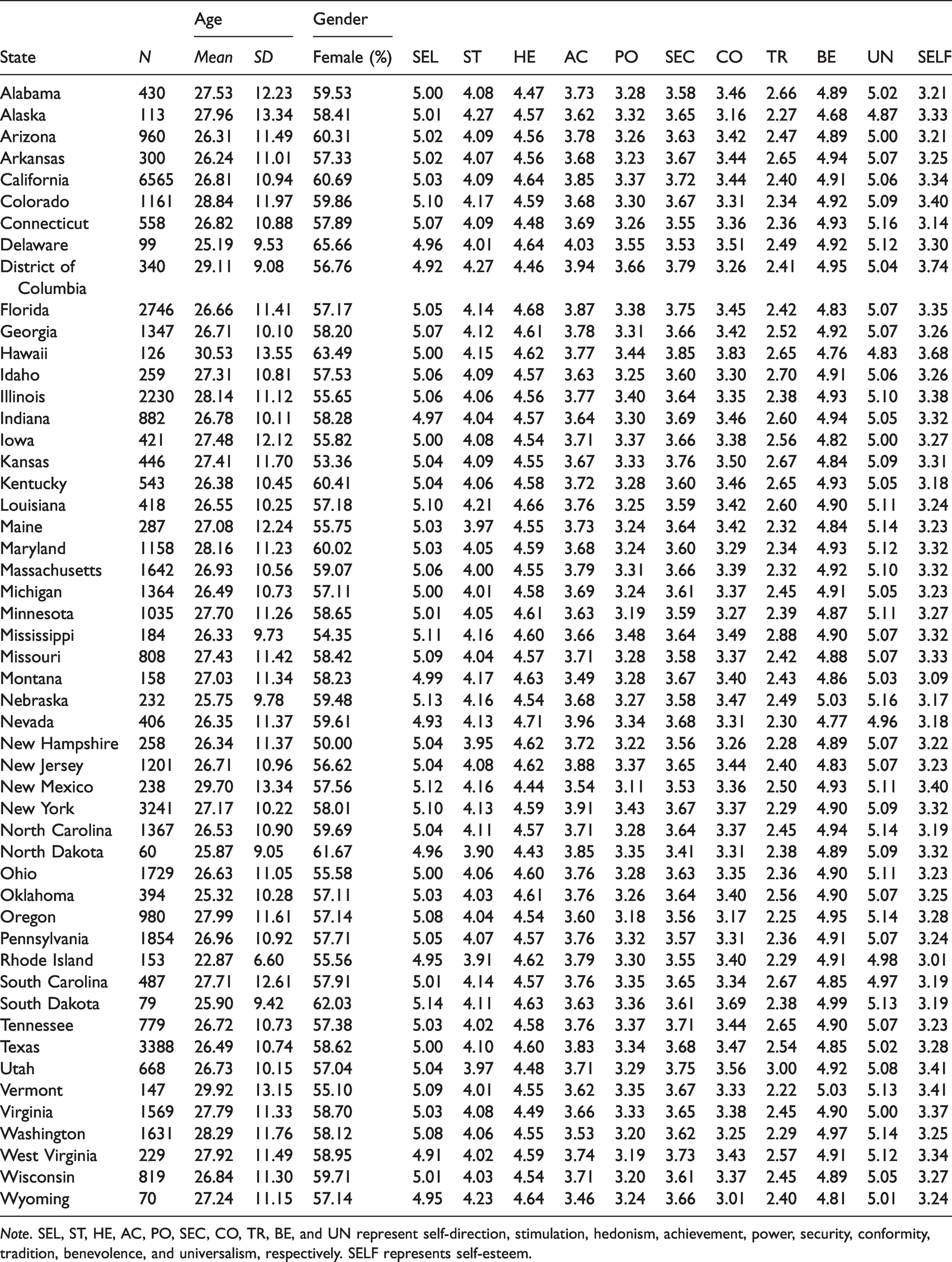
Note. SEL, ST, HE, AC, PO, SEC, CO, TR, BE, and UN represent self-direction, stimulation, hedonism, achievement, power, security, conformity, tradition, benevolence, and universalism, respectively. SELF represents self-esteem.
Measures
Individual-Level and State-Level Values
Values were assessed using the Twenty Item Value Inventory (TwIVI; Sandy et al., 2017). The measure contains 20 portrait-type items (e.g., “S/he believes s/he should always show respect to his/her parents and to older people It is important to him/her to be obedient,” “Religious belief is important to him/her. S/he tries hard to do what his religion requires.”), representing 10 basic values, including openness to change values (i.e., self-direction, stimulation, hedonism), self-enhancement values (i.e., achievement, power), conservation values (i.e., security, conformity, tradition), and self-transcendence values (i.e., benevolence, universalism; Sandy et al., 2017). Participants indicated how much the described fictional person was like themselves on a 6-point Likert scale (1 = not at all like me; 6 = very much like me). Prior research has shown that the 20-item scale can successfully capture the patterns of the original 40-item Portrait Values Questionnaire (Sandy et al., 2017; Vignoles et al., 2017). Cronbach’s alphas of the scales in the current study ranged from .28 (security) to .78 (benevolence), which is comparable to previous findings (Sandy et al., 2017; Schwartz et al., 2001). Given that the two items of each value assessed different aspects of values while avoiding redundancy with each other, the relatively low Cronbach’s alpha estimates are to be expected (Gosling et al., 2003; Rammstedt & John, 2007). Because each value was assessed using two items, we first averaged the scores of two items of each value and obtained 10 value scores. Next, following the recommended procedure for correcting response biases (Schwartz, 2009), we calculated an average score of the 10 value scores within each person. Last, we subtracted this average score from the 10 value scores and obtained the final individual-level values.
Based on these individual-level values, we calculated state-level values by averaging the scores of all individual-level values in each state of the United States, respectively. Considering that our sample was generally representative of the U.S. population by state, the aggregated rating scores of respondents from each state likely adequately represent the state-level values. Moreover, the utilization of average rating scores of participants in a state in this way is conceptually supported by cross-cultural theories on values (Fischer, 2012; Fischer et al., 2010; Fischer & Boer, 2016) and methodologically consistent with the value congruence literature (Benish-Weisman et al., 2020; Du et al., 2019; Khaptsova & Schwartz, 2016), the broad person-culture fit literature (Bleidorn et al., 2016; Götz et al., 2018; Jokela et al., 2015) and current measurement standards in geographical psychology (Buecker et al., 2021; Ebert, Götz, et al., 2020; Obschonka et al., 2018; Rentfrow et al., 2008).
Both individual-level and state-level values were grand-mean centered for further analyses, with higher scores indicating higher levels of values.
Self-Esteem
Self-esteem was measured via an adapted version of the Single-Item Self-Esteem Scale (Robins et al., 2001): “S/he is a person with high self-esteem. S/he takes a positive attitude towards himself/herself.” Participants answered this item on a 6-point scale (1 = not at all like me; 6 = very much like me), with higher scores indicating higher levels of self-esteem.
Demographic Variables
Participants reported demographic information, including gender, age, and country/state/city of residence.
Analyses
Prior to polynomial regression analyses, we examined whether the distributions of individual- and state-level value scores were sufficient for testing congruence effects. Specifically, we followed the recommended procedure by Humberg et al. (2020) and inspected the percentage distribution of data points across three groups—Group A: incongruence with individual-level values exceeding state-level values (by at least half a grand standard deviation of individual- and state-level values); Group B: incongruence with state-level values exceeding individual-level values; and Group C: rough congruence with individual- and state-level values being within half a grand standard deviation from each other. This check revealed that the percentage coverage of Group A ranged from 29% to 43%, Group B ranged from 26% to 29%, and Group C ranged from 31% to 42%. These results suggest that the data points of individual- and state-level values are roughly equally distributed across the three groups, which we consider sufficient to test congruence effects.
To test value congruence effects, we carried out polynomial regression analyses in the statistical programming environment R (R Core Team, 2018). Given that individuals were nested within the states, we employed an adapted version of multilevel response surface analyses (Nestler et al., 2019) to examine the relationships among individual-level values, state-level values, and individual self-esteem. All preparatory data processing syntax and analysis code are publicly available on our Open Science Framework project page (https://osf.io/df87x/).
In our polynomial regression analyses, the dependent variable was self-esteem. The independent variables included individual-level values (I), state-level values (S), the squared terms of individual-level values (I2), the interactive term between individual- and state-level values (I.S.), and the squared terms of state-level values (S2). The basic polynomial regression model for individual i in state j is given by:
In this model, the independent variables (I, S, I2, I.S., and S2) are represented through corresponding coefficients (b1 to b5); moreover, the model includes the overall intercept (b0), the individual-level error (e), and the random intercept at the state level (u) (Bleidorn et al., 2016; Nestler et al., 2019).
It is important to note that the predictors I and S have been centered on the grand mean, that is, the mean of the combined individual- and state-level values. The centering approach has the advantage of preserving the congruence pattern of the individual- and state-level value scores (Humberg et al., 2020).
We ran 10 polynomial regression analyses to test the effects of the 10 values, respectively. The multilevel RSA yielded five parameters (a1 to a5) for each plot: a1 and a2 represent the slope and curvature above the line of congruence, respectively, whereas a3 and a4 represent the slope and curvature above the line of incongruence (Edwards & Parry, 1993). The parameter a5 has no direct interpretation, but when a3 and a4 satisfy certain criteria, a5 can be used to determine whether the first principal axis of the model matches the line of congruence (Nestler et al., 2019).
Value congruence effects are supported if the parameters meet the following criteria: (a) a1 and a2 are not significant, (b) a4 is significantly negative, and a3 is not significant, and (c) a5 is not significant (Nestler et al., 2019).
In case no value congruence effects would be observed, we decided to conduct exploratory analyses to inform future research. This approach was inspired by recent research using the RSA method (He & Côté, 2019). Specifically, we examined whether the coefficients from our RSA suggested effects that we had not hypothesized. These examinations should be considered tentative and rely on future research to be consolidated.
Results
Table 1 presents the state-level means of values and self-esteem. We display the results of the multilevel and RSAs in Table 2. The plots demonstrating the interactive effects between individual- and state-level values are shown in Figure 1(a–j).
Regression coefficients (b1–b5) and model parameters (a1–a5) in main analysis.
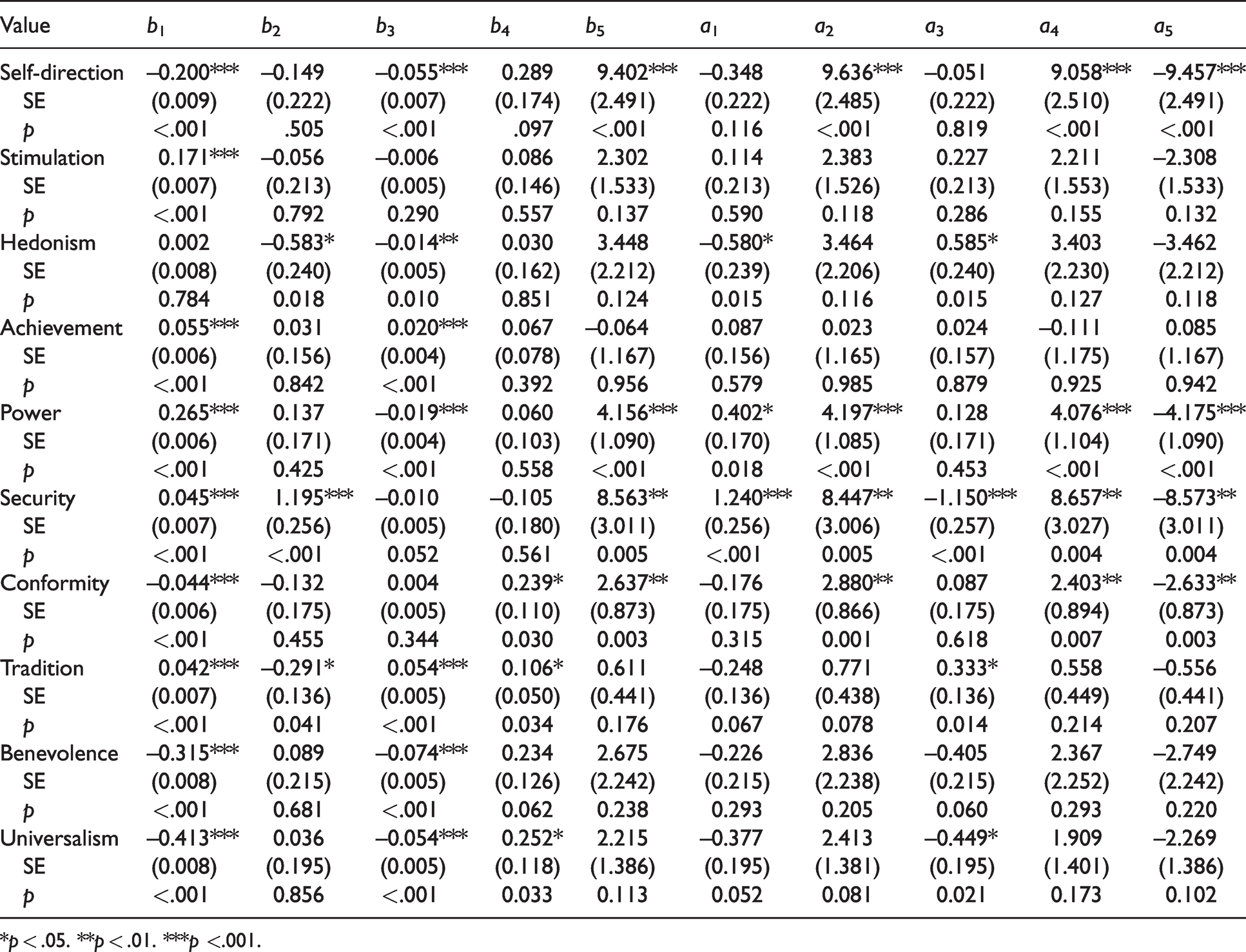
*p < .05. **p < .01. ***p <.001.
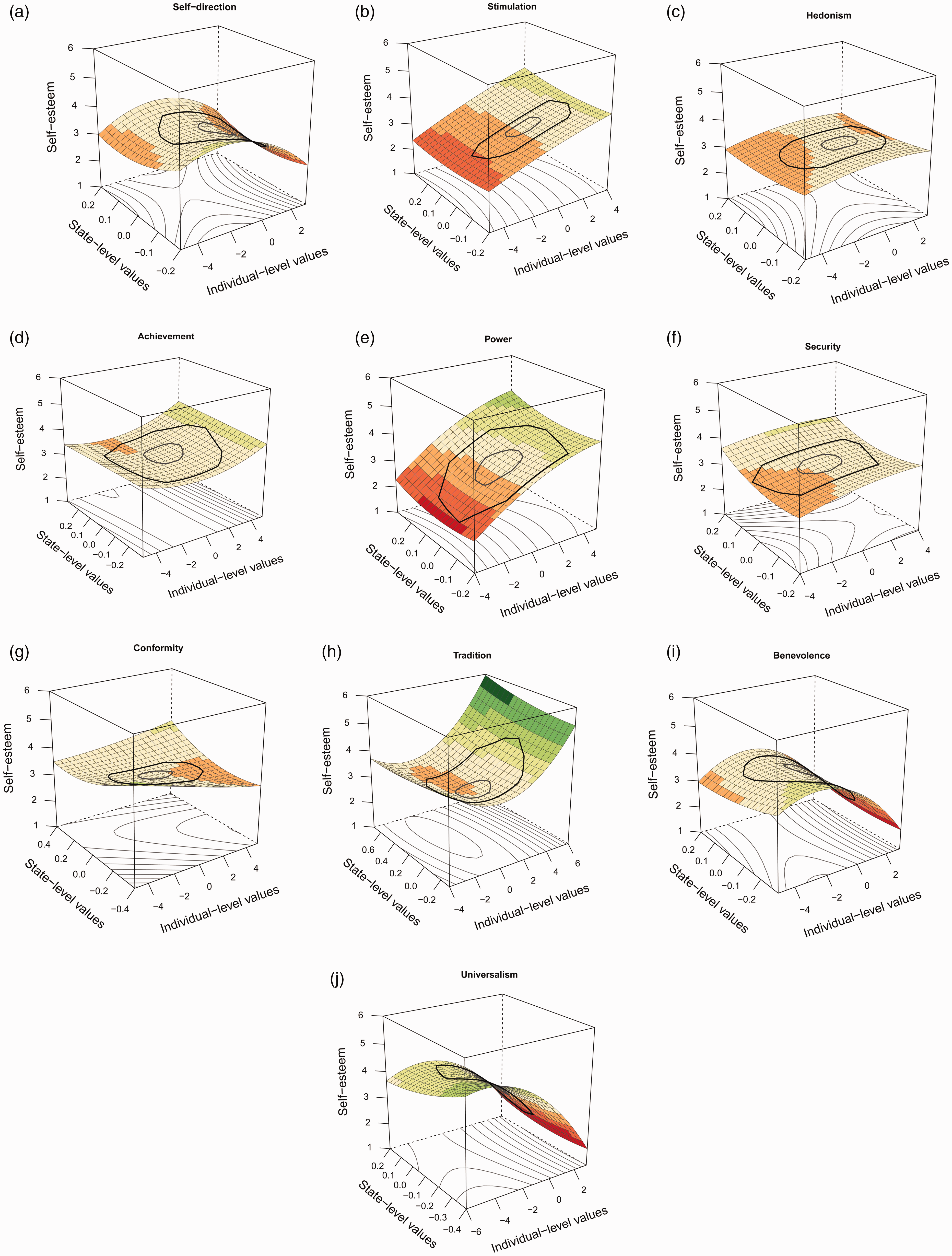
Response surface analyses plots illustrating that individual-level values and state-level values predicted self-esteem. Plots a–j represented self-direction, stimulation, hedonism, achievement, power, security, conformity, tradition, benevolence, universalism, respectively.
It is important to note that all the plots are restricted to the area of predictor combinations that were in the data for each of the 10 RSA models, and our interpretations are restricted to the hull area (i.e., the part of the surface that lies within the black hull) in each of the plots. Moreover, because the state-level values had a much smaller range than the individual-level values, the axis for the state-level values covers a much smaller range than the axis for the individual-level values in each of the plots. In this way, the visual diagonal in the plots does not match the line of congruence. The line of congruence should be interpreted based on the RSA parameters in Table 2.
Confirmatory Tests of Value Congruence Hypothesis
Following the recommended checklist put forwarded by Nestler et al. (2019), we tested the value congruence hypothesis based on the five coefficients (i.e., a1 – a5). We found that the conditions to infer support for the value congruence hypothesis were not met across all 10 values, suggesting that there were no significant congruence effects on self-esteem in neither of the 10 values.
Exploratory Analyses of Effects Suggested by the Multilevel Polynomial Regression Models
In the absence of supportive evidence for any value congruence effects, we conducted exploratory analyses to illuminate the linear and curvilinear effects of individual-level values, as well as potential interactive effects between individual- and state-level values on self-esteem.
Self-Direction
The model showed both linear and curvilinear effects between individual-level self-direction and self-esteem. As the linear effects should not be interpreted on their own in such instances, we focused on the curvilinear effect for the interpretation of the results. The curvilinear effect indicated that individual-level self-direction was associated with higher self-esteem below the inflection point but associated with lower self-esteem above the inflection point. Moreover, the model showed a positive curvilinear effect of state-level self-direction, such that self-esteem was higher when state-level self-direction values were at extremely high or low levels rather than a medium level (see Figure 1a).
Stimulation
The model showed a linear positive association between individual-level stimulation and self-esteem, such that individuals with higher stimulation values reported higher self-esteem (see Figure 1b). No other significant effects were found.
Hedonism
The model showed a negative linear association between state-level hedonism and self-esteem, such that in the states with higher hedonism values, individuals had lower self-esteem. Moreover, the model showed a negative curvilinear association between individual-level hedonism and self-esteem, indicating that self-esteem was lower when individuals endorsed extremely high or low, rather than mid-range levels of hedonism (see Figure 1c).
Achievement
The model showed a curvilinear effect of individual-level achievement, such that individual-level achievement was associated with lower self-esteem when achievement was below the inflection point, but associated with higher self-esteem above the inflection point (see Figure 1d).
Power
The model showed a curvilinear effect of individual-level power, such that individual-level power was generally associated with higher self-esteem but was associated with lower self-esteem at the upper end of the spectrum (see Figure 1e). In addition, there was a significant curvilinear effect of state-level power, which was associated with higher self-esteem above the inflection point but related to lower self-esteem below the inflection point.
Security
Individual-level security was associated with higher self-esteem (see Figure 1f). We also found a curvilinear effect of state-level security, indicating that state-level security was associated with higher self-esteem above the inflection point, but it was associated with lower self-esteem below the inflection point.
Conformity
We found a linear effect, such that individual-level conformity was associated with lower self-esteem. There was also a curvilinear effect of state-level conformity, such that state-level conformity was associated with higher self-esteem above the inflection point, but linked to lower self-esteem below the inflection point. In addition, there was a significant interaction between individual- and state-level conformity, insofar as individual-level conformity was associated with decreased self-esteem in states with low conformity values. Meanwhile, in states with high conformity values, the association between individual-level conformity and self-esteem was much weaker and mostly flat (see Figure 1g).
Tradition
We detected a curvilinear effect of individual-level tradition, in which individual-level tradition was associated with lower self-esteem below the inflection point, but it was associated with higher self-esteem above the inflection point (see Figure 1h). State-level tradition was linearly associated with lower self-esteem. More importantly, there was a significant interaction effect between individual- and state-level tradition, in that the association between individual-level tradition and self-esteem was comparatively stronger in states that scored high on tradition compared to those that scored low.
Benevolence
We observed a curvilinear effect, such that individual-level benevolence was associated with lower self-esteem above the inflection point, as well as higher self-esteem when benevolence was below the inflection point (see Figure 1i).
Universalism
The model showed a curvilinear effect, such that individual-level universalism was associated with lower self-esteem above the inflection point and with higher self-esteem below the inflection point (see Figure 1j). There was also a significant interaction effect between individual- and state-level universalism. In states with higher levels of universalism, individual-level universalism was more negatively associated with self-esteem.
Robustness Check 1: Reanalysis of Data With Big-Sample States
Because four states (i.e., Delaware, North Dakota, South Dakota, and Wyoming) had samples fewer than 100 participants, we re-ran the RSA excluding these four states as a robustness check to ensure reasonably accurate estimation of state-level values (Ebert et al., 2019; Götz et al., in press; Payne et al., 2019).
The results of these reanalyses are presented in Table S1 and Figure S1 in the Supplementary Information. No significant congruence effects on self-esteem were observed for any of the 10 values, which does not support the value congruence hypothesis and is thus consistent with the results based on the whole sample.
Robustness Check 2: Reanalysis of Data With Randomly Selected Small Samples
The current analyses drew from a large nationwide sample in the United States. However, the large sample may have produced a power issue in RSA. Experts on RSA have suggested that “a congruence hypothesis will almost always be rejected when the sample size is sufficiently high” (Nestler et al., 2019, p. 304). Therefore, it is critical to examine whether the null congruence effects for all 10 values may at least in part be due to the combination of the high sample size and very sensitive RSA models employed in the current study.
To address this issue, we randomly selected a small subsample from the whole sample and reconducted our RSAs. Given that North Dakota had the smallest sample (n = 60), we used this sample size as a benchmark and randomly selected 60 participants from each of the 51 regions (except North Dakota) so that the resulting small sample (n = 3,060) accounted for 6.3% of the whole sample. In addition, to ensure that the 60 participants represented the whole sample in each state and that the average level of values among the 60 participants could be used to estimate state-level values, we investigated the difference between the state-specific value means derived from the randomly drawn 60-participant subsamples and the state-specific value means based on the whole sample. After the first round of random selection, we found 13 significant differences among 500 one-sample t-tests. We subsequently re-ran the sample selection for those states with significant differences twice, after which no significant differences in values were detected between the random subsample and the whole sample in any of the states. We then used this sample of 3,060 participants to conduct our robustness check.
The results of the corresponding reanalyses are reported in Table S2 and Figure S2 in the Supplementary Information. No significant congruence effects on self-esteem were observed for any of the 10 values, which does not support the value congruence hypothesis and is consistent with the results based on the whole sample. These results suggest that our findings of null congruence effects cannot be primarily explained by the potential power issues arising from RSAs’ sensitivity to large samples.
Robustness Check 3: Reanalysis of Data With City-Level Values
We operationalized cultural values through state-level values, which raises the potential limitation that state-level values may not represent individuals’ immediate cultural or social environment, which may in turn—at least partly—explain the lack of congruence effects between individual-level and cultural (i.e., state-level) values. To address this issue, we conducted an additional robustness check, in which we used participants’ narrower area of residence (i.e., city) as a proxy for immediate living environments. In this analysis, we used data for participants who reported the current city where they lived at the time of data collection, and we excluded participants who did not report that information. In addition, to assure reasonably accurate estimation of city-level values, we used the criterion of at least 60 participants in each city and excluded cities with fewer than 60 participants from the analysis. Consequently, we retained 13,399 participants from 95 cities in our analysis, with city sample sizes ranging from 60 (i.e., Omaha, Spokane) to 683 (i.e., Chicago).
To test for potential value congruence effects, we replicated the analytical procedure described above. City-level values were calculated as the average scores of individual-level values in each city, respectively. Individual-level and city-level values were grand-mean centered prior to RSAs. As shown in Table S3 and Figure S3 in the Supplementary Information, no significant congruence effects were found among the 10 values. The results were thus the same as those reported for state-level values. That is, the findings do not support the value congruence hypothesis and suggest that even if we focus on a narrower area of residence (i.e., participants’ city) as a proxy for cultural context, we do not find evidence for value congruence effects.
Robustness Check 4: Reanalysis of Data With Raw Value Scores
In our main analyses, we have used ipsative scores of values (i.e., by subtracting the average scores of each individual’s value scores). This approach is recommended to eliminate participants’ response biases (Schwartz, 2009, 2012); however, it may cause some interdependence issues in covariance matrices in the data (Meade, 2004).
To rule out the possibility that the ipsatization may have biased our results, we re-ran the RSAs using raw scores of individual-level values. Accordingly, state-level values were calculated by averaging the raw scores of the respective state residents’ individual-level values.
The results of this robustness check are reported in Table S4 and Figure S4 in the Supplementary Information. No significant congruence effects on self-esteem were found for any of the 10 values, which is in line with the results based on the ipsative data and does not support the value congruence hypothesis. These results thus suggest that the lack of congruence effects has not been caused by the ipsative procedure employed in our main analysis.
Summary of the Results
We did not observe any value congruence effects, which would have required that the agreement between individual- and state-level values positively (or negatively) affected self-esteem (Humberg, Nestler, et al., 2019). Robustness checks suggest that null congruence effects were not related to small or big state-level sample sizes, representativeness of the state-level values, a more geographically proximal operationalization of cultural values, or the use of raw versus ipsative value scores.
Instead of congruence effects, we found different linear, curvilinear, and interactive effects of individual- and state-level values on self-esteem. In terms of individual-level values, higher levels of stimulation and security values were associated with higher self-esteem, whereas higher levels of conformity values were associated with lower self-esteem. We also observed curvilinear effects of individual-level values, including self-direction, hedonism, achievement, power, tradition, benevolence, and universalism. For achievement and tradition values, individuals with extreme levels of value endorsement (both low and high) tended to have higher self-esteem than individuals with medium levels of value endorsement. In contrast, for the values of self-direction, hedonism, benevolence, and universalism, individuals with medium levels of value endorsement tended to have higher self-esteem than individuals endorsing extreme levels of value endorsement. Power was generally associated with higher self-esteem but was associated with lower self-esteem at the upper end of the spectrum.
In terms of state-level values, we found that hedonism and tradition values showed a negative linear association with self-esteem, such that self-esteem was lower in states exhibiting higher hedonism and tradition values. Moreover, we found curvilinear effects of state-level values, including self-direction, power, security, and conformity, which showed that self-esteem was higher when states exhibited extreme (both low and high) levels of these values rather than medium levels. Generally, it should be noted that—consistent with prior cross-national research (Fischer & Schwartz, 2011)—between-state variances in values were very small (ranging from 0.0017 [power] to 0.0047 [benevolence]), suggesting that state-level values only accounted for small variances in the linear and curvilinear effects.
Last, we found individual- and state-level interactions among the three values of conformity, tradition, and universalism. First, individuals with high conformity levels generally reported poorer self-esteem and this association was stronger in states with low levels of conformity than in states with high levels of conformity. Second, individuals valuing tradition derived greater self-esteem benefits in states with high versus low levels of tradition. Third, individuals valuing universalism displayed lower self-esteem in states that were high in universalism than those in states that were low in universalism.
Discussion
The current study investigated whether value congruence predicts self-esteem, providing a large-scale test in a sample of 48,563 individuals across the United States. We preregistered the hypothesis that value congruence in achievement would be associated with higher self-esteem. Regarding all other values, we adopted an exploratory approach without formulating a priori hypotheses. Following the state-of-the-art procedure for testing congruence effects (i.e., multilevel response surface analysis; Nestler et al., 2019), we found that none of the 10 values demonstrated congruence effects on self-esteem. Subsequent exploratory analyses revealed different linear, curvilinear, and interactive effects of individual- and state-level values on individual self-esteem.
Implications for Congruence-Related Hypothesis Testing
Null effects of value congruence in the current study stand in contrast with previous findings. First, our null findings are inconsistent with the study of Du et al. (2019), which reported congruence effects in some values (i.e., achievement, security, conformity, tradition, benevolence, and universalism). Second, our null findings are inconsistent with the study of Benish-Weisman et al. (2020), which reported congruence effects for self-enhancement and self-transcendence values.
To exclude the possibilities that the null congruence effects were caused by sample sizes, validity of state-level values, an overly coarse geographical operationalization of people’s social and cultural environment, or the use of ipsative value scores, we conducted four robustness checks, in which we reanalyzed our data with only big-sample states (Robustness check 1), randomly selected small samples (Robustness check 2), city-level values (Robustness check 3), and raw value scores (Robustness check 4). All reanalyses consistently indicated that there were no significant congruence effects for any of the 10 values. Taken together, the current results seem to suggest that value congruence is not beneficial to self-esteem, at least among U.S. Americans.
On the one hand, the inconsistencies between our findings and previous studies may be due to cultural differences, because value congruence effects in global populations (Du et al., 2019) or Israeli adolescents (Benish-Weisman et al., 2020) may not generalize to U.S. Americans.
On the other hand, in addition to the generalizability issue, a methodological explanation for this inconsistency appears plausible. The two prior studies (Benish-Weisman et al., 2020; Du et al., 2019) tested congruence effects based on single RSA parameters (Barranti et al., 2017), which are misapplications of the RSA method (Humberg, Nestler, et al., 2019). For example, the authors took the significance of a1 to indicate a linear congruence effect. If this approach was adopted in the current study, we would have found value congruence effects for the values of power and security, which would be partly consistent with previous findings. However, as Humberg, Nestler, et al. (2019) have demonstrated, congruence effects cannot be captured by a single parameter; instead, multiple RSA parameters should be adopted to test congruence effects. Therefore, future research on value congruence and person-culture fit in general, ought to consider multiple RSA parameters as an inferential basis to evaluate congruence effects.
Tentative Conclusions on the Relationship Between Values and Self-Esteem
In this section, we comment on the relationship between values and self-esteem based on the results of our exploratory analyses reported above.
Positive Associations Between Values and Self-Esteem
Stimulation and security values showed beneficial effects on self-esteem, such that individuals who endorse these values more strongly tend to have higher self-esteem. The beneficial effect of stimulation is consistent with the theoretical view that the openness to change value raises self-esteem. Meanwhile, the beneficial effects of security stand in contrast with the theoretical view that conservation values decrease self-esteem (Bilsky & Schwartz, 1994; Lönnqvist et al., 2009). Extending prior work on values and collective self-esteem, we found that the security value showed beneficial effects for both personal and collective self-esteem (Du et al., 2019). These findings suggest that valuing stability of self and society can help individuals maintain positive evaluations about themselves and society.
Negative Associations Between Values and Self-Esteem
The conformity value was associated with lower self-esteem among Americans, which is consistent with a study in a nationally representative sample in Netherland (Fetvadjiev & He, 2019). However, in a Finnish adult sample (Lönnqvist et al., 2009) and an Australian college student sample (Feather, 1991), the conformity value was not associated with self-esteem. The inconsistent findings may be related to the sample characteristics, in that the significant findings were revealed in representative samples with much bigger sample sizes, rather than small convenient samples, which deserves further attention in future research.
Curvilinear Associations Between Values and Self-Esteem
Although the achievement and power values had different curvilinear effects on self-esteem, the plots (see Figure 1D and E) demonstrated that these two values of self-enhancement mostly benefit self-esteem, which stands in contrast with the theoretical view that self-enhancement values decrease self-esteem (Bilsky & Schwartz, 1994; Lönnqvist et al., 2009). Yet, the curvilinear effects of achievement also suggested that for individuals with low levels of achievement, stronger endorsement of the achievement value may not help improve self-esteem. In addition, pursuing power too much may be detrimental to self-esteem.
The curvilinear effects of tradition suggest that people valuing tradition (e.g., religion, customs) at extremely high or extremely low levels reported higher self-esteem than those valuing tradition at more moderate, mid-range levels. The effects of extremely high versus low levels of tradition may be accounted for by different mechanisms. Individuals strongly valuing tradition tend to believe in religions and endorse traditional customs, and religious beliefs and traditional customs have protective effects on self-esteem (Smokowski et al., 2014; Yonker et al., 2012). In contrast, individuals with extremely low endorsement of tradition tend to pursue uniqueness, and prior research suggests that exhibiting unique characteristics (e.g., tattoos) can enhance self-esteem (Şimşek & Yalınçetin, 2010; Swami, 2011).
Self-direction, hedonism, benevolence, and universalism values showed differently shaped curvilinear associations with self-esteem that favored medium, rather than extreme values. That is, endorsing self-direction, hedonism, benevolence, and universalism values may boost self-esteem to a certain inflection point, but strong endorsement of these values may diminish self-esteem. All these four values represent growth needs, which motivate individuals to achieve goals and satisfy needs for growth. Satisfaction with goal achievement can increase self-esteem up to a certain inflection point; however, to continue the pursuit beyond the inflection point may be associated with reduced self-esteem. For example, extremely high levels of self-direction prioritize self-focused and egocentric goals that may weaken one’s feelings of belongingness, which in turn reduces self-esteem (Leary & Baumeister, 2000). Too much of a good thing, such as happiness, can lead to negative effects on well-being (Grant & Schwartz, 2011; Pierce & Aguinis, 2013). In addition, strong endorsement of the benevolence and universalism values (e.g., concern and care for the well-being and interests of others) may “go against the current” and conflict with the individualistic mainstream culture in the United States (Oishi et al., 1998). Thus, individuals with extremely high levels of the benevolence and universalism values may receive less social approval and reinforcement, which in turn makes it more difficult to maintain high self-esteem.
We also found some evidence for linear and curvilinear effects of state-level values. Residents in states where hedonism and tradition were endorsed tended to report lower self-esteem. In addition, residents in states with more extreme levels of self-direction, power, security, and conformity endorsement reported higher self-esteem than those in states where the respective values were at a medium level. However, due to small between-state variances in values, the direct impact of these effects on self-esteem may be modest.
Interactions Between Individual- and State-Level Values
The results for conformity, tradition, and universalism demonstrate the important role of state-level values in the relationship between personal values and self-esteem. The results for conformity suggest that individuals’ endorsement of conformity values reduced self-esteem, with this effect being more pronounced in federal states that do not embrace conformity and diminished in federal states that do embrace conformity. The results for tradition indicate that endorsement of tradition at the state level strengthens the positive association between individual-level tradition and self-esteem. Regarding universalism, endorsement of universalism at the state level strengthens the negative association between individual-level universalism and self-esteem. Taken together, state-level tradition appears to boost the beneficial effect of individual-level tradition endorsement on self-esteem; state-level universalism value appears to intensify the detrimental effect of individual-level universalism endorsement on self-esteem; and state-level conformity value appears to attenuate the detrimental effect of individual-level conformity endorsement on self-esteem.
Limitations and Future Research
The current study has several advantages, such as its large sample, advanced multilevel RSA techniques, and state-of-the-art multi-criteria congruence effect evaluation procedure (Nestler et al., 2019). Despite these strengths, the current study also has several limitations. First, the sample was recruited through a Star Wars-themed online survey hosted by TIME Magazine, and therefore, was plausibly limited to those who knew or were interested in the Star Wars saga. Consequently, our large-scale sample was not nationally representative. Thus, even though our sample displayed broad representativeness in terms of state-level population size and ethnic composition, caution should be used when generalizing the present findings to the whole population. Second, our sample was limited to U.S. Americans who are from a Western, industrialized, rich, and democratic society (Henrich et al., 2010). Replications of our findings in different cultures would therefore be of considerable value. Third, a single-item scale has been used to measure self-esteem, which may compromise assessment accuracy. Although the single-item measure of self-esteem has been shown to be reliable and valid (Robins et al., 2001), and is widely used in psychological research (Bleidorn et al., 2016; Gebauer et al., 2020; Phillips & Lowery, 2020), future replication research should consider using multi-item scales. Fourth, the current research assessed participants’ state of residence at the time of participation in the study but did not assess their personal migration history (e.g., domestic migration across states), so that we cannot exclude the possibility that the current sample contained individuals who had only recently moved to their respective state. Future research may explore whether and how domestic migration, as well as the duration of residence in a specific area, affects the link between value congruence effects and self-esteem. Last, in the present study, we adopted a personal value congruence approach. While a value system congruence approach is beyond the scope of this paper, future research should seek to replicate our findings by considering holistic value profiles, which may ultimately also foster a better understanding of the convergences and divergences of personal value versus value system congruence approaches.
Conclusion
Values have been theorized and empirically investigated for more than three decades. The current work builds on the emerging person-culture fit perspective by exploring the impact that value congruence between individuals and their home states has in shaping self-esteem. Although the current study provides no evidence for congruence effects, the findings demonstrate diverse patterns of the relationship between values and self-esteem and offer new insights and implications for theory and research on basic human values.
Supplemental Material
sj-pdf-1-erp-10.1177_08902070211038805 - Supplemental material for Revisiting Values and Self-Esteem: A Large-Scale Study in the United States
Supplemental material, sj-pdf-1-erp-10.1177_08902070211038805 for Revisiting Values and Self-Esteem: A Large-Scale Study in the United States by Hongfei Du, Friedrich M. Götz, Anli Chen and Peter J. Rentfrow in European Journal of Personality
Footnotes
Acknowledgements
We would like to thank the editor Dr. Mitja Back (University of Münster), and Dr. Sarah Humberg (University of Münster)—who served as a reviewer on this paper—for their invaluable advice on and help with the application and interpretation of our multilevel response surface analyses. We especially appreciate Dr. Sarah Humberg’s generous help in providing sample R code and tweaking our analyses. We further thank Chris Wilson (TIME Inc.) for his support in developing, implementing, and distributing the Ultimate Star Wars Quiz.
Data Accessibility Statement
The preregistration for the current study and all preparatory data processing syntax and analysis code are publicly available on our Open Science Framework project page ( ). The data that support the findings of this study are available from the corresponding author upon request. The personal values data from the TIME Magazine Basic Human Values Dataset are propriety data and may not be shared publicly due to restrictions imposed by the ethics committee that approved the study but can be shared with fellow researchers on an individual basis. To enquire about access to these proprietary data, please contact the corresponding author, Friedrich M. Götz (
Declaration of Conflicting Interests
The author(s) declared no potential conflicts of interest with respect to the research, authorship, and/or publication of this article.
Funding
The author(s) disclosed receipt of the following financial support for the research, authorship, and/or publication of this article: This work was supported by the Start-Up Fund of Beijing Normal University at Zhuhai awarded to Hongfei Du, and a postdoc fellowship of the German Academic Exchange Service (DAAD) awarded to Friedrich M. Götz.
Supplemental material
Supplemental material for this article is available online.
References
Supplementary Material
Please find the following supplemental material available below.
For Open Access articles published under a Creative Commons License, all supplemental material carries the same license as the article it is associated with.
For non-Open Access articles published, all supplemental material carries a non-exclusive license, and permission requests for re-use of supplemental material or any part of supplemental material shall be sent directly to the copyright owner as specified in the copyright notice associated with the article.
