




Abstract
A large body of cross-sectional research on personal values and subjective well-being has inspired theories of the interplay between personal values and subjective well-being. In this registered report, we investigated which of these theories fit best with the longitudinal associations between values and cognitive and affective subjective well-being. We hypothesized that openness-to-change values have a causal effect on subjective well-being and that subjective well-being, in turn, has a causal effect on openness-to-change values. We analyzed 12 waves of a German panel study (N = 9,723) with random intercept cross-lagged panel models (RI-CLPM). Partly consistent with our hypotheses, all four six-month cross-lagged effects and one of four 18-month cross-lagged effects from openness-to-change values to subjective well-being and vice versa were statistically significant. Neither openness-to-change values nor subjective well-being appeared to be causally predominant over the other. Additional exploratory analyses yielded little evidence for cross-lagged effects from conservation, self-transcendence, and self-enhancement to subjective well-being or vice versa. Overall, our findings are compatible with theorized bidirectional influences between openness-to-change values and subjective well-being. Time-varying confounders might provide an alternative explanation for the cross-lagged associations that we could not rule out. We conclude with directions for further theory-driven research on the values–subjective well-being interface.
Personal values are broad, trans-situationally consistent goals. They serve as guiding principles and are associated with a wide range of preferences and behaviors (Sagiv et al., 2017). Thus, it is not surprising that values have often been found associated with subjective well-being (SWB; for a review, see Schwartz & Sortheix, 2018). For example, in samples from 32 countries, Sortheix and Schwartz (2017) found that (a) openness-to-change values (i.e. following one’s own intellectual and emotional interests) tend to be positively associated with SWB and (b) conservation values (i.e. sticking to the rules, seeking certainty, and preserving the status quo) tend to be negatively associated with SWB. Self-enhancement values (i.e. enhancing one’s own interests, even at the expense of others) and self-transcendence values (i.e. transcending selfish concerns and promoting the welfare of others) showed less consistent associations with SWB (see also, Bobowik et al., 2011).
Despite the rich body of cross-sectional research on the values–SWB linkage, longitudinal research on the temporal interplay between values and SWB is scarce. This is unfortunate because longitudinal data are more suitable than cross-sectional data for testing claims about the causal structure of the values–SWB interface that different theories have proposed. Longitudinal data provide information on the temporal order that can be harnessed when investigating whether the evidence is in line with causal theories about values and SWB. Furthermore, longitudinal data enable researcher to separate between-person from within-person relationships and thus to have an unclouded look at the within-person level to which causal theories about the values–SWB interface are applicable. For example, Sortheix & Schwartz (2017) proposed a theoretical model suggesting that pursuing openness to change values promotes SWB (i.e. a causal effect of openness-to-change values on SWB; see also Ryan & Deci, 2000). Applied to within-person associations, this causal effect would entail that within-person elevations in openness-to-change values cause within-person elevations in SWB. A related advantage of longitudinal data is that longitudinal data allow researchers to control for additive confounding effects of time-invariant variables (e.g. the genotype of a person) even if these variables were not measured (Allison, 2005; Berry & Willoughby, 2017).
The current study aims to unlock the potential of longitudinal data in order to investigate whether longitudinal associations between values and SWB are compatible with, or contradict, different causal theories on values and SWB that have been proposed in the literature. Our data stem from an ongoing large-scale panel study from Germany. We analyzed longitudinal associations between the four higher-order values (openness-to-change, conservation, self-enhancement, and self-transcendence) and the cognitive and affective components of SWB. The higher-order values are part of Schwartz’s quasi-circumplex model of values that conceptualizes values on different levels of abstraction (Figure 1; Schwartz, 1992; Schwartz & Bilsky, 1987; Schwartz et al., 2012). The positions of the values in the quasi-circumplex model illustrate that some values are more motivationally compatible with each other (e.g. openness-to-change and self-enhancement values) than others (e.g. openness-to-change and conservation values).
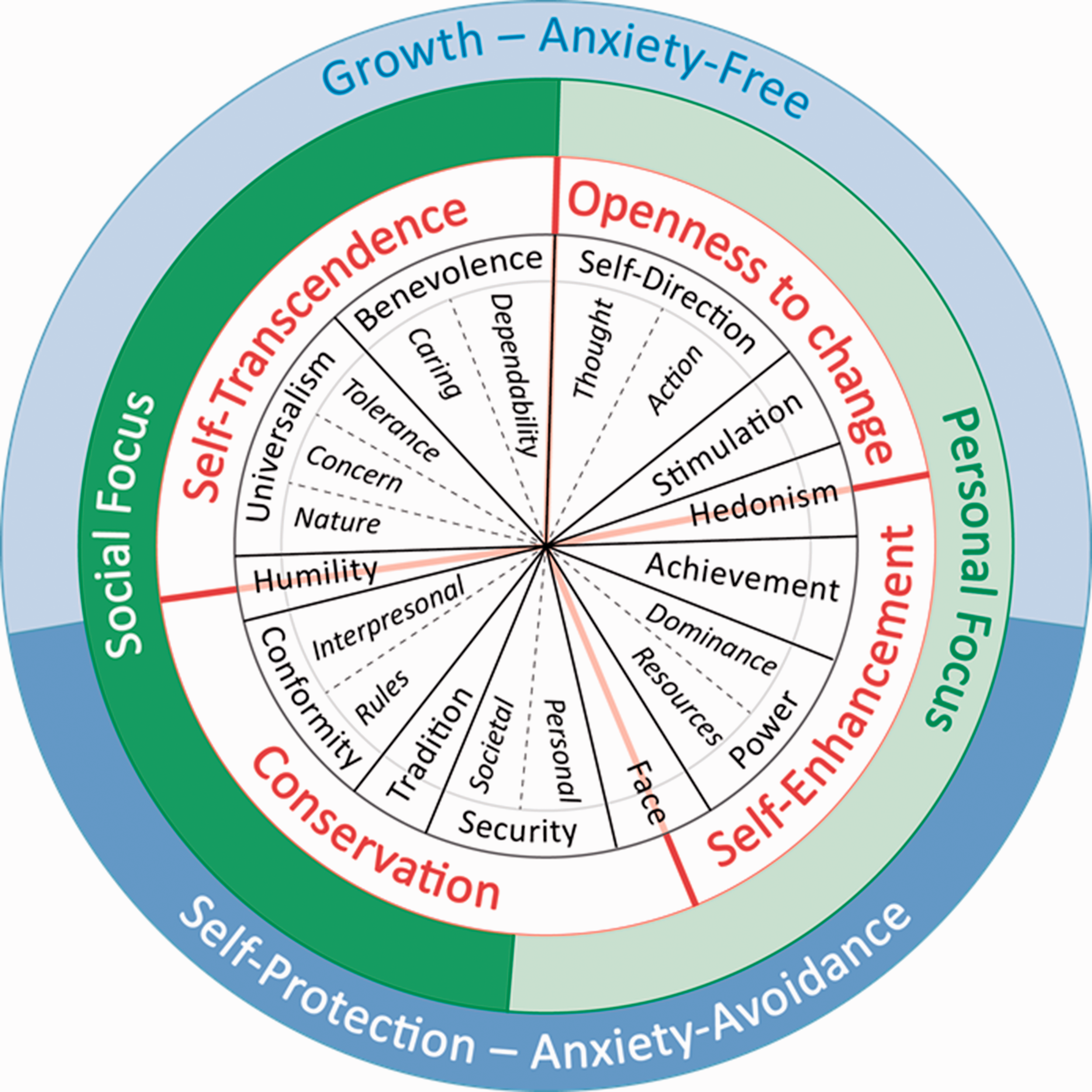
Schwartz’s quasi-circumplex model of values. It contains 19 personal values, four higher-order values, and two underlying motivational sources (adapted from Schwartz et al., 2012)
Causal theories about the interplay between values and subjective well-being
Several theories have been proposed to explain the repeatedly found cross-sectional associations between values and SWB (for a review, see Schwartz & Sortheix, 2018). These theories can be categorized into theories proposing that values cause SWB and theories proposing that SWB causes values. Before we review these theories, please note that the causal links proposed by these theories might depend on the normative values emphasized in one’s reference group, socio-economic context, and culture (for research on cultural and subcultural moderators see Sagiv & Schwartz, 2000; Sortheix & Lönnqvist, 2014; Sortheix & Schwartz, 2017).
Theories proposing a causal impact of values on subjective well-being
One theoretical perspective that proposes a causal impact of values on SWB is the “healthy values” perspective (Jensen & Bergin, 1988; Sagiv & Schwartz, 2000; see also Bilsky & Schwartz, 1994). On the basis of theories by Maslow and psychotherapy literature, this perspective argues that pursuing growth values (self-direction, benevolence, universalism, and stimulation) enhances well-being because growth values are self-actualizing. Self-actualization means that individuals do what they are fitted for (Maslow, 1987). For example, a person who is fitted for making music self-actualizes by making music. In contrast to pursuing growth values, pursuing deficiency values (conformity, tradition, security, and power) is believed to lead to perceptions, attitudes, or behaviors that reduce well-being.
A second theoretical perspective that proposes a causal impact of values on SWB builds on self-determination theory (Niemiec et al., 2009; Ryan & Deci, 2000; Ryan et al., 1999). This perspective argues that certain values relate positively to SWB because pursuing these values promotes the satisfaction of the basic needs of autonomy, competence, and relatedness. For example, self-direction values are assumed to relate positively to SWB because the pursuit of these values aims to satisfy the basic need of autonomy and thus can lead to highly rewarding fulfillment (see also, Welzel & Inglehart, 2010). In contrast, pursuing values that do not satisfy any of the three basic needs (e.g. power values) is believed to relate negatively to SWB because pursuing these values distracts from, and interferes with, the satisfaction of basic needs (Ryan et al., 1999).
A third and most recent theoretical perspective was put forward by Sortheix and Schwartz (2017). It integrates the two previous theoretical perspectives and a large body of empirical work. This perspective argues that two characteristics of a value determine whether that value promotes or undermines SWB. These characteristics are (a) the motivational orientation of the value—self-protection vs. growth—and (b) the focus of the value—personal vs. social. Growth-oriented (i.e. relatively anxiety free) values are believed to increase SWB because they lead to self-actualization and satisfy the needs for autonomy, relatedness, and competence. Conversely, self-protection oriented (i.e. anxiety-based) values reflect a perceived need to prevent or deal with threat and uncertainty. These values run counter to self-actualization and are thus believed to decrease SWB. Values with a personal focus are believed to increase SWB because they impel people toward self-actualization and the pursuit of personal success and gains. Conversely, values with a social focus are believed to decrease SWB because they cause concern for the problems, needs, and expectations of others. This perspective argues that openness-to-change values foster SWB because they combine a growth orientation and a person focus (Figure 1 and Table 1). Further, conservation values reduce SWB because they combine a self-protection orientation and a social focus. Finally, self-enhancement and self-transcendence values are thought to relate less consistently to SWB because they combine an orientation and a focus that have opposing implications for SWB: Self-enhancement values combine a self-protection orientation and a person focus. Self-transcendence values combine a growth orientation and a social focus (Sortheix & Schwartz, 2017).
Motivational basis of higher-order values and their theorized effects on subjective well-being.
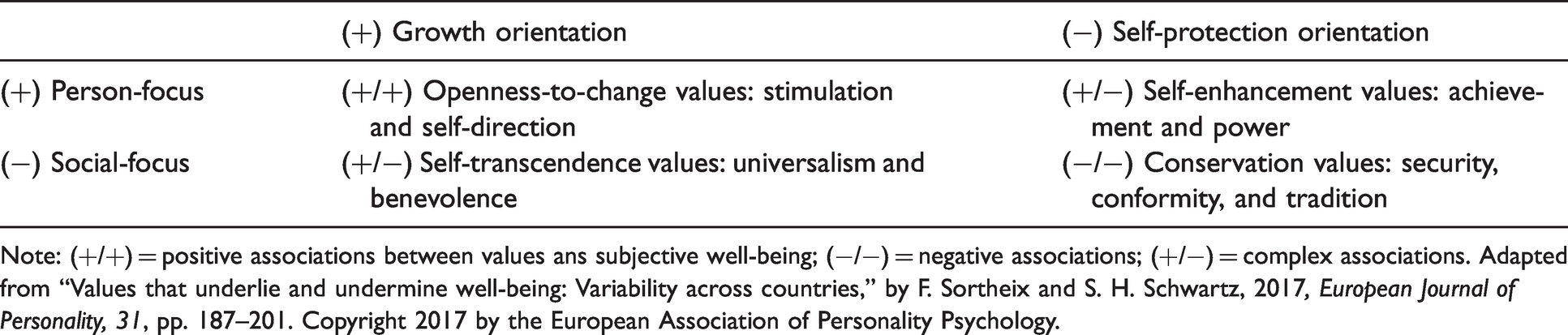
Note: (+/+) = positive associations between values ans subjective well-being; (−/−) = negative associations; (+/−) = complex associations. Adapted from “Values that underlie and undermine well‐being: Variability across countries,” by F. Sortheix and S. H. Schwartz, 2017, European Journal of Personality, 31, pp. 187–201. Copyright 2017 by the European Association of Personality Psychology.
The theoretical notion that increases in openness-to-change values lead to increases in SWB is compatible with the findings of a recent longitudinal study by Fetvadjiev and He (2019). They found that within-person elevations in self-direction values were associated with subsequent (one year later) within-person elevations in emotional and cognitive SWB in a Dutch sample from the general population. Hence, we hypothesized that increases in openness-to-change values cause increases in SWB (Hypothesis 1).
The theoretical notion that increases in conservation values lead to decreases in SWB was, however, challenged by the same study by Fetvadjiev and He (2019). Within-person elevations in conformity and security values were not negatively but positively associated with subsequent within-person elevations in SWB. Hence, we did not hypothesize that increases in conservation values cause decreases in SWB. Instead, we investigated whether there is evidence in line with the theoretical notion that increases in conservation values lead to decreases in SWB in an exploratory manner.
We also had no hypotheses for the two other higher-order values, self-transcendence and self-enhancement, because the theories and findings regarding these two higher-order values are inconsistent (Sortheix & Schwartz, 2017; see also Fetvadjiev & He, 2019). 1 We examined the associations of elevations in self-transcendence and self-enhancement values with subsequent elevations in SWB in an exploratory fashion.
Theories proposing a causal impact of SWB on values
The view that values cause SWB is currently dominant in the literature. However, there are also theoretical perspectives proposing that SWB causes values. These theoretical perspectives offer an alternative explanation for the often observed cross-sectional associations of values with SWB (Sortheix & Schwartz, 2017). Perhaps most prominently, Sagiv and Schwartz’s (2000) proposed that SWB increases openness-to-change values because SWB provides people with the emotional resources to pursue these values. Similarly, SWB is believed to decrease conservation values because increases in SWB alleviate feelings of vulnerability and difficulty coping with threat. This theoretical position is in line with the broaden-and-build theory by Fredrickson (2004). According to the broaden-and-build theory, positive emotions signal safety and thus lead to a broadened mindset and the discovery of novel ideas, actions, and social bonds (see also, Friedman et al., 2007; Gasper & Spencer,2018; Lyubomirsky et al., 2005). Negative emotions, on the other hand, signal threat and danger and thus lead to narrow and conservative thoughts and actions according to the broaden-and-build theory.
The general theoretical proposition that SWB has a causal impact on personal values has been buttressed by the study of Fetvadjiev and He (2019). In their study, within-person elevations in SWB tended to be more strongly associated with subsequent within-person elevations in personal values than within-person elevations in person values tended to be associated with subsequent within-person elevations in SWB. Furthermore, in line with the theoretical notion that increases in SWB lead to the adaption of openness-to-change values, within-person elevations in SWB were positively associated with subsequent within-person elevations in self-direction values. Hence, we hypothesized that increases in SWB cause increases in openness-to-change values (Hypothesis 2).
Within-person elevations in SWB were also positively associated with subsequent within-person elevations in security values and conformity values (Fetvadjiev & He, 2019). This finding contradicts the theoretical notion that increases in SWB lead to the abandonment of conservation values. Hence, we did not hypothesize possible causal effects of (decreases in) SWB on (decreases in) conservation values. Instead, we approached this question in a purely exploratory fashion.
The theories and findings for the other two higher-order values (self-transcendence and self-enhancement values) are again inconsistent. Hence, we again had no hypotheses for these two higher-order values but analyzed their associations with SWB in an exploratory fashion.
The current research
As we have just seen, existing theories propose that particular values cause SWB or that SWB causes particular values. The current study investigated whether these theorized causal effects about the values-SWB interface are in line with longitudinal associations between personal values and SWB. To be clear, the current study is unable to conclusively establish whether the proposed causal links exists or not because, for example, our non-experimental longitudinal design cannot rule out all potential confounders. Yet, the longitudinal evidence can make particular causal theories more or less plausible. The less plausible theories would not necessarily be wrong, but to reconcile these theories with the conflicting evidence, proponents of these theories would need to assume, for example, confounding mechanisms or suppression effects that explain why the longitudinal evidence would contradict these theories. By challenging some theories while not others, the longitudinal evidence of the current study can help to refine theories about the causal links between values and SWB.
We analyzed longitudinal data from the GESIS panel (GESIS, 2020). The GESIS panel is more representative of the target population than convenience samples are, thanks to its probability-based, mixed method design (Bosnjak et al., 2018). That is, the panel is based on a random sample of German-speaking people aged 18 to 70 residing in Germany, and the panelists can participate online or with paper-and-pencil. This mixed-mode strategy has improved the representation of the population, especially in terms of education (Bosnjak et al., 2018). Hence, the variance in personal values and SWB should be larger than in convenience samples, and the observed associations should be more representative of the average associations in the target population. Furthermore, the GESIS panel includes a large number of participants and measurement occasions—data from 12 measurement occasions were used in the current study. Hence, we should have enough statistical power to detect small to medium sized effects (i.e. standardized cross-lagged coefficients of .10 to .20; Gignac & Szodorai, 2016), and we should be able to fit complex structural equation models to the data.
We fit random intercept cross-lagged panel models (RI-CLPMs; Hamaker et al., 2015; for path diagrams, see Figure 2). We opted for RI-CLPMs, rather than the traditional cross-lagged panel models without random intercepts, because previous research suggests that a considerable amount of the variance in SWB and personal values is time-invariant (Anusic & Schimmack, 2016; Fetvadjiev & He, 2019; Milfont et al., 2016; Pöge, 2019; Vecchione et al., 2016). As cases in point, Anusic and Schimmack (2016) estimated that 42% of the reliable variance in affect and 52% of the reliable variance in life satisfaction is time-invariant, and Fetvadjiev and He (2019) estimated that, on average, 52% of the reliable variance in personal values is time-invariant. If constructs are characterized by time-invariant stability, cross-lagged panel models without random intercepts lead to distorted parameter estimates and erroneous conclusions (Berry & Willoughby, 2017; Hamaker et al., 2015; see also, Campbell & Kenny, 1999: Chapter 5). In contrast, RI-CLPMs prevent distorted parameter estimates by separating stable between-person associations from within-person associations (for details, see Methods section). This has the additional advantage that the estimation of cross-lagged regression coefficients in RI-CLPMs is not confounded by additive effects of time-invariant variables such as genotype, sex, or early childhood experiences—irrespective of whether these variables are observed or unobserved (Berry & Willoughby, 2017; Bollen & Brand, 2010).
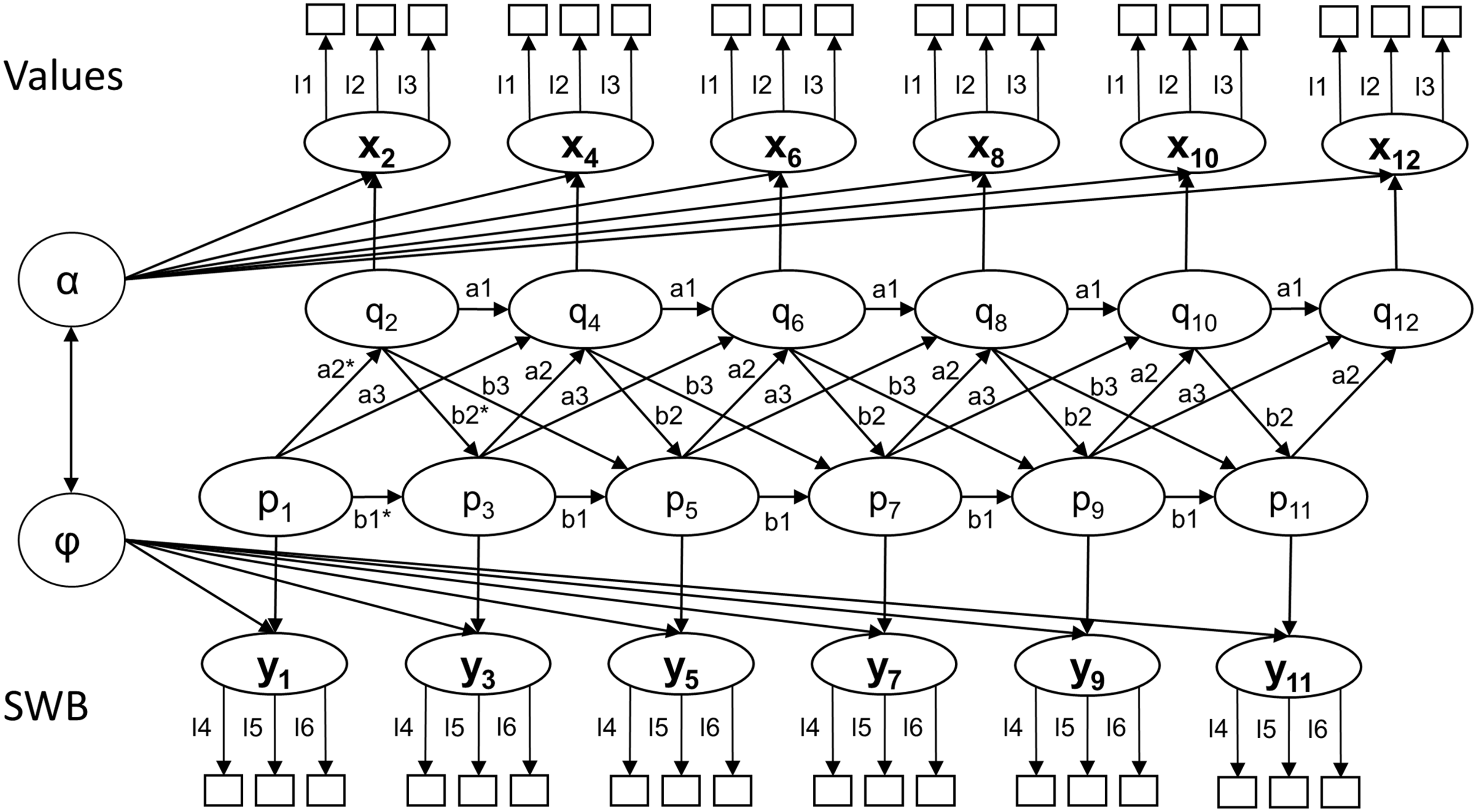
Bivariate random intercept cross-lagged panel model (Hamaker et al., 2015) with 6 and 18 months cross-lagged effects from personal values to subjective well-being and vice versa. This is a simplified version of the models that we fit (for exact model specifications see Method section and R code). Personal values were assessed every year in September. Subjective well-being was assessed every year in March. SWB = subjective well-being; xt = a human value at measurement occasion t; yt = a component of subjective well-being at measurement occasion t.
We fit RI-CLPMs with cross-lagged effects over both 6 months and 18 months (Figure 2) because the theoretically proposed causal effects might either come with a short or a long time lag. For example, increases in (the pursuit of) openness-to-change values might be accompanied by feelings of autonomy, which may increase SWB immediately. If this increase in SWB is not transient but lasts for some time, it should be detectable at the subsequent measurement occasion of SWB (i.e. six months later). Alternatively, a strong endorsement of openness-to-change values might lead to the attainment of more autonomy months or even years later, and this autonomy might lead to increases in SWB. Relatedly, Niemiec et al. (2009) found that placing high importance on intrinsic goals strongly predicted the attainment of intrinsic goals one year later (β = .51), and that attaining intrinsic goals was positively associated with well-being and negatively associated with ill-being (see also Oishi et al., 1999). The RI-CLPMs with cross-lagged effects over 6 and 18 months can indicate whether the longitudinal associations between values and SWB are in line with causal effects having short or long time lags, respectively.
Moreover, we investigated—in an exploratory manner—potential differences between a cognitive component of SWB, life satisfaction, and an affective component of SWB, frequency of positive and negative affect. These two commonly distinguished components differ in their developmental patterns and in how they are related to personality traits, life circumstances, life events, and life outcomes such as longevity (Busseri, 2015; Luhmann, Hofmann et al., 2012; Tov,2018). For example, cognitive SWB is more stable than affective SWB (Busseri, 2015; Luhmann et al., 2011). Furthermore, cognitive SWB seems to be more strongly affected by general life circumstances, whereas affective SWB seems to be more strongly affected by the personality traits extraversion and neuroticism as well as by specific everyday activities and events (Busseri, 2015; Luhmann, Hawkley et al., 2012). Similarly, the longitudinal associations between personal values and SWB might differ for the two components of SWB. Hence, although we mainly focused on SWB generally, we additionally explored potential differences between the cognitive and affective components of SWB.
Finally, we investigated—again in an exploratory manner—whether the three basic socio-demographic variables, age, gender, and education moderate the relationships between values and SWB. Socio-demographic variables have been found to be related to value orientations and SWB and changes in value orientations and SWB over time (Gouveia et al., 2015; Robins et al., 2002). For example, value orientations have been found to change across the lifespan (Carstensen et al., 2003). What is more, Schwartz and Sortheix (2018) reported that age and gender moderated cross-sectional correlations between values and SWB in data from the European Social Survey. For example, with increasing age, openness-to-change values were more positively correlated with SWB, while conservation and self-enhancement values were more negatively correlated with SWB. Hence, the strength and even direction of the longitudinal associations between values and SWB might depend on socio-demographic variables.
As in the current study, Fetvadjiev and He (2019) used RI-CLPMs to investigate longitudinal associations between values and SWB with panel data from a West European country. Despite these similarities, the study by Fetvadjiev and He and our current study differ in several important ways. First, due to differences in study goals, only the current study (but not the study by Fetvadjiev and He) investigated whether the cross-lagged effects of a specific personal value on SWB were significantly different from the cross-lagged effects of SWB on that specific value. Differences indicated which of the two variables (i.e. the specific value or SWB) appeared to be causally predominant (Bentler & Speckart, 1981; Hamaker et al., 2015). Second, although both studies had a one-year time interval between measurement occasions of the same variable, the lag for the cross-lagged effects was 12 or sometimes 24 months in the study by Fetvadjiev and He, whereas it was 6 and 18 months in the current study. Third, the current study was partly confirmatory in nature, whereas the study by Fetvadjiev and He was purely exploratory. At least, they did not preregister or state any hypotheses in their manuscript. Fourth, Fetvadjiev and He focused on seven individual values and thus only on part of the value space, whereas the current study focuses on the four higher-order values covering the entire value space.
We did not perform a power analysis because we would have needed to make many assumptions about variances, covariances, and effect sizes to do so. Furthermore, power analyses are less useful after data collection than prior to data collection because the sample size cannot be altered. Instead of a power analysis, we used an approach similar to equivalence testing (Lakens, 2017) to decide whether to interpret a statistically non-significant finding as inconsistent with a hypothesis or as inconclusive evidence (potentially due to a lack of statistical power; for details see Method section).
Method
Participants and procedure
The GESIS panel is an ongoing, longitudinal survey of German-speaking people aged 18 to 70 years who reside in private households that are registered in Germany (Bosnjak et al., 2018; GESIS, 2020). A two-stage sampling procedure first sampled municipalities and then individuals in the chosen municipalities randomly. All members of the probability sample (N = 21,870) were first contacted through a prenotification letter and then personally by an interviewer (minimum of four contact attempts). Of the probability sample, 7,599 participated in a computer-aided face-to-face recruitment interview. Interviewees who expressed their willingness to participate in the panel had the option of participating either via an online questionnaire or via a paper-and-pencil questionnaire sent via postal mail. Thirty-eight percent of the panelists chose to participate in the survey via mail (for more details on the sampling, recruitment rate, and sample composition bias, see Bosnjak et al.,2018; Steinacker & Schmidt, 2014).
Personal values have been assessed every year in and around September, whereas SWB has been assessed every year in and around March. At Time 1 in March 2014 (i.e. the first measurement occasion for SWB), 4,304 people responded to the survey. At Time 2 in September 2014 (i.e. the first measurement occasion for personal values), 4,035 people responded to the survey. We used the data from 12 measurement occasions over a five-year period: from 2014 to 2019 (for number of respondents at later measurement occasions, see https://dbk.gesis.org/dbksearch/download.asp?db=E&id=52782). To compensate for attrition, two new cohorts of individuals were sampled, one in 2016 and one in 2018, from the Allgemeine Bevölkerungsumfrage der Sozialwissenschaften (ALLBUS; GESIS – Leibniz Institut für Sozialwissenschaften, 2018). In the approved preregistered protocol, we stated that we would include all three cohorts in our analyses. However, we decided not to include the data of the third cohort because it had not been released at the time of the analysis (May/June 2020) and it was unclear when it would be made available. Thus, we included only the first two cohorts. The total sample size was 9,723 (51% female; Mage = 45.70; SDage = 15.14).
At each bimonthly assessment, panelists completed a 20-minute survey. Each survey devoted 15 minutes to studies submitted by panel users and 5 minutes to core study topics. Personal values and SWB were both in the core study of the panel, along with questions about personality, political behavior and orientations, environmental attitudes and behavior, and information/communication technology usage.
Preregistration and supplemental material
This is a registered report. The registration of the approved Stage 1 protocol can be found at https://osf.io/9pkaj. Supplemental tables, R code, and Mplus output files can be found at https://osf.io/ztruw. The codebook, questionnaires, wave reports, and study descriptions can be found at https://www.gesis.org/en/gesis-panel/documentation/. Although we are not allowed to publicly share the data, researchers can apply for free access to the data at https://www.gesis.org/gesis-panel/data. We used version 35.0.0 of the GESIS panel data (GESIS, 2020). A list of publications based on data from the GESIS panel can be found here: https://www.gesis.org/gesis-panel/gesis-panel-home/bibliography/.
Prior access of authors to the data
Two of the three authors (the first and the second author) had no access to the GESIS panel data and had not worked with the data at the time of the preregistration. The third author had access to and worked with the first 8 of the 12 measurement occasions of the data prior to the preregistration. He investigated the mean-level trajectories and rank-order stabilities of the four higher-order values. At no point did he analyze, nor even inspect, the data regarding SWB. Taken together, none of the authors had any prior information about relationships that were relevant to the present hypotheses.
Measures
Cronbach’s alphas for the values and SWB scales on all measurement occasions can be found on the diagonal of Table S1.
Personal values
The GESIS panel assessed the four higher-order values of Schwartz’s basic human values theory with 17 items. Five items assessed openness-to-change (i.e. the importance of following one’s own intellectual and emotional interests, especially in new situations; e.g. “It is important to her/him to extend her/his knowledge”). Three items assessed conservation (i.e. the importance of sticking to the rules of the society or the group, of seeking certainty, and of preserving the status quo; e.g. “It is important to her/him to maintain traditional values and beliefs”). Five items assessed self-transcendence (i.e. the importance of transcending selfish concerns and of promoting the welfare of other people; e.g. “It’s very important to her/him to help the people dear to her/him“). Finally, four items assessed self-enhancement (i.e. the importance of enhancing one’s own interests, even at the expense of others; e.g. “It is important to her/him to be the one who tells others what to do”). For each item, respondents were asked to indicate on a six-point rating scale how similar the person described in the item is to themselves (1 = is not similar to me at all; 6 = is very similar to me).
Subjective well-being
The cognitive component of SWB was assessed by seven rating scale items in the GESIS panel: One global life satisfaction item asked panelists how satisfied they were all in all with their current life (from 0 = extremely unsatisfied; 10 = extremely satisfied), 2 and six domain-specific life satisfaction items asked panelists how satisfied they were with specific domains of their life, namely, their family, work, leisure, friends, neighbors, and financial situation; (1 = very unsatisfied; 7 = very satisfied).
The affective component of SWB was assessed by eight six-point rating scale items that measure eight different affective states experienced during the last seven days (depressed, exhausted, restless sleep, happy, lonely, enjoyed life, sadness, could not get going; from 1 = never to 6 = always).
Statistical analyses
We conducted all analyses in a structural equation modeling framework and used maximum likelihood estimation with robust standard errors in Mplus (version 8; Muthén & Muthén, 2017). Robust maximum likelihood estimation uses full information from complete and incomplete cases (i.e. inclusion of cases with missing items and missing times of measurement). Therefore, the estimation has lower bias and higher statistical power than traditional missing-data handling techniques such as listwise deletion if data are missing at random or completely at random (Enders, 2010). To improve the chances of meeting the missing at random assumption, we included age at Time 1, gender, and educational attainment 3 as auxiliary variables (Enders, 2010). We ran all analyses with the R package MplusAutomation (version 0.7-3; Hallquist & Wiley, 2018).
We needed to adjust the preregistered R code after the pre-registration in three expected (preregistered) and three unexpected ways. Expected ways: (a) We needed to revise the section of the R code in which we cleaned and prepared the data (Chapter 1 of the R Code) once we were confronted with the peculiarities of the data from the GESIS panel. In particular, we integrated the R code on how to merge all data files of the GESIS panel that was provided by the GESIS panel team along with the data. (b) Whenever a cross-lagged coefficient was not consistent with a hypothesis, we added R code to test whether the standardized version of the coefficient was significantly less positive than a small positive effect of .10 (see also equivalence testing). (c) The preregistered R code contained over 8,500 lines. Thus, we needed to make several minor adjustments due to typos and errors. Unexpected ways: (a) We changed the R code for the measurement invariance analyses across age, gender, and education groups because we noticed that we need to specify the parameter constraints differently. (b) We increased the number of iterations and added starting values to several analyses models to facilitate model convergence. (c) We added R code to compute the correlation matrix and Cronbach’s alphas of the manifest scale scores of all six constructs across all measurement occasions because we realized that this information might be informative for future research (e.g. meta-analyses) (for details of all changes, see the history of commits at https://github.com/MichaelPaulGrosz/VAL_SWB/commits).
Measurement models and invariance
We modeled each of the four higher-order values and the two components of SWB as unidimensional latent variables with multiple indicators. Scalar (or “strong”) measurement invariance over time for the measurement models was assumed. That is, we set the parameters for the intercepts and factor loadings of all indicators to be equal across measurement occasions. We tested the assumption of measurement invariance for each latent variable in a separate model in a global test (e.g. ΔCFI < .01 and ΔRMSEA < .015; Chen, 2007). The results of these tests indicated that the assumption of scalar measurement invariance over measurement occasions was tenable for all values and subjective well-being constructs (all ΔCFIs < .01 and all ΔRMSEAs < .015; for details, see Table S2).
Moreover, we allowed the errors of the same item to correlate across measurement occasions to account for item specificity (correlated uniqueness; Figure 2). Otherwise, unmodeled item specificity might inflate estimates of stability in latent variables over time (Marsh & Hau, 1996).
Main analyses
Associations between openness-to-change values and subjective well-being (confirmatory analysis)
To investigate our hypotheses, we analyzed the data with two bivariate RI-CLPMs (Hamaker et al., 2015; Figure 2). In each model, two constructs were modeled: the openness-to-change values and one of the two SWB components.
The bivariate RI-CLPMs can be expressed as


The focus of the current study was on these temporal deviations qt and pt (i.e. within-person level). That said, we also investigated—in an explanatory manner—the relationships between the random intercept factors α and φ (i.e. between-person level). Inspecting the between-person associations might help to explain potential discrepancies between the current study and previous cross-sectional studies on the values–SWB interface, given that cross-sectional relationships are a weighted composite of within- and between-person relationships (Berry & Willoughby, 2017; Hamaker et al., 2015).
To investigate the 6- and 18-month cross-lagged effects (Figure 2), the temporal deviations qt and pt are modeled as


The unstandardized autoregressive coefficients a1 and b1 (i.e. stability paths) and the unstandardized cross-lagged regression coefficients a2, a3, b2, and b3 were constrained to be equal over time, except when indicated by an asterisk in Figure 2. Furthermore, from Time 3 onwards, the residuals εxt and εyt were also constrained to be equal over time so that the standardized cross-lagged regression coefficients were also equal over time (from Time 3 onwards).
The results were interpreted as consistent with Hypothesis 1 (i.e. an elevation in openness-to-change values causes elevations in SWB) if one or both of the two coefficients b2 and b3 were positive and statistically significant. Analogously, the results were interpreted as consistent with Hypothesis 2 (i.e. elevations in SWB cause elevations in openness-to-change values) if the coefficients a2 and/or a3 were significantly positive. Whenever a coefficient was not in the predicted direction or was not statistically significant, we tested whether the standardized version of the coefficient was significantly less positive than a small positive effect of .10 (i.e. –1 ≤ standardized coefficient < .10; see also equivalence testing, Lakens, 2017). Whenever a standardized coefficient was significantly less positive than .10, we interpreted the finding as challenging the existence of the hypothesized effect. If not, we interpreted the evidence as inconclusive.
Stronger support for a hypothesis accrues if the predicting variable (i.e. the value or SWB) appears to be causally predominant (Bentler & Speckart, 1981; Hamaker et al., 2015). We thus tested which of the two variables (i.e. the personal value or SWB) appeared to be causally predominant by investigating whether the standardized path b2 was significantly more positive (Hypotheses 1) or less positive (Hypothesis 2) than the standardized path a2. To conduct this test, we defined the difference between the standardized b2 and a2 as a new parameter Δab = a2 – b2 in Mplus and tested whether Δab was statistically significant. The evidence would have been compatible with a hypothesis if Δab was statistically significant and Δab and b2 or a2 were in the predicted directions. Whenever Δab was not statistically significant, we judged the evidence to be inconclusive. Analogously, we investigated whether the standardized coefficient b3 was significantly more positive (Hypotheses 1) or less positive (Hypothesis 2) than the standardized coefficient a3.
The test for causal predominance is not only unaffected by additive effects of time-invariant third variables but also by effects of time-varying third variables if (a) the effect of the third variable does not change over the course of the study (e.g. the effect is the same at Time 1 and Time 2; see also “assumption of stationarity”, Campbell & Kenny, 1999: Chapter 9) and (b) the effect of the third variable has a similar time lag for personal values as for SWB (e.g. the third variable causes values and SWB with a time lag of, say, zero months or the third variable causes both with a time lag of, say, 10 months). Hence, the test for causal predominance provides stronger evidence for a causal hypothesis than the significance test of a cross-lagged regression coefficient from a RI-CLPM. That said, even the test for causal predominance cannot rule out all potential confounding effects (e.g. the confounding effects of time-varying variables that affect values and SWB with different time lags). Hence, we interpreted all our results as compatible with or challenging a particular causal theory about the value-SWB interface, but we refrained from interpreting the results as confirming or refuting a particular causal theory.
Associations of conservation, self-transcendence, and self-enhancement values with subjective well-being (exploratory analysis)
As noted earlier, previous research does not suggest clear-cut hypotheses concerning the links between subjective well-being and the other three higher-order values: conservation, self-transcendence, and self-enhancement. In exploratory analyses, we fit the same bivariate RI-CLPMs with 6- and 18-month cross-lags (Figure 2) to investigate these values’ associations with SWB.
Robustness check with ipsatized items (exploratory analysis)
Several previous studies ipsatized the personal value items (i.e. subtracted the within-person mean across all value items from each individual value item) in order to assess the relative importance of a value compared to other values for that panelist (Sortheix & Schwartz, 2017). Ipsatizing also controls for individual differences in scale use and acquiescence and results in item scores that reflect the relative importance of each value relative to all others (i.e. value priorities). In our main analyses, we did not ipsatize the personal value items but used the raw value scores because time-invariant between-person differences in relative importance, scale use, and acquiescence are controlled for in the RI-CLPMs, and previous longitudinal research on the value-SWB interface had also used the raw scores (Fetvadjiev & He, 2019). We stated in the approved preregistered protocol that we would additionally run all main analyses with the ipsatized item scores as exploratory robustness checks. That is, from each panelist’s response to a value item, we subtracted that panelist’s time-specific average response (i.e. the mean score of that individual on all 17 value items of that measurement occasion). However, we were able to conduct the robustness check with ipsatized item scores only for self-enhancement models but not for models involving the three other values because these other models did not converge. For the models involving openness-to-change values, conservation values, and self-transcendence values, we were unable to resolve convergence issues by (a) increasing the number of iterations and (b) using starting models (for details, see commits from 6 to 8 May 2020 at https://github.com/MichaelPaulGrosz/VAL_SWB/commits). We think the random-intercept models with ipsatized value scores are less likely to converge because these models try to account for the responses to value items by more sources than is usually the case: (a) relative importance of value compared to other values and acquiescence (modeled by ipsatizing), (b) stable individual differences in values (modeled by random intercept factors), (c) individual’s temporal deviations from her or his expected score (modeled by an occasion-specific value factor), and (d) measurement error (modeled as residual variance).
Difference between cognitive and affective subjective well-being (exploratory analysis)
We investigated whether the longitudinal associations of personal values with affective SWB differ from those with cognitive SWB in three ways. First, we fit four trivariate RI-CLPMs, each including one of the four higher-order values (e.g. openness-to-change values) and both components of SWB. In each trivariate RI-CLPMs, we tested whether the standardized cross-lagged effect from the personal value on cognitive SWB assessed six months later was significantly different from the standardized cross-lagged effect from the same value on affective SWB assessed six months later. For this test, we defined the difference between these two standardized cross-lagged effects as a new model parameter in Mplus and tested whether this new parameter was statistically different from zero. Cognitive SWB was not an independent variable (i.e. predictor) in the cross-lagged regression equations in which affective SWB was the dependent variable (i.e. outcome variable). Analogously, affective SWB was not an independent variable in the cross-lagged regression equations in which cognitive SWB was the dependent variable. Instead, the concurrent and adjacent residual variances of the two components of SWB were allowed to freely covary. Second, in the same four trivariate RI-CLPMs, we tested whether the standardized cross-lagged effect from the value on cognitive SWB assessed 18 months later was significantly different from the standardized cross-lagged effect from the same value on affective SWB assessed 18 months later. Third, we descriptively compared the cross-lagged effects of cognitive and affective SWB on subsequently assessed personal values in the bivariate RI-CLPMs specified for the main analyses and in the trivariate RI-CLPMs. In the trivariate RI-CLPMs, we estimated the effect of one component of SWB on a personal value after controlling for the effect of the respective other component of SWB on that value (i.e. incremental effects of affective or cognitive SWB over and above each other).
Age, gender, and education as moderators (exploratory analysis)
We furthermore investigated whether the effects of values on SWB or the effects of SWB on values are moderated by age, gender, and education. To investigate the moderating role of age, gender, and education, we ran multiple-group analyses. In the multiple-group analyses for age, we ran all main analyses separately for each age group by splitting the sample in young adults (age 18 to 35 years), middle adults (age 36 to 54), and older adults (age 55 and older) according to the participant’s age at Time 1. To test whether age moderates the effect of values on SWB or SWB on values, we tested whether the difference Δab between the coefficients a2 and b2 in one age group was significantly different from that in any of the other two age groups. To conduct these tests, we defined a new parameter in Mplus for each difference across two groups in Δab and tested whether this new parameter was statistically significant. We conducted an analogous test for the coefficients b3 and a3. The moderating effects of gender and education were tested analogously in a multiple-group analysis with the two gender groups and a multiple-group analysis with the two education groups (see Footnote 4). That said, we were able to conduct the robustness check regarding age, gender, and education groups only for some models because several models failed to converge.
To make the results for the different age/gender/education groups comparable, we set the intercepts and loadings of all items on their latent variable equal across age/gender/education groups in each multiple-group analysis (i.e. scalar or strong measurement invariance). We tested the assumption of scalar measurement invariance for each latent variable in a separate model in a global test (e.g. ΔCFI < .01 and ΔRMSEA < .015; Chen, 2007). The results of these tests indicated that the assumption of scalar measurement invariance over age, gender, and education groups was tenable for all values and subjective well-being constructs (all ΔCFIs < .01 and all ΔRMSEAs < .015; for details, see Tables S3 to S5).
Model fit
We evaluated the model fit of each model with the comparative fit index (CFI), the root mean square error of approximation (RMSEA), and the standardized root mean square residual (SRMR). We also report Chi-squares but did not use them to evaluate the model fit because of its sensitivity to sample size. We followed conventional guidelines to judge model fit as good (acceptable) if CFI ≥ .97 (≥ .95), RMSEA ≤ .05 (≤ .08), and SRMR ≤ .05 (≤ .10; Schermelleh-Engel et al., 2003).
Alpha level and correction for multiple testing
The complexity of the RI-CLPMs might increase the standard errors of the cross-lagged parameter estimates and decrease statistical power. Thus, a conservative Bonferroni correction of the alpha level might lead to many nonsignificant results, including of parameters that have substantial and relevant effect sizes. Hence, we corrected for multiple testing in a more liberal way and simply used an alpha level of .01 to reduce the risk of type I and type II errors. The alpha level influences not only the type I but also the type II error rate because we used the alpha level to test not only whether there was enough evidence against the null hypothesis (null hypothesis significance testing) but also whether there was enough evidence against the alternative hypothesis (equivalence testing).
All significance tests that pertain to our hypotheses were one-tailed because our hypotheses were directional. For the exploratory analyses regarding the associations of subjective well-being with conservation, self-transcendence, and self-enhancement values, we reported two-tailed p-values. 5
Results
Table S1 displays the manifest correlation matrix for all six constructs across all measurement occasions. Tables S6 to S11 display the fit indices of all models of the associations between values and SWB. Although the CFIs were sometimes slightly below .950, most CFIs and all RMSEAs and SRMRs indicated acceptable to good model fit. All effect sizes a2, b2, a3, and b3 reported below are standardized effects.
Confirmatory findings
Openness-to-change values and subjective well-being
Consistent with Hypothesis 1 (i.e. openness-to-change values cause elevations in SWB), we found positive six-month cross-lagged effects of openness-to-change values on cognitive (b2 = .08; p ≤ .001) and affective SWB (b2 = .08; p ≤ .001; Table 2). In other words, within-person elevations in openness-to-change values were associated with subsequent within-person elevations in cognitive and affective SWB six months later. The standardized six-month cross-lagged effects from openness-to-change values to SWB did not differ significantly from the standardized six-month cross-lagged effects from SWB to openness-to-change values (for cognitive SWB: Δab = –.03; p = .104; for affective SWB: Δab = .00; p = .464). In other words, openness-to-change values did not appear to be causally predominant over SWB at the six-month lag.
Results from bivariate random intercept cross-lagged panel models (main results).
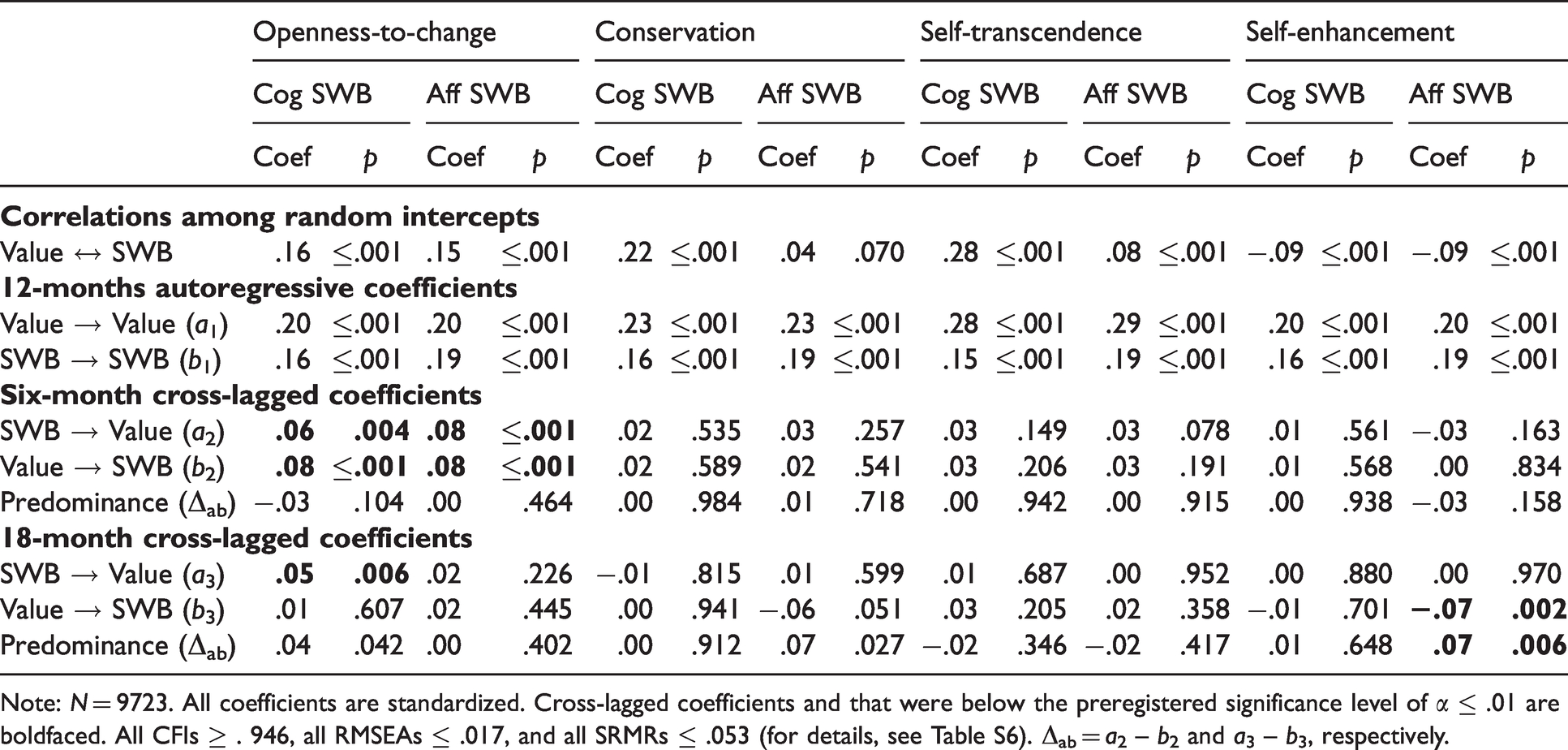
Note: N = 9723. All coefficients are standardized. Cross-lagged coefficients and that were below the preregistered significance level of α ≤ .01 are boldfaced. All CFIs ≥ . 946, all RMSEAs ≤ .017, and all SRMRs ≤ .053 (for details, see Table S6). Δab = a2 – b2 and a3 – b3, respectively.
Contrary to Hypothesis 1, we found no 18-month cross-lagged effects of openness-to-change values on cognitive SWB (b3 = .01; p = .607) or affective SWB (b3 = .02; p = .445). The two standardized effects were significantly less positive than an effect of .10 (both ps ≤ .001). Furthermore, the standardized 18-month cross-lagged effects from openness-to-change values to SWB did not differ significantly from the standardized cross-lagged effects from SWB to openness-to-change values (for cognitive SWB: Δab = .04; p = .042; for affective SWB: Δab = .00; p = .402). These findings challenge the notion that there is a long-term effect of openness-to-change values on SWB over and above a short-term effect. In other words, our results suggest that, if there is a long-term effect of openness-to-change values on SWB, then this effect is driven by effects with no or short time lag.
Consistent with Hypothesis 2 (i.e. SWB causes elevations in openness-to-change values), we found positive six-month cross-lagged effects from cognitive and affective SWB to openness-to-change values (for cognitive SWB: a2 = .06; p = .004; for affective SWB: a2 = .08; p ≤ .001; Table 2). In other words, within-person elevations in cognitive and affective SWB were associated with within-person elevations in openness-to-change values six months later. As reported above, the standardized six-month cross-lagged effects from the two types of SWB to openness-to-change values did not differ significantly from the corresponding standardized cross-lagged effect from openness-to-change values to SWB (Table 2). Hence, neither of the two types of SWB appeared to be causally predominant over openness-to-change values at the six-month lag.
We found a positive 18-month cross-lagged effect from cognitive SWB to openness-to-change values (a3 = .05; p = .006), which is consistent with Hypothesis 2. The 18-month cross-lagged effect from affective SWB to openness-to-change values was, however, not significant (a3 = .02; p = .226), and the standardized version of this effect was significantly less positive than an effect of .10 (p ≤ .001). As reported above, for both types of SWB, the standardized 18-month cross-lagged effect from SWB to openness-to-change values was not significantly different from the standardized 18-month cross-lagged effect from openness-to-change values to SWB in the test of causal predominance (Table 2). Hence, our findings provide only limited support for a long-term effect of SWB on openness-to-change values over and above a short-term effect.
Exploratory findings
Because 21 out of 44 models failed to converge, we were not able to run several of the exploratory but preregistered robustness check analyses: (a) random-intercept models with ipsatized value scores for openness-to-change values, conservation values, and self-transcendence values and (b) several multiple group analyses across age, gender, and education groups, respectively (for details, see Methods section, Tables S12, and S14 to S24).
Conservation, self-transcendence, and self-enhancement values and subjective well-being
In the main analyses involving the three other values, we found only one cross-lagged effect with a p-value below .01 (Table 2): Self-enhancement values had a negative 18-month cross-lagged effect on affective SWB (b3 = −.07; p = .002). In other words, within-person elevations in self-enhancement values were associated with within-person decreases in affective SWB 18 months later. Moreover, the 18-month cross-lagged effect from self-enhancement values to affective SWB differed significantly from the 18-month cross-lagged effect from affective SWB to self-enhancement values (Δab = .07; p = .006). This suggests that self-enhancement values were causally predominant over affective SWB. If confirmed in future research, these results would be in line with a lagged negative causal effect of self-enhancement values on affective SWB.
In the self-enhancement models with ipsatized item scores (Table S12), we also found a negative 18-month cross-lagged effect from self-enhancement to affective SWB (b3 = −.22; p ≤ .001). This effect was three times the size of effect found in the analysis with raw scores (b3 = −.07). The effect was again significantly more negative than the 18-month cross-lagged effect from affective SWB to self-enhancement values (Δab = .23; p ≤ .001). Additionally, the models with ipsatized items yielded negative 6- and 18-month cross-lagged effects from self-enhancement values to cognitive SWB (b2 = −.16; b3 = −.18; both ps = .007) and a negative six-month cross-lagged effect from affective SWB to self-enhancement values (a2 = −.10; p ≤ .001). The test of causal predominance was not significant for any of the latter three effects (Table S12).
Differences between cognitive and affective subjective well-being (exploratory analysis)
The effects involving cognitive and affective SWB were largely similar. This was the case in the main analyses (Table 2), in the analyses with ipsatized item scores (Table S12), and in the trivariate RI-CLPMs including one of the four higher-order values and both components of SWB (Table S13). For example, in the four trivariate RI-CLPMs, none of the effects on cognitive SWB differed significantly from the effects on affective SWB (Table S13). The most notable difference was in the 18-month cross-lagged effects of self-enhancement values on SWB. These effects were significantly negative for affective SWB but negligible for cognitive SWB in both the main analyses (b3 = −.07; p = .002 vs. b3 = −.01; p = .701) and the trivariate RI-CLPMs (b3 = −.07; p ≤ .001 vs. b3 = −.02; p = .460). In the models with ipsatized values scores, the 18-month cross-lagged effects of self-enhancement values on cognitive and affective SWB were both significant and comparable in size (b3 = −.18; p = .007 and b3 = −.22; p ≤ .001, respectively).
Age, gender, and education as moderators
Tables S14 to S24 display the results of the multiple-group analyses with different age, gender, and education groups, respectively. We found only two significant differences: The difference between the six-month cross-lagged effect from openness-to-change values to cognitive SWB and the six-month cross-lagged effect from cognitive SWB to openness-to-change values was significantly more negative in the young age group than in the middle age group (Δ in Δab = −.16; p = .005) and the old age group (Δ in Δab = −.20; p ≤ .001; Table S14). That is, cognitive SWB appeared to be more causally predominant over openness-to-change values among young adults (age 18 to 35 years) than among middle-aged adults (age 36 to 54) and older adults (age 55 and older). Accordingly, the test for causal predominance was significant among young adults (Δab = −.17; p ≤ .001) but not among middle (Δab = .00; p = .948) and older adults (Δab = .03; p = .415; Table S17). Because these comparisons of the tests for causal predominance across age, gender, and education groups are difficult to interpret, we encourage readers interested in differences across age, gender, and education groups to inspect the cross-lagged effects in Tables S17 to S24.
Discussion
The current study used data from a German panel study to investigate the longitudinal interplay between personal values and SWB. We found cross-lagged effects from openness-to-change values to SWB and from SWB to openness-to-change values. These findings are consistent with findings by Fetvadjiev and He (2019) and the hypothesized bidirectional causal effects between openness-to-change values and SWB. Neither openness-to-change values nor SWB appeared to be causally predominant. The bidirectional cross-lagged effects between openness-to-change values and SWB may be due to causal effects of similar size in both directions (i.e. from openness-to-change values to SWB and from SWB to openness-to-change values). Alternatively, the bidirectional cross-lagged effects might be due to confounding effects or causal effects only in one direction (for a discussion of this issue, see Limitations section).
A causal effect from SWB on openness-to-change values would be in line with the theoretical notions that SWB provides people with the emotional resources to pursue openness-to-change values (Sagiv & Schwartz, 2000) or that SWB signals safety and thus lead to a broadened mindset and the discovery of novel ideas, actions, and social bonds (Fredrickson, 2004). In turn, a causal effect from openness-to-change values on SWB would be consistent with the theory that values with a growth orientation and a person focus lead to high SWB, whereas values with a self-protection orientation and a social focus lead to low SWB (Figure 1 and Table 1; Sortheix & Schwartz; 2017). That said, we did not find evidence in line with a negative causal effect of conservation values (i.e. self-protection orientation and social focus) on SWB. Fetvadjiev and He (2019) found even many positive cross-lagged effects from the lower-order conservation values, conformity and security, to SWB. Thus, values with a self-protection orientation and a social focus might not be as harmful as the theory by Sortheix and Schwartz suggests.
An exploratory finding of the current study suggested that openness-to-change values have a particularly strong positive effect on cognitive SWB among young adults (age 18 to 35 years), as opposed to middle-aged and older adults. Given that this finding was exploratory and we did not find a similar effect on affective SWB, we think this finding needs to be investigated and replicated in a different sample before we can draw any substantial conclusions.
Furthermore, we found some evidence in line with a negative causal effect of self-enhancement values on SWB, especially for effects with a long lag and in the analysis with ipsatized items (i.e. relative importance of self-enhancement values). However, the evidence was mixed and the findings were exploratory. Thus, they need to be replicated by future research. If they were to be confirmed, they would fit theories that propose that extrinsic goals and narcissistic tendencies have adverse long-term effects on SWB (Campbell & Campbell, 2009; Ryan & Deci, 2000). For example, self-determination theory argues that pursuing extrinsic goals such as fame, image, or money interferes with fulfilling the basic needs of autonomy, competence, and relatedness, thereby leading to lower SWB in the long run (Ryan & Deci, 2000). Similarly, the contextual reinforcement model (Campbell & Campbell 2009) proposes that narcissistic tendencies, which strongly overlap with self-enhancement values (Anello et al., 2019), are not very harmful for the self in the short run but lead to depression and other problems over time.
Besides the five effects involving openness-to-change values and one 18-month effect involving self-enhancement values, we found 26 nonsignificant cross-lagged effects between personal values and SWB in the main analyses. The relatively large number of nonsignificant cross-lagged effects (i.e. within-person associations) is noteworthy, given that most associations on the between person-level were significant (i.e. correlations among random intercepts in our analyses; Table 2) and that previous research reported many cross-sectional associations between values and SWB (Sortheix & Schwartz, 2017). The discrepancy between within-person associations and between-person/cross-sectional associations might indicate that the causal relationships linking values with SWB differ across within- and between-person level. Perhaps associations on the between-person level and thus cross-sectional associations are spurious. They may reflect the influence of time-invariant confounders such as genotype, cultural socialization during childhood, or gender, whereas the RI-CLPM purges the within-person associations from additive confounding effects of such time-invariant background variables. In any case, the discrepancies between the within- and between-person levels underline the value of disaggregating the two levels via longitudinal research designs and modeling approaches because the cross-sectional associations are a weighted blend of within- and between-person associations (Berry & Willoughby, 2017; Hamaker et al., 2015).
We found fewer cross-lagged effects than Fetvadjiev and He (2019) did. To understand this discrepancy, it is important to note that the two studies differed in several respects (length of time lag, sample size and thus statistical power, country population, assessment of SWB and values, etc.). For example, Fetvadjiev and He assessed two dimensions of affective SWB, positive affect and negative affect, each with 10 PANAS items. The current study assessed only one overall dimension of affective SWB, with six negative affect items and two positive affect items. This difference in assessment might matter because Fetvadjiev and He reported descriptively higher mean absolute standardized cross-lagged effects for positive affect (from value to SWB = .14; from SWB to value = .14) than for negative affect (from value to SWB = .04; from SWB to value = .05) and cognitive SWB (from value to SWB = .04; from SWB to value = .09). Perhaps within-person differences in positive affect are more strongly linked to within-person differences in values than within-person differences in other aspects of SWB are. Future research might probe this and other potential reasons for the across-study differences in cross-lagged effects.
Limitations and future research
Our data and modeling strategy (RI-CLPMs) enabled us to rule out additive confounding effects of time-invariant variables, both observed and unobserved (Berry & Willoughby, 2017; Bollen & Brand, 2010). Nonetheless, effects of time-varying variables and interaction effects involving time-invariant variables might have biased the estimates of the cross-lagged effects. Such confounding effects are a potential explanation for the bidirectional cross-lagged effects that we found between openness-to-change values and SWB and for why neither openness-to-change values nor SWB appeared to be causally predominant. 6 In order to identify potential confounding variables, it might be worthwhile to review existing theories and empirical research on personal values and SWB. For example, Bardi et al. (2009) found that the amount of value change and an aggregate score of 33 life events were related. Thus, life events might be time-varying variables that cause change in both values and SWB. Nonadditive effects of time-invariant variables could be interactions involving time-invariant and time-varying variables, for example gene × environment interactions (Briley & Tucker-Drob, 2014). Future research needs to rule out confounding effects of time-varying variables and nonadditive confounding effects of time-invariant variables. This could be done by including time-varying variables as control variables in RI-CLPMs. Better yet, researchers might randomly assign participants to groups that do or do not receive an intervention that increases openness-change values and investigate whether the intervention increases levels of SWB. Such an openness-change values intervention study might not only be informative for theories on the causal links between values and SWB but also for designing practical interventions aimed at increasing SWB.
An alternative explanation for the observed bidirectional cross-lagged effects might be causal effects not in two but one direction. Imagine, for example, that increases in openness-to-change values caused an immediate increase in SWB while increases in SWB did not cause changes in openness-to-change values. Then increases in openness-to-change values between Time 2 and Time 3 led to increases in SWB at Time 3 and openness-to-change values at Time 4 (Figure 2). The result would be a positive cross-lagged coefficient a2 from SWB to openness-to-change values despite the absence of a causal effect from SWB to openness-to-change values. That said, we think unidirectional causal effects are an unlikely explanation for the observed bidirectional cross-lagged effects because Fetvadjiev and He (2019) found similar bidirectional effects between self-direction values and SWB, yet they assessed values and SWB simultaneously (i.e. not on different measurement occasions). The simultaneous assessment reduces the possibility that bidirectional coefficients are driven by unidirectional causal effects.
One might also attribute the bidirectional cross-lagged effects we observed to overlap in the item content. That is, the openness-to-change and SWB items might, to some extent, measure the same latent trait. If so, increases in the openness-to-change measure would be accompanied by increases in the SWB measure six-month later and vice versa, even without a causal effect from openness-to-change values to SWB. For example, if the latent trait that both openness-to-change values items and SWB items measure would increase three months before the second measurement of values, then the values would appear to be higher at their second measurement occasion and the SWB would appear to be higher 6 months after the second measurement occasion of the values. As a consequence, there would be a six-month cross-lagged effect from openness-to-change values items to SWB. However, close examination of the items that measured the two variables reveals no meaningful overlap between them. Moreover, the 18-month cross-lagged effect from cognitive SWB to openness-to-change values opposes such an explanation. This effect emerged even though we controlled for openness-to-change values 12 months earlier.
There is evidence that culture moderates the links between personal values and SWB (Sagiv & Schwartz, 2000; Sortheix & Lönnqvist, 2014; Sortheix & Schwartz, 2017). Hence, the longitudinal associations between personal values and SWB that we found in German data may not replicate in other nations. Additional research is needed to assess the generality of our findings.
We attempted to investigate causal effects with a short time lag (including immediate effects) by cross-lagged effects over six months. A reviewer raised the concern during the stage 2 review process that immediate effects might not persist for such a long time period. For example, increases in conservation values might only lead to short-lived increases or decreases in SWB. Via our design and analysis, we were only able to investigate lasting effects. Future studies might want to use more intensive designs with more frequent measurement occasions to investigate not only lasting but also short-lived effects of values on SWB and SWB on values.
Relatedly, future research might profitably refine and formalize the theoretical positions about the values-SWB interface. For example, theorists might specify the timing of the effect of values on SWB and SWB on values. Future empirical endeavors could then develop study designs with tailored time lags. Future research might further utilize qualitative methods (interviews, responses to open-ended questions) to gain direct insight into why change in particular values is related to change in SWB or vice versa (Rohrer et al., 2017).
Conclusion
Our analysis of a large-scale longitudinal study went beyond past cross-sectional research on the values-SWB interface by separating within-person from between-person associations between values and SWB. We observed bidirectional six-month cross-lagged effects between openness-to-change values and SWB. These findings are consistent with causal effects from openness to change values on SWB and from SWB to openness to change values that have been proposed in theories of the values-SWB interface (Sortheix & Schwartz, 2017). We hope that the current study spurs further efforts to identify the causal effects between personal values and SWB.
Footnotes
Acknowledgments
We thank Mitja Back, Julia Rohrer, and two anonymous reviewers for their helpful feedback during the stage 1 and stage 2 review process. We also thank our student research assistants Fahima Farkhari, Christian Blötner, and Julia Lemp for their help with preparing the manuscript.
Data accessibility statement
The R code and Mplus output files can be found at https://osf.io/ztruw. The codebook, questionnaires, wave reports, and study descriptions can be found at https://www.gesis.org/en/gesis-panel/documentation/. We were not allowed to publicly share the data. Researchers can apply for free access to the data at https://www.gesis.org/gesis-panel/data. We used version 35.0.0 of the GESIS panel data (GESIS, 2020).
Declaration of conflicting interests
The author(s) declared no potential conflicts of interest with respect to the research, authorship, and/or publication of this article.
Funding
This research was supported by a grant from the Leibniz Foundation (“Leibniz Competence Center on Socio-Emotional Skills”; PIs: Beatrice Rammstedt, Clemens Lechner, and Daniel Danner).
