




Abstract
Whereas theory and research agree that social interactions are central mediators of the associations between personality traits and relationship outcomes, less is known about the mechanisms involved. This is particularly evident when looking at adolescence, when social networks restructure and expand. Drawing on experience sampling data from two adolescent samples (overall N > 200), we examined which self- and other-perceptions of real-life social interaction behaviors contribute to the links between personality traits (i.e., extraversion, agreeableness, and neuroticism) and momentary satisfaction with social interactions. Multilevel exploratory factor analyses revealed that most social perceptions could be represented by two factors, labeled expressive and communal behavior. As hypothesized, we found that higher extraversion and agreeableness and lower neuroticism predicted greater social satisfaction. These associations were mediated by perceptions of more expressive and communal behaviors in the case of agreeableness and extraversion and perceptions of less expressive behavior in the case of neuroticism. Contrary to our expectations, the results were the same no matter whether self- or other-perceptions were used as mediators. We discuss how our results provide information about the co-development of personality traits and social relationships from a microlevel perspective and outline directions for future research on perceived social interaction behavior.
Whereas social relationships represent an essential human need across the entire lifespan (Baumeister & Leary, 1995; Kahn & Antonucci, 1980), building and maintaining social relationships is of particular interest in late adolescence when relationships outside the family and a new level of intimacy are pursued (Rubin et al., 2006). A growing body of research has shown that personality—defined as a set of relatively enduring patterns of thoughts, feelings, and behaviors (Roberts et al., 2006)—is related to relationship quality (e.g., Asendorpf & Wilpers, 1998; Parker et al., 2012; Wagner et al., 2014). Among the Big Five personality traits, high extraversion, high agreeableness, and low neuroticism have consistently appeared as predictors of positive relationship experiences (Harris & Vazire, 2016; Mund et al., 2016). Theory and research generally agree that these macrolevel associations between personality traits and relationship outcomes are mediated by daily social interactions (e.g., Back et al., 2011; Baumeister & Leary, 1995; Caughlin et al., 2000), yet the underlying microlevel mechanisms are not well understood. Moreover, because studies on social interaction dynamics have tended to target young adults or people in older age groups (e.g., Chui et al., 2014; Mueller et al., 2019; Sun et al., 2017), it is unclear whether existing findings apply to the reality of adolescent life (e.g., unique developmental tasks and related social network characteristics; Aquilino, 2006; Rubin et al., 2006).
To address this research gap, the current article uses experience sampling method (ESM) data from two adolescent samples and aims to test for whether associations between personality traits and satisfaction with social interactions generalize to adolescents and to identify social interaction behaviors and perceptions that explain these associations in real-life contexts at the microlevel. With this study, we hope to move this research field forward in four important ways: First, our study is the first to examine personality traits and social interactions in adolescents. Second, forming empirically derived indices from a wide range of naturally occurring perceived social interaction behaviors assessed in an ESM design provides new insights into the perceptions involved in social interactions in everyday life. Third, we aim to shed light on the mediating role of these interpersonal perceptions in the associations between personality and social satisfaction. Finally, we aim to provide a new level of detail to this interplay by distinguishing associations across personality traits vs. facets and by differentiating between social perceptions concerning the self and the interaction partner. In the following, we draw on the rich body of literature on associations between personality traits and social relationship outcomes on the macrolevel to make inferences about corresponding, but less empirically tested and, thus, less understood microlevel associations and processes in social interactions.
The interplay between personality traits and social satisfaction in late adolescence
The belongingness hypothesis (Baumeister & Leary, 1995) states that the need to belong to someone and have frequent pleasant interactions has evolved as a result of evolutionary selection. A satisfying social relationship—defined as direct, repeated, and dynamic interactions between two individuals—which is mentally represented and recognized as a relationship by both interaction partners (Asendorpf & Banse, 2000; Hinde, 1979), has an enhancing effect on well-being and health (Cohen, 2004; Diener & Seligman, 2002). In late adolescence, strong social ties might be particularly crucial because individuals and their social networks both experience radical changes: The graduation from school marks the end of childhood (or the beginning of emerging adulthood) and a time of personality maturation and adaption to new social roles (Arnett, 2000; Roisman et al., 2004). In this chapter in life, social networks transform, new relationships gain importance, and others have to be redefined (Wagner et al., 2014). Therefore, it is important to understand which factors contribute to adolescents’ establishment and maintenance of well-functioning, satisfying social relationships and repeated interactions within these dyads.
Personality traits are a key ingredient of functioning social relationships (Back, 2021; Back et al., 2011), or—as assumed in the dynamic-interactional paradigm—personality traits and social relationships co-develop over time (Neyer & Asendorpf, 2001). Within the Big Five taxonomy (McCrae & Costa, 1989), research has consistently pointed to the impact of extraversion, agreeableness, and neuroticism on socially relevant outcomes, whereas the effects of openness and conscientiousness seem to be less pronounced (Harris & Vazire, 2016; Mund et al., 2016). Therefore, the current study focuses on how neuroticism, extraversion, and agreeableness are associated with interindividual differences in social relationships and social interactions. Whereas most previous studies have provided information about personality–social–relationship dynamics in the long run (i.e., on the macrolevel), little research has examined these dynamics from a short-term perspective (i.e., on the microlevel). Dynamic interactional theories (Back et al., 2011; Thibaut & Kelley, 1978) suggest that multiple positive or negative interpersonal experiences accumulate into an overall level of relationship satisfaction. In order to understand how personality traits are related to adolescents’ social relationships over time, it is necessary to understand how these traits are related to momentary satisfaction with social interactions.
Perceived social interaction behavior: Mediator of the interplay between personality traits and social satisfaction?
Back et al.’s (2011) framework for analyzing the complex dynamics of personality and social relationships—the PERSOC framework—provides theoretical scaffolding for studying the links between personality traits and interpersonal outcomes. The model proposes that personality traits and social relationships can mutually influence each other and that (perceptions of) daily social interactions are central mediators for explaining this association. To gain a better understanding of these dynamics, we investigated how stable interindividual differences (i.e., at the person-level) are related to average measures of momentary social interaction processes (i.e., at the situation-level). Specifically, we examined whether perceptions of momentary social interaction behaviors function as mediators of the associations between personality traits and momentary satisfaction with social interactions. To maintain parsimony, and in line with our study design, we focused on interactions between two people and on the perceptions of one interaction partner.
From the perspective of an individual, (at least) two types of information appear to be relevant for the experience of a social interaction: the individual’s momentary perception of their own behavior (perception of self) and their momentary perception of the interaction partner’s behavior (perception of other). Whereas each of these types of perceived behaviors partly reflect actual external (social) events and partly reflect the individual’s tendency to process information (Barrett & Pietromonaco, 1997; Bond, 1994), it is the interwoven combination of these two factors that accounts for a person’s subjective experience of the social interaction (Furr & Funder, in press). Initial empirical research using ESM data from student samples (Geukes et al., 2019) and married couples’ problem-solving discussions in the laboratory (McNulty, 2008) have demonstrated that an individual’s perception of self and other are both related to, first, this person’s personality traits and, second, to the individual’s social experience (e.g., Caughlin et al., 2000). For example, people higher on extraversion reveal more information about themselves over the course of a social interaction (Geukes et al., 2017) and experience greater satisfaction from perceiving themselves as self-revealing (Collins & Miller, 1994). Along these lines, we hypothesize that both types of perception are likely to partially explain the links between personality traits and momentary satisfaction with social interactions in our adolescent sample.
Links of personality traits with perceived social interaction behaviors and social satisfaction: Trait-specific mediation models
Whereas manifestations of personality traits in daily and momentary social interactions are not very well understood, previous empirical studies using adolescent and young adult samples have supported the theoretically proposed associations between personality traits and social relationship characteristics on the macrolevel. Extraversion has predicted the formation of new relationships (Asendorpf & Wilpers, 1998; Harris et al., 2017; Klimstra et al., 2013; Wagner et al., 2014) and higher levels of emotional closeness (Harris et al., 2017; Wagner et al., 2014). Agreeableness has predicted lower rates of conflict (Asendorpf & Wilpers, 1998; Deventer et al., 2019; Parker et al., 2012), declines in insecurity (Deventer et al., 2019; Parker et al., 2012), and higher levels of emotional closeness as well as relationship stability (Wagner et al., 2014). Neuroticism has predicted increases in insecurity (Deventer et al., 2019; Parker et al., 2012), higher rates of conflict (Borghuis et al., 2019), and lower levels of emotional closeness (Wagner et al., 2014).
Overall, both extraversion and agreeableness have primarily been associated with positive relationship outcomes, whereas neuroticism has shown largely negative effects. On the level of daily social interactions, we argue that these macrolevel associations should be mirrored in each trait’s associations with higher (or lower) average levels of momentary social satisfaction. In addition, we propose that extraversion, agreeableness, and neuroticism also differ in their associations with the perception of self and the perception of other. Based on this trait-specificity of both social satisfaction and social perceptions, in turn, the perception of self and perception of other should ultimately emerge as distinct mediators in the association between each trait and momentary satisfaction (see Morse et al., 2015). In the following, we summarize findings from social interaction studies—most of which have used university student samples—that seem to support this differential argumentation.
We propose that extraversion—the most observable of all traits (Back, 2021; McCrae & Costa, 1989)—is most salient in an individual’s behavior and corresponding self-perceptions. In previous studies that have used experience-sampling data (Breil et al., 2019; Geukes et al., 2019; Wilson et al., 2015) and ratings of videotaped interactions in unacquainted triads (Morse et al., 2015), extraversion was related to more sociable, friendly, and self-revealing behavior and to less emotion suppression. In addition, extraversion has been associated with perceptions of control in social interactions (Barrett & Pietromonaco, 1997; Cuperman & Ickes, 2009) and being the focus of attention (Sherman et al., 2013). Overall, it seems likely that individuals high on extraversion will attribute social experiences primarily to their own behavior. Their momentary satisfaction with social interactions should thus depend mainly on their perception of self.
Agreeableness’ relevance to interpersonal behavior is similar to extraversion’s (McCrae & Costa, 1989) but instead concerns the maintenance of positive relationships with others rather than social impact (e.g., Wagner et al., 2014). We propose that agreeableness becomes salient in both an individual’s self-perceptions and the person’s perceptions of the interaction partner. In previous studies using experience-sampling reports (Geukes et al., 2017) or ratings of undergraduates’ videotaped social interactions (Back et al., 2009; Berry & Hansen, 2000), agreeableness was related to more expressive, modest, and attentive behavior and to less arrogant behavior. The trait has been linked to tender-mindedness and a tendency to perceive positive characteristics in other people (Cuperman & Ickes, 2009; McCrae & Costa, 1989; Rau et al., 2020). Moreover, agreeable behavior and its conflict-avoiding aspects (Jensen-Campbell & Graziano, 2001; Parker et al., 2012) can potentially trigger friendlier behavior in the interaction partner. Overall, it seems likely that individuals who score high on agreeableness will attribute social experiences to both their own and the other person’s behavior. Their momentary satisfaction with social interactions should thus depend on perceptions of both self and other.
Finally, we propose that neuroticism—a trait that is predominantly related to thoughts and feelings (McCrae & Costa, 1989)—is most salient in an individual’s perceptions of the interaction partner. In previous research on romantic couples, individuals higher on neuroticism perceived their partner’s behavior in problem-solving discussions more negatively (McNulty, 2008), and an interpretation bias in hypothetical scenarios mediated the trait’s negative effect on relationship satisfaction (Finn et al., 2013). Using ESM, Hannuschke et al. (2020) found that neuroticism was related to perceptions of more warmth and sociability in the interaction partner and argued that these results might reflect the tendency of people high on neuroticism to perceive others more positively in contrast to themselves. Other studies have found associations between high neuroticism and a stronger responsiveness to (negative) social cues (Denissen & Penke, 2008; Geukes et al., 2017), a closer coupling with the romantic partner’s positive affect (Mueller et al., 2021), attempts to adapt to others’ behavior (Cuperman & Ickes, 2009), and perceptions of threat, criticism, deception, and negativity (Morse et al., 2015; Sherman et al., 2013). Overall, it seems likely that individuals high on neuroticism will attribute social experiences primarily to their interaction partner’s behavior. Their momentary satisfaction with social interactions should thus depend mainly on the perception of other.
Despite the presence of all these rich studies that have examined the complex relationships between personality traits, interpersonal dynamics, and relationship experiences, we identified four limitations that we aimed to address with our study: First, many studies took place in a laboratory setting (e.g., Berry & Hansen, 2000; McNulty, 2008; Vater & Schröder-Abé, 2015), leaving unknown the extent to which the results could be generalized to real-life interactions. Second, using university students at zero-acquaintance (e.g., Berry & Hansen, 2000; Morse et al., 2015), psychology freshmen (e.g., Geukes et al., 2017; Hannuschke et al., 2020), or married couples (e.g., McNulty, 2008), only specific types of relationships, social interactions, and life circumstances have been studied. Third, some studies (Caughlin et al., 2000) have used retrospective accounts of interpersonal behavior, interpretations of behavior in hypothetical scenarios (Finn et al., 2013), or aggregated data (Wilson et al., 2015), thus complicating any conclusions that could be drawn about the associations between momentary perceptions and corresponding satisfaction with specific interactions or relationships. Finally, most of the abovementioned studies did not differentiate between participants’ perception of self and perception of other, leading to further ambiguities in the interpretation of social interaction processes.
In sum, scientific evidence regarding the roles of social interaction behaviors and perceptions in the associations between personality traits and momentary social satisfaction is sparse. Next to the small number of existing microlevel studies, methodological challenges and the complex nature of social dynamics have made it difficult to draw any conclusions about mediating mechanisms yet. Looking at adolescence, current assumptions are on even shakier ground because nearly all previous studies have used adult samples. Therefore, further research on these dynamics is still required.
The current study
Two samples of more than 200 late adolescents (in total) who were in their final year of high school provided ratings of their personality traits in a questionnaire and reported on their everyday social interactions in an ESM week. The purpose of the current study was twofold: first, to test whether associations between personality traits (i.e., extraversion, agreeableness, and neuroticism) and satisfaction with social interactions generalize to adolescents, and, second, to identify perceptions of social interaction behaviors that can (partly) explain these associations in real-life contexts. In line with research on broader relationship outcomes (Asendorpf & Wilpers, 1998; Parker et al., 2012; Wilson et al., 2015) and on momentary happiness in social interactions (Mueller et al., 2019; Sun et al. 2017; Wilt et al., 2012), we expected that higher extraversion and higher agreeableness as well as lower neuroticism would predict higher satisfaction with social interactions also in adolescence (Hypothesis 1). Due to the specified conceptual relevance of extraversion, agreeableness, and neuroticism for either social behavior, emotional-cognitive processes, or both in adulthood (McCrae & Costa, 1989; Wiggins, 1991), we further expected that perceptions of self and perceptions of other would differentially account for the links between the Big Five personality traits and satisfaction with the social interaction in our sample of late adolescents (Hypothesis 2). More precisely, we hypothesized that extraversion would predict greater satisfaction with social interactions through perceptions of self (partial mediation; Hypothesis 2a), that agreeableness would predict greater satisfaction with social interactions through perceptions of self as well as perceptions of other (partial mediations; Hypothesis 2b), and that neuroticism would predict lower satisfaction with social interactions through perceptions of other (partial mediation; Hypothesis 2c).
Given the diversity in possible social interaction behaviors and the lack of an established system for classifying such behaviors (for initial conceptual integrations based on adult samples, see Geukes et al., 2017; Leising & Bleidorn, 2011), we refrained from making specific predictions about which types of behaviors would contribute to the perception of self or to the perception of other. Instead, we addressed this as an open, exploratory research question. Specifically, we focused on the psychological consequences of perceived social interaction behaviors enacted by an individual and their interaction partner over the course of the interplay between personality traits and social satisfaction. For example, we assessed how sociable, dominant, or self-revealing participants perceived themselves and their social interaction partner to be during a specific social interaction, using the exact same dimensions for both evaluations (see Geukes et al., 2017). To arrive at a classification of perceived social interaction behaviors in adolescents, we then conducted an exploratory factor analysis to form indices of participants’ perceptions of self and perceptions of other.
Recently, a growing number of researchers in personality science (e.g., Mueller et al., 2019; Mund & Neyer, 2014) have concluded that the relationships between specific characteristics of situations or social experiences and personality traits should be studied on the facet level as opposed to the examination of broad personality factors. Therefore, we investigated the facet scores of extraversion (sociability, assertiveness, activity), agreeableness (compassion, respectfulness, trust), and neuroticism (anxiety, depression, volatility) in an exploratory manner. 1 Moreover, acknowledging that specific social context characteristics potentially represent an important source of intraindividual variation (e.g., Chui et al. 2014; Geukes et al., 2017; Ram et al., 2014), we decided to control for a number of situational characteristics, including the participant’s familiarity with the interaction partner, the partner’s gender, whether the social interactions took place on weekdays or weekends, and the day of the ESM. In addition, in line with previous research on social interactions (e.g., Mueller et al., 2019), we included participant gender as a control variable.
Method
The present article represents the first research to use data from the SELFIE study (https://osf.io/4gnz9/), a German multimethod longitudinal study on the development of personality traits and self-esteem across major life transitions. Thus, no other research using these data has been published yet. Ethical approval for the study was granted by the German Psychological Society (DGPs). In SELFIE, adolescents in their final year of high school participated at three measurement points. Data were collected from two samples: For the first sample, the introductory session took place in a laboratory in Berlin, Germany, and the follow-up sessions were online (Sample 1). The second sample completed everything online (Sample 2). In both samples, the introductory session was followed by an ESM week and all participants received monetary compensation that was proportional to the number of ESM questionnaires they completed. The current project used personality trait assessments and ESM data from adolescent participants at the first measurement point, testing hypotheses in the two samples separately. Hypotheses and data analyses were preregistered at https://osf.io/nxugc/ via the Open Science Framework (Center for Open Science, 2011/2020).
Participants
In the SELFIE study, 103 adolescents in Sample 1 and 143 adolescents in Sample 2 completed demographic and personality trait measures at the introductory session. Because we were interested in late adolescents’ social interactions, participants who did not rate any social interactions during the ESM (n = 1 in Sample 1, n = 27 in Sample 2) were excluded prior to the analyses. 2 In our final Sample 1, N = 102 late adolescents (70.59% female) aged 16–22 (M = 17.53, SD = 1.04) rated an average of 15.32 (SD = 5.66, range: 4–29) social interactions during the ESM week. This resulted in a total of 1563 social interaction ratings. In our final Sample 2, N = 116 late adolescents (81.03% female) aged 16–20 (M = 17.85, SD = 0.89) rated an average of 11.90 (SD = 7.43, range: 1–29) social interactions during the ESM week. 3 This resulted in a total of 1380 social interaction ratings. 4 In Sample 1 (Sample 2), 32.25% (28.62%) of the social interactions were with friends, 23.99% (29.71%) were with family members, 14.14% (10.51%) were with classmates, 9.02% (11.09%) were with a romantic partner, and the remaining interactions were with other people. Thus, the majority of the social interactions took place with a rather familiar person.
We conducted a Monte Carlo simulation in Mplus (Muthén & Muthén, 2002) and derived parameter estimates from our own multilevel mediation analyses for power estimations of our overall sample (Noverall = 218; for Mplus outputs of the power simulations, see the supplementary materials at https://osf.io/mxbfw/). The simulations indicated overall satisfactory power ranging from 76.50% to 100% to detect effects with b-coefficients equal to or larger than 0.12, with higher power for effects with larger b-coefficients. Therefore, our data appeared to be sufficient to detect very small to small 5 effects reported in the Results but insufficient to detect exceedingly small effects (i.e., b-coefficients much smaller than 0.12). Thus, we refrained from interpreting these effects.
Procedure
At the first measurement point, demographic information and personality traits were assessed using online questionnaires implemented with the open-source software formr (Arslan et al., 2020). Participants in Sample 1 answered these questionnaires during an introductory session in the laboratory with computers provided by the study team. Participants in Sample 2 answered the questionnaires through a public survey link on their own devices. One day after completing the introductory session, participants in both samples began the ESM period and received five questionnaires per day (9 a.m., 12 p.m., 3 p.m., 6 p.m., 8 p.m.) on their smart phones for a one-week period. In each of these questionnaires, participants were asked what activities they had engaged in since answering the last questionnaire (or since getting up) and whether they had socialized with another person. If this was the case, participants were further asked to rate their own and the other person’s behaviors (i.e., the perception of self and the perception of other) during the social interaction and to evaluate the quality of the social interaction per se. If participants indicated that they had been alone, these items were skipped. The questionnaires included a number of other measures that are not relevant to this study.
Measures
Demographics
In the demographic questionnaire that was part of the introductory session, participants indicated whether they identified as male or female. Gender was coded 0 for male and 1 for female adolescents.
Personality traits
Big Five personality traits were measured on the factor and facet levels during the introductory session with the German version of the Big Five Inventory 2 (BFI-2; Danner et al., 2019; Soto & John, 2017). Extraversion (sociability, assertiveness, activity), agreeableness (compassion, respectfulness, trust), and neuroticism (anxiety, depression, volatility) were measured with 12 items per factor, which can be further split into four items per facet. Specification of the degree of agreement with the item content was done on a scale ranging from 1 (strongly disagree) to 7 (strongly agree). In Sample 1 (Sample 2), internal consistencies of personality factors and their subscales as indicated by total omega ω ranged from .73 to .89 (.66 to .83) for extraversion, from .57 to .75 (.64 to .81) for agreeableness, and from .70 to .88 (.71 to .88) for neuroticism. In Table 2, internal consistencies are provided in detail.
Social interaction
All measures relating to the social interaction were assessed via adolescents’ self-reports during the ESM week. Items were adapted from a study with a design similar to ours by Geukes et al. (2017, 2019).
Perceptions of self and perceptions of other
Each time adolescents reported that they had socialized with someone within the ESM interval, they were asked to rate their own and the other person’s behaviors during the social interaction (i.e., perceptions of self and perceptions of other) on the exact same adjectives. Ratings of nine behaviors were given on bipolar scales ranging from 0 to 10, anchored with in a bad mood versus in a good mood, bored versus activated, submissive versus dominant, reclusive versus sociable, unfriendly versus friendly, arrogant versus modest, exploiting versus cooperative, self-revealing versus reserved, and reliable versus unreliable.
Satisfaction with the social interaction
Satisfaction with the social interaction was measured after each reported social contact by asking participants to rate the interaction on a scale ranging from 0 (negative) to 10 (positive).
Characteristics of the social interaction
After each social contact, adolescents were asked to indicate the degree of familiarity by rating how well they knew the interaction partner on a scale ranging from 0 (not at all) to 10 (very) and to indicate whether the other person was male or female. Relative to each participant’s gender, the interaction partner’s gender was coded 0 for the same and 1 for the opposite gender. Using participation dates, we computed a variable indicating whether the social interaction took place on a weekday (0) or the weekend (1) plus a variable indicating the ESM day relative to the individual ESM start date ranging from Day 1 (0) to Day 7 (6).
Data analysis
Data cleaning, data structuring, and the computation of descriptive statistics including correlation matrices were performed with R version 3.6.0 (R Core Team, 2019) and various R packages. Our data represent a two-level structure, with social interactions (Level 1) nested within persons (Level 2). Accounting for the fact that within-person data are not independent from each other, multilevel analyses were conducted with Mplus 8.2 (Muthén & Muthén, 1998–2017) and the R package MplusAutomation (Hallquist & Wiley, 2018) using maximum likelihood estimation with robust standard errors and manifest means. To address multiple testing, we only discuss effects that were significant at an alpha level of α = .05 (two-tailed tests) and that were replicated at this alpha level across our two samples. Given the novelty of our research question and the opportunity to identify associations that have not yet been studied, we applied no additional corrections for multiple testing. Following McShane et al.’s (2019) recommendations, however, we provide readers with all necessary information to evaluate our results by reporting exact p values for all confirmatory analyses. In addition, we report confidence intervals for the indirect effects in our mediation models. The code and the data that are necessary to reproduce all results and supplementary materials can be retrieved from https://osf.io/mxbfw/. The Appendix of this article is provided online at https://osf.io/crkh9/.
Index formation: Factor analysis
Before hypothesis testing, we aimed to identify integrative indices describing the participants’ perceptions of self and perceptions of other in social interactions using exploratory multilevel factor analysis (EMFA) with maximum likelihood estimation, robust standard errors, and oblique rotation. A similar approach has been used in other studies that used an intensive repeated-measures design (e.g., Goetz et al., 2013; Rush & Hofer, 2014). Analyses were conducted for perceptions of self and other separately and repeated in Samples 1 and 2 with the analyses differentiating within-person and between-person levels. After a preliminary exploration of different factor solutions and after applying the eigenvalue > 1 rule (for these analyses, see Supplementary Tables A1 to A3), we decided to extract indices from models with two factors as well as one single-item behavior on the within-person and between-person levels. Results from the EMFAs can be found in Table 1. Results appeared to be consistent across perceptions of self and perceptions of other, across the two samples, and across the within- and between-person levels: Most ratings on perceived behaviors loaded on two positively related broader factors. As an exception, ratings of dominant behavior were not consistently related to either factor and were largely unrelated to the other behaviors (for intercorrelations, see Supplementary Table B1). Thus, dominant behavior had to remain a single-item behavior.
Significant rotated factor loadings of the 2/2 (w/b) factor solutions for the perception of self and other.
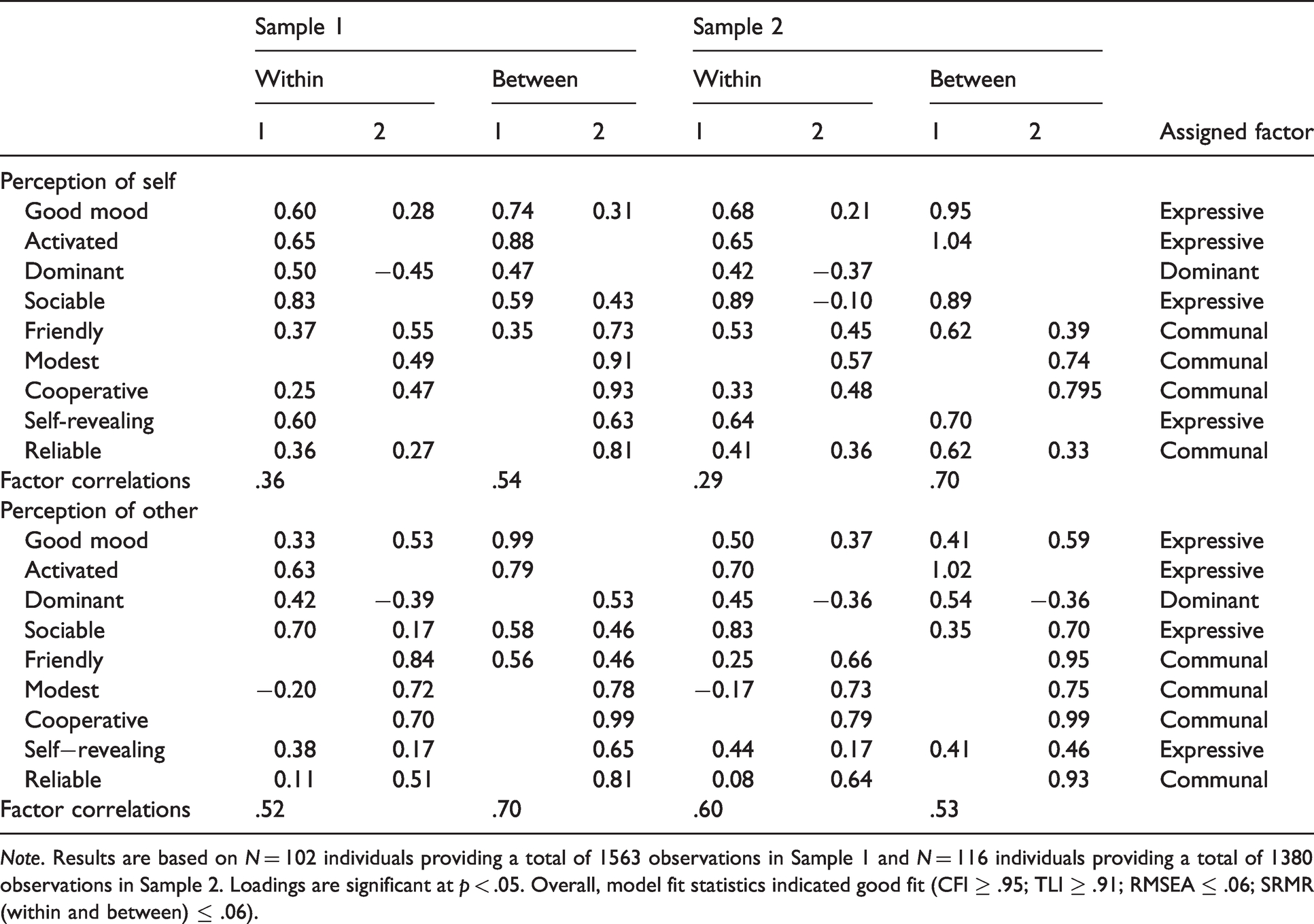
Note. Results are based on N = 102 individuals providing a total of 1563 observations in Sample 1 and N = 116 individuals providing a total of 1380 observations in Sample 2. Loadings are significant at p < .05. Overall, model fit statistics indicated good fit (CFI
We used these results to form the following indices on the within- and between-person levels, applying to both perceptions of self and perceptions of other: expressive behavior (good mood, activated, sociable, self-revealing), communal behavior (friendly, modest, cooperative, reliable), and dominant behavior (one-item measure). Our indices were aligned with the two factors from the agency and communion framework (Bakan, 1966; Leising & Bleidorn, 2011), reflecting a person’s motivation and capacity to “get ahead” or “get along,” respectively (Hogan, 1983). Specifically, expressive and dominant behaviors reflect two key aspects of agency, whereas communal behavior corresponds to communion. Moreover, expressive and communal behaviors largely resemble the indices that were conceptually derived and used by Geukes et al. (2017) for expressive and antagonistic (the opposite of agreeable) behaviors, but we included a wider range of behaviors in our indices. For the perception of self, internal consistencies for Sample 1 (Sample 2) as indicated by total omega ω were .82 (.84) for expressive behavior and .79 (.82) for communal behavior. For the perception of other, the corresponding consistencies were .78 (.82) and .83 (.86). In sum, our exploratory approach suggested that within- and between-person variance in adolescents’ perceptions of social interaction behavior could be represented by two related dimensions, expressive and communal behaviors, and a third dimension reflecting dominant behavior.
Hypothesis testing and exploratory analyses
We used the newly formed indices to set up a series of multilevel models to investigate the associations between our predictors (extraversion, agreeableness, neuroticism), mediators (perception of self, perception of other), and outcome variable (satisfaction with the social interaction). 6 To avoid problems with multicollinearity and to facilitate the interpretability of the models, separate models were specified for each personality trait (and facet) and for each index of the perceptions of self and other. To maintain parsimony in the following descriptions, however, we uniformly refer to the perceptions of self and other as perceived social interaction behavior.
To test the multilevel mediation in a 2-1-1 design, we followed Preacher et al.’s (2010, 2011) approach: the predictor personality trait was assessed between persons (Level 2), whereas the mediator momentary perceived behavior and the outcome momentary satisfaction were assessed across social interactions within individuals (Level 1; see Figure 1). As is common in the literature (e.g., Bolger & Laurenceau, 2013), we use a to label the predictor-to-mediator link, b to label the mediator-to-outcome link, c to label the predictor-to-outcome link (total effect), and c’ to label the predictor-to-outcome link after extracting the mediation effect (partial effect). Importantly, Preacher et al.’s (2010, 2011) approach accounts for the fact that the mediator can manifest within and between persons. Even though situation-specific perceived behavior was assessed as a Level 1 variable, each participant’s average perceived behavior could additionally be considered as a Level 2 variable. This decomposition of the mediator into a within and a between component leads to the estimation of two meditator-to-outcome links, bwithin and bbetween. Following Preacher et al.’s recommendations, we modeled both of these paths in our statistical analysis but only interpreted the bbetween path because the 2-1-1 design only allows for the calculation of indirect effects on the between-person level. Thus, in line with the current study’s focus on interindividual differences, the mediated effect of personality traits on satisfaction with the interaction through perceived social interaction behavior could be calculated from the product of the mediation paths a × bbetween. This indirect effect evaluates the extent to which between-person differences in personality traits are related to between-person differences in perceived behavior and the extent to which such between-person differences in perceived behavior, in turn, are related to the average level of satisfaction with social interactions.
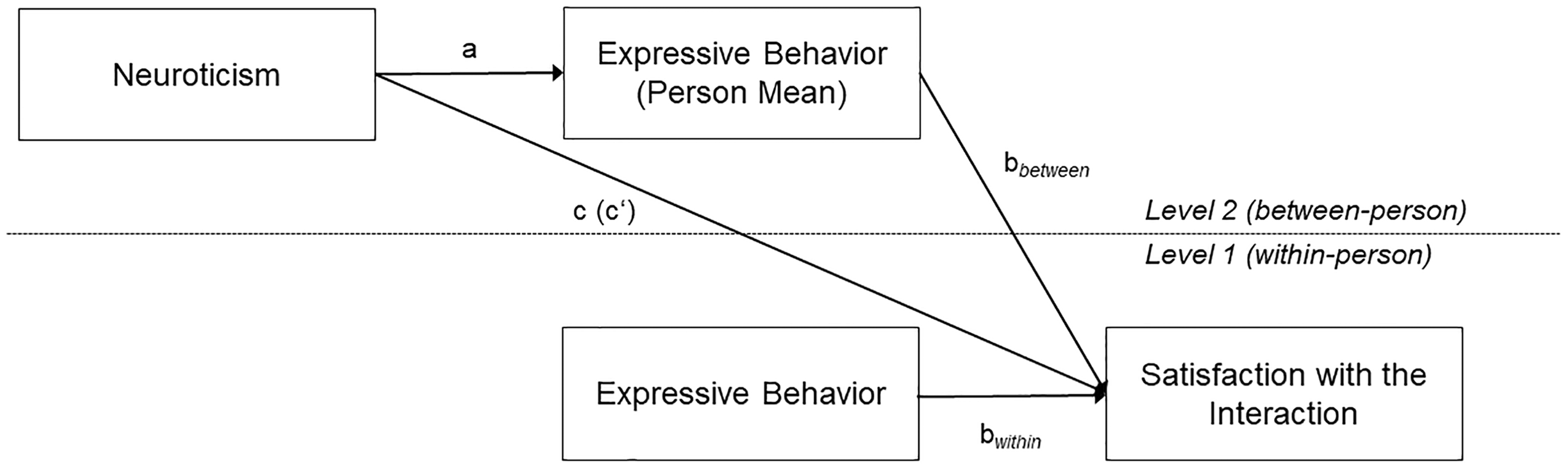
2-1-1 mediation model. Note. Illustration of the mediation model with the exemplary predictor neuroticism, exemplary mediator perceived expressive behavior, and outcome satisfaction with the social interaction in a 2-2-1 design (Preacher et al., 2010, 2011). The a path represents the link between predictor and mediator. The b path between the mediator and outcome can be separated into a within-person effect bwithin and a between-person effect bbetween. On the path between the predictor and outcome, c represents the total effect and c’ represents the partial effect after the mediation effect has been extracted.
In line with our preregistration, we carried out the mediation analyses in a stepwise manner for two reasons: First, given the novelty of microlevel investigations on explaining the mechanisms behind the interplay between personality traits and social satisfaction and the exploratory nature of our interaction behavior indices, we sought to understand the plain interrelatedness between variables. Second, given the large number of potential mediations, we aimed to restrict the number of mediation models. Thus, in the first step, we analyzed all mediation paths separately using multilevel regression modeling. In the second step, we conducted multilevel mediation analyses for the personality traits (or facets) and perceived social interaction behaviors that were significantly related to each other (a path in Figure 1) and to satisfaction with the interaction (bwithin, bbetween, and the c paths in Figure 1) in the preliminary analyses. For all multilevel models directly relevant to our two research questions, we additionally explored whether the effects remained robust when the control variables were included. The control variables on the within-person level were familiarity with the interaction partner, interaction partner’s gender, weekday versus weekend, and day of the experience sampling. On the between-person level, participant gender was the only control variable. In all analyses, continuous within-person predictors were centered at the participants’ individual mean, and continuous between-person predictors and all control variables were centered at their grand mean.
In the following, we first present the results from our main analyses that were performed to address our research questions. Then, we present results from exploratory analyses that included the control variables. For our main analyses, we report results for random effects (e.g., variation in random intercepts) and estimates for the variance explained by our multilevel regression models. Following the approach outlined by Snijders and Bosker (1994, 2011), we calculated Rw2 and Rb2 as the proportional reduction in mean squared prediction error for predicting values at the within-person level and the proportional reduction in mean squared prediction error for predicting values at the between-person level, respectively.
Results
Descriptive statistics and bivariate intercorrelations among the between- and within-person study variables can be found in Tables 2 and 3, respectively. On the within-person level, ratings of expressive behavior and communal behavior largely converged within and across the perceptions of self and other: Between these variables, the correlation coefficient r ranged from .55 to .70 in Sample 1 and from .53 to .76 in Sample 2 (all ps < .001). Thus, on average, adolescents perceived that they and their interaction partners behaved similarly, and perceived expressive behavior went along with communal behavior. By contrast, dominant behavior showed little association with the other types of perceived behaviors, and the corresponding perceptions of self and other were negatively related (Sample 1: r = −.20, p < .001; Sample 2: r = −.30, p < .001). For further details, Supplementary Table B1 provides descriptive statistics and bivariate intercorrelations for the single items measuring the perceptions of self and other.
Descriptive statistics, internal consistencies of the BFI-2 scales, and intercorrelations among continuous study variables: between-person associations.
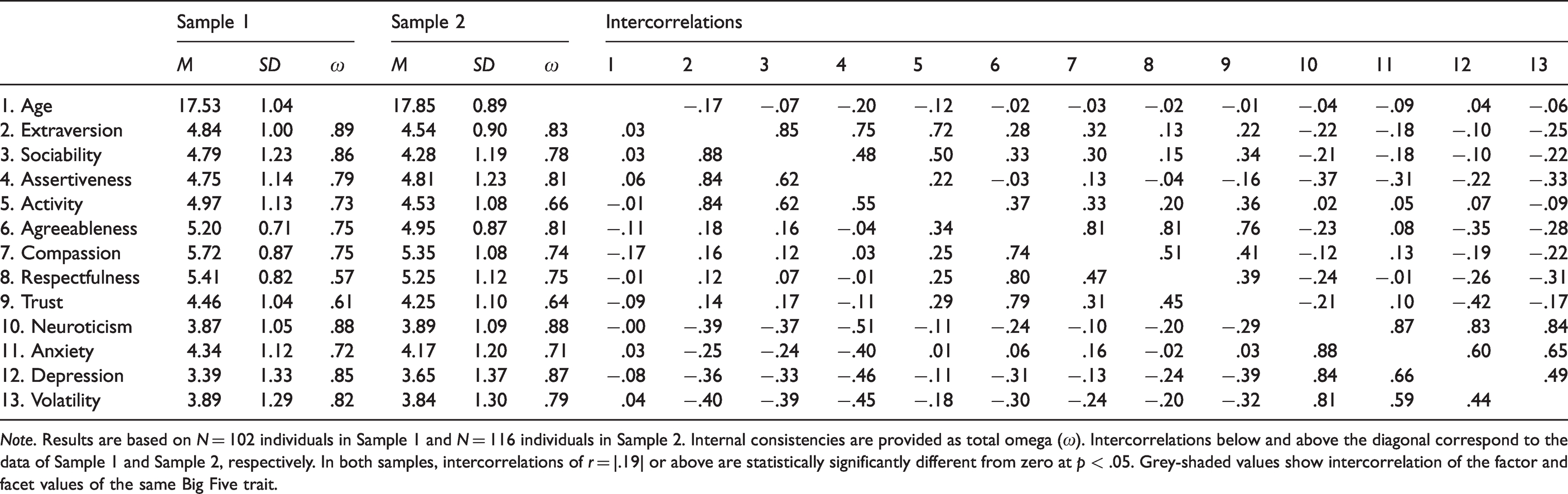
Note. Results are based on N = 102 individuals in Sample 1 and N = 116 individuals in Sample 2. Internal consistencies are provided as total omega (ω). Intercorrelations below and above the diagonal correspond to the data of Sample 1 and Sample 2, respectively. In both samples, intercorrelations of r = |.19| or above are statistically significantly different from zero at p < .05. Grey-shaded values show intercorrelation of the factor and facet values of the same Big Five trait.
Intercorrelations among continuous study variables: within-person associations.
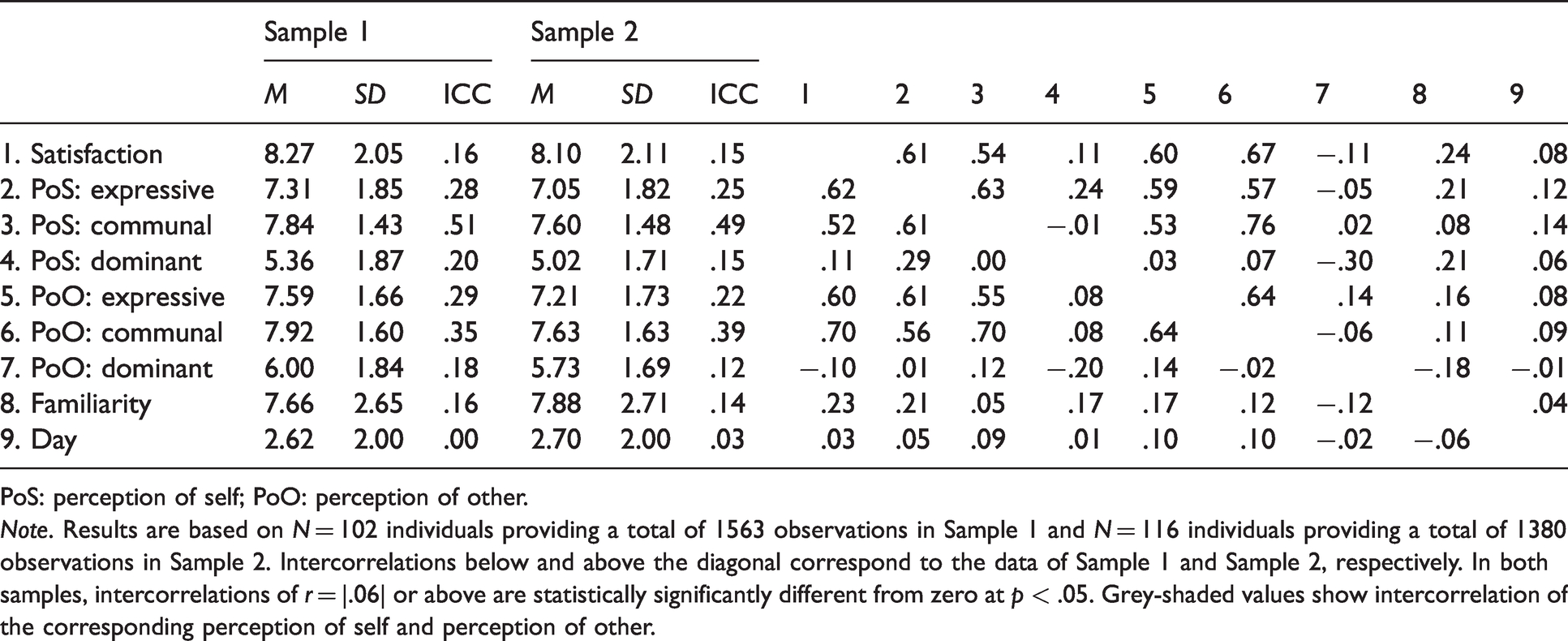
PoS: perception of self; PoO: perception of other.
Note. Results are based on N = 102 individuals providing a total of 1563 observations in Sample 1 and N = 116 individuals providing a total of 1380 observations in Sample 2. Intercorrelations below and above the diagonal correspond to the data of Sample 1 and Sample 2, respectively. In both samples, intercorrelations of r = |.06| or above are statistically significantly different from zero at p < .05. Grey-shaded values show intercorrelation of the corresponding perception of self and perception of other.
Before the confirmatory analyses, we estimated a multilevel null model of satisfaction with the social interaction to assess the proportion of variability located within and between persons. As indicated by the intraclass correlation coefficient (ICC) values, 16% (15%) of the variance in satisfaction with the social interaction was on the between-person level in Sample 1 (Sample 2). This illustrates that most variance was at the within-person level, that is, satisfaction with social interactions showed more variability across social interactions within one person than between persons. The ICCs of the other variables measured at the within-person level can be found in Table 3. Similar to momentary social satisfaction, the variance of perceived interaction behaviors was based primarily on variability across social interactions within one person. As an exception, the variance of self-perceived communal behavior was equally distributed across the within- and between-person levels, as indicated by an ICC of .51 (.49) in Sample 1 (Sample 2). Thus, compared with the other-perceptions, communal behavior in the perception of self was driven more strongly by a general tendency of the participant than by characteristics of the specific social interaction.
The association between personality traits and satisfaction with the social interaction
Our first research question addressed the total effect in our mediation model (c path): Are between-person differences in personality traits related to average levels of momentary satisfaction in social interactions? In line with research on relationship outcomes on the macrolevel and on momentary happiness in adult participants, extraversion and agreeableness were positively related and neuroticism was negatively related to momentary satisfaction with the social interaction (see Table 4). Despite the consistent trait effects, the facet-level analyses further revealed substantial associations between personality traits and social satisfaction: On average, adolescents showing higher levels of activity (extraversion) and compassion (agreeableness) and lower levels of depression (neuroticism) had more satisfying social interactions. For these traits, the estimated amount of explained between-person variance as indicated by Rb2 in Sample 1 (Sample 2) ranged from .07 (.06) to .21 (.10), with the highest values for the models predicting momentary satisfaction from agreeableness and compassion. By contrast, being sociable and assertive, respectful and trusting, as well as anxious and volatile were not related to satisfaction with the social interaction in a consistent manner.
Fixed effects of personality on satisfaction with the social interaction.
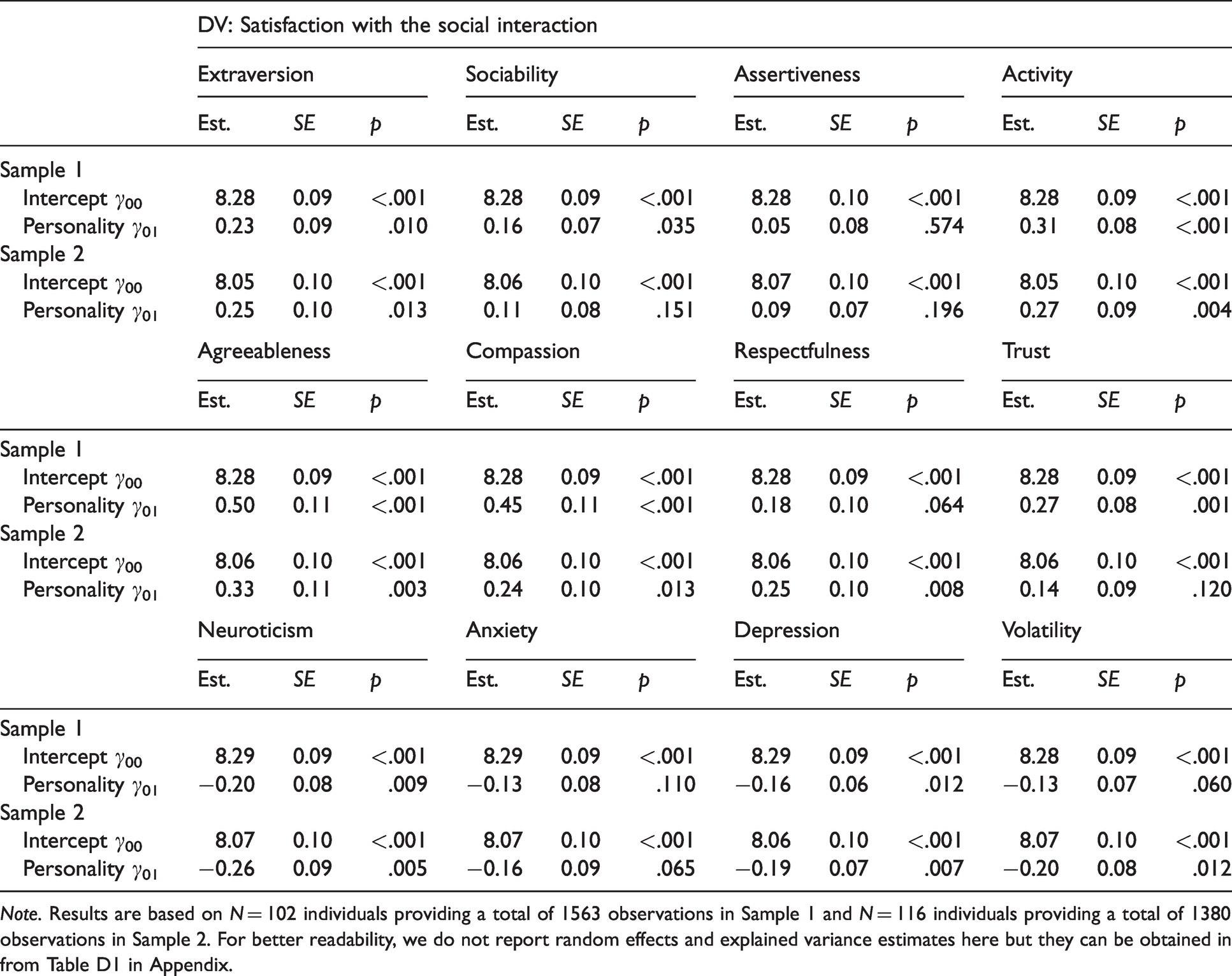
Note. Results are based on N = 102 individuals providing a total of 1563 observations in Sample 1 and N = 116 individuals providing a total of 1380 observations in Sample 2. For better readability, we do not report random effects and explained variance estimates here but they can be obtained in from Table D1 in Appendix.
When we reran the multilevel regression models with the control variables included (see Supplementary Table E1), we found a positive effect of familiarity with the interaction partner in all models and both samples: In line with previous research on momentary affect in adults, adolescents indicated higher levels of satisfaction when interacting with somebody more familiar. The remaining control variables, participant’s gender, interaction partner’s gender, day of the experience sampling, and weekday versus weekend had no consistent effect on momentary satisfaction with the social interaction. Overall, the results on the associations between personality traits and social satisfaction remained unaffected after entering the control variables.
The mediating role of perceived social interaction behavior
Our second research question addressed the indirect effect in our mediation model (a × bbetween paths) and tested whether between-person differences in personality traits are related to average levels of momentary satisfaction in social interactions mediated by perceived social interaction behavior. Results for Research Question 1 illustrated that all three personality factors and one facet per factor were each related to adolescents’ momentary satisfaction with the interaction (c path). Accordingly, before conducting the multilevel mediation analyses, we examined potential mediators of the associations between personality traits and social satisfaction for extraversion and activity, agreeableness and compassion, as well as neuroticism and depression. To do so, we established the separate associations between our predictors (i.e., personality traits) and our mediators (i.e., perceptions of self and other; a path; Supplementary Tables C1 and C2), and the within- and between-person associations between our mediators (i.e., perceptions of self and other) and our outcome (i.e., satisfaction with the social interaction; bwithin and bbetween paths; Supplementary Table C3).
Results from the separate analyses illustrated that expressive and communal behaviors in the perceptions of self and other were related to both personality traits (facets) and social satisfaction and therefore qualified as potential mediators. Specifically, expressive and communal behaviors were related to extraversion (activity) and agreeableness (compassion), whereas only expressive behavior was related to neuroticism (depression). By contrast, dominant behavior was not consistently linked to any of the personality traits or facets with respect to perception of self or perception of other. Furthermore, it showed no association with momentary satisfaction with the interaction on the between-person level. Given our selection criteria, dominant behavior did not emerge as a potential mediator of the interplay between personality traits and social satisfaction. 7 We address this null finding in Discussion section. Given these preliminary analyses, we tested a total of 20 mediation models in both samples.
Results from the multilevel mediation models for Samples 1 and 2 are summarized in Tables 5 and 6, respectively. Before going into detail, we would like to highlight two overall findings: First, c’ paths yielded nonsignificant p values in all but three models, suggesting that the indirect effects of the perceptions of self and other accounted for most of the association between personality traits and satisfaction with the social interaction. Given that our sample was too small to detect such small effects, however, we cannot determine whether this were full or partial mediations. Second, contrary to our hypotheses, the perceptions of self and other continuously appeared as mediators in a completely parallel manner between personality traits and satisfaction with the social interaction. That is, there were no distinct effects between social interaction behaviors corresponding to the perceptions of self and other.
Multilevel mediation models (2-1-1 design): Sample 1.
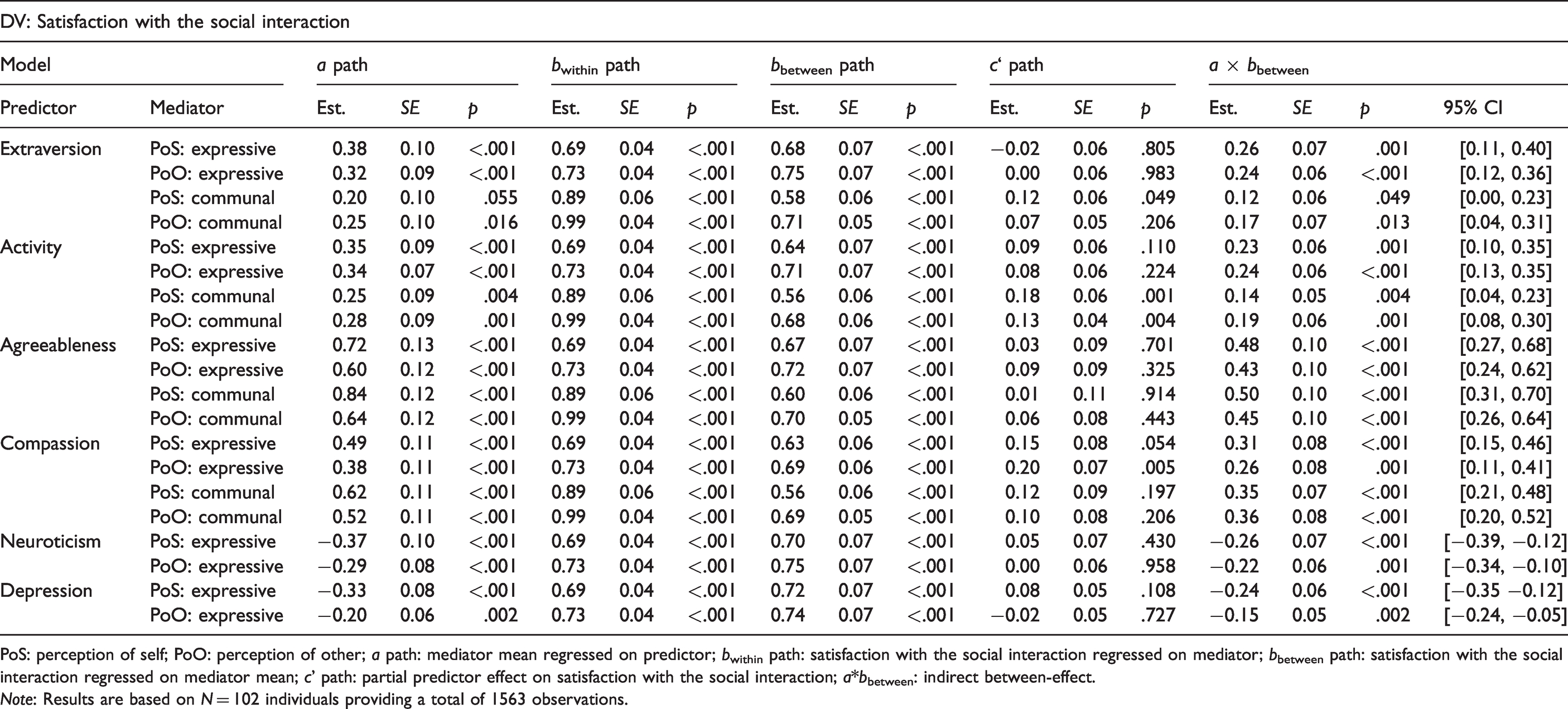
PoS: perception of self; PoO: perception of other; a path: mediator mean regressed on predictor; bwithin path: satisfaction with the social interaction regressed on mediator; bbetween path: satisfaction with the social interaction regressed on mediator mean; c’ path: partial predictor effect on satisfaction with the social interaction; a*bbetween: indirect between-effect.
Note: Results are based on N = 102 individuals providing a total of 1563 observations.
Multilevel mediation models (2-1-1 design): Sample 2.
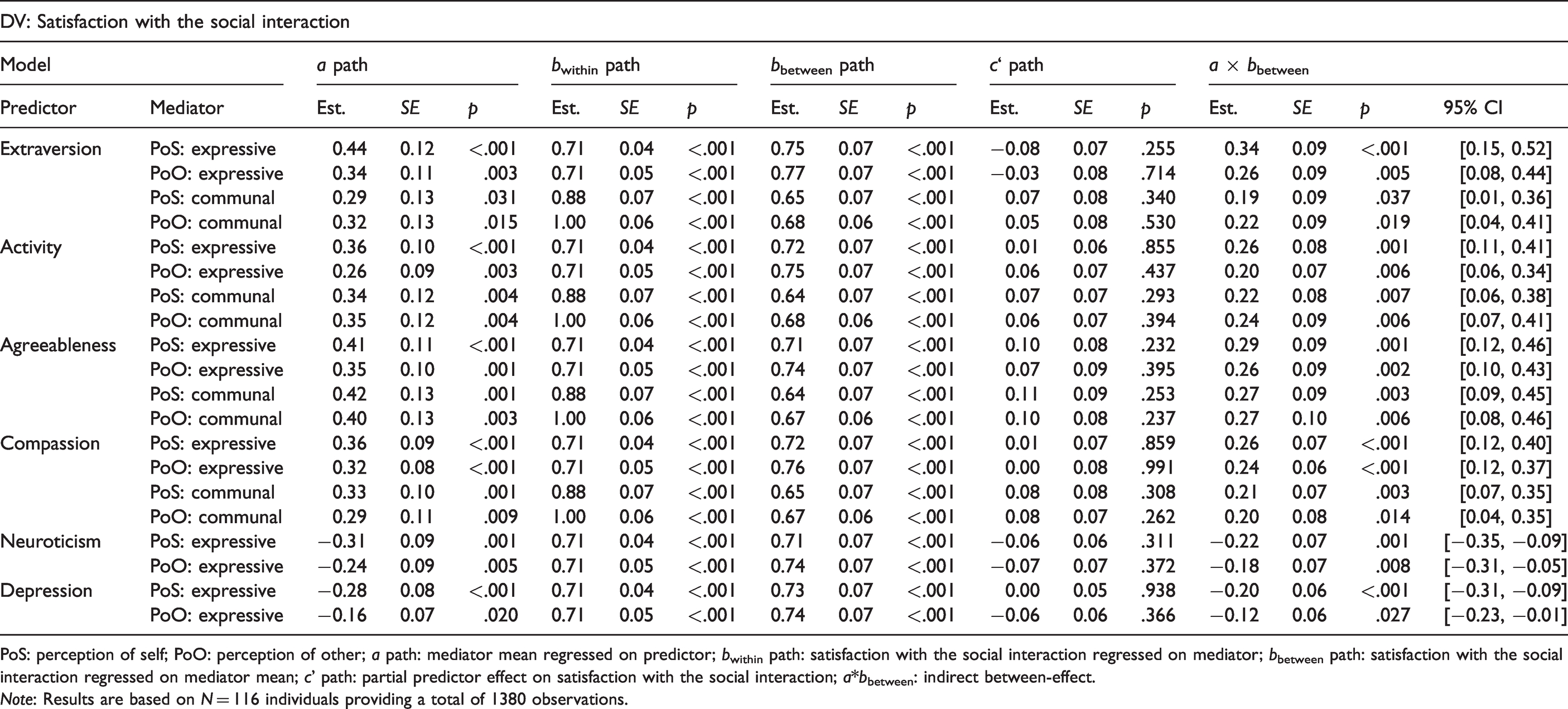
PoS: perception of self; PoO: perception of other; a path: mediator mean regressed on predictor; bwithin path: satisfaction with the social interaction regressed on mediator; bbetween path: satisfaction with the social interaction regressed on mediator mean; c’ path: partial predictor effect on satisfaction with the social interaction; a*bbetween: indirect between-effect.
Note: Results are based on N = 116 individuals providing a total of 1380 observations.
Looking into the specific effects with respect to extraversion, the link between the trait (as well as its facet, activity) and momentary satisfaction with the social interaction was mediated by perceptions of expressive and communal behaviors from both the self and other perspectives. Accordingly, adolescents higher on extraversion (and especially activity) reported higher satisfaction with their daily social interactions in the light of perceiving themselves and their interaction partner as behaving on average both more expressively and more communally. Similar to extraversion, the link between trait agreeableness (as well as its facet, compassion) and momentary satisfaction with the social interaction was mediated by perceptions of expressive and communal behaviors from both the self and other perspectives. That is, adolescents higher on agreeableness (and especially compassion) reported higher satisfaction with their daily social interactions in the light of perceiving themselves and their interaction partner as behaving on average both more expressively and more communally. Finally, the link between neuroticism (as well as its facet, depression) and satisfaction with the social interaction was mediated by perceptions of expressive behavior. Thus, adolescents higher on neuroticism (and especially depression) reported lower satisfaction with their daily social interactions in the light of perceiving themselves and their interaction partner as behaving less expressively on average.
We reran the multilevel mediation models with the control variables included. Results for Samples 1 and 2 are presented in Appendix (Supplementary Tables E2 and E3, respectively). All indirect effects remained unaffected by the presence of the control variables. Apart from the familiarity effect reported above, participant gender, interaction partner’s gender, weekend, and day of the ESM did not have consistent effects on momentary satisfaction with the social interaction in these models.
Given that participants self-rated both the interaction behaviors and their social satisfaction with some temporal delay, both ratings might have been biased by adolescents’ general tendency to feel positive and to recall events in a positive way. In a final step, we ran additional exploratory analyses controlling for the participant’s momentary happiness 8 and for the individual mean of momentary happiness in addition to the remaining control variables (see Supplementary materials). This additional analysis tested the robustness of our results when controlling for both momentary happiness when rating the interaction and for adolescents’ general tendency to feel happy across the ESM. Whereas both happiness variables were positive predictors of momentary satisfaction with the social interaction in most mediation models, all previously reported indirect effects of personality traits on momentary social satisfaction through perceived interaction behavior remained significant. Compared to the main analyses, effect sizes were slightly reduced when taking all control variables including happiness into account: In Sample 1, the average b-coefficient for the indirect effects changed from MIND = 0.28 to MIND = 0.23. In Sample 2, the average b-coefficient for the indirect effects changed from MIND = 0.23 to MIND = 0.19. In sum, the mediation models pointed to the explanatory function of the expressive and communal behaviors that adolescents perceived in the association between personality traits and social satisfaction on average. Contrary to our expectations, however, the perceptions of self and other did not function as differentially relevant mediators across traits.
Discussion
Using experience sampling data from two samples of more than 200 late adolescents in total, the current study investigated two research questions: First, how are extraversion, agreeableness, and neuroticism related to momentary social satisfaction in late adolescents? Second, which perceived social interaction behaviors mediate this link? Providing new insights into the real-life associations between personality traits and the social relationships of adolescents from a microlevel perspective, we highlight four main findings: First, we identified three indices of expressive, communal, and dominant behavior in the reflection of interpersonal perceptions and subsequently used them to test our mediation hypotheses. Second and along the lines of previous studies on associations between personality traits and social satisfaction, we found that extraversion and agreeableness had positive associations and neuroticism had negative associations with average levels of momentary social satisfaction. Third, multilevel mediation models revealed that interpersonal perceptions of expressive and communal behaviors mediated the associations between personality traits and social satisfaction. Finally, contrary to our expectations, we were unable to support distinct effects of social interaction behavior in its correspondence with perceptions of self and other. Next, we discuss our findings in detail and provide an outlook for future research.
Associations between personality traits and momentary social satisfaction in late adolescence
Regarding the associations between personality traits and momentary satisfaction with the social interaction, results were in line with previous research on broader relationship outcomes (Asendorpf & Wilpers, 1998; Parker et al., 2012; Wilson et al., 2015) and on momentary happiness (Mueller et al., 2019; Sun et al., 2017; Wilt et al., 2012). Our findings extend existing research on the personality–relationship interplay to late adolescence and further highlight the importance of certain personality facets: Specifically, whether adolescents were more or less active, compassionate, and depressed appeared to be especially relevant for their social interactions. Only these respective facets of extraversion, agreeableness, and neuroticism emerged as consistent predictors of momentary social satisfaction across our two samples, whereas the roles of the remaining facets were less clear.
Given that this is the first microlevel study on personality traits and social relationships to include facet-level analyses and that previous macrolevel research used different facet measures, it is rather difficult to compare our results with previous findings. In two longitudinal studies (Deventer et al., 2019; Mund & Neyer, 2014), negative affect, a construct resembling the neuroticism facet of depression, was related to negative relationship outcomes as it was also the case in our study. Furthermore, the two macrolevel longitudinal studies found that sociability was a predictor of positive relationship outcomes in friendships, whereas we found no consistent associations between sociability and momentary satisfaction with the social interaction. These macro- and our microlevel analyses emphasize that facets are pivotal for better understanding personality–relationship associations. At the same time, diverging findings across studies highlight that different measures across studies might complicate integrative discussions. Overall, it should be noted that this is the first study to explore how personality facets are related to satisfaction with social interactions and that some facets (e.g., agreeableness’ respectfulness or neuroticism’s volatility) emerged as predictors in only one of our two adolescent samples. Therefore, we emphasize that whereas activity, compassion, and depression seem important for social interactions, other personality facets might be relevant too, and the facet-specific findings need to be replicated in future research.
Our findings have implications for dynamic interactional theories (Back et al., 2011; Thibaut & Kelley, 1978). Given that we were able to replicate macrolevel associations between personality traits and broader relationship outcomes (e.g., Harris & Vazire, 2016) on the microlevel for social interactions, our findings suggest that the links of extraversion, agreeableness, and neuroticism with interindividual differences in satisfaction with social interactions might ultimately accumulate into long-term relationship satisfaction. In addition, we set out to shed light on the processes that might explain this interplay on the level of social interactions. Accordingly, we discuss the role of perceived social interaction behavior next.
Expressive, communal, and dominant social interaction behavior
With this study, we aimed to gain a better understanding of the perceptions of social interaction behavior that could explain the associations between personality traits and social satisfaction. We used late adolescents’ ratings of their own and their interaction partner’s behavior to identify three indices that (a) reflect interpersonal perceptions that vary within and between persons and (b) apply to the perception of self and other: expressive, communal, and dominant behaviors. The first two behaviors, expressive and communal behaviors, each summarize a range of interaction behaviors that largely map onto dimensions of interpersonal behavior that have been identified in previous research with adult samples (Geukes et al., 2017; Leising & Bleidorn, 2011) and that are aligned with the two factors from the agency and communion framework (Bakan, 1966; Wiggins, 1991). In line with interpersonal theory and previous research on interpersonal behavior (e.g., Fournier et al., 2008), adolescents’ perceptions of self and other were positively related to each other with regard to communal behavior (i.e., interpersonal correspondence), and negatively related to each other with regard to dominant behavior (i.e., interpersonal complementarity). Going beyond previous findings, we additionally illustrated that perceptions of self and other with regard to expressive behavior were also characterized by interpersonal correspondence.
Looking at trait-specific associations of perceived social interaction behaviors, extraversion and agreeableness were, on average, positively related to both expressive and communal behaviors in perceptions of self and other, whereas neuroticism was only negatively related to the average perception of expressive behavior. Contrary to findings from an ESM study reporting that individuals higher on neuroticism perceived more warmth in their interaction partners (Hannuschke et al., 2020), our results did not indicate that individuals higher on neuroticism perceived more warmth in their interaction partners. This inconsistency might derive from differences in the sample (adolescents vs. psychology undergraduates), the personality trait measure (BFI-2 vs. BFI-S), or the type of social interaction partner (diverse interaction partners vs. only psychology undergraduates) in our and Hannuschke et al.’s study, respectively. Next to their links with personality traits, perceptions of expressive and communal behaviors were also positively related to momentary satisfaction with the social interaction on the within- and between-person levels, underscoring both their situational and differential relevance. These findings are in line with studies reporting positive relationships between an individual’s own extraverted (e.g., Jacques-Hamilton et al., 2019; Margolis & Lyubomirsky, 2019) as well as agreeable behavior (Kritzler et al., 2020) with momentary positive affect. At the same time, they point to the relevance of a broader range of social interaction behaviors (i.e., expressive and communal behaviors) in the context of momentary social satisfaction and to the relevance of perceptions of both interaction partners’ behavior.
When looking at perceptions of dominant behavior, a number of deviations from the pattern found with regard to perceptions of expressive and communal behaviors became evident. First, dominant behavior stood out as mostly unrelated to the other interpersonal behaviors. Second and in line with meta-analytic findings by Gerpott et al. (2018), hardly any personality trait or facet was consistently associated with perceptions of dominant behavior across the two samples. Third, dominant behavior was not related to satisfaction with the interaction at the between-person level for perceptions of self or other. Given this lack of differential effects, perceptions of dominant behavior appear to play only a minor role in mediating associations between personality traits and social satisfaction. By contrast, within-person dominant behavior in the perception of self was positively related to momentary satisfaction, whereas within-person dominant behavior in the perception of other was negatively related to momentary satisfaction. It appears that adolescents evaluate their social interactions more positively when they perceive themselves as acting more dominant and others as acting less dominant than usual in a specific daily interaction. These contrasting perceptions of self and other might illustrate that adolescents who perceived themselves as more dominant and their interaction partner as acting less dominant in a social interaction felt that they themselves must have a higher agentic reputation (Rau et al., 2019). This, in turn, might be related to higher momentary social satisfaction. Alternatively, our finding might simply reflect that, when acting more dominant than usual, adolescents were also more successful in getting their way and therefore felt more satisfied.
Perceived social interaction behaviors mediate associations between personality traits and momentary social satisfaction
In line with our hypotheses and the theoretical notions of the PERSOC model (Back et al., 2011), the links between personality traits and social satisfaction were mediated by perceived momentary social interaction behavior. Given the different conceptual relevance of extraversion, agreeableness, and neuroticism for emotional-cognitive processes and social behavior in adulthood (McCrae & Costa, 1989; Wiggins, 1991), we had hypothesized that perceptions of self and other would serve as differentially relevant mediators of the interplay between personality traits and social satisfaction. Despite these strong theoretical indications, we found that late adolescents’ self- and other-perceptions of expressive or communal behaviors did not only occur in terms of interpersonal correspondence (see Fournier et al., 2008), but also mediated the associations between personality traits and social satisfaction in a parallel manner. More specifically, extraversion and agreeableness’ positive links with satisfaction were mediated by perceptions of more expressive and communal behaviors, whereas only perceptions of less expressive behavior accounted for the link between neuroticism and social satisfaction. Thus, although our results pointed to different mediators across traits, we did not find support for our hypothesis that the perceptions of self and other would play different roles.
How can this lack of differentiable findings for the perceptions of self and other be explained? First, our participants may have been unable to distinguish between these two types of perception. Given the relatively young age of our participants, results might indicate ongoing developmental processes (Blakemore, 2012; Suleiman & Dahl, 2019), including the establishment of interpersonal abilities. Alternatively, trouble distinguishing between one’s own and one’s interaction partner’s behavior might be independent of age. In an experience sampling study by Sun and Vazire (2019), university students showed relatively little self-insight into their own agreeable behavior, pointing to perceptual limitations even in adulthood. Such limitations might also explain why the perceptions of self and other with regard to communal behavior, which is similar to agreeable behavior, were so closely interrelated in our study. Second, it could be argued that it is not the perceptions of self or other nor is it the specific perception of expressive or communal behavior, but rather, it may be a common factor of perceived positivity (e.g., Rau et al., 2020; Rauthmann et al., 2015) that accounts for the association between personality traits and social satisfaction. However, our additional analyses revealed that our findings remained robust when controlling for adolescents’ happiness during the experience sampling, making this explanation less plausible. Finally, the relatively high intercorrelations between self- and other-perceptions might have disguised distinct effects: Given this strong statistical overlap, which was most pronounced with regard to communal behavior, parallel findings for the two types of perception come as no surprise. We decided to run separate analyses for each personality trait and each index of perceived behavior to facilitate interpretations of the indirect effects and to avoid multicollinearity. On the basis of this analytical strategy, however, we were not in a position to extract the unique effects of each of our mediators in the interplay between personality traits and social satisfaction by controlling for the remaining perceptions of self and other. Because this is the first study to test the potential mediating effects of interaction behaviors, we suggest that readers accept these findings as an initial indication that requires further research and replication.
In sum, while acknowledging the potential impact of our design and analytical decisions, the current study indicates that expressive and communal social interaction behaviors in the perceptions of both self and other might be relevant for explaining the interplay between personality traits and social satisfaction.
Limitations and future directions
Our study has multiple strengths, including the use of experience sampling data to provide insights into the daily lives of late adolescents, the use of empirically derived indices of perceived interaction behaviors, the differentiation across personality facets and between perceptions of self and other, as well as the availability of two samples to test the robustness of our effects. Nonetheless, a number of limitations should be considered.
Beginning with limitations regarding our design, this study aimed to investigate interindividual differences in the ways in which people perceive and enjoy social interactions. Whereas only self-reports can provide insights into subjective experience, their sole use might also bear some problems such as shared measurement variance (Podsakoff et al., 2003). Whereas we would like to emphasize that self-reports of perceptions of the self and satisfaction cannot be replaced and that our additional analyses provided no support for the idea that a general positivity bias could explain the associations, future research could use other-reports of personality traits.
Second, although our design offers insights into real-life social interactions, the correlational nature of our data does not allow for causal conclusions with regard to the complete mediation: Whereas the required temporal ordering exists for the associations between personality traits and perceived behaviors, this was not as clearly the case for the associations between momentary perceived behaviors and social satisfaction, which were assessed in this order one after the other but during the same ESM assessment. Accordingly, although our mediation analyses were based on previous research and theoretical arguments, we are unable to determine whether interpersonal perceptions might, as reasoned in our paper, “influence” momentary satisfaction with the social interaction. Alternatively, it is possible that the opposite direction of effects or a bidirectional pattern is at work here.
Third, our sample was composed only of students in the highest track within the German school system and was thus not representative of late adolescents attending other school and educational tracks.
Finally, as a more general limitation, we could not confirm our theoretically derived hypothesis that the associations of extraversion, agreeableness, and neuroticism with momentary social satisfaction would be differentially mediated by the perception of self or the perception of other. Whereas we need to consider the possibility that no such distinct associations exist, future studies should implement different research designs using laboratory settings to be able to clearly differentiate or manipulate perceptions of self or other. This might enable researchers to test for their unique influence in combined models.
The present research could be further extended in several potential directions. First, future studies might want to examine other personality traits, such as the remaining Big Five traits of openness and conscientiousness (e.g., Danner et al., 2019), traits from the HEXACO model of personality (Lee & Ashton, 2004), or other traits relevant to social satisfaction, such as narcissism (Rentzsch et al., 2021). Similarly, future studies might investigate a broader range of personality facets: Whereas the BFI-2 facets measured in the current study balance differentiation and brevity (Soto & John, 2017), other personality trait questionnaires, such as the NEO-PI-R (Costa & McCrae, 1992), enable a more nuanced assessment of personality facets. In addition, it is important to note that this is the first study to examine personality facets in social interactions. Because some of our results were not consistent across the two samples and might look different in a nonadolescent sample, we would like to encourage researchers to continue analyzing facets in addition to personality traits.
Second, by using empirically formed indices, we took a first step toward a systematic assessment of perceived social interaction behaviors that might be relevant for explaining the interplay between personality traits and social interaction. In line with previous research (Geukes et al., 2017) and the agency and communion model (Bakan, 1966), perceptions of expressive and communal behaviors emerged as relevant dimensions. Given the lack of an established taxonomy and the wide range of social perceptions that might not have been measured in the current study, future studies should continue investigating the behavioral dimensions that people use to describe their social interactions and how these dimensions are related to social satisfaction. Moreover, research could explore whether these dimensions differ by age group.
Third, the use of only self-reports of social interactions did not allow us to differentiate between observable interaction behavior and individual construal (Rauthmann et al., 2015). In this study, this distinction did not matter because we were interested in the individual’s subjective daily social experience, which is most likely mixing both aspects (see Furr & Funder, in press). Nonetheless, future studies might want to further disentangle how personality traits are related to momentary social satisfaction via actual interaction behavior as opposed to individual (biased) perceptions by comparing self- and other-reports of social interaction behavior.
Fourth, it is important to note that when looking at personality traits as we did in this study, only average between-person differences in perceived social interaction behavior and social satisfaction can be observed. At the same time, most of our momentary measures showed more variance within than between persons. That is, a person’s perceptions of behavior and satisfaction during a social interaction seem to depend on situational characteristics to an even stronger degree than on stable individual differences. In addition, a growing number of researchers have sought to adapt momentary measures of the Big Five (i.e., states; Fleeson, 2001; Rauthmann et al., 2019). In future studies, it would be interesting to examine how within-person differences in personality states are related to social satisfaction through perceived social interaction behaviors. For example, dominant behavior, which showed only within-person associations with satisfaction, might mediate effects of extraversion when measured as a state.
Conclusion
To our knowledge, no previous study has examined how personality traits are related to satisfaction with social interactions in late adolescence and whether perceived social interaction behaviors serve as mediators of this interplay. Given the extensive theoretical and empirical work on macrolevel associations between personality traits and social relationships, we made use of students’ experience-sampling reports of real-life social interactions to close this research gap. Our results suggest that personality traits are related to momentary social satisfaction in a manner that is fairly similar to how such traits are related to relationship satisfaction in long-term studies, with positive associations for extraversion and agreeableness and a negative association for neuroticism. Importantly, these associations were mediated by perceptions of expressive and communal interaction behaviors during the social interaction. Whereas our results provided no support for differences across traits regarding their associations with the perceptions of self and other, they pointed to the possibility of differences in associations with certain types of perceived behavior. Given that this is the first study of its kind on this topic, future research should replicate our findings, extend our knowledge to different age groups, and further explore the roles that diverse personality facets and interaction behaviors play in this dynamic interplay.
Footnotes
Data accessibility statement
All study materials are provided at the OSF page of the SELFIE study (https://osf.io/4gnz9/). The data and analysis scripts used for this article can be accessed at our OSF page ( ).
).
Declaration of conflicting interests
The author(s) declared no potential conflicts of interest with respect to the research, authorship, and/or publication of this article.
Funding
The author(s) received no financial support for the research, authorship, and/or publication of this article.